




Abstract
Dockless micromobility sharing systems have wrought significant visual changes to urban streetscapes worldwide. These changes are often described in terms of the ‘mess’ of micromobility, characterised by dockless vehicles abandoned in roadways, sidewalks, and recreational paths, tossed into waterways, and graffitied, burned, and otherwise vandalised. In this paper, we argue that efforts to govern this dockless micromobility mess – which most frequently comes in the form of parking regulations – effectively impose and enforce normative visual order on the cityscape. Based on an analysis of primary image data and publicly available documents, we identify that efforts at governing docklessness also have the effect of governing the aesthetics of urban space in three ways: through (1) visual-material interventions (e.g. parking corrals and mats, app interfaces); (2) linked strategies of visual verification (digital image capture and assessment) and computer vision (the use of AI and machine learning); and (3) visual erasure (e.g. impounds and bikeshare graveyards). We discuss the implications of the aesthetic effects of micromobility governance for docklessness itself and the utilisation of dockless micromobilities and potential impacts on transportation equity and sustainability, and most significantly, for the right to the city.
Introduction
Brightly coloured and nearly ubiquitous, shared bikes and e-scooters are now pervasively observable fixtures of cityscapes around the world (The Economist, 2017). The accelerated proliferation of micromobility sharing systems during and in the aftermath of COVID-19 is ‘one of the most visible changes’ demarcating a shift from the pre- to the post-pandemic city (Picard, 2023: n.p.). While bicycles have long been mainstays of the urban transportation landscape, over the last decade-plus, urban cycling infrastructure has been digitally disrupted by the advent of bicycle sharing platforms that allow members of the public to rent docked or dockless bicycles, including e-bikes, via a mobile app (Stehlin et al., 2020). While earlier platformised bikeshare systems were largely docked in nature, requiring bicycles to be retrieved from and returned to stations at fixed locations, dockless versions of micromobility systems – which include both e-bikes and e-scooters – now dominate (NACTO, 2022). Also referred to as ‘free-lock’, stationless, and ‘free-floating’ systems, dockless micromobilities are now found in more than 1250 cities across 66 countries (NUMO Alliance, 2024).
The worldwide rollout of urban dockless micromobility has been underwritten by claims that these systems deliver increased transportation affordability, sustainability, equity, and ‘attractive[ness]’ (Lyons, 2018: 4). This lattermost quality is associated with the bright pop art-esque colour schemes of the vehicle fleets; the centrality of these systems to city identity and branding on the global urban stage (Stehlin, 2019); and ‘viral social media image[ry]’ of micromobility sharing (Stehlin and Payne, 2023: 282). However, contrary to the purported ‘allure’ of docklessness (Bellan, 2023: n.p.), the romanticised serendipity of stumbling upon free-floating bikes and e-scooters has been pierced by logistical and also visual chaos unleashed upon cities as venture-capital backed dockless micromobility systems have flooded city streets with their vehicles, sometimes literally overnight (Fearnley, 2021). Frequently reported scenes of the visual disarray that has ensued include familiar tableaux of dockless bikes and e-scooters fly-tipped on their sides and strewn across the middle of roads, sidewalks, and paths; strung up in trees (Lu, 2020); thrown off bridges (Markovich, 2017); tossed into fountains, waterways, and canals (Glaser, 2018); and vandalised by being set on fire (Squires, 2023) and/or graffitied (McGurk, 2024). These chaotic scenes have been widely derided in the popular press, wherein abandoned, discarded, obstructing, and vandalised micromobility vehicles have variously been referred to as ‘litter’ (Schuler, 2023: n.p.), ‘clutter’ (Campbell, 2019: n.p.), ‘polluti[on]’ (Taylor, 2023: n.p.), and ‘refuse’ (Applin, 2018: n.p.). The idea that micromobility vehicles constitute clutter is at least partially connected to the fact that the vehicles themselves so easily become trash, either by breakdown or by vandalism (Fraser and Wilmott, 2020).
Despite public scorn for the ‘eyesore’ of micromobility (Lu, 2020: n.p.), cities’ regulatory responses to the rollout of dockless micromobilities have largely been aimed at the serious road and pedestrian safety issues that they pose, compounded by their being operated and subsequently abandoned in areas where they are not permitted. Cities most frequently address these concerns by regulating where and how free-floating e-scooters and bikes may be parked. These efforts at regulating micromobility stationment have the effect of materially organising urban space by imposing and enforcing normative visual order on the cityscape. Even where ostensibly aimed at abating the safety risks of docklessness, we identify that micromobility parking regulations simultaneously function as modes of aesthetic governance that both shape and are shaped by aesthetic decisions about which kinds of spatial arrangements of micromobilities are common-sensical, expected, and desirable within urban built environment. These sensibilities in turn underwrite the (re)shaping of urban landscapes to accommodate the introduction of dockless micromobilities and to sustain their continued presence within urban landscapes.
Drawing on a cross-section of evidence from key literatures, news and media coverage, reports, and primary data collected during fieldwork in cities in Canada, Poland, and Turkey, we identify three classes of visual-centric efforts at regulating micromobility stationment that also function as modes of aesthetic governance: (1) visual-material interventions; (2) visual verification and computer vision; and (3) visual erasure. Mobilisations of aesthetic governance have the effect of cordoning-off swathes of public city space for express use by micromobility vehicles and platform operators, creating sites where these presences become concentrated and thus hyper-visible, while simultaneously removing them from portions of the landscape where their presence is deemed undesirable. This raises questions about who – and what – has the right to urban landscapes seeded by dockless micromobilities, and about the role and capacity of dockless e-bikes and e-scooters to deliver equitable and sustainable urban mobility transitions.
Micromobilities and urban aesthetics
The widespread derision of ‘free-lock’ micromobilities arising from perceptions of their ‘anarchic parking’ (Halais, 2019: n.p.) points to widespread dissatisfaction with the aesthetic effects of docklessness. Two interconnected attributes of dockless micromobility help to explain such reactions to their presence in urban space. First, dockless micromobility is an innovative type of transportation, and its key affordance – docklessness – creates new visual features in cities. Second, micromobility holds an ambivalent status as a form of transportation, which plays out both functionally (in terms of where they are ridden and parked) and legally (in terms of how they can be regulated). Regulation is complicated for micromobilities because their use exists in a ‘legal grey zone’ (Halais, 2019: n.p.) between local and central government regulation, between commercial use and public space, and between active and motorised transportation modes (Fearnley, 2020). These attributes inform three key reasons why cities have been motivated to regulate dockless micromobility: (1) issues of health and public safety, with haphazardly parked vehicles constituting trip hazards (e.g., Sobrino et al., 2023) and obstacles for vision and/or mobility impaired individuals (e.g., Ma et al., 2021) (2) a perception that systemically ‘bad rider behavior’ is to blame for the visual chaos (Fonseca, 2019: n.p.), prompting cities to responsibilise operators with ensuring user compliance as a condition of their license to operate; and (3) a response to public irritation in the form of complaints about logistical and visual disorder, to which cities are tasked with responding (Klein et al., 2023).
While regulations governing micromobility usage diverge between jurisdictions, the presence of micromobility vehicles on the landscape is most commonly governed through parking restrictions (Klein et al., 2023), including where these vehicles cannot be parked (e.g. parts of public space that are high foot traffic areas), as well as proximity-based restrictions that prohibit parking near to street corners, fire hydrants or bus stops, or on vegetation or landscaping (Brown, 2021). Parking regulations also designate where and how shared scooters and bikes ought to/may be parked, which in some cities includes the ‘furniture zone’ between sidewalks and the roadway, and/or in demarcated parking zones, corrals, or repurposed car parking stalls. Compliance is managed through enforcement and fines aimed at both riders and operators, but incentive-based measures – which aim to ‘nudge’ riders towards ‘proper’ parking behaviours through financial and other rewards – are also common (Kjærup et al., 2021).
In governing where and how dockless micromobilities are to be stationed within the cityscape, parking regulations have the effect of also visually and materially (re)shaping the urban landscapes in which they are enacted. As such, we argue that parking regulations function as modes of aesthetic governance that visually order the cityscape by acting on the sensory field to ‘distribute sensibility’. By this, Rancière (2006) means that aesthetic power is exerted to shape sensory perceptions of some material arrangements as common-sensical to the exclusion of other, non-conforming arrangements which come to appear ‘out of place’ (Degen and Rose, 2024; Ghertner, 2015: 125). Certainly, the rollout of new material presences in cities – such as solar panels (Sánchez-Pantoja et al., 2018) and smart city data infrastructures (Caprotti, 2019) – has always entailed aesthetic changes which have required that public consensus be secured around the rationality of these additions to urban landscapes (Julier, 2005).
But aesthetic governance involves more than simply the manufacturing of collective sensibilities around whether or not certain materialities come to be accepted as rational features of the urban spatial fabric. As developed by Ghertner (2015: 7, 125), what he terms ‘aesthetic rule’ also describes the subsequent mobilisation of consensus around acceptedly common-sensical aesthetic arrangements – i.e. ‘expectations for how [city] space looks and how it should look’– as ‘codes of appearance’ for ‘organizing public space’ in the image of the ‘word-class city’. Aesthetically, the ‘world-class city’ is commensurate with ‘vistas … fit for the planning reports, promotional websites,’ and social media posts (Aiello, 2021: 137) that cities increasingly depend on to ‘sell themselves’ for attracting ‘inward investment, … tourists, …spending, [and] residents’ (Degen and Rose, 2022: 4). Visual referents of the world class aesthetic include signature ‘architectural forms (e.g. new-build cube-style [buildings] and preserved historical exteriors)’; building materials including gleaming glass, metal, and smooth stucco; and design details that signal urban authenticity (e.g. exposed brick, rusted metal) (Aiello, 2021; Leszczynski and Kong, 2023: 777).
These aesthetic referents of ‘world-classness’ dominate within highly sanitised, orderly pedestrian-centred enclaves seeded with particular kinds of places (independent cafés, luxury retailers, market squares) and specific types of objects – including shared bikes and e-scooters – that mark these landscapes as innovative, sustainable, and future-oriented (Aiello, 2021; Degen and Rose, 2022; Leszczynski and Kong, 2023). Indeed, one of the ways in which second-tier cities such as Windsor, Canada (Raynar, 2022) and Pittsburgh, Pennsylvania (Langerholc, 2021) look to fashion themselves in the image of the world-class city is by adopting micromobility sharing systems precisely for the reason that they are markers of status in global urban hierarchies (Stehlin, 2019). But this aesthetic association between world-classness and micromobilities likewise prevails in archetypal global cities. For example, even though Paris banned shared e-scooters from its streets effective September 2023 (Chrisafis, 2023), it had previously been hesitant to do so for fear of ‘appear[ing] anti-innovation or anti-novelty’ as an already-established world-class city (Cateir, quoted in Halais, 2019: n.p.).
In Ghertner’s (2015) work, a world-class aesthetic is invoked to justify the mass clearance of informal housing in Delhi, India, to make way for a luxury shopping development. Presented as serving the shared goal of elevating Delhi’s status in global urban hierarchies, this violent redevelopment of space is accepted as common-sensical even by those whose dwellings are slated for clearance. This is significantly different, in terms of human stakes, from a situation in which cities look to achieve and/or solidify their ‘world-classness’ by adopting micromobility systems. But Ghertner’s notion of the world-class aesthetic as a mode of urban governance does help to render visible a key contradiction at the heart of cities’ pursuit and embrace of shared micromobility systems, which are now predominantly dockless: as cities adopt and retain micromobility sharing as a means of realising their aspirations for and maintaining an appearance of world-classness, the introduction of docklessness interrupts and undermines these efforts by visually degrading their landscapes, requiring cities to intervene and restore a normative aesthetic order that caters to globalist appetites for idealised spatial tableaux comprised of ‘upright identical bikes’ and scooters ‘aligned in neat rows, docked correctly at stations, or placed unobtrusively on [the edges of] sidewalks’ (Leszczynski and Elwood, 2022: 367). The world-class aesthetic, then, informs both the addition of micromobilities to the cityscape and also the (re)organisation of urban landscapes to accommodate these new presences.
It is in this way that we argue that parking-centric regulations have the effect of functioning as exercises of urban aesthetic governance: they work to conform the on-the-ground observed ‘micromobility mess’ to a normative ideal of a ‘world-class’ micromobility landscape in which free-lock vehicles are visually ordered and contained on city streets. So, how do cities govern dockless micromobilities aesthetically through regulations targeting parking and stationment? We answer this question by inductively drawing on a range of data sources, which we identify below.
Methodology
This intervention is part of a comparative urbanism project investigating the aesthetics of urban platforms across a selection of cities that have been pervasively platformised, yet understudied as sites of platform urbanism: Gdańsk, Kraków, and Warsaw (Poland); Toronto, Vancouver, Brampton, and Vernon (Canada); and Istanbul (Turkey). This research employs a walking methodology predicated on embodied immersion in and visual sensory engagement with the urban environment. Data collection consisted of digital photography of street scenes centred on what Leszczynski and Kong (2022: 9) call ‘platformized urban presences’: physical objects that ‘visually cue the opportunity to access, secure, or consume goods, services, [and/]or amenities’ via a digital app. The platformised objects most frequently encountered throughout our 15-month period of data collection (May 2023 to July 2024) were micromobility vehicles, which we observed and photographed in various configurations inclusive of both docked and dockless bikes and e-scooters. We subjected this image data to inductive content analysis, coding them for details of the platform objects themselves (including shared bikes and scooters, as well as whether they were docked or dockless); additional physical elements including parking infrastructures (e.g. corrals, stations, etc.); and for the visual orderliness of urban micromobility arrangements (e.g. stationed within a corral or obstructing a sidewalk). We found that in our study sites, dockless micromobilities dominated outside of the two major Canadian cities (Toronto and Vancouver, which at the time of data collection in May and June 2023 both had only docked bikesharing systems in operation).
In addition to mediations of micromobility dis/organisation observed on the ground in our study cities, we identified further approaches to addressing the visual-logistical chaos unleashed by the rollout of these systems via an extensive review of three sets of materials: the scholarly urban micromobilities literature; press coverage of micromobilities and their urban effects; and reports and policy documents generated by city administrations and agencies (e.g. dockless pilot programme reports). Through analysis of these primary and secondary data sources, we identify three classes of efforts at regulating docklessness that also have the effect of governing the aesthetics of the urban landscapes in which they are deployed and operate: (1) visual-material interventions (e.g. parking corrals and mats, app interfaces); (2) linked strategies of visual verification (digital image capture and assessment) and computer vision (the use of AI and machine learning); and (3) visual erasure (e.g. impounds and bikeshare graveyards).
Aesthetically governing the micromobility mess
Visual-material interventions
Visual-material interventions comprise phenomena observable by the human eye. These include physical interventions within the urban built environment and those made to dockless vehicles themselves, as well as those enacted within micromobility platform app ecosystems. Within the urban built environment, these interventions consist of physical infrastructures constructed to (re)impose visual order on the organisational disarray that docklessness has wrought on city streets. The most frequently encountered of these are micromobility corrals – also referred to as bays and parks – that commonly take the form of painted markings designating a box or rectangle on the street surface, often with an e-scooter (Figure 1a) and/or bicycle icon stencilled inside the marked-off area to visually indicate its purpose. In addition to paint, cities have also used decals and bollards to visually carve-out micromobility corrals from the surrounding built environment and, as with painted markings, to visually direct riders to park dockless vehicles in spaces that physically and visually contain micromobility vehicles on the streetscape. In certain metro areas, these corrals are furthermore marked by street signs erected on posts that make them easily visually discernible both from a distance and amongst other features of the built environment. For instance, in Istanbul, we found that micromobility corrals were designated by a bicycle and scooter icon encased within a location pin-shaped sign atop a signpost, which renders the location of a nearby corral highly visible amongst dense road surface traffic and parked vehicles that otherwise obscure the corral sites from the view of the human eye at street level.
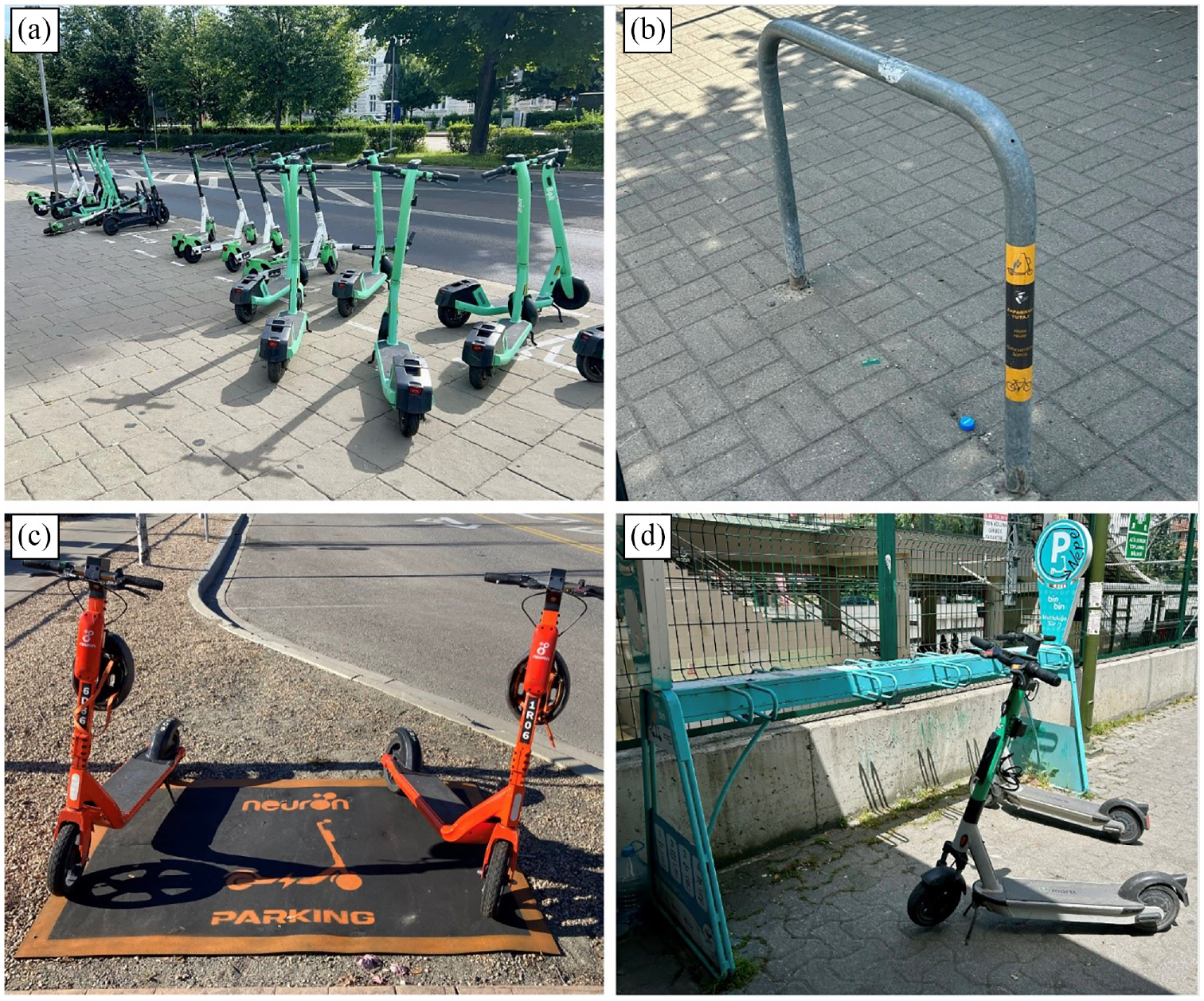
Visual-material interventions within the built environment: (a) an e-scooter corral in Gdańsk, Poland; (b) a staple-style frame with a sticker stating ‘PARK HERE’ written below an e-scooter icon; (c) Neuron e-scooter parking mat in Vernon, Canada; and (d) a BinBin e-scooter rack in Istanbul. Source: the Authors.
While corrals are the most prolific of these physical-material interventions, we profile three additional strategies here. The first is dockless parking zones, which are not visually bounded as with the box of a corral, but which are nevertheless likewise visually discernible as an area designated for micromobility stationment. In Warsaw, such zones are visually signalled by arrays of metal staple-style frames displaying e-scooter and bicycle icons alongside multi-lingual text stating ‘PARK HERE’ (Figure 1b). These materialities visually indicate the purpose of an area of curbspace 1 to be reserved for the placement of stationary dockless vehicles on the cityscape. We also encountered similar staple-frame filled micromobility parking zones in Istanbul. The second notable approach is parking mats featuring e-scooter icons (Figure 1c), which we observed in Coquitlam and Vernon, both in British Columbia, Canada. These represent a non-permanent and highly transferrable approach that allows cities to move designated dockless parking spots around the city without making any physical changes to the built environment itself.
A third infrastructure-centric visual strategy deployed by cities consists of docks for dockless shared vehicles. The best example of this are novel e-scooter stations. Much like bikeshare stations, they provide parking bays for these nominally dockless vehicles, and sometimes also support charging for these vehicles as well. In Istanbul, bright teal-coloured wire-frame e-scooter docks have been around for several years, since at least 2022 (Toprakkaya, 2022; Figure 1d). In the US, Lyft began phasing in bespoke e-scooter docks with charging capability and new fleets of compatible docking scooters in Chicago (as part of its dockless Divvy micromobility sharing system) and in Washington, DC in 2023 (Bellan, 2023). In Vancouver, a newly approved e-scooter programme will be North America’s first completely-docked system, which will ‘keep [the] streets and sidewalks tidy’ (Mayor Ken Sim, quoted in City of Vancouver, 2024: n.p.).
Whether in use or not, these different types of material interventions function as visual symbols of cities’ and operators’ commitments to a more regulated form of micromobility – and thereby to more orderly landscapes of docklessness. These interventions enact visual order by diverting dockless vehicles from spaces where their presence is perceived as visual clutter – as in the middle of a sidewalk, recreational path, or roadway – to sections of public space (corrals, zones, mats, e-scooter docks) where they are visually concentrated and where the ‘mess’ of docklessness is aesthetically contained. Many cities now deploy one or more of these strategies concurrently with the introduction of dockless micromobility programmes, as was observed in Coquitlam, Canada (part of the Metro Vancouver area), where freshly painted corrals filled with dockless shared e-bikes and e-scooters appeared simultaneously overnight when the programme launched in 2023. However, earlier in the era of dockless micromobility sharing, corrals were at times implemented as reactionary solutions to ‘concerns around improperly parked e-scooters’, as occurred in Calgary, Canada (City of Calgary, 2020: n.p.). Similarly, the Kadıköy municipality in Istanbul was chosen in 2022 as a pilot area for corrals in response to the negative consequences of irregular parking (Toprakkaya, 2022). By the time of our Istanbul fieldwork in 2024, corrals had yet to be implemented outside of Kadıköy; in other areas of the city, a different visual-material strategy was used, as discussed below.
Visual-material strategies are not limited to interventions within the urban environment, and may also be enacted to dockless vehicles themselves. The most prolific of these involves the inclusion (or addition) of locking cables to e-scooters, which visually cue the need for riders to tether their e-scooter to fixed objects within the built environment at the end of a ride, in accordance with what are known as ‘lock-to’ requirements. We observed this visual strategy at play in two of our fieldwork sites. In Istanbul, particularly in the Karaköy municipality and in other areas outside of Kadıköy (with its parking corrals), we found e-scooters locked to all manner of fixed elements within the built environment, from lamps and signposts to window grates, drain pipes, fences, and trees (Figure 2b-d). We also observed this in Brampton, a city within the larger Greater Toronto Area (GTA) that at the time of image capture (Summer 2023) was in the middle of an e-scooter pilot. Here we encountered e-scooters locked to bollards and signposts in the furniture zone (Figure 2a). These locking requirements impose visual order upon the otherwise messy landscapes of docklessness by physically anchoring dockless vehicles to other kinds of objects already visually and materially fixed in urban space. Where locked to trees, window grates, and lamp posts, lock-to requirements effectively remove dockless micromobilities from the centreline of vision in the middle of a road, towpath, or sidewalk, and visually graft them onto other materialities that are already often placed ‘off to the side’– such as lampposts and trees lining one edge of a sidewalk, and street-level window grates and drainpipes on the other. This effectively aesthetically declutters these environments, and clears the field of view of pedestrians, drivers, cyclists, and other human users of urban environments.
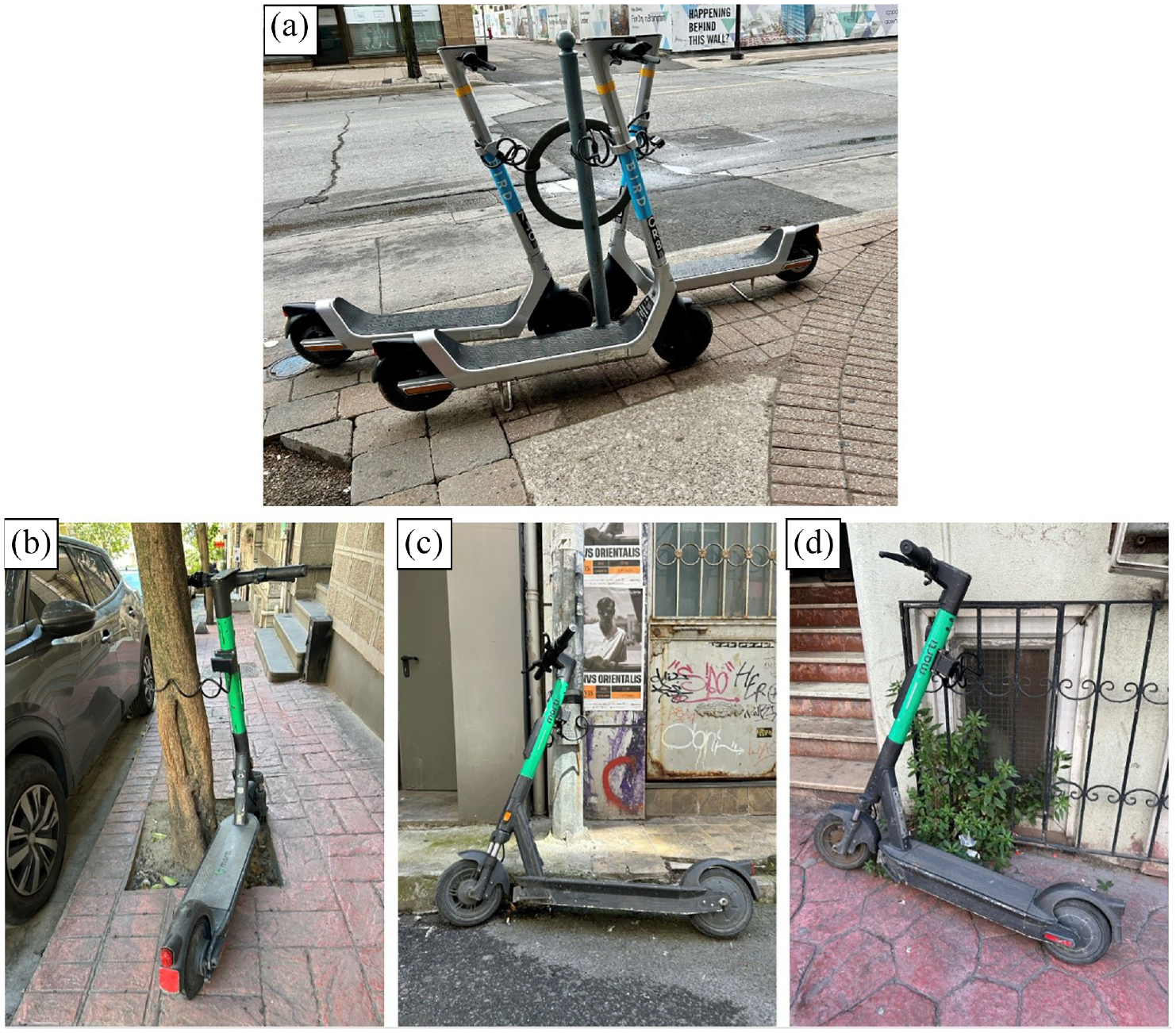
E-scooters locked to: (a) a bollard in Brampton, Canada; and to (b) a tree; (c) a lamppost and (d) a window grate in Istanbul. Source: the Authors.
Yet where within cities e-scooters and dockless e-bikes may be locked to fixed objects needs to be communicated to users. This often involves a third type of visual-material intervention, one enacted within the spaces of digital app interfaces, which make geofences – virtual perimeters defined by bounding coordinates – visible to users of the system. In areas where riding and/or parking is controlled, geofence technology can be used to prevent a ride from being terminated in-app, and thereby also prevent dockless bike and e-scooter from being left stationary within a geofenced-off area where its presence is deemed undesirable. While invisible to the human eye on the ground, ‘geofencing allows travellers to see’ designated ‘parking spaces in apps in addition to on the street’ (Brown, 2021: 5). No-parking (and non-operational) zones tend to be marked as bright red on digital map interfaces within micromobility sharing apps, whereas areas where scooter ridership and parking are permitted are usually green, reflecting the universal visual language of ‘stop’ (red) and ‘go’ (green) (Moran et al., 2020).
Visual verification and computer vision
Visual verification involves the capture and review of visual evidence about dockless vehicle stationment (parked within a designated spot such as a corral, or locked to something in the built environment) and positioning (e.g. upright) at the end of a ride. There are two components to visual verification. The first requires users to take a digital photo of their compliant dockless e-scooter and/or e-bike parking job upon trip termination, and upload it through the app interface. This requirement to supply visual evidence through an app may be issued by a city (e.g. a requirement in the US cities of Omaha and Indianapolis; Brown, 2021) or by a micromobility sharing platform/operator. In the case of the latter, this may apply across the platform ecosystem in all cities served by that micromobility operator. We identified this to be in effect for several dockless platforms, including Martı (operating in Istanbul; Martı, n.d.), Zipp (operating in Ireland, the UK, Spain, and Poland; Zipp Mobility, 2021), and Neuron (operating in Australia, New Zealand, Canada, and the UK; Neuron, n.d.). With Neuron, an ‘End of Trip Photo’ prompt is sent to riders through the app, reminding them to park ‘correctly’ and to provide visual evidence of doing so (Neuron, n.d.). Described by Neuron as a safety feature, other operators rationalise this form of photographic visual verification as an intervention to nudge system users towards compliant parking behaviours. For the e-scooter and e-bike operator Voi, the ‘Parking Photo’ feature requires riders to take and submit a photo after each ride to ‘encourage good parking behaviour amongst e-scooter riders’; or as a Voi General Manager stated, to get riders to ‘think before they park’ (Voi, 2021: n.p.). This enforces an understanding of ‘good’ parking as not only safe (unobtrusively placed fully within a corral’s bounding box), but also aesthetically pleasing (stationed upright), conforming with a globally appealing image of a ‘world-class’ micromobility landscape of standing, aligned bikes and e-scooters either neatly visually contained (corrals, mats, parking zones) or dispersed in an orderly fashion (tethered).
The second component of visual verification requires that the user-captured photo be evaluated to assess scooter parking compliance. From the operator’s perspective this is non-trivial, requiring photos to be reviewed against local parking requirements, which vary by city and by location within them. While these rider-generated parking photos have to date largely been assessed by human reviewers, more recently, some operators have enlisted the assistance of artificial intelligence (AI) to automatically review photos and provide feedback to riders within seconds of uploading. Micromobility enterprises have teamed up with AI firms including Captur and Drover to identify violations or irregularities that are visually evident in parking photos (ATOM Mobility, 2023; Voi, 2022). This involves the operationalisation of computer vision, a rapidly advancing field of AI that focuses on extracting information from images and automating image analysis and interpretation tasks, including object recognition and scene classification (Voulodimos et al., 2018). Wider claims that emerging deep learning-based computer vision models can augment or even surpass human visual perception (Paglen, 2016) undergird micromobility operators’ investment in these models for visual verification of parking non-compliance, including parking on or too close to a road, blocking a sidewalk or entrance, or vehicles fly-tipped on their sides (Rogerson, 2023). Indeed, some operators envision that this form of machinic vision might free operators from having to make visual-material interventions in the built environment in the first place. For instance, some companies assert that their technology has the potential to help cities launch micromobility programmes ‘without having to pay for expensive infrastructure changes [such as] mandatory parking zones’ (Captur, 2023: n.p.), effecting aesthetically orderly landscapes of docklessness without physically altering urban built environments.
Meanwhile, the micromobility operator Lime has developed in-house machine learning models trained on high quality labelled photos captured by deployment partners and subcontractors who perform tasks of e-scooter/-bike retrieval, charging, and rebalancing. These photos are then used to evaluate parking compliance in user-uploaded photos (Xia, 2020). Relatedly, Neuron has developed an in-app augmented reality (AR) tool that uses Google’s ARCore Visual Positioning System and Street View imagery to provide riders with real-time visual and textual feedback indicating where to park (Evans, 2023). Once directed to an appropriate parking area, riders are then prompted to take a photo of their finalised parking job – which has the not inadvertent effect of also improving the quality of these user-generated photos fed back into computer vision models. In these examples, visual verification serves the immediate purpose of governing micromobilities through the aesthetic norms of orderly parked vehicles against the urban cityscape, yet it also advances the competency of computer vision models as deployed within the context of dockless micromobility sharing. In an era when visual datasets increasingly fuel and determine the very scope of AI, parking photos promise to expand the scope of micromobility operations for those operators such as Lime (Xia, 2020) and Neuron (Neuron Mobility, 2023) that enrol computer vision capabilities to leverage their users’ image data.
Visual erasure
Visual erasure describes the aesthetic effects of practices whereby shared bikes and e-scooters are strategically scrubbed from the urban visual field altogether in an effort to uphold the aesthetic norms of desired urban tableaux. So called ‘bikeshare graveyards’ offer perhaps the most arresting example of micromobility’s visual erasure from the cityscape. In China, dockless vehicles flooded cities in 2017, and without other means to curb oversupply, thousands were removed from the streets and deposited in hidden-away vacant lots in massive, if orderly, piles and rows (Taylor, 2018).
Elsewhere, other less spectacular instances of visual erasure are also deployed as a means of reining-in the micromobility mess by effectively removing it from view. Both simple and drastic in execution, micromobility vehicles are simply impounded, erased from public sight by municipal and jurisdictional authorities, who place them in a holding facility (impound lot, warehouse) until a fee is paid by the operator, at which point the vehicle can be put back into circulation. Removals typically occur when vehicles are deemed to be parked in such a way as to negatively impact safety or access in the public realm, often as a stop-gap measure prior to the development of formal parking regulations (Barragan, 2018).
In Kadıköy, Istanbul, we encountered lay online reports that municipal authorities have confiscated e-scooters when parked outside of designated corrals; even when tethered to an object on a sidewalk, their locks are allegedly cut and they are relocated to a warehouse until a fine is paid for their release (Castiel, 2021). In the town of Johnston, Rhode Island, shared e-scooters and bikes permitted in the neighbouring city of Providence regularly cross the municipal boundary and are abandoned in Johnston, where they cease operating (are rendered immobile; Schuler, 2023). Although their use is governed from a separate jurisdiction, police in Johnston have been given the authority to levy a fine and impound the vehicles if they are left stationed ‘on any public property, public right of way, public street, or sidewalk overnight’ (Schuler, 2023: n.p.), effectively preserving normative visual order by hedging against the material and logistical mess of docklessness from spilling over into their municipal limits. And in San Diego, California, an ‘e-scooter bounty hunter’ startup named ScootScoop received significant and largely favourable media coverage in 2019 for its business model of impounding thousands of e-scooters abandoned on or near private property at the behest of property owners; however, the company faced lawsuits and pushback contesting their authority to do so (Martyn, 2019).
‘[C]rippling impound fees’ are one of the reasons why the operator Lime pulled out of a dozen cities around the world in 2020 (Kovacevich, 2020: n.p.). According to a spokesperson for Lime, which refused to pay the $30–$50 ‘ransom’ per scooter, the public ‘should be careful when engaging with pop-up companies claiming to provide city services like impounding or towing’ (Romero, 2019: n.p.). A characteristically ‘neoliberal management of public visibilities and invisibilities’, dockless vehicle impounds and graveyards ‘represent a space’ where the negative aesthetic outcomes of the micromobility ‘[platform] economy model can be conveniently hidden’ such that normative aesthetic urban order is maintained and restored through the removal of any offending presences (Mubi Brighenti, 2016: xix) – such as improperly stationed dockless micromobility vehicles – from the public’s line of sight, relegated to spaces where they do not interrupt what Aiello (2021: 137) refers to as the ‘vista’ of urban world-classness.
Implications for dockless micromobility futures
We assert that efforts to influence the spatial footprints and operation of dockless micromobilities on city streets are mobilised not only to make dockless micromobility sharing safer, but also to address ‘aesthetic incompatibility [with] prevailing sentiments’ (Simone, 2022: 12) about what the landscapes of digitally mediated urban mobilities should ideally look like: orderliness and efficiency delivered through a city’s embrace of digital innovation in transport and its attendant business models. This incompatibility between the normative aesthetics of dockless micromobility sharing as an increasingly significant referent of the ‘world class city’ on the one hand, and the visual reality of their often chaotic presence on the ground on the other, subjects cityscapes to ‘radical makeovers’ (Simone, 2022: 12) in the form of attempts to contain and confine (e.g. corrals), disperse (e.g. lock-to requirements), or eliminate (e.g. impounds, graveyards) the visual aberrations of vandalised, abandoned, submerged, and/or fly-tipped bikes and e-scooters within the urban visual field. Bringing the lens of aesthetic governance to cities and operators’ efforts at governing dockless micromobilities informs an understanding of what would appear to be disparate interventions and practices – parking zones, tether-to requirements, bikeshare graveyards, impounding, user image capture, and the turn to AI and machine learning – to actually be intrinsically linked, all part of efforts to (re)develop cityscapes seeded with digitally mediated dockless micromobilities in the image of the world-class city latently promised in their adoption. This focus on the maintenance and restoration of a normative world-class aesthetic marked by urban orderliness and technological innovativeness adds a novel perspective to research on micromobility regulation that aligns with but also moves beyond concerns around safety and rider behaviour.
The (re)shaping of urban built environments to both accommodate and sustain the rollout of digitally mediated urban mobility transitions, and to grapple with the resulting degradation of cityscapes that ensues from their adoption, has implications for people and organisations too – including municipal governments, micromobility operators, and riders. The arrival of docklessness represents a major shift to shared micromobility, but the subsequent mobilisation of visual-material interventions targeted at the placement of these vehicles in the urban environment has had the unintended consequence of effectively terminating their unique comparative affordance within the wider transportation sector: the ability for a rider to start and end their journey in virtually any location. Corrals, mats, parking zones, geofences, and e-scooter docks impose a level of spatial restriction similar to first-generation docked bikeshare systems in terms of where dockless vehicles may be retrieved from and returned to, leading us to designate nominally dockless systems pseudo-dockless at best. For riders, widespread pseudo-docklessness means they can no longer deposit micromobility vehicles ‘wherever [they] happened to hop off them’ at the conclusion of a trip (Bellan 2023, n.p.). As noted by one e-scooter user, ‘having to find a designated parking spot takes up time e-scooters are designed to save’ (Anderson, 2022: n.p.). As such, the spatial containment of micromobility via the imposition of designated parking areas or docks can be seen as a visual symbol of cities’ and operators’ commitments to a more regulated form of shared micromobility – but this may come at the expense of convenience and ridership levels.
Furthermore, whether enacted in the form of visual-material interventions in urban environments or via geofences and computer vision solutions not discernible to the human eye, the setting-aside of swathes of the urban spatial fabric for express use by micromobility vehicles raises questions about who – and what – urban public space is for, and whether or not the broader ‘right to the city’ is being curtailed by the growing annexation of public areas such as plazas and sidewalks for dockless bike and scooter operators, irrespective of whether they are private for-profit enterprises or city owned-and-run (Tuncer et al., 2020; Speak et al., 2023). This is also true of micromobility graveyards and impounds, which likewise represent a recalibration of ‘highest and best use[s]’ of both private and public urban space (Stehlin, 2018: n.p.).
At this critical juncture in micromobility’s evolution, more evidence is needed on the implications for cities and society of imposing docking and spatial parking restrictions on docklessness. Some research suggests that spatial restrictions on micromobility parking could negatively impact wider social equity in terms of access and use (Meng and Brown 2021). Indeed, docklessness on its own is unlikely to lead to equitable spatial accessibility and use without equity programmes and careful efforts to rebalance vehicles across diverse areas of a city (Kong and Leszczynski, 2022). Relatedly, the more difficult that cities make it for riders to locate a shared micromobility vehicle by restricting where these may be stationed – and the more that users are penalised (fined, ticketed) for not conforming to parking regulations or in-app requirements (e.g. to upload a photo at trip end) –‘the less likely [it is] that folks will choose one instead of a car’ (Kovacevich, 2020: n.p), significantly curtailing the purported sustainability benefits to be achieved through the at-scale modal shift to electrified shared micromobility away from more carbon intensive modes of digitally mediated travel, such as ridehailing.
And last but not least, exercises of aesthetic governance we identify here are not in and of themselves effective in resolving the micromobility mess wrought by docklessness. For instance, in Camden, London, ‘despite strict rules imposed by the council, including … restricting bikes to designated parking bays’, there are still reports of ‘loads of vehicles being abandoned carelessly’ (Kihl, 2023: n.p.). This is in part because while aesthetic governance interventions target the organisation of (pseudo)dockless shared vehicles on city streets, they do not address other emergent social practices around micromobilities. One such example involves the ‘hacking’ of dockless Lime e-bikes in London in the summer of 2023, whereby push-starting these vehicles enabled them to be ridden without paying in unpowered pedal mode (Houghton, 2023). Reportedly, it often took several tries to get a Lime bike going in this illicit mode – with unsuccessfully hacked vehicles abandoned ‘across pavements and pedestrian crossings’, adding to the existing visual chaos of the already-existing micromobility mess (Houghton, 2023: n.p.).
Footnotes
Declaration of conflicting interests
The author(s) declared no potential conflicts of interest with respect to the research, authorship, and/or publication of this article.
Funding
The author(s) disclosed receipt of the following financial support for the research, authorship, and/or publication of this article: This research was funded by a Canadian Social Sciences and Humanities Research Council (SSHRC) Insight Grant, Award #435-2022-1542.
