




Abstract
Enlivening is an increasingly common response to urban challenges and seeks to make urban space ‘liveable’ and ‘healthy’. A central tenet in achieving the enlivened city, is an active citizen who travels by sustainable modes, namely active travel. Whilst there is an increasing impetus upon producing an inclusive template of the active citizen within policy, it is our encounters with the materiality of active travel infrastructures within our everyday lives as disabled people that impact upon our ability to exercise citizenship rights and upon our sense of belonging within enlivening. Using an autoethnographic approach to my own experiences as a disabled tricyclist in Greater Manchester, UK, this paper demonstrates how through both encounters and non-encounters with access control barriers on traffic-free routes, the city is rendered less liveable, rather than enlivened, for many disabled people. I also attend to practices of care and repair related to infrastructures of active travel, and how these further consolidate embodied experiences of (non)citizenship. Recognising that such every day, small-scale interactions are the foundations of larger social forms, I demonstrate how autoethnography can contribute to informing inclusive policy and practice, in this case by demonstrating how practice needs to match rhetoric of inclusive, enlivened futures within Greater Manchester, as well as more broadly, if disabled people are to enact our citizenship through active mobility and be part of enlivened urban futures.
Introduction
What is the promise of the access control barriers in Figure 1; a material infrastructure endemic on traffic-free walking, wheeling and cycling paths across the UK?
Most commonly implemented by local authorities – within the context of austerity and severe cuts to public services – such controls seek to solve the ‘problem’ of anti-social use by people on dirt bikes and mopeds with minimal ongoing cost. In and of themselves, access controls can be considered as hostile (Bader, 2020; Petty, 2016) or defensive architecture (Davis, 2006); ‘installed in public spaces in order to render them unusable in certain ways or by certain groups’ (Petty, 2016: 68). Routinely, however, controls fail to keep their promise. Those on dirt bikes and mopeds can often negotiate their vehicles through, over and around barriers (note the desire lines to the left in photograph) and there is no evidence to suggest that they are effective.
What access control barriers do achieve, while perhaps not their intention, is the exclusion of disabled people from using routes entirely (Cox and Bartle, 2020), or from using routes with the same level of comfort as non-disabled people. For those who use mobility aids, for example, the gate is locked, the K-frame is too narrow to navigate through, the horse stile cannot be levitated over, and the desire line is too steep and uneven to negotiate (Figure 1). But these barriers also pose a challenge for many people who do not use a mobility aid. For example, people with balance impairments struggle to navigate through or over controls, and for many blind and visually impaired people, such controls are a dangerous obstacle.
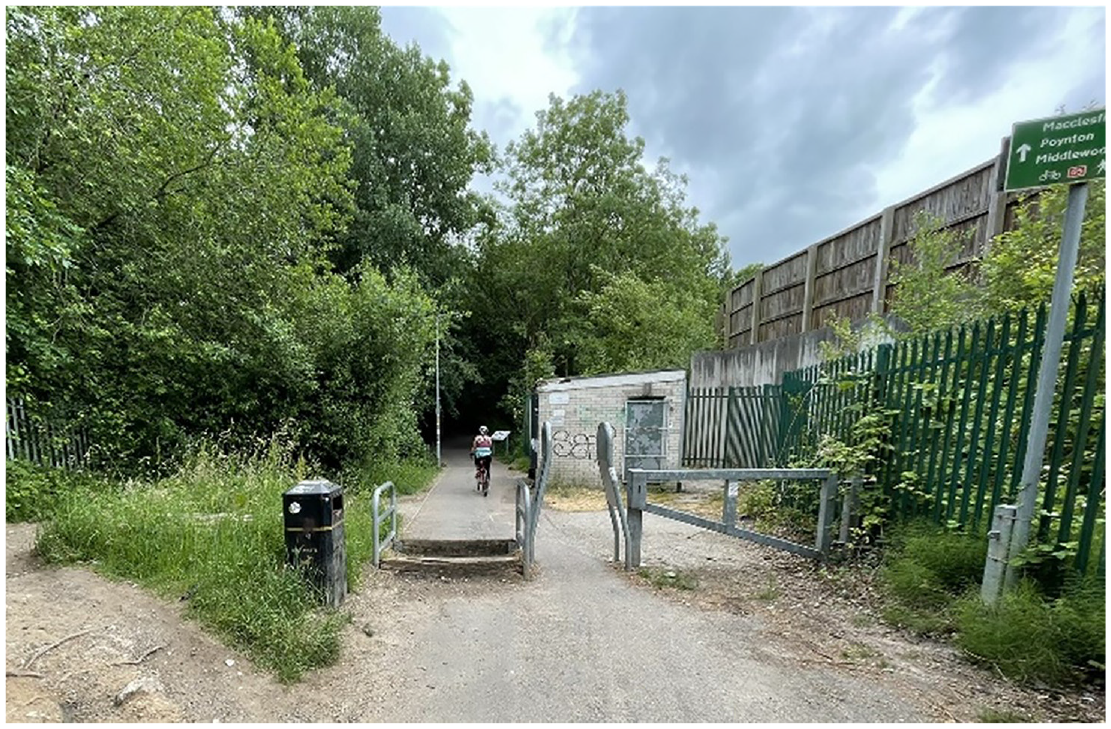
Access control barriers across a traffic-free walking, wheeling and cycling path in Stockport, Greater Manchester.
Within this paper I am writing an autoethnographic account of my encounters with access controls on traffic-free routes within Greater Manchester, UK. I am a disabled person and I use my adapted cargo trike as my primary form of transport. Traffic-free routes in Greater Manchester, as well as more widely, are a substantial element of active travel networks, often linking up places where the road infrastructure is not well suited for active travel (DfT, 2020a; Jones, 2012). There are hundreds of access controls across Greater Manchester, 1 and thousands throughout the UK. So, whilst my trike enables me to get around independently and with minimal pain, such controls limit the geographies of my everyday life.
Methodologically, situating focus upon my own encounters recognises that small-scale interactions are ‘foundations of larger scale social forms including patterns of social integration and fragmentation, uneven geographical development and collective social imaginaries’ (Angelo and Hentschel, 2015: 306). I pay attention to both encounters of presence, but also absence, recognising that encounter is also about what is not there and how ‘expectation, memory, and previous experience, all enable, constrain and shape encounters’ (McFarlane, 2016: 231). This is relevant to access controls as I am increasingly noticing their absence, some removed by local authorities, but others removed by activists.
Through my autoethnographic account I explore encounters and non-encounters with access controls and consider implications for citizenship and belonging within urban enlivening agendas. Urban enlivening is an increasingly common response to urban challenges and seek to make urban space ‘liveable’ and ‘healthy’ (Hamraie, 2018). A central tenet in achieving the enlivened city is an active citizen who travels by sustainable modes, namely active travel (Hamraie, 2021). Through this analysis I demonstrate how practice needs to match rhetoric of inclusive, enlivened futures within Greater Manchester, as well as more broadly, if disabled people are to enact our citizenship through active mobility. This is supported by development of a more inclusive definition of active travel that is not based upon normative conceptualisations of physical activity. Furthermore, this article has a methodological contribution, demonstrating the value of autoethnography for informing inclusive design policy and practice and how micro stories in active travel and transport can inform wider understanding of social forms and infrastructures.
Active travel, (non)citizenship and encounters within enlivening city agendas
What is active travel?
Active travel has been defined by Cook et al. (2022: 154) as ‘travel in which the sustained physical exertion of the traveller directly contributes to their motion’. Walking, wheeling – which in Cook and colleagues’ definition would be using a manual wheelchair – and cycling are the most common active travel modes. In my own definition of active travel, I expand out to include use of mobility aids, such as mobility scooters and powered wheelchairs. This is not only because these are important walking aids for many disabled people and there are overlaps in infrastructural requirements, but also because the definition above encompasses normative conceptualisations of activity and exertion and does not consider that, for many disabled people transferring into a mobility aid, the act of sitting in a wheelchair or a mobility scooter and using limbs to operate these aids are all forms of exertion (see also Larrington-Spencer, 2024).
Walking, wheeling and cycling are important for disabled people with all forms of impairment in terms of making journeys, especially because disabled people live in households that are less likely to have access to a vehicle (DfT, 2021; USDOT, 2022). Additionally, walking, wheeling and cycling in their own right may also be more significant considering the difficulties disabled people face in accessing public transport (Motability, 2022; Park and Chowdhury, 2022), for example, inaccessible public transport infrastructure (Bezyak et al., 2017; Lindqvist and Lundälv, 2012), discrimination (Iudici, 2015; Wayland et al., 2022) and failure of passenger assistance (BBC News, 2011; Caird, 2021).
In addition to being a form of mobility, active travel is also associated with numerous health and wellbeing benefits. Walking 30 minutes or cycling 20 minutes a day reduces all-cause mortality risk by 10% and active commuting is associated with a 10% decrease in cardiovascular disease and a 30% decrease in type 2 diabetes risk (WHO, 2022). Active travel can also have positive impacts in terms of mental health (Kroesen and De Vos, 2020). It is important to recognise, however, that such health and wellbeing benefits are developed upon normative conceptualisation of what physical activity is, and more work is necessary to understand the impacts of non-normative forms of physical activity embedded in walking, wheeling and cycling for disabled people. There has been pushback from disabled people and disabled academics on health and physical activity research that has medicalised disability (Hayes and Hannold, 2007). This is because it commonly starts from a deficit viewpoint of disability (Inckle, 2019). However, adopting a non-normative and inclusive understanding of what physical activity and exertion can be offers opportunities to better understand positive and negative impacts for disabled people – for example physical activity is not appropriate for everyone living with chronic fatigue syndrome/ME (NICE, 2021) – and how to better support disabled people to be active in ways that meet their needs.
This piece of work starts with the presumption that embedding physical activity (inclusively understood) into mobility can be of huge value for disabled people and will challenge the worse mental and physical health outcomes our community experiences because of immobility (Inckle, 2022).
How is active travel related to citizenship?
Formally, citizenship is ‘the legal status of membership of a nation state’ (Lister, 2008: 9). At a substantive and lived level, however, citizenship ‘means much more than this legally, politically and socially’ (Lister, 2008: 9). It is at the substantive level therefore, that citizenship in relation to active travel is understood within this article. Having citizenship, is about being able to exercise citizenship rights, such as inclusion, participation and autonomy (Gaete-Reyes, 2015; Morris, 2005). These rights are central tenets of social justice and for equal opportunities to be equal citizens (Morris, 2005). Citizenship is neither fixed (Spinney et al., 2015) nor a possession (Valentine and Skelton, 2007), but rather an embodied, negotiated and inherently relational process, produced and reproduced through everyday practices (Valentine and Skelton, 2007) and interactions with other subjects, infrastructures and wider socio-economic processes (Bacchi and Beasley, 2002; Gaete-Reyes, 2015).
Being a citizen often results in an embodied sense of belonging (Wiseman, 2019). This is because to be a citizen, at any scale, is ‘more than [being] an insider – it also means to be one who has mastered modes and forms of conduct that are appropriate to being an insider’ (Isin, 2009: 371–372). In contrast, uneven distribution of resources necessary for the production of citizenship can result in non-citizenship, where people are unable to exercise citizenship rights, which has detrimental impacts in terms of one’s sense of place and belonging (Isin, 2009; Spinney et al., 2015).
Mobilities (see Sheller and Urry, 2006), rather than simply being an outcome of citizenship, are increasingly recognised as producing (non)citizenship. While much research importantly focuses upon aspects such as diaspora and migration (Spinney et al., 2015), there is developing scholarship on the production of citizenship through everyday (im)mobilities (Gaete-Reyes, 2015). This scholarship recognises that exercising one’s citizenship rights is often enabled by having access to means of transport (Gaete-Reyes, 2015; Spinney et al., 2015). Active travel, as a form of everyday mobility, can therefore be understood as having a role in the production of (non)citizenship (Aldred, 2010; Spinney et al., 2015).
Disabled people’s embodied citizenship, in relation to mobility and active travel, is particularly pertinent as disabled people are commonly denied citizenship, as a result of inequalities in accessing mobility (Gaete-Reyes, 2015). While not necessarily framed through a citizenship lens, much scholarship demonstrates how transport inequalities experienced by disabled people around the world impact upon our ability to exercise citizenship rights, such as access to employment, access to health care and access to a social life (Martin et al., 2015; Naami, 2019, 2022; Pyer and Tucker, 2017; Remillard et al., 2022; Rosenbloom, 2007). Looking expressly at disability and active travel what literature shows is that the process of claiming citizenship can often be mediated through and in relation to our mobility aids (Gaete-Reyes, 2015).
Encounters with the active citizen in enlivening city campaigns
Active travel is also related to citizenship through the active citizen that is mobilised within the enlivening of cities and urban space. In response to urban challenges, such as air pollution, road traffic collisions and serious injuries, there is an increasing push towards enlivening cities, making them ‘liveable’ and ‘healthy’ (Hamraie, 2018). A central tenet in achieving the enlivened city, is an active citizen who travels by sustainable modes, namely walking, wheeling and cycling (Hamraie, 2021). Hamraie (2021) observes, however, that efforts to enliven urban space often result in ‘the biopolitics of liveability’ (Hamraie, 2018: 99), in which a health-based and normative framing produces discourses of which lives are worth living (Hamraie, 2018). Disabled bodies, as well as fat bodies and other non-normative bodies, become ‘problems to solve rather than a form of human difference deserving access to the built environment’ (Hamraie, 2021: 1).
Within this paper, the infrastructures that produce enlivening are not only limited to the material, for example the infrastructure that makes up active travel routes. Rather, infrastructure that makes up enlivening is understood as a sociotechnical arrangement made up of visible and invisible, human and non-human components (Amin, 2014; Amin and Thrift, 2017; Wiig et al., 2023). As such attending to the policy context as an enlivening infrastructure, and particularly in terms of the production of an active citizen, is important to better situate lived experiences of disabled people.
While, in the UK at least, policy seeking to enliven urban space through active mobility has traditionally failed to recognise disabled people and our mobility aids (Andrews et al., 2018; Hickman, 2016), there is an increasing impetus on the need to ensure that active travel futures (and the active citizen) are inclusive of disabled people and our diverse needs. For example, within ‘Gear Change’, which is the ‘bold vision for walking and cycling’ set out by Department for Transport (DfT, 2020b: 1), the cover includes a photo of a disabled woman using a handcycle, and mobility scooters, wheelchairs and recumbent cycles are included in graphics and photos throughout the document. The document also clearly reflects that active travel material infrastructure (although the focus is largely upon cycling infrastructure) needs to incorporate the needs of disabled people and our mobility aids and the report is accompanied by Local Transport Note (LTN) 1/20 (DfT, 2020a), which provides the infrastructural design guidance to facilitate this.
Within this autoethnography I specifically explore experiences of encounter while travelling actively as a disabled person in Greater Manchester. Greater Manchester is a city-region in Northwest England, made up of 10 boroughs. Although the region’s economy was originally founded upon industrialisation, more recent economic growth – from wholesale and retail, real estate, medical services, manufacturing and finance and insurance – means Greater Manchester has the second largest economy in the UK after London: in gross value added (GVA) terms £79 billion in 2021 (GMCA, 2023b). Following the economy, the region has a growing population of almost 2.9 million, expected to reach 3 million by 2040, with two central boroughs – Manchester and Salford – seeing the highest growth, reflecting the greatest levels of urban regeneration (GMCA, 2023a). Property prices in the region are also growing at a faster rate than the national average.
Greater Manchester is governed by the Greater Manchester Combined Authority (GMCA), consisting of 10 indirectly elected councillors (i.e. through each of the boroughs) and a directly elected mayor. Greater Manchester transport policies are developed by the GMCA and Greater Manchester Transport Committee (GMTC), but Transport for Greater Manchester (TfGM) is the local government body responsible for delivery. Recognising that a sustainable transport system is central to sustaining the growing population and growing economy and that road transport in the region contributes 31% of carbon dioxide, 65% of nitrogen oxide and 79% of particulate emissions, transport policy has been developed to increase rates of active travel and public transport use. Within Greater Manchester, such enlivening policy involves a goal of 50% of all journeys by active travel and public transport by 2038 (GMCA, 2021). While inclusion is outlined as a key principle in the wider transport strategy for the region (GMCA, 2021), the original ‘Made to Move’ policy document underlying the active travel component of the strategy made no reference to disability and inclusion and had no images of visibly disabled people using mobility aids within it (GMCA, 2017). However, Made to Move has recently been updated with ‘Refresh the Mission’, in which accessibility is outlined as a key foundation of any active travel network: ‘Active travel in Greater Manchester must be inclusive, universally accessible and built to consistent standards that meet and exceed local and national standards’ (GMCA, 2023c: 13). There are also multiple disabled people included in the photographs throughout the document. A completed active travel network within Greater Manchester is proposed to comprise over 1100 km of segregated routes on busy roads, 900 km on quiet roads and 600 km on off-road routes, to be complete by 2040 (TfGM and Sustrans, 2023). The off-road component of the network already largely exists and is distributed across the 10 boroughs.
However, while broad and inclusive conceptualisations of enlivened urban futures and the actively travelling citizen are being mobilised within policy infrastructures at the national and regional level, material infrastructures are encountered within people’s everyday lives (Middleton, 2021). For disabled people then, even if an inclusive active citizen is being produced within policy, it is our embodied and relational encounters (Hovorka, 2016), through our everyday mobility and with our mobility aids if we so use them (Gaete-Reyes, 2015), that impact both upon our ability to exercise citizenship rights and upon our sense of belonging. Encounters can thus be understood as an ‘empirical and conceptual lens through which the city itself is revealed to us’ (McFarlane, 2016: 232) and enables attention to the ‘many complexities, contestations and contradictions of contemporary urbanism, with a specific attention to difference’ (Wilson and Darling, 2016: 1). Encounters are not only about meeting difference – for example there is a large body of work on encounters and cultural difference – but how, through encounters, difference can be made and transformed (Wilson and Darling, 2016). In addition to addressing the city that is ‘there’ (Swanton, 2016), it is important to recognise that encounters are also about what is not there: encounters with absence (McFarlane, 2016). This involves paying attention to ‘the role of expectation, memory and previous experience, all enable, constrain and shape those encounters with difference that play an important role in the life and politics of cities’ (McFarlane, 2016: 231).
Within this paper, and building upon work of scholars on disability and the built environment (Hamraie, 2017; Imrie, 2000, 2012) and urban scholars work on similar ‘one-unit-at-a-time’ material infrastructures (Muñoz, 2020; Weilenmann et al., 2014), I explore my encounters with access control barriers on traffic-free paths as a disabled tricyclist in Greater Manchester. Recognising that some access control barriers have been removed I also pay attention to encounters with their absence and the relationality of their removal – by local authorities, but also by activists.
I consider the removal of access control barriers on traffic-free routes, whether by local authorities or local activists, repair work. Repair work recognises that the urban landscape is made and remade through mundane and practical everyday activities (Graham and Thrift, 2007). Although scholarship on repair work tends to focus upon the upkeep and maintenance of what is already there (Graham and Thrift, 2007; Hall and Smith, 2014; Mattern, 2018), I would posit removal in the case of access controls is repair – resolving the injustice of inaccessibility. As such, repair work is also inherently care work (Hall and Smith, 2014; Mattern, 2018): ‘a species activity that includes everything we do to maintain, continue and repair “our world” so we can live in it as well as possible’ (Fisher and Tronto, 1990: 40). And as repair is care, then a question that arises from my non-encounters with access control barriers is ‘who cares to repair?’ Attention to this question involves what Martin et al. (2015: 636) term a critical practice of care, ‘paying attention to the privileged position of the caring subject, wary of who has the power to care, and who or what tends to get designated the proper or improper objects of care’.
Why are my experiences important enough to write about in a journal article?
Through an autoethnographic exploration of my encounters and non-encounters with access control barriers, I consider my experiences as a disabled person and explore implications for my citizenship and belonging within Greater Manchester’s campaign to enliven the region.
An autoethnography is when as researchers we analyse our own experiences to develop deeper understandings of cultural experiences, qualified by possessing a cultural identity relevant to the experience (Ellis et al., 2011). My cultural identity is of being a disabled person living in Greater Manchester, UK. I use the Equality Act (2010) definition of disability which is that someone is disabled if they have a physical or mental impairment that has a substantial and long-term (more than one year) adverse effect on their day-to-day activities.
My experience of being disabled is strongly entangled with cycling. I gained one of my impairments from being hit off my bike by a driver. The ensuant nerve damage, upper limb impairment and chronic pain meant I could no longer safely cycle a two-wheel bike, and so I switched to a cargo trike. I now find cycling much more comfortable than walking – a common occurrence among disabled people (Wheels for Wellbeing, 2021) – as my nerve pain is aggravated to a lesser extent, and I am able to carry items in the cargo bucket that I would not be able to carry with only one working arm. Foregrounding voices of those who live the experiences and issues being investigated and challenged, autoethnography is cohesive with the fundamental principle of disability ethics: nothing about us without us (Charlton, 1998).
Writing an autoethnography is not simply about recounting memories (Lourens, 2021), but rather involves ‘retrospectively and selectively write[ing] about epiphanies related to one’s own cultural identity’ (Ellis et al., 2011: 276) and, through being researchers, using our methodological and theoretical tools, to analyse these experiences (Ellis et al., 2011). In doing this work, the researcher can better understand their own experience but also use their experiences to understand and critique wider social and cultural forces (Lourens, 2021; Pryer et al., 2023). Autoethnography is therefore a highly relevant method to investigate infrastructural encounters, recognising that the micro-politics of encounter are the foundations of larger social forms. Through the nature of introspection and the fluidity of process, autoethnography also enables examination of the ‘thoughts, feelings and bodily sensations connected with [cultural] experiences’ (Lourens, 2021: 1209), which are all relevant to understanding the embodied nature of both encounter (Middleton, 2021) and citizenship (Bacchi and Beasley, 2002; Gaete-Reyes, 2015).
Utilising autoethnography to influence policy and practice has so far been successful in the fields of health, disability and justice (Sinden-Carroll, 2019) and there is great value in expanding the method to influencing inclusive built environment policy and practice. Autoethnography particularly empowers marginalised voices, such as those of disabled people (Doan and Darcy, 2025), by enabling ‘those affected by policies to analyse and study impacts and develop an academic, well-researched evidence base on how to address it’ (Sinden-Carroll, 2019: 76). While undertaking social research, such as traditional ethnography, on inclusive design infrastructures, for example, often ‘demands’ seamless and uninterrupted fieldwork, this does not account for ‘caring responsibilities, precarious employment, disability, relational commitments, and other life circumstances’ of researchers (Günel and Watanabe, 2023: 133). Such fieldwork commonly excludes researchers from marginalised groups and so a more ‘patchwork’ approach through autoethnography allows such researchers to make space for how their ‘bodies determine how they can and cannot move through the field’ (Günel and Watanabe, 2023: 134) and contribute to knowledge production and scholarship. Recognising the value of disabled voices through autoethnography also supports a disability politics of ‘nothing about us without us’ and recognises that disabled people are often, because of our experiences, experts in the design of everyday life (Hamraie and Fritsch, 2019).
In the empirical section below, I provide three vignettes of my own encounters: first with access control barriers (Vignette 1) and then with access control barrier absence (Vignettes 2 and 3). Through these vignettes I explore the embodied nature of these encounters and how they intersect with my everyday mobility and citizenship, as well as belonging within an enlivened city agenda. These vignettes are extracts from retrospective reflections (Edwards, 2021) I wrote between 2019 and 2022. Reflections were initially a form of catharsis (Pillow, 2003) as I sought to make sense of my experiences as a disabled person. However, as they developed it became clear they provided insightful empirical material.
Encounters with access control barriers
Vignette 1 (January 2019)
It’s 2019 and I’m cycling comfortably and safely for the first time in two years. And I’m elated. My cargo trike has been chosen and adapted for me. The handlebars are curved and allow me to rest my palsy arm on them. Braking and gearing have been moved to the righthand side. The front wheels are independent from the bucket, making it light enough to steer with one arm, enabling me to carry cargo – such as my dog. Three-wheels rather than two means I don’t risk toppling over, and my nerve pain isn’t exacerbated by getting up and down at traffic lights. I can’t stop smiling. I feel like I’m four again and I’ve just learned to cycle. And much like my four-year-old self, I imagine the geographical limits of my world expanding. Places that are too far for me to walk (and too painful – as walking exacerbates my nerve pain) and that are undesirable by public transport (since being hit by a car I’m anxious about motorised transport) seem possible again. I feel hopeful. But the feeling doesn’t last. We cycle to the traffic-free path that connects our street with a protected cycle lane. I stop at chicane barriers, which are spaced too narrowly for me to zigzag through. The path is too narrow for me to turn around. I wait for my husband to catch up and feel useless as he proceeds to pivot and shimmy the trike through the gap. 100 metres further along the path and we repeat the process. It dawns on me that I won’t be able to use this path independently. We continue along protected cycle lanes, barely wide enough for my trike, intending to access the traffic-free walking, wheeling, and cycling path that runs alongside the river and which is part of the National Cycle Network. Except we can’t, or at least I can’t. We reach the entrance of the path and encounter an A-frame barrier and a horse stile [like those in Figure 1]. My trike is too wide to fit through the A-frame and too heavy for my husband to lift over the horse stile. I feel so frustrated. And I also feel shame. Shame that my body and my needs are all wrong. I don’t fit, literally and metaphorically.
Within the vignette above I very briefly experience what I believe it must feel like to be an active citizen in Greater Manchester. By travelling actively, in this case by cycling, I have ‘mastered modes and forms of conduct that are appropriate’ (Isin, 2009: 371–372). I feel joy in my mode of travel – perhaps unsurprisingly as cycling is often associated with positive affect (Wild and Woodward, 2019) – and I start to imagine my everyday geographies expanding. Within this expansion I imagine places that I was no longer unable to access – by walking or by public transport – as possible again. I am the disabled active citizen that is produced within enlivening city discourse and national active travel policy documents, demonstrating how cycling can be adapted for different needs. And with this active citizenship comes an ability to exercise my citizenship rights, to be included, to participate, to be autonomous (Gaete-Reyes, 2015; Morris, 2005). I can imagine getting where I need to get to for work, for leisure, for utility, by cycling.
But my performance of an active citizen is short lived, as I quickly encounter access controls. These can be understood as a ‘perfect’ example of the social model of disability (Oliver, 1996). Within the social model, whilst it is people that have impairments – for example a mobility impairment, neurodivergence, mental health condition, sensory impairment – it is physical and social environments not adapted to accommodate a diverse range of embodiments that disable us (Oliver, 1996). In the case of my vignette, I have an impairment (upper limb palsy) and a way to manage my impairment within the context of mobility practices (my adapted trike). It is therefore my encounter with physical barriers, the access controls, that are disabling me. And through these disabling encounters with access control barriers, I am rendered a non-citizen in enlivened urban landscapes; I cannot exercise my citizenship rights through active mobility practices. This rendering is coherent with wider experiences of disabled people in that many practices considered ‘green’ are inaccessible, and so disabled people are excluded from the environmental movement, or worse characterised as anti-environmental (Larrington-Spencer et al., 2021).
Through my disablement, we can also understand how encounters with access controls produces a form of active citizen that contrasts strongly with the inclusive citizen within regional and national active travel policy. This everyday production will not be unique to Greater Manchester, considering the endemic nature of access controls on traffic-free paths across the UK (Sustrans, 2023). From Figure 1, you can understand the expectation of the body that access controls are designed for: someone on a two-wheel bike, who has the dexterity to negotiate their bike through the A frame or the strength to lift their bike over the horse stile, or the balance to take on the steep desire line that becomes slippery as soon as it rains (see also Cox and Bartle, 2020a). Such an active citizen is the spectre of the ‘normate’ (Garland-Thomson, 2011); the disembodied subject that dominates in urban planning (Hine and Mitchell, 2001) and though supposedly neutral, is generally ‘a particular white, European, non-disabled, youthful, and often masculine figure’ (Hamraie, 2017: 20). And this normate template (Hamraie, 2017) excludes not only disabled people from becoming active citizens, but also others with non-normate bodies – for example fat bodies, or parents who are cycling with children in trailers.
Although I can ‘rationalise’ my exclusion using the social model of disability and the normate template of the active citizen that both produces and is produced by the access controls, the lived and embodied negotiation of my non-citizenship (Bacchi and Beasley, 2002; Gaete-Reyes, 2015; Valentine and Skelton, 2007) still results in me situating my exclusion in my own body. I feel ‘shame, shame that my body and needs are all wrong’. Shame is a common response when we are discriminated against (Matheson and Anisman, 2009) and it is a particularly painful emotion that comes with ‘scrutiny of the self’ and the ‘sense of shrinking, of being small, and of being worthless and powerless’ (Tangney et al., 1992: 670). There are very real consequences of the negative affect caused by discriminatory events such as this, including depression, psychological distress, self-rated poorer health and reduced life satisfaction (Hackett et al., 2020).
What this vignette shows is that although the policy rhetoric around enlivening Greater Manchester through active travel has a narrative of inclusion and accessibility, my lived encounters of access controls while tricycling contradict this narrative. Through our encounters with access controls, which conversely produce an active citizen through a normate template of abled masculinity, we are dispossessed and rendered non-citizens, unable to enact our citizenship through active mobility practices. Inaccessibility renders the city less liveable, rather than enlivened (Findlay, 2023). I say in the above vignette that ‘I do not fit’. I am expressing what Garland-Thomson (2011: 592–593) calls ‘the misfit’, when there is an ‘incongruent relationship between two things: a square peg and a round hole’. This results in a deep sense of not belonging, or being out of place (Hamraie, 2021). Not being able to exercise our citizenship through our mobility practices is thus not only about the value that exercising citizenship brings, for example being able to participate in social life, or work, of access healthcare, but there is value too in this sense of belonging. Belonging is a fundamental human need and is a strong foundation for mental health, wellbeing and life satisfaction (Allen et al., 2021; Daley et al., 2018).
Non-encounters with access control barriers in Greater Manchester
In the following section, informed by two vignettes, I write about encounter with a form of absence, specifically the removal (or at least a significant reconfiguration to a more accessible format) of access control barriers on traffic-free routes that now means I can navigate certain stretches.
Vignette 2 (August 2021)
It’s 2021 and I am cycling along the same traffic-free path that connects my home with a protected cycle lane. But today I don’t need to dismount and have my husband negotiate my trike through the chicanes. The distance between the chicanes has been extended and I can The extension of the distance between the chicanes on this path has been carried out by my local council. But did they do this work because they understood, from my communications, the impact that access control barriers have upon the mobility of disabled people? No. Did they extend the barriers because they recognised, proactively, that they contradicted enlivening urban space policy and inclusive design principles at both national and regional levels? Also no. So why did they extend the barriers? They did it because I began the process of taking legal action under the Equality Act 2010, using the Disability Attitude Readjustment Tool (DART).
2
When I reflect upon this non-encounter through a lens of care, I consider that while the local authority did repair the access control barrier through reconfiguration, they did not care to repair such unequal urban landscapes. Their reluctance and belief that they should not have to repair the urban landscape until they are threatened with legal action, demonstrates that they do not care enough about disabled citizens unless there will be legal and financial (and probably very public) implications for themselves. That they do not care is further materialised through the failure to comply with inclusive infrastructural guidelines in the reconfiguration of the access control. This failure to care about the capacity of disabled residents to exercise their citizenship through active mobility practices is despite said mobility practices being represented within local policy (Puig de la Bellacasa, 2012). According to Price (2015: 279) care only emerges between subjects when each considers the other ‘to be equally valuable’ which means ‘to be treated as someone who is having a meaningful experience’. By failing to care, the local authority is demonstrating they do not consider disabled citizens to be as equally valuable as non-disabled citizens. And this failure to care results in a deep sense of disbelonging within the prevailing mobility paradigm (Hamraie, 2021). As put so aptly by Carly Findlay on her own encounters with an inaccessible urban environment: ‘We want to feel that our city, that we love so much, loves us back’ (Findlay, 2023: 1).
Vignette 3 (September 2021)
I receive a Twitter message from an anonymous account with a photograph of part of a traffic-free path that I am familiar with. The path, however, looks different to normal. The access control barrier is no longer in its original form. Part of it has been removed and the route would now be accessible using my adapted trike. The change in configuration of the access control is not perfect. The removed part now lies discarded in the bushes and to bypass the control you still have to traverse brambles which have grown over the path. I ask why the barrier has been removed and the response is that disabled people should be able to access traffic-free routes too.
In the vignette above, as I reflect upon it, I realise I am not only encountering non-encounter in terms of the removal of an access control barrier, but I am also experiencing non-encounter through the anonymity of the activist who has removed the barrier. In contrast to my non-encounters facilitated by the local authority, encountering non-encounter from barrier removal because of anonymous activism, undertaken for the very simple belief that disabled people should be able to access the same public spaces as non-disabled people and with no desire for recognition for their act, fills me with a strong sense of belonging to a community – not only in terms of a community of people who travel actively, but also a community of people who strongly believe in the rights and citizenship value of their disabled neighbours. Within this community, I am perceived as a legitimate active citizen. This is really important because belonging and community can help mitigate the negative impacts that disability-related discrimination and structural ableism has on disabled peoples sense of self and life satisfaction (Daley et al., 2018; Hall and Bates, 2019). The work by anonymous activists to remove access control barriers also reminds me how small acts of care through repair are not only undertaken by those who formally work in and for the city (Hall and Smith, 2014), but also informally by residents and neighbours.
However, attending to a critical practice of care in encounters (Martin et al., 2015), we need to recognise that ‘there is nothing inherently radical about cycling practice, advocacy and policy unless it questions the fields of power that produce it’ (Davidson, 2021: 29; see also Hamraie, 2021; Spinney, 2016; Stehlin, 2014). There is a risk, I suppose, that the stealth removal of barriers means that local authorities can avoid considering and addressing their role within the reproduction of unequal urban environments and that removal only enables individual preference of modal type, without advocating for wider system change addressing inequalities and ableism (Hamraie, 2021). However, I think a more productive reading is through people as affordances (Dokumaci, 2020), or people as infrastructure (Simone, 2004), in the sociotechnical arrangement of more inclusive enlivening futures. According to Dokumaci (2020: 97), disabled people undertake affordances –‘everyday acts of world building’– that ‘make up and at the same time make up for that which fails to readily materialize in their environments’. Within such a theory, affordances can also be socially enabled ‘through improvised relationalities between the world and one’s own body as well as between multiple bodies’; or people as affordances (Dokumaci, 2020: 100). By embodying ‘people as affordances’ through activist removal of access control barriers, those involved are performing the radical act of accessible future making, and providing a visual statement to local authorities that such futures are both possible and desirable (Kafer, 2013).
Conclusion
Active travel and the actively travelling citizen are central tenets of enlivening urban futures. Within national and regional policy infrastructures, including in Greater Manchester, there is a growing impetus on inclusive active travel futures and the recognition that disabled people, using our array of mobility aids, should be able to travel actively. Using encounter as a conceptual lens, I have provided an autoethnographic account of everyday active mobility within Greater Manchester and encounters and non-encounters with access control barriers on traffic-free routes.
Through my encounters with access control barriers, I have demonstrated how such barriers, inscribed with ableist imaginaries of the normate template, mean that disabled people are rendered non-citizens within enlivened urban landscapes, unable to exercise citizenship rights through forms of active mobility. Being rendered a non-citizen in this way is considered to compound histories of disabled people being perceived of as anti-environmental because of the inaccessibility of the environmental movement (Larrington-Spencer et al., 2021). Active citizenship matters not only for being able to exercise citizenship rights within an enlivened city, but it also matters for one’s sense of belonging and place. Through my non-encounters with access control barriers, and considering their removal as repair and therefore care, I have demonstrated how while local authorities, in contrast to their enlivening policy, do not seem to care for their disabled citizens, citizens themselves are exercising care and repairing experiences of disbelonging. Although this potentially risks local authorities being able to ignore unequal urban and social landscapes, I think it rather provides a material form of activism (see also Larrington-Spencer et al., 2021; Routledge, 2017) that demonstrates to policy makers that accessible futures are possible and desirable.
Through this autoethnography I have demonstrated how disabled people’s lived realities of the material infrastructures of active travel can contrast significantly within the discourses produced in policy on urban enlivening. Considering the growing popularity of such agendas, both in the UK and beyond (Hamraie, 2018, 2021), this paper is a call for urban regions to go beyond rhetoric of inclusion and ensure the materiality that disabled people encounter within our everyday lives facilitates the mobilities of actively travelling disabled citizens. Recognising the efficacy of autoethnography for raising these policy challenges through analysis of the built environment encounters I experience as a disabled person, I propose that autoethnography could also be conducted by others marginalised in active travel, by gender, ethnicity or income for example, so that policy and design better reflects their cultural experiences.
Footnotes
Acknowledgements
Many thanks to Ersilia Verlinghieri and Rachel Aldred for reading and commenting on earlier iterations of this work. And thank you to the special issue editors and the two anonymous reviewers for their useful comments which have helped develop the paper.
Declaration of conflicting interests
The author declared no potential conflicts of interest with respect to the research, authorship, and/or publication of this article.
Funding
The author received no financial support for the research, authorship, and/or publication of this article.
