




Abstract
Observation and theory confirm that economic activity can benefit from spatial agglomeration and clustering. Typically this has been analysed at the region or city scale, but recently micro-local and neighbourhood dynamics have drawn attention. Most studies first observe agglomeration, then infer or theorise processes that drive it; these inferred processes have become embedded in urban policy thinking. One such process is localised knowledge exchange, believed to be encouraged by spatial proximity and third spaces such as cafes and parks. In this study of Montreal firms, we directly explore the importance that firms attach to different scales and places at which knowledge exchange occurs. Overall, micro-local and local scales are considered less important than metropolitan and wider scales; third spaces are not considered important, except by marketing innovators; and there is no connection between innovation and the importance of local scale for knowledge acquisition. However, results are not homogeneous across urban context, economic sector or innovation profile: the association between micro-local knowledge exchange and geographical location is complex and cannot be generalised across neighbourhoods or firms.
Introduction
It is generally accepted that industries, and firms that constitute them, can benefit from geographical proximity between them: the generic term ‘agglomeration economies’ is used to describe this phenomenon (Fujita and Thisse, 2013). The mechanisms underlying such economies are varied: access to markets and labour (Fujita and Thisse, 2013), access to infrastructure (McCann and Shefer, 2004), division of labour and specialisation (Malmberg and Maskell, 1997), related variety (Frenken et al., 2007), diversity (Van Oort, 2015) and so on. Furthermore, local institutions, culture, politics, knowledge creation and information exchange are also seen as drivers of agglomeration (Asheim et al., 2006).
Although it has been of interest for some time (Arzaghi and Henderson, 2008; Drennan and Kelly, 2010; Funderburg and Boarnet, 2008; Parr, 2002; Rosenthal and Strange, 2003; Shearmur and Coffey, 2002), there is renewed interest in the spatial scale at which agglomeration economies operate. A number of researchers are currently investigating the micro-geography of agglomeration, that is, the neighbourhood dynamics of agglomeration (Adler et al., 2019; Andersson et al., 2019; Boix et al., 2015; Ferretti et al., 2022; Lavoratori and Castellani, 2021; Rammer et al., 2020; Spencer, 2015).
These studies observe that specific activities congregate within metropolitan areas at the neighbourhood scale. It is inferred – though rarely systematically observed – that a driver of this micro-local agglomeration is the importance of local knowledge spillovers, which are associated with innovation. Certain neighbourhoods are understood to stimulate face-to-face and inter-organisational relationships, creating distinctive amenities and knowledge dynamics (Adler et al., 2019; Andersson et al., 2019). The fact that different activities congregate in different neighbourhoods – or even buildings – suggests that they confer different externalities, maybe supporting different localised innovation systems (Roche et al., 2022).
In this article, we focus upon knowledge exchange, which is understood as an important driver of agglomeration at the neighbourhood level (Adler et al., 2019; Arzaghi and Henderson, 2008; Rosenthal and Strange, 2003; Spencer, 2015). Following Marshall (1890), Storper and Venables (2004) argue that three main processes underpin the spatial agglomeration of firms: access to markets, access to labour and knowledge spillovers. With respect to the latter, Storper and Venables (2004: 352) write that the study of ‘localized interactions which promote technological innovation’ […] ‘is likely to be incomplete unless grounded in the most fundamental aspect of proximity: face-to-face contact’. In this article, we investigate which spatial scales, and which types of places, are considered important, by Montreal firms, for the exchange of knowledge related to their operations.
The originality of this study is twofold. First, we do not infer or theorise the importance of scale and place to knowledge exchange, but directly ask firm managers how they rate this importance: we explore how this varies across neighbourhoods of different densities and economic activity, and examine whether innovative firms place more value on localised interactions. Second, our survey covers a variety of manufacturing and technical business service sectors across the Montreal urban region rather than focusing on a specific sector or cluster.
The article is structured as follows. In the next section, we provide an overview of the literature that addresses the scale at which agglomeration economies occur, with attention to studies that focus on micro-geography and the neighbourhood level; we pay particular attention to whether the exchange of knowledge at the micro-local scale is inferred, theorised or actually observed. We then summarise some current urban policy approaches that build upon ideas emanating from the literature. In the ‘Data and methods’ section, we describe our data and methodology. In the ‘Results’ section we present our results, which are discussed in the ‘Discussion and conclusion’ section.
The micro-geography of agglomeration processes
Studies of the micro-geography of agglomeration
Marshall (1890: Chapter 10, section 3) wrote that ‘so great are the advantages which people following the same skilled trade get from near neighbourhood to one another [,] the mysteries of the trade become no mysteries […] but are as it were in the air’. Whilst the role played by neighbourhoods in the co-location and clustering of economic activity has been theorised for over a century, notably the way they facilitate knowledge and know-how exchange, this role has been questioned on several counts.
First, the role of geographical proximity for knowledge exchange is less evident today, in an age of virtual communications (Cairncross, 1997; Shearmur, 2012). Knowledge can be exchanged by, for instance, video-conference, email and document exchange, and trust can be built during temporary periods of travel-facilitated co-location (Bathelt, 2010).
Second, Marshall (1890) describes localisation economies, which are advantages gained by the co-localisation of firms within the same industry: even if these remain tied to a neighbourhood scale, it is unclear whether urbanisation economies (Jacobs, 1969), that is, advantages accrued by the co-localisation of diverse industries, operate at the same scale. Likewise, economies of related variety may also operate at different scales (Frenken et al., 2007).
Third, proximities other than geographical (such as social, organisational and cultural; Boschma, 2005) may provide advantages that are not geographically delimited (Golra et al., 2024). Thus, geographical proximity may play a role for certain actors or activities, but may be less important for others.
Fourth, there is some ambiguity with respect to what is enhanced by proximity between actors: when interactions are ‘enhanced’, is it their presence, their frequency or their importance? To the extent that local interactions have been directly observed, some research examines their presence (or absence) (e.g. Ferretti et al., 2022; Huber, 2012) and other research builds proxies to measure their frequency or number (e.g. Bignami et al., 2020). Only a few studies measure their perceived importance: for instance Shearmur and Doloreux (2015) show – at the regional, not the neighbourhood, level – that interactions more closely associated with innovation occur over longer distances than those linked to everyday business activities. This suggests a Christallerian effect whereby interactions across short distances can be of many sorts, trivial and non-trivial, whereas interactions across longer distances tend to be non-trivial and/or strategic in nature (Grillitsch and Nilsson, 2015).
Finally, the micro-foundations of agglomeration economies – whatever their nature and whatever their scale – are not fully understood (Rosenthal and Strange, 2004). As outlined in the introduction, a wide array of processes contributes to economies of agglomeration: each may operate at a different scale, and some – such as knowledge exchange – may be spatially extensive. Furthermore, the spatial extent of these various processes may differ for different types of actors and processes.
Notwithstanding these questions, the fact of agglomeration is incontrovertible (Fujita and Thisse, 2013). Not only do economic activities agglomerate in cities and specific regions but they also agglomerate at smaller scales within metropolitan areas (Adler et al., 2019; Arzaghi and Henderson, 2008; Roche et al., 2022; Rosenthal and Strange, 2003). In the 1990s, as urban forms evolved, numerous geographers studied polycentricity, analysing the agglomeration and dispersal of industries within metropolitan areas (Bingham and Kimble, 1995; Coffey and Shearmur, 2002; Fuji and Hartshorn, 1995; Garreau, 1991; Gordon and Richardson, 1996; Scott, 1996; Stanback, 1991; Suarez-Villa and Walrod, 1997). These studies were not framed by formal theories of agglomeration, although many explored the neighbourhood-level clustering of sectors through the lens of proximity and information exchange (Scott, 1996; Shearmur and Coffey, 2002; Suarez-Villa and Walrod, 1997). These studies document the clustering, agglomeration and/or dispersal of sectors, inferring and corroborating (or not, in the case of Suarez-Villa and Walrod, 1997) ideas about underlying processes such as localised knowledge exchange. These processes are not investigated directly.
At about the same time, urban economists also began focusing on the micro-geography of agglomeration (Anas et al., 1998). Rosenthal and Strange (2003) show – for six different sectors – that the spatial range of localisation does not extend much beyond a mile, whereas urbanisation economies appear to operate at the metropolitan scale. They suggest (but do not observe or measure) that the result for localisation may be due to ‘information spillovers that require frequent contact between workers [and that] may dissipate over a short distance as walking to a meeting place becomes difficult or as random encounters become rare’ (Rosenthal and Strange, 2003: 387–388). Arzaghi and Henderson (2008: 1035) study the Madison Avenue advertising industry in New York: they observe that new agencies open in very close proximity to existing ones, ‘which strongly suggest[s] the importance of networking or information spillover effects in high-end service industries’. Boix et al. (2015) undertake a study at the European scale, based upon establishment locations. They confirm that creative economic activities agglomerate, and that for many sectors clusters have a radius of 10 km or less. All these studies infer or posit the importance of knowledge exchange at the neighbourhood scale, but none observe it.
Whereas Rosenthal and Strange (2003) hint at city-wide urbanisation economies, Andersson et al. (2019) and Adler et al. (2019), in their multi-city studies, corroborate their existence. Both these studies show that localisation economies (as measured by venture capitalised start-ups (Adler et al., 2019) and total factor productivity (Andersson et al., 2019)) are evident at the neighbourhood level, respectively zip codes and 1 × 1 km neighbourhoods. Urbanisation economies are revealed at the city scale by Adler et al. (2019), whereas Andersson et al. (2019) suggest that they operate locally within metropolitan areas, but at the city scale in smaller towns. Just as in the studies cited previously, these studies corroborate, but do not observe the nature of, localised interaction effects. Likewise, Rammer et al. (2020: 1011), in a detailed study of the location of innovators in Berlin, report that innovators self-select into neighbourhoods where there are specific knowledge sources; however, as in many other studies, ‘[the authors] do not know to what extent firms actually interact with these knowledge sources and how knowledge is exchanged’.
Studies that have observed interactions between firms tend to either be case studies or to focus upon very specific types of connection, such as patent citations. Patent citations, however, ‘are only an imperfect measure of intellectual spillovers […] a proxy for the importance of exchanging technology rather than a proxy for all forms of intellectual spillover’ (Ellison et al., 2010: 1202). In contrast, Saxenian’s (1994) seminal study of Silicon Valley rests on interviews with executives, and shows that a key difference with Boston’s Route 128 is the Valley’s capacity to create advantage by drawing upon local knowledge. Porter’s (1990) studies of regional clusters arrive at similar observations, as do Golra et al.’s (2024) study of Lahore’s textile cluster and Biggiero and Sammara’s (2010) study of Rome’s aeronautics cluster. These studies do not, however, distinguish between regional-scale and neighbourhood-scale interactions.
Of the case studies that focus on neighbourhoods, such as Currid’s (2007) of New York’s creative industries, Bathelt’s (2005) of Leipzig’s media sector and Rantisi and Leslie’s (2010) of the Mile End neighbourhood in Montreal, some reveal a role played by local interactions – although Bathelt (2005) also emphasises the importance of non-local connections, and concludes that the Leipzig cluster lacks dynamism because of the absence of both local and global interactions.
Not all neighbourhood-level studies, however, reveal the importance of knowledge spillovers: Massey et al. (1992), in an early study of science parks, note that local knowledge spillovers are negligible. Huber (2012), studying the Cambridge Business Park (i.e. an environment in close proximity to a source of knowledge similar to those highlighted by Rammer et al., 2020), emphasises the importance of access to labour as well as the park’s prestige: local interactions between firms in the park are rare, and he concludes that ‘innovation policies should be careful with the assumption that spatial clustering quasi-automatically leads to knowledge spillovers and networks’ (Huber, 2012: 123). Shearmur (2012), in a study that resembles Rammer et al.’s (2020) but with lower geographical resolution, shows that innovative service firms in Montreal locate both within and far from clusters, a result similar to Suarez-Villa and Walrod’s (1997) study of Los Angeles’ advanced electronics sector. Other studies, that do not focus on clusters, show that firms compensate for lack of local interactions by engaging in strategic longer-distance knowledge exchanges (Grillitsch and Nilsson, 2015; Meili and Shearmur, 2019), an option also available to firms located within clusters, which may choose these locations because of labour, market, real estate, prestige, or other considerations.
In sum, the importance of micro-local knowledge exchanges – one of the three Marshallian cornerstones of localisation economies (the other two are labour clustering and inter-firm linkages –Ellison et al., 2010; Storper and Venables, 2004) – has typically been theorised and corroborated rather than observed. When observed, it has more often been studied at the regional or city scale, not at the micro-geographical (or neighbourhood) scale. To the extent that it has been explored at the micro scale, studies rest upon a small number of interviews, and do not always reveal it as important. In this article, we interview 398 small and medium-sized manufacturing and service firms in Montreal, widening the usual scope of micro-geographical observational studies. Before describing the data, we briefly examine some urban policies premised on the idea that knowledge spillovers are important.
Urban policy and the micro-geography of agglomeration
Whilst by no means a comprehensive or in-depth review of innovation-related urban policy, the purpose of this section is twofold. The first is to illustrate how public policies have internalised the importance of micro-local knowledge exchange for creativity and innovation, themselves believed to fuel urban prosperity. These policies – often critiqued as focused on small elites (Kayanan, 2022; Scott, 2006) – are premised on ideas and processes articulated in wider theories of agglomeration and innovation. Second, these policies translate into specific emphasis on urban amenities such as parks and cafes: neighbourhood context, not just the premises occupied by economic actors nor the city writ large, is understood as important for knowledge exchange.
We briefly outline three broad policy interventions that have incorporated these ideas.
Science parks
Science parks were popular in the 1980s and 1990s (Massey et al., 1992; van Geenhuizen and Soetanto, 2008). Typically suburban, they are often affiliated with a university and subsidised by way of public grants, land or tax breaks. The underlying principle is to enhance interactions and knowledge spillovers between the (nearby) university and science park firms, encourage spin-offs and generate collaborations and exchanges within the parks. There is little evidence that such synergies have been generated (Huber, 2012; van Geenhuizen and Soetanto, 2008).
Innovation districts
Often located close to a university, innovation districts follow a similar model to science parks, although typically situated closer to the urban centre (Katz and Wagner, 2014), providing ‘work–live–learn–play–cyber environments for knowledge workers and their families’ (Yigitcanlar et al., 2020: 1). They capitalise on the urban lifestyle that 21st-century talent is reputed to prefer (Florida, 2002), infusing urban amenities and third spaces (such as cafes, parks and restaurants) into innovation-focused neighbourhoods. They are claimed to ‘reflect […] a fundamental rethinking by corporate management about how and where innovation happens […] making the case that discrete urban geographies can be instrumental in strengthening the competitive advantages of specific firms and clusters’ (Katz and Wagner, 2014: 2). Although it is too soon to evaluate their impact, they have been critiqued as real estate-driven policies that privatise urban redevelopment efforts, instrumentalising the belief that local interactions and specific lifestyles promote innovation and regional development (Kayanan, 2022).
Creative cities and cultural districts
Cultural districts and creative city policies also capitalise on the lifestyles of 21st-century talent (Florida, 2002; Scott, 2006). Premised on the importance of local interactions, understood to encourage clashes of ideas and novelty, these policies aim to attract creative people who will, it is hoped, stimulate the local economy. As well as providing specific cultural attractors, such as museums and festivals, these approaches often emphasise third spaces and the design of public space, which are believed to promote socialisation and knowledge exchange in the same way as innovation districts (Trip and Romein, 2014).
Whilst such policies are not direct implementations of theory, theory often shades them and provides them with implicit justification. In the 1990s and 2000s, innovation (Shefer and Frenkel, 1998), creativity (Florida, 2002; Landry, 1994) and clusters (Porter, 1990) were being put forward as drivers of regional and urban development. At the same time, the idea of regional innovation systems had gained traction (Braczyk et al., 2004) and Oldenburg (1997) had popularised the idea of third places. Likewise, studies such as those cited in the preceding section were producing evidence of city-wide interactions between firms, whilst inferring the importance of neighbourhood-level processes. Local interaction and knowledge exchanges were put forward as important building blocks of neighbourhood-level innovative and creative dynamics.
Research questions
In this article, we evaluate which geographical scales, and which places, are considered important by firm directors or managers for the exchange of knowledge relevant to current operations. We ask direct questions about the importance of knowledge exchanges at different scales and in various places: our approach has some similarities to that used in happiness studies, where direct questions are used to capture a phenomenon that has often been indirectly inferred (Veenhoven, 2017).
This approach explores the beliefs and experience of decision makers: since strategies and location decisions are made by these respondents (or their close colleagues), their views on the relevance of particular scales and places for knowledge exchange will shed light on the extent to which local information sources play a role in location decisions (and hence in observed micro-agglomeration dynamics). Furthermore, this approach goes beyond assuming that firms, and innovators in particular, value local interactions and knowledge sourcing: it seeks to document how firms with specific characteristics (size, sector, innovation) and in different local urban environments (clusters, distance from centre, broad districts) value information and knowledge sourced at different scales and in different places.
Our research questions are as follows:
1: Which geographical scales (0–1 km; 0–5 km; rest of metropolitan area; rest of world) do firms consider very important for knowledge exchanges relevant to their operations?
2: Which places (virtual; within own building; at interlocutor’s offices; cafes and restaurants; parks and public places) do firms consider very important for knowledge exchanges relevant to their operations?
3: Is the importance of these scales and places associated with the firm’s neighbourhood context (sector mix; broad location within metro area; distance to CBD) and/or with firm-level characteristics (size; sector; innovation activity)?
Data and methods
Data
The study’s principal data are from an original firm-level survey conducted in Montreal, covering firms’ innovation activities and knowledge exchange from 2020 to 2022. The survey was carried out by an external research firm using computer-aided telephone interviews (CATIs) between February and May 2023. Survey questions were designed with reference to the Oslo Manual (OECD, 2018), the Survey of Innovation and Business Strategy (SIBS) in Canada and existing literature on innovation. The primary goal of the survey is to gather information on firms’ innovation activities and on spatial aspects of knowledge-related interactions with external organisations.
The rationale for conducting this survey is twofold. First, existing firm-level surveys, such as SIBS, do not gather information about the micro-level geography of inter-organisational knowledge sourcing interactions; second, these surveys are representative across industry but not across intra-metropolitan territory. The survey questionnaire was completed by the Director, Chief Executive Officer or R&D manager of each firm.
Data were collected using a stratified random sample drawn from the Centre de Recherche Industrielle du Québec business directory (www.icriq.com). The sample includes firms which reported five or more, but fewer than 250, employees. Stratification is based on three variables: (i) the location of the firm within five broad areas of Montreal city-region (Figure 1); (ii) industry, which includes manufacturing and selected technical Knowledge-Intensive Business Services (T-KIBS) sectors (Table 1); and (iii) firm size. The data initially identified 2710 firms, with the final sample for empirical analysis comprising 398 firms, representing 14.7% of potential respondents.
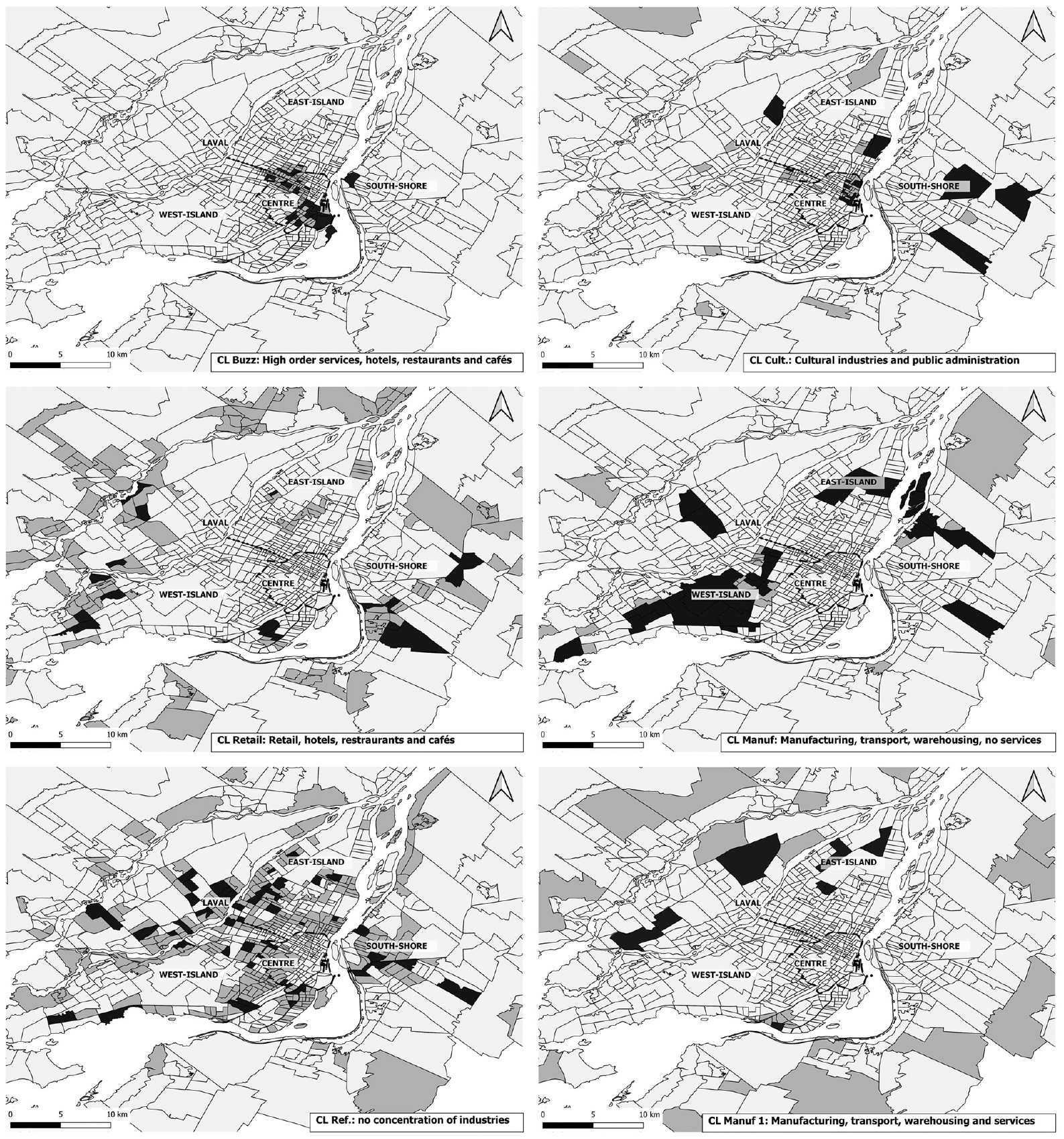
Geography of observations and economic clusters in Montreal.
Descriptive statistics.
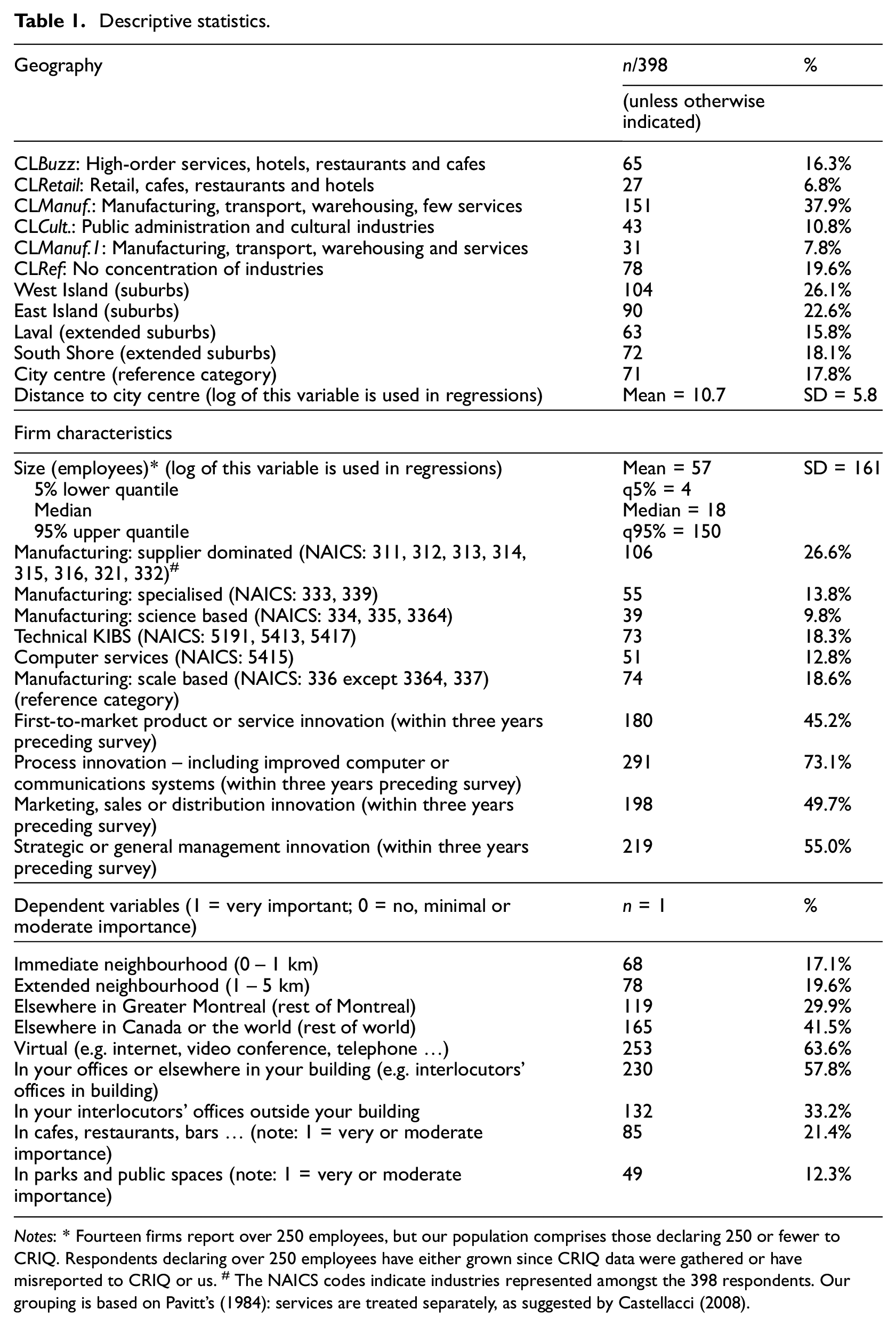
Notes: * Fourteen firms report over 250 employees, but our population comprises those declaring 250 or fewer to CRIQ. Respondents declaring over 250 employees have either grown since CRIQ data were gathered or have misreported to CRIQ or us. # The NAICS codes indicate industries represented amongst the 398 respondents. Our grouping is based on Pavitt’s (1984): services are treated separately, as suggested by Castellacci (2008).
Using postal codes, each firm is positioned in its census tract, for which we have detailed place-of-work data from the 2016 census allowing us to characterise the firm’s economic environment (Figure 1; Appendix A1). We use the 2016 census because we are unsure of the extent to which 2021 census data reflect COVID-19-related perturbations. The 2016 data reflect each neighbourhood’s longer-term economic profile.
Method
For each census tract we have place-of-work information for 20 two-digit NAICS sectors covering the whole economy. Following Shearmur and Coffey (2002), we transform tract-level job information into potentials. So, for each sector s in tract i:


where Psi is the employment potential of sector s in tract i, esi is employment in sector s in tract j and dij is the distance in km between the centroids of tracts i and j. Transforming employment into potentials allows surrounding tracts to be taken into account at a rapidly decreasing rate: with a minimum distance set at 500 m, employment in a tract 5 km distant contributes 100 times less to potential than employment in the tract itself. However, many tracts towards the city centre are small, so neighbouring tracts cannot be ignored; in the densest areas, neighbouring tracts will contribute equally to potential (Figure 1).
Measures of potential tend to decline with distance from the centre. Therefore, they are transformed into location quotients, which measure the local concentration of each sector relative to the local concentration of total employment, taking into account surrounding census tracts following the distance decay function of equation (2):

where LQsj is the location quotient of sector s in census tract i; Ptj is the potential for total employment in census tract i; and n is the total number of census tracts.
Twenty location quotients are too many to analyse: again, following Shearmur and Coffey (2002), we perform a principal components analysis (Appendix A1) to identify six components that identify sectors that tend to co-locate. A Ward cluster analysis is performed on the component scores to generate sectoral profiles for each tract (Appendix A1): these profiles are used to characterise the economic environment of the neighbourhood within which our observations are located (Figure 1, Table 1). Each cluster therefore represents a different urban context with local access to a different combination of local economic activities and of potential sources of knowledge and information. The reference cluster has low concentrations of all types of economic activity, and – from observing Figure 1– essentially consists of suburban residential areas.
Two sets of dependent variables are explored: four relate to scale and five relate to places at which knowledge exchange may be considered important (Table 1). For each of these scales and places, respondents are asked: ‘For your current activities, please indicate how important [this scale or place] is for your exchanges of scientific and technological knowledge’. The same question is also asked for ‘exchanges of practical information and know-how’.
Geographical scales are divided as follows: 0–1 km (i.e. walking distance (Watson et al., 2015) – more relevant in dense, walkable neighbourhoods), 0–5 km (i.e. extended neighbourhood, corresponding to a short drive, cycle or public transport trip – more relevant in lower-density suburban contexts), rest of Montreal (i.e. the rest of the metropolitan area beyond the neighbourhood) and rest of the world (i.e. rest of the province, of Canada and of the world). It is important to note that the 0–1 km and 0–5 km scales overlap, with the 0–5 km category being an aggregation of replies to 0–1 km and 1–5 km questions; thus, ‘rest of metropolitan area’ corresponds to exchanges that occur beyond 5 km. Distances are estimated by the respondent, so 0–1 km can be qualitatively interpreted as respondents’ immediate neighbourhood, and 0–5 km as their extended neighbourhood. The places considered are defined in the questionnaire as: virtual spaces (e.g. internet, video conferencing, phone); in own building (i.e. own offices, but also other spaces within the building); interlocutor’s offices; cafes (including bars, restaurants); and parks and public spaces. The survey instrument is provided in Appendix A4.
Respondents reply along a four-point scale: not important; minimally important; moderately important; and very important. These responses are transformed into dichotomous variables, equal to 1 if the respondent answers ‘very important’ for either of the two types of knowledge exchange.
For cafes and parks and public spaces, the proportion of ‘very important’ responses is below 5% (whereas it is above 17% in all other cases, Table 2), so their respective indicators are also set at 1 if respondents answer ‘moderately important’, ensuring that the binary dependent variables have at least 1:9 ratios of 1 to 0. This should be borne in mind when interpreting results: the likelihood of cafes and public spaces being considered important has been boosted by relaxing the definition of importance.
Proportion of respondents declaring scale/place as very important, by neighbourhood type.
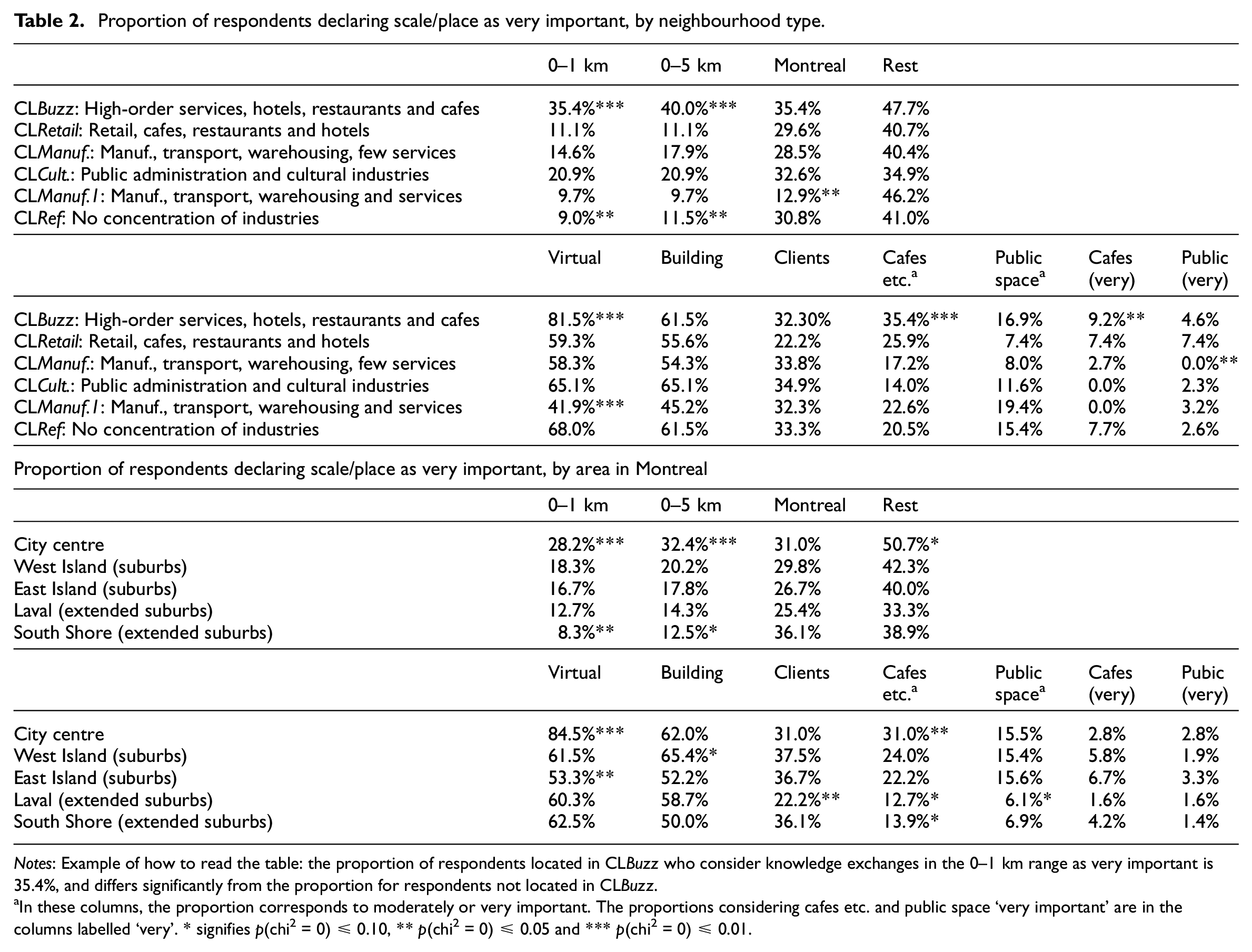
Notes: Example of how to read the table: the proportion of respondents located in CLBuzz who consider knowledge exchanges in the 0–1 km range as very important is 35.4%, and differs significantly from the proportion for respondents not located in CLBuzz.
In these columns, the proportion corresponds to moderately or very important. The proportions considering cafes etc. and public space ‘very important’ are in the columns labelled ‘very’. * signifies p(chi2 = 0) ≤ 0.10, **p(chi2 = 0) ≤ 0.05 and ***p(chi2 = 0) ≤ 0.01.
For each of the nine dichotomous variables, a logistic regression of the following form is run:

where I is a dichotomous variable recording whether the geographical scale or place is considered very important for knowledge exchange, geo is a vector of variables that characterise the firm’s location and environment in Montreal and firm is a vector of variables that characterise the firm itself. The variables are described in Table 1. Three regressions are run for each dependent variable: each block of explanatory variables is entered separately, then both blocks are entered together with backwards selection (the remain criterion is p (chi2 = 0) ≤ 0.15). The selection process reduces the number of variables in the model by eliminating those that are far from conventional significance levels: no selection process is applied when each block is entered separately, allowing for verification that no key variables are eliminated when the full (but reduced) model is run.
Results
We first briefly describe the economic geography of Montreal as illustrated in Figure 1. Although nine types of industry mix (which we refer to as clusters since they are derived from cluster analysis and correspond to specific local concentrations of economic activity) characterise the metropolitan area (Appendix A1), our observations are located in six of them (Figure 1). Clusters Buzz (high-order service sectors, hotels, restaurants and cafes) and Cult. (public administration and cultural sectors) characterise the centre of Montreal: Cluster Buzz characterises the Central Business Districts (CBDs) and gentrified neighbourhoods such as the Plateau, Mile End, Griffintown, Rosemont and Westmount. Members of cluster Cult. lie immediately to the East of the CBD extending into Hochelaga, which is at an early stage of gentrification.
The industry mix of cluster Cult. also characterises some suburban census tracts, corresponding to local administrative and cultural centres. Cluster Manuf. corresponds to Montreal’s major suburban economic areas, with high concentrations of manufacturing, warehousing and transport activities. Cluster Retail corresponds to suburban areas, many of which include, or are close to, shopping malls and power centres. Cluster Manuf.1’s profile resembles cluster Manuf.’s, but incorporates some services sectors. Its members often lie at the edges of cluster Manuf. Cluster Ref. corresponds to areas that are essentially residential: some of its tracts incorporate economic activity, but not in a concentrated fashion. Appendix A3.2 details how these clusters are distributed across Montreal’s central and other areas.
The minor importance of local scale for knowledge exchange – except in buzzing neighbourhoods
Overall, local or micro-local scales are unlikely to be considered very important for knowledge exchange. This is evident from descriptive statistics (Table 1), and is further emphasised by Table 2: across all neighbourhood-level environments, firms are most likely to consider rest-of-world exchanges as very important, and are more likely to consider metropolitan- than local-scale exchanges as very important.
There is an important proviso to this statement. Firms in neighbourhoods that can be qualified as buzzing (CLBuzz: high-order service sectors, hotels, restaurants and cafes) are more likely to consider the local scale to be very important than firms in other geographical contexts, though they remain most likely to consider the national/global scale very important (Table 2). 1 Indeed, firms in buzzing neighbourhoods display a general openness to knowledge exchanges at all scales. A similar, though less marked, proviso applies to firms located in the city centre where most of the buzzing neighbourhoods are found.
Turning now to places, firms in buzzing neighbourhoods and in the city centre are more likely to consider cafes and restaurants as important venues for knowledge exchange, although these are considered less important than virtual spaces, buildings and interlocutor offices.
This is a key result: it partly corroborates studies observing micro-local agglomeration, such as Rosenthal and Strange (2003) and Arzaghi and Henderson (2008), and which infer the importance of local knowledge spillovers. However, our observations qualify these studies in two ways.
First, our results do not lend themselves to the conclusion that firms in the city centre and/or in buzzing neighbourhoods place particular value on local knowledge exchange: in fact, these firms are somewhat more likely to place value on national and global knowledge exchanges and on virtual exchanges (Table 2). It is only relative to other geographical contexts in the city that firms in these locations place more value on local knowledge exchanges and on those occurring in third spaces.
Second, agglomerations of manufacturing, transport and warehouse activities (CLManuf; CLManuf.1) do not increase the likelihood of local knowledge exchanges being considered very important. Thus, not all agglomeration, even of export-orientated activities and services, is equal in this respect.
Factors associated with the importance of scale and place for knowledge exchange
In ‘The minor importance of local scale for knowledge exchange – except in buzzing neighbourhoods’ section we established that, across most environments except the city centre and buzzing neighbourhoods, few firms consider neighbourhoods (or third spaces such as cafes) as important venues for knowledge exchange, whereas more consider the global scale and private spaces as important. In this section, we explore to what extent contextual factors (i.e. the neighbourhood’s industrial mix; its general position within the Montreal region; its distance from downtown) and firm-level factors (i.e. size, sector and innovation activity) contribute independently – after controlling for other factors – to explaining, in a statistical sense, the importance that firms assign to different scales and places of knowledge exchange.
Factors associated with the importance of different scales for knowledge exchange
The local scale: It is principally geographical factors that associate with valuing local knowledge exchanges. Firm-level characteristics are not, as a group, significantly associated with it (Table 1, B′, B; Appendix A2), although firms in the supplier-dominated manufacturing sector (such as foods, clothing and textiles) are more likely to value neighbourhood-scale knowledge exchanges (Table 3, C′, C), as observed by Rantisi and Leslie (2010) in Montreal’s Mile End.
Geographical scales rated ‘very important’ for knowledge exchange.
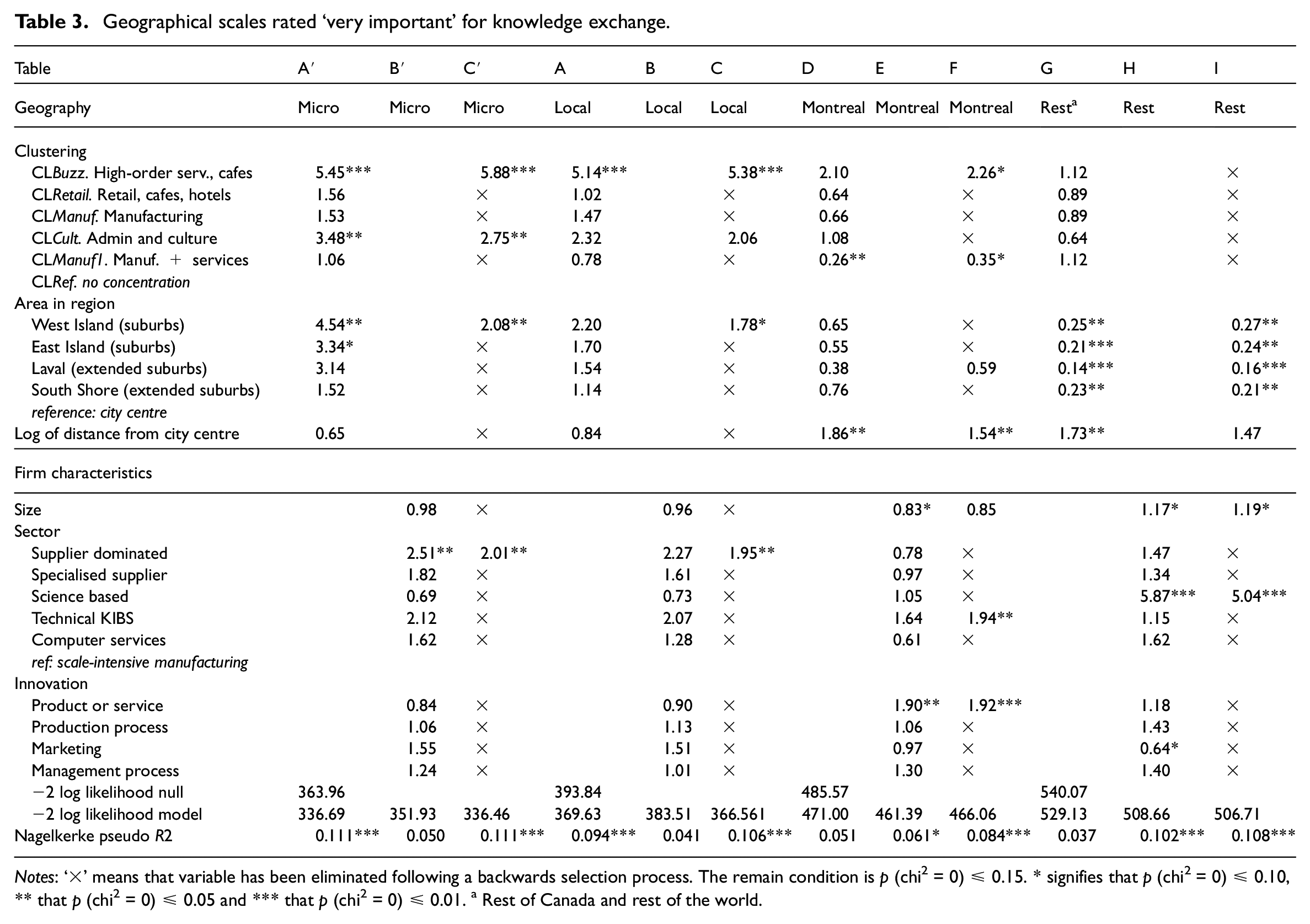
Notes: ‘×’ means that variable has been eliminated following a backwards selection process. The remain condition is p (chi2 = 0) ≤ 0.15. * signifies that p (chi2 = 0) ≤ 0.10, ** that p (chi2 = 0) ≤ 0.05 and *** that p (chi2 = 0) ≤ 0.01. a Rest of Canada and rest of the world.
Although the local scale is least likely to be considered important across the board, our multivariate analyses confirm that firms located in environments with high concentrations of high-order services and amenities (such as restaurants and retail – CLBuzz; cultural industries and public admin – CLEnt) are relatively more likely to consider it important than firms elsewhere (Table 2; Table 3, A′, C′, A, C). Firms located in the West Island suburbs (where many high-tech sectors locate, close to the airport –Duvivier et al., 2018) are also relatively more likely to value localised knowledge exchange (Table 1, A′), principally at the micro (0–1 km) scale.
Metropolitan scale: Neither local context (Table 1, D) nor firm-level characteristics (Table 3, E) discriminate much between the importance that firms assign to knowledge exchanges at the metropolitan scale. This scale is considered more important as distance from the centre increases (Table 3, D, F), by T-KIBS, and by firms that have introduced new-to-market products or services (Table 3, F and Appendix A2). It is notable, in the context of discussions about the scale at which agglomeration economies operate, that these innovators do not particularly value neighbourhood-level knowledge spillovers, but value wider metropolitan (and global) scales (Appendix A2).
Global scale: Firm-level characteristics are closely associated with the likelihood of valuing the global scale (Table 3, H, I) – they drive the overall model (Table 3, I). The key association is between science-based firms and valuing the global scale (Table 3, H, I; Appendix A2) – this is commensurate with theory to the extent that science-based firms rely on technical and scientific information, which tends to be codified (i.e. more easily transmissible) and which is global in scope (i.e. which cannot be replaced by alternative local or metropolitan sources) (Howells, 2002; Shearmur and Doloreux, 2015).
Although, overall, geographical context is not significantly associated with the importance of global-scale knowledge exchanges, two apparently contradictory results emerge. First, it is firms in the city centre that are most likely to consider the global scale important (Table 3, G, I); second, as firms locate further from the city centre (Table 3, G), the likelihood of considering the global scale important increases. A U-shaped pattern emerges, whereby it is firms downtown and those in the outer suburbs which most value the global scale for knowledge exchange.
Overall, two broad patterns are revealed by our analysis of scale.
First, as we move from local to global scales, the statistical explanatory power of geographical and firm-level factors switches. Valuation of the local scale is driven by geographical factors (Table 3, A′, C′, A, C): firm-level factors (Table 1, B′, B) are, as a group, not significant. For the Montreal scale, neither geographical (Table 3, D) nor firm characteristics (Table 3, E) have much explanatory power, though the reduced model shows that both play a role (Table 3, F). For the global scale, it is firm characteristics that predominate, with only minor variation across different geographical contexts (Table 3, G, H, I).
Second, although, when compared to other types of neighbourhood, firms in central and ‘buzzing’ places assign more value to micro-local knowledge (Table 3), in absolute terms– even in these neighbourhoods – micro-local exchanges are valued less than global exchanges and are on par with Montreal-scale exchanges (Table 2). Across the rest of Montreal – including suburban clusters based upon manufacturing sectors – micro-local exchanges are valued substantially less than Montreal and global-scale exchanges.
Factors associated with the importance of different places for knowledge exchange
Virtual spaces
Virtual places are the most likely to be considered very important for knowledge exchange (Tables 1 and 2; Appendix A2), and it is firm-level characteristics (as opposed to contextual ones) that explain variation across firms. T-KIBS and computer service firms are more likely than firms in other sectors to rate virtual spaces as very important, as are management (and to a lesser extent product or service) innovators and larger firms (Table 4, A, B, C).
Places rated ‘very important’ for knowledge exchange. a
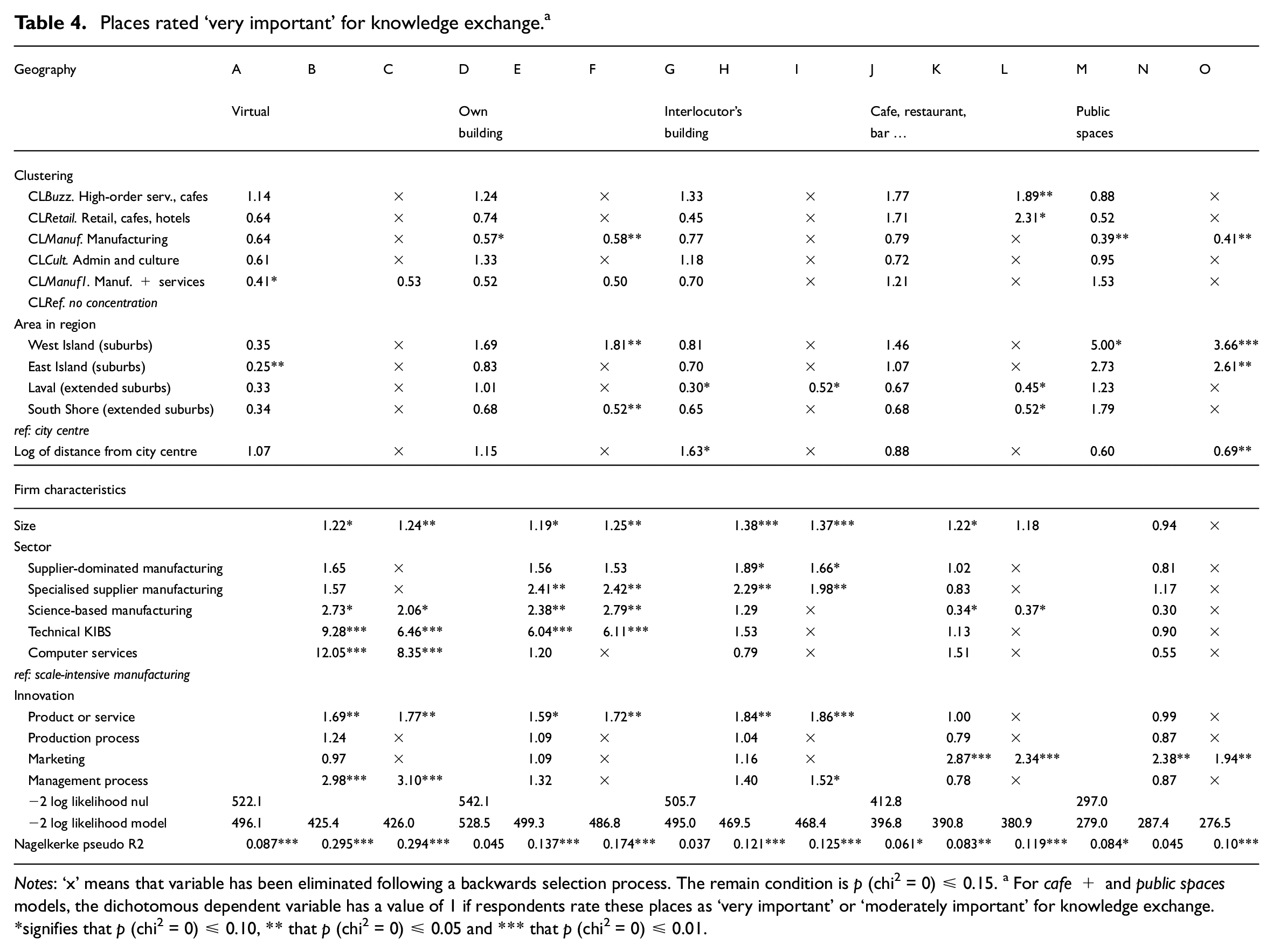
Notes: ‘x’ means that variable has been eliminated following a backwards selection process. The remain condition is p (chi2 = 0) ≤ 0.15. a For cafe + and public spaces models, the dichotomous dependent variable has a value of 1 if respondents rate these places as ‘very important’ or ‘moderately important’ for knowledge exchange. *signifies that p (chi2 = 0) ≤ 0.10, ** that p (chi2 = 0) ≤ 0.05 and *** that p (chi2 = 0) ≤ 0.01.
Own building
Exchanges within one’s building are also considered very important by many firms (Tables 1 and 2). Although, taken individually, it is firm characteristics that explain variations (Table 4, D, E), in the full model some geographical factors emerge as significant (Table 4, F). Firms in manufacturing, warehouse and transport districts (CLManuf) are less likely to rate knowledge exchange within their own buildings as important, as are firms in the extended South Shore suburbs (Table 4, F). This contrasts with firms in the closer West Island suburbs (suburbs located closer to the airport that tend to house more high-tech firms), which are more likely to rate their own buildings as important (Table 4, F). Firms in the specialised, science-based and T-KIBS sectors are more likely to rate their buildings as important venues for knowledge exchange, as are larger firms and product or service innovators. Computer services are least likely to rate their own buildings as important (Table 4, E, F).
Interlocutor offices
Firm-level factors also dominate the explanation of differences in the importance of interlocutor offices for knowledge exchange (Table 4, H, I). It is larger firms, and lower-tech manufacturing firms in the supplier-dominated and specialised supplier sectors, that place more importance on them. Just as for virtual and own-building knowledge exchanges, it is first-to-market product or service innovators that are more likely to value outside offices for the purpose of knowledge exchange.
Cafes and restaurants, public spaces
Few firms rate cafes and restaurants or public spaces as ‘very important’ for knowledge exchange (Table 2). For this reason, the chosen dependent variable records respondents for whom these spaces are ‘moderately’ or ‘very’ important: thus, the importance levels recorded in Tables 1, 2 and 4 are boosted relative to other places and spaces. This does not affect how we interpret factors associated with the variation of this measure of importance.
It is firms located in ‘buzzing’ neighbourhoods (CLBuzz), and to a lesser extent in neighbourhoods with concentrations of food and retail (CLEnt.), that are more likely to consider cafes and restaurants to be important: in contrast, firms located in extended suburbs are least likely to consider cafes and restaurants to be important (Table 4, L). Interestingly, marketing innovators – those most closely tied to cultural knowledge and to creative processes – are most likely to value cafes and restaurants as venues for knowledge exchange (Table 4, L).
This result – the association between marketing innovation and the importance of cafes and restaurants for knowledge exchange – also holds for parks and public places (Table 4, O). However, it is mainly geographical factors that associate with the likelihood of valuing parks and public places: firms in the East and West Island suburbs are more likely to consider them important, as are firms located closer to the city centre. Firms located in neighbourhoods dominated by manufacturing, transport and warehousing (CLManuf.) are least likely to value these places.
Taking a step back from these detailed relationships, four broad results emerge.
First, fewer than 5% of respondents consider either cafes and restaurants or public spaces as ‘very important’ for knowledge exchanges (Table 2). Whatever the patterns that emerge from our analysis, the overwhelming result is that it is private spaces that are considered ‘very important’ for the purposes of knowledge exchange: regression results for cafes and restaurants and public spaces include respondents that rate them as ‘moderately important’.
Second, it is principally firm-level characteristics that associate with different levels of importance assigned to private spaces: in contrast, contextual elements play a role when it comes to the importance of cafes and restaurants and public places.
Third, larger firms are more likely to assign importance to private places than smaller firms.
Finally, whereas new-to-market product and service innovators are more likely to consider private places (virtual, own building, interlocutors, offices) as important for the purpose of knowledge exchange, marketing innovators are more likely to place value on external venues such as cafes, restaurants and public places: this result should be interpreted in light of the low likelihood for these external places to be considered important (Table 2).
Discussion and conclusion
In this article, we adopt an original approach to studying the scales and places at which knowledge exchanges are considered important. Unlike many studies of the micro-geography of agglomeration economies (such as Adler et al., 2019; Arzaghi and Henderson, 2008; Rammer et al., 2020; Rosenthal and Strange, 2003) – which observe the scale and location at which agglomeration occurs, and infer the role played by knowledge spillovers – we directly survey firms in Montreal to assess and record the importance they attribute to knowledge exchanges at specific scales and in specific places.
Our results are in keeping with the nuanced findings of qualitative studies such as Bathelt (2005), Huber (2012) and Currid (2007)– some of which find that neighbourhood-scale interactions are important, others of which find them unimportant or absent. Unlike case studies of particular clusters, our study is city wide, resting on a sample of 398 firms, representing the manufacturing, technical and computer services sectors.
On the one hand, our results confirm that there exist specific types of neighbourhood – towards the city centre and in which cultural services and public admin, or high-order services, food services and retail, concentrate – where neighbourhood-scale and third-space interactions are considered relatively more important than they are across the rest of the city. This lends some confirmation to the idea of buzzing neighbourhoods (Duvivier et al., 2018; Storper and Venables, 2004) and of localised knowledge interactions (Rammer et al., 2020).
On the other hand, this confirmation is tempered by the fact that, even in these buzzing neighbourhoods, third spaces and local interactions are far less likely to be deemed very important for knowledge exchange than are global interactions, own building and virtual spaces: in buzzing neighbourhoods, only 40% of respondents consider local knowledge exchanges very important (the highest proportion across different types of neighbourhood, Table 2), whereas 48% consider global exchanges important, 82% virtual exchanges and 62% own-building exchanges. Even in buzzing neighbourhoods (and the city centre), local interactions are only considered very important by just over a third of respondents.
Two other elements temper the idea that local-scale interactions systematically underpin the micro-agglomeration of economic actors.
First, it is only two types of central environment – linked to high-order services and cultural services – that are associated with the importance of neighbourhood-scale knowledge exchange. Other types of environment – those that concentrate manufacturing (mainly suburban) – are not connected with local or with third-space knowledge exchanges. This does not preclude the possibility of smaller-scale (e.g. within-building, or within a few hundred metres) knowledge exchange dynamics (Rammer et al., 2020), nor of specific circumstances where local knowledge exchanges take place, but does show that – at the neighbourhood scales we have studied (i.e. 1 km and 5 km radii) – most firms do not consider local knowledge exchanges to be of primary importance to their activities.
Second, innovation activity is emphatically not associated with the perceived importance of neighbourhood-level exchanges. It is only for the metropolitan scale – a scale usually associated with urbanisation economies – that new-to-market product and service innovators are more likely to assess knowledge exchanges as very important. Similarly, these technological innovators only place importance on knowledge exchanges in private, controlled spaces (virtual space, own building, interlocutor offices): they do not value exchanges in third spaces or public space. It is marketing and sales innovators that are somewhat more likely to value knowledge exchanges in third spaces (cafes and restaurants, and public spaces).
Our study does not contradict previous studies, but questions some inferences they make: whilst our results do not preclude the possible existence of specific neighbourhoods in Montreal in which localised exchanges are valued and are associated with innovation, they strongly suggest that innovation does not require localised knowledge exchanges, and that such exchanges are generally considered less important than non-local exchanges. Although the firms we survey may locate in dense ‘buzzing’ neighbourhoods because they value local interactions – which we corroborate to some extent in certain central districts – this is not connected with innovation activity. Furthermore, knowledge acquired in third spaces is only considered important by marketing innovators (and then only moderately so). Thus, findings such as Arzaghi and Henderson’s (2008), which focus on a downtown advertising cluster, should not be generalised beyond this specific sector and type of location: this is important, because studies such as theirs have been generalised and have been presented as evidence of the importance of localised knowledge exchanges (e.g. Adler et al., 2019). Likewise, studies such as Rosenthal and Strange’s (2003), which cover a wider array of sectors, should be read carefully: they document the spatial agglomeration of similar activities, but their conclusions with respect to local interactions are inferences, not observations.
Our results therefore raise questions. Agglomeration is abundantly documented at various scales (Adler et al., 2019; Ellison et al., 2010; Fujita and Thisse, 2013; Rosenthal and Strange, 2003). Marshall (1890) proposed three drivers of agglomeration, which are still by and large accepted (Ellison et al., 2010; Storper and Venables, 2004): proximity to markets, access to labour and knowledge spillovers. Other reasons for agglomeration can be prestige (Huber, 2012), access to infrastructure (McCann and Shefer, 2004) and building type (Powe et al., 2016) – the latter itself related to land-use regulation and the historic development of cities.
Thus, there are many possible explanations for observed spatial concentrations of sectors. It is striking, however, that many researchers have chosen to infer that micro-scale concentrations are connected with localised knowledge spillovers: these exist in some contexts (Currid, 2007; Rantisi and Leslie, 2010; our own results), but in an age of virtual exchanges – the type of exchange considered very important by most respondents – it is heroic to assume that localised spillovers systematically underpin spatial micro-agglomeration.
Yet micro-agglomeration is undeniable for some sectors and firms. If not spillovers, what can drive micro-agglomeration? What role do the many other possible drivers of micro-local agglomeration (often of activities in related sectors) play? Future studies should carefully explore under what conditions micro-local spillovers exist, rather than infer their existence. Are they relevant for technological (as opposed to marketing or cultural) innovative activity? Are knowledge exchanges at other scales complements or substitutes to micro-local exchanges? Our study cannot address these questions: however, it provides reasons to explore them, to back away from the assumption that micro-scale agglomeration necessarily corroborates the importance of local knowledge spillovers and to question the assumption that micro-level knowledge exchanges, when they occur, play an important role in innovation processes.
Our study is exploratory and is limited to a cross-sectional analysis of manufacturing and technical service industries in Montreal. Unlike other studies (e.g. Arzaghi and Henderson, 2008; Rammer et al., 2020), it does not identify firms located in specific micro-agglomerations: rather, it surveys firms across the whole metropolitan area, assesses the importance they assign to specific geographical sources of knowledge and information, then examines whether this importance is related to their location within certain types of neighbourhood – characterised by economic profile – and to their innovation activities. This approach provides a general assessment of the value assigned to localised knowledge exchanges and of the factors associated with them, but does not allow for the identification of specific neighbourhoods where such exchanges may indeed be important, which we recognise as a possibility.
Finally, our findings are not definitive – our approach to studying the scales and places of knowledge exchange is novel: it directly measures the perceived importance of knowledge exchanges rather than inferring it, but further similar studies are necessary. Our study’s principal contribution is to unsettle the rather comfortable inferences that have regularly been made about the importance of neighbourhood-level knowledge spillovers for the operation of firms and for their innovative activities in an age of non-Marshallian virtual exchanges.
Footnotes
Appendix A1
Appendix A2
Appendix A3
Appendix A4
Acknowledgements
We would like to thank the editor and three anonymous reviewers for their constructive suggestions with respect to earlier drafts of this article. The authors are solely responsible for this final version. Richard Shearmur would also like to thank the Harris Centre, Memorial University, for hosting him during his sabbatical during which this article was written.
Declaration of conflicting interests
The author(s) declared no potential conflicts of interest with respect to the research, authorship, and/or publication of this article.
Funding
The author(s) disclosed receipt of the following financial support for the research, authorship, and/or publication of this article: The project was funded by the Chair on innovation and regional development at HEC Montreal.
