




Abstract
Contemporary suburban landscapes have developed at scale, in variety, at speed and with ethnic concentrations or superdiversity. These complexities call for the reworking of urban theory and method. In this paper we contribute on both fronts. We develop an interpretative framework that emphasises the mediation of the production and consumption of new suburbs. Methodologically, we analyse on-site billboards as ‘technologies of enchantment’ that provide insight into the symbolic mediation of the production and consumption of new suburbs. We visually inspected 114 billboards and 38 active residential developments in the City of Wyndham – a rapidly growing suburban municipality in Australia. Our research sheds empirical light on how increasingly standardised production and consumption by an increasingly varied profile of residents are reconciled in the symbolic (re)enchantment of suburbanism as a way of life. Our findings indicate the value of future research into: ways of life in systemically produced suburbs; the agency needed to fashion community in extensive mass produced suburbs; and new forms of consumer society-related alienation in suburbia.
Introduction
We live in an extended urban and (post)suburban world (Brenner and Schmid, 2014; Keil, 2017; Phelps et al., 2006; Phelps and Wu, 2011). As such, analyses of suburbs and processes of suburbanisation are vital to the remaking of theory and method in urban studies from the outside in (Alam, 2023; Keil, 2017; Phelps, 2021; Soja, 2000). Suburbanisation also presents challenges to practices of suburban retrofit (Dunham-Jones and Williamson, 2011) shot through as it is with contradictions (Phelps et al., 2010). Much remains to be understood, then, about the appeal of the suburbs that we produce and consume across the Global North in the face of a shift in the zeitgeist in built environment practice from garden to compact city ideals.
Melbourne’s growth areas are prime cases from which to offer theoretical and methodological contributions regarding the contradictions of suburbanisation. In contrast to the social homogeneity emphasised in established accounts of suburbanisation, contemporary Global North suburbs have developed at scale, in variety, at speed and with particular ethnic concentrations, on the one hand, or ‘superdiversity’ on the other (Li, 1998; Vertovec, 2007). First, then, these complexities necessitate an interpretative framework that emphasises the mediation of the production and consumption of new suburbs in the face of increasing socio-economic, ethnic and other group identity diversity. In this connection, billboards have featured in popular cultural representation and academic analysis of suburbs (Rowley, 2015) as visual devices that provoke consumption of nature, amenities and identities through consumption of housing (Collins and Kearns, 2008; Gillon and Gibbs, 2017; Kern, 2010). Second, then, we analyse on-site billboards as ‘technologies of enchantment’ (Harvey and Knox, 2016) to provide insight into the symbolic mediation of the production and consumption of new suburbs.
In the remainder of the paper, we review the literature on the production, mediation and consumption of suburbia. We then proceed to describe the research methods employed to explore these themes. We present evidence from an inspection of billboards associated with 38 active residential developments in the outer suburban city of Wyndham, 30 km to the west of the City of Melbourne: a case with which to explore the evolution in the ‘Australian Dream’ of owning a suburban home. We conclude by offering additional insights for future research on contemporary suburbanisation, which stem from our findings. These insights include how suburbanism as a way of life may be circumscribed by the way in which suburban form is mass produced, the agency needed in order to fashion community from extended forms of urbanisation, and the potential for alienation associated with suburban housing and amenity consumption.
The (re)enchantment of suburbia in consumer society
Global North suburbs have often been subject to dualistic interpretations in academic analysis: here standardised cookie-cutter developments, there niches of lifestyle developments aimed at particular demographics; here the exclusively white middle-class suburb, there the ethnoburb or superdiverse suburb. However, these dualisms do not do justice to the complex interactions between the production, mediation and consumption of contemporary suburbs that we conceptualise in Figure 1. Standardisation in production has been one constant in the transition from organisational to consumer suburbs across the Global North – although it may be masked by an appearance of variety in urban forms in, and the agency promised by, suburban superdiversity and the opportunities for consumption of ‘stuff’ (Miller, 2010). In this paper we underline how the mass systemic production of suburbs does not preclude some variety in (new) suburban forms and is accompanied by agency on the part of a diversity of consumers in suburbs when compared to that in organisational suburbs.
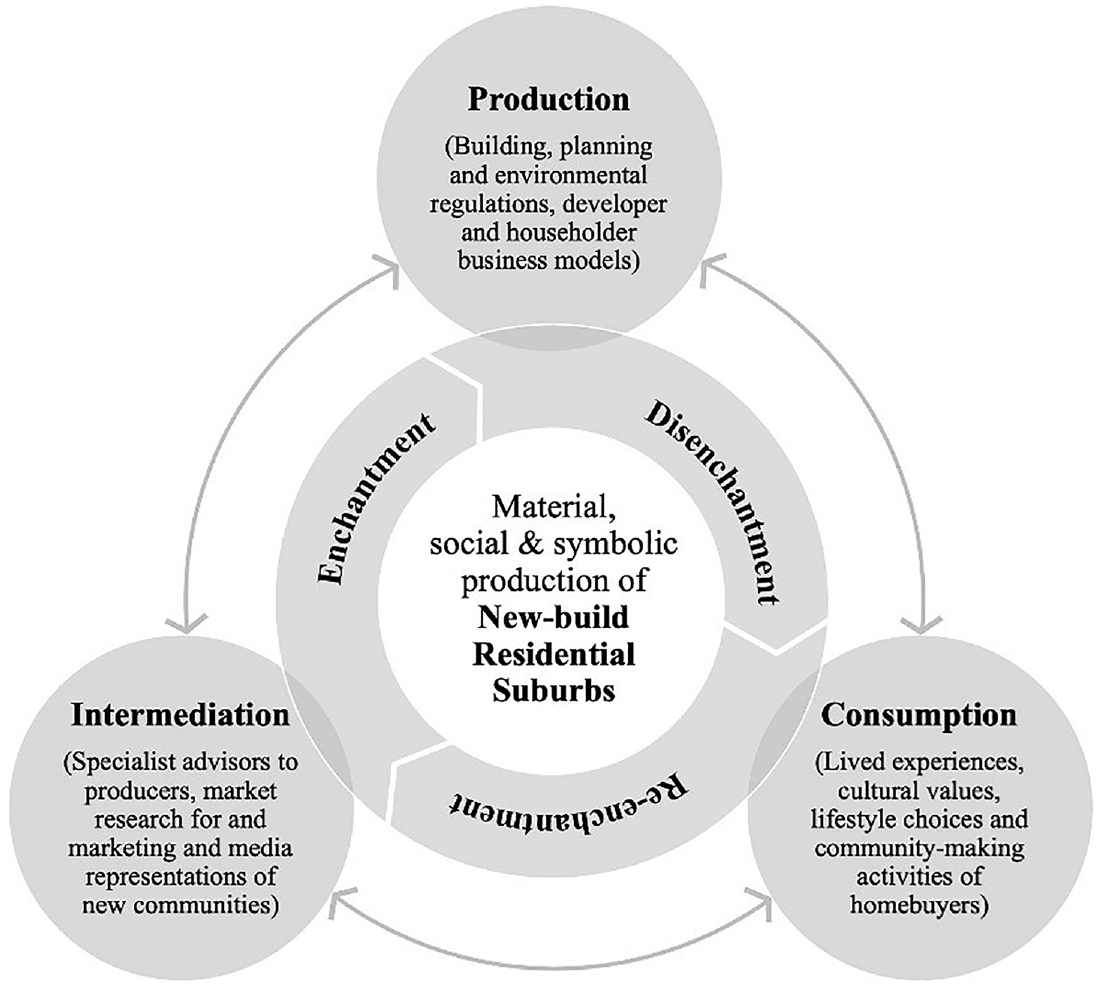
Conceptual framework.
The production of suburban landscapes: Standardisation and variety
Levittown became emblematic of standardisation in the production of suburbia in the early postwar years in the US and elsewhere across Global North liberal market economies. The production of suburbs went hand-in-hand with consumption of new mass-produced and marketed household goods: cars, refrigerators, cookers, vacuum cleaners (Walker, 1981). Little wonder that the newly built suburbs could be interpreted as locales for the ‘creeping conformity’ (Harris, 2004) embodied by ‘organisation man’ (Whyte, 1956).
Contemporary variety in the production of suburban landscapes is seen in the rise of ‘McMansions’ (Knox, 2008) and New Urbanist or lifestyle niches (Grant, 2005); the embrace by suburban jurisdictions of a variety of housing types and land uses in response to changing demographics (Nelson, 2009) and post-suburban realities of funding public services (Phelps, 2015); and COVID-19 pandemic-induced housing typologies that include home office spaces.
Despite being more diverse in some of its materiality, the production of suburbs has become more systematic and administered (Phelps et al., 2023). Underlying increased variety in the appearance of (post)suburban residential landscapes is the economics of standardisation in housing production (Adams and Watkins, 2008). Standardisation is apparent in subdivision design, the strategic planning and permitting of development, suburban residential architecture and housing typologies, and house construction techniques. This standardisation results from rising land prices and economies of scale generated in the materials supply chains involved.
Selling the suburbs: From organised capitalism to consumer society
This standardisation in the production of residential suburbs notwithstanding, suburban housing has reflected important differences in societal attitudes and opportunities for upward social mobility across Global North liberal market economies. In the US, exclusionary zoning has played an uneven part in the socio-economic transitions possible through residential property markets (Whittemore, 2021), in contrast to the entrenched class divides found in the UK (Healey et al., 1988) and the historically egalitarian complexion of Australian suburbs (Gleeson, 2006). These differences also have a bearing on what we understand as suburbs: in the US, even the smallest of suburbs, in population or land area, are commonly incorporated as separate jurisdictions, whereas in the UK and Australia, suburbs are understood as neighbourhoods within local government jurisdictions.
Speaking to the US case, Knox (2008) highlights how suburbanism as a way of life lost its spell-like hold on, or enchantment for, consumers to be once again re-enchanted by ‘exchange professionals’. An understanding of the work of intermediaries such as ‘exchange professionals’ is central to reconciling the agency seemingly exercised with respect to the consumption of highly standardised, if uniquely expensive, commodities (houses) as ones uniquely invested with meaning (as homes). These intermediaries include the likes of the real estate agents but also surveyors, land brokers, market research and marketing companies and even lawyers, architects, planners and other design consultants that help articulate the complex public–private systems by which new suburbs are produced and consumed.
Intermediaries perform a variety of roles in economic systems (Wood and Phelps, 2018), but little scholarship has addressed how, in what ways, and to what effect they shape the recursive connections between the production and consumption of newly built suburbs. Intermediaries may contribute to innovation and efficiencies in the workings of market mechanisms. However, their main role appears to be in helping articulate production and consumption rather than influencing more sustainable housing or design formats (Phelps et al., 2023). Here intermediaries are involved in the ideation, digital rendering and mediation of (sub)urban life (Degen and Rose, 2022).
Mass produced residential suburbs initially enchanted the white middle-class populations who moved into the postwar suburbs of national varieties of organised capitalism across the Global North. New consumer suburbs continue to be mass produced: they are less the product of design or planning as the product of bureaucratic or administrative processes (Phelps et al., 2023). Nevertheless, suburbs have been (re)enchanted through variety of forms and consumption opportunities. ‘Marketing specialists often create seductive first impressions at the expense of considerations that turn out to be more important for residents as years go by’ (Langdon, 1994: 69). Today, the text and images used to sell Global North suburbs are required to work harder than before to appeal to the tastes of a diverse and shifting range of consumers: intermediaries facilitate (re)enchantment through the accelerated (re)attachment of symbols to new suburbs and the ways of life they promise (Phelps, 2017). Where once suburbs could be sold in settled and readily interpreted images and meanings attached to suburban houses and neighbourhoods, they now must be (re)enchanted in ways that appeal to more and frequently shifting consumer identities and ways of life.
Consuming the suburbs: Agency and alienation
Suburbs are landscapes of the imagination, the consumption of which has not remained unchanged. The advertising of organisational suburbs projected some of the intangibles of suburban life (Henthorn, 2006: 79) that became familiar in suburban residential stereotypes of white middle-class, nuclear families, communing with nature, but was also concerned with generating new desires for material things.
The residential suburbs of today, while mass produced, are landscapes integral to a contemporary economy of signs and symbols (Lash and Urry, 1993). ‘Commodity consumption … in suburbia as everywhere else … is instrumental in the fashioning of selfhood and society’ (Archer et al., 2015: xiii). In consumer society (Lury, 1996), suburban houses have use value as shelter and a means to fashion personal, family and community identity, but they are also assets to accumulate capital and derive exchange value (Picketty, 2014), in ways that may challenge well-conceived housing design (Langdon, 1994: 76) and/or detach the meaning of the ideal home from the house as a result of various compromises made in housing sites (Alam et al., 2021: 72–73).
Suburban disenchantment coexists with enchantment and re-enchantment, as houses are sought with compromises made by home-buyers with less secure, more geographically distributed and ephemeral patterns of work, life and community-making. Evidence from the US suggests that immigrant communities have pioneered adaptations to suburban residential houses (Lung-Amam, 2017; Nicolaides, 2024). The geographic scale of new suburbs poses a challenge to urban planners (Phelps and Nichols, 2022), who struggle to address the deficits and lags in infrastructure, services and amenities that continue to be associated with new suburbs. Residents’ efforts at new suburban community-building involve the juggling of fragments of time, at numerous places and ‘non-place urban realms’ in physically extensive suburban cities in an era of automobility (Urry, 2004; Webber, 1964). The contemporary (re)enchantment of suburbia across the Global North may be every bit as unstable as the superdiversity it serves. Suburbanism as a way of life emerges less as ready-made and more than ever as a process of becoming.
Methods
We adopt a case study approach (Yin, 1989), which not only allows for context specifics but also is an approach common in the literature on suburbs and suburbanisation. The extent and variety of development projects in this suburban city offer a large sample of cases within a single case. Wyndham is emblematic of outer suburban growth in Melbourne and, to an extent, elsewhere in metropolitan areas of ‘the first suburban nation’, Australia (Phelps, 2022), and, to a lesser extent, Global North liberal market economies experiencing extensive and rapid suburbanisation (US and Canada). It is the fastest growing suburban municipality in greater Melbourne, in which planning struggles to respond to the community-making needs of residents, the majority of whom are immigrants (Roggenbuck, 2019).
Specifically, the research is based on observation of 38 active residential suburban developments and content analysis of the associated advertising text and imagery of billboards found on location. While content analysis of marketing materials has been used before in research on residential developments (Collins and Kearns, 2008; Gillon and Gibbs, 2017; Kern, 2010), we believe the combination of on-site observation of both billboards and the appearance of developments is methodologically distinct. First, the simultaneous observation of billboards and suburban form helps us develop an understanding of how and to what extent the lived realities in-the-making follow or differ from how they were imagined by consumers and systematically produced and mediated. Second, documenting both the billboard images and materialisation of developments through photographs overcomes the fleeting nature of stand-alone observation methodologies, allowing further reflection (Basil, 2011).
In approaching billboard content, we see images as representations of places and practices but also how places were first ‘seen, displayed and circulated’ (Rose, 2008: 157). Thus, the collection of and reflection on billboard photographs are an ‘ethno-aesthetic’ (Latham and McCormack, 2009: 260) response, in which images are an extension and elaboration of either an already produced or even a perceived landscape, including the diverse spatially mediated relations (Alam et al., 2020). Thus, our analysis interprets billboard images and texts as constitutive of an imagined suburban life with the promise of particular material manifestations to a target market. The observed residential sites were also cross referenced to understand residents’ alignment with and deviations from the promises and imaginations through their everyday suburban consumption.
Travelling by car, we inspected 114 billboards in 38 residential developments in Wyndham ‘live’ as of January 2024 (Figure 2). We estimate that the billboards represent over 95% of all of those present in Wyndham at the time of the survey. Of the billboards 19% featured text only, and 75% of the billboards used images. Of the 86 billboards that featured images as primary content, 36% featured people and 37% suburban amenities. Some 12% of the billboards included only subdivision plans or generic images of interior living spaces. Only 25% of the billboards with images featured couples or young parents with children. Not a single billboard focused on a particular house product. Texts such as ‘community’, ‘commute’, ‘life’, ‘nature’, ‘water’, ‘growth’, ‘quality’, ‘win’, ‘explore’, ‘pride’, among others were coded and connected with relevant secondary literature to understand the extent and nature of the suburban imaginary promulgated.
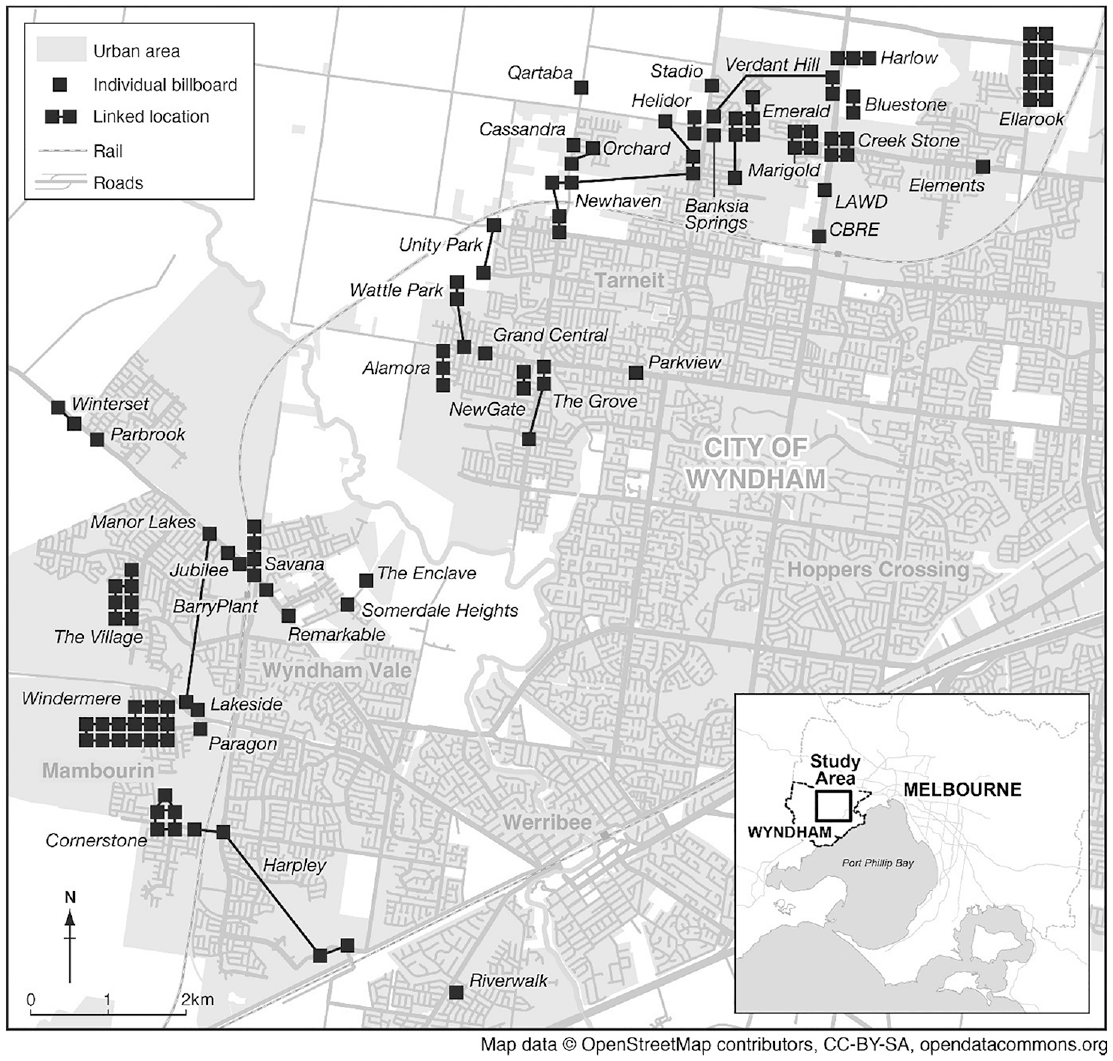
The 114 billboards and 38 residential developments in Wyndham.
For analysis, billboard images and text, site photographs and field notes were fed into NVivo and cross referenced. Following Collins and Kearns (2008: 2930), we offer an inductive analysis of the billboards’‘visual and verbal tropes’. Here our account is informed by our positionalities. The first author brings extensive knowledge of suburbanisation from Anglophone countries. As a migrant with a distinct cultural and racial background, resident and potential first-home buyer in Wyndham, the second author brings an intersectional perspective to bear. The findings were grouped into major themes and the next section reports on our framework themes of production, mediation and consumption.
The enchantment of new residential suburbs in Wyndham
The production of suburbia: Building community quickly
The production of Melbourne’s outer suburbs is regulated as part of an extensive system of public, private and intermediary actors. In the greater Melbourne context within which our case study sits, land speculation has been intense. A growth boundary was created to increase developable land supply. However, the growth boundary has failed to diminish cyclical volatility in, or halt escalation of, land prices (Ball et al., 2014; Phelps and Miao, 2023). The historic aspiration of the majority of households has been for ‘value for money’ large (three or four bedroom) detached houses with parking in an established suburb, close to family and friends (Infrastructure Victoria, 2023; Kelly, 2011). Thus, inelastic price demand for large houses has driven a decline in average plot sizes by 12% between 2012 and 2021 as developers seek to maintain the profitability of developments (Yardney, 2022). House builders are subject to fluctuations in material costs and also seek competitiveness through standardisation of designs and materials as well as supplier and labour sources. All of this produces conformity in the appearance of the developments we examined.
The local authority land use planning framework in Melbourne’s outer suburban municipalities is established in local precinct structure plans (PSPs). PSPs have been an innovation allowing the build-out of communities over extended periods, allocating land for community amenities such as parks and schools and commercial centres and equalising developer contributions and compensation payments of landowners for public facilities. There is much to commend these from the point of view of producing suburbs that now come with distributor roads and a standard array of community facilities, where in the recent past they did not (Phelps et al., 2023). Yet the development of Melbourne’s outer suburbs through a patchwork of PSPs reveals important limitations such as a housing–jobs–services disconnect that undermines the role that provision of local amenities can play in reducing travel and promoting health (Goodman and Taylor, 2022; Kroen et al., 2021). Moreover, these improvements have come at the cost of standardisation in land use planning and a lack of urban design and landscape architectural treatment of plans. Standardisation also derives from the state government being the co-designer and approver of PSPs, with local authorities primarily concerned with permitting individual development proposals. Indeed, PSP guidelines have since been revised to allow local authority planners and developers to exercise discretion.
In national contexts where there is significant concentration of capital in the retail sector, major retailers also shape the standardised physical form of suburban centres – not least, as retailers are ‘replicators’ in terms of their business models (Phelps and Fuller, 2016). These retailers have their own standardised plan templates for these centres, which are not always in keeping with the intentions of developers or planners and PSPs. The suburban centres that emerge commonly feature a limited repertoire of anchor tenants: one of the major grocery retailers (Woolworths and Coles in Australia), one of a limited number of fast-food retailers (McDonalds, KFC), a global chain petroleum garage (Shell or BP) featuring a car wash and possibly an Australian specialist retailer (Dan Murphy’s or K-Mart).
Alongside this systemic replication of development formats, there are innovations driven by both public sector regulation and private sector initiative. For example, the idea of building community facilities (such as district centres or playgrounds) ‘up front’ has become normalised among planning authorities and developers to ameliorate some of the suburban ‘blues’ and generate price premiums for residential developments. 1 Some of these elements now appear well before the houses themselves (Figure 3). Developers have started to pay more attention to the planning and landscaping of watercourses and bodies and the marketing of those features, as we discuss further below.
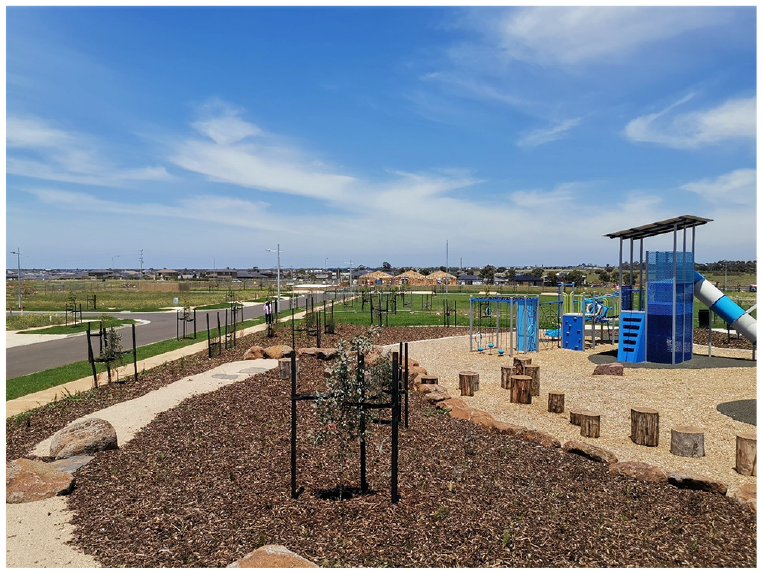
A playground without a resident population.
Our inspection of the 38 residential developments also reveals some emergent developer-initiated formulas for building new suburban communities. One formula is the sales office as café. In the smallest developments, this is little more than the sales agent serving as a barista in the showroom. However, in the largest developments (Figure 4), a café may be leased to separate operators and appear alongside a children’s playground at the outset of the development to form a hub at which the first arriving residents can congregate. This whole unit is strategically placed adjacent to the wetland/nature reserve with jogging/running/cycling tracks assembled, indicating that the sales centre would eventually be converted into a community facility. There are a few variations to this formula depending on the project size and target population. Some larger developments market club facilities exclusive to their residents. These can be large in scale, such as the one in Point Cook’s gated Sanctuary Lake development. However, we were able to observe a more modest-sized multi facility (bar, swimming pool and gym) in the case of the Heartlands development in Tarneit. The facility is exclusive to its residents with secured swipe card entry systems.
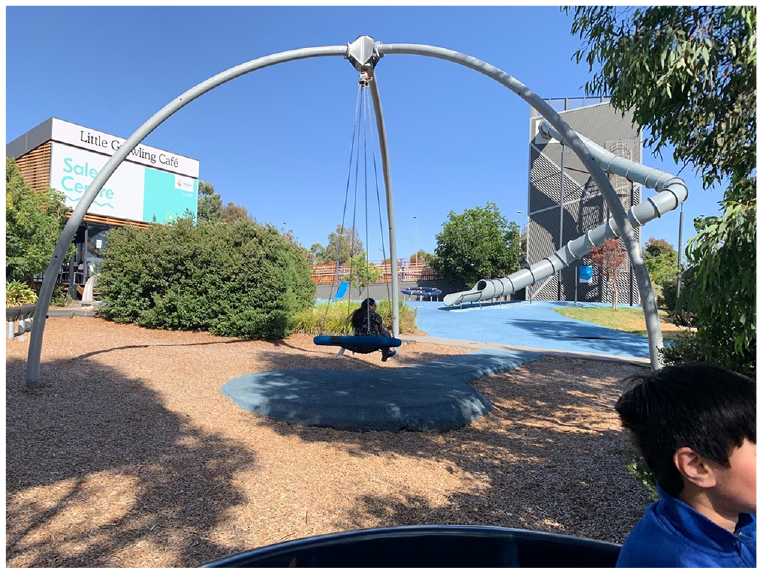
A sales centre combined with a café and a playlot.
(Re)enchanting the suburbs: Your suburb, your way
The work of mediating pressures for continued standardisation in the production of Melbourne’s outer suburbs and consumer demands for an increased variety of housing typologies and suburban form fall to a variety of intermediary organisations and professions.
Specialist land brokers, planning, urban and landscape designers, water and civil engineering service companies and market monitoring services (tracking land and house prices and estate development trends) all play a role in aiding the production of suburbs. As the environmental and design regulatory burden on planning systems has increased, so industry representative bodies and specialist private and third sector advisories have emerged to promote voluntary codes and best practices. In the Melbourne context, periodic competitions to spur innovation in housing typologies and construction materials and processes are also orchestrated by state government bodies. The national real estate industry body, the Urban Development Institute of Australia (UDIA), has its own voluntary certification scheme. The Centre for Advancing Sustainable Built Environments (CASBE) has produced sustainable subdivision standards that it has been trialling with several growth area local authorities. Other actors, such as market research companies, collect data on residential preferences and user satisfaction for housebuilders and developers. The effect of these in articulating and promoting the overall efficiency of a complex public–private system seems clear even if their intention and ability to promote innovation is limited (Pert and Phelps, 2024; Phelps et al., 2023).
Where in organisational suburbs the matrix of suburban imagery was distinct and quite stable, the marketing efforts of ‘exchange professionals’ (Knox, 2008) we were able to observe on billboards had a variety of rural landscape, urban amenity and lifestyle elements readily attached to and detached from developments that are similar in their materiality. One marketing line we were able to observe was emblematic of this. ‘Build your dream home your way’ (Figure 5) echoes a line first used by a well-known fast-food chain. In this context, it is unclear from direct observation whether and how residents relate to these statements or whether they are simply a convenient way of selling as and when demographics, tastes and aspirations change.
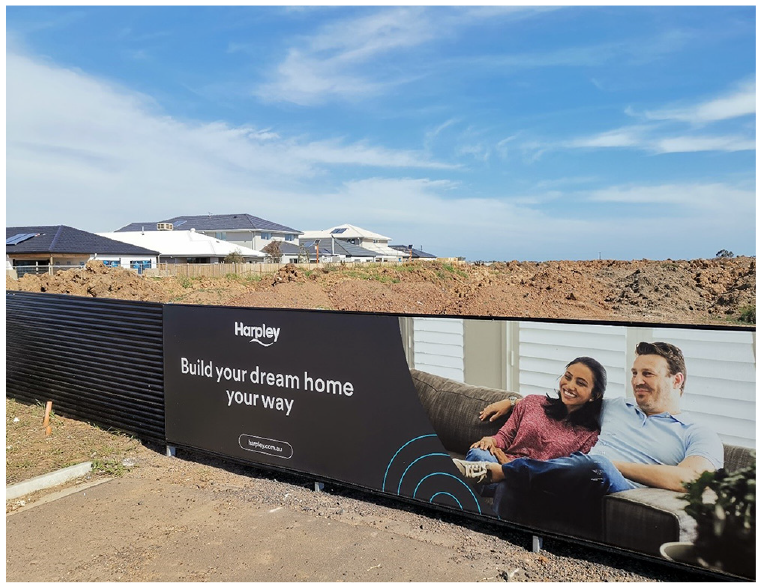
Build your home your way.
Yet advertising images were responding to a diverse and rapidly arriving immigrant population, reflecting some of the mixed ethnicity of the arrivals in Wyndham. They also seem to imply family units differently constituted to those of the single nuclear family we associate with organisational suburbs – that is, ethnically mixed couples and quite possibly a family composed of a divorced or separated couple with children from those marriages. Such images are easily assembled to reflect the origins of migrants as they arrive. Having said this, across the billboards found in Wyndham, persons of Black African origin remain noticeably absent, despite now composing an important element of the immigrant communities populating Wyndham’s new suburban communities and also visible as we surveyed the various developments.
Our fieldwork suggested that images can appear and disappear more often and at shorter notice than may commonly be appreciated. One example of a sales office and accompanying advertising was conspicuous in this regard, although it is a difficult one to interpret since it disappeared over the duration of the COVID-19 outbreak. The sales office and marketing for the ‘Urban Square’ development disappeared to be replaced by the livery of the larger Jubilee master planned development of which it was a part (alongside developments marketed as ‘Ridgetop Views’, ‘The Quarter’ and ‘Scholars Green’). Its calls to ‘an inner city-inspired lifestyle’ with a view of nature at Urban Square ‘Centred around the vibrant Urban Plaza’ and ‘European-style boulevard’ that once were visible from the roadside in Wyndham Vale, but are no longer. 2 We might ponder whether the billboard advertising for residential suburban developments – and its imagery – is as ephemeral as the display homes and sales offices, which routinely are relocated as each estate builds out.
In some instances, there is no clear or consistent image of the new suburban community that emerges. The Windemere Mambourin development project simply had multiple advertising phrases and imagery to appeal to the most aspirations for urban, suburban and rural living in a single place. The newness of the place was signalled in the slogan ‘grow into a life at Windemere’ that apparently was also ‘providing well established amenity’. Traditional appeals to settling down in a clearly identifiable place were to be found in ‘A sought-after place to call home’, yet one that had ‘connections to everything beyond’.
Consuming the suburbs: Beyond the white picket fence and lawn
In this context of the systemic mass production and mediation of contemporary suburbs, consumers continue to exercise agency in purchasing, modifying and stocking their houses, and assembling lives and lifestyles.
First, while planners and developers seek to fashion 20-minute communities in which most daily necessities are within individual PSP areas, it is residents who are left to reassemble their suburban communities. Some of the familiar build-up of specialist stores and services is apparent in or adjacent to the new suburban residential developments we were able to observe. With respect to some individual developments, this reflects the emergence of concentrations of particular ethnicities. Yet, there remain notable deficits in planning provision that drive resident improvisation and belie notions of suburban superdiversity with regard to the likes of places of worship (Laing, 2023).
Infrastructure provision, like suburban bus services and local schools, has not kept pace with settlement formation (Clure et al., 2021), forcing suburban residents into excessive automobile dependency. Suburban automobility demands a first vehicle for commuting to work and ensuring that money flows to the suburb for consumption. A variation to the first car is a van or a utility vehicle/truck indicating the householder’s occupation in the trade sector. However, the car’s value in contemporary consumer society exceeds mere utility. A second vehicle, either a solid family ‘people mover’ or a smaller ‘runaround’ for ‘managing complex daily routines’ (Dowling, 2000) of school pick-ups/drop-offs, household errands and drive-through takeaways, is often in view on a driveway. First and second vehicles may be joined by a third ‘obese’ sport utility vehicle – the suburbanite’s means of exploring the Australian outback during weekends and holidays. A variation to this is an expensive ‘muscle car’, (often an attribute of affluent suburbs (Wiesel, 2018) but visibly odd in middle-class residential suburbs) or a luxury vehicle with cultural references to the car owner’s country of origin. These latter vehicle types are a store of ‘prestige’, often a symbol both of masculinity and progress – the car as a ‘tool for (Australian) identity-making’ (Tranter, 2003: 72) for immigrant homeowners. Single extended family car collections spill out of the driveway and on to grass verges or the roadside. Being under CCTV surveillance, the vehicles described above form an extension to the house.
The double garages common with suburban houses are repurposed for a personal gym, working, or setting up business from home (Figure 6). They may also alleviate the home-storage crisis found with regard to US suburban consumer society (Arnold and Lang, 2007). In addition, the presence of extended families or parents in these homes or additional bed space for rent (Alam et al., 2021), has exacerbated the space crisis even more. With a severe lack of functional backyard space due to large construction footprints on small lots, some garages may become the family lounge.
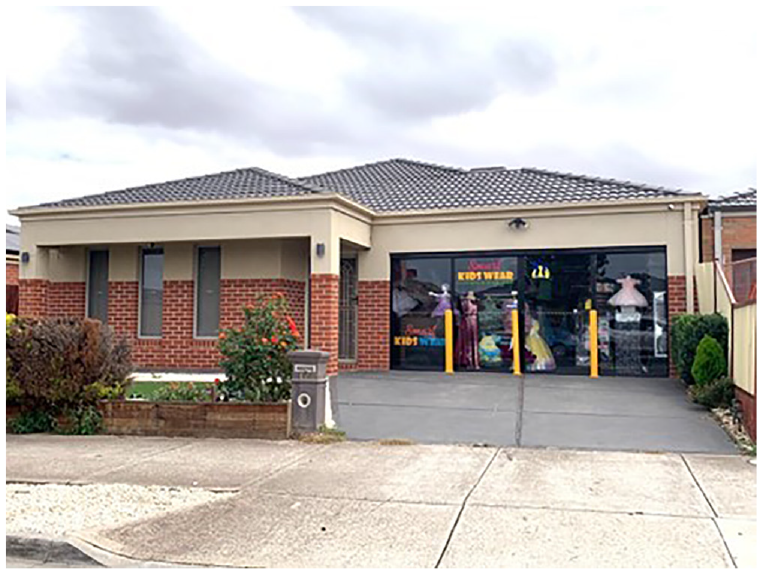
Garage enterprise in Tarneit.
Here the simple suburban archetype of a nuclear family of husband, wife and two and something kids and a single or two cars is no more. The automobile fetish has created a distinct suburban neighbourhood consumption archetype: the extensive car wash facility, invariably accompanied by a gas station and drive-through fast food outlet. Strategically placed at the suburb’s entry/exit or in neighbourhood commercial centres, these are the new suburban cathedrals to the car, with suburbanites waiting in line on weekends to be cleansed (Figure 7).
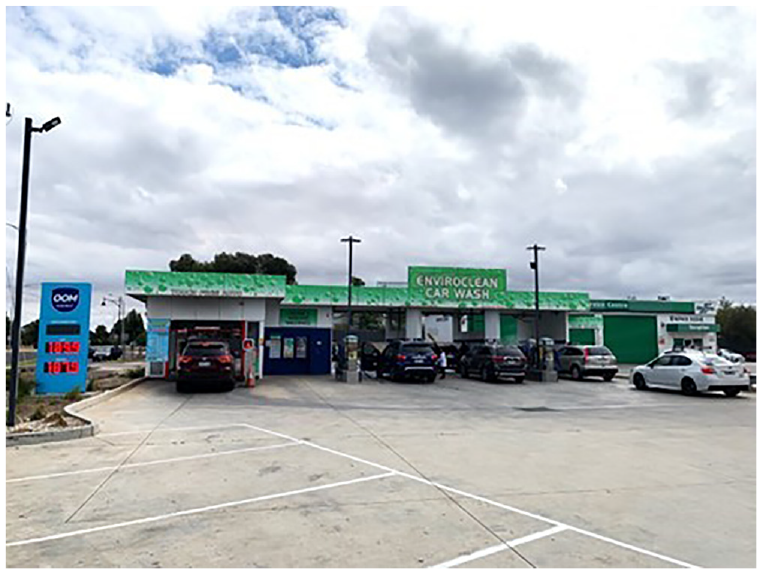
A suburban cathedral to the car.
Second, the house has been less appreciated as a unique condensation of the materiality of, and affect induced by, global suburban landscapes. The house as home is at once highly concrete and yet abstract, highly local and personal as well as generic and global (Duncan and Lambert, 2004). The plot size and orientation, house design and planning and building regulations curb that govern its basic materiality do not preclude either its further physical modification, ornamentation or investment with meaning through the decoration and acquisition of ‘stuff’ (Miller, 2010). In this way, the mass-produced houses of suburbia are woven into the global financial and ideological landscapes of modernity (Appadurai, 1996), with individual housing typologies being global cultural phenomena in their own right (King, 1984).
Plot sizes and planning and building regulations kerb some of what residents might wish to customise about the appearance of their houses. For those buying plots of land and commissioning builders, elements from chosen religions and cultural norms from homelands – such as auspicious orientations (feng shui from China and five elements from India) – are sometimes apparent in the orientation of the plot selected and placement of windows. In these instances, and those in which limited housing typologies have been commissioned or bought readymade, it is common to find statues of deities or prominent naming or signature ornamentation of the front of the house. If this much is visible from the roadside, one unknown is how suburban living is projected with stuff from the inside of the home.
Third, a transformation of the suburban lawn has been under way. Gone are the extensive yards engulfing a modest bungalow as part of the original ‘Australian dream’: they have been replaced by small back-of-house barbeque decks and front-of-house lawns. The proliferation of artificial turf in small front lawns represents an inversion in the making of suburban landscapes (Figure 8). Following a more general international trend where developers and planning authorities previously conspired to erase nature (placing water courses in concrete channels), they now adopt nature-based solutions (Beatley, 2011), the cost of which can be recouped through the premiums charged for properties in proximity to ‘nature’. Instead, it is the residents who once sought to commune with nature in extensive backyards who now prefer the maintenance efficiency of tiny fake grass front lawns. The inversion is complete in the relative neglect by residents of the municipal grass verges immediately adjacent to artificial lawns.
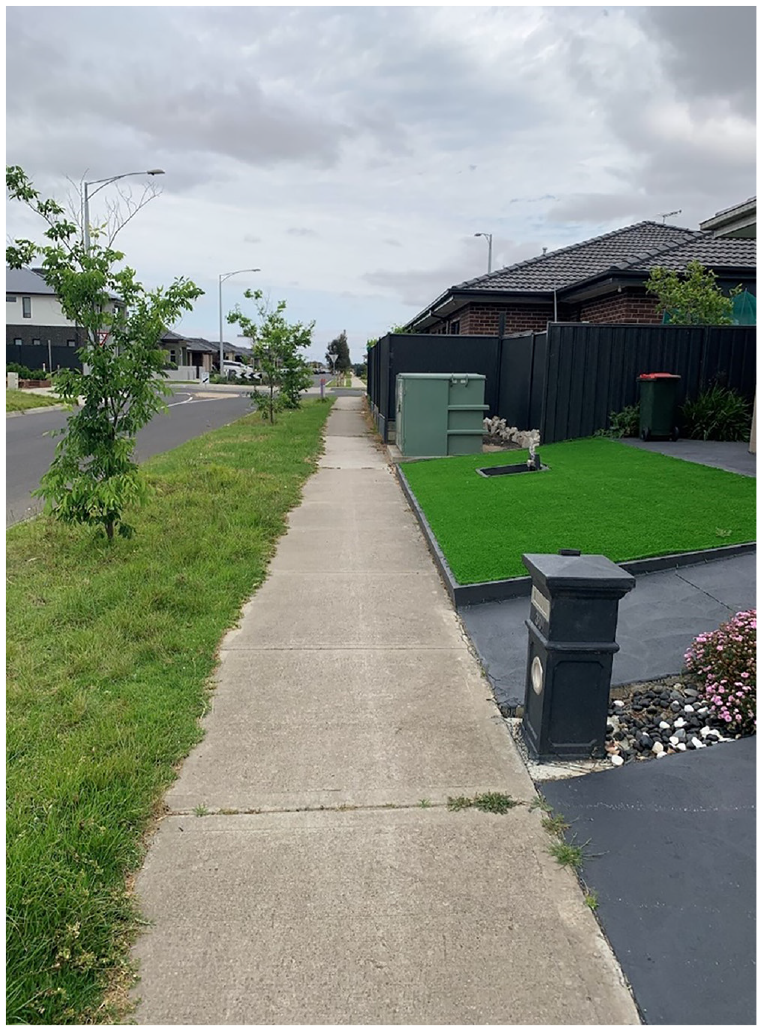
Tidy private artificial lawn and unkempt municipal grass verge.
Conclusion
Patterns and processes of extended urbanisation demand that urban theory and method be wrenched from their city-centric roots (Brenner and Schmid, 2014; Keil, 2017; Phelps, 2021; Soja, 2000). First, we presented a theoretical framework that allows us to comprehend some of the enduring appeal of suburbanism as a way of life despite its many contradictions. Our research sheds empirical light on how increasingly standardised production and consumption by an increasingly varied profile of residents are reconciled in the symbolic (re)enchantment of suburbanism as a way of life. The ‘Australian Dream’ of suburban home ownership takes on new physical forms and social and ethnic compositions, despite its contradictions.
Second, with respect to the need to move beyond ‘methodological cityism’ (Brenner and Schmid, 2014), ‘The distinct spatial organisation of suburbs calls for alternative approaches to research’ (Jones-Correa, 2006: 203). We used observational analysis of billboards and emergent elements of the design of residential subdivisions to gain some appreciation of the production, mediation and consumption of community in the spatially expansive suburban City of Wyndham. Future research might deploy additional methods to examine a number of substantive topics regarding the making of community in ethnoburbs and superdiverse suburbs.
Our theoretical framework, methods and findings are also suggestive of avenues for future research on suburbs and suburbanisation. First, how do suburban superdiversity and ethnic concentration play into political representation and styles of urban planning? The scale of new outer suburban municipalities undermines place-based politics (Jones-Correa, 2006). In Miami, for example, immigration-fuelled suburban growth has resulted in a transience that precludes distinct and enduring urban political regimes (Nijman, 2011; Phelps, 2015). Politics and planning in new superdiverse outer suburban communities are likely to be more relational and global than understood in extant theories of urban politics. Immigrants arrive with norms and expectations regarding their ‘right to the city’ and homeland norms of participation in politics with implications for trade-offs between different public goods (Gottlieb, 2007). They also arrive with homeland norms regarding architectural style, building typology, use, adaptation and construction techniques. Some of these specificities may be accommodated within host planning, business and societal norms, others may not.
Second, do new suburbs manifest as communities without propinquity (Webber, 1964)? New suburbs are communities born in an age of (global) personal and virtual mobility. Drawing from Laurier (2002), we can pose the question: is it planning authorities and developers that create neighbourhoods from such extensive landscapes, or residents who ‘put community back together again’ when juggling fragments of time across suburban places and in the virtual spaces afforded by a host of devices and modes of communication. Evidence from the outer suburbs of Melbourne and elsewhere in Australia suggests it is the latter (Dowling et al., 2010; Laing, 2023; Nicholls et al., 2018; Roggenbuck, 2019). We might usefully know more about how residents do the work of community-building, including in the contemporary reconstitution of public and private spheres and spaces in ways that exceed processes of neoliberalisation (McGuirk and Dowling, 2009; Willems, 2019).
Intermediaries help articulate the complex systems by which we produce new suburbs at scale, pace and in a variety of forms. Third, in (re)enchanting suburban living with reference to the amenity and connectivity of entire suburban landscapes amidst standardisation in housing and subdivision design and local plans, it remains unclear what role intermediaries presently play in raising the social and environmental quality of suburban forms?
Fourth, Relph (1976) pointed to the absurdity of organisational suburbs produced across North America. Do the adaptations of homes that we observed amount to suburban landscapes purposefully made over in inclusive, sustainable ways? Or does the home become evermore the focus for, rather than a refuge from, the anxieties and alienation in continuous tests of personal standing in consumer society? This is a theme that has been little explored, especially with regard to suburban ways of life woven together by global aspirations to standards of living and social standing.
Footnotes
Declaration of conflicting interests
The author(s) declared no potential conflicts of interest with respect to the research, authorship and/or publication of this article.
Funding
The author(s) received no financial support for the research, authorship and/or publication of this article.
