




Abstract
Neighbourhood effects are commonly understood as an effect of a characteristic of the residential location on social outcomes – although people are also linked to other places in their everyday lives. Based on a mixed-methods study on the significance of neighbourhoods for political recruitment of first- and second-generation Turkish immigrants in Berlin, this article shows that neighbourhoods with a strong migrant civic infrastructure are important places for political recruitment – not only for their residents, but also for visitors and people linked to them through social networks. The article identifies three mechanisms by which people can be linked to neighbourhoods and the resources embedded in them. The first is residency. Second, neighbourhoods can work as a hub when people visit them to shop, meet friends, or engage in other activities. Visitors can then profit from a neighbourhood’s infrastructure, such as civic organisations. Third, neighbourhoods work as a node when social networks transmit information and resources originating in one neighbourhood context – for example, political information – to others located outside of it. The article contributes to an understanding of neighbourhoods not as closed-off containers but as being interconnected to other places, non-residents, and resources, an understanding that comprehends the spatial production of social inequalities in terms of residency, everyday mobility, and social network connections.
Introduction
Immigrants’ access to political rights is often limited, as they do not have access to full political rights (especially voting) without acquiring formal citizenship status. Besides this formal political inequality, immigrants also participate at lower rates in political activities open to non-citizens such as demonstrations, signing petitions, or contacting officials (Müssig, 2020). Past research has especially examined the importance of immigrant and other associations for political participation and has shown that they foster political trust, distribute and translate information about political events, and ask people to participate (Bloemraad, 2006; Togeby, 2004). However, immigrant and other civic organisations are not equally distributed but cluster in specific areas. How this spatial distribution affects processes of political inclusion has received limited attention so far.
This paper focuses on one social interaction that has proved to be especially effective in supporting political participation – recruitment – and asks if and how recruitment of first- and second-generation immigrants is facilitated by urban contexts with a high number of immigrant organisations.
Whether or not neighbourhoods matter for social inequalities is a question that has been extensively researched. In looking for an answer, neighbourhood effects studies examine if and to what extent residential neighbourhoods matter for accessing resources, for social processes, and for dimensions of social inequality. Focusing solely on the residential neighbourhood can, however, lead to overlooking important ways in which the spatial embeddedness of social and other resources matters for the (re-)production of social inequalities, as people do not stay only in their residential neighbourhoods, but move around during the day for work, leisure, and other activities. This brings them into contact with people, infrastructure, and organisations outside of their residential neighbourhood. Furthermore, people have social networks that can link them to information circulating in the residential neighbourhood of a friend, for example. A growing body of literature highlights the importance of including the links people have to places beyond their residential neighbourhood – via everyday mobility or social connectedness – in the research agenda (Candipan et al., 2021; Wissink et al., 2016; Zhou and Guo, 2023).
This article contributes to these debates and shows how recruitment of first- and second-generation immigrants for political activities is connected to neighbourhoods where migrant associations are concentrated. The article is based on data from a mixed-methods study that examined if and how neighbourhood resources contribute to the political participation of first- and second-generation Turkish immigrants in Berlin, Germany.
The analysis shows that first- and second-generation immigrants are often recruited in or through a connection to neighbourhoods where migrant and other civic organisations concentrate. The analysis identifies three mechanisms that can link a person to such neighbourhoods: (1) living in the neighbourhood (residency mechanism), (2) visiting the neighbourhood (hub mechanism), or (3) being linked to the neighbourhood through personal social networks that transmit political information and invitations to participate in political activities (node mechanism). The results emphasise the importance of examining the role that resources and infrastructures embedded in specific places play in social processes, and the need to look beyond the residential neighbourhood when doing so.
The next section reviews literature on recruitment and research that exemplifies the importance of looking beyond container-like conceptualisations of neighbourhoods. After a description of the methodological approach, the results are presented in two steps. First, I start from a typical neighbourhood effects perspective by examining the question of whether there is a residential neighbourhood effect on the likelihood of being recruited using multilevel survey data. In a second step, I present an analysis of qualitative in-depth interviews with a subset of survey participants which shows that neighbourhoods with a strong migrant civic infrastructure also play a crucial role for the recruitment of non-residents. The article concludes with a summarising discussion of three mechanisms identified in the analysis, by which people can get into contact with resources located and circulated in resource-rich neighbourhoods.
Recruitment in residential and other spatial contexts
Recruitment in a spatial context
Recruitment is one of the main mechanisms that facilitate political participation (Abramson and Claggett, 2001; Lim, 2008). Simply put, political recruitment happens when someone asks someone else to participate in a political activity. A common argument is that rational recruiters should target people with a higher social status more often, as it is more likely that they will follow through on the request. Applied at the neighbourhood level, this means that recruiters should target high-status neighbourhoods more often because this should make successful recruiting more likely (Strömblad and Myrberg, 2013). However, this might not be reasonable to assume regarding all political issues and social groups. In this vein, Bratsberg et al. (2021) show for Norway that immigrants’ political behaviour is not so much influenced by the neighbourhood’s socio-economic status but by the presence of immigrant and politically active neighbours.
Additionally, focusing only on the socio-economic status of other residents ignores the role of neighbourhood-based organisations, which can play a central role in recruitment (Alex-Assensoh and Assensoh, 2001). Research has shown that organisational resources are often more prevalent in low-status neighbourhoods than in high-status neighbourhoods (Small and McDermott, 2006; Wiedner et al., 2022) and that immigrant or multilingual organisations in immigrant neighbourhoods often provide their residents with access to social networks, information, or jobs (Meeus et al., 2019; Portes and Bach, 1985).
Thus focusing on the organisational infrastructure would lead us to expect a different set of neighbourhoods to serve as arenas for recruitment than when we only focus on the social or immigrant status of residents. We can, therefore, expect that the presence of immigrant and other organisations in a neighbourhood supports political inclusion through recruitment and information dissemination. Additionally, it is likely that immigrant organisations matter more for people with a lower level of proficiency in the language of the country of residence due to language barriers in non-immigrant organisations. From this, we can derive the following hypotheses about the places that matter for recruitment and political inclusion:
H1: Immigrant residents of neighbourhoods where immigrant organisations concentrate are more often asked to participate in political activities.
H2: H1 is especially true for immigrant residents with low German language proficiency, as they rely more strongly on multilingual organisations and interactions.
It is important to note that it is likely that the relevant local infrastructure consists not only of immigrant self-organisations but also of other organisations and infrastructures that provide opportunities to distribute information and meet people. Still, the presence of immigrant organisations in a neighbourhood is probably indicative of an immigrant-friendly and multilingual civic infrastructure.
Looking beyond the residential neighbourhood
The most common way to research how spatial factors affect social processes and outcomes is through are neighbourhood effects studies (Van Ham et al., 2012). Neighbourhood effects are usually defined as the effect of a residential neighbourhood characteristic on a social outcome that is independent of individual characteristics like education or income (Galster, 2008).
However, most people do not live their lives solely within their residential neighbourhood but move around during the day, go to school or work, access social services and organisations elsewhere, shop, are civically engaged outside of their residential neighbourhood, or have connections to people living elsewhere (Petrović et al., 2020; Sampson, 2019). In regard to immigrants, Zhou (1992), for example, shows how the Manhattan Chinatown in New York performs specific functions not only for Chinese immigrants living there but also for those living elsewhere. Hanhörster and Weck (2016) demonstrate that Turkish immigrants in Germany who have moved out of immigrant neighbourhoods still return to meet friends and family, shop, experience familiarity, or be civically engaged. Neighbourhood effects studies, in their narrow sense, however, rarely conceptualise relevant relations outside of the residential neighbourhood as spatial and often rely – explicitly or implicity – on a container model of space, in which social relations are conceptualised as being confined in spatial units with definite borders.
Other conceptions of neighbourhoods have sought to move beyond such container-like understandings, instead recognising them as places that connect people, places, and resources (Blokland and Savage, 2008; Van Kempen and Wissink, 2014). While these neighbourhood conceptions focus on networks, resource flows, and mobilities across different locations, they also emphasise the relevance of specific places in these connectivities. As mobilities, flows, and connectivities ‘connect certain nodes but not others, while access is regulated’ (Van Kempen and Wissink, 2014: 102), it is important to examine how this unevenness of connections affects dimensions of resource access and social exclusion and inclusion (Cass et al., 2005).
Several strands of research attempt to move beyond a container-like understanding of spatial inequality, which focuses solely on the residential context, and show that people connect to a variety of places in their everyday lives. One approach examines different ‘domains’ of everyday life and explores if people who live in segregated neighbourhoods also have more segregated workplaces, personal networks, or modes of transportation. Results show that correlations between segregation patterns across these domains vary among social groups, such as immigrant men and women (Boterman and Musterd, 2016; Tammaru et al., 2016).
Research on everyday mobility and segregation shows that residents of different neighbourhoods vary significantly in the types of locations they visit for routine activities (Krivo et al., 2013; Phillips et al., 2021). Candipan et al. (2021), for example, focus on racial segregation and propose a ‘segregated mobility index (SMI) – that captures the extent to which neighbourhoods of given racial compositions are connected to other types of neighbourhoods’ (p. 3095) via the everyday mobility patterns of people in a city, based on Twitter data.
Activity space research focuses on people’s movement through, and time spent, in their residential and other locations. It often makes use of geolocated data, such as GPS data or geotagged social media data, to capture people’s exposure to different spatial contexts throughout the day (Cagney et al., 2020; Järv et al., 2015). Xu’s analysis of GPS mobile phone data shows, for example, that people – especially those living in highly segregated areas – are in fact exposed to more opportunities for diverse social contact than analyses that focus only on residential contexts indicate (Xu, 2022).
This research highlights the importance of looking beyond the residential neighbourhood by focusing on patterns of movement, connection, and segregation. These studies demonstrate convincingly that exposure to different social contexts varies; however, they often do not examine if, how and which contexts affect dimensions of social inequality or resource access (but see Sugie and Lens, 2017).
Regarding to the residential context, there is an extensive discussion about the mechanisms that produce neighbourhood effects (e.g. via socialisation, access to networks, or neighbourhood institutions, Small and Feldman, 2012). Research on everyday mobility exemplifies the need to expand the discussion on spatial mechanisms and to identify not only (1) the mechanism of how social contexts and their resources affect social inequality dimensions once people are connected to them, but also (2) the mechanism of how people come into contact with specific places and the resources embedded in them. This shifts changes the research focus from the question if the residential neighbourhood matters to examining who is able to access which resources, where, and how, in order to understand how resources are accessed in, through, and across connections to different locations (Petrovic et al., 2020; Sampson, 2019; Van Kempen and Wissink, 2014). Based on the research discussed, we can assume:
H3: Clusters of civic infrastructure are potentially important not only for residents but also for visitors to the neighbourhoods.
Here, the question arises whether this can still be considered a neighbourhood effect. If we take the above-cited definitions of neighbourhoods as places that connect people, places and resources seriously, it makes sense, however, to distinguish between residential and non-residential contexts or neighbourhood effects. This also keeps the spatial distribution of resources and infrastructures in focus, as well as the conditions in which they are embedded (e.g. the clustering of civic organisations in multifunctional places).
Data collection
To assess if and how neighbourhoods where immigrant organisations and networks are concentrated facilitate the recruitment of first- and second-generation immigrants, I used a mixed-methods approach consisting of a quantitative mail survey with a multilevel sampling structure, and qualitative in-depth interviews with a sub-sample of the survey participants. The survey data allows residential neighbourhood effects to be tested for. The qualitative data provides the opportunity to examine the underlying mechanisms and social processes that produce these effects (Small and Feldman, 2012) as well as to explore the relevance of other spatial contexts and connections – beyond the residential neighbourhood.
The data was collected in 2013 and 2014 and focuses on first- and second-generation immigrants from Turkey living in Berlin, Germany, for several reasons: immigrants from Turkey are the largest immigrant group in Germany overall and in Berlin. Berlin, the largest city in Germany, exhibits significant variation in relevant context characteristics, such as the presence of Turkish immigrant residents and the number of immigrant organisations. In the German context, it is also one of the few municipalities with a small-scale neighbourhood zoning for which official statistics are available (see more info below). While this results in limitations regarding the generalisability of results to other municipalities or immigrant groups – since they might have different spatial distribution patterns – the case of Turkish immigrants in Berlin is a theoretically informative one as it offers an opportunity to study spatial patterns of immigrant – specific civic infrastructures and how it affects political inclusion. Furthermore, Turkish immigrants in Germany are an especially interesting and relevant case in terms of political inclusion, as their access to full citizenship status in Germany was for a long time more limited compared to other immigrant groups, mainly due to a late introduction of the ius soli principle in German citizenship law and due to the fact that until recently access to dual citizenship was more restrictive than for other immigrant groups. Consequently, large proportions of first- and second- generation Turkish immigrants do not possess full political rights (Sauer, 2022).
While the study is therefore limited in terms of whether the amount and spatial patterns of political inclusion work the same across other immigrant groups or cities, it offers an opportunity to analyse and discuss relevant mechanisms (a) of how a clustering of resources in specific neighbourhoods affects political recruitment and inclusion processes and (b) of how people get linked to these resources. The main goal of the article is this conceptual discussion.
Standardised mail survey
The construction of the survey sample is based on a multilevel sampling procedure that, first, sampled neighbourhood areas and, second, selected residents with a Turkish migration background within these areas. For this, I relied on area units designed to account for social milieu and material structures, such as major streets (so-called Planungsräume, Senatsverwaltung für Stadtentwicklung und Wohnen, n.d). These units are also often used to implement neighbourhood-oriented policies and are thus likely to shape residents’ perceptions of neighbourhood boundaries, at least to some extent.
As a first step, a sample of 30 neighbourhoods (out of a total of 447) was drawn. This sample was stratified along three criteria in order to account for variation in potentially relevant context characteristics of immigrant residents, organisations, and social status: (1) the share of residents with Turkish nationality, (2) the share of residents receiving welfare benefits and (3) the number of Turkish migrant civic organisations. While the first two criteria are available from official statistics, the third was constructed by searching the public record of registered associations for organisations with Turkish names (or a references to Turkey in their names), that were then mapped across neighbourhoods (Figure 1s in the Supplementary Material). To ensure that the sample covers different combinations of these characteristics, I used a disproportional sampling strategy for the neighbourhood sample (Table 1s in the Supplementary Material).
For each of the 30 sampled neighbourhoods, data from the official resident register was requested, and an onomastic analysis of all residents’ names was conducted to assess the likelihood that a given name was of Turkish origin. This was necessary to identify first- and second-generation Turkish immigrant residents, as the register does not entail full information on a family’s migration history.
The resulting gross sample consisted of 3,011 individuals, who were then contacted by mail (four mailings in total). Overall, 452 people completed and returned the bilingual questionnaire (response rate 15%). While a higher response rate would have been desirable, response rates were similar across the different sampling strata, and comparison with official statistics shows that the gender and age distribution of the sample is very similar. While we cannot exclude the possibility of systematic drop outs, there is considerable variation in the survey sample along criteria of socio-economic and integration-related factors, such as education, length of stay and German language proficiency (Table 1s and 2s in the Supplementary Material) – usually major determinants of survey non-response. It is, however, still possible that, for example, more active or well-connected people participated.
In-depth interviews
The mail survey included the question whether respondents were willing to be contacted again for an in-person, in-depth interview. From this pool, interviewees for in-depth interviews were selected based on criteria similar to those used in the quantitative sampling. In addition, the aim was to include variance regarding civic and political participation. Respondents were therefore selected based on the following dimensions: whether they lived in a neighbourhood with a high number of Turkish migrant organisations (more than three) and a high share of first- and second-generation residents of Turkish descent (more than 10%); whether they were engaged in a civic organisation; and whether they were strongly politically active (more than three political activities in the last two years).
The aim of the sampling strategy was to conduct three interviews in each combination of these characteristics; however, some combinations are underrepresented due to a lower number of potential interviewees or unsuccessful interview requests (Table 3s in the Supplementary Material). In total, 24 interviews were conducted using a semi-structured interview guideline (Table 4s in Supplementary Material). All interviews were transcribed and analysed. The coding process was partially pre-structured by theoretical interest but also allowed for the emergence of new codes, concepts, and relations between them. For this, the analysis relied on coding principles of Grounded Theory, using its strategies of open and axial coding, which are especially useful for analysing concepts, their causes, and consequences. Open coding techniques allow for the emergence of new concepts, codes, and questions, while axial coding focuses specifically on the analysis of relations between codes and concepts (Strauss and Corbin, 1990).
Is there a residential neighbourhood effect on the likelihood of being recruited?
This section analyses whether residents of neighbourhoods with a strong migrant civic infrastructure are more likely to be recruited by others for political activities based on the survey data.
Modelling strategy and variables
In the survey, ego-centred network instruments were used in order to assess whether a respondent had been asked to participate in a political activity over the last two years. Respondents (egos) could name up to four network members (alters), and follow-up questions were asked for each of these . One was whether alter had tried to recruit ego for a political activity over the past 12 months (Table 5s in the Supplementary Material). Some 43% of respondents named at least one person who had asked them to participate in a political activity over the past 12 months (Table 6s in the Supplementary Material). Overall, 31% of all network ties were recruiters.
The dependent binary variable is 1 if the respondent had at least one network tie who tried to recruit them in the last 12 months and is 0 if there was none.
The model is a two-level logistic multilevel regression that accounts for the clustered data structure. Table 1 shows log-odds coefficients that are difficult to interpret in terms of effect strength due to their non-linearity, therefore, the table also shows average marginal effects (AMEs) to allow for a more substantial interpretation of effects (see reading example in Table 1).
Recruitment via network tie (two-level logistic random slope model). a
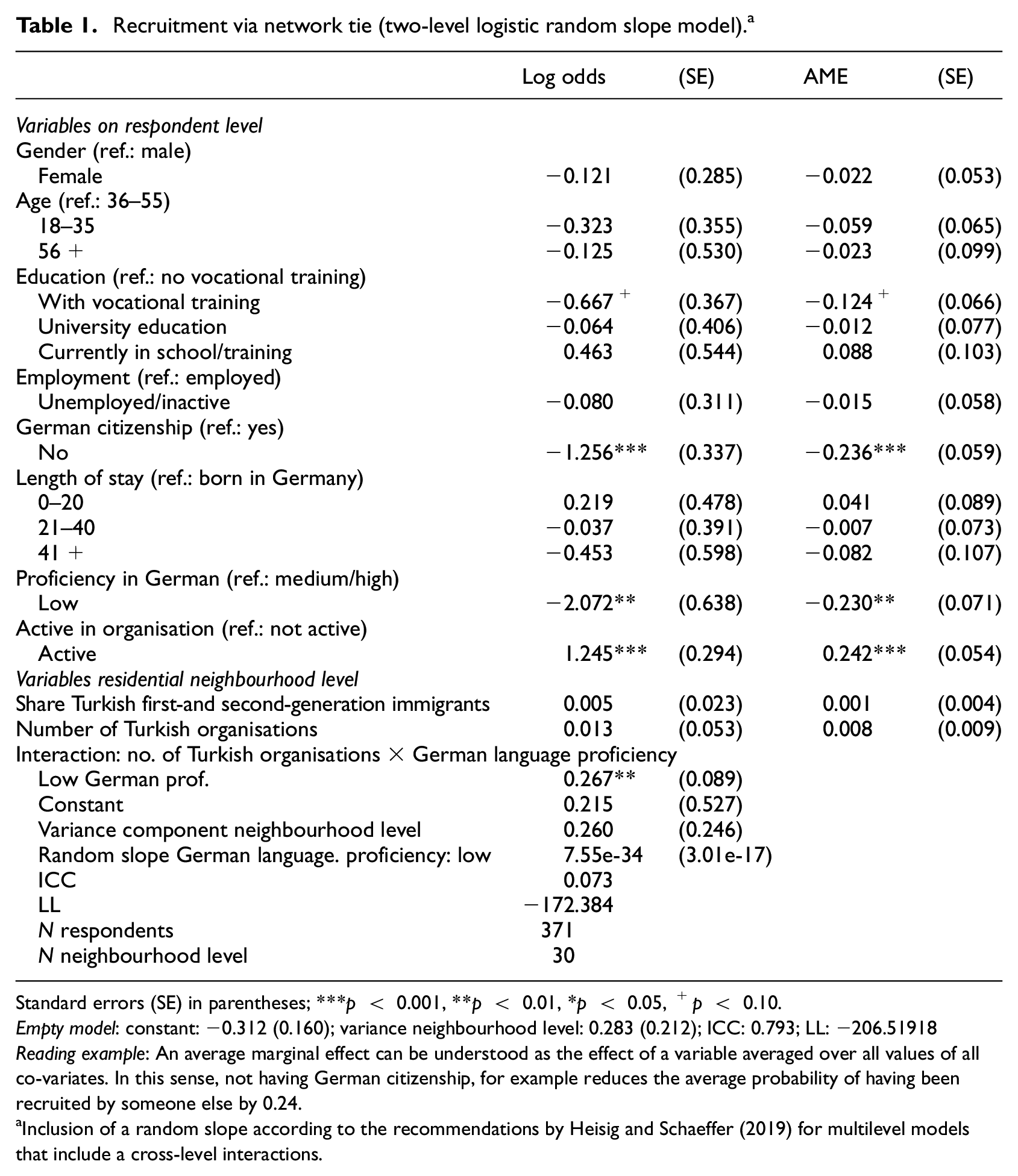
Standard errors (SE) in parentheses; ***p < 0.001, **p < 0.01, *p < 0.05, +p < 0.10.
Empty model: constant: −0.312 (0.160); variance neighbourhood level: 0.283 (0.212); ICC: 0.793; LL: −206.51918
Reading example: An average marginal effect can be understood as the effect of a variable averaged over all values of all co-variates. In this sense, not having German citizenship, for example reduces the average probability of having been recruited by someone else by 0.24.
Inclusion of a random slope according to the recommendations by Heisig and Schaeffer (2019) for multilevel models that include a cross-level interactions.
At the neighbourhood level, the model considers the immigrant-specific organisational infrastructure of the neighbourhood, as migrant organisations can be expected to be especially well equipped to recruit first- and second-generation immigrant residents into political activities. In order to assess whether residents with lower German language proficiency depend more on this organisational infrastructure, an interaction term between the number of Turkish migrant organisations and the language proficiency of a person is considered in the model. The model also controls for the share of Turkish immigrant residents on the neighbourhood level. Since this is strongly correlated to the socio-economic neighbourhood composition, the latter is not included; however, an alternative model including this factor yields similar results, (Table 7s in the Supplementary Material includes this and other alternative step wise model specifications). Table 6s in the Supplementary Material shows a bivariate overview on the variables and their relations to the dependent variable.
Results
At the respondent level, results show that migration-related characteristics are clearly connected to being recruited by a network tie: having no German citizenship and having low proficiency in German reduce the likelihood of being recruited by someone else, while being active in an organisation has a positive relationship to being recruited.
At the neighbourhood level, the model shows no effect regarding the share of residents with Turkish nationality in the neighbourhood. However, there is an effect of the interaction between the number of Turkish organisations in a neighbourhood and the German language proficiency of a person. For people with low German language proficiency, the number of Turkish organisations in the neighbourhood significantly increases the likelihood of being recruited. Figure 1 shows the interaction between these two factors in more detail in the form of averaged predicted probabilities (analogous to AMEs). We see a strong effect for people with low German language proficiency: those in this group living in neighbourhoods with no Turkish migrant organisations have a very low likelihood of being recruited (0.13), while those living in neighbourhoods with a strong Turkish organisational infrastructure have a likelihood of being recruited by a network tie of around 0.70. It is important to note that neighbourhoods with a strong infrastructure of Turkish migrant organisations tend to also be neighbourhoods where other organisations are also concentrated. While it is likely that the effect for people with low German proficiency is related to the presence of Turkish migrant organisations, it is also likely that other organisations in these neighbourhoods are more open to immigrant members and, for example, do not only use German to communicate.
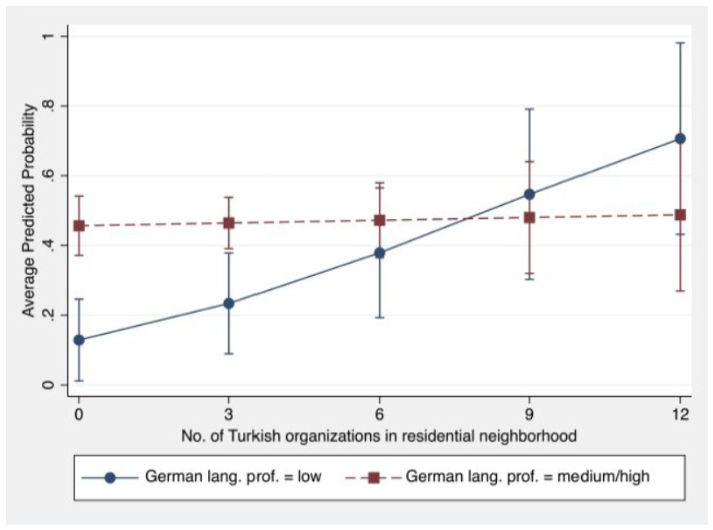
Interaction German language proficiency and number of Turkish organisations in residential neighbourhood.
The results show that there is, in fact, a residential neighbourhood effect, although only for a specific part of the population: only those residents who have low German language proficiency have a significantly higher probability of being recruited into political activity if they live in neighbourhoods with a high number of Turkish migrant organisations. While German language proficiency is not a classic socio-economic dimension like education or job status, it structures the access to crucial resources. In sum, this shows the importance of accounting for heterogeneity in migrant populations with respect to how much the residential context matters.
Looking beyond the residential neighbourhood context
The model presented in the previous section identified an effect of the number of Turkish migrant organisations in the residential neighborhood on recruitment – albeit only for persons with a low German language proficiency. Thus, the presence of Turkish migrant associations in a residential neighbourhood seems to matter only for a subset of people, while others appear to be recruited via different routes. The following section examines these different relevances of residential location by analysing the in-depth interviews.
Recruitment of residents in neighbourhoods with a strong migrant civic infrastructure
Most people I talked to in the in-depth interviews who recalled having been recruited for a political activity and who lived in neighbourhoods with a lively organisational infrastructure reported that they were recruited in their residential neighbourhoods often on the street. Fatme Erdem, for example, was asked to sign a petition against rising rents in her neighbourhood and also learned about a subsequent demonstration in which she participated. She recalled that she was approached by older Turkish women who distributed leaflets and collected her signature (interview 10, Fatme Erdem, age 49; all names have been altered to protect privacy).
Others were recruited in the context of organisations. Fethi Doğu, for example, lived in an inner-city migrant neighbourhood with a high density of migrant and other organisations for most of his life, until he moved to a more peripheral residential neighbourhood four years ago. He still vividly remembers how he learned about political issues and opportunities for political participation through religious associations he used to frequent when living in his old neighbourhood: When I went to the mosque or to these associations, there you heard about it. […] you either received this information through some kind of notice or leaflet – in some way you heard about it. (Interview 23, Fethi Doğu, age 48)
How enabling a Turkish-speaking organisational infrastructure can be for residents who speak Turkish well but have a low German language proficiency is exemplified by the case of Amina Gönül, who is politically very active in Turkish-speaking networks and organisations in her residential neighbourhood. She is active in a mosque close to her home that is mostly visited by Turkish-speaking first- and second-generation immigrants. When the mosque organised a money collection effort to support humanitarian causes, she joined in by cooking food that was sold during the event. Beyond that, she also participates in demonstrations and similar events that she hears about through her circle of friends and neighbours. This circle appears in her descriptions as a web of local ties where recruitment and participation among friends and acquaintances, also in connection with local organisations, is very common (interview 06, Amina Gönül, age 41).
These examples show how civic organisations recruit for their activities in public and semi-public spaces and how associational contexts distribute invitations for political activities. This strong organisational infrastructure, which includes migrant organisations that provide recruitment and information about political activities in different languages, is an important resource for civic–political inclusivity. This is particularly beneficial for residents with low German language proficiency.
Recruitment of visitors – neighbourhoods with a strong civic infrastructure as hubs
Many interviewees who live outside of migrant neighbourhoods with a strong civic infrastructure recall that they were not recruited in their own residential neighbourhoods but instead in migrant neighbourhoods with a strong civic infrastructure. In this case, these neighbourhoods serve as hubs, as locations of recruitment for non-residents. Such recruitment occurs, for example, at public events: Harun Yüksel, who has lived in an inner-city migrant neighbourhood for most of his life before moving to a neighbourhood on the outskirts of Berlin, still visits his former residential neighbourhood frequently and helps out in his brother’s shop sometimes, which is also located there. He recalls the last time he signed a petition: ‘I signed something at this bazaar. That was at [central place in his former residential neighbourhood] and was for human rights’ (interview 19, Harun Yüksel, age 42).
In this example, civic organisations were present in public space and recruited directly for their causes. A somewhat different example is the case of Birol Yolçu, who lives in an outer non-immigrant district of Berlin and has never lived in one of the inner-city immigrant neighbourhoods with a dense organisational infrastructure. He sometimes visits a specific neighbourhood where many Turkish immigrants live and many civic organisations are located, for shopping. He and his wife also enjoy eating at a pizzeria in this neighbourhood, where he sometimes signs petitions that are on display:
Yes, I signed [petitions] a few times. This pizzeria, they do something good. It is [in the neighbourhood] where we sometimes shop. They sometimes have these petitions and I sign. It did that a few times. For example, for the referendum [a city-wide referendum].
And here, where you live, were there also signature lists, for examples for this referendum?
Here? Here, here, I didn’t see anything.
(Interview 21, Birol Yolçu, age 53)
Thus, it is not only civic organisations themselves that are an important infrastructure in these neighbourhoods but also a wider urban setting of restaurants, shops and other third places that can be crucial for recruitment activities and political information dissemination. This multifunctionality of areas where different activities take place (e.g. residence, shopping, civic and leisure activities) is therefore instrumental for information distribution and recruitment, as it increases the usage and sociability of public and semi-public spaces (Jacobs, 1961; Oldenburg, 1999; Wessendorf, 2016). Such multifunctional neighbourhoods increase the likelihood of encountering political recruitment while doing something else like shopping, visiting a restaurant, or attending a street festival. It is also this multifunctionality of certain neighbourhoods that attracts visitors and turns them into hubs for recruitment activity.
Past research has similarly shown that some urban areas provide functions for populations beyond their residents. One example is a study by de Graauw et al. (2013), which shows how suburbs engage in ‘freeriding’, as their proximity to central urban areas allows them to avoid funding immigrant organisations and other services, since their immigrant residents can use such infrastructure in central urban areas. Similarly, Hanhörster and Weck (2016), demonstrate how immigrant neighbourhoods serve as hubs for a range of activities for immigrants living elsewhere. In their study on everyday mobility, Phillips et al. (2021) show that some cities have more hub neighbourhoods – neighbourhoods that are visited by a disproportionally larger number of visitors – than others.
Recruitment via social networks – neighbourhoods with a strong civic infrastructure as nodes
Another mechanism by which people can be linked to resources embedded in neighbourhoods other than their residential one is when neighbourhoods function as nodes – as places where networks connect people to resources embedded in the neighbourhood even though they do not live there (or do not visit it).
One example of this is the case of Leyla Türkan, who moved from an inner-city immigrant neighbourhood to the outskirts of the city with her kids. However, she kept in touch with a circle of women she got to know in the former neighbourhood school of her kids. The women meet once a month for various activities, during which they often discuss political issues. Leyla Türkan remembers that it was through this circle of friends that she learned about a demonstration in her old residential neighbourhood and participated in it. This shows how this long-lasting network continues to connect her to political information, events, and recruitment activities that originate and are circulated in her old residential neighbourhood. In this way, the neighbourhood acts as a spatial node and has an effect beyond its territorial boundaries, as networks connect people to resources such as political information and recruitment embedded in its social organisation. As these networks reach beyond the territorial boundaries of the neighbourhood, it is not necessary to be physically present to be connected to information and recruitment circulated within it.
The relevance of such a node mechanism is exemplified in the research field on transnational and translocal social ties and relations (Faist et al., 2013; Greiner and Sakdapolrak, 2013; Herz, 2015), that examines how social networks connect localities in and between different nation states. Zhou and Guo (2023) show, for example, that Chinese rural-to-urban migrants’ health is supported by maintaining translocal ties to their families in their hometowns.
Being disconnected from neighbourhoods with a strong civic infrastructure
Both hub and node functions of neighbourhoods show how neighbourhoods matter beyond their residential population and, thus, beyond their physical borders. To understand the way how this place-based resource access is structured it is important to emphasise, that not all interviewees were connected to immigrant neighbourhoods with a strong civic infrastructure. Those who had no connections to these neighbourhoods and also do not visit them tend to have moved to Berlin during the last 5–10 years. Deniz Gül, for example, moved to a part of Berlin where his former wife lived, which lies at the edge of the city. When he meets friends or acquaintances, he meets them there and not in one of the inner-city migrant neighbourhoods where he has never lived and where he also does not go for shopping or other activities. He is, therefore, also not exposed to the political recruitment happening there and does not report that anyone tried to recruit him for a political activity – in or outside of his residential neighbourhood.
While it is difficult to research absent connections with qualitative data, this indicates that prior residential history, the residential location of family, friends and acquaintances and the point in time of moving to the city are factors that play a role in connecting people to resource rich urban areas.
Discussion and conclusion
This article connects to a growing body of work on neighbourhoods and local contexts that looks beyond understanding them mainly as residential contexts (Cagney et al., 2020; Candipan et al., 2021; Van Kempen and Wissink, 2014). It examines the relevance of immigrant neighbourhoods with a concentration of migrant civic organisations for recruitment into political activities.
The presented results show that, first, there is a residential neighbourhood effect for the immigrant population whose German language proficiency is low. The quantitative survey data show that those who live in neighbourhoods with a strong migrant civic infrastructure have a much higher likelihood of being recruited by others than those living in neighbourhoods where this infrastructure is lacking. However, this effect is not present for immigrant residents with medium or high German language proficiency. For these individuals, their likelihood of being recruited does not seem to depend on the organisational makeup of their residential neighbourhood. The results emphasise that it is crucial to examine which population groups rely more on their residential contexts than others (Small and Feldman, 2012).
Second, the analysis of the qualitative data shows that neighbourhoods where migrant civic organisations concentrate also matter to visitors and to people connected to these neighbourhoods via social networks. The analysis identified the following mechanisms of how non-residents can tap into the resources embedded in these neighbourhoods. On the one hand, the neighbourhood can function as a hub, as a centre for recruitment activity, when non-residents visit these neighbourhoods. Here, visitors come into contact with political recruitment when they are physically present, for example, when they go there to shop, meet friends, visit festivals, or dine in restaurants. On the other hand, the neighbourhood can function as a node where social resources such as political information and recruitment are embedded and are accessible to people via their social networks. For example, some interviewees who do not live in neighbourhoods with a strong migrant civic infrastructure have social network ties to people living in such neighbourhoods. Via their relationships, they are connected to political information and recruitment that circulates in these neighbourhoods. Thus, this mechanism is not tied to physical presence in the neighbourhood itself.
In summary, the presented analysis shows that we need to consider different mechanisms for how people access spatially embedded resources in order to understand which specific places perform vital functions for a wider population. The three mechanisms of how people get in contact with spatially embedded resources that were discussed here – (1) residency, (2) hub, and (3) node functions – are likely to be important for a wider set of social processes. For example, the hub mechanism can be connected to current discussions on how to incorporate measures of everyday mobility into our understanding of spatial segregation, and the node mechanism to research on how networks form webs of resource exchanges across locations. Furthermore, such a deepened understanding of the spatial patterns of resource access might be especially relevant for social inclusion of marginalised populations like immigrants.
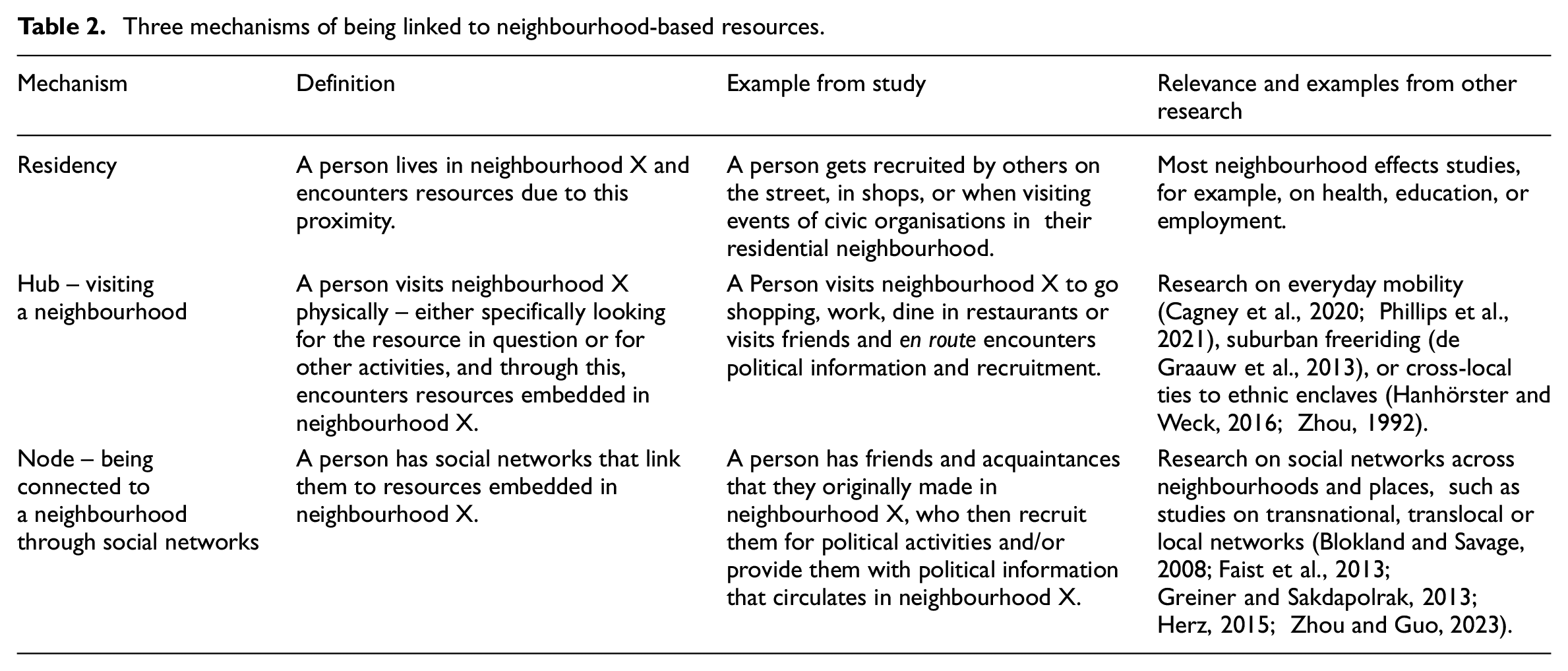
Table 2 summarises the three mechanisms identified here and provides examples of other research areas to illustrate their scope of relevance. While the residency mechanism is the basis for neighbourhood effects studies, examples of hub mechanisms can be found in research on everyday mobility or ethnic enclaves, and examples for node mechanisms, for instance, in research on transnational or translocal social networks.
Three mechanisms of being linked to neighbourhood-based resources.
The research presented here shows the importance of considering these mechanisms together to arrive at a fuller picture of how specific places and the resources embedded in them matter to social processes. To clarify again, the three presented mechanisms concern the question of how people get access to resources located in specific places, not how exactly these affect social processes. The latter aspect encompasses a different set of mechanisms, such as collective socialisation or recruitment, which also needs to be determined in order to arrive at a fuller explanation of which kinds of neighbourhoods matter, how, for whom, and for what. Thus, multiple levels of mechanisms need to be considered regarding the ways people access resources in spatial contexts.
In summary, the presented results emphasise the need to study people’s relationships to places beyond their residential context. Only focusing on the residential neighbourhood might underestimate the importance of the spatial location of resources for social processes and inequalities. This is especially relevant, as showing that people access resources elsewhere through everyday mobility or social networks does not mean that everyone can do so. Rather, studies show that mobility and networks across neighbourhoods are not evenly distributed but that these connections are themselves structured by social inequalities and differences (Cass et al., 2005; Van Kempen and Wissink, 2014).
The presented study has, of course, crucial limits that raise new questions. One is the limitation to one immigrant group in one city. Here, the question arises if spatial patterns of resource access are different for other immigrant and other social groups, as they might rely on a different set of organisationally dense neighbourhoods. Furthermore, if we research other social processes than recruitment, other areas might be important (e.g., for job counselling, social support, education). Translocal resource access is also likely to differ among regions or between urban and rural contexts. Finally, this study is able to provide only limited information on the factors that determine disconnection from resource-rich areas such as prior residential and migration history, or social network formation.
Supplemental Material
sj-docx-1-usj-10.1177_00420980241270928 – Supplemental material for Neighbourhoods as resource hubs and resource nodes: Civic organisations and political recruitment of first- and second-generation immigrants in Berlin, Germany
Supplemental material, sj-docx-1-usj-10.1177_00420980241270928 for Neighbourhoods as resource hubs and resource nodes: Civic organisations and political recruitment of first- and second-generation immigrants in Berlin, Germany by Nihad El-Kayed in Urban Studies
Footnotes
Acknowledgements
I would like to thank Talja Blokland, Martin Kroh, John Mollenkopf and Kurt Salentin for their generous support during the research process, and Ulf Tranow for his comments on the final paper. I also thank the anonymous reviewers for their helpful remarks and recommendations.
Declaration of conflicting interests
The author declared no potential conflicts of interest with respect to the research, authorship, and/or publication of this article.
Funding
The author disclosed receipt of the following financial support for the research, authorship, and/or publication of this article: The research for this article was financially supported by a scholarship from the Heinrich-Böll-Foundation as well as by funding provided through the Berlin Graduate School of Social Sciences at Humboldt-Universität zu Berlin.

Supplemental material
Supplemental material for this article is available online.
References
Supplementary Material
Please find the following supplemental material available below.
For Open Access articles published under a Creative Commons License, all supplemental material carries the same license as the article it is associated with.
For non-Open Access articles published, all supplemental material carries a non-exclusive license, and permission requests for re-use of supplemental material or any part of supplemental material shall be sent directly to the copyright owner as specified in the copyright notice associated with the article.
