




Abstract
Digital platforms are a central infrastructure that has dramatically changed our daily lives. Like any other urban infrastructure and amenity, the digital platform has a heterogeneous influence on social groups. Studies exploring the influence of the digital on the mundane tend to focus on users, their socioeconomic status and their digital skills. However, digitisation is not an exogenous force; rather, it relates to culture and place. The departure point of this article is to conceptualise the idea of neighbourhood in the digital age, which offers a path towards understanding the role of the digital in our daily lives in relation to places. The article starts by discussing the neighbourhood and digitisation, addressing gaps and links that connect these themes. This discussion is followed by presentation of a framework linking the material with the virtual in understanding neighbourhoods. This framework is based on gathering data on four key issues: spatial configuration, digital infrastructure, demographic profile and digital participation in a neighbourhood. Jointly, these four issues are viewed as the means to contextualise and expand the way we think about the interplay between infrastructures and the agency of the neighbourhood’s inhabitants.
Introduction
Analysing neighbourhoods in the digital age is a challenging task. A century ago, Clarence Perry’s 1929 study framed neighbourhoods as units of urban social territory and political organisations (Mehaffy et al., 2015; Perry, 2011). Perry’s framework has been enormously influential in the evolution of modern cities and has been the subject of intense controversy that has endured to the present day. Some controversies have arisen due to the difficulty of defining what constitutes an urban neighbourhood (Galster, 2019: 21), as it has both geographic (place-orientated) and social (people-orientated) aspects (Kenny, 2009). Digitisation processes have added extra complexity to this epistemological challenge of agreeing on what constitutes a neighbourhood and its role in our lives. In contemporary times, many people conduct their daily affairs, such as shopping, entertainment and services, on the internet. Furthermore, neighbourhood infrastructure (e.g. transportation), management (e.g. local and municipal platforms that provide services and information) and communities (in many places, although not evenly) are often supported by digital platforms. Today, digitisation creates new opportunities to participate in the neighbourhood context and enhances new patterns and practices in the virtual sphere, altering (yet not eliminating) the role of physical spaces. These reciprocal relationships between the physical and virtual stretch the geographical boundaries of neighbourhoods and can be viewed as a part of a historical process in which urban life has become less about the local and more about the city region as a network of places and spheres.
However, these processes and changes have not detracted from the presence of the neighbourhood as a unit of analysis in social sciences and urban studies. Although the neighbourhood remains a contested and dynamic category, it is still significant for understanding social processes in cities. The key argument of this article is that when studying contemporary neighbourhoods, the way digitisation reshapes daily life in place should also be addressed. This work suggests the concept of ‘neighbourhoods in the digital age’ as a term indicating that digitisation can no longer be viewed as an independent infrastructure or as a platform of data that can teach or inform us about places and neighbourhoods; rather, it should be perceived as an infrastructure that is physically located and affects materiality, place and daily conduct (Hatuka et al., 2021). The motivation for developing this approach is the increased socioeconomic gaps, segregation and inequalities among neighbourhoods in cities. In general, digital processes have the potential to reduce gaps because they allow access to education and information. However, if access to digital infrastructures is lacking and digital skills are underdeveloped, digital processes can contribute to extending existing forms of inequality. Furthermore, in a city where various social groups reside, the use of various technologies is also related to residents’ characteristics, lifestyles and the space where they live.
This argument is the departure point for developing a conceptual framework for understanding neighbourhoods in the digital age. ‘Conceptual frameworks are products of qualitative processes of theorization’ (Jabareen, 2009: 50), linking multiple bodies of knowledge from different disciplines (Jabareen, 2009). This framework is no exception, linking studies on neighbourhoods from urban studies and planning with those on digitisation from social media and cultural studies, with a focus on the digital-material configurations of the mundane (Barns, 2018; Elwood and Leszczynski, 2018; Pink et al., 2017). The conceptual framework offers directions for understanding the relationship between neighbourhoods and digitisation as an experience, with a focus on daily practices. This approach calls for shifting the focus from digital platforms as a mechanism or merely an infrastructure to the way physical places and digital platforms constitute one another and influence daily conduct in neighbourhoods.
This article starts by briefly discussing the concept of the neighbourhood as it relates to digitisation, addressing gaps in the way these two themes have been studied as well as the links that tie them together. This discussion is followed by a presentation of the methodological framework for assessing neighbourhoods in the digital age. The subsequent section explores the ways that this framework can be used to examine varied sets of questions at diverse scales. The article ends with a discussion on the significance of assessing the neighbourhood in the digital age as a means to enhance equal opportunities and inclusiveness when developing digital initiatives (Hatuka and Zur, 2020a).
Neighbourhoods and digitisation: Exploring related themes of study
Neighbourhoods are often physically identifiable places that function as platforms for daily exchanges. The physical structure of the neighbourhood serves as a spatial organisation unit that produces a form of ‘order’ out of the spatial complexity of the city (Bradley, 2015). Neighbourhood spatial distinctiveness, particularly centrality, helps residents build their identity, local power (Talen, 2018: 5) and sense of belonging (Drozdzewski and Webster, 2021: 6). Thus, if a city is conceptualised as an aggregation of communities existing within urban space, then neighbourhoods are the smallest territorial scale at which the communal processes of urban life are usually organised. Together, the physicality of the neighbourhood and daily exchanges constitute an embedded social reality, and vice versa, social connections are often enhanced by a neighbourhood’s functionalities (Talen, 2018: 6). Thus, ‘although it is tempting to conceive of the neighbourhood as a commodity with fixed, clearly defined characteristics, it is more appropriately viewed in a more dynamic perspective’ (Galster, 2001: 2116). In that respect, the neighbourhood is a mutable sociomaterial space that provides banal everyday opportunities for urban residents to ‘informally’ engage with one another, accommodate differences and collectively cultivate their specific needs and political identities in the place (Bradley, 2015).
Like the neighbourhood, technology has an important function in everyday life. Individuals are all becoming ‘platform dependent’ and cultural commodities that are open to constant revision, redesign and redistribution (Nieborg et al., 2020). Studies on digitisation are often based on the idea that the digital involvement of individuals and their digital capital are central components that determine academic achievement, employment opportunities and the quality of services and education (Robinson et al., 2015). This assumption regarding the role of digital capital in individuals’ achievements has resulted in ongoing research investigating residents and the concept of the digital divide (Gunkel, 2003; Min, 2010; Nemer, 2015; van Dijk, 2006). Numerous empirical studies have examined these ideas by focusing on ethnicity, race, sex, socioeconomic status, age and education to elucidate how and to what extent these characteristics influence internet usage and skills (Bélanger and Carter, 2009; D’Haenens et al., 2007; Min, 2010; Nam and Sayogo, 2011; Peter and Valkenburg, 2006; Rahim et al., 2011; Robinson et al., 2015; Stevens et al., 2017; van Deursen et al., 2011). Most studies on digitisation do not, however, assess digital use in the context of the individual’s living environment and spatiality.
This neglect explains why studies on the relationships and possible dynamics between neighbourhoods and digitisation are still in their infancy. In this body of research, a few directions could be found. First, social media plays a role in shaping the image of neighbourhoods. A recent study on images and associations connected to neighbourhoods revealed the role of vibrant platforms for local communities in exchanging and steering bottom-up place associations (Breek et al., 2018). It is argued that the use of digital platforms contributes to successful rituals that create symbols of group membership and imbue individuals with emotional energy (Breek et al., 2018; Collins, 2004). Another direction is the role of digital platforms in creating connections between social groups in segregated or unsegregated areas. Exploring this idea, a recent study showed that social media connections might help bypass existing barriers between diverse neighbourhoods, as ‘the growing diversification of Neighborhoods may effectively sidestep the more dire effects of segregation by leading to alternative channels of resources and information between Neighborhoods’ (Gibbons, 2022: 1340). Another direction looks at how the use of digital platforms relates to the physical built environment (e.g. detached houses or high-rises) and the daily life of the community (Hatuka et al., 2021). These studies addressing the relationships between neighbourhoods and digital practices have been able to bridge the seemingly enormous gap between the two fields. Conceptually, neighbourhood studies focus on the morphology of the built environment (i.e. density, land uses and public amenities) and social and economic dynamics (i.e. neighbourhood effects, segregation, conflicts, exclusion, poverty and housing markets) (Galster, 2011, 2019). Digitisation studies tend to focus on digital skills, digital literacy, capabilities, digital usage and digital differences, with a focus on the residents’ conduct and profile, not necessarily on the particular place. These differences explain in part why the spatial and physical environment is rarely the centre of attention in digitisation studies and, vice versa, why digitisation is considered an exogenous, virtual infrastructure that supports city life. Regrettably, there are not enough studies that ‘advance understanding of the complex coevolutionary processes linking new information technologies and space, place and human territoriality’ (Graham, 1998: 171).
Although gaps exist in the way that neighbourhoods and digitisation are explored, there is an extant set of ideas that ties neighbourhood and digitisation processes together (Figure 1). In the physical sphere, there is a vast body of research focusing on digitisation as a means of better developing new infrastructure (such as in transportation) or evaluating the performance of existing infrastructure by using methods of data science (Karami and Kashef, 2020; Kelley et al., 2020; McLean et al., 2016). In the social sphere, questions on community and identity have always been a key theme pursued in the study of neighbourhoods. Recent studies on neighbourhoods have shown that social media are important tools in the interplay between digital and face-to-face neighbourhoods (Lane, 2018; Stevens et al., 2017) and that online social relationships sustain offline neighbourhood relationships (Gibbons, 2020; Lane, 2018; Tai et al., 2020). Additionally, social media foster offline relationships, facilitating involvement in the neighbourhoods of people who may not have been involved otherwise (Goodspeed, 2019; Lane, 2018). These studies illuminate the role of social media in transforming the way people cultivate a sense of neighbourhood community (Gibbons, 2020: 1274). In the political sphere, there are new platforms that cultivate participation and engagement in city affairs (Bayat and Kawalek, 2023; Lee-Kelley and James, 2003). The idea of e-governance assumes that citizens who fully embrace digital assemblages of hardware, software and platforms are empowered to communicate, collaborate and participate in urban governance processes and mechanisms (Ho, 2016); moreover, by leveraging digital conduits, information is easily and quickly shared, and urban services can be delivered more efficiently and in new ways. Additionally, some platforms operate at the neighbourhood scale. Online neighbourhood social platforms, for example, do not differ significantly from traditional systems (Vogel et al., 2020), but their key value, in addition to a topical focus on local issues, is the formation of a community of trust among residents of a particular neighbourhood, enabled by neighbourhood delimitation and identity verification mechanisms (Vogel et al., 2020: 14).
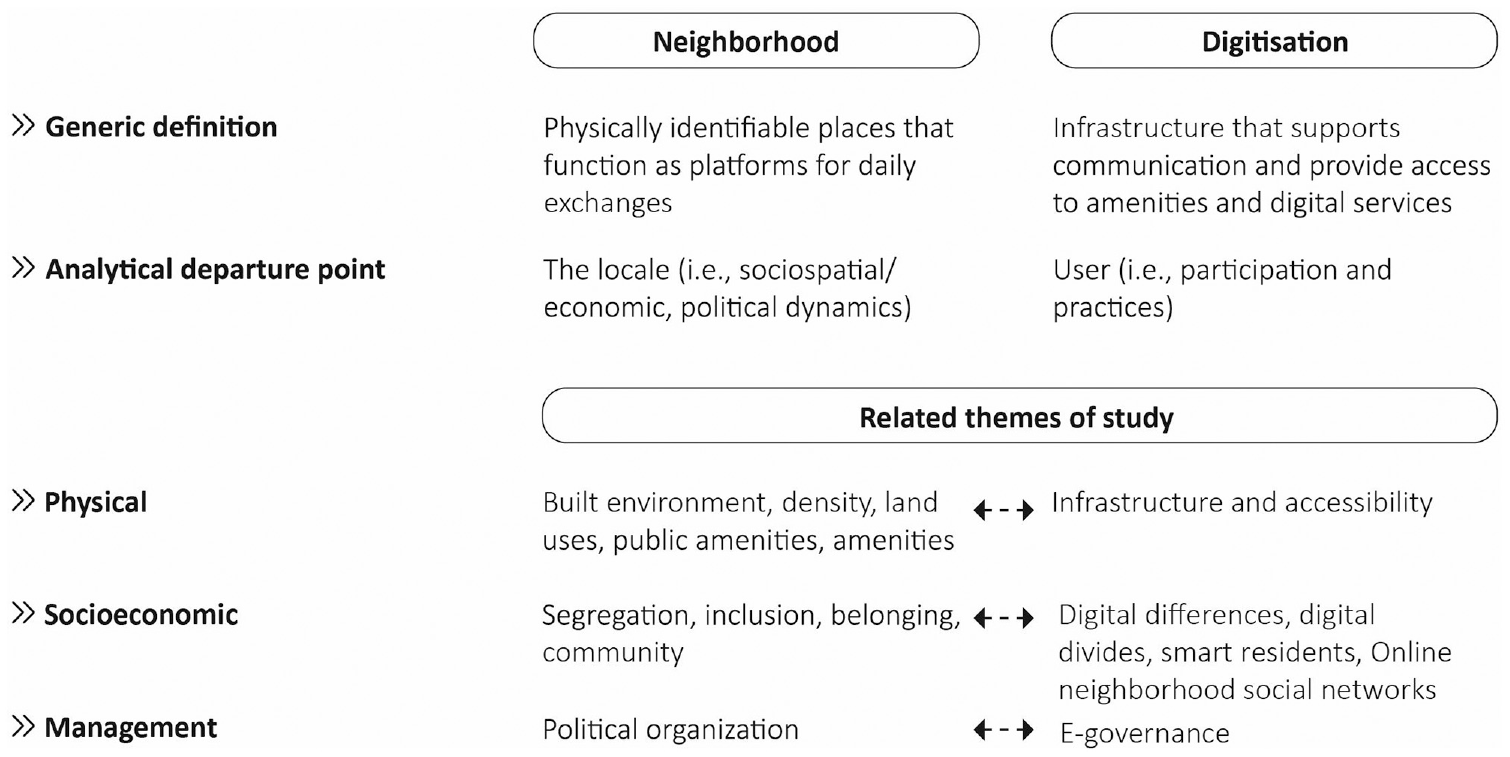
Neighbourhoods and digitisation.
Together, these related themes assist in conceptualising the idea of ‘neighbourhoods in the digital age’, a term that points to the next phase in the evolution of daily experience in neighbourhoods. Figure 1 summarises the discussion, showing that although neighbourhood and digitisation studies differ in their departure points, they share related concepts and common interests.
A conceptual framework for understanding neighbourhoods in the digital age
The premise of the concept of neighbourhoods in the digital age is that both the neighbourhood as a place and the daily practices of inhabitants have been altered by digitisation. Thus, the key analytical question is as follows: what is the neighbourhood in the digital age? This overarching question can be further addressed by responding to four key interlinked themes and questions: Spatial configuration – what is this place? Digital infrastructure – what is supported digitally in the neighbourhood? Demographic profile – who resides here? Digital participation – how and to what extent are residents digitally active? The first two questions focus on infrastructure, and the other two questions focus on practices; together, they provide four datasets that can help us understand the contemporary profile of neighbourhoods (Figure 2).
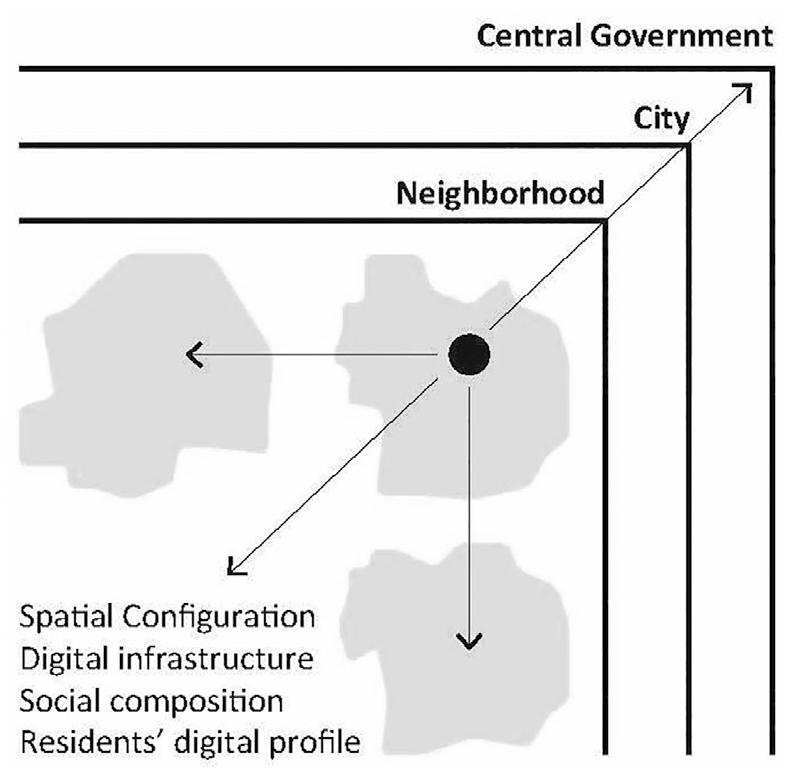
Departure points for understanding the neighbourhood in the digital age.
Spatial configuration: What is this place?
The physical infrastructure and the design of a neighbourhood have a tremendous influence on the lives of residents in a locale. Numerous studies have focused on the spatiality of neighbourhoods, their boundedness and centredness, their street composition and the effect of that composition on internal and external connectivity (Song and Quercia, 2008). Living in a neighbourhood dominated by high-rise buildings and public transportation infrastructure is different from living in a suburban environment dominated by detached housing and private car use. The type of built form and the presence of other service-orientated amenities, such as education and health, as well as commercial amenities, have an effect on individuals’ familiarity with people, places and daily practices. The distances from homes to workplaces and city/town halls and the distances from homes to the nearest amenities (e.g. bars, recreational facilities, hospitals, supermarkets, parks and transit stops) (Zong and Zhang, 2019) are crucial factors that shape daily practices and the sense of community (Rogers and Sukolratanametee, 2009). In terms of the physical configuration of the neighbourhood at hand, four parameters should be accounted for, analysed and mapped: (a) Geography entails the location of the neighbourhood in the city and how well that neighbourhood is connected to its surroundings. Is the neighbourhood spatially and physically well connected to the city with roads and public transportation, or is it an isolated enclave? (b) Mobility refers to whether human mobility is supported by physical infrastructure (i.e. via trains, buses, cycling lanes and pavements). (c) Built forms and land use refer to the neighbourhood’s physical characteristics, including height, density and types of housing and amenities (e.g. schools, parks). (d) The availability of amenities relates to how people make commercial and recreational uses of public and private spaces (non-existent, time specific and gendered); amenities also include the institutional services (e.g. education and health) available to residents and visitors. The outcome of this assessment and mapping is a spatial configuration of the neighbourhood that categorises its type (i.e. central, urban, peripheral or suburban) (Song and Quercia, 2008).
Digital infrastructure: What is supported digitally in the neighbourhood?
New technologies do not substitute for the social world and place but are constituted in a place and through social relations (Crang et al., 1999; Zong and Zhang, 2019). Thus, while many cities have developed digital infrastructures, the applicability and use of the strategies used for this development have had different meanings at different levels, from the municipal or regional levels to the more targeted neighbourhood- or site-specific areas (Edge et al., 2020; Fernandez et al., 2018; Lam and Ma, 2019). For example, ‘how consumers adopt e-commerce varies greatly between societies, and such variations are directly and indirectly linked with the construction of space in each society’ (Zook et al., 2004: 163). Thus, it is important to understand what digital infrastructures and services are available in neighbourhoods, accounting for (a) municipal initiatives such as the provision and maintenance of information and communication infrastructure (e.g. the installation of optic cables), the development of specific products or services and the applications available at the local level (e.g. Moovit, GetTaxi, waste management, lighting or Wi-Fi) and the municipal-level platforms available to communicate with residents. Moreover, (b) local initiatives must also be considered, such as bottom-up community digital platforms and designated digital local services (i.e. training for personnel or culturally sensitive infrastructures). The outcome of this assessment will be a map of the municipal/local digital infrastructures and will provide an analysis of the digital profile of the neighbourhood (i.e. it explains whether the neighbourhood is unsupported, partially supported, supported or hyper-supported).
Social composition: Who resides in the neighbourhood?
As they had done in the earliest days of the Chicago School, throughout the 20th century and into the 21st century, social scientists have continued to cultivate a definition of neighbourhood based on social demographics; this definition mostly meant that neighbourhoods were defined as census tracts, land use, housing use and industrial use (Park et al., 1925; Talen, 2018: 63). In the case of digitisation, census tracts can support the analysis of digital inequality. Studies on digital inequality have focused on the individual level through an assessment of the role of socioeconomic status (Peter and Valkenburg, 2006; van Deursen and van Dijk, 2019; van Deursen et al., 2011; van Dijk, 2005). Yet, following this approach, scholars claim that there is a place to examine the non-uniform geography of information and communication technology (ICT) within a city and how it might influence new types of social exclusion (Crang et al., 2006). A study conducted in England examined two geographically adjacent neighbourhoods in the city of Newcastle; one of them, Blakelaw, is included on the list of the 20 poorest neighbourhoods in England, while the other, Jesmond, is among the 20 wealthiest neighbourhoods in the country. The findings show clear differences in their Internet practices in terms of both type of use and access. In stronger neighbourhoods, internet usage for information, searches and daily communications is twice that in weaker neighbourhoods (Crang et al., 2006). Age has been perceived as having a significant influence on digital inequality because older residents must ‘migrate’ to the digital world, whereas younger residents are ‘natives’ who were born there. Education is also considered a significant variable that affects all types of digital skills (Crang et al., 2006). Considering past studies, three parameters should be assessed: (a) socioeconomic status, including average income, education, homeownership and car ownership. The latter can indicate whether they are temporary residents in the neighbourhood as well as their daily commuting lifestyle; (b) age, with particular attention to children, elderly individuals and the type of household (i.e. family home or single housing); and (c) ethnicity, with attention to immigration status. The outcome of this set of data will assist in better understanding the social composition and the groups residing in the locale but cannot be used as constituting stand-alone resident profiles in the locale.
Residents’ digital profile: How and to what extent are residents digitally active?
Contemporary residents engage digitally in various formal platforms (i.e. municipal), crowdsourcing platforms, feedback-reliant applications and online public forums (e.g. X/Twitter, Facebook and VKontakte). Thus, while people in traditional cultures see information being shared horizontally among citizens, the new urban landscape is marked by ‘a dramatic shift to vertical information sharing between citizens and government’ (Finch and Tene, 2014: 1593). However, it has been argued that engagement with these platforms does not necessarily embody meaningful participation in a democratic system (Morozov, 2012, 2014). Rather, the use of these technologies blurs the line between participation in public life and consumption. Moreover, even if this type of engagement is accepted as a form of participation, it is not broadly based; residents without access to the internet or smart mobile devices are unable to either participate or consume. Technologies enable municipalities and private firms to record and track citizens’ activities for various purposes (Calzada and Cobo, 2015: 30). Recording daily life in seemingly ever-increasing detail is not without social and personal consequences (Klauser et al., 2014). The storage of residents’ information, from their location to their debit and credit card information, can compromise their privacy and the security of their personal information (Elmaghraby and Losavio, 2014; Martinez-Balleste et al., 2013; Seto, 2015). The inclination of residents to participate and their growing awareness of privacy and surveillance issues contribute to the development of multiple profiles, from active residents to watchful residents, non-residents and conscious non-residents (Hatuka and Zur, 2020b). In assessing residents’ digital profiles, three parameters should be examined: (a) e-literacy, which is the common denominator across the various definitions of digital literacy and constitutes the agreement that digitisation is a language. Accordingly, digital literacy means using linguistic, cognitive and psychological skills that are different from those used in the analogue world. In either case, digital literacy requires understanding multiple means of communication and a synthetic understanding of images, sounds and words (Lankshear and Knobel, 2008). Recent studies have presented the centrality of digital skills as the chief cause of growing divides and inequality (Hargittai, 2011; Robinson et al., 2015; van Deursen and van Dijk, 2019). (b) The way the use of digital services differs between formal municipal platforms and local or personal platforms. (c) People’s privacy in the digital age. This analysis will assist in mapping the various profiles of residents and non-residents on digital platforms in a given neighbourhood (Hatuka and Zur, 2020b).
This conceptual framework offers directions for understanding the relationship between neighbourhoods and digitisation as an experience, with a focus on daily life. The empirical departure point is the residents in the locale, an approach that calls for shifting the focus from digital platforms as a mechanism or merely an infrastructure to the way physical places and digital platforms constitute one another and influence daily conduct in neighbourhoods. The framework assists in gathering data on four key issues – spatial configuration, digital infrastructure, demographic profile and digital participation in a neighbourhood – but these issues are not the end goal; they are only the means to contextualise and expand the way we think about the interplay between infrastructures and the agency of the inhabitants of the neighbourhood. This interplay assumes that the place is defined, used and constituted by the inhabitants. The inhabitants use the available physical and digital infrastructures at hand. Thus, one direction of investigation is to explore (spatial and digital) infrastructures and their influence on residents’ daily lives. We can explore the extent to which the spatial configuration of a neighbourhood influences people’s use of digital platforms. Is there a relationship between spatial and digital infrastructures and residents’ social and digital profiles? To what extent do spatial and digital infrastructures define the relationships between residents’ participation and municipality involvement (i.e. trust, hostility, indifference)? These correlative questions help us understand neighbourhoods’ spatial profiles and unveil the role of digital knowledge in the daily lives of residents in neighbourhoods. Another direction in exploring data gathered for the four key issues is to start with the profiles and practices of the inhabitants to reflect on the neighbourhood infrastructures. How do the digital practices of inhabitants affect the economy and identity of the neighbourhood and thus its infrastructures? Do inhabitants’ digital practices support social cohesion among social groups, or do they enhance exclusion processes? To what extent do the digital profiles of the residents influence the involvement of the municipality in the neighbourhood? These are some examples of how we can think about the important interplay between infrastructures and agencies in the neighbourhood in the digital age.
Figure 3 summarises the questions and dimensions of the analysis. The suggested framework can be adapted to various types of methods and can be used at different scales. The analysis can be based on either quantitative or qualitative methods, as long as the key elements of infrastructure are linked to practices. In addition, there are new methods and tools for researching digitisation. For example, most particularly, self-datafication has emerged through engagement with quantified self-technologies (i.e. motion sensors or GPS units) that assist in producing ‘mundane data’; moreover, some practices involve subsequent interactions with one’s self-tracking data (Pink et al., 2017).
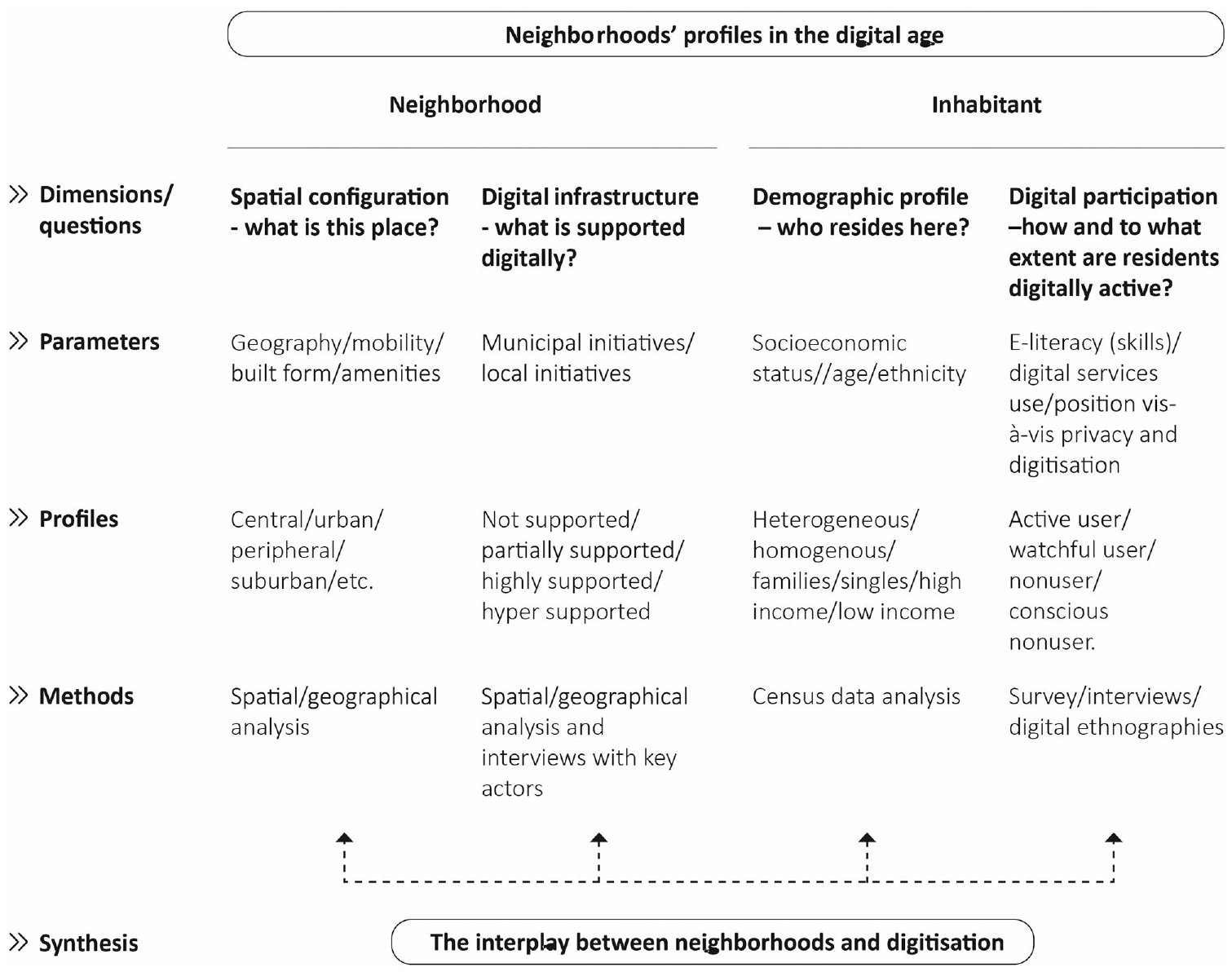
Conceptual framework for assessing the neighbourhood in the digital age.
This framework could be used in non-scalar and multi-scalar ways (Figure 4). Figure 4 summarises three key options for possible empirical research. First, an intrinsic case study can be used for an individual case independent of scale to understand particular dynamics at play in a neighbourhood associated with digitisation. The focus is then on the digital-practice repertoires in that neighbourhood. Second, in an instrumental study, the framework can be used to understand a city’s neighbourhood-based composition in the digital age, with a focus on digital practice repertoires and the interplay of different social groups and neighbourhoods within that city. This approach could be part of a third approach, a multi-scalar analysis of neighbourhoods that also addresses city and national scales. Adopting a multi-scalar approach makes it possible to go beyond the hierarchical fixed institutionalised structures of power (Çağlar and Glick Schiller, 2021). Scales are approached as mutually constituted, relational and interpenetrating territorially; indeed, they are reference entry points for an analysis of interconnected processes (Brenner, 2019; Swyngedouw, 2004). Underlying the concept of multiple scales is an acknowledgement of ‘urban space and state space as intricately entangled, mutually constituting, and conflictually coevolving formations of scale-differentiated sociospatial relations under modern capitalism’ (Brenner, 2019: 7). In that sense, neighbourhoods in the digital age do not posit uniform global, national or city dynamics because the multiple, changing and intersecting trajectories of power are experienced and reformulated by multiple actors within specific places and over time.
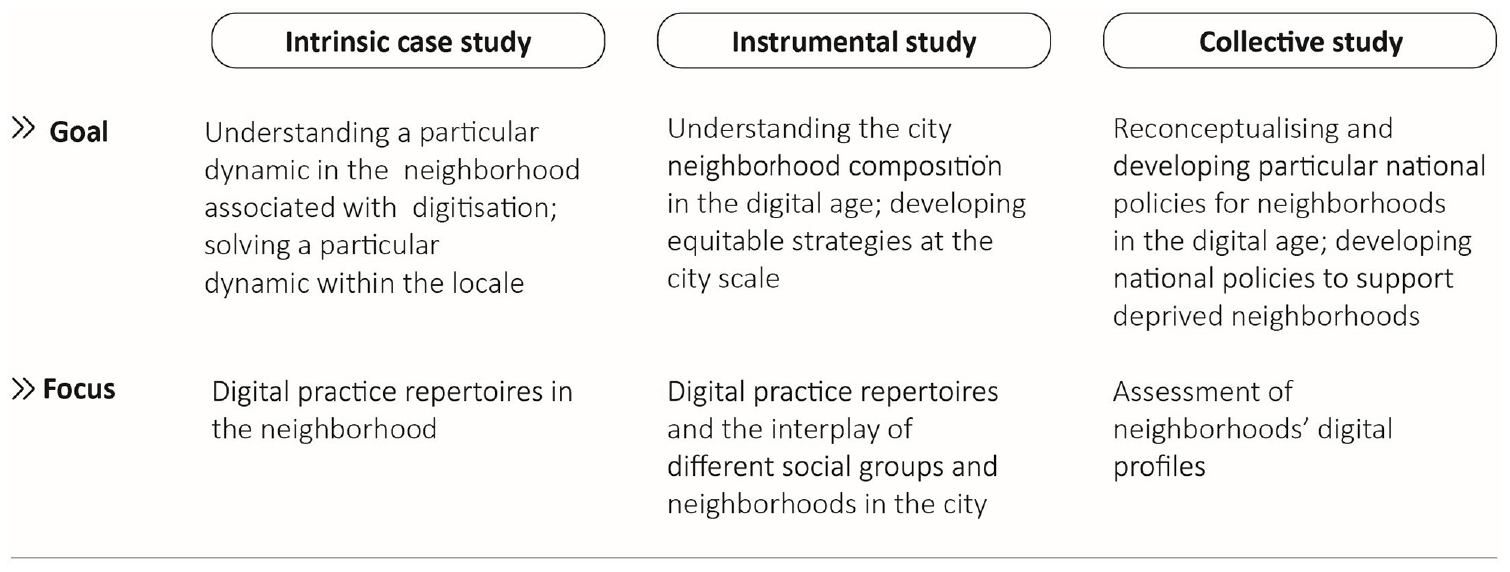
Using the conceptual framework.
Discussion: Future neighbourhoods in the digital age
The conceptualisation of ‘neighbourhoods in the digital age’ is about attending to the ‘digital mundane’, that is, the on-the-surface, taken-for-granted, seemingly ordinary and routine sites, objects, data productions and networked practices of everyday life (Leszczynski, 2020). Methodologically, the suggested framework is adaptive and evolving. Therefore, this conceptual framework is a loose guideline, a departure point for asking multiple sets of questions that should be carefully rethought and adjusted when applied to empirical research.
Importantly, connecting neighbourhoods and digitisation can provide new insights at various scales: resident, neighbourhood and city. First, at the resident scale, the analysis of physical and digital space (de Souza e Silva and Frith, 2012: 46) will teach us about the power of the individual to construct his or her personal space and practices by using various tools in place (Calzada and Cobo, 2015; Hatuka and Zur, 2020b; Martin and Shilton, 2016); it may help in the exploration of why and under which conditions residents choose to use digital platforms, to what extent physical conditions and amenities in the neighbourhood push residents towards the virtual and how the interplay between physical and digital activities shapes residents’ mundane activities. Second, at the neighbourhood scale, this connection might elucidate how spatial, social and digital factors are interlinked, influencing and co-defining one another. It may help explore to what extent particular digital practices and particular digital infrastructures affect the neighbourhood (i.e. social, political, economic) and enable influence to be gained in the neighbourhood, and if so, by whom. Here, again, there is a need to further explore the adaptation of digitisation in place and its influence on both the locale and the inhabitants. Third, at the urban scale, using this framework to analyse neighbourhoods will support understanding digital inequality between places and the way that digitisation influences the division of resources and power relations within the neighbourhood and the city (Hatuka et al., 2021); it may help to explore the advantages of better-equipped digital neighbourhoods in terms of attention from the municipality and better access to resources, and it can also assist in studying relations between the physical infrastructure of the neighbourhood and the digital infrastructure, and digital platforms can contribute to inclusion/exclusion processes. These questions are new, as are the processes of digitisation, and this framework suggests starting from the microscale to discuss the city or national scale. The neighbourhood in the digital age is an important category with a contemporary smart city agenda, as massive funds are being invested in digitisation and the recruitment of residents for digital apps and services. The question is not whether one has physical access to the internet but rather how different populations use it, given their different levels of digital literacy, skills and abilities. Do residents use the internet for entertainment and social networking; to consume services; to streamline operational processes; to manage daily life; as a tool for work; to seek information; to express political opinions, for protest or self-expression; for software development; for employment or for creating capital (economic, social or cultural)? There are major differences between these uses, and they influence current and future digital inequality and daily lives. Digital gaps and differences between neighbourhoods will enhance segregation and polarisation in cities.
Thus, future research should ground digital processes in place, contextualising the role of digital tools in our lives. This understanding could help reduce gaps or address specific challenges in different realms of the neighbourhood and the city (e.g. language, unemployment, teenagers, welfare or education). In addition, it is becoming clear that differences in digital infrastructures and use in neighbourhoods influence people’s resiliency and access to resources. This argument gained salience during the pandemic, when neighbourhoods played important cognitive, emotional, social and organisational roles (Introini et al., 2021: 302) in maintaining social connections and a sense of belonging, distributing locally relevant information (Vogel et al., 2021: 3043) and developing a hybrid social dynamic that balances offline in-person interactions with online digital interactions (Vogel et al., 2021: 3044).
Finally, without an examination of technological initiatives or applications in the contexts of neighbourhoods and social groups in the city, we will not be able to map the suitability of these initiatives for these groups and the latter’s willingness, or lack thereof, to use online services; we will also not be able to account for the appropriateness of these initiatives for all residents in the city. A lack of such examination will distance us from understanding the current social processes that are taking place in multiple spheres. The conceptualisation of neighbourhoods in the digital age might open a new path for support, a concept that positions society and the urban context as the primary parameters when developing digital initiatives.
Footnotes
Acknowledgements
I want to thank George Galster and Jan Üblacker for inviting me to the workshop in Cologne in May 2022 and for their thoughtful comments on previous versions of this article. I also want to thank anonymous reviewers for their insightful suggestions.
Declaration of conflicting interests
The author declared no potential conflicts of interest with respect to the research, authorship, and/or publication of this article.
Funding
The author received no financial support for the research, authorship, and/or publication of this article.
