




Abstract
The notion of infrastructural politics has been increasingly used in urban studies as it helps to explore urbanisation processes, the urban condition and urban life. Given its relevance, this article maps out and critically reviews the main analytical strands that inform its meanings, namely, conventional and popular infrastructural politics. These strands reveal the current tendency to demarcate infrastructural politics as two separate, antagonistic domains that associate the notion with particular hegemonic and subaltern actors, practices and processes. The article problematises this tendency and proposes a broader understanding of infrastructural politics as an ordinary and contentious political arena where diverse actors develop politico-infrastructural repertoires that co-exist in multifaceted, conflictive ways rather than as separate domains. Drawing on political ethnographic understandings of politics, infrastructural politics is conceived as a point of convergence where conventional and popular infrastructural politics meet and mesh. This suggests the possibility of cross-fertilising conversations between infrastructure studies and political ethnography that can refine our understanding of infrastructural politics, first, by promoting a more nuanced examination of the overlaps and interdependencies between hegemonic and subaltern politico-infrastructural actors and practices, and second, by addressing the critical role of infrastructures in enabling and materialising such overlaps and interdependencies.
Introduction
The literature exploring the relationship between the political and the infrastructural continues expanding in the fields of urban studies, geography, anthropology, information and technology studies and area and environmental studies. Often having the urban as their main focus or background, concepts such as infrastructural politics, the politics of infrastructure, political infrastructure, techno-politics and other variants condense this shared, cross-disciplinary interest in both politics and infrastructures. While this article primarily focuses on the urban and addresses urban scholars, it draws on these cross-disciplinary engagements as it acknowledges that the problematisation of infrastructural politics can only develop in this conceptually and empirically rich field.
There are differences between the concept of infrastructural politics and its variants, but their general usage reveals similarities, overlaps and complementarity (Nolte, 2016). In their broader sense, these concepts simultaneously foreground the political actors, practices and processes that shape infrastructure production (Millington, 2018; Millington and Scheba, 2021; Young and Keil, 2010, 2014) and the political agency of these material entities (Amin and Thrift, 2017; Appel et al., 2018; Laszczkowski, 2020; McFarlane and Rutherford, 2008). Generally speaking, either side of this spectrum recognises the intimate relationship between human and non-human agency and the multiple instances in which social actors forge strategic political alliances with infrastructures (Bennett, 2010; Fredericks, 2018).
Given the similarities and differences between these terms, a detailed examination of the usage of the notion of infrastructural politics emerges as a necessary task. For urban research and practice this is even more relevant, considering the extensive use of the term in the discipline and the tendency to rarely define it and strongly associate its meanings with particular sets of actors, practices and processes rather than others. This conceptual unfolding in urban vocabularies can be explained by what Larkin (2013) once identified as the productive instability of the basic research units in infrastructure studies. From this perspective, understandings of infrastructural politics are also characterised by a healthy diversity of meanings constantly enriched theoretically and empirically. As with other concepts in urban studies, such diversity calls for more reflexivity about the use of infrastructural politics and their theoretical and political limitations and potentialities (Bhan, 2019; Lawhon and Truelove, 2020; Ren, 2022; Schmid et al., 2018; Theodore et al., 2019).
This article interrogates the use of infrastructural politics in the literature, in particular the emphases and tendencies on which its meanings are built. By mapping out the central themes underlying the meanings of the notion, this article reveals that the use of the term tends to be split into two main directions: one focused on hegemonic and the other on subaltern actors, practices and processes. These relatively well-demarcated strands are discussed under the notions of conventional and popular infrastructural politics, which play here a heuristic function. The analysis also shows that these strands subsequently unfold around more specific sub-themes that stand firm in the literature and provide further insights into the connotations of infrastructural politics. This is discussed in the section ‘Approaches to infrastructural politics’ after a brief section on the methods employed to develop this analysis.
The following section, ‘An arena of interdependencies’, problematises this conceptual divide by proposing an understanding of infrastructural politics as an arena where politico-infrastructural repertoires – both conventional and popular – overlap and contest each other as they define infrastructure production and broader urban processes. This perspective reads infrastructural politics as a point of convergence where hegemonic and subaltern actors, practices and processes co-exist in multifaceted, conflictive ways rather than as separate domains. The approach draws on debates and concepts stemming from political ethnographic approaches to ordinary and contentious politics and their multifaceted outcomes (Auyero, 2007, 2012a; Benzecry and Baiocchi, 2017; Schatz, 2009; Tilly, 2006). It also builds on empirical cases in the literature on infrastructural politics that already suggest such convergence but still tend to fall on one side or the other of the conventional–popular divide.
This article contributes to urban studies debates on infrastructural politics in at least three ways. First, it maps out the main tendencies (strands and dimensions) in the conceptualisation of this extensively and increasingly used notion. Second, it provides additional terminology to situate the who, how, why, where and when of (conventional and popular) infrastructural politics. Third, it proposes an approach that brings political ethnographic thinking into infrastructural politics. In this way, the article restates the critical role of infrastructural politics in producing a wide range of urban constellations (and their outsides) (Brenner and Schmid, 2015; Kanai and Schindler, 2019; Roy, 2016; Wiig et al., 2023). This includes constellations in ongoing and emergent debates in the Urban Studies journal, such as the permanent questioning and challenging of plug-in infrastructural projects (Guma et al., 2023); the advocacy of everyday infrastructures and infrastructural commons in contexts of crisis (Bryson et al., 2023; Fan et al., 2023; Sanchez, 2023); the examination of smart urban infrastructure in the Global South (Alizadeh and Prasad, 2024; Bobbins et al., 2024); and the study of vertical infrastructure and its implications for urban space (Ebbensgaard et al., 2024).
Methods
This article is based on the analysis of the literature concerning infrastructural politics, for which a qualitative literature review has been conducted. The primary search strategy consisted of searching for relevant sources on the Web of Science and ProQuest databases that included the keywords ‘infrastructur* politics’ and ‘the politics of infrastructure’ in titles and abstracts. Boolean operators AND, OR and NEAR and the databases’ predefined filters were used to narrow down the search in peer-reviewed urban studies, geography, anthropology, information and technology studies, history and sociology journals. Additional terms were used for search refinement, such as ‘urban*’, ‘colonial*’, ‘popular politics’, ‘subaltern*’, ‘people as infrastructure’ and ‘encroach*’. A total of 138 articles, book chapters and books were thematically analysed, which resulted from excluding sources that mobilised the terms in marginal or tangential ways. Some limitations of the study must be considered, including the overfocus on more contemporary journal articles that resulted from the predominance of this source type in the databases and the qualitative nature of the literature review, which demarcates both the scope of the search strategy and the reach of the analysis.
Approaches to infrastructural politics
An analysis of the usage of infrastructural politics in urban studies and cognate disciplines reveals at least five key issues. First, the term is rarely explicitly defined in the literature. Second, its meanings emanate from the richness but also the limitations of empirical research. Third, infrastructural politics are often treated as a distinct practice performed by particular sets of actors. Fourth, a closer look reveals that the term unfolds in two main strands with their own sub-themes. Fifth, there are relevant lessons to be learned concerning how these two strands overlap and their sets of actors become interdependent. To map out this conceptual landscape, the selected literature is examined under the notions of conventional and popular infrastructural politics (Table 1).
Approaches to infrastructural politics.
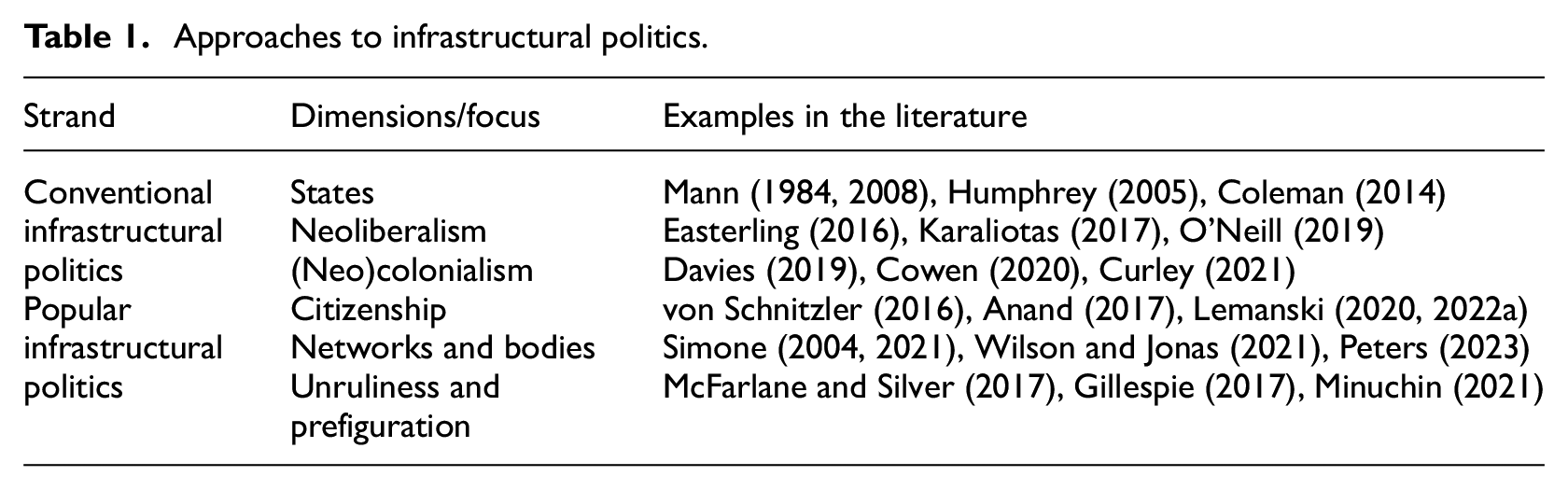
Borrowed from Finewood et al. (2019), the term conventional highlights the hegemonic actors, practices and processes of infrastructure production. Colonial and capitalist domination, exploitation and exclusion driven by states and private corporations characterise this approach. Drawn from studies concerning the subaltern–infrastructure nexus, popular denotes the engagements of marginalised actors in practices and processes of infrastructure thinking, planning, making and maintaining. Survival strategies and prefigurative politics come to the fore in this approach. These strands are examined in the following sections with a focus on urban experiences to portray the who, why, how, where and when of infrastructural politics.
Conventional infrastructural politics
Generally speaking, conventional infrastructural politics echoes the idea that infrastructures are mediators and conveyors of hegemonic political agendas (Appel et al., 2018; Millington, 2018; Young and Keil, 2010). They operate as bio-necropolitical devices that consolidate state, private and colonial territories and control populations for value extraction purposes (Addie, 2021; Guma, 2023; Ranganathan, 2020; Usher, 2023). In this approach, state, capitalist and (neo)colonial powers become predominant figures whose capacity to produce violence, injustices and death through infrastructures become predominant. Marked by conventional infrastructural politics, urbanisation is infused with material entities that more than often reinforce long-standing socio-spatial inequalities. The three dimensions in which conventional infrastructural politics further unfolds focus on states, neoliberalism and (neo)colonialism.
States
In conventional infrastructural politics, the state is often placed at the centre of infrastructure production, which is primarily used as a state-building tool (Appel et al., 2018; Bachmann and Schouten, 2018; Mann, 1984, 2008; Mukerji, 2009). This infrastructural power generates both disciplinary and welfare infrastructures that reaffirm state presence and rule over peoples and territories in visible and invisible ways. State economic, political and social agendas are deployed through increasingly urban biopolitical technologies of government (Amin and Thrift, 2017). And while domination and exploitation are major goals in state-controlled infrastructural politics, they co-exist with community-building agendas that ensure different experiences of social reproduction through the uneven provision of welfare infrastructure. In this line, infrastructures are also produced as totems that convey the state’s ideological principles and bring people together under shared ideas of national identity and belonging (Coleman, 2014; Humphrey, 2005; Redfield and Robins, 2016).
The presence (or absence) of state-led conventional infrastructural politics has been central in the shaping of urbanisation processes across the planet (Lemanski, 2019; Shatkin, 2022). Most extensively in the Global North, critical and social infrastructure provision has been one of its signatures. And although state retrenchment has taken place everywhere, it continues to play an active role in enabling and contesting infrastructure. States, for example, have a hand in the financialisation of private infrastructure and the dismantlement of social infrastructure in the Global North and South (Deruytter and Derudder, 2019; Silver and McFarlane, 2019). Operating across multiple scales, China’s Belt and Road Initiative (BRI) is also a powerful example of state-triggered conventional infrastructural politics. Deployed across different regions, the initiative is transforming a myriad of localities and global geopolitical agendas alike (Lesutis, 2020; Murton and Lord, 2020; Sternberg et al., 2017) while boosting urbanisation processes with variegated impacts. In Kampala and Addis Ababa, for instance, urban expressways and light rails realise the Chinese and local state’s conventional infrastructural politics through opaque, contingent and unanticipated negotiations that reimagine and repurpose infrastructures (Goodfellow and Huang, 2021). In the process, these infrastructures reinforce forms of urban extractivism, social control and belonging in African cities.
Neoliberalism
Profit-seeking hegemonic actors and processes characterise the second dimension of conventional infrastructural politics, while its focus on neoliberalism emphasises the impact of deregulation, privatisation, austerity and technocracy on infrastructure provision and management (Easterling, 2016; Petrova and Prodromidou, 2019). Neoliberalism also highlights the end of a brief period in modern history when all-powerful states commanded infrastructure production. Also referred to as the neoliberalisation of infrastructural politics (Karaliotas, 2017), this approach focuses on the emergence and consolidation of technocratic governance and accumulation regimes that create new interdependencies between states and private actors in infrastructure provision (Gartner, 2016). At the urban scale, neoliberal infrastructural politics reengineer infrastructure’s funding, financing and governing by increasingly intertwining the viability of urban infrastructure with the design and enactment of investment instruments that maximise profit returns (Deruytter and Derudder, 2019; Furlong, 2020; Hall et al., 2019; Li et al., 2023; O’Neill, 2019). Worldwide, the neoliberalisation of infrastructural politics produces spectacular public–private infrastructures that transform neighbourhoods, city centres, high streets, waterfronts and industrial areas, further fragmenting urban environments and deepening precarity and social vulnerability (Akhter et al., 2022; Boland et al., 2017; Graham and Marvin, 2001; Oommen and Sequeira, 2021; Raco, 2014; Rius-Ulldemolins and Klein, 2022; Smith, 1990).
In Jakarta, for example, where access to water supply networks has been highly differentiated since colonial times (Kooy and Bakker, 2008), contemporary conventional infrastructural politics has further splintered the city’s fabric through private investment in hyper-visible infrastructural projects (Colven, 2020). Sea walls, skyscrapers, roads and satellites have been built at the expense of ordinary infrastructural networks on which most city residents rely to fulfil their water needs (e.g. pipes, wells, pumps). In a context of land subsidence, floodings, tsunamis and water contamination, the proclivity for spectacular infrastructures – including new generations of climate-change mitigating infrastructures (Robin and Broto, 2021) – accentuates the urban poor’s vulnerabilities and further exposes them to socio-environmental risks, including evictions, floodings and disease. Similar logics of infrastructural (in)visibility and (dis)connection under neoliberal regimes have been shaping suburbanisation in Toronto, urbanisation in China, peri-urbanisation in Manaus and Bagamoyo, development in Laotian cities and energy access in Accra (Coward, 2015; Destrée, 2022; Kanai and Schindler, 2019; Sims, 2021; Young and Keil, 2010).
(Neo)colonialism
A focus on the coloniality of infrastructure constitutes the third dimension of conventional infrastructural politics. It foregrounds how state and corporate powers interact to establish global systems of exploitation by aligning infrastructure production with (neo)colonial agendas (Cowen, 2020; Curley, 2021; Davies, 2019). A central element in this critical reading of conventional infrastructural politics, (neo)colonialism is conceived as an ongoing bio-necropolitical project that continues erasing territorial identities and racialising peoples for the sake of resource and labour extraction (Ranganathan, 2020). This provides the notion of conventional infrastructural politics with a sense of its role in the dispossession, racialisation and enslavement of indigenous peoples in Africa, Asia and the Americas. It also sheds light on the role of infrastructures as (neo)colonial ‘beachheads’ used by contemporary states and corporations to escalate extractive operations in poor countries (Curley, 2021; also Akhter et al., 2022).
Cities and urban infrastructure encapsulate these colonial dimensions as nodes of (neo)colonial infrastructural networks that have historically performed administrative, financial and military functions for the control and extermination of indigenous peoples and territories. For colonial and imperial powers, the construction of urban space in the Global North and South was paramount. Alongside railways, cities like Montreal, Toronto, Winnipeg, Calgary and Vancouver were crucial to the expansion of settler colonialism in Canada (Cowen, 2020). Today, indigenous urban movements also reclaim these cities as part of their struggles against colonial legacies (Tomiak, 2023). Similarly, Tucson and Phoenix in the USA expanded as national infrastructures were deployed to manage the Colorado River and dispossess Diné communities of their water rights (Curley, 2021). In Brazil, the port city of Recife condenses Great Britain’s imperial rule through the engineering of its urban layout. Railways, docks and housing have been essential for resource and labour extraction (Davies, 2021). The literature complements this approach to conventional infrastructural politics by pointing at the lack of infrastructure as another facet of colonial infrastructural power (Arefin, 2019; Cupers and Meier, 2020; Endres, 2023; Ficek, 2018; Hart, 2022; Mason, 2023; Salamanca and Silver, 2022). In Asian, African and Latin American contexts, the lack of infrastructure imposed by colonial powers has entrenched in long-standing forms of urban segregation.
Popular infrastructural politics
As a heuristic device, conventional infrastructural politics outlines one of the dominant approaches to infrastructural politics in the literature. States, neoliberalism and (neo)colonialism demarcate the conceptual and empirical boundaries concerning the role of hegemonic actors, practices and processes in infrastructural politics and, consequently, on the urban. This strand and its three dimensions must be analysed vis-à-vis popular infrastructural politics, which condenses the subaltern actors, practices and processes that shape our understanding of infrastructural politics. The notion of the subaltern invokes a diversity of individuals, groups, communities and populations whose politico-infrastructural agency is simultaneously defined by their experiences of subordination, marginalisation and exploitation and their transformative potentialities through disruptive, dissenting and prefigurative practices (Bayat, 2000; Benjamin, 2008; Choplin and Ciavolella, 2017; Green, 2002; Roy, 2011; Scott, 1990). With a focus on citizenship, networks and bodies and unruliness and prefiguration, this second strand reveals an infrastructural politics deeply embedded in survival and emancipatory strategies that allow the subaltern to mould urbanisation at different scales.
Citizenship
Subaltern struggles for citizenship and rights strongly permeate the definition of infrastructural politics. Works on infrastructural citizenship (Lemanski, 2020, 2022a), democracy’s infrastructure (von Schnitzler, 2016) and hydraulic citizenship (Anand, 2017), for example, revolve around the mediating role of infrastructures in state–society relations and the realisation (or not) of citizenship within a particular polity. As an overarching notion to examine this relationship, infrastructural citizenship has been used to emphasise the combined struggles for citizenship and infrastructures of poor, marginalised and racialised urban dwellers in the Global South (Hope, 2022; Lemanski, 2019). In this reading of infrastructural politics, the urban subaltern make themselves visible as subjects of state care (Appel et al., 2018) and demand specific modalities of inclusion, often in the form of rights that might help to overcome segmented or hollowed citizenship and infrastructural poverty (Amin, 2014; Arora and Ziipao, 2020; Goodwin, 2018; Redfield and Robins, 2016). Infrastructure provision realises or expands citizenship in face of the failures of (neo)liberal democracy, thus providing a point of convergence between conventional and popular infrastructural politics.
In cities, infrastructure plays a prominent role in the realisation of citizenship while subaltern demands for citizenship constantly influence the urbanisation process. Subaltern claims to access urban goods and services such as housing, electricity, water, or sanitation illustrate this particular state–subaltern dynamics all over the world. Struggles around state-subsidised homeownership in South Africa and the United Kingdom not only foreground that citizenship-focused popular infrastructural politics unfold both in the Global North and South. They also reveal the contentious negotiations between urban dwellers and state agents over obligations and responsibilities concerning infrastructure provision and ownership, the right to housing and the right to the city (Lemanski, 2022b; Wafer, 2019). In Cape Town and Mumbai, similar articulations between citizenship and the right to pee and to city life infuse the notion of popular infrastructural politics with subaltern connotations deeply focused on sanitation provision (McFarlane, 2019; McFarlane and Silver, 2017). For its focus on citizenship, this approach to popular infrastructural politics emphasises the expanding language of rights shaping cities, the subaltern’s urban condition and their vernacular infrastructural interventions.
Networks and bodies
The second dimension of popular infrastructural politics presents an open, flexible, diverse, even messier understanding of the subaltern’s politico-infrastructural practices. Moving beyond citizenship, this approach attends to the multiplication of political entities with which the subaltern make their territories and communities endure in contexts of marginality and immiseration (Bellanova and Glouftsios, 2022; Laszczkowski, 2020; Venkatesan et al., 2018; Wilson and Jonas, 2021). This shift is captured in the notion of people as infrastructure. Originally rooted in Global South experiences, the term highlights the subaltern’s capacity to develop networked socio-spatial formations that operate simultaneously within, outside and even beyond the confines of modern, liberal expectations (Simone, 2004, 2021; Venkatesan et al., 2018). In people as infrastructure, the subaltern are relatively autonomous, mobile, flexible and provisional politico-infrastructural constellations. In a more radical reading, subaltern networks and bodies transform popular infrastructural politics into ways of dissenting from and resisting capitalist urbanisation, neoliberalism, gentrification and austerity (Addie, 2021; Wilson, 2022; Wilson and Jonas, 2021).
Based on the experiences of Johannesburg’s poor residents, the original account of people as infrastructure brings the subaltern’s strategic alliances with objects, spaces, landscapes and other technologies to the centre of popular infrastructural politics. These alliances are critical to preserve subaltern livelihoods, sustain the urban life of African cities and challenge the institutional attempts to render their lives legible and governable (Simone, 2004). Although instances of instrumentalisation, exploitation and alienation within these socio-material networks have been recorded (Addie, 2021; Doherty, 2017; Fredericks, 2018; Truelove and Ruszczyk, 2022), the politically creative, resourceful and multi-scalar nature of these infrastructural politics continues to dominate the discussion. For instance, the scrap pickers’ repurposing of derelict industrial estates in Surabaya is praised for its role in sustaining the city’s public transport (Peters, 2023). In Lagos, the poor vendors’ informal articulations of commerce and transport are rendered essential for the city’s economy (Xiao and Adebayo, 2020). In Chicago, the sly politics of low-wage clubbers is considered critical to resist the gentrification of USA’s rust belt blues clubs (Wilson, 2022).
Unruliness and prefiguration
Popular infrastructural politics are also conceived as unruly, illiberal and prefigurative politics given their disruptive, defiant, evasive and transformative nature (Anand, 2017; Minuchin, 2021; Minuchin and Maino, 2023; Redfield and Robins, 2016; von Schnitzler, 2016). From this perspective, they represent new styles of contestation and resistance, and the possibility for new urban political trajectories. Subaltern politico-infrastructural practices of all kinds and scales saturate this dimension. They include, for example, the slow encroachment of poor urban communities in Tehran, Cairo, Istanbul, Accra and Medellin (Bayat, 2000; Gillespie, 2017; Hayes-Conroy et al., 2020); the more disruptive, performative infra-making of sanitation activists and homeless people in Cape Town, Mumbai and Turin (Lancione and McFarlane, 2016; McFarlane and Silver, 2017; Redfield and Robins, 2016); the persistent infra-commoning and incrementalism of slum dwellers in Rio de Janeiro and Accra (Amin, 2014; Silver, 2014); or the ordinary salvage bricolage of waste collectors, migrants or ordinary people in Dakar, Bogota or Athens (Fredericks, 2018; Meißner, 2021; Mora-Gámez, 2020).
The unruliness of these practices underpins popular infrastructural politics’ transformative potential. Based on a radical understanding of subaltern agency, this approach foregrounds infrastructure production as thought and practised otherwise, providing politico-infrastructural openings that may transcend neoliberal and (neo)colonial agendas (Cowen, 2020; Kamish, 2021; Tomiak, 2023). Although increasingly institutionalised, prefigurative urbanisation in Guayaquil allows poor urban dwellers to incrementally produce popular infrastructures by mobilising grassroots networks of cooperation and consolidating experiences of well-being and dignity through housing, roads and water and electricity supply systems (Minuchin, 2021). In New York and San Francisco, unsanctioned cycling and walking safety infrastructure (e.g. bollards, cones, pedestrian crossings) deployed by transport activists creates socio-spatial arrangements that prefigure alternative state–citizens relationships not centred on automobility (Thorpe, 2023). Recent iterations of the prefigurative dimension of popular infrastructural politics make indigenous, queer, black, feminist, environmental and decolonial ontologies and epistemologies resonate throughout infrastructures so they become the spearheads of alternative, politically progressive economics and politics (Akhter et al., 2022; Robin and Broto, 2021; Salamanca and Silver, 2022).
An arena of interdependencies
The analysis of how the notion of infrastructural politics has been used sheds light on the multiple ways in which the term has unfolded in urban studies and cognate disciplines. As heuristic devices, the notions of conventional and popular conceptualise its more dominant meanings, which focus on particular sets of hegemonic and subaltern actors, practices and processes. These associations demarcate the theoretical and empirical boundaries of the notion, which the sub-themes in each strand further define. These strands and dimensions also show that the urban emerges as a constitutive component in the understanding of infrastructural politics. Cities, urbanisation, the urban condition and urban life are central settings, products and drivers of infrastructural politics.
While mapping out these tendencies in the literature helps to unveil the who, why, how, where and when of infrastructural politics, it also reveals a conceptual divide between conventional and popular infrastructural politics that can be further problematised. A key point that requires further attention is the possibility of developing a broader understanding of infrastructural politics, one that builds on but also transcends the distinction between conventional and popular infrastructural politics. This final section is concerned with this possibility based on two main developments: first, on the fact that, empirically, works in the infrastructural politics literature already attend to overlaps and interdependencies between actors, practices and processes that a broader conceptualisation requires; and second, on the insights offered by political ethnographic approaches to politics which can help to consolidate an understanding of infrastructural politics as an arena where hegemonic and subaltern politico-infrastructural actors, practices and processes meet and mesh.
Table 2 revisits Table 1 and identifies some works in the reviewed literature that address these overlaps and interdependencies, highlighting their approaches to how they primarily conceive the interaction between hegemonic and subaltern politico-infrastructural actors (column 3). As the latter shows, the focus on domination and resistance still emphasises the antagonistic relationship between conventional and popular infrastructural politics, which ultimately reinforces the conceptual divide discussed in this article. Here, state, neoliberal and (neo)colonial forces amalgamate to dominate, discipline and exploit subaltern groups, while segments of the subaltern coalesce to avoid and challenge these practices and processes. Portrayed in this way, conventional and popular infrastructural politics still operate with and as opposing logics; although, interestingly, a focus on state protection and citizenship offers a glimpse into more nuanced readings of the overlaps and interdependencies.
Focus on overlaps and interdependencies in the infrastructural politics literature.
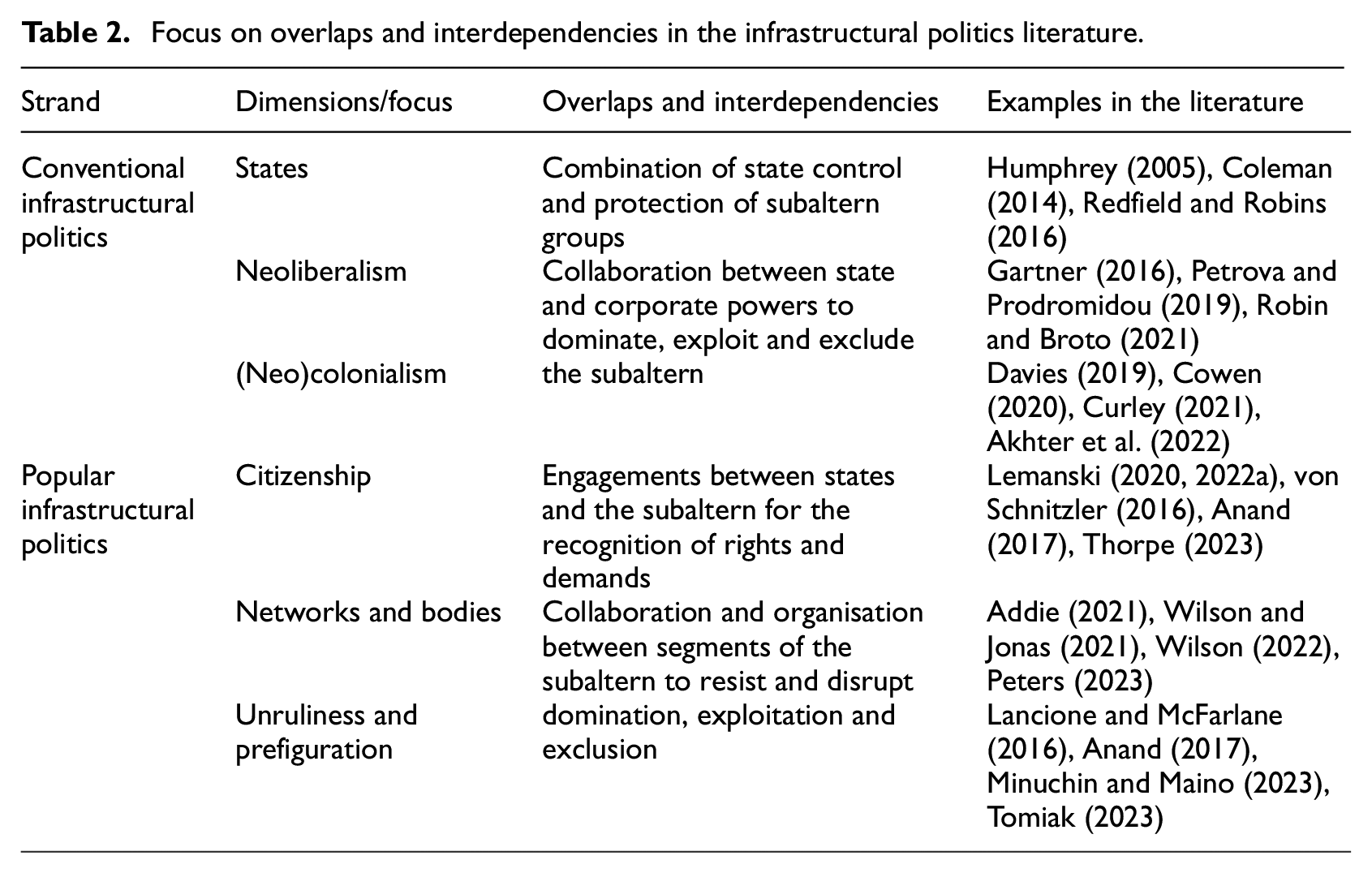
To further consolidate this nuanced approach, this section also draws on debates concerning ordinary and contentious politics (Auyero, 2007, 2012a; Benzecry and Baiocchi, 2017; Schatz, 2009; Tilly, 2006) to advance the proposed definition. By following the political ethnographic critique of standard political research, which frees the notion of politics from its primary association with mainstream liberal practices and institutions, we can then see infrastructural politics as a point of convergence where conventional and popular infrastructural politics co-exist, interact, overlap and contest each other in the creation of multifaceted political outcomes and infrastructural landscapes. This is a definition that particularly relies on Javier Auyero’s work (Auyero, 2000, 2007, 2012a; Auyero and Swistun, 2009), which is concerned with the development of nuanced understandings of hegemonic–subaltern political relations. Given the salience of the urban, urban relegation and inadequate and crumbling infrastructures in Auyero’s work, it strongly connects with urban studies’ concerns.
Infrastructural politics as ordinary and contentious
Political ethnography is now a consolidated mode of enquiry and social sciences subfield interested in exploring how politics unfold in everyday life (Baiocchi and Connor, 2008; Benzecry and Baiocchi, 2017). Its definition of politics stems from the idea of politics as interactions among people, households and other small groups, whose contingent, dynamic and processual nature can be examined microscopically as it unfolds in ordinary life through performances, identities and memories (Auyero, 2000, 2006; Kubik, 2009; Tilly, 2006). Studying politics primarily involves focusing on clusters of interactions and encounters, particularly in the rules, trajectories, boundaries, conflicts and outcomes of these relationships (Auyero and Jensen, 2015). For its focus on relationality, political ethnography’s theoretical and methodological foundations align with the project of defining infrastructural politics as an arena characterised by overlaps and interdependencies between hegemonic and subaltern actors, practices and processes. This can be more clearly revealed by examining the notions of ordinariness and contentiousness underpinning this definition of politics, which can also set the scene for an initial cross-fertilising dialogue between political ethnography and infrastructure studies.
An ordinary political arena
In political ethnography, politics emerges as an ongoing reality unfolding everyday through mundane relations, encounters, practices and discourses and not as a specialised field controlled by professional politicians. This mundane approach embeds politics in ordinary social life and highlights the prominence of ordinary people in the making of politics. Ordinary people such as city residents, state officials, street-level bureaucrats, politicians and activists of all types take centre stage as personifications of larger, formal and informal, social and political entities such as states, nongovernmental organisations, or social movements (Auyero, 2012a; Joseph and Auyero, 2007). Politics is also an ordinary matter in the sense that vernacular meanings permeate its symbolic boundaries (Benzecry and Baiocchi, 2017; Lichterman, 1998), often producing seemingly counter-intuitive arguments that transcend normative frameworks about power relations. A key example in political ethnography is the subaltern’s good reasons to justify and support patronage relationships as they emerge in contexts of negotiation (Auyero et al., 2009). As a wide, mundane arena where ordinary people converge in the reproduction of socio-political orders, politics includes but is not limited to pre-established political events such as elections in liberal democracies or other rituals in different political systems (Auyero, 2000, 2007). These politics are always in motion and can be captured in statu nascendi by looking at instances of negotiation between dominant and subordinate actors (Kubik, 2009). Characterised by their own rules and temporalities (Auyero, 2012a), they imply the constant deployment of dispositions, skills and emotions as a form of labour required for the reproduction of socio-political structures.
The mundane nature of the politics of infrastructure production and the diversity of ordinary actors has also been highlighted in the infrastructural politics literature. This mundanity has been also addressed in the popular infrastructural politics strand for its focus on subaltern ordinary politico-infrastructural practices and infrastructure’s widespread presence and embeddedness in people’s everyday life through ordinary engagements (e.g. Bayat, 2000; Gillespie, 2017; McFarlane and Silver, 2017; Mora-Gámez, 2020). In addition, ordinary engineers, bureaucrats, politicians, investors, urban dwellers and activists feature among a wide range of actors involved in infrastructural thinking, planning, making and maintaining (e.g. Gartner, 2016; Humphrey, 2005; Mukerji, 2009). Empirically speaking, the depiction of these actors is not sombre nor monochrome; however, their relationships tend to be described as primarily antagonistic, thus limiting the possibility of capturing the overlaps and interdependencies between conventional and popular infrastructural politics in their complexity. The political ethnographic approach suggests that infrastructural politics’ sense of ordinariness can be recast by looking beyond the antagonistic and normative parameters that still infuse the use of the notion. In this case, the ordinariness of infrastructural politics can be more associated with the routine instances of politico-infrastructural negotiation between state agents and corporate and subaltern actors. Such focus can provide a vantage point to observe the meet and mesh of dispositions, skills and emotions among seemingly opposing forces.
In this cross-fertilising dialogue, infrastructural politics can also expand political ethnography’s conceptualisation of politics. Although infrastructure and the urban feature in ordinary politics discussions, they appear as background or by-products of political relationships between hegemonic and subaltern actors, often in the form of shantytowns, imagined spaces, crumbling infrastructures, or toxic materialities (Auyero, 2000, 2007; Auyero and Swistun, 2009; Landriscina, 2007). There is a radical opportunity to strengthen the recognition of infrastructure’s political agency and its role in ordinary political arenas (Bennett, 2010; Fredericks, 2018; McFarlane and Rutherford, 2008; Venkatesan et al., 2018). For instance, conventional infrastructural politics has already provided critical insights into how infrastructures become protagonists in the making of neoliberal and (neo)colonial political orders (e.g. Cowen, 2020; Davies, 2021; Karaliotas, 2017). Infrastructures’ deployment in urban contexts and the complex alliances they become part of alongside bodies, objects, landscapes, spaces, networks and other technologies elucidate their status as ordinary political actors in ordinary political life.
A contentious political arena
The notion of infrastructural politics can be further refined by rethinking its contentious nature considering the ways in which ordinary politico-infrastructural actors, practices and discourses co-exist, interact, overlap and become interdependent. From a political ethnographic approach, this involves going beyond conceptual boundaries and critically considering unperturbed distinctions between authorities and dissidents, oppressors and insurgents (Auyero, 2012b; Auyero and Swistun, 2009). This is not only the embracement of a more heterogeneous, dynamic, contingent and informal approach to political relations (Schatz, 2009), but also a call to avoid the depiction of political actors and practices as clear-cut. This means examining the blurred boundaries between the ‘informal’ and ‘formal’ workings of hegemonic and subaltern actors and power structures and their interplay when they are operationalised in interactions and encounters. This means taking further the approach to overlaps and interdependencies mainly featured in the states and citizenship dimensions (see Table 2, rows 1 and 4), whose focus on state protection through social infrastructure provision (Amin, 2014; Bachmann and Schouten, 2018; Lemanski, 2020) foregrounds rights and recognition as points of convergence in hegemonic-subaltern interactions.
For a broader understanding of infrastructural politics, this means interrogating the representation of politico-infrastructural practices as the result of two relatively well-demarcated domains and the tendency to focus on the overlaps and interdependencies between state and corporate actors and practices, on the one hand, and segments of the subaltern and their practices, on the other hand (see Table 2). The notion of repertoires in political ethnography can help to refine this point as repertoires are sets of routine political practices simultaneously informed by variegated logics of domination and subordination. Repertoires develop at the heart of the continuum of everyday life, ordinary politics and contentious politics and as part of the recursive encounters between ordinary political actors (Auyero, 2004). For this reason, they comprise types of political action invoked in contexts of quiet negotiation and loud confrontation alike.
State routine repertoires include what Auyero (2010) calls visible fists, clandestine kicks and invisible elbows. As state-generated violence, they aim to achieve different forms of subordination (e.g. forceful evictions by the police; community violence by state-managed thugs; indifference of bureaucrats) and have historically involved the participation of subaltern actors in ways that dilute the boundaries between them and hegemonic actors. Similarly, subaltern repertoires operate in the interstices of domination and contestation, displaying both grand and extraordinary episodes of public collective political action and many more quiet and obscured routine political practices. Scott’s (1990) public transcripts, hidden transcripts and infrapolitics conceptualise diverse subaltern repertoires of strategic submission, intensive negotiation and open confrontation under different conditions of subordination (e.g. petitions, evasions, squatting, rioting). This focus on repertoires and contestation already intersects with the examination of some subaltern politico-infrastructural practices (e.g. McFarlane and Silver, 2017; Mora-Gámez, 2020; Redfield and Robins, 2016) and state and corporate strategies to maximise profits through infrastructure production (e.g. Furlong, 2020; Hall et al., 2019; O’Neill, 2019).
A conceptualisation of infrastructural politics as a contentious political arena can be expanded around existing politico-infrastructural repertoires that reveal hegemonic–subaltern hybridisation processes, some of which have already been examined in the literature. Struggles for infrastructural citizenship on the subaltern side (Lemanski, 2019; Thorpe, 2023) and the deployment of welfare infrastructure on the hegemonic one (Amin and Thrift, 2017) are two immediate examples. These interdependencies can be further explored by looking into how repertoires such as incrementalism and infra-commoning (Amin, 2014; Silver, 2014) or the deployment of infrastructures for control and exploitation (Addie, 2021; Ranganathan, 2020) manifest overlaps produced through negotiations between dominant and subaltern actors. This attention to the shifting symbolic and material boundaries of domination and subordination can shed additional light on how conventional and popular infrastructural politics operate beyond their most antagonistic manifestations. The fact that infrastructures are recognised as multifaceted entities that condense a diversity of economic, social, political and cultural agendas and expectations in fluctuating ways provides further opportunities (Appel et al., 2018; Venkatesan et al., 2018). How infrastructures become conveyors and drivers of interdependent interests, needs, or aspirations is central in this regard, as well as how these interdependencies translate into overlapping demands for infrastructure provision.
In political ethnography, the study of the grey zone of politics illustrates such imbrications and interdependencies more clearly, a political space also explored, for instance, in the illiberal politics that shape hydraulic citizenship (Anand, 2017). The grey zone highlights the spaces and moments in politics when and where the lines that divide hegemonic and subaltern actors dissolve (Auyero, 2007; Auyero et al., 2009). By examining riots in Argentina’s urban areas in the early 2000s, Auyero’s work challenges rigid and often misleading conceptual distinctions that overlook how seemingly antagonistic actors negotiate political landscapes and socio-spatial configurations by building ‘shadowy ties’ (Auyero, 2012b) in order to achieve shared but also contrasting goals, in this case, reaffirming the state’s control over the poor and the preservation of the urban poor’s livelihoods.
These are instances of political interaction whose concealment facilitates more than formal or informal encounters between powerholders and the subaltern. In these engagements, each other’s agendas, interests and needs inform their respective repertoires of political action. Although infrastructures are not part of this political ethnographic examination of contentious politics, they can even be considered grey zones of politics to the extent that their production and functioning entail modes of interaction between hegemonic and subaltern actors that resemble the secretive instances of political negotiation and cooperation described above.
Conclusion
In this article, I have mapped out key tendencies concerning the use of the notion of infrastructural politics in urban studies and cognate disciplines. In analysing the literature, two main strands and their key dimensions have been identified, revealing an analytical divide in the term’s conceptualisation (see Table 1). Named conventional and popular infrastructural politics, these strands reveal a strong association between the notion of infrastructural politics and particular sets of hegemonic and subaltern actors, practices and processes, which demarcate the empirical and theoretical boundaries of the term. While the conventional and popular strands unveil the rich and productive research in infrastructure studies, they also tend to present infrastructural politics as two separate domains that primarily oppose each other.
I have argued that conceiving infrastructural politics as an arena where diverse actors, practices and processes converge provides a platform to critically examine the politico-infrastructural overlaps and interdependencies that underlie the production of urban space and diverse urban conditions. This article’s final section argues that insights from political ethnography can be mobilised in tandem with those of infrastructure studies (see Table 2) for a wider and more robust understanding of the co-existence, interaction, overlapping and co-constitution of seemingly contrasting politico-infrastructural repertoires and infrastructural landscapes. Unbundled around the idea of infrastructural politics as ordinary and contentious and a critical focus on the multifaceted relationality of ordinary political actors and practices, the proposed conceptualisation calls for a rethinking of the dynamic relationship between conventional and popular infrastructural politics.
The article thus asserts that this broader approach may well contribute to refining and nuancing current understandings of infrastructural politics (and infrastructure) as biopolitical entities at the service of death or life. A political ethnographic reading of the empirical and theoretical boundaries of conventional and popular actors, practices and processes in infrastructure studies can shed light on how repertoires of infrastructure production consolidate as hybrid products of hegemonic–subaltern interactions rather than as separate domains. Moreover, a critical approach informed by political ethnography can also unveil the instances in which infrastructures themselves become the grey zone of politics and, therefore, spatial and temporal points of convergence where more-than-hegemonic-and-subaltern agendas emerge. This dialogue also brings insights from infrastructure studies into political ethnography, particularly a more nuanced understanding of the agency of infrastructures in the making of ordinary political life.
For an urban studies interested in unpacking processes of de- and re-politicisation of infrastructures and the possibilities for alternative futures through radical and progressive prefigurative infrastructural practices, such analysis of infrastructural politics is of great significance. Additional attention to overlaps and interdependencies may help to assess more critically the involvement of hegemonic and subaltern forces in the shaping of alternative infrastructural futures. Finally, given the centrality of infrastructural politics in urbanisation processes, the propagation of the urban condition and the transformation of urban life, this article hopes to contribute to its consolidation as a useful analytical tool in urban theory and practice.
Footnotes
Acknowledgements
The author would like to thank his PhD supervisors at the University of Leeds, Prof. Sara Gonzalez and Prof. David Bell, his mentor as an ESRC Post-doctoral Fellow at the University of Sheffield, Dr Philipp Horn and the anonymous reviewers of this article for their always stimulating feedback and for encouraging me to explore further these rich conceptual avenues.
Declaration of conflicting interests
The author(s) declared no potential conflicts of interest with respect to the research, authorship, and/or publication of this article.
Funding
The author(s) disclosed receipt of the following financial support for the research, authorship, and/or publication of this article: This work was supported by the Economic and Social Research Council (Grant number: ES/W005476/1).
