




Abstract
Infrastructure investments, a core element of slum upgrading, play a role in improving the livelihoods of over 1 billion slum residents globally. Established planning practices often successfully deliver functional infrastructure but evidence shows that their contribution to improved livelihoods often either is absent or declines sharply after some time. To explain this limited effectiveness, this article identifies the missing link between infrastructure delivery and livelihood improvements as lying in the appropriation process, that is, the uptake and embedding of infrastructures into the daily practices of residents. Recent insights from sociotechnical transitions studies help to conceptualise appropriation. The authors use Munyaka informal settlement in Eldoret town, Kenya as a case to investigate the mechanisms of new infrastructure uptake. Findings indicate that appropriation is a social process that proceeds in three steps: reception, domestication and institutionalisation. This process is driven by the need to maintain or adjust residents’ livelihood practices relative to prevailing socioeconomic and spatiotemporal conditions. The study concludes that appropriation is a significant process that planners should try to anticipate. Prevalent approaches to participation have to be modified accordingly. This is essential for planning to improve livelihoods in slums.
Introduction
As rapid urbanisation processes lead to the uncontrolled growth of informal settlements, slum upgrading has become a priority in many Global South countries (Randolph and Storper, 2023; World Bank, 2022). Investments in infrastructure, a core component of slum upgrading, remain common place planning interventions for improving the livelihoods of residents (Acioly, 2021). Slum upgrading aims to improve the quality of settlements, to reduce the time and costs of accessing basic services through ‘solid’ infrastructures in order to finally improve slum residents’ livelihoods (Devkar et al., 2019). Despite many efforts, slum upgrading has failed to achieve this ultimate goal in many if not the majority of cases and may even contribute to deteriorating livelihoods in some cases (Cherunya et al., 2021). This is primarily because resultant infrastructures have failed to align with the existing resources, interests, and goals of the residents.
Researchers and planners agree that to improve the outcomes of slum upgrading, residents must be involved and participate actively during the planning process (Patel, 2013; UN Habitat, 2015). Participation aims at involving residents to provide knowledge about context conditions in order to improve the outcomes of planning in terms of acceptance and fit with the needs of actors (Arnstein, 1969; Chambers and Conway, 1992; Choguill, 1996; Wainaina et al., 2022). Much is known about participation, its nature (Arnstein, 1969), benefits for planners (Healey, 1997) and its configurations that work (Wainaina et al., 2022). However, little is known about the content that planners seek to learn through participation beyond baseline figures that concern what lacks in these places. Indeed, through participation, as it is currently implemented, planners often learn little about how residents will likely use proposed infrastructures but a lot about what kind of basic services lacked before the intervention.
We argue that the current dominant way of organising participation during infrastructure planning misses anticipating the dynamic social processes of appropriation that happen only after the infrastructure has been delivered. This results in limited improvements in livelihoods due to infrastructure upgrading. This study aims to conceptualise appropriation and to demonstrate how it leads to un/improved livelihoods. By livelihoods, we imply a means of gaining a living for which basic infrastructure access is an asset (Chambers and Conway, 1992). Subsequently, it offers crucial insights for how participation could be improved in order to anticipate appropriation processes more accurately.
We develop the concept of infrastructure appropriation based on recent insights from the sociotechnical transitions literature (Fuenfschilling and Truffer, 2016), which explains how transformation through reconfiguration of practices, infrastructure and technologies – so-called sociotechnical systems – occurs to lead to societal benefits (Murphy and Carmody, 2019). Based on this literature, we define appropriation as a suite of social processes that occur after infrastructure delivery, where residents proactively and consistently take actions that shape the impact of infrastructures on residents’ livelihoods. We understand appropriation as the stepwise embedding of different features of the provided infrastructures into practices of production and reproduction that enable residents’ livelihoods. Even though every resident will have to enact this embedding process for him or herself, we consider appropriation primarily as a social process, that is, one that leads to similar patterns of practices across different segments of slum residents (Cherunya et al., 2020; Mukeku, 2018). The focus on appropriation is a much-needed conceptual extension to the planning literature beyond its current limit of plan making and plan implementation as illustrated by Hersperger et al. (2019) and Malekpour et al. (2017).
We investigate mechanisms of appropriation using a qualitative research approach, for the case of newly introduced infrastructures in an informal settlement called Munyaka in a secondary Kenyan town named Eldoret. We also highlight how far participation executed during the planning process was able (or not) to anticipate appropriation. Munyaka was one of 80 informal settlements that were upgraded under the Kenya Informal Settlement Improvement Program (KISIP) between 2014 and 2017 (MLHUD, 2013b). Findings demonstrate that appropriation is a social process and proceeds in three steps: reception, domestication and institutionalisation. This process is driven by the need to maintain or adjust residents’ livelihood practices relative to prevailing socioeconomic and spatiotemporal conditions.
Unbundling appropriation in the context of basic service infrastructures
To improve the outcomes and impact of their interventions, planners started to engage with concepts from the sustainable livelihoods literature and their variations early on (Talukdar et al., 2010). This literature focuses on capabilities, equities and sustainability aspects for residents to gain a living (Chambers and Conway, 1992). In addition, it gives attention to assets and capitals that residents have access to. These include natural assets such as soil and water, physical assets such as infrastructure, economic assets such as savings and remittances, human capital assets such as knowledge and skills and social capital assets such as trust and adherence to rules (Winarso, 2022).
Through participation and employing livelihood concepts, slum upgrading has resulted in infrastructures with varying utility to residents and a consequent varying impact on livelihoods. Few successful upgrading interventions have been recorded (Patel, 2013). In contrast, larger numbers of interventions that have failed to varying extents are common despite participation claims (Cherunya et al., 2020, 2021; Chidambaram, 2020; Libertun de Duren and Osorio, 2020; Massey, 2014; Yeboah et al., 2021). In order to appreciate this state of affairs, it is necessary to understand how infrastructure delivery leads to improved livelihoods. It is, however, difficult to explain this through the lens of planning literature alone because planning only accounts for infrastructure delivery and not beyond (Hersperger et al., 2019; McConville et al., 2011). The livelihoods literature is only of partial help as it is rather static in accounting for what assets exist in slums and not how (i.e. through which processes) residents learn to use the new offerings. We argue that there is a high potential benefit to better understand what we frame as the appropriation of new infrastructures. Indeed, improving livelihoods does not happen overnight and the utility of delivered infrastructures has to be actively ‘produced’ and sustained by the receiving residents before improvement of livelihoods can occur.
One explanation for the lack of attention to appropriation processes lies in the fact that slum upgrading studies have defined slums by primarily focusing on what they lack (UN Habitat, 2015). More recent studies have tried to conceptualise slums as urban settlements, which are social contexts structured by interlinked rulesets – regimes. These regimes guide production, social reproduction and infrastructure use activities and constitute the so-called infrastructure–livelihood nexus (Murphy and Carmody, 2019; Wainaina et al., 2023). Such regimes guide and are observable through daily practices of residents as they secure their livelihoods. They are characterised by spatial, transactional costs, temporal and organisational mode dimensions (van Welie et al., 2018). Slum upgrading influences residents’ practices in these four dimensions and thus the infrastructure–livelihood nexus can be observed through them. The following two paragraphs explain these dimensions in further detail.
The spatial dimension relates to the ‘where’ and ‘why there’ questions concerning the siting and use of infrastructures (Jones and Murphy, 2011; Wainaina et al., 2023). Space plays multiple functions for securing livelihoods in slums (Kamalipour, 2020). New infrastructures will compete for the same spaces, often transforming them from multiple use to single use or vice versa. In addition, the services that new infrastructures provide are only an addition to the portfolio of residents’ means to achieve a service even when they appear superior (Cherunya et al., 2020). The transactional costs dimension goes beyond cash and characterises costs incurred in accessing an infrastructure and using its associated service (Allen, 1991). These can be in cash, can be in kind, can allow for haggling or can be flexible over time, for example pay per use or monthly bills (van Welie et al., 2019). Incomes are low in informal settlements and spending priorities shift from one basic service to another (Kamath et al., 2008).
The temporal dimension relates to when livelihood activities are conducted in alignment with infrastructure use (van Welie et al., 2018). This is illustrated for instance when accessing a toilet while selling or buying wares in a market during the day, when/if it opens, or being able to use a road to go to work in the rainy season, going to a bar in the evening or even committing a crime on the streets at night. This temporal dimension leads to ‘oscillations’ of the domestic spaces depending on socio-economic characteristics of the households and their context (Cherunya et al., 2020). New infrastructures may reconfigure the infrastructure–livelihood nexus by reducing/increasing times of access to services, reducing/increasing times for socioeconomic activities, allowing the conduction of multiple activities concurrently or forcing the sequencing of activities. The time needed to access basic services provided by infrastructures is limited for the residents due to other livelihood activities that compete for the same time (Chikaraishi et al., 2017). Lastly, the organisational mode dimension denotes how actors organise to seek and provide a basic service, including operating and maintaining associated infrastructures (van Welie et al., 2018). A variety of actors within and beyond the slums, including the residents themselves, may be responsible for providing and sustaining such basic services (Devkar et al., 2019; Joshi and Sohail Khan, 2010). Transformations of the organisational mode manifest in residents taking up or being relieved of roles and stakes in providing a service. To illustrate, a new piped-water supply system relieves residents who were providing the service before through handcarts. A successful transformation in organisational mode would need to reincorporate these previous service providers in the operations of the new piped-water supply system. Therefore, when slum upgrading does not consider these four dimensions as interlinked, it often results in extending some at the cost of others.
With this understanding of the structural aspects of the infrastructure–livelihood nexus, we may conceptualise a three-stage process for infrastructure appropriation –reception, domestication and institutionalisation– as shown in Figure 1. These three stages describe the residents’ stepwise recognition of the new infrastructures, the infrastructures’ alignment with residents’ prevailing livelihood practices, and the willingness to maintain them in case the alignment proves to generate benefits for the residents or to actively obstruct or even destroy the infrastructure if it is perceived as an impediment. The reception stage denotes the immediate responses of residents when the new infrastructure and its services are delivered and opened for use. This reaction will strongly be conditioned by how residents experienced their involvement during the participation process. As Wainaina et al. (2022) have shown, this relates not only to the early planning stage – the locus of most participation processes implemented in planning – but even more importantly to implementation. Feelings of unjust treatment or lapses in trust will lead to a more critical reception compared to processes that were conducted in harmony and where the voices of all stakeholders were taken into account.
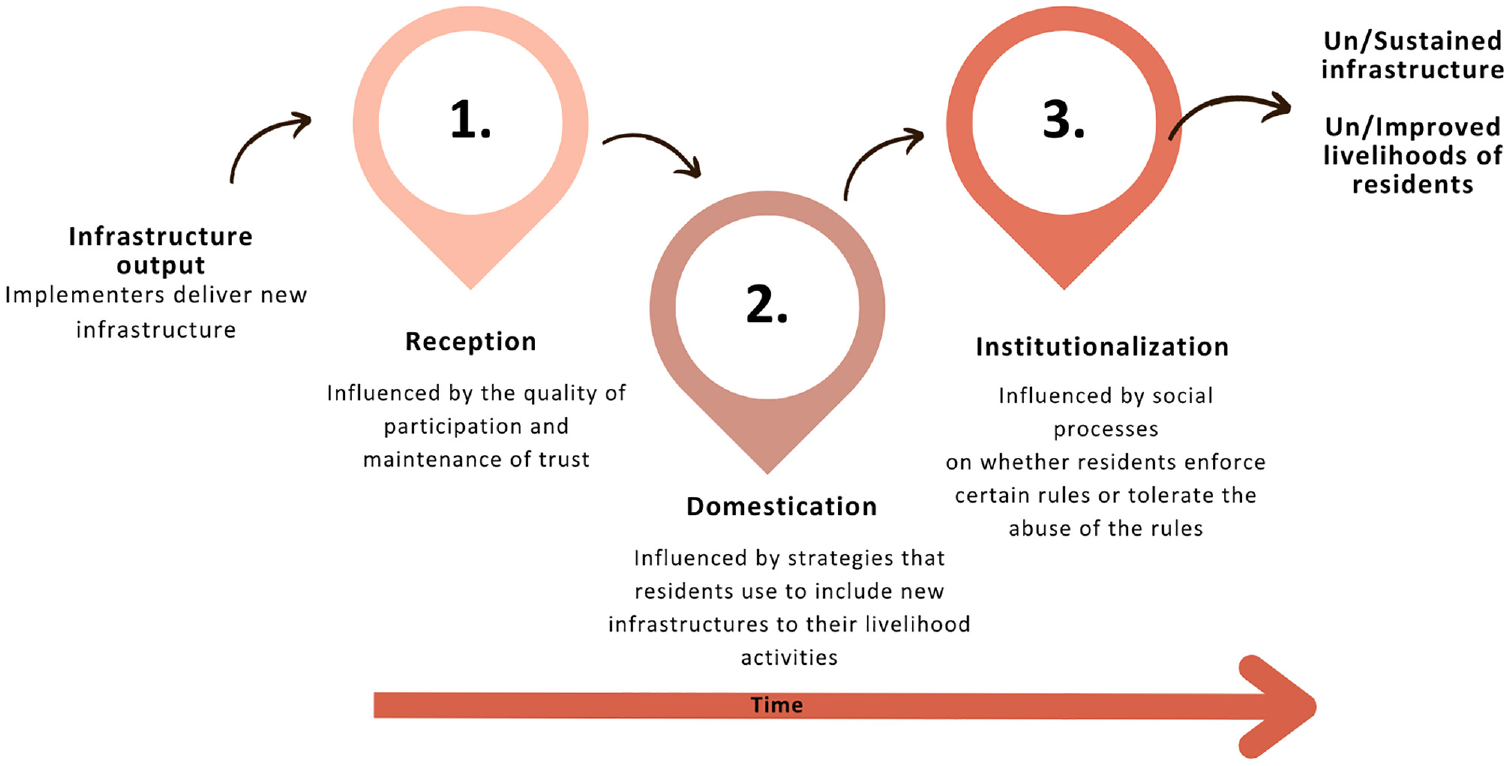
The appropriation process.
The second step, domestication, concerns the active uptake of the material infrastructures, their associated rules of use and their proactive alignment with prevalent livelihood practices (Sørensen, 2006). Domestication of new artefacts has been analysed in a long series of product innovations in Science and Technology Studies, and similar mechanisms are likely to happen with newly introduced infrastructures (Ingeborgrud and Ryghaug, 2019; Pantzar, 1997; Sørensen, 2006). Recent studies from the sociotechnical transitions literature have provided further insights into how to understand the domestication of infrastructures (Cherunya et al., 2021; Wainaina et al., 2023). Specifically, Cherunya et al. (2021) outline four response strategies that residents adopt to align basic service alternatives in slums at a personal scale. They proposed a four-way typology that distinguishes between whether the residents mobilise their personal resources and whether they draw on the resources of their social environment. The second dimension relates to whether they respect prevalent social norms, rules and regulations or decide to break them.
Drawing on personal resources, residents typically first try to navigate between the requests of the new infrastructure and their personal capabilities and resources to maintain their livelihoods (personal-conforming type). Navigation respects social rules and regulations and tries to resort to alternative options in case of impediments. An illustration for this is a resident using the toilet of their workplace or of their neighbour if a newly installed public toilet proves to be too expensive. In case rule following is not possible, for instance if alternative toilet facilities are not available during the night, actors often have to resort to coping options (personal-violating type). This would be to defecate in open fields or into plastic bags, a behaviour that might go against feelings of personal dignity, be considered shameful or even be formally illegal. If individuals do not possess the necessary resources by themselves, they may resort to accessing them through their social networks and therefore negotiate their access (social-conforming type). This strategy comes into play, for instance, when asking to use a neighbour’s toilet in exchange for other neighbourly services. Finally, access to socially available resources by going against socially accepted rules and regulations can be termed as contravening. This strategy is characterised by rule-breaking actions that seek to force access or exploit opportunities and may result in legally prosecutable actions (social-violating type). An illustration for contravening is a resident illegally connecting to a water or sewer pipe network to access a service for free (Cherunya et al., 2021).
The domestication stage concludes when residents, as observed in their practices, find relatively persistent use and symbolic representation of the new infrastructure and its associated service and how they serve their infrastructure–livelihood nexus. So far, this has only been studied to an extent for individual technologies and products (Bar et al., 2016; Dourish, 2003; Nadal et al., 2019). Only Cherunya et al. (2021) have mobilised these ideas for explaining failures in slum upgrading contexts. We did not find studies that related to basic service infrastructures specifically.
While the appropriation strategies represent individual ways to react to the newly delivered infrastructure, over time and through community interaction, they will develop into a shared perception of how the new infrastructure can and should be used and whether it provides any utility at the community scale. Therefore, the institutionalisation stage denotes strategies that residents employ once reception and domestication have been concluded and socially validated. In the case that residents have come to align the new infrastructures with their livelihood practices, they may be motivated to invest in their maintenance and proper functioning, as in the case presented by Patel (2013). If the opposite happens, residents might either tolerate inappropriate use of the new infrastructure or accommodate it for their own specific needs. As a result, the infrastructure is likely to deteriorate due to neglect or even suffer from outright destruction. The positive case might need collaboration with actors outside the informal settlement, such as service providers, construction companies or government officers. However, it might also mobilise residents to self-organise and maintain the service. Therefore, the institutionalisation stage will manifest depending on whether residents are willing to offer/withhold their time, money or spaces or even to reorganise by who and how they achieve a given service, or alternatively to destroy the infrastructure if it is judged to provoke disruptions to their extant infrastructure–livelihood nexus. Such a case was observed by Libertun de Duren and Osorio (2020), where gangs destroyed paved roads to slow down police cars entering the informal settlement. The probability of residents engaging in maintenance decreases with unsuccessful domestication and poor reception.
All told, we argue that instead of the currently dominant view on infrastructure uptake as an act of acceptance by predominantly passive individual recipients or ‘beneficiaries’, we have to understand post-delivery as a complex, social process, in which slum residents act as co-producers of infrastructure services. This process conditions whether or not improvements to livelihoods can unfold. Interactions between the residents during this process will lead to the institutionalisation of a new infrastructure–livelihood nexus in the form of taken-for-granted practices, norms and material structures. Appropriation overall will therefore lead to what transition scholars refer to as the ‘embedding’ of socio-technical systems into local contexts (Fraedrich et al., 2015). While we can identify the mechanisms of appropriation, which are a necessary condition for positive impacts on livelihood, these mechanisms are not sufficient to improve residents’ lives unless processes of power co-optation or gentrification are also addressed.
Methods
We employed a qualitative approach following abductive reasoning partially inspired by causal process tracing ideas (Beach and Pedersen, 2013; Blatter and Haverland, 2012). Through the case of the Munyaka informal settlement, we outlined the mechanisms that explain how livelihoods can be improved through infrastructure investments and the role of participation in anticipating this. The method establishes causality based on the level of uniqueness and certainty of different evidence pieces in line with conceptual claims.
Munyaka is one of the eight informal settlements located in Eldoret town, Kenya. The settlement is located 4.3 km northeast of the town, comprising 18,107 households and occupying an area of 88 hectares. Munyaka’s residents are of different religions and operate small businesses within and outside the settlement. The monthly income for over half of the households was less than KES13,000 per household, against a KES15,120 minimum wage per person, similar to Mathare and other settlements in Kenya (Corburn and Karanja, 2016; Mangíra et al., 2019; MLHUD, 2013b). The settlement suffered from typical deficiencies in basic service infrastructures, including limited accessibility by road, unsafe sanitation, poor drainage, insecurity and limited access to water services. This is what necessitated KISIP to upgrade it and another 79 settlements spread all over the country (World Bank, 2011). Munyaka’s characteristics represented most characteristics of other settlements holistically, making it a rich case.
Munyaka settlement was selected for this study not only because its economic, demographic and geographical characteristics were relatively comparable with those of most of the other settlements, but also because of the existence of a collaborative relationship and trust between the lead author and the stakeholders. This relationship had been built over previous research visits to the residents’ premises and their leaders, as well as to government officials. These were essential due to the nature of evidence that process tracing as a method requires.
KISIP’s first phase was a US$165 million funded upgrading programme that targeted improving informal settlements by providing basic services and infrastructures to improve their living conditions. This was a welcome response for the over 60% of Kenyan households that live in housing that falls under the definition of slums (World Bank, 2019). KISIP had been largely successful in the delivery of infrastructures but evidence on the impacts on livelihoods was uneven (Wainaina et al., 2022). These settlements targeted were mostly in secondary towns of Kenya and are similar to those in secondary towns in many countries of the Global South (Cities Alliance, 2022; UN, 2022). In addition, KISIP allowed for a comparison of how multiple and different infrastructures were eventually used since they were implemented in the same timeline with similar end users and socioeconomic contexts.
The first author collected data through in-depth interviews with four community representatives, 22 residents and two government officials and observations in the informal settlement during a stay in the informal settlement from November to December 2021. The community representatives were a subset of the committee that was selected to represent other residents. The overall committee comprised different group representations, including landlords, women, tenants, businesspeople and people living with disabilities. The 22 residents were businesspeople, landlords and tenants of both sexes living and operating along the newly built infrastructure during and after the implementation of the project. This strategic selection of participants ensured that known intersectional and relational biases between residents and between different groups of residents were taken into account (Hooper and Cadstedt, 2014; Rigon, 2022).
In addition, the author reviewed two project reports, and four publications closely associated with the settlement and its upgrading process. During the two weeks’ stay at the settlement, the author clarified claims made during the interviews where possible to ascertain evidence. A combination of multiple interviews, observations and clarification, reports and the onsite experience ensured triangulation of claims, which was useful in ensuring that past perceptions of the interviewees were not influenced by current infrastructure experiences.
These comprised the dataset for this study and were transcribed and analysed qualitatively using NVivo following abductive coding similar to the procedure presented by Vila-Henninger et al. (2022). The analysis sought to retrace and reconstruct the upgrading and appropriation process to establish how residents received, domesticated and institutionalised the infrastructures after they were constructed. In addition, the analysis sought to identify the aspects of the settlement participation, identified or not, that would have influenced appropriation and subsequent livelihood improvement. The focus of analysis was ablution blocks, floodlights and roads based on the output variable, as the three cases represented three typical outcomes, that is, one failure, one success and one moderate success case with corresponding impacts on livelihood, as shown in the findings.
Findings
The planning and implementation process in Munyaka took place between 2011 and 2017. In 2011, the KISIP team selected Munyaka as one of the settlements that would be upgraded after consultations with the municipal council of Eldoret (the county government later took over in 2013 after the devolution of governance all over the country) (World Bank, 2011). The earliest activities at the settlement commenced in 2012 when the KISIP team and government officials through local leaders engaged residents using public mass gatherings in the settlement and elected a community representatives team.
Later, consultants facilitated participatory baseline studies, prioritisation and designs of infrastructures that would be installed. Through this exercise, the residents prioritised roads, sewerage, solid waste management, storm water drainage and street lighting (floodlights), which the consultant seconded as of April 2013 (MLHUD, 2013b). However, a later report that year indicated different infrastructures that included roads, drainage, infiltration pits, ablution blocks and floodlights and it was not clear to the residents how this list came about (MLHUD, 2013a). From field visits, all infrastructures in the latter list were constructed except for infiltration pits.
There was no evidence that the residents were involved in reviewing or validating the actual designs that were developed by the consultants. Procurement of contractors was done at the national government level and the infrastructure construction was launched in 2014 (Uasin Gishu County News, 2014). This marked the beginning of the plan implementation phase. Construction work began in late 2014 and ended in early 2017.
In the following, we outline in detail how participation took place and how it influenced the reception, domestication and institutionalisation leading to un/improved livelihoods.
Ablution blocks
Participation exercises informed planners that 86% of the residents had pit latrines in their homes and the rest shared one in their compounds (MLHUD, 2013b). They were also informed that the residents prioritised and were in consensus for sewerage as an alternative. Despite this, the planners decided to construct ablution blocks (MLHUD, 2013b: 15). This was not well received by most residents, who felt short-changed. This led to a lapse in trust and some community residents consequently relinquished their roles, claiming limited consideration of their views by planners (from multiple interviews).
During implementation, contractors ignored the residents’ views for an alternative location for some of the toilets. Residents felt that the locations were either far away from busy activities or not well thought out. They also held back some of their views so as not to appear conflictive, as planners had warned them that the financiers (the World Bank) would withdraw support for the infrastructures if there were conflicts in the construction sites. When some residents followed up later on why the planners did not implement sewers, they were told that the finances available were not enough for sewers and thus the ablution block was the only option and this was not negotiable (as reported by multiple interviewees).
We [community representatives] felt we were used, just like rubber stamps they [implementers in general] come and pretend they want to consult us then they go their way … Then there were issues of the communication barrier, and they [contractors] were very arrogant. (Community representative 4)
Ultimately, functional ablution blocks were delivered that required payment for use and a new organisational mode to manage and run them, and that ended up in suboptimal locations.
While the infrastructure delivery process seemed successful from the planners’ point of view, the reception by residents was unanimously critical. This is because participation ignored crucial insights provided by the residents which could have informed about later appropriation-induced problems. First, planners did not fully understand how the provision of sanitation happened in the settlement and associated bottlenecks. They just assumed that the residents would adapt to the new ablution blocks for lack of alternatives. The residents on the other hand relied on their pit latrines, which needed regular emptying. This was expensive. Their preference for sewers was mostly related to this challenge. A second insight the planners missed was the residents’ socio-spatial knowledge of the settlement, which would have been key for establishing locations of the ablution blocks that would have fit the residents’ oscillating domestic space.
The domestication stage for ablution blocks was characterised by navigating and contravening actions. The residents refrained from using the ablution blocks after delivery, despite their being functional. One of the blocks in the centre of the settlement was given to a women’s group to manage, but no one was willing to pay due to the presence of other alternatives and the women immediately stopped operating it (cost and organisational mode). Navigation manifested when residents opted not to pay for toilet use as they claimed they either had one at home or could use their neighbour’s toilet near where they operated small businesses (transaction). Navigation also occurred due to spatial reasons. The residents opted to use other means, as they reported that a second ablution block was located in an inferior place with lower population density where everyone had a toilet. In terms of contravention, one of the residents occupied the vacant veranda of one of the ablution blocks for drying cereals that she would sell afterwards. She informally claimed the space and no one was stopping her from doing that as it is a norm there to occupy space considered unused. In addition, some unscrupulous people turned one of the toilets into a hiding spot when they committed crimes at night and even vandalised it. Due to this pattern of domestication, the ablution blocks were dilapidating with time.
The institutionalisation of the ablution block was characterised by ignorance of the infrastructure and persisting vandalism. This was because residents did not find their economic or social worth, but rather saw them as a waste of resources. They would have preferred that the resources for toilets be transferred to other infrastructures. It was clear that the ablution blocks would never be used for the provision of sanitation and were deteriorating rapidly over time.
Based on insights from this case, the participation process was poorly implemented. It only captured the status of the settlement and not the processes and challenges of achieving sanitation. The consensus for sewers was reached at the prioritisation stage of planning but ablution blocks were constructed instead. Consequently, the residents’ appropriation resulted in critical reception due to a lapse in trust during implementation, diverse acts of domestication, i.e. navigation and contravening, and negative institutionalisation characterised by vandalism and dilapidation. As a consequence, no improvement in sanitation provision occurred due to the new ablution blocks.
Floodlights
From participation, the planners were aware of the following: (i) insecurity issues prevalent in Munyaka due to a lack of street lighting; (ii) the minimal space requirement for floodlights; (iii) the need to pay for monthly electric bills, a responsibility that the Eldoret municipality would take up – placing adverts on the floodlights was proposed as a way of generating income to pay monthly bills; and (iv) the floodlights’ role in extending hours for livelihood activities. These were listed as potential factors that would be essential for implementing and sustaining the floodlights (MLHUD, 2013a: 61; MLHUD, 2013b: 51). These insights portrayed an awareness of the challenge of insecurity complemented by a solution that had foresight for appropriation. Consensus for floodlights was reached through three prioritisation engagements that took place at the settlement facilitated by consultants.
There was, however, one relevant event during the construction of the floodlights – the issue of where to site them spatially. Some community representatives lobbied for siting them near their households. One of the floodlights had to be relocated from a representative’s gate to a mutually agreeable location after financiers received complaints from other residents during one of their few field visits (reported by residents and witnessed by the first author). The planning process resulted in functional floodlights in optimised locations, whose charges were catered for by the county government, which functioned automatically thus not requiring residents to take up any role immediately, which occupied limited space and which increased the time and sense of security for other socioeconomic activities relevant to livelihoods.
From an appropriation perspective, residents expressed overall approval on receipt of the floodlights due to their relatively smooth implementation. They, however, quickly realised that the envisioned automatic functioning did not always work. Domestication was also effortless since nothing was required of them yet the floodlights had benefitted them. From the moment their construction was completed, the amount of time residents could open their business premises increased as people felt it was more secure, and those who worked as hawkers in the town could work more and return home much later. In addition, those who went for social activities had more time. Furthermore, the residents did not have to pay for the lighting as the local government took care of this and it occupied very little space. The prospects for the floodlights to continue functioning and contribute to improving their livelihoods were very high.
The floodlights were further institutionalised effortlessly due to the net benefits in their infrastructure–livelihood nexus. Residents proactively organised around sustaining the functionality of the floodlights over time when they perceived problems of persistent functioning after some time: The problem is that it [the floodlight] regularly goes off, in fact it is we that usually switch them on, and there is a young man that volunteered to do that … They [the county government] usually come here to repair but it’s never lights up continuously, when it breaks down they take a long time to come to repair after reporting, we usually switch it manually because they gave us the key. [Resident 16]
The appropriation of the floodlights was characterised by approved reception, effortless domestication and proactive institutionalisation by residents. This was because the floodlights maintained and extended the infrastructure–livelihood nexus leading to improved livelihoods.
Roads
During the plan-making process of the road infrastructure, planners identified the following insights from participation: (i) only 14% of residents had access to an all-weather road near their household; (ii) roads were the priority for residents as compared to any other infrastructure type; (iii) road spaces existed in the settlement but residents had encroached in some areas by extending their houses, shops and market stalls – shopkeepers pleaded to be relocated near the upgraded road where they could have easy access to customers, rather than in hidden markets; (iv) the need for the county government to take over management of the road after construction; (v) the increased likelihood of the constructed road flooding; and (vi) the norm of residents in disposing of their waste along existing roads (MLHUD, 2013a). There was consensus to upgrade the roads. However, it was not detailed enough to inform the lengths, widths and extents of the settlements that would be tarmacked and the multiple uses of road spaces beyond commuting. This was contentious during construction.
Information gathered about traders operating on roads was very relevant during road construction work. It prompted the planners to address the relocation of residents from trading along the roads. As a result, 53 traders who occupied the road spaces during construction were facilitated to move their stalls a few metres away from the road (MLHUD, 2013a). Contentions however arose due to the lack of clarity in the content of the consensus in the plan-making phase and communication deficits. Residents in different clusters of the settlement claimed that some roads were never tarmacked, contrary to their expectations. In terms of communication, community representatives reported that the contractors excluded them. Communication was also constrained between the contractors and the residents, and even between the community representatives. All these contributed to a lapse in trust: So there was a communication breakdown, even the community elders didn’t communicate fully, they only did to individual persons. And even sometimes they didn’t know the details (Resident 14).
Delivery resulted in functional roads whose reception was mildly critical for the following reasons. The roads were meant for the conveyance of car traffic only, ignoring other uses such as play spaces for children and market spaces that were beneficial to residents (space and time). The roads also did not cover all areas that the residents deemed essential and their management was the responsibility of the county government as planned (organizational mode). They were also free for residents to use (cost). Immediately after the handover, the road was useful in terms of accelerating traffic. Those who owned motorbikes, handcarts, and vehicles ferried people and goods in the neighbourhood and to and from Eldoret town more efficiently as the roads were better. Transport took less time and residents paid less to ferry goods (time and transaction). However, the roads also exacerbated floods in other sections of the settlement.
Domestication was quite complex and manifested through a broad mix of contravening, navigating and coping actions. Contravening actions immediately occurred when the residents who had been facilitated to relocate re-established their market stalls on the road spaces (spatial). They explained that that was where their customers passed and thus their wares could get more visibility, especially in the late evening, and they did not have to pay rent (time and transaction). They used this justification to occupy the road spaces and other residents were okay with it. This resulted in pedestrians walking or shopping in the road spaces that were meant for motor vehicles. The residents did not complain since they were benefitting from cheap wares and preferred not to quarrel with neighbours, as observed during fieldwork: It is because of capability [financial] … You know rent is costly and not many will afford it, so people opt to use the spaces to set up businesses, another thing is the lack of rentals in the preferred places where they would like, they end up setting up the businesses on the roadside where there are many potential customers. (Resident 1)
Residents also engaged in benign contravening actions. This was illustrated when residents realised that the drivers and riders were driving too fast. This was especially dangerous as children played on and along the roads. They took up the responsibility to make earthen bumps to regulate these speeds and avoid accidents, making the road more usable. The municipality later built solid bumps after residents persistently complained: ‘there were no road bumps. We [residents] also erected some because of speeding vehicles and motorcycles. And you see that the soil makes the road dirty, later on after complaints they came and erected professional ones’ (Resident 7).
Secondly, residents conducted actions that comprised navigation: ‘This road is very busy in the evening; even if you are passing using a vehicle it is difficult, so many would opt to use the other backroads because there are many people in the evening’ (Resident 2).
Thirdly, residents also engaged in coping actions. It was evident that the residents dumped waste on the roads. They did this at night when no one was looking. Households and small businesses that could not afford waste collection fees mostly did this. There were also no other alternative spaces to dump, and dumping on any open space was the norm for solid waste management in the settlement, as explained by residents: They [residents] dump mostly at night, and when we come here in the morning, there is garbage, what will you do? There was a day I cleaned here in the evening, and the following morning I found a lot of garbage here. (Resident 13)
The actions presented in the domestication stage for roads were all socially validated and occurred concurrently. Institutionalisation therefore was characterised by residents maintaining the status quo of domestication. They did not take up any further role to maintain the functionality of the roads since it would either cost them financially or disrupt their social relations. Consequently, the roads remained partially blocked with at least one lane available for mobility and dilapidated albeit gradually due to continued dumping. This reflected how the road space was appropriated before the upgrading; only now was the space tarmacked.
Based on these findings for the roads, reception was mildly critical due to a mix of the lapse in trust during participation and the overall contribution to the infrastructure–livelihood nexus that the roads offered. Domestication reshaped the new road back to the space it was before upgrading and institutionalisation cemented the status quo. While the residents accrued benefits from the road, it was gradually dilapidating and the benefits would likely be short-lived.
Discussion
The three infrastructures illustrate the three-stage mechanism of appropriation that led to distinct infrastructure outcomes and livelihood impact. The mechanism comprises residents’ reception of new infrastructure, and its domestication and institutionalisation based on whether it disrupts, maintains or extends the residents’ infrastructure–livelihood nexus. Maintenance and extension lead to improvement in livelihoods to varied extents, while disruption leads to their deterioration.
Explicating the three stages of the mechanism, the cases demonstrate that reception is heavily reliant on whether participation is effective in maintaining trust between residents and implementers, reshaping infrastructures to fit the needs of residents and informing planners about the full realities of residents’ needs. It is already known that interactions of different actors with residents during infrastructure construction result in different infrastructure outcomes (Massey, 2013; Wainaina et al., 2022). This study extends this knowledge by informing the impact that participation has on the reception of infrastructures specifically and the associated outcomes to livelihoods. Findings demonstrate that the reception’s nature determines the actions that shape the subsequent domestication.
The cases demonstrate that domestication is a very proactive social process that takes longer in comparison to the reception. As demonstrated in the richer case of roads, it comprises multiple interactions of individuals and groups over time to shape the infrastructure. These interactions model relationships over time, which regulate the actual use of infrastructure, motivate its maintenance or tolerate its deterioration. Where these processes result in the maintenance or extension of the infrastructure–livelihood nexus, domestication is effortless as in the case of floodlights. Contrary to this, disruptions to the nexus lead to navigation, contravention and coping actions, as demonstrated in the roads and the ablution block cases. It is important to note two things that relate to domestication. First, not all cases of contravention are negative; some are benign and even gain support from formal authorities. A good example is the earthen bumps made by residents that the authorities later improved. Second, navigating and/or coping actions during domestication are likely to lead to ignorance and the eventual dilapidation of the infrastructure.
The cases further demonstrate that institutionalisation is driven by the social endorsement and replication of specific forms of domestication within the settlement. The new infrastructure becomes part of the institutionalised socio-technical system in the form of a modified, improved or deteriorated infrastructure–livelihood nexus. Or in other words, full-scale ‘embedding’ has taken place. The ablution blocks were institutionalised as a failed intervention, which to some extent was even considered a token of pride because the residents had been able to defend themselves against unwanted intervention. In the case of floodlights, these were an essential addition to the improved infrastructure–livelihood nexus, showing positive impacts on livelihoods, leading to mobilisation of resources by residents to maintain them. The roads were an addition that residents shaped to fit their needs at the cost of the road’s lifespan.
Conclusion
This study aimed to investigate mechanisms of appropriation that moderate the influence of infrastructure upgrading on the livelihoods of residents in slums. We conceptualised appropriation as a social process proceeding in three steps: reception, domestication and institutionalisation. The appropriation process will ultimately lead to the ‘embedding’ of the new options into the infrastructure–livelihood nexus of the informal settlement. Either this will lead to the reorganisation of the residents’ time and activity portfolio to maintain the new infrastructure, or residents will repurpose or even destroy the infrastructure to safeguard their livelihood practices.
With our proposed framework, we are however not (yet) in a position to predict specific outcomes of appropriation processes in general. The actual outcomes will depend on a myriad of context conditions of each case, such as different infrastructure types and socio-spatial conditions like demography, income, density and religion. A typology of coherent combinations of context conditions that shape appropriation processes in specific ways was not in reach with our empirical approach. We claim, however, that the concept of appropriation is of general heuristic value by introducing general mechanisms that will come into play after the delivery of new infrastructure. Reception, domestication and institutionalisation will happen in all informal settlements. The specific impacts on livelihood that these processes generate will, however, be moderated by the specific local context conditions. For instance, infrastructure interventions in a settlement consisting of rather homogenous ethnic and economic residents will probably lead to a different infrastructure–livelihood nexus than a settlement where youth gangs are a dominating factor. Based on our analysis, we therefore cannot predict how appropriation will lead to positive or negative outcomes in each and every case. Our contribution is rather to provide a heuristic framework for analysing the specific processes that will be happening in different settlements. A fully spelt-out conceptual theory connecting appropriation in different contexts and predicting the outcome in terms of livelihoods would need to be developed in future research. We hope to have paved the way for such a journey by us or by other researchers. We follow here the understanding of the relationship of general mechanisms and local context conditions as explained by Randolph and Storper (2023) in a recent elaboration of whether different contexts need different theories.
In complement to other sustainability transitions perspectives, the infrastructure appropriation concept provides bridges to the broad urban studies literature. It adds to Patel’s (2013) study that concluded that a ‘certain type of community participation determines the success of the upgrade’. We argue that the participation implied is one that accounts for and anticipates appropriation. In addition, the concept further extends the planning view beyond the plan making and plan implementation phases outlined by Hersperger et al. (2019), towards understanding of the appropriation of planning outputs. The concept provides inroads to understanding and evaluating the co-assessment phase of coproduction in infrastructure delivery services. Coproduction encompasses activities that occur in any phase of public service cycles between state actors and residents for mutual benefit (Nabatchi et al., 2017).
For participation to be effective in informing the planning of infrastructures, it needs to anticipate processes of appropriation in order to support effective upgrading interventions. Particularly, it should aim to build trust in order to provide good grounds for reception. In addition, it needs to anticipate and consider the infrastructure–livelihood nexus based on what exists during baseline studies and in a qualitative way. A focus on the interlinkage between the spatiotemporal and socioeconomic factors in the settlement is crucial. Furthermore, it needs to account for what is already institutionalised and anticipate how new interventions will deinstitutionalise it.
The study further demonstrates that slum upgrading should care not only about the access to and costs of basic services but also about the multiple uses of spaces to reach critical junctures where residents are willing to organise themselves to sustain the infrastructures. This is the only way the livelihoods of informal residents can be improved.
Conceptually, this article informs transition studies by unbundling the social processes leading to the embedding of new socio-technical structures in local contexts. It furthermore provides an alternative view on the role of residents in these processes, portraying them as proactive co-producers of outcomes instead of passive beneficiaries (Nabatchi et al., 2017). Finally, we have shown that appropriation is a deeply social process, which builds on but institutionalises individual appropriation strategies by residents.
Footnotes
Declaration of conflicting interests
The author(s) declared no potential conflicts of interest with respect to the research, authorship, and/or publication of this article.
Funding
The author(s) disclosed receipt of the following financial support for the research, authorship, and/or publication of this article: Eawag Discretionary Funds.
