




Abstract
Uneven regional development fomented by city-centric growth agendas generates significant challenges for regional peripheries. Placing regional margins and other plural geographies at the centre, in this article we apply a normative framework based on justice theory to uncover the dominance of urban viewpoints in urban regional development policy. Departing from Nancy Fraser’s three-dimensional justice theory, we provide a deconstruction of city-centrism by illustrating how regional disparities in two regions in Sweden are not only reproduced by economic maldistribution but also by political misrepresentation and cultural misrecognition. By doing so, we illustrate the fruitfulness of applying a normative justice framework to create a broader understanding of factors that contribute to the political production of uneven regional development and need to be addressed if a transformative and progressive change is to occur.
Introduction
In the introduction to the Urban Studies special issue ‘Why does everyone think cities can save the planet?’, Angelo and Wachsmuth (2020: 2202) usefully develop a critical viewpoint on contemporary urban sustainability policy debates, claiming that progressive visions of urban futures need to create new frameworks for addressing the relationship between cities and their environment. While historically, cities were seen as problems, they are today increasingly regarded as solutions. In this article, we add to their critique and argue that urban policy agendas need to be scrutinised in terms of their justice repercussions at different geographical scales. Here, we focus on the regional geographical scale and investigate how city-centric agendas affect geographies beyond the urban–regional centralities in justice. Today, regions are largely governed by city-centred logics, which form the basis of how urban centralisation and regional enlargement interact (Brenner, 2019; Keil et al., 2016). Ongoing urban regionalisation processes, based on functional relations and labour markets, tend to primarily focus on geographies affirming urban and growth-oriented perspectives on regional development. Other geographical contexts consequently experience injustices in the form of political marginalisation, exclusion and misrecognition. How such injustices are reproduced needs to be critically assessed using a multi-spatial lens addressing uneven development (Angelo and Wachsmuth, 2020; see also Brenner, 2019).
In this article, we argue that a new critical viewpoint for a research agenda on urban processes needs to dedicate more attention to regional scales of justice. By focusing on justice and placing regional margins and other plural geographies at the centre, we make a conceptual and empirical contribution to advancing analyses of marginalisation and uneven development in urban regions. By doing this, we respond, in the words of Roy (2009: 819), to the need for developing ‘new geographies of imagination and epistemology’ for studying regional urbanisation processes (see also: Grange and Gunder, 2019; Peck, 2015; Robinson, 2016). Based on Nancy Fraser’s three-dimensional justice theory, we illustrate how regional disparities are reproduced through economic maldistribution, political misrepresentation, and cultural misrecognition. Thus, we question the city-centrism in current urban and regional policy and argue that it largely ignores the socio-spatial injustices of regional disparities.
Despite its reputed focus on equality, Sweden is experiencing growing regional differences in income, education, health, job opportunities, and welfare services (LO, 2016). Today, Sweden displays similar levels of regional differences, based on income and GDP per capita, as in the 1930s (Enflo, 2016). Intra-regional social differences have grown even more, especially in rapidly urbanising regions (LO, 2016; Tillväxtverket, 2016). The Swedish state frames regional development through a redistribution arrangement, mainly through a municipal tax equalisation system. Sweden has no national planning, and access to welfare services is growing increasingly unequal among regions and municipalities. A white paper (SOU, 2017) warns that regional differences now threaten social and territorial cohesion. An example of this can be found in smaller municipalities beyond the urban centres, where the public’s trust in politics, democratic institutions, and the media is shrinking (Tillväxtverket, 2020). One factor in this uneven development is the policy focus at all institutional levels on metropolitan regions and regional centres as key growth sites (Björling, 2016; Fredriksson, 2014). As we will show, this city-centrism, combined with a failure to address regional justice, creates an asymmetrical relationship between municipal welfare policy and regional growth-oriented agendas.
Our study focuses on four less populated municipalities in the regions of Skåne and Västra Götaland. It builds on a review of local and regional policy documents, national policy documents, statistical data, and interviews conducted with, in total, 18 civil servants in the four municipalities. 1 As shown in Table 1, several of these municipalities are currently experiencing high total dependency ratios, high total poverty rates, increased child poverty rates, high levels of sick leave absence, and a smaller proportion of the population with higher academic education compared to national averages. To further analyse how these municipalities experience the outcome of current regional development politics and what their justice claims are, in the next section, we identify justice as a largely absent notion in regional development. After that, we introduce Nancy Fraser’s three-dimensional notion of justice as a response to the gap we identify. The two empirical and analytical sections thereafter introduce the four municipalities and present our analysis of regional injustices based on Fraser’s justice theory from the point of view of the municipalities. In the discussion section, we discuss how the term ‘misframings’ can help to better understand how uneven regional development is (re)produced. In the concluding section, we return to the question of alternative viewpoints from which more progressive urban and regional agendas can be shaped and argue that Fraser’s notion of justice can provide one such viewpoint.
Data on social disparities in the case municipalities and regions. a
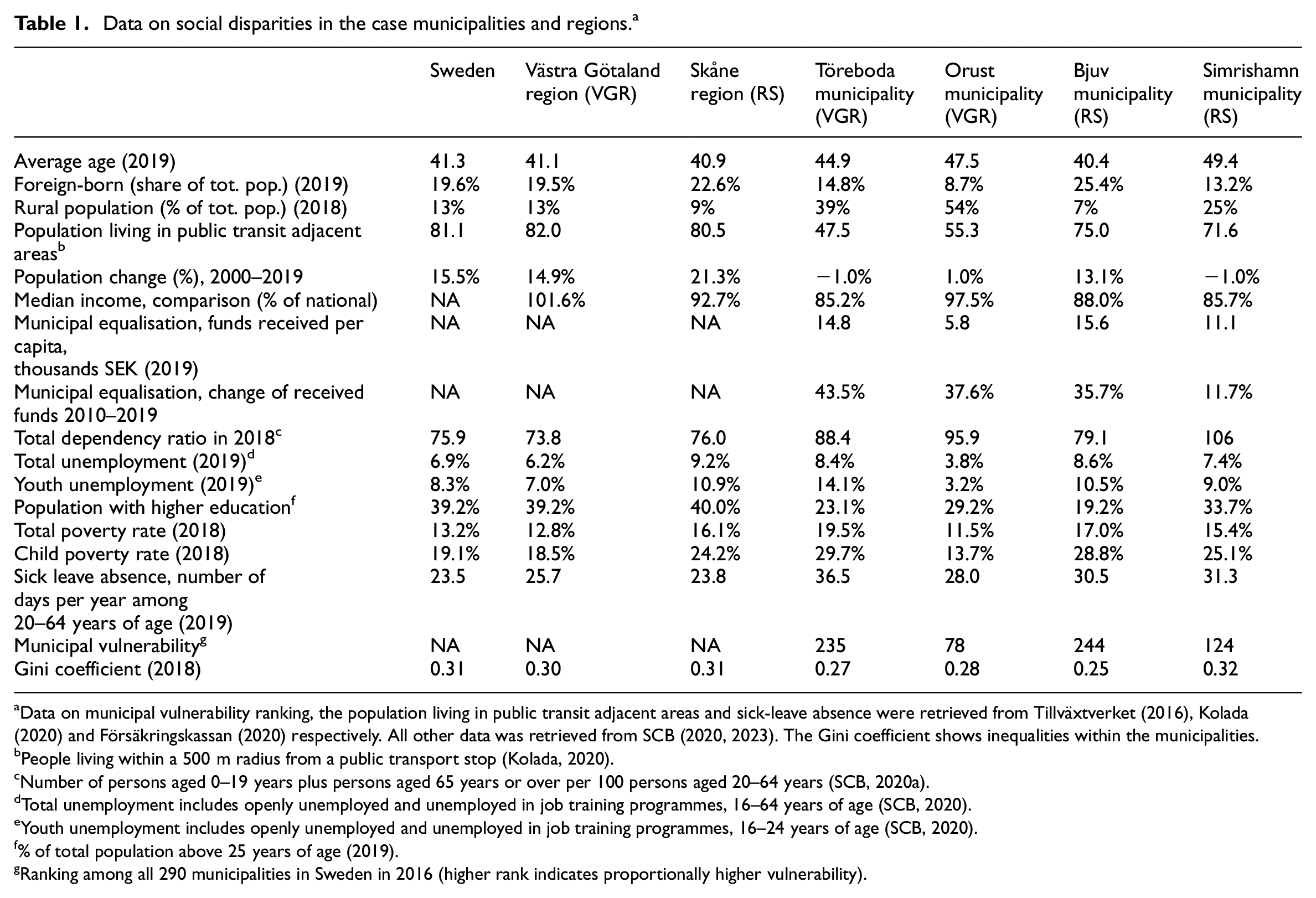
Data on municipal vulnerability ranking, the population living in public transit adjacent areas and sick-leave absence were retrieved from Tillväxtverket (2016), Kolada (2020) and Försäkringskassan (2020) respectively. All other data was retrieved from SCB (2020, 2023). The Gini coefficient shows inequalities within the municipalities.
People living within a 500 m radius from a public transport stop (Kolada, 2020).
Number of persons aged 0–19 years plus persons aged 65 years or over per 100 persons aged 20–64 years (SCB, 2020a).
Total unemployment includes openly unemployed and unemployed in job training programmes, 16–64 years of age (SCB, 2020).
Youth unemployment includes openly unemployed and unemployed in job training programmes, 16–24 years of age (SCB, 2020).
% of total population above 25 years of age (2019).
Ranking among all 290 municipalities in Sweden in 2016 (higher rank indicates proportionally higher vulnerability).
Justice: A (largely) absent dimension of regional development
Much attention has been directed towards the political aspects of uneven regional development (e.g. Storper, 2011). For example, Etherington and Jones (2009: 260) argued that uneven development is ‘deeply political’ and is the outcome of not only accumulation processes but also political discourses. Addressing city-regions, they emphasised that these ‘reinforce, and have the potential to increase, rather than resolve, uneven development and socio-spatial inequalities’ (Etherington and Jones, 2009: 260). Others (e.g. Painter, 2013) have looked at how the governing of territories always involves a regulating power relationship between the territory and its population. Similarly, several authors (e.g. Harrison, 2010; Jonas, 2013; Jonas and Moisio, 2018) have emphasised the need for deeper scrutiny of how political discourses shape uneven regional development.
While scholarship on urban and spatial justice has usefully drawn attention to how social injustices are bound up with the political organisation of space, less attention has been directed towards discussions of how spatial justice often addresses the urban, or metropolitan, scale while ignoring the regional scale. There are, however, exceptions to this. Jonas and Ward (2007) introduced a discursive understanding of how tensions between social reproduction and regional economic distribution can be understood. As early as 2007, they criticised the reification of city-regions as autonomous political agents and laid out an alternative approach by which geographies of city regionalism could be understood through everyday struggles around social reproduction, distribution, and political participation. These conflicts, the authors argue, ‘may be played out “locally”, but they reveal the wider circuits of conflicts that connect geographically discrete places, and that are essential elements in the restlessness of capitalism’ (Jonas and Ward, 2007: 172). They emphasise the need to further theorise and engage with social reproduction struggles in city-regionalism geographies. Along much the same lines, Purcell (2007: 197; see also Soja, 2015) emphasised the need to examine regional democracy, a theme which, at the time, and according to the author, was ‘absent in most research on city-regions’. Purcell (2007) emphasises how it is not the change of scale, from an urban to a city-regional or metropolitan scale, that decides the extent to which the process is democratic (see also Jonas and Moisio, 2018; Keil et al., 2016); it is instead, Purcell (2007: 203) underlines, the introduction of new political agendas and the introduction of possibilities for ‘those empowered by a given scalar strategy (such as the city-regionalisation of urban governance) that will produce democratisation, competitiveness, inequality etc’. Consequently, and as Purcell (2006) argued elsewhere, unless we think critically about the interplay between scales, democratisation risks becoming fragmented in delimited geographical areas and, in this way, maybe hit with ‘the local trap’. Similarly, Hudson (2006: 34) has argued that justice requires recognition, ‘the outsider must be able to put her claims in her own terms, not have to accommodate to the dominant modes of legal/political discourse’. If recognition is not addressed, social injustices will be reproduced with consequences such as the silencing of voices.
Jones et al. (2019) have since argued that a normative theory of justice ‘has the potential to make a useful contribution to understanding the unequal distribution of economic resources, public services, and well-being at other geographical scales, not least the regional scale’ (p. 106). Justice, in other words, provides a useful but still largely absent lens for uncovering how uneven regional development is produced and reproduced. To our knowledge, there have been no attempts to use Nancy Fraser’s notion of justice in analyses of uneven regional development, even though it addresses aspects that have been identified as critical for further theorisation on geographies of city-regionalism. To demonstrate the usefulness of Fraser’s theory in advancing such an understanding, the following section presents her three-dimensional justice framework.
Nancy Fraser’s three-dimensional notion of justice
Feminist moral and political philosophy, notably including the works of Nancy Fraser, Iris Marion Young, and Doreen Massey, is a sphere where the concern for how geography matters for the pursuit of social and democratic justice has proliferated (Barnett, 2011). Departing from Fraser’s justice theory, we elaborate on how the political production of regionally uneven development and regional injustices requires, as the above-cited critical regional scholarship suggests, looking beyond while continuing to include redistributive concerns. In Fraser’s (2007, 2008) philosophy, justice is constituted through three interconnected dimensions: economic redistribution of recourses, cultural recognition, and political representation.
Redistribution
According to Fraser (2008: 58), the problem of distributive injustice, or maldistribution, is that resources, such as economic wealth, work opportunities, and access to education, are unevenly distributed demographically and geographically. While redistribution is inevitable, it does not in itself change the societal structures that generate inequalities, for example, injustices in the form of marginalisation, exploitation, and deprivation generated by class structures (Fraser, 2008: 16). Young (1990), similarly, has emphasised how theories of social justice must take the broader issues of power asymmetries as their starting point, ‘[w]hile distributive issues are crucial to a satisfactory conception of justice, it is a mistake to reduce social justice to distribution’ (Young, 1990: 15). What is needed to address social injustices, according to Fraser (1995: 75), are transformative and universal remedies with the potential to change oppressive structures.
Recognition
The second justice dimension deals with the problem of misrecognition within status hierarchies, sorting people and places into value categories differentiated in terms of higher and lower value. (Fraser, 2008: 58). This second justice dimension engages with cultural domination, non- or misrecognition, and disrespect reproduced by status hierarchies. Recognition takes place both at an intimate, interpersonal level and in the public sphere. An example of the problem of misrecognition can be seen in the stigmatisation of groups and places, where de-stigmatisation is necessary to counteract recognition gaps (Derickson, 2016; Porter, 2014). By introducing the term ‘geographies of recognition’, Fraser (2008: 106) addresses how claims for recognition and protests against status subordination are geographically and spatially embedded (Fraser, 2007: 322). As she claims, ‘the best way to overcome misrecognition is not by changing people’s attitudes about one another or re-engineering their identities but through institutional change: the goal is to de-institutionalise parity-impeding value hierarchies and to replace them with parity-enabling alternatives’ (Fraser in Hrubec, 2004: 886). This, she further argues, entails ‘the wholesale transformation of societal patterns of representation, interpretation and communication in ways that would change everybody’s sense of self’ (Fraser, 1995: 73). To achieve change, Fraser (2007: 322, emphasis in original) argues, misrecognition needs to be regarded ‘as a genre of institutionalized injustice’.
Representation
The third justice dimension describes the problem of misrepresentation and political voicelessness, which occurs when people are excluded from taking part as peers in decisions affecting them (Fraser, 2008: 59). The issue of representation raises two questions: ‘who counts?’ and ‘how should we determine which mapping of political space is just?’ (Fraser, 2008: 5, 15). Injustices of representation can be witnessed in the upholding of borders as ‘structural obstacles to fair participation’ (Fraser, 2007: 324). This is described as ‘misframing’ by Fraser (2008). Justice should be rethought in terms of who and what it includes, as well as how justice is enacted institutionally in representative terms, ‘[i]n cases of politically rooted exclusion, what is needed is transformative representation, which reframes the constitution of political space’ (Fraser, 2007: 316). Such reframing must include at least two levels: At one level, which pertains to the boundary-setting aspect of the political, representation is a matter of social belonging. What is at issue here is inclusion in, or exclusion from, the community of those entitled to make justice claims on one another. At another level, which pertains to the decision-rule aspect, representation concerns the procedures that structure public processes of contestation. Here, what is at issue are the terms on which those included in the political community air their claims and adjudicate their disputes. At both levels, the question can arise as to whether the relations of representation are just. (Fraser, 2008: 17)
The following section examines how redistribution, recognition, and representation are dealt with in the four case municipalities. By analysing regional development through Fraser’s three-dimensional notion of justice and from the point of view of the municipalities, in the next section, we illustrate how her expanded notion of justice usefully contributes to broadening the understanding of the political (re)production of uneven regional development.
Four Swedish municipalities in two regions
The Swedish planning system is primarily organised at the municipal level. National planning takes place through national interests and regulations. The state also governs planning through 21 County Administrative Boards, which play an advising and controlling role in relation to the planning performed by the 290 municipalities. Regional planning is a fairly new task (SOU, 2015), currently ongoing in three of 21 regions. Recent years have also seen increased interest in new forms of national land-use planning (Regeringskansliet, 2022). A recent white paper (SOU, 2020) on the capacity of municipalities to provide welfare illustrates the complexity of the challenges faced by the municipalities, not least since the municipalities vary much in size, from the smallest municipality (2500 inhabitants) to the largest (960,000 inhabitants). Nevertheless, in similarity to the other Nordic countries, all Swedish municipalities share the same welfare responsibilities, and municipal autonomy is strong compared to other parts of Europe (SOU, 2020).
Since the 1990s, the Swedish state has promoted planning for regional enlargement and urban growth to strengthen international competitiveness and increase effectiveness in the public sector (Johansson et al., 2021). The state handles disparities between Swedish municipalities through the Swedish tax equalisation system, where the two main components are tax redistribution between municipalities based on population size and allocation of structural grants based on a municipal vulnerability ranking. The Swedish government has recently focussed on curbing urban–rural disparities (SOU, 2017) and strengthening the strategic planning capacity of municipalities (SOU, 2020). These ambitions indicate an increased governmental interest in a more holistic regional perspective and the interplay between economic production and social reproduction (Eriksson and Tollefsen, 2022).
The four municipalities that formed the research case studies are located in two of the three metropolitan regions in Sweden: Töreboda and Orust in the Västra Götaland region and Bjuv and Simrishamn in the Skåne region (see Figure 1). The regions and municipalities were selected to cover contrasting conditions and to include diverse outcomes of uneven development. The Västra Götaland region comprises 49 municipalities and is the largest region in Sweden, with 1.7 million inhabitants. The Skåne region consists of 33 municipalities and 1.4 million inhabitants. Both regions have a formal mandate to develop regional development policies and regional transportation plans through collaboration with the municipalities. Unlike Västra Götaland, the municipalities in Skåne decided, in a signed letter of intent in 2008, to give the Skåne region a further political mandate to translate the region’s development policy into a spatial strategy named the Structural Picture of Skåne (Region Skåne, 2013). In addition, in 2019 the Skåne region was given land-use planning responsibility through a change in the Swedish Planning and Building Act. Regarding formal planning, Västra Götaland is currently only preparing plans for regional infrastructure. Additional soft planning processes for spatial development in Västra Götaland are based on initiatives from the municipalities and are carried out by four municipal federations through inter-municipal agreements. In the following, we give a general presentation of the four case municipalities.
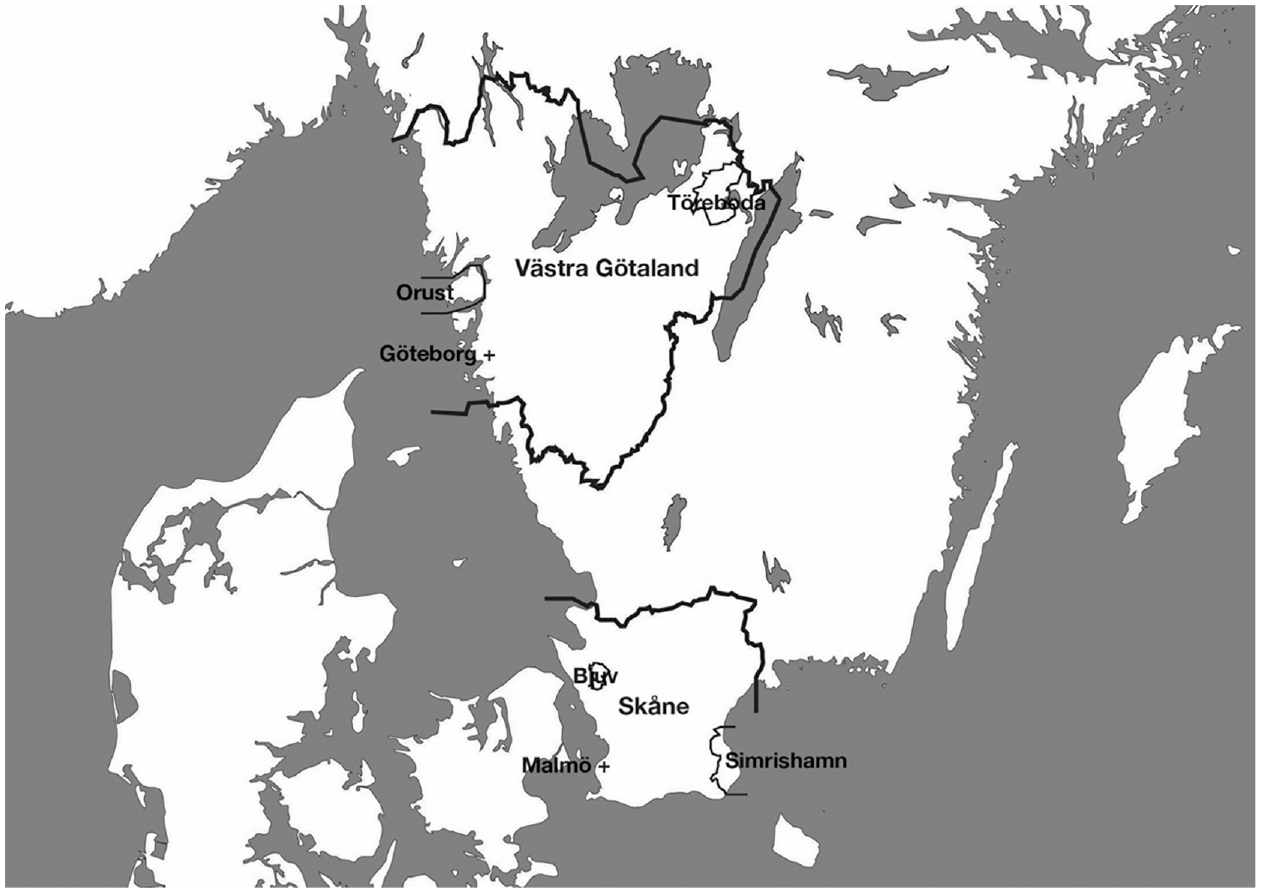
Map of southern Sweden showing the location of the Västra Götaland and Skåne regions, as well as the four municipalities of Töreboda, Orust, Bjuv, and Simrishamn.
Töreboda
Töreboda (9400 inhabitants), located in the north-east periphery of the Västra Götaland region (see Figure 1), is classified as a ‘sparsely populated rural municipality’ (Tillväxtverket, 2020). 2 In 2018 Töreboda was identified as one of Sweden’s 30 most socially vulnerable rural municipalities (Tillväxtverket, 2018). Compared to the national average, the local population has a lower level of education, a lower average income, a higher youth unemployment rate, poorer health, and higher economic vulnerability (Folkhälsomyndigheten, 2020; Tillväxtverket, 2016). The municipality has experienced a long-term population decline. However, an inflow of refugees has dampened this trend recently, and the municipality is currently planning for growth with 300–750 new housing units (Töreboda kommun, 2014a, 2019).
Most jobs in Töreboda are in manufacturing, health care, education, and agriculture (Töreboda kommun, 2016). Commuting connections to surrounding labour markets are good, but local public transportation is poor (Töreboda kommun, 2019). Locally, there is frustration over the insufficient supply of services and lack of investments and job opportunities. In sufficient skill supply is identified as a significant future challenge. Another major challenge is meeting the growing welfare needs of the ageing population and the need for significant public investments in the future. The municipality has a high dependency ratio and has recently seen a substantial increase in social security spending (SCB, 2020; Töreboda kommun, 2018, 2020).
Orust
Orust (15,000 inhabitants), classified as a ‘peri-urban rural municipality’, is a west-coast island with several smaller towns and a relatively densely populated countryside (Orust kommun, 2020; Tillväxtverket, 2020). The population has been stable over recent decades. Still, the municipality is changing demographically, with a decreasing permanent population in the towns and villages and growth in the more sparsely populated countryside (SCB, 2020). In the summer, the municipality’s population multiplies due to tourism and the ongoing transformation of permanent houses into vacation homes (Orust kommun, 2016, 2020).
The local labour market is marked by a strong entrepreneurial tradition and is dominated by small enterprises, mainly in crafting, small-scale agriculture and tourism (Interview with Susanne Ekblad, Head of Economy, Orust Municipality, 16 September 2020; Interview with Richard Karlsson, Head of Planning, Orust Municipality, 16 September 2020; Interview with Henrik Lindh, Head of Local Administration, Orust Municipality, 16 September 2020). The general level of education is low (Folkhälsomyndigheten, 2020), but a high level of specialised industry skills can be found among the local population. In Orust, unemployment rates and economic vulnerability are lower than the national average (Folkhälsomyndigheten, 2020). Orust faces a negative birth rate, an ageing population, and a dependency ratio significantly above the average (SCB, 2020). The municipality aims to increase its tax income through population growth, requiring new development (Interview with Richard Karlsson, 2020; Orust kommun, 2016). The region has, however, forecast a slightly decreasing population for Orust over this period (Västra Götalandsregionen, 2019). In Orust, improvements to public transportation and road infrastructure are regarded as crucial to keep existing local businesses and attract new investments (Interview with Richard Karlsson, 2020). The most urgent major investment for the municipality is an additional mainland bridge (Interview with Richard Karlsson, 2020).
Bjuv
Bjuv (15,550 inhabitants), located in northwest Skåne, is a ‘peri-urban rural municipality’ (Tillväxtverket, 2020) and is spatially characterised by a patchy settlement pattern with low-density housing, industrial plants, forests, and agricultural land. Most of the population is concentrated in the three main towns, which have grown somewhat over recent decades, mainly due to immigration (SCB, 2020, 2023). Public transportation connections to the region’s larger labour market are good, and commuting levels into and out of the municipality are fairly high.
Traditionally, Bjuv has relied on mining, agriculture, and manufacturing. The mines have long been closed, and while employment in agriculture has been profoundly reduced, manufacturing catered to 15.6% of local jobs in 2021 (Region Skåne, 2023). Although the labour market has been diversified over time, the loss of manufacturing jobs has led to long-term high unemployment. Over time, social vulnerability among the local population has increased. Average incomes and the level of education are significantly lower, and poverty rates are significantly higher than the national averages. Local policy and planning strategies have adopted the aim of counteracting unemployment through education and attracting wealthier inhabitants by making Bjuv an ‘attractive commuter municipality’ (Bjuvs kommun, 2016a).
Simrishamn
Simrishamn (19,200 inhabitants), located in southeast Skåne, has one central town and several smaller villages and is classified as a ‘sparsely populated rural municipality’ (Tillväxtverket, 2020). The population has been shrinking since the 1970s. Still, the main town, Simrishamn, and the coastal areas are growing, partly due to the transformation of vacation homes into permanent housing (Simrishamns kommun, 2017a). Most jobs are found in the public sector and small-scale enterprises in agriculture, food production, the service sector, tourism and manufacturing (Företagarna, 2020). The level of education is low among the local population, and the unemployment rate is slightly above the national average. Meeting the demands of sufficient skills supply and building fast and reliable public transportation to the region’s larger labour markets are factors identified as key to future growth (Simrishamns kommun, 2017a, 2017b).
The municipality’s economic situation is stable. However, it faces challenges in its supply of public services due to seasonal population fluctuation. With tourism and the high amount of vacation residences, the population increases by an estimated 50% during the vacation season (Simrishamns kommun, 2020). Thus, the municipality provides services for a large population that does not pay municipal tax. In the long term, forecasts show an ageing population, a negative birth rate, and an uneven demographic change (Simrishamns kommun, 2017b). The average age of the local population is among the highest in Sweden, and demographic transformations will require costly investments (Simrishamns kommun, 2017a, 2017b). Simrishamn’s strategy to meet these challenges is to increase the taxpaying population (Simrishamns kommun, 2020).
A three-dimensional analysis of municipal justice claims
To penetrate the different situations faced by the municipalities from a justice perspective, focussing on how the local challenges are situated and reproduced at the regional scale, in this section, we provide an analysis of their justice claims related to recognition and representation within the regional policy processes, and redistribution, which occurs through both national and regional decision-making.
Redistribution
Due to their socio-economic differences, the redistributive needs regarding the provision of welfare services and infrastructural investments in the four municipalities varied greatly. While in Bjuv and Töreboda the provision of municipal welfare services over the short and long term was emphasised as a great challenge, in Orust and Simrishamn redistribution, in the form of regional and national funds for transport infrastructure improvements, was the primary concern.
In Sweden, a tradition of local self-government means that municipalities levy the largest share of all income taxes and are responsible for providing a significant proportion of all welfare services. To counteract unequal standards of welfare services across the country, funds are redistributed from wealthy municipalities to less wealthy ones through a municipal tax equalisation system. All four municipalities have been long-term receivers of funds through this system (see Table 1).
Despite receiving redistributive funds at a growing rate, in Bjuv and Töreboda, those interviewed experienced significant problems meeting local welfare service needs. In both cases, this problem is linked to restrained municipal tax incomes combined with increasing welfare demands due to high unemployment, especially youth unemployment, stagnating population growth, ageing populations, out-migration of inhabitants of productive age, in-migration of households dependent on social welfare and a growing number of children in need of new family homes (Interview with Per-Ola Arnling Hedberg, Head of Local Administration, Töreboda Municipality, 24 August 2020; Interview with Christer Pålsson, Head of Local Administration, Bjuv Municipality, 9 September 2020). In Bjuv, the long-term restrained economic situation has resulted in underinvestment in municipal facilities and services (Bjuvs kommun, 2012, 2016b, 2020). Local estimations predict that the municipality will need to cut and/or restructure welfare provisions unless it increases tax income through population growth (Interview with Christer Pålsson, 2020). In Töreboda the only solution seemed to be increasing delivery efficiency.
Counteracting the challenges of welfare delivery was seen by the local representatives in Bjuv as entirely dependent on the municipality’s ability to increase tax income through demographic change by attracting middle-class households to Bjuv (Interview with Christer Pålsson, 2020). As a part of this strategy, the municipality is planning transit-oriented development in Bjuv. This strategy appears unviable in Töreboda since low property values prevent lending for new buildings. In Töreboda, the informants instead emphasised the need to take joint responsibility for socially vulnerable groups among and between municipalities: Yes, even if one [inhabitant] cannot contribute with a salaried employment, several of them will live in Töreboda – and in other municipalities – in the future. We [municipalities within the region] must take joint responsibility for the part of the population which, regardless of how much we [the municipality] do, will not be able to graduate from school. (Interview with Per-Ola Arnling Hedberg, 2020)
Challenges of welfare service delivery were also addressed by interviewees in Orust and Simrishamn. Due to their high rates of second homes, both municipalities experience significant population growth in the summer season, placing tremendous pressure on municipal services such as elderly care, emergency services, water supply, and public transport. Participants argued that the current municipal tax equalisation system did not consider uneven seasonal welfare service demands in both municipalities. In Simrishamn, the participants also highlighted uneven development within the municipality and the political ambition to balance the welfare service supply between the main town and the villages as a challenge.
However, the main concerns in both Orust and Simrishamn were a perceived lack of national and regional engagement in developing transport infrastructure to support development in the municipalities. One interviewee in Orust emphasised that this leads to disputes between the municipal federations: So there is no functioning regional development planning, or infrastructure planning in a way that has a holistic perspective, and can work based on functional entities, but instead it becomes a contest between these municipal federations. (Interview with Richard Karlsson, 2020)
According to interviewees in Orust, the allocation of transport investments is determined by a municipality’s position in the municipal federation rather than its needs, where stronger municipalities’ interests are placed higher on the regional wish list. Partly because of a weak position within the current federation, Orust municipality has recently requested to become a member of another municipal federation.
In conclusion, the four respective municipalities expressed that their situations were determined by the current shaping of redistribution systems and policies. They also felt that current procedures and policies did not consider local needs sufficiently and just ways.
Recognition
In the four municipalities, geographical patterns of identification sort places into categories that create local geographical status hierarchies, whereby some places are regarded as more valuable than others. Institutions form these, and when they hinder parity-enabling recognition, misrecognition occurs. As our analysis shows, all four municipalities are subject to some form of misrecognition.
In Bjuv and Töreboda, representatives experienced a lack of recognition in regional policymaking of how their social and economic vulnerabilities affected their conditions for future change. In Töreboda, representatives from the municipality expressed a general feeling of having been left behind, both by the region and the national government (Interview with Per-Ola Arnling Hedberg, 2020). The fact that the socio-economically worst-off municipalities are left to handle their problems on their own is taking its toll, according to one of the representatives: ‘We cannot have lots of angry people who live in villages without schools and shops’ (Interview with Per-Ola Arnling Hedberg, 2020).
In both municipalities, right-wing populism has grown. In Töreboda, an ultra-right community has taken advantage of low property prices and settled in the municipality. In Bjuv, the Sweden Democrats, an ethno-nationalist political party, took over the political leadership in 2019. In contrast to Töreboda, Bjuv’s socio-economic vulnerability has occasionally been recognised at both the national and regional levels (Interview with Christer Pålsson, 2020). However, Bjuv representatives found that the municipality’s vision for post-industrial development was not fully recognised at the regional level, where Bjuv is seen as an ideal location for new and ‘dirty’ industries: To be honest, at the regional level, it is more or less assumed that Helsingborg is [to be kept as] a nicer place and that Bjuv and Åstorp are suitable for [the location of new] dirty and space-demanding industrial development. (Interview with Niklas Ögren, Head of Planning, Bjuv Municipality, 10 September 2020)
Both Töreboda and Bjuv have also experienced a lack of recognition of their rural qualities, such as their proximity to natural areas, at the regional level. Orust and Simrishamn have a higher status within the regional and national geographical hierarchies. Contrary to Bjuv and Töreboda, Orust and Simrishamn are recognised widely for local qualities they take pride in, such as their natural landscapes, the marine industries, and the crafting industries. Both municipalities, however, see increasing differentiation between a more vulnerable permanent inland population and a wealthier seasonal population along their coastal areas.
Like many rural municipalities, Orust and Simrishamn have ageing populations. Furthermore, the level of education is low among the inhabitants. However, unlike Bjuv and Töreboda, Orust and Simrishamn have relatively stable municipal finances and low unemployment. In Orust, the municipal administration has high expectations of growth. Still, they are restrained by a lack of regional investments in infrastructure, which in turn obstructs them from achieving their goal of attracting new inhabitants with a higher level of education. In their view, this goal contributes to increased tax income and a higher status. Simrishamn displays a similar story. The municipality is recognised for its scenic coastal landscape and has become an attractive place for second homes. However, an ageing population and a proportionately low share of local taxpayers have posed a challenge to welfare service delivery and risk creating tensions between a more vulnerable but taxpaying inland population and a wealthier coastal population that does not pay municipal tax. Like Orust, Simrishamn identifies insufficient infrastructure investments as an obstacle to attracting a younger, skilled workforce. Representatives, however, hesitate to be publicly vocal about the insufficiency of regional and national transport investments as it may create an image that disincentivises new investments and in-migration (Interview with Diana Olsson, Head of the Local Administration, Simrishamn municipality, 8 September 2020).
Representation
All four municipalities are formally represented in regional forums addressing regional development matters. The municipalities are also part of different subregional collaborations through municipal federations. All four municipalities showcase how their conditions for political representation are determined, in both enabling and constraining ways, through how the subregional forums are delineated geographically and how the regional political structures are shaped. They all face a major challenge to be heard on equal terms with the larger municipalities in regional and subregional forums.
In Orust and Töreboda, the representatives expressed a feeling of unjust representation because the municipal federations prioritise the interests of the larger municipalities in their dialogues at the regional level (Interview with Henrik Lindh, 2020). In Orust, this situation affected, according to one of the representatives, their ability to lobby for infrastructure investments since the infrastructure planning organisation does not allow the municipalities to communicate their needs directly with the region: ‘This whole setup that you need to collaborate in an infrastructure intervention through a municipal federation, to produce a transport plan later, that whole setup is dysfunctional’ (Interview with Richard Karlsson, 2020). To counteract the perceived injustice of representation, Orust has recently requested to become a member of the municipal federation of the Gothenburg Region instead.
The municipal representatives in the four municipalities also felt that political representation in subregional forums was not a guarantee of being successfully recognised in terms of needs and priorities. Some representatives point out that the larger municipalities often have stronger voices. In Simrishamn, the representatives expressed that their subregion faced difficulties in being prioritised, despite political representation, due to their geographic location and more rural profile (Interview with Diana Olsson, 2020; Interview with Ann-Sofie Pellas, General Planner, Simrishamn municipality, 8 September 2020), as expressed by Pellas: ‘The region does not see the same potential with us as with the regional cores…we are seen as a distant corner for recreation’ (Interview with Ann-Sofie Pellas, 2020).
In Töreboda, there is a fear that the injustices of political representation hinder its development (Töreboda kommun, 2014b). For instance, there is a discrepancy between local growth predictions and the lower regional growth estimations (Länsstyrelsen, 2019). An explanation may be that meetings between the region and municipalities rarely occur.
In contrast, Bjuv illustrates how subregional collaboration strengthens its influence over decisions made by the region (Interview with Christer Pålsson, 2020). Importantly, the subregional collaboration also functions as the organisation of joint municipal service delivery, allowing the smaller municipalities to attract needed competence and make service delivery more efficient by creating economies of scale. Nevertheless, the interviewees in Bjuv, like those in the three other case municipalities, stressed that the larger municipalities have more weight in subregional and regional forums.
To summarise, despite attempts to strengthen their representation through subregional cooperation and inter-municipal collaborations, all four municipalities struggle to participate in decision-making on equal terms with the larger (urban) municipalities. This contributes to the experience among the four municipalities of not being fully represented and their needs not being fully recognised, despite the commitment of the Skåne region to be ‘the municipalities’ region’ (Region Skane, 2010) and the ambitions of the Västra Götaland region to create ‘conditions for a greater sense of belonging and trust between people and throughout society’ (Västra Götalandsregionen, 2021).
The political (re)production of uneven development through misframings
In explaining her three-dimensional notion of justice, Fraser (2008: 5) distinguishes between ‘the balance’ and ‘the map’. The balance relates to the question of ‘what’ justice should bring about. The map refers to the question of ‘who’ should be included. Fraser (2008) further introduces the term ‘misframings’ to describe situations where the map is wrong or problematic concerning ‘who’ is included to negotiate the ‘what’ questions.
To illustrate how these misframings can be understood, we provide three examples from the analysis. Despite receiving additional funds through the municipal tax equalisation system, Bjuv and Töreboda experienced problems meeting existing and predicted demands for welfare services and investments. This situation showcases a redistributive misframing in which the regional administration is limited by its duties to facilitate regional economic growth and is not responsible for supporting the delivery of municipal welfare services despite the displacement of socially vulnerable groups taking place on a regional scale.
The two other municipalities, Orust and Simrishamn, experienced a representational misframing regarding the need for infrastructure investments and welfare service needs created by seasonal population fluctuations. While Orust municipality wished to reframe the subregional administrative divides, by requesting to become a member of another municipal federation to increase their ability to negotiate for a new mainland bridge, Simrishamn wanted the region to reframe the statistics and include the part-time residents in the prognosis for new public transport. In other words, they wanted to create new maps enabling other regional balances.
A third example is the recognitional misframing apparent in the Töreboda and Bjuv cases, where local representatives expressed that the municipalities’ growing social vulnerabilities were not sufficiently recognised regionally and nationally. While the inter-municipal collaborations provided arenas to strengthen their capacity to lobby for infrastructural development, they expressed a general feeling of having to counteract social vulnerabilities partly generated by regional urban processes and uneven development on their own. Such ‘local traps’ illustrate the importance of understanding how misrecognition contributes to reproducing regional processes of uneven development by obscuring the viewpoints of peripheral regional areas. Bjuv and Töreboda have been significantly affected by uneven regional development with growing social vulnerabilities that have remained largely unaddressed in the regional political contexts and regional development agendas. While the growth of political reactionism in the two municipalities has a complex background and cannot be reduced to the regional processes, the regional marginalisation and misframings must be addressed as contributing factors.
In regional urban research, there has been a call for theorisation and empirical exploration of spatial justice issues, democracy, and the repercussions of uneven development at the regional scale. Purcell argues that it is the introduction of new political agendas rather than the change of scale of democratic processes that ultimately contributes to democratisation. Our empirical material shows, however, that institutional misframing in the form of misrepresentation has repercussions on how political agendas are formed and what they address, for example, what and whose problems are recognised and addressed discursively and in terms of distribution. We seek to show that Fraser’s three-dimensional justice approach offers us a normative framework for exposing the misframings and ‘local traps’ that reproduce and lock in marginalisation and uneven development at the regional scale. Our findings also illustrate how misframings and local traps obstruct struggles against injustices. All four municipalities are trying to acquire better positions in their negotiations concerning the balance of what justice should bring about, for example, by creating new institutional collaborations. However, the institutional maps and political agendas do not respond to perceived injustices. Within the framework of Swedish social-liberal democracy, there are still strong institutional driving forces for a fair distribution and equal development of society. However, as the analysis of the four case municipalities’ justice claims shows, if a more just and transformative development is to be achieved, we need to focus more on institutional framings and how they enable or hinder recognition and representation. This would require the Swedish national government to be involved since the territorial division of regions and municipalities largely determines representational misframings.
To summarise, our analysis illustrates how the political production of uneven regional development is not limited to maldistribution. A broader problematisation of regional injustice has shown how uneven regional development also occurs through misframings based on misrecognition and misrepresentation. Despite being formally represented in regional and subregional forums, all four municipalities felt they could not advocate for their needs as effectively as the larger municipalities. The search for a new balance of recognition, representation, and redistribution would require framing regional development through a lens that looks beyond the city-centred perspective and addresses an expanded notion of justice.
However, while aspiring towards a better understanding of how the production of uneven regional development is crucial, it does not translate automatically to effective remedies. We argue with Fraser (1995) that counteracting injustices requires transformative, as opposed to affirmative, remedies. Transformative remedies seek to change the societal and economic structures that reproduce injustices, in contrast to affirmative remedies that only aim to compensate for unjust outcomes. Addressing the injustices generated by uneven regional development in a transformative way requires, we argue, more than targeted re-/distribution of income, tax, investments, and other resources; it also requires remedies targeting the production of geographical status hierarchies, exclusion and voicelessness.
Conclusion and new viewpoints
Places in the margins of the city-centric regional landscapes are today defined through the views of dominant centralities and institutional frameworks, often by how ‘useful’ they are to an urban, growth-oriented regional economy. There is an imminent risk that justice claims from municipalities like the four analysed in this article will be neglected. Creating more just urban–regional development requires, in the first instance, both deeper and broader involvement with notions of justice, a topic we have identified as a largely absent notion in regional development policy. In this article, we have responded to the call for more theoretical and empirical work on how urban–regional inequalities and uneven geographic development are reproduced. We have illustrated how this can be done by analysing the plurality of regional geographies through a normative framework building on Fraser’s three-dimensional, expanded notion of justice. Importantly, beyond its analytical value, Fraser’s expanded justice notion provides a powerful point of departure to deconstruct the urban viewpoint and build new, progressive, and plural visions of regional development.
Footnotes
Declaration of conflicting interests
The author(s) declared no potential conflicts of interest with respect to the research, authorship, and/or publication of this article.
Funding
The author(s) disclosed receipt of the following financial support for the research, authorship, and/or publication of this article: Svenska Forskningsrådet Formas research grant 2017-00953.
