




Abstract
This paper engages recent writing on urban trauma, exploring its connection with the gendered forms of activism that displaced women practise as they seek to rebuild more emancipatory urban futures. Their activisms are situated in the context of multiple, ongoing and intersecting forms of violence from intimates, armed groups and the state, including institutional neglect (in and of the city) that is racialised and gendered. We draw on participatory action research undertaken with women in the Colombian cities of Bogotá and Medellín. Using creative audio-visual methods over several months, women co-researchers produced a documentary in which they chart the ways that they claim spaces of the city inside and outside their homes. We draw particular attention here to the temporal dimension of urban trauma as it intersects with migrant women’s spatial biographies; this has consequences for their activisms which also transcend the sites and scales of public and private spheres, national and global crises and individual and community responses. We argue that it is the gradually accruing and multiplying character of violence and trauma which in turn necessitates the gradual and multiscalar development of these activisms. The women used ecological metaphors of rooting and growth to explain how, through these activisms and directly informed by past traumatic events, they ‘come back to life’. Together, they build solidarity networks and alliances, and imagine and practise alternative feminist urban futures and modes of recovery in their new urban homes.
Introduction
The poem in Table 1 was written by the women who participated in the research reported in this paper. Written to represent other displaced women and victims of the Colombian conflict, it tells the story of the displacement and violence they have experienced, the challenges they encountered on moving to new urban environments, and the action they take for more emancipatory urban futures.
Poem written by research participants.
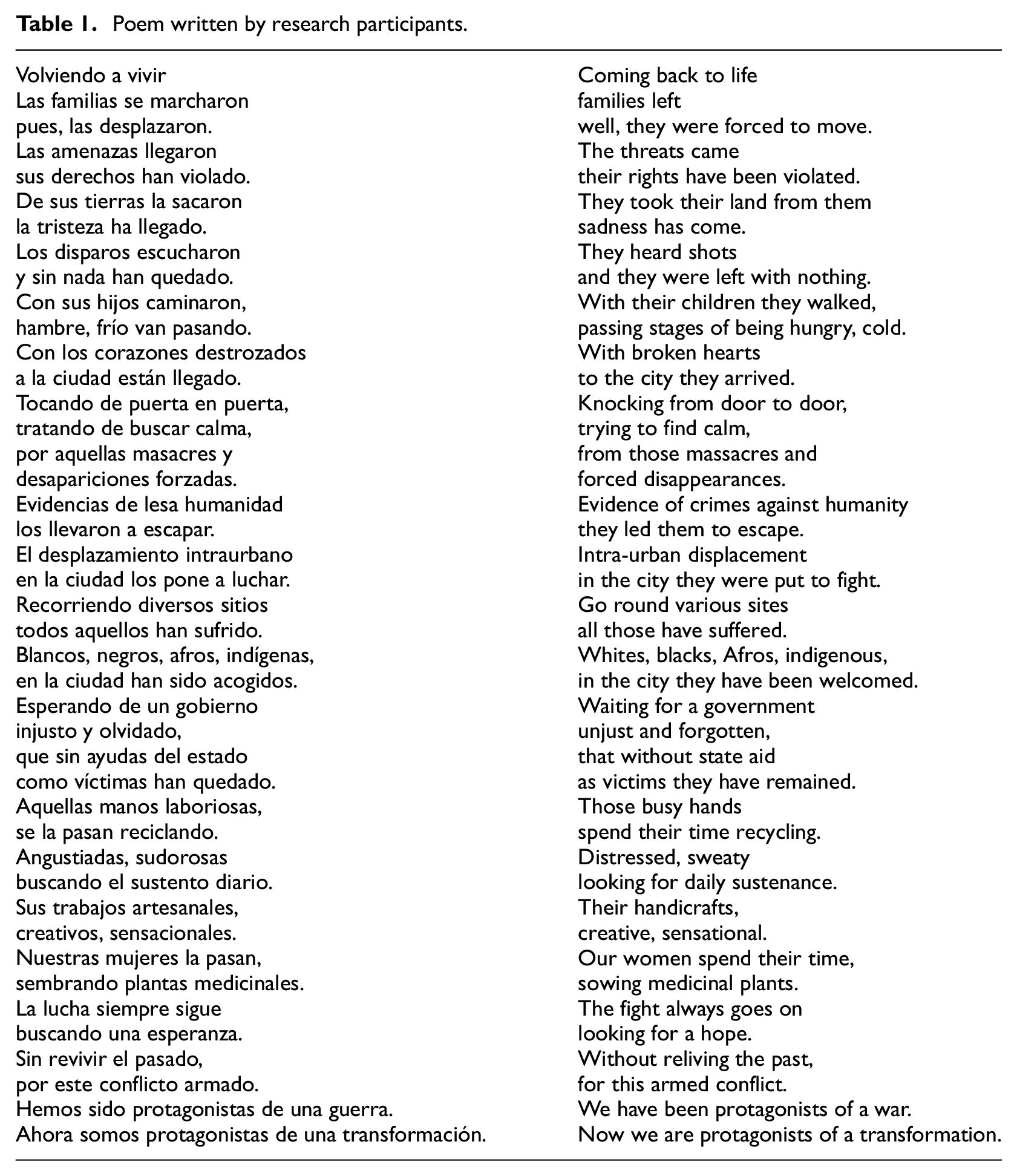
In this paper, we present some of these women’s accounts, engaging and developing the concept of urban trauma and in particular its connection to the activisms that women practise. Both trauma and activism are intersectional, especially in terms of gender, race, class and place (the often rural places of origin, and city/neighbourhood). We are especially interested in the temporal dimension of trauma, as urban trauma intersects with displaced women’s biographies, social obligations and networks and the consequences for their activism which, we will show, also transcends the sites and scales of individual, community, national and global crises.
There has been much research on violence and trauma experienced by women in urban areas, often focusing on gender-based violence (Hume and Wilding, 2020; Koskela and Pain, 2000; McIlwaine, 2014; McIlwaine et al., 2020). However, the specifically urban character of these forms of violence, and how women resist and counteract violence, is less well charted (McIlwaine et al., 2023; WRV Collective, 2022). Firstly, then, in this paper we draw on recent literature on (chronic) urban trauma (Emery, 2022; Hartal and Misgav, 2021; Pain, 2019; Shields, 2012), which provides a framework for understanding how experiences of everyday violence are folded in with the effects of wider structural violence and trauma. Urban trauma describes various forms of harm against the city, or the wounding of urban places (Shields, 2012; Till, 2012), and we add to this analysis the accumulating forms of structural and interpersonal violence that our women co-researchers experienced before and since moving to the city.
Secondly, we chart women’s responses to these multiple forms of violence, analysing these as activism. In line with existing feminist analysis, this necessitates broadening understanding of activism as exceeding the public sphere, as creatively and collectively generated and as enmeshed in relations of care. There has been relatively little attention to these quieter, more dispersed forms of activism that women and minoritised groups are more likely to engage in (see Askins, 2015; Jenkins, 2017). However, McIlwaine et al. (2023) have recently developed Jimeno’s (2008) concept of ‘emotional communities’ to describe how women in Brazilian cities practised resistance during the COVID-19 pandemic. Building on feminist geographical work on quiet activism against gender-based violence (Pain, 2014), they understand women’s resistance as non-linear and gradual, and invert the connection between collective crises and individual resistances (McIlwaine et al., 2023). In Colombia, Zulver (2022) has analysed women’s ability to resist and work for peace in situations with ongoing high risks of violence, proposing that conflict creates opportunities for women to come together with a common agenda. But while others highlight the growing public feminist activism that has developed in the last few years to counter gender-based violence in Latin America (eg., Gago, 2020), there is still relatively little attention to how displaced women rebuild their lives in (post)conflict urban contexts.
Therefore, this paper asks in what ways do women affected by chronic, multiscalar violence and conflict manage to build emancipatory urban futures? It connects urban trauma with recent feminist writing on violence and women’s resistance in the city (e.g. McIlwaine et al., 2023; Truelove and Ruszczyk, 2022), slow activism and peace-building (Lederach, 2023; Murrey, 2016; Piedalue, 2022; Saunders and Al-Om, 2022). We draw on participatory action research co-produced with two groups of displaced women in the cities of Medellín and Bogotá, Colombia. Using participatory audio-visual methods in 2021, our research together came to focus on mutual support and solidarity. While our specific interest is the Colombian context, its relevance is much broader, resonating with other urban contexts of urban trauma, violence and feminist resistance and activism (Gago, 2020; McIlwaine et al., 2023; WRV Collective, 2022).
The paper connects ideas of urban trauma with feminist analyses of activism which highlight the power of ‘small’ and ‘quiet’ individual acts in producing social change (see Askins, 2015; Staeheli, 1996). We conceptualise activism as a spectrum, along which political action may be large or small scale, short or long term, domestic or public, collective or individual, hidden or observed (Murrey, 2016). We show how activism is both continually (re)built and dispersed over space and time; and that it is the temporal, gradually accruing and multiplying character of violence and trauma in our co-researchers’ lives which in turn necessitates the slow development of these activisms. We are particularly interested in the urban character of activism, which becomes clear from the biographies that displaced women shared with us. These show how women rebuild their lives in the city, working with, around and in spite of its structures, dynamics, politics, culture, networks and social and physical infrastructures (Truelove and Ruszczyk, 2022).
The paper is organised as follows: we first provide a summary of the Colombian context, which underpins much of the displacement and violence in the lives of our co-researchers, followed by describing the project methodology. We then develop the concept of urban trauma, drawing on women’s biographies of violence, loss and rebuilding. In the final section, we analyse the various forms of activism that women develop in response to these intersecting traumas, to rebuild more emancipatory urban futures.
Researching Colombia, urban violence and gendered urban challenges
Cities are becoming increasingly feminised, as women make up a majority of urban citizens, including in Latin America (Chant and McIlwaine, 2016). Women move to cities for varied reasons, such as better access to services and employment, better education opportunities and changing patriarchal norms and dynamics within and beyond the family (Chant and McIlwaine, 2016; Hume and Wilding, 2020; McIlwaine et al., 2020). However, urban growth in Colombia is also a result of violence and internal displacement arising from armed conflict over five decades between left wing guerrilla, right wing paramilitaries, the Colombian government and organised crime groups who are often involved in drug trafficking (Arango-Vargas, 2021; López, 2019).
Despite the negotiated signed peace accord between the Colombian Government and the FARC-EP (Fuerzas Armadas Revolucionarias de Colombia), the conflict and related violence are ongoing: in 2022 alone, over 180 social leaders and human rights defenders were killed (Indepaz, 2023). Over 9 million people are now officially registered as victims of the Colombian conflict, of which are 4.7 million are women, and over 7 million people are estimated to be forcibly displaced (López, 2019; Unidad Victimas, 2023). About 89% of displaced people moved from rural to urban locations (IDMC, 2020), seen in the growth of low-income informal neighbourhoods in Colombia’s cities.
Our research took place with displaced women in Bogotá and Medellín, Colombia’s capital and second city. Both host large displaced populations (Arango-Vargas, 2021; Marzi, 2023a), and both are challenging contexts for their conflict-affected populations, in terms of urban violence and insecurity, living conditions and sharp structural inequalities (Maclean, 2015; Zeiderman, 2016).
The women in our study are affected by conflict in a number of ways. In keeping with Zulver (2022), we do not distinguish between ‘conflict’ and ‘post-conflict’; not only is conflict ongoing in Colombia, but this binary fails to speak to women’s everyday experiences. Our co-researchers come from all over Colombia, but mostly rural areas, the majority violently displaced by paramilitaries, guerrillas or state military forces. A small number are not displaced but still registered as victims of the conflict, as violence perpetrated by armed groups continues in the cities. Displaced women often arrive in Bogotá or Medellín alone with children and are heads of their household (Chant and McIlwaine, 2016). The majority live in poorer informal urban areas on the outskirts of the city (Davila, 2013; López, 2019), meaning they are disadvantaged by limited access to transportation (Davila, 2013) and public goods and resources, and continue to face multiple violences including armed conflict, political, economic and structural violence, gender-based violence and further forced displacement (Abello-Colak and Pearce, 2015; López, 2019).
To investigate women’s experiences of displacement and the challenges they encounter in the two cities, we worked together (the 24 displaced women, Colombian and UK researchers and a London-based film company) to develop an innovative remote participatory audio-visual methodology. 1 Over a period of 10 months in 2021, we created the documentary ‘Volviendo a Vivir’ (‘coming back to life’), 2 which is publicly available.
We recruited women online and with the help of existing local contacts with female community leaders. The methodology involved online workshops using participatory exercises, creative methods of drama and short video-making, training in film-making, group work and open discussions and analysis of emerging themes and then the developing set of filmed material. This methodology is detailed elsewhere (Marzi, 2023a, 2023b). The ethical framing of the project was based on principles of respect and reciprocity, with participants equal partners in the research as far as possible (Marzi, 2023a). Because these activities required extensive time and commitment from the women co-researchers, sometimes potentially resulting in loss of income, they were compensated financially and the costs of data for smartphones provided.
In this paper we draw on a range of data, from online and face-to-face workshops, semi-structured life history interviews and audio-visual material. All data were transcribed in Spanish. While participants all gave initial informed consent for the use of their data, we always ask for consent again when using quotes or sensitive material.
While the word trauma is quite rarely used by participants (who self-describe as ‘conflict victims’ which has legal status in Colombia), they frequently narrate after-effects that seriously affect mental health and everyday life. Our use of ‘trauma’ in this paper reflects these connections of past and present, and the social/spatial rather than medical condition.
Gendered biographies of trauma meet urban trauma
Conflict, disasters and humanitarian crises are rarely singular, isolated or short-term, but are often experienced as multiple, layered and cyclical, particularly for women, racially minoritised communities, those experiencing poverty and forced migrants (Rezwana and Pain, 2022). Many of our participants experienced multiple conflicts and crises, including displacement, which increase their vulnerability to further harmful events. Explicitly acknowledging these sometimes complex timelines, we consider women’s gendered biographies of trauma in this section, recognising the temporal and spatial trajectories of the impacts of violent events (see Pratt et al., 2017). We understand trauma to be ‘a psychological effect of violence that may have distinct impacts a long way down the line, but [that] may also underpin an ongoing relational dynamic between abuser and abused’ (Pain, 2019: 388); this twofold conception identifies both the chronic effects of cumulative harms from the past, and the ways that these replay because of specific economic, social and political dynamics of the city.
We use the term ‘urban trauma’ to describe the chronic effects of various accumulating forms of structural and interpersonal violence in the city. Importantly, urban trauma includes the various forms of harm against the city, or wounding of urban places (Shields, 2012; Till, 2012). In describing chronic urban trauma, Pain (2019) draws attention to the slow, attritional nature of traumatic urban events and post-traumatic stress, contesting imaginaries of the post-traumatic city where traumatic events are singular and originate outside the city. Feminist, postcolonial and queer approaches focus on repeated state violence against urban fabric, infrastructure and inhabitants and the targeted harm this does to the most marginalised people and places (Cahill et al., 2019; Emery, 2022; Fullilove, 2016; Hartal and Misgav, 2021; Shields, 2012; Till, 2012). What we seek to add to this growing literature is an explicit conceptual and empirical focus on activism.
We add to these framings explicit consideration of the trauma biographies that women bring to the city and that intersect with the urban trauma (in and of the city) they encounter there. As our co-researchers describe, these two strands of past/present trauma interweave. In this section, then, we ground and embody the concept of ‘urban trauma’ through the prism of women’s everyday experiences, evidencing how and why the accumulation of past traumas from other places must be acknowledged.
Loss of place, roots and identity
Our co-researchers’ stories of displacement and being victims of the conflict are full of loss and violence: they faced traumatic experiences in their place of origin, during displacement and when settling and rebuilding their lives in the city. In both Bogotá and Medellín, women focused their discussions on what was left behind when first displaced, and what they encountered arriving in the city. Violence forced them to leave, and they are still emotionally attached to the places they come from. Figure 1 was created during a workshop in Medellín, and is read from right to left. The black and white windmill or flower (they used both words) symbolises things abandoned when they were displaced. Maria explained that the black petals stood for grief, a symbol of the pain they felt: They are little brothers (the black and white lines) because family is lost, the life project is lost, mental health is lost, lives are lost, community is lost, tranquillity is lost and look, next to them are those figures that are black … how one feels when the armed conflict touches us, which is displacement, but … it is also the lives lost and all the things that make up the (loss through) armed conflict. (Maria, workshop Medellín)
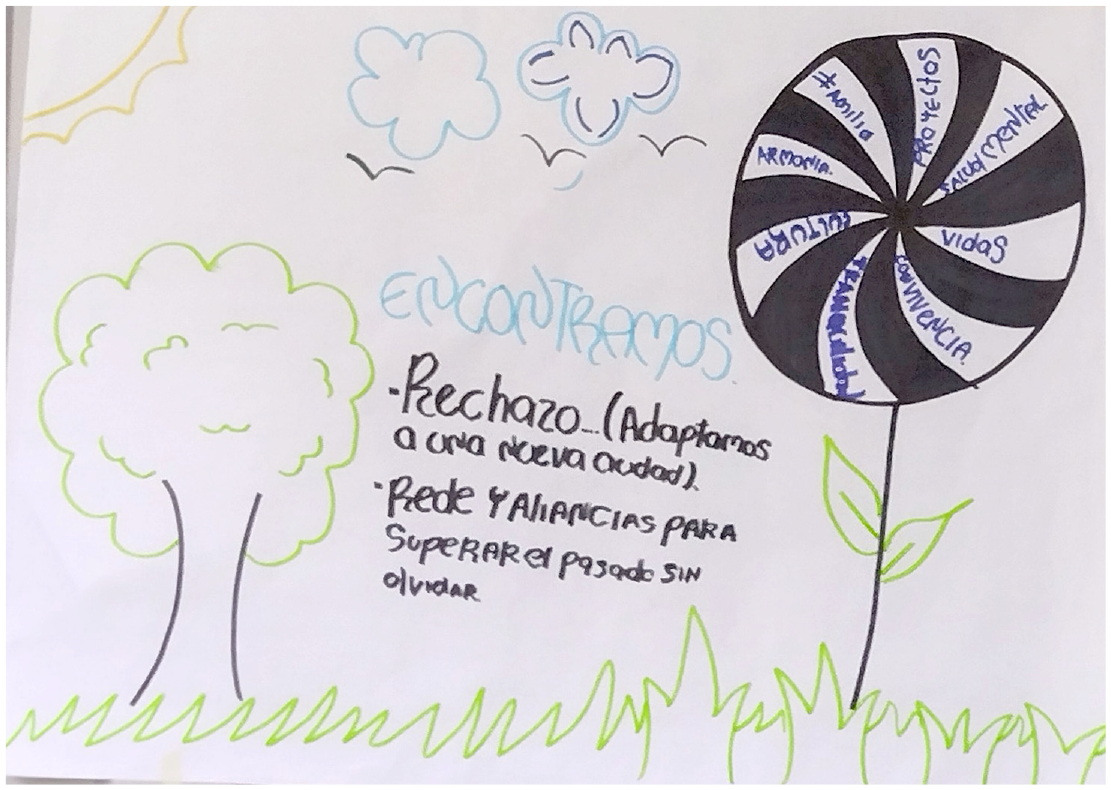
Group work Medellín. Medellín (We encounter – neglect (we adapt to a new city) – networks and alliances to overcome the past without forgetting).
In both cities, women emphasised the importance of losing their place-based roots on displacement: I see it like thinking of a tree or a plant. The roots stay there in the ground and the rest is carried away. So when we talk about roots, it’s all that we had there from the beginning in those places, we had our house, our family, and everything, we had to leave many things there and bring the rest here. (Marisa, workshop Bogotá)
Many women described losses of family, friends, culture, life (both way of life and the lives of people murdered), including animals and food. Given the strong ties between sense of self, identity and place, place dispossession creates chronic trauma, as Fullilove’s (2016) powerful work in US cities shows. For our co-researchers, the trauma of losing their roots is compounded by the loss of identity as ‘campesinas
3
’ (family farmers) (López, 2019) in ‘el campo’ (countryside). The struggle of living in new urban environments as migrants reinforces this feeling: I didn’t want to talk about what [violence] had happened to me, the only thing I wanted was to survive in this city, completely strange, a city where instead of waking up to the sound of birds, it was the sound of cars, instead of breathing pure air, I breathed polluted air, where the roads were cement. (Maria, life-history interview)
Maria is displaced due to conflict in rural Antioquia, where she experienced violence perpetrated by paramilitaries, guerrilla and the state military. She created a new life for herself and her daughters in Medellín but, like many of the displaced women, struggles with life in the city including urban violence. Maria has been involved in community activism since she first settled, but in doing so in the territory of urban armed groups she became targeted by them. To keep her children safe she had to move again to the other side of the city. Such double displacements – relatively common among our co-researchers – often mean reliving earlier traumas of displacement and loss.
Rejection in and by the city: Discrimination, rechazo and government neglect
We asked women to explain what they found on arriving in the city. In both Medellín and Bogotá, women identified rechazo as their main difficulty when displaced to the city (see Figure 1); translated as rejection, it involves intersectional discrimination and stigmatisation: A rechazo [rejection] by a city with an institution [government] that is not thinking about dealing with this type of violence, a city that even from a planning perspective does not care for the victims [of the conflict] when they arrive … but who also become part of it [city]. So here when we talk about rejection, it is in that. (Maria, Medellín workshop).
The women discussed two main forms of rechazo. First, in Bogotá, as displaced families from the countryside they encountered discrimination. Eleana explains that displaced families arrived with many children, and no one would rent housing to them or help them. Anthia adds that stigmatised parts of the country are identifiable in their accents: ‘I mean if people come from Pasto, or areas that have these distinct accents, people would just laugh at them and make jokes about how they speak’ (workshop, Bogotá). Rechazo is highly racialised, adding to the trauma of violence that led to displacement. Nadja reflects on her experience of racism as a displaced Afro-Colombian woman: Rechazo, when we try to get a job, since we didn’t have, let’s say, a resume, or someone like me didn’t have recommendations, they don’t give you the job. There is a lot of mistrust because of how someone looks (pointing to her body). (workshop Bogotá).
These interweaving violences on arrival in the city continued to accumulate as women reoriented themselves, finding somewhere to live, finding community and building new roots for their families.
The second form of rechazo is identified as lack of care for victims of the conflict from the government. In both cities, women reflected on challenges including poverty, hunger, state neglect and structural violence. As victims of the conflict, they have the right to reparations from the state through the 2011 victims’ law (Weber, 2020). However, many women did not know about this right and had little support or information on how to claim it. Often, they were afraid to register as victims of the conflict, having encountered violence that was sometimes perpetrated by armed groups of the state itself.
Using drama as a creative method, women reflected on their experiences of fleeing violence, displacement and arrival, creating short films that highlight their struggles to find institutional support. 4
We left dreams behind but then we had to see how in a city we find ways to support our children, and how to get food, I think that all of us who have been displaced have had to go through that. We got to a city and then had to sleep under a bridge, […] cover ourselves with the same clothes because we didn’t even have a blanket to keep us warm, it’s just that – rebuild and start from scratch. (Paola, workshop Medellín)
During the online workshops, the COVID-19 pandemic was inevitably spoken about, but the women were quick to assert the ‘many pandemics’ in Colombia that impacted them more than COVID-19, especially during the National Strike starting spring 2021 (Lozano Lerma, 2022): The main pandemic here in Colombia is corruption […] and thanks to that there are no educational opportunities […] as well as no healthcare and a lot of unemployment … (Eleana, video Bogotá)
Here we have many different pandemics and within those is the lack of employment, and one of the others of those pandemics is the lack of food, and there are many people who have no food […] and sometimes mothers prefer that their children eat before they can. (Mara, video Bogotá)
Rechazo as state neglect breeding urban violence
Many of the women also encountered further violence in the city, including domestic abuse, and neighbourhood violence living in areas controlled by urban armed groups. Taking advantage of rechazo in the form of absence of the state in poorer neighbourhoods, criminal groups continue to ‘govern’ these areas (Dávila, 2018; Gutiérrez Rivera and Delgado Mejía, 2022). For displaced women this reduces geographical mobility and creates distrust: ‘One doesn’t know who is who. And one needs to be aware that the city is full of paramilitaries and guerrilla’ (Eleana). Eleana had been renting out her NGO venue to guerrillas without realising who they were. Without support from the police or government, she had to tolerate them to keep herself safe and continue the work of her NGO which helps displaced people.
Because of this difficulty distinguishing who is linked to armed groups, and because the state is not trusted to keep people safe (Maclean, 2015), trauma that originates from violence and loss in women’s places of origin is now expressed in precautionary behaviour embodied in woman’s daily lives and voices in the city. Women refer to armed urban groups as ‘them’ and ‘they’; they may not know exactly who they are (guerrilla, paramilitaries or state), but they know it is dangerous to talk about them.
During an interview with Tara in Medellín asking her how these dynamics changed on moving to the city she started a sentence and stopped, asking ‘eso se puede decir?’ (‘can you say these things?’). This moment shows the continued and subconscious fear that is engrained in her body; her voice became quieter and hesitant as she looked around to make sure nobody else was listening. Tara is displaced from the Caribbean coast, from a town that suffered a lot of conflict during the 1990s and early 2000s: Many people were left in the middle of this conflict, for example, my uncle … one day when he came home they killed him, it is not known who, but they believed him to be a collaborator … the guerrillas had summoned him many times to pay for the outstanding vacuna (extortion money) … he managed to escape and he left through the backyard and ran up the mountain, but they went looking for him and killed him, the shots were all we heard, I was about 16 or 17 years old at that time.
She eventually left for Medellín because there was no work as a result of the conflict, and because her husband was targeted by armed groups. They now live in an apartment complex provided by the government. Tara was hesitant as the comuna was known for its armed conflict and drug trafficking, but says that if one avoids ‘those’ people you can ignore the violence around you to a certain extent.
Such testimonies illustrate how chronic and accumulating forms of multiple and layered forms of violence and discrimination, from women’s past to their urban present, result in urban trauma but also always possibilities for resistance. Tara, like most of the co-researchers, is connected to other displaced women and now works for positive change. While silence has often been essential to women’s survival in the past and present, they speak out once they feel more secure; their experiences of rechazo and violence are channelled into activism which we now explore.
Women and activism: (Re)building emancipatory urban futures
So far, we have shown how different forms of violence interweave during women’s lives, resulting in long and compounded after-effects. These trauma biographies move through time and space with displaced women (see Pratt et al., 2017), often replaying and interacting with the traumatic events in and of the city that are encountered there. In this section, we show that the long-term nature of violence-related trauma demands that recovery and rebuilding are also long-term projects. Feminist and postcolonial perspectives on recovery from interpersonal and structural violence are clear that it can never be a return to life as it previously was, but is an ongoing process of rebuilding new futures. Moreover, recovery is not something that is done for the cities’ poorest inhabitants, as shown in the lack of support from the patriarchal state for women, racially minoritised and LGBTQ survivors of violence (Dave, 2012; Morrow and Parker, 2020; Piedalue, 2022; Zulver, 2021). Our co-researchers in Medellín and Bogotá describe ‘volviendo a vivir’ (coming back to life), rebuilding their lives in the city by building on their roots to develop informal collective organising and solidarity networks over time (see also McIlwaine et al., 2023).
Feminist activism surged in the 1970s, reflecting fast-changing Latin American societies (Lebon and Maier, 2010): often a response to the move to neoliberal democracies and the impacts of conflict and displacement on women. In the 1980s, popular feminism highlighted the particular struggles of poor and working class women (Arango-Vargas, 2021; Conway and Lebon, 2021; Motta, 2021): Popular feminism … is the feminism of the poor and the subaltern, whose concerns for gender justice are inescapably co-constituted with their collective struggles for material, cultural and psychic survival against racist violence, land dispossession, environmental despoliation, and economic deprivation. (Conway and Lebon, 2021: 3)
Popular feminism became more intersectional as inequalities of class, race and indigeneity grew more apparent (Arango-Vargas, 2021; Zulver, 2021). Such activism has often been ignored by Western feminism, which tended to reinscribe colonial tropes of women as passive victims of poverty and sexism, with the home considered a place of female subordination excluding them from political participation in the public sphere (Basu, 1995; Conway and Lebon, 2021). In Latin America, where many poorer women had to work outside the home, activism politicised motherhood, care work and the private sphere, demanding better structural and material conditions (Arango-Vargas, 2021; Conway and Lebon, 2021; Safa, 1990).
For our co-researchers in Bogotá and Medellín, activism is about transforming their lives and communities to achieve better urban futures, without forgetting the violence of the past (see Figure 1). Recovery and healing (sanar) were referred to throughout the research: Letting go of burdens, it is about healing those wounds, which come from homes where they abused us but we have healed because we want to transform our children, we want these stories not to be repeated with our children, grandchildren, friends, we have been transforming all of this, and that helps us to heal our wounds. (Yessi, workshop Medellín)
Indigenous Guatemalan scholar-activist Lorena Cabnal argues that healing and recovery is a reciprocal process taking place between people, a bodily experience that is an emancipatory and active act against a patriarchal system: Healing ourselves is a personal and political act and contributes to weaving the web of life. Healing ourselves goes through the recovery of the body territory with the earth territory as a beautiful possibility for life. And healing ourselves is also a feminist bet. We say healing you, healing me. And healing I heals you. It is the reciprocity of healing. We believe that healed bodies are bodies that are also emancipated (Cabnal, 2020: n.p.).
Throughout the research, the women spoke of ‘healing together’, using metaphors of ecological growth (see the image in Figure 1), not surprising given many of their campesina roots and culture (see also Lederach, 2023). Many highlighted they did not suffer hunger in el campo as they grew food, and many created urban gardens for food and medicinal herb species from their home territories.
In what follows, we explore the spatial and temporal nature of the activisms women have been involved in, showing how the gradually accruing character of trauma has necessitated the slow development of activisms that transcend public/private space and individual/crises. We use the stages and metaphors of plant growth that many co-researchers deployed as they explained adapting to the city.
Re-establishing roots: Activism in the personal sphere
Longstanding feminist theorisations of activism challenge the figure of the activist cast through a masculine lens as pursuing political action through formal public arenas. Instead, focus is on what Askins (2013: 528) calls ‘the everyday, embodied agencies of activists’ (see Abrahams, 1992; Staeheli, 1996). On the windmill/flower that women drew in Medellín (Figure 1), women wrote about rechazo (neglect) but also adaptation in the city, building ‘social networks and alliances to overcome the past without forgetting it’. They drew a tree which stands for new beginnings, their growth in the city, building new roots and ‘coming back to life’ in the city. This invariably started with women’s own personal development, taking opportunities which the city offers. For example, women told us that one advantage of both cities is access to formal education: ‘What doesn’t bother me about being in the city, is that I learned to write’ (Nele, workshop Medellín). Nele never went to school before being displaced with her three daughters and living in extreme poverty in Medellín for a decade. However, knowing that she needed to find a way to make the city her future, she learnt to read and write with her daughters when they went to school. For Nele the value of literacy is not just skills acquisition but pride and self-esteem.
Similarly, Mariana says: For me (this) is a way of saying that we are capable of getting ahead without begging, let’s put in the effort we have made to study, work and expose ourselves to many things, we have raised our children and we have gotten ahead too. It is a way of showing the country that the displaced are not only weak, we are also fighters … because the majority of women who leave the countryside they come to a city and learn to do things they never thought they would do. (Mariana, workshop Medellín)
This building of confidence and self-esteem, especially in contexts of violence and insecurity, is highlighted by many co-researchers. A number had experienced gender-based violence from partners or family members, either before or following displacement, and this process of ‘getting ahead’ (salir adelante) through their own efforts is experienced as empowering way to establish roots for further activism.
Branching out: Transcending space and scales
Feminist conceptions of activism also blur the dualistic scales and spaces that have bounded masculinist ideas of activism: such as informal/formal, private/public and individual/collective. In women’s lives, these spaces and scales are interwoven and activism travels back and forth in a spectrum, which transcends individual crises. Women’s action ranges from becoming more independent within their own households (as Nele and Mariana describe above), to resisting patriarchal gender norms, to becoming resourceful women community leaders. Gradually claiming spaces of the city inside and outside their homes, they practise different modes of recovery and imagine alternative urban futures. Women in Latin America have always played these roles in neighbourhood and community building, creating informal networks within urban communities such as mutual aid and community kitchens (Ortiz and Millan, 2022; Safa, 1990). Many in our study draw on their experiences of violence to work towards healing and social change, a form of activism often led by so-called women community leaders (Gutiérrez Rivera and Delgado Mejía, 2022).
For example Eleana in Bogotá started a local NGO to be able to support displaced people in her community. She provides food at cheaper prices, and psychological support, helping other women to settle in the city. In similar ways the women in Medellín support each other: Participating in community spaces, where we tell our stories and realise that in reality there are many stories like ours, we realise that others have suffered things, even crueller than we did. It is this word from mouth to mouth, what [other community leaders] do, spreading the word is very important and safer … Once activism starts it doesn’t stop anymore. (Yana, workshop Medellín)
The women’s activism thus crosses public and private spheres, as domestic/informal activism morphs into community organising. It focuses on national issues that created their identity as displaced victims of the conflict, demanding that the state provides justice for them. But it is also enacted at a local level in their neighbourhood, community and city, trying to shift the dynamics of criminal violence as well as domestic abuse. This activism grows outwards like branches of a tree with each woman they talk to, each woman they draw into their local activities and each woman they teach about their rights as victims. These small, less visible acts enact change in a variety of spaces, where public and private, formal and informal, individual and collective action are intertwined. As a result they are creating emancipatory urban futures and become part of shaping the city.
Slow growth: The persistent temporalities of activism
These forms of activism are marked by temporality as well as space. Once roots are established, women’s activism begins to branch out, but this is a slow and gradual process. Writers in other contexts have recently described slow resistance (Saunders and Al-Om, 2022), slow non-violence (Piedalue, 2022) and slow peace-building (Lederach, 2023), describing everyday, dispersed and gradual community responses to specific forms of structural, racist and gender-based violence (Pain and Cahill, 2022). Such struggles, often place-based, may progressively scale up to impact on representations of issues of violence and, in turn, public support (Saunders and Al-Om, 2022). Murrey (2016) points to ‘slow dissent’ as a form of resistance, charting the ways that collective practices of survival and resistance persist in the most challenging contexts of multi-faceted power (see also Jenkins, 2017). Such struggles occur quietly everyday, continuing for years, rather than being fast and tangible. There is no unified or predetermined route of struggle; rather there are multiple and simultaneous pathways, and they are always changing across time and space (Murrey, 2016).
The women in our research describe this journey of activism over time: We are like the wheat plant that sows a seed and it multiplies … one knowledge leads us to another, and always in different places and we are learning. (Paola, workshop Medellín) [It’s] like preparing yourself for a revolution, swimming against the current. […] For example, if we do a platón [people ‘plant’ themselves to the ground in protest], I have to know and prepare where I’m going to go, because I can’t go (there) crazy (without plan). (Rita, workshop Medellín)
A dense canopy: Networks of collective resistance
Finally, as the tree of activism slowly grows, our co-researchers describe how the branches form alliances that collectively support reciprocal healing and growth, until the canopy becomes a strong and robust layer of women’s shared ecosystem. In this way, a ‘density of resistance’ is built up (Bayat, 2010, cited in Murrey, 2016). Women’s networks may initially be small-scale, informal and unplanned, but also move through time from being self-empowering to creating wider spaces of power: When we talk about networks and alliances […] 90% of these networks begin to be organised from the autonomy of each one of the people. It is there where we begin to come together in a network, we find that many of us have gone through this life and this tree [referring to Figure 1]. What it means is that it comes back and the roots are constantly being watered because despite the fact that we have had to suffer … the lack of opportunities, and the violation of our rights. Despite this, the root is still alive, because just the fact that we are alive means that we can continue multiplying that root and what we want is to become what that little tree is, multipliers for transformation, because the city is also ours. (Maria, workshop Medellín)
This interweaving spectrum of activism happens often ‘below the radar’, largely unrecognised and under-theorised (Jenkins, 2017: 1445). Here women’s activism is embedded in their local everyday practices, and becomes organized as they come together in their communities with shared needs for urban change. While they often begin informally, these actions become collective and more publicly political as women community leaders demand emancipatory urban futures.
These activisms also become city wide, as they connect to other women leaders in the city and work with NGOs, researchers or local councils to bring their demands forward to a platform that is wider still. Their aspirations are to transform the city according to their needs: We have been the protagonists of the self-construction of our territories, it is that we bring together different populations, we get together, the communities, to build our neighbourhoods, to build our homes, to build our city. (Maria, informal interview)
Conclusion
Using the metaphor of plants that (re)root and grow within their wider ecosystems, our women co-researchers explain how, as they put it, they ‘come back to life’ in the face of the ongoing trauma of displacement by violent conflict: through building networks and alliances for solidarity, and imagining and practicing alternative emancipatory urban futures and modes of recovery in their new urban homes. The co-production of creative methods, processes and outputs on this project supported women to develop and tell their stories of harm and recovery as they would like these to be told.
In this paper, we first expanded on existing frameworks of urban trauma, particularly recent feminist work on chronic urban trauma, to understand how women’s accumulating experiences of past violence become folded in with further interpersonal and structural violence when they move to the cities of Bogotá and Medellín. These cumulative harms from the past move through time and space to replay in the context of the economic, political and social dynamics of the city. Telling biographies of trauma, the women describe the loss of life, place and identity that accompanied displacement and then the rechazo (neglect) and further violence that is both in and of the city.
Secondly, the women’s responses to these experiences of violence and trauma became the focus of the research and creative outputs, and we considered these as different forms of activism. Directly informed by past traumatic events, these activisms are also gradual and accruing, transcending the sites and scales of individual experiences of violence and trauma. Here activism develops across private and public spheres, informal and formal spaces; it is composed of individual struggles and collective endeavours at the same time, and encompasses short-, mid- and long-term action. Women described establishing new roots in their urban environments by becoming more independent within their households, and creating new relationships within their communities that plant self-esteem and belief that progress is possible. They resist patriarchal gender norms, urban violence and structural inequalities through developing networks of solidarity with other women in their communities, to create awareness of their rights as victims of the conflict. And for some, this leads to them becoming resourceful community leaders who support others in resisting chronic trauma and structural violence at different scales within the city, enacting political change from the local to the city scale and beyond.
As Cabnal (2020) contends, in this way healing and recovery constitute a personal and political act against patriarchal oppression. Our research has connected urban trauma with recent feminist writing on violence and women’s resistance in the city (e.g. McIlwaine et al., 2023; Truelove and Ruszczyk, 2022), slow activism and peace-building (e.g. Lederach, 2023; Murrey, 2016; Piedalue, 2022; Saunders and Al-Om, 2022) and Latin American popular feminist and social movement theories (Arango-Vargas, 2021; Conway and Lebon, 2021; Gago, 2020; Motta, 2021; Safa, 1990). Understanding women’s responses to violence, displacement and resettling means reframing activism as exceeding the public sphere, always practised in community with other women, and as enmeshed in relations of care. Through these means, displaced women shape more emancipatory urban futures for their families, communities and the next generation.
Footnotes
Acknowledgements
Our deepest gratitude goes to the women in Medellín and Bogotá who collaborated with us in this project. We feel privileged to have worked and learnt with and from them in the hardest of times during the pandemic and beyond. Our gratitude also goes to the Colombian research team who made this research possible. Thanks also to the anonymous reviewers for their generous time and helpful feedback on this paper.
Declaration of conflicting interests
The author(s) declared no potential conflicts of interest with respect to the research, authorship, and/or publication of this article.
Funding
The author(s) disclosed receipt of the following financial support for the research, authorship, and/or publication of this article: UK Research and Innovation, Economic and Social Research Council Grant No. ES/V006029/1.
