




Abstract
Identifying the diverse and often competing values of citizens, and resolving the consequent public value conflicts, are of significant importance for inclusive and integrated urban development. Scholars have highlighted that relational, value-laden urban space gives rise to many diverse conflicts that vary both spatially and temporally. Although notions of public value conflicts have been conceived in theory, there are few empirical studies that identify such values and their conflicts in urban space. Building on public value theory and using a case-study mixed-methods approach, this paper proposes a new approach to empirically investigate public value conflicts in urban space. Using unstructured participatory data of 4528 citizen contributions from a Public Participation Geographic Information Systems in Hamburg, Germany, natural language processing and spatial clustering techniques are used to identify areas of potential value conflicts. Four expert interviews assess and interpret these quantitative findings. By integrating quantitative assessments with the qualitative findings of the interviews, we identify 19 general public values and nine archetypical conflicts. On the basis of these results, this paper proposes a new conceptual model of ‘Public Value Spheres’ that extends the understanding of public value conflicts and helps to further account for the value-laden nature of urban space.
Introduction
Past and present development projects demonstrate that pluralistic values of various stakeholders often lead to conflict about the planning of urban space (McAuliffe and Rogers, 2019). A key challenge for planners and decision makers is to identify and address these diverse and often competing values of citizens and other stakeholders (Van der Wal et al., 2015). Integrated and participatory urban development, as highlighted by both the UN’s Sustainable Development Goal 11 and the EU’s New Leipzig Charter, contributes to enhancing the common good and to transitioning to a sustainable and inclusive city. However, the identification of the public’s underlying values and their spatial conflicts through participatory approaches is a complex and challenging task (Nabatchi, 2012) as it requires methods to account for diverse and pluralistic public values related to the development and usage of urban space (Campbell, 1996; Godschalk, 2004; Lombard and Rakodi, 2016). Viewing urban space as being continuously socially produced and relational (Lefebvre, 1991; Purcell, 2022), such a conceptualisation often lacks practical application in urban planning to bolster government action through participatory means of governance (Lehtovuori, 2016).
Several scholars have discussed the presence of values in the public sphere (Bozeman, 2007; Graeber, 2013; Hillier, 1999), including developing public values theory for institutions (Nabatchi, 2018). Originating from public administration research, public values theory is concerned with the underlying norms, principles and standards of public policy and government. This domain emphasises inclusive elicitation of public values (Nabatchi, 2012). The literature also highlights the usefulness of mapping (assumed) stakeholder values and demonstrates how participatory mapping can support identification of areas with potential land-use conflicts and provide resolution among stakeholders (Brody et al., 2004; Brown and Raymond, 2014). While these studies are highly influential, current approaches can be improved in areas that are lacking, in terms of implicitly assuming value(s) or reducing conflict to a pair of values. A pre-specified list of values (Brown and Raymond, 2014; Karimi et al., 2015) leads to a mapping of pre-imposed values while an empirical identification infers values from data provided by citizens in which they express their values without constraints (Nabatchi, 2012). A narrow investigation on either a singular value or on a dichotomic value conflict (Tyrväinen et al., 2007) does not recognise the need for a pluralistic approach to understanding the inherent conflicts in urban development (McAuliffe and Rogers, 2019). Thus, an empirical and cohesive approach is necessary to support inclusive urban development.
Inclusion of public values as one ‘of the most important aspirations for public participation programs’ (Beierle and Konisky, 2000: 588) lies at the core of integrated urban development. That is often reflected in the daily work of planners (Forester, 1999), but not in their own job perception (Lehtovuori, 2016). Following the calls of Nabatchi (2012) to leverage participatory data for the identification of public values and their conflicts, there seem to be only limited attempts to theoretically establish, and empirically identify, value conflicts with the help of large-scale public participatory data in an urban context. Previous theoretical work focused on analysing value conflicts in urban regions proposed a sustainability/liveability prism to identify and discuss key values in a relational setting, both physically and metaphorically (Campbell, 1996; Godschalk, 2004). Other studies find six conflict types in peri-urban areas that ‘emerge[s] from site-specific social, economic and ecological interactions’, namely ‘noise pollution’, ‘visual blight’, ‘health hazards’, ‘nature conservation’, ‘preservation of the past’ and ‘changes to the neighborhood’ (Von Der Dunk et al., 2011: 149). These findings implicitly mark values as static. However, such seminal work can be expanded to a continuously changing landscape of values in urban areas that are also geolocated and manifest various types of dynamic conflicts. Further, in evaluating several methods to identify social-ecological hotspots, Karimi et al. (2015) call for additional case studies to include social values in spatial decision support tools.
By building upon the theory of public values, this paper proposes a new approach: A case study–mixed methods design aids in understanding which public values are present and how they can lead to conflict in urban space. Applying natural language processing and spatial clustering techniques to participatory data from Hamburg, Germany, public values and areas of potential conflicts are identified. Subsequently, expert interviews serve as a means to qualitatively discuss and interpret the findings of the quantitative analysis. Our goal is twofold: first, to illustrate the potential of open-source participatory data to elicit geolocated public values in an urban region and identify potential conflicts associated with urban development projects; and second, to contribute to the present theory in urban studies by proposing a conceptual model that supports understanding the pluralism of public values and their conflicts across time and space.
The paper is structured as follows: first, we lay out seminal theoretical work on public values and illustrate the importance of identification of values for urban planning. Second, we explain the data and methods used. Third, we state the quantitative and qualitative results separately and then integrate the findings of both strands to form a more comprehensive model of conflicting public values in urban planning. Lastly, we discuss our approach and state conclusions for the application of the conceptual model and future research.
Public values and urban planning
Identification of public values
Several scholars in various fields – Anthropology, Philosophy, Psychology, Economics and Public Administration research – have developed a distinct theory of value(s) for their purposes (e.g. Bozeman, 2007; Graeber, 2013; Hillier, 1999). The most profound and reoccurring distinction is the one between singular and plural: A value (singular) is typically conceived as something tangible, allocatable and traceable in relation to a specific object, for instance the monetary exchange value of a property (Bozeman, 2007). In contrast, values (plural) are considered non-comparable, co-existing and relative, and are related to a much broader, ‘societal’ and ‘political’ context (Graeber, 2013). Values comprise ‘both cognitive and emotive elements’, are connected to one’s definition of oneself, are hardly changeable, and have ‘the potential to elicit action’ (Bozeman, 2007: 117). Hillier (1999) further differentiates between instrumental and intrinsic values. Intrinsic values are ends in themselves, their realisation being their purpose. In contrast, instrumental values serve another end than itself. One could, for example, value nature preservation as an intrinsic means in itself, yet another one values nature preservation as an instrumental means to their personal health. Public values, as conceptualised by Bozeman (2007: 132), concern the values that ought to be present in the public sphere across various levels. On an individual level, people hold both public and private values, the former being values that one wishes to be realised in the public realm (e.g. ecological preservation) and the latter concerning values in their private lives (e.g. intercultural experiences brought by carbon-intensive long-distance travel). On an aggregate level, societies and governments also embrace public values, ideally emerging from the individual’s values and serving the public interest.
The theory of public values is thus concerned with ‘those providing normative consensus about … the principles on which governments and policies should be based’ (Bozeman, 2007: 13) and ‘the social standards, principles, and ideals to be pursued and upheld by government agents and organizations’ (Nabatchi, 2018: 60). As the literature recognises that in reality, the utopia of normative consensus on values seldom materialises (Nabatchi, 2012), pluralism of equally valid, correct and fundamental values exists. The ‘most fundamental’ (Fukumoto and Bozeman, 2019) challenge in this research area is the identification of public values. Previous approaches include the analysis of governmental documents (Fukumoto and Bozeman, 2019), intuition, elections, surveys and academic literature (Bozeman, 2007: 133–141). Nabatchi (2012), however, argues that any approach for public values identification other than including the public, tends to be exclusionary by highlighting only certain privileged values.
Public values and urban space
The role of values in urban planning gained significant traction since the recognition of relational urban space and its inherently social production (Jacobs, 1961; Lefebvre, 1991; Soja, 2000). In contrast to an absolute and Euclidean conceptualisation, relational urban space implies that the perception of urban space, including its social realm, is relative to its observer and cannot fully be comprehended objectively. Subsequently, scholars have described planners as ‘practical ethicists’ (Forester, 1999: 31), rejected the idea of value-neutral planning (Sandercock, 2004), and urged planners to reconsider the plurality of values and explore more effective value-incorporation strategies for inclusive urban development (Hillier, 1999). More recently in Urban Studies, several articles investigated how urban values relate to urban qualities (Metzger and Wiberg, 2018; Molnar, 2023). However, the aforementioned literature does not adhere to a single coherent theory of values and falls short in conceptualising the transition from individual values to institutional decisions in, for example, participatory processes. Thus, in line with recent research, we contribute to advancing the theory of public values in the field of urban studies (Candel and Paulsson, 2023).
Identification of value conflicts in space
The existence of value conflicts in urban space is uncontested (De Graaf et al., 2016; Hillier, 1999; Nabatchi, 2018). Scholars point out that ‘emotional’ reactions towards land and places are an integral part of urban life and its resulting conflicts in cities across the globe (Lombard and Rakodi, 2016). Since the entrance of sustainability principles into urban planning, scholars point out the resulting value conflicts between social, economic and ecological aspects (Campbell, 1996). Others add additional dimensions, for example, by investigating conflicts with the value of liveability (Godschalk, 2004) or exploring values specifically related to urban woodlands (Tyrväinen et al., 2007). Multiple conflict archetypes are also investigated in peri-urban areas (Von Der Dunk et al., 2011) and specifically at urban waterfront projects (Avni and Teschner, 2019).
In a democratic development of urban space, there is a continuous production of conflicting values (Purcell, 2022), which, by their very nature, are dependent on the person expressing them, and thus incommensurable between people (Bozeman, 2007; Graeber, 2013; Rokeach, 1973). Value conflicts materialise in space where the realisation of one value oftentimes prohibits or impairs the realisation of another. From a relational viewpoint, value conflicts are not only unavoidable, but inherent to the planning process itself and are continually changing.
Even though multiple scholars provide insight into how analysing the framing elicits urban values (Metzger and Wiberg, 2018, Molnar, 2023) and others advocate for increased deliberation and participation in urban planning (Nabatchi, 2012), a coherent overview of public values in urban planning is yet to be obtained (McAuliffe and Rogers, 2019). The question for urban decision makers then is how to transcend incommensurability and identify public values and their conflicts in an empirical and inclusive manner.
Methods and data
We conducted a case study–mixed methods approach that embeds a mixed methods study within an overarching case study (Guetterman and Fetters, 2018). For the mixed-methods design, we followed an explanatory sequential approach with (1) a quantitative research strand followed by (2) a smaller qualitative study (Creswell and Clark, 2010). The results from both strands (3) were integrated and interpreted to form a better conceptual model of (conflicting) public values in urban space. In public values’ elicitation, the quality of the quantitative analysis of participatory textual data is dependent on the researchers conducting such a study (Chang et al., 2009). To address this concern our approach encapsulates a qualitative strand that makes use of expert knowledge for the purpose of interpretation and evaluation.
We selected Hamburg, Germany, as a case study for three reasons. First, the city faces substantial urbanisation challenges with a potential total population increase of 200,000 people by 2040, thereby crossing the two million inhabitant threshold. Second, Hamburg’s Senate founded the ‘Stadtwerkstatt’ (‘urban workshop’) to stimulate a new planning culture by proactively involving the citizenry in informal participation processes in urban planning and deploying the digital on-site and online participation platform DIPAS on a city-wide scale (Lieven, 2017). Third, Hamburg’s own transparency law prescribes the publication of information processed within the city’s administration in a central online repository that is accessible in an anonymous way without any associated costs.
In the quantitative strand, we leveraged 4528 citizen contributions from a total of 24 participation processes between 2016 and 2021 on the DIPAS platform where people input open textual comments on heterogeneous local urban planning matters (for more detailed information about the projects, see Online Supplemental Material). Contributions are attributed to a certain category and type (Lieven, 2017). Of these contributions, 3584 were geolocated. Preprocessing of the data included basic data cleaning, named entity removal, lemmatisation, n-gram modelling and stopword, number and punctuation removal (Grimmer and Stewart, 2013); see the Online Supplemental Information for details. Subsequently, the data was transformed to a bag of words and the most infrequent 0.75% of words were removed before applying Structural Topic Modelling (STM) (Roberts et al., 2019), an unsupervised clustering algorithm for large text corpora to infer latent topics behind documents in the text corpus while allowing metadata to influence topic assignments. Structural Topic Modelling as an unsupervised machine learning method does not rely on pre-existent training data, but aims to find structures in the data by itself. In contrast, supervised machine learning algorithms would only predict labels in the data that were manually specified beforehand. Hence we argue that the methodology – by design – enables a much better inductive analysis and can uncover structures in participatory data that were previously unknown. Additionally, using the Google Translate API, the contributions were translated to English and sentiment analysis was applied to add more nuanced metadata to STM. We chose k = 30 topics as a hyperparameter based on the metrics of residual analysis and semantic coherence and manually assigned topics to a public value, wherever such an assignment was justifiable. We based this decision on the close investigation of contributions found in each specific topic cluster (see Supplemental Information). To examine areas of potential public value conflicts, the different assigned public values were spatially clustered using the HDBSCAN algorithm (Campello et al., 2015) and converted into spatial polygons by applying the alpha shape algorithm, as illustrated by Chen et al. (2019). Using this method, areas of potential public value conflicts can be investigated by exploring the intersection of polygons. To investigate these conflicts, we largely built upon the theoretical work of Godschalk (2004) and Campbell (1996) since they provide an inventory of archetypal conflicts on a city-wide scale that encompasses generic values as opposed to specific contexts, spatial scales and geographies.
In the qualitative strand, four expert interviews with urban planners based in Hamburg and familiar with the local context were conducted. Their different domains were green space and playground planning, residential development, mobility planning, and noise protection planning. Due to restrictions regarding the spread of the Coronavirus, interviews were conducted in an online Zoom environment. The Stadtwerkstatt Hamburg acted as an intermediary to establish contacts with planning experts. To ensure a mutual benefit of the interviews, only planning experts with background knowledge in the DIPAS platform and participation processes were selected. Expert interviews were structured in three main parts: Section one, ‘Introduction’, set the scene and introduced participants to the concept of public values. Section two, a short semi-structured interview, sought to gain insights into the perception of public values and their conflicts by expert planners (see Online Supplemental Information). Section three was an interactive working session: Together, the STM results were investigated and via remote controlled screen sharing, an interactive map of contributions and areas of possible public value conflicts were explored. Afterwards, interviews were both transcribed and coded for the extraction of relevant knowledge.
Lastly, both quantitative and qualitative research strands were integrated to formulate a more comprehensive model of public values and their spatial conflicts in urban planning. By building on existent metaphorical descriptions of pluralistic values as spheres and universes (Graeber, 2013; Van der Wal et al., 2015) we suggest different visualisations that depict the identified public values and spatial conflicts as a snapshot in the case study of Hamburg.
Quantitative results
Using STM on Hamburg data, 30 topics were identified that were discussed in relation to urban development projects. Twenty-eight topics were assigned with a caption that represents the overarching concepts discussed in each topic, and two showed no broader coherent theme. In these topics, five broad public values were identified: economic opportunity, ecologic quality, social equity, liveability and safety/health. A single public value is reflected in 19 topics; the remaining ones contain various public values (for more details see Online Supplemental Information). As shown in Figure 1a, the public value of ecologic quality revolves around the two main ideas of protection and creation of green spaces. The most probable words for the public value of social equity (as shown in Figure 1b) are ‘car’, ‘bicycle’, ‘provide’, ‘good’ and ‘wide’. They reflect the idea that the city should be more accessible to cyclists with the improvement of bike lanes, for example, by widening them. Contributions for topic 11, ‘Living for marginalised groups’, in another notion of social equity, lament exploding apartment rents, wish for subsidised and accessible living space for disabled people, suggest increased investment in neighbourhood activities due to increasing loneliness of the elderly/the youth or actively look out for partners to provide living space for the homeless. As Campbell (1996: 297) describes the value of economic opportunity realised as the ‘space of highways, market areas and commuter zones’, the issue of providing parking spots for residents in public spaces was assigned to the public value of economic opportunity. As many contributions are attributed to this specific issue, the most probable words are ‘local residents’, ‘far away’, ‘zone’, ‘always’ and ‘establish’ (see Figure 1c). Representing the more tangible everyday environment and its design, many (partially contradicting) desires are subsumed under liveability. Dominant words are ‘should’, ‘find’, ‘instead of’ and ‘design’, indicating a wish for a different shaping of urban space. Looking for terms that concretise these desires, words like ‘gastronomy’, ‘subway’, ‘business’, ‘market’, ‘bank’ and ‘playground’ can be found. Lastly, the public value of health/safety was identified mainly in mobility-related topics, which explains their most probable words: ‘traffic’, ‘protection’, ‘tempo’, ‘high’, ‘sidewalks’ and ‘dangerous situations’ (see Figure 1e).
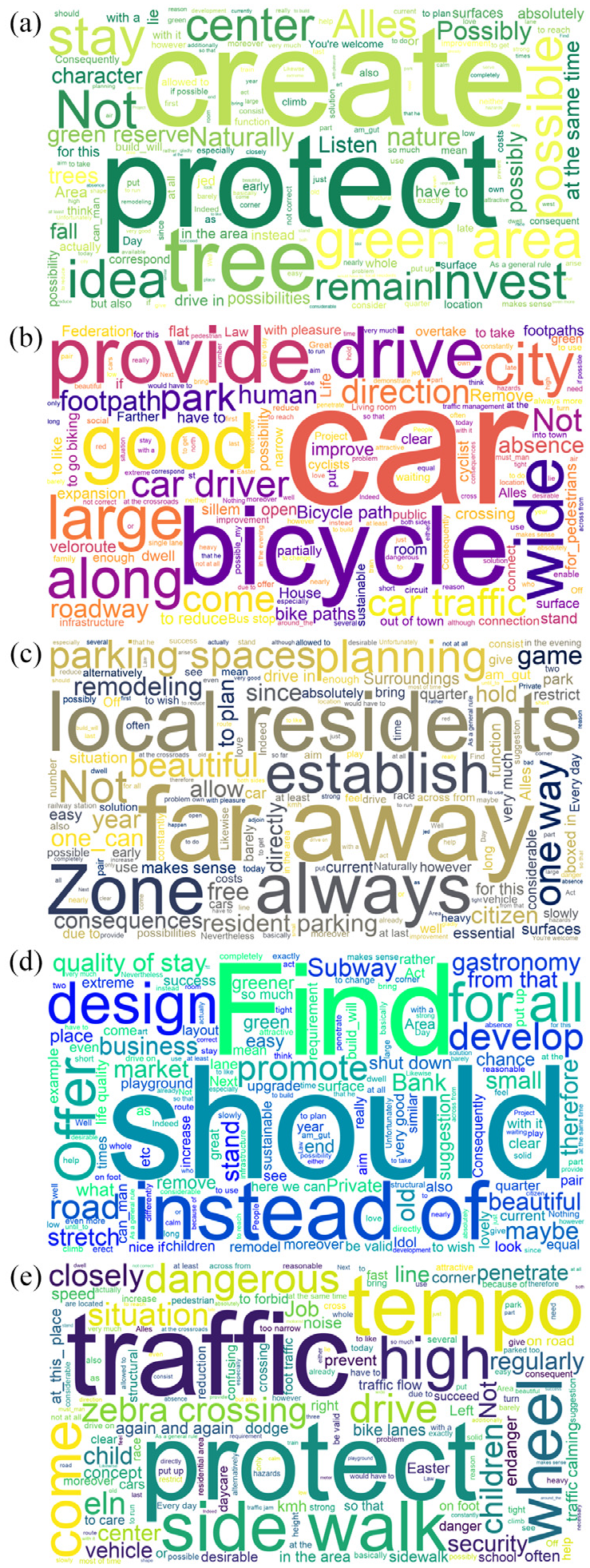
Wordclouds show the most probable words that appear in topics assigned to a single public value. (a) The public value of ecologic quality centres around the creation and protection of green spaces. (b) The public value of social equity mainly reflects the provision of better bicycle lanes for better accessibility. (c) The public value of economic opportunity is largely concerned with the provision of parking spots for local residents. (d) The public value of liveability reflects certain wishes for the built environment regarding design that should be realised. (e) The public value of health/safety indicates the wish for better protection from dangerous traffic situations.
Figure 2a illustrates the spatial distribution of public value clusters detected by the HDBSCAN and alpha shape algorithm. Note the several larger value clusters of equity, liveability and health/safety in this map. Additionally, three larger clusters of economic values can also be observed. Multiple smaller clusters of each value are distributed across the city. Intersections of overlapping clusters show areas of potential public value conflicts (Figure 2b). Through the lens of Godschalk’s prism, six types of conflict are distinguished and illustrated with the help of three regions of special interest in Hamburg (Godschalk, 2004).
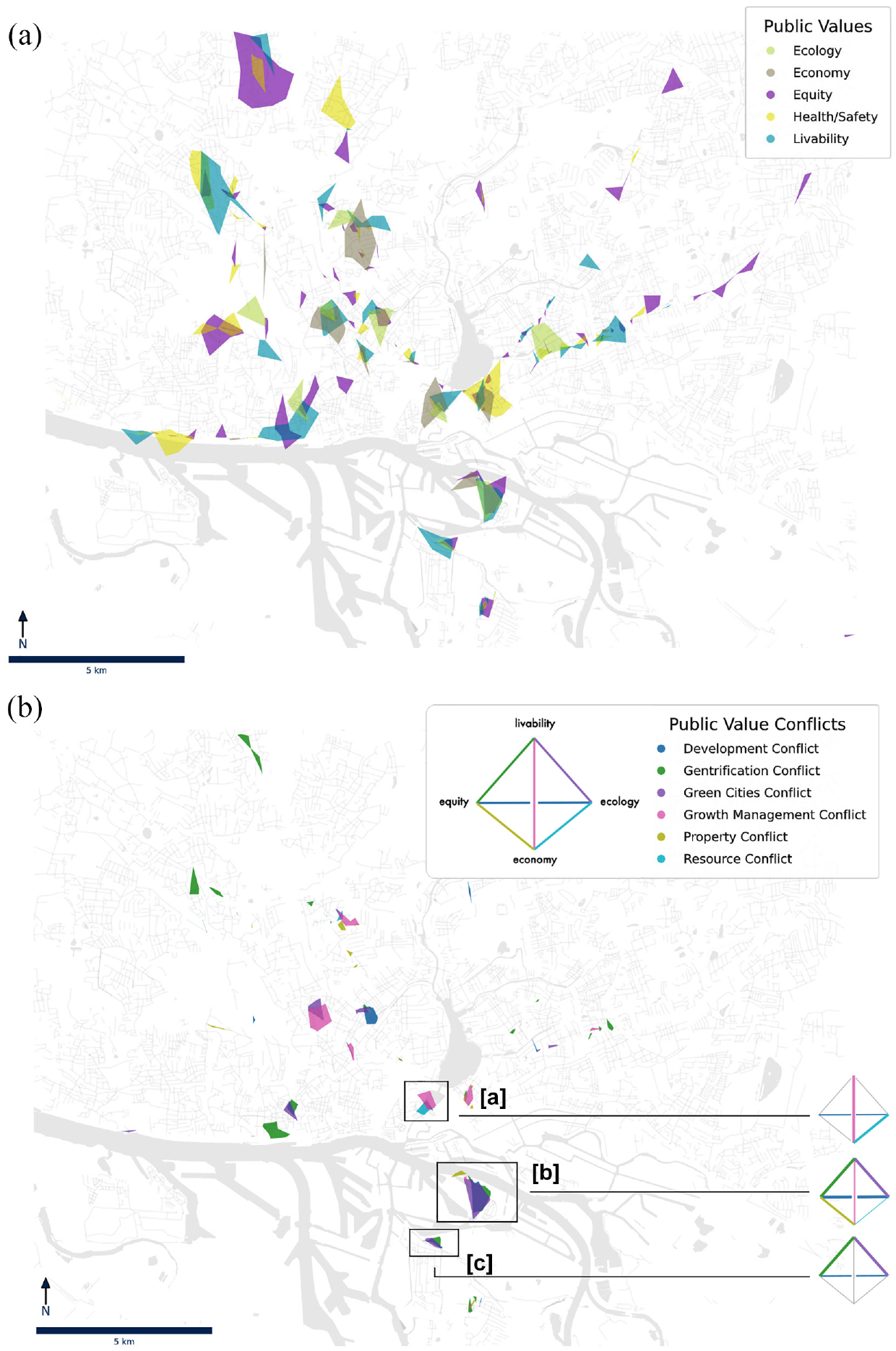
Public values and their spatial conflicts, distributed over the map of Hamburg, Germany. (a) Public values are distributed unevenly across the city, showing both larger and smaller areas of public value clusters. (b) Public value conflicts under the sustainability/liveability prism appear in multiple parts of the city. Interesting spaces for further insights were selected at the Jungfernstieg [a], the Grasbrook [b] and the Spreehafenviertel [c] sites.
One, in multiple areas a development conflict manifests. Its most common form is the dedication of street space for increased access to pedestrians and cyclists as opposed to green area protection, specifically along the Jungfernstieg (Figure 2b [a]).
Two, in the newly developed district of the Grasbrook (Figure 2b [b]) and the Spreehafenviertel (Figure 2b [c]), the gentrification conflict becomes visible in a clash between the wish for both highly liveable environments and affordability. As these neighbourhoods are about to be developed for residential living, multiple people wish for affordable government housing while other people wish for exciting architecture and other appealing places.
Three, the green cities conflict is only partially reflected in the case study of Hamburg. In the perception of most contributors liveable and green spaces go hand in hand. This becomes especially apparent around the Jungfernstieg (Figure 2b [a]): frequently, liveability values reflect a desire for more urban green instead of the built environment. However, sporadic contributions reflecting wishes for open-air cinemas, more art and more kiosks could result in a green cities conflict with contributors wishing for the restoration of nature.
Four, the growth management conflict again becomes visible around the Jungfernstieg [a] area, which was chosen as a car-free pilot project. Here, multiple people lament the decay of the inner city due to customers’ lack of accessibility by car. Simultaneously, many see a more liveable environment created through the exclusion of private cars.
Five, multiple smaller sections in Hamburg exhibit the property conflict between equity and economic values. The property conflict ‘between private interest and the public good’ (Campbell, 1996: 298) is frequently reflected in the wish for redeveloping street/parking space for cyclists and pedestrians. In that way, pedestrian and bike lanes reflect a much more social sharing of space. Private cars are considered to take up public space that could otherwise be used for the broader benefit of society.
Six, the resource conflict between economic and ecologic values manifests only in very sparse sections of the city. It is identified in similar spaces as the property conflict, since oftentimes, the wish for more parking spots contradicts the wish for the preservation or creation of green areas.
Qualitative results
When interviewed about the presence of values and value conflicts, the answers of expert planners depend on their area of expertise (see transcripts in the Online Supplemental Material). Typically, DIPAS online participation serves a supplementary function to other formal and direct procedures, such as personal encounters, public hearings and institutionalised responses from official institutions and special interest groups.
All planners mention the public value of ecologic quality which manifests in the preservation of current green areas, the wish to plant (fruit) trees, the creation of space for bees and insects and the conversion of sealed parking space to green space. The value of social equity revolves around inclusion, the creation of spaces for everyone and accessibility both as a means to enable a better access of citizens with disabilities and as a goal to increase the accessibility of other modes of transportation than the car. As interviewee (I) two put it, ‘there are many people, especially in inner-city areas, who consciously decide not to own a car and then say they would rather use the space for something else’. The value of economic opportunity was most apparent in a noise protection context: ‘There is still little that can be done about aircraft noise because the economic component is so strong. […] we can’t do anything at all’ (I4). In other instances, residential development was mentioned: ‘People say “Yes, we want this progress. We want housing and we want something to develop and happen here”’ (I3). The value of liveability has many different facets; it is an umbrella term that bundles a myriad of individual perceptions regarding the design and everyday experience of the built environment. These include the public values of sports facilities, aesthetics, cleanliness and quietness. The public value of safety is primarily related to traffic. In this specific domain, ‘Safety is always the top priority and I have to subordinate everything to it’ (I2). More specifically, ‘it’s […] about individual safety and also about the perception of safety. So it’s not always about objective safety. Rather, what plays a role is subjective safety’ (I2). In that conceptualisation of safety as the absence of fear, it is to be distinguished from the public value of health. Health is furthermore related to the public value of quietness: When talking about a noise level map of Hamburg, one planner admits: ‘If you look at the map as an overview of Hamburg, everything is red or everything is purple. There is a lot that is already a health hazard’ (I4). Lastly, multiple planners refer to people opposing action or change. One planner mentioned ‘that “everything was better in the past” comes up quite often’ (I1). Another expert, when asked for which public values citizens would like to see realised, answered: ‘I would say there are not so many things that they wanted to see realised as things that they did not want to see realised’ (I3). This value might well be titled conservatism in a sense of conserving the status quo.
Expert interviews brought forward a wide range of public value conflicts. Additional to the conflicts outlined by Godschalk (2004), we identified three more value conflicts. As an example of what we term the ‘Dangers of Nature Conflict’, a planner describes how the value of safety opposes ecological values: ‘So when I think about ecology and fruit trees and bees, they all yell for it. But if I plant fruit trees in a playground and in the summer the bees come, the parents don’t like it either’ (I1). The ‘Externality Conflict’ appears in between economic development viewpoints and the public value of health when the externalities of economic development (such as noise and/or pollution) impair the health of residents. The ‘Drawback of Beauty Conflict’ between the values of tranquillity and aesthetics manifests in ways that aesthetic spaces typically attract people, which will then lead to noise.
Integration
The results of both strands showcase that there is mainly agreement regarding the public values and conflicts that were identified. The findings of the quantitative strand were largely confirmed and valuable and contextual information from other sources of participatory data was gathered. For instance, the public value of conservatism and several public values inside the umbrella term of liveability were mentioned, and three additional conflicts were identified. As such, the conflicts identified are in high accordance with the ones found in earlier studies in similar Western European contexts (Von Der Dunk et al., 2011). However, integrating both strands allows us to look specifically into points of discrepancy. The resource conflict provides an exemplary instance: Although planners describe the conflict between nature preservation and economic development as an archetypal conflict in every new development project, the quantitative results barely reflect that. This can be explained by improper quantitative assignments via STM and the following missing spatial clusters. Holders of both values can be identified when analysing the raw data manually.
Additionally, value conflicts that open up between official municipal decisions, institutionalised actors and citizens are not identifiable in the quantitative strand. The externality conflict, for instance, was described by planners but could not be identified in the quantitative strand. It shows itself in the interest of economic stakeholders against the health interests of citizens and hence could only be identified due to the planner’s access to different kinds of participatory data.
Overall, the integration of the quantitative and qualitative strands demonstrates empirically that public values and their conflicts in urban planning are pluralistic and diverse. On a city-wide scale, multiple archetypal conflicts could be identified that go beyond the ones outlined between the dimensions of sustainability (Campbell, 1996), liveability (Godschalk, 2004) or specific to only certain urban areas (Von Der Dunk et al., 2011; Avni and Teschner, 2019). We thus identify a need for a conceptual model that is capable of capturing the pluralism of various public values and their conflicts in a specific spatio-temporal setting.
This paper proposes public value spheres as a novel conceptual model to capture public values and their conflicts in urban planning. The model is inspired by exemplary scholarly work by Jørgensen and Bozeman (2007), Van der Wal et al. (2015) and Graeber (2013) who make use of the metaphor of universes, galaxies and value spheres when conceptualising the plurality of (public) values. With such a metaphorical conception in mind, we aim to represent the pluralism and relational connections of public values. We argue that a spherical representation of public values allows for a simple expansion and display of the pluralism of public values and their conflicts across different spatial and temporal scales. Thus, the model enables researchers and practitioners to take different snapshots and arrangements of public values, which might become an important element to capture, visualise and analyse different (conflicting) public values in participatory settings and beyond. At the same time, the conceptual work of previous authors is embedded in a larger context (Campbell, 1996; Godschalk, 2004).
Two exemplary figures showcase Hamburg-specific snapshots of city-scale public values and their conflicts during the time of data gathering from 2016 to 2021. Based on the integrated findings of both research strands, we display which conflict archetypes we found in between public values in Figure 3a and how public values are interconnected and relate to each other in Figure 3b. In the former depiction, the conflicts previously outlined are mapped in between value spheres. In the latter depiction, the intersections of several public value spheres show where certain instrumental values might be connected to intrinsic values.
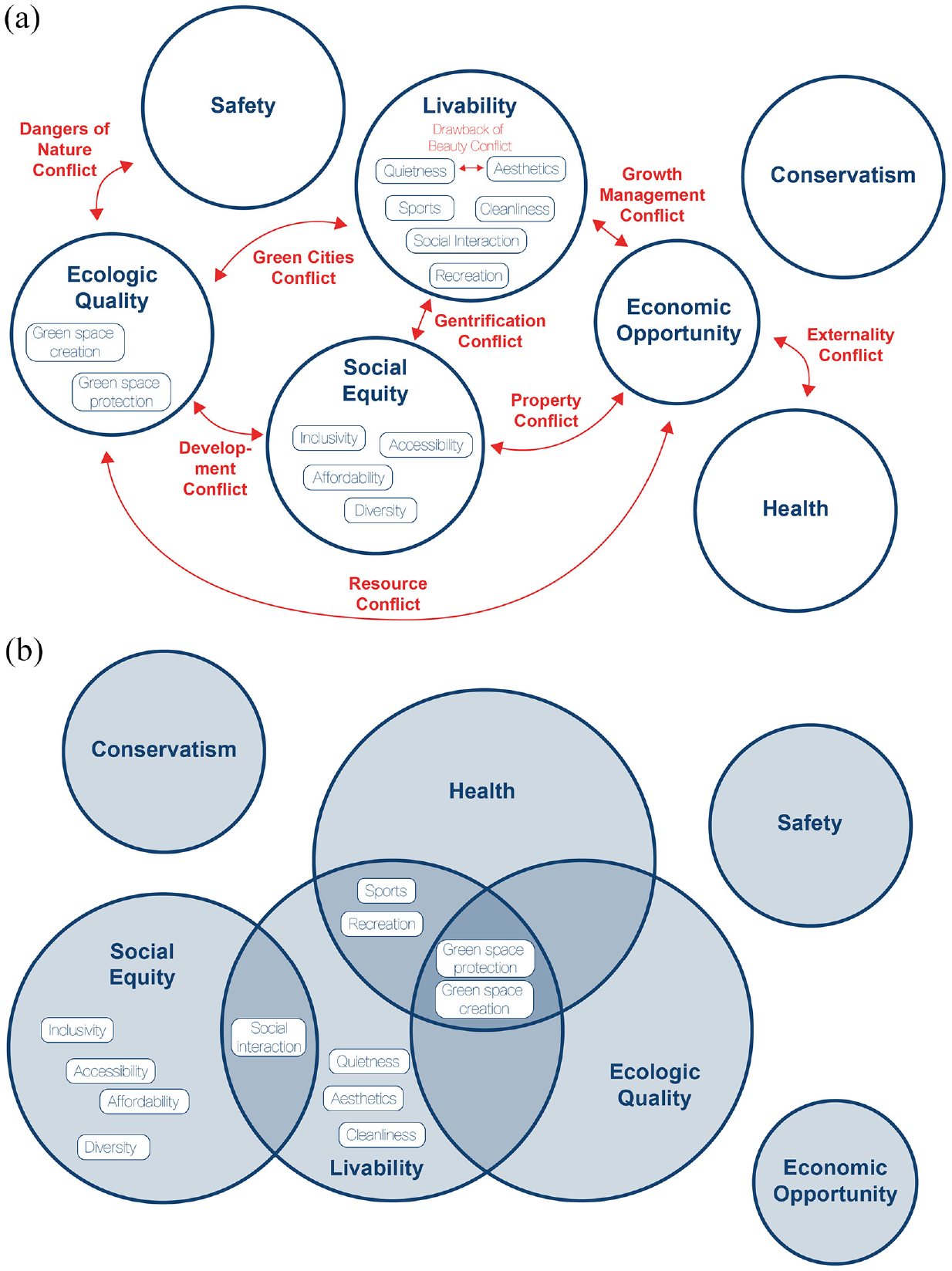
Different arrangements of public value spheres allow for a closer investigation in relational urban space. (a) Public value spheres outline different archetypal conflicts manifesting between values in urban space. (b) Public value spheres display the possible connections between instrumental and intrinsic values.
Discussion
This paper illustrates the potential of participatory data in eliciting geolocated public values and presents a new conceptual model of (conflicting) public values in urban planning based on our integrated findings. The novel case-study mixed methods approach provides an innovative and viable way to combine quantitative and qualitative work in an urban context. From a methodological point of view, connecting natural language processing with spatial clustering algorithms adds to the list of spatial analysis techniques, specifically the ones for participatory big data. Mixing methods with qualitative expert interviews succeeded in adding nuance and context, since applying quantitative methods to largely unstructured textual data cannot (yet) outperform human judgement (Chang et al., 2009). This is even more the case when inferring public values from citizen contributions, a task that is very much dependent on background information and knowledge of human nature (Bozeman, 2007). In that regard, the qualitative follow-up mitigates the shortcomings of the quantitative methodology and supplements its advantages in analysing big participatory data. From a theoretical point of view, this paper contributes by bringing together public value theory originating in public administration research with urban planning and public participation research. We propose a conceptual model capable of capturing pluralistic public values and various types of dynamic conflicts as snapshots of specific spatio-temporal settings. This model can aid in understanding how citizens value urban space and how these valuations might lead to conflicts in urban development.
Applying public value spheres
Specifically for the case study of Hamburg, this paper identifies 19 main public values and a total of nine archetypal conflicts that are mapped out in two snapshots of public value spheres that show both the present public values and their archetypal conflicts (see Figure 3).
Similar to the seminal work of Walzer (1983), the metaphor of public value spheres implies that there are no universal and static values across people, time and space. They help to better understand the plurality of values attached to urban space, their interrelations and their archetypal conflicts. Specifically for urban planning and policy, public value spheres can be a conceptual model to map out values and conflicts involved in participatory processes. Such mapping enables the connection of conflicts across space, scales and planning domains. Aiding value-driven design, the model can serve in collecting best-practice examples and archetypes to find better solutions and compromises of spatial conflicts. This may, however, involve rethinking and possibly adapting current (digital) participatory practices to also elicit the underlying public and individual values, i.e. truly understanding why people want something, not only what they want. However, as citizens might not always be equipped to articulate their underlying values, research on generative design techniques and context-mapping (Visser et al., 2005) might provide additional starting points on how to support the extraction of tacit knowledge and latent needs. Collecting such information could ultimately lead to better decision-making by facilitating the mediation process between conflicting interest groups. For citizens themselves, public value spheres provide a means to exchange viewpoints and understand how other perspectives relate to their own. They might also serve as a visual means to understand that in a deliberative planning process there will almost inevitably be conflicts between public values. For advancing scholarly work, public value spheres can provide a means to study and reveal the interconnections of several public values and possibly map them to socio-economic groups for future sociological and data-driven research.
Limitations
Generally, participatory data is subject to bias, especially when there is no random sampling of contributions (Brown et al., 2014) and people who are in vulnerable life situations are likely to be underrepresented. As DIPAS was developed with strict data privacy concerns in mind, neither planners nor platform providers know who contributes to the various processes, thus trading off a possible mobilisation of special interest groups against a low-threshold design considering data privacy (Lieven, 2017). Although we infer no normative statements from the public values identified, we are aware that our findings focus on those public values and conflicts that are collected within DIPAS and identified by expert planners. In the interviews, planners addressed these limitations while pointing out the advantages of such an approach. In their assessment, people who do not speak up in town hall meetings due to power asymmetries in the setting supposedly told them that the online platform gives them a voice to raise their concerns, lowering the threshold of participation. For some others, the digital aspect may increase the divide between those who can and cannot participate. These findings are in line with the digital participatory platform study by Kleinhans et al. (2022).
Additionally, another inherent content bias of the input data is likely: As multiple participation projects were posed with project-specific questions to the citizenry, the topics and public values in the contributions might also reflect these initial conditions. Although the design of DIPAS allows the formulation of generic contributions to any topic by anyone, the data itself largely reflects the topics that planners deem relevant. They initiate participation processes, determine the contribution categories and types and frame the context. It is thus important to note that such data is neither neutral nor objective.
From a methodological perspective, the approaches used to identify public values and their spatial conflicts are both situated in and connected to a complex social and material environment. The quantitative methods, aiming to elicit structure from unstructured data, tend to favour recurring patterns over singular perspectives. STM, aiming to generate text that is statistically similar to the most likely words in the contributions, largely results in topics where contributions have a similar vocabulary. HDBSCAN identifies areas with frequent occurrences, so that areas of sparse and singular data points are neglected in the clusters, potentially containing relevant contributions of public values. Later, multiple implicit and explicit assumptions are made when inferring public values from textual contributions, both in the process of manual value assignment, as well as in the process of facilitating expert interviews. The qualitative results shine light on the hermeneutic power that planners possess when analysing participatory data.
Thus, the conceptual model of public values spheres – as any model – only partially captures reality, possibly neglecting the links and hierarchies between values, their (intrapersonal) co-occurrence and other possible classification schemes. If used in either public participation processes or in future scientific inquiries, it is paramount to carefully reflect upon the underlying data and methods used to identify public values and their conflicts in space.
As the results are embedded in the overarching case study of Hamburg, the geographical and historical context of the city must be acknowledged. As such, for example, the gentrification conflict between ‘liveability’ and ‘affordability’ found in certain areas might only emerge due to the current cultural and economic conditions, such as neoliberal free-market policies in real-estate. Since the proposed conceptual model of public value spheres is explicitly designed to be open to expansion and/or rearrangement, future case studies in differing contexts might help with drawing a more holistic picture by providing additional ‘snapshots’ of (conflicting) public values in other spatiotemporal settings.
Future research
Building on the previous discussion, three main starting points for future research can be explored. First, additional case studies in other social and cultural contexts, especially ones in the Global South, would add crucial perspectives on public value spheres. Enlarging this public value network with additional values and archetypal conflicts will ultimately lead to a more comprehensive understanding of the complex interactions of public values and urban space and into how decision makers could possibly mitigate or resolve such conflicts. Comparing spatial characteristics of conflicts, best practices and archetypes to address various conflicts can be systematically studied to aid value-driven design. Studying such phenomena through the lens of a material semiotic approach could reveal connections of values to certain material and social contexts. Second, investigating the differentiation between individual and public values and the sources of conflict in between these values would help explain multiple urban social phenomena and could provide starting points for more effective public participation processes (Thoneick, 2021). Third, research into participatory processes and generative design techniques could aid in improving current PPGIS platforms to not only investigate what citizens want, but also their underlying values. In this context, drawing from a participatory process that includes other tools tailored towards diverse needs of a society could ensure that more minority voices are heard. Such future research would also critically evaluate our suggestion of public value spheres and its implications for urban planning and participatory settings.
Conclusion
Understanding public values and especially their inherent conflicts is crucial to achieve the UN’s Sustainable Development Goal 11 of more inclusive and sustainable cities. Only once such conflicts are identified, can they be effectively addressed, mitigated and potentially resolved. By viewing such conflicts through the lens of public values spheres, the present case study of Hamburg showcases a new approach to both identify and conceptualise public values in urban space. Attempts to truly understand the citizenry should start at identifying their norms and values: the principles on which the development of their city should be based. Emerging technology and multidisciplinary approaches now enable an integration of pluralistic values obtained from a large-scale sample of citizens for inclusive and sustainable planning of urban space.
Supplemental Material
sj-docx-1-usj-10.1177_00420980231207475 – Supplemental material for Cities for citizens! Public value spheres for understanding conflicts in urban planning
Supplemental material, sj-docx-1-usj-10.1177_00420980231207475 for Cities for citizens! Public value spheres for understanding conflicts in urban planning by Rico H Herzog, Juliana E Gonçalves, Geertje Slingerland, Reinout Kleinhans, Holger Prang, Frances Brazier and Trivik Verma in Urban Studies
Footnotes
Acknowledgements
We would like to thank the Stadtwerkstatt Hamburg, especially Mateusz Lendzinski, for the data provision of multiple DIPAS participation processes and for establishing the contacts to the expert planners to conduct the workshops.
Declaration of conflicting interests
The author(s) declared no potential conflicts of interest with respect to the research, authorship, and/or publication of this article.
Funding
The author(s) received no financial support for the research, authorship, and/or publication of this article.
ORCID iDs

Supplemental material
Supplemental material for this article is available online.
References
Supplementary Material
Please find the following supplemental material available below.
For Open Access articles published under a Creative Commons License, all supplemental material carries the same license as the article it is associated with.
For non-Open Access articles published, all supplemental material carries a non-exclusive license, and permission requests for re-use of supplemental material or any part of supplemental material shall be sent directly to the copyright owner as specified in the copyright notice associated with the article.
