




Abstract
This paper critically examines why urban studies should be interested in the emergence of controlled environment agriculture. Over the last decade, there has been significant commercial and urban policy interest in controlled environment agriculture systems for producing food in enclosed environments. Furthermore, there has been a significant expansion in research publications on urban controlled environment agriculture, stressing the novel character of these systems and the complex relationships with the conventional concerns of urban agriculture. The paper subjects these claims to critical scrutiny and then reconceptualises urban controlled environment agriculture as an emergent urban infrastructure of artificial, highly productive microclimates and ecosystems for non-human life designed to increase the productive use of ‘surplus or under-utilised’ urban spaces. We argue that controlled environment agriculture tries to secure food production through three spatial–temporal fixes: (1) the enclosure move – holding food closer by substituting the increasingly hostile outdoors for the controlled indoors in order to optimise yield, quality, efficiency and the ‘cleanness’ of the food; (2) the urban move – holding food closer to the city by substituting rural agricultural space for urban space to shorten supply chains and thereby help secure food production and improve its green credentials; and (3) combining 1 and 2, the urban interiorisation move – holding food yet closer still by moving food production into city buildings and intricate infrastructural systems, increasing control by securing total environments. In these ways, the paper shows how urban controlled environment agriculture selectively extends existing logics of urban and rural agriculture and identifies the future research challenges for urban studies.
Introduction
Controlled environment agriculture (CEA) utilises digital technologies and artificial environments to produce enclosed indoor farms that seek to transcend the climatic, seasonal and territorial constraints of the city (Bidaud, 2019). Paris-based company Agricool produces strawberries, lettuce and herbs all year round in 30 m2 container production units called ‘cooltainers’ that integrate: LED lighting focused on the part of the spectrum that is most useful for the plants; a water efficient soilless aeroponic system using a nutrient-intensive mist targeted at each plant; pollination via digitally controlled bumblebees and an internal cooling system. When Agricool expanded to Dubai, following further venture capital investment, the company adapted the cooltainer to very different local climate conditions. Due to Dubai’s extreme daytime temperatures, they ‘played on the climate’ by reversing day and night – during the day the air is cooled, and LEDs shut down, while at night when it is slightly cooler outside the LEDs are switched on and the container is in full operation (Acquaviva, 2019).
Over the last decade there has been a rapid expansion in both research and societal interest in the application of controlled environment agriculture systems in an urban context. Numerous new start-up companies have entered the market and existing agri-tech businesses have started to offer urban CEA systems. Recent reviews have revealed hundreds of new research papers (see Al-Kodmany, 2018; Benke and Tomkins, 2017; Gómez et al., 2019; McCartney and Lefsrud, 2018; Shamshiri et al., 2018 for reviews) and an explosion in coverage of urban CEA through sector websites, market assessments, commercial expos and specialist reports. Research interest in urban CEA has been heavily concentrated within agricultural and biological science, environmental science and engineering, which focus intently on the indoor setting, not the detailed spatial, social or even climatic context of CEA. Conversely, urban studies have had little to say about the CEA in its midst. This is surprising given a considerable amount of urban studies research on other types of urban agriculture, which has expanded rapidly since 2013 (see the review in Pinheiro and Govind, 2020). The most recent systematic reviews of urban agriculture by urban studies scholars do not engage with urban CEA at all (see Darly and McClintock, 2017; Horst et al., 2017; Tornaghi, 2014). In some ways this is not actually surprising given that CEA is generally hidden from view in private enclosures in the city.
This paper seeks to address this disconnection. In particular, it examines why urban research – particularly that with an interest in agriculture and food, as well as infrastructures and technologies – should seek to engage critically with the claims being made about the originality and transformative potential of urban CEA. Our starting point is the identification of two key claims of urban CEA that require further scrutiny.
The first is the novelty of CEA systems and their application in urban contexts. The new technologies of CEA are represented as an ‘innovative urban agriculture’ (Armanda et al., 2019: 13) that could lead to a ‘paradigm shift’ in urban farming and food production (Al-Kodmany, 2018: 1) which can ‘solve several global problems’ (Despommier, 2011: 234). These assessments stress the potential of technically mediated and enclosed food production, its ability to transcend the climate and environmental constraints of any urban context and to dramatically increase crop yields. CEA developers have been optimising indoor farming by calibrating, tuning and expanding a ‘wide-range of variables’ including light, temperature, atmospheres, water and air humidity (Al-Kodmany, 2018: 6). Critically this takes place within enclosures that provide ‘protection from all exterior elements’ including weather, pollution, pests and pathogens (McCartney and Lefsrud, 2018: 455). Furthermore, ‘agro-architectural researchers’ have spawned many new spatial design concepts to integrate the indoor growing of plants into the urban landscape – including vertical farming, growth cabins, smart food capsules, zero-soil farming, etc. (O’Sullivan et al., 2019: 137). Key to these developments is the ‘merging’ of food production and consumption in ‘one place’ (Al-Kodmany, 2018: 1). Urban CEA, it is claimed, can address a range of issues including increasing resource efficiency, helping meet demand for locally grown produce, enabling all year production (bypassing seasonality) and producing food in virtually any urban environment (see review in Gómez et al., 2019).
The second claim focuses on the novelty of new entrants involved in testing, developing and commercialising urban CEA in contrast to the conventional providers of urban agriculture. Key to this are the activities of existing agribusinesses seeking to identify new urban contexts for their systems and the activities of new entrants developing agri-tech in the urban food sector (Data Bridge Market Research, 2021). Large agribusiness companies have been making significant investments in sophisticated indoor CEA systems in cities across Asia, the United States, Europe and the Middle East (O’Sullivan et al., 2019: 133). New entrants focused on vertical farming are ‘proliferating’ in the United States, and cities such as New York, Chicago and Milwaukee are ‘becoming pioneers’ (Al-Kodmany, 2018: 15–16). From 2015 to 2017 the number of urban warehouse agricultural operations in the United States grew from 15 to 56 (Newbean Capital, 2017). In Asia, there are over 500 plant factories and three operating commercial container-style farms, with others in the process of commercialising (Newbean Capital, 2017). Several countries with widely varying climates, such as South Korea, China, Italy, Netherlands, Jordan, Saudi Arabia and Canada, amongst others, are developing various forms of vertical farming projects (Besthorn, 2013). The new landscape of CEA does appear to be quite different from the outdoor growers and not-for-profit users that make up the diverse arena of existing forms of urban agriculture.
In order to address the gap between the transformative claims being made for urban CEA and the lack of scrutiny within urban studies, this paper has three objectives: (i) to explore whether and how CEA is a novel urban technology; (ii) to examine the key relations between CEA and urban agriculture; and (iii) to propose a framework for conceptualising CEA as an urban food infrastructure that enables three spatial–temporal fixes for food production. The paper addresses these in the following steps. First, we examine the genealogy of CEA technologies and applications in multiple domains and explore the resonances and dissonances between CEA and the conventional concerns of urban agriculture (UA). Second, we draw on infrastructure studies to explore CEA’s complex interweaving with urban contexts and processes. We argue that CEA can be usefully understood as an emergent urban infrastructure of artificial, highly productive microclimates and ecosystems for non-human life designed to increase the productive use of ‘surplus or under-utilised’ urban spaces. Third, we illustrate the multiple emerging infrastructural spaces in which urban CEA is being applied, demonstrating their diverse and contingent socio-material pathways. Finally, we summarise the contribution of the paper and set out five future research priorities of interest to urban studies.
Genealogy of CEA and interactions with urban agriculture
The key assertions made about the novelty of CEA focus on two characteristics. The first is that CEA itself is a novel urban technology. And the second stresses novelty of the new entrants becoming involved in ‘innovative’ modes of urban agriculture. Here we subject these two claims to critical scrutiny to understand what is analytically and empirically distinctive about the application of CEA in urban contexts.
CEA in agriculture and extreme environments
Contemporary urban CEA systems build on a long history of techniques developed to overcome specific climatic and environmental limits to local habitats. These approaches seek to modernise agriculture through strategies configuring productive ‘artificial’ protected environments in hostile outdoor contexts. There is clearly a need to subject the claims of novelty to more scrutiny to develop a more nuanced understanding of the history of urban CEA. Key to this is unpacking the purposes of CEA within its various research and horticultural contexts – see Table 1 – and understanding the creation of protected environments to enhance the security, efficiency and effectiveness of food production.
The spatial typology of CEA.
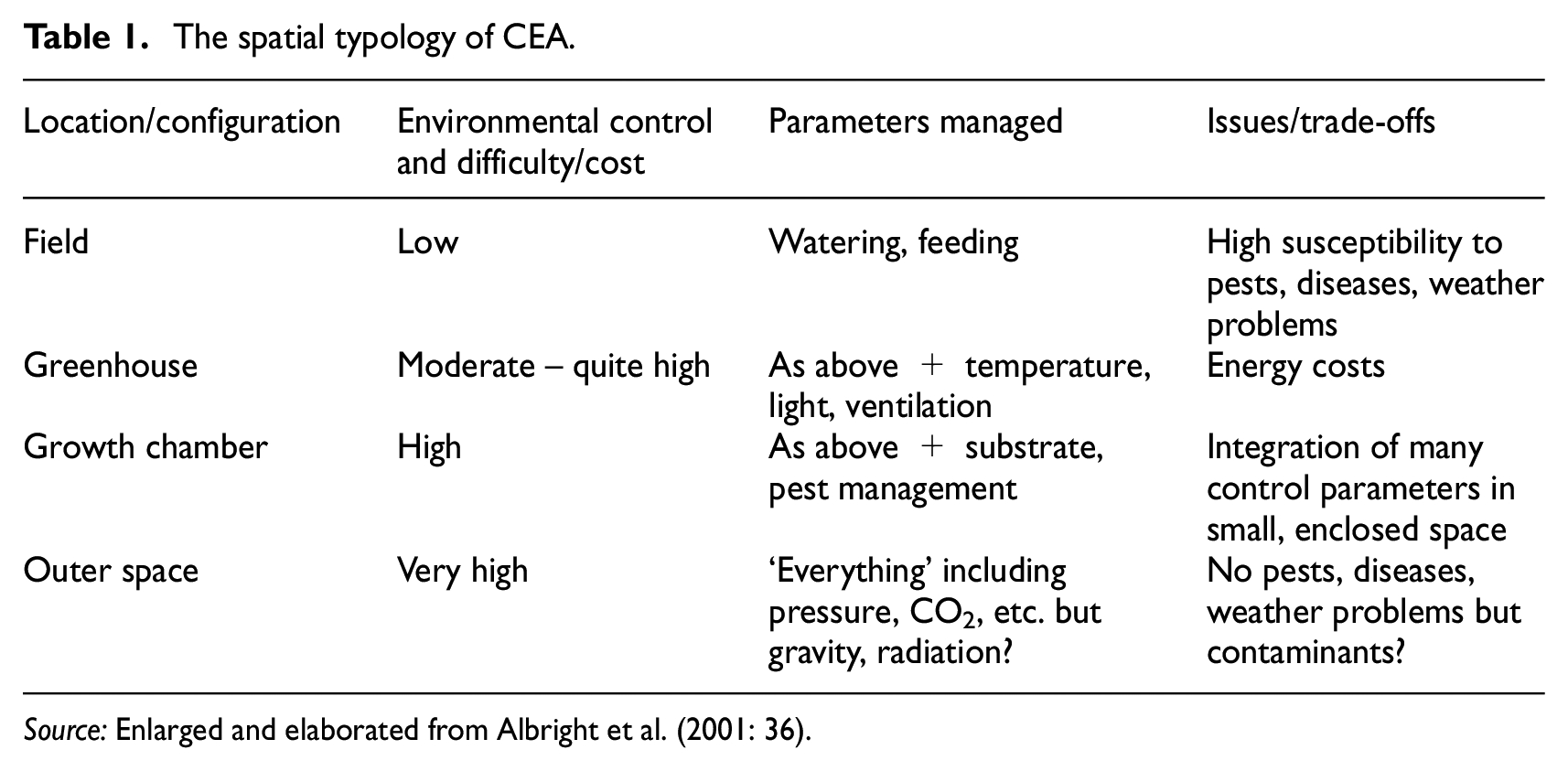
Source: Enlarged and elaborated from Albright et al. (2001: 36).
Agricultural food production has focused on making productive use of local environments to produce a variety of crops. Indeed, traditional farmers have long exerted a degree of control over shaping the immediate microclimates to enhance security and productivity (Wilken, 1972). More complex forms of greenhouse, glasshouse, hotbed, cold frame, tunnels, etc. – known as ‘protected culture’– were used in Europe and the United States from the 19th century onwards for vegetable ‘forcing’ or for protecting exotic fruits (Grant, 2013; Walters et al., 2020). Hydroponic production techniques – growing plants in nutrient solutions without the use of soil as a substrate – date back as far as the 1920s. The US military were even using hydroponics to produce food on the Pacific Islands during WWII (Dalrymple, 1973: 31–32; Jensen and Collins, 1985; Walters et al., 2020). Although current trends are putting CEA in the spotlight, it also clear that indoor agriculture is not a novel technique. Both the United States and Japan have worked on artificially lit, fully controlled, year round vegetable factories since the 1970s (McCartney and Lefsrud, 2018).
The concept of CEA defined as ‘the modification of the natural environment to achieve optimum plant growth’ producing yields greater than open field agriculture can be traced back to the 1960s (Jensen, 2002: 19). This was part of a wider search for ‘an intensive approach for controlling plant growth and development by capitalising on advanced horticultural techniques and innovations in technology’ (Gómez et al., 2019: 1448). For instance, the University of Arizona’s Environmental Research Laboratory studied ways of improving crop yields in desert areas without using vast quantities of water: ‘This required the development of innovative and cost-efficient construction techniques and simplified systems to control temperature and other environmental variables’ (Mahler et al., 1974: 379; also, Hodges et al., 1968). An ensuing project in Abu Dhabi in the early 1970s provided the infrastructure for large-scale vegetable production (Mahler et al., 1974: 379–380). Moreover, a 1973 US Department of Agriculture review of global CEA and greenhouse emergence argued that ‘environmental control via greenhouses will be increasingly important in agriculture’ (Dalrymple, 1973, iii). At this time, CEA techniques included artificial cooling, CO2 enrichment, artificial soils and automated irrigation, where, it was argued, the ‘most advanced facilities can significantly improve on nature’ (Dalrymple, 1973: ix).
Yet the development of CEA was not only undertaken in existing agricultural zones. Researchers studied the differential deployment of CEA in desert, polar, tropical and temperate regions, recognising that CEA techniques vary according to location and contextual requirements (Jensen, 2002; McCartney and Lefsrud, 2018). Coining the notion of ‘pop-up agriculture’ for adaptable and flexible enclosed systems aimed at such locations, it was argued that ‘the ultimate challenge for any crop production system is to be able to operate and help sustain human life in remote and extreme locations, including the polar regions on Earth, and in space’ (Gwynn-Jones et al., 2018: 35). This focus expands geographical and temporal (seasonal) frontiers for crop growing ‘where otherwise they could not survive’, contributing thereby to ‘stabilising the market’ by increasing dependability and availability of produce (Wittwer and Castilla, 1995: 6, 15). Comprehensive technical reviews of greenhouse structures and microclimate technological configurations have been carried out across climatic regions to analyse the different parameters that need to be considered in greenhouse design in extreme environments (e.g. Choab et al., 2019; Ghani et al., 2019).
Because of these challenging conditions, there has been a great deal of reciprocal life support system experimentation between polar regions and extra-terrestrial space exploration. For instance, CEA projects for food production have been developed in the Canadian Arctic and Antarctica (Bamsey et al., 2009; Giroux et al., 2006; McCartney and Lefsrud, 2018: 463–464). Building on these experiments, NASA and other space agencies have sponsored research on food production in space for missions and prospective colonisation projects at Arizona’s Controlled Environment Agriculture Centre (CEAC) (Albright et al., 2001; Giroux et al., 2006).
Vertical farm research in urban areas has indeed pointed out the importance of these prior experiments for inspiration. Dickson Despommier, Professor of Environmental Science at Columbia University, did much of the groundwork in developing vertical urban farming by building on space science: ‘For methods of indoor agriculture, he referred to technology pioneered by NASA and to the work … decades ago on how to grow crops in non-Earth environments’ (Frazier, 2017). Indeed, these techniques are used at both the US South Pole station (University of Arizona, n.d.) and on the International Space Station (Spaceflight101 – International Space Station, n.d.).
This necessarily brief review of the genealogy of CEA illuminates three key features of the technology’s development prior to its transmutation into an urban context:
CEA is not a novel technology but has a prior history developed in multiple contexts, laboratories, outdoor agriculture and extreme environments.
CEA is designed to transcend the climatic limits of existing environments by producing a technically optimised protected and productive interior.
CEA enables agriculture to move between contexts, raising the challenge of negotiating the contextual specificities and contingencies of different sites of application.
These features help to make sense of CEA’s recent move into the city. We turn now to consider how this transmutation of CEA from multiple contexts into the city interacts with the existing landscape of Urban Agriculture.
CEA’s relation to urban agriculture
Urban agriculture (UA) has been part of cities since the latter first emerged amid farmland. The practice of ‘urban agriculture’ is thus an ancient rather than new phenomenon. What is newer is the recent concept and embrace of UA in many parts of the Western world. Although domestic food production practices have been continuous in many cities, tucked away in backyards and forgotten pockets (Moore, 2006), it is only since approximately the 1990s that agricultural land uses have become more visible and normalised within cities, at least as far as research interest indicates. Prior to this, farming was progressively fragmented and largely removed from city environments as planners and others began ‘seeing like a city’ and tried to organise spaces and activities according to a self-conscious ‘urban’ ideal based on central business districts, suburbs and manicured green spaces for recreation (Valverde, 2011). Farming – notably husbandry of dairy cows, pigs and chickens – was out of keeping with this ideal and much (though not all) of it was pushed out via nuisance laws, land use planning regulations and loss of supporting infrastructure (Valverde, 2011). As a result, agriculture became a ‘stranger’ to urban planning, until its recent resurgence (Morgan, 2015).
Today, UA refers to a heterogenous array of food production practices within urban environments, from backyard veggie patches to community run gardens, school gardens, guerrilla gardening, urban orchards, underground mushroom cultivation and – increasingly – serious commercial farms. The diversity of UA, combined with the multiple objectives motivating many single initiatives, means that urban agriculture is often described as ‘multifunctional’ (Poulsen et al., 2017). Besides food production, UA is pursued for community, nutritional, wellbeing, pedagogical, environmental, disaster resilience, urban greening and spatial justice reasons, among others. With the partial exception of initiatives focused on food justice, the question of how and where UA is pursued and to what end is often as central to its perceived value as the agricultural products it generates. UA frequently features in discussions of urban greening for example, as a form of vegetated space and source of the many benefits such land use is associated with, including amenity, greenhouse gas mitigation and climate change adaptation. The multiple benefits that urban agriculture can generate mean that increasingly it is even the basis of a social movement for change and new urban politics (Ghose and Pettygrove, 2014; Gray et al., 2014; McClintock et al., 2018; Morgan, 2015).
Consequently, UA is frequently associated with progressive ideals and visions of transformational change. Although individual UA initiatives do not always live up to these ideals – as a growing number of critics point out (McClintock, 2013; Reynolds, 2015) – it is in this political context that CEA is emerging. As with all UA, CEA implicitly advocates for the legitimacy of agriculture in the city. But how does it fit into the already heterogenous category that is urban agriculture? The answer is ‘not very well’. Among the many ways in which CEA contrasts with existing UA, we highlight three here that are of strategic importance.
First, CEA spatially and functionally extends the productionist, scale-oriented logic of rural agriculture (RA) (Rickards and Hinkson, 2022) into the city. In doing so, it redresses normal UA’s relative lack of production intensity with a high-tech form of production that promises to deliver at scale. In contrast, as indicated above, agricultural production is just one value of UA. Indeed, sometimes described as a social movement, UA is often celebrated not for its similarities to mainstream, professional RA, but for its differences (McClintock, 2013; Neilson and Rickards, 2017).
Second, contributing to CEA’s focus on yield, notably yield efficiency and density, is the fact that it requires significant investment in and securitisation of a site. From horizontal space to volumetric space, and from bespoke equipment to reliable supplies, CEA aims to generate complete, optimal environments. As a result, it tends to be even more capital intensive and secured than most forms of RA and many forms of urban built environment. In contrast, most other UA is relatively sparse in terms of ‘site improvements’, hyper-local in terms of its supply chains and permeable in its borders. As a result, it can be (seen as) a relatively public, transitory, mobile presence in cities, particularly in the case of guerrilla gardening, although such initiatives may be deliberately designed to be ‘temporary’ (see McCann et al., 2023). While this can be a major vulnerability for UA initiatives – which are often at the whim of real estate developers looking to secure and add value to sites – the resultant uneasy relationship between UA and the dominant built environment means that UA is often celebrated for transgressing such urban spatial norms and challenging unjust spatial enclosure (Allen and Frediani, 2013; Purcell and Tyman, 2018). CEA, in contrast, transgresses RA norms more than urban spatial ones.
Third, because UA often exists physically amid the built environment as a type of green space, either ‘holding on’ against competing land uses (as in peri-urban zones) or popping up to ‘fill’ seemingly under-utilised spaces such as car parks, road verges or abandoned house lots, it is frequently valued for adding local amenity. Although open air urban farm vegetation is not immune from the pollutants that characterise the urban environment such as heavy metals – with some urban agricultural food products consequently representing a danger not a bonus for human health (Eriksen-Hamel and Danso, 2010) – relative to concrete-based urban land uses, UA often offers welcome green foliage. In contrast, urban CEA does not adhere to the outdoor, open-air mode of normal UA and RA, instead hiding its greenery out of sight in tightly enclosed, interior spaces.
These are just three of the ways CEA transgresses not only the assumption that agriculture does not exist in cities, but, in turn, expectations around ‘normal’ urban agriculture that can be summarised as:
CEA conflicts with the progressive ideas of UA by intensifying the productionist logic of much RA.
CEA is substituting the outdoor environments of UA with enclosed, artificial built environments.
CEA is optimising those forms of enclosure with elaborate control systems for generating prolific, profitable plant growth.
As an interiorised techno-mediated agricultural environment that is intensifying as much as challenging the built environment, CEA is thus an awkward addition to UA. Because of its ill-fit with the rest of UA, CEA demands research that reaches beyond existing conversations about UA to literatures that help expose how CEA is relationally shaping and shaped by other urban politics and processes. Key to understanding CEA’s two-way relationship with the urban environment is to consider two more of its distinctive characteristics: its securitisation of food and its infrastructural qualities.
Securing food through CEA as infrastructure
Urban CEA is emerging in the context of growing concerns about the sufficiency, reliability and externalities of mainstream, commercial, rural agriculture. Two inter-related spatio-temporal vulnerabilities plague RA and everyone who relies on it: one, its dependence on, exposure to and impacts on nature, undermining its reliability and acceptability; two, its distance from external supplies, markets and infrastructure (notably Information and Communication Technology [ICT]), increasing its sensitivity to disruptions and agility to accommodate new demands. Efforts to secure the mass production of food variously tackle one or both vulnerabilities. By offering to address both at once, urban CEA is especially generating excitement. In doing so, urban CEA is not simply bolstering profitable food production, it is revealing the affordances and failures of existing infrastructural systems, and the ongoing dominance, fragility and malleability of cities.
Key to understanding the significance of CEA is how the systems themselves constitute a distinctive infrastructural capacity or ‘fix’ for the secure and precise reproduction of food. While we acknowledge the multiple lineages and uses of the notion of ‘fix’ through its development in economic geography, state restructuring and urban ecology (see Bok, 2018), our focus is to understand CEA as a combined economic, social and ecological process. As a spatial–temporal fix urban CEA involves capital investment that creates a new frontier of accumulation in urban interiors and a socio-ecological process through artificial environment creation as an infrastructure. This internalisation of a new techno-nature within a built environment mediated through infrastructural systems is, we argue, a technique for overcoming fundamental problems of both conventional rural agriculture and outdoor urban agriculture. In this sense, we use the concept of the socio-ecological fix as a response that has economic and ecological dimensions (see Ekers and Prudham, 2015). Building on these insights, Table 2 proposes an initial framework of the key features of the spatial–temporal fix of CEA to stimulate a new critical research agenda as not only urban but urban-centric, and as not only infrastructure-enabled, but inherently and paradoxically infrastructural. Below we outline the key steps in this emerging fix.
Fix 1 – The enclosure move: making food production more secure, through a process of enclosure to protect crops from local climate.
Urban food production and spatial-temporal fixes.
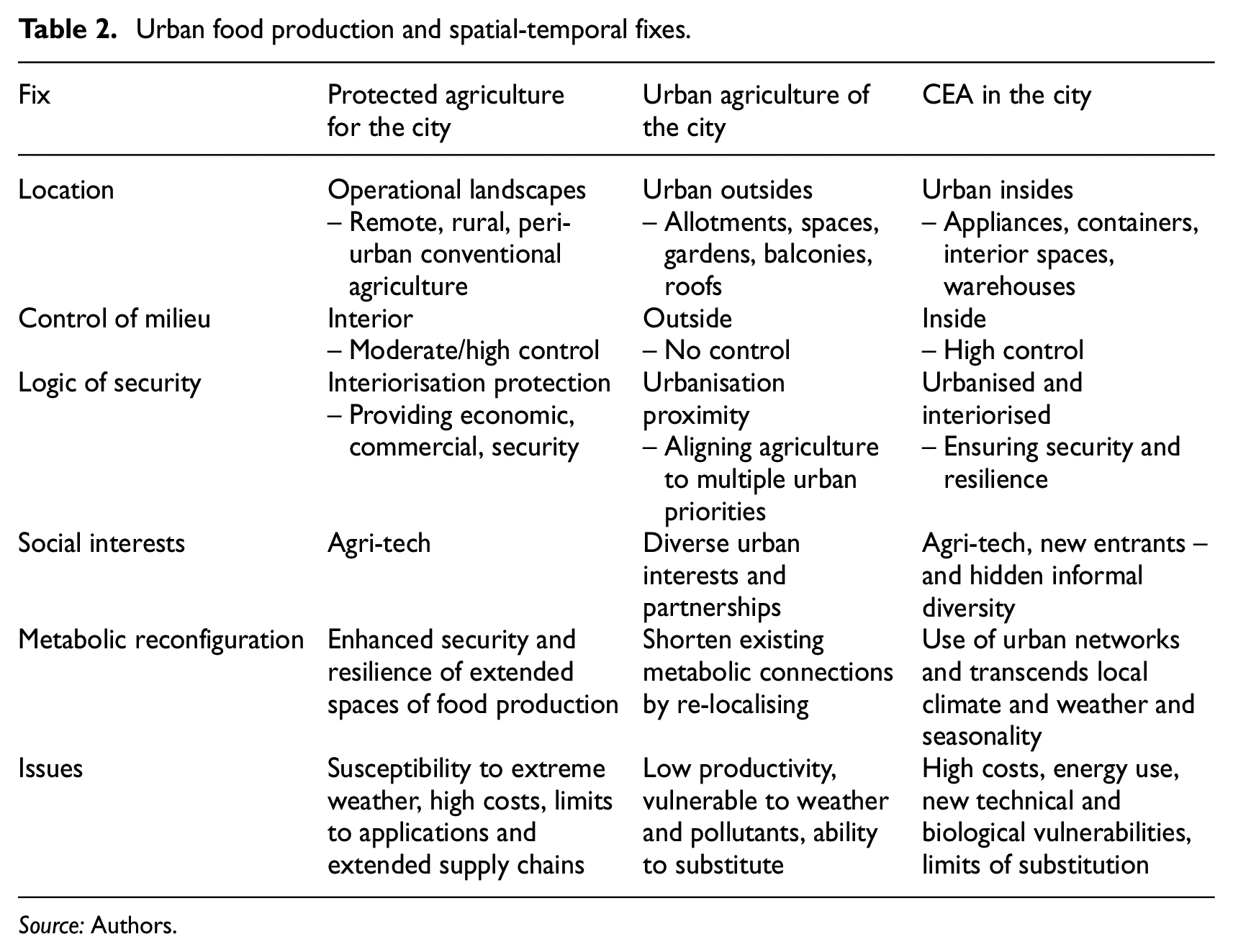
Source: Authors.
The controlling of the agriculture environment is at the heart of centuries-old efforts to modernise and professionalise farming. In RA, this includes the physical enclosure of spaces to optimise yield and quality. By inserting built structures and technologies between plants and the wider environment, an unreliable and increasingly hostile outdoor environment is replaced with a more controlled indoor space. Combined with the declining availability of arable land, the move to protected cropping and indoor farming of various sorts is accelerating, ranging from low-tech poly tunnels to medium tech partially controlled greenhouses to high tech smart glasshouses and indoor farms.
The active climate control involved in CEA not only shuts out the outdoors but enrols farms into elaborate technological systems. In this way, the ambient conditions are shaped by an integrated techno-mediated array of inputs to manipulate and augment the capacity of plants as biological non-human entities. Motivated by the desire to produce food of greater quality (improved taste, colour, nutrition), more quickly and independent of season (multiple harvests a year) and more productively (high volumes of especially high-value low-volume crops), CEA is part of move to ‘Agriculture 4.0’ in which farming becomes ‘smarter’ thanks to the use of sensors, cloud-based IoT, AI, big data analytics, drones and robots, among other things (e.g. see Araújo et al., 2021; Iaksch et al., 2021; Kamilaris et al., 2017; Rose et al., 2021; Wolfert et al., 2017).
It is here that the infrastructural quality of CEA begins to become apparent. CEA clearly increases the agriculture sector’s reliance on networked infrastructure, extending beyond well-known linkages between agriculture and the water sector to include more intensive links with electricity and ICT infrastructure. More than that, though, by using the associated inputs (water, energy, data) to create a conditioned artificial enclosed habitat, CEA is itself infrastructural (Marvin and Rutherford, 2018). This is a specific mode of infrastructural capacity that is explicitly designed to create environments that enable the reproduction of more than human life (see Barua, 2021: 1477). In turn, by making plants more reliable, calculable, measurable and investable, the food itself is constituted as an infrastructural resource. Indeed, many CEA developers, investors and policy makers already represent CEA as a distinct mode of ‘food infrastructure’ that enhances food security through forms of technically mediated climate enclosure (see e.g. Equilibrium Capital, 2020; Metropolitan Washington Council of Governments, 2019).
The emphasis on food security intensifies the infrastructural logic of CEA. Underpinned by enduring anxiety that outdoor farms are ‘never fully insulated from their environments’ (Otter, 2014: 9), advocates argue that food infrastructure such as CEA is a vital system critical to the reproduction of life (Otter, 2014). Vital systems are a military idea that recognises that the security of modern states requires the defence of not only people and land, but also the sophisticated and distributed infrastructural systems on which they rely. As Collier and Lakoff (2015: 19) explain, ‘vital systems security operates as a form of reflexive biopolitics, managing risks that have arisen as the result of modernization’. As the term ‘systems’ indicates, vital systems extend the security focus on critical infrastructure by adopting a functional view of sectors. For food production, this means the focus is not only on the classic infrastructure components that enable it, but on the food production system, including the plants. Underpinned by humans’ own metabolic reliance on food, a vital systems lens frames food production, distribution and consumption as networked infrastructures of critical societal importance because of the food production service they provide. In this way, they ‘create conditions for economic activity, produce collective security and introduce reliability and predictability…’ (Frohlich et al., 2014: 2).
A critical vulnerability that even the infrastructuralisation of food production in rural areas does not overcome is the long distances that distribution systems need to travel, whether in delivering material inputs such as fertilizer to agriculture, or food products to market. This spatial vulnerability brings us to the second ‘fix’ that urban CEA addresses.
Fix 2 – The urban move, part A: holding food closer to the city by substituting rural agricultural space for urban space, securing food production and improving its green credentials by shortening supply chains.
Urban agriculture is usually defined as the production of food within metropolitan cores, in contrast to production in peri-urban and rural areas. UA has a long history, involves a diverse range of activities and occurs at a variety of scales and range of locations from balconies, left-over spaces to community gardens or large scale commercial urban farms (McClintock, 2013). The UN FAO reports that 800 million people globally grow food or raise animals in cities accounting for 15–20% of the world’s food production (FAO, n.d.). Over the last two decades there has been renewed attention to urban agriculture because of the social, environmental and health benefits of re-urbanising food production in urban settings (Morgan, 2015). These processes are not just about the relocalisation of food production in urban areas but also the proximity to ports, distribution systems and other critical infrastructures. Within urban agriculture and food community professional networks, policy advocates and researchers argue that metropolitan food systems can therefore be understood as an ‘essential infrastructure’ (see Clark et al., 2021).
Yet urban food policy makers have recognised that while they place increased emphasis on prioritising the growth of urban food production, there has been less emphasis on the frequently missing or inadequate infrastructural connections that link urban food producers to urban consumers. This is primarily the case because ‘Metropolitan food infrastructure… has for far too long been an invisible infrastructure of American cities and metropolitan regions’ (Clark et al., 2021: 1, emphasis added).
In response to this infrastructural gap, agricultural food agencies have increasingly conceived of the urban context as an operational landscape for urban food production. US agricultural agencies have been funding initiatives to develop urban knowledge assets and digital capacities and reinserting new infrastructure facilities, such as warehouses and cold storage, for food producers in urban systems (USDA, n.d.). An initiative in Canada specifically focused on ‘not for profits’ has sought to develop new infrastructures that address food insecurity and increase access to healthy foods in urban communities (Government of Canada, 2023). These initiatives are designed to more effectively intermediate between food production and consumption at the metropolitan level by developing social, technical and organisational capacities that can reinsert both local commercial and non-profit producers into new food circuits. This type of thinking has been given increasing attention because of the interruptions to urban food systems caused by COVID-19 that revealed the fragility, inequity and invisibility of existing urban food infrastructure leading to empty supermarkets and exacerbated food insecurity (Clark et al., 2021).
Yet a critical vulnerability that the re-localisation of food production systems in urban areas cannot address is the reliance on local climate and weather for reliable production and the risk of urban pollutants contaminating the food produced. This climatic and environmental vulnerability brings us to the third fix that urban CEA addresses.
Fix 3 – Combining 1 and 2, The urban move, part B: holding food yet closer still by moving food production into city buildings, occupying them to secure total environments, reduce dependency on old requirements such as weather and soil, and improving food security.
The third fix combines 1 and 2 – enclosure and urban production inside buildings in total climate-controlled environments displacing the need for rural and outdoor agriculture and claiming to enhance urban food security. The urban infrastructural characteristics of CEA rework the spatial–temporal fixes (and mobilities) of urban life to create new sites, environments and rhythms of food production at different scales. It is for this reason that CEA is valorised as a new form of commercial and secure UA through enclosed environments, use of digital technologies and algorithms to control production and the use of energy efficient and renewable technologies. This package of technologies when assembled as systems could enable a ‘second green revolution’ (O’Sullivan et al., 2019) that can accelerate ‘innovative urban agriculture’ to optimise food production (Armanda et al., 2019: 14). Furthermore, Petrovics and Giezen (2022) call vertical farming ‘a proposed solution’ to climate change and global population growth ‘at the urban scale’ which has significant ‘upscaling potential’ to address food security. Consequently, urban authorities have sought to provide amenable policy frameworks and incentives to attract CEA investment – despite concerns that the benefits may be overstated (see Goodman and Minner, 2019). What is important here is the way urban CEA enable two novel capacities:
Spatial – the ability to construct new technologically-mediated production environments opens possibilities for reappropriation and use of unusual, ‘abandoned’, interstitial or otherwise reconfigured spaces – rooftops, underground carparks, warehouses, sheds, containers, etc., as productive environments. Likewise, within these spaces, CEA infrastructure is mobilised to rebundle together climatic variables in a search for more efficient and optimised integrated wholes than is possible through reliance on immediate local outside climatic conditions.
Temporal – in doing so, and therefore in bypassing nature, new temporal fixes are sought and continually adjusted – limits of seasonality can be stretched or transcended to enable productive crop growth all year round. Day and night diurnal/nocturnal rhythms can be played with or reversed according to needs and costs. Plant growth can be accelerated, slowed, manipulated and managed according to market demand, and by controlling parameters of light, heat, humidity, pollination, etc. within the closed artificial environment.
In summary, CEA is an urban infrastructure that totally reconfigures the (possibilities of) local environment in spatial and temporal terms. Moreover, the strategic importance of CEA as urban food infrastructure lies in these possibilities of new spatial–temporal fixes that may fundamentally reconfigure traditionally stabilised dimensions of local environments through climate control, manipulation of temporal rhythms and their consequences. This leads to standardising and extending access to produce that otherwise would be spatially or seasonally ‘exotic’– such as strawberries in Dubai or in December in Paris. This effacing of environment/climate uncertainties also displaces the risk to the economic domain as the high level of technological mediation in CEA demands high levels of infrastructural investment. These new capacities raise important questions not only for urban infrastructural and agricultural studies but also for the discipline of urban studies more widely.
Urban research agenda
CEA is an emerging capacity of transcendence – bypassing local climate and the rural–urban divide – through generating more productive and secure interiorised technically mediated growing environments. Its distinctiveness as an infrastructure is the ability to selectively create and transfer bespoke customised climates in and between sites and locations both within and between cities. This involves the development of a capability of climate creation that can unbundle ecological inputs and then selectively rebundle components together into integrated systems, experimentation and exchange of ‘climate recipes’ and the wholesale importing and exporting of bespoke ‘climates’ in which food crops have been successfully grown. Crucially, this capacity then allows the strategic circumvention of immediate local climate constraints using a more precise optimal food production infrastructure. The future development of CEA clearly raises key issues for urban studies. We consider five of these issues below.
The first issue concerns what kind of fix CEA represents in the urban context. The question of whether this is primarily a new mode of accumulation, a new sustainability fix or a form of greenwash cannot be simply answered by this article with its focus on reviewing current trends and existing literatures. There is a need for further research to unpack the differentiated dynamics of CEA in order to understand what sort of fix it represents in differing urban contexts (e.g. McCann et al., 2023). CEA is likely to continue to develop in variegated, rather than generic, forms according to local contingencies that require further comparative in-depth research. Critically, this demands an enhanced sensitivity, not only to the commercial applications that have been covered in the literature, but also to the ways in which CEA becomes intertwined with varied and multiple social interests – prisons, schools, not for profits, etc. – in the urban context. These are often structured in configurations not always envisioned by the developers of CEA systems.
The second issue is to better understand CEA’s complex transmutation from agriculture and extreme environmental contexts into a proto-infrastructural urban capacity. Table 3 illustrates the incredible diversity of urban CEA applications – not solely commercial operations but also involving not for profits and civil society. For instance, the domestic domain is a complex and unresearched sector of CEA use. IKEA has teamed up with the Swedish University of Agricultural Sciences to produce a basic hydroponic growing system called VAXER. The aim is for ‘people to grow their own herbs and vegetables 12 months a year. Whether you live in the northern parts of Sweden in the wintertime or if you live in China or North America’ (Steffen, 2018). White goods manufacturers have created more complex systems that control every variable of the growing environment in an under-kitchen counter appliance called the Urban Cultivator –‘an all-in-one automated indoor kitchen garden that allows you to grow fresh microgreens and herbs 365 days a year’ (Urban Cultivator, n.d.). Rather than purchase off the shelf systems DIY users can find advice on the plans, materials, construction and operation of their own self-built indoor hydroponic growing systems (Hermit, 2022). These different contexts involving the domestication of CEA in home settings offer the potential to further understand the ways in which people may develop new food producing practices. Yet CEA is also becoming entangled in a set of wider debates about the urban resilience to food systems. Gotham Greens in New York City operates a hydroponic indoor farm that remained fully operational during Hurricane Sandy (Gotham Greens, 2023). Vertical indoor farms are potentially more resistant to extreme weather and other disruptions than other forms of outdoor urban agriculture. Doomsday preppers have begun to explore the potential of hydroponic systems to maintain food production after disruptive events (Levy, 2020). These examples illustrate the processes through which urban life reshapes and transmutes CEA technologies into a multiplicity of modalities as CEA engages with different social contexts, addressing specific issues and producing quite distinctive configurations.
Urban CEA’s diverse interior settings.
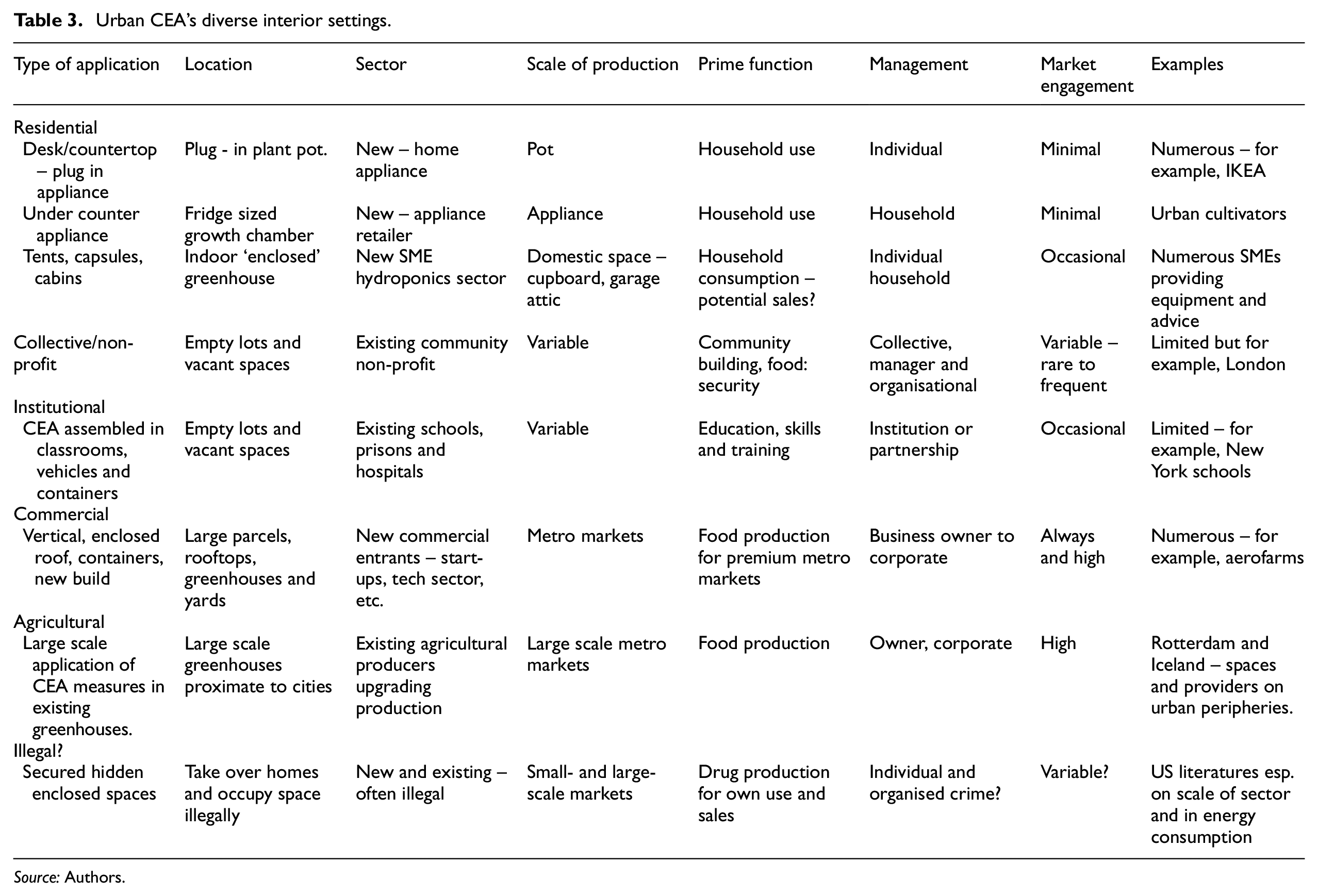
Source: Authors.
The third issue is the need to examine the circulation of CEA technologies, expertise and finance, focusing on the friction, contestations and even resistance in diverse urban contexts. Specifically, there is a need to engage in further work on the dynamics of CEA and more established urban concerns. This includes the need to understand the processes by which CEA spaces are being inserted into the urban built environment fabric and with what effects. What sorts of ‘surplus’ or created spaces are being targeted; are these temporary or permanent uses; what legal status do they have; what relations are developed with other land uses; and how do these relate to gentrification, local resistance, contestation and wider urban growth strategies? These questions raise important social justice challenges of the sort examined in relation to other forms of urban agriculture (e.g. Horst et al., 2017; Suchá and Dušková, 2022). Further work is also needed on CEA’s socio-technical characteristics – the relations between users, labour, residents and CEA systems as workplaces, neighbours or even home based applications, linking to wider infrastructure questions about people as infrastructure, glitches and hacks (e.g. Truelove and Ruszczyk, 2022). Again, critical research on other forms of urban agriculture offers a valuable starting point here (e.g. Baker et al 2022). These are a just a few of the ways in which CEA may productively link with more mainstream urban themes.
A fourth concern we need to examine is the relation between CEA and wider urban infrastructural systems. While there has been almost no work on urban CEA from an urban infrastructural perspective, research on illegal and legalised cannabis production has raised important resource consumption, waste and security issues. An analysis of the pseudo-legalisation of medical cannabis in Humboldt County, California showed how it increased substantially to constitute 25% of the economy (Meisel, 2017). Legalisation enabled funding from the industry to support local environmental organisations in promoting water savings techniques and controlling the nuisances of high noise and strong smells from indoor growers. Yet the energy costs of indoor production are extremely high – greater than any other residential or commercial building type – and a decade ago cannabis related CEA production was responsible for 9% of household electricity use in California (Mills and Zeramby, 2021). Further liberalisation is expected to generate significant growth in energy demand. In the United Kingdom context, the police have reported that a ‘significant proportion’ of organised crime groups (OCGs) are ‘now engaged in commercial production’ of indoor CEA cannabis production. Commercial cultivation of cannabis is defined as 25 or more plants and evidence of a cannabis farm – a premises adapted for hydroponics systems, high intensity lighting, extraction fans, etc. Properties suffer extensive damage as growers by-pass electricity metres and illegally use the main grid to avoid arousing the suspicion of electricity companies (NPCC, 2014). Furthermore, the intertwining of digital and computational systems used intensively in commercial CEA systems also introduces new vulnerabilities. These include data theft, stealing resources, data loss, etc., that can enlarge the scope of attack and the potential of serious societal implications due to lost food production, according to the US Department of Homeland Security (Public-Private Analytic Exchange Program, 2018). Consequently, there are many different contexts where the interrelations between urban CEA and the contradictory implications for urban infrastructural demands, systems and security can be further explored.
The fifth issue concerns wider questions for the study of urban nature. The challenge is in extending the concept of urban nature to include a sensitivity to the importance of enclosed artificial and technically mediated ecologies. Although our focus is on agriculture such infrastructural capacities are also relevant to botanical gardens, zoos and other protected spaces for more than human occupation (e.g. Lockhart and Marvin, 2020). While specialist, enclosed, air-conditioned zones for humans are already an object of critical analysis, we clearly need to extend these studies to food, plants and animals (this, we argue, builds on recent work to think about the relations between infrastructure and the more than human and state sponsorship of specialist ecologies for botanical purposes). Furthermore, these are suggestive of new engagements in and around urban political ecology concerned with the technicities of ‘more-than-urban’ operational ecologies (see e.g. Tzaninis et al., 2021). There are clearly opportunities for much closer analytical engagement between work on the technicities of agriculture, nature conservation and animal conservation (e.g. Royer et al. 2023). Critical here is understanding the way that artificial ecologies further hybridise relations between the urban agriculture and conventional rural agriculture, and between ex situ and in situ natures.
In summary then, urban CEA raises many fascinating and thorny issues for urban studies as the complex interconnections, tensions and contradictions between agricultural and infrastructural domains become revealed through the relatively limited work that has already taken place. Going forward then, there is the potential to stimulate dialogue, discussion and programmes of work between the technological and the agricultural and how the interrelations between these become reconfigured in, through and beyond the urban context.
Conclusion
While much of the research literature focuses on the high profile and visible roles of commercial CEA, our critical review illustrates the wider range of contexts in which the infrastructure of CEA is emerging. This highlights how we need an enhanced sensitivity to CEA as an emerging infrastructural capacity that is developing along multiple pathways, involving different social interests and priorities that produce quite distinctive socio-technical configurations of CEA. Our focus on the antecedents and the current landscape of urban agriculture highlights the critical issues at hand as increasingly precise technological mediation of the growing environment is now being put to work in the urban context.
Indeed, we argue that by reconceptualising CEA as urban food infrastructure we can begin to unpack the specificity of CEA in urban contexts compared to existing UA and previous forms of enclosed agriculture. This specificity lies in understanding how climate control within volumetric enclosure is increasingly crucial to food/crop production and the reproduction of urban life. This infrastructure reworks spatial and temporal configurations of agricultural production. It transforms disused and interstitial spaces in the city into new productive sites that can be incorporated into bioeconomic circuits of potential value. It extends periods of plant/crop growth across different timescales by bypassing reliance on immediate local environmental conditions. The possibility of 24-hour, all year-round crop growth in urban spaces without direct access to sunlight, water, heat, etc. constitutes an overcoming of geographical and climatic parameters whereby some of the final barriers and constraints of ‘nature’ no longer differentiate the ultimate productive possibilities of places.
What is significant here is the claim that techno-mediated artificial growth environments can be created from scratch, able to overcome the climatic limitations of their contexts of application, and are then potentially mobile and transferable (in containers or chambers). It is in this emerging logic and capacity of transcendence – bypassing nature and the rural–urban divide with more productive and secure interiorised growing environments – that its urban significance lies, as we begin to see an ability to selectively create and transfer bespoke customised climates in and between sites and locations.
Analysing the dynamics and implications of CEA clearly requires urban studies researchers to engage more critically with the technocratic claims being made about the transformational potential of CEA. Furthermore, this will require new collaborations to be built between agricultural and food studies, science and technology studies and urban studies to develop a more critical analysis of the ways in which the city and CEA are becoming intertwined and mutually reconfigured in the processes and politics of CEA’s urbanisation.
Footnotes
Acknowledgements
The authors would like to acknowledge the helpful and constructive comments from two referees.
Declaration of conflicting interests
The author(s) declared no potential conflicts of interest with respect to the research, authorship, and/or publication of this article.
Funding
The author(s) received no financial support for the research, authorship, and/or publication of this article.
