




Abstract
This paper engages in critical debate with urban informality in interstitial urban spaces through the lens of micro-scalar spatial practices motivated by everyday needs and desires. The aim is to examine the generative potential of small-scale reappropriations to change the functions, meanings and governing policies of undervalued urban spaces. An empirical focus is taken on residential alleys in inner-city neighbourhoods of Melbourne, Australia. Remnants of 19th-century sanitation and drainage infrastructure, these alleys are now underdetermined spaces of manifold functions and meanings. Drawing from extensive fieldwork documentation and interviews, this study maps and interrogates the interplay of formal and informal spatial practices. Formal practices, driven by assertion of authority rather than vision for public space, operate like Bourdieu’s habitus. Informal practices, driven by everyday needs and desires, have a teleoaffective dimension that can modify the social field in which these dispositions are formed and thereby alter habitus.
Introduction
This paper addresses two important aspects of urban space that are not often explicitly linked – informal spatial practices and urban interstices – taking an empirically grounded approach to explore their socio-material interactions. The precise aim of this paper is to examine the generative potential of micro-scalar informal reappropriations to change the functions and meanings of undervalued urban spaces and the policies that govern them. In addressing these aims, the paper revisits Bourdieu’s habitus, but leans on Schatzki’s teleoaffective structure of practice to illustrate how practically oriented desires could change habitus. Using the case of residential alleys in Melbourne, Australia, this study examines informality as the site-specific spatialisation of everyday needs and desires. The paper responds to recent arguments to understand informality in practice rather than principle through analysis of the spatiality of its social relations (Marx and Kelling, 2019), and the need to reconcile its everyday meanings with structural processes (Cirolia and Scheba, 2019).
Informal reappropriations: Habitus and desires in interstitial spaces
In the context of scholarship on urban informality, this paper is primarily concerned with informal spatial practices in the Global North, where informality operates as a balancing concept to either legitimise or subvert formality while also carrying multiple meanings. Lara-Hernandez et al. (2020) illustrate the difference between informality as deliberate resistance against the neoliberal city, as everyday placemaking, and as practices that fall outside of legal and economic structures. Marx and Kelling (2019) similarly illustrate different ways of experiencing informality: as laws (legislature and property rights), as a condition (descriptive qualifier based on some criteria) and as socio-political currency (socio-spatial knowledge production). Informal spatial practices through which people address needs that local governments would not, or could not, address could be a productive response to shortcomings of state planning, but these practices could also tailor a city to the needs and wants of certain groups (Douglas, 2014; Finn, 2014; Iveson, 2013). Devlin (2018) draws attention to the difference between ‘informality of desire’ and ‘informality of need’, in other words informality as well-off residents’ frustration with state planning or as actions by the disadvantaged to meet basic needs. Differentiating needs from desires based on one variable alone, such as social class, is problematic as it excludes other differences relating to age, health, disability, gender, and race, as well as other factors. Desires are not necessarily arbitrary or frivolous but, as argued by Purcell (2022), they may be an underlying component of radical democracy to motivate people to ‘manage their affairs themselves’. However, desires could be not only affirmative but also destructive. Unlike Purcell’s (2022) argument for democracy as the process by which people negotiate their different desires without state policies, this paper will examine how informal spatial practices could inform policies that respond to people’s desires.
On the level of an individual’s involvement, urban spatial informality is simply an appropriation of space, not as a one-time action, but rather as an assertion of meaning and usefulness over time, thus necessitating re-appropriation (Proshansky, 1976). If reappropriation is then action over time, informality is a process rather than a specific outcome. That process can have multifaceted outcomes, and environmental psychologists have argued that when people reappropriate their physical environment to form a more meaningful place, they may also transform themselves (Feldman and Stall, 1994) and develop a psychological bond with that place, or place attachment (Rioux et al., 2017). A long-standing argument posits that more meaningful spaces are produced through reappropriation. Hall (1966) and Rapoport (1982), for example, argue that environments dominated by fixed features, like buildings and infrastructure, are the least meaningful because they are created by a few people and delivered to the rest as ready-made settings. On the other hand, environments dominated by semi-fixed features (movable objects) and non-fixed features (activities) are more personally meaningful as they are created and controlled by those who use that space (Rapoport, 1982). Similarly, scholarship on urban informality commonly evokes Lefebvre’s the right to the city, the city as an oeuvre or a creative work in which everyone should participate (Lefebvre et al., 1996 [1968]). However, Lefebvre argued that participation alone does not constitute an oeuvre; instead, it encompasses all the decisions and actions taken, and codes and messages produced, in both the social and material realms.
Looking beyond individual acts of reappropriation leads to the question ‘what motivates reappropriation?’ Practice theory is useful here as its concern is not with individual actions or the properties of actors, but with the structure that produces and organises actions. For Bourdieu (1977), practices are interwoven activities (games) played in a particular social domain (field) that are guided by dispositions created under the objective conditions of that field, which he calls habitus. Continuously reinforcing itself by rewarding those who play the game well, habitus self-perpetuates and is durable, although not impossible to change (Bourdieu, 2005). In planning and design literature, habitus has been linked to technocratic spatial production (Hillier and Rooksby, 2005; Tardiveau and Mallo, 2014). Habitus is a ‘structuring structure’ (Bourdieu, 1977) involving ‘the consent or active complicity of both dominant and dominating actors’ where those who are dominated embody belief in the legitimacy of the power exercised over them (Hillier and Rooksby, 2005: 25). This power could manifest as both material outcomes of the built environment (Tardiveau and Mallo, 2014) and the social vision of urban planning (Hillier and Rooksby, 2005).
Schatzki (2005) proposes to look at practice as ‘an open-ended set of actions’ interconnected by practical understanding (know-how), rules, and a teleoaffective structure. He argues that the teleoaffective structure is practically oriented towards end goals but is also motivated by emotions and desires. Unlike Bourdieu’s habitus that focuses exclusively on conditions of the field, knowledge of the rules, and an ability to play them to one’s advantage, Schatzki argues that rules only sometimes guide practice and that people also do things that simply work for them. Therefore, when rules are disobeyed, such as with informal reappropriation of urban space, the motive may not be to resist the neoliberal city but simply to adapt space to a more desirable usage. At the same time, even if reappropriations are not politically motivated, they are not politically meaningless because they can change how space is valued and governed.
Mundane urban spaces and everyday spatial practices are imbued with creative and political potentials but are often overlooked (Crawford, 1999), especially when spaces are regarded as problematic or ambiguous. These terrain vague sites have unrealised possibilities, but technocratic order is imposed upon them to make them recognisable and acceptable (De Sola-Morales Rubio, 1995). Franck and Stevens (2007) call for the recognition of loose spaces that have provisional social potential but aesthetically, functionally and symbolically fall outside of conventional norms. Phelps and Silva (2018: 1204) suggest that urban interstices could ‘offer an alternative analytical point’ for study of urban peripheries, but the same can be said for marginal urban spaces. Urban ‘marginalia’, once abandoned and devoid of human activity, can emerge as sites of ecological, cultural and political significance (Gandy, 2022). While naturalistic urban interstices are now valued for expanding our understanding of urban nature, urban spaces lacking obvious naturalistic qualities, like residential alleys, are still largely unappreciated.
Residential alleys collectively might seem like terrain vague and loose space, but when socio-material variations of individual alleys are considered, it is more accurate to consider them as underdetermined spaces. A concept borrowed from a philosophy of science, underdeterminacy describes a situation in which it is difficult to know what position to hold based on the evidence presented (Laudon, 1990). For every theory proposed, at least one other theory might be equally well supported. As will be presented in this article, in Melbourne’s residential alleys, every spatial claim could be contested by other claims. Unlike loose space and terrain vague, which speak to unrealised potentials, in underdetermined spaces multiple potentials have already been realised. These potentials compete with and contradict each other, but some can challenge the habitus of what is recognised as valuable public space and how that space should be produced.
Residential alleys: Underdetermined spaces of multiple potentials
Residential alleys, once widely used for unsightly but necessary domestic services, became largely obsolete urban features by the early-20th century due to improvements to infrastructure. Although alleys reemerged in the 1990s in New Urbanism developments for service functions, historical residential alleys of inner-city neighbourhoods are largely overlooked urban features. Often seen as ambiguous (Wolch et al., 2010) and liminal (Imai, 2013) spaces with overlapping public and private boundaries, alleys are often also considered to be problematic spaces.
Scholarship and policy often take a simplistic view of residential alleys, mostly focusing on a single function and not the relationships among different activities and groups. A frequently assumed purpose is for rear garage access, but alleys have also been recognised as potential walking and cycling pathways (Baran et al., 2008; Wolch et al., 2010). However, public access to alleys is often associated with antisocial and criminal behaviours, with some cities implementing gating strategies to deter such uses through denial of access (Rogers, 2007). In general, however, there is little evidence that alleys are more dangerous than other public spaces. Some alleys connecting to busy streets and drug-selling zones could be used for drug abuse (Dovey et al., 2001), but so too could nearby footpaths, streets and parks (Dwyer et al., 2014). Graffiti in alleys are often regarded as an undesirable and criminal activity (Martin, 1996; Seymour et al., 2010); however, in some instances, ‘good graffiti’ can represent revitalisation rather than decay (Iveson, 2009), depending on the perceived quality of a piece and its location (Dovey et al., 2012).
Secluded from streets and closely linked to homes and backyards, alleys could enable social interactions among neighbours. Historical studies of infill alley housing from the early-20th century in Washington, DC (Borchert, 1980) and Galveston, TX (Beasley, 1996) showed that despite being regarded as problematic by city officials, alleys were valuable social spaces for residents. A more recent survey of four older neighbourhoods in San Diego found that alleys were appreciated as ‘neutral open spaces’ for playing, socialising and various domestic tasks (Ford, 2001). Martin (1996) also argued that residential alleys are unique spaces that enable physical and social informality among neighbours, as opposed to more formally regulated usage on streets. Residential alleys can be valued as play spaces for children (Furneaux and Manaugh, 2019), and as community spaces they can excel through participatory initiatives between residents and NGOs (Brazeau-Béliveau and Cloutier, 2021). Some even argued in favour of transforming alleys into formally recognised open spaces (Newell et al., 2013; Wolch et al., 2010) although the risk of such initiatives being overtaken by formulaic planning visions was not acknowledged.
In Melbourne, residential alleys in inner-city neighbourhoods (called laneways in Australia) are relics of 19th-century sanitation infrastructure and are now the last significant reserve of undervalued land in densely populated areas. Although these alleys were constructed in the pre-automobile era, their current de facto designation is as vehicular rights-of-way, even if they are too narrow for car access. At what point their designation changed from rights-of-way for night soil collection to rights-of-way for personal vehicles is unclear; however, it is rarely questioned, illustrating the power of habitus. The legal ownership of residential alleys is shrouded in ambiguity. Local councils are the custodians of the alleys, but not their legal owners because infrastructure assets such as easements and rights-of-way were not transferred to councils until the Subdivision Act of 1989. Residential alleys in Melbourne are still likely held in the names of their original subdividers from the 19th or early-20th centuries.
While alleys in the central business district of Melbourne have undergone a renaissance and are now accepted as socially, economically and culturally valuable spaces, views on residential alleys in inner-city neighbourhoods display contradictions between everyday desires and the governing habitus. Residential alleys are regarded as simultaneously derelict and iconic urban features. In some areas, they are protected with a heritage overlay, even though local councils do not invest in their upkeep. Alleys paved with traditional bluestone pitchers are more appreciated than those paved with asphalt. Graffiti are technically illegal, but they are widespread and sometimes commissioned in alleys, and councils occasionally try to exploit the popularity of street art in tourism promotions (Dovey et al., 2012). Also, public/private interfaces that are regarded as problematic elsewhere, such as walls, fences and back doors, in residential alleys are more conducive to social activities (Moreau, 2022).
Approach and case study
This study focused on residential alleys in several inner-city neighbourhoods in Melbourne, spanning the Yarra and Merri-bek 1 city councils that sit on the traditional lands of the Wurundjeri people. The case discussed here came from a larger study that examined the relationships between variations in urban morphology and uses of residential alleys (Moreau, 2019). In defining the study area, the aim was to account for diversity across alleys, reappropriations and populations. In total, 87 kms of alleys were surveyed. The neighbourhoods under study underwent gentrification, starting in the early 1990s, where light industrial parcels were converted into housing and commercial uses. Infill densification produced housing of different styles and price points for a socio-economically diverse population. While the neighbourhoods have a legacy of European working-class immigration, their proximity to financial, leisure and education centres now makes them highly desirable with professionals, families and students. As a result, the cost of real estate has sharply increased, but these neighbourhoods have some of the lowest open space figures in Melbourne. However, most urban blocks have at least one but often multiple alleys, foregrounding their potential functional, social and economic values.
Each alley was visited at least once and was photographed at multiple locations to note material and social reappropriations, a non-obtrusive approach used to reveal people’s spatial preferences (Zeisel, 2006). Over 4000 photographs were collected, geo-located and analysed for a range of reappropriations. Examining photographs in the context of research questions, as argued by Suchar (1997), revealed ‘patterns, features or details’ that went beyond initial observations in the field. Sweetman (2009) also argued that photography can be a well-suited research method for uncovering habitus in our everyday life. For this research that meant discovering informal reappropriations as spatialised desires that challenged the alleys’ rights-of-way designation, which was then triangulated against interviews.
Several alleys with gardening reappropriations were selected for interview recruitments, and 15 interviews from 12 households across alleys in six urban blocks were conducted. Eleven interviewees were recruited via letters delivered to all households in those alleys, one interview came from snowballing and three from a chance encounter. Targeted demographic sampling was not possible as census data for individual households and even individual urban blocks were not publicly available due to privacy protection laws. However, sending letters to all households and interviewing those who replied ensured non-biased sampling. Many interviewees were in their sixties or older, some had childcare responsibilities as parents or grandparents, and most were long-term residents. They were not the young creative newcomers to whom the literature often attributes informal reappropriations. In addition, while urban gardening is often attributed to women, there was equal gender representation across interviewees consisting of seven men and eight women. Further studies could take a closer look into gender, age, race and ethnicity representation in various reappropriations and contexts.
Interviews were semi-structured and took a phenomenological approach as per Seidman (2013), focusing on the subjective lived experiences of each resident. There was not much knowledge about residential alleys in Melbourne, so the interviews were exploratory rather than hypothesis driven. The aim was to establish the individual’s background with alleys, reconstruct the details of reappropriation, and reflect on the outcomes and meanings produced through that experience. Each interview was transcribed verbatim and handled as a unique story before cross-analysis for overlapping themes that included: motivations for reappropriation; what residents gained from reappropriation; how reappropriation affected relationships among residents, the wider public and local councils; and residents’ reflections on alleys as public open spaces. Interviews were conducted in residents’ homes, and sometimes in alleys as an environmental walk-through probe (Zeisel, 2006) where residents reflected on specific alley features being discussed. Additional interviews with a council employee, a community alley advocate and an event organiser were also conducted, to provide the non-residents’ perspective on the values and meanings of reappropriations.
Reappropriations as spatialised needs and desires
Despite their de facto designation as vehicular rights-of-way, residential alleys in the study area served many other functions supported by fixed, semi-fixed and non-fixed features (Figure 1). They accommodated various utilities, such as electricity and gas lines and meters, and surface and underground drainage. They provided access for remodelling and infill development construction in which plots with single family homes fronting streets were converted into a series of townhouses fronting alleys (Moreau, 2022). Alleys were often used for parking that councils attempted to manage through signage; wide alleys had designated parking locations and times, but in most alleys parking was illegal. Depending on the condition of the pavement, alleys were used for cycling and a small number of them were converted to dedicated cycling paths. However, more often, alleys were used for walking. Sometimes, they were used for drinking, drug abuse, and rough sleeping. Almost every alley in the study area had numerous graffiti, ranging from simple tagging to elaborate street art, which in some locations turned into attractions. Basketball hoops mounted on walls and occasional basketball stands were observed throughout the study area. Some narrow alleys with complex morphologies where car access was not possible were reappropriated as gardens and incorporated furniture and play equipment. Activities observed during fieldwork included wood chopping, barbecuing, loading/unloading, cleaning, filming, walking and cycling. However, more activities were reported in interviews, such as parties, exercise, domestic tinkering and tool sharing. But alleys were also favoured locations for waste dumping that ranged from green clippings to large household items.
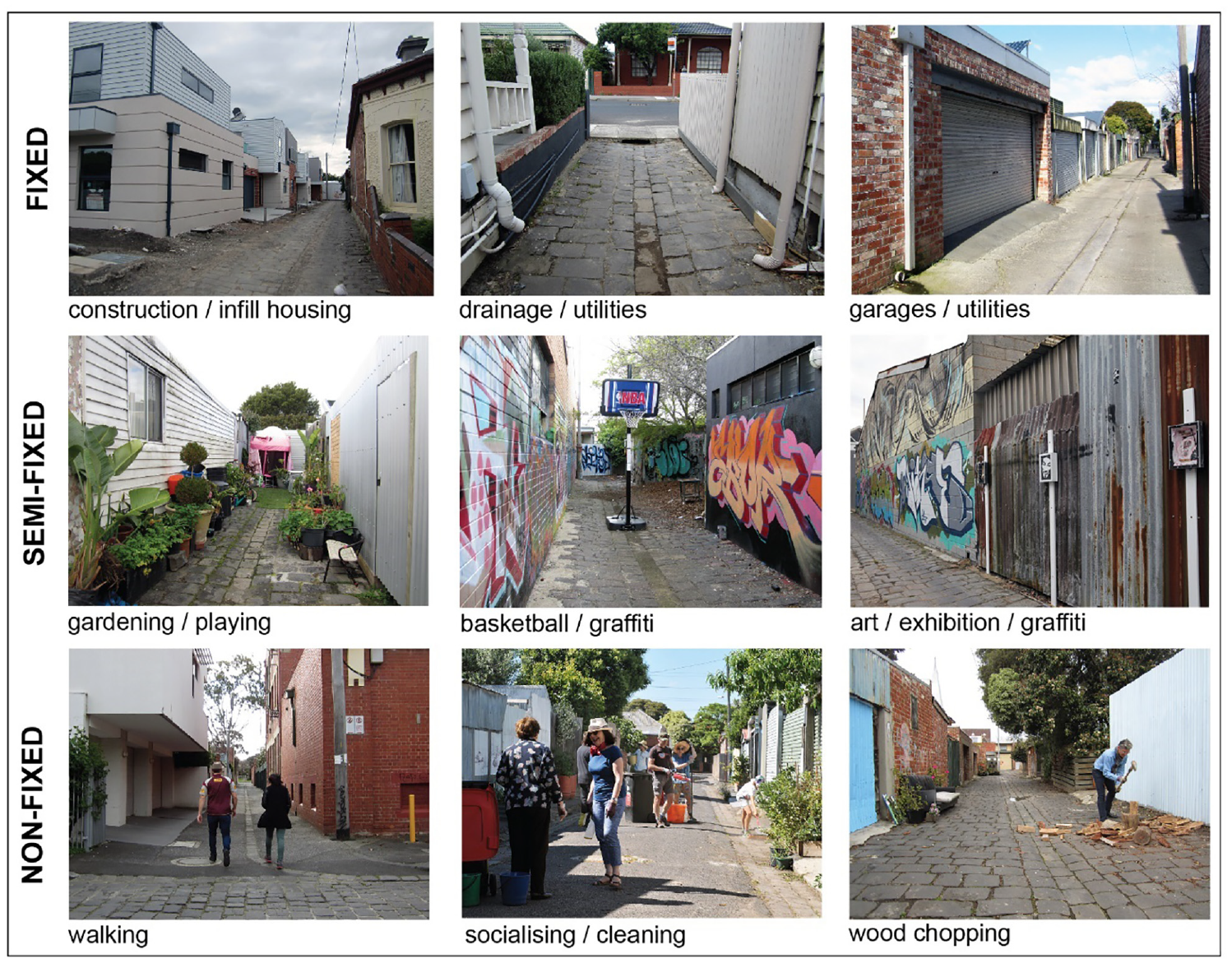
Reappropriations of residential alleys – fixed, semi-fixed, non-fixed (photos by the author).
Residential alleys had various uses although these uses differed from one alley to another. Councils practiced very little oversight, perhaps regarding alleys as the least consequential of all spaces. Reappropriations, whether gardening or dumping, went under council radar; but for residents the alleys were far from insignificant.
This study began on the heels of a dispute in the Merri-bak City Council in which the community successfully fought an alley maintenance policy that sought to gradually replace historical bluestone pitchers with asphalt under the guise of repair. What might have seemed like a banal disagreement about paving material was in fact a zealous dispute about the value of alleys as public spaces. For the Council, the alleys were scrappy roads in need of cheap repair, but for the community, they were culturally, socially and environmentally significant places. Forefront arguments for preserving bluestone included a mix of affective and practical reasons, illustrating the teleoaffective structure of the community campaign: aesthetic preference for stone over asphalt, cultural links to locally quarried bluestone and the concern that impermeable asphalt would increase urban stormwater runoff and traffic speed where car access was possible.
The proposed policy was overthrown through concerted efforts such as objections at City Hall meetings, an overwhelming rejection of the policy in a Council-issued survey, and various organised activities and events. Facing strong opposition, the Council set up a Citizens Working Group (CWG) to find a compromise. However, the work of the CWG was contentious, mainly because the CWG started to reframe the discussion about alleys from the budget expenditure set by the Council to the alleys’ cultural, historical, social and environmental values. These alleys also became a Council election issue, in which people could pledge votes for candidates who supported the preservation and repair of bluestone alleys. Another group, called Save the Bluestone Lanes, leaned into existing practices of everyday reappropriation, such as gardening, playing and socialising, to emphasise that alleys were valuable shared spaces. Although alley gardens and associated uses became part of the Merri-bek community’s fight over maintenance policy, their origins long predated this struggle. Gardening was present throughout the study area, and decades earlier, Merri-bek City Council even awarded residents for improving their alleys through resident-led greening. Such gardens were even more common in the adjacent Yarra Council.
Interviews with residents from both councils revealed that these alley gardens shared a common narrative, although they emerged independently of each other. Personal and mundane needs for gardening, informal childcare and social interaction motivated residents to make small reappropriations which turned alleys into quasi-domestic spaces shared by neighbours while remaining in public use. Although initial reappropriations were not elaborate, they revealed new potentials. A small change made by one person gave implicit permission to others to do the same, and over time the functions and meanings of these alleys evolved. This evolution was well illustrated in one garden that over 25 years ago started from repurposed waste bins, as explained in this quote: and then other people saw what I was doing, not immediately, years later. And they put couple of tubs there and started growing herbs and spices. And then, about three years ago, a neighbour was renting a place out there and he said – I’m gonna make this a green lane. It went from just our little tubs to a gigantic lane full of trees, and really trees, and herbs and vegetables.
Those who got involved in gardening spent more time in their alleys, which increased interactions and strengthened social ties among neighbours. These interactions ranged from small gestures of conviviality, such as a quick handwave to neighbours attending to their plants, to more elaborate gatherings such as barbecues, birthdays parties and holiday celebrations. Even some residents who did not garden spent more time in the alleys. As more people got involved, the personal needs that motivated initial reappropriations were consolidated into collective benefits.
Through reappropriations, residents developed a sense of informal ownership of the alleys, expressed through caretaking rather than exclusion of others. Lacking council maintenance and repair, residential alleys generally had a disordered appearance compared to other council maintained public spaces. Interviews revealed that the residents regarded their reappropriations as environmental, social and aesthetic repairs of the public realm, which also potentially deterred undesirable activities such as waste dumping. Echoing previous studies, reappropriations fostered feelings of place-attachment as well as a sense of community among residents. At the same time, residents recognised that a degree of undesirable activity was to be expected and accepted in alleys like in other public open spaces. As most interviewed residents have lived in the area for decades, they have seen much rougher times not only in the alleys but in their neighbourhoods generally. The gardens have been there for years to decades, and the long-term experience of doing things out in the open made them more resilient to unwanted activities. Perhaps being actively engaged in reappropriations of care and repair enabled an empowered mindset, and for residents to be proactive when faced with undesirable activities or to ‘manage their affairs themselves’ (Purcell, 2022).
When faced with undesirable usage, residents did not necessarily rely on their councils to fix the situation; they tried to mitigate it through reappropriations. One of the residents talked of strategically planting hardy plants along her boundary fence to discourage waste dumping and unwanted graffiti. Plants seemed to work somewhat as a deterrent strategy for dumping, while graffiti, a common reappropriation by outsiders, were gradually accepted. Reporting and/or repainting graffiti was not a long-term solution as they would just reappear. Instead, the resident simply did not repaint graffiti she found acceptable, in an effort to discourage potentially less desirable ones, and also noted that nearby businesses commissioned graffiti for the same reason. In that way, the resident supported street art, which councils uniformly regarded as illegal. Personal tastes and preferences played a role here as she was more tolerant of ‘good’ graffiti, or more elaborate pieces, than ‘bad’ ones, or simple tagging. Also, graffiti on metal fences were easier to tolerate than those on brick walls, consistent with other studies’ findings (Dovey et al., 2012; Iveson, 2009).
Alley gardens were commonly likened to small-scale sustainability actions, such as mitigations of the urban heat island effect, community building and growing food locally. Gardening was a practical and enjoyable activity, but residents also believed that they set a positive example of civic responsibility and care for the environment. In interviews, they recounted positive interactions and feedback from passers-by who used their alleys for walking or bicycling. Having their efforts praised by the broader public was seen as a legitimisation that reappropriations transcended residents’ personal interests and contributed to the common good. Sometimes residents deliberately engaged with the public. In one instance, a resident adopted an abandoned planter and left water-filled containers with the written message ‘please water me’ for when she could not do it herself. Strangers regularly obliged, watering plants that did not belong to them. In other instances, art exhibitions were organised to show the work of resident and non-resident artists. These included large scale photo-posters pasted on fences, commissioned murals and a group exhibition across several alleys, named Bluestonia 24/7. These events were promoted to the wider public to engage them with alleys as public spaces. The idea was to leave the work indefinitely and simply see what happened, as explained by a resident who organised these exhibitions: It’s work in progress how you use laneways. You test things, see what happens, find actions. Some things move through, some things don’t, and then particular ways of using space develop a constituency.
Another alley was reappropriated into an herb garden, established and maintained by one resident, but open and free for all to use. The first iteration of the garden was intended to be private, but it failed because hiding it from the street to prevent possible vandalisation also made it inconvenient to maintain and the plants died. The resident reframed his own expectations about gardening in a public space and created a public herb garden, which over time engaged others to use and care for it: I started thinking that it was the wrong approach to try to hide it away from people. What if I moved it to a place where it was actually in the thoroughfare, and you were signalling to people that it wasn’t just for you? That it was for everybody. So I moved things down to here. At the start, things would just go missing all the time. But the real interesting thing happened. As time has gone on, that’s almost totally stopped.
For that resident, the real significance of the garden was in providing an opportunity for strangers to collectively care for and share something in their neighbourhood. The garden was well used, and people occasionally left ‘thank you’ notes and presents, such as homemade jams and beer, and other plants to add to the garden. Even those who did not cook, and had no practical use for it, occasionally expressed appreciation that the garden existed as a shared resource.
These alley gardens were not formally sanctioned by councils, but they were not entirely unknown to them either. Council maintenance crew sprayed weeds seasonally, and reappropriations never triggered a removal request. Apart from reporting waste dumping, residents did not seek much involvement from councils either. When asked what they would like to see councils do about the alleys, the common answer was ‘nothing’ and to ‘leave them the way they are’. Council involvement was seen as potentially deterring rather than encouraging of social activities. Birthday and holiday parties and other social gatherings were common. While technically, such gatherings would need to have council permits, residents rarely sought them. In fact, it was widely believed that seeking formal approval from councils would be detrimental, as illustrated in this quote: We love to use it [alley] and we are fearful if they [Council] became too interested, they would impose rules that don’t suit us. For example, I think what I’m most worried about is if they insisted that if we have a lane party here, we have to take up an insurance. Public liability insurance, get permission and permission is only granted if you have insurance or something like that. That would kill it stone dead.
The residents were aware that some of their activities, such as parties, were not ‘by the book’, but they were more interested in informally coming up with arrangements with their neighbours rather than seeking a formal permit from councils.
As a small-scale informal reappropriation can grow into a shared garden, a single formal complaint in one alley can dismantle not only that garden, but all the others in that council. During this study, a multi-household alley garden that had existed for over 25 years in the Yarra council had to be cleared after a new resident requested removal, invoking vehicular right-of-way access. Even though that alley could not accommodate cars due to its narrow width and 90° bend, the presupposed car access trumped all logic and spatial constraints. The residents initially refused and had broader public support, but after being threatened with a hefty fine, they ultimately complied. Although residents knew that the garden was not blocking any viable access, but instead provided many benefits, habitus prevailed, as residents also accepted the legitimacy of the Council’s power. Because the garden emerged outside the Council’s formal framework, it was deemed illegal. For keepers and users of alley gardens, this argument was still hard to accept, as the resident who filed the complaint allegedly had associations with Melbourne’s criminal underworld. In this instance, removing the gardens based on illegality was seen as ironic, especially as both councils were regarded as socially and environmentally progressive, and the gardens’ benefits were ignored.
The struggle over alley gardens revealed that what was considered formal, informal, or even illegal was not based on what was being done there, but through which practice it had emerged. For example, while residents had to clear alley gardens for hypothetical traffic obstructions, they could also request from the Council to instal planters on the sidewalks in front of their homes (Figure 2a). Council planters formally reappropriated busy sidewalks, while residents’ informal gardens in less frequently used alleys needed to be proven safe. Some residents cleared their alley gardens (Figure 2b), while others applied for permits to re-establish their gardens (Figure 2c). However, the Council scrutinised where the plants grew; allowing them to grow in the ground was unacceptable, as it symbolised entrenchment or reappropriations taking root, so to speak. The re-established gardens needed to be in pots and planters, symbolising their temporality, mobility and ability to perhaps literally ‘pop-up’ and out of alleys upon request.
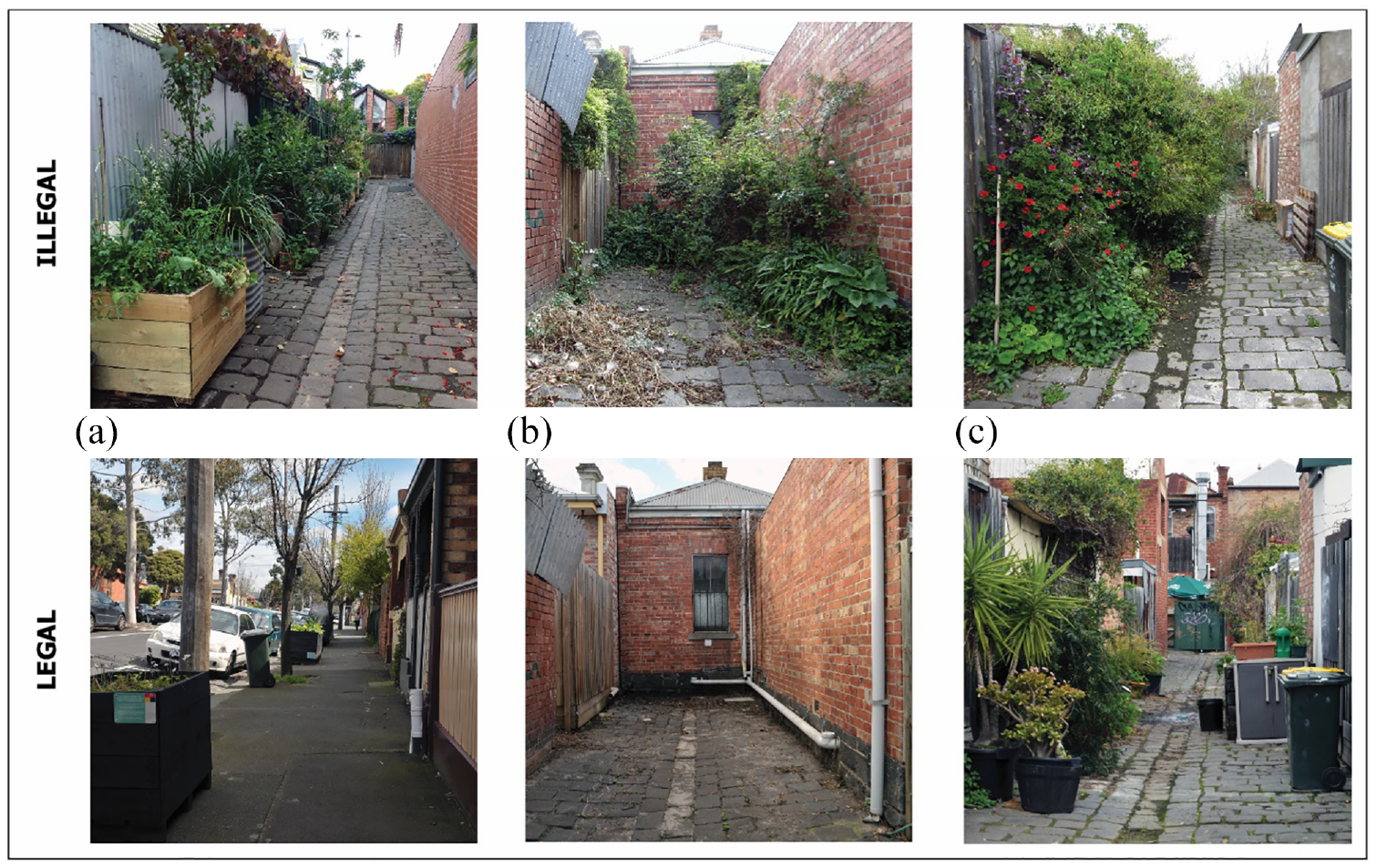
Contingent legality of reappropriations (photos by the author).
After years of the Council being wilfully ignorant of the gardens, the notice to clear them seemed superfluous as enforced compliance was put in action seemingly overnight. Adding insult to injury, one of the councillors also characterised gardening in alleys as ‘middle-class welfare’, implying that reappropriation benefits some residents unfairly and was an unjust privatisation of public space. The councillor statement echoed some of the critique presented in the literature that the informality of the middle-class is not motivated by genuine need. However, through the lens of practice theory, actions cannot be explained through a single characteristic of the actors. In fact, most of the interviewed residents were older and some were looking after children, so mobility limitations, reduced access to open space and lack of social interactions, were also something they shared. All residents also took pleasure in gardening and believed the gardens provided benefits to others. The councillor statement also suggested that spatial justice is only dispensed through formally sanctioned Council approval, which is rather a limiting view. For residents the councillor’s statement was a distraction from the real issue about who has the right to produce the city: (He) characterised urban gardening as middle-class welfare. And that’s just absolute rubbish. It’s not middle class, it’s not welfare. You pay for it yourself, and all sorts of people are involved in it. So how is it middle class and how is it welfare? But that was the catch cry.
Recognising that alley gardens were widespread, the Council established a formal process to request and pay a sizable permit fee to establish ‘pop-up gardens’. The initial permit requirements were focused on compliance and risk mitigation, where both alleys and gardens were considered hazardous. Risks to be mitigated included tripping over uneven pavement and overturned planters. Social and environmental benefits of the gardens were not acknowledged. The initial permitting process had some residents fearing that the purpose was to discourage rather than encourage gardens. The Council’s safety concerns were met with scepticism, if not ridicule, and the permitting process was revised to be less about exaggerated risk management. Under public pressure, the Council lowered the permit fee and organised gardening workshops run by its urban agriculture team to support applicants in establishing alley gardens. New alley garden permits created a condition from which alternative visions for residential alleys could evolve. Like alley gardens that started from a couple of tubs, small policy changes began an acceptance of residential alleys as more than vehicular rights-of-way.
Months after the events discussed here, follow-up correspondence with one of the residents revealed that support for alley gardens was growing from newly elected councillors. Small gardening reappropriations were observed in subsequent visits, and many did not have or did not display a council permit. While the material aspects of reappropriation could be temporarily usurped, it was evident that the reappropriations instigated long-lasting changes in people, how they find values and meanings in alleys and their role in spatial production.
In/formality in underdetermined spaces
From the vantage point of an outsider, whether a council member, researcher, or the public, residential alleys (or any other interstitial spaces) are terrain vague and loose spaces, sites that are hard to define or fit into established spatial typologies. For those who reappropriate, whether resident, graffiti artist, or dog walker, alleys have a clear purpose, and being outside of conventional aesthetic and functional norms creates an advantage for realising those purposes. Residential alleys in Melbourne have existed at the edges of what Young (2014) calls the ‘legislative city’ of planning strategies, policies and laws that regulate urban space and behaviour. They have evolved through a combination of council neglect and informal reappropriations. Due to neglect, residential alleys have evaded formulaic definitions of what constitutes valuable urban space. Instead, their value has been worked out ‘on the ground’ largely through informal spatial practices that involved practical end-goals and the emotions shared by different actors, illustrating Schatzki’s teleoaffective structure. This paper aimed to render visible the generative potential of informal spatial practices to create socially responsive places, and also to inform governing policy. The progress made in recognising the ecological and cultural values of urban landscape interstices may be a premonition of what could be achieved for other undervalued urban spaces. However, as Gandy (2022) illustrates, getting to that point requires a ‘forensic’ approach to inquiry as well as commitment to engaging with the differences and temporalities of sites.
The case of residential alleys presented here shows that we do not need to think of urban interstices necessarily as spaces in between purpose and identity but rather as underdetermined spaces where various actors have realised different purposes and potentials. While the primary focus was on alley gardens, the multi-scalar morphology of alleys also enables other socio-spatial arrangements (as illustrated in Figure 1). An individual alley is relatively small, but collectively, they add up to an extensive network covering urban blocks with diverse housing types and in different socio-economic settings. An alley is neither a strictly public nor private space; each alley is shared by multiple households as well as the public that collectively defines its purpose. It is a space with the potential to affirm differences (Purcell, 2022), both spatial and social. However, socio-spatial arrangements are specific to each alley, and what works in one location may not work in others, thus requiring a more nuanced approach to governance and development.
Informal reappropriations motivated by the desires and needs of various actors can produce novel socio-spatial arrangements that are material manifestation of teleoaffective structure. For example, political and creative desires can materialise as graffiti on boundary walls and fences. Undesired graffiti may prompt some residents to sow plants along the boundaries, and this in turn could inspire other residents to add more plants. These informal gardens could increase the usage of alleys as common spaces by the broader public, for walking through more frequently than those with less reappropriation. All of these reappropriations are significant departures from the policy designation for car access, and they also have the potential to inform future policies.
The mapping of the actors, their reappropriations, and degrees of formality, informality, or legality in Figure 3 highlights the paradox that informality is scrutinised when in fact it is the norm rather than the exception. A very small number of reappropriations are formally implemented, although they are always legal and fixed. Even when their logic is dubious, their legality is rarely questioned. Marx and Kelling (2019) argue that the binary pair of in/formality is produced as a social practice, but this paper aims to make visible the spectrum of distinction among formality, informality, or even legality, as shown in Figure 3. Where a reappropriation falls on this spectrum is not tied to what is done, but to the practice which organises it (e.g. the practice of formal governance). The actors in Figure 3 are grouped into ‘residents’, ‘outsiders’, ‘developers’ and ‘council’, primarily to highlight different kinds of spatial practices. There is diversity within individual actor groups as well as overlap across them. For example, the Council was wilfully ignorant of gardening reappropriations until a resident raised a complaint evoking right-of-designation. Residents of one alley could also be considered outsiders in other alleys, and so on. The matrix is not exhaustive but illustrative of typical activities and relationships.
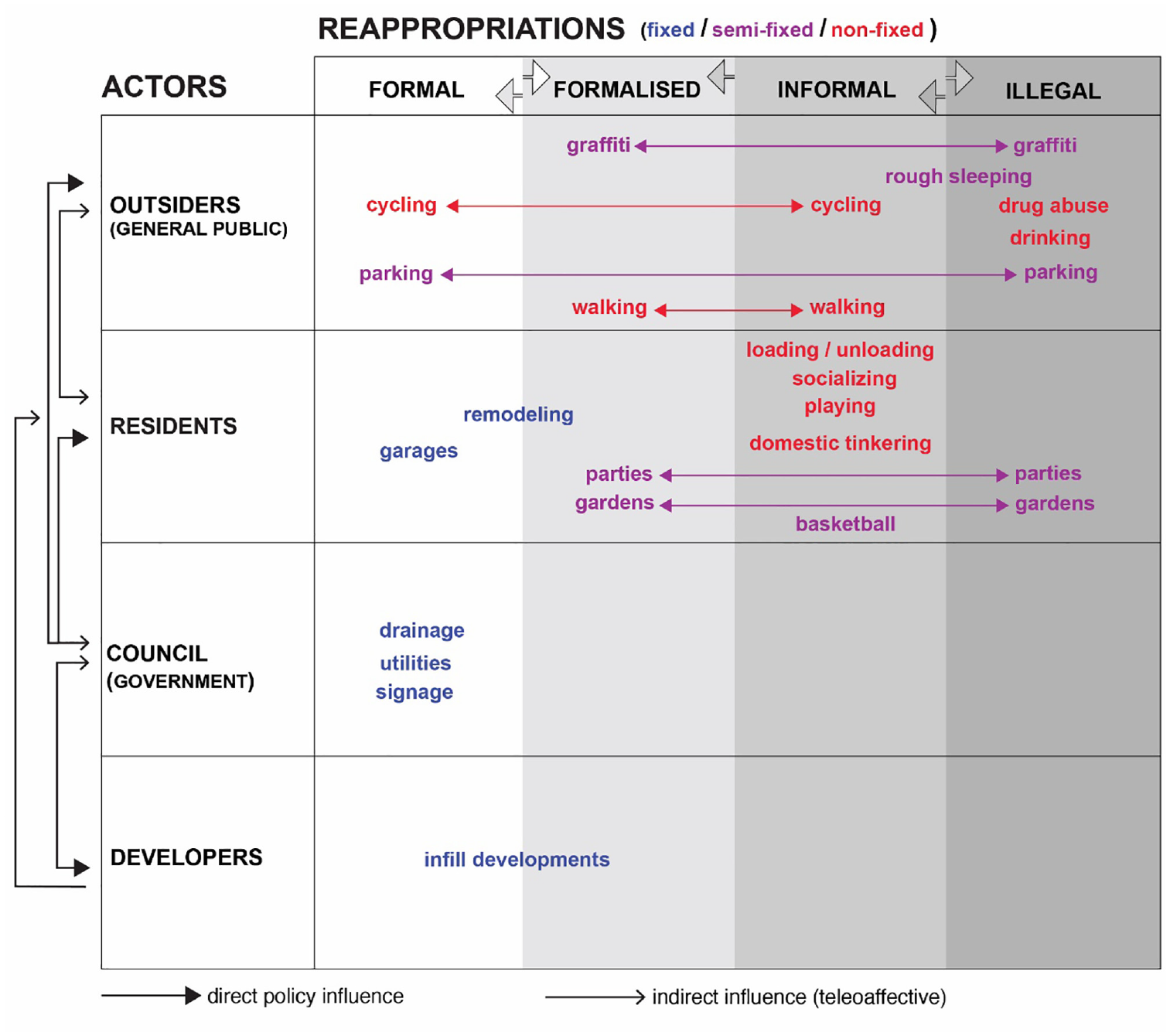
Matrix of spatial practices in residential alleys: reappropriations, actors, in/formality and influences.
Informal reappropriations by ‘residents’ and ‘outsiders’ can be deemed illegal or become formalised. Informal reappropriations can only become illegal through the enactment of policies, such as for parking, graffiti and alley gardens. New policies could also formalise these same reappropriations, by designating parking spaces, developing a permitting process for alley gardens, or even by residents commissioning graffiti. Reappropriations are de facto formalised through interpretation of existing policies and codes, such as when developers obtain a permit to build infill housing. The new housing is driven by market demands rather than planning vision; therefore, if developers meet minimal building code and planning requirements, ‘anything goes’ in residential alleys. The developers’ reappropriations are fixed and difficult to change, especially when infill housing alters modes of land ownership and the material properties of public/private interfaces (Moreau, 2022).
Policies strive to manage spatialised desires, while desires test the practical legitimacy of policies. While councils exert influence through policies, other actors influence councils through their practically oriented desires, as illustrated in Figure 3. Councils are not singular and fixed entities; they are made up of many individuals, from councillors to employees, across various roles and departments; however, councils usually act uniformly, through policies, regardless of an individual’s belief. At the same time, the points of potential influence are multiple, and in Melbourne’s residential alleys, residents exerted their influence through community events, social media, word of mouth, protests and elections, all which were supported by the broader public.
Needs and desires are not mutually exclusive but rather mutually constitutive. They are the teleoaffective dimensions of practice that Schatzki proposes can redefine the ‘structuring structure’ of policy habitus. In urban space, where the practices of various actors intersect without explicit formal controls, teleoaffective structures emerge from lived experiences and become the socio-spatial norm. Reappropriations can change how space is used or governed through the creation of new socio-spatial possibilities, which have the potential to democratise public space. However, it is the task of empirically grounded inquiry to uncover different processes of informality; what does or does not work, where and for whom; and to engage with informality as a practice and not just a concept.
Footnotes
Acknowledgements
I thank Kim Dovey, Scott McQuire, Quentin Stevens and Elek Pafka for their advice and support in conducting this research. The comments of two anonymous reviewers provided valuable feedback for finalising this manuscript, and I appreciate their time and attention.
Declaration of conflicting interests
The author declared no potential conflicts of interest with respect to the research, authorship, and/or publication of this article.
Funding
The author disclosed receipt of the following financial support for the research, authorship, and/or publication of this article: This research was made possible by Australian Postgraduate Award (later Research Training Program Scholarship) to the author.
