




Abstract
Crises spur reflection and re-evaluation of what matters and what is valued. The impacts of the 2008 global financial crisis, COVID-19 pandemic and climate emergency are reigniting debates about the nature of economic development approaches and what they aim to achieve in urban settings. Addressing a substantive gap in contemporary debates by helping to navigate a burgeoning and diverse field, this paper provides a critical and comparative assessment of five leading agendas that have been positioned as alternative and progressive policy responses to urban economic change: inclusive growth; the wellbeing economy; community wealth building; doughnut economics; and the foundational economy. Taking an international perspective, the paper provides a comparative review of their stated visions, mechanisms for change, and the spatial scales through which they are led and implemented. Our argument is that these alternative approaches to urban economic development are shaping creative, innovative and progressive responses to longstanding urban problems within policy and practice communities but require on-going scrutiny and evaluation to realise their potential to meaningfully achieve transformative change.
Introduction: Alternative urban economic development policy responses to social and geographical inequalities
Cities have been buffeted by unprecedented change in recent years. This includes the shocks of the 2008 global financial crisis, COVID-19 pandemic and war in Ukraine, alongside wider developments such as austerity and the return of the state, rising disenchantment with mainstream economic development models and politics, demographic shifts, technological change, and the climate emergency. These have all ignited debates about how urban economic policymakers can respond to growing turbulence and social and geographical inequalities in cities (Beveridge and Featherstone, 2021; Dijkstra et al., 2020; Jones, 2018; McCann, 2020; Rodríguez-Pose et al., 2021; Tomaney et al., 2019; Tooze, 2019, 2021). Such disruptions and crises have sparked searches for policy alternatives in cities internationally. Established paradigms of urban growth have been questioned for their perceived failure to address concerns about persistent or widening inequalities; economic, social and ecological sustainability; and democratic accountability.
Cities have been at the crux of these developments as urban settings framed as the engines of economic growth but also where inequalities and divisions, the impacts of austerity, and environmental challenges such as pollution and congestion are most pronounced (Fainstein, 2010; Florida, 2017; Peck, 2012). The acute pressures cities face have prompted searches for alternative approaches within and beyond the local state to mitigate and resolve complex and cumulative challenges (MacKinnon et al., 2022). Policymakers in local and city regional institutions across a range of countries are increasingly experimenting with a variety of ‘beyond GDP’ approaches centred on more socially, economically and ecologically just models of development (Davies, 2021; Etherington and Jones, 2018; Stiglitz et al., 2009; Thompson et al., 2020). This endeavour reflects the critique of conventional economic development models for pursuing a narrow ‘competitiveness’ logic (Bristow, 2005; Harrison, 2007; Ward and Jonas, 2004) where cities are pitted against each other in a race to enhance productivity or capture mobile capital ahead of addressing ecological harms or ameliorating social and economic inequalities (Coyle, 2014; Jones, 2018; Tomaney et al., 2019).
In some urban contexts, the local state has become ‘a key terrain of struggle’ (Beveridge and Featherstone, 2021: 445) as a site both for implementing austerity as well as a potential ‘space for repoliticization’ through which to develop ‘counter-hegemonic visions’ to neoliberal growth models (Etherington and Jones, 2018: 67, 69). This ranges from more incrementalistic, reformist approaches through to a wave of ‘new municipalism’ that has seen cities such as Barcelona (Spain), Preston (England) and Jackson (United States) experiment with radical-democratic responses to urban-capitalist crises (Russell, 2019; Thompson, 2021).
Addressing a substantive gap in contemporary debates by helping to navigate a burgeoning and diverse field, this paper aims to make a key contribution to interpreting the literature on ‘progressive economic development’ approaches (Filion et al., 2021). It provides the first critical and comparative assessment of five leading agendas positioned as alternatives to conventional forms of urban economic development focussed on growth maximisation: inclusive growth; the wellbeing economy; community wealth building; doughnut economics; and the foundational economy. This selection is guided by two key considerations. First, the five ideas are already being adopted and implemented within subnational urban economic development strategies and policies. Our concern here is to assess frameworks that are currently being mobilised by actors in urban policy settings to inform wider questions about how ‘beyond GDP agendas’ are translated and applied in real world contexts. For this reason, newer and emergent agendas such as ‘postgrowth’ (Jackson, 2021) and ‘degrowth’ (Hickel, 2021) that fundamentally challenge growth-oriented paradigms have not been included as they are yet to gain explicit and widespread traction in urban policy settings despite increasing academic, activist and tentative policymaker interest (Rocha, 2022; Savini et al., 2022).
Second, the approaches selected invite comparative assessment by offering a contrast to conventional modes of policymaking that privilege economic competitiveness. They all advocate ‘beyond GDP’ goals to some degree while taking different positions on the extent to which economic growth remains a prerequisite or constraint in the pursuit of desired social, economic and ecological outcomes. Inclusive growth (IG) is the most established of the five approaches and, arguably, the most critiqued for its perceived failure to depart from ‘business as usual’ economic growth models that perpetuate social and spatial inequalities. We include it in the review in recognition of its emergence as the first distinctive break from conventional approaches to economic development, both as a foil for the emergence of the four newer and, contestably, more transformative strategies, and to acknowledge the diverse formulations of IG that include more ‘growth critical’ variants.
Despite the growing prominence and uneven deployment of these alternative approaches, there has been no attempt to date to map the five approaches out in relation to each other and assess their core features. This is a critical gap because there is a need to understand and conceptualise how these approaches function as potentially competing, alternative or complementary forms of knowledge or ‘visions’ to resolve urban economic development problems. The central contribution of this paper is to set out the similarities and differences between these five approaches to urban economic development to generate new insight and help navigate this evolving, experimental, differentiated and plural policy space. Our analysis highlights the shared point of departure from conventional urban economic policy of looking ‘beyond GDP’ for alternative understandings of urban economic development. It then identifies differences between the five approaches in their stated visions, specified mechanisms for change, and the spatial scales through which they are led and implemented. In undertaking this assessment, we provide novel insights to inform wider international debates in urban studies about the opportunities, challenges and tensions in stimulating and realising alternative urban economic development policies.
This assessment is based on analysis of documentary and online materials between 2009 and 2022. These sources comprise ‘foundational’ texts and academic literature, strategy and policy papers, toolkits for action, good practice reviews, and other online materials such as websites and blogs (see the online supplementary material for detail on specific sources). Our understanding of foundational refers to material produced by, or referring to, key actors (individual and institutional) recognised as pivotal in developing, and advocating for, each of the five approaches. There is a significant volume of literature on each approach, particularly in relation to inclusive growth. Material reviewed was limited to the Global North to distinguish our review from debates in development economics using similar terms but in relation to very different economic and political contexts (e.g. Rodríguez-Pose and Wilkie, 2018). We recognise, however, that a more global dialogue on alternative approaches could be usefully pursued in future research. The authors collectively engaged in a process of iterative challenge and discussion to identify the key aspects, differences and similarities between the approaches. The aim of the analysis is not to systematically assemble the evidence and evaluate the effectiveness of the five approaches, but to explore how these agendas are being conceptualised and adopted by advocates.
The second section provides a brief descriptive overview of the five approaches in terms of origins, key proponents, core vision and urban examples. The third section then assesses the five approaches in relation to three key themes. First, it explores the underpinning vision of change. Drawing on Wright’s (2010) theory of social transformation, this analysis demonstrates that all of the approaches make transformative claims but the extent and nature of this, and what this implies for the urban economy, radically differ. Second, the assessment reveals the prominence of local adaptation, experimentation and democratic participation within the proposed mechanisms for change across all five approaches, although each exhibits significant variation in the degree of clarity and prescriptiveness of interventions advocated to achieve desired ends. Third, the assessment reviews the geographical dimensions of the five approaches. While each is gaining traction at specific scales of governance through city, local and regional administrations, most are ambiguous and loose about the geographical causes of inequalities, scale(s) of action and their intended impacts. The fourth section concludes with final reflections and outlines a future research agenda. It argues that, although these approaches share some common themes, they also exhibit important differences in origins and key advocates, the visions of transformation, the prescriptiveness of change mechanisms, and geographies of implementation. The argument is that the plurality, complexity and messiness of these emerging approaches are generating space for creative, innovative and progressive forms of urban economic policymaking in a time of considerable policy flux and economic and social turbulence. Such alternative approaches require careful empirical research, evaluation and scrutiny to hold proponents to account and measure their effectiveness against stated ambitions.
The five approaches: An overview
The broad contours of the five approaches are summarised in Table 1 below with further detail provided in the online supplementary material. Inclusive growth (IG) is perhaps the most established agenda in urban economic development. IG envisions an economic system in which more people participate in and benefit from economic growth, thus achieving more widely shared prosperity (Lee, 2019). Its core elements include changing the nature of economic activity and the distribution of benefits (e.g., changes to business practices and labour market conditions) and broadening participation and opportunity (e.g., through ‘social investment’ in skills, health and community infrastructure).
An overview of the five approaches.
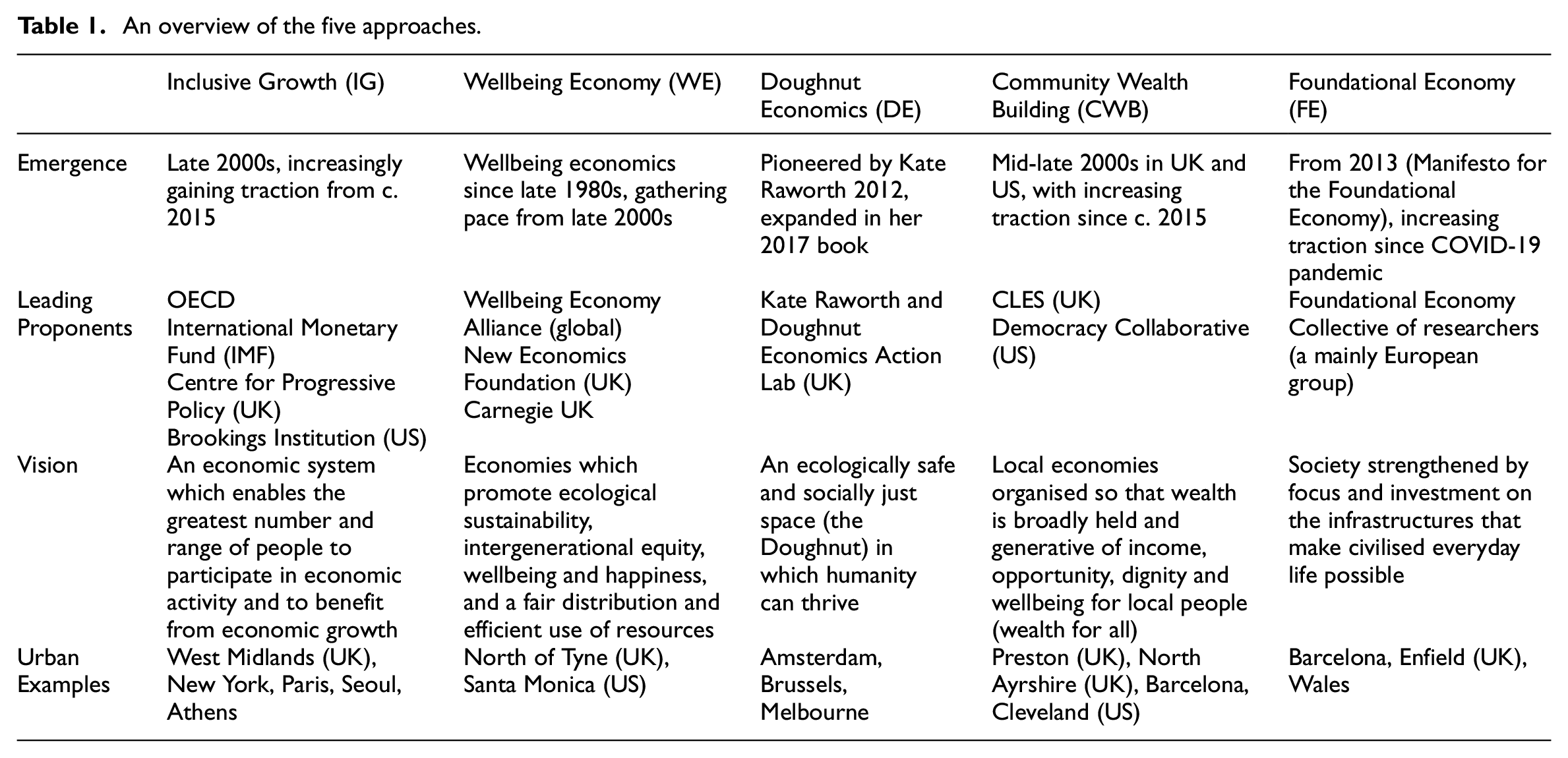
IG originated in the field of international development in the late 2000s, replacing the term ‘Pro-Poor Growth’ which had previously highlighted social and distributional concerns (Lee, 2019). It was quickly taken up by international organisations including the World Bank (Anand et al., 2013), International Monetary Fund (2014) and the Organisation for Economic Co-operation and Development (OECD, 2014, 2018), and applied in Global North as well as Global South contexts. A range of advocates have identified cities as key sites for delivering IG including the OECD (e.g., its ‘Inclusive Growth in Cities’ Campaign); the Royal Society of Arts, Joseph Rowntree Foundation and Centre for Progressive Policy in the UK; and Brookings Institution and the Rockefeller Foundation in the US. They argue that cities or city-regions are both sites of concentrated poverty and engines of economic growth, and can link economic development and social policy interventions in bespoke ways in meaningful geographies to ensure growth better addresses inequalities.
Some analysts distinguish between more ameliorative ‘growth plus’ variants of IG that aim to better distribute the benefits of existing growth (e.g. jobs) and a more transformative ‘inclusive economies’ conception that emphasises more thorough-going changes in business models and employer behaviour and developing good quality jobs (Benner and Pastor, 2016; Lupton and Hughes, 2016). IG advocates envision using economic policies to pre-distribute income to reduce the need for reactive social spending to respond to the costs of poverty and inequalities, while deploying social policies (e.g. preventive health, equitable education) to facilitate broader economic participation and productivity (RSA, 2017a). Prominent urban examples of take-up of IG in the UK include the West Midlands (England) (Spencer, n.d.) and a series of city-region and growth deals in Scotland (Waite and Roy, 2022). Globally, inclusive growth has been adopted and advocated for by 105 mayors covering 38 countries as part of the OECD’s Champion Mayors for Inclusive Growth Initiative (OECD, 2021).
Wellbeing economies (WE) and doughnut economics (DE) are broader approaches, located firmly in ‘beyond GDP’ thinking. Wellbeing economies maintain that economic development should focus on maximising wellbeing in a way that is ecologically and socially just rather than increasing growth. Going further than IG, the WE approach is about changing the purposes of the economic system (Fioramonti et al., 2022). Differences remain, however, between proponents as to the desirability of growth – from ‘growth agnosticism’ (Olsson, 2020; Raworth, 2017) to degrowth (Fioramonti et al., 2022) variants – as well as the extent to which political actors or national governments can adopt and realise notions of wellbeing without co-opting or diluting it (McClure, 2021).
These principles have been advocated for several decades by various organisations such as the New Economics Foundation (NEF) and Carnegie UK in the UK. On a global scale, the development of the Wellbeing Economy Alliance (WEAll) and Wellbeing Economy Governments (WEGo) group as well as work to develop a Thriving Places Index (Zeidler et al., 2021) in the UK has helped articulate what WE would mean in particular places. The self-styled WEAll ‘movement’ encourages testing and scaling of WE solutions, and seeks to build momentum for adoption by national and city governments. The New Zealand Wellbeing Budget (Government of New Zealand, 2021) and Wellbeing of Future Generations Act in Wales (Welsh Government, 2015[2021]) provide examples of mobilisation by national governments, while cities and regions have adopted wellbeing strategies and policies including the North of Tyne Combined Authority’s (NTCA) Wellbeing Framework (UK) (NTCA and Carnegie UK, 2022) and Santa Monica’s (US) Wellbeing Index.
In common with WE, DE argues for a fundamental repurposing of the economic system, not to grow but to thrive, meeting the essential needs of all without overshooting ecological pressures on the planet. The ‘doughnut’ describes an environmentally safe and socially just space, ringed by 12 social foundations (including health, education, social equity, peace and justice) and nine planetary boundaries which form the ecological ceiling. Economist Raworth (2017) pioneered the DE idea, and it is now promoted by the Doughnut Economics Action Lab (DEAL) which aims to help put the principles into practice, including through the development of ‘City Portraits’ as local applications of the doughnut framework. Cities and regions that have adopted and developed the DE model, often through building coalitions across city governments and the non-profit sector, include Amsterdam (City of Amsterdam, 2020; Doughnut Economics Action Lab, 2020), the Brussels Capital Region (Dissaux et al., 2021) and Melbourne (Regen Melbourne, 2021)
By contrast, the idea of community wealth building (CWB) originates in thinking about local economic ‘development from below’ (Stöhr and Fraser Taylor, 1981). CWB critiques the dominant economic model – particularly the focus on growth maximisation, inward investment, high growth sectors and places, competition, and service privatisation – as extractive of wealth and ecologically harmful (Brown and Jones, 2021; McInroy et al., n.d.). Pursuit of this model is seen to create social and spatial inequalities, leaving local communities depleted of assets and capacity for economic development.
As an alternative CWB promotes a model oriented towards local ownership in a variety of forms, in which income and wealth are retained and recirculated through local procurement of goods and services and through local financial institutions. Land and assets are used in socially productive rather than just wealth-generating ways, and employment relations and practices are rebalanced in the interests of workers. Drawing inspiration from European social democratic models and local forms of economic organisation such as Mondragon in Spain, CWB was pioneered in the late 2000s in Cleveland, Ohio (US) by Democracy Collaborative. Working in partnership with the City of Cleveland and the city’s major hospitals and universities as locally embedded anchor institutions, it sought to implement a new model of large-scale worker-owned and community-benefitting businesses (Howard, 2012). CWB has since gained traction elsewhere, particularly in the UK, where Preston City Council has developed its own ‘Preston Model’ in association with the Centre for Local Economic Strategies (CLES) (Brown and Jones, 2021). The Scottish Government has also been exploring the potential of CWB as a means of delivering what they term ‘inclusive growth’ (Scottish Government, n.d.), demonstrating how alternative approaches can be combined in practice.
The Foundational Economy (FE) approach emerged in the UK in 2013 from a critique that national and regional economic policy were too focussed on GDP/GVA and competitive and tradeable activities (Bentham et al., 2013). The FE analysis argued that this conventional approach neglected the 40% of the workforce engaged with providing basic goods and services, upon which wellbeing and ‘civilised life’ depends (Bentham et al., 2013). FE’s advocates argue that the primary role of public policy should be to secure basic goods and services as forms of collective consumption rather than boost private consumption to secure growth (Hansen, 2022). This should be done in a socially responsible way, with decent wages and conditions for workers and within environmental limits. The FE is separated into the two domains of the material FE comprising the structures and networks that connect households to daily essentials (e.g. water, electricity, banking and retail) and the providential FE which largely includes public sector welfare activities (e.g. health, education and income transfers) (Foundational Economy Collective, 2022). FE further advocates for radical progressive reform of taxation and stronger regulation and licencing of employers (Foundational Economy Collective, 2022; MacKinnon et al., 2022).
More recently emergent than some of the other approaches covered here, FE ideas are currently less developed as a ‘model’ or ‘how to’ manual, adoptable by national or local governments. FE researchers and advocates propose a focus upon local community and neighbourhood-based experiments, popular participation and co-production in order to develop new policy alternatives and change processes. In the UK, the ‘Enfield Experiment’ affords an early example of an attempt to forge an alternative vision for development for a north London borough, rooted in a mix of foundational economy ideas (Johal and Williams, 2013).
Conceptualising the alternative approaches to urban economic development
This section analyses the five approaches against three key themes relating to: their vision of change; the proposed mechanisms for change; and the geographical dimensions of their agendas in terms of the sites of mobilisation and implementation. These themes have been selected to assess the fundamental elements of the approaches and to provide a framework for further research that considers actual or potential tensions, contradictions and compromises in operationalising these frameworks in real-world policy and practice contexts.
Vision of transformation
The core visions of the five approaches all centre, to varying degrees, on claims of transformative potential. There are differences, however, in the way these visions are articulated and the extent to which they align with proposed mechanisms of change. To explore this further Wright’s (2010) work on Envisioning Real Utopias provides a normative theory of social transformation that can be used to analyse and compare the relationship of the five approaches to capitalism; the intended scale and nature of transformation of the current economic system; and the broad form of institutional and systemic changes required to effect this change.
Wright (2010) develops a three-part typology of transformation, suggesting that social change can be brought about through three different strategies, each with its own vision of the trajectory of systemic transformation. First, ruptural strategies seek to break or dismantle existing institutions and structures (‘smash first, build second’) as the precursor for developing new forms of social empowerment, as embodied, for example, in revolutionary political movements. Second, interstitial strategies aim to develop alternative, more progressive practices and institutions in the niches and margins of capitalist society outside of state control, such as worker cooperatives and community land trusts. Third, symbiotic strategies seek to deepen institutional forms of popular social empowerment in ways that simultaneously solve problems faced by dominant classes and elites, often mediated through the national or local state. Wright (2010: 321) makes a further distinction between ruptural strategies that seek to engineer a radical disjuncture in existing institutional structures in contrast with interstitial and symbiotic strategies that advocate change through ‘metamorphosis’ whereby ‘relatively small transformations cumulatively generate a qualitative shift in the dynamics and logic of a social system’.
While none of the five approaches could be conceived as ruptural strategies that seek to dismantle and reconstruct existing institutions and structures, the notions of symbiotic and interstitial strategies have clear resonance.
IG, particularly ‘growth plus’ versions, may be seen primarily as symbiotic strategy where the state, working alongside other key actors, seeks to engage in ‘collaborative problem-solving [to] create “win–win solutions” in everyone’s advantage (Wright, 2010: 362) in a way that solves social problems while ‘positively contribut[ing] to the realization of capitalist interests by helping to solve macroeconomic problems’ (Wright, 2010: 341). This clearly aligns with IG’s focus on trying to reconcile the social needs of more marginalised groups with the economic interests of producers. This ‘win–win’ assumption has rendered IG open to critiques that it is inattentive to power asymmetries and vulnerable to co-option by economic and political elites in ways that weaken its transformative potential. Seen through this lens IG becomes ‘a get out phrase for the same old market liberalism’ (Burch and McInroy, 2018: 8) and merely modifies existing growth models in order to enable greater social and spatial access to employment opportunities (Rodríguez-Pose and Wilkie, 2015). At the same time, ‘Inclusive economy’ versions of IG may be seen as more interstitial, using the palatability of IG as a term to insert more progressive policies and practices such as broadening the ownership of the economy through social enterprises and worker cooperatives and small businesses (RSA, 2017b).
The visions underpinning the four other approaches also combine elements of both interstitial and symbiotic strategies, albeit to different ends. WE and DE are the most ‘vision centred’ in terms of conceptualising a better society (‘the good life’) in social, economic and ecological terms as the foundation for systemic change. Their central premise is that economic models, policy and practice should be fundamentally reengineered to support a set of social and ecological objectives. One difference between WE and DE is that DE starts with a clearly defined vision built around measurable planetary boundaries and social needs, with scope for local variation and adaptation, whereas WE advocates propose a more decentred, fluid approach to developing a vision of what wellbeing looks like.
Both WE and DE contend that transformation should be enacted through evolutionary and incremental modes of change to avoid destabilisation and rupture (Raworth, 2017; Trebeck, 2018). The emphasis of both WE and DE on the development and, ultimately, scaling of alternative and more democratic forms of economic ownership within local economies constitutes a gradualist strategy, but one which envisages longer-term transformation of economic systems. This resonates with Wright’s (2010) conceptualisation of interstitial strategies as seeking change metamorphically through small scale interventions in the ‘spaces and cracks’ (p. 322) of social systems At the same time, both WE and DE incorporate elements of symbiotic strategies by envisaging a key role for the national and local state, both in terms of mitigating and regulating the harms of capitalism while also facilitating interstitial activities (e.g. the development of worker cooperatives) through state support and funding.
FE and CWB also straddle both strategic approaches in advocating for interstitial forms of democratic economic ownership within the niches of the capitalist system while promoting a strong role for coalitions including local government, business and civil society to pursue symbiotic change through mutually beneficial initiatives such as ‘good work’ agendas. Like DE and WE, some advocates of CWB envisage transformational change through metamorphosis where progressive local coalitions of ‘many small alternatives’ gradually expand to effect systemic change at wider spatial scales (Brown and Jones, 2021: 32) and usher in the ‘next system’ (McInroy, 2018). This has echoes of the radical incrementalism of DE and WE, but without the vision of the ‘good life’ that lies at the end of the process of metamorphosis. Like IG, the transformative ambitions of CWB have been challenged with sympathetic critics suggesting CWB can only mitigate at a local level the ‘territorial injustice’ of the geographically uneven impacts of national level spending decisions (Clemoes, 2018).
Finally, FE proponents make a strong theoretical case for transformative change by advancing a new pluralistic and zonal conception of the economy in which the foundational sectors that deliver the essentials of daily life receive greater attention. This vision contains elements of interstitial strategies in its support for forms of economic democracy such as workers cooperatives, but it is far less sanguine about the potential for scaling such activities to achieve a fundamental reconfiguration of economic systems (Foundational Economy Collective, 2022). Instead, it prioritises more muscular state regulation and mitigation of the harms of capitalism, particularly through symbiotic policy mechanisms such as social licencing where the right to operate and profit from delivering essential forms of collective consumption is conditional on embracing more socially and ecologically just and sustainable forms of corporate practice (Foundational Economy Collective, 2022). In short, and similarly to the symbiotic approach of IG, it seeks to make capitalism fairer but in a way that is far more attentive to the need to neutralise extractive practices and power asymmetries that might otherwise undermine ‘win–win solutions’.
Mechanisms for change
Proponents of the five approaches typically seek to translate the vision and principles into practice through espousing and facilitating local adaptation, experimentation and demonstration. Each recognises the lack of a one-size-fits-all response to contemporary urban economic development predicaments and the importance of locally tailored solutions. Key forms of action include engaging and lobbying policymakers, creating broader networks to spread ideas and frameworks of action, the diffusion of knowledge and research, and public participation and engagement. One common aspect across all five approaches is to promote more democratic forms of participation, marking a shift away, at least to some degree, from top-down template or ‘identikit’ and technocratic policymaking (Bristow, 2005). However, the degree of clarity and prescriptiveness of mechanisms to achieve the desired change varies considerably.
CWB is characterised by greater prescriptiveness of means and practical actions to achieve desired ends. It advocates local control of the economy through broader bases of ownership, coupled with the local rootedness of resources to minimise wealth extraction. This approach moves beyond abstraction and articulates five core principles to guide local agency including progressive procurement of goods and services and fair employment and just labour markets (CLES, 2019). Advocates of the CWB approach have published toolkits with practical actions and real-world examples including establishing anchor networks in local areas (CLES, 2020a), local and urban wealth funds (McKinley et al., 2021), promoting particular types of economic organisation such as cooperatives and social enterprises (CLES, 2020b), and reshaping specific markets (e.g. adult social care) (Lloyd Goodwin et al., 2020). This practical emphasis means it is possible for local policy makers to implement certain elements of the CWB approach – for instance, the development of community energy schemes and the implementation of living wage activities – without others, meaning CWB is being used as a selective rather than ‘all or nothing’ approach (Brown and Jones, 2021). Whether this undermines its coherence and potential impacts remains unclear.
Similarly, it is possible to identify and adopt specific mechanisms through the IG approach, although it is less prescriptive than CWB. This may reflect ambiguity in IG goals which range from more modest ‘growth plus’ to radical ‘inclusive economy’ versions of the approach (Lupton and Hughes, 2016). The ‘growth plus’ model is arguably the more immediately accessible to urban policy makers, as it is about better connecting people to (existing) growth opportunities through, for example, employment and skills initiatives (Green et al., 2015), improvements in transport (Crisp et al., 2018) and sharing local implementation practices. By contrast, the inclusive economy version of IG – in losing the nomenclature of growth and seeking a different kind of economy – emphasises changes in business models and employer behaviour and developing good quality jobs and aligns more closely with some aspects of CWB (Lupton and Hughes, 2016).
In seeking to foster an alternative economic imaginary, the FE approach takes a broader view of the economy encompassing different economic ‘zones’, incorporating a societal perspective rather than a predominantly market focus. While the FE approach is prescriptive about change mechanisms, it is less developed than the CWB approach on the precise means of action at local level, although this is an area of increasing activity. Rather, it focusses on wider radical reform at the national level of the taxation system through taxing wealth and property and a system of social licencing whereby government negotiates with large, financialised companies to specify explicit social obligations (such as the living wage, training and fair treatment of suppliers) (Foundational Economy Collective, 2022). Alongside these large-scale regulatory changes, there is an emphasis on experimentation and on the importance of foundational sectors in local economic strategies with a policy focus on promoting fair work by addressing low wages, unstable hours and low-quality working conditions in sectors such as social care, retail and hospitality (Winckler, 2021).
The DE and WE approaches differ from the CWB approach in terms of the degree of clarity and prescriptiveness of means to achieve desired ends. While guides to application such as ‘The Amsterdam City Doughnut’ (Doughnut Economics Action Lab, 2020) and ‘The Wellbeing Economy Policy Design Guide’ (Wellbeing Economy Alliance, 2021) have been developed, DE and WE approaches both tend to place more emphasis on ends than the specificity of the means for travelling towards and arriving at their desired futures. Coupled with their more bottom-up and decentred ethos, DE and WE remain more abstract in formulation with less articulation of change mechanisms in comparison with the other approaches.
WE often promotes the development of indicators and frameworks rather than detailed policy prescriptions as change mechanisms to move the objectives of urban economic development beyond GDP growth to include broader social and environmental dimensions of sustainability, inclusion and wellbeing (e.g. NTCA and Carnegie UK, 2022). Aligning with the ‘beyond GDP’ agenda (Stiglitz et al., 2009), the idea here is that defining, measuring and evaluating progress against desired outcomes can propel change by providing a framework for action. Reflecting the wide spectrum of wellbeing approaches, it is important to recognise that wellbeing articulations are also emerging through updated policy appraisal guidance in some national contexts (e.g., HM Treasury, 2021).
Similar to WE, DE places concern for sustainability and social justice at its core and advocates the development of decentred, networked forms of action as a means of achieving desired ends. Like WE, these means are articulated more in terms of identifying appropriate social and ecological metrics and the principles they embody to help build a new type of economy, as opposed to specific ‘policy prescriptions or institutional fixes’ to be taken by actors to reach those ends (Raworth, 2017: 17).
In summary, there is variance in the degree of prescriptiveness of the mechanisms for change in the five approaches. CWB and, to a lesser extent, IG offer a toolkit or menu-based approach, sometimes codified within ‘how to’ manuals and guidance for local actors. By contrast, WE and DE focus more on articulating a ‘grand’ vision and then developing the mechanisms to achieve this, often using a framework of clearly defined and measurable outcomes to set parameters for action to achieved desired goals. Finally, FE more than any other approach clearly articulates a set of national policy reforms, focussed around tax and regulatory changes needed to engineer a fairer economic system. FE is, though, the least prescriptive in terms of potential application at the local level and relies upon local experimentation and the accumulation of knowledges and experiences.
Geographical dimensions
Although the five approaches are gaining traction at specific scales of governance through local, regional and urban administrations in various national contexts, most are ambiguous or somewhat loose about the geographical scale(s) of action and intended spatial impacts. At a time of growing policy concern around enduring and often widening spatial inequalities internationally (Habitat, 2022) it is notable that these alternative approaches are rarely positioned explicitly as direct responses to geographical disparities. Action may be orchestrated at particular scales of governance, often by institutions such as local authorities with clearly delineated spatial responsibilities. However, desired outcomes are only infrequently articulated with reference to reducing spatial inequalities or supporting demarcated territories such as low-income urban neighbourhoods.
Indeed, among all five approaches, only CWB has an explicit scale, with the often undefined or delimited local economy and community figuring as both the site of action and intended beneficiaries (CLES, 2021). ‘Local’ here tends to mean local authority area as a scale at which there are ‘enduring place-based economic relationships’ (McInroy, 2018: 681) and around which local government and the local state is organised and wields authority and resources that can be deployed in line with CWB principles. A distinction needs to be made, however, between the orientation of the CWB movement, which is global, and the scale and focus of action which is specifically local. UK exemplars of CWB such as the Preston model have been characterised as a form of ‘managed municipalism’ within broader typologies of new municipalism (Thompson, 2021). This variation emphasises local state agency as a pragmatic response to economic conditions, marked by the relative absence of grassroots social movements, partly due to class decomposition and weakening working-class solidarity.
CWB’s local focus has been critiqued as a form of local economic ‘autarky’ that may be limited by the potential to produce or secure goods and services locally and difficult to scale up beyond locally defined boundaries (Spicer and Casper-Futterman, 2020: 9). Upending conventional economic ideas of comparative advantage and trade, CWB can also have unintended zero-sum-effects if Place A’s institutions reorient their procurement and activities locally to retain wealth at the expense of people in Places B, C and D etc., who would have formerly benefitted. This latter concern, however, underplays CWB’s emphases on asset utilisation and innovation to create new value, not merely to move existing activity around (see Russell and Roth, 2018).
None of the other four alternative approaches so clearly articulates a specific geographical scale of organisation and action. Instead, their initial thinking at national or global scales has been increasingly applied locally in order to mobilise actors and stimulate action, particularly by city governments. IG is the approach most widely adopted and implemented at local level, driven in part internationally by the OECD’s focus on the role of city governments through its Inclusive Growth in Cities campaign and Champion Mayors initiative. In England, advocates for IG have particularly focussed on the role of mayors and combined authorities (Centre for Progressive Policy [CPP], 2020; RSA, 2017a), seeking to harness the opportunities provided by city-region devolution and various deal-making rounds in the absence of more explicit national government engagement with the agenda. Scotland and Wales, on the other hand, demonstrate a nested approach whereby both national devolved administrations and some local governments have embraced the IG agenda (Waite and Bristow, 2019).
While global in conception with its emphasis on planetary boundaries, the Doughnut Economic Action Lab is moving to the development of ‘City Portraits’ to facilitate local applications of the framework. WE has also been translated to the local scale through the development of wellbeing metrics to guide strategy and policy (e.g. NTCA and Carnegie UK, 2022), although, in common with DE, it has not seen the same degree of traction, advocacy and implementation at local scales as IG. Those advocating for a FE approach have argued that there is ‘no privileged institutional form or scale’ for action (Engelen et al., 2017: 420). They propose a more geographically sensitive approach that connects cities to their ‘hinterlands’, variously defined or constructed (cf. MacKinnon et al., 2022). This understanding can include support for local producers but advocates caution against forms of ‘post-code localism’ that create ‘sheltered reservations’ rather than build business capabilities in order to operate across geographical and administrative boundaries (Foundational Economy Collective, 2022: 142). Demonstrating some plurality of thinking within these alternative approaches, Russell’s et al. (2022: 1078) analysis of FE thinking suggests some formulations do place ‘emphasis on constructing power through the local’ through cross-sectoral place-based alliances, indicating the role that spatial scale may play in building strategic coalitions.
Addressing spatial inequities is a longstanding and central ambition of conventional forms of urban economic development. This raises questions about the extent and scale to which these alternative approaches also seek to tackle geographical inequalities. All five approaches critique existing economic models for producing socially and geographically uneven outcomes and imply a need to reconfigure urban economic development policy to generate benefits for places and people that are currently excluded. However, the goal of spatial rebalancing is only set out explicitly in some versions of IG. The RSA’s (2017) Inclusive Growth Commission, for example, explains that inclusive growth is not just about inequalities between people, but about ‘addressing inequalities in opportunities between different parts of the country and within economic geographies’ (p. 6). In practice, this leads to geographically differentiated investment priorities and spatial plans. The Greater Manchester Spatial Framework’s central theme of reducing geographical disparities, for example, resulted in greater emphasis than previously seen on development of outlying northern and eastern areas of the conurbation and suburban town centres, not just the central city and growth hubs (Greater Manchester Combined Authority [GMCA], 2019; Lupton et al., 2019).
Other approaches may generate action that more indirectly addresses spatial disparities. For instance, the North of Tyne Combined Authority’s Wellbeing Framework (NTCA and Carnegie UK, 2022) sets out a range of targets relating to subjective and objective dimensions of living in neighbourhoods including trust, belonging and air pollution. Arguably CWB’s explicitly local approach should mean (or intend) that greater wealth is generated in previously underinvested areas, rebalancing wealth distribution. Drawing upon the established tradition of equity planning (Krumholz, 2019), practical examples from the US-based Democracy Collaborative (2014) illustrate how anchor institution activity can focus on revitalising distressed neighbourhoods, deliberately targeting specific places for the building of economic capacity to supply goods and services.
In summary, addressing spatial inequalities is not an explicit or central feature of any of the five alternative approaches with the limited exception of some versions of IG and, to a lesser extent, WE and CWB. The geographical framings and orientations of the five ideas are often fluid, with many of the approaches lacking a clear or fixed spatial focus in terms of the understanding and targeting of urban problems despite being governed and pursued in urban settings. This fluidity differs markedly from previous rounds of urban policy which were more focussed on economic development and area-based regeneration within clearly demarcated spatial boundaries (Crisp et al., 2014).
A clear implication for urban versions of these alternative approaches is that they will need to have a clearer spatial orientation and perspective. This is a call to think about and articulate the specific types of places at certain spatial scales amenable to such alternatives and to understand the wider economic and geographical relations and processes of which they are part (Hughes and Lupton, 2021). Given the bounded, territorial and unbounded, relational nature of contemporary urban phenomena (MacKinnon and Shaw, 2010), there is a need for nested approaches and strategies which address relations between cities and regions as well as within them. Strategies based on local assets alone may end up exacerbating geographical inequalities between better and less well-endowed places (Mealy and Coyle, 2022). Similarly problematic are approaches which ignore the differentiated spatial impacts of austerity and the capacity of areas to generate both growth and inclusion (Beatty and Fothergill, 2016, 2018).
Conclusions and the future research agenda
This paper aimed to provide the first critical and comparative assessment of five leading alternative approaches to urban economic development, all of which are gaining traction, albeit unevenly, at the city level. The five approaches are at different stages of development, implementation and evaluation, finding expression in varied ways in a range of visions, practices and plans in urban settings internationally. While they increasingly jostle for political and policy attention in a diverse and often confusing policy space, it has been unclear for many what they constitute, how they differ and what their applications entail. Our assessment demonstrates how the ideas have emerged from a new emphasis in urban economic policy on tackling longstanding spatial and social inequalities through prioritising ‘beyond GDP’ objectives that challenge conventional measures of economic success. These approaches ultimately grapple with a wider conception of ‘value’ in the economy, and who benefits (Mazzucato, 2018). Yet, this shared point of departure from conventional forms of urban economic development belies differences in origins and key advocates, the nature of change, the prescriptiveness of mechanisms, and geographies. While each idea moves away from a conventional, competitiveness-led view of urban economic development to a degree, some sit alongside conventional models more comfortably than others.
Our analysis demonstrates that a transformative vision is advocated by all proponents, although the nature, degree and centrality of that vision vary (as explored through Wright’s theory of social transformation). Moreover, the claims for transformation are contestable depending on the perspective adopted. The mechanisms for change vary by approach, with some emphasising means through a prescribed set of interventions while others focus on defining and measuring the desired ends and then configuring policies and strategies around them. Finally, the paper considered the geographical dimensions of the five approaches, revealing that while often deployed by actors through city, local and regional governments, most are ambiguous and loose about the geographical scale(s) of action and the intended impact on geographical inequalities at different scales.
Building on our review and navigation of this plural field, three priorities can be identified for a future research agenda around alternative urban economic development approaches. A first priority is examining empirically and comparing how these ideas are understood, adopted and implemented within and across governance arenas in particular geographical and temporal conjunctures. A better understanding is needed of how actors in specific urban settings select, interpret, adapt and mobilise around the ideas and what impacts and implications they have for urban economic development. Transformative intentions do not necessarily equate to transformative practices on the ground and further research is needed to consider the issues and challenges of praxis. Widening the geographical reach and frame, there is a need to address such issues beyond the focus on the Global North in this review to consider their wider global mobilities in the Global South and beyond.
Relatedly, and emphasising the malleability of the five approaches, a second priority is to explore how more than one approach – or their sub-elements – is taken up and operationalised in the same place. Given the complexities of contemporary urban economic development, a degree of more plural bricolage or policy ‘pick and mix’ can be expected as pragmatic local actors blend and work with the ideas guided by community-centred, problem-oriented and experimental principles (MacKinnon et al., 2022). In North Ayrshire (Scotland) for example, CWB has been deployed as the operational approach to support inclusive growth while North Ayrshire Council is also a member of the Wellbeing Economy Alliance (North Ayrshire Council, 2020). Whether such pluralism is coherent, legible and effective or not are key questions. Such research might also explore what forms of local leadership, and autonomies support the adoption and combination of these agendas, how they are resourced, and what role national policy direction plays.
Monitoring and evaluation of these alternative approaches is a third priority, reflecting an existing gap. Indeed – and whilst an evolving picture (Rose et al., 2023) – there has been limited evidence of outcomes and impacts to date. Exceptions include descriptive good practice reviews of specific projects (e.g. Scottish Government, 2022) and attempts to lay out potential frameworks for monitoring and evaluation (e.g. Beatty et al., 2016) although this is largely limited to identification of appropriate indicators that could be adopted by policymakers to capture change. This, however, does not provide a robust evidence base to demonstrate that any of these approaches are achieving their specific goals or leading to the kinds of transformational changes claimed. Our call here does not mean advocating or imposing a conventional and narrow ‘what works’-type monitoring and evaluation framework given the alternative ambitions and goals of such approaches. Nonetheless – and acknowledging the long timeframes over which change may be realised – there remains a need to develop appropriate indicators and evaluative frameworks to explore processes, participation, outcomes and impacts. Such assessment is critical in supporting understanding of how these approaches are able to effect change in their targeted urban areas and whether incremental change can lead to longer-term transformation (as some advocates of particular approaches claim), particularly given the disruptive, uncertain and volatile nature of the contemporary urban condition.
Supplemental Material
sj-docx-1-usj-10.1177_00420980231187884 – Supplemental material for ‘Beyond GDP’ in cities: Assessing alternative approaches to urban economic development
Supplemental material, sj-docx-1-usj-10.1177_00420980231187884 for ‘Beyond GDP’ in cities: Assessing alternative approaches to urban economic development by Richard Crisp, David Waite, Anne Green, Ceri Hughes, Ruth Lupton, Danny MacKinnon and Andy Pike in Urban Studies
Footnotes
Acknowledgements
The authors would like to thank attendees of an online CRESR conference at Sheffield Hallam University on 8 July 2021, and participants at a CURDS workshop, ‘Building inclusive and sustainable city economies’ on 9–10 March 2023 (in Newcastle upon Tyne), for their engagement with the paper. This study is based on a re-analysis of existing data which are openly available at locations cited in the ‘References’ section of this paper. No new empirical data were created in this study.
Declaration of conflicting interests
The author(s) declared no potential conflicts of interest with respect to the research, authorship, and/or publication of this article.
Funding
The author(s) disclosed receipt of the following financial support for the research, authorship, and/or publication of this article: Pike and Mackinnon acknowledge the Economic and Social Research Council (ESRC) in conjunction with L’Agence Nationale de la Recherche (ANR) and DFG Deutsche Forschungsgemeinschaft [grant number ES/V013696/1] under the Open Research Area scheme; project website: https://research.ncl.ac.uk/beyondleftbehindplaces/. Green acknowledges support from Research England via the West Midlands Regional Economic Development Institute (WMREDI). Hughes and Lupton acknowledge support from the UK Prevention Research Partnership, an initiative funded by UK Research and Innovation Councils, the Department of Health and Social Care (England) and the UK devolved administrations, and leading health research charities; weblink: https://ukprp.org/ and project website:  .
.
Supplemental material
Supplemental material for this article is available online.
References
Supplementary Material
Please find the following supplemental material available below.
For Open Access articles published under a Creative Commons License, all supplemental material carries the same license as the article it is associated with.
For non-Open Access articles published, all supplemental material carries a non-exclusive license, and permission requests for re-use of supplemental material or any part of supplemental material shall be sent directly to the copyright owner as specified in the copyright notice associated with the article.
