




Abstract
The retail sector is experiencing unprecedented change, from ongoing shifts in shopping behaviour to retailer rationalisation and business failure. Internationally, this is impacting the crucial economic and social role of many highly developed city centres. This paper examines how key stakeholders have responded to the challenges of adapting city centres for the future. Empirically, the paper draws on a series of repurposing schemes across five case study cities. Conceptually, theories of assemblage are used as an analytical framework to understand how heterogeneous networks combine to repurpose city centres. The paper makes a distinctive contribution by revealing symbiosis between mixed uses that challenge traditional high street norms, and suggests that harnessing common desires could underpin productive shared governance and support business communities’ efforts to bring vibrancy and enhance resilience.
Introduction
Internationally, the retail sector is undergoing unprecedented change and an ‘existential crisis’ (Carmona, 2022) is taking place in many highly developed towns and cities. This stems from shifts in consumer behaviour, retailer rationalisation of space requirements and business failure, compounded by economic and behavioural shifts caused by the COVID-19 pandemic, including a longer-term move to home working post-pandemic (Corfe, 2020), that may cause lasting urban damage (Glaeser, 2022) and create significant challenges for urban management. This paper makes the UK its empirical focus, examining the retail cores of town and city centres, traditionally the nexus of economic, social and cultural growth and interaction, yet facing numerous threats (Carmona, 2022), including rising vacancies and stalled refurbishments that are precipitating a ‘downwards trajectory of decline’ (Orr et al., 2022: 126).
As the amount of vacant space in city centres has risen dramatically, debates are taking place about alternative viable uses. Burayidi and Yoo (2021), looking at suburban stand-alone US malls and Grimsey et al. (2018), examining UK town and city centres, have reached similar conclusions despite their locational, ownership and physical differences. These include that revitalisation should focus on creating a community through new anchors such as experience and service uses, including a park or sport facility, as well as including health, education and housing uses, complementing office and (reduced) retail space. The process of repurposing vacant space is, however, fraught with risk and uncertainties, but is arguably critical to adaptive resilience and more fundamental ‘transformative urban change’ (Leixnering and Höllerer, 2022).
Repurposing space may involve a simple change of occupier but many high street properties tend to be older and have complex or large floorplates, especially in UK cities. When a different use is proposed the expertise of multiple stakeholder groups is required and spans roles such as construction, planning, design and conservation across different social and environmental domains. These stakeholders can have shared aspirations but also competing commitments and responsibilities. It is only through the shared efforts of these stakeholders that many vacant or under-used spaces can be brought back into use, yet the complexities of the interactions between stakeholder groups during the process of change are often under-estimated. Thus, the aim of the paper is to explore stakeholder interactions in relation to the challenges and opportunities of repurposing retail space and thus contribute to understandings about the process of change in city centres and how to bring underused and vacant properties back into productive and enduring use. The empirical focus of the research is UK city centre space that is large and/or awkward to reuse, however the research has wider international applicability in towns and cities with established retail sectors.
The professional stakeholder groups involved in such repurposing schemes are heterogeneous, spanning owners, occupiers and private- and public-sector planning and economic regeneration professionals. They are subject to exogeneous influences, operating within a highly regulated, evolving and complex physical environment. Conceptually, the paper deploys and reflects on the value of assemblage thinking in helping to analyse and understand different interactions and relationships that might enable or constrain city centre redevelopment. This mirrors Li (2007), whose study of community forest management as an assemblage reflected similar complexities brought about by an extensive array of agents (villagers, labourers, entrepreneurs, officials, activists, donors, scientists) and objectives (profit, livelihoods, control, property, efficiency, sustainability, conservation). An assemblage lens is not often utilised in studying the commercial real estate sector, yet its conceptualisation of a phenomenon undergoing processes of evolution, of making and unmaking through liaisons between multiple human and non-human components, offers a way of recognising the processual and relational nature of change inherent on traditionally retail-dominated high streets. Assemblage theory is used in preference to other theories that explore the capacity to act in networked governance (such as growth machine or actor–network theories, or Foucauldian dispositive) because of the theoretical framework it provides to open up the complexities of decision-making.
Assemblage thinking is introduced in the next section as the conceptual framework for the study. Research methods are set out in the third section, with five case studies used to explore relationships during the process of repurposing vacant or under-utilised retail space. Findings are presented in the fourth section. In the fifth section, conclusions and recommendations identify the importance of symbiotic relationships between mixed uses, and the strength of common desire among stakeholders. It is suggested that this desire could be harnessed to underpin shared governance of the high street and support business communities’ efforts to bring vibrancy and enhance resilience.
Seeing real estate differently through assemblage thinking
Following the development of the assemblages concept by Deleuze and Guattari (1980), and their key text ‘A Thousand Plateaus’, this philosophical way of thinking has been explored, deconstructed and reconstructed extensively. Its core nevertheless remains: an assemblage is the bringing together and co-functioning of different things, captured by the original term ‘agencement’– the action of fitting together a set of components and the result of such action (DeLanda, 2016; Rutzou and Elder-Vass, 2019). Furthermore, agencement can be conceptualised as a generated strategic agency: assemblage is a continuous process, not an outcome. This seemingly all-encompassing definition reveals its attraction while belying its complexity with, for example, assemblages embodying the interactions between different types of human and non-human artefacts, including material forms (persons, bodies and things), practices (action, activities and agencies), knowledge (scientific statements, concepts and discourse) and social organisations (culture, institutions and organisations) (Rutzou and Elder-Vass, 2019). In philosophical usage, however, an ‘assemblage’ has a distinct definition: it is a cluster of independent, but interrelated parts, a whole composed of heterogeneous components that are capable of relationships of exteriority and possess emergent capacities (DeLanda, 2016).
DeLanda (2016) explains that the component parts of an assemblage are heterogeneous but recognisable, forming a mixture that is diverse in character. These components can have ‘relationships of exteriority’ (DeLanda, 2016) and are self-subsistent, retaining their autonomy and identity outside the assemblage (unlike ‘relationships of interiority’). The components can unplug from one assemblage and plug into another (DeLanda, 2016; McFarlane, 2011), and can be part of more than one assemblage at the same time. This raises the issue of how heterogeneous components co-exist in assemblage relationships, being through alliances or liaisons, which tend towards symbiotic relationships (Anderson and McFarlane, 2011; DeLanda, 2016; Rutzou and Elder-Vass, 2019) with latent capacities (Kamalipour and Peimani, 2015). Successful ‘co-functioning’ may not be easy, yet assemblages can still hold together (Li, 2007) but, equally, may fail due to uneasy alliances (Brownill, 2016). When successful, the component parts do not merely co-exist/co-function, an assemblage possesses ‘emergent capacities’ and these generate a new entity (DeLanda, 2016).
Relationships between components are core to the concept of processual interactions. In assemblage thinking, there is no central governing power (Anderson and McFarlane, 2011), no hierarchy, but multiplicity. Power is polycentric in nature, it is everywhere, rather than ‘somewhere’ in particular (Savage, 2020). However, while assemblage theory is a flat ontology, giving an equal status to all components, there can still be unequally distributed power. Deleuze and Guattari (1980) distinguish between power in French as pouvoir– instituted, coercive power; and puissance– the power to act rather than to dominate, the desire to produce something, to make something happen. Indeed, the latter tends towards symbiotic relationships (Hillier and Abrahams, 2013).
Assemblages are not expected to be stable, or hold together indefinitely, but are always in a process of making or unmaking. Assemblage methodologies emphasise provisional stabilisation, disassembly and reassembly (Baker and McGuirk, 2017), with Deleuzoguattarian ontology emphasising difference, change and transformation, and continual creation (Hillier and Abrahams, 2013). As such, Araabi and McDonald (2019) describe how assemblage thinking sheds light on the dynamic processes of continual urban reformation, helping enhance understanding of the ways in which the social and physical structures of cities emerge. Similarly, Kamalipour and Peimani (2015: 403) explain that assemblage thinking ‘has the capacity to provide theoretical and conceptual frameworks for exploring the complexity of the city problems and the processes through which urbanity emerges’, while McFarlane (2011) finds that assemblage theory signifies the city as an ongoing construction. It has potential for opening conceptual windows onto how cities work and are transformed, and how space is repurposed.
With the seemingly all-encompassing nature of assemblage theory, the body of work is not only vast, but often contradictory. There is no neat understanding, or single replicable means of application; indeed production in a Deleuzoguattarian sense does not repeat predetermined processes (Hillier and Abrahams, 2013). Kamalipour and Peimani (2015) set out that there is not a straightforward or correct way to use assemblage. Indeed, perhaps the only consistent point of agreement is that assemblage provides a way of thinking, a means of viewing and therefore exploring the world, through the recognition of complexity.
In this vein, empirical studies necessitate a degree of pragmatism, of inevitable boundaries. The investigatory boundaries of this paper are (perhaps artificially) focused on human-to-human relationships. This may seem at odds with assemblage thinking which explicitly embraces non-human elements of assemblages. However, the physical environment is at the core of the work of the (human) stakeholders and the physicality of repurposing schemes is thus embedded implicitly throughout the study. Indeed, the wider study explored the physical built environment (see Orr et al., 2022). A second pragmatic boundary relates to the sheer expanse of assemblage theory. Here, the epistemological commitments of processuality and labour, identified by Baker and McGuirk (2017) as commonly associated with assemblage methodologies, are embraced to provide a guiding framework, albeit with divergences (following Kamalipour and Peimani, 2015). Processuality speaks to the evolving nature of the built environment. However, evolution has a regulatory context, with making and remaking a product of ongoing interaction at the ‘planar frontier’, and this offers a way to explore key stakeholder interactions. By revealing the ‘labours’ that make and maintain assemblages through the co-functioning of different things, the work associated with repurposing can be explored. Through labours, assemblages may exist through alliances and liaisons, and it is the binding fabric, ‘the common’ that ties components together. Thus, the ‘planar frontier’, ‘the commons’ and ‘labours’ complete the guiding framework. Through a deductive methodology, these three themes of assemblage thinking that speak to the phenomenon of change in the built environment, through the roles and interactions of professional actors in the repurposing of physical space, form the conceptual framework for the study.
The planar frontier and the remaking of place
Recognising the epistemological commitment of processuality, the study adopts the Deleuzoguattarian ontological conceptualisation of planes – the plane of immanence and the plane of transcendence – and critically examines stakeholder relationships at the ‘planar frontier’ (Hillier, 2008: 46), where the process of making or remaking of the assemblage is shaped through interactions. DeLanda (2016) envisages the world (Earth), as a theoretical space, one huge continuum, in which every future possibility lies. An assemblage emerges as a progressive segmentation within this continuum, becoming distinct. Deleuze and Guattari refer to this Earth-continuum as the ‘plane of immanence’, which simultaneously includes both ‘the virtual’ (‘the pre-possible’) and its actualisation (its ‘becoming’) (Hillier and Abrahams, 2013). Novel becomings are formed because they are open to new connections and relationships, which stimulate creative thinking and innovation, as new connections are made and unmade continuously (Hillier, 2008).
The opposite plane is the ‘plane of transcendence’ (Hillier and Abrahams, 2013). Transcendence refers to an absolute or universal idea ‘out-there’ which shapes behaviour in the form of transcendent organising structures (Hillier, 2008). The two planes are juxtaposed. Whereas the plane of immanence is the Deleuzoguattarian ‘virtual realm of potentials’ (Hillier, 2008), the plane of transcendence is pre-formed and fixed, relating to the ways a field of activity is organised. Indeed, Deleuze and Guattari also called it the ‘plane of organisation’. The plane of transcendence possesses certain goals, which present as predetermined standards (such as planning policies/regulations and design guidelines), facilitating or blocking movements or changes along the plane of immanence (Hillier, 2008). Deleuze and Parnet (1977: 91) suggest that it is organised by virtue of an extra dimension, an ‘image’ which (like the law) lays out the plan, a ‘kind of design, in the mind of man or in the mind of a god’. This has parallels with the policies or ‘visions’ that councils, Business Improvement Districts (BIDs), economic development agencies and others hold for city centres.
The planes exist simultaneously and are interconnected and interrelated (Hillier, 2008), sometimes more closely than others (Hillier and Abrahams, 2013). Activities are pursued on both planes, but not necessarily organised from the top down; assemblages are conceptualised as a symbiotic, emergent unity (Hillier and Abrahams, 2013). Thus, a city centre retail repurposing scheme actualises through relationships at the ‘planar frontier’ (Hillier, 2008), whereby the plane of transcendence carries with it the notion of trajectory steerage as proposals originate from the plane of immanence. The plane of immanence lays out the ‘potential logic’ of place, while one of the tasks of planning is to ‘“flush forms” out of the chaotic state of the plane of immanence’ (Frichot, 2005: 68).
‘The commons’ and the holding together of assemblages
The component parts of an assemblage are diverse and, as above, this raises questions about how assemblages can hold together. Given that assemblages can be conceptualised as possessing a generated strategic agency, components are invested with (common) strategic purpose (Li, 2007; Savage, 2020). Indeed, the formation of an assemblage rests on a process of making ‘the common’, an emergent formation that can only be constructed through a cooperative fabric that links together infinite singular activities (Negri, 2006). It is the practice of interaction, care and cohabitation shaped by certain forms of thinking/doing that are resolutely held in common (McFarlane, 2011). Closely related to ‘the commons’, ‘desire’ is a key concept in assemblage theory whereby ‘desire is the mechanism of connection’ (Hillier, 2008: 30).
It is important to note the role of ‘the common’ in directing labour and intervening to produce desired outcomes and avert undesired ones (Li, 2007), not least because there are no underlying organisational principles to an assemblage. A key characteristic of an assemblage is that, since it lacks organisation, it can draw in any number of disparate components, with diverse roles and interactions throughout the complex process of making and remaking. Assemblages come into being and dissolve in accordance with the energies and fluxes they are subject to. There is no predetermined model or end-state to which assemblages aspire; no ideal of a coherent goal and no single direction for the future agreed by a range of actants (Hillier and Abrahams, 2013). ‘The common’ can both make an assemblage exist, and maintain its existence; the forming/holding together of an assemblage can be read as a form of ‘commoning’.
The labours of assemblage
Assemblages are heterogeneous and, in the forming of an assemblage, components are not required to shed their differences (Tampio, 2009). While the concept of ‘the commons
Methods and data
This section sets out how, guided by assemblage thinking, the data for the study were generated and analysed. Assemblages can variously be identified as non-spatial entities (such as a policy assemblage, e.g. Baker and McGuirk, 2017); or, equally, city centres and city regions. Here, the physical material (non-human) components of an assemblage are sited at the individual property scale, forming the focus for the interactions of the (not spatially fixed) human components. Additionally, the focus of the research is the processuality of change, the repurposing itself, a phase within the life of an assemblage, as it evolves or is remade. Below, details of the case study approach and selection are presented followed by the methods of data collection and analysis.
Method: Case study approach
To achieve the aim of exploring stakeholder interactions in the repurposing of retail space, the study utilises a case study approach. It is well established that this approach enables in-depth inquiry into the phenomenon, here the process of change, and its context, in this instance the regulatory environment and the wider physical city centre. To build richness in the data, five case studies are selected and explored in line with the conceptual framework, explicitly connecting each with theory (following Blaikie, 2010).
Selecting the case study cities
This paper is part of a larger study of adaptive capacity across five regionally significant, northern UK city centres – Edinburgh, Glasgow, Hull, Liverpool and Nottingham – since 2000. Controlling for broad location is important, with Wrigley and Dolega (2011) finding that north–south economic imbalances influence the resilience of retailing centres. The cities are, however, diverse, including in their economic structure which impacts processes of renewal (Harper Dennis Hobbs, 2016; Reynolds and Schiller, 1992). Exploring socio-economic and real estate market data (from Knight Frank, 2017, with additional data supplied to the project) reveals key differences. For example, Edinburgh is well placed in terms of population growth and affluence, as well as expenditure growth, reflecting its position as a capital city and its international clientele. However, its supply is significantly physically constrained and thus susceptible to competition. Another example is Hull, which is similar to the other cities in terms of catchment population, expenditure (apart from tourism) and competition, and ranks quite highly for retail provision and resilience. However, it gets low scores for rental growth and investment demand, which suggests an over-supply of space, with an insufficient mix of retail and leisure provision, for a centre with low levels of affluence. The cities were randomly assigned the identifiers 01–05 as anonymity was very important for participants.
Identifying the specific properties
The case study properties were drawn from a list developed during the earlier stages of the larger study to avoid duplication with other lines of interrogation and prevent participant fatigue. Selection aligned with the aim of the study and thus focused on underused or vacant properties being brought back into use, with a focus on space that is large and/or awkward to reuse. The process of repurposing had been completed, at least in part, with new uses functioning in all the properties, enabling stakeholder interactions to be fully explored.
The sample was constructed by identifying similarities to enable meaningful results to be generated. The properties are nested within high street locations, rather than under the consolidated ownership of large purpose-built shopping malls, each having both pedestrianised and trafficked streets adjacent. They all include multiple occupiers, mixed uses and/or innovative uses that represent difference in the high street context, including high-density office accommodation, an education establishment, and an experiential visitor attraction. In terms of their histories, three were former department stores or shopping centres, and all comprised large, multi-floored and architecturally prominent properties. At the time of purchase, the shopping centre was seen as ‘failing’ with significant vacancies, one department store operator was known to be in financial difficulties, with both department stores becoming vacant shortly thereafter. Locationally, all three had suffered from shifts in the urban structure due to newly developed competing in-town shopping centres and/or over-supply of retail space, yet were seen as important or iconic within their respective cities. Like the failing centre, the fourth case study was largely vacant, but of a smaller scale, an open precinct and courtyard more suited to multiple local independent businesses. The particular challenge to bring it back into effective use was the lack of a frontage, both in terms of window displays and fronting onto a street. Like the former department stores, the fifth case is in single occupancy, but a rationalisation of space requirements by the occupier resulted in a need to repurpose parts of it, moving from single- to mixed-use, to ensure ongoing use. Similar to the first three, it is a fairly large, multi-floored and architecturally and locationally notable property.
Data collection
Semi-structured interviews were used to enable a detailed exploration of the repurposing process, through the lens of assemblage thinking, and reveal subtle and intricate details (following Denscombe, 1998). A ‘headings matrix’ ensured each element of the conceptual framework was appropriately covered, and open-ended questions allowed participants to elaborate on points of interest, enabling emerging themes to surface (Denscombe, 1998).
The sampling strategy was to target heterogeneous professional stakeholder groups involved in each case study. In total 24 interviewees took part in the one-to-one interviews, spanning the period April-September 2021, with – due to COVID-19 restrictions – participation via video call or telephone. The interviewees spanned all targeted private, public and non-governmental roles. Professional planners were selected over elected members given their extensive delegated decision-making powers and in-depth technical knowledge. Identifiers and city coverage are shown in brackets, being building owners (Owner: 01, 03–05), building occupiers (Occup: 01–03, 05), private sector planning professionals (PrivPlan: 01–03), public sector planning professionals (PublPlan: 02–05), local non-government organisations (NonG: 01, 03–05), economic development professionals (EconDev: 01–02, 05) and private sector property managers (PrivMan: 04). The interviews lasted 45–90 minutes.
Data analysis
All the interviews were professionally transcribed and checked by the interviewer. With the conceptual framework derived deductively from assemblage thinking, the raw data were then explored to develop a thematic coding framework with the codes, concepts and categories emerging inductively through engagement with the interview texts (Denscombe, 1998). In total, eight sub-themes emerged and the resulting hierarchical coding tree is presented in Figure 1. The sub-themes are discussed in the fourth section.
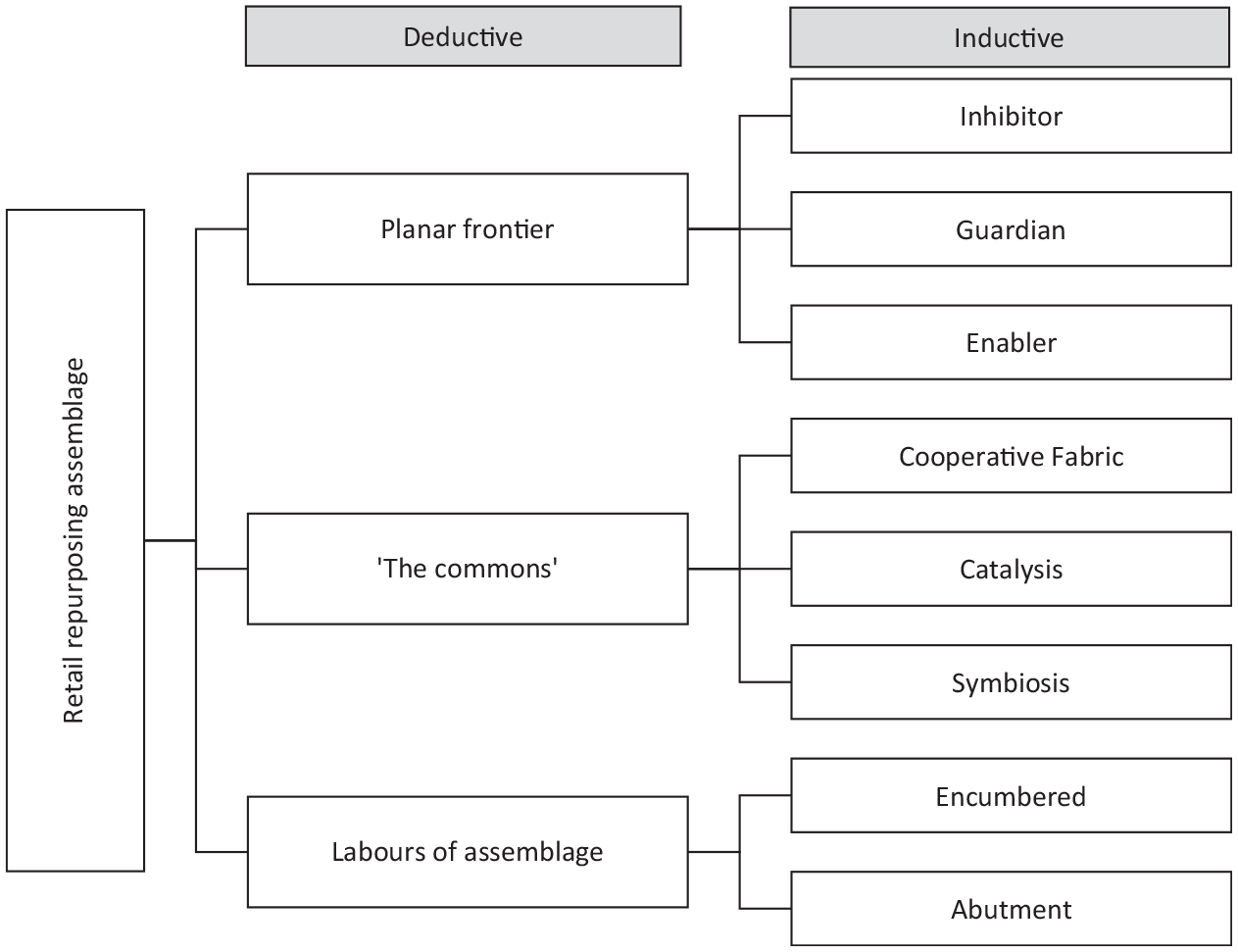
Hierarchical coding tree.
Findings
The analytical interpretations and explanations presented here rely on the qualitative data, with interviewees cited, interpreted through reference to the assemblage framework.
Exploring the planar frontier
The planar frontier is where assemblages go through processes of ‘becoming’ and evolving; new connections are made and existing relationalities continue. It is through these co-functioning relationships, through alliances and liaisons, that the new identity is generated, and the repurposing scheme emerges. These interactions are seen in three ways by the respondent stakeholders, and these sub-themes can be seen as representing a spectrum, from the plane of transcendence acting as: (1) an ‘inhibitor’ for repurposing schemes; (2) a ‘guardian’ for the wider good; and (3) an ‘enabler’ for the schemes, each discussed in turn.
There is a range of outcomes for the assemblage, including ‘unmaking’ if the repurposing cannot be completed. This can be associated with health and safety regulations, where there may be little or no room for negotiation or compromise, as noted by Owner05: ‘if it’s applied tightly, it can be a kiss of death’ and ‘financially it kills it’, highlighting that, once costs exceed financial viability, the assemblage fails, the components break apart, and the repurposing ceases.
Other factors are also seen to threaten the scheme, placing it in danger of failure and breaking apart, and two emerged consistently as especially problematic. From all categories the respondents identified these as (1) regulatory restrictions on advertising through signage (NonG05, PublPlan04, Owner04) and (2) licences for outdoor seating (Owner03, Owner04, Owner05, PrivPlan01). These were seen as important ways to both create a presence for the business, essential for success, but also to contribute to the vitality of the area. This was evidenced through the relaxation of licencing of street seating during the COVID-19 pandemic, as ‘you go into town and it’s buzzing … and it’s obviously stimulating demand’ (Owner05). The lack of signage was acknowledged as hiding the occupiers (PublPlan04), with passing trade not knowing the business is there (NonG05). Business failure can be problematic for the assemblage, as the occupier is forced to ‘unplug’ and the assemblage may break up or evolve and ‘become’ again.
Frustrations emerged where proposals, felt by occupiers to be important for business success, were refused. This was especially acute where owners/occupiers believed their plans, such as for outdoor seating beyond the curtilage of the property and the introduction of roof terraces, included both direct improvements to, and more general revitalisation of, the streetscape. Occup01 voiced frustrations that the council had been ‘super-unhelpful’ by rejecting their proposal to partnering to upgrade an adjacent public plaza. Refusals were based on concerns over the privatisation of public space (PrivPlan01), visual backdrops (NonG01), and architectural importance of the area and buildings (NonG01, PrivPlan03), for example.
With respect to the protection of existing users, residential occupiers require perhaps the highest level of protection from new uses and ‘you’d be normally looking out for protection of residential occupiers’ (PublPlan03). With a change of use to residential a Permitted Development Right (PDR) in England under the Town and Country Planning (General Permitted Development etc.) (England) (Amendment) Order 2021 in some situations, PublPlan03 explains that ‘it certainly complicates the picture for us … it does ask us a lot of questions about how we … how we might be able to or not be able to manage city centres and town centres going forward’. Concerns also relate to the quality of the conversion (NonG04), representing increasing guardianship challenges.
The positive enabling role played by planners was highlighted by many respondents, with EconDev01 describing how, if the scheme is right for the city, there is a need to be flexible and act as enablers because of the changing retail environment. Positive steps to allow the repurposing scheme to emerge included compromise in recognition that the scheme would otherwise fail (PublPlan03), accepting that the building needs to be repurposed and thus supporting change (PublPlan03), and proactively supporting the scheme via committees and other stakeholder groups (NonG01). Highlighting the crucial relationship at the planar frontier, Occup03 explained that ‘a massive enabler was the support from the council and more important[ly] from the planning department’ in connection with venting for a new air conditioning system. To avoid significant delays and costs from internal venting up to roof level, or negative visual impact from external venting to roof level, active compromise from both sides enabled an innovative solution to vent at ceiling level. These enabling interactions contrast with the inhibiting interactions in that they relate to the detailed changes to the property itself, and the generation and emergence of the new identity, whereas the plane of transcendence is more inhibitory in terms of higher-level planning policies and regulatory regime, and the area outside the boundaries of the property.
‘The commons’
As set out above, the formation and holding together of an assemblage rests on a process of making ‘the common’ through a cooperative fabric based on principles such as interaction, care and cohabitation, with actions and interactions variously contemporaneous and periodic. This came through clearly in several ways, the strongest being the idea of the cooperative fabric, but also that ‘the commons’ can be driven forward and the repurposing scheme moved towards completion through the actions of one stakeholder. In addition, with multi-occupied mixed-use properties, the idea of symbiotic relationships, whereby the assemblage comes into being through their energies, emerged as key to the formation and staying together of an assemblage, that is, a realised repurposing scheme.
The role of the planner was also highlighted, with PrivPlan03 praising the approach of the planning officer as excellent and as ‘proactive as he can be trying to facilitate things … he’s tried to move things along as quickly as possible’ noting, as above, the desire of the council to ‘give these buildings a viable ongoing existence’.
Furthermore, Occup03 discussed how, if a building had, say, residential on the top floor, office accommodation in the middle providing employment opportunities for the residents, with food and drink orientated uses on the ground floor, then ‘it’s sustainability within the centre, that’s what we’re after … it’s all very positive providing it’s done in the right way. And, obviously, there needs to be the right complementary mix of uses and people’. However, none of the case studies included residential accommodation, and stakeholders from four of the five case studies highlighted challenges associated specifically with residential occupiers within a mixed-use property, or area. They highlighted compatibility issues and ‘obvious conflicts’ (PrivPlan03) associated with, predominantly, noise-creating uses such as late-night drinking establishments and live entertainment venues. Residential occupiers would need protection from these dominant uses (PublPlan03). In assemblage terms this is seen as exerting pouvoir, creating dominance in the power relationship, not a characteristic of symbiotic relationships. While many uses can be carefully coordinated (Owner04), Owner04 explained, ‘a resident has a different expectation from an office user … from a retail operator, it’s only natural’ and, thus, ‘the principle of having lots of people there throughout the day or night is widely accepted but when there’s a mix of uses there are technical challenges’ (PrivPlan02). NonG04 went further by stating, in the context of increasing city centre residential accommodation, ‘and that I believe is storing up problems for High Streets … [because] … you put residential in a retail area, that actually isn’t complementary’.
The labours of assemblage
Components within an assemblage are heterogenous and are not required to shed their differences. This underpins the empirical findings of Li (2007) and Baker and McGuirk (2017) that an assemblage is the result of ‘hard work’ (Li, 2007) and is a ‘laboured-over achievement’ (Baker and McGuirk, 2017). Notwithstanding the strength of the finding relating to the existence of the ‘cooperative fabric’, above, the participants also reveal different perspectives on the burden, or encumbrance felt by stakeholders.
One specific frustration emerges, with owners feeling their investment into the city, bringing in new businesses (and employers) as occupiers, investing in a new ‘destination property’ and contributing to the upgrading of an important location, often went unrecognised. This manifested as being asked for a financial contribution via a planning obligation, often part of the granting of planning permission in the UK to mitigate the impacts of a development proposal, with Owner04 explaining that it was a drain on the financial viability of the scheme, bringing it closer to collapse. Similar frustrations relating to the lack of support for job creation were voiced by Owner03 and Owner05.
Conclusions and implications
The unprecedented change in the retail sector is impacting the built environment in many city centres, with vacant and under-utilised space increasing significantly. The economic and social consequences are serious. This study has utilised assemblage thinking – exploring processuality through interactions at the planar frontier, where repurposing schemes are shaped by organising structures and the assemblage is remade; common desires that underpin the emerging of new formations; and hard work, the labours involved in change – to help map and understand the ways in which properties may be brought back into productive and enduring use. Drawing directly on the findings of the study, this section reviews the factors underpinning positive change, followed by areas of difficulty, with suggestions made to ease the obstacles identified.
Two of the sub-themes are identified as most commonly underpinning the positive evolution of the assemblage: the role of the plane of transcendence as ‘enabler’ on the planar frontier, and the ‘cooperative fabric’ of ‘the commons’. Investigation at the planar frontier reveals that positive change is enabled by the plane of transcendence, where an individual repurposing scheme aligns with the strategy and vision held by the local authority and other local organisations. Here, challenges that arise as the scheme evolves are overcome through flexibility and compromise, achieved through working relationships akin to a partnership approach. This engenders the assemblage concept of evenness of power, with all components equal in status, developed through common desires. The idea of a cooperative fabric, built on shared values and desires, was perhaps the strongest theme to emerge from the research, with the focus being the desire to see the building brought back into repair, into use, reopened and doing well. This may be because the case studies are large and architecturally prominent properties, engendering nostalgia and local importance.
However, a number of areas emerged where the repurposing of space was felt to be hindered, with frustrations suggesting the presence of a hierarchy, or unequally distributed power. At the planar frontier, occupiers, more than other stakeholder groups, feel that higher level planning policies inhibit change and have been too slow to react to the rapid and fundamental shifts in the retail environment, and mixed and non-retail uses must be embraced. For well over a decade, there have been shifts in shopping behaviour and retailer failures, accelerated by the COVID-19 pandemic. The need for change arguably goes beyond the introduction of Use Class E in England in 2020, whereby permission is no longer required for a change of use between shops, financial and professional uses, restaurants and cafes, as well as some leisure and associated uses, intended to promote flexibility for developers, as well as the 2021 extension to PDR from Use Class E to residential. As a change in use often requires regulatory permission for structural work, this suggests the limited reach of the relaxation. A more fundamental update in guidance, directed towards mixed use, could help invigorate central areas.
Protection of the character of conservation areas and of architecturally significant buildings is at the core of the UK psyche. Yet occupiers need to advertise their business, create a buzz and draw trade into the area. These tensions relate to local authorities’ role as ‘guardian’, another example of power asymmetry, albeit eroded by the PDR extensions in England, which ‘stripped away councils’ ability to shape their local places’ (Clifford et al., 2021: 1). The cooperative fabric of ‘the commons’ could be harnessed through a shared governance structure with the local business community, formalising power symmetry and embedding the positivity between the planes of immanence and transcendence. Inclusive governance could balance changes pursued by occupiers for business success with concerns over the privatisation of public space and protecting distinctiveness, while controlling the quality of conversions.
Examination of ‘the commons’ also revealed that, if mixed uses – promoted by commentators such as Grimsey et al., 2018; Savills, 2020/21) – are to be enduring, they need to be in symbiosis. The right mix of tenants can go beyond co-existing; symbiotic relationships can generate a new entity for the repurposed property. This provides for business success, bringing employment opportunities, and consequent positive spill-over effects for the local area. Agglomeration economics has long been at the core of the high street, with the clustering of similar uses. In contrast, symbiosis between mixed uses could be extrapolated across whole areas, restructuring high streets, with footfall generated and vibrancy enhanced. However, fragmented ownership presents challenges distinct to those of highly curated malls and so, for this to be realised, inclusive and careful governance is needed to ‘avoid dysfunctionalities of urban agglomeration being able to undermine the viability of the city centre’ (Rogerson and Giddings, 2021: 1977). This contrasts with the loss of control through PDR, noted by Clifford et al. (2021) as a threat to viability, employment, growth and environmental sustainability and referred to as an anathema by Carmona (2022).
In terms of environmental sustainability that may be achieved through careful alignment of mixed uses, residential has been identified as a key element. However, interviewees repeatedly discussed that residential requires such strong protection that it can be problematic within individual schemes, and has been identified as a challenge for the future management of high streets, including a vibrant street-level frontage. This is important for the concept of 20-minute neighbourhoods, where urban places are recreated so residents can meet their day-to-day needs within a 20-minute walk of their home (see Gower and Grodach, 2022). Careful governance is needed.
Finally, and, to a degree, at the core of the cases discussed here, is the inherently risky and uncertain nature of repurposing schemes, compounded by the fundamental shifts in the functioning of city centres. Risk-sharing in large-scale city regeneration schemes is increasingly necessary, but is not adopted at the scale of individual properties. The burden felt by owners, more than any other stakeholder group, is revealed in the sub-theme ‘encumbered’, and is intensified by the financial burdens associated with planning obligations, and a lack of recognition of employment creation and efforts to upgrade wider areas. It is important that this is addressed to avoid jeopardising future repurposing schemes and the resilience of the city. The perception of one-way risk contradicts the common desire identified across stakeholders. A re-balancing of risk, through shared governance, could reassure owners that there are cross-party processes for risk mitigation relating to their investment.
In terms of final implications, the conclusions can be distilled as follows. Higher level shifts in planning strategies and visions are needed, to move away from the focus on retail towards guided restructuring through mixed use. Common desires across stakeholder groups could lead local decision-making and implementation, alleviating the burden of risk felt by owners. For occupiers, a relaxation of some regulatory controls to enable the generation of footfall and vitality, through attractors such as signage and seating, could support business success, providing vibrant and resilient places. Realising these changes may be possible through initiatives akin to neighbourhood plans, whereby the business community seeks to establish developmental priorities and plans. Furthermore, the identification of specific zones for the relaxation of some regulatory controls, with a pro-business enabling vision, may enhance vibrancy. Further research is needed into enabling repurposing to residential use to mitigate conflict and enhance enduring, sustainable and positive change. These initiatives are not simple or uncontroversial, and solutions not immediate, but the unprecedented change in the retail sector demands responses of such a scale to realise resilient and adaptive city centres or, moreover, fundamental urban change. The findings here could usefully form a research agenda across international contexts.
Footnotes
Acknowledgements
The interviewees’ time and insights are gratefully acknowledged, as is the work of James Hickie during the early stages of the research.
Declaration of conflicting interests
The author(s) declared no potential conflicts of interest with respect to the research, authorship, and/or publication of this article.
Funding
The author(s) disclosed receipt of the following financial support for the research, authorship, and/or publication of this article: This work was supported by the Economic, Social and Research Council [grant number ES/R005117/1].
