




Abstract
Smart cities promote computational and data-driven understandings of the built environment and have the potential to reconfigure urban planning and governance practices in profound ways. Smart urbanisation is often presented as a politically neutral and socially beneficial approach to achieve urban sustainability goals but the emphasis on data gathering and algorithmic analysis and decision-making has the tendency to restrict how urban stakeholders know and act upon cities. In this article, we apply Artistotle’s intellectual virtues of techne, episteme and phronesis to critique current practices of smart cities, data-driven urbanism and computational understandings of cities as they relate to urban planning theory and practice. We argue that the rise of smart cities represents a partial return to early- to mid-20th-century positivistic knowledge politics and the reassertion of technical experts as the drivers of urban change. However, we also highlight the recent emergence of citizen-centred smart cities as an opportunity to promote value rationality in urban planning activities. We conclude that there is a need for greater integration of techne, episteme and phronesis in the pursuit of smart cities to ensure that digitalisation does not foreclose on certain ways of knowing cities but instead, provides a foundation to support a progressive knowledge politics of urban development.
Introduction
The smart city agenda with its emphasis on ‘big data’ is an increasingly dominant approach to urban development (Karvonen et al., 2019; Willis and Aurigi, 2020). Founded on a realist epistemology, it assumes that there is a reality external to observation which can be known through the systematic application of the scientific method. Big data frames cities as complex systems that can be objectively known and accurately measured, tracked, statistically analysed, modelled and visualised while having the unintended consequence of promoting impoverished modes of urban development with deleterious, undemocratic impacts on residents (Datta, 2018; Kitchin, 2016; Luque-Ayala and Marvin, 2020; Mattern, 2021).
In this article, we argue that the pursuit of big data-led urbanism is a new mode of urban knowledge politics that demands further critical scrutiny. We contend that there are striking similarities between the instrumental and analytic rationalities of contemporary smart city developments and the expert-led urban planning practices of the early- to mid-20th century. We examine the rise of smart city developments and associated big data narratives by drawing upon urban planning scholarship that critiques technocratic planning practices and ‘objective’ positivistic knowledge embodying instrumental rationalities, as well as the subsequent rise of contemporary planning practices founded on multiple knowledges and the promotion of value rationalities (Healey, 1997, 2007).
Specifically, we apply a strong and vibrant stream of urban planning research founded upon Aristotle’s intellectual virtues of ‘knowing how’ (techne), ‘knowing what’ (episteme) and ‘knowing to what end’ (phronesis) to critique contemporary smart cities practices. By drawing attention to the recursive combination of these virtues, we argue that there is no single way to know cities but rather multiple ways that involve analytic, instrumental and value rationalities. Such a novel pluralistic perspective deepens the critique of smart city developments that promote a profoundly instrumental rationality (also underpinning 20th-century planning practices) and at the same time highlights burgeoning opportunities to promote phronesis (knowing to what end) and hence value rationality to open up the knowledge politics of the smart city to a broader range of voices and standpoints beyond cities and systems.
The knowledge politics of urban development
Although there are many definitions of planning, we subscribe to the view that planning is about connecting forms of knowledge with forms of action in the public domain (Friedmann, 1987). Knowing about cities and acting upon them are thus indelibly intertwined and mutually supportive activities. A century ago, urban planning knowledge was accumulated by trained experts (often engineers) who applied a positivistic logic to explain urban phenomena through causal laws that could be identified and validated through experimental testing and/or statistical analysis (Allmendinger, 2002). These positivistic approaches founded in the realism of natural sciences legitimised conclusions and predictions of planning experts who subsequently used them as the grounds for planned courses of action in cities. In many cases, this was a very effective way to produce the modern city but relied on elite forms of decision making and results that benefitted some at the expense of others (Healey, 1997).
Beginning in the 1960s, positivistic approaches to urban planning were increasingly critiqued and undermined by academics, activists and the media who argued that scientific knowledge was constructed through specific perspectives and paradigms (Davoudi, 2012; Healey, 2007). Advocates of environmental protection and social justice played a significant role in exposing the weaknesses of formalised technical knowledge and championed the value of ‘local’ knowledge in planning decisions (Karvonen and Brand, 2022; Van Herzele, 2004). Today planning knowledge is understood to be constructed through networks of actors that frame and filter what is experienced, observed and even imagined as it is arranged into systems of meaning shaped by contexts, purposes, values and power relations (Healey, 2007; Valler et al., 2023). Such distributed intelligence (Innes and Booher, 2000) emerges from various ‘construction sites’ of planning practice such as the council chamber, the professional studio and planning project deliberations in which forms of knowledge encounter each other and are filtered and arranged into arguments, justifications and concepts (Healey, 2007). In such sites, people debate meanings and values and make ‘practical judgements’ about the significance, validity and integrity of the knowledge claims of others (Flyvbjerg, 2001). This is a markedly different form of urban planning knowledge production when compared to the expert dominated positivistic approach practiced in the first half of the 20th century.
Over the last two decades, several planning theorists have applied Artistotle’s intellectual virtues of techne, episteme and phronesis to delve further into the knowledge politics of urban development (Davoudi, 2015; Flyvbjerg, 2001, 2004; Gunder, 2011). In basic terms, techne focuses on planning skills while episteme is about planning theories and concepts that underpin urban development processes. Meanwhile, phronesis emphasises practical wisdom and prudence and builds upon techne and episteme to provide the moral and ethical backbone of planning practice. This tripartite conceptual lens provides a useful way to connect planning theory about knowledge politics to contemporary smart cities activities.
Davoudi (2015) argues that contemporary planning practices are composed of reciprocal interrelations between techne, episteme and phronesis. Planners make practical judgements by ‘combining not separating, the Kantian dimensions of scientific, moral, and aesthetic understanding’ (Healey, 2009 cited in Davoudi, 2015: 327). Thus generating practical wisdom is less about having scientific knowledge in the form of big data collected and analysed beforehand and more about the practical experience of doing planning in cities. Paraphrasing Wagenaar (2004), Davoudi (2015: 321) argues ‘what planners know is not entirely held in their memory, codified rule books, databases or websites but is embodied in the actions in which they are engaged in’. This means that planners must often take action in complex environments with little or no codified knowledge about them. Such ‘embodied, embedded and enacted knowledge allows them to look beyond what is known and become “seasoned” planners capable of making practical judgement’ (Davoudi, 2015: 321–322). This perspective challenges and has largely overturned traditional conceptions of knowledge as abstract, disembodied, individual and formal which were predominant in early 20th-century planning practices.
While the ideology of positivism has declined in planning theory, positivist and rationalist thinking has continued to dominate planning practice and is embedded in our educational and governmental institutions (Fisher cited in Flyvbjerg, 2004: 286). Today, smart city developments and big data are vivid examples of the re-enchantment of positivism and scientific episteme in urban planning. Thus the Aristotelean perspective which has been used to critique and reconstruct planning practices is a useful way to explicate and critique these aspects of smart city developments. More specifically, the techne-episteme-phronesis approach provides a conceptual lens in smart city developments and big data applications to argue for greater attention to value or ends rationality (Turnbull, 2006). Specifically, it provides an opportunity to actively and deliberately promote phronesis (the value based deliberation of outcomes) in smart city developments to counter balance the emphasis on techne (e.g. the application and use of sensors and servers) and episteme (the generation and analysis of big data).
In the following sections, we apply Artistotle’s intellectual virtues in urban planning to analyse contemporary practices of smart cities and their implications on knowledge politics. Here, the emphasis on technological development in smart cities harkens back to the early-20th century and the rise of the modern networked city (Coutard and Rutherford, 2015). In other cases, the debates about smart cities in some contexts have created new opportunities for participatory planning where a wide range of stakeholders can scrutinise and deliberate about the positive and negative impacts of digitalisation on different individuals and groups (Cardullo and Kitchin, 2019; Stratigea et al., 2015).
The techne of smart cities
At the centre of all smart city practices is technology. It is through the application of the latest digital devices and networks that cities can benefit from the collection, analysis and application of big data. Techne is closely related to technology and involves the skills and techniques involved in enacting the smart city. This is primarily the domain of the engineer who engages in the practical, on-the-ground work of integrating information and communications technology (ICT) into the built environment. Thus, techne in contemporary urban planning can be interpreted as the art and craft of digitalising cities. However, techne is not restricted to smart cities and the engineering of the data-driven city; it also embodies core ‘planning skills’ such as drawing with computer software. Such skills are profoundly action-oriented and necessitate mastering the means to plan, which develops in cumulative fashion as planners interact with techniques and technologies. In practice, planners construct their interpretation of technologies while interacting with them (Davoudi, 2015).
With respect to knowledge politics, techne emphasises the production of the built environment or the ‘doings’ of urban development. Techne involves the drawing of a proposed street, the design of a water sensor network and the construction of a building. There is less emphasis on the overarching meaning of the built environment or how a particular intervention will impact current and future residents. Instead, there is a focus on the ‘know how’: how to realise a particular urban service or feature. Techne is a strongly contextual form of knowledge production that is about navigating the material and social characteristics of a particular place through an adherence to instrumental rationality. There are many parallels here with the birth of modern city building in the late-19th and early-20th century when urban development centred on the material production of buildings and infrastructure networks (Graham and Marvin, 2001). The means by which to build the city was the most significant matter of concern for urban stakeholders, and unsurprisingly, techne has returned as the primary rationality to create smart cities. Smart city builders ask: How can ICT be integrated into existing urban services? Who is most qualified and best situated to achieve this task? What needs to happen on the ground to make the smart city a reality?
Examples of techne include national programmes to promote smart city development such as the India Smart City Mission, the building of urban operating centres and dashboards in Rio de Janeiro and Dublin, and the creation of new cities such as Songdo to realise the data-driven city. The primary purpose of many of these developments is to create urban operating systems that can produce big datasets to produce a comprehensive overview of city operations (Luque-Ayala and Marvin, 2020). For example, urban operating systems explicitly link multiple smart city technologies to enable greater coordination of city systems. In this way, urban operating centres and city dashboards attempt to draw together and interlink urban big data to produce a synoptic city intelligence. Thus, the intellectual virtue of techne as practiced in the contemporary smart city involves building systems and infrastructures that are seamlessly integrated and produce a holistic perspective on urban metabolic processes.
Collectively, such developments represent a new urban age where data driven urban processes will provide connectivity that can facilitate improved collective services and improved quality of life for urban residents. In the coming decades, this could result in the wholesale reinvention of how cities look and function. For example, the further integration of urban artificial intelligences embedded in city brains, delivery robots and autonomous vehicles is likely to reshape urban forms and everyday life in cities (Son et al., 2023). However, the emphasis on techne and the integration of ICT and associated innovations into the built environment tends to ignore the outcomes and overarching purpose of creating the data-driven city. This is where Artistotle’s second intellectual virtue of episteme comes into play.
The episteme of the data-driven city
If techne is the intellectual virtue of ‘knowing how’, then episteme is the complementary virtue of ‘knowing what’ (Davoudi, 2015). Episteme is closely related to epistemology and centres on scientific knowledge production and the pursuit of universal principles. It forwards analytical rationality as a means to understand the meaning of things. In other words, where techne is about practical application of tools and techniques in particular contexts, episteme is concerned with the development of universal principles of meaning that can be applied in a wide range of settings.
With respect to urban planning, Davoudi (2015) argues that episteme and techne are intertwined to the point that planning is a practice of knowing. Instead of thinking about knowledge as having an instrumental role in the planning process to provide a foundation for action, it is more accurate to characterise planning in and of itself as a process of knowing and learning. Seen in this way, knowledge and action are recursively interlinked with the former not preceding the latter in linear causal fashion (Allmendinger, 2002; Davoudi, 2015). Knowing how is inseparable from knowing what.
With respect to smart cities, episteme is clearly evident in the pursuit of universal laws that govern data-driven urbanism (Kitchin, 2016; Shelton, 2017). Identifying these principles is often separate from the building of the smart city and, thus, episteme and techne are independent knowledge practices. And there is a compelling logic that episteme can inform techne to realise the smart city. Knowledge is accumulated through analytical rationality and this knowledge in turn will support policy development. Indeed, the rise of the New Urban Science is an example of how data-driven urbanisation relies on episteme to know cities better (Derudder and van Meeteren, 2019; Karvonen et al., 2021). Computer and information scientists use the latest computational approaches to enrich ‘how we understand, explain and predict city processes’ (Duminy and Parnell, 2020: 650).
Strictly empirical and evidence based urban knowledge practices have been widely critiqued (Raco and Savini, 2019). For example, there are striking parallels here between the New Urban Science and long-standing calls for evidence-based planning where urban development decisions are based on pre-existing information (Davoudi, 2015). However, planners argue that the term ‘evidence’ has only limited utility in understanding the nature of planning activity and the role of knowledge in it (Healey, 2009). Instead of considering evidence as something that planners have (or seek to gain), they contend we should focus on knowing as an important planning skill (Hoch, 2009). Consequently, critics view such evidence-based planning as regressive because it represents a return to the previous era of positivistic knowledge production and instrumental rationality that produced dubious results in the previous century (Davoudi, 2015).
There are clear parallels here with episteme in smart cities. Data produced by networked technologies are assumed to be self-evident and readily applicable to shape policies and decision-making about urban futures. However, problems do not lie ‘out there’ waiting to be discovered and resolved through public policy but are constructed via the application of frames (Turnbull, 2006). By framing cities as systems, smart city developments and big data actively construct problems that can be addressed through planning policies. Thus, smart city developments and big data are far from self-evident but are selectively shaped by the gaze of policy makers where cities and urban populations are framed in an instrumentalist fashion (Datta, 2018; Kuecker and Hartley, 2020). In this way, smart city developments are often commensurate with Flyvbjerg’s (2001) view that power is knowledge, as smart city developments selectively collect data and ignore urban problems to achieve instrumentalist aims embodied in modernist ideals of functionality and efficiency. Other knowledges and epistemologies including folk, local and indigenous wisdom may be omitted, resulting in a highly circumscribed view of cities (Hartley and Kuecker, 2021).
Concomitantly, the pursuit of smart cities forges stronger connections between techne and episteme. In some activities, the gathering of evidence through big datasets is not just about assessing conditions to inform policy but to feed into algorithms to directly control urban collective services. The aforementioned urban operating centres and dashboards are sites where datasets are not only generated and assessed but where urban functions can be controlled in real time. Algorithms informed by machine learning and artificial intelligence can be used to process data streams in real time to manage transportation, energy, water and communication networks, resulting in the optimisation of city operations (Cugurullo, 2021; Luque-Ayala and Marvin, 2020; Macrorie et al., 2021). The result is a new form of highly responsive urban governance in which big data systems prefigure and set the urban agenda by controlling how city systems respond and perform. Such a tight coupling of techne and episteme serves to short circuit existing knowledge politics of urban planning and reduces the role of the urban planner to an algorithm developer or even supplants the planner altogether (Cowley and Caprotti, 2019). These initiatives follow the modernist assumption that ‘more data leads to better policy’ and this tends to colonise all manner of urban systems and environments while suturing and supplanting actors in their wake.
Episteme in the smart city shares with positivistic approaches of urban planning an emphasis on a panoptic core and the retrenchment of expert knowledge. Methods to comprehend cities which form the basis of planning practice have failed by the standards of natural science and led to an instrumental rationality devoid of a reasonable understanding of humankind and everyday life in cities (Flyvbjerg, 2001). However, the close coupling of techne and episteme in the smart city diverges from positivistic planning practices of the 20th century because it lacks the ambition to build a grand theory of city development. Instead, knowledge production and application in the data-driven city is incremental and recursive. There is no need to develop a long-term, big-picture perspective when algorithms can constantly adjust urban operations in real time (Karvonen, 2018). Instead, knowing the city involves processes of drawing together bits of data and organising them into a bricolage that exhibits particular patterns of performance. The algorithmic performance of cities is not free of politics, as some proponents have suggested (d’Ignazio and Klein, 2020), but is rather politics by proxy. Missing from the knowledge politics of smart cities discussed so far is the role of urban residents and their ability to inject their value judgements on how their cities are designed, built and operated. This leads us to the third of Artistotle’s intellectual virtues, phronesis.
Phronesis and the ethics of the smart city
Although it has no contemporary equivalent, phronesis may be translated as practical wisdom or prudence. It complements the instrumental rationality of techne (‘knowing how’) and the analytical rationality of episteme (‘knowing what’) with value rationality (‘knowing to what end’). Phronesis emphasises the consequences of actions rather than the intentions of actors or the means by which those actions are achieved. It suggests that we not only need to think about why we are doing something and how we are doing something but also need to consider the implications of those actions. It is about the ‘knowledge of ends’ as Kant calls it, that is equally important in planning practice as knowing what to do and knowing how to do it (Davoudi, 2015). Phronesis is oriented towards action in a particular situation; it is variable, context-dependent knowledge. It emphasises that knowing does not exist outside of the knower. Phronesis serves to guide our collective ethical choices about how we design, develop and operate cities (Flyvbjerg, 2004).
In practical terms, phronesis suggests that no matter how thoughtful and skilful planners become, it does not automatically follow that they know how to navigate complex ‘social–moral environments’ of planning processes (Wagenaar, 2004: 649) and hence which moral choices to make and which courses of actions to pursue (Davoudi, 2015). Here, the relations between individual planners, their communities and their conceptions of planning activity shape the ethical aspects of planning practice. Such relations are mediated through forms of representation, systems of rules and relations of power. In this complex web of relations, knowledge is not a separate category but rather permeates these relations which themselves are dynamic and constantly changing (Healey, 2007).
In making moral choices, planners consider how their practices and institutions may be deployed and structured in ways that obscure truth and prevent understanding, either suppressing the testimony of particular knowers (e.g. users of smart platforms) making it difficult for them to know what is in their interest to know, or distorting understanding and stymieing inquiry (Pohlhaus, 2017). Here there is a range of conflicting and complementary frameworks through which justice in a digital world can be understood (Kitchin, 2016). Different justice frameworks use different informational bases to evaluate whether a decision, society or distribution is fair (Sen, 1999). Epistemic injustice can therefore invisibly permeate all the mechanisms through which justice claims are made, through which justice is pursued and through which institutions are evaluated and held accountable (or not).
Data driven urbanism and the pursuit of the smart city hold significant potential to transform structures of meaning-making and knowledge-producing practices in the city in ways that can be more just or unjust. In short, the production of the smart city has ethical implications. The data infrastructures that underpin smart city visions may easily result in epistemic injustice owing to their tendency to describe their use of urban data in terms of what Haraway (1991: 195) describes as ‘the view from above, from nowhere, from simplicity’, claiming neutral and omniscient knowledge of the lives of urban residents. Complex and contradictory situated knowledges may be disembodied, simplified and potentially subjected to epistemic violence as data collection, analysis, communication and decision-making processes are performed by actors that are one or more steps removed from the local context in question (Dotson, 2011; Guma and Monstadt, 2021; Odendaal, 2021).
The epistemic injustices that are often embedded in the design of data infrastructures and data-driven algorithmic solutions to urban problems have a tendency to wilfully reinforce existing structural power differentials, because the perspectives of the elite and powerful are readily storied as the unbiased, unmediated and disembodied default position (d’Ignazio and Klein, 2020; Haraway, 1991). Distant data centres and omnipresent but invisible interfaces between humans and computational processes mask the people, methods, questions and rationales that lie behind the claims of seemingly neutral and objective data-driven knowledges. The supposedly objective and apolitical knowledges so produced tend to align with the perspectives and agendas of the people and institutions in positions of power (d’Ignazio and Klein, 2020) whose worldviews and value systems may not always align with those of the communities where data-driven solutions are deployed. The authoritarian tendencies of smart cities have the potential to create epistemically disadvantaged groups that lack the means to respond to technocratic, instrumentalist and rationalistic ways of knowing, with significant implications for justice and democratic empowerment.
There are several emerging practices of phronesis in smart cities and data-driven urbanism. The rise of citizen-centred smart cities in recent years, particularly in Barcelona, point towards an ethics of data-driven urbanism (Charnock et al., 2021; Lynch, 2020; Mann et al., 2020; March and Ribera-Fumaz, 2019). Here, the conversation about the digitalisation of the built environment starts not with how to achieve it (techne), or what principles to follow (episteme), but why digitalisation is being done and what are the implications to urban residents individually and collectively (phronesis). Open deliberation that is participatory is required to open up smart cities to those who will be affected by its design and implementation. There are clear synergies here with collaborative and participatory planning theories and practices that have flourished since the 1960s as well as more recent calls for Responsible Research & Innovation and technological sovereignty (Foth et al., 2021; Thapa et al., 2019). It is here where the smart city meets contemporary urban planning theory, specifically with respect to participation, deliberation and democratic decision-making.
Conclusions
The emergence of smart cities and data-driven urbanism introduces new modes of knowledge politics in urban planning theory and practice. Computational understandings of cities create particular governance logics which have significant potential to reduce everyday life to ‘calculative rules and procedures, underpinned by an instrumental rationality and realist epistemology’ (Kitchin, 2016: 1). They may also profoundly reconfigure knowledge and action as well as relations between the two in city governance practices, such as urban planning, and consequently foreclose ways of knowing and acting in these, such as phronesis. This matters, not least because in governance activities such as planning, features of a situation are carefully selected and described to frame and focus representations and interpretations of plans (Hoch, 2009). If such processes are reduced to a calculative logic shorn of any sense of value rationality, plans and policies are unlikely to resonate with citizens and will fail to address critical issues related to climate resilience, social cohesion and economic prosperity.
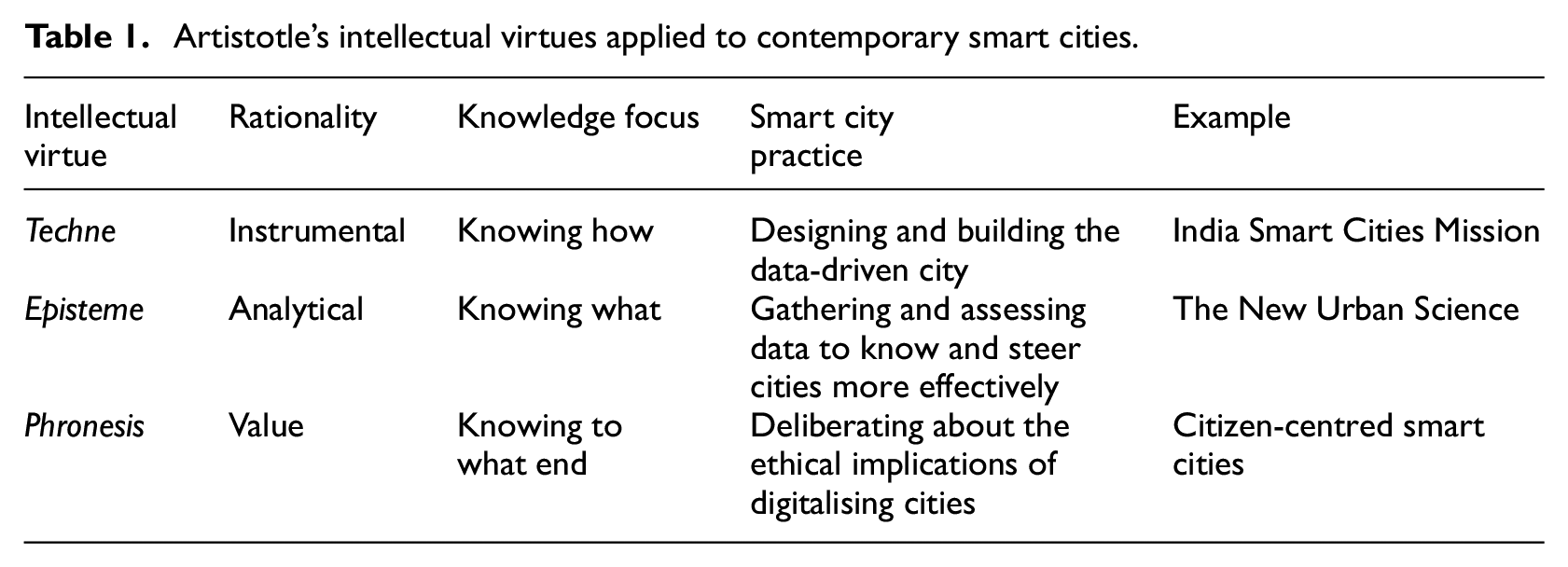
Artistotle’s intellectual virtues of techne, episteme and phronesis collectively comprise a useful lens to interpret the various ways that the digitalisation of cities parallels and diverges from previous activities of knowing and acting upon cities. The application of Artistotle’s intellectual virtues to contemporary smart city practices is summarised in Table 1.
Artistotle’s intellectual virtues applied to contemporary smart cities.
The rise of smart cities has many parallels with early- to mid-20th-century planning logics that were based on positivistic knowledge production and application. The pursuit of data-driven urbanism reasserts instrumental and analytic rationalities while celebrating the return of the technical expert to reinvent cities for the 21st century. From this perspective, knowing cities is achieved through the generation of positivistic knowledge which speaks for itself and follows an instrumentalist logic where knowing (e.g. about problems) is a priori and independent of action. At the same time, smart cities are being subjected to critique and injection of phronetic forms of knowledge politics that recognise the ethical and moral implications of digitalisation. This aligns with the rise of participatory planning since the late 1960s and the need to include a wide range of urban stakeholders in decisions about urban design and development. This suggests that smart city stakeholders need to not only address questions of ‘what’ and ‘how’ but also ‘to what end’ in the digitalisation of the built environment. An emphasis on data-driven urbanism has the potential to reinforce the utility of a panoptic core of city governance, with experts occupying an Archimedean position to steer cities towards particular ends. This stands in stark contrast to contemporary planning ideals that call for inclusive and democratic modes of urban development that benefit from the distributed intelligences of local residents.
The recursive combination of techne, episteme and phronesis is intended to recognise that there is no single way to know cities but rather multiple ways that involve analytic, instrumental and value rationalities. While analytic and instrumental rationalities are prominent in all smart city activities, value rationality is only beginning to emerge as an important component of knowledge politics of data-driven cities. The rise of smart citizens and public discourses on how digital technologies are applied to urban services opens up smart cities to issues of morality and justice. Ultimately the emphasis on phronesis as an intellectual virtue is an attempt to instil wisdom in the smart city. It is through a deliberate and concerted application of all three of Artistotle’s intellectual virtues that we can realise future cities that are beneficial not only to the technically informed elite but to all stakeholders. Universal principles and their application in the real world need to be complemented with deliberation and reflection on how these thoughts and actions impact all individuals and groups in a particular place.
It is through the combined application of techne, episteme and phronesis that the smart city can emerge as beneficial to urban populations rather than an instrument for a small cadre of technical elites with a particular urban vision. Crucially, in such instances, city analytics and their instrumental governance rationalities would not be allowed to trump reason, experience and other sources of knowledge founded on value-based rationalities. It is important to note that contemporary planning practices are far from perfect. Planning often relies on dated large scale datasets (such as a decennial population census) which provide simplistic ‘snap shots’ of urban life. Big data has significant potential to provide improved insights in such instances and could lead to potentially wiser planning decisions. However, it is important to remember that ‘knowing is a dynamic process that is situated and provisional, collective and distributed, pragmatic and purposive, and mediated and contested’ (Davoudi, 2015: 323). It is only through pluralistic, deliberative and reflective modes of knowledge politics that the smart city can emerge as a progressive and desirable approach to realising future cities.
Footnotes
Declaration of conflicting interests
The author(s) declared no potential conflicts of interest with respect to the research, authorship, and/or publication of this article.
Funding
The author(s) received no financial support for the research, authorship, and/or publication of this article.
