




Abstract
Complementary currencies have been promoted by ‘new-municipalism’ progressive movements to stimulate the local economy. Public administrations may engage in issuing complementary currencies or support them by realising expenditure and accepting them in payment. To assess and motivate the involvement of policymakers, measures to evaluate the multiplicative local impact of complementary currency programmes are required. The present research demonstrates a comparative procedure to analyse the local multiplier of income support payments provided by the City Council of Barcelona in euro and in a complementary currency, the REC. The results obtained show that the local impact of public income support can be enhanced when it is paid in a complementary currency and identify factors that mediate this effect.
Introduction
The forces driving globalisation have clashed with the need to generate more sustainable and fairer means of development to promote diverse economic practices beyond totalising conceptions of capitalist domination (Gibson-Graham, 2008). Alternative mechanisms to achieve an economy for the common good (Felber, 2015) have been proposed to respond to neoliberal austerity with the aim of mitigating spatially uneven progress and strengthen the local economy, to provide regeneration opportunities, address market and state failures in deprived neighbourhoods, and to tackle place-bounded economic and social development (Bayırbağ et al., 2017).
In this context, ‘new-municipalism’ initiatives emerging from social activism, with a flagship in the city of Barcelona, have gained leverage in local administrations (Russell, 2019; Thompson, 2021) as movements of political insurgence (Dikeç and Swyngedouw, 2017). Several governments resulting from these movements, the self-called ‘fearless cities’, have tested policies that seek a radical-democratic transformative response to urban capitalist dysfunction, to change the paradigm of city-regionalism which neglects issues of equity and social justice (Harvey, 2013). They do so by turning attention to local welfare systems (Andreotti et al., 2012), institutionally supporting initiatives aiming to control capital flows, shortening supply chains, socialising finance, creating self-sufficient circular economies and re-localising wealth creation (Jarvis, 2019; Thompson et al., 2022) in the pursuit of ‘alterity’ (Fuller and Jonas, 2016).
In Barcelona, the candidacies of change (candidaturas del cambio) that emerged across major Spanish cities after the financial crisis gave birth to the party ‘Barcelona en Comú’, which gained office in May 2015 (Thompson, 2019). The new administration provided political anchorage to social and political activists, representing a major rupture with the neoliberal urban model of gentrification and touristification that followed post-Olympic boosterism (Davies and Blanco, 2017). Albeit having to mediate with the contradictions of institutional action, the agenda of the municipal government included fostering cooperatives and social enterprises, the municipalisation of public services and providing support to ‘transformative social innovation’ in areas such as housing, public procurement or public participation in policymaking (Blanco et al., 2020). Among the experimental policies developed in Barcelona, the city launched a complementary currency in 2018, the REC, to provide an inclusion support payment across 10 disfavoured neighbourhoods (Martín Belmonte et al., 2021).
Grounded in the conceptualisation of the urban economy as a ‘leaky bucket’ from which resources flow out by the forces of capitalism and globalisation (Ward and Lewis, 2002), complementary currencies are devised as monetary systems that have the purpose of protecting, stimulating and re-orienting economic activities at the local or regional level (Blanc, 2011; Seyfang, 2006).
Whereas the aims of complementary currencies in promoting the local economy in a social redistributive manner are appealing to ‘new-municipalism’ initiatives, the existing literature on the local effects of using complementary currencies to provide support payments in deprived areas is scant and inconclusive (North, 2014; Pacione, 1997). As noted in the work around complementary currencies and transition economies by North (2007), Jonas (2010) and Fickey (2011), there is a need to move beyond the identification of alternative practices towards analysing their convenience, their strengths and their weaknesses (North, 2014). With this aim, our study analyses the income support payment provided by a complementary currency in Barcelona. It contributes to existing research by providing a novel evaluative framework of the economic flows generated, contrasting their local multiplier effect with the effect of comparable payments in euro and discussing factors that determine their effectiveness in retaining local wealth.
The article is structured as follows. First, we present background literature surrounding the provision of public support payments via complementary currencies and the assessment of local multiplier effects. Next, we describe Barcelona’s REC complementary currency programme. We subsequently analyse and compare the local multiplier effects of income support payments in euro and in RECs and measure the local impact of the currency. Finally, we evaluate the results, their contribution, limitations and lines for further investigation.
Background
Complementary currencies
Amongst complementary currencies, local currencies are paper-based or electronic monies that are used for market exchanges and are usually convertible and backed by national legal tender. They differ from service, mutual exchange and barter markets in that they are not based on inter-personal or closed circuits of credit. They also differ from cryptocurrencies as they circulate within a delimited geographical scope (Blanc, 2011).
The main objective of local currencies is to stimulate local circulation and to prevent capital flight, modifying patterns of consumption and promoting purchases in local businesses. They aim to position the participating organisations in favour of social capital, increasing consumer trust and loyalty. In doing so, they strive to contribute to building social cooperation and collective values which may be particularly relevant in deprived neighbourhoods with fragmented, disparate socio-economic groups (Forrest and Kearns, 2001). Furthermore, as local currencies aim to promote import substitution and reduce the required transportation, they can be understood as grassroots of degrowth and relocalisation and are associated with positive environmental impacts (Seyfang and Longhurst, 2013).
Several factors may however hinder the ability of complementary currencies to achieve these goals. The seminal studies conducted by Peter North and Noel Longhurst, analysing a plethora of complementary currency experiences, identify that, first and foremost, complementary currencies require a critical mass of engaged consumers, retail and wholesale businesses to develop and consolidate (North, 2010, 2014; North and Longhurst, 2013; Seyfang, 2006; Seyfang and Longhurst, 2013). Such a volume is only attainable after a sufficient circulation time and if several factors align. A large body of research shows that the existence of a significant business sector, including business-to-business suppliers and a breadth of possibilities for expenditure; the social conditions of consumers, their heterogeneity, degree of cohesion, level of education and age; the involvement of local banks and authorities; the incentives to participate and not to redeem the complementary currency and the existence of funding mechanisms based on the currency, are essential factors to their success (for reviews of this literature see Blanc, 2011; Michel and Hudon, 2015).
Notwithstanding these conditionings, since local public administrations have limitations in generating debt, complementary currencies have gained progressive policymakers’ attention as mechanisms to promote the local economy and to reduce inequality (Martín Belmonte et al., 2021). The public sector can have a direct role in issuing a complementary currency or promote it by fostering its use. This may include accepting it in payment of taxes and public services, using it to pay suppliers and workers or to issue bonuses, loans and support payments. Local currency initiatives have emerged with various degrees of public involvement worldwide. However, despite their potential to develop local intervention policies promoting social and economic dynamisation with limited resources, experiences in which public authorities have channelled expenditure in a local currency are scarce and their results under-researched (Muns et al., 2019).
An early experience of a public income support payment with a complementary currency is Bolsa Familia in Brazil, where it boosted local consumption and the labour market (De França et al., 2012). In Spain, several municipalities have channelled public support payments through local currencies. For example, San Juan de Aznalfarache (Andalusia) launched the Ossetana in 2012 to aid impoverished families (Caravaca and González, 2019). In Santa Coloma de Gramenet (Catalonia), the local administration launched the Grama in 2016 to give grants to retailers and Small and Medium Enterprises’ (SMEs) associations (Muns et al., 2019). More recently, in 2018, Barcelona (Catalonia) launched the REC to subsidise disfavoured neighbourhoods (Martín Belmonte et al., 2021). The present study is based on data from this later experience.
Local multipliers
Multiplier measures were originally developed for the analysis of the impact of governmental expenditure on the aggregate economy (Keynes, 1936). There exist several methodologies to compute multiplier indicators, depending on their degree of aggregation, the type of information available and the economic impacts analysed (Moretti, 2010).
At a microeconomic level, local multipliers measure the impact of expenditure on the local economy and its capacity for generating and retaining wealth. To do so, they must consider inflows of money as well as what local agents, consumers and businesses do with them. Local economic inflows can be spent on local goods and services, they can be spent on goods and services with no local presence (i.e. produced or commercialised by companies from a different territory), or they can be saved. When injections leave the area of interest or are saved, they cease to create wealth at the local level. Conversely, the portion of the inflow spent locally is a source of wealth for local agents that may cause further waves of income and wealth creation within the local economy (Mulligan, 2008). The local multiplier measures the ratio of the output of derived transactions over the primary amount of expenditure.
To evaluate the impact of local policies when information is limited, a simplified approach to compute local multiplier effects, the LM3, developed by the New Economics Foundation (NEF), has gained attention (Sacks, 2002). The LM3 analyses three consecutive rounds of expenditure incurring within the limits of a predefined territorial boundary. The first wave (A) considers the initial amount of expenditure originating from the impact analysed (a grant, the building of a critical infrastructure, etc.). The second round of expenditure (B) comprises the expenditure that the initial expenditure (A) has generated at the local level. The third wave (C) evaluates the local spending originated second-wave recipients. Finally, the LM3 divides the sum of the three waves of expenditure (A + B + C) by the first wave of expenditure (A). The measure is usually not computed beyond the fourth round of knock-on spending as the estimation becomes cumbersome and the ratio is assumed to rapidly decrease (Mitchell and Lemon, 2019). The LM3 captures the local wealth generated by the originating expenditure. It has been used to study the impacts of local public procurement of hospitals in the UK (Thatcher and Sharp, 2008), to analyse environmental policies shortening supply chains in the Czech Republic (Březina et al., 2013) and the local effects of online retail on an English market town (Mitchell and Lemon, 2019).
The use of complementary currencies for public expenditure is economically justifiable if they entail a comparatively higher local multiplier effect. Despite the fact that digitalisation of complementary currencies has facilitated traceability and access to detailed transaction data, few studies have attempted to quantitatively evaluate their economic local impact (Segura and Muns, 2019). Existing studies focus on monetary velocity and benchmark the multiplier effects of currencies with macroeconomic multiplier indicators of fiscal or national spending (De la Rosa and Stodder, 2015; Stodder, 2009).
To our knowledge, only two complementary currencies have been analysed with local multiplier measures. On the one hand, Lafuente-Sampietro (2021) obtained LM3 measures for two digital French schemes, a currency launched in 2014 and one launched in 2015, which respectively obtained a yearly LM3 of 2.34 in 2019 and of 2.05 in 2018. On the other hand, the public reports of the Grama programme in Santa Coloma de Gramanet (Spain), launched in December 2016, displayed an LM3 of 1.95 in the first year of circulation (LBD, 2018) and an LM3 of 5.39 in 2021 (LBD, 2022). While these are relevant reference values of the potential local multiplier effects of complementary currency programmes, the aforementioned schemes were not associated with the provision of an income support payment to deprived areas and neither were their results were contrasted with comparable injections in euro, which is the purpose of the present study. We measure and compare the local effects of social cash benefit payments granted by the City Council of Barcelona in the official currency, the euro, and in RECs, the currency associated with the B-MINCOME programme, which is described next.
Barcelona’s REC complementary currency programme
The endurance of structural swathes of poverty and a growing socio-economic segregation in the city of Barcelona have pushed the vulnerable population to the outskirts of the metropolitan urban sprawl and have strengthened historical progressive social movements, contributing to the electoral victory of ‘Barcelona en Comú’ as a response to austerity policies (Blanco et al., 2020). The emergence of a ‘new-municipalism’ form of urban governance, aimed at promoting political and economic reforms centred on social welfare, has been the object of previous research (Blakeley, 2005; Davies and Blanco, 2017; Eizaguirre et al., 2017; Thompson, 2021). The present study focuses on analysing the local economic impact of the REC currency developed under the B-MINCOME, one of the major programmes of public support to disfavoured neighbourhoods by the local government of Barcelona.
The B-MINCOME programme was an initiative to provide a social assistance minimum guaranteed income in deprived areas of Barcelona that was funded by the European Union’s Horizon 2020 Innovative Urban Actions and led by the Planning and Innovation Department of Barcelona City Council’s Social Rights Area (Laín et al., 2019). The objective of the payment was to fight the area’s weakened economy and commercial desertification by developing new economic circuits supporting the transition to a local, greener, circular and more egalitarian economy (Martín Belmonte et al., 2019).
Associated with the initiative, a complementary currency, named the REC (in Spanish, Recurso Económico Cuidadano), was created as a convertible Type 3 digital currency (ECB, 2012), co-funded by the Barcelona City Council and launched by the NOVACT Association. With a one-to-one exchange parity in euro and bank-account backing in euro, the REC currency was issued on the 25th of September of 2018 and remains in circulation at the date of this publication. The legal form of governance of the currency is a cooperative of stakeholders including its users and the civil society organisation managing the REC.
The B-MINCOME programme was implemented in 10 neighbourhoods of Barcelona, the so-called Eix Besòs. The per capita available household income of Eix Besòs was €13,361.08 in 2018, substantially below the average of the city of Barcelona, which was €20,956 that year (Barcelona City Council, 2021). The majority of the 950 individuals targeted as beneficiaries of the payments were women (84.00%). The majority of the households of the beneficiaries had four members (27.00%), five members (21.05%) and three members (20.00%) (Martín Belmonte et al., 2019). The transfer of the payment to the beneficiaries was made in RECs via a mobile app account linked to its backing in euro. Recipients were not allowed to withdraw RECs from the system and had to spend them on the goods or services provided by the retailers accepting the currency via the same mobile-app. Conversely, despite being actively encouraged to recirculate the RECs, the businesses and voluntary customers that participated in the system were allowed to redeem them without penalty. During the 13 months of the B-MINCOME income support payment programme, ending on the 30th of October 2019, 786,853.56 REC of payments were distributed to 532 beneficiaries. The initial 82 retailers reached 174 active business users, including three wholesalers, mostly from the food sector (40.94%). Eighty-two private users voluntarily engaged in the system. Data on the sociodemographic characteristics of the Eix Besòs, the B-MINCOME beneficiaries and the participating retailers are provided in the Online Supplemental Material.
Previous studies on the REC describe the flows originated and the involvement of participants (Martín Belmonte et al., 2019, 2021). The Supplemental Material summarises the results of surveys made to consumers and businesses and the exchanges made between September 2018 and October 2019. This article focuses on comparing the local multiplier of income support payments in euro and in RECs and developing measures of the total impact of the REC currency, including all sources of currency creation and exchanges, to globally evaluate the factors contributing to the local multiplicative effect of the programme.
Comparing the multiplier effects of income support payments in euro and in RECs
The local impact of the payments in euro and in RECs was evaluated using the LM3, considering the three first waves of expenditure: wave 1, the total amount paid to the beneficiaries of the income support payment; wave 2, the expenditure of the income support made in local businesses by the beneficiaries of wave 1; and wave 3, the local expenditure of income received in wave 2.
LM3 of the income support payment in euro
To delimit the first wave of the payments in euro, information was gathered regarding all the income support payments with a markedly finalist purpose that the Barcelona City Council awarded in 2017. We considered all the support payments that were aimed at individuals or families and had the goal to provide personal support. Information regarding the economic support provided to resident individuals or cohabitation units at risk of exclusion was screened and three types of aid distributed through debit cards were selected for this study: (1) aid to families with children aged 0–16; (2) aid to single-parent families; and (3) emergency food provision aid. The selection of payments corresponded to their similarity with the B-MINCOME in terms of purpose and potential beneficiaries. To quantify wave 1, we obtained the aggregate amounts paid. The total municipal aid budgeted in the city of Barcelona was €18,762,080.83 distributed among 22,528 beneficiaries. Of these, €4,141,694.12 was destined to households of Eix Besòs with 4938 beneficiaries. The expenditure realised by the beneficiaries in Barcelona was 86.12% of the budgeted amounts, totalling €16,158,292.55 in Barcelona. Since we lacked data on the specific expenditure realisation by Eix Besòs beneficiaries we estimated it by keeping the same proportion, totalling €3,566,912.75. Information regarding the beneficiaries and payments is provided in the Online Supplemental Material.
The second wave comprised the expenditure made in local businesses by the beneficiaries of the income support payments of wave 1. The information was provided by the Barcelona City Council, obtained from the supplier of the debit cards used to pay the benefit, CaixaBank, in the form of card settlements. The amounts were provided by geographic location (postal code) and aggregated by type of retailer (sector of activity) for smaller retailers, whereas distributor chains and franchisees were nominally identified. That is, the database provided the total amount that each type of retailer at each postal code had obtained from the payments to income support beneficiaries from Eix Besòs in 2017. Out of €16,158,292.55 of expenditure, 73.62% was spent in the city of Barcelona and 15.58% within the territorial area of Eix Besòs, whereas 19.17% of the expenditure was not geographically attributable, as the postal code of the expense was unrecorded. This unrecorded expenditure was geographically reassigned following the distribution of the recorded expenses. The resulting expenditure in wave 2 was €14,717,322.63 spent in the city of Barcelona and €3,113,888.93 spent in Eix Besòs. The Online Supplemental Material provides details of the estimation of wave 2.
The third wave comprises the expenditure made locally by the retailers that were recipients of wave 2 (e.g. salaries paid to local workers, goods and services acquired in local suppliers, etc.). According to the credit card records, 74.77% of the expenditure of wave 2 was carried out in large commercial chains or franchised establishments and 25.23% in local retailers. To obtain wave 3, an approximative approach based on qualitative interviews and secondary data was necessary. Following the procedure by Sacks (2002), the local expenditure in wave 3 was estimated differently for proximity retailers than for retailers identified to pertain to distribution chains or franchises.
To estimate the expenditure incurred locally by proximity retailers, in-depth interviews were conducted. We interviewed 15 proximity-retailers in Eix Besòs among those providing goods or services to income support recipients in the main sectors of destination of the expenditure of wave 2 (six local retailers from the food sector, two in the education sector, six from the hygiene-health sector and one from the clothing sector). These retailers provided information about their expenses (amounts, typology and frequency) and an approximation of the share of which of these were local. Weighting this information by sectors, we obtained the share of total local expenses. Out of the total €785,695.65 expenditure in proximity retailers of wave 2, 19.46% was estimated to remain in Eix Besòs. The Supplemental Material provides details of the estimation resulting from the interviews.
The local expenditure of retailers belonging to commercial chains was obtained by estimating the wages that these businesses paid locally, following the approach in Sacks (2002). The reasoning behind this approximation is that, with a highly centralised supply system, wages are the only expenditure incurred with a significant local destination. This is particularly applicable for reduced geographical areas with a low concentration of commercial suppliers, as is the case of Eix Besòs. In accordance, to approximate the contribution of commercial chains to wave 3, the weight of salaries over total expenditures was obtained from the aggregate accounts of the five retailers identified to accumulate 60% of the expenditure in wave 2 (extracted from SABI, 2019). The average share of salaries in the expenses of these retailers, once weighted by their participation in the expenditure of wave 2, was 9.8%. As a starting point to estimate the local wages paid, we made the maximalist assumption that 100% of the workers of these large retailers would be from Barcelona. To estimate the share of workers from Eix Besòs, we took into consideration that the inhabitants of Eix Besòs amounted to 7.13% of the population of Barcelona in 2018 (Barcelona City Council, 2021). Moreover, according to published mobility statistics, 20.2% of work-related transit in Barcelona was done by active mobility in 2018 (ATM Barcelona, 2018). Considering that the number of local workers of the neighbourhood that would not use active mobility (e.g. by foot, bicycle, scooter, etc.) to reach workplaces in the neighbourhood would be residual, we assumed 30% as an upper-bound approximation for the proportion of local workers. This assumption led us to estimate that, at most, 2.94% of the total expenditure of distribution chains and franchises in wave 2 was spent in Eix Besòs. Accordingly, €68,448.88 out of €2,328,193.28 of expenditure from chains or franchisees in wave 2 was estimated to materialise in Eix Besòs. The Supplemental Material includes a sensitivity analysis by estimating wave 3 for different proportions of local workers at the distribution chains.
Adding the estimated local expense by proximity retailers and distribution chains, a total of €221,345.26 was attributed to wave 3. The Supplemental Material presents the results per type of retailer and the approximation made to obtain the value of wave 3 for the city of Barcelona as a whole.
As a result of the three waves of expenditure considered, we obtained an LM3 of 1.94 for Eix Besòs. The approximation for the city of Barcelona was an LM3 of 2.14. The corresponding rate of local commercial retention of the income support payments was 6.21% in Eix Besòs and 23.32% in Barcelona. That is, 6.21% of the payments in Eix Besòs were estimated to remain circulating in the local economy of the district after three rounds of expenditure and 23.32% of payments in Barcelona, were estimated to remain in the economy of the city.
LM3 of the income support payment in RECs
The LM3 of the income support payment in a complementary currency, the REC, was obtained by estimating the three first waves of expenditure generated by the payment. The data to perform this analysis was provided by Novact, the entity managing the REC. The record of all the transactions done in RECs during the period analysed identified the sender, the receiver, the date and the quantity of RECs transacted.
To obtain the first wave of the payment in RECs, we considered the income support payment injections, duly recorded in the system. The total amount of RECs obtained by the beneficiaries of the payment, considering all possible sources, was 788,540.76 REC. A total of 786,853.56 REC (99.79%) was obtained as a support payment; 1608.12 REC (0.20%) from transacting with other agents and 79.08 REC (0.01%) from exchanging euro into RECs.
To estimate the amount of expenditure in wave 2, we first obtained the proportion that the income support payment represented of the total amount received by each of the beneficiaries (including all transactions). These weights averaged 99.79%. We attributed to wave 2 the corresponding share of the total amounts spent by the beneficiaries during the period under consideration. As a result, out of 691,262.66 REC spent by the income support payment beneficiaries, a total of 689,791.66 REC was attributed to wave 2.
The third wave of expenditure comprises the local expenditure that originated in the amounts that agents obtained in wave 2. To estimate the proportion of the expenditure to be imputed to wave 3, we computed the proportion that agents received in wave 2 over the total quantity received by each of these agents, including all transactions. These proportions averaged 92.55%. We attributed to wave 3 the corresponding share of the total amounts spent by each recipient of wave 2 during the period considered. As a result, a total of 171,467.66 REC was attributed to wave 3. The Online Supplemental Material includes details of the estimations of the three waves of expenditure.
The LM3 obtained for the REC income support payment was 2.09. Out of the 786,853.56 REC of payment, 21.79% was retained in circulation in Eix Besòs after three waves of expenditure. The local commercial retention was substantially higher than that obtained for the income support payments in euro (6.21%). Table 1 presents a comparison between the local multipliers and share of local circulation retention for the payments in euro and in RECs at each wave of expenditure.
Estimated amounts, local multipliers and share of local circulation retention for the three waves of expenditure of payments in euro and RECs.
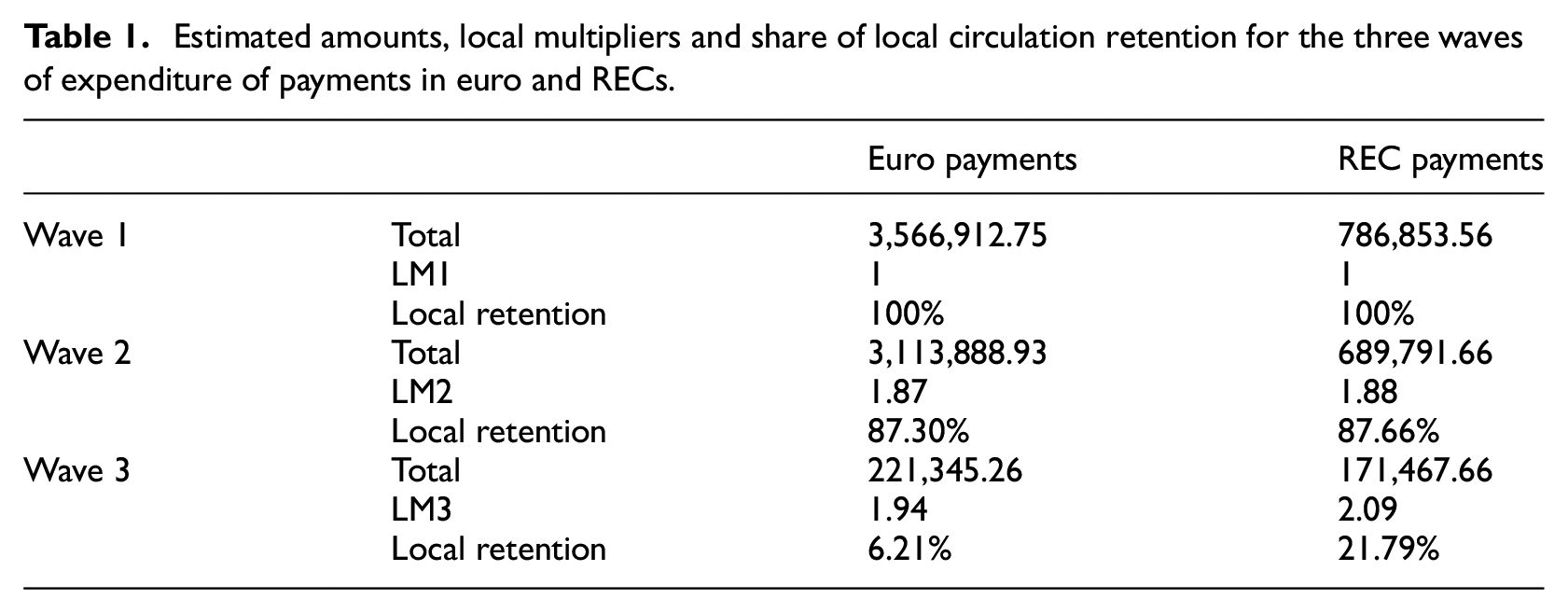
Whereas both income support payments caused a highly localised expenditure in the second wave, the REC payment created an important differential local circulation retention in the third wave. Even though the businesses withdrew an important amount of RECs during the period considered, 514,080.13 REC by retailers and 120,057.10 REC by wholesalers, they had a proportionally higher local expenditure in the third wave than those obtaining revenues from euro beneficiaries. Out of the 689,791.66 REC received, 21.79% were spent locally in the third wave of expenditure. Conversely, we estimated that the businesses of the second wave of the euro payments spent 6.21% of the €3,113,88.93 received locally. The analysis of the transactions made by the different agents in RECs and the resulting local multiplier of the currency as a whole is pursued in the following section.
Total local multiplier effects of the REC
The total multiplier effects of the REC, considering all sources of REC creation and transactions, is computed based on the complete record of transactions between September 2018 and October 2019, considering the total amounts injected and withdrawn, all business-to-business (B2B), business-to-consumer (B2C), consumer-to-business (C2B) and consumer-to-consumer (C2C) operations. Over the analysed period, 789,739.81 RECs were created, out of which 788,540.76 RECs (99.84%) corresponded to the income support payment injections, 2839.71 RECs (0.35%) were euro converted to REC by customers and 46.54 (0.01%) by retailers. A total of 634,159.43 RECs were withdrawn, representing 80.3% of all injected RECs.
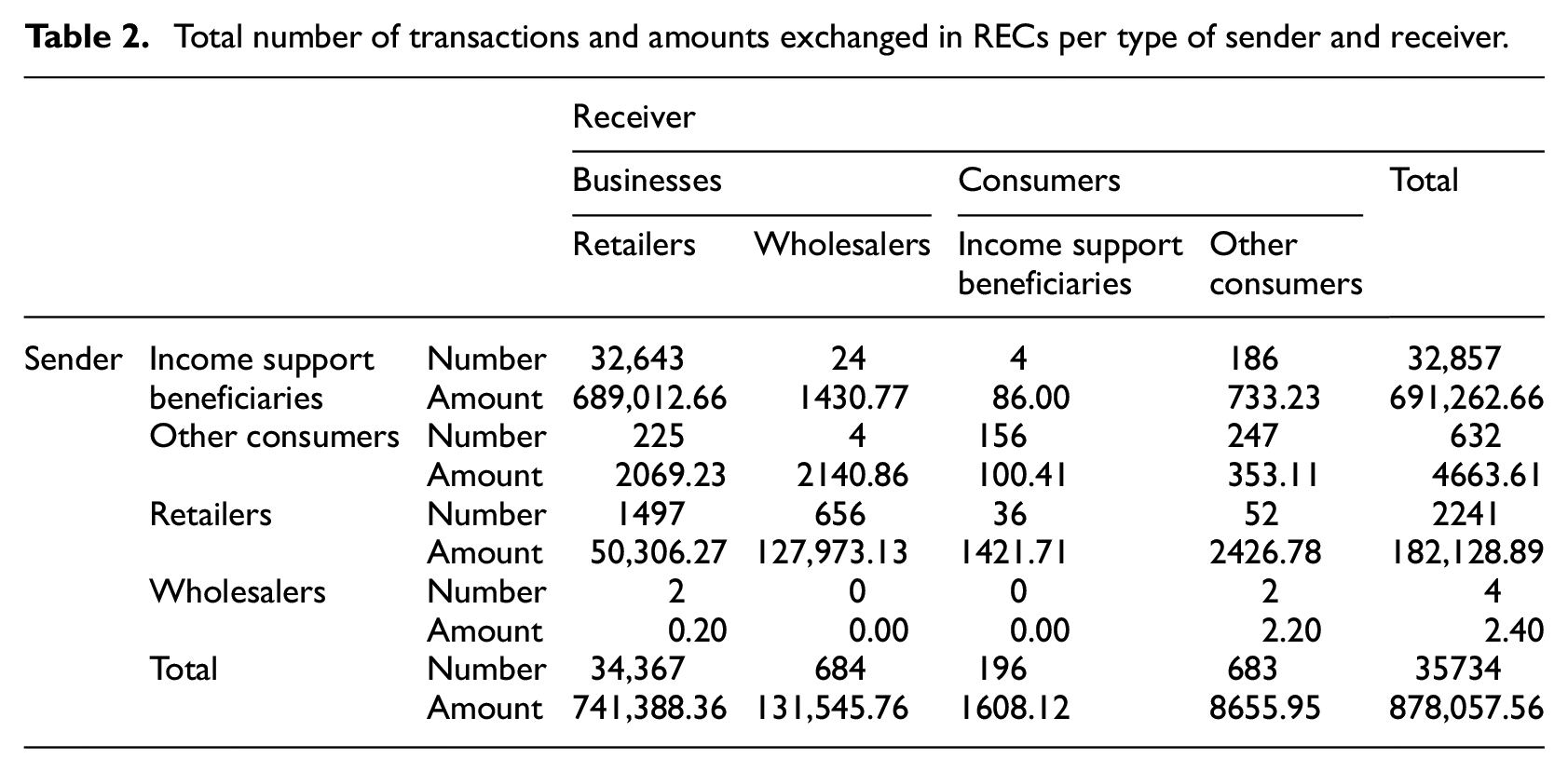
The predominant exchanges were C2B (694,653.52 REC), followed by B2B (178,280.60 REC). B2C (3850.69 REC) and C2C (1272.75 REC) transactions were scarce. A detailed analysis of the prevalent exchanges shows that C2B transactions were mostly done by the income support payment beneficiaries, 32,667 transactions totalling 690,443.43 REC, whereas other consumers only realised 229 transactions totalling 4210.09 REC. The main sector in which RECs were spent was food (23,640 transactions and 491,619.94 REC), pharmacies (3415 transactions and 61,415.83 REC) and supermarkets (2948 transactions and 40,359.02 REC). Among B2B transactions, 656 purchases totalling 127,973.13 REC were done to wholesalers whereas 1499 purchases with a total value of 50,306.47 REC were done to retailers. Table 2 summarises the number of transactions and amounts exchanged between senders and receivers of different types. The Supplemental Material provides details of the monthly monetary flows by type of exchange.
Total number of transactions and amounts exchanged in RECs per type of sender and receiver.
Three measures of the local multiplier of the transactions realised in RECs were computed: the monthly multiplier, the cumulative multiplier and the cumulative weighed multiplier.
The monthly multiplier was computed as the sum of the total RECs injected and all the transactions (B2B, B2C, C2C and C2B) realised during the month over the total RECs injected in that month. The monthly multiplier had a large variation. Disregarding an extreme value in February (23.05) due to a malfunction that deferred the payment to March, the two months with higher multipliers were May (2.58) and July (2.61).
A cumulative multiplier was developed to aggregate the impact of REC injections and total transactions from the first month of circulation until the end of the considered period. To obtain it, we added the injection of complementary currency with the cumulated total exchanges (B2B, B2C, C2C and C2B) made up to a certain month and divided it by the amount of complementary currency that had entered the system up to that same month. By the end of October 2019, the cumulative multiplier of RECs reached a value of 2.11.
Finally, we developed a cumulative weighted multiplier to account for the fact that the complementary currency was injected gradually. To do so, we weighted the amount of RECs injected by the number of days elapsed since their creation. By doing this, the cumulative multiplier reached a value of 2.95 after 402 days of circulation. The Online Supplemental Material provides a monthly summary of the multipliers obtained.
Conclusions
Progressive local governments linked to ‘new-municipalism’ and ‘transition’ movements around the globe have embraced complementary currency programmes as grassroots initiatives to materialise alternative ‘diverse economies’ for a post-capitalist future aiming to increase social engagement, promote local businesses and build new circuits of sustainable provision (Gibson-Graham, 2008). To evaluate whether and how public authorities should engage in actively promoting them in the pursuit of a local welfare system (Forrest and Kearns, 2001) and to overcome the potential resistance of policymakers in the face of a novel paradigm affecting pre-established protocols of public management, enhanced objective measures to capture their local economic impacts are required (North, 2014).
Our research contrasts the economic local effects of an income support payment channelled via a complementary currency by comparing them with the effects of a payment distributed in the official currency. The measures are grounded on the LM3 procedure developed by the New Economics Foundation to obtain local multipliers (Sacks, 2002) and are computed for data of income support payments provided by Barcelona City Council. The comparison between the results obtained for the multipliers of payments in euro and in RECs are indicative of the potential that public policies based on complementary currencies have in boosting the local economy. Results show that, after 13 months of circulation, the REC complementary currency achieved a larger local multiplier than payments in euro. Whereas the LM3 multiplier for payments in euro was 1.94 in Eix Besòs, implying a rate of local circulation retention of 6.21%, the LM3 multiplier for payments in RECs was 2.09 and the rate of local circulation retention was 21.79%. Moreover, the weighed cumulative local multiplier, considering the total effects of the complementary currency assessing all the exchanges generated by the currency, reached a value of 2.95.
The comparative analysis of the income support payments indicates that the expenditure generated in the second wave was highly local, both for euro and RECs, while the REC payment created a substantially higher local circulation retention in the third wave. Several intervening factors are worth mentioning. First, since the payments were aimed at covering the basic needs of the beneficiaries, a significant share was spent in food retailers, supermarkets and pharmacies, which, quite naturally, were of a local nature. Conversely, despite an important amount of RECs being redeemed by retailers, the third round of expenditure caused a comparatively larger external leakage of the euro payment than of the REC payment. Whereas the third wave of the euro payment corresponded mostly to the local wages of larger distributors, the expenditure in the third wave of the REC payment was mostly B2B transactions, of which 71.78% were purchases from the three wholesalers participating in the REC system, all in the food sector.
It is to be noted that the period analysed corresponds to the initial stages of implementation of the REC. Complementary currencies require a critical mass of consumers and a variety of engaged local and medium sized businesses to develop and consolidate (North, 2010, 2014; North and Longhurst, 2013; Seyfang, 2006). At the stage analysed, the main source of creation of RECs was the B-MINCOME income support payment. Few consumers and businesses converted euro to RECs to participate in the system. This caused the second wave to mostly correspond to the purchases of the income support beneficiaries. On the other hand, the rate of withdrawal was high and the third round of expenditure was dominated by B2B purchases from retailers to wholesalers. Very few exchanges implied B2C transactions (e.g. payment of salaries) or C2C exchanges (e.g. private transactions).
An increase in the volume of participants, including more wholesalers, retailers and service providers of varied sectors, as well as generating incentives and diversifying the sources for the creation and usage of RECs would contribute to strengthening the currency and its local retention power. The highly populated and dynamic urban nature of Barcelona, with a high density of networks and resources, plays in favour of the volume required to ensure the survival of the grassroots intervention (North and Longhurst, 2013). As a benchmark, take the Grama currency (also in Catalonia), which achieved an LM3 of 5.39 after five years of circulation (LBD, 2022). During this period, its uses were expanded from the issuing of public aid for local retailers to the partial voluntary payment of public servants’ salaries and, in 2022, the creation of a social income support payment for households at risk of social marginalisation. In this direction, the City Council of Barcelona has striven to generate incentives for the creation and circulation of RECs by recently issuing a bonification for cultural activities in RECs and extending their use to further neighbourhoods of the city.
Some considerations, limitations and potential scope for further investigation need to be outlined at this point.
First, it must be noted that, whereas our analysis of the local multiplier of the income support payment in the complementary currency was solely based on the effects of the exchanges done in RECs, any local multiplicative effects of the payment that may occur after the withdrawal of RECs and conversion to euro by companies or consumers was not integrated in the measures presented. Adding such further local effects would in turn increase the local multipliers associated with the B-MINCOME income support payment.
Second, our study compares the local effects of the income support payments provided in euro and in RECs on the available data from different periods between 2017 to 2019. When comparing the results of the local multipliers and the associated local circulation retention, we implicitly assumed that factors other than the currencies used, which could vary across the time span of the study, did not significantly explain the differences found in the multipliers. Additionally, it must be noted that the beneficiaries of the income support payments in euro and in RECs did not fully coincide. Despite the similar nature of the payments studied, there might be differences in behaviour between these groups of beneficiaries that our analysis could not capture. A potential study of a longer period, analysing within-subjects effects or randomly assigning perfectly equivalent payment schemes distributed in different currencies and in the same moment in time would be desirable to further explore the local multiplier effects and potential externalities of providing an income support payment in a complementary currency (Lafuente-Sampietro, 2021). Moreover, while we had quasi-perfect information on the REC transactions, several estimations and a sensitivity analysis were necessary to obtain the LM3 measures for the payments in euro. We based the computation of wave 3 on the results of in-depth interviews with proximity-retailers and an estimation of the local expenditure of distribution chains based on the weight of local salaries. As discussed in Thatcher and Sharp (2008), the approximation that the LM3 requires, especially when obtaining the third wave of expenditure, is one of its major limitations (Mitchell and Lemon, 2019).
Despite the interest of public administrations, previous research regarding the local multiplier and local circulation retention of public expenditure in a complementary currency is scarce (Martín Belmonte et al., 2021; Muns et al., 2019; Seyfang and Longhurst, 2013). Moreover, results of previous research only contrast these measures with national spending or fiscal multipliers (De la Rosa and Stodder, 2015; Martín Belmonte et al., 2021). We argue that such an approach is limited as it compares multipliers of expenditures with substantially different purposes, areas of implementation and objective populations (Michel and Hudon, 2015). The estimations made in our study, as well as the particularities of the payments analysed, warrant caution regarding their generalisability and limit the association of measures of significance to the difference in multipliers and local circulation retention rates.
Notwithstanding these limitations, our study contributes to going beyond theorisation and boosterism surrounding grassroots initiatives by providing empirical evidence of an instance where complementary currencies increase the local impact of public expenditure. It also demonstrates a novel methodology for evaluating a new generation of public policies based on complementary currencies. The study develops and demonstrates a procedure to benchmark the local impact of income support payments channelled in a complementary currency, a policy promoted by ‘new-municipalism’ initiatives (Thompson, 2021). The development of enhanced measures to evaluate the local multiplier effect and local circulation retention rates of payments in a complementary currency ultimately contributes to fostering the interest of policymakers by providing them with tools to evaluate the desirability of implementing such a system. Further research analysing the cost–benefit of undertaking such a programme, evaluating the return of the significant investment realised by the public authorities that promoted and developed it, would be necessary to appraise the scope required for it to pay off and its full economic implications. Moreover, an analysis of the social impact of issuing similar schemes based on complementary currencies would be necessary to encourage the development of such novel progressive ‘new-municipalism’ public initiatives aimed at mitigating uneven progress and providing regeneration opportunities in times of economic downturns. As further technological solutions are readily available to facilitate their management and analysis, public policies based on complementary currencies aimed at boosting local resilience in confronting economic recessions, incorporating social and environmental objectives in their design and protecting the sustainability of the local economy are bound to emerge.
Supplemental Material
sj-docx-1-usj-10.1177_00420980231177138 – Supplemental material for The local multiplier of income support paid in a complementary currency: Comparative evaluation in the city of Barcelona
Supplemental material, sj-docx-1-usj-10.1177_00420980231177138 for The local multiplier of income support paid in a complementary currency: Comparative evaluation in the city of Barcelona by Mercè Roca, Marta Segura, Jordi Puig and Susana Martín Belmonte in Urban Studies
Footnotes
Acknowledgements
We thank Dani Duocastella from NOVACT, Lluís Torrens, Director of Social Innovation, of the Area of Social Rights, Global Justice and Feminism and LGTBI of the Barcelona City council and Álvaro Porro of the Cooperative, Social and Solidarity Economy Department (responsible for the social currency project) for their support and data provision to conduct this study. We are also grateful to Lluís Muns, from Learning by Doing, for his invaluable contribution to the project and to our ESCI-UPF research assistants Guillem Artigau and Paula Martínez, contributing to data treatment. Finally, we thank Kathryn O’Connor for undertaking a professional proofreading of the final version of the manuscript.
Declaration of conflicting interests
The author(s) declared no potential conflicts of interest with respect to the research, authorship, and/or publication of this article.
Funding
The author(s) disclosed receipt of the following financial support for the research, authorship, and/or publication of this article: Funds for this study were provided by the B-MINCOME project from the Urban Innovative Actions Sub-programme of the European Regional Development Fund.

Supplemental material
Supplemental material for this article is available online.
References
Supplementary Material
Please find the following supplemental material available below.
For Open Access articles published under a Creative Commons License, all supplemental material carries the same license as the article it is associated with.
For non-Open Access articles published, all supplemental material carries a non-exclusive license, and permission requests for re-use of supplemental material or any part of supplemental material shall be sent directly to the copyright owner as specified in the copyright notice associated with the article.
