




Abstract
Do the leaders of minority communities in divided cities influence group members’ expressed willingness to engage politically with rival groups? Studies typically link group members’ willingness to engage with rival groups to direct contact between individuals from opposing groups. However, such contact is problematic in divided cities, wherein opportunities to interact are scarce and frowned upon. Focusing on the contested urban space of Jerusalem, we find indications that the diverse nature of community leadership in East Jerusalem can influence Palestinian residents’ attitudes towards political engagement with Israeli authorities via municipal elections. The ‘middlemen’ role can explain community leaders’ influence in divided cities. They facilitate indirect contact between their constituents and the other group’s members or institutions. Our analysis employs original data from a public opinion survey conducted among Palestinian residents of East Jerusalem immediately prior to the Jerusalem 2018 municipal elections. It has ramifications regarding urban governance for other divided cities.
Introduction
Divided cities are characterised by a violent and ongoing conflict over the state between two national groups living in the same urban setting (Nagle, 2013). This division is apparent in the city’s geography and reinforced by historically embedded segregation patterns and endogamy (Lustick, 1979). In addition, these cities suffer from a democratic deficit, mainly exhibited by a lack of political participation among the marginalised group. However, each group is not homogenous, and many ideas, attitudes and leadership at the urban and community levels are at play (Nagle, 2013). For example, in the last municipal elections in 2018 in Jerusalem, two local Palestinian leaders decided to run for the municipal election (Shicha Mekomit, 2018). These candidacies challenged the Palestinian anti-normalisation stance that opposed voting in mayoral and local council elections. Results of public opinion polls also evidenced this plurality of attitudes and normative change in Jerusalem. For example, one poll suggested that 39% of Palestinians were prepared to vote in the municipal elections (Shikaki and Ladadweh, 2010). Another poll reported that 58% of the respondents considered voting to elect representatives to promote their interests (Miodownik and Brenner, 2018).
Nevertheless, at most, actual election participation is 1% (Blake et al., 2018). This normative contrast in Jerusalem is puzzling and calls for an inquiry. Hence, in this paper, we ask: what motivates the attitudinal inclination to engage politically with the opposing groups’ institutions in a context where actual engagement is minimal?
In 2018, before the municipal election, we interviewed several Palestinian local leaders (Avni et al., 2022; Brenner et al., 2022). As they spoke spontaneously about the elections and the Palestinians’ attitudes towards them, they explained the role of community leaders in these processes. One explanation claims that the diversity of community leadership in the absence of central urban leadership produces a multiplicity of positions that eventually decrease the Palestinians’ ability to go against a robust anti-voting norm. For example, one Palestinian leader said: ‘Regarding the elections, it is easy to go against the elections and go with the mainstream. It is hard to go against it. In the absence of real central leadership, the multiplicity of leaderships weakens the struggle [for municipal redistribution]’ (Interview, 2018). The second explanation complements the first claim that community leadership reflects the variety of behaviours among Jerusalem’s residents. This sentiment is reflected in another leader’s interview: ‘A large number of [community] leaders reflect a large number of behaviours of the residents. … But when it comes to the big political questions, they understand that these leaders are irrelevant’ (Interview, 2018). This participant claims that residents turn to different leaders to address various local issues without central leadership. These leaders increase the urban political engagement of the residents and offer them an alternative to national leadership, but they need more power to promote a genuine political solution. Both explanations highlight the key and ambiguous role of community leadership and its plural nature, which increases the inclination of the residents to engage politically with other groups.
This paper further examines the relationship between political engagement and community leadership attitudes. Previous studies have tackled the issue of political engagement, seeking to unpack the conditions and mechanisms underlying efforts to enhance compromise and cooperation between rival groups in general (e.g., Halperin, 2014; Horowitz, 1985; Schneckener, 2016; Wilson, 2015). Others have examined the topic of political engagement in contested urban settings in the Global North (Bollens, 1999, 2012; Shlay and Rosen, 2010) and the Global South (Auerbach, 2017; Jonnalagadda, 2022). In this kind of setting, political engagement is a form of intergroup relations. Political engagement includes the residents’ political actions and attitudes vis-à-vis other groups or the authorities (e.g., voting in the municipal elections, public participation processes, protests or legal struggles). Using explanations from our interviews, we examine the problem of political engagement through the prism of community leadership as mediating leadership (Bénit-Gbaffou and Katsaura, 2014; Jonnalagadda, 2022) and present the concept of leadership repertoire. We argue for their influence over the residents’ attitudes following their role as middlemen. Minority community leaders often assume this role of middlemen (Purdue, 2001), achieving this via several means: (a) by expanding the social network of frequently isolated minorities and facilitating indirect contact with members of the other group; (b) by moderating the effect of intergroup tensions and enhancing, for instance, residents’ engagement in local politics or neighbourhood-level cooperation; and (c) by facilitating an alternative and less institutionalised channel for political engagement. To understand the effect of leadership on residents’ attitudes, we gain insight and develop hypotheses using contact theory and studies of community and opinion leaders.
We tested our hypotheses using a public opinion survey several months before the 2018 municipal elections. Our study outlines a new theoretical direction for the study of political engagement in divided cities, highlighting the role of community leaders as middlemen between opposing groups and the diversity of community leadership as a critical factor in changing the attitudes of marginalised groups. We conceptualise this diversity as a community leadership repertoire and define it as the composition of leaders (in terms of number and type) addressed by the residents when they have an urban problem or a local dispute. For example, a resident who wishes to improve the public transportation in his neighbourhood might find several leaders relevant: a local businessman, the community council chair, a local non-profit organisation or the municipality itself. Another resident might find none relevant and approach her family or community religious leader. Accordingly, we claim that minorities in divided cities are forced to find ways to engage the municipality despite their open national struggle against it (Avni et al., 2022; Shlomo, 2017). A diverse leadership repertoire offers these minorities several opportunities to engage and reconstruct their attitudes towards more contested forms of engagement, such as voting for the municipality.
The first section of this paper introduces the unique case of Jerusalem as a divided urban setting. The second section explains the concepts of ‘leadership repertoire’ and ‘middlemen’ and reviews the existing literature on intergroup political engagement. Later, it addresses the theoretical integration of political engagement, contact theory and community leadership and presents our hypotheses. In the third section, we detail our methodology and participant sample and outline the operationalisation of the variables. In the fourth section, we present our results and their interpretation. Finally, we conclude this paper with contributions and implications to theories of urban governance and intergroup relations in divided cities beyond the case of Jerusalem.
Leadership repertoire and urban politics in Jerusalem
Jerusalem is recognised in the literature as a divided (Bollens, 2012) and even polarised city (Benvenishti, 1983), with a dynamic demographic structure caused by continuous immigration (Zaban, 2017, 2020) and asymmetric power relations which favour the Jewish majority. Jerusalem’s contemporary geopolitical characteristics directly resulted from the war between Israel and Jordan in June 1967. Following the occupation of the Jordanian West Bank, Israel annexed to the city of Jerusalem an area of 70 km2 that included Jordanian Jerusalem as well as 22 Palestinian villages (the dark shaded grey spots beyond the ‘green line’ in Figure 1). In the 50 years that followed, Israel engaged in a massive construction project of residential neighbourhoods to integrate Jewish immigration in the annexed areas. These neighbourhoods (the light-shaded grey spots beyond the ‘green line’ in Figure 1) include Pisgat-Zeev, Neve Yaacov, French Hill and Ramat Shlomo in the North, as well as Gilo and Har Homa in the South (El-Atrash, 2016). However, the sprawling of Jewish neighbourhoods into East Jerusalem did not significantly increase the direct contact between Israeli and Palestinian residents. As a result, neighbourhoods (Jewish and Palestinian) remain segregated, except for the sporadic immigration of Israeli-Arabic and Palestinian families to Givat-Zeev and the French Hill (Shtern and Yacobi, 2019).
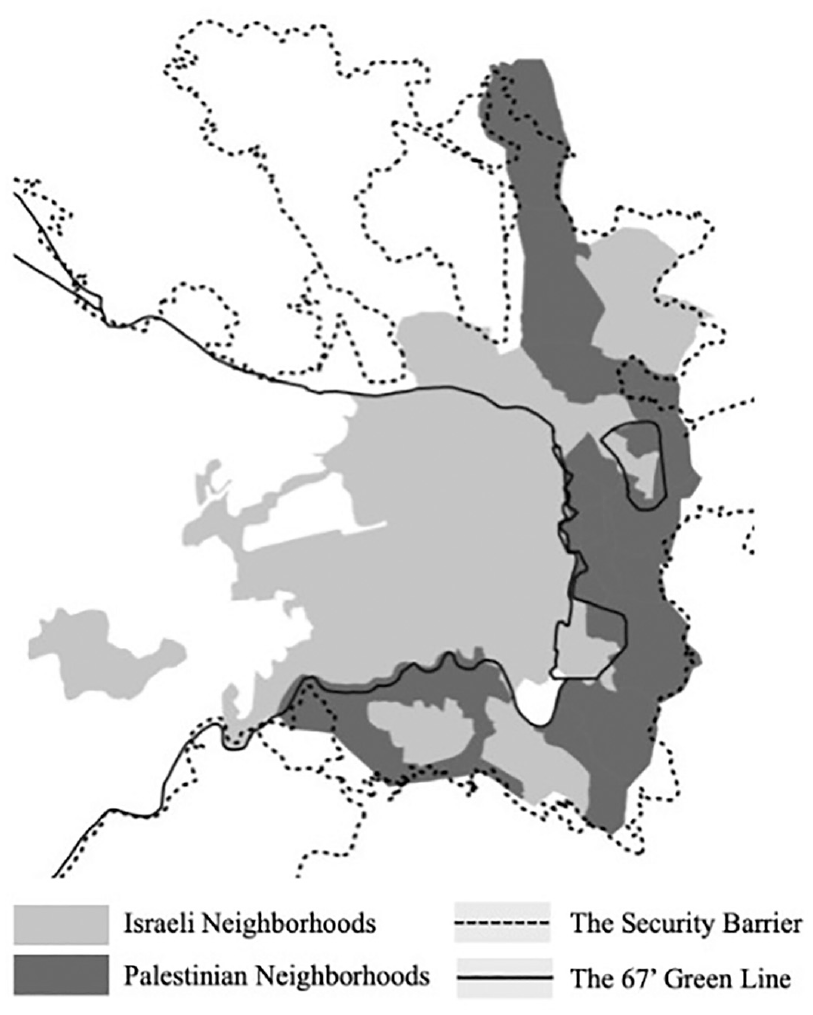
Geopolitical divisions and barriers in Jerusalem.
Another spatial characteristic of the city is the Security Fence, 1 the construction began in 2003, amid the Second Palestinian Intifada (the dotted line in the city’s outskirts on Figure 1). The fence stretches for most parts along the municipal boundaries of the city. It extends somewhat to the East and North-West to cover areas of major Jewish settlements outside Jerusalem. The fence also partly runs within the city’s municipal boundaries, demarcating two heavily populated Palestinian neighbourhoods (MP Shuafat and Kufr Aqab) (Rokem et al., 2018). The erection of the fence and physical demarcation of East Jerusalem from the rest of the West bank resulted in a massive re-entering of Palestinians, who had left the city but were keen to save their resident status and the legal, economic and social benefits it provides. This migration drove up the housing price and exacerbated the already severe social and economic problems of East Jerusalem (Hammoudeh et al., 2015). It was even more intensive due to the municipality and the state’s ethnonational agenda and planning (Jabareen, 2010), which limited the expansion of Palestinian neighbourhoods.
This urban development, influenced by the Israel-Palestine conflict, has implications for the Palestinians’ urban and national citizenship. Most Palestinians in East Jerusalem are not Israeli citizens but rather permanent residents of Israel. They can apply for Israeli citizenship, yet very few do so. They do not have the right to vote in national elections, but they do have the right to do so in local elections. Nevertheless, voting is frowned upon and viewed as a step towards ‘normalisation’ (Tatbie) and cooperation with the Israelis, an act that the Palestinian Authority and large segments section of the East Jerusalem residents fiercely oppose, as it denotes the de-facto recognition of Israel’s occupation. The contentious reality of Jerusalem, which also suffers from recurring eruptions of violence between Palestinians and Israelis (Bhavnani et al., 2014; Rokem et al., 2018), affects residents’ feelings of personal safety, mutual trust and willingness to engage with – or contact – the rival group (Canetti et al., 2017; Halperin, 2014).
Moreover, Jerusalem plays a central, symbolic role in the Israeli-Palestinian conflict; any positive or negative development may have broader implications. In this unique political context, most Palestinians deem political engagement inappropriate. More so, the Palestinian Authority strongly forbids any act seen as ‘normalisation’ of the occupation (e.g., participation in local elections). Therefore, the Palestinians are not represented at the national and municipal levels.
However, some Palestinians engage in politics at the sub-municipal and community level and other activities beyond elections, like voting for the community council board, approaching city institutions or protesting them and supporting local social enterprises (Avni et al., 2022). Nevertheless, voting in elections remains normatively inappropriate, forbidden by the Palestinian Authority, and rare (approximately 1%; Blake et al., 2018). This paper aims to unpack and understand attitudes about such engagement with community leadership in Jerusalem. The community leadership repertoire in East Jerusalem is diverse and involves numerous community initiatives, organisations, institutions and individuals working to improve residents’ lives (Asmar et al., 2015; Asmar and Kimchi, 2017; Isser, 2016; Nakal et al., 2015). Some leaders, such as religious figures or the Palestinian Authority (PA) officials, promote the struggle to recognise religious and political rights. Others advocate redistributing municipal resources, such as community councils and local activists. This current diverse nature of the local leadership in East Jerusalem resulted from the decline of the city’s traditional ‘noble’ families and the expulsion of the PA from the city in 2002 (Shlay and Rosen, 2015), and the Israeli government’s hostile attitude towards any PA involvement in East Jerusalem (Baumann and Massalha, 2021; Klein, 2005; Shtern, 2019). These processes provided fertile ground for the emergence of numerous local Palestinian leaders working to address their communities’ concerns while mediating with Israeli agencies. However, with behavioural norms dictated by leaders outside Jerusalem, residents have little political engagement and leadership remains at the sub-municipal level. Hence, it is essential to critically examine the role of leaders living within Jerusalem and serving as middlemen between Palestinians and Israelis.
The ‘middlemen’ and urban political engagement
We regard community leaders as middlemen who bridge the gap between members of the in-group and outgroup members (Jonnalagadda, 2022; Oliver-Lumerman et al., 2013; Sullivan et al., 2006). Middlemen are essential in conflict situations to transfer ideas between groups and traverse structural holes (Burt, 2004), especially when leaders are expected to be at the forefront of negotiations and confront the other side regarding future solutions (Lehrs, 2019). Middlemen perform a role that is quite different from that of other authority figures: police officers (who control groups; Dumper, 2013); coordinators (who encourage individuals to form a group; Baldassarri and Grossman, 2013); or political entrepreneurs (Jonnalagadda, 2022). The role of middlemen is evident in most intergroup situations. It is even more essential in divided cities (Aspinall and Berenschot, 2019; Masry-Herzalla and Razin, 2014), where such leaders are sometimes the only individuals engaging with the authorities to advocate on behalf of their group.
Moreover, since community leadership is pluralistic and diverse (Dahl, 1989; Hunter, 1953), each resident may be affected by a different leadership repertoire. We define leadership repertoire as the composition of leaders (in terms of number and type) addressed by the residents when they have an urban problem or a local dispute. Middlemen engage the opposing group or institutions on the residents’ behalf and transfer knowledge and awareness about the other side to their constituents. Hence, residents with a diverse leadership repertoire possess more political awareness about their community and the other side and have more ways to solve their urban problems. In addition, a diverse leadership repertoire increases the residents’ communal social capital within their neighbourhood and collaborative social capital with other communities (Purdue, 2001). Moreover, widening the residents’ network changes the political opportunity structure (Diani, 1997), indirectly allowing the residents to engage with the rival group. This diverseness also positively affects their willingness to engage politically directly, even in highly contested settings, like the Palestinians in Jerusalem.
The term ‘political engagement’ encompasses the various means by which citizens seek to alter their lives and their political institutions: typically, by voicing diverse opinions and reaching agreements (e.g., see Blokland et al., 2015; Cohen-Blankshtain and Ron, 2013; de Graaf et al., 2015; Van Neste, 2020). In divided societies characterised by social groups embroiled in continuous struggle, political engagement with the other side is usually highly contested and, sometimes, normatively forbidden (Bar-Tal, 2007; Bar-Tal and Teichman, 2005). Consequently, some groups may choose to abstain from such engagement (Beaulieu, 2006; Bhatti et al., 2019), such as Palestinians in Jerusalem (Blake et al., 2018). On the one hand, these groups undermine their representation in local politics by abstaining from participation in the elections. On the other hand, these groups and their national authorities ensure their internal cohesion and collective identity by abstaining from participation, bolstering their position in future negotiations with the dominant group. However, what explains the willingness to engage politically in divided cities? To answer this question, we focus on expressions of interest and participation as they unfold at the municipal level of governance. Daily life problems unfold in the city, and solutions are urgently needed and often formulated (Allegra et al., 2012; Bollens, 2012). The city is also where community leaders can function as mediators between their group and the municipality.
Many scholars of intergroup relations agree that political engagement reflects an advanced stage in recognising a rival group. In broad terms, the significant literature on intergroup engagement offers three theoretical arguments to explain how and when group members change their attitudes towards political engagement. First, contact hypothesis scholars have argued that direct and indirect contact between members of different groups reduces prejudice and promotes positive attitudes towards engagement with members of other groups (Allport, 1954; Eller et al., 2012; Kanas et al., 2017; Pettigrew et al., 2007; Pettigrew and Tropp, 2006). Second, studies of exposure to violence have argued that rational and psychological factors motivate residents to engage politically. For example, when the costs of violent counterattacks are high, the two sides seek a resolution (Olzak, 1992; Zartman, 1989). By contrast, exposure to conflict emphasises emotions of fear, hatred and anger, accentuating the distance between the two sides (Bar-Tal and Teichman, 2005; Canetti et al., 2017; Laketa, 2016). Third, the literature on in-group policing (Fearon and Laitin, 1996) has argued that intergroup political engagement occurs mainly due to the dense networks of ethnic groups in cities where group members are wary of violating group norms.
The approaches illustrated above devote most of their attention to describing intergroup relations in a broadly defined conflict resolution process. Other theorists, mainly scholars of divided cities, attempt to link day-to-day politics with national agendas. These theories define divided cities by a salient asymmetry in power relations, inequality and social instability (Allegra et al., 2012; Yiftachel and Yacobi, 2003). In such cases, residents – especially minorities who do not trust the city institutions – refrain from engaging politically with other institutions to resolve present or future issues (Björkdahl, 2013). Moreover, the municipalities and local politicians hold back from providing top-down solutions to these communities, leaving them to self-organise (Pierce, 2020). Finding a way to enhance functional trust seems necessary to achieve group goals due to the lack of engagement through direct participation. Direct and indirect individual contacts (e.g., friends) with outgroup members and via group leaders’ contacts may be a practical non-participatory way to promote group goals. We argue that community leaders can fulfil this function by acting as middlemen between rival groups, performing most political engagement on behalf of their followers while expanding their networks.
Recent contact theory studies have found that indirect contact (e.g., with friends) reduces prejudice and increases willingness to engage politically with the other side. For example, some studies have found that exposure to friends with connections with the other side amplifies the positive influence of direct contact on political engagement (Pettigrew et al., 2007). Moreover, such an impact is particularly pronounced among individuals who experience fewer opportunities for direct contact (Eller et al., 2012). Following these studies, we postulate a new theory that attempts to explain the role of community leaders as facilitators of indirect contact. Accordingly, based on our understanding of leaders as middlemen, our first hypothesis postulates:
H1: Diverse leadership repertoire is positively correlated with members of minority communities’ expressions of support for political engagement with the opposing group’s institutions.
Indeed, residents with a diverse leadership repertoire are exposed to various opinions. Such exposure increases residents’ political awareness regarding their neighbourhood or the city. According to opinion leadership studies, exposure to opinion leaders who act as bridges in social capital networks (Burt, 2004; Roch, 2005) correlated with information regarding other actors and groups in the network. Moreover, information about other groups increases the indirectly connected people (residents in this study) likelihood of espousing racial and political tolerance, supporting the ‘mainstream’ group line, and developing stable attitudes towards political engagement (Allport, 1954; Zaller, 1990). Thus, H1 anticipates that a diverse leadership repertoire positively affects the residents’ inclination to tolerate and politically engage with the opposing groups’ institutions.
Nevertheless, in contrast to other types of indirect contact (i.e., friends or colleagues), community leaders may promote a negative attitude regarding engagement because some leaders advance adverse opinions regarding the other side. Indeed, community leadership is characterized by many opinions and authorities (Dahl, 1989; Hunter, 1953; Parry, 2005) and diverse agendas: cooperative, oppositional, or even isolationist (e.g., Dempsey, 2020; Rosen and Shlay, 2014). Moreover, the notion that exposure to elite discourse automatically increases support for a unified elite opinion only applies to some issues. Many topics are highly contested, often to the extent that no mainstream discourse exists. Hence, a diverse repertoire among leaders can confuse residents or result in oppositional attitudes towards the other group, primarily if a consensus exists regarding a particular issue (e.g., not voting in the municipal elections in Jerusalem). In formal terms, our second hypothesis is:
H2: Diverse leadership repertoire is negatively correlated with members of minority communities’ expressions of support for political engagement with the opposing group’s institutions.
Previous research shows that direct contacts substantially affect political engagement with opposing groups more than indirect contacts (Mckeown and Dixon, 2017; Pettigrew et al., 2007). Thus, for example, residents who engage in direct contact attribute greater weight to their own experiences than to those of their friends (Eller et al., 2012), and direct contact amplifies the effect of indirect contact on tolerating the other group (Liebkind and McAlister, 1999; Paolini et al., 2004; Pettigrew et al., 2007). We assume that the same applies to leaders and residents who engage in direct contact; when residents have direct contact with the rival group, acquiring knowledge about its members, they will exhibit greater confidence in their engagements. Increased confidence often enables them to see the other side as individuals rather than one block and increases their ability to empathise with the rival group members. Moreover, such personal knowledge acts as a psychological anchor to overcome negative opinions imparted from the outside, such as those advocated by some community leaders. Hence, residents contacting opposing groups will be more resilient to predominantly negative opinions about the other side.
Moreover, such residents assemble their leadership repertoire according to their predisposition towards the other side (Zaller, 1990). Thus, their personal experience of direct contact with opposing group members will amplify their leadership repertoire’s effect. Therefore, our third hypothesis is:
H3: Direct contact with the other side amplifies the positive influence of a diverse leadership repertoire on residents’ expressions of support for political engagement or moderates its negative influence.
Data
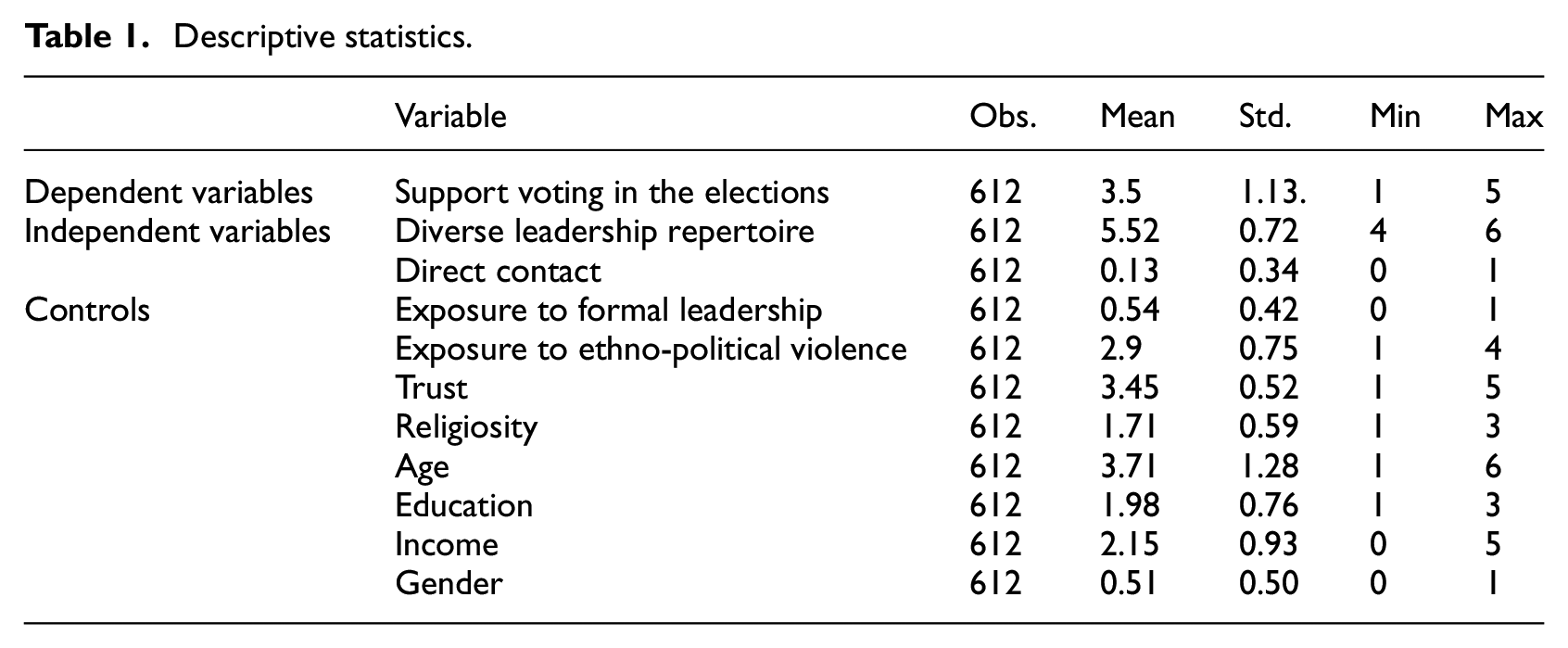
Data regarding the Jerusalem residents’ perceptions and attitudes are based on a public opinion survey conducted in January 2018, nine months before the municipal elections. The sample included 612 Palestinian respondents from East Jerusalem (95.3% Muslims and 4.7% Christians) interviewed face-to-face in their native language by a Palestinian interviewer. The survey was conducted in all East Jerusalem neighbourhoods. The sampling technique guaranteed representation according to geographical dimensions (e.g., the relative size of the East Jerusalem neighbourhoods) and socio-demographic fault lines: levels of education, income, religiosity, age and gender (see descriptive statistics in Table 1).
Descriptive statistics.
Main variables
This study examined the Palestinian residents’ attitudes towards future political engagement via support for voting for Palestinian representatives in the municipal elections. Because (historically) 99% of Palestinians have not voted (Blake et al., 2018), we focused on their attitude towards voting rather than their actual behaviour (0 = object, 1 = support, mean = 0.58, SD = 0.49). Interested in evaluating residents’ community leadership repertoire we asked residents to rank their three preferred leaders and to mark all relevant leaders in their neighbourhood according to eight categories (including community council, municipality, religious figure or organisation, Mukhtar or Sheikh, family members, local figure (such as businessmen or activists) and local organisation such as social clubs of parents’ associations). Figure 2 illustrates the diversity of the residents’ leadership preferences. We measured leadership repertoire by counting the number of leadership categories each respondent perceives as relevant in his or her neighbourhood. The diversity of the leadership repertoire is distributed between four to six leadership categories, with a tendency towards six categories (mean = 5.5, SD = 0.72). 2
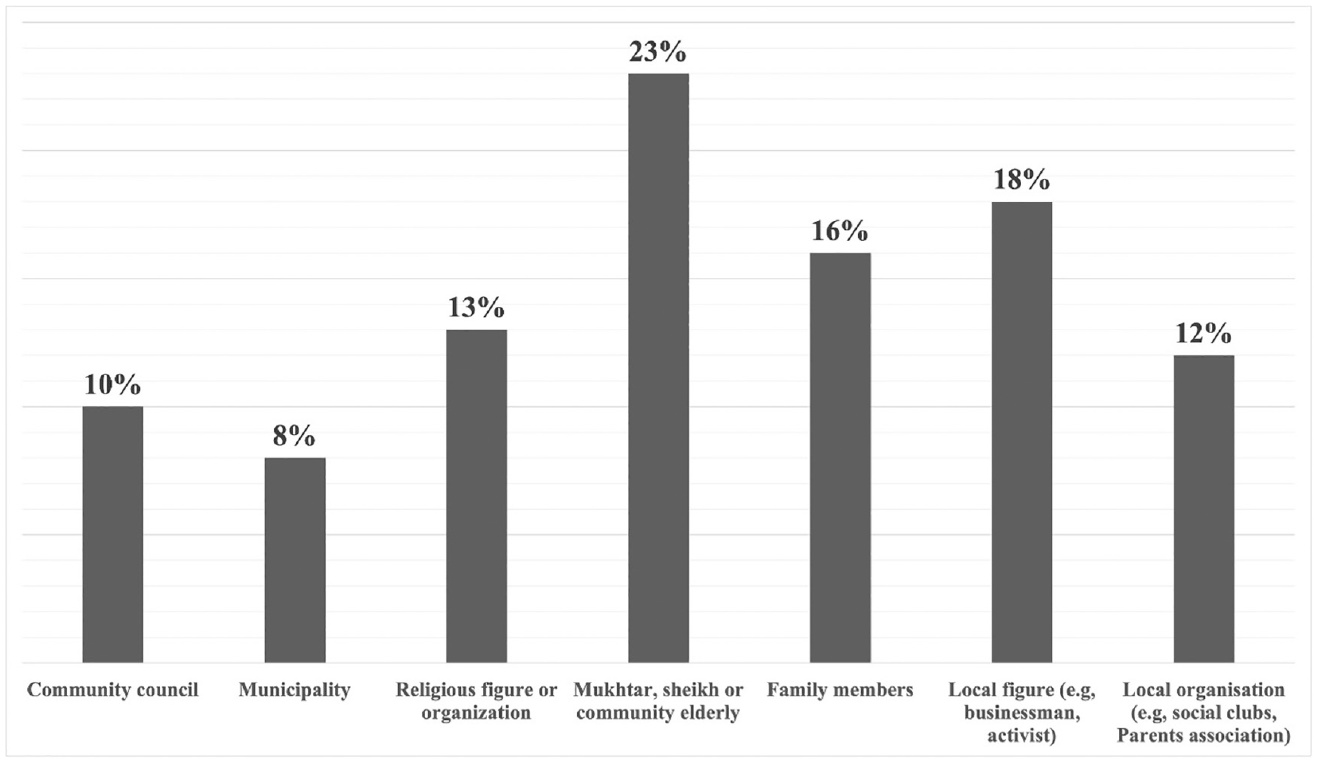
Diversity of leadership categories.
Guided by contact theory, we measured direct contact between the Palestinians and Israelis via two questions regarding the residents’ workplace location and the identity of their employer (Lolliot et al., 2015). We computed the two questions together to form a more substantive measure (0 = no contact, 1 = contact, mean = 0.13, SD = 0.34). 3
Control variables
Second, we controlled for exposure to conflict, which previous work showed influences political engagement (Canetti et al., 2017). Third, we employed valid measures from recent studies concerning city violence (Sampson et al., 1997) to measure the residents’ perceived exposure to ethnopolitical violence. The measure was constructed using the following question: ‘How often have you observed or heard of violent acts between Palestinian and Jewish residents or Israeli security forces in your neighbourhood during the past six months?’ Fourth, we also control for trust in community leadership, which is considered to have a prominent effect on followers’ attitudes towards their leaders (Ferrin and Dirks, 2002), social networks (Anderson et al., 2018) and social capital (Purdue, 2001). Lastly, we controlled several demographic characteristics: income, education, age, gender and religiosity.
Results
Our study sought to discover how leadership repertoire and direct contact with the other group influence attitudes towards political engagement, mainly support for voting in municipal elections. We also endeavoured to understand these two variables separately by unpacking their interactions. Therefore, we employed linear regression analysis to test our hypotheses. The analysis results support our first and third hypotheses (see Figure 3, Model 1). First, the results support H1 and refute H2 because a diverse leadership repertoire appears to have a statistically significant positive association with support for voting.
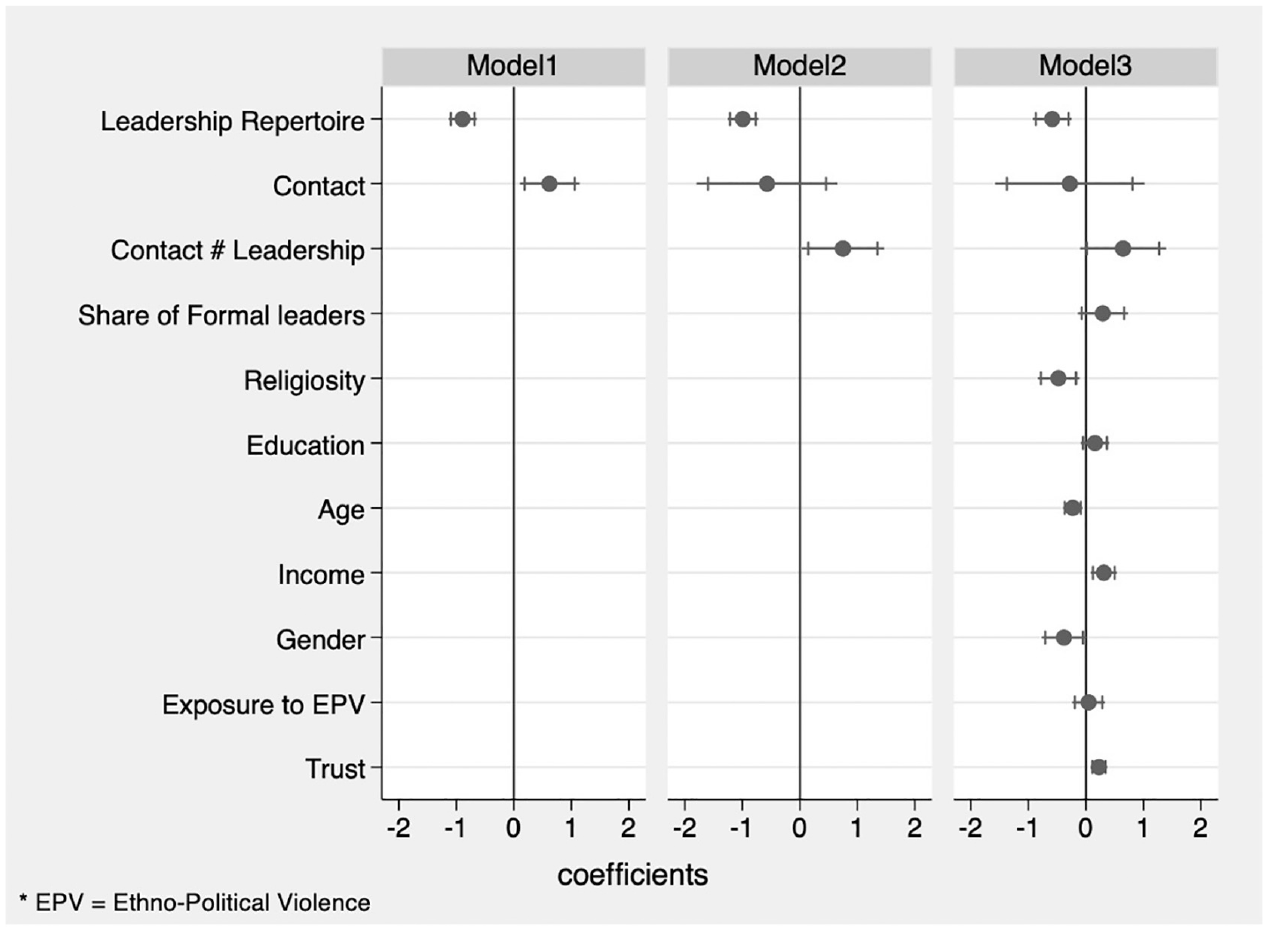
Individual predictors of support for voting in the municipal elections.
Moreover, in line with previous studies (Eller et al., 2012; Pettigrew et al., 2007), our analysis suggests that direct contact increases the likelihood of positive attitudes towards political engagement. The analysis also supports H3 (see Figure 3, Model 2), suggesting that direct contact amplifies the positive effect of a diverse leadership repertoire. These observations are significant even in the full model with controls (see Figure 3, Model 3).
Some controls were significant: religiosity, age and gender (female) decrease the residents’ likelihood of supporting voting in the elections, while trust in community leadership and income increase the residents’ likelihood of supporting voting in the elections.
H3 postulates that the effect of a diverse leadership repertoire will be moderated by exposure to direct contact. The analysis supports the expectation: the principal positive effect of a diverse leadership repertoire influenced only those respondents who did not directly contact the other side. In contrast, the multiple leaders’ opinions marginally affected residents who had direct contact with the other side. Figure 4 presents the predictive margins of the interaction model, demonstrating the moderating effect of direct contact on residents with diverse leadership repertoires. Once again, the impact of a diverse leadership repertoire depends heavily on the residents’ personal experiences with the other side or the absence of these experiences.
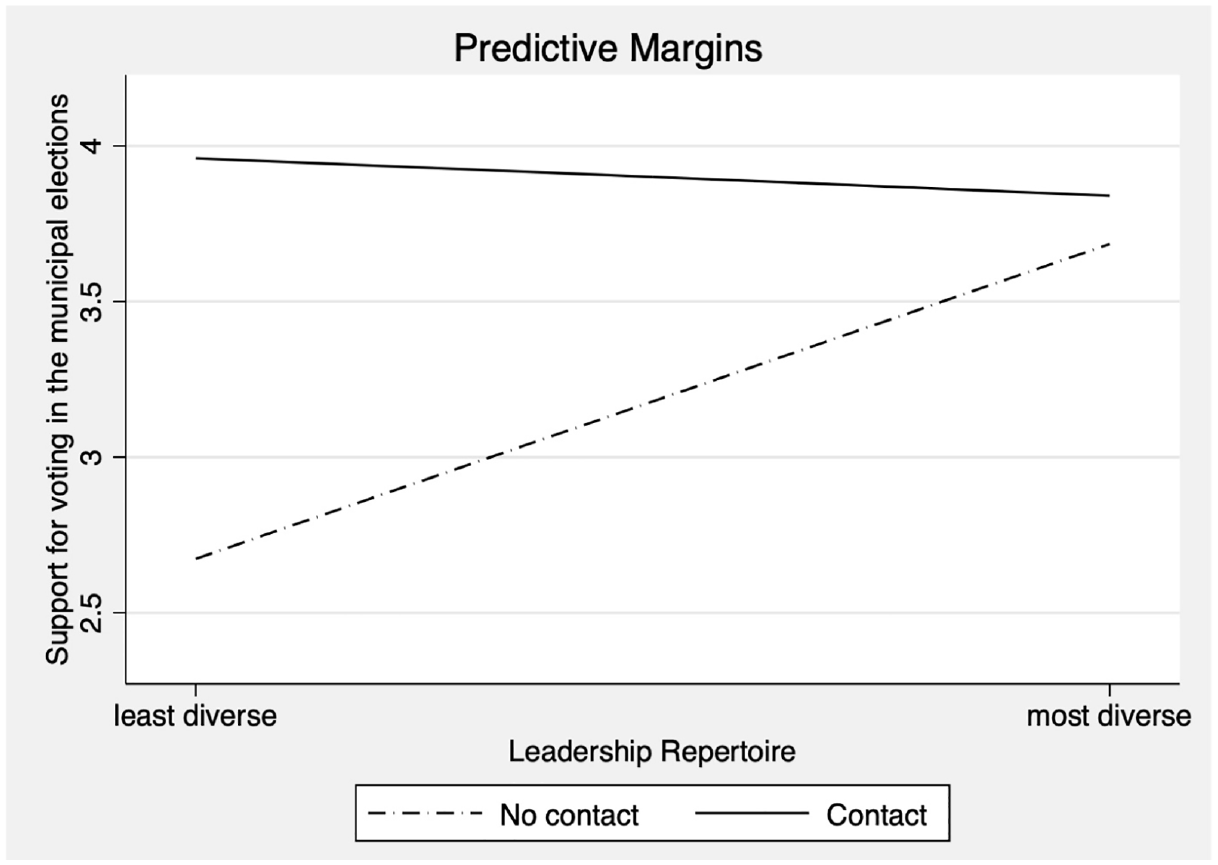
Interaction between leadership repertoire and direct contact.
Residents without direct contact depend more on community leaders’ mediation, so they are more likely to be influenced by them. Hence, when residents without direct contact with opposing group members have a more diverse repertoire (i.e., they have more relevant leadership categories), their willingness to legitimise voting increases. This diverse leadership repertoire represents a more varied set of opinions and alternatives to which the residents are exposed. Thus, residents without direct contact, who turn to a diverse repertoire of leaders, are looking for more alternatives to advance their interests and are open-minded about coming to see voting in elections as another alternative to this.
Robustness tests
We further examined the robustness of the results with coarsened exact matching (CEM) software (Blackwell et al., 2009; Iacus et al., 2012). The idea behind CEM is to coarsen each characteristic into meaningful categories to find a sizeable matching sample at the expanse of variance. In other words, CEM assesses a more precise effect of a single covariate in observational data. CEM matches respondents based on a pre-determined theoretically meaningful set of covariates by selecting identical pairs of respondents on all relevant independent variables but one: the treatment. CEM mimics an experimental design in which one group is treated, and the other serves as the control. We applied CEM following the suggested practice of Iacus et al. (2012): first, we coarsened the demographic variables (age, income, education and gender) into meaningful categories to create the new stratum. Then, we used a newly matched sample to rerun our analysis. The re-analysis results reaffirmed the robustness of the abovementioned observations (see Figures 5 and 6).
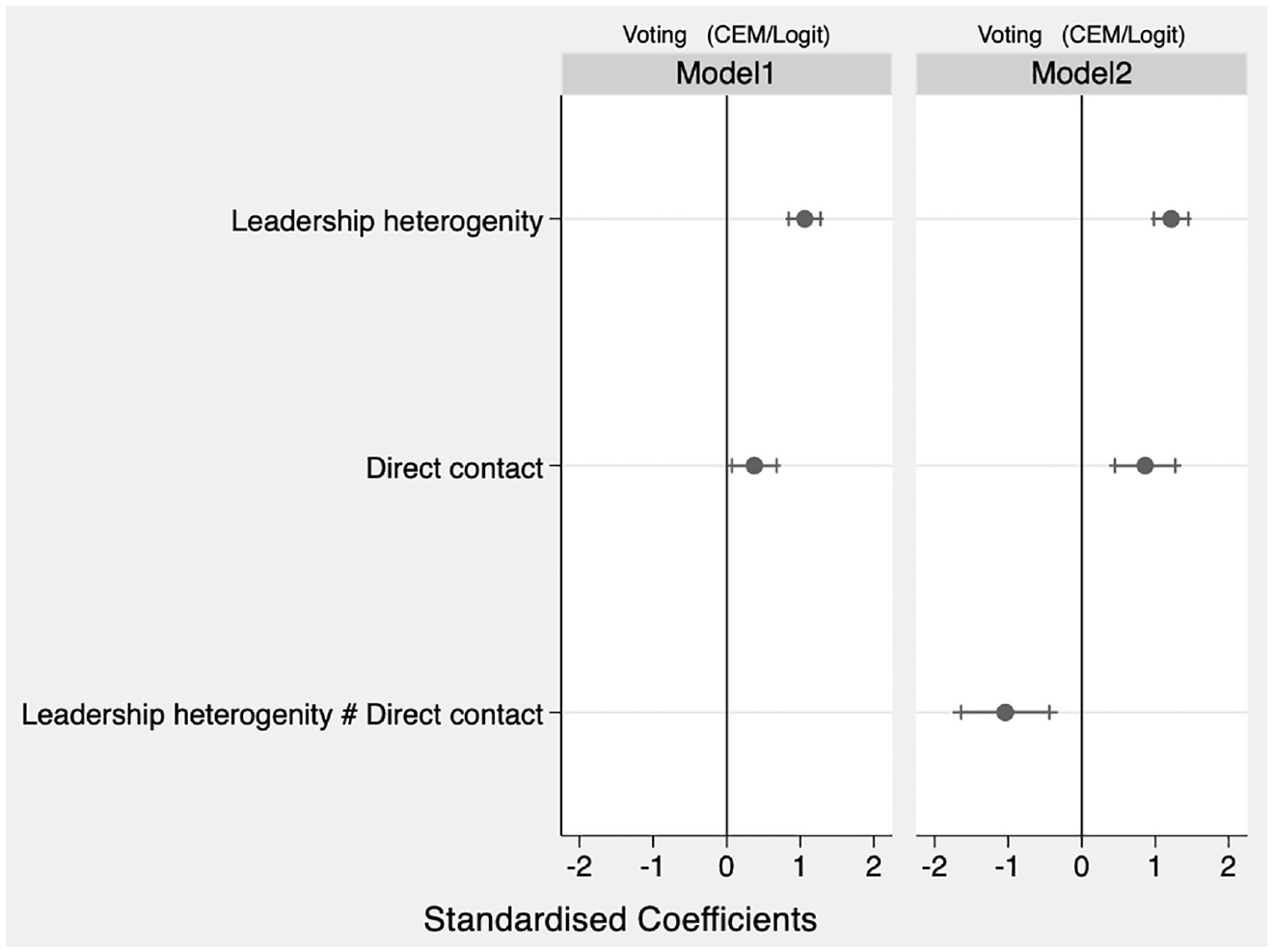
Effect of leadership repertoire and direct contact on support voting in the municipal election by CEM specifications.
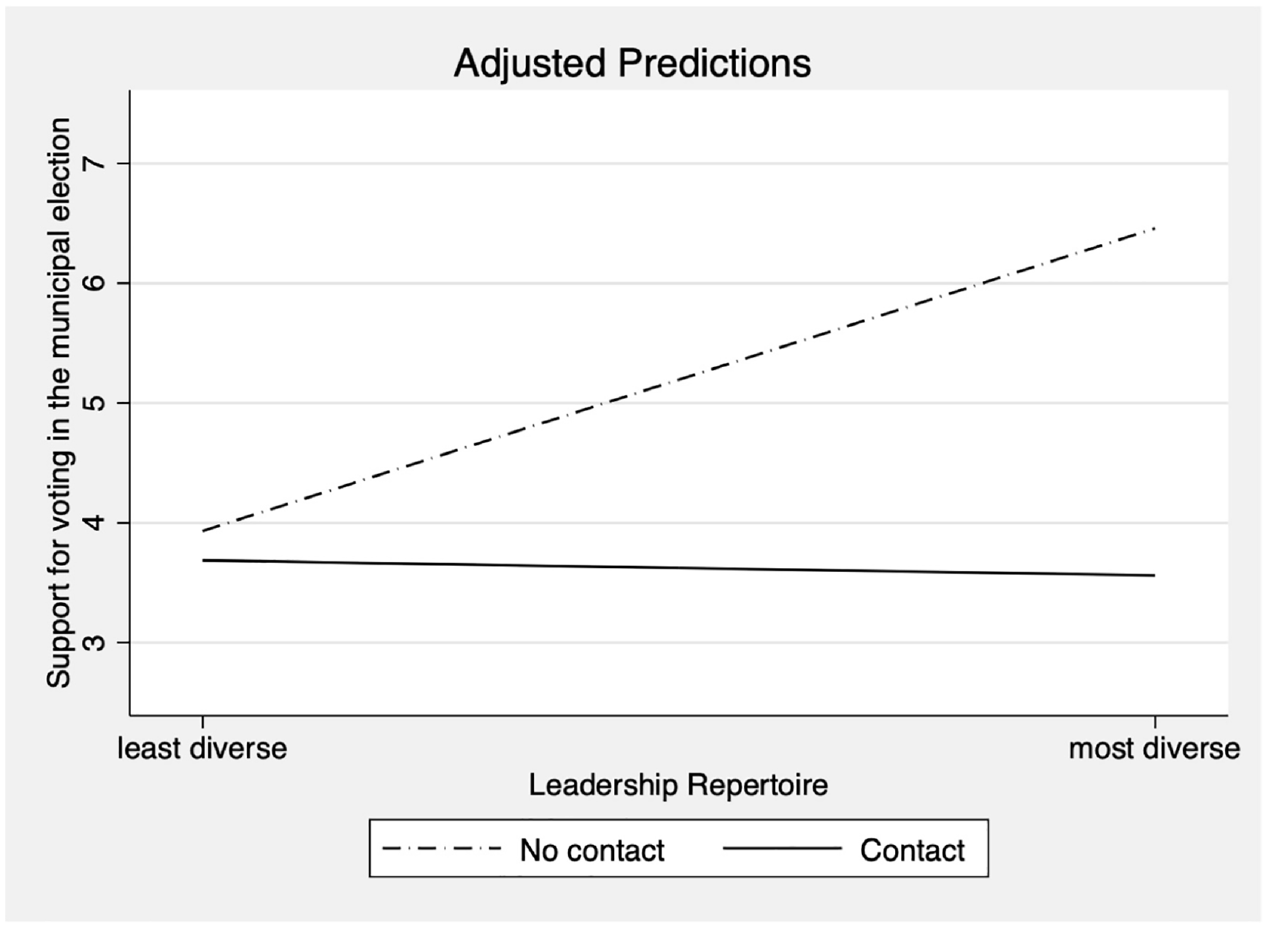
Interaction between leadership repertoire and direct contact (CEM model).
Conclusion: Beyond the case of Jerusalem
Political engagement in divided cities is highly contested and of critical significance. It constitutes one of the ‘golden paths’ towards achieving agreements between opposing groups in a fragmented society and including all communities in the political game (Nagle, 2013). Hence, when certain conditions are conducive to political engagement, they must be investigated further. In this article, we curiously followed and examined explanations in our conversations with local leaders in Jerusalem about why Palestinians abstain from voting in municipal elections. These explanations from the field, which presented the multiplicity of community leaders as a reflection of Palestinians’ urban political engagement, were in line with previous studies on Jerusalem (Avni et al., 2022; Brenner et al., 2022). However, while these accounts highlighted the contribution of these leaders to urban politics, we have taken the explanations about the plurality and multiplicity of the leaders a step further and examined their impact on national politics. Expressly, we understand their contribution to the legitimacy of voting in the municipal elections as an expression against the strong national norm of the Palestinian Jerusalemites. We adopted a novel perspective to this dilemma, asking whether – and, if so, how – minority community leaders in divided cities influence group members’ attitudes towards engagement in local politics. Our results support the argument that community leaders play a crucial role in mediating attitudes of political engagement between the Palestinians and the Israeli institutions. Furthermore, under certain conditions, they increase the residents’ positive attitudes towards engagement with the other side; in our study, supporting attitudes towards voting in the municipal elections. This observation is consistent with the recent theoretical trend to investigate broader local problems, including intergroup and minority-majority relations.
The concepts of leadership repertoire and leaders as ‘middlemen’ contributes to indirect contact literature, as it positions community leaders, like friends or employers, as indirect channels that influence the political attitudes of their followers. It also echoes the concept of ‘middlemen minorities’ described by Masry-Herzalla and Razin (2014). Their study showed the vital role of Israeli Arabs who migrate to Jerusalem and act as middlemen – teaching Hebrew, administrating schools or community councils and acting as lawyers or accountants against the Israeli authorities. It also reflects the concept of ‘political entrepreneurs in the global south’ (Aspinall and Berenschot, 2019; Jonnalagadda, 2022; McFarlane, 2012). Studies of the Global South cover hyper-urbanisation problems accompanied by urban inequality, informality, social instability and lack of resources. While these studies mainly address the sites like India, Africa, or Latin America, some critical scholars argue that a Global South approach could apply to the asymmetry site like East Jerusalem or other divided cities (Avni and Yiftachel, 2014). Likewise, we point out that these mid-level activists are crucial intermediators between the residents and the authorities in East Jerusalem, like political entrepreneurs in India’s slums or between castes. From a broader theoretical perspective, these kinds of actors promote positive attitudes towards political engagement with the authorities by (a) expanding and pluralising the social network of frequently isolated minorities; (b) moderating the effect of intergroup tensions and enhancing, for instance, neighbourhood-level cooperation; and (c) facilitating an alternative and less institutionalised channel for inter-group interactions. Overall, the plurality of leaders exposes residents to viewpoints, attitudes, and perceptions about the other side. Per the first hypothesis, it positively affected attitudes towards political engagement.
Moreover, building on contact theory and studies of divided cities, we theorised that residents who rarely engage in direct contact with the other side indirectly experience the effects of contact via their community leaders. The more diverse their political leadership repertoire, the more comprehensive the range of opinions they encounter within their community, the other side, and the ethnopolitical environment in general. Such exposure to many opinions can lead to confusion or clarity, but it significantly influences residents’ positions towards political engagement with opposing groups’ institutions. Moreover, our analysis demonstrated that residents’ leadership repertoire is even more critical among residents without direct contact with the other group. Our findings clarify the importance of investigating leadership in divided cities, where residents do not interact directly with each other and, thus, rely on ‘middlemen’.
Nevertheless, some critiques should be noted. One potential critique of our results is the political-historical development of contemporary leadership in East Jerusalem. The leaders we studied emerged under conditions that pushed them to engage with Israel. This process eventually increased the Palestinian residents’ dependence on the municipality, leaving few alternatives available for local Palestinian stakeholders to solve their urban problems rather than engage with the Israeli authorities (Shlomo, 2017). Thus, when we argue for a diverse repertoire (and, indeed, there is one), it is possible that, in practice, such a repertoire consists mainly of leaders who tend to engage with Israel due to the political processes in which they were developed. A second limitation is the examination of voting as a sole form of political engagement. In the case of Jerusalem, we already know that Palestinian residents politically engage, although very few, in several less apparent political activities like protests, legal struggles, or merely approaching the Israeli institutions for services (Avni et al., 2022). We claim that investigating the ‘extreme’ case of voting in the municipal election, symbolising Israel’s sovereignty for the Palestinians can teach us about more ‘moderate’ political activities.
Furthermore, several implications and normative consequences of urban governance should be noted. Following Sampson’s (2019) explanation of person-based versus place-based approaches to solving inequalities in the US, we offer the subsequent implications. The person-based approach incentivised poor residents to move to more economically established neighbourhoods. In the case of minority communities in divided cities, moving to the other group’s neighbourhoods is difficult. At the same time, given the study results, this policy can be translated into incentivising residents to study, engage and meet with politically rival groups. Incentives of this kind will help create direct contact between the groups in the city and develop new leadership. The place-based approach tried to strengthen the communities from within by introducing established populations and creating community institutions. As mentioned, in the case of divided cities, population mixing is a problematic solution. However, community institutions and leaders connect their communities to external agencies such as the state, NGOs, academia or political parties (Jonnalagadda, 2022). Moreover, as the community leadership repertoire is pluralistic, it can voice the different minorities’ interests for redistribution and recognition.
Urban scholars found that in contexts like East Jerusalem or similarly divided urban settings, intermediaries are crucial to political negotiations of the weak and disadvantaged (Aspinall and Berenschot, 2019; Auerbach, 2017; Bénit-Gbaffou and Katsaura, 2014). In this paper, we even found that one’s diverse leadership repertoire correlates with one’s positive attitude towards municipal institutions. Nevertheless, the cruciality reflects the embedded underrepresentation of minority groups and a democratic deficit. Therefore, following Sampson (2019), we suggest municipalities incentivise direct contact and support plural community leadership. Nevertheless, we point out that reliance on brokers can also lead to patterns of paternalism or clientelism, which undermine democratic culture and endorse corruption (Zacares, 2020). Hence, states and municipalities should focus on bettering their democratic procedures to secure direct representation for the city populations.
Footnotes
Acknowledgements
we would like to thank Avner de-Shalit, Gillad Rosen, Oren Shlomo and the USJ reviewers for their constructive comments.
Declaration of conflicting interests
The authors declared no potential conflicts of interest with respect to the research, authorship, and/or publication of this article.
Funding
The authors disclosed receipt of the following financial support for the research, authorship, and/or publication of this article: This Study was conducted as part of the ‘project Building Common Visions for the Future of Jerusalem – a European Union Peace Building Initiative’ (grant number ENI/2016/383-058, PI Dan Miodownik). The study has also received support from the Leonard Davis Institute for International Relations Research and the Harry S. Truman Institute for the Advancement of Peace, both in at The Hebrew University of Jerusalem; and The President of the state of Israel grant for Academic Excellence and Scientific Innovation (recipient Noam Brenner).
