




Abstract
This article investigates how OmaStadi, a Finnish platform for digital participatory budgeting, legitimises certain urban knowledge and experiences to receive public resources from the City of Helsinki. Using a quali-quantitative critical case study that combines quantitative data analysis, interviews and participatory observation, we advocate a dialectical approach for unpacking OmaStadi’s potential and limitations for democracy. It represents a socio-technical assemblage of knowledge-making for digital urban democracy in (and beyond) the post-welfare urban context. On the one hand, OmaStadi enforces epistemic enclosures that restrict the scale, object and temporality of urban knowledge that is to be considered legitimate in decision-making based on simple majoritarianism. Such enclosures lead to an individualistic and aggregated democracy. On the other hand, OmaStadi fosters an epistemic opening for democracy when wider publics join to form collective knowledge about ongoing urban struggles against privatisation and the decay of heritage. Our argument goes beyond binary and techno-deterministic analyses of digital knowledge-making and participation to build on emergent studies of digital urban democracy by discussing the democratic potential of cities in the age of platformisation.
Introduction
By 2015, Digital Platforms for Political Participation (DPPPs) running on open-source software 1 had been implemented in more than 200 governmental institutions across Spain, Finland, Argentina, Brazil, Taiwan and Japan. They allowed citizens to propose, comment and vote on urban issues, legislation and public budget allocation (up to 100 million euros in Madrid). This worldwide expansion of DPPPs has its roots in global social movements (i.e., the Occupy Movements) that prompted civic hackers to initiate decision-making reforms in Spanish municipalities (Barcelona and Madrid) and the Taiwanese government by inventing and/or deploying DPPPs (Tseng, 2022a). In this regard, DPPPs are quick, affordable, and ambitious political projects that aim to revitalise local democracies at the global scale (Tseng, 2020a); they contrast with the regional deployment of e-participatory budgeting in Brazilian cities from 2000 (Colman and Cardoso Sampaio, 2017) and other single deployments in European and Asian cities.
With their ever-expanding geographical trajectory, diverse configurations and cross-disciplinary nature, DPPPs present significant analytical and empirical challenges for urban scholars who seek to fully unpack their global democratic impacts. Emerging analysis of DPPPs in urban studies has sought to delineate the democratic potential of one or two cases through specific framings such as friction (Tseng, 2022b), algorithmic empowerment (Tseng, 2022a), technopolitics (Pena-Lopez, 2019; Smith and Martín, 2021) and smart urbanism (Charnock et al., 2021). Existing studies of DPPPs generally avoid techno-deterministic traps, but they experience two other limitations. Firstly, some analyses rely on simple statistics (e.g., the number of proposals and users) when considering how DPPPs were actually used and experienced by citizens and for what purposes. Secondly, those who offer a more detailed empirical analysis of digital participation tend to leave ‘the democratic potential of the urban’ (Amin and Thrift, 2002) undertheorised and reinforce an anti-democratic proposition in their chosen framings. For instance, Smith and Martín’s (2021) critique of the two Spanish DPPPs hinges on a binary analysis of platforms privileging ‘codified’ versus ‘situated’ urban knowledge, thereby foreclosing platforms’ democratic potential.
Against this backdrop, this article explores how a Finnish DPPP, OmaStadi 2 (‘my/our city’ 3 in English), operates within a post-welfare urban society (Baeten et al., 2016). The OmaStadi platform was deployed by the City of Helsinki in 2018 as its first effort to digitalise and democratise decision-making throughout the city. 4 This development was carried out alongside a management reform aimed at centralising decision-making (Harrinvirta, 2021), which could potentially reinforce its already corporate-friendly policy-making (Hyötyläinen and Haila, 2018). We engage with OmaStadi as a socio-technical assemblage of knowledge-making (Kitchin et al., 2016) that gathers diverse civic knowledge and experiences by enabling registered Helsinki residents to propose, comment on, and vote on proposals for improving urban services, infrastructure, and spaces through an e-participatory process. 5 The City of Helsinki (2017) has highlighted ‘the utilisation of the knowledge and expertise of service users’ as one of the principles underpinning the development of the OmaStadi platform and other non-digital participatory initiatives (such as voluntary activities, community forums, open city venues etc.). OmaStadi allocates a public budget (up to 8.8 million euros) and administrative resources to realise ‘the proposals with the most votes’ that are within the purview and legal capacity of the City of Helsinki. OmaStadi is enmeshed in wider neoliberal and welfare democratic commitments and a highly digitised public services infrastructure. Therefore, we see it as ‘a critical case’ (see Flyvbjerg, 2006: 222–223, 226) – the most likely candidate for identifying the democratic potential of DPPPs and for investigating different variations of digital participation in Nordic urban welfare societies and beyond.
We contribute to an emergent literature on DPPPs and urban democracy by teasing out the dialectical relationship between epistemic enclosure and opening, which is never settled nor ‘resolved into a neat binary of closure versus openness’ (Jeffrey et al., 2012: 1254) to make sense of diverse urban issues produced in and through OmaStadi. While the enclosures occurring within OmaStadi restrict the scale, objects, and temporality of urban knowledge to be legitimised, the platform also enables an epistemic opening through which ongoing struggles against privatisation are collectively promoted. We argue that this dialectical relationship has significant implications for our understanding of digital urban democracy. It recognises the democratic potential and limits that dynamically and empirically unfold from different DPPPs’ knowledge production without restricting them to dichotomous and techno-deterministic discourses of digitally facilitated knowledge-making (Hodson et al., 2021: 6) and democratic participation (Wright, 2012a). While OmaStadi reinforces an individualistic democracy (Young, 2000), it can also produce democratic possibilities for wider publics to influence decision-making on specific issues. Therefore, our dialectical argument captures a context-dependent and dynamic understanding of digital urban democracy beyond established theories.
This article uses a quali-quantitative critical case study methodology, combining data analysis and ethnography (30 interviews and online/offline participant observation). The mixed method approach allowed us to navigate some of the challenges urban scholars face when specifying platforms’ effects on knowledge production and urban governance (Fields et al., 2020; Hodson et al., 2021). This method does not bypass the black-boxed issues imposed by urban platforms; rather, it allows for a distinctive focus on whose and which objects of urban knowledge become legitimated (at the expense of others) through OmaStadi over time.
This article is organised as follows. First, we develop the concept of epistemic enclosure by reviewing analyses of digital modes of knowledge-making in platform and urban studies. We then engage with studies on urban and digital democracy to examine the former’s connection to knowledge-making. Secondly, we explain the quali-quantitative critical case study method used to explore how OmaStadi produces multiple understandings of urban needs and struggles. Next, we illustrate how OmaStadi categorically, geographically, and temporally encloses ways of knowing urban needs. We then consider how OmaStadi can create openings for digital urban democracy. Finally, we offer recommendations to foster epistemic openings for urban democracy and conclude with notes on how our dialectical approach can enrich discussions of digital urban democracy and further research.
Literature review
Epistemic enclosure in platform studies and urban studies
Digital enclosure often refers to a sheltered space or environment (e.g., a feedback loop) where the flow of information is restricted and controlled for ubiquitous monitoring, exploitation and privatisation of users’ online activities (Andrejevic, 2007). Lately, platform enclosure has also described epistemic enclosure – the ways in which platforms like Google and Facebook use a statistical logic to presume, define and produce knowledge through algorithmic mechanisms (Gillespie, 2014: 168). Platforms only know and measure the world through aggregated algorithmic calculus and categorisation, reinforcing a partial, statistical and biased knowledge about people, places and other datafied subjects (Cheney-Lippold, 2011; Gillespie, 2014).
Similarly, urban scholars see platform technologies as ‘provid[ing] a powerful realist epistemology for monitoring and understanding cities’ by prioritising statistical, ordered, and rational urban knowledge (Kitchin et al., 2016: 94). This often reinforces racist and/or classist representations of urban communities (Leszczynski, 2016). However, recent work on the emergent concept of platform urbanism calls on scholars to unsettle the technological-deterministic analysis that frames platform technologies as the only way of knowing the city (Hodson et al., 2021). Leszczynski (2020) warns that taking a technical-deterministic approach – that is, subsuming urban spaces, systems and people under universal computational logics – eliminates opportunities to attend to and theorise localised glitches and political possibilities. As Hodson et al. (2022) remind us, computational technologies do not neatly override other ways of knowing the city and people; instead, they often co-exist with or contest other alternative modes of knowledge-making. Therefore, we must recognise ‘multiple’ modes of knowledge about and for the urban platforms that facilitate different political possibilities and transformations (Fields et al., 2020; Hodson et al., 2021). For example, McFarlane and Söderström (2017: 313) establish an alternative ‘knowledge-intensive’ smart urbanism which harnesses digital platforms to amplify locally-produced, tacit and experimental knowledge about the ‘already existing struggles in urban places’. The ‘knowledge’ here is a civic one that reflects place-relevant needs and struggles that are (re)framed and lived with by the (marginalised) residents.
Urban democracy and digital democracy
There is no consensus on what counts as democracy and how to achieve it. Yet, urban democracy and digital democracy studies suggest democratic practices can yield the following actual political influences: (1) empowering citizens to directly influence decision-making/policy-making, (2) making a difference in the lives of the marginalised (Baiocchi and Ganuza, 2014; Coleman and Cardoso Sampaio, 2017; Wright, 2012a; Young, 2000). Other concerns form around questions of institutional and societal conditions that determine ‘who’ can participate, ‘how’ to participate and ‘how long’ such democratic effects can last (Fung and Wright, 2001; Young, 2000).
Urban scholars often borrow from concepts like participatory democracy (Baiocchi and Ganuza, 2014; Young, 2000) and/or radical democracy (Mouffe, 1999; 2005) to develop ad-hoc principles like inclusivity, legitimacy or justice to evaluate the power and democratic potential of different participatory practices (e.g., citizen juries, focus groups, participatory budgeting, experiments and social movements) in urban spaces (Fung and Wright, 2001; Koch, 2013; Purcell, 2013). Others have explored how different urban knowledges shape democratic politics. Civic urban knowledge – including experiential, deliberative and other collective ways of knowing the city – is considered democratic because it (re)centres ways of knowing the city from and for urban inhabitants (especially the marginalised) based on their everyday routines and rhythms (McFarlane, 2011
A more democratic mode of knowledge-making would ‘result [from] particular struggles among particular actors in particular times and places’ (Purcell, 2006: 1927). That said, any knowledge production for urban democracy should include wider publics’ ongoing resistance against privatisation and political oppression and their efforts to (re)gain control over urban space and everyday life (Lefebvre et al., 2009; Purcell, 2008, 2013). Additionally, urban scholars highlight the particular institutional settings and societal actors that come together to enable better democratic practices (Fung and Wright, 2001; Postigo, 2011). Fung and Wright (2001) note the important role of governmental institutions in devolving decision-making powers from national administrations to local institutions to execute the results of participatory experiments (also see Baiocchi and Ganuza, 2014). Postigo (2011) shows how both states and civil societies must come together in synergistic transformation to boost vibrant activism and autonomous citizenship through participatory budgeting initiatives.
Studies of digital democracy have moved away from technological-deterministic and discourse-driven approaches, and now focus on empirical analysis of real democratic effects and limitations emanating from digital political participation in e-petitioning, e-participatory budgeting and e-debate (Colman and Cardoso Sampaio, 2017; Hague and Loader, 1999; Wright, 2012a). This empirical turn has advanced digital democracy studies in two ways. Firstly, it debunked binary discourses that suggest digital technologies will either revolutionise or maintain the status quo of democratic politics (Wright, 2012b: 252). Scholars now see technologies as actively delimiting the scope and possibility of political participation (Colman and Cardoso Sampaio, 2017) by creating new relations with and between participants (Tseng, 2022a). Empirical details allow researchers to attend to power asymmetries between (middle-class, white) active and resourceful citizens and others (Bright et al., 2020; Hague and Loader, 1999; Wright, 2012a). Secondly, this turn identified institutional conditions that ensure good democratic practices in implementing citizens’ proposals such as efficiency, transferability (Wright, 2012a) and security (Colman and Cardoso Sampaio, 2017). As Colman and Cardoso Sampaio (2017) explain, sustaining e-participatory budgeting processes requires a strategic curation of a collective feeling – citizens need to see how their participatory actions meaningfully influence policymaking.
Taken together, we landed on a dialectical approach that goes beyond dichotomous discourses and technological-deterministic analysis of digital knowledge-making and participation to locate democratic possibility in OmaStadi’s processes of knowledge-making. This dialectical approach first engages with the idea of epistemic enclosure: we question OmaStadi’s numerical approach to legitimising information as objective knowledge and how it creates oligarchic and individualised democracy. We then discern epistemic openings, the moments when citizens used OmaStadi to express their knowledge and lived experiences of urban struggles that were otherwise not broadly known.
A quali-quantitative critical case study situating OmaStadi within post-welfare urban contexts
We used both qualitative and quantitative methods (Leszczynski, 2018) to examine how the urban dwellers, policymakers and communities affect and are affected by OmaStadi’s knowledge production in a post-welfare urban society. Quantitative methods, including social media queries and data analysis, ‘maximise[d] understanding and strengthen[ed] the substantiveness of qualitative research findings’ (Leszczynski, 2018: 474) to shed light on the otherwise obscured patterns of knowledge-making. The ethnographic methods recontextualised the data for the post-welfare context of urban communities and governance to identify processes of collective knowledge-making as a distinctive pattern emerging within and beyond OmaStadi’s epistemic enclosures.
We position OmaStadi as ‘a critical case’ (Flyvbjerg, 2006: 226–228, 229–230) for digital urban democracy. It exists within a context of strong welfare democratic principles (Ylipulli and Luusua, 2020) and well-established digital infrastructures and services (The United Nations, 2022), making it one of the most likely candidates for locating democratic openings in DPPPs. Firstly, it can contest the anti-democratic propositions found in studies on neoliberal smart cities, which are primarily based on single case studies in the Anglosphere and Global South (see Luque-Ayala and Marvin, 2015). Secondly, it can theorise digital urban democracy without losing empirical details: if there is democratic possibility to be found within the extensive application of DPPPs, it is most likely to be found in post-welfare urban societies like Helsinki. Conversely, democratic limitations found in OmaStadi are also likely to appear in other examples beyond post-welfare urbanism. However, we urge scholars not to reject other DPPPs that emerge as critical cases due to different digital-political configurations (see Tseng, 2022a). Overall, our strategic case study generates a new understanding of digital urban democracy, which may serve as a hypothesis to be tested by further investigations and generalisations (Flyvbjerg, 2006: 229).
Gathering and analysing OmaStadi user data
Following Moore and Rodgers’ (2020) digital fieldwork environment, we deployed two techniques to gather quantitative data. First, we used Mohawk, a Finnish language search engine, to look for participatory components like comments, campaigns and meeting announcements on Facebook, Twitter and Instagram with the keyword ‘OmaStadi’. We found communities and users who promoted their proposals on local Facebook groups (and, to a lesser extent, on Twitter and Instagram). Second, we built a scraping tool to collect and statistically analyse different data sources from the OmaStadi platform (https://omastadi.hel.fi/). We scraped OmaStadi in September 2021 to create a dataset containing public information on 477 users who had authored a proposal, including how many proposals were submitted per category and location, and the date and time users contributed participatory components. This dataset was supplemented with another data source containing anonymised information on all users who voted (50,409 users for the first trial and 49,507 for the second), which we obtained from civil servants managing OmaStadi with permission from the City of Helsinki. These two data sources helped us understand the spatial, temporal and categorical distribution of votes and how much time users spent on OmaStadi. Throughout this study, we complied with the Finnish Data Protection Act and Finnish National Board on Research Integrity by anonymising any attributes that would make a ‘natural person’ identifiable.
Ethnographic methods
While quantitative methods have been widely used to analyse digital platforms, we acknowledge such methods are only best at identifying patterns fitting the logic of platforms and fundamentally exclude some potentially relevant information (Leszczynski, 2018; Moore and Rodgers, 2020). To cultivate a thick ‘urban’ account, we conducted in-depth interviews and observations to uncover different knowledge-making from manifold experiences and stories of urban needs by individual users or/and urban communities who took part in OmaStadi’s participatory budgeting. Some experiences were characterised by passion and solidarity; however, most were frustrated with or felt undermined by the platform’s majoritarian knowledge-making. We conducted 20 interviews with OmaStadi participants – those who submit proposals and sometimes actively promote proposals via social media platforms or physical events – in central Helsinki and suburban communities (Laajasalo and Pihlajamäki) and another 10 interviews with policymakers and programmers from the Helsinki City Council. Interviews were conducted in English or Finnish (translated by Ida Roikonen, a native Finn). We also took part in several community activities that relied on or were seeking participatory budget funding (e.g., elderly exercise events). All interviewees were given a pseudonym and had full access to their interview data (recording and transcription).
The localisation of global democratic revitalisation in Helsinki
DPPPs’ emergence in Helsinki differed from other cities of origin – Taipei, Madrid and Barcelona (Tseng, 2022a). There was no pressing demand from civil society to reform existing decision-making processes within the City of Helsinki or to revitalise global democratic politics. Rather, DPPPs (in the form of OmaStadi) came about after a decade of elite advocacy and unanimous support from the City of Helsinki. It was conceived as a tool for participatory budgeting and a localised solution for democratising decision-making by harnessing the knowledge of citizens.
Tensions between neoliberal and welfare democratic values shaped the contextual factors that fed into the development of OmaStadi as a knowledge-making assemblage to boost local democracy. Certainly, OmaStadi addresses a domestic concern for representative democracy in accordance with Nordic welfare principles of strengthening local democracy and autonomy. 6 In 2008, the Finnish government considered declining political membership and lower turnout in general elections to be pressing concerns for its democracy. 7 Local elites and academic groups introduced the idea of participatory budgeting to the City of Helsinki to address wider national concerns and supplement representative democracy to increase citizens’ participation in decision-making. In its strategic plan, the City of Helsinki (2009) committed itself to ‘further clarify[ing] the delegation of decision-making power downwards’. Following this commitment, in 2011, a working group called ‘the Democratic Group’ was established by the City of Helsinki to draft plans, prepare, implement and monitor new local democratic mechanisms that would allow citizens to participate in decision-making processes (Typpi, Reunanen and Rissanen, 2013). The Democratic Group determined that consolidating a ‘citizen-oriented’ decision-making process required directly reflecting citizens’ needs and lowering the participatory threshold through open data, referendum, pilot experiments and participatory budgeting (Taipale et al., 2011). However, to fund its new e-participatory-budgeting processes, the City of Helsinki terminated the suburban fund (lähiöprojekti) and transformed it into a new inclusive fund (The City of Helsinki, 2017). 8 This money had been used (since 2006) to bridge the social-economic disparity between the central and suburban areas in Helsinki by supporting social and cultural activities for the unemployed, families, and the elderly (Nupponen et al., 2008).
It is also important to acknowledge that the implementation of OmaStadi took place in conjunction with a management reform within the City of Helsinki under a right-wing administration (The City of Helsinki, 2017). This reform has centralised decision-making power to a few politicians and industrial representatives (Harrinvirta, 2021) who are strongly in favour of neoliberal policies like privatising public assets (Hyötyläinen and Haila, 2018) and promoting corporate-friendly policy to attract global flows of money and talent to rebrand Helsinki as a ‘Global City’ (Ahlqvist and Moisio, 2014). In this context, some activists and academics 9 have raised important questions: How does OmaStadi revitalise local democracy by directly delegating decision-power to ordinary citizens? Or, does OmaStadi simply integrate citizens ‘into the decision-making through customer-like relationships … to provide feedback on the services … and provide ideas for new products through digital crowd-sourcing solutions’? (Ahlqvist and Moisio, 2014: 40).
The emergence of epistemic enclosures
OmaStadi is a knowledge-making assemblage, dynamically composed of heterogeneous relations between ranking algorithms, categories, interfaces, participants and policy-makers under specific political-economic circumstances (Kitchin et al., 2016). OmaStadi selects some urban proposals (out of hundreds of submissions) as the most legitimate knowledge for allocating public funding and resources based primarily on simple majoritarianism. 10 This knowledge-making is characterised by its facilitation of ‘competition’ and ‘winner-takes-all’ between participants (van Dijck, 2013: 21). The rollout of OmaStadi’s knowledge-making has cast categorical, geographical and temporal enclosures on ways of knowing and rating the importance of urban issues (where the winners usually promote the discourses of sustainability and health).
OmaStadi’s interface asks citizens to sort their urban proposals into eight pre-existing categories: learning and skills, culture, health and wellbeing, built environment, community, sport and outdoors, parks and nature and eco-friendliness. Finnish citizens have one of the highest levels of trust in local government (Fitzgerald and Wolak, 2016), so many participants viewed the eight categories as an implicit reference for the kinds of urban needs and issues imaginable by the City of Helsinki. Participants generally bear these categories in mind when forming their knowledge on urban issues, and the majority of urban proposals fit into one or more of the pre-defined categories. Two categories –‘sport and outdoors’ and ‘parks and nature’– have dominated OmaStadi’s majoritarianism rankings and ways of knowing urban issues. In 2018–2019, 50% of the winning proposals were from these categories (22 out of 44); in 2020–2021, this number jumped to 72% (54 out of 75). Therefore, OmaStadi clearly produced highly homogenised objects of urban knowledge; many projects have centred improvements of small-scale urban infrastructures and environments such as planting more trees, adding benches and bins in public spaces/parks and building more sport facilities like a swimming pier, football, playground or fitness equipment. One OmaStadi user, Mary, critically questioned whether OmaStadi’s simple majoritarianism presented the best way to understand urban needs, since many of its projects concern somewhat trivial urban issues: In my opinion, when you think about these (proposals) like ‘more garbage cans’, I think that the city should bring the garbage cans there even without OmaStadi.
OmaStadi constructs this monotonous urban knowledge from its categorisation and the aggregation of positive votes from participants. In contrast, a more democratic mechanism would gather, translate and coordinate (not just aggregate) different categories and perspectives of urban issues through debate, deliberation and negotiation between citizens, experts and policy-makers (McFarlane, 2011: 96–98; Young, 2000).
In addition to categorical enclosure, OmaStadi puts funding proposals from different districts into competition with each other, facilitating a geographical knowledge enclosure. As shown in Figure 1, when participants voted for a district-level proposal (i.e., not city-level proposals), they predominantly selected proposals near their area of residence. This voting preference is evoked by OmaStadi’s mechanical competition between participants and forms a highly localised urban knowledge that severely limits the geographical scope of urban issues. Most winning urban proposals focused on neighbourhood- or district-specific needs. Too often, this hyper-localised knowledge is misunderstood as more inherently democratic, legitimate and relevant than other scales of urban knowledge (Purcell, 2006).
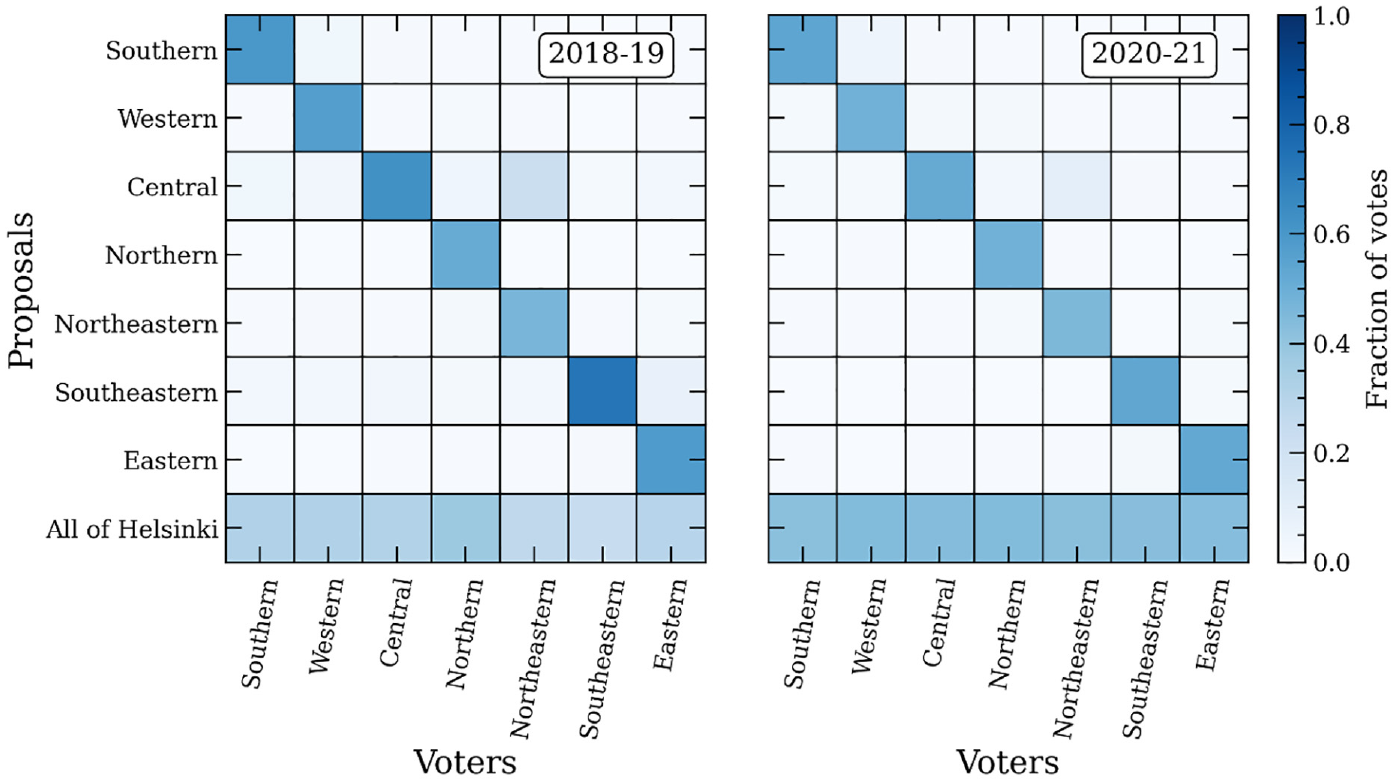
Geographical enclosure of urban knowledge.
OmaStadi’s inherent competition has also created narrow windows when the most active users
11
surge the vote. By voting at the beginning of the process, they can influence how others (the majority of users) vote in the last few days of the voting period via digital/physical campaigns. Figure 2 shows how active users up-voted their proposals on the first and second day of voting, whereas most users voted on the last day of voting. This strategy allowed active users to secure prominent and long-lasting visibility for their proposals by launching physical or/and digital campaigns in the following days. It was advantageous to secure a ‘top rank’ for one’s proposal early in the voting process since most participants voted for proposals that were already popular. Mark, an active user, explained this tactic: it was quite easy because we have the event of free sauna happening quite in the beginning, like two days after the voting started. We [our proposal] were [ranked] the first after that [the sauna event]. We were like the first until the last day. It’s psychologically easy [for] people to vote the winner you know.
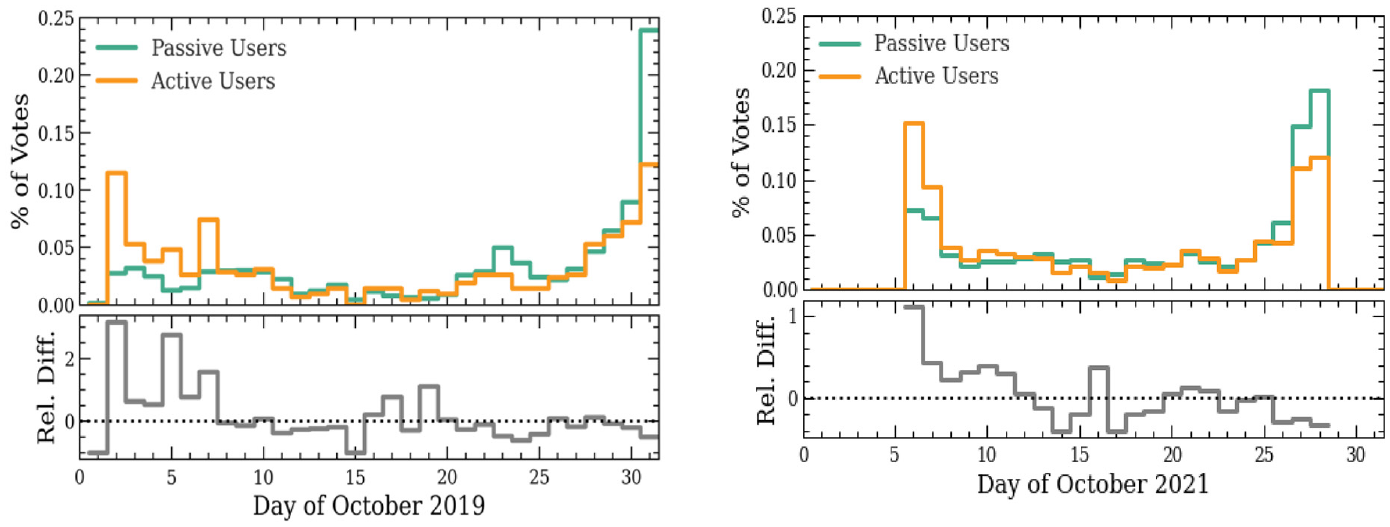
Temporal enclosure of urban knowledge.
Ann, an OmaStadi user, affirmed what Mark speculated about participants’ behaviour: I didn’t want to give … my vote to some plan that … clearly won’t be selected. So, I would find it useful to be able to change my vote to the most popular ones, so that my vote would not be useless.
The temporality to make sense of urban issues was further enclosed since the average time-per-session on OmaStadi was only 7 minutes, meaning most users quickly evaluated a proposal’s political importance via popularity and visibility across digital/physical campaigns (as curated by active users), not necessarily its content.
Such enforcing of majoritarian and competitive ways of knowing urban issues reveals the limits of digital urban democracy. OmaStadi fell into Purcell’s (2006)‘local trap’ by constructing temporo-spatially restricted and homogenised urban needs around green space and leisure facilities, without considering social justice. Residents not only became more insular in how they understood Helsinki’s issues, but also implicitly accepted the legitimacy of local proposals without challenging the simple majoritarianism underpinning OmaStadi’s knowledge-making. This resulted in what democratic theorists call an ‘aggregated mode’ of (urban) democracy. In this oft-critiqued model of democracy, dynamic processes of debating and negotiating different interests and conflicts are reduced to a single aggregation of individual preferences (Mouffe, 1999; Purcell, 2008: 65; Young, 2000). As Young (2000: 20) critically notes, democracy should not be taken as a static and numerical aggregation of personal preferences for ‘it carries a thin and individualistic form of rationality’. This aggregated and individualistic democracy forecloses the chance for citizens to engage with diverse opinions and perspectives, thereby impeding the formation of a ‘public’ knowledge of issues that extends beyond individual interests (Young, 2000). In other words, OmaStadi’s construction of an aggregated democracy epitomises oligarchic participation due to the uneven distribution of decision-making power. It becomes a competition between a small group of active users who make ‘decision[s] that serve their interests but not the interests of a larger public’ (Purcell, 2006: 1935; also see Koch, 2013). Digital political participation seems to make active and resourceful users more influential in promoting their individual urban needs in accordance with simple majoritarianism (vis-à-vis offline politics, Koch, 2013). There is little deliberation, so active users have fewer chances to reconstruct their knowledge through different geographical scopes, collective narratives and times. The presence of powerful and active users reaffirmed longstanding power inequalities between resourceful participants (often seen as the ‘white-middle-aged man’) and those without resources in digital democracy (Bright et al., 2020; Hague and Loader, 1999; Wright, 2012a) and urban participation (Koch, 2013).
Epistemic opening(s): Collective ways of knowing urban issues
Urban democracy requires the collective knowledge of urban issues and struggles to gain popular control over decision-making (Baiocchi and Ganuza, 2014; Purcell, 2013) and/or the production of urban space (Lefebvre et al., 2009; Purcell, 2006). Following this definition, we make a vital distinction between those proposals producing collective ways of knowing struggles (e.g., against socio-economic marginalisation of ethnic minorities, drug addicts and homeless people, against privatisation of heritage sites) from those without (e.g., planting more trees, adding more benches or sport facilities). The following section details the collective knowledge-making process that emerged prior to, and around, a proposal to recover a historical heritage site in Laajasalo, a suburban community in southeast Helsinki.
Collective knowledge in construction: Struggles against the decay and privatisation at Aino’s villa
The Aino Ackté villa bears historical and cultural significance for Finnish musicians and residents in and beyond southeast Helsinki. Surrounded by Tullisaari Park, the villa was named after a famous Finnish opera singer who used it as a summer residence in the early-20th century. Acquired by the City of Helsinki in 1929, the villa was restored in 1987 and later opened to the public. It hosted cultural events, lectures, and meetings, including the Aino Ackté Chamber Music Festival before, in 2010, serious moisture damage was discovered in its wooden façade and structure, forcing the City of Helsinki to close the villa (Helpinen, 2021).
Several attempts to save the villa from total rot and decay have manifested over the last decade. The Laajasalo Society, a local organisation, has played a key role in forming collective demands imploring the City of Helsinki to restore the villa. Their mission has always been clear: ‘to save the villa for cultural use, in accordance with the wishes of opera singer Ackté’ (Rinta-Tassi, 2019: np). Since 2011, the Laajasalo Society and the Aino Ackté Chamber Festival foundation have lobbied decision-makers. Mike, an active member of the Laajasalo Society, described the lengthy and difficult lobbying process: we’re lobbying with all the managers [from the City of Helsinki] and because it’s not so easy not to go there and [say], ‘hey, give me your money’. It’s quite a lot [of work] … we have 300 hours of meetings with the officials from the City.
Despite local organisations continuing to influence the political decisions of the Helsinki City Council, however, the City decided not to prioritise the villa’s renovation due to the high cost of the repairs, instead, opting to sell it to private companies in 2020. The chairman of the Laajasalo society told a Finnish newspaper Yle: ‘[to save Aino Ackté villa] has been an endless struggle. It seems that the city has no interest whatsoever in preserving the building’ (Rinta-Tassi, 2019: np).
Continuous frustration and disappointment with the City of Helsinki pushed John, a member of the Lajaasalo Society, to write a proposal to assess the villa’s financial and architectural needs. His proposal organically caught the attention of locals and wider publics in Helsinki and beyond (e.g., musicians and citizens concerned with historical and cultural heritage), who provided many votes just a few days after the voting 12 opened. Many Laajasalo residents were not surprised that the villa’s proposal quickly rose to the top. It was already a well-known issue, engraved within the memories of local and wider musical communities over years of struggle. 13 As one concerned citizen, Leo, explained, ‘the villa has been in the minds of the people [over years] … It did not come out of the blue’.
A strategic curation of shared memory over the villa’s unresolved fate was undertaken through a combination of offline and online campaigns, which contributed to the development of a collective understanding of the historical and cultural meanings and political struggle underpinning the proposal. Such strategic campaigns were most evident when advocates found themselves in a ‘winner takes all’ situation,
14
fighting against a pricey proposal for an artificial football field in another south-eastern Helsinki community. Days before the voting closed, members of the Lajaasalo Society organised a symbolic event in a local church to invoke a collective memory and feeling (see Colman and Cardoso Sampaio, 2017) around the villa. A documentary showcasing the beauty of the villa was presented to evoke memories of past concerts and events that were attended by hundreds of local residents. In the meantime, strategic language such as ‘forgotten’, ‘Laajasalo people (Laajasalolaiset)’ and ‘we/the people of Helsinki’ were carefully embedded into online storytelling across local Facebook groups, for instance: A lot of people have their own unforgettable experiences and memories of the Ackté villa concerts and other meeting events. They want the same thing again. Many have even been willing to volunteer work to renovate that valuable villa. … Aino Ackté’s villa is a shared cultural venue for us and all city residents when it is fixed … The issue is critical because this would also send a strong message to the city that the people of Helsinki want to return the Ackte villa to the use it deserves … you, me, we can all affect it.
Strategic storytelling campaigns enabled a broader range of citizens to identify themselves within the collective knowledge-making process (Young, 2000: 73–74, 76), resulting in the villa’s proposal winning over the football field by a narrow margin of 17 votes. The Laajasalo Society effectively utilised the collective momentum around the proposal to eventually convince policymakers at the City of Helsinki to spend two million euros on the renovation. This case demonstrates how a politically marginalised urban issue strategically constructed collective knowledge to exert popular influence over the City of Helsinki’s decision-making (Baiocchi and Ganuza, 2014; Fung and Wright, 2001). OmaStadi’s majoritarianism was appropriated by and joined with the wider civic society (Postigo, 2011) to consolidate political momentum against the privatisation and decay of the villa.
Discussion: Epistemic openings for democratic possibility
Our dialectical approach located an epistemic opening in OmaStadi’s assemblage of knowledge-making. Local actors carefully curated storytelling and actively resurrected memories in a process of collective sense-making for an urban struggle. Crucially, collective knowledge-making for the villa existed before and after the e-participatory process. This collective knowledge-making pushed against individualistic democracy and circumvented institutional limitations (e.g., financial and jurisdictional thresholds) embedded within OmaStadi by bringing the wider public to ‘make known their ideas on the space and time of their activities in the urban area’ (Lefebvre, 1996: 34). This process would not have been possible without the involvement of informal democratic participation, which includes in-person (un/official) discussions, negotiations and organisation among different actors (McFarlane, 2011; Young, 2000), such as locals, musicians, wider citizens, experts and policy-makers.
Our study of OmaStadi serves as a critical case for examining the limitations and potential of DPPPs and other platform-based participation in post-welfare societies and beyond. On one hand, it is important to recognise the presence and extent of epistemic enclosures and their limitations (particularly when DPPPs are implemented in developing countries with significant digital and socio-economic inequalities). Another limitation was the institutional decision to allocate municipal funds from socio-economically disadvantaged suburban communities to fund OmaStadi. On the other hand, the epistemic opening arising from Laajasalo’s proposal merits further investigation in other contexts. Indeed, Laajasalo’s proposal demonstrates democratic possibility by empowering the public against the ongoing privatisation of public assets. However, this popular power did not adopt an adversarial stance against the City of Helsinki (unlike a classic anti-neoliberal movement; Purcell, 2008). Instead, it established an ambivalent relationship with the municipality and used OmaStadi’s majoritarianism to collectively advance the cause while still negotiating with municipal decision-makers, thereby reinforcing existing power structures in urban governance (Koch, 2013: 2979). Exploring DPPPs through a dialectical approach facilitates connections with ‘informal participations’ and multi-scalar struggles. To this end, we propose rethinking the questions of ‘who’, ‘when’, ‘what’ and ‘how’ to determine the needs of urban democracy:
1) Who: Continue expanding OmaStadi to different scales of publics, including those who are not officially registered as residents of Helsinki.
2) When: Remove the OmaStadi limits that restrict the actions of proposing to a certain time period (usually 1 month).
3) What: Amplify and engage with multi-scalar urban needs and struggles hitherto marginalised and ignored in decision-making (e.g., housing and racial/gender discrimination) without prejudicing ‘local’ and ‘non-conflictual’ ones. Actively reach out to those who hold the knowledge about these needs such as NGOs and institutions that closely work on disability, mental health, racism, drug abuse, immigration, housing and humanitarianism.
4) How: Slow OmaStadi’s majoritarian decision-making with processes of (informal) discussion, debate, and deliberation that do not immediately resolve the contestations. Open public discussions to improve decision-making within and beyond institutionalised procedures.
Conclusion: A dialectical approach to digital urban democracy
This article presents a timely, interdisciplinary and dialectical critique of urban digital democracy. As cities around the world delegate their decision-making responsibilities to platforms like OmaStadi, scholars must examine the politics and consequences of collecting, ranking and organising citizens’ urban knowledge for democracy. We introduce a quali-quantitative methodology to understand the previously unexplored ‘what,’‘whose’ and ‘where’ urban knowledge that is deemed politically important and legitimate in and through OmaStadi.
Our contribution to the field of digital urban democracy argues for a dialectical approach that moves beyond binary views of DPPPs’ knowledge-making as either pro- or anti-democratic. Rather than assuming digital platforms are inherently anti-democratic, this approach unveils the new terrain and possibilities in a post-welfare urban society where OmaStadi, as a socio-technical assemblage, forges democratic openings by formulating collective knowledge about urban struggles and unsettling individualistic democracy’s epistemic enclosures. In other words, OmaStadi operates as an epistemic dialectic that oscillates between rolling-out collective knowledge and locking-in majoritarian ways of knowing cities.
This dialectical approach centres cities’ democratic potential as sites for creating collective senses of urban struggles and expands our understanding of cities as ‘repositories of institutions, associations, public spaces, and social vitality’ (Amin and Thrift, 2002: 131) in the era of platformisation (Hodson et al., 2021). This approach frees democratic potential from technocratic and binary discourses by highlighting the process in which urban communities and places become involved in shaping collective knowledge on urban struggles. While this collective knowledge-making may exclude some struggles and may not necessarily lead to wider socio-economic transformations, it provides new opportunities for policy interventions beyond existing institutional limitations (e.g., financial and jurisdictional thresholds). Ultimately, this approach goes beyond seeing cities as a particular and localised form of democracy and posits them as an open process for gathering a variety of digital democratic openings in connection with struggles across wider urban spheres (see Purcell, 2013).
Our positioning of OmaStadi as a critical case provides guidance for further investigation into the limitations and potential of DPPPs and other platform-based participatory processes in post-welfare societies and beyond. In one sense, researchers should examine the presence and extent of epistemic enclosures and their institutional and infrastructural limitations, especially when DPPPs are implemented in developing countries with significant digital and socio-economic inequalities. In another sense, researchers should actively seek out various forms of epistemic opening that arise from digital platforms, including social media platforms beyond the Global North (see Nemer, 2022). Researchers must understand how these knowledge-making processes can lead to democratic possibilities by visualising different kinds of urban struggles in place to challenge oligarchy, domination and suppression in platformised cities. Researchers can also explore the different democratic possibilities present in multiple institutional and urban contexts that allow for ‘the everyday modalities of the appropriation of technology’ (Odendaal, 2021: 652) and consider how they impact marginalised groups’ ability to influence policy-making (Tseng, 2022b). After all, digital urban democracy is not a final destination, but a continuous process of seeking and gathering moments for challenging issues that concern urban scholars – power asymmetries and socio-economic inequalities – in platformised and/or smart urban societies (Odendaal, 2021; Sadowski, 2021).
Footnotes
Acknowledgements
We would like to especially thank Antti Hukkanen for providing a user database for this manuscript. We highly appreciate the extremely helpful comments and deep engagement from the three reviewers and editors from Urban Studies Journal, as well as the good suggestions gleaned from two seminars hosted by research groups at the Centre for Consumer Society Research, University of Helsinki. We were also grateful to receive feedback from Pauli Saloranta, Kirsi Verkka and other policymakers at the City of Helsinki.
Declaration of conflicting interests
The authors declared no potential conflicts of interest with respect to the research, authorship, and/or publication of this article.
Funding
The author(s) disclosed receipt of the following financial support for the research, authorship, and/or publication of this article: This manuscript is part of the results of Dr. Tseng’s postdoctoral project, which was jointly funded by the Cities of Helsinki, Vantaa, and Espoo.
