




Abstract
This paper assesses the role of parental gifts in neighbourhood sorting among young adult homebuyers. We make use of high-quality individual-level registry data for two large urban metropolitan areas in the Netherlands. While previous studies have shown that young adults receiving gifts purchase more expensive housing, little is known about the role of gifts in where young adults buy. Our study finds that parental gifts flow into the housing market in a spatially-uneven way. Movers supported by substantial parental gifts are more likely to enter owner-occupied housing in high-status and gentrifying urban neighbourhoods compared to movers without gifts. This study shows that this can only partially be explained by household and parental characteristics and by the uneven distribution of housing values. The remaining effect suggests that parental gifts also play a role in trade-offs regarding spatial residential decision-making. The conclusion discusses the ramifications of our findings for debates on (re)production of class and intra-generational inequalities through housing, and provides avenues for further research.
Introduction
Gentrification has long been associated with people in their twenties and thirties buying owner-occupied dwellings in relatively affordable urban neighbourhoods (Butler and Robson, 2001; Ley, 1996; Moos, 2016). As the ‘urban renaissance’ has taken hold, many cities have become increasingly unaffordable for younger households, particularly for owner occupation. As access has become more difficult, some young adults will look for alternatives like rental housing or shared housing, or they are excluded altogether (Grander, 2023; McKee, 2012). Yet, some will receive financial support from their families. Parental gifts increase the likelihood of becoming an owner-occupant and typically lead to more expensive home purchases (Engelhardt and Mayer, 1998; Helderman and Mulder, 2007; Moos, 2018; Spilerman and Wolff, 2012). As such, family wealth may also impact spatial processes. Evidence suggests that family background and neighbourhood sorting correlate, and that intergeneration transfers may be conducive to segregation and gentrification (Hochstenbach, 2018; Hochstenbach and Boterman, 2017). Yet, previous studies largely assume a transfer of wealth and resources. To date, little is known about the impact of parental gifts on where young adults who receive such gifts buy their home, compared to those who do not.
The objective of this paper is to understand how parental gifts not only affect the acquisition of owner-occupied housing but also how they structure spatial sorting in residential environments. Our study focuses on the case of the Netherlands, where in recent decades new policies have been adopted to support parental gift-giving towards housing. The main question is how parental gifts impact socio-spatial sorting among young adults in the country’s two largest metropolitan areas: Amsterdam and Rotterdam/The Hague. We are particularly interested in whether parental gifts are instrumental in accessing urban neighbourhoods that are gentrified or are gentrifying. This is done using a unique registry dataset, covering tax records on parental gifts and all home purchases made by young adults in the year 2014.
There are several reasons why households that receive parental gifts would be more likely to move to gentrified and gentrifying urban areas. First, choosing where to live is the outcome of a complex decision-making process of trade-offs over costs, the dwelling and neighbourhood characteristics and the organisation of daily life (Brun and Fagnani, 1994; Clark and Dieleman, 1996). Living in centrally-located areas allows young adults to access higher education, career opportunities and cultural amenities (Musterd et al., 2016a; Smith and Holt, 2007). Being able to spend more on expensive urban housing through parental gifts may soothe decision-making trade-offs. So, simply put, gifts add to the household budget and may help to access areas with higher housing prices.
Second, there may also be a socio-cultural element to sorting. Young owners may not only be endowed with economic capital but also, through their upbringing, with cultural capital. In other words, the preference for urban neighbourhoods and accompanying life styles and life course may be related to fractions of the middle class, who are more urban oriented (Butler and Robson, 2001; Custers and Engbersen, 2022; Lees, 2014; Van Gent et al., 2019). Some young adults may be more adamant in their wish to live in owner occupation in the city rather than the suburbs, and their parents may be more willing to assist to accommodate this wish.
Third, the reliance on parental gifts also reflects a broader change in housing systems in countries like the Netherlands in the recent decade. On the demand side, young adults are feeling the impact of economic policies that have embraced a more flexible work force on temporary contracts with less protection, effectively weakening labour market positions and conditions (Aassve et al., 2013; Arundel and Lennartz, 2020). On the supply side, young adults have more difficulty obtaining housing. After the financial crisis of 2008 mortgage regulations became stricter, while house price growth outpaced wage growth. Scarcity of housing, limited access to credit, and reduced purchasing power imply a rise of affordability problems (Arundel and Lennartz, 2020; Breidenbach, 2018). As a consequence, young adults spent an increasingly long period in the private rental sector or in the parental house (Clark, 2019; Lennartz et al., 2016; McKee, 2012; Sissons and Houston, 2019). Supply and demand factors thus make it more difficult for young adults to enter owner-occupancy or to access any form of housing without family financial support (Köppe, 2018; McKee, 2012).
Lastly, owner-occupiers and their families may consider housing not only a consumption good, but also an investment (Ronald and Dewilde, 2017). The rent gap in (potential) gentrification neighbourhoods may attract new investments (Smith, 1979). Parental gifts can help young adults to buy and rehabilitate property. Additionally, real-estate price appreciation in gentrifying areas offers a good way for family capital to grow and the younger generation’s cultural knowledge of urban space may help to select the best areas for investment (Hochstenbach and Boterman, 2018).
Residential mobility and neighbourhoods
Households are selective in which neighbourhood they choose to settle, leading to consistent patterns of spatial sorting (Hedman et al., 2011; Musterd et al., 2016b). These patterns can be partially explained by housing needs and preferences, and by the distribution of housing in an urban region. Additionally, households face constraints, most importantly with regards to their budget and housing availability and accessibility (Mulder and Hooimeijer, 1999). Dwelling characteristics like housing type, tenure, quality and price vary significantly over different neighbourhoods and by their uneven distribution structure neighbourhood sorting through housing (Hedman et al., 2011). Yet, neighbourhoods are part of an inseparable bundle of housing services (Dieleman, 2001). They satisfy locational needs, the ‘utility’ of a place for everyday life, differently for different households. Both the location of an area in relation to amenities, work and education (situational characteristics), as well as the neighbourhood itself (site characteristics) are important depending on life course (Coulton et al., 2012; McCrea, 2009; Musterd et al., 2019). Young adults, often without children, typically prefer centrally-located urban locations for their access to amenities and cultural venues, as well as work and education (Booi and Boterman, 2020; Moos, 2016).
While situational characteristics are consistently found to be important factors in residential decision-making, another strain of research emphasises the social and cultural aspects of residential sorting. Households tend to display a preference for living closer to other households with similar income characteristics (Hedman et al., 2011; McCrea, 2009; Musterd et al., 2016b). Furthermore, Van Gent et al. (2019) have found that, more than material resources, the tendency to self-segregate is heavily related to class position, as determined by education and socio-cultural dispositions. Part of the middle classes are theorised to reflexively regard neighbourhoods and urban space, not only in terms of utility, location and composition, but also in view of their status and prestige (Butler and Robson, 2001; Custers and Engbersen, 2022; Lees, 2014). Gentrification neighbourhoods mostly see change from such affluent and high-qualified individuals moving in (Ding et al., 2016; López-Gay et al., 2020). High status and gentrification areas in the city may offer these groups – often referred to as the urban middle classes – a way to acquire cultural capital (see Bourdieu, 1984). So, for middle classes, neighbourhood selection is also driven by reputations and symbolic value. In general, together with social networks, reputation is an important factor in how patterns of spatial sorting and of neighbourhood segmentation are reproduced over time (Sampson, 2012).
Owner-occupancy and young adults: Increasing importance of parental support
Many advanced economies have been experiencing stagnating or declining ownership rates. The accessibility of homeownership has been in particular decline among young adults and lower-income households (Arundel and Ronald, 2021; Hochstenbach and Arundel, 2021; McKee, 2012) as labour market flexibilisation has made it harder for young adults and low-income workers to have secure permanent employment contracts and stable incomes (Dol and Boumeester, 2018). Even with a sufficiently high income, precarious employment conditions can hamper the ability to obtain a mortgage loan. Simultaneously, house price growth has exceeded income growth in many countries, while mortgage lending has become stricter for prospective owner occupants (Arundel and Lennartz, 2020).
Given this context, parents can provide support to their children to enable them to move into owner-occupied housing (Cigdem and Whelan, 2017; Coulter, 2017; Köppe, 2018; Mulder et al., 2015; Toft and Friedman, 2021). They may share specific knowledge, use their social networks to acquire housing, or help out with the renovation of a dwelling. Parents can also give guarantees or provide co-residence to help their offspring save for a deposit. Most importantly here, they can provide financial help directly by providing a loan or a gift (see Druta and Ronald, 2017). Receiving a parental gift supplements the households’ budget, bringing more dwellings and neighbourhoods within financial reach. Previous work indicates that households receiving gifts purchase more expensive dwellings with higher monthly costs (Luea, 2008; Manzo et al., 2019). Next to this, gifts are also used to obtain a dwelling with lower initial loan-to-value or to finance down-payments (Engelhardt and Mayer, 1998). Young adults receiving parental gifts tend to enter owner-occupancy at a younger age (Engelhardt and Mayer, 1998; Helderman and Mulder, 2007).
In terms of residential decision-making, parental gifts may potentially soothe trade-offs between various aspects of the dwelling and where it is situated, thereby impacting on neighbourhood sorting. Households receiving parental support may be able to achieve higher place utility, or be able to buy a similar house in a neighbourhood with a higher status or reputation. So, in contrast to peers who do not receive financial aid, they may be able access neighbourhoods after the initial gentrification has already taken off and experienced significant price inflation (Hochstenbach and Boterman, 2017).
Parental aid may help access gentrification neighbourhoods to benefit their children, but also as a way to maintain and grow family capital. Gains are hypothesised to be highest in neighbourhoods that have experienced disinvestment and have been regaining popularity with the rise of the urban middle class (Lees, 2014; Smith, 1979), and more recently, by the advent of short-term rental and speculative real-estate investment (Aalbers, 2019). Parental gifts could be a channel through which family capital is recycled and invested in urban housing markets. Such financial strategies are particularly worthwhile when gift taxes are lower than inheritance taxes.
Data and methods
This paper analyses how parental gifts affect neighbourhood selection of young adults moving to owner-occupied housing. We are particularly interested in whether receiving gifts affects mobility behaviour to low-status, low-status upgrading 1 and high-status neighbourhoods in and outside the central cities of Amsterdam and Rotterdam/The Hague metropolitan regions in the Netherlands. To do so, we make use of the System of Social-statistical Datasets of Statistics Netherlands which includes all young adults registered in the Netherlands. This registry data is combined with tax data covering all fiscally-reported parental gifts. Parental gifts fluctuate significantly from year to year, in response to changing fiscal regulation. In 2010, a new gift tax law came into force and in 2013 an important amendment was made to allow one-time tax-free gifts of up to 100,000 euros (to be spent within two years) towards the purchase, renovation or mortgage debt repayment of a primary residence. This amendment was rolled back on January 1st 2015 and then a similar amendment became permanent on January 1st 2017. 2 An evaluation shows that most older recipients used the tax-free gifts for debt repayments, while younger recipients (under 30 years old) most often used them for acquiring housing (Rekenkamer, 2017). A later evaluation indicates that this practice seemed to have had a local effect on prices but it did not demonstrably affect municipal housing markets. It also highlights how wealth transfers in comparably affluent families will exacerbate wealth inequalities (Vermeulen et al., 2021).
At the time of our dataset construction, the latest available year for parental gift data was 2016. Thus, this paper analyses all gifts over 5000 euros received in 2013 and 2014 that may have been used towards the purchase or repayment of an owner-occupied dwelling in 2014. Our population consists of all households of which the head is between 18 and 40 years old, in the Amsterdam and Rotterdam/The Hague metropolitan regions. These regions are the two largest metropolitan regions in the Netherlands but differ on the basis of their demographic and economic composition. Amsterdam is more affluent and has a more services-oriented economy while the Rotterdam/The Hague region is less affluent and has a relatively stronger industrial and government related economic base. The regions are analysed together in the interest of sample size.
The analysis in this study is twofold. First, using maps and descriptive statistics, we show how young adult moves supported by parental gifts are distributed over destination neighbourhoods. Second, multinomial regression models aim to add to our understanding by assessing the role of parental gifts in neighbourhood selection among young adults.
The dependent variable is the neighbourhood type young adult homeowners move into. In this analysis seven neighbourhood types are constructed: urban and regional low-status neighbourhoods, urban and regional low and upgrading neighbourhoods, urban and regional high-status neighbourhoods. We also include a category ‘other/new build’ for areas where the housing stock has mutated strongly.
Urban neighbourhoods are statistical neighbourhoods within the municipal borders of Amsterdam, Rotterdam and the Hague. Regional neighbourhoods are all other neighbourhoods within the metropolitan region. Neighbourhood status is determined by the median owner-occupied house price per neighbourhood compared to the regional median house price for all regional neighbourhoods and by the median city house price for the urban neighbourhoods on 1 January 2015. We use (‘WOZ’) real estate value tax register data to obtain house prices. We use 2016 data as yearly WOZ values are set to correspond with house prices on 1 January of the previous year. Neighbourhoods are considered to be ‘upgrading’ when the median house value growth has outpaced the average median house value growth between 1 January 2006 and 1 January 2015. The year 2006 is chosen as a reference year, as it sits before the Great Financial Crisis. Neighbourhoods featuring less than 10 dwellings are excluded. 3 Not all destination neighbourhoods receive more than 10 young adult homebuyers or homebuyers supported by parental gifts. For our gift maps these neighbourhoods are merged with adjacent neighbourhoods for privacy reasons on the basis of neighbourhood type to achieve an N higher than 10.
Our variable of interest is categorised based on the total value of the gifts received. 4 Additionally, this study includes household-level variables for: age (of the head of household), gender (of head), educational level (of head), country of origin (of head), household income, household non-housing wealth, partnership status, children and previous dwelling (own, rent, parental or other/unknown). 5 Household composition is relevant, as singles, couples and families differ in their likelihood and desire to enter owner-occupied housing (Blaauboer, 2010). Income and wealth are categorised as a factor (e.g. 1–1.5×) of the median household income and wealth. For 2015, the median household income in the Netherlands is 49,200 euros and median household non-housing wealth is 13,300 euros. On the parental level the analysis includes parental tenure, income, non-housing wealth and gifts. Lastly, the number of siblings, a regional dummy and a house value variable are included. The latter will account for the uneven distribution of house values across neighbourhood types. The variable ‘siblings’ captures the total number of children associated with the parent(s) of the households (see Keister, 2004).
As this study seeks to capture all moves made by young adults towards owner-occupation in the Amsterdam and The Hague/Rotterdam metropolitan area in the year 2014, household variables are measured at their level on January 1st 2015. This implies that household wealth is measured after purchase and, for many, it will be lower than before. The data does not allow 2014 household wealth to be captured as not all households existed at that time as an independent unit. For instance, for homebuyers living in the parental house on 1 January 2014, it is impossible to distinguish between household and parental wealth.
For the parental variables, this study uses a summation of the wealth of all parents related to the children’s household. For couples this means a possible summation of up to four parents. This also applies to parental gifts. For parental tenure, the value can be either all owner-occupancy, part owner-occupancy, rental or unknown.
Results
Figure 1 shows the distribution of neighbourhood types in the Amsterdam and Rotterdam/The Hague metropolitan region. Both regions have a distinctive socio-spatial layout. The Amsterdam municipality features some of the region’s most affluent neighbourhoods at the very heart of the historic centre and in pre-war extensions. Conversely, the post-war outskirts of the municipality, in the south-eastern, northern, and western districts feature mostly low-status neighbourhoods. Most upgrading low-status neighbourhoods (‘gentrifying’) are found in the direct vicinity of affluent areas. The Hague municipality has a more linear divide, with very affluent neighbourhoods close to the seaside and less affluent neighbourhoods more inland. In Rotterdam most affluent neighbourhoods are found north of the New Meuse River.
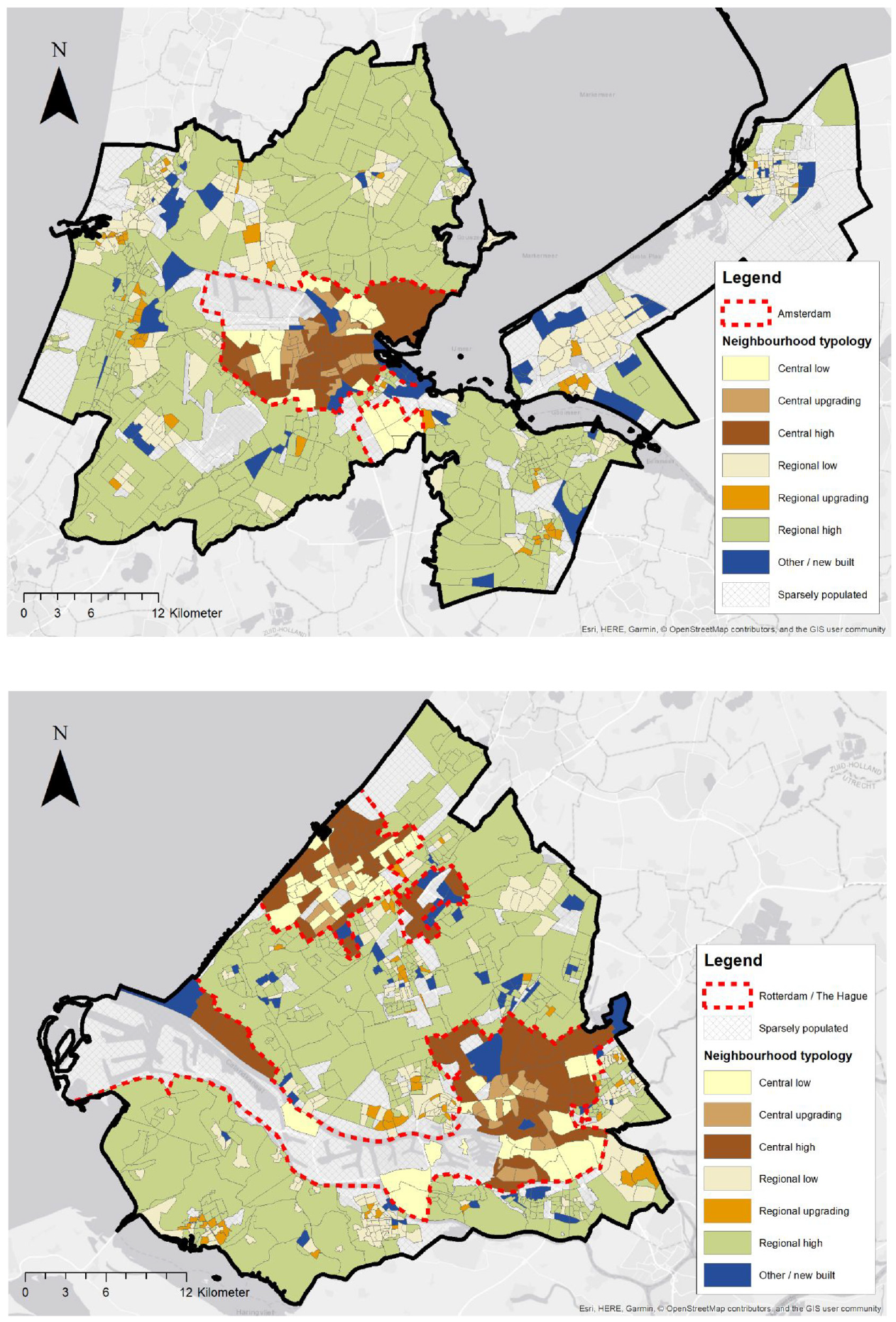
Map of neighbourhood types in the Amsterdam region (top) and the Rotterdam/The Hague region (bottom).
Overall, the Amsterdam region has more low status neighbourhoods experiencing housing price appreciation than the Rotterdam/The Hague region. This reflects the differences in economic structure, the timing of economic restructuring and the expansion of the professional middle class, which have led to Amsterdam gentrification processes happening sooner and being more substantiative than in Rotterdam/The Hague (see Boterman and Van Gent, 2023; Hochstenbach, 2018).
Both regions feature affluent smaller cities, suburban towns and villages within commuting distance of the central city. Most post-war New Towns in both regions feature predominantly low-status neighbourhoods. Neighbourhoods outside the built-up areas are almost all categorised as ‘regional high’. These countryside areas are relatively expensive but have low population counts.
Figure 2 shows the spatial distribution of moves made by young adults towards owner-occupied housing supported by parental gifts. In both regions, high-status neighbourhoods both within and outside Amsterdam, The Hague and Rotterdam attract a substantially higher share of movers with parental gifts. Central low-status upgrading neighbourhoods, particularly within Amsterdam municipality, also attract a higher share of movers with parental gifts. Outside of the central cities, higher shares of gifts among movers are visible in the affluent municipalities directly adjacent to The Hague and Amsterdam respectively and in and around the smaller cities of Delft, Haarlem and Hilversum.
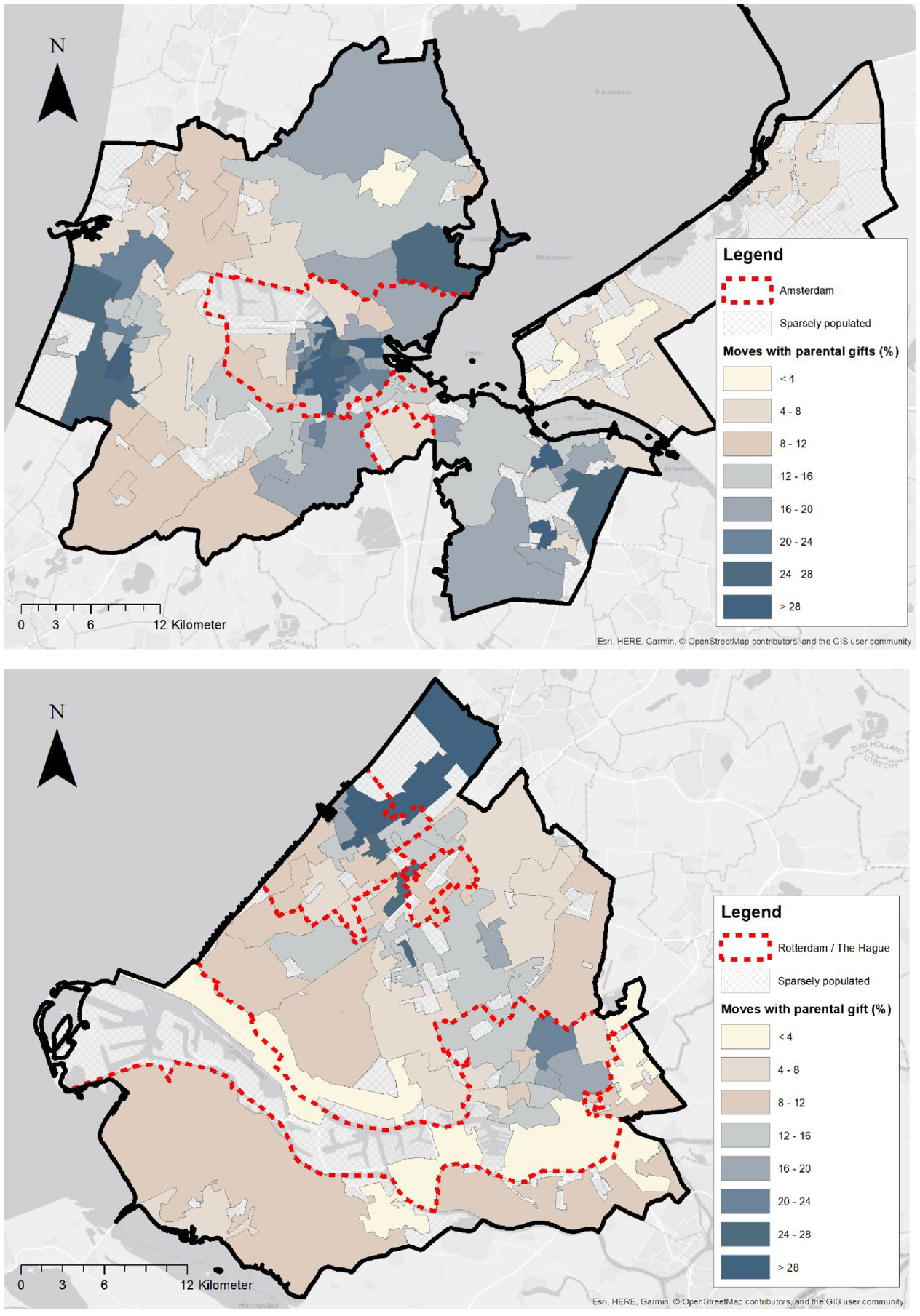
Proportion of moves supported by parental gifts in the Amsterdam region (top) and the Rotterdam/The Hague region (bottom).
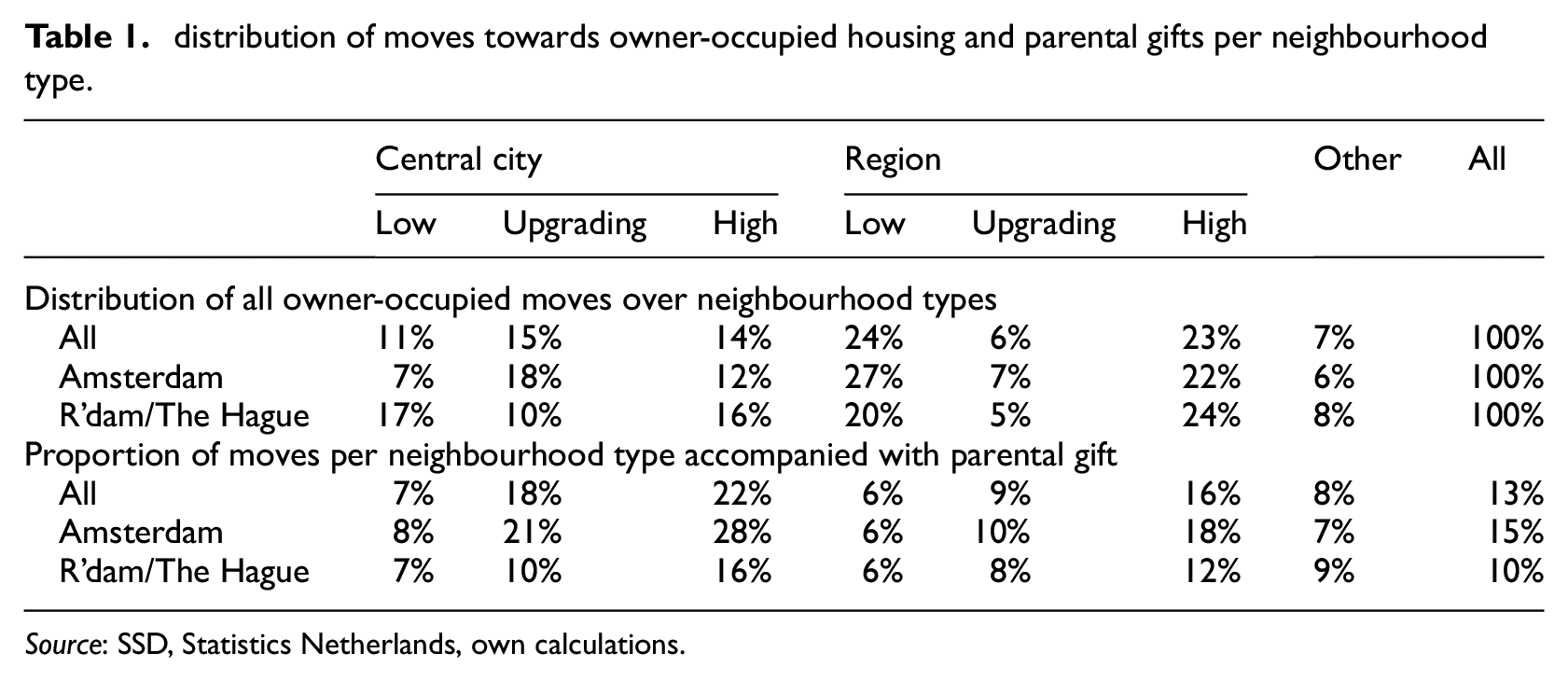
Table 1 shows the distribution of moves towards owner-occupied dwellings, and of moves with parental gifts by neighbourhood type. When looking at all moves, we can see differences between the regions. In the Amsterdam region, a lower share of all moves is made towards urban low-status neighbourhoods and a higher share of moves is made towards low-status upgrading neighbourhoods (i.e. gentrifying), while in Rotterdam/The Hague region fewer moves are made towards central upgrading neighbourhoods. This may reflect demand for urban living in Amsterdam. Yet, it is also related to supply: there are more of these neighbourhoods in Amsterdam, and their higher density means that they have more dwellings.
distribution of moves towards owner-occupied housing and parental gifts per neighbourhood type.
Source: SSD, Statistics Netherlands, own calculations.
When looking at moves supported by parental gifts, we see that the share is highest in urban high-status neighbourhoods (‘gentrified’). This is most pronounced in the central cities. In the Amsterdam region, the share of moves towards urban upgrading neighbourhoods (‘gentrifying’) supported by parental gifts is 21% compared to 15% overall. In contrast, in the Rotterdam/The Hague region the share of moves towards these neighbourhoods is in line with the regional average at 10%. Overall, the Rotterdam/The Hague region has fewer young adult homebuyers receiving parental gifts.
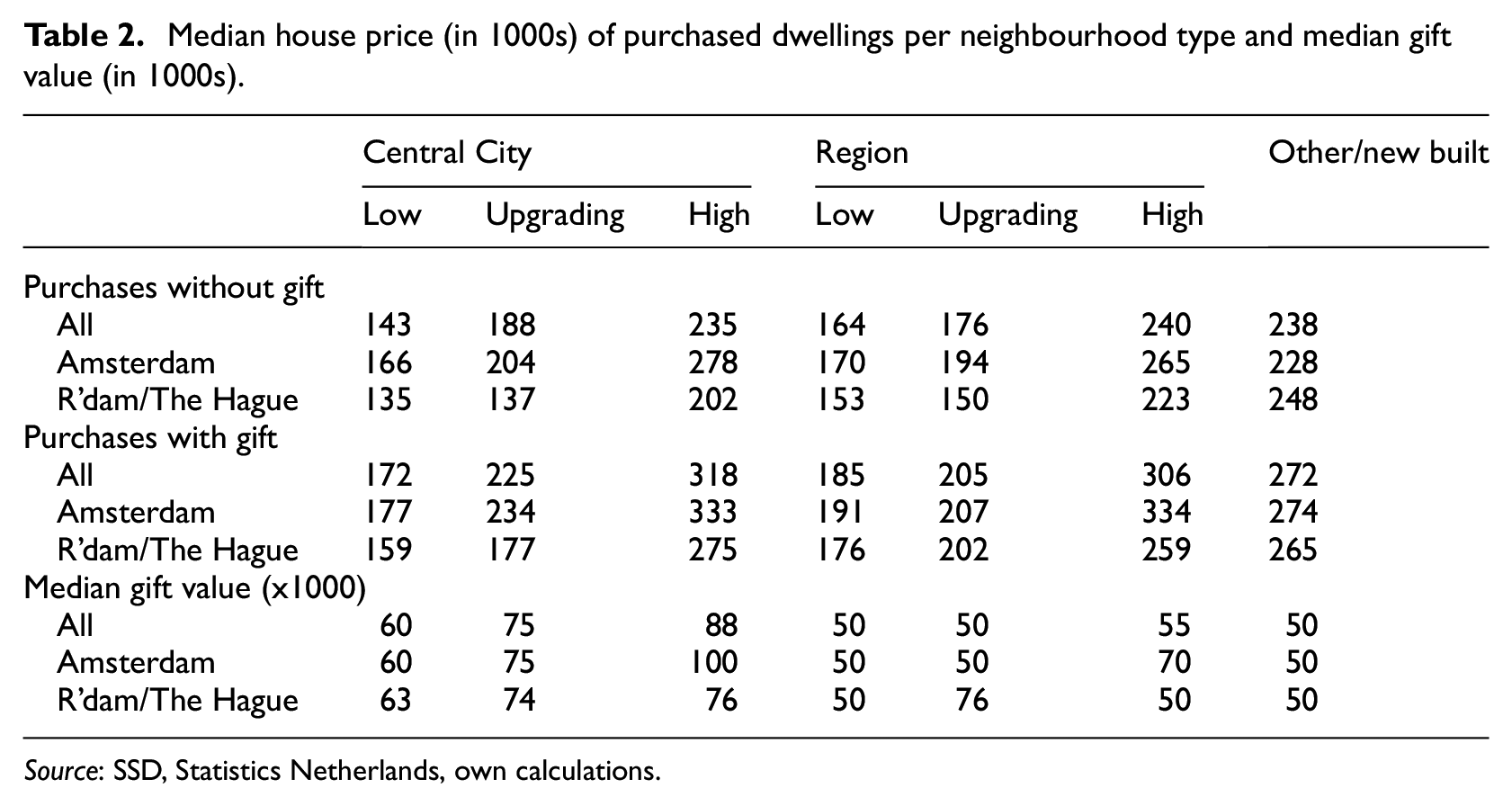
Unsurprisingly, young adults receiving parental gifts purchase more expensive dwellings than those without parental gifts. Table 2 shows that this is the case in all neighbourhood types. Interestingly, the median value of parental gifts is highest in central upgrading and central high-status neighbourhoods, meaning that these urban housing markets not only attract a higher share of gifts, but also higher gift values, particularly in Amsterdam.
Median house price (in 1000s) of purchased dwellings per neighbourhood type and median gift value (in 1000s).
Source: SSD, Statistics Netherlands, own calculations.
Neighbourhood and dwelling choice may not only arise from parental gifts, but is also dependent on household factors, such as their demographic or socio-economic characteristics. Similarly, next to parental gifts, parental background may also be significant, and thirdly, housing values also may play a role. In order to examine how these factors together shape neighbourhood sorting, two multinomial regression models will be presented. The first model shows the likelihood of moving into owner-occupied housing in urban low-status, upgrading or high-status, regional upgrading and high-status neighbourhoods, and new build neighbourhoods compared to low-status peripheral neighbourhoods. The first model includes all household and parental variables. The second model also includes a house value variable of the purchased dwelling to examine to what extent neighbourhood sorting may be explained by the uneven distribution of housing, and to see whether neighbourhood selection is based on more than the economic factors in the model (i.e. wealth, income, and housing values).
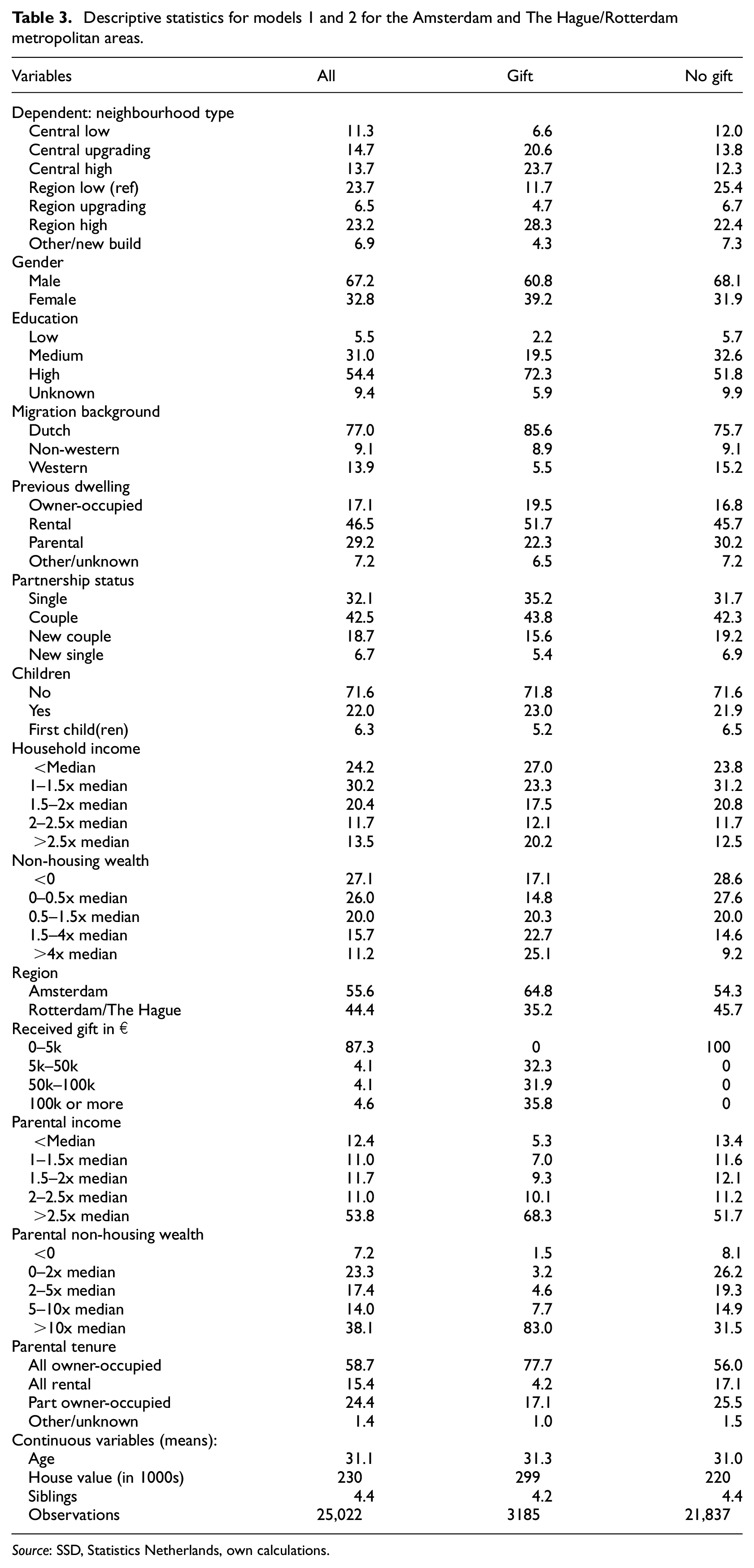
The descriptive statistics in Table 3 confirm that young adults receiving gifts more often move to urban upgrading and urban high-status neighbourhoods and less frequently move to regional low-status or new build neighbourhoods. Young adults receiving gifts are more often native Dutch, highly educated, female, have previously been living independently in their own owner-occupied or rental dwelling, more often have a high household income and more frequently have parents with both very high incomes and very high levels of non-housing wealth. Parents of young adults receiving gifts also are far more often homeowners themselves than parents of young adults not receiving gifts.
Descriptive statistics for models 1 and 2 for the Amsterdam and The Hague/Rotterdam metropolitan areas.
Source: SSD, Statistics Netherlands, own calculations.
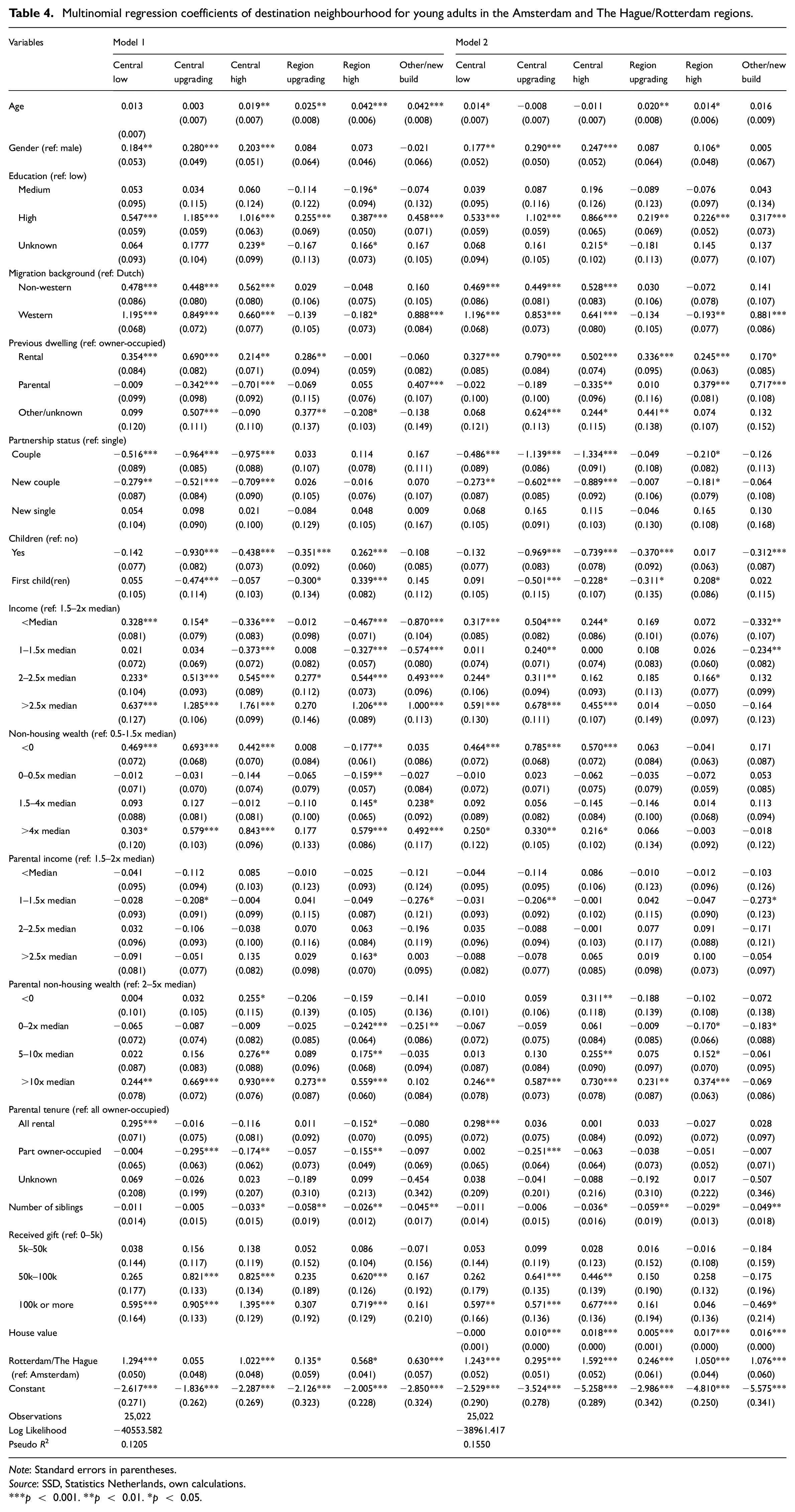
Two multinomial regression models are presented in Table 4. Model 1 shows the likelihood of moving towards the various neighbourhood types compared to moving to a low status peripheral neighbourhood, including all independent variables except for the purchased dwelling value. Model 2 also includes a control variable for that purchased dwelling value.
Multinomial regression coefficients of destination neighbourhood for young adults in the Amsterdam and The Hague/Rotterdam regions.
Note: Standard errors in parentheses.
Source: SSD, Statistics Netherlands, own calculations.
p < 0.001. **p < 0.01. *p < 0.05.
In both models, very high incomes, compared to 1.5–2.5× median incomes, and high household wealth, compared to 0.5–1.5× median wealth, are associated with higher chances of moving into all three urban neighbourhood types compared to moving to regional low neighbourhoods. The same is true for women, compared to men. Households with a migration background also show this urban orientation, just like singles and newly formed households (compared to stable couples). Highly educated households compared to lower educated households are less likely to move towards peripheral low-status neighbourhoods compared to all other neighbourhood types. Also, interestingly, very low incomes and wealth holdings, compared to moderate levels, are associated with greater chances of entering urban neighbourhoods compared to regional low neighbourhoods. 6
Our key variable, parental gifts, indicates a higher chance of moving towards urban low, upgrading and high-status neighbourhoods in both models for households who received more than 50,000 euros. In model 1 these households are also associated with a higher chance of moving towards regional high-status neighbourhoods compared to regional low-status neighbourhoods. Yet, after controlling for the value of the purchased dwelling, the latter coefficient is no longer significant.
Next to parental gifts, parental non-housing wealth also shows an effect on neighbourhood sorting. Parents may, for example, use such non-housing related assets to provide a loan to their children. Such a loan (a kind of inheritance in advance) will expand their children’s financial position in the housing market; wealthy parents can even decide to waive the interest payment and report it to the tax office as a gift to their children.
The results from the multinomial models show that the findings in Tables 1–3, indicating the high share of moves supported by parental gifts towards urban high-status and upgrading neighbourhoods, are in part produced by young adult household demographic and socio-economic characteristics, such as their gender, educational level and income, and in part by the socio-economic characteristics of the parents, especially wealth. To better assess how parental gifts shape neighbourhood sorting controlling for all household and parental background characteristics, Figure 3 shows the predicted estimates of how moves towards different neighbourhood types are distributed based on the first multinomial regression model (Table 4). Here, the estimates and their confidence intervals confirm that young adults receiving parental gifts of over 50,000 euro are more likely to move towards urban upgrading and high-status neighbourhoods and far less likely to move towards regional low-status neighbourhoods compared to young adults who receive few or no financial gifts.
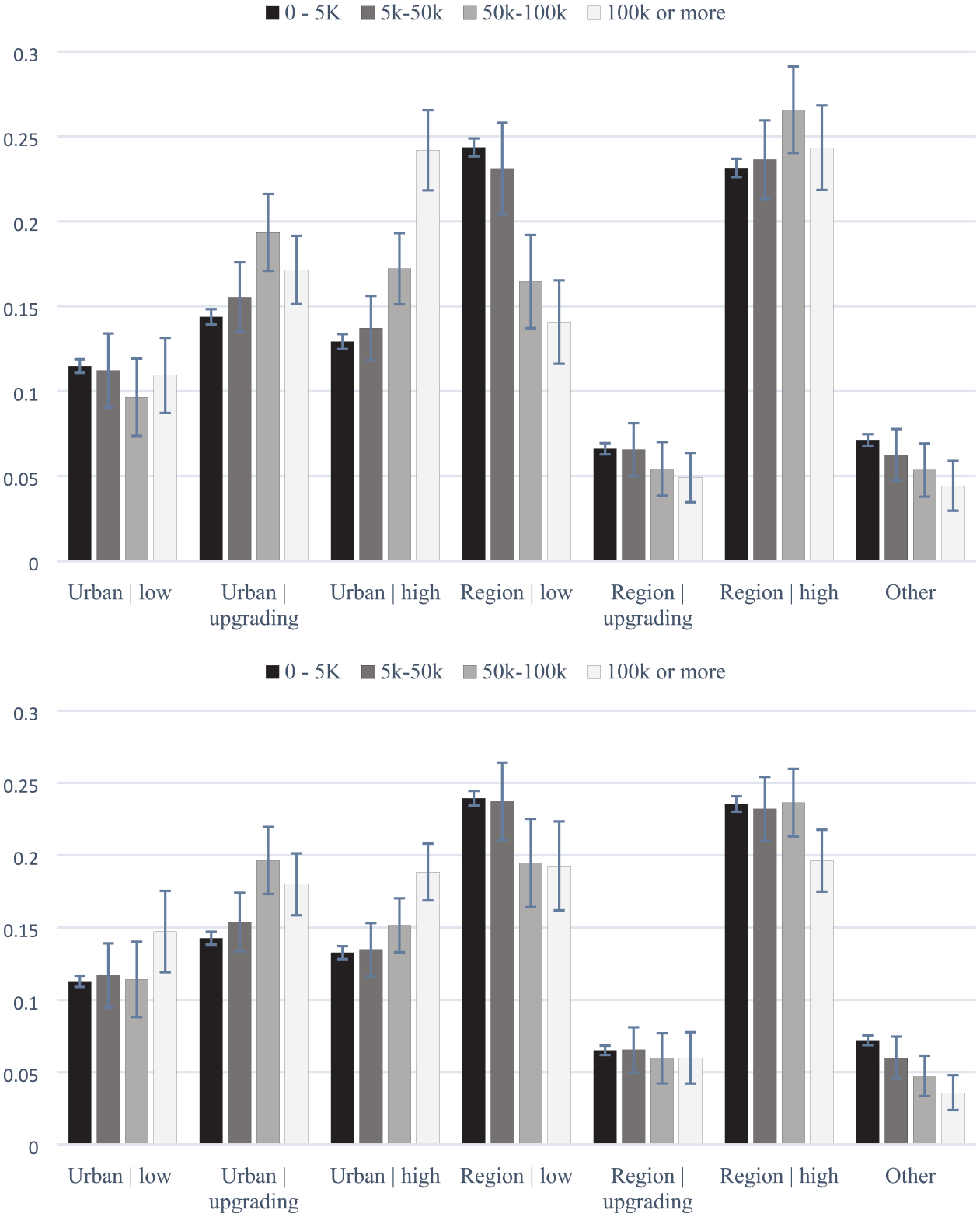
Predicted probabilities of move towards neighbourhood type (model 1, top graph) and move towards neighbourhood type controlled for destination house value (model 2, bottom graph) for owners categorised based on their received gifts in € in 2014.
Because neighbourhood sorting is structured by the distribution of housing quality, size and tenure over different types of neighbourhoods, Figure 3 also presents the predicted probability estimates based on the second multinomial regression model, which includes the value of the purchased dwelling (Table 4). In comparison to the findings based on model 1, differences between young adults receiving and not receiving gifts are dampened for most types of destination neighbourhood. This suggests that – as expected – the uneven distribution of house values across neighbourhoods is an important factor explaining differences in neighbourhood sorting between those receiving and those not receiving parental gifts. However, even after controlling for house price, parental and household background, young adults receiving parental gifts of over 50,000 euros are more likely to move towards urban upgrading neighbourhoods and are less likely to move towards regional low-status neighbourhoods. Additionally, households receiving 100,000 euros or more are more likely to move to high-status urban neighbourhoods compared to households receiving less than 50,000 euros.
Further analysis of the two regions analysed separately indicates that the impact of parental gifts 7 on moving towards urban high status and urban upgrading neighbourhoods is more pronounced in the Amsterdam region. A model of the Rotterdam/The Hague region shows that the impact of parental gifts on moving towards urban high-status neighbourhoods is no longer significant after controlling for house prices (models not presented).
Discussion
Our study sought to investigate how parental gifts are implicated in housing and neighbourhood outcomes for young adults in order to gain insight into how intergenerational transfers may impact residential sorting generally and moving to gentrification areas specifically. Young adults who receive substantial parental gifts are not only more likely to move to more expensive housing, but also to particular neighbourhood types. Simply put, financial gift support allows young adults easier access to gentrifying and gentrified neighbourhoods in central cities as well as to high status areas in the region. Notably, even after controlling for household and parental background and housing quality, a neighbourhood sorting effect remains for parental gift giving (for gifts of over 50,000 and 100,000 euros). This indicates that parental gifts alter the trade-off balance in housing decision making. Ceterisparibus, parental gifts can help some young adult households achieve similar housing quality in a gentrifying or gentrified urban neighbourhood, or in a high-status area in the region.
The question remains how this preference for urban neighbourhoods beyond housing prices and other modeled factors can be understood in view of the literature. Our findings provide support to various strands of literature. There may be an element of convenience and place utility as these areas tend to be close to cultural amenities, centres of work, education, and transport hubs. The residual effect could also point to investment strategies that seek to maximise housing market appreciation (either in the region or in the city) to maintain family capital. In addition, for the gentrifying neighbourhoods, the difference may indicate class-related socio-cultural dispositions that value urban living (cf. Hochstenbach and Boterman, 2017). The status of gentrifying and gentrified areas can be an expression, and an accumulation, of cultural capital. This would mean that the young adults receiving gifts, and perhaps also their parents, are more likely to belong to the urban middle class. There is evidence for class variation in intergeneration transfers (Albertini and Radl, 2012).
For cities, the result of the highly spatialised transfers of family wealth contributes to processes of gentrification in lower-status urban neighbourhoods, putting these and higher status urban neighbourhoods further beyond the reach of households receiving little or no support. Such processes will also increase intragenerational gaps between socio-economic strata. Apart from being able to benefit from place utilities that many central urban areas offer, the spatially-uneven development of housing values will likely exacerbate housing wealth inequalities between those who have parental support and those who do not, as well as between those who are able to buy and those who have to rent (see Arundel and Hochstenbach, 2020; Hamnett, 1999; Moos, 2018).
While an association between parental wealth and neighbourhoods sorting has been established before (Hochstenbach and Boterman, 2017), our study was able to trace actual financial gift transfers into specific neighbourhood types and show that, next to housing, neighbourhoods matter. These findings lead to several new questions and opportunities for further inquiry.
First and foremost, further research could tease out how different mechanisms through which parental gift giving operates work together to produce the socio-spatial results found in this paper. In particular, such research could dig deeper into the relationship between parental gifts and the interaction between housing quality and neighbourhood type. Here, we operationalised housing quality by measuring the purchasing price of the dwelling. The conventional wisdom is that the price of the dwelling would capture a range of characteristics of the neighbourhood as well. From that perspective, we would not expect significant effects of parental gifts on the selection of a type of neighbourhood after controlling for house price differences. Yet, here we found that over and above the price of a dwelling, parental gifts still significantly added to the ‘explanation’ of selecting certain types of neighbourhood. To be clear, the gifts may facilitate but not ‘cause’ this sorting; many young adults would have been oriented towards these neighbourhoods regardless of support. Yet, they indicate how several material, demographic and socio-cultural factors (re)produce spatial outcomes. Research can look into the role spatial knowledge among children and parents plays in housing investment strategies that involve family wealth (see Lui, 2013). It could also address how neighbourhood, proximity and place of residence factor into negotiations between parents and children in gift giving. Relatedly, further studies on the impact of parental gifts on neighbourhood type selection would benefit from research adopting a socio-cultural, or class-based, approach. Cultural capital, in interaction with economic capital, may play an important role in the strong orientation towards central urban high-status and urban upgrading neighbourhoods among those who are receiving parental gifts. Such neighbourhoods typically contain centres of cultural activity, employment, education and entertainment, but increasingly have also been hotspots of gainful financial investments. Neighbourhood selection may be driven by higher-educated young adults who through their upbringing have been endowed with social and cultural capital, and who are more likely to have wealthy gift giving parents who are willing to provide economic capital to support the urban orientations of their offspring, possibly while also keeping an eye on the housing value appreciation. Such class-based analyses may also investigate the intersections with race and ethnicity. Our descriptive data show that gifts are mostly received by (white) native Dutch. Yet, various migrant, ethnic and racial groups vary in their ownership rates and housing equity (Keister, 2004; Kuebler, 2013; Van Gent and Zorlu, 2020). This diversity in tenure, housing equity and transfers implies a variety of spatial outcomes.
Second, while using unique high-quality registry data, we were only able to analyse gifts that have been reported to the tax office for 2013 and 2014. These years saw far more gifts than in later years (Vermeulen et al., 2021). It coincided with a period of housing market recovery and increased mobility. It is unclear how, but this ‘period effect’ may have played a role in residential sorting (see Damhuis and Van Gent, 2022). Furthermore, our analyses show that next to parental gifts, parental wealth and tenure are relevant factors in neighbourhood sorting. Not all parents may report their gift giving, in particular when giving smaller gifts, or may provide financial support in forms such as loans (not included in our analysis). Moreover, wealth may also indicate social reproduction in tenure preference and spatial orientations through upbringing and socialisation (Lersch and Luijkx, 2015; Toft and Ljunggren, 2016; Van Ham et al., 2014). In sum, there are multiple ways in which parents may structure neighbourhood selection of their young adult children.
Footnotes
Declaration of conflicting interests
The author(s) declared no potential conflicts of interest with respect to the or publication/or publication of this article.
Funding
The author(s) received no financial support for the research, authorship, and/or publication of this article.
