




Abstract
This paper expands the repertoire of comparative urbanism by putting forward a method of ‘hopeful comparison’, in which we explore an asynchronous comparison between post-war Poland and Syria. Similar to the way that Polish architects used urban design as a ‘practice of hope’ during the Second World War, contemporary Syrian architects are now drafting reconstruction plans even if their implementation does not seem politically possible. Yet what role can an ethical, affective stance such as hope play in the methodology of comparative urbanism? In our comparative strategy the role of radical hope is threefold. First, it creates the comparative connection between two cities destroyed by urbicide, thus countering the destructive connectivities of war and, in case of Syria, capitalism, and foregrounding resilience and human connection (which also opens up the potential of healing). Second, radical hope provides a temporal reorientation of knowledge, redirecting the analysis from the traumatic past towards an open future. Third, in this way a hopeful comparison becomes a practical tool for thinking through concrete ethical and political dilemmas concerning reconstruction and property regimes. How to think about reconstruction when the conflict is still ongoing, and, if the property system is now weaponised as part of the conflict, how to avoid inadvertently reproducing this violence in the process of property restitution and reconstruction.
‘It is then in making hope practical, rather than despair convincing, that we must resume and change and extend our campaigns’
Introduction: Urbicide and radical hope
The only solid grounds in Syria might be those for despair. For over a decade of continuous war the political situation has remained extremely unstable, while the rubble is piling up (Figure 1). Across Syria, at least 33% of the housing stock has been destroyed, along with infrastructure networks, public institutions and cultural heritage sites (UNOCHA, n.d.). To make matters worse, many so-called ‘reconstruction’ projects mask and legitimise new rounds of destruction and displacement, as habitable neighbourhoods are being demolished to make space for luxury real estate (Clerc, 2014; Kayyali, 2019). When the very vocabulary of hope is being exploited by military–financial cynicism, it is hard not to lose all hope.
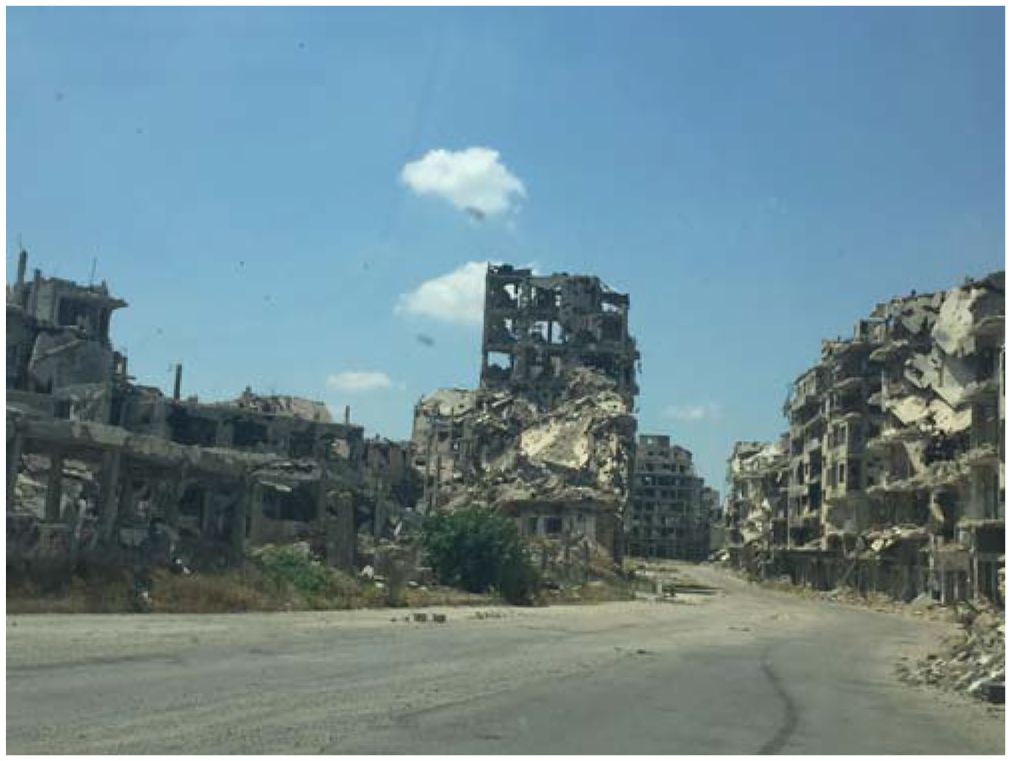
Destruction of Homs.
In such desperate moments, any analytical approach becomes ethically charged. Once we choose a lens through which to understand the situation, this lens inevitably guides our responses. Thus, the key question that confronts people who once felt at home in Syrian cities – those who stayed there and those who became refugees or migrants – is at once analytical and ethical. The question ‘how to respond to the catastrophe?’ is inseparable from the question ‘how to live when the old ways of living are unattainable?’
To uphold such questions of ethics in the face of cultural devastation, Lear (2006) analyses the response of the Native American Crow tribe to their US-imposed enclosure in a reservation. Although the Crow people knew that moving to a reservation would effectively annihilate their culture, they also knew that it was the only way to avoid genocide. When the imbalance of power is so great that militant opposition becomes identical with massacre, the final frontier is internal: it lies between hope and despair.
To mobilise hope in desperate circumstances is a radical act that has nothing to do with naïve optimism. On the contrary, the possibility of radical hope depends on a realistic assessment of the conditions that preclude what we imagined as a ‘better future’. Anchored in the painful knowing of the impossibility of the future that we want, radical hope is simultaneously elevated by what we cannot yet know: ‘what makes this hope radical is that it is directed toward a future goodness that transcends the current ability to understand what it is’ (Lear, 2006: 103). Radical hope, whether it has a religious or secular grounding, is always transcendent, for it acknowledges that no ‘realism’ can fully grasp the dynamic complexity of the world. In this sense, radical hope points not so much to the future possibilities anchored in the present, but to the possibility of a future that we cannot imagine, for it disrupts our knowledge about the present.
It is precisely this kind of radical hope that, mobilised in the face of two distinct acts of ‘urbicide’ (Coward, 2008b), provides the impulse for the asynchronous comparison that we propose in this paper. This comparison juxtaposes the current situation in Homs – one of the largest and most destroyed Syrian cities – with the historical destruction and rebuilding of Warsaw, the Polish capital, which was razed to the ground during World War II. There are many aspects in which, as we will scrutinise, these cases seem legitimately incomparable. And yet, there is also a poignant similarity in how Polish and Syrian architects and urban planners responded to urbicide. 1 Just like contemporary Syrian architects and urban planners who, at home and in diaspora, have been thinking and writing about the future of their destroyed cities (Al Asali, 2020; Almasri, 2013; Al-Sabouni, 2017), Polish urban professionals had been drafting plans for the rebuilding of Warsaw long before there was any ‘realistic’ perspective that the violence and dispossession would come to an end. War-generation Varsovians and contemporary Homsis alike have turned urban design into a ‘practice of hope’ (Joronen and Griffiths, 2019: 70) long before the implementation of their plans seemed politically possible.
What role can an ethical stance such as hope play in the methodology of comparative urbanism? While the radical hope sustained by Homsis and Varsovians cannot and should not be compared to one another, hope in this paper becomes a key element of our ‘comparator’, that is a material-conceptual assemblage that actively performs comparative work (Deville et al., 2015). Comparators consist of concrete people, tools, theories and, we would like to add, also ethical and affective positions that provoke relations between what is being compared. To us – both scholar-activists living abroad, one from Warsaw, one from Homs – the radical hope sustained by Varsovians and Homsis through urban design signals an affinity in the ‘structures of feeling’ (Dirksmeier, 2016; Williams, 1975), one that overpowers other contextual differences. Thus, radical hope is key to our ‘launching’ a conversation between two urban singularities (Robinson, 2023: 331). At the same time, through the ethically charged (and acutely political) task of ‘thinking Homs through Warsaw’, we seek to intervene in methodological debates on comparative urbanism (Myers, 2014; Robinson, 2023; Schmid et al., 2018).
The paper’s contribution is twofold. First, we expand repertoires of comparative urbanism, proposing a methodology of a ‘hopeful comparison’. Building on research on ‘generative’ comparisons that put concepts from one context to work elsewhere (Hentschel, 2015; Robinson, 2023; Schmid et al., 2018), we argue that a comparison can be ‘generative’ not only for concepts and theories, but also for affective positions such as hope. We propose a hopeful comparison as a tool to assist the process of thinking through ethical decisions (without providing answers) and to facilitate trauma healing by amplifying hope (Umer and Elliot, 2021).
Second, we use this comparison to discuss concrete ethical dilemmas concerning reconstruction, housing and property restitution in post-urbicide Warsaw and Homs. The history of Warsaw, as well as its contemporary consequence, points to the relevant (though not always obvious) issues that must be considered when thinking about the future of Homs. By thinking these cities’ dilemmas together, we also revive the tradition of conceptual exchange between Eastern Europe and the Levant (Klimowicz, 2019; Stanek, 2020), strengthening the ‘epistemic space’ of the Global East (Müller, 2020).
To reflect on a researcher’s positionalities in the context of war trauma – and to highlight the importance of ‘structures of feeling’ in research on ‘making hope practical’– we weave both authors’ personal voices (marked in cursive) into the ‘standard’ academic narrative that usually blurs the line between individual researchers (for a similar strategy see Lisle and Johnson, 2019). To carry this personal voice, we also negotiate the Anglo-American format of a research paper, mixing it with more personal formats of academic writing typical in our own traditions. For example, the longer introduction that goes beyond signposting the paper goals, and that includes personal and philosophical reflections on how the authors’ positionality is indeed part of the argument, is inspired by the Eastern-European tradition of essayism as a valid form of academic writing (Kusiak, forthcoming).
The method of a hopeful comparison
Healing through comparative connections: Mobilising hope
In Homs, I was teaching at the School of Architecture at Al-Baath University. With the regime’s efforts to crush the Revolution, our old ways of living collapsed. Tanks entered the city, tower blocks turned into snipers’ platforms, and neighbourhoods became sites of the battlefields. One day in 2011, a bomb exploded near the School of Architecture. In the design studio where I was with my students, windows shattered. Chaos erupted. Those of us who got away from explosion, still could not get away from fear.
I left Syria in November 2011 without being able to return since then. From afar, I witnessed the destruction of my city. I saw my most cherished places and streets erased. From afar, I sensed the weight of suffering of the people who stayed. Now I watch how, through the so-called reconstruction projects, the regime bulldozes what remains of the social and cultural fabric of the city. In my exile, I feel a responsibility to keep the city alive in some ways.
I left my city, but my city never left me.
Urbicide is a geotrauma: a collective spatial trauma (Pain, 2021). It brings about damage that is at once spatial, social and psychological. If cities are ‘emotional knots’ (Thrift, 2008: 206), urbicide reconfigures the affective spatial experiences of its survivors (Bleibleh et al., 2019) and of the urban generations to come. In Warsaw, over 75 years after the total destruction of the city, trauma is visible not only in the bullet-holes on facades of the few remaining historical buildings. It manifests itself also with an excessive memorialisation of violence both through countless monuments and in the popular culture (Napiórkowski, 2016). In this way, urbicide reverberates in what Raymond Williams dubbed the ‘structure of feelings’ (Dirksmeier, 2016; Williams, 1975), that is the city’s collective emotional disposition.
Indeed, it was the structure of feelings – rather than the analytical gathering of facts of trauma (Schwab, 2010) – that triggered the comparative work presented here. As postulated by Robinson (2023), the ‘comparative gesture’ may come in different forms and originate from different genealogies. While some comparisons start with evident similarities, others ‘trace’ or even ‘invent’ connections to ‘underpin oppositional possibilities for solidarity and mobilization across divergent cases’ (Robinson, 2023: 158). Such connections are not arbitrary but programmatic, for they counter the powerful connectivities of capitalism (Katz, 2001: 1232) including transnational profiteering from war.
The hopeful comparison does not ‘invent’ the connection but rather feels into it. It derives comparative gesture out of the human connection, which is known to be the most effective means of healing trauma. Our own comparative and healing work started with a meeting.
In February 2019 I attended a talk on the destruction of Homs given by Ammar. As we were discussing similar dilemmas posed by the two urbicides – especially concerning the themes of land, property and housing – I recognised in Ammar’s speaking an archetypical figure from the cultural-affective landscape of my city: a displaced architect who, expelled from a city in ruins, keeps rebuilding the city in his mind and imagination.
Warsaw today is an incredibly lively city that has ‘survived its own death’. 2 The destruction of Warsaw was an element of the Nazis’ geopolitical strategy – yet urbicide is never reducible to its military aspect; it is also a form of social eugenics. Urbicide is an assault on buildings in order to destroy urbanity (Coward, 2008a). ‘Destroying buildings is thus the destruction of that which – in and through constituting shared spatiality – comprises the condition of possibility of heterogeneity’ (Coward, 2006: 429). To achieve this, in the early 1940s, Nazi architects conceived the so-called Pabst plan as ‘the final solution of the Warsaw-problem’ (Gutschow and Klain, 1994: 103). The plan foresaw the mass displacement of the Polish population, followed by a descaling and redesigning of Warsaw into a provincial German town. Although the Pabst plan was never realised, the Nazis nonetheless razed Warsaw to the ground as a deliberate punishment for the city’s ultimate act of insurgency, the Warsaw Uprising (Gutschow and Klain, 1994: 131).
Warsaw was destroyed in a planned fashion. Special ‘burning detachments’ (Verbrennungskommandos) were formed that set buildings ablaze and blew them up one after the other, while documenting the whole process. By 1945, Warsaw was reduced to rubble and ashes: 67% of the cubic volume of its real estate lay in ruins, including 78% of that in the city centre (Warszawa, 2004: 39ff) (Figure 2).
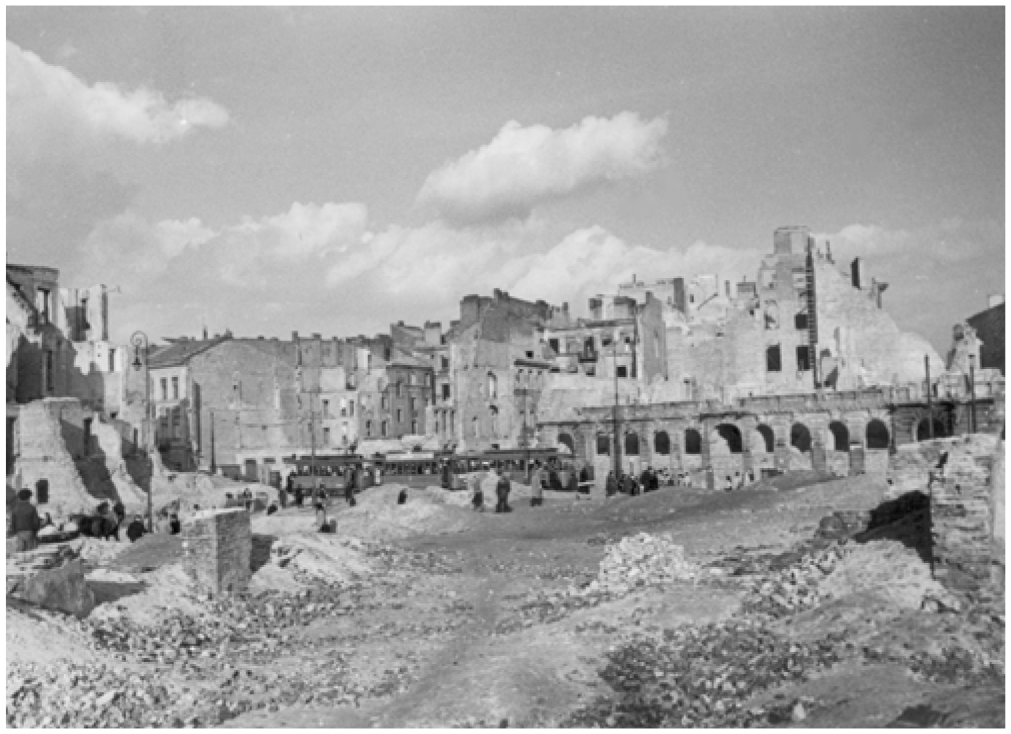
Destruction of Warsaw.
Yet long before this destruction was completed, urban professionals were drafting plans to rebuild Warsaw. In summer 1940 – when there were no grounds to believe that the city would ever be liberated – architects, sociologists and urban planners in Warsaw started an ‘Atelier for Architecture and Urban Planning’ (Pracownia Architektoniczno-Urbanistyczna– PAU). Working illegally underground, PAU members coped with the threatening reality of occupation by imagining the city’s future. Around the same time as Nazi architects were drawing the urbicidal Pabst-plan, PAU members were discussing how to turn the destruction caused by the early bombings into an opportunity to improve the city’s liveability. In their projects, they focused on providing affordable housing and on greening the city (Gutschow and Klain, 1994: 57ff), for these were the features that had lacked in the overly dense, pre-war Warsaw.
An incredible sense of professional mission carried Warsaw architects through the dark times they endured. During his 18-month imprisonment in the Auschwitz concentration camp, Szymon Syrkus – one of the PAU’s most prominent architects – sent letters to his wife Helena (herself an architect and PAU member) in which he shared ever new ideas for the future development of Warsaw. In November 1943 – after nearly a year in Auschwitz – Syrkus wrote to his wife that he considered the experience of the concentration camp ‘not without use’ for his planning practice, for he could now ‘understand more deeply the challenges faced by people who lived in very close quarters, and their consequences for the designing of residential and work spaces’. He concluded: ‘I am waiting to be able to use this important knowledge about people to work for [my] housing cooperative and for the city’ (cited in Gutschow and Klain, 1994: 95).
Simultaneously, architects and planners in exile were also working on reconstruction plans. The University of Liverpool created the so-called ‘Polish School of Architecture’ for them in 1942. 3 In October 1944, when news about the systematic destruction of Warsaw had reached England, Liverpool’s final-year students were given an assignment to draft reconstruction plans for Warsaw’s Old Town. Beyond the UK, organised groups of Polish architects in Russia and Germany were also working on reconstruction plans (Gutschow and Klain, 1994: 148). And while some of the people who had drafted those hypothetical plans for Warsaw did, in fact, later participate in the actual reconstruction (Piątek, 2020), they had no reasons, in the early 1940s, to believe this would ever happen. At this stage, urban design was foremost a coping strategy to move through the trauma and grief. It was a practice of hope.
I recognised this kind of hope – hope that heals not through a sentiment of optimism but through the hard labour of persistence – in Ammar and other Syrian professionals who keep the questions of reconstruction at the heart of their work. Within the context of academia, it is usually sufficient to say that the common themes between our projects on Warsaw and Homs have ‘interested’ me enough to pursue this collaboration. Yet the comparative approach that we are forging here – one that works with hope as an affective position that can be transmitted (Brennan, 2004 ) – was only possible because Ammar’s persistence in maintaining hope throughout the destruction has genuinely touched me. This should not be concealed by an academic form.
Hopeful reorientation of knowledge
The cognitive role of feeling, while confirmed by neuroscience (Damasio, 2006), is still rarely acknowledged as a valid part of the social sciences’ methodology. Yet, to grasp the phenomenon of radical hope, both in historical materials and in interviews conducted by Ammar with the Syrian diaspora, we have searched for the link between its two dimensions: hope as an affective position and hope as a material practice. And following Miyazaki’s (2004) recognition that hope cannot be reduced to an object of analysis, but must become a method, we saw our own affective entanglement as a strength, and not a weakness of the comparative approach. Indeed, we ourselves hope for Syria and understand this hope as a practice (which includes writing this text). Thus, we see Warsaw as a useful lens to better ground this practice, both strategically and ethically.
Analysis can also kill hope. Academic papers belong to the least hopeful of genres, for scholars tend to ‘bind lack of hope with being profound’ (Taussig, 2002: 45). And the force of reasoning, because it is generated a posteriori, can make trauma seem overwhelmingly inevitable and complete. Focusing on what has already happened, analyses forego unrealised possibilities. In this way, it may reinforce the sense of powerlessness experienced by the survivors, ‘re-isolating’ them in their experience (McKittrick, 2011: 960; Pain, 2021: 12ff).
As a method, hope breaks this cycle through a ‘radical temporal reorientation of knowledge’ (Miyazaki, 2004: 5). Reconstructing hope as methodology, Miyazaki builds on the works of Ernst Bloch, Walter Benjamin and Richard Rorty. According to Bloch, philosophy (and contemplative knowledge in general) is structurally limited because of its focus on what has already become. An unmitigated focus on the past can block analysis from accessing a ‘future of the genuine, processively open kind’ (Bloch and Plaice, 1995: 8; spelling in the original; see also Miyazaki, 2004: 13).
This is why, we would like to add, a meeting can be a crucial methodological trigger for a hopeful analysis. While the drive for understanding the sources of trauma pulls the researcher backward, a living person embodies a radical openness of the future. For Ammar to forget hope after having lived through trauma would be an act of surrender. For Joanna meeting Ammar was a reminder of how similar, future-oriented practices of hope have enabled the survival and healing of her own city. Such affective resonance can produce a hopeful analysis as ‘an improvisation that links the past, present and not yet realized future’ (Back, 2021: 16).
Simultaneously, launching a comparison in the context of trauma and healing brings to the surface the ethics of comparative approach. Unless done by a single scholar, assembling a comparison includes configuring a relationship between the researchers. Usually, this process also remains hidden from methodological accounts. Yet in the context of trauma and hope, the fact that positionalities of researchers influence the results of the research becomes a key element of the research setup.
As a Syrian in the UK, I’ve seen how some UK based academics turned our pain and trauma into a funding opportunity. Many of them wouldn’t speak the language, know our struggle, or care about us – but they find in our struggle an opportunity to build their career. I was moved by Joanna’s emotional attunement to the Syrian trauma, and by her insistence on writing the paper ‘with me’ rather than just ‘about me’, encouraging me to write more personally about the trauma while also respecting my boundaries.
When I started working with Ammar, it was important for me to discuss very openly how our vantage points are not just methodologically, but also existentially different. Most importantly, while my research on Warsaw is based on historical sources, Ammar has lived – and is still living – the trauma of urbicide. I didn’t want to create an academic catalogue of similarities and differences between the two cases. Instead, my goal was to use the story of Warsaw as a discursive ‘container’ in which hope – as it is being practiced by Ammar and other Syrian urbanists – could further unfold.
In this unfolding of hope, facilitated by the story of Warsaw’s past and present, we wanted to write about Homs in a way that is honest about the current structural violence and yet analytically open towards the future. Thus, we use the method of hope to project the ‘still undischarged future of the past’ (Eagleton, 2015: 32) and analytically evaluate possible ways of creating it.
Making hope practical: Mobilising the past for the present
The cases of Poland and Syria are vastly different, not only in terms of context and culture, but also when it comes to geopolitical framing. The urbicide of Warsaw was carried out by an external enemy (the Nazis), while the war in Syria is internal with several external states entangled in the conflict. The factions diverge even on how to define this war’s (potential or already accomplished) end.
Warsaw was rebuilt by a socialist state within the context of an impending Cold War. In Syria and the Levant we can observe an authoritarian neoliberalism (Bruff and Tansel, 2019) and corporate urbanisation. In the broader geopolitical frame of global capitalism, large real-estate projects are strongly influenced by transnational networks of capital (Rolnik, 2019). By contrast, all post-World War II reconstructions, both in the East and in the West, were public ventures carried out by states. While Poland’s history also illustrates that global political –economic frameworks – however stable they appear – might collapse or transform, currently there are no reasons to assume that the reconstruction of Homs would happen in circumstances bearing any similarity to those of Warsaw.
The aim of a hopeful comparison is thus not to provide answers or give policy recommendations. Instead, a hopeful comparison pulls people who are currently grappling with the trauma of urbicide and the dilemmas of reconstruction into a conversation with people who have faced similar issues in the past. Following Law and Urry (2004: 397), we postulate that a social scientific method (such as hopeful comparison) can become a ‘system of interference … for working towards and making particular forms of the social real while eroding others’.
Analytical accounts of the past typically focus on historical outcomes. But to ‘make hope practical’ it is equally important to understand that – before any outcomes came into being – real people grappled with ethical choices, and they did so without the privilege of hindsight. Thus, seeing the outcomes together with the original dilemmas is more helpful in approaching contemporary problems. With this in mind, the next section both describes two big dilemmas faced by urban professionals who hoped for (and later participated in) the rebuilding of Warsaw, and evaluates the outcomes of the decisions that were ultimately made.
Thinking Homs through Warsaw: The dilemmas of conflict, reconstruction and property
Reconstruction amidst ongoing conflict
Homs: Displacement by reconstruction and the dilemma of participation
The first dilemma faced by Syrian professionals, as well as by the international community, considers participation in the context of the Syrian regime’s ongoing violence. Can one participate in any reconstruction project without being implicated in this violence? Should expats, NGOs and external governments offer practical and/or financial help to reconstruct Syrian cities? Or is it better to withdraw such help as long as the regime does not comply with democratic standards? Assuming that the answer is more complex than a simple ‘yes’ or ‘no’, how to decide in which cases, with whom, and under what conditions to engage in reconstruction?
These questions touch upon the ongoing conflict that has led to the destruction of Syrian cities. Like Warsaw, Homs was not destroyed only for military purposes – its destruction was a deliberate act of punishment for the people’s rebellion. The Syrian Government laid siege to the city, blockading it in order to attack rebel-held neighbourhoods (Clerc, 2014). Maps show that the heavy damage was concentrated in neighbourhoods that supported the revolution, while pro-government neighbourhoods stood entirely intact or incurred little damage even when situated right next to the ruined neighbourhoods. Between 2011 and 2017, different sieges took place across different parts of the city. Over half of the neighbourhoods were heavily damaged, with a further 22% suffering partial damage (UN-Habitat, 2014).
Beyond physical destruction, Homs has been torn apart as a community, dividing people from each other (Al-Sabouni, 2017). Overall, more than half of the Syrian population has been displaced. Over six million people have fled the country, and the number of those internally displaced is even bigger. Although the lines of physical division – fences, walls, checkpoints and concrete blocks – have been now largely removed, people remain divided. Many still refuse (or fear) passing through another neighbourhood inside their own city. These divisions create a real backdrop to all the discussions about potential reconstruction.
Scholars and activists warn that the reconstruction projects that are currently carried out by the regime tend to deepen those divisions by continuing politically motivated harm. As Clerc (2014: 44) notes, the Syrian authorities ‘used urban planning as a weapon, not only by destroying opponents’ houses and bombarding the quarters held by the armed opposition, but also by drawing up projects for urban renewals (i.e. demolition and reconstruction) of specific neighbourhoods’.
In Homs and Damascus, people are being forcibly displaced (sometimes arrested or even ‘disappeared’) from opposition neighbourhoods using reconstruction projects as a pretext. In the place of low-income, low-rise neighbourhoods, projects like Marota City or Basilia City are proposed, gated communities with rooftop swimming pools and large shopping malls. In theory, people are allowed to stay if they pay for the ‘reconstruction’ of their own flat. But with the economic collapse, most of these people will not be able to afford to live in the newly built apartments and are effectively forced to sell the shares they were offered.
To protest the regime’s actions, international donors and governments have refused to provide any financial support for reconstruction in the absence of any political change. The European Union and the United States, for instance, ‘have repeatedly declared that their support for Syrian reconstruction and an end to sanctions would depend on a credible political process leading to a real political transition’ (Daher, 2019: 51). The fear is that reconstruction will further violate human rights and harm already suffering communities. Kayyali (2019: 2) reports that ‘the Syrian government has developed a policy and legal framework that allows it to co-opt humanitarian assistance and reconstruction funding to fund its atrocities, advance its own interests, punish those perceived as opponents, and benefit those loyal to it’.
The refusal to participate in reconstruction projects, while understandable, does not solve the ethical dilemma of leaving people without help, especially in the context of the regime’s continued violence. A question thus arises: under what circumstances (if any) would it be possible to participate in reconstruction projects in Syria? Is it possible to reconstruct the city amidst the political conflict?
Warsaw: Housing as a unifier
The end of war rarely means the end of social and political divisions. Thus, the first dilemma faced by urban professionals after the war was the most basic one: Should they participate in the reconstruction of Warsaw carried out under the umbrella of the new socialist government? Poland’s government-in-exile, based in London and allied with the West, refused to accept the socialist governing authority that, allied with the USSR, ultimately took power. Many supporters of the London government, as well as communists critical of Stalin, were persecuted by this newly formed government.
In 1945, the socialist government launched The Office for the Rebuilding of the Capital (Biuro Odbudowy Stolicy, BOS), an umbrella institution that, operating until 1951, was responsible for all reconstruction processes, from removing rubble to planning and building. And it is seen as one of the miracles of Warsaw history that the BOS – although operating during the years of Stalinism – united professionals of all political persuasions in the task of rebuilding the city.
How was it possible that even openly right-wing architects were willing to participate in the rebuilding, often at the price of foregoing the comfort of their Western lives and working mostly for basic provisions? How is it that the regime silently agreed not to persecute the urban professionals who criticised it? The archival materials, meticulously analysed by the historian Piątek (2020), reveal two key reasons that united all the fractions of the professionals who joined the BOS.
The first is the pragmatism of hope. In 1945, the London government was effectively powerless. It was thus clear that the communists had won and that joining the BOS was the only way to influence the reconstruction (Piątek, 2020: 82). This was an important motivation for Jan Zachwatowicz, an architect who worked for London-government and then became one of the BOS’s most influential members. Within the BOS, Zachwatowicz successfully lobbied for the restoration of some of Warsaw’s historical features and against turning it into a fully socialist–modernist city. This kind of pragmatism was led by a mission-like ethos of professional responsibility. In the not-yet-globalised context, expertise itself was a scarce resource. Another London-allied architect, Piotr Biegański, recalled: ‘not only was one allowed to, one had to take the risk of participating in this sacred mission [of reconstruction], to do whatever required to achieve a positive result, to face up to the consequences’ (quoted in Piątek, 2020: 81).
Second, and perhaps most importantly, beyond all the political differences there was a basic agreement that the top priority of the reconstruction must be housing. Even the reconstruction of Warsaw’s historical parts – the Old Town and the Saxon Axis – were about building housing projects behind the historical facades. This was a legacy of both pre-war modernism and of Warsaw’s long-term housing crisis. Piątek (2020: 87) quotes architectural pamphlets published before the war in both right-wing and left-wing magazines, all of which highlighted the priority of affordable housing in thinking about future Warsaw. Thus, even experts politically opposed to the regime had the feeling that, by participating in the reconstruction, they were contributing to the well-being of people, both immediately and in the long term. Eighty years and one systemic revolution later, the apartments built by the BOS are among the most sought-for on the Warsaw housing market.
Hoping for Homs with Warsaw: Focus on housing
The openness of radical hope does not call for one to engage in any specific reconstruction projects, now or in the future. However, it calls for one to seriously consider if there could be any terms under which such participation could be possible or beneficial for the communities – either after the change of regime, or despite its continuous rule.
The example of Warsaw shows that ‘reconstruction’ is too general of a term – it all depends on its specific priorities. And the modernist paradigm of reconstruction, despite its many successes, can also be legitimately contested (Hubbard et al., 2003). If there were any government-led reconstruction projects in Syria which aimed at providing affordable housing, the balance of harms and gains coming from supporting such projects would need to be reconsidered (which is not to say that such projects should always be supported).
The history of Warsaw draws attention to the fact that, in the current context of Syria, affordable housing has not been given enough priority. The government-led projects propose housing only for the rich elites. At the same time, the focus of several local and international efforts is on monumental heritage sites. This focus neglects the everyday needs and the suffering of people. Can we redirect the conversation about Syria’s reconstruction away from its primary focus on monuments and towards the building of homes?
Finally, the example of Warsaw poses a question about participation within the open horizon of radical hope. If the collaboration with the regime is not an option, what would enable Syrian architects to come together under the cause of reconstruction? Would the reconstruction need to be big in scale? Or could it work through a system of support that would help local communities in their individual housing projects despite (and amidst) the political violence? And how might such a system be created? In fact, it is the ongoing violence that makes the need for housing particularly dire. Thus, it is not enough to stay ‘clean’ by refusing to give support; we need to increase our creativity in searching for new ways to help people rebuild their homes – and their lives. One example of such creativity can be found in the action of local charities such as Al Bir, which have been distributing kits and guidance for owners to repair and fix their partially damaged homes by themselves.
Urbicide, urban diversity and property systems
Homs: The weaponisation of property systems
Let us imagine that Syrian cities have become free and democratic: how could they be transformed back into the heterogenous communities that they once were? One of the biggest dilemmas of all post-urbicide reconstruction concerns property restitution.
Urbicide destroys people and buildings. But it also destroys and/or manipulates socio-legal systems such as property. And because property rights play a crucial role in upholding a city’s ‘normal’ order, it is often assumed that restoring property rights contributes to the restoration of the pre-urbicide urban order. It is a common liberal belief that property restitution can undo at least some of the injustices of urbicide. But is it really that simple?
In Syria today, we can observe how the legal framework of property has been weaponised to perpetrate violence: the ‘government urban planning laws are often used to confiscate the property of residents, leave them without any alternative housing and never provide them with compensation, so violating their property rights on more than one level’ (Human Rights Watch, quoted in Arab News, 2018).
According to Unruh (2016: 453ff), housing, land and property systems (HLP) in Syria have been weaponised in several ways. First, the archives and HLP records have been purposefully destroyed. In Homs, the land registration department building was targeted and burnt down in 2013. Second, because property titles link people’s names to specific geographic locations, the government is using property to locate and target its political opponents. This makes it dangerous for political opponents to make any claims relating to their property. Third, the property in dissident constituencies is more often destroyed. Fourth and fifth, the HLP documents are often confiscated at checkpoints (to effectively expropriate owners) and HLP rights are reallocated to regime-friendly groups, which often includes falsified documents and forced transactions.
Finally, the state has been issuing new legislation, the most prominent example being Law 10, to evict political opponents and take over HLP. Enforced in April 2018, Law 10 allows the government to confiscate peoples’ property if they do not lodge their ownership claims from within the country inside a given period of time. Yet those who have fled rebel held areas with their families and relatives might be unable to return, fearing they will be arrested. Even when they still have relatives inside Homs, these relatives might fear lodging HLP rights for their family members. Again, property claims are being used to track relationships between members of the opposition. At the same time, refugees who are living in camps like those in Jordan might not even be aware that they have a right to claim their property.
While property upholds urban order, it can also be used to manipulate that order or, if the manipulations are coded in law, violently impose a new one. Thus, property restitution after urbicide often not only fails to undo past injustices, it may even exacerbate those injustices, or produce new ones.
Warsaw: The violence of expropriation and the violence of restitution
In Warsaw – similar to what is happening now in Syria – not only buildings, but also archives were purposefully destroyed. And in legal terms, any activity related to reconstruction – even as simple as the removal of rubble – demands agreement from the owner of a given land lot. As around half of its inhabitants had been killed or had fled, by the war’s end most of Warsaw’s property owners were unreachable. Large-scale expropriation was needed to allow for large-scale reconstruction.
In 1945 the socialist government passed the Warsaw Decree and expropriated all land in the city. The Warsaw Decree was a planning decree, and its aim was to enable Warsaw’s reconstruction (Popiołek, 2016). Though it could be seen as simply part of socialist ideology, expropriation was actually a standard move for enabling post-war reconstruction in the East and in the West.
While the Warsaw Decree definitely did its job in terms of enabling large-scale rebuilding, its imprecise language allowed for unfair implementation. Similar to Law 10 in Syria, the Warsaw Decree allowed owners to reclaim their property within a set timeframe, and comparable to how the Syrian government is using Law 10 to make it difficult for political opponents to reclaim their property (DiNapoli, 2019: 263), Poland’s socialist government politicised its decisions on who could have their property returned to them. Thus, while the rebuilding of Warsaw was a success in terms of urban form and housing provision, pre-war property owners felt that they were dispossessed without compensation. Furthermore, the ethnic diversity of pre-war Warsaw that, to some extent, could have been preserved by property titles, was never restored. In particular, the Warsaw Jewish community was never restored. Many of those who survived Holocaust left Poland after the war.
The framework of property restitution might be especially inappropriate in the context of urbicide, where the destruction wreaked is part of a deliberate military strategy. DiNapoli (2019: 276ff) uses examples of Bosnia and Lebanon to show how property claims can be both politicised and commercialised. In Warsaw, too, the legal framework of restitution was misused for profit, despite the fact that the democratic community had not agreed to the restitution in the first place. Kusiak (2019a, 2019b) describes how a small group of ‘reprivatisation businessmen’ used their knowledge and influence to turn property restitution into a lucrative form of real estate speculation. Through what she calls ‘dispossession-by-restitution’, the city’s key public services (including schools, hospitals, parks and public housing) were partly dismantled, as attractive urban lots were appropriated by businessmen who bought up property claims and even, as has been proven in some cases, forged them.
From the perspective of historical justice, the failures of Warsaw’s post-urbicide property restitution are poignant. First, the restitution did not mitigate the sense of injustice and conflict caused by the war’s destruction and the subsequent expropriation. As restitution only considers who currently owns a property title, it has retroactively legitimised all types of war-related fraud, such as forced transactions (many Jews had to sell off their property cheaply to survive) and forgery (which is very hard to prove when the archives are destroyed and owners are gone).
Second, restitution created resentment in the broader community, for it prioritised a material loss specific to the wealthy over types of losses (loss of life, death of family members, displacement) that pertained equally to everyone, and notably the poor. Third, the commercialisation of claims has turned restitution it into a business for the few, thus creating new types of injustice. In Warsaw, thousands of tenants were evicted from public housing that was rebuilt with public money and on the back of public labour after their buildings were ‘returned’ for free to the commercial owners. Thus, restitution has been reversing the equitable housing distribution that had served as the ‘uniting cause’ of post-war rebuilding.
Finally, neither in Warsaw nor in Bosnia nor Lebanon has restitution managed to undo the homogenising effects of urbicide, that is to restore pre-war ethnic diversity. When claims are commercialised, most owners tend to sell. In his work on Beirut and Sarajevo, Bădescu (2020) notes that reconstructing the pre-war cosmopolitan cityspace is challenged in many ways, especially by the post-war displacement of the people. In different geographies, including Syria, this means that the pre-war sense of diversity and cohesion might never return to cities when these communities have been persecuted and forcibly uprooted – or it might take a long period of time to reconstruct trust, based on accountability and justice.
Hoping for Homs with Warsaw: Community claims rather than individual claims?
One of the aims of urbicide is to undo urban diversity. In 2017 the government declared that through destruction Syria ‘has won a healthier and more homogeneous society in the real sense’. 4 The weaponisation of HLP in Homs can be read as the regime’s way of maintaining such homogeneity and of rewarding loyalists. The experience of Warsaw shows that such manipulations cannot be easily reversed through a property restitution based on individual claims.
While we cannot realistically hope to achieve justice through restitution, the perspective of radical hope does not imply giving up on the possibilities of justice inherent in property as a framework. Instead, it calls for more creativity in exploring new models of community-based restitution. One fruitful inspiration could be indigenous collective land claims, for they aim at restoring property rights to certain ethnic or cultural groups without focusing on individual titles (Crabtree, 2014). Such an approach could also utilise Syrian’s customary tenure systems in Islamic law, which, as Unruh (2016: 469) suggests, are more difficult to weaponise.
Conclusion
How can we imagine the future, when the past – including past visions of the future – has been destroyed? From the memoirs, letters and historical accounts that tell the story of Warsaw we have reconstructed radical hope as a threefold ethical commitment. First, radical hope commits to the belief that, no matter what the current situation, the future is ontologically open: we cannot really predict what is going to happen. This invalidates both optimism and pessimism.
Second, radical hope commits to the search for new possibilities in a present that appears hopeless. To see, from within deep grief, options that we might have never chosen to have is an act of emotional courage. To some critics, focusing on realistic options amidst the destruction seems almost sacrilegious; as if thinking about the future legitimised the urbicide. And yet, many contemporary urban professionals from Syria are trying to combine realism and critique with hope. Nasser Rabbat, a US-based Syrian architect seeks the opportunities that may come with reconstruction, even as he admits that he is not optimistic about how and when the war will stop: [p]erhaps we can hope for a future in which architects are going to come together in order to take the opportunity of the tragedy that has become Syria to rethink how architecture can engage with issues of housing, issues of public space, issues of parks, recreation, open green spaces, issues of institutions, services available to the people (Rabbat, 2016).
Seen from this perspective, hope indeed becomes a practical task of preparing for possible futures: ‘[l]et’s assume theoretically that the war stopped at a certain future day: What needs to be done in Syria?’ (Rabbat, 2016).
Third, a radically hopeful commitment to the present demands the repeated making of difficult ethical decisions in circumstances that might be not preferred. The question ‘what needs to be done’ is thus always also to ask ‘on what terms’? What are the priorities, and what lines cannot be crossed? Whose help can be accepted, and which types of support might actually bring more harm than good? How can the needs of displaced people be balanced with the needs of those who have stayed behind despite the lack of safety? How can the need for historical justice be acknowledged without producing new types of harm?
Using the lens of Warsaw, we argue that there are two interconnected focal points that seem crucial for the city’s survival: rebuilding people’s homes, and doing so in a way that does not further fracture the community. If urbicide is indeed a collective spatial trauma, to overcome its results we need strategies that are not only spatial, but also collective.
Looking at Warsaw’s past in relation to contemporary political struggle, I see the enormous courage of people who decided to do what’s best for the urban community – to do something – in conditions that rendered them politically vulnerable, especially within their own circles. Critical pessimism, and longing for the past, is often the safest option. To practice hope means to take a risk, to turn trauma into a source of resilience. This does not mean that the trauma just disappears. Warsaw is alive, but it’s still working through the shadows of its own history.
Looking at the strikingly similar pictures of ruined Homs and Warsaw, I feel that the most tragic loss would be to lose hope. Just like Warsaw, Homs will survive its own destruction. Each time I talk with someone who remained in Syria, I see the care, solidarity and kindness that people have given to each other during the darkest times. With all that we have lost, we should not let the war ruin us from the inside. We should never forget the radical hope that enabled us to imagine another future at the start of the revolution.
Footnotes
Acknowledgements
The authors would like to thank Martin Coward, Deen Sharp and Grzegorz Piątek as well as the three anonymous reviewers for their comments on the drafts of the article.
Funding
The author(s) disclosed receipt of the following financial support for the research, authorship, and/or publication of this article: Narodowe Centrum Nauki [Grant agreement no. 2019/35/D/HS6/03880].
