




Abstract
In contrast to the conservative values of rural populations, cities are often seen as bulwarks of more tolerant, liberal and progressive values. This urban–rural divide in values has become one of the major fault lines in Western democracies, underpinning major political events of the last decade, not least the election of Donald Trump. Yet, beyond a small number of countries, there is little evidence that cities really are more liberal than rural areas. Evolutionary modernisation theory suggests that socio-economic development may lead to the spread of progressive, self-expression values but provides little guidance on the role of cities in this process. Has an urban–rural split in values developed across the world? And does this gap depend on the economic development of a country? We answer these questions using a large cross-sectional dataset covering 66 countries. Despite the inherent challenges in identifying and operationalising a globally-consistent definition of what is ‘urban’, we show that there are marked and significant urban–rural differences in progressive values, defined as tolerant attitudes to immigration, gender rights and family life. These differences exist even when controlling for observable compositional effects, suggesting that cities do play a role in the spread of progressive values. Yet, these results only apply at higher levels of economic development suggesting that, for cities to leave behind rural areas in terms of liberal values, the satisfying of certain material needs is a prerequisite.
Introduction
Polarisation between urban and rural areas has become one of the world’s most important political cleavages (Cramer, 2016; Ford and Jennings, 2020; Iammarino et al., 2019; Jennings and Stoker, 2016; Maxwell, 2019; Wilkinson, 2018). Values are, it is argued, at the root of this division. City populations tend to be more diverse, better educated and more likely to do knowledge-based work. Because of this, the conventional wisdom is that city-dwellers also hold more tolerant and progressive values around gender rights, homosexuality, immigration and the family. The idea that cities have grown apart from the conservative areas surrounding them has become one of the dominant trends in modern political thought. This has been taken up by popular commentators such as the Financial Times’Kuper (2019), who argued that ‘Famously, today’s big political divide is between liberal cities and their populist hinterlands’.
Yet, while the view that cities are important locations for liberal values is widespread, this belief is based on recent political events – Brexit, Trump, the Gilets Jaunes – in a small number of rich countries (cf. Huijsmans et al., 2021; Kenny and Luca, 2021; Maxwell, 2019). Recent efforts have moved beyond ‘Western’ countries, and explored paradigmatic cases in contexts such as East Asia (Evans, 2019). However, we still lack systematic cross-country evidence across other continents. Moreover, the classic theoretical explanation for the spread of progressive, self-expression values, that is, modernisation theory, does little to explain why there might be sub-national variations in these attitudes. Focussing on one specific value, support for gender rights, Evans (2019: 962) argued that while ‘many scholars regard it as a truism that support for gender equality is higher in cities, they rarely explain sub-national variation in gender relations’. Similarly, Ayoub and Kollman (2021) suggest that cities played a key role in the expansion of lesbian, gay, bisexual, transgender, queer and other non-binary gender identity (LGBTQ+) rights across Europe. However, little work has systematically considered the intersection between economic development, cities and social values across the world.
In this paper we address this omission and present new evidence on how more tolerant, progressive attitudes vary between urban and rural areas across countries at different levels of development. We argue that this is an important question: it tells us about how economic development feeds through into progressive values, and it helps us understand the role of cities in driving these changes. This becomes even more relevant in a context of polarisation driven by a new urban–rural political cleavage emerging in many advanced economies. We define as progressive those values reflecting ‘greater tolerance for ethnic, cultural, and sexual diversity and individual choice concerning the kind of life one wants to lead’ (Inglehart, 1997: 23). These emerged in the 1960s as post-modernisation drove a cultural shift towards self-expression and tolerance in advanced economies (Inglehart, 1997: 23). In this study, we consider three main types of values: attitudes to gender rights, family values and immigration. We draw on a dataset combining the World Values Survey and the European Value Study, two compatible cross-sectional surveys with over 80,000 respondents in 66 countries, representing around 4.3 billion people, or close to half of the world population.
Combining evolutionary modernisation theory, research on the geographies of individual attitudes, and urban theory around the economic and social role of cities, we consider two questions: (1) Is there an urban–rural gap in progressive values across the world? (2) Does this vary at different levels of material development?
Epistemologically dissecting what is ‘urban’ from what is ‘not urban’, and operationalising such a distinction into a globally-consistent taxonomy covering Global North and South countries is inherently difficult. Despite these important caveats, our results uncover that while urban areas are, in general, more liberal than rural ones, this link fades for countries with lower levels of economic prosperity. Liberal cities of the rich world seem to be growing apart, but less so in lower-income countries. While we are not able to uncover in depth the mechanisms behind our findings, these are consistent with some hypotheses highlighted in evolutionary modernisation theory – which suggests that economic development will be accompanied by social change – but, we argue, only if we consider the further role of cities in providing more choices, exposure to different ways of living, socialisation spaces and raising opportunities beyond the group the person is raised in. Plausibly, this is accompanied by a self-reinforcing process through which the socially liberal move to cities. Our results also suggest that this gap is not only the result of composition effects, as different observable characteristics between rural and urban dwellers only partly explain the correlation between individual attitudes and place of residence.
Overall, our research contributes to a growing literature which considers polarisation between urban and rural areas as a social and political cleavage. Much of this literature has generalised from the United States, in particular the 2016 election of Donald Trump (e.g. Johnston et al., 2020), or from Europe. For example, a set of studies have begun to consider these issues in a cross-national context, considering urban–rural differences in political trust (McKay et al., 2021; Mitsch et al., 2021; Stein et al., 2021) and political attitudes (Kenny and Luca, 2021) using the European Social Survey. However, to the best of our knowledge, this is the first paper to empirically test urban–rural differences in progressive attitudes – which are the subject of so much popular and academic discussion – beyond the contexts of North America and Europe.
In so doing, our research also aims to engage with the separate but related bodies of literature on ‘planetary urbanisation’ (Brenner and Schmid, 2015), on comparative global urbanism (Robinson, 2016; Storper and Scott, 2016) and on ‘progressive cities’ (Douglass et al., 2019). In the last decades, many urban theorists have challenged overly simplistic theoretical approaches to cities rooted in the Euro-American experience and the view of global urbanism – and ‘sub-urbanism’ (Keil, 2018; Walks, 2013) – as homogenous phenomena. By contrast, contributions highlight the multifaceted and spatial–temporal heterogeneity existing between cities across the world, especially once one takes into account the urban experience in the Global South (Peck, 2015; Roy, 2009; Schindler, 2017). Relatedly, a separate strand of literature explores the ways to foster ‘progressive urban governance’, that is, to expand the ‘right to the city’ in the pursuit of inclusive spatial and social justice (Harvey, 2003; Marcuse, 2009; Soja, 2010). Progressive urban governance, it is argued, relies on broad cultures of political trust and on feelings of belonging in inclusive local identities (Douglass et al., 2019). Connecting to these two separate bodies of urban research, our contribution aims to show how the link between urbanisation and progressive values is not univocal but, instead, contingent on a country’s level of material prosperity.
Our paper is structured as follows: we first outline the theoretical channels through which socially liberal values spread, but also why there may be differences in these values between urban and rural areas; next, we outline the World Values Survey and European Value Study, and we discuss how we will use this data to test our hypotheses; then we present our regression models and the results; finally we conclude by arguing that these changes are likely to be driving much of the political cleavage between urban and rural areas.
Modernisation and the ‘disruptive power’ of cities
One of the dominant theories for the spread of liberal attitudes across the world has been modernisation theory. Dating back to Marx and Weber, the basic version of this theory suggests that socio-economic development will lead to changes in values as individuals move from a focus on meeting basic needs to one where they are better able to make choices, that is, the so-called ‘silent revolution’ (Inglehart, 1977, 1997). In Inglehart’s (2018) most recent formulation – which he describes as evolutionary modernisation theory, to distinguish it from previous, less complex versions of it, there are two processes driving this change. The scarcity hypothesis suggests that the most pressing needs are dealt with first, and that when people are secure, they focus on postmaterialist goals such as ‘belonging, esteem and free choice’. The possibility of taking survival for granted ‘brings cultural changes that make individual autonomy, gender equality, and democracy increasingly likely, giving rise to a new type of society that promotes human emancipation on many fronts’ (Inglehart and Welzel, 2005: 149). Inglehart’s second hypothesis suggests that this will take time: cultural change primarily occurs through intergenerational population shifts, as younger generations, characterised by higher educational levels and enjoying more material prosperity, replace older ones. These processes will operate in complex, path-dependent ways and there is no one route towards social liberalisation. The transformation of cultural values in a progressive direction is neither homogenous nor unidirectional. For example, cultural change is often slow until it reaches tipping points, at which new norms spread rapidly because of ‘social conformism’ and ‘social pressure’ influencing what is considered desirable by society and/or what is enshrined in legislation that will, in turn, affect individual behaviours. Furthermore, modernisation can ‘go in reverse’ when unexpected events may tilt the balance of power between social groups (as after a military coup/political revolution), or when people’s sense of security is being eroded (Inglehart and Norris, 2017). As it is argued, this is what has recently happened across many cities and regions in Europe and North America affected by relative economic decline, diminishing job security or rising spatial inequality (cf. McCann, 2020; Mutz, 2018; Rodríguez-Pose, 2018; Rodrik, 2021). But, overall, the idea is that economic prosperity and individual security progressively lead to a relative decline of conformist, in-group attitudes and a growing spread of liberal attitudes in advanced countries. While it cannot explain individual cases which are both rich and illiberal, such as Saudi Arabia, 1 the theory has been used to explain overall changing values across many countries.
Modernisation theory says little, however, about how differences in values develop geographically within countries, beyond the basic effects of (intergenerational) population characteristics and differential income levels. Studies testing modernisation theory have largely overlooked sub-national geographical heterogeneity or the role of cities, and tended to focus on the nation state as a homogenous unit of analysis due to what has been described as ‘methodological nationalism’ (Jeffery and Schakel, 2013; Wimmer and Glick Schiller, 2002).
Drawing on an established tradition in geography and urban studies, we argue that cities may play a particularly important role in value creation, albeit one largely ignored by the modernisation literature. Cities serve two key functions which are stressed in the most recent exposition of evolutionary modernisation theory (Inglehart, 2018). First, they allow socialisation, the method through which new values consolidate and become dominant. Since the seminal work of Allport (1954), a large body of work in psychology and cognate fields has for example suggested how (under the right conditions) social contact between different groups improves intergroup relations and tolerance. While values traditionally spread through generations, cities allow the rapid transmission of information and values between diverse contemporaneous groups. Major cities are diverse – or, in some cases, ‘super-diverse’ (Vertovec and Cohen, 2002; Wessendorf, 2014) – contexts in which more frequent interaction with ‘the different’ is more likely to occur, more likely to modify attitudes and more likely to reach the ‘tipping points’ after which cultural change occur in a fast way (Inglehart, 2018).
Cities across the world differ vastly in terms of urban structure, sociocultural fabric and other key aspects which promote or hinder interaction across groups (e.g. through spatial segregation). Overall, however, urban dwellers are, generally, likely to interact more frequently with segments of the population that are perceived as threatening in the conservative imaginary, such as LGTBQ+community members and migrants. This, on average, may promote greater tolerance in urban settings relative to rural areas, where the interactions with ‘the different’ are scarcer. In these areas, remoteness frequently implies a lack of interaction with different people (Gimpel et al., 2020). Urban areas also provide a variety of role models who can show, for example, women in non-traditional gender roles and so lead to the quicker adoption of these skills (Evans, 2019).
Second, cities are more likely to provide enhanced choice. According to Inglehart (2018: 3), ‘modernization brings economic development, democratization and growing social tolerance – which are conducive to happiness because they give people more freedom of choice in how to live their lives’. This freedom of choice is particularly important in cities, as it provides diverse stimuli and a diversity of lifestyle choices which allow people to select into different groups (Jacobs, 1969). As stressed earlier, not all cities across the world provide the same freedom of choice. Yet, on average – we suggest – a child growing up in a city is likely to be exposed to a much wider variety of social groups than one raised in the countryside. Overall, cities are more likely to meet people’s non-material needs for culture, contacts with diversity and interactions with different groups into which individuals can then self-select.
There are specific theories linking social change to cities. For example, in a study of Cambodia, Evans (2019) focuses on gender equality, one aspect of progressive attitudes which we consider here. She develops a theory based on three factors: self-interest, or the increased opportunity cost of women working in the home; exposure, or increased exposure to women performing valued roles in cities; and association, as they make it easier to challenge established gender norms. Testing these hypotheses, she argues for the ‘disruptive power of cities’ (
Similarly, Ayoub and Kollman (2021) argue that since the 1990s cities have played a key role in the expansion of LGBTQ+rights across Europe. Specifically, they suggest that, across the continent, urbanisation has strengthened LGBTQ+rights by facilitating collective organisation among movements, and by enhancing their visibility and political advocacy.
A growing amount of urban theory has challenged the view of global urbanism as a homogenous phenomenon and, instead, highlighted the multifaceted and spatial–temporal heterogeneity existing between cities across the world. In particular, the literature underlines how different forms of urbanisation may differ substantially across different countries, and between Global North and Global South contexts (Peck, 2015; Roy, 2009; Schindler, 2017; Sheppard et al., 2013). Hence, we posit, not all cities may offer the same preconditions for progressive attitudes to thrive. Consistent with the scarcity hypothesis, Inglehart (1977) suggests that the emergence of progressive values is linked to the appearance of an economically secure middle class. Although over the last decades across many areas of the Global South there has been an expansion of this class, the majority of this growth has taken place in a few Asian countries (Kharas, 2017; Ravallion, 2010). By contrast, rapid urbanisation in less developed countries has often brought about urban poverty and a rapid expansion of slums, where health, economic and security challenges prevail (Parnreiter, 2022; Sarzynski, 2012; UN-Habitat, 2004).
A broader set of studies show the importance of contextual effects in explaining individual attitudes and voting outcomes. At the heart of this literature is the idea that – as Pattie and Johnston (2000: 45) put it, ‘people who talk together vote together’. Formalising this, Cox (1971) argues that three, locally-bound variables are particularly important: membership of (local) social groups, neighbourhood characteristics and locational factors such as environmental threats which are specific to the area. Each of these factors may shape attitudes in a particular neighbourhood, but not others. Studies then try to identify the extent to which voting patterns are influenced by individual characteristics, such as age, ethnicity and economic situation or the social and economic situation in which they are placed. While there is some debate in this literature about the differential role of individual effects and contextual effects, there is a general agreement that individual attitudes, values and voting patterns are, in part, determined by where people live, although this is complicated by patterns of residential sorting into neighbourhoods (Lee et al., 2018). Recent studies have tended to find that context plays a significant role.
Beyond the material perspective, some of the Global South contexts may miss strong liberal institutions, which are indispensable for the safeguarding of individual freedoms. For this reason, polities without sufficient safeguards of individual freedoms may not offer the preconditions necessary ‘to reach tipping points’ and make cities promoters of progressive thinking, such as the ability of citizens to choose freely among different lifestyles, the exposure to non-conforming ideas and the freedom of association. As a result, it is unclear whether the apparent urban–rural divide observed in developed countries is also a consistent feature in less advanced economies. Building on these theoretical observations, we test the following primary hypotheses in the next part of the paper.
H1: Across the world, there is a significant gap in individual values along the urban–rural continuum, and this gap is linked to the contextual effect of place.
H2: On net, and holding idiosyncratic country characteristics constant, these divides become apparent at higher levels of socio-economic development.
While our two main hypotheses posit that cities may foster progressive thinking, especially in countries at higher level of socio-economic development, an alternative explanation of potential differences in individual attitudes across the urban–rural continuum draws on composition effects (Maxwell, 2019). The composition of the population of urban areas will vary – in terms of their demographics, education and so on. This is likely to matter significantly for their values. Balancing against these forces will be self-reinforcing processes of selective sorting. Urban–rural migration is selective and individuals who move will have different characteristics. Migration within countries is often determined by national cultural norms. Although often driven by economic motives, it is also linked to social desires, in particular the desire for young people to experience the cultural benefits of major cities (Green, 2017).
The issue of sorting is not straightforward, because migrating might itself spur changes in those who move, favouring therefore the contextual hypothesis. As Lee et al. (2018) argue, mobility provides exposure to new ideas, peoples and cultures, expands social networks, and breaks up established group identities. Cities bring people from different backgrounds into proximity, help them share ideas, and can spread progressive values and practices. Nevertheless, we test for the following alternative hypothesis.
HA: Differences in attitudes along the urban density divide are not explained by contextual effects but, instead, by composition effects.
To conclude, we suggest that few studies have tested these hypotheses across the world. Traditionally, territorial political analyses have mainly focused on political behaviour (Lipset and Rokkan, 1967; Rokkan and Urwin, 1983). In the wake of the populist resurgence of the mid-2010s, there have been many studies on urban–rural political division. Most studies have focused on the United States (Cramer, 2016; Gimpel et al., 2020; Rodden, 2019), and Europe (e.g. Ford and Jennings, 2020). Besides, there are fewer studies about how urban–rural divide is linked to values. Huijsmans et al. (2021) show a divergence of cultural attitudes around immigration, multiculturalism and European integration between urban and rural areas of the Netherlands from 1979 until 2017. Using the European Social Survey, Mitsch et al. (2021) show a growing divergence of political trust between urban and rural areas. In a similar study, Kenny and Luca (2021) show that political attitudes differ as well. In a study of immigration attitudes in large European cities, Maxwell (2019: 472) notes the presence of both sorting and self-selection effects: ‘Large European cities have more positive immigration attitudes than rural areas because those cities have larger percentages of residents who are highly educated and professionals and because people with positive immigration attitudes self-select into large cities’. Again, these studies tend to be focused on the United States or Europe. There is, to date, little evidence on how this varies in other world contexts, particularly in less advanced economies.
Progressive attitudes in urban and rural areas
In this paper, we focus on two research questions: (1) Are there structural urban–rural divides in progressive attitudes across the world? (2) Is this gap different across countries at different development stages?
Data: The World Value Survey and The European Value Survey
To answer our research questions, we use data from two country-level surveys: the World Values Survey (WVS) and the European Values Study (EVS). These surveys are representative of all individuals 18 and older residing within private households in each country, irrespective of their nationality. Although the surveys are collected by national teams, they must comply with several rules, such as a minimum sample size (N = 1000 for countries below 2 million and N = 1500 otherwise) and the implementation of a common questionnaire. To correct for small deviations in several dimensions relative to census data or country statistics – including the urban–rural distribution, we use survey weights included in most countries. Since both datasets offer an overlap of variables and collaborate on the survey design, they can be integrated. Specifically, we use the last waves of the WVS (seventh wave) and the EVS (fifth wave), whose surveys cover the period from 2017 to 2021.
We limit the analysis to the last wave of both surveys since prior waves have three limitations. First, they include too few low-income countries to test our second hypothesis. Second, while defining urbanisation in a consistent cross-country manner is inherently challenging, in previous waves it is even more difficult to develop a homogeneous urbanisation variable, since country surveys often did not report any information about where respondents live. Third, early waves lacked coverage of rural areas, particularly in developing countries. Besides, we also exclude from the analysis all countries where questions on any of the value dimensions we consider were not recorded.
The final sample has around 81,500 observations in 66 countries: 29 high-income countries, 23 upper-middle countries and 14 lower-middle and low-income countries (see online Supplemental Appendix A.1 for details). For this income categorisation we follow the most up-to-date World Bank classification from 2020. 2
Defining ‘urban’ and ‘rural’ areas
Defining ‘urban’ versus ‘rural’ areas is particularly challenging. First, from an epistemological point of view, the literature in critical urban studies has increasingly questioned the nature of urbanisation. Drawing on the seminal work of Lefebvre (1970), scholars have challenged the view of cities as territorially-bound objects (cf. Amin and Thrift, 2002), as well as the possibility of epistemologically dissecting the ‘urban’ from the ‘non-urban’. Because of the disappearance of ‘wild zones’ as well as the dramatic explosion of worldwide urbanisation and global capitalism, the literature on ‘planetary urbanisation’ for example highlights how ‘urbanity’ now permeates a significant majority of human ‘spatialities’ and interactions across the globe, while even rural or peri-urban areas have increasingly taken on ‘urban’ characteristics (Brenner and Schmid, 2015). Relatedly, a stream of work on ‘sub-urbanism’ has highlighted how an increasing number of people around the world live in dispersed sub-urban spaces (Keil, 2018; Walks, 2013). Under such light, a key question would not be whether a place is ‘urban’ or ‘non-urban’, but what kind of ‘urbanism’– and/or ‘sub-urbanism’– influences and permeates different places across the globe. 3 Second, and relatedly, cities across the world may be highly heterogeneous in forms, structure and everyday functioning.
While these debates are extremely important in challenging overly simplistic dichotomies between ‘town and country’, and call for more nuanced interpretations of ‘urbanisation’, we still believe there is merit in finding ‘universal’ territorial taxonomies that offer a common language for comparative urban research. For example, a number of scholars have recently highlighted how different strands of contemporary critical urban theory risk overly highlighting complexity and particularism, potentially leading to indeterminacy and a ‘provincialisation of knowledge’ (Storper and Scott, 2016). By contrast, we believe that while individual countries and cities represent ‘unique and idiosyncratic combinations of social conjunctures’, there is merit in adopting common analytical tools to find generalised common patterns (see Scott, 2022, for a similar argument).
Even leaving aside important critical debates on the meanings of ‘urbanisation’ and on the longstanding debate between particularism and universalism (Brenner and Schmid, 2015; Fox and Goodfellow, 2022; Randolph and Storper, 2022; Rogerson and Giddings, 2021; Storper and Scott, 2016; Zhang and Grydehøj, 2021), from a more practical point of view, identifying a ‘hard’ empirical metric that allows between settlements to be distinguished in a generalisable, cross-country way is challenging. For example, there is no clear-cut distinction between rural and urban areas. Furthermore, the concept of rural might vary from country to country, depending on their degree of urbanisation. A better way of conceptualising the divide is to consider a spectrum ranging between densely populated urban centres – often capital cities – and highly isolated rural areas (Scala and Johnson, 2017). Therefore, we have classified the settlement of residence in five categories (see online Supplemental Appendix A.2 for details).
It is important to stress that our empirical strategy is not perfect. Since the data only offers information on the size of the settlement, it ignores where these are located relative to (other) urban centres. For instance, smaller places might either be in the suburbs of big cities or in remote areas. In this regard, a population variable is not an infallible way of capturing the degree of urbanisation in a given area. 4 Alas, however, data availability is a key limitation in empirical research, particularly when broadening the scope of analysis to the global scale. Overall, in our approach we follow the recent literature exploring the geographies of urban/rural sociocultural polarisation (Cramer, 2016; Gimpel and Karnes, 2006; Gimpel et al., 2020; Huijsmans et al., 2021; Maxwell, 2019; Scala and Johnson, 2017; Scala et al., 2015).
To address this limitation, we also carry out a robustness check using geocoded information on the respondents and linking it to the Global Human Settlement Layer Settlement Model (GHSL SMOD) developed by the Joint Research Centre of the European Commission 5 (see Supplemental Appendix A.9 for details).
Progressive values
Our dataset has many variables that encapsulate ‘progressive values’, that is, values linked to greater tolerance for ethnic, cultural and sexual diversity and individual choice concerning the kind of life one wants to lead (Inglehart, 1997: 23). We identify three broad themes.
The first group relates to family values. On a Likert scale from 1 (never justifiable) to 10 (always justifiable), the WVS/EVS datasets include variables on tolerance to six items: Abortion, Homosexuality, Prostitution, Divorce, Euthanasia and Casual Sex.
The second group encompasses gender equality values. On a Likert scale from 1 (strongly agree) to 4 (strongly disagree), there are two variables available: ‘Men make better politicians’ and ‘Men make better businessmen’.
The third group describes attitudes towards immigration. The WVS/EVS have two useful variables: ‘Jobs should be prioritised for national citizens’ 6 and ‘what is the impact of immigrants on the development of your country’. These variables follow a Likert scale from 1 (strongly agree/very bad impact) to 5 (strongly disagree/very good impact).
An inspection of the data suggests that values within and across groups are highly correlated. To provide a straightforward analysis, we create an overall index of Progressive Values. This is done in two steps. First, we take the average for each group of values (family values, gender equality and immigration attitudes). Second, we rescale the Likert scales to match that of family values
The map in Figure 1 shows the mean score in the Progressive Values Index for each country included in our study. There is clear association between the level of development and progressive values. Advanced economies in Western Europe, Australia and New Zealand show high levels of progressive thinking. Lower-middle and low-income countries in Southeast Asia and Africa show very low levels of progressive values, whereas middle-income countries in Eastern Europe, China and Latin America have values somewhere in between. Using a Kernel density estimating the Progressive Values Index for countries in the three income groups we find a similar pattern (see online Supplemental Appendix A.3 for details). Therefore, overall, the descriptive evidence aligns with the predictions of evolutionary modernisation theory: progressive thinking is more prevalent where the material needs of citizens are satisfied.
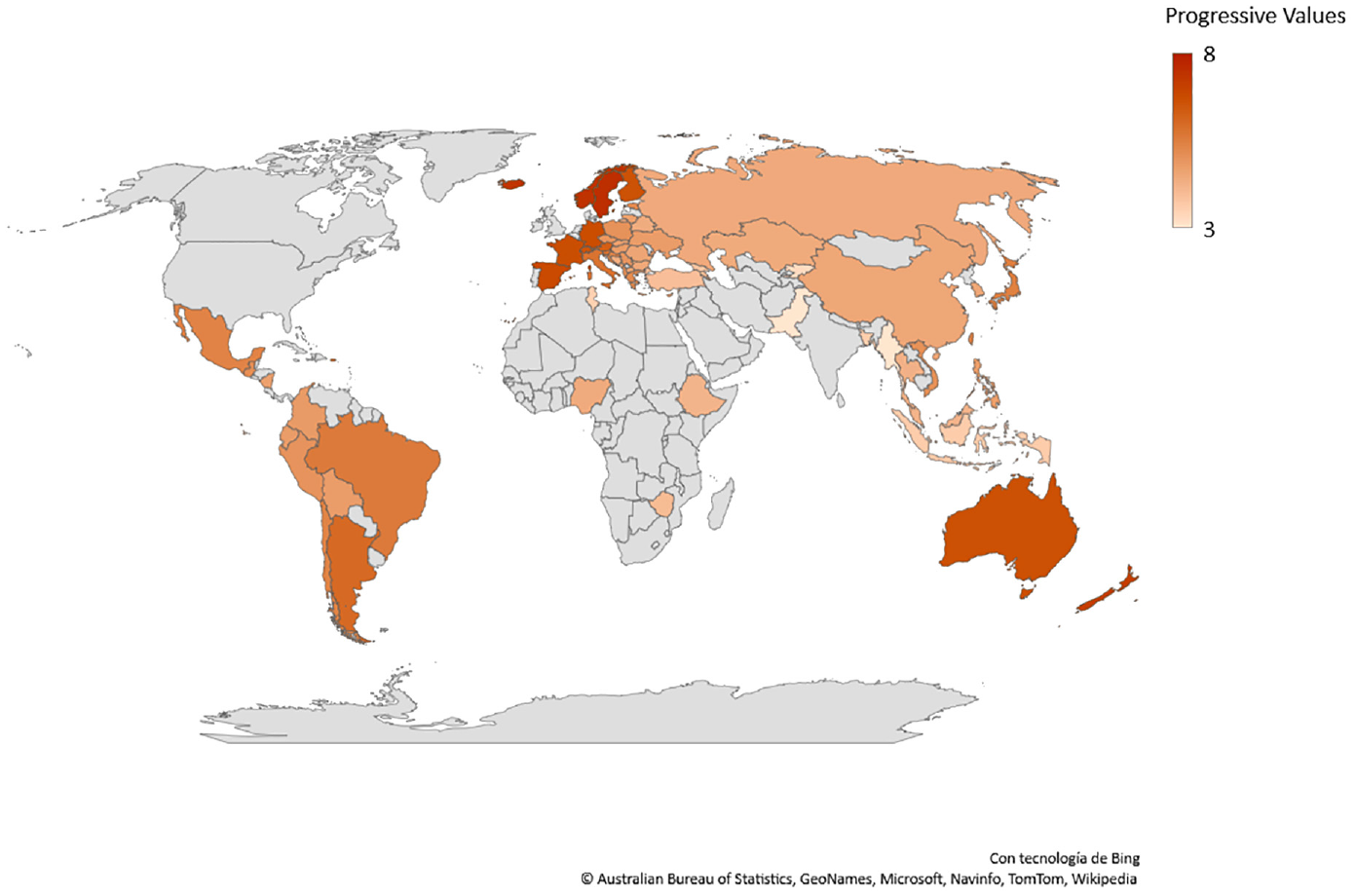
Mean score in the Progressive Values Index.
The correlation between the urban–rural gap and the level of economic development is easier to appreciate in Figure 2, which shows a scatterplot of the mean urban–rural gap and the national Gross Domestic Product (GDP) per capita in 2019 (international $, current prices). 7 While, clearly, there are strong idiosyncratic differences across individual countries, 8 the overall relationship is strong: richer countries show a larger gap in progressive thinking between urban and rural areas. This gap is closer to 0 $ and even positive for some countries – for lower levels of GDP per capita.
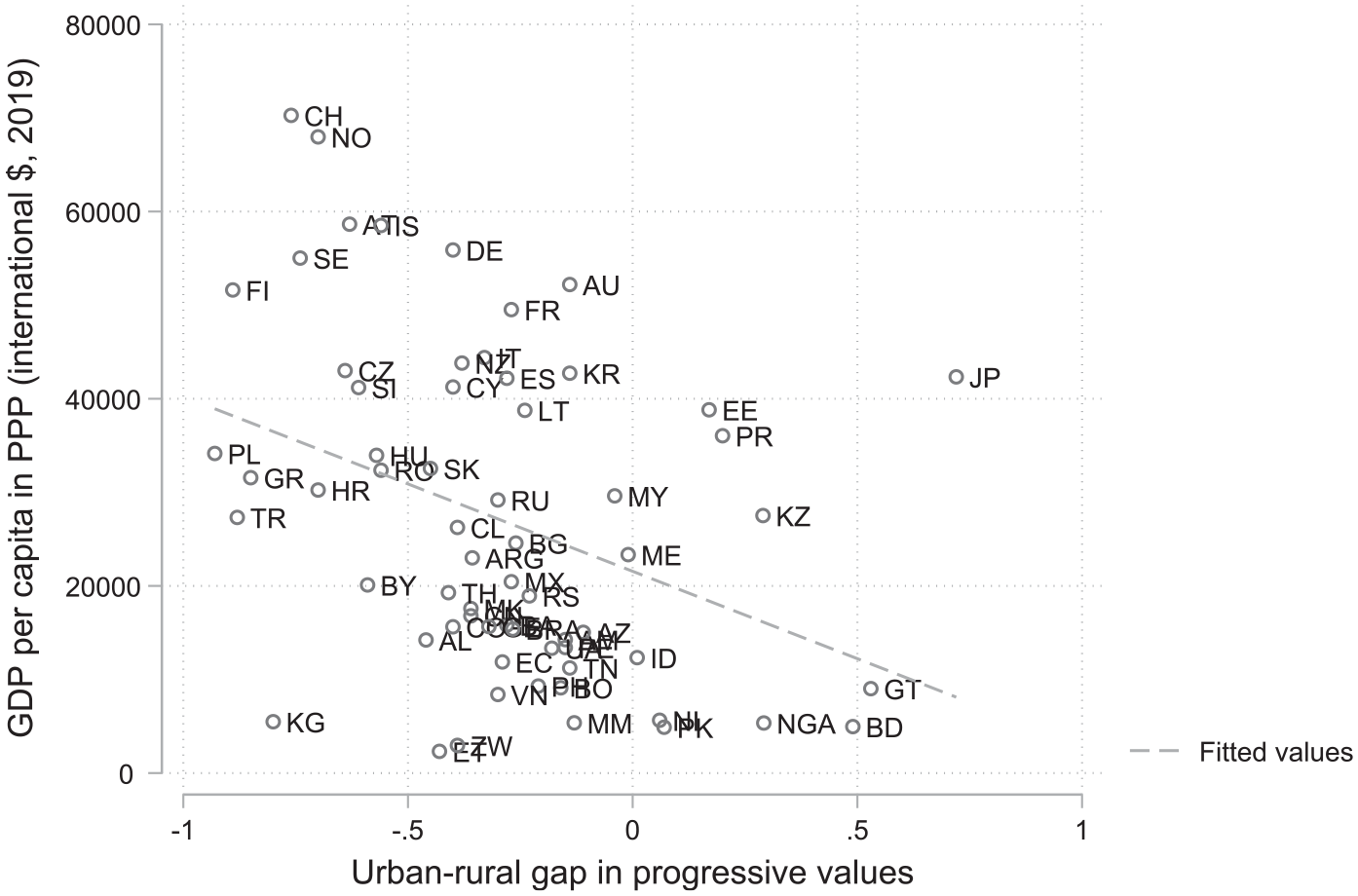
GDP per capita (US$ current prices) and the urban–rural gap in progressive values.
Model and empirics
We test our hypotheses using an Ordinary Least Square (OLS) 9 regression model controlling for a set of individual characteristics. These controls allow us to verify whether there is a rural–urban gap that goes beyond compositional effects based on observable characteristics, that is, beyond the concentration in cities of people that are different in characteristics such as income, age or education. This would suggest that ‘ecological’ elements such as exposure, socialisation and freedom of choice may play a role in the emergence of progressive values. Model (1) captures our main specification.
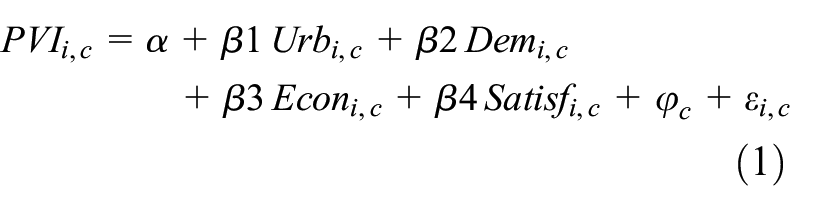
where
Although Model (1) cannot account for other unobservable characteristics, we expect these controls to account for most of the potential cofounders. It is nonetheless important to stress that our analysis does not claim to provide a causal explanation of the relationship between progressive outlooks and place of residence. By contrast, inspired by the belief that rigorous descriptive evidence is a helpful first-step tool to then develop detailed causal explanations, we aim to present a broad, systematic analysis of a set of robust, cross-country comparative findings, which might well be analysed in more depth and with the use of more advanced causal inference techniques by future research.
The three sets of controls include the following covariates.
Age
We first include age as, following the literature, we may expect individual attitudes to be highly stratified by age groups, with progressive and cosmopolitan views being more likely to be embraced by younger generations (e.g. Goodwin and Heath, 2016; Harris and Charlton, 2016). 10 We classify age in seven groups: below 21 years old, 21–30, 31–40, 41–50, 51–60, 61–70 and over 70.
Gender
We equally control for gender, as we may expect this variable to have a significant effect on attitudes, particularly those related to family and gender values (e.g., Evans, 2019; Goodwin and Heath, 2016).
Education
Along with age, education is consistently discussed in the literature as one of the key variables positively associated with more progressive views (e.g.,
Native
We equally add a dummy for people born in their country of residence. For example, on average we may expect natives to have more conservative views towards migration.
Income
We then aim to control for respondents’ economic situation, since income levels may affect one’s social status and hence outlooks. Furthermore, we do so following the literature on the ‘winners’ and ‘losers’ of globalisation (Inglehart and Norris, 2017; Kriesi, 2010; Rodrik, 2021), which suggests that many forms of political and cultural backlash may be associated to personal relative economic stagnation or decline. We measure the variable by the decile in which the respondents’ household income is placed with regards to that of all households in the country.
Employment status
Similarly, we include dummy variables for each of the following categories: employed full time, in part-time occupation, self-employed, retired, home maker (e.g. housewife, househusband or looking after children), student, unemployed and other.
Life satisfaction
We also include a measure of life satisfaction, to capture the overall level of individual satisfaction of respondents.
Finally, as discussed in the literature, the emergence of progressive values has been linked to the economic security enjoyed in advanced economies (Inglehart, 1977), in which clusters of self-expression thinking emerged in the 1960s. Across many Global South countries, such clusters might have not emerged or might be reduced to a narrow economic elite, and hence the urban–rural gap may be smaller or non-existent. Moreover, across many Global South contexts, thinner liberal institutions may also prevent the emergence of progressive thinking in urban agglomerations. To test whether the urban–rural gap is different across Global North and Global South countries, we run Model (1) interacting the degree of urbanisation with a categorical variable indicating the level of income of the covered countries: high, upper-middle, and lower-middle/low-income countries.
More details about the definition of the dependent and explanatory variables, as well as their key summary statistics, are reported in online Supplemental Appendices A.4 and A.5.
Results
We start the analysis by estimating the correlation between the degree of urbanisation and the Progressive Values Index, which aggregates opinions on family, gender equality and immigration attitudes. Our focus is on the degree of urbanisation categorical variable, with very large cities hosting over 500 K inhabitants being the reference category.
Table 1 presents the OLS results. Column one shows the gap when only including country fixed effects, while columns two to four progressively add key demographic, economic and life satisfaction controls. The coefficients of Table 1 suggest that the gap between urban and more isolated areas is negative and significant for all degrees of urbanisation, when compared to very large cities. This negative gap increases as the degree of urbanisation decreases. The gap is roughly twice as large in rural areas compared to middle-sized cities.
The urban–rural gap in progressive values: robust OLS estimates.
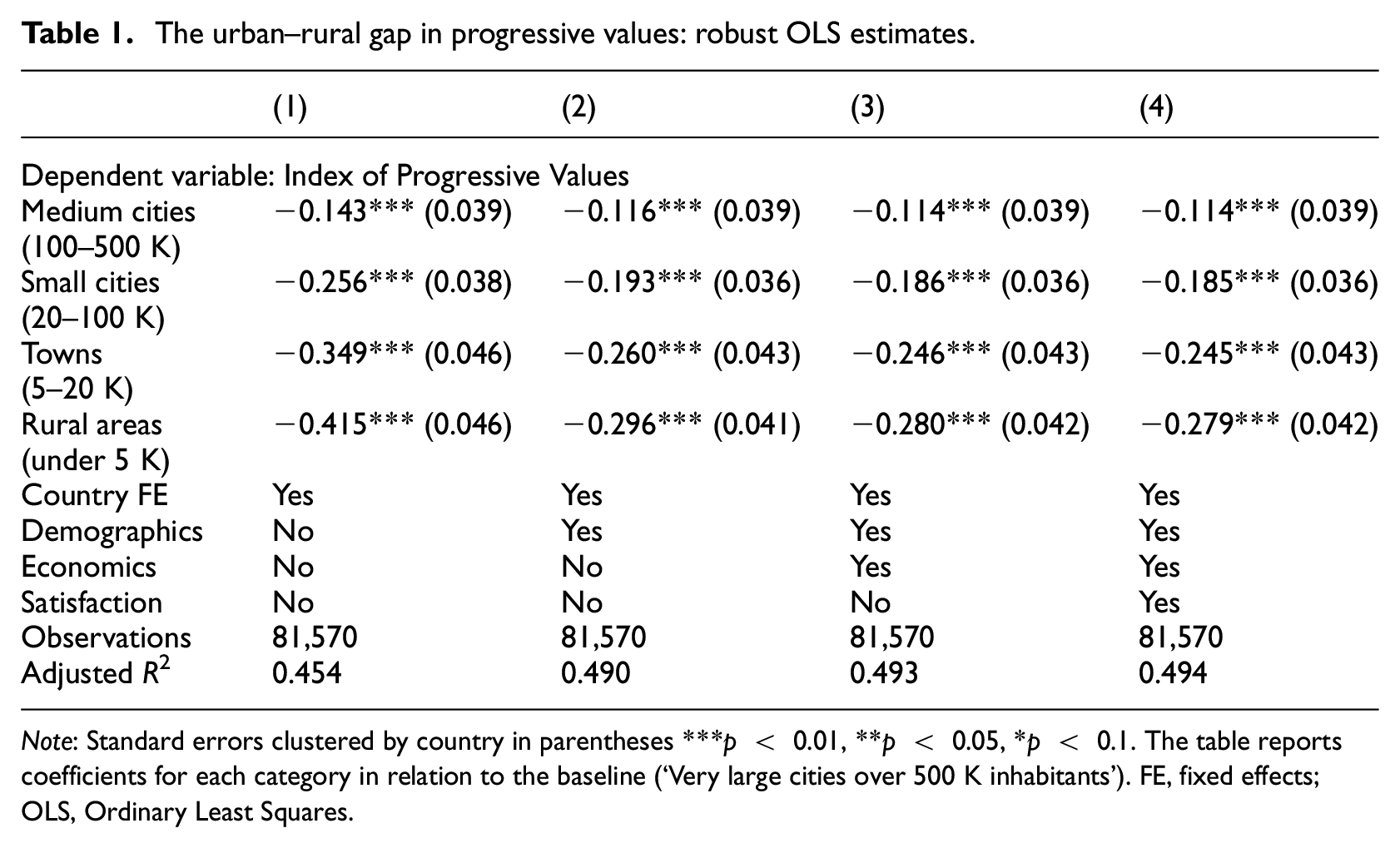
Note: Standard errors clustered by country in parentheses ***p < 0.01, **p < 0.05, *p < 0.1. The table reports coefficients for each category in relation to the baseline (‘Very large cities over 500 K inhabitants’). FE, fixed effects; OLS, Ordinary Least Squares.
The magnitude of the gap decreases after the inclusion of controls, suggesting that compositional effects play a role in the urban–rural gap. A comparison of columns one and two suggests that controlling for observable demographic factors (age, gender, education, immigration status) leads to a noteworthy reduction of the gap between the respondents living in very large cities (the baseline category) and those residing in smaller urban centres and the countryside. By contrast, the inclusion of individual economic controls in model three has a more moderate effect in explaining the ‘gross’ urban–rural gap in values, while controlling for respondents’ life satisfaction (cf. model four) has almost no influence on the estimates.
To provide a better understanding of the results, Figure 3 plots the regression coefficients for all variables included in model four of Table 1. The magnitude of the difference between very large cities (our reference category) and rural areas is roughly the same as that existing between respondents identifying as male and female. The comparison with different age cohorts is also interesting (for simplicity, in the plot we combine age groups in three categories: under 30; 30–55 and over 55): the gap between rural and urban areas is almost as large as generational differences. Similarly, the difference between urban and rural dwellers is relatively similar to that existing between respondents in the lowest (the reference category) and highest income deciles. By contrast, instead, education is correlated to differences in outcome which are around 50% larger than the magnitude of place of residence (cf. in particular, the difference between respondents with tertiary education and up-to-primary education, the baseline category). Finally, coefficients for life satisfaction, employment status and being a foreigner are either insignificant or very small in magnitude.
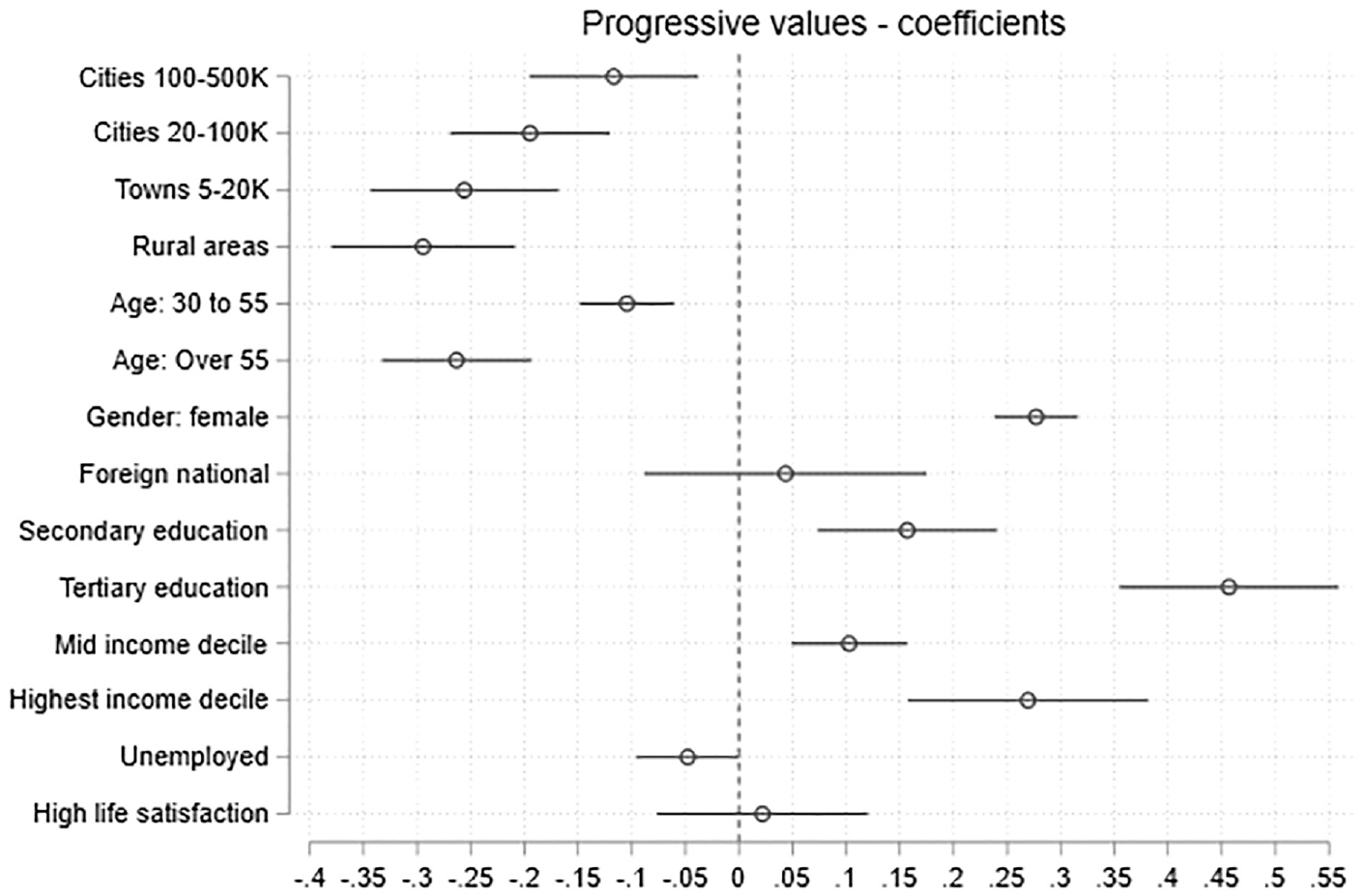
The urban–rural gap in progressive values: a comparison of all regression coefficients.
Overall, the results indicate that place of residence has a significant and meaningful correlation with our Index of Progressive Values, suggesting that cities are indeed poles of progressive thinking. This goes in line with the literature, which highlights processes of exposure, freedom of choice and socialisation, all of which are more present in large urban agglomerations relative to more isolated communities.
For robustness, online Supplemental Appendices A.6 and A.7 respectively replicate the OLS result of Table 1 with Ordinal Logit and Multilevel estimators. The results are overall very similar. Relatedly, online Supplemental Appendix A.8 shows the urban–rural gap for the different groups of values that compose the aggregate index. 11 Finally, as discussed above, a problem with ‘place of residence’, our main independent variable of interest, is that it may report as rural areas places with smaller populations but which are nonetheless adjacent to large urban areas. Hence, in online Supplemental Appendix A.9 we re-estimate the main regressions linking geocoded information on each respondent’s place of residence with the GHSL SMOD database. Online Supplemental Appendix Table A.9.2 confirms how adopting an alternative measure of urbanisation does not substantively affect the results, which still highlight how there is a significant global negative gap in values between urban and rural areas.
Urban–rural gap in progressive values across levels of material development
As anticipated, our second research hypothesis posits that the gap in urban–rural values might be less relevant as we move down the material prosperity ladder. Expanding on Inglehart’s propositions, we hypothesise that large cities in Global South countries might not offer the required material security for progressive values to become widespread. Similarly, some developing countries may have a ‘democratic deficit’ that deprives cities from many of their advantages relative to rural areas, such as freedom of choice and exposure to different lifestyles. To test this idea, in Table 2 we replicate our models including an interaction term between place of residence and an ordinal variable indicating each respondent’s country income group, following the most recent World Bank’s classification. To simplify we collapse the degree of urbanisation variable into two categories: rural (i.e. any place below 20 K inhabitants), and urban areas (above 20 K).
The urban–rural gap in progressive values across levels of development: robust OLS estimates interacting place of residence and country-level GDP.
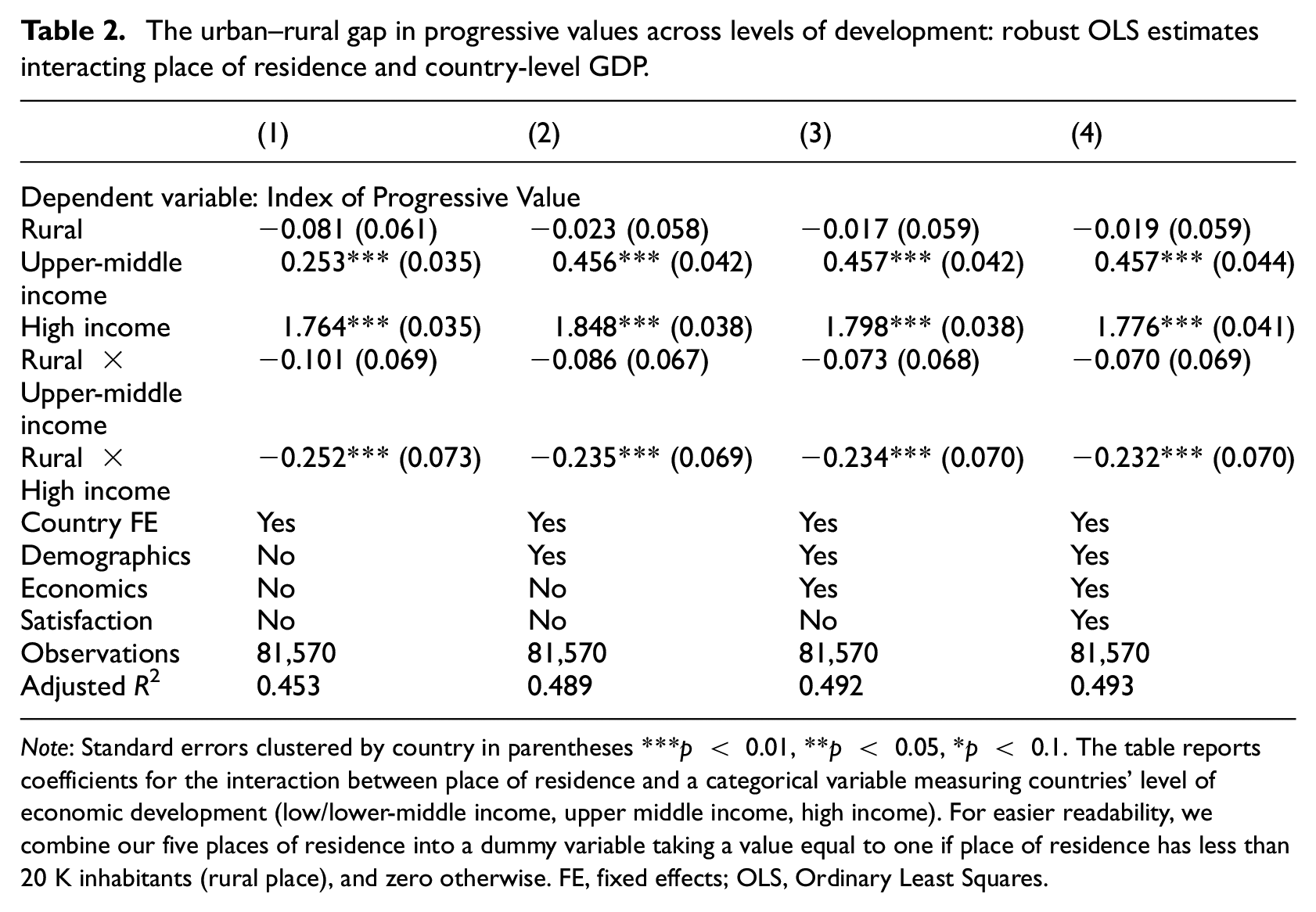
Note: Standard errors clustered by country in parentheses ***p < 0.01, **p < 0.05, *p < 0.1. The table reports coefficients for the interaction between place of residence and a categorical variable measuring countries’ level of economic development (low/lower-middle income, upper middle income, high income). For easier readability, we combine our five places of residence into a dummy variable taking a value equal to one if place of residence has less than 20 K inhabitants (rural place), and zero otherwise. FE, fixed effects; OLS, Ordinary Least Squares.
The results suggest two conclusions. As anticipated, the overall level of national economic development is a strong predictor of progressive values: the higher the income of the country, the more progressive their citizens. Second, the gap between cities and rural areas increases with the level of material prosperity. The interaction between living in a high-income country and being a rural resident is significant, implying that the gap is significantly larger for high-income countries relative to lower and low-income countries. Moreover, once we control for the gap existing in more advanced economies, the gap between rural and urban areas becomes statistically insignificant, suggesting that such a gap is driven by advanced economies.
As a robustness check, in online Supplemental Appendix A.10 we run an alternative specification where, instead of including an interaction term between the combined place of residence dummy (rural vs urban areas) and country income group, we consider all five place of residence categories. Since interacting these five categories with the three country income groups would result in a table that is difficult to read, we follow a different approach and stratify the sample of countries into three groups based on their income levels – effectively running a separate regression for each group of countries. Online Supplemental Appendix Table A.10 further confirms our second hypothesis.
Overall, the results go in line with Inglehart’s hypothesis: richer countries show more progressive thinking. Furthermore, cities leave behind rural areas only in countries that reach a sufficient level of economic prosperity. Other factors beyond material security, such as stronger democratic institutions in advanced economies, could also explain why cities in the developed world can maximise their ecological advantages, such as exposure, the freedom to choose a preferred lifestyle and the freedom to associate yourself with alike individuals, hence widening their gap in terms of values with less diverse, more isolated areas.
Conclusion
There is widespread concern about the social and political implications of divergent values between residents along the urban–rural continuum. In this paper, we have presented new evidence exploring the global geography of this divide, the extent to which it is explained by individual characteristics, and the levels of development at which it applies. Based on our analysis of representative survey data for 66 countries, our results suggest three principal findings – each of which has important implications for our thinking about cities and urban–rural polarisation.
First, while it is inherently difficult to epistemologically define urban areas, and to operationalise such distinction comparatively, our evidence shows that urban residents are – on average across countries – much more likely to have progressive values. This result applies across three categories of values: family values, gender equality and immigration attitudes. Second, we find that this applies even when controlling for a battery of controls for demographics, including age and education, economics and satisfaction with local conditions. We are not able to precisely pin down the mechanisms explaining our findings. For example, while we control for a full host of individual observable characteristics, we cannot be sure if these results are partly driven by sorting of people on unobservable traits, as people with progressive values move into cities, or reflect culture which is gained when living within cities, but these findings do suggest that cities provide the ‘catalysts for social change’ identified by Evans (2018, 2019).
Our third finding provides an important caveat to this result: we find much stronger results for high income countries than we do for countries in lower levels of development. We argue that this suggests that only more advanced economies can provide cities with the material comfort, and probably the right institutional environment, to make progressive values relevant. We need to be cautious with this finding, which is a general exploratory trend, rather than a universal law. As our descriptive analysis shows, there are advanced economies in which cities are not more progressive than rural areas, such as Japan, as well as developing countries with large urban–rural gaps in values, such as Kyrgyzstan. 12 Still, our analysis does suggest that there is something about affluent cities which allows the expression of new values.
These results have implications for both research on values and that on urban–rural polarisation. These differences represent an important fault line at the heart of many democracies, and one which will develop as countries become richer and the process of urbanisation continues. Given that those with higher education are increasingly drawn to cities, patterns of sorting are likely to continue.
Future work might wish to address some of the open questions outlined here, and some of the limitations of our study. First, our analysis is not able to provide a causal explanation of the relationship between progressive outlooks and place of residence. Inspired by the belief that rigorous descriptive evidence is a helpful first-step tool to then develop detailed causal explanations, we aimed to present and discuss a set of robust, systematic cross-country findings. Future research using more advanced causal inference techniques, and/or in-depth qualitative tools, may well analyse in more detail the causality behind our findings. Qualitative studies have already begun to address these questions (Evans, 2019), but further work – for example, using long panel surveys and analytical techniques that can allow controlling for individual unobservable characteristics – might be able to better identify the extent to which the results we uncover are driven by place and socialisation (McNeil et al., 2022) or, instead, purely by selective mobility and the spatial sorting of ‘more progressive’ people into large urban areas (Bosquet and Overman, 2019; Hoogerbrugge and Burger, 2022; Maxwell, 2019).
Second, and relatedly, our paper has shown patterns at as large a scale as possible. But doing so limits the extent to which we can identify some of the nuances and different forms in which ‘urbanity’, ‘sub-urbanity’ and ‘rurality’ manifest in individual countries. Furthermore, it might be possible that urban/rural differences might be explained by different mechanisms in different areas of the world. While in this paper we have shown how the link between urban/rural place of residence and individual attitudes is contingent on countries’ levels of economic development, other idiosyncratic factors may influence specific patterns in specific countries. Similarly, we acknowledge the important debate in critical urban studies challenging overly-simplistic taxonomies of space distinguishing the ‘urban’ from the ‘non-urban’. As highlighted by Brenner (2018), there are relevant merits in an engaged pluralism between different urban studies approaches, and further qualitative comparative work may complement our analysis by exploring in a more fine-grained manner the ways in which different forms of ‘urbanism’ and framings of ‘urbanisation’ may influence the spatiality and temporality of individual attitudes in more complex ways.
Supplemental Material
sj-docx-1-usj-10.1177_00420980221148388 – Supplemental material for Progressive cities: Urban–rural polarisation of social values and economic development around the world
Supplemental material, sj-docx-1-usj-10.1177_00420980221148388 for Progressive cities: Urban–rural polarisation of social values and economic development around the world by Davide Luca, Javier Terrero-Davila, Jonas Stein and Neil Lee in Urban Studies
Footnotes
Acknowledgements
We are grateful to Alice Evans, David Soskice, Pablo Navarrete-Hernandez, Vlad Mykhnenko and participants at an internal International Inequalities Institute working group, at the 2021 Regional Studies Association e-conference, at the University of Oxford’s Sustainable Urban Development seminar, the University of Bergen – Strengthening Regional Democracy project, the Governance research group at the University of Tromsø and at the University of Chile’s Global Habitat seminars for help and suggestions. Our huge thanks also go to Lawrence McKay for sharing his geocoded data so openly, and to the editors of Urban Studies and three anonymous referees for their critical but constructive comments.
Declaration of conflicting interests
The authors declare no potential conflicts of interest with respect to the authorship, research, and publication of this article.
Funding
The author(s) disclosed receipt of the following financial support for the research, authorship, and/or publication of this article: This project was funded by the LSE’s International Inequalities Institute.

Data statement
The dataset as well as the codes used to produce the results presented in the paper are available on request.
Supplemental material
Supplemental material for this article is available online.
Notes
References
Supplementary Material
Please find the following supplemental material available below.
For Open Access articles published under a Creative Commons License, all supplemental material carries the same license as the article it is associated with.
For non-Open Access articles published, all supplemental material carries a non-exclusive license, and permission requests for re-use of supplemental material or any part of supplemental material shall be sent directly to the copyright owner as specified in the copyright notice associated with the article.
