




Abstract
Water utilities have favoured the modern ideal of piped networks and infrastructure that is reproduced in policies and discourses about achieving ambitious water targets. In this article, using ethnographic insights from an urbanising village of New Delhi called Rawta, we build on work that challenges the myth of formal water as ‘piped’ water and informal water as ‘non-piped’ and explore both piped and non-piped water as dynamic and socially negotiated water regimes. We analyse how water regimes are shaped by complex constellations of formal and informal actors, institutions and technological practices. What constitutes piped water supply in Rawta is in fact largely constituted by an elaborate informal network of underground pipes and water pumps laid down to realise very specific local water needs. We explore what this kind of informality means for drinking water supply in rapidly urbanising peripheries.
Introduction
Meera (pseudonym) said, ‘awaaz uthaane se tho jhagdaa hi hoga (if we raise our voice, it will only create conflict)’. She further explains that the upstream parts of the village are inhabited prominently by the Jaats, the social group that is socially, numerically and economically powerful. At the same time, the lower castes tend to be concentrated in the downstream parts of the village. Juxtaposing the settlement pattern with the water distribution network tells us the story of why there is an inequitable pattern of water distribution, as lower castes may find it difficult and costly to confront the higher castes.
The above statement represents the unequal power relations between different social groups in a (peri)urban village in New Delhi. In part due to unequal power relations and in part due to the characteristics of peri-urbanisation that shape this village, water delivery arrangements are far from straightforward, and different kinds of water regimes are manifested through heterogeneous technology, institutions and actors. As our ethnographic exploration will later show, what we describe as water regimes are not as neatly carved nor homogeneous as official water policy plans expected them to be.
The fact that Rawta is peri-urban is not just incidental but shapes, in important ways, the characteristics of water provisioning observed therein. While peri-urban studies have earlier foregrounded the role of formality and informality (as examples, see Narain and Singh, 2017; Randhawa and Marshall, 2014; Vij et al., 2019), we note that the growth of peri-urban spaces cannot be underestimated for propelling new and more complex relationships between formal and informal water provisioning. What makes the peri-urban unique is not purely ‘locational’ but relates to introducing a conceptual category that allows the features and processes of the geographic space to be foregrounded: namely the co-existence of rural and urban land uses and economic activities and the diversity and heterogeneity of actors inhabiting such a space (Follmann, 2022; Marshall et al., 2009; Mehta and Karpouzoglou, 2015; Vij and Narain, 2016). The existence of rural–urban linkages and a rapidly growing demand for water outpaces the expansion of urban infrastructure, as seen in the case of Rawta (and other peri-urban spaces of the Global South, see Allen et al., 2017; Narain, 2014; Schindler and Kishore, 2015; Vij and Narain, 2016).
While attention has been paid to the dynamics of water distribution in (peri)urban spaces, the relative role of formal and informal actors, technologies and institutions is a more recent concern (as examples, see Mehta and Karpouzoglou, 2015; Narain and Singh, 2017; Randhawa and Marshall, 2014; Vij et al., 2019). Beyond a certain recognition of formal and informal in the (peri)urban there is still a lack of theorisation of how formality and informality interrelate particularly with regard to drinking water provision.
In this article, we address this gap by conceptualising this entanglement of formal and informal actors, institutions and technologies as a water regime. We mobilise the term ‘regime’ in the way it is used in transitions studies which is a body of literature that engages with scholarship around the organisation and control of technology. The term first appears in transitions studies as part of the multi-level perspective (MLP) that distinguishes three fundamental analytical levels for understanding how technology is organised by societal actors: the technological landscape, regime and niche (Geels, 2004; Rip et al., 1998). The regime represents the middle-level of the MLP, where technology has mostly matured and is more widely accepted by actors that are tightly coupled through formal and informal rules (shared beliefs, values and social practices; Fuenfschilling and Truffer 2014; Geels, 2004). Critical insights from this work have been further developed to understand water supply provision as a regime (Blomkvist and Nilsson, 2017). In the formation of water regimes, transitions scholars have tended to focus much more on the state and municipal actors as prominent system builders, mobilising large-scale technological networks and capital for delivering water (Hughes, 1993).
However, in transitions scholarship informality as part of regime formation has received less explicit attention, especially in relation to water provisioning in the Global South. To address this gap, in this paper, we mobilise the terms ‘formal’ and ‘informal’ to explain the tensions and overlaps across municipal water supply on the one hand and alternatives to municipal water supply on the other. In this article, we further mobilise the term regime from the transitions literature to explain the organisation of water provision both through recognition of formality and informality (Fuenfschilling and Truffer, 2014, 2016; Geels, 2004; Lawhon and Murphy, 2012). We thus bring attention to the interplay of formality and informality on regime functioning and analyse the heterogeneity of different water regimes temporally and spatially, instead of assuming universality and uniformity of one large regime – which does not give an accurate picture of water provisioning in the Global South. Further, we connect our analysis with urban political ecology (UPE), on the role of actors and water supply regimes beyond centralised and piped solutions (Farrelly and Brown, 2014; Furlong and Kooy, 2017). Drawing on UPE, we bring to the foreground that local political and material power influences water regimes. Formal and informal water provision services show how water access and control are determined among the powerful (elite) and powerless communities. Swyngedouw (2005) relates informality to the urban water system, elaborating nuances of various informal actors in organising and providing water services. Lastly, keeping the questions of power central to the analysis of water provision, UPE has discussed the role of formality and informality in urban water provision, which is shaped by larger political and hydrological processes and further shapes the water flow, access and control (Ranganathan, 2014).
Drawing on ethnographic work in an urbanising village of New Delhi, we analyse the organisation of water provision at the local level through the lens of actors, technologies and institutions that shape access to water in (peri)urban spaces. The article makes a case for explaining the intertwined relationship between formal and informal water regimes, in efforts both by municipalities and water users to develop options for securing water supply. It further makes a case for deconstructing notions of piped water supply as a strictly municipal endeavour, where informal water regimes successfully mimic the formal water regimes in terms of technology and institutions, providing services and bridging the water supply-demand gap. The expansion of this is seen as a panacea for the poor access to drinking water and sanitation and the accomplishment of sustainable development goals (SDGs).
The rest of this article is divided into four further sections. The next section presents the conceptual groundwork (from transitions and UPE studies) used to analyse the case of Rawta. The third section describes the research context and presents the methods used to collect and analyse the data from the fieldwork. The fourth section presents the key findings regarding the modes of water provisioning. The fifth section explains the relationship among the various modes of water provisioning and the power nuances between the formal and informal water regimes and concludes the article with its key messages.
Conceptual groundwork for this research
This research is conceptually grounded in two bodies of literature that have made important advances in the conceptualisation of urban water services in recent years. These are the bodies of literature around transitions and urban political ecology (UPE), respectively. These two debates are typically not interrelated in theorising urban water services; however, we find it useful to bring these two fields into closer conversation with each other (Furlong, 2014; Lawhon and Murphy, 2012). We want to extend the discussion around transitions and UPE – which has thus far taken place on a more theoretical level – through an emphasis on empirics and by showing that these two areas of study can learn from each other regarding the interaction of formal and informal water provision in cities of the Global South. The transitions scholarship positions this research to understand the blurring boundaries between the formal and informal water regimes, exemplifying the heterogeneity of water actors, institutions and technology; while UPE helps in conducting a detailed analysis of power relations between the formal and informal actors and institutions, shaping society–nature relationships in the Global South.
In the transitions field, we find more scholars engaged with theorisation of cases in the Global South (Ghosh and Schot, 2019; Van Welie et al., 2018; Wieczorek, 2018). This has helped to create a different type of conversation amongst transition scholars about the particular meaning and implication of regimes in Global South settings (Van Welie et al., 2018). Additionally, there is much greater emphasis on geographical factors and power relations within transitions debates emerging from engaging with Global South cases (Brisbois, 2019; Murphy, 2015). Furthermore, transitions scholarship in the Global South is more engaged with the question of informality and how that shapes regimes (Ramos-Mejía et al., 2018). In other words, regimes are no longer seen as homogeneous and abstract categories. Hence, a key distinction from earlier transitions work (typically conducted in Northern Settings) is the increasing acceptance that the boundaries between various regimes can be highly blurred and there is heterogeneity in terms of how regimes are configured with each other to make water supply possible (Van Welie et al., 2019). This resonates with recent UPE scholarship bringing attention to water infrastructures as ‘heterogeneous infrastructure configurations’ where different infrastructures formal/informal, large/small, state/non-state are configured with each other as part of an extended web of infrastructure relations (Lawhon et al., 2018; Smiley, 2020). Hence, the study makes use of the regimes vocabulary but situates it in a context where regimes are in reality far less aggregated and where water provision is characterised by heterogeneity. The term ‘regime’ was originally used to explain the organisation of technology, actors and institutions (Geels, 2004; Geels and Schot, 2007; Lawhon and Murphy, 2012). Regimes tend to be closely linked to institutional frameworks while the degree of their strength depends on their level of structuration, or their level of order (cf. Fuenfschilling and Truffer, 2014).
Transitions studies literature has thus far been principally concerned with formal water regimes in more mature infrastructures typically found in Global North settings. However, more recent transitions literature has productively expanded its focus to include more in-depth analyses of urban water provision in the Global South (Van Welie et al., 2018). This work has helped to better characterise and understand water regimes along the lines of their constituting political, economic, cultural, institutional and technical characteristics (Blomkvist and Nilsson, 2017). There is also an interest in developing a deeper understanding of the degree of formalisation of different kinds of regimes. The degree of formalisation of a regime is closely interlinked with the level of order and structuration, where rules and norms are either widely accepted and upheld by the regime constituency or are being contested (Fuenfschilling and Truffer, 2014).
Formal regimes of water provision particularly in cities can thus typically become widely legitimised through municipally state supported norms and institutions. Formal water regimes also tend to mobilise large-scale technological networks and capital for delivering water through piped networks and technologies. Although formal regimes are very much present and influential in Global South settings, the degree of formalisation of a regime may not provide the full picture of how water reaches a household, particularly in low-income contexts of the Global South. Ramos-Mejía et al. (2018) refer to the ‘informal and insecurity’ settings of the Global South where there is significant ambiguity in terms of the role of the state, the market, the community and the household in the constitution of the regime. What this also means is that individuals and communities tend to develop a diverse portfolio of strategies and livelihoods to face insecurity and uncertainty and these strategies tend to be characterised by a context of informality.
In this study, we also take the position that these various coping strategies are constituted as particular kinds of water regimes. The main difference is that these are far less formalised and hence we prefer to refer to them as informal water regimes. Nevertheless, like formal regimes, informal water regimes are constituted through complex relationships between actors, institutions and technologies that make them operational on a daily basis. Hence complex questions of power and justice that typically form an important focus of UPE are also now deliberated within transitions scholarship as well and there is an overlap in terms of the kinds of infrastructures these two fields are engaged with.
UPE has a long tradition of focussing on how water flows in cities are mediated and shaped by power relations. Water infrastructure and delivery in the Global South is the medium through which ‘socio-natures’ are produced (Swyngedouw, 2007), shaping water access and control. This perspective is important to understand the operation of water regimes as part of questions of access and control over those water regimes. From this vantage point, access and control over water regimes are an expression of larger political, economic, social and cultural struggles in society, since they are determined by a combination of hydrological processes and politicised human interventions (Bakker, 2010). Such politicised interventions create inequalities between parts of the city and within communities that receive water in abundance and those that lack access to it. These types of inequalities reflect infrastructural unevenness as well. UPE has elaborately discussed the role of state actors in creating formal water delivery systems, through heavy emphasis on managerial or technocratic approaches (Myers, 2008).
UPE scholars have used the notions of (peri)urban metabolism and flow to analyse power and critique the structure of the formal actors or the state (Ranganathan and Balazs, 2015). From this work, we can gain insights on how formal water regimes are organised in the way that they are today. For instance, Mbembe (2001) shows how constant proliferation of formal technologies of the state – budgets, and contracts – can be used for meeting its covert goals of obtaining electoral advantages. UPE studies have also examined informal water regimes to understand implications of pricing, water quality and use of agricultural water in urban and (peri)urban contexts, raising issues pertaining to water injustice (Mehta et al., 2014; Vij et al., 2019; Zwarteveen and Boelens, 2014).
Special attention is placed on the actors that are operating water provision beyond the pipes from the perspective of the everyday practice of water provision and how it is mediated by power relations (Misra, 2014; Ranganathan, 2014). For instance, Vij et al. (2019) show that (peri)urban Hyderabad residents and politicians owning water tanker establishments have a relationship built around water access and usage. Hence, we can argue that the interplay between formality and informality can explain water governance and represents constellations of power. Moreover, contemporary UPE literature suggests that the boundaries between formal and informal are often blurred and what we tend to see occurring resembles more a formality–informality continuum, with different configuration of infrastructures emerging and layering over each other (Lawhon et al., 2018). Lastly, UPE water scholars have also emphasised how the informal water suppliers use their power to break the boundaries between formal and informal water markets (Ahlers et al., 2014; Graham et al., 2013; Ranganathan, 2014), eventually establishing new arrangements of water governance.
The research context and methodology
Rawta is a village located at the periphery of two North Indian cities, namely, New Delhi, the National Capital of India and Gurugram – an emerging residential, recreational and outsourcing hub of the Northwest Indian state of Haryana (Narain and Singh, 2019). Administratively, it is under the jurisdiction of the South Delhi Municipal Corporation (SDMC), making it ‘urban’ by administrative classification.
The village is located at about an hour’s drive from the heart of the city, and is the second village, after Daurala, as we cross the border from Gurugram into Delhi (Figure 1).
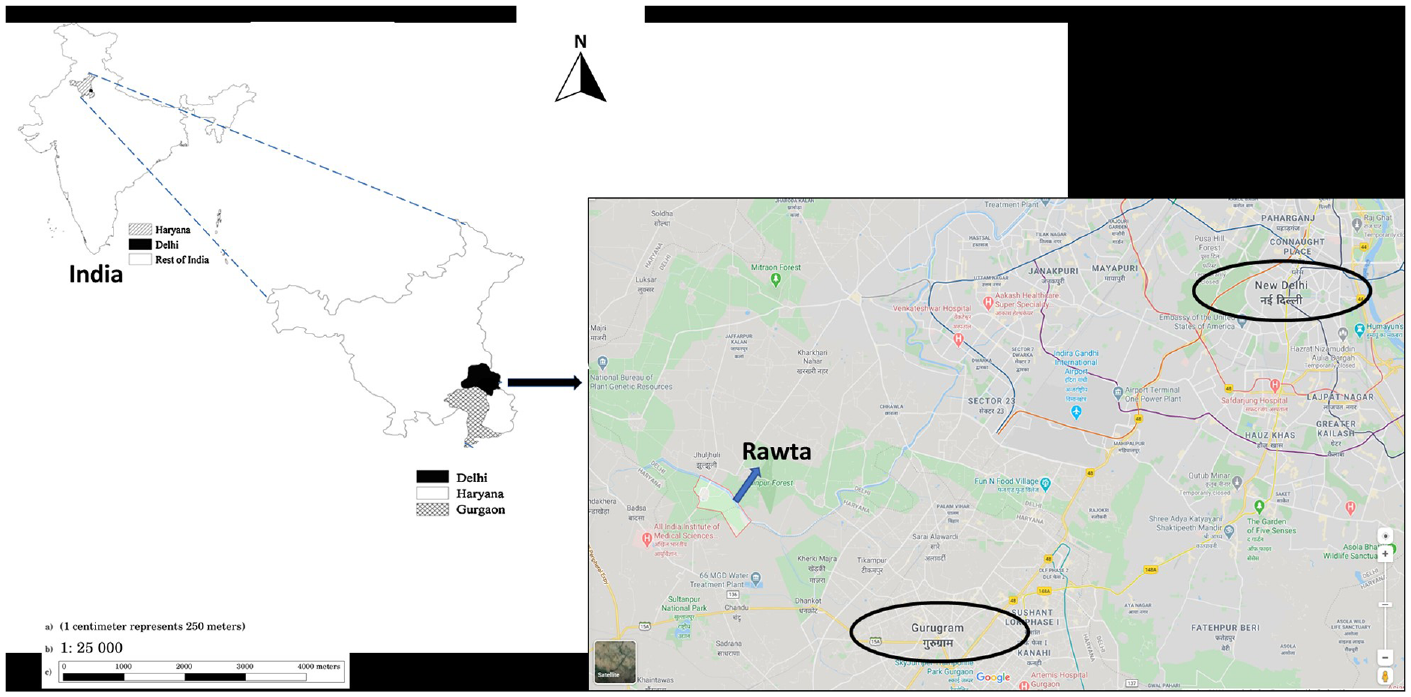
Location of the study village, Rawta.
Although its administrative classification is urban, in terms of a livelihood profile, the village could be considered (peri)urban as the livelihoods of the people of Rawta straddle the rural–urban divide (Narain, 2017; Tacoli, 2003). Agriculture is still an important activity, with rice and wheat being major crops in the kharif (monsoon) and rabi (winter) seasons respectively. Najafgarh in Delhi serves as the nearest wholesale market for agricultural produce. Livestock rearing is prevalent, but much less so than in earlier decades. In interviews with residents, two reasons stood out for the diminishing role of livestock rearing. The first was the gradual disappearance of grazing lands (mainly on account of land consolidation and the redistribution of land among the landless) and the second was a reduction in the number of working hands in the family as many of the village youth took up jobs in the city. There is also a continuous flow of goods and services between Rawta and nearby commercial locations. At least one member of most households commutes to Delhi daily for work, for instance, in public utilities or industry.
It is common to see modern buses with automated doors and high floors on the main road that runs through the village, allowing the residents to move to and from Delhi. In terms of water flow, the Najafgarh drain flows very close to the village, bringing in the city’s wastewater to the village. In return, there is a continuous flow of agricultural produce (including vegetables) and labour force from the village. To further characterise peri-urbanisation in Rawta, the commons such as village ponds are not in use, and some have been encroached privately. Similar evidence of encroachment and depletion of commons is reported by peri-urban scholars elsewhere in India (Vij et al., 2019; Vij and Narain, 2016).
The population of the village is about 5000–6000 inhabitants with 2500 electoral votes. The social group strongest in the village numerically, socially and in terms of land ownership are the Jaats, primarily agriculturists. They comprise about 75–80% of the population. Migration of labourers from the states adjoining Delhi such as Uttar Pradesh as well as from more distant states such as Bihar and Madhya Pradesh for construction is common. Migrant laborers, predominantly men, provide labour in the paddy fields, for transplanting and harvesting. The people who live in the settlement area called the Tokas Niwas are original inhabitants from Munirka, another urbanised village in South Delhi. They moved here when their land was acquired in Munirka and bought land in Rawta from the sale proceeds. This is an extended clan and lives in one large settlement.
The research relies on a qualitative, ethnographic research design, using a case study method (Yin, 1984). In the spirit of a case study, the focus was on the researcher immersing in the context of the research. The main source of data was semi-structured interviews conducted with the residents of Rawta. Thirty semi-structured interviews were conducted with individuals over the period from April 2019 to January 2020. All interview recordings were transcribed and stored in a repository.
All social interaction has a spatial and temporal dimension (Giddens, 1984). Practices around water access were directly observed (for instance, at the time of water collection from a water tanker) and became a basis for further investigation. Discussions with groups of women and men were conducted to obtain an overall understanding of the context of formal and informal water supply and the relationship between the two. Developing social relations in the field is known to improve the quality and reliability of data collection in field work. The lead researcher of this article therefore developed strong social ties with a family headed by a local resident from a higher caste group, who himself worked as a driver of a water tanker employed by the Delhi Jal Board (DJB). A local shopkeeper was also an important key informant, and was interviewed several times in order to obtain greater clarity on several pertinent issues.
Modes of drinking water provisioning in Rawta
Being administratively located under the SDMC implies that the DJB has the main responsibility for providing drinking water in the village. The water source is at Nangloi, in New Delhi. A piped water supply is made available from the DJB through an underground connection that originates from the DJB boosting plant at the village Ujjwah, located about 6 km away from Rawta. The piped water is currently made available for free, as there are no water meters in the households. The underground piped network of DJB is supplemented by another network of pipes and pumping sets to meet the water needs, especially when the DJB water supply has been shut off. The alternative piped water supply is laid down by a private groundwater vendor in partnership with another village resident. Further, both these modes of water provisioning are supplemented by an institutionalised mechanism of delivering water through water tankers provided by the drinking water utility. Put together, the domestic water provisioning in Rawta translates into a complex interface of technologies, institutions and actors. We elaborate on this interface below.
Piped water network provided by the state
For the purposes of this article, we define formal water supply as water provided by state authorities designated for this purpose; informal water supply refers to water provided by actors other than the state. In this case, formal water supply refers to the water provided by the DJB. It is provided both through a piped network, and through water tankers.
The DJB boosting station at Ujjwah, from where water is pumped to the Rawta village, also serves adjoining villages such as Daurala, Khedala, Dhansa and Munerha Pudh. As a way of rationing the scarce water supplies, these areas receive water on alternate days. On one day it is the turn of villages in the direction of Daurala and Khedala (this is the direction in which village Rawta is located) and on the other day it is the turn of Dhansa and Munerha Pudh. As a result of the rotation system followed by the DJB, Rawta does not receive a daily water supply, and during the period of piped water supply the residents of Rawta fill their water containers for two to three days. They usually have water containers with a capacity of 200–300 l.
For the piped water supply provided by the state to become usable, however, it needs to be supplemented by a parallel system of technologies: pipes laid down by the households to carry water from the central piped network to their homes; water canisters and underground reservoirs to store the water; and a further network of pumps and pipes to pump the water to higher levels in their houses. Without this supporting network of pipes, pumps and storage devices, the water supplied by the utility through its own piped network is of little use.
The water provided by the DJB is put through a privately owned reverse osmosis (RO) treatment at the household level before being used for drinking. The cost for that is incurred privately and only by water users who can afford the RO technology. This is yet another aspect of the ‘technologies’ through which access to piped water is mediated. Though we did not gather exact quantitative estimates of the ownership of the RO plants, most of the households that we interviewed had installed RO plants in their homes.
There is a big distribution challenge associated with the piped water supply made available by the DJB, which is represented in an unequal distribution between the upstream and downstream parts of the distribution network. ‘Upstream’ implies houses located closer to the water pumping station at Ujjwah, and ‘downstream’ means houses located further away. The water is made available starting at around 7 pm till about mid-night in the winter and from 7 pm until about 3 am in the summer. Houses located in the upstream part of the village, closer to the pumping station at Ujjwah, receive the water first; when the water has been appropriated by these households, only after that can the downstream households appropriate it. The downstream households therefore receive water much later. Women in these households who fill water need to stay up late through to midnight or wake up in the early hours of the day (usually before dawn), making this a burdensome task for them.
Due to the over appropriation of water from the formal network upstream, less water is available downstream. This over appropriation is linked to the illegal diversion of drinking water into agricultural uses. Approximately 30 households in the upper reaches of the village have made heavy bores and divert the water to their agricultural fields, or for vegetable gardens (locally called gher 1 ). Water is used for growing vegetables such as onions and spinach as well as fodder crops such as jowar (pearl millet) and burseem (sorghum). The justification for this is that the groundwater is so saline that if they irrigated vegetables with it, the vegetables would burn.
Thus, the dichotomy between a piped water supply – assumed to be meant for domestic consumption or for drinking – and irrigation is violated in the case of Rawta. Though the piped water supply – being provided by the Delhi Jal Board, the designated drinking water utility for Delhi – is meant to be for drinking purposes, it is also used for irrigation. This is in fact one of the reasons why less water is available for drinking downstream. Furthermore, there is a topographical dimension to this as the upstream users are in the low-lying regions while downstream users are in the higher terrains where water is even more difficult to pump.
Given the context of over appropriation of water by some households upstream within the formal water regime, many respondents living downstream were asked why they did not resist this practice. One of the respondents said, ‘awaaz uthaane se tho jhagdaa hi hoga (if we raise our voice, it will only create conflict)’. Thus, within the context of the formal water supply, there is a conflict of interest between the upstream and downstream residents; however, this does not spill over into an overt conflict. This highlights the unequal power relations between the different social groups. Juxtaposing the settlement pattern with the water distribution network, we find that the upstream parts of the village are inhabited prominently by the Jaats, the social group that is socially, numerically and economically powerful, while the lower castes tend to be concentrated at the downstream parts of the village. This may explain why this inequitable pattern of water appropriation is allowed to persist, as lower castes may find it difficult and costly to confront the higher castes.
Formal (state provided), un-piped water supply
The other mode of provisioning of drinking water within the formal regime is through the water tankers provided by the DJB. Households who are unable to receive drinking water through the piped network of the DJB rely mainly on water supplied through tankers by the DJB. Households who do receive piped water but not adequately, supplement it through the water tankers provided by the Delhi Jal Board.
The water provided by the water tanker is used for drinking, much like the water provided by the formal, piped network of the DJB. Also, it is free, much like the latter. However, unlike water made available by the piped network, this water is used for drinking directly, without subjecting it to a prior RO treatment. Through our interviews with the staff of the DJB at Ujjwah, we learnt that areas not well served by the piped water supply are meant to be served by the system of tankers. The logic of providing the water tanker supply is to meet the unmet need of piped water supply. ‘Yeh to sarkaar ka niyam hai (this is the rule of the law)’, as was said by a DJB official posted at Nazafgarh. Each water tanker serves the needs of five to six neighbouring houses. Staff at the DJB claim that the water provisioning through the water tankers is free as part of conscious state policy, to provide water as a necessity.
There is an institutionalised arrangement for securing water from the tankers by residents of Rawta. The MLA (Member of the State Legislative Assembly), an elected member of the legislative body at the state level, is an important actor shaping water access at the local level. Adjacent households in a neighbourhood who require water secure this arrangement by making a collective request to the MLA. The latter then requests the Junior Engineer, an officer of the DJB, to provide a water tanker service to the concerned locality. Usually, the service of the water tankers that collectively serve a neighbourhood of a group of houses is not paid for, like in the case of the piped water supplied. However, when there is a special function like a marriage or another social occasion and a request is made for a water tanker to serve a specific household, water has to be paid for. The collective requests for the water tanker are directed at the MLA, while the household level requests for specific occasions are delivered to the Junior Engineer directly.
Every day, seven or eight water tankers visit the village. They are parked at designated spots called ‘addas’ (analogous, for instance, to bus stops). A tanker remains parked at a designated spot for about 15–20 minutes. During this time, households surrounding that adda bring in their own pipes and vessels. This includes neighbours who may not have been part of the initial application. This is because providing water is also seen as a samaajic seva (social service).
In the upstream parts of the village, located closer to the water pumping station at Ujjwah, almost all the drinking water needs are met by the piped water supply. The reliance on tankers increases as we move downstream. Some of the households interviewed in the upstream parts of the village did not depend on water tankers at all. However, two groups of consumers face some discrimination. Households who do not have their own pipes must wait for those with pipes to fill in their containers before they can fill their own. Baniyas, a minority group, are often denied access or forced to make do with less.
The informal (non-state provision) water regime
The main provider of water in the informal water regime is a local resident who pumps groundwater and provides it to individual households. He got into this business about 15 years ago in partnership with another village resident. He pumps groundwater from his fields and supplies water to households at the rate of Indian Rs. 2002 per month. He sells water to about 450 households. Each household’s entitlement is 400 l/day.
Many years ago, the village Panchayat (local council) gathered to find a solution to the problem of water scarcity in the area. It was then agreed that the vendor and his partner would lay down a network of pipes to carry water from the village Badsa, located about 10 km away, to Rawta. This system worked for some time; however, the residents of Badsa resented it. Subsequently, the vendor installed a submersible in his agricultural fields and laid down infrastructure to transport the water to the residents of Rawta.
This water is provided through a semi-covered network of polyvinyl chloride (PVC) pipes. There is an underground pipe laid by the groundwater vendor that runs through different parts of the village, and from this pipe, households further connect through individually owned pipes. The vendor’s main task is to divert the water in different directions in the village by rotating the valves laid down for this purpose. Water is pumped daily for 10–15 minutes to each household, sufficient to deliver the pre-determined volume of water.
When asked about the norms of the partnership, the vendor said that everything is shared equally. ‘Dukh bhi fifty-fity, sukh bhi fifty-fifty (all sorrow is shared in half; and so is all joy)’ The costs of pumping are shared equally as are the sale proceeds of the water. In the initial years, the pumping was through a diesel pump-set. They now use an electric pump-set. When the electricity supply is shut off, a diesel operated generator is used. The vendor’s partner died recently, but the partnership continues with the family of the deceased.
This activity constitutes an important source of water supply, especially for those living downstream of the DJB piped water supply system, many of whom belong to the lower castes, who do not receive adequate water supply or find its timing inconvenient. During the field interviews, many respondents said that they were unserved by the piped water supply network of the DJB and depended heavily on the water tankers or on the water pumped and provided by the groundwater vendor. One respondent also said that the water supplied by the vendor was used for drinking in his household after subjecting it to RO treatment.
There are times, however, when there is a dispute between the groundwater vendor and the buyer, the latter alleging that the intended quantity of water has not been delivered; there is an interesting way in which this conflict is resolved. The vendor comes to the house of the buyer and asks that he fills a canister of a capacity of 400 l. This serves as a check that the target quantity is delivered. The groundwater vendor initially charged Rs. 100 per month per household and has gradually increased it to Rs. 200 per month. This is generally resented by the buyers of the groundwater; however, they seem to tolerate it and accept it as this is an important source of water for their domestic needs. Perhaps the real reason for this is the dependence on the groundwater vendor as the tube well from which he pumps the groundwater is in a gher, where the groundwater is less saline than elsewhere in the village. Thus, relations of power – regularised relations of autonomy and dependence (Giddens, 1984) – between the seller and buyers of groundwater prevent a conflict from escalating, though there is a conflict of interest between the two sides.
The Junior Engineer entrusted with Rawta village under his jurisdiction expressed the view that the provisioning of water by the private groundwater vendor was illegal and needed to be checked. However, when confronted with the question of why the DJB did not interfere in this provisioning, the response was simply that it is not part of DJB mandate, and that even when the DJB had to install a water extraction device, permission had to be sought from the relevant authority.
Concluding remarks
This study of domestic water provisioning in (peri)urban New Delhi suggests that it is materialised through a complex interface of technologies, institutions and actors, straddling the state and non-state divide. These constellations of technologies, actors and institutions represent different water regimes (Fuenfschilling and Truffer, 2014; Geels, 2004; Lawhon and Murphy, 2012). We can distinguish a formal water regime, that becomes effective when it is matched by a parallel informal water regime. The formal water regime comprises a network of pipes but also non-piped technologies such as water tankers. The informal water regime comprises pipes pumps and storage devices installed by the residents of Rawta. Institutional arrangements across actors of these regimes make water provisioning possible. The informal water regime tends to further mimic the state by introducing a network of pipes laid down by the private groundwater vendor and institutions (norms, practices and codes of conduct) that develop around it.
These different modes of water provisioning complement each other for water delivery to be fulfilled, and in the absence of one, the weaknesses of the other become more visible. Both piped and non-piped technologies are essential for the functioning of the state-owned water delivery regime. When piped water becomes over-appropriated by residents who live in the upstream parts of the village, several households in the lower reaches remain without water. This void is filled by the non-piped water supply in the form of water tankers sent by the DJB. The water supplied through the formal water regime is made possible due to the cooperation among the residents of Rawta village to supplement piped with non-piped water supply. While this cooperation starts in Rawta, it requires the involvement of city level actors such as the MLA. However, this form of cooperation between the residents and the MLA is mediated by power relations, regularised relations of autonomy and dependence (Giddens, 1984). The MLA depends on the residents for electoral votes, and the latter use this knowledge to secure water for their household needs. During interviews with a local upper-caste family, with whom the researcher had developed close social ties, they suggested that the MLA became more compassionate and sympathetic to their water woes as elections approached.
When we look at the informal water regime, we find that the water supplied by the groundwater vendor and his partner further completes the picture. We notice that unequal power relations among the residents lead to a situation wherein downstream residents of the village do not confront the upstream residents for the illegal appropriation of water for growing vegetables and other crops. This, in turn, creates a more significant dependence among the former on the non-piped formal mechanisms of water provisioning through the water tankers. At the same time, power relations between the residents and politicians (the MLA) are crucial in how water provisioning gets materialised through the mechanism of water tankers: this operates through institutionalised networks among state and non-state actors blurring the formal/informal divide (Truelove, 2021).
The research in Rawta provides a way to contextualise further (peri)urban water insecurity particularly, further suggesting the need to explore how a piped water supply becomes complemented by various other forms of water provisioning. Within the urban planning discourse, a piped water supply conjures images of secure and timely water access and is seen as a universal panacea for poor drinking water and sanitation challenges (Bakker, 2010). This research suggests otherwise. In Rawta, there is an underground piped water infrastructure network laid down by the state; however, to be effective it needs to be connected with pipes laid down by the households themselves. Further, the technology of piped water supply becomes effective when supplemented by devices for storing water at the household level and for pumping it to higher levels in a household. This water needs to be supplemented by water tankers, that represent the un-piped mode of water provisioning within the formal water regime. The combination of the state-owned and non-state-owned water delivery technology and devised institutions represents a heterogeneity of water supply infrastructure (Alba et al., 2022; Lawhon, et al., 2018). Though this situation could also be found to prevail within more urban contexts, this is more relevant to (peri)urban contexts like that of Rawta, which may not completely be covered by formal water supply sources and which also has to contend with migration – both seasonal and long term, expanding demands on their water sources, and growing competition over water for domestic, agricultural and other uses. The transitory and ‘messy’ characteristics of the (peri)urban create space for a wider diversity of actors, technologies and institutions associated with water provisioning. This research thus further contributes to our understanding of the socio-technical mediation of (peri)urban water insecurity (Narain and Singh, 2017; Shrestha 2019; Vij et al., 2018, 2019).
Unequal power relations determine households’ dependence on the different water regimes. The appropriation of water by households at the upper levels of the water distribution network means that there is inequity in water access within the piped infrastructure and this inequity is sustained by unequal power relations (Alba et al., 2022). The view of a state-supplied piped water network as being socially neutral and sanitised therefore needs to be challenged. Further, the diversion of water meant for drinking into irrigation also suggests the domestic–irrigation water dichotomy to be a false one. To the extent these practices of water allocation in the formal water regime are shaped by social relations, the ‘formal’ and ‘informal’ boundaries are seen to be constantly blurring (Lawhon et al., 2018), an idea also supported by Wu et al. (2013), who concluded that the (peri)urban land markets in China should not be seen as binaries of formal and informal.
In planning discourses on water provisioning in large metropolitan centres such as Delhi, there is still much emphasis on expanding piped water supply by the state. There is an implicit assumption that piped water supply can even be extended to (peri)urban regions to solve problems of poor domestic water access. The study in Rawta suggests that ‘piped water supply’ is itself not a solution to water woes and must be understood in light of the various other forms of water provision. Other than the presence of a piped water supply network laid down by the state, issues of timing and frequency remain crucial in shaping the perceived convenience. Besides, the state operated piped water supply network is not socially neutral in its functioning. Local power relations are crucial in shaping the uneven distribution of water. State and non-state actors are closely connected through the practices which shape the augmentation of piped water supply provided by the state.
This research leads us to understand formal and informal water as water that can be both ‘piped’ as well as ‘non-piped’ and suggests both piped and non-piped water to be dynamic and socially negotiated categories. Complex constellations of actors become involved by interconnected social, institutional and technological practices that form water regimes that can be both formal and informal as well as piped and non-piped. The way that technologies, actors and institutions shape access to water across the formal-informal continuum requires further analysis particularly in the context of (peri)urban spaces, while also being relevant in more urban contexts. Ethnographic research that attempts to unravel these practices, networks and relationships should further inform heterogenous approaches to water provisioning in (peri)urban spaces of the Global South.
Footnotes
Acknowledgements
We would like to acknowledge the support of all the key respondents we interacted with in Delhi as part of the fieldwork and for sharing their time generously. Their support has been invaluable for the collection of the material which is described in this manuscript. We also would like to acknowledge the support of the Management Development Institute Gurgaon, India, for fieldwork and logistical support during fieldwork by Dr Timos Karpouzoglou and Dr Sumit Vij. We would also like to acknowledge the anonymous reviewers for their comments that have helped us revise and improve the manuscript.
Declaration of conflicting interests
The author(s) declared no potential conflicts of interest with respect to the research, authorship, and/or publication of this article.
Funding
The author(s) disclosed receipt of the following financial support for the research, authorship, and/or publication of this article: The study is financed by a Formas Future Research Leaders research grant no 2018-01174 titled ‘Making the water flow: Conflict(s) and cooperation between formal and informal urban water regimes in Asia and Africa’ (WaterFlow) led by Dr Timos Karpozouglou.
