




Abstract
This article explores the effect of meeting opportunities between local urban and nonlocal residents on locals’ prejudice against migrant children in China by focusing on three contexts: friendships, schools and neighbourhoods. China’s hukou policy creates a boundary between urban and rural residents, which also takes the form of locals and nonlocals in rural-to-urban migration. Urban public schools with a mix of local and migrant students offer a chance to observe the intergroup relationships between local and nonlocal students as well as their parents. Using two waves of data from the China Education Panel Survey (CEPS), this study examines how changes in migrant friend groups, schoolmates and neighbours of local children affect changes in their parents’ prejudice, as seen among a sample of 1630 student-parent pairs. With longitudinal data, this study mitigates the effect of reverse causality between intergroup contact and prejudice. The findings show that parents whose children have more migrant friends have less prejudice, under certain conditions. Additionally, more nonlocal students in a school relates to less prejudice, especially among parents who are more embedded in the school life. Furthermore, local families with low socio-economic status experience an increase in prejudice, potentially due to an increased feeling of threat. Additionally, this article finds that prejudiced attitudes spread through the social networks of children and parents at the school level. This study emphasises the importance of different contexts of meeting opportunities and sheds new light on the generalisability of the (extended) contact hypothesis to the understudied context of Chinese internal migration.
Introduction
Internal migration has been a topic of heated discussion for more than 40 years in China. Since the reform and opening-up policy of 1978, mobility within China has become much easier. Internal migration, specifically rural-to-urban migration, provided an abundant labour force and made important contributions to the development and construction of Chinese cities (Fan, 1999; Guang, 2005). In 2017, the mobile population reached 244 million people, which was 17.6% of the total population in that year (UNICEF, 2017). While the restrictions on population mobility have been gradually eased, the institutions that were once designed to manage mobility have not yet been abolished. The household registration system (hukou system) not only divides the population into urban and rural residents but is also directly related to the distribution of resources and welfare policies (Lu and Zhou, 2013; Solinger, 1999; Wang, 2020), which includes the right to enrol in local schools. There were more than 14 million migrant children due to engage in compulsory education in 2017 (Li, 2018), which makes education for migrant children a significant social issue. Yet attention was not given to this issue until long after the implementation of the opening-up policy of mobility. It was not until 1998 that the Ministry of Education began to address this problem with a law passed allowing urban schools to incorporate migrant children (Wang, 2008). In 2001, the central government stressed that the solution to this problem called for local governments and public schools to take responsibility (Chen, 2008; Lu and Zhou, 2013; Wang, 2008). Shanghai was the first city to take action. In 2008, it was the first city in China to incorporate migrant children into local public schools. Prior to this, migrant children could only study in informal private schools made up of only migrant children. Many cities followed Shanghai’s example (Lan, 2014). However, even in cases where hukou status no longer restricts access to schools, the distinction between local and nonlocal, or urban and rural, might still occur in more subtle forms. Group boundaries might dictate social relationships and locals might have prejudices against nonlocals and discriminate against them (Feng et al., 2002; Kwong, 2011; Lan, 2014; Lu and Zhou, 2013). Schools that mix local and migrant children give local and migrant children and their parents an opportunity to meet and interact. This makes these schools an important context in which to study the interaction and meeting opportunities between members of the two groups.
The distinction between local and migrant students can be linked to an important research approach in social psychology. Since Allport (1954), the inquiry into the causes of prejudice has focused on intergroup relationships, which is distinct from the research focusing on interpersonal relationships. Following this research approach, Tajfel and Turner (1986) established social identity theory, which argues that the basis of intergroup behaviours is knowledge of the membership of the group to which people belong. Applied to the context of internal migration in China, the institution of the hukou system generated two groups: locals and nonlocals. Although its original meaning merely relates to urban administration and resource distribution, the media and the people developed its meaning in cultural and identity aspects by constructing a narrative system, which in turn shaped the stereotypes of local residents towards migrant people (Li, 2013; Luo and Wang, 2020; Pan, 2007). Prejudice towards migrants, especially migrant workers, has not receded until now, and has pervaded various fields, including schools (Kwong, 2011; Wang, 2008). In schools, as well as other contexts, the long-existing stereotypes of the contrast between locals and nonlocals might be altered through the direct and indirect interaction between local and migrant children and their parents (Allport, 1954; Li et al., 2010). We draw on the extended contact hypothesis, because it was found that not only direct contact by individuals, but also perceived intergroup contact of others can influence individuals’ prejudices (Zhou et al., 2018). This (perceived) intergroup contact might increase local people’s knowledge about and empathy towards migrants and reduce anxiety (Pettigrew and Tropp, 2008). This may result in reduced prejudice against migrants, suggesting that the different opportunities local parents have to meet migrants or observe local-migrant contact will positively alter their prejudice against migrants. Interactions, however, are not always positive: people can have a pleasant chat with each other, but when people live in close proximity to each other, tensions can arise over, for example, the use of public goods or space (Nieuwenhuis et al., 2013). Therefore, we also consider scenarios in which interactions could lead to increased prejudice.
In this article, we explore local urban residents’ prejudice regarding how migrant children in schools affect the quality of education and the atmosphere in class using two waves of the China Education Panel Survey (CEPS). More specifically, we are interested in how contact opportunities between local parents and migrants shape local parents’ prejudice against migrant children. We focus on three contexts of meeting opportunities, including friendships, schools and neighbourhoods, which were rarely tested altogether in previous studies (Mijs and Nieuwenhuis, 2022; Nieuwenhuis et al., 2021). We use the understudied case of China (Kende et al., 2018; Nieuwenhuis, 2022) to add a relatively new perspective to the study of meeting opportunities and prejudice, thereby shedding new light on the generalisability of the mechanism.
Literature review
Revisiting the ‘contact hypothesis’
It should be emphasised that the construction and development of social identity is based on a cognitive tendency to exaggerate differences between different groups and to underestimate the variability in the characteristics of the out-group, thereby strengthening the self-esteem of the in-group (Brown, 2010; Tajfel, 1982). When people favour their own group, they have a predisposition to allocate scarce resources to them. Therefore, competition arises between groups, potentially resulting in prejudice and conflict, which in turn increases in-group favouritism, resulting in a negative spiral (Scheepers et al., 2002).
However, intergroup relationships do not necessarily have to be a cause of conflict but rather they have the potential to fix between-group tensions. Long before the development of social identity theory, the conditions under which intergroup prejudice can be reduced were explored by Allport (1954). Allport’s ‘contact hypothesis’ predicts that increased intergroup contact results in increased knowledge of the other group, which results in a better understanding of out-group members, therefore reducing prejudice. But it predicts reduced prejudice between groups only if the following conditions are satisfied: equal status, mutual goals, intergroup cooperation and support from authority and law. Later studies showed that they are more likely to be catalysts than necessary conditions (Pettigrew, 1997; Pettigrew and Tropp, 2006), which broadened the conditions under which the effect of contact on prejudice can take place.
Further studies examined the effect of contact from different perspectives. For example, the quality of contact is significantly related to attitudes towards ethnic groups (Stephan et al., 2000), contact mediates the relationship between immigration background and the perceived threat of local residents (McLaren, 2003) and even imagined integration can mitigate prejudice towards other groups (Crisp and Turner, 2009). A large meta-analysis of 515 studies showed that the general consensus is that there is a negative relationship between intergroup contact and prejudice (Pettigrew and Tropp, 2006). Meanwhile, this study extended the application of the contact hypothesis by stressing its generalisability to other out-groups, besides ethnic groups (Pettigrew and Tropp, 2006). Moreover, positive contact with one individual from the out-group can make a difference for prejudice or stereotypes towards the entire group (Amichai-Hamburger and McKenna, 2006). The original contact hypothesis’ focus was specific to people’s own contact with members of different groups, but intergroup contact with other members of someone’s own group has also been proven to influence prejudice (Turner et al., 2008; Wright et al., 1997; Zhou et al., 2018). This is dubbed the ‘extended contact hypothesis’, and the mechanisms behind own contact and observed contact are similar. Therefore, when studying the prejudice between local and nonlocal parents and children in the Chinese context of internal migration, the contact hypothesis will likely prove very useful.
In order to explore the underlying mechanisms of the contact hypothesis, two things have been done by scholars. First, researchers found several mediators between contact and prejudice: (1) knowledge about the out-group, (2) anxiety about the out-group and (3) taking the perspective of out-group members and empathising with them. Of these three, anxiety and empathy appear to be the most important (Pettigrew and Tropp, 2008). Second, the reverse causality of contact and prejudice should not be neglected. People may have more contact with out-group members because they were already less prejudiced. Methods that can address this problem include experiments and longitudinal studies (Laar et al., 2005; McLaren, 2003; Pettigrew, 1997, 2008). The present study uses longitudinal data to study changes in prejudice and therefore has an advantage over the more common cross-sectional studies.
Despite many confirmations of the contact hypothesis and efforts made towards more integrated societies, in reality, conflict and prejudice between different groups still exist, even when they have opportunities to meet each other (Dixon et al., 2005; Stephan, 1978). This dilemma calls for rethinking the contact hypothesis. One of the reflections focuses on the variability of contact. Studies have emphasised the quality (Stephan et al., 2000) and meaning (Valentine, 2008) of contact. Another study suggested focusing on the effects of negative contact (Pettigrew, 2008). Negative contact with out-group members will strengthen the salience of in-group identification, thereby facilitating prejudice. Furthermore, negative contact has a stronger effect than positive contact (Barlow et al., 2012; Paolini et al., 2010). These findings remind us to examine the effects of (perceived) contact more carefully. A recent study shows that Chinese urban locals and rural nonlocals who move into the same neighbourhood and thus have meeting opportunities can still be hostile and prejudiced towards each other (Du et al., 2021).
Three contexts of contact
There are many studies examining the role of contact in different contexts, such as contact in the form of friendships, co-workers, schoolmates, neighbours, etc. Different situations offer different social norms for intergroup contact. The following review focuses on three specific contexts: friendships, neighbourhoods and schools. These contexts vary in the types of contact people have within them. For example, friendships are inherently more intimate while relationships in neighbourhoods and schools are often more casual (Amir, 1969). In all three contexts, intergroup contact can be direct, meaning that individuals themselves have out-group contact. However, individuals can also be influenced by indirect contact, which occurs when they know in-group members that have out-group contacts (Hewstone et al., 2005). All three contexts provide opportunities to observe indirect intergroup contact.
Friendships
Among the three contexts, friendship is the most tested. Researchers argue that friendship is an intimate type of contact that has a significant effect on attitudes towards out-group members compared to more casual contacts (Amir, 1969; Ellison et al., 2011). Friendship is also the type of contact closest to the ‘optimal conditions’ that Allport (1954) raised because it is equal and voluntary (Pettigrew, 1997). Intimate contact in the form of friendships with nonlocals can reduce the perceived threat and exclusionary feelings of local people (McLaren, 2003). Furthermore, through the mechanisms of empathy, identification with the out-group and reappraisal of the in-group, having or perceiving cross-group friendships may make local people more favourable towards pro-migration policies and towards nonlocals in general (Pettigrew, 1997).
However, focusing on friendships can have drawbacks, because friendships can only have an effect when people have opportunities to meet each other (Turner et al., 2008). More studies started to extend the contact effect by arguing that even no contact can have a negative relationship with prejudice. Specifically, when people know that their in-group members make friends with out-group members, their attitudes towards out-group members can improve (Turner et al., 2008; Wright et al., 1997; Zhou et al., 2018). Meeting opportunities in the contexts of parents’ children’s friendships, and also in schools and neighbourhoods, do not one-on-one reflect social relationships, however, they do reflect a high probability that two people interact with each other much more than two random individuals (van der Laan et al., 2022). This perspective sheds new light on the intergroup relations literature; and as for the present research, although the parents of local students may not make friends with nonlocal students and their parents directly, their attitudes towards them can improve under noncontact conditions. A meta-analysis has shown that for this extended contact hypothesis, in-group members’ attitudes towards out-group members improve when they believe in the existence of cross-group friendships, even when this information may be inaccurate (Zhou et al., 2018). Therefore, extended contact may have an effect on local students’ parents when they perceive their children’s cross-group friendships with nonlocals.
Schools and neighbourhoods
Compared to cross-group friendship, not only are the effects of (perceived) contact in schools and neighbourhoods less often tested, the existing literature is also more variable and inconclusive. Among the existing studies, some argue that intergroup contact in these contexts does not significantly mitigate prejudice (Du et al., 2021; Kwong, 2011; Wagner et al., 1989) while others occasionally find a positive influence from contact in schools and neighbourhoods (Laar et al., 2005; Pettigrew, 1997). Both contexts provide the opportunity for intergroup contact or to perceive intergroup contact, and both may overlap somewhat when considering children generally attend a school near their residence. However, in these two contexts, the nature of interactions parents may differ. In schools, interactions revolve around education (Chiang, 2018), while in neighbourhoods, interactions may revolve around helping each other out with small problems around the house (Völker et al., 2006), but may also be based in conflict over incompatible lifestyles (Nieuwenhuis et al., 2013). Because of the different nature of the (perceived) intergroup contact within these two contexts, we also expect differences in their influence on prejudiced feelings towards migrants.
In ideal situations, intergroup contact in schools and neighbourhoods can facilitate people from different groups getting to know each other and subsequently reduce levels of anxiety towards members of the other group. However, such contact opportunities do not necessarily reduce prejudice. The actual opportunities to meet out-group members and the potential for contact in schools and neighbourhoods to generate friendships are important. First, meeting opportunities in these contexts do not necessarily lead to actual contact. Although local and nonlocal students/residents might be in the same schools/neighbourhoods, the two groups of people may not actually mix with each other and, therefore, the opportunities for them to interact with each other might be constrained (Kwong, 2011; Stephan, 1978; Wagner et al., 1989). That being said, schools and neighbourhoods do reflect a much higher probability of meeting for people within them than individuals who are not linked through these spaces (van der Laan et al., 2022). Again, in line with the extended contact hypothesis, the higher likelihood to observe contact between in- and out-group members in these contexts can reduce prejudice (Turner et al., 2008; Wright et al., 1997; Zhou et al., 2018). Second, meeting opportunities are related to reduced intergroup prejudice. For example, different opportunities for contact resulted in different outcomes in West and East Germany. In schools and neighbourhoods, contact between locals and foreigners could reduce locals’ prejudice towards out-group members, but only in West Germany because people in West Germany had more foreign friends and perceived these contacts as more important (Wagner et al., 2003). Moreover, this study found that contact opportunities in schools and neighbourhoods can reduce prejudice because of their potential to generate cross-group friendships (Wagner et al., 2003), suggesting that it is cross-group friendships that truly matter. A situation’s potential for friendship is even treated as the essential condition of optimal intergroup contact (Pettigrew, 1997). The findings above remind us to consider the strength of social relationships when studying the contact hypothesis in schools and neighbourhoods.
Furthermore, in the school context, attention should be given to peer influence among students and their parents. Social learning theory states that people have a tendency to learn from the opinions and behaviours of others in their environment (Bandura and McClelland, 1977). Especially in the contexts of families and schools, opinions will be transmitted from parents to children and among students (Dohmen et al., 2011), particularly when parents are involved in the school, such as is often the case in China (Chiang, 2018). Cross-group friendships and levels of prejudice are strongly correlated between parents and their children (Meeusen, 2014), and studies have shown that the transmission of values within families is bidirectional, including transmission from parents to children, but also from children to parents (Benish-Weisman et al., 2013; Davidov et al., 2015; Knafo and Galansky, 2008). Therefore, it is reasonable to predict that attitudes such as prejudice can also spread throughout schools between students and their parents. When parents in a school have prejudiced attitudes towards nonlocals, these attitudes may spread through social networks, including students and parents (Christakis and Fowler, 2013). Individuals who did not hold prejudiced attitudes may adopt them because they meet other parents in the school who are prejudiced or even observe discriminatory behaviour (Bandura and McClelland, 1977). Previous studies have shown evidence for students’ behaviours and attitudes being ‘contagious’ in peer groups for many aspects, such as engagement in classes (Mendoza, 2020), beliefs about the malleability of intelligence (King, 2020) and sense of well-being (Datu, 2017). One study even argues that peer groups may affect individuals’ homophobic attitudes and support for social hierarchy (social dominance attitudes) (Poteat et al., 2007). How the contextual factors of social networks of students and parents in schools can affect the prejudiced attitudes of local parents towards nonlocals is seldom discussed but it is important to understand group dynamics within Chinese schools.
In the neighbourhood context, being surrounded by nonlocal residents may have different effects on local residents according to their socio-economic status (SES). When social resources, such as employment, are limited and scarce, people will have to compete for them (Nieuwenhuis and Hooimeijer, 2016). Under such circumstances, people will generally favour in-group members, potentially leading to increased prejudice towards out-group members (Scheepers et al., 2002; Sherif et al., 1988). It was found that the perceived threat of migrants in the competition over scarce resources leads to negative attitudes towards migration, prejudice towards migrants in general (Esses et al., 1998), and more specifically, negative attitudes about migrants’ educational competences (Esses et al., 2006; Shinnaoui and Narchal, 2010). It is therefore not improbable to argue that the effect of perceived threat of migrants in the neighbourhood on prejudices translates to overall prejudices about migrants, including in the educational domain. Most nonlocals in Chinese cities migrated from poor areas of the country to perform low-skilled jobs in cities (Ling, 2015). Low-skilled jobs generally hire people with low education, pay a low income and are more unstable than high-skilled jobs. Low-skilled local workers in cities may therefore feel more threatened by the presence of nonlocals in their neighbourhood because they personally experience the competition for scarce goods, such as local employment (Nieuwenhuis et al., 2013; Scheepers et al., 2002; Yang et al., 2010). Conversely, people with higher education and higher salaries are in different job markets from most nonlocal workers and are more likely to be aware of the contributions of nonlocal workers instead of feeling threatened by them (Yang et al., 2010). Thus, low SES locals may be more likely to be negatively affected by nonlocals in their neighbourhood than high SES locals.
The current study
Previous research has shown how prejudice and conflict may occur due to intergroup relationships and has proven that positive contact can reduce intergroup prejudice. Even the prejudice of people who are not directly involved in intergroup contact can potentially be reduced when they observe that other members of their own group have positive contact with out-group members (Pettigrew, 1997; Pettigrew and Tropp, 2006). Furthermore, many studies linking contact to prejudice are based on cross-sectional data and are unable to address topics such as reverse causality (Pettigrew, 2008). Additionally, the potential role of negative contact is understudied (Pettigrew, 2008). Finally, there are many studies focusing on different contexts in which contact may affect prejudice differently, but few of them have examined several contexts together.
The current study uses two waves of CEPS to test the contact hypothesis in a relatively understudied context, that is, China. Prejudice from local urban residents towards nonlocal migrants can threaten the social cohesion within Chinese cities; therefore, studying whether meeting opportunities between the two groups may facilitate more mutual understanding and less prejudice will provide a better understanding of social integration in Chinese cities. Using longitudinal data, we can mitigate the influence of reverse causality by studying the relation between changes in social contexts and changes in prejudice. Furthermore, we contribute to the literature in two ways: first, we examine the effects of contact in three different contexts together, including friendships, schools and neighbourhoods; and second, we test whether intergroup contact can affect other in-group members, meaning changes in local students’ intergroup contact will affect their parents’ prejudice. In that sense, we hypothesise that when local urban residents have more opportunities to meet nonlocals and have more examples of positive contact between locals and nonlocals, they will have lower levels of prejudice against nonlocals. Additionally, we argue that people who are more embedded in the context where they have meeting opportunities will be more strongly affected by this context; therefore we formulate two related hypotheses. First, the effect of opportunities to meet nonlocals in schools on prejudice against nonlocals will be stronger for people who are more involved in their child’s school. Second, the effect of having opportunities to meet nonlocals to form friendships on prejudice will be stronger for people who have knowledge about their child’s friends’ parents. The latter hypothesis is also consistent with the extended contact hypothesis from which we can derive that although local students’ parents do not make friends with nonlocal students directly, their prejudice can be reduced when they perceive these cross-group friendships and recognise their importance. Furthermore, the effects of contact may vary for people with different socio-economic statuses because low SES locals may feel more threatened in their employment by the presence of low SES nonlocals than high SES locals would (Hello et al., 2006; Yang et al., 2010). Therefore, we hypothesise that the effect of opportunities to meet nonlocals in neighbourhoods on prejudice against nonlocals will be negative for high SES individuals and positive for low SES individuals. Finally, we expect prejudiced attitudes to be ‘contagious’ among locals’ social networks. For example, when enough people hold prejudiced views against nonlocals, other locals will also adopt these views. We hypothesise that the more prejudice against nonlocals parents in schools hold, the higher people’s individual-level prejudice will be.
Data and methods
Participants
To test our hypotheses we used the China Education Panel Survey, a nationally representative, longitudinal dataset of students, parents, teachers and school administrators. The first wave of data was collected in the 2013–2014 academic year with a sample size of approximately 20,000 seventh and ninth grade students nested in 438 classrooms from 112 schools in 28 county-level units in mainland China. We only used the seventh grade students and their parents for whom there was a second wave of data available for the 2014–2015 academic year (10,279 students). As we are interested in changes in the attitudes of parents, we selected only those parents who completed the questionnaire at both time points and excluded respondents who did not. Furthermore, we only selected individuals with a local hukou who lived in an urban area. Finally, because we are interested in changes in meeting opportunities with nonlocals, we only selected schools that enrolled nonlocal students during at least one of the measurement points. These selections resulted in a reduced sample of 2216 student-parent pairs. We used pairwise deletion to handle missing data, resulting in a final sample of 1630.
To test whether the probability of missingness was associated with our outcome variables, we ran several t-tests (Allison, 2002). The following variables were missing at random: change in nonlocal friends (t = −0.2632, df = 2214, p = 0.7924), change in migrants in the neighbourhood (t = −1.1569, df = 2214, p = 0.2474), (non)agricultural hukou (t = 0.6623, df = 2214, p = 0.5078), parental education (t = 0.7572, df = 2207, p = 0.4490), family SES (t = −1.0249, df = 2117, p = 0.3055), parental sex (t = 0.6486, df = 2171, p = 0.5166) and student sex (t = −1.5159, df = 2214, p = 0.1297). The following variables were not missing at random: missing respondents were more likely to change to a school with fewer nonlocals (t = 5.3129, df = 2020, p < 0.0001) and less likely to have a decline in the school-average prejudice regarding how nonlocal students affect the quality of education (t = −7.1738, df = 2214, p < 0.0001) and the atmosphere in class (t = −3.9427, df = 2214, p = 0.0001). Finally, missing students were slightly older on average (t = −4.5543, df = 2156, p < 0.0001). The results for these variables need to be interpreted with caution.
Variables
Our two outcome variables are local residents’ changes in prejudice regarding how nonlocal students affect educational quality and the atmosphere at school. These were measured with the question: ‘What kind of effect do you think will the increase of students from nonlocal county/district have on the educational quality of the school/atmosphere of the school?’, with the answers (0) ‘beneficial’, (1) ‘no effect’ and (2) ‘harmful’. The question was asked in both waves and subtracted from each other to form a scale from −2 to 2, where a negative number means respondents became less prejudiced over time and a positive number means they became more prejudiced. The descriptive statistics for these and other variables can be found in Table 1.
Descriptive statistics.
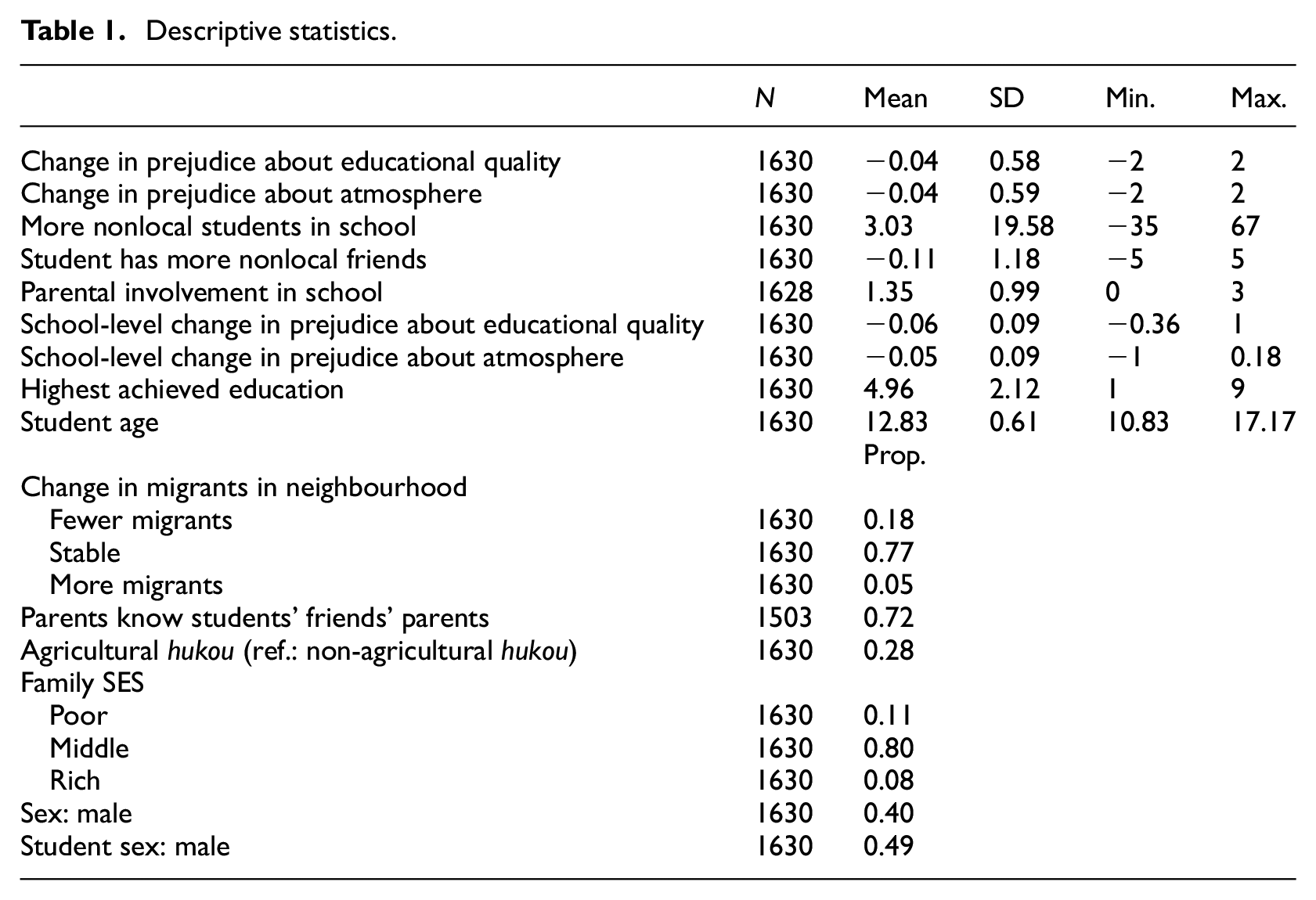
To study how respondents’ prejudice could be influenced by the prejudice of others, we aggregated both of the abovementioned indicators of prejudice at the school level. We then took the difference between the two waves for both measures of prejudice to create a variable of school-level change in prejudice.
Next, we created three variables for change in contextual meeting opportunities with nonlocals, for friendships, the school and the neighbourhood, using a multiple responder approach. First, for friendships, the students were asked to name up to five best friends and some of their characteristics, including their best friends’hukou status. For both waves we counted the number of nonlocal friends that students possessed and took the difference between the two waves to measure the change in nonlocal friends. Second, for the school, the school administrator was asked the percentage of students with a nonlocal hukou in both waves. The two waves were subtracted from each other to create a school-level variable measuring a positive change in nonlocal students in the schools. Third, for the neighbourhood, the parents were asked in both waves in which type of neighbourhood they lived in, and they could check all demographics that applied to their neighbourhood, including ‘migrant workers’. We created a variable with three categories measuring whether parents marked ‘migrant workers’ in wave 1 but not in wave 2 (fewer migrants), vice versa (more migrants), or whether they gave the same answer in both waves (stable).
To measure how embedded parents are in the social contexts, we created two variables in wave 2. First, to measure embeddedness in school, we measured parental involvement in school with the question: ‘How many times have this child’s parents contacted the teacher at school this semester?’, with answers (0) never, (1) once, (2) two to four times and (3) five times or more. Second, to measure parental embeddedness in the context of their children’s friendships, we used the question: ‘Do you know the parents of the friends who often play together with this child?’, with the three answers: ‘No, I don’t’, ‘Yes, I know some of them’ and ‘Yes, I know all of them’. We dichotomised this to (0) no and (1) yes.
The control variables include hukou status, family SES, parental education, parental sex, students’ sex and students’ age. As we only studied the prejudice of parents with a local hukou, hukou consists of local agricultural and local non-agricultural. Family SES stratifies families into poor, middle and rich. Highest parental education was used as a continuous variable with the following values: (1) none, (2) elementary school, (3) junior high school, (4) technical (secondary) school, (5) vocational high school, (6) senior high school, (7) junior college, (8) bachelor’s degree and (9) master’s degree or higher. Parental and students’ sexes are coded (0 = female and 1 = male). Finally, students’ age was measured in years.
Analyses
To study how changes in meeting opportunities and school-aggregated prejudice affect changes in individual prejudice against nonlocals in urban China, we conducted regressions for two measures of prejudice regarding how nonlocal students affect the educational quality and the atmosphere at school. As we studied school-level indicators and the data were collected in schools, individuals nested within the same school might not be independent of each other. To account for this, we clustered the standard errors within 73 schools. Then we conducted two sets of analyses. In the first analysis, we studied how changes in meeting opportunities in different contexts and school-aggregated prejudice relate to changes in individual prejudice. In the second set of studies, we included the interaction effects with contextual embeddedness and family SES.
Results
We drew a chart to obtain a general overview of the different levels of prejudice per context. Figure 1 shows the average levels of prejudice in wave 1 for different contextual conditions. The chart shows that for schools with 0%–24% and 25%–49% nonlocal students, the levels of prejudice are similar; but for schools with 50% or more nonlocal students, parents have relatively higher levels of prejudice. For parents whose children have no nonlocal friends or at least one nonlocal friends, the levels of prejudice are rather similar, although it is slightly higher for parents whose children have one nonlocal friend or more. For respondents living in neighbourhoods with or without migrant neighbours, the levels of prejudice are again rather similar, although they are slightly higher for people living in neighbourhoods with migrants. Although negligible, the general trend is that when the local respondents have more opportunities to meet with nonlocals, they have higher levels of prejudice.
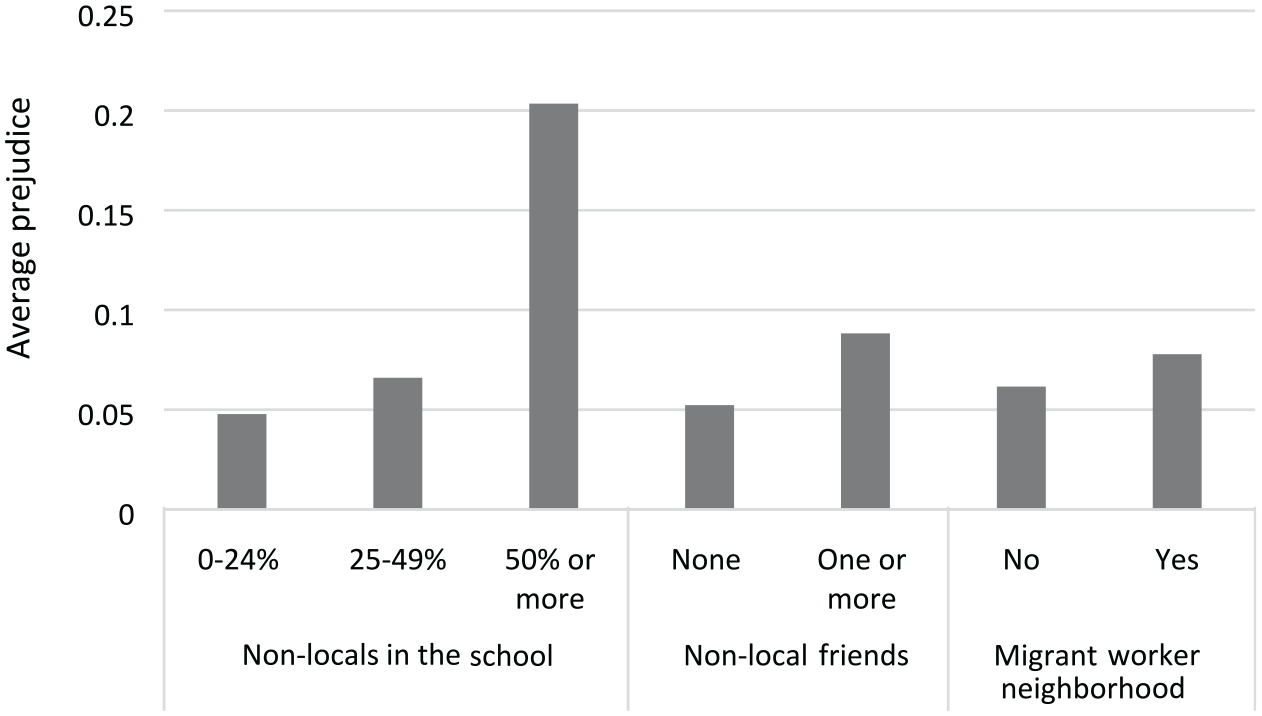
Average levels of prejudice by context (N = 1630).
Our hypotheses go further than the descriptive results of Figure 1 because we are interested in how changes in contextual meeting opportunities relate to changes in individual-level prejudice. We first ran the two models for the main effects of meeting opportunities and contextual prejudice on the two indicators for individual-level prejudice (Table 2). The results appear very similar for both outcome variables. When there was a change towards a larger share of nonlocal students attending the school of respondents’ children between waves 1 and 2, respondents had a reduction in their levels of prejudice regarding how nonlocal students affect the educational quality and the atmosphere at school. These results were not found for the other two contextual variables regarding meeting opportunities: if respondents’ neighbourhood had more or less migrants living there, this did not change their level of prejudice; and when respondents’ children had more or less nonlocal friends, their prejudice did not change. Furthermore, respondents were strongly affected by changes in the average level of prejudice at the school level. When parents became more prejudiced against nonlocals at the school level, respondents also became more prejudiced against nonlocals. Finally, the control variables indicate that higher educated individuals became less prejudiced over time.
Regressions for local residents’ changes in prejudice about how nonlocal students affect the educational quality and the atmosphere at school (N = 1630).
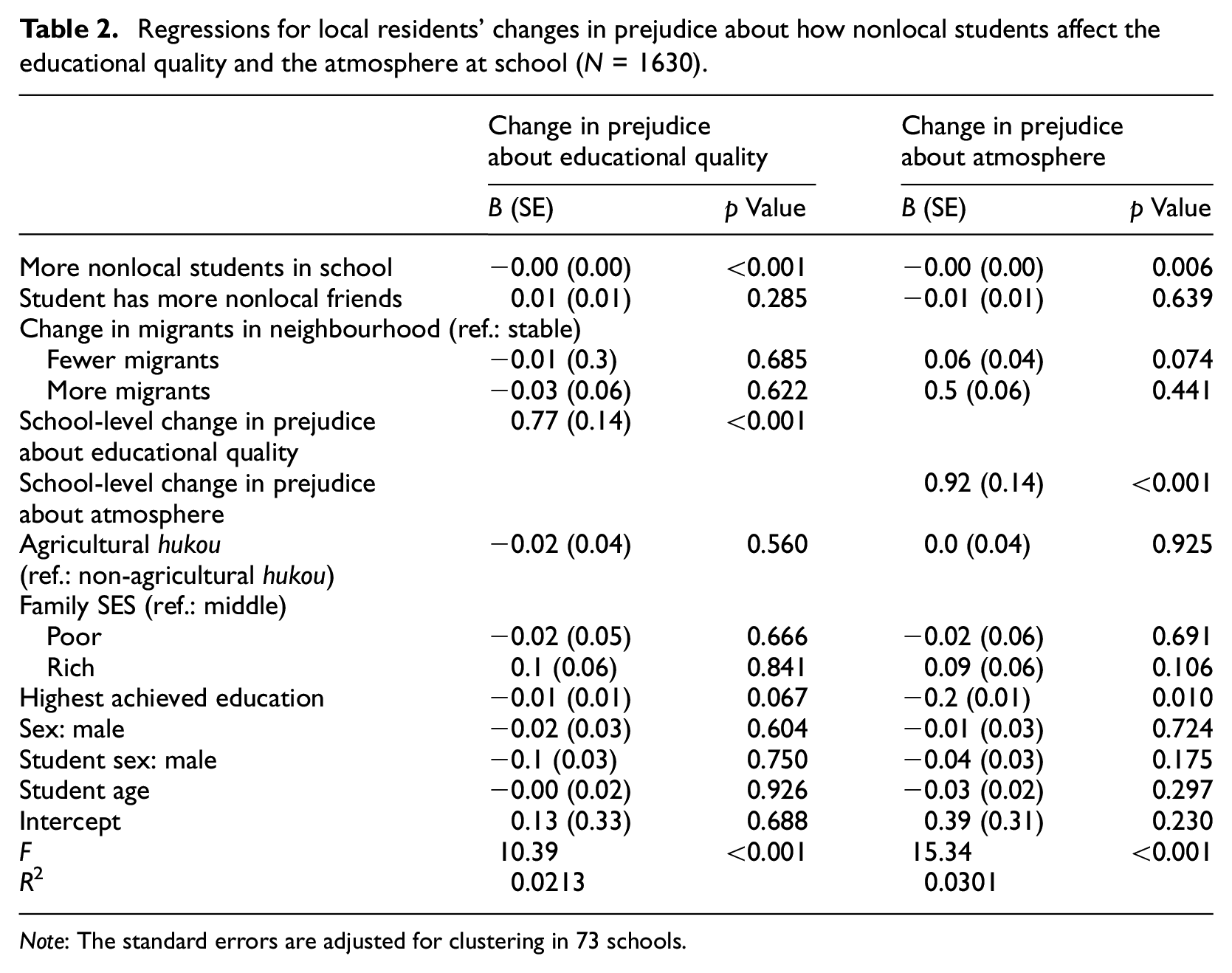
Note: The standard errors are adjusted for clustering in 73 schools.
Next, we tested our hypotheses about embeddedness in the context and competition by including three interaction effects (Tables 3 and 4). Model 1 in both tables includes the interaction between the change in nonlocal students in school and parental involvement in school. The results are the same for both outcome variables, namely, that the main effect of the change in nonlocal students in school becomes insignificant while the interaction term is significant and negative. This means that the reduction in prejudice caused by a change towards more nonlocal students in school is only present for parents who are involved with the school and not for uninvolved parents. Model 2 in both tables includes an interaction between the change in the number of nonlocal friends that the respondents’ children possess and whether people know the parents of their children’s friends. The interaction term is significant and positive for both outcomes; and the variable measuring a change towards more nonlocal friends becomes negative, albeit only significant in the model for the outcome relating to prejudice regarding the atmosphere at school. This indicates that when respondents’ children possess more nonlocal friends, respondents become less prejudiced, but only when they do not know their children’s friends’ parents. Perhaps respondents who know their children’s nonlocal friends’ parents might be less prejudiced to start with and therefore new nonlocal friends do not affect levels of prejudice. Additional inspection of the data shows that respondents who know their child’s friends’ parents have, on average, a lower level of prejudice in wave 1 (1.05 on a scale from 0 to 2) than respondents who do not (1.10). Finally, model 3 includes the interaction between the change in migrants in the neighbourhood and family SES. This interaction is only meaningful for the outcome variable pertaining to prejudice relating to educational quality. The results suggest that (1) when rich families experience a change towards fewer migrants in their neighbourhood, respondents become more prejudiced; and (2) when poor families experience a change towards more migrants in their neighbourhood, respondents also become more prejudiced.
Interaction effects for local residents’ changes in prejudice about how nonlocal students affect the educational quality in schools.
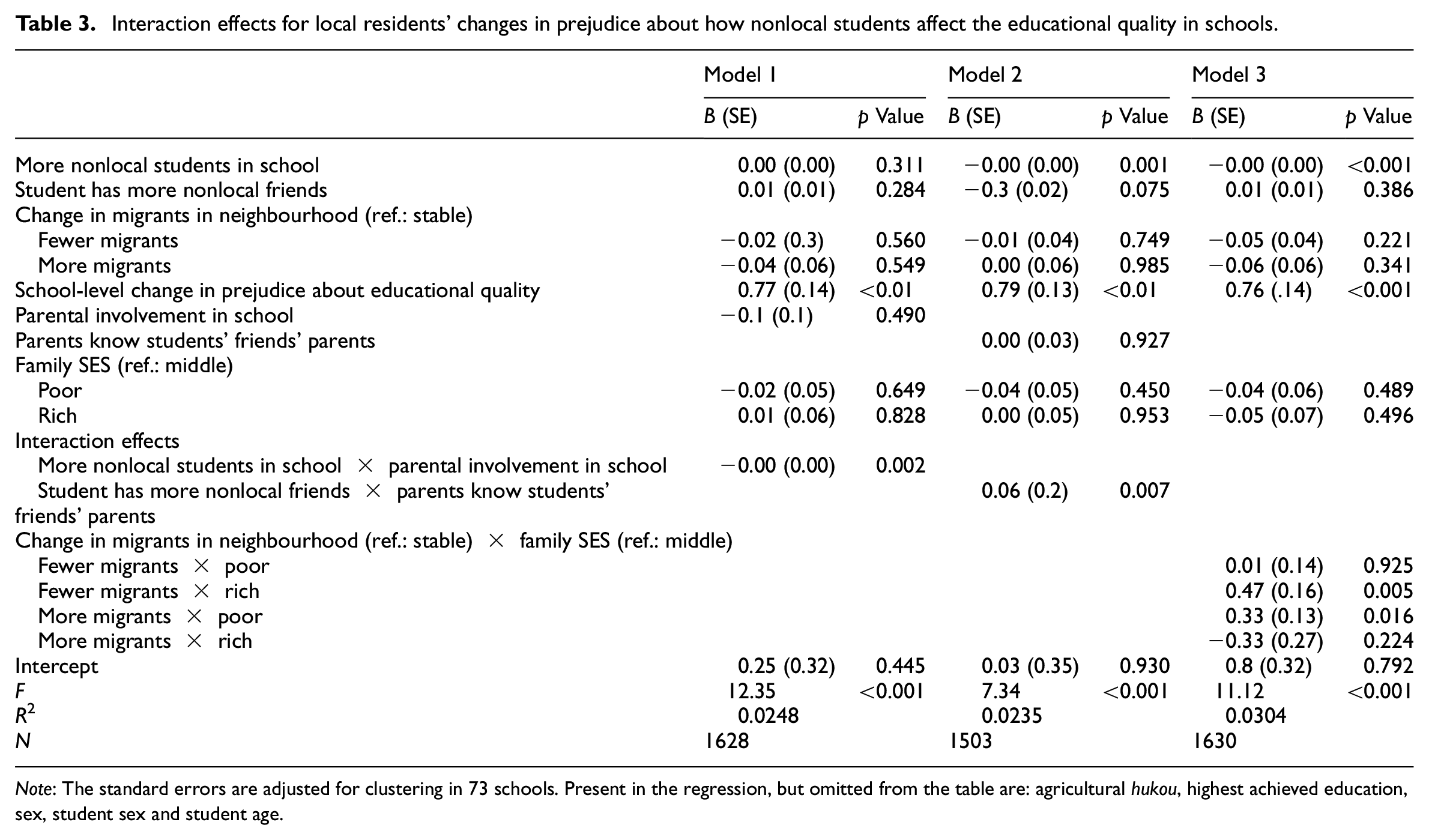
Note: The standard errors are adjusted for clustering in 73 schools. Present in the regression, but omitted from the table are: agricultural hukou, highest achieved education, sex, student sex and student age.
Interaction effects for local residents’ changes in prejudice about how nonlocal students affect the atmosphere at school.
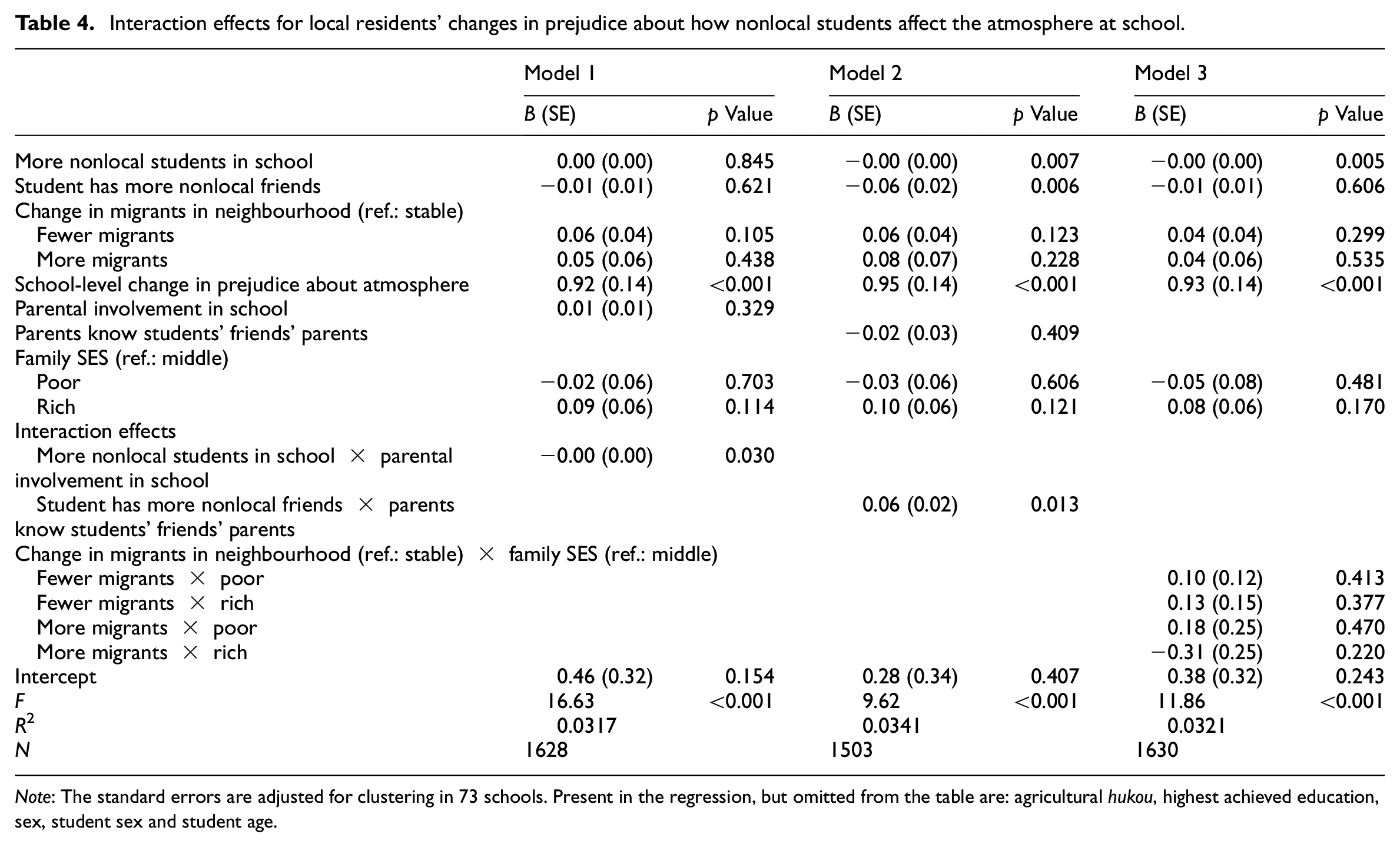
Note: The standard errors are adjusted for clustering in 73 schools. Present in the regression, but omitted from the table are: agricultural hukou, highest achieved education, sex, student sex and student age.
Conclusion and discussion
Since Shanghai was the first city in China to mix local urban and migrant students in public schools in 2008, the issue of intergroup interaction between local and nonlocal students became an important issue. Despite the loosening of the hukou policy together with the easing of schooling restrictions for migrant children, the long-standing group boundaries between locals and nonlocals have not disappeared (Feng et al., 2002; Lu and Zhou, 2013). It is very important to focus on the understudied topic of intergroup contact and prejudice in the context of Chinese internal migration and examine how to mitigate local urban residents’ prejudice towards migrants. The first objective of this study was to examine the effect of intergroup meeting opportunities and perceived intergroup contact of local urban students’ parents in their prejudice towards migrants in three different contexts: friendships, schools and neighbourhoods. Furthermore, in order to test the role of different meeting opportunities in more detail, we hypothesised that the effects of (perceived) contact on prejudice are stronger among parents who are more embedded in the school and know the parents of their children’s nonlocal friends. In addition, inspired by social learning theory, we predicted that prejudiced attitudes may spread through the social networks of students and parents. Our second objective was to generalise the contact hypothesis to the context of Chinese internal migration, which has received limited attention in this field but is of great significance (Kende et al., 2018). Different from studies on intergroup contact between urban residents and rural migrants in China, most of which concluded that internal migration strengthened the group boundaries between these two groups and led to increased prejudice towards nonlocals (Du et al., 2021; Li et al., 2006; Wang, 2008), this study finds that (perceived) intergroup contact between locals and nonlocals can reduce prejudice. However, we also found that prejudice increased under conditions of potential negative intergroup contact, namely, for poor local families who might feel threatened by the potential competition for scarce local resources such as jobs or housing. When we studied the cross-sectional levels of prejudice for our sample, we saw that more meeting opportunities in all three contexts relate to more prejudice, which would be in line with beforementioned studies on China. However, where previous studies only used static, cross-sectional levels of prejudice, we also studied how changes in intergroup contact relate to changes in prejudice. By this, we provide stronger evidence of the actual relation between intergroup contact and prejudice against nonlocal migrants.
Our findings clarify the effect of meeting opportunities of local urban students’ parents on their prejudice towards nonlocals in three contexts. Specifically, in the school context, intergroup contact can only reduce prejudice when parents are more involved in school affairs, which is in line with research on the contact hypothesis indicating that more meeting opportunities lead to reduced prejudice (Wagner et al., 2003). In addition, consistent with social learning theory (Bandura and McClelland, 1977), we find that prejudiced attitudes at the school level can be ‘contagious’ through networks of students and parents. In the friendship context, we find that children’s friendships with nonlocals can reduce the prejudice of their parents. This can be explained by the extended contact hypothesis indicating that perceiving in-group members’ friendships with out-group members can significantly reduce prejudice (Zhou et al., 2018). However, this finding is only true for parents who do not know their children’s nonlocal friends. It is possible that we found a floor effect for parents who already knew nonlocals and therefore already had lower prejudice at the first measurement point and could not go much lower while parents who did not know nonlocals and had higher levels of prejudice were able to reduce their prejudice, in line with the hypothesis. Furthermore, this finding for the friendship context is strongly in line with the extended contact hypothesis, which argues that it is not necessarily an individual’s own contact with out-group members that matters for prejudice but observing contact of other close in-group members (in this case, their children) is enough to reduce prejudice.
In the neighbourhood context, we find that the effect of intergroup contact can vary among local families with different socio-economic statuses: for families with higher SES, prejudice will increase as the number of nonlocal neighbours decreases; and for families with lower SES, prejudice will increase when there are more nonlocal neighbours. For higher SES people, this result is in line with the prediction from contact theory, but reversely argued, namely, when there is a reduction in meeting opportunities prejudice increases. Next, inspired by previous research, we argue and find that unlike locals with higher SES, locals with a lower SES may compete with nonlocals in the same job market for scarce resources (e.g. employment), so they might feel threatened by the increase in the nonlocal population (Hello et al., 2006; Scheepers et al., 2002). This phenomenon represents a situation under which the extended contact hypothesis does not lead to a reduction in prejudice and echoes the importance of paying attention to negative contact that might flow from perceived competition over, for example, jobs or housing. When intergroup interactions are negative, because they revolve around some conflict or disagreement, this is unlikely to reduce prejudice and might actually strengthen the already existing prejudices people might have. Since negative interactions are deemed to have an even greater impact on individuals than positive interactions (Labianca and Brass, 2006), it is important to pay attention to them and look for ways to resolve them. If negative interactions remain unresolved, negative attitudes and prejudices will persist, potentially leading to a negative spiral of prejudice and conflict.
There are a few issues we were not able to address in this study but that could be of great value for future research. First, some scholars state that the search for ideal conditions of optimal contact seems to be utopian (Dixon et al., 2005) and question the effectiveness these microlevel interactions can have in macrolevel ethnic conflicts (Forbes, 2004). Therefore, how intergroup contact at the microlevel affects societal-level conflict between locals and nonlocals in urban China is still a question for future research. Second, research on the contact hypothesis calls for a greater focus on negative contact (Pettigrew, 2008), which has the risk of making group identification more salient and incurring intergroup conflicts (Barlow et al., 2012; Paolini et al., 2010). The results in this study also show that local families with lower SES may be more prejudiced against nonlocals because of intergroup contact. Therefore, the variability and quality of contact should be treated more carefully with specific indicators in future studies. The mechanisms behind families with lower SES having increased prejudice when there are more nonlocal neighbours can be further explored. According to previous research, perceived threat is proven to be the most important explanatory factor of why more educated people have less prejudice towards migrants (Hello et al., 2006). Another study has shown that urban residents with higher SES have lower levels of prejudice towards rural-to-urban migrants, which is beneficial for their intergroup contact; and this link is moderated by urban residents’ perceptions of migrants’ social integration (Yang et al., 2010). Future studies can explore more mediators or interaction effects in the relationship between families with low SES in neighbourhoods and the effect of intergroup contact on prejudice.
In conclusion, in this study on China, we focused on the role of intergroup meeting opportunities of local urban parents on their prejudice towards migrant people in the contexts of friendships, schools and neighbourhoods. Our findings show the importance of meeting opportunities for shaping intergroup contact between local urban residents and nonlocal migrants. Mostly, intergroup contact reduces intergroup prejudice; however, depending on the conditions, it also has the potential to lead to more prejudice. The results suggest that, in general, stimulating intergroup meeting opportunities is a good idea when the goal is to reduce prejudice; however, policy makers have to be aware of the intricacies of group dynamics when it comes to the attitudes of those with a more precarious existence. Within neighbourhoods and communities a certain level of social cohesion must be in place to accommodate the needs of low SES locals as well as those of migrants. China’s residents’ committees provide a formalised social network that deals with social safety, prevention work and the mediation of disputes (Ngeow, 2012). Such neighbourhood and community organisations relate to high levels of local social cohesion (Putnam, 1995; Völker et al., 2006), which in turn relates to, for example, better health outcomes among residents (Mohnen et al., 2011; Nieuwenhuis, 2020). For example, it was found that during the COVID-19 lockdowns, neighbourhoods with more supportive residents’ committees also reported higher levels of social cohesion, mental health and wellbeing (Chen et al., 2021; Miao et al., 2021). Studies showed that migrants, due to their disadvantaged positions, are more dependent on their local social networks (Wu and Logan, 2016) and that migrants with more local residents in their social network are better integrated (Yue et al., 2013). Migrants who made use of community services and local public spaces reported higher life satisfaction and levels of integration (Ji et al., 2019; Liu et al., 2020). The link between migrants’ embeddedness in local social networks and their integration suggests that there is an important role to be played by residents’ committees and local social networks to facilitate the full acceptance of migrants in China’s cities.
Existing policies to stimulate the integration of migrants are diverse; for example, attempts were made to establish a more positive image of migrant workers as being hard-working and persevering (Qian and Guo, 2019), and steps towards more inclusive policies are being taken in the form of dialect training and business and administration training for migrants, as well as the trend towards removing hukou-related barriers (Tang et al., 2015). However, reforms have been slow (Sun and Fan, 2011) and differ between, and sometimes even within, cities (Chan and O’Brien, 2019). Building upon existing literature, this study shows that social policies work best in combination with social relationships. Social policy can open up pathways for migrants into mainstream urban society by opening up schools to migrant children and by allowing nonlocal hukou-holders to use social services. However, migrant integration is likely best served by combining social policy with social network integration: allowing migrant children into local schools only opens up the pathway by mixing local and nonlocal students, but creating more opportunities for parents to be involved in school affairs facilitates the meeting of local and nonlocal parents. For example, schools should provide meeting opportunities through parent-teacher meetings and open days at schools and educate students about the importance of ethnic equality. Furthermore, mixed residential areas create pathways for migrants into the local urban society, but governments should pay more attention to job and housing security for low SES families, which could reduce the perceived threats locals may experience and thus prevent prejudice towards migrants. Besides, local social networks and services should be accessible to everyone in communities, in order to stimulate integration as well as lower prejudice.
Footnotes
Declaration of conflicting interests
The author(s) declared no potential conflicts of interest with respect to the research, authorship, and/or publication of this article.
Funding
The author(s) received no financial support for the research, authorship, and/or publication of this article.
