




Abstract
Traditional markets represent vital spaces of opportunity for livelihood-building, intercultural contact and for developing familiarity with the city. Yet, worldwide, markets are under pressure due to redevelopment agendas driven by neoliberalised forms of urban governance. Although precarious sites of occupation and employment, markets still maintain an attractiveness for immigrant micro-entrepreneurs as a foothold into the labour market and urban economy. Through a case study of the historic Moore Street market in central Dublin (Ireland), we explore the experiences of immigrant entrepreneurs. While these may be different in terms of their familiarity with the urban, institutional and regulatory landscapes, they are not entirely dissimilar from the experiences of longer-term traders in Moore Street. However what is evident is how precarity is tactically exploited by newcomer entrepreneurs for particular reasons. These traders prize the autonomy brought by market trading and use it as a meso-scale between low-paid waged employment and higher-level employment that may be out of reach for a variety of reasons. We argue that in examining urban precarity, increased attention should be paid to exploring the context-specific nature of the processes that give rise to it as well as the agentic capacity exercised to exploit it even within structural constraints.
Introduction
Traditional markets are important urban public assets, providing substantial social and economic value to cities, particularly for low-income and minority social groups (Moore-Cherry and Bonnin, 2020). Despite their globally recognised importance (Gonzalez and Waley, 2013; Grüneisl, 2018; Spire and Choplin, 2017; Watson, 2009) street markets are increasingly squeezed out of urban centres world-wide as neoliberal urbanism, characterised by property market-led approaches, drives redevelopment that prioritises economic return. Gentrification, driving displacement of both lower income residents and lower order urban economic activities, state-driven disinvestment in market infrastructure and their environs, as well as increased competition from supermarkets and other retailers has contributed to such decline. However, traditional markets remain an essential element of urban infrastructure, and particularly for those on low incomes. As cities have become more socio-culturally diverse, the nature and character of urban street markets has changed and their importance has been diversified. In this paper, we shed light on the role of street markets as key livelihood-building opportunities for immigrant newcomers, arguing that urban ‘market-scapes’ provide both an important foothold into the labour market and an opportunity for autonomy.
In this paper, we conceptualise markets as relational spaces characterised by social interactions and practices that extend beyond the territorially bounded extent of the street market (Grüneisl, 2018). These relational spaces reflect ‘contested fields of power that are socially constructed and re-composed through the efforts of human actors’ (Bonnin and Turner, 2014: 324). Our analysis centres on the historical Moore Street marketplace in inner-city Dublin. We define this market as encompassing not just the open-air fixed food stalls selling fruit, vegetables, flowers and fish, but also the surrounding buildings, streets, social practices and networks that form part of the wider market environment, referred to henceforth as the ‘market-scape’. The street market itself has been a feature of Dublin’s inner-city since the 1700s (Kennerk, 2012), and today comprises a diversity of vendors, including families who have been trading for generations, as well as newer immigrant traders who arrived from the late 1990s (Moore-Cherry and Bonnin, 2020). The market-scape thus includes a mix of traditional street market stalls, disinvested buildings along the fringe that are home to an assortment of ethnic small- and micro-enterprises and an indoor lower-order retail area occupied by immigrant traders.
This market-scape has provided important opportunities for immigrant entrepreneurship to flourish due to relatively affordable rents compared to prime city centre locations, and flexible, short-term leases in a context where commercial leases range from annual to 10 years in duration and require a significant financial outlay. These opportunities co-exist alongside the challenge of ongoing threats of redevelopment. While facilitative, the short-term nature of leases has also created precarity as they enable landowners to evict tenants at relatively short notice and without compensation. This tension between constraining and enabling elements for livelihood-building in Moore Street engenders a form of precarity that while productive in the short-term, is ultimately limiting.
A now extensive literature on precarity and precariousness rests primarily on two key understandings (Han, 2018). The first, concentrates on precarity as an historical phenomenon tied to conditions associated with post-Fordist production, neoliberal globalisation, transformation of class relationships and the decoupling of labour from the welfare state. Some commentators argue that this has given rise to an emerging social class, a precariat, with a shared identity based on a lack of secure labour, stable occupational identity and collective voice (Standing, 2009). However, the idea of precarity as ‘new’ is challenged by the so-called informal economy, long serving as the income-generating base for most residents in low-income countries. In the 1980s, the informal economy extended to highly institutionalised, industrialised settings under increasingly flexible labour arrangements and with an interdependency of informal and formal economies (Castells and Portes, 1989). According to Kasmir (2018: online), ‘[t]his broader geographic and historical perspective on global capital accumulation shows that Fordist stability is the exception and precariousness the norm, as opposed to the obverse’.
A second strand of thinking focuses on precariousness as an ontological condition of vulnerability that all humans experience due to our interdependence on each other, which Butler (2004) describes as ‘precarious life’. However, according to Butler (2004, 2010), the experience of precarity is unequal, and borne most by socio-economically marginalised groups. This inequality is further amplified by the impacts of neoliberalism, conflict and climate crises (Kasmir, 2018). In this paper we adhere to this more open, unbounded conceptualisation of precarity as a ‘condition of vulnerability relative to contingency and the inability to predict’ (Ettlinger, 2007: 321). This focuses our attention to ‘the local historical, cultural, economic and regulatory conditions that render lives precarious in specific contexts’ (Martin et al., 2019: 901). We unpack the paradoxical, and at times productive, aspects of precarity by exploring the context-specific nature of the processes that give rise to it, as well as how everyday precarity is being engaged (Strauss, 2018) by immigrant newcomers. While widely accepted as problematic, our study explores the less documented productive nature of precarity which in some very specific instances facilitates autonomous pathways for urban newcomers. While Dublin city officially seeks to encourage immigrant entrepreneurship (Dublin City Council, 2016), this is not accompanied by any meaningful practice. It thus results in individual decision-making by would-be entrepreneurs to engage tactically with precarity. We suggest that attention to the precarious conditions through which immigrant enterprises emerge is crucial both in terms of understanding the importance of liminal spaces within the city but also to creating pathways to more sustainable livelihood building activity. Understanding the decision-making and experiences of immigrant entrepreneurs is also important for wider societal inclusion as ‘the daily lived experience of migrants and their children in communities across the country is an important factor in building a sense of belonging’ (Fahey et al., 2019, foreword).
Prior to commencement, this research received full institutional ethical approval. It adopts a qualitative case study approach, drawing on ethnographic methods. Non-participant observation was undertaken to understand the operation of the marketplace prior to recruiting research participants. Thirteen semi-structured interviews were specifically undertaken with fifteen immigrant entrepreneurs (some in pairs) operating in the retail premises adjacent to the street market, some with the assistance of a Mandarin to English research assistant. The paper is also supported by data drawn from interviews carried out as part of a broader ongoing research project since 2015. All interviews were recorded and later transcribed with full participant consent. Transcripts were analysed thematically. In addition, planning documents and policy statements on migrant entrepreneurship were gathered and subjected to content analysis.
Precarity, the market-scape and immigrant entrepreneurship
Market vending is practiced widely around the globe in a variety of different formats, temporalities, spatialities and contexts. Traditional markets, such as Moore Street, are often ‘open air’ selling a mixture of affordable household goods, crafts, clothes, fruit, vegetables and other food (Regeneris, 2010). Along with these products, services such as hairdressing, restaurants or electronic device repairs are often offered. In the case of Moore Street, such service-oriented businesses make up 25% of immigrant-owned enterprises.
Traditional retail markets tend to be different in character – trading lower-order goods and services and targeting a different demographic – compared to the farmers or niche markets that have become ubiquitous in cities across the Global North. The latter are often privately-owned and privately-operated markets attracting affluent customers, servicing ‘lifestyle’ choices rather than basic food provisioning. Often associated with inner urban gentrification, these high-end markets have exploded in number globally, at the same time as traditional street markets are declining due to underinvestment and neglect (Gonzalez and Waley, 2013; Regeneris, 2010). Yet despite the pressures they are subjected to, traditional street markets remain of paramount importance to sustaining lower-income urban communities, and are significant public assets (Gonzalez and Waley, 2013; Watson, 2009).
Traditional markets offer a broad spectrum of urban dwellers the opportunity to access the labour market, goods and services. For example, in London (UK), street markets make a significant contribution to the livelihoods of deprived communities, minority groups and low-income families, supporting higher living standards due to the affordability of goods sold, and social cohesion (Gonzalez and Waley, 2013; Regeneris, 2010; Watson, 2009). Due to their attractiveness to newcomers, traditional markets also transform market districts into global hubs, where products, traders and customers from all over the world come together to forge intercultural connections (Hiebert et al., 2015; Pottie-Sherman, 2012; Watson, 2009).
Similarly, street markets in areas of the Global South, provide employment with minimal overhead costs to vulnerable populations (Giddings, 2016). In Latin America, street vending in markets such as Santa Helena, near one of the most violent and distressed areas of the Colombian city of Cali, is an important income generation activity for individuals with low access to capital (Martínez et al., 2018). According to Tengeh and Yota (2013) and Martínez et al. (2018) street vending is a means to access the labour market for those with limited skills, income and level of education. Individuals often enter street vending and other forms of micro-enterprise in order to seek full and complete autonomy over their business transactions as compared to the available, also precarious, waged labour opportunities in that context (Bonnin, 2005; Huang et al., 2018).
Self-employment is often the first route to employment for immigrants as an ‘obvious reaction to blocked opportunities in the labour market’ (Volery, 2007: 31). Barriers to formal employment opportunities commensurate with one’s skills and training are frequently related to views that: newcomers may lack educational qualifications or their foreign academic/professional credentials are not recognised, a form of structural discrimination; they may not be in a position to successfully access information on relevant employment vacancies; and they may face discrimination by local employers (Birdthistle, 2012; McGinnity et al., 2011; Rath, 2011). This often pushes newcomers into sectors with low barriers of entry such as lower-end retailing, wholesaling, catering and street markets (Rath and Swagerman, 2016). Immigrant entrepreneurship within developed economies has come to be understood as operating on the economic margins often in, or adjacent to street markets, due to an initial unfamiliarity with the governance of enterprise establishment within a host country (Cooney and Flynn, 2008). Newcomer entrepreneurs may also have difficulty securing finance, establishing supplier and customer contacts, leasing business premises and in gaining credibility (Cooney and Flynn, 2008). Relative to native-born entrepreneurs, immigrant entrepreneurs are often at an informational disadvantage relating to regulatory, legal and institutional obligations (Cooney and Flynn, 2008) and with regard to financial, human, cultural and social capital (Kloosterman and Rath, 2010). Consequently, they may gravitate towards low-cost businesses that require a more modest capital and informational input and are more labour intensive.
Traditional markets can therefore be an enabler to immigrant entrepreneurship, providing a pathway to labour for newcomers who enter into host countries at an informational, financial and linguistic disadvantage. Establishing micro-enterprises within the market-scape offers a means for immigrants to improve their quality of life and livelihood trajectories through autonomy (Parella et al., 2013). Yet, as we will show, this is a constrained form of agency, dependent on navigating highly precarious conditions and shaped by labour market structures wherein ‘limitations on immigrants’ opportunities result from uneven power relations and regulatory contexts’ (Blue, 2021: 176).
Thus, the conditions that enable micro-entrepreneurship are often completely antithetical to formal visions of the future city (Spire and Choplin, 2017). Globally, revanchist urban policies aim to decongest and modernise cities (Spire and Choplin, 2017) in the service of property-led regimes. Already existing precarity can be intensified when market vendors are stigmatised as a barrier to upgrading. In many contexts, people and places are discursively constructed by governing elites as disorderly or ‘uncivilised’, such as in Vietnam, Western and Northern Africa where street vending has been, often forcibly, removed, relocated or even banned (Barthelmes et al., 2017; Grüneisl, 2018; Spire and Choplin, 2017; Turner and Schoenberger, 2012). Access to trading space is often contested amongst traders and state actors (Grüneisl, 2018). Because of the marginal nature of their employment activities and information deficits on their legal and civil rights, immigrants who operate within street markets often have poor, if any, social protection, and are subject to economic exploitation, heightening their vulnerability (Wilson, 2018).
The specificity of the urban experience and the relationship that exists between immigrant entrepreneurship, urban precarity and redevelopment is complex and contradictory. The relationship between individual agency and structural conditions is not straightforward. How it is negotiated is too multifarious to be understood as a simple binary of good or bad, and demands further interrogation grounded in experience. A focus on street markets as specific sites of entrepreneurship facilitates a more nuanced understanding of the role that precarity plays in immigrant experiences within our cities and challenges us to consider how newcomer entrepreneurship that may be ignited by particular conditions and related to individual preference can be developed and sustained in the longer term.
Context: The market-scape
In Ireland there are no formal statistics of the number of markets in operation, number of employees or overall value to the economy. The best estimate of the number of market traders in Ireland – based on those looking for market insurance – puts the figure at around 2,500 (Markets Alive Support Team Ltd, 2021 personal communication) with the direct value of market trading estimated to be about €250–300 million. The lack of publicly available data on the extent and nature of market trading is indicative of their formal invisibility despite their social and economic value. Dublin City Council operates a number of markets in Dublin including the indoor Wholesale Fruit and Vegetable Market, the Moore Street Fruit and Vegetable Market which is a retail outdoor permanent market offering fish and fresh produce as well as a number of markets in public parks and other settings that are privately managed.
The Moore Street market is Dublin’s oldest traditional open-air street market, adjacent to the city’s primary thoroughfare, O’Connell Street. Beginning in the mid 18th century as a residential district, the area developed into a market bazaar of back streets and alleys, each specialising in a particular trade (Kennerk, 2012: 11). From the 1960s, the market became a particularly important livelihood source for working-class inner-city locals due to the decline of traditional industry (Moore-Cherry and Bonnin, 2020) associated with urban economic restructuring. Women’s labour became critical to household incomes as a means of coping with the loss of male employment. Since the late 1990s, the street has undergone ethnic diversification as a direct result of Ireland’s changing demographic profile from a country of emigration into one of immigration (Gilmartin and White, 2008), although there was a reversal of this pattern from 2008 to 2014 as a result of Ireland’s financial crisis. Driven by the economic boom of the 1990s but also partly through the expansion of the European Union, Ireland now has one of the highest proportions of foreign-born residents in the EU. EU and non-EU immigrants are centralised in Ireland’s five cities with relatively low levels of segregation compared with European and American metropolitan areas (Fahey et al., 2019). Those immigrants with relatively poor English-language proficiency seem to locate more frequently in areas of least affluence and greatest educational disadvantage. Because of the recent nature and character of immigration, there is a relatively small and young population of second-generation immigrants, and most are White European. The 2016 Census counted just 1.4% of the population as Black and 2.1% as Asian. While there is some emerging evidence of structural racism in Ireland – for example 16% of African-born residents are out of work compared to 4% of White Irish (Irish Network Against Racism [INAR], 2019) – the numbers are relatively small and the recent nature of immigration makes it difficult to fully assess.
Interestingly, the Moore Street market-scape now comprises a diverse mix of both indigenous White and newcomer traders, particularly of African, South and Southeast Asian and Chinese origin (Bonnin et al., 2016: 112). These are groups that do not report the lowest levels of English-language proficiency (Central Statistics Office, 2019: Statbank Table E7062). Today, the district is widely recognised as one of the most ethnically diverse in the country. The market-scape provides a space within which immigrants can build their livelihoods, representing a space of intense intercultural and intracultural contact, and enabling newcomers to create pathways into the labour market. Socio-demographic transformation has also been accompanied by significant urban transformations.
These are happening within an increasingly neoliberalised political economic context. Since the 1980s, urban policy in Ireland has followed a broadly similar trajectory to the UK, North America and Australia with property-led development being enabled through incentives, de-regulation and privatisation. An economic resurgence and property boom that emerged in the late 1990s and lasted until the global financial crisis of 2008/09, was driven by and resulted in: the attraction of significant global investment into financial services, the technology sector and pharmaceutical sector; population growth and ethnic diversification partly fuelled through inward migration; and the growth of domestic consumption. Inward investment into Dublin in particular drove large-scale ‘regeneration’ schemes, some of which resulted in wholesale redevelopment as well as significant gentrification and increased social polarisation (MacLaran and Kelly, 2014). Although temporarily interrupted by the global economic crisis, the trajectory of policy and development has remained relatively stable over time (Moore-Cherry, 2016; Moore-Cherry et al., 2015).
Despite these changes, the Moore Street market has resiliently persisted through traditional trading. However, its place within the contemporary city has been threatened by repeated urban redevelopment proposals over the last 30 years (Moore-Cherry and Bonnin, 2020). Alongside the increasing power of the real-estate sector, clientelism and tight relationships between developer lobbyists and the political class (Moore-Cherry and Tomaney, 2019), public sector disinvestment and lack of a clear planning direction left market traders in a ‘limbo land’, under increasing pressure. The late stages of urban neoliberalisation are characterised by ‘re-regulation’ and this has been experienced through mandatory codes of practice for traders, punitive trading fees as well as progressively restrictive licencing arrangements (Bonnin et al., 2016). Complicating the issue has been recent debates and legal challenges around the ‘heritage’ of the street, associated with its historical role in the 1916 Rebellion against British rule (Moore-Cherry and Bonnin, 2020). These compounded the difficult trading conditions that have been experienced since the closure of the Smithfield wholesale market in 2002 and the arrival of discount food retailers (Bonnin et al., 2016: 112). Although the number of Irish traders on Moore Street has been diminishing since the early 2000s, the arrival and expansion of immigrant micro-enterprises has been critical to maintaining the social and economic vibrancy of the area.
The experience of immigrant entrepreneurship in the Moore Street market-scape
Immigrant business owners operating within and adjacent to street markets face a difficult dilemma. On the one hand, the precarity that comes with doing business within the market-scape does not enable sustainable livelihood-building strategies, but on the other, this precarity in the form of low barriers of entry and affordable leasing provides an enabling opportunity. This is illustrated in the experiences of newcomer entrepreneurs in Moore Street’s market-scape and their responses.
Institutional environment
An initial challenge faced by all new entrants to a particular market is how to navigate the national, sectoral and local institutional environment, including tax and welfare, regulatory, housing and rental systems. During the economic boom of 1994–2008 in Ireland, opportunities for employment increased across a range of sectors. Over 260,000 immigrants entered the country in 2007 and 2008 (Central Statistics Office, 2019) many seeking employment opportunities. The Irish government has developed a framework that promotes the integration of immigrants (such as the Migrant Integration Strategy 2017–2020 and the Dublin City Council Integration Strategy, 2016–2020 [Dublin City Council, 2016b]) but research and policy pertaining to newcomer entrepreneurship is out-dated (Cooney and Flynn, 2008; Equal, 2006). Although a policy framework on equality and social justice for immigrants and minority groups in Ireland exists, frameworks supporting immigrant entrepreneurship are lacking. Miguel, a Brazilian immigrant who opened a Brazilian grocery store on Moore Street in 2009, referred to this structural blockage: ‘I know the city enterprise board, they help people in general [with their businesses], but I don’t think specifically there is help for people born in other countries’. The outcome of this is well illustrated by Ravi, originally from India, who has run two businesses, an Asian supermarket and hardware store on Moore Street since 2002. Ravi described his struggles with the Irish institutional environment, stating ‘there are so many different regulations now that weren’t here before. It is so difficult to meet and understand all the necessary documents.’
Nevertheless, many newcomer entrepreneurs do navigate around the institutional difficulties faced by immigrant businesses, including through the building of informal social networks. This approach was explained by Lin, the owner of a Chinese tech repair shop operating on the street since 2012: ‘we often talk to each other and have dinner together once in a while… not just Chinese, but immigrants from India, Pakistan, Romania, etc. We’d normally talk about the policies, regulations carried out by the Irish government in relation to our business.’ These inter-ethnic informal networks are essential for the dissemination of information amongst immigrant entrepreneurs on Moore Street, according to Lin, and for developing peer support to navigate complex institutional and regulatory contexts. Another strategy is to seek professional support privately. For example, Sanjay and Palisha, immigrants from Nepal who jointly run a beauty salon established in 2011, attribute their success to the advice of professionals: ‘We go to accountants, and they tell us what to do and explain what the law is in Ireland … Most migrants do this.’ However, professional advice can be a very expensive option that not all immigrants can afford, according to Ayodele, a Nigerian hair salon/grocery shop owner since 2013. Ayodele therefore seeks legal and financial advice from the Money Advice and Budgeting Service (MABS), a free money advice service offered by the Irish government, which has been of significant help to her as an immigrant business owner.
Anti-social behaviour
As well as being at a relative disadvantage due to unfamiliarity with the institutional environment, a challenging aspect of the day-to-day experience of immigrant entrepreneurship within the Moore Street market-scape is anti-social behaviour. Of greatest concern to traders on the street and a challenge to their ability to continue their livelihoods was the risk posed to themselves and their businesses by anti-social behaviour and the neglect of this by local law enforcement. All respondents stated that they experienced verbal abuse, intimidation, or theft on an ongoing basis. A perceived lack of responsiveness by authorities is contrary to the experience documented by researchers in other parts of the world, where traders are often under constant surveillance and pressure from law enforcement. Yet, our research participants’ experiences are common to all of the traders on the street. General problems with anti-social behaviour and the apparent turning of a blind eye to it by the relevant authorities has been raised in the Irish media by traditional street traders who have signalled their inability to cope with continued criminality and ongoing neglect (Kelly, 2019).
All of our interviewees complained of anti-social behaviour, claiming that police either do not show up, or else arrive several hours after an incident. Ravi, whom we introduced above, expressed his despair: ‘What really makes me angry is that the police don’t care about this street. I have kids coming and smashing things and ruining fruit stalls. I call the police, but they don’t come.’ Tech repair shop owner Xin, originally from China, also expressed his feelings of defeat and abandonment by local law enforcers: ‘If you have someone making trouble, we call the Gardaí (the police) straight away, but they come in one or two hours when trouble is finished already. Or they just don’t.’ Although there is a general sense by all traders that criminality goes undeterred within the market-scape, some of the immigrant business owners felt that their experience was even worse. According to Ravi ‘a lady hurt herself outside the other day, so we called an ambulance and the police and they were here in 2 minutes…loads of Gardaí! The police don’t care about us migrants.’ Zofia, who has owned a Polish bookshop on Moore Street since 2014, is also particularly concerned about the state of the street: ‘you’ll see the anti-social behaviour on this street. At 5 o’clock people are drunk and where are the GardaiÌ?’.
While harassment from anti-social individuals is a major issue for the immigrant business owners of Moore Street, this harassment did not appear to take the form of racism or prejudice. Authors such as Ishaq et al. (2010), Jones et al. (2014) and Ram et al. (2017) report that racism in the form of hostility from host populations and organisations within the mainstream business environment is a major obstacle for immigrant entrepreneurs. In contrast, most of the interviewees we spoke with did not report racism as an overt concern, although we acknowledge that it is possible research participants may have felt this was a sensitive issue and did not feel comfortable to reveal this to us. For our respondents, it was the more generalised anti-social behaviour, heightened by drug and alcohol abuse in the area, that was the critical issue. As outlined by Ravi, ‘I came to Moore Street originally because it was very busy and there were a lot of customers. Now it is nearly deserted. People don’t want to come here because we get a lot of anti-social behaviour. I believe this is why the street is becoming so empty. Why would anybody come here? The street market is declining, this is hardly a market street anymore.’ The precarity of livelihood building activity in the area is a direct result of neglect by the relevant authorities, in line with much of the literature on revanchist urbanism and street and marketplace traders (Endres, 2014; Gonzalez and Waley, 2013; Mackie et al., 2014; Turner and Schoenberger, 2012). This daily lived experience of anti-social behaviour adds a further layer of precarity stemming from being constantly at the risk of violence, or what Ettlinger (2007: 321) calls the ‘unpredictability of terror’, while the complete absence of police response to traders’ requests for assistance in this context represents yet another form of vulnerability and disinvestment.
Historical commemoration, redevelopment and leasing
As outlined earlier, Moore Street and its environs are a contested part of the city with a diversity of stakeholders seeking to maximise their opportunities in different ways. Private-sector developers have accumulated a significant land bank on the east side of the market-scape and have proposed different redevelopment proposals over the last 30 years, some of which were halted by the economic crash. From another perspective, a divided heritage campaign has attempted to slow down, halt or entirely alter redevelopment proposals because of the historical associations of the street (Moore-Cherry and Bonnin, 2020). Neither side has paid much attention to the material and symbolic importance of this area to immigrant communities and to market traders more generally.
Since the beginning of heritage campaigns, scarce effort has been made to consult or secure the support of any traders (Bonnin et al., 2016) and our research indicates that many of the immigrant traders know very little about either the contested heritage of the area or redevelopment proposals. Not one of our respondents had any clear sense of future plans for the street or timelines of such change despite the potential devastation for their livelihoods. The immigrant owners who run the majority of businesses within the broader market-scape are entirely uninformed and have had no opportunity to offer input – formal or informal – into future plans. The only business we visited that had been given any formal notification of the redevelopments was a tech repair shop run by Umar and Yasmin, originally from Pakistan and Malaysia respectively, who had recently received a letter from Dublin City Council. No other interviewees reported obtaining such a letter. Lin despaired at the thought of the repercussions on her business of potential displacement for redevelopment: ‘If we move to another place, customers are unlikely to find us, I think a lot of customers will give up and not travel to find us.’ As well as the threat of total demolition, increased rent, disruption and customer loss, many immigrant-run businesses are on short-term leases, meaning that under any proposal, landlords could force them out of their businesses at short notice. Ravi is concerned for the future of his businesses, which are immediately adjacent to the site for a ‘1916 Rising Commemorative Centre’ and pedestrian walkway. In his words, ‘I heard they are renovating, but they don’t tell us about it. If they redevelop, I could potentially lose two businesses and I don’t know where I will go or what I will do. It will be tough to survive.’ Despite running two successful businesses on Moore Street for over 10 years, Ravi remains powerless, voiceless and invisible in the governance of the street and its environs.
Paradoxically, the very reasons underpinning why immigrant entrepreneurs first established businesses on the street could very quickly transform into the reverse: the reason why they will lose their livelihoods. Beauty salon owners Sanjay and Palisha highlighted: ‘In life, the hardest thing for us is financing, so the street market is cheaper. People who have weak financial backgrounds, they can come to this market or other marketplaces if they don’t have enough money. Moore Street is very affordable.’ The street provides newcomers with flexible and affordable leases according to entrepreneurs like Miguel: ‘When I set up, there was a lot of vacant lots available and leases were very flexible and inexpensive.’ Kamran, a Pakistani immigrant, started his tech repair business on Moore Street in 2014 specifically for the same reason: ‘This was inexpensive, that is why I chose here’. Such precarious leasing – an outcome of the uncertainty surrounding future redevelopment – enabled the establishment of these businesses. Without such flexible and affordable leasing, these newcomers would very likely never have had the option to pursue entrepreneurship as a livelihood strategy.
While short-term leasing was critical to setting up their businesses, several interviewees expressed their concern with leasing terms and current increases in rent payments demanded by landlords, compounded by the difficulties in accessing loans and financial assistance. According to Lena, from Poland, who has run a pharmacy since 2009: ‘there used to be a lot of Polish people here 10 years ago, but they are all leaving because it is not as cheap anymore.’ Sanjay stated that it is difficult for small immigrant businesses to get a loan from the bank due to their small footfall. As Ravi commented: ‘On this street, our biggest challenge is keeping up rent payments, and as well… on Moore Street we have a 14-day lease so we can be told to leave with only 2 weeks’ notice.’ Li Wei also expressed his concern with these extremely short-term leases: ‘We were told we will get six months’ notice, but my landlord could just tell me a month before. Landlords don’t care… they just want to get their rent. It has happened before… people have been given a month’s notice and had to leave.’ Immigrants working within the market-scape are acutely aware of their vulnerability, but many are not clear on what underpins that vulnerability nor how they might resist it or exploit opportunities to reshape their own labour market pathways.
Drivers of locating in a precarious urban setting
For newcomers, entrepreneurship is not only about job creation, but also about becoming active agents of their own destiny, upward mobility, social cohesion and contributing to an eclectic social and cultural life (Rath, 2011). While the urban market-scape is indeed very precarious, the low barriers of entry offers immigrant entrepreneurs an autonomous foothold into the host economy and enables them to foster co-ethnic social networks of support.
Although employment within the market-scape comes with significant challenges, the initial choice to become self-employed as opposed to seeking waged labour was driven by two key issues for our interviewees: the opportunity for autonomy, and ease of access. There were some cultural differences apparent between immigrants of different nationalities. Those from Chinese backgrounds, remarked that self-employment eliminated the anxiety of working in an unfamiliar environment or passing a formal English-language interview, an issue of less concern for participants from India or Pakistan who were more familiar with Western culture and the English language. However, for others, autonomy was also important if they were ambitious. For example, Li Wei entered into self-employment on Moore Street because he felt formal employment was limiting. Although the street market itself does not offer Li Wei a means of financial stability superior to that of waged employment, for him, entrepreneurship within the environs of the market-scape was an opportunity for professional autonomy and to ‘do better for yourself’ as an independent business owner. The market-scape thus affords an important sense of control over livelihood pursuits even while this agency is bounded by the structural conditions which limit access to viable labour market alternatives and the tenuous operating conditions on the street. How immigrant entrepreneurs on Moore Street deployed their formal education was another notable finding of this research. Tengeh and Yota (2013), Rath and Swagerman (2016) and Martínez et al. (2018) suggest that self-employment is a means of income generation for individuals who lack the skills and educational attainment to engage in formal means of employment. However, this was not entirely the case with the newcomer traders we interviewed on Moore Street. Eleven of our fifteen interviewees possessed higher education qualifications (Table 1). Even though the vast majority of our respondents were highly skilled (Iredale, 1999), they were operating in a low-skill, low-profit and precarious environment. One example is Palisha (MSc Economics), who runs a beauty salon on Moore Street barely large enough to fit more than one customer at a time.
Educational attainment of interviewees.
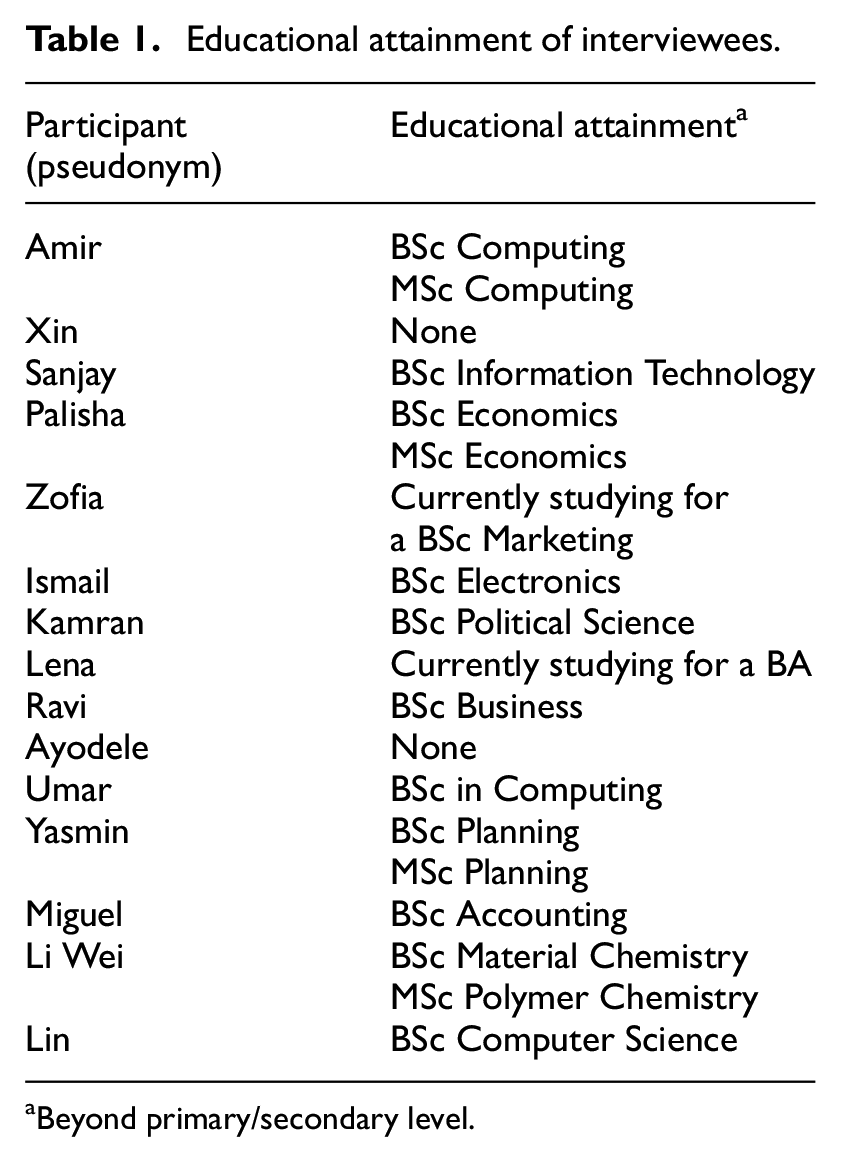
Beyond primary/secondary level.
Although language competency and other cultural barriers played a role in prompting some interviewees to pursue self-employment rather than seeking formal waged employment, the main overall driver for the majority we spoke with was the desire for and cultural significance of autonomy.
In their study of Chinese street vendors, Huang et al. (2018) highlight the importance of perceived autonomy. Bonnin (2005) found similar motivations by women who started home-based micro-enterprises in Metro Manila, Philippines as a means of resisting the precarity of formal employment. For entrepreneurs like Ayodele, autonomy is key. Ayodele set up her hair salon in order to ‘work for myself’, much like Ravi who revealed ‘I became self-employed so that I could be my own boss’. One of our interviewees, Li Wei, simply wants to work for himself: ‘I find with this job, I have a lot of freedom. I am happy here and I can work for myself.’ While this process is often referred to as ‘de-skilling’ or ‘brain-waste’ (Aure, 2013; Currie, 2007), our respondents were drawing on their educational qualifications and re-purposing their skills. Both Ravi and Miguel use their accountancy and business qualifications to help with the running of their businesses, while the majority of tech repair shop owners stated that they used skills that they had acquired at university. Many of our interviewees are on the surface over-qualified for the work they are involved in, but they are re-purposing their skills to support self-employment. For example, Kamran, explains ‘I am ok with what I am doing. I make good money; I have no headache and no boss! I could never work for someone else.’
The decision by immigrants to open a business within the market illustrates a clear sense of agency but one that is clearly structurally constrained. The market acts as a meso-scale between waged employment within very low-entry level jobs and higher-level employment corresponding with their educational attainment, which may be out of reach because for example, educational qualifications are not recognised. The Irish labour market does show some evidence of racially motivated inequality. Despite anti-discrimination policies, migrants, particularly non-white immigrants, consistently fare worse than other members of the Irish community (Joseph, 2018). Therefore, immigrants are at an immediate disadvantage upon entry into Ireland. This was particularly true for Ismail, who has a BSc in Electronics: ‘before I was working as a kitchen porter and after, I was able to open my own business… before I worked 2 or 3 jobs… ’. Employment within the street market offered Ismail a better quality of life and a means of self-actualisation, which he was not offered within formal employment: ‘…but when I opened [I thought] this is better… this is
The opportunity provided by the market-scape has been an essential enabler for many immigrants. Although many work in a low-yield sector for which they are apparently over-qualified, they repurpose their skills towards realising longer-term ambitions and building co-ethnic social networks that could be of importance in the future. Without a longitudinal study, it is difficult to assess whether this form of strategizing has the desired long-term outcomes, but it provides an alternate understanding to the experiences of newcomers in host environments and nuances the relationship between urban precarity and livelihood building strategies.
Discussion and conclusion
The Moore Street market-scape has not only contributed to the livelihoods of low-income Irish families over centuries but has more recently been actively harnessed in very particular ways to support the social and economic prosperity and wellbeing of immigrants. Within the street market environment, their experience is at once unique and common. Due to their initial unfamiliarity with the local and national regulatory, linguistic and social environment, immigrants enter into the labour force at an immediate disadvantage. The low barriers to entry – in terms of physical accessibility (centrally located) and economic accessibility (low rents, flexible leases, ready consumer base) provided within the market-scape facilitates the entry into self-employment, offering them a means to gain autonomy and improve their livelihoods. Although many immigrants could not directly use their qualifications as a result of entering into employment in low-yield sectors, the empowerment and sense of freedom that they experience through entrepreneurship is most highly valued overall. The market location is financially accessible but also provides a familiar and safe space through immigrant and co-ethnic clustering, of traders and customers, contributing to building social networks in the new country. Woolcock and Narayan (2000: 226) suggest that this type of approach puts migrants in ‘a stronger position to confront poverty and vulnerability … and take advantage of new opportunities’.
Micro-enterprise development is based on an ideology that the solution to poverty and livelihood sustainability is the integration of socio-economically marginalised and vulnerable groups into market relations. Our empirical data would suggest that these street shops are being utilised by immigrants like short term markets can be used in other settings, to gain a foothold in the urban economy. Without the overheads, high costs and long-term financial investment, the retail units that form part of the market-scape enable newcomers to ‘give it a try’ with minimal risk. The situation is therefore somewhat beneficial in the short-term, but it provides no longer-term security. By its very definition, precarity is insecure and unsustainable. While precarity is an initial enabler to establishment, the ever-declining and wider context of the street market environment, may ultimately prove a death-knell. Prolonged and unsustainable exposure to such precarity may lead to the destruction of the very livelihoods it helped to create and ultimately lead to greater social and economic exclusion of those most vulnerable. Although official discourse and policy supports ethnic entrepreneurship, little is done in practical terms to support it. Rather, temporal uncertainty and precarity is the key enabler under which immigrants establish their micro-enterprises. The street market is an essential means for newcomers to take charge of their own lives, giving them a sense of autonomy, dignity and pride in their new home country and the ability to sustain a livelihood. It provides an opportunity for entrepreneurship at lower cost than traditional entrepreneurship, but also provides additional opportunities such as support and cohesion through co-ethnic clustering.
Where cities are undergoing rapid transformations, usually property-led and market-based, issues of social and environmental justice come to the fore. While structural racism may force immigrants into low-paid waged labour, many of our participants actively chose market trading as a way of circumventing the limitations of the labour market. Precarity was thus negotiated by individuals exerting agency within certain structural limitations or contexts. While the experiences of immigrant entrepreneurs may be different in terms of their familiarity with the urban, institutional and regulatory landscapes, they are not entirely dissimilar from the experiences of longer-term traders in Moore Street who suffer from similar challenges related to the operation of the real-estate market. This is a common pattern across many cities transforming through processes of neoliberalisation. Across Dublin over the last 20 years, former market buildings have been shut down for redevelopment and remain idle, but with political will, this market infrastructure could be repurposed in whole or part to support market-based entrepreneurship and provide much-needed access to livelihood opportunities. These spaces could provide a transitional space for micro-entrepreneurs between the street-scape and more formal and established enterprises. Such a dramatic policy shift would require the re-imagination of the place of traditional markets within the city as important social and cultural, rather than purely economic, assets. Extending and deepening understandings of urban precarity as a process that is complex, negotiated and where agentic capacity can be exercised, and recognising market-based entrepreneurship as an important meso-scale activity within the labour market, offers an opportunity to rethink the dynamics of urban experience and governance in the contemporary city.
Footnotes
Acknowledgements
With thanks to the traders on Moore Street who participated, to Zhao Zhang and Niall Traynor who undertook some of the interviews, and to the two anonymous reviewers for excellent comments that have strengthened the paper.
Declaration of conflicting interests
The author(s) declared no potential conflicts of interest with respect to the research, authorship, and/or publication of this article.
Funding
The author(s) disclosed receipt of the following financial support for the research, authorship, and/or publication of this article: This work was supported by the UCD Equality, Diversity and Inclusion Seed Funding scheme [grant number SF1625].
