




Abstract
Transit-oriented development (TOD) is generally defined as planned high-density development containing a mixture of residential, retail, commercial and community uses around a transit hub and surrounded by a high-quality urban realm that prioritises the pedestrian (and more recently the cyclist) over the automobile. This article analyses the steps taken in Cape Town and Johannesburg to develop TOD schemes. In so doing, it problematises both the concept of TOD as a universal mechanism in which all cities apply a similar set of guidelines as well as the specific planning practices in South African cities. Drawing on the policy mobilities literature and specifically the emerging discussions of policy mobilities failure, I note the challenges and delays in implementing TOD in South Africa. It is not so much that TOD has been applied incorrectly as that it has been unable to stick in the local context. Rather than furthering the debate on whether a city should or should not promote TOD, viewing their planning through a policy mobilities lens highlights the urban politics of policymaking. Accordingly, the article presents a fine-tuned analysis of TOD as both a conceptual framework as well as a process for actually doing transport planning. Such a critical reading of the intertwined and overlapping practices of policymaking provides insights into the process of urban development and spatial transformation in (South/ern) Africa as well as across cities of the global south.
Introduction
Transit-oriented development (TOD) is defined as ‘integrated urban places designed to bring people, activities, buildings and public space together, with easy walking and cycling connection between them and near-excellent transit service to the rest of the city’ (Institute for Transportation and Development Policy [ITDP], 2017: 8). In this idealised image of TOD, urban planners develop new tactics that encourage density and diversity by designing walkable mixed-use precincts centred on public transport. Rather than segregating residential, retail and commercial uses as has been standard in cities around the world, TOD seeks to mix economic, environmental and social interests with urban form. And almost every city worldwide has adopted some form of TOD as part of generally accepted practices of good urban planning (Suzuki et al., 2013). This article analyses the steps taken in Cape Town and Johannesburg to develop TOD. This is not a case of successful implementation, however; instead, this article considers the ways in which TOD has not gone according to plan and how the concept has been adapted in South African cities. What do the failings of TOD say for South African cities? And what do the failings suggest about the internationally accepted principles of TOD? In exploring these provocations, I will problematise both the concept of TOD as a universal mechanism in which all cities take a similar approach as well as the specific planning in South Africa.
This article locates the international replication of TOD, an ostensible best practice solution, within the ‘policy mobilities’ (McCann, 2011; McCann and Ward, 2011) literature. Research of the movement of best practice across localities has expanded in geography and urban studies, with a range of studies of city planning (Robinson, 2011) and urban management (Baker et al., 2016). The scholarship scrutinises the topographical movement of policy actors and their physical travels (McCann, 2011; Rapoport and Hult, 2017), as well as topological comparisons made through benchmarking and rankings (Bunnell, 2015; Robinson, 2015). While TOD has yet to feature as a case of policy mobilities, research of the circulation of other transport best practices such as bus rapid transit (BRT) (Wood, 2015a) and bike share (Wood, 2020a) is worth noting. This article aims to explicitly frame TOD as a mobile policy moving around the world through a process of learning, dialogue and politically motivated exchange. Rather than assessing the outcome of a successful instance of policy adoption, however, this article reflects on the politics of policymaking and the challenges of introducing policies from elsewhere.
This article locates itself empirically within Cape Town and Johannesburg, two South African cities that have piloted ambitious transport transformation projects. Studies of TOD in South Africa consider transport corridors in Cape Town (Wilkinson, 2006; Wilkinson and Marks, 2007), eThekwini (Markewicz et al., 2011) and Johannesburg (Harrison et al., 2019). eThekwini’s ‘Northern Urban Development Corridor’ for instance aims to achieve higher densities by directing development into concentrated nodes along major transport routes (Markewicz et al., 2011). These analyses identify and assess the long-term and short-term outcomes for economic, environmental and social development. This article adds to the literature by considering how, why and with what consequences international ideas like TOD percolate into South African urban planning.
Methodologically this article will analyse the knowledge flows in and out of Cape Town and Johannesburg, focusing on the practices by which city officials exchange ideas about TOD. This discussion is the outcome of a recurring engagement with urban policy actors within and beyond government. Between 2012 and 2020, I met with hundreds of architects, consultants, politicians and planners involved with transport in South Africa and around the world. For this article, 34 interviews that engaged explicitly with TOD in South Africa were analysed. Interviews were selected as the primary methodology because they are particularly useful for uncovering the politics of the decision-making process. However, because I asked policy actors to describe their initiatives, I also reviewed the relevant frameworks (e.g. National Planning Commission, 2011), guides (e.g. ITDP, 2017) and legislation (e.g. National Department of Transport, 2009) and participated in learning events (e.g. the Southern African Transport Conference (SATC) – the principal gathering of academics and practitioners on transport issues).
The next section of the article aims to problematise concepts of TOD. I trace the long history of transit-oriented thinking before introducing two major gaps in the literature – research on ‘bus-oriented development’ and ‘people-oriented development’. From there I examine the policy mobilities approach, outlining the broader questions of how and why best practice circulates. Bringing these two literatures together, I turn to the empirical discussion of the two case studies, the Klipfontein Corridor in Cape Town and the Corridors of Freedom in Johannesburg. These examples illustrate a South Africanised version of TOD that may provide lessons for cities around the world. In concluding, I reflect on the main theoretical arguments that serve to problematise concepts of TOD.
Problematising concepts of transit-oriented development
It has been 30 years since Calthorpe (1993), the American architect famous for promoting concepts of new urbanism, coined the term ‘transit-oriented development’ (TOD). In his book The Next American Metropolis, Calthorpe (1993: 56) defines TOD as ‘a mixed-use community within an average 2000-foot walking distance of a transit stop and a core commercial area’. He goes on: ‘TODs mix residential, retail, office, open space, and public uses in a walkable environment, making it convenient for residents and employees to travel by transit, bicycle, foot or car’. The concept had its first trial in 1988 in Calthorpe’s study of Portland, Oregon in which he convinced the city to introduce a light rail, instead of the proposed Western Bypass highway, and to cluster housing, offices and retail around the stations (Gauvin, 1994). For Calthorpe, this was not a particularly new idea so much as a call ‘to reinvent the old streetcar suburb, where you had fabulous downtowns and you had walkable suburbs, and they were linked by transit’ (Kunzig, 2019). He calls himself ‘a reviver rather than an originator of ideas’ (Newman, 1991).
Indeed, transit-oriented theorisations appear throughout urban history and these historical developments continue to shape contemporary framings of TOD (Knowles et al., 2020). American streetcar suburbs (e.g. Brookline outside Boston) and British new transit towns (e.g. Bedford Park outside London), where land development was facilitated by electric trams, serve as antecedents (Knowles et al., 2020). The most famous predecessor is the garden city, an urban planning model popularised by Letchworth Garden City (completed in 1919) and Welwyn Garden City (completed in 1920), two new towns built on the northern outskirts of London in the early part of the 20th century (for fuller treatment of Letchworth, see Lewis, 2015). Interestingly, the garden city concept also spread around the British Empire, notably in the development of Pinelands, a suburb of Cape Town, South Africa, which opened in 1919 (Wood, 2019a). In each of these developments, the train station and its associated commercial precinct served as the focal point (Hardy, 1992).
Contemporary understandings of TOD as a financial tool can be traced to American transport agencies where declining ridership in the 1970s gave rise to the need to develop real estate around the stations to cover operating costs (Belzer et al., 2004). These practices of ‘transit-related development’ (Dittmar et al., 2004: 6) turned into what Cervero (1993) dubs ‘transit-supportive development’, as transport agencies turned developers throughout the 1980s. Land-based financing expanded and transport agencies soon extended into the neighbourhoods beyond the stations, enabling a form of ‘development-oriented transit’ (Dittmar et al., 2004).
A clearer definition of the terminology is needed before proceeding. At the broadest level, the label can be used as a planning instrument to promote principles of inclusivity, liveability and sustainability; whereas in a more prescriptive sense, TOD refers to stand-alone, mixed-use buildings adjacent to transit hubs. Both planning and academic literature use this nomenclature to promote sustainable development. They emphasise the symbiotic relationship between land use and transport as well as the central role of decision-makers working in the economic, environmental and social sectors across governmental and nongovernmental agencies. Cervero and Kockelman (1997) highlight the importance of the three ‘Ds’– density (i.e. concentrations of uses around transport stations, e.g. Tumlin et al., 2003), diversity (i.e. a mixture of residential and retail uses, e.g. Schuetz, 2015) and design (i.e. pedestrian-friendly and cycling facilities, e.g. Ewing and Bartholomew, 2013). Later, they add an additional three ‘Ds’– destination (i.e. regional accessibility, e.g. Renne et al., 2016), distance (i.e. access to the train station and walkability, e.g. Akbari et al., 2018) and demand management (i.e. reduction of parking spaces, e.g. Ewing and Bartholomew, 2013) – for increasing transport ridership and decreasing vehicle miles travelled. In spite of the many studies of the six ‘Ds’, Jamme et al. (2019: 409) note the absence of the ‘D’ in TOD (i.e. development) which, while typically signifying land development, has become universalised.
Two areas relevant to the forthcoming discussion are what I call ‘bus-oriented development’ and ‘people-oriented development’. First, the synergies between transport, land and density are generally attributed to development along railways and around rail stations rather than busways and bus stations. One exception however is Wohlwill (1996), who observes new subdivisions comprised of single- and multi-family houses as well as shopping centres, entertainment and medical facilities built alongside busways in Pittsburgh, Pennsylvania. In light of the global proliferation of BRT in the past two decades (for details, see Wood, 2015a), it is surprising that so little attention has been paid to ‘bus-oriented development’. Likewise, the literature overlooks the association between TOD and non-motorised mobilities such as cycling and walking. Both would entail a thorough reconsideration of bus and bicycle services as high-value, fixed infrastructure worthy of adjacent investment and land redevelopment. Research of bus-oriented development might therefore shed insight into the way in which buses as well as bicycles and walking can stimulate TOD.
Second, for the most part the association between TOD and ‘people-oriented development’ is sidelined. A people-oriented development approach puts the needs of the community first by involving urbanites in the planning process. While community-building was central to Calthorpe’s (1993) definition, around the world TOD has fuelled gentrification and displacement by increasing land values (Chatman et al., 2019). Jamme et al. (2019: 409) note a shift in TOD research from a ‘utopian definition centered on communities to an operational and site-specific definition applying to land use only’. And over the past 25 years, only 12% of references recognise an association between community development and TOD (Jamme et al., 2019: 413). Likewise, Chatman et al. (2019) conclude that while there is an established correlation between income and automobile usage, the association between income, automobile usage and proximity to public transport remains nebulous. Accordingly, research into people-oriented development would consider who benefits from TOD and how planners can use TOD to encourage more equitable development practices and universal access to public transport.
While the scholarship on TOD is interdisciplinary, encompassing discussions in urban planning, transport, urban design as well as geography, much of the literature on TOD draws heavily from the North American experience. And even while practitioners and planners typically attribute their learning to the example of TOD in Curitiba, Brazil (see the case of Klipfontein), much of the academic discourse remains focused on the global north (Knowles et al., 2020). The undertakings in African cities are all but absent in the literature. A third contribution then is to theorise not only the way in which the TOD concept has been applied outside of the global north but also how cities of the global south serve as prototypes of TOD. This more global orientation allows for opportunities to critique the concept and consider its universal applicability.
Employing a policy mobilities lens
Academic analysis of ‘policy mobilities’ (McCann, 2011; McCann and Ward, 2011) – the process by which policy moves across jurisdictional boundaries – has ballooned in recent years. Studies of the global proliferation of best practice (Moore, 2013), public policy (Peck and Theodore, 2015), transport (Wood, 2015a) and urban management (Baker et al., 2016) have been particularly fundamental in recent theorisations. The scholarship identifies the mobility of policy knowledge and models (Montero, 2020) via policy actors (Rapoport and Hult, 2017; Wood, 2014) and their policy organisations (Theodore and Peck, 2011; Wood, 2019b) as well as across sites of learning (McCann and Ward, 2012; Wood, 2015a), interpreting best practice as moving both topographically via policy actors and their physical travels and topologically through benchmarking and rankings (Wood, 2020b). This literature can explain the extensive efforts to promote TOD in South African cities, and in turn the empirical examples can expose new ways of understanding policy mobilities.
The policy mobilities rubric is particularly useful in analyses of South African cities. It serves to counteract misunderstandings of South African cities as unique; instead highlighting the connections between South African and global north and global south cities (Harrison, 2015; Wood, 2015a). This is not the first instance in which South African cities have been used as evidence for policy mobilities research, however –Didier et al. (2012) analyse the mobilisation of business improvement districts, and Wood (2019a) studies the circulation of the garden city model, both ostensible policy successes elsewhere that have had dubious successes in South Africa. This article adds to these studies by highlighting the circumstances through which TOD knowledge flows across South African cities as well as the (unintended) consequences.
In particular, this article addresses three theoretical concerns within policy mobilities. First, it engages with the concept of ‘best practice’, a ‘powerful heuristic tool for the dissemination of innovation and knowledge’ (Moore, 2013: 2371). For Peck and Theodore (2010: 171), best practice policy models ‘travel with the license of pragmatic credibility, and models that emanate from the “right” places invoke positive associations of (preferred forms of) best practice’. Moving away from the assumption that best practice provides a template for universal reproduction, the policy mobilities literature reveals the way in which the policy introduced differs from the one at its site of origin (Montero, 2017). Imported policies are often reshaped to suit the needs of the importing locality. González (2011), for instance, considers how urban regeneration models mutate to fit the needs of a diversity of adopting localities. And Robinson (2011) concludes then that policy models are always subject to negotiation at the local level. Yet, still relatively little is known about how these mutations take place. This article highlights the features that attracted South African policymakers to TOD and in so doing reflects on the theoretical notion of best practice and mutation.
Second, the article engages with the concept of ‘policy mobilities failure’, a notion used to describe the procedures by which policymaking is not always successful. Referring to the process by which policies are made into successes, Ward (2006: 70) proposes that ‘There is nothing natural about which policies are constructed as succeeding and those that are regarded as having failed’. And Lovell (2017) highlights the need to engage more substantially with understandings of absences and mutations as well as with the sites of failure. A themed issue by Temenos and Lauermann (2020) reviews the recent studies of policy mobilities failure and concludes that failure is relational (McCann and Ward, 2015), multi-temporal (Wood, 2015b) and only one of many possible outcomes (Wells, 2014). That policy mobilities failure is procreative, with outcomes greater than or different from those intended, is the factor that is most relevant to the forthcoming discussion. This scholarship draws on studies by Chang (2017), who reasons that ‘failure matters’ for Dongtan eco-city, a project that failed but remains both mobile and influential, and by Wells (2014: 475), who understands the case of public property disposal in Washington DC through the ‘interruptions, exceptions, and stalled attempts at policymaking’, what she calls ‘policyfailing’. Also, Lauermann (2016) suggests that failed Olympics bids fuel investment long after the process has ended. These studies are less concerned with the failure to translate (as might be measured by a hostile reception), instead focusing on how policy stalls during the translation process (as might be measured by difficulty in reaching project outcomes) as well as the unintended results of these stoppages. This article moves these discussions forward by attending to both incomplete and misconstrued understandings of town planning as well as the implications on both the policy actors and the locality wherein failure takes place.
This article aims to overlap discussions of best practice and failure. Harris and Moore (2013) ask what it means when best practice fails to transfer referencing research by Crot (2010) on the challenges that officials in Buenos Aires faced when relocating models of participatory budgeting from Barcelona and Port Alegre. They suggest that policy actors may have incomplete knowledge, which limits their ability to act. What appears as a case of failure may be a case of slow policy transfer when the policy resurfaces (Wood, 2015b). Failure in South Africa may be the result of technical challenges in applying the model or political contestation over responsibility for implementation. Indeed, policy mobilities is an uncertain process. This case of TOD offers an occasion to reinforce arguments that policy mobilities processes are lengthy and meandering.
Third, this article considers how policy mobilities processes shape, and are shaped by, the importing locality. Prince (2016: 424) notably appeals to ‘avoid overly fetishizing the actual movement of policy’ and instead ‘pay more careful attention to the specific circumstances in which policy is adopted’. And Wood (2014) furthers the need to understand the role of local policy actors accepting circulated notions within the mobilisation of BRT. Such contentions are particularly useful in understanding the way in which the locality captures and grounds policies-in-motion. This article contributes to policy mobilities discussions by deliberating on the practices through which best practice from elsewhere is approved, embraced and/or disregarded by local actors, their interactions with global advocates and inter-referencing across space and time. To better address these concerns, the next section explores the processes by which concepts of TOD were introduced in Cape Town and Johannesburg.
The case for transit-oriented development in South Africa
There is a strong association between land development and transport in South Africa. The mining outposts and port villages of South Africa, like their European counterparts, separated the worker from their place of work and the factories from the inner city, all of which necessitated the development of a viable means of public transport. The story of TOD in South Africa therefore begins with the inauguration of horse-drawn streetcars in Cape Town in 1863 (Gill, 1961) and in Johannesburg in 1889 (Van Onselen, 2001). Policy mobilities logic is implicit within these developments. Architects frequently pursued antidotes to local urban challenges in British town planning models, which diffused through the global hegemony of western imperialism and were implemented with relative ease (Lemon, 1991). In 1919, for example, the British garden city model, which called for efficient, decentralised residential areas to replace the dirty and crowded cities of industrialised England, was replicated as Pinelands in Cape Town (Wood, 2019a).
It is not surprising then that South African politicians and planners root their support for TOD within concepts of density, growth management and inclusiveness, which they learned from Curitiba in the years following democracy. Capetonians and Joburgers travelled to Curitiba to see TOD projects first-hand and they returned eager to install these best practices back at home (e.g. City of Cape Town, 2003). Others learned about TOD while studying or working in Europe and the United States (interview, transport planner, Johannesburg, February 2012). One engineer in Cape Town explains:
Transit-oriented development goes back here for me to the 1980s when I was at Berkeley doing my graduate work … That was new then, and in 2003 it was new here. It became the flavour of the month but it was donkey’s years old. (Interview, Cape Town, June 2012)
South Africans remained committed to the principles of good public transport and called upon these earlier encounters in the planning of both the Klipfontein Corridor in Cape Town and the Corridors of Freedom in Johannesburg.
Klipfontein Corridor in Cape Town
In 2002, Klipfontein Road, a double-lane road running from the southern suburbs of Mowbray and Athlone to the townships of Gugulethu, Nyanga and Khayelitsha, was slated to be Cape Town and South Africa’s first TOD corridor (see Figure 1). Klipfontein was identified as Phase 1 of Cape Town’s Mobility Strategy, which laid out a framework for public transport corridors that integrated mixed land uses and higher densities. Recalling the best practices of Curitiba, the plan was to use BRT to transform the 20-km stretch of desolate road into an economic heartland. The Klipfontein BRT would run in the median lane, and the unimproved land along the Corridor would be redeveloped as convenience stores, supermarkets, coffee shops, crèches, hardware stores and newsagents to serve the tens of thousands of BRT users (City of Cape Town and Provincial Government of Western Cape, 2005). The then-Provincial Minister of Transport in the Western Cape, Tasneem Essop, imagined the Klipfontein Corridor becoming a destination, stating:
We want to inject life, inject hope into the Klipfontein Corridor … We want to turn it into a social and cultural hub again. … Imagine them [township residents] taking an evening stroll to a street café on a paved street mall that is well-lit and secure. (Williams, 2003)
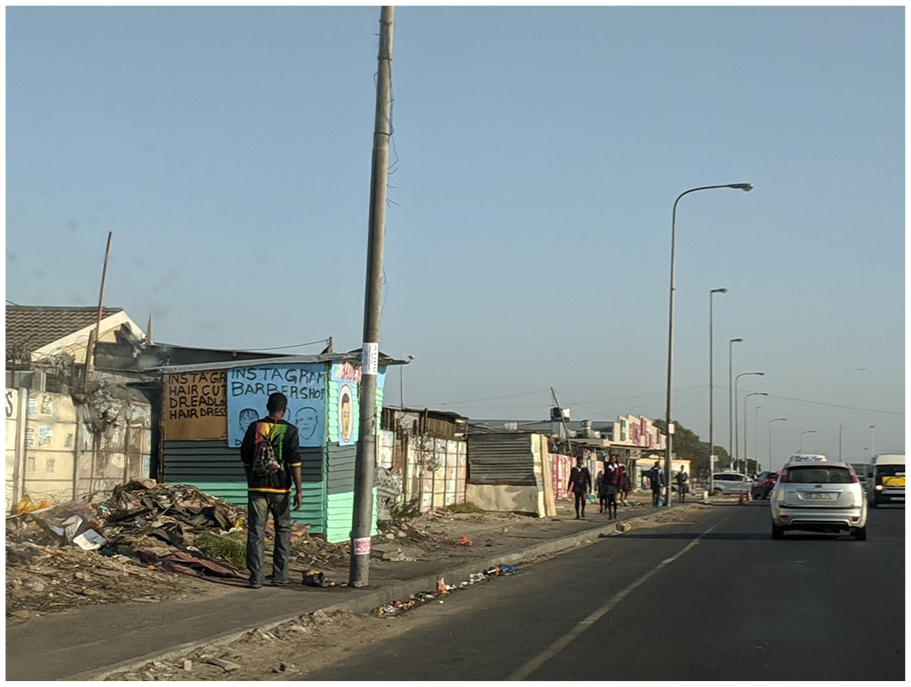
Klipfontein Road in Gugulethu, Cape Town.
The Klipfontein Corridor never materialised for various technical and political reasons. Technically, the project was a challenge because the two-lane road through Mowbray was particularly narrow and there was limited space to reallocate to BRT. The community protested, claiming that the City wanted to tear down historic buildings, and while the plans could have accommodated the narrow streetscape, overcoming such technical challenges required political will (interview, consultant, London, March 2012). As challenges mounted, the partnership between the Province and the City fizzled. In 2003, the City was permitted to plan for public transport initiatives while the Province was responsible for funding the infrastructure. When the City failed to match the financial investment of the Province, the relationship fell apart (interview, consultant, Cape Town, April 2012). And in 2004, Essop, who had been driving the project, was reassigned to another portfolio and her TOD project fell by the wayside (interview, consultant, Manila, February 2012).
But the project did not fail as much as morph into the plans for the MyCiTi BRT in Cape Town. Even after the Klipfontein project was cancelled, the local actors continued to promote TOD. Lynne Pretorius from the City and her counterpart in the Province, Zaida Tofie – two local actors who had been involved with Klipfontein – founded a consulting firm specialising in public transport, and together they continued to work on transport projects. They were appointed in 2008 to do the operational planning for Cape Town’s MyCiTi Phase 1. The plans for TOD along Klipfontein remained on the books with the City’s Department of Transport. In 2016, the Klipfontein Corridor resurfaced in the City’s TOD Strategic Framework as one of 10 corridors that utilise public transport infrastructure to redress the spatial legacy of apartheid (City of Cape Town, 2016). Maddie Mazaza, Director of Transport in Cape Town, explained that the MyCiTi Phase 1 shifted from Klipfontein to the R27 and Klipfontein became Phase 2 (interview, Cape Town, March 2012). At present the City is developing the business and operational plans for a Klipfontein transit corridor. The earlier iteration of the Klipfontein Corridor project was therefore not a failure. On the contrary, it was instrumental in creating both the physical and political space for ongoing TOD projects.
Corridors of Freedom in Johannesburg
In May 2013, Johannesburg’s then-Mayor Tau (2013) launched an ambitious programme of TOD, dubbed the ‘Corridors of Freedom’. The plan promised to reshape the future of the city by linking transport interchanges with high-density, mixed-use residential, retail and business developments as well as educational and leisure facilities. Three corridors were selected: the CBD to Soweto (a former black township to the southeast) along Empire and Perth Roads which follows Rea Vaya BRT Phase 1B (City of Johannesburg, 2012a), Louis Botha Road between the CBD and Alexandra (a former black township in the north) along Rea Vaya Phase 1C (City of Johannesburg, 2012b) (see Figure 2) and Turffontein node, a working-class district south of the CBD (City of Johannesburg, 2012c). Proposed interventions included parks, clinics, libraries, sports facilities, pedestrian crossings and cycleways. And in reference to the best practices in Curitiba, a tenfold increase in density from an average in Johannesburg of 4000–7000 people/km2 to about 40,000 people/km2 and a morphology of 10–12-storey buildings immediately adjacent to the stations and 4–6-storey buildings in the surrounding areas were also recommended (interview, town planner, Johannesburg, December 2019). The city set aside R1.5 billion over a period of 10 years (or about 15% of the city’s R10 billion capital budget) (interview, town planner, Johannesburg, December 2019) as well as an additional R2.6 billion for capital investment in transport systems such as Rea Vaya BRT (City of Johannesburg, 2014). In response, private developers were expected to bankroll infill rather than peripheral development (Todes and Robinson, 2020). And the goal was to transform entrenched settlement patterns, which have shunted the majority of residents to the city’s outskirts, away from economic opportunities.
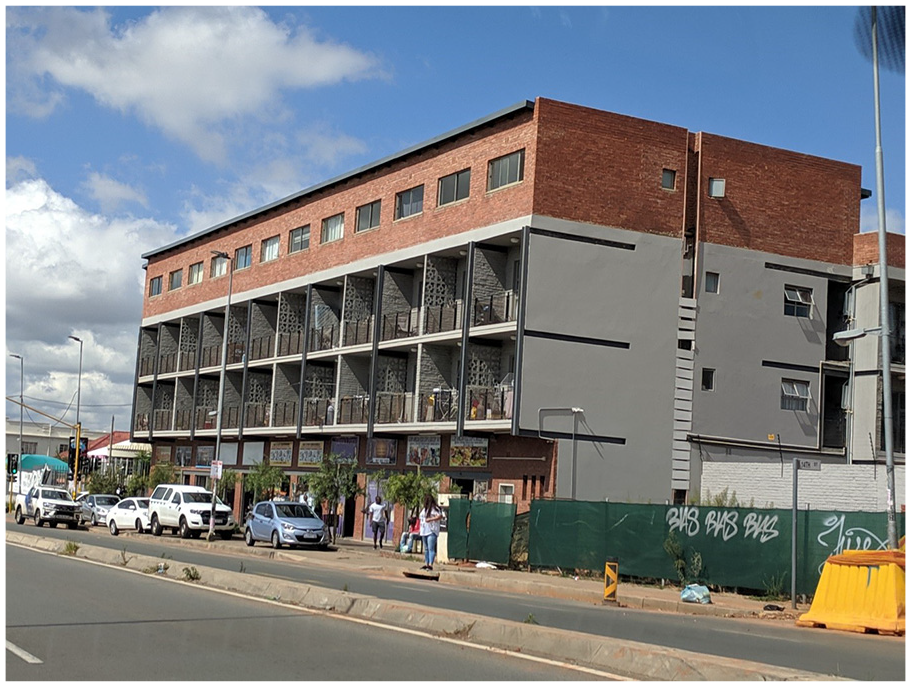
New developments along Louis Botha Road corridor of freedom in Johannesburg.
The project did not unfold as expected: in August 2016, Johannesburg elected a new mayor to lead a coalition government of the Democratic Alliance and the Economic Freedom Front, business tycoon Herman Mashaba, who argued that these interventions focused too heavily on the mostly-White Northern suburbs at the expense of the inner city and the predominantly-Black southern townships. One planning official recalls that Mashaba ‘didn’t want to ride on the Corridors of Freedom bus, which was such a strong brand for Parks Tau’ and ‘he was more orientated towards immediate or daily service delivery with less of a focus on the future growth of the city and how you can take the pain now, but reap the benefits later’ (interview, town planner, Johannesburg, December 2019). The project, which had been both under-funded and under-resourced throughout, hit a wall (Robinson et al., 2020). And despite incentives for developers, only a few came on board, with the majority remaining focused on building along the periphery (Todes and Robinson, 2020). Robinson et al. (2020) moreover suggest that bus-based transport is a minor component of travel in Johannesburg – with developers preferring to invest around the region’s Gautrain rail system – and yet the Rea Vaya BRT was meant to serve as the backbone of this mega-project. And while the project trudged along under the generic nomenclature of ‘Transit Corridors’, to a large extent the momentum was lost, and by 2018 the project was defunded.
While the Corridors of Freedom has been renamed and its significance downgraded, the long-standing commitment to align development and public transport continues. In an effort to better understand the successes and failings of the project, Robinson et al. (2020) consider the response of private developers to public investment and Harrison et al. (2019) assess units of inclusionary housing. And while it is too soon to fully comprehend the long-term results of the Corridors of Freedom – with the plan intended to unfold incrementally over several decades – four planning shifts are worth noting. First, by 2017, there were at least 60 applications from private developers eager to consolidate and convert residential and commercial parcels into higher densities (interview, town planner, Johannesburg, December 2019). These developments include around 5000 units of affordable housing. This leads to the second result – in 2019, Johannesburg became the first city in South Africa to implement an inclusionary housing policy that requires developers to allocate 30% of new housing as affordable (Robinson et al., 2020). New student accommodation on the Empire–Perth corridor is a third associated result (Harrison et al., 2019). And the final metric is one that fits the categorisation of development-led transport: the number and frequency of Rea Vaya buses in operation has increased. The F2 bus route has increased from 14 buses per hour to 18 buses per hour; the C4 route has increased from eight buses to 16 and the C2 has increased from 18 buses to 22 (interview, transport planner, Johannesburg, January 2020). Indeed, this suggests a higher demand for public transport in the short term as well as shifts in residential and business uses in the long term. More than a story of success and/or failure of TOD in South Africa, the Corridors of Freedom provides insight into a South African version of TOD, a topic to which this article now turns.
A South African understanding of TOD
The South African experience with TOD offers three pathways for geography and urban studies. First, the South African circumstances demonstrate that TOD is not a prescriptive mechanism for development. Indeed, there is no singular approach that covers all possibilities or provides for all opportunities. TOD is a flexible concept appropriate within a variety of contexts. Across sectors and spheres of government, South Africans use the phrasing of TOD in reference to ‘inclusivity’ (interview, consultant 1, Johannesburg, February 2012), ‘accessibility’ (interview, consultant 2, Johannesburg, February 2012) or ‘social cohesion’ (interview, consultant 1, Johannesburg, February 2012); or it can address improvements to public space or ‘liveable spaces’ (interview, town planner, Johannesburg, December 2019). In the South African version of TOD, economic and community development combine and intertwine. According to one Johannesburg-based planner, TOD ‘is about how you plan the city and so in the planning you may not even call it TOD but in fact it influences the way you think’ (interview, town planner, Johannesburg, March 2012). And one of the key planners of Johannesburg’s Corridors of Freedom explained: ‘I don’t really like the term TOD, because of the amount of misconceptions that it creates as well. At one stage the city manager kept on saying, “We should build a new highway because it’s TOD”’. For Johannesburg as elsewhere, he concludes, TOD is both a ‘brand’ and a ‘style of planning’, and for the Corridors of Freedom it was ‘the tipping point and the spine around which we could restructure and rebuild a new kind of city’ (interview, town planner, Johannesburg, December 2019). However, the application of these concepts in practice was more aligned to the South African spotlight on inclusivity and transformation.
Second, TOD materialises not only along fixed and/or costly transport lines such as rail or even BRT but informal transport systems can also provide opportunities for development along corridors of movement. One of the limitations of TOD in South Africa has been the tendency for city leaders to concentrate investment around fixed routes without taking account of the possibilities for building TOD along informal transport routes. The minibus taxis, though not strictly formalised, have particular routes and predictable stops, and city leaders should find ways to stimulate capital within the existing transport systems rather than fixating only on investment along the BRT route. Likewise, non-motorised forms of transport could be considered, as studies suggest that over 29% of all peak period trips are made on foot (Gauteng Department of Roads and Transport, 2020). One of the limitations for both the Klipfontein Corridor in Cape Town and the Corridors of Freedom in Johannesburg is that the government tended to concentrate investment alongside high-capacity systems like rail, presuming that fixed infrastructure was more permanent and long-lasting and therefore necessary to court private development. As rail is under severe pressure in South African cities, it is increasingly apparent that other modes of transport need to be considered for transport and planning.
Third, the South African experience reveals that TOD can happen through both macro- and micro-transactions. This stands in stark contrast to the internationalised version of TOD which calls for large-scale development and high-end economic investment, for the most part ignoring the importance of the frequent micro-transactions of the everyday. Economic transactions happen wherever passengers board/alight; and even micro-transactions such as buying repackaged crisps or single cigarettes from a snack stand generate economic externalities. In Johannesburg, for example, a TOD corridor could have been implemented in Soweto between Meadowlands and Dobbsonville, which is a taxi-only route with a noticeably high degree of informal transactions and trade (interview, transport planner, Johannesburg, November 2020). The snack stand that folds up at the end of the day, the barber shop that is just a chair and a sign and the cook selling lunch to resting taxi drivers are all strategically situated within transport nodes. These small-scale entrepreneurs and micro-transactions form part of the broader urban economy and should be considered within TOD.
Concluding thoughts
This article proposes to problematise the concept of TOD by applying a policy mobilities logic to transport planning in South Africa. The empirical examples show how a seemingly straightforward application of TOD in South Africa can twist and turn with far-reaching and unexpected consequences. TOD did not entirely fail in either Cape Town or Johannesburg; rather, it reformed into other projects – the Klipfontein Corridor became MyCiTi Phase 2, for example. For policy mobilities scholarship, this underscores how policymaking failures are generative, yielding unanticipated opportunities for better urban planning. Indeed, policy mobilities is more than the outcome of the topological and topographical movement of ideas but is also a process of adaption and mutation facilitated by local (South African) policy actors and their interactions with elsewhere. This suggests a further need to challenge related concepts of best practice by dispelling the impression of an easy application of international ideas. No programme or policy can ever be a best practice, only perhaps a better practice, and only in certain times and places. And in highlighting the politics of these decisions, this article also exposes the tensions inherent within practices of policy mobilities.
For transport geography, this article further complicates the notion of TOD by challenging calculative studies of transport geography. Rather than seeing TOD as a mixture of residential, retail and commercial development situated along a fixed public transport system, as might be typical in transport studies, this article takes a critical perspective, seeing TOD as an opportunity for inclusivity, liveability and sustainability. The South African experiments provide three openings through which to rethink TOD scholarship. First, TOD is a fluid, malleable notion, and one that takes account of the existing circumstances. Indeed, TOD is deemed a failure when it does not take account of the setting into which it arrives. Second, the South African understanding helps us realise the possibilities of ‘bus-oriented development’, ‘taxi-oriented development’ and other associations between informal modalities and land value. Third, the empirical discussion directs academics and practitioners towards a greater appreciation of the micro-transactions that fuel the transport economy but are often sidelined in traditional TOD literature. Indeed, it is the imbrication of these three provocations that invites further research in African cities and beyond.
For South African scholarship as well as urban studies in general, this article confirms the importance of locally made decisions. Rather than focusing only on the circulation of ideas from here to there, this article has considered what actually happens when a policy arrives. In fact, mobile policy often requires local policymakers to unfold and refold instructions to fit within the prevailing setting. The examples in South African cities direct transport planners – and academics as well – to consider not only the expensive fixed transport systems but also the informal systems, small transactions and moments of encounter. Indeed, the empirical stories of success and/or failure help us to generate a more complex understanding of TOD both within the continent and around the world.
Footnotes
Acknowledgements
This article is the outcome of several years of research and it would be impossible to thank all those whose remarks have buoyed it. I am especially indebted to my colleagues in the African urban mobilities research network and the delegates at the workshop ‘Towards Comparative, Historically Informed Research on African Urban Mobility Issues’ who helped refine my arguments. Any mistakes herein are all my own.
Declaration of conflicting interests
The author declared no potential conflicts of interest with respect to the research, authorship, and/or publication of this article.
Funding
The author received no financial support for the research, authorship, and/or publication of this article.
