



Abstract
We are living through a global urban transition, but the timing of this transition has varied significantly across countries and regions. This geographic variation in timing matters, both theoretically and substantively. Yet contemporary debates on urbanism hinge primarily on questions of universalism versus particularism, at the expense of attention to how history and geography collide to shape urban processes. Specifically, they neglect the critical fact that urbanisation in many countries today is late within the context of the global urban transition. We argue that trajectories of contemporary urbanisation must be understood in relation to a suite of conditions unique to the late 20th and early 21st centuries and partly shaped by early urbanisation, including historically unprecedented demographic intensity, hyperglobalisation, centripetal state politics and the spectre of environmental catastrophe in the late Anthropocene. These factors condition the range of possibilities for late urbanisers in ways that did not apply to early urbanisers yet can also produce diverse outcomes depending on local circumstances. We draw on a comparison between countries in sub-Saharan Africa and China to illustrate why the conditions of late urbanisation matter, but also why they have produced highly variable outcomes and are not deterministic of urban futures.
Introduction
Urban theory has had a fertile and fractious decade. The question of the fundamental definition of the urban returned with force after Brenner and Schmid (2014, 2015) issued a challenge to dominant epistemological framings of urbanisation, drawing on Lefebvre (1970) to popularise the idea of ‘planetary urbanisation’. Storper and Scott (2016) responded by reasserting an agglomeration-based definition – a perspective that has been (and continues to be) highly influential in both academic and policy domains. In parallel, there was a flourishing of approaches emphasising the particularities of ‘Southern’ cities in the face of theories developed in the North (Robinson, 2006; Roy, 2009; Schindler, 2017; Watson, 2009), and a backlash against the more totalising claims of ‘planetary urbanisation’ building on feminist, postcolonial and post-structuralist perspectives (Angelo and Goh, 2020; Derickson, 2018; Reddy, 2018).
These currents within urban theory can be broadly characterised for heuristic purposes as two approaches espousing very different sorts of universalism, and one primarily emphasising difference and geographical particularism. On the one hand, Scott and Storper (2016) assert that the urban can be universally defined and delimited with reference to a set of general criteria, rooted in the ‘urban land nexus’. Brenner and Schmid (2014) reject this perspective but claim that the urban has become planetary in its reach and manifestation, positing that there ‘is no longer any outside to the urban world’ (p. 750; emphasis in original). It is reasonable, therefore, to characterise this as a dispute between a universal definition of urban form and a thesis predicated on universal reach of the urban process (but with a diffuse definition of urban form). While ‘planetary urbanisation’ is not necessarily incompatible with a focus on diversity (Angelo and Goh, 2020; Schmid et al., 2018), it is feminist and postcolonial scholars that have foregrounded difference to promote anti-universalising accounts of the urban process (Derickson, 2015; Roy, 2016).
While these debates have been very productive, it is notable that they have been occurring within quite a narrow disciplinary range, primarily involving geographers and planning theorists. Sociologists, political scientists, historians, demographers and economists all played central roles in elaborating urban theory in the 20th century yet are only partly drawn into contemporary theorisation of the urban. Among other things, this calls attention to the fact that by focusing primarily on geographical universality versus specificity, these approaches do not adequately consider the question of variable temporality as central to the global geography of urban transformation. This means foregrounding the fact that cities in different places have been made at different times. Comparative urban scholarship has focused heavily on spatial context, but largely overlooked the comparative historical context. Yet it is clear that when a society transitions from predominantly rural living to predominantly urban living has a profound impact on how this transition unfolds.
Brenner and Schmid (2014, 2015) reject this kind of periodisation on the grounds that the epistemological and methodological bases for measuring urbanisation are flawed. There are certainly formidable challenges in this regard that necessitate ongoing efforts to rethink how urbanisation is measured (Buettner, 2015; Bureau of the Census, 2021; Schroeder and Pacas, 2021) as well prompting reflections on what this means for theorising the urban. Yet while it may be difficult or even futile to delineate a rigid urban/rural divide, it is possible to say that some societies and regions of the world urbanised – by any definition – before others. This fact has very real material, visceral and ecological consequences ranging from changes in life expectancy, fertility rates and gender norms to terrestrial, aquatic and atmospheric environmental change. Moreover, despite the extensive geographical reach of the processes associated with urbanisation, highlighted by eminent scholars such as Louis Wirth in 1938 and Jane Jacobs in 1969, the urban–rural ‘lens’ continues to be hugely significant both discursively (Angelo, 2017) and in terms of the concrete efforts by countries in the North to foster new forms of territorial integration through development assistance to the South (e.g. Schindler and Kanai, 2021).
We therefore reassert in this paper the importance of the urban transition – not to perpetuate the ‘urban age’ discourse but to foreground the varied timing of urbanisation in different parts of the world. This geohistorical approach does not mean merely scrutinising the histories of particular urban places but rather emphasising that processes of urbanisation and urban growth are taking place today not only in ‘a world of cities’ (Robinson, 2011) but in a world where some societies urbanised before others. In other words, it is not only the ‘Southern-ness’ or post-coloniality of cities of the South that makes them different. It is also the fact that urbanising late within the global urban transition involves distinct challenges and opportunities.
Countries that experienced this transition 100 or more years ago did so under very different technological, demographic, economic, political and ecological conditions than those experiencing it now. Moreover, early urbanisers have directly influenced many of the conditions of late urbanisation, not just through colonial legacies but through the political, economic and environmental conditions generated by their own earlier urbanisation and their contemporary power in global institutions. We therefore need to build on, but also think beyond, Schmid et al.’s (2018) coupling of diachronic analysis of historical pathways in a given city with synchronic analysis of spatial urban forms. Explaining the conditions of urbanisation in much of the contemporary world requires interrogating the intersection of history and geography not only at particular urban sites, but at the level of the global urban transition.
This requires closer attention to differentiations within the South, which encompasses highly variable degrees of urbanisation among countries. The idea of a ‘Southern’ experience of urbanism (Schindler, 2017; Watson, 2009) usefully highlights characteristics that are more significant on average in cities outside the industrialised North. However, while we appreciate the ongoing everyday utility of the category of ‘global South’ and the value of ‘Southern perspectives’ as a form of critique, the limitations of the ‘South’ as a geographical category for analysis are increasingly recognised (Lawhon and Truelove, 2020; Mabin, 2014).
In this article, we take a geohistorical approach to understanding the conditions of urbanisation in countries that we identify as urbanising relatively late. While both our definition and periodisation of urbanisation are inevitably open to dispute, the temporal dimension of the underlying processes that we aim to capture is real and significant. We argue that countries undergoing urbanisation and urban growth today are experiencing these processes under historically unique conditions of demographic intensity, hyperglobalisation, centripetal state politics and the spectre of environmental catastrophe.
These geohistorical conditions are not deterministic in any given context; indeed, our perspective is both non-deterministic and anti-universalising. We seek to specify how certain geohistorical conditions collide with local circumstances to shape novel urban development pathways in cities around the world. Unlike any of the perspectives discussed above, we foreground both the difference between and relationship between earlier and later urban transitions, while also exploring the highly varied pathways evident among later urbanisers. To emphasise this point, we compare the very different experiences of countries in sub-Saharan Africa with that of China. In doing so, we highlight the salience of two key questions: (1) how do the conditions of late urbanisation affect the range of possible urban development trajectories? And (2) what unique collisions of geohistorical conditions and local circumstances account for major divergences among these trajectories? Unlike the concept of ‘Southern urbanism’, which seeks to provide an umbrella category for diverse places, the concept of late urbanisation is a historical classification that makes no a priori assumptions about similarities between places.
While the conditions of late urbanisation yield diverse outcomes across local and regional contexts, we argue that they produce phenomena – such as hyper-development in Chinese cities, urbanisation without industrial development in African countries, and perverse incentives driving distinct forms of real estate investment in both contexts – that were not characteristic of early urbanisers. Moreover, confronting the conditions of late urbanisation may stimulate innovations that place late urbanisers on the frontier of new urban trajectories. We conclude with reflections on the implications of this perspective for contemporary urban theory, and a call for scholars to look beyond all-encompassing accounts of the urban condition in order to consider how the geohistorical conditions of late urbanisation interact with specific cities and urban systems to generate unique urban trajectories.
What is ‘late urbanisation’?
We use the term ‘urbanisation’ in a strictly spatial-demographic sense to refer to an increase in the proportion of people living in urban settlements within a country or region. While there is no universal definition of an urban settlement (Brenner and Schmid, 2014; Fox and Goodfellow, 2016), we are essentially interested in the growth of relatively large, densely populated and permanent human settlements. To be clear, we are not using the terms ‘urban’ and ‘urbanisation’ to denote structural economic change (e.g. Potts, 2017), the physical development of built environments or the spread of particular aspects of global capitalism associated with the more ‘extended’ ramifications of urbanisation (e.g. Brenner and Schmid, 2014, 2015). We also recognise the methodological flaws with the measures we use below, but in the absence of more robust measures they are the best available for historical cross-country comparison and do reflect – albeit imperfectly – the general trends we seek to explore. Our use of the 50% measure, though problematic for reasons that Brenner and Schmid (2014) document, is taken as a crude proxy not for the entry of the world into an ‘urban age’ but for the shift towards a phase of mass urbanisation in specific countries.
From a global perspective, there are three major phases in the history of urbanisation. The first and longest phase began with the rise of the first cities roughly 6000 years ago and ends in roughly 1800. During this phase, cities emerged independently in Africa, Asia, Europe, North America and South America. But the overall urban population remained relatively small – hovering around 5% of the total global population (Fox, 2012). The second phase, which we date between 1800 and the Second World War, is marked by sustained growth of urban populations (in both absolute and relative terms) in parts of Europe, the Americas, Japan, Australia and New Zealand. This is the first time societies experienced permanent transitions towards predominantly urban living. As Table 1 shows, by 1950 about 30 countries had more than 50% of their populations living in urban areas. These countries are ‘early urbanisers’ in our framework. The third phase began during the Second World War and continues to this day. This latter phase has been characterised by sustained increases in urban populations in virtually all countries. However, as Table 1 illustrates, this latter phase has been staggered across countries and regions. Although we do not propose a strict cut-off for classifying countries as ‘early’ or ‘late’ urbanisers, it is clear that many countries (and most in Africa) are urbanising late within the context of this global urban transition. This temporal sequencing has important implications for how cities grow and develop.
Countries listed according to when the urban population share reached 50%.
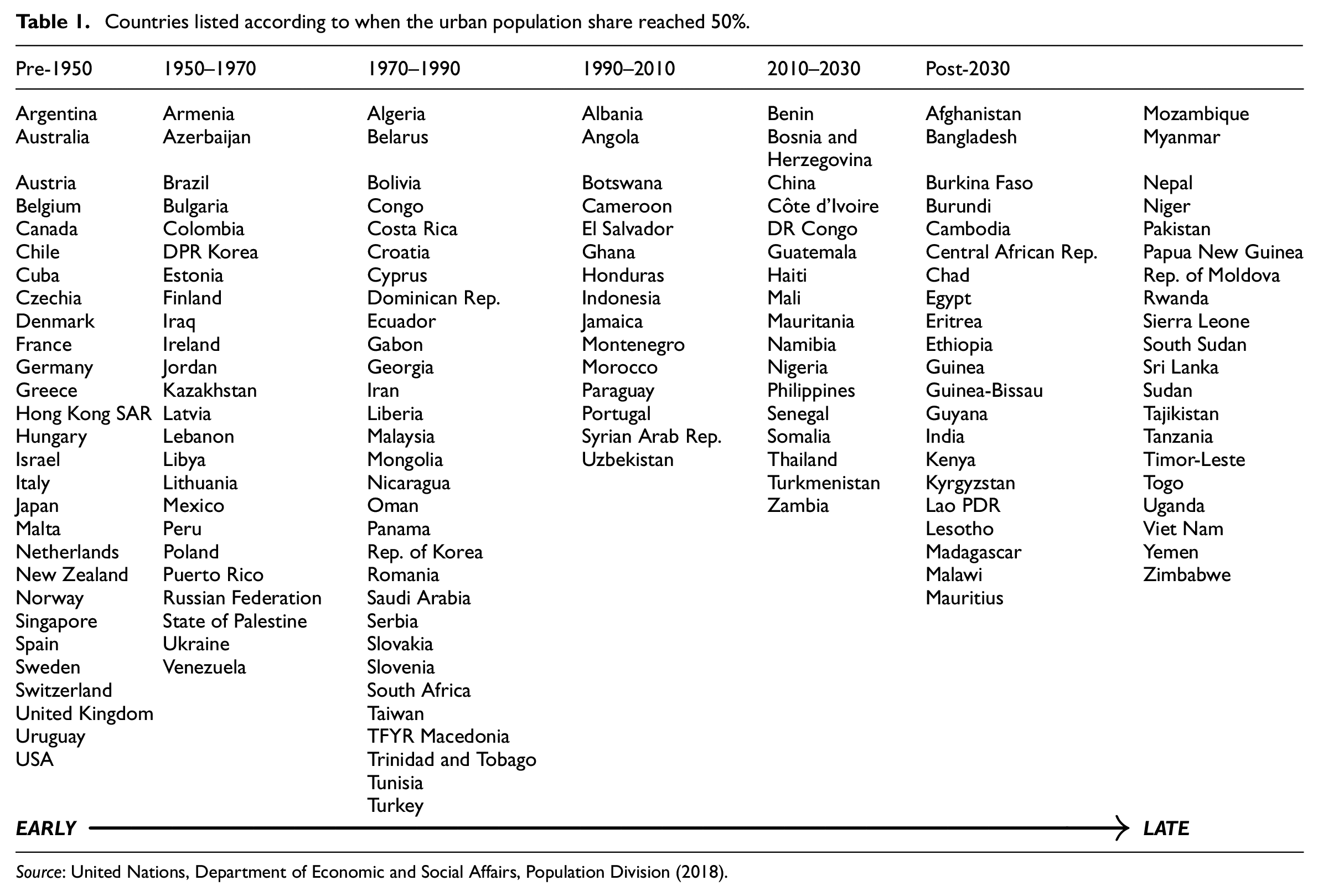
In advancing this schema, two important clarifications are needed. First, urbanising late does not imply the absence of deep urban history. For example, parts of Africa have urban histories dating back several millennia, including areas of present-day Ethiopia, Nigeria, Mali and Zimbabwe as well as North Africa and the Swahili Coast. Meanwhile, China has many cities that have been continuously inhabited for thousands of years. In all these cases, however, the current territory remained predominantly rural until very recently, notwithstanding the important differences in the number and sizes of historically significant cities. As discussed below, the relative depth of these urban histories can itself intersect with the conditions of late urbanisation with dramatic results.
Second, the conditions of late urbanisation can have both negative and positive implications. On the one hand, many early urbanisers reaped gains that cannot be replicated under current conditions; but on the other, late urbanising regions can benefit from urban experiences and innovations incubated elsewhere. Unlike the idea of ‘late development’, the term ‘late urbanisation’ does not imply anything teleological, has no normative content and should not be read as pejorative. The term simply serves to characterise the experience of urbanisation within a geohistorical context: ‘late’ in this sense merely denotes taking place ‘after’ some other regions of the world urbanised, rather than implying that the process is somehow ‘tardy’ or ‘belated’. Indeed, we seek to emphasise that late urbanisation is not some kind of aberration, nor is it secondary to early urbanisation in its global significance. In fact, late urbanisation is the norm. In 1960, the combined population of the ‘early urbanisers’ shown in the first column of Table 1 accounted for just 21% of the total global population and 43% of the global urban population (according to UN estimates).
Demographic intensity
Demographic intensity is one of the defining conditions of late urbanisation. Early urbanisers experienced relatively moderate demographic changes, which were associated with structural transformation of domestic economies. By contrast, late urbanisers have exhibited historically unprecedented rates of urban population growth. In many cases (e.g. many African countries) this has happened without concomitant economic growth, while in others demographic intensity has been augmented by exceptionally rapid economic change made possible by contemporary economic conditions (e.g. South Korea and China).
Early urbanisers saw life expectancy increase slowly but steadily as they industrialised through the 19th and 20th centuries. Social scientists have tended to assume (wrongly) that both urbanisation and improvements in life expectancy were driven by industrialisation (see Szreter, 1997). In practice, substantial but incremental improvements in public health and medicine helped to alleviate some of the worst human consequences of early industrialisation. Nevertheless, industrialisation drove demand for urban labour, which stimulated rural–urban migration and hence urbanisation. But the incremental nature of these changes led to a prolonged urban transition.
By contrast, most African countries have experienced explosive urban population growth without significant structural economic change thanks to declining mortality rates rather than industrialisation (Bandyopadhyay and Green, 2018; Dyson, 2011; Fox, 2012, 2017; Gollin et al., 2016; Menashe-Oren and Boquier, 2021). After the Second World War, there was a rapid diffusion of vaccines, antibiotics, famine relief, clinical infrastructure, sanitation infrastructure and medical knowledge around the world, which led to a dramatic fall in mortality in many of the world’s poorest countries, regardless of economic conditions and trends. While it took roughly 100 years for life expectancy in Europe to increase from 36 (in 1820) to 50 (in 1920), Africa experienced the same improvement in just 50 years between 1950 and 2000 (Riley, 2005; United Nations, Department of Economic and Social Affairs, Population Division, 2018). This precipitous decline in mortality is the primary engine of urban growth in many late urbanisers. Rural–urban migration has certainly played a significant role in driving urban growth in African countries, but natural growth within cities has been an equal contributor in East and southern Africa and a majority contributor in Central and West Africa since at least 1985 (Menashe-Oren and Boquier, 2021). The millions of people living in informal settlements are increasingly native urbanites, born and raised in towns and cities. The widely noted phenomenon of urbanisation without industrialisation in Africa is not an aberration but rather a natural by-product of significant improvements in life expectancy. China’s urban transition in the late 20th century was also influenced by demographic fundamentals, but further accelerated by economic conditions in the second half of the 20th century, which stimulated the greatest sustained wave of rural–urban migration in history. However, natural increase in urban areas is now the dominant driver of urban population growth in China (Menashe-Oren and Boquier, 2021).
The intensity of spatial demographic change is clear when we compare the urban transitions of Europe, sub-Saharan Africa and China. While it took 150 years for Europe to shift from 12% urban to 50% urban, it took China just 60 years to make the same transition. It will likely take Africa 90 years to shift from 11% urban to 50% urban based on current projections. China and sub-Saharan Africa have been urbanising much faster than Europe did.
Second, and more importantly, the scale of population change in these three regions is not even remotely comparable. Europe experienced a peak urban population growth rate of just over 2% per annum; the urban growth rate in both China and sub-Saharan Africa peaked at over 5% per annum (many countries in sub-Saharan Africa experienced episodes of much faster urban growth). Moreover, rates of urban growth in both regions today continue to exceed the peak rates observed in Europe during the heat of the industrial revolution. In short, early urbanisers in Europe experienced far less raw demographic pressure than late urbanisers have. A tendency to focus on rates and levels of urbanisation rather than rates of urban growth obscures the most pressing demographic challenge of late urbanisation: the sheer number of new human beings that need homes and services and jobs in urban areas.
In both China and sub-Saharan Africa, the demand for land generated by urban growth has turbo-charged land markets, stimulating a rush for urban land acquisition in ways that are shaped by both global capitalism and local politics (Steel et al., 2017; Zoomers et al., 2017). However, the key point here is that this demographic growth is a crucially important force in its own right. Moreover, many of the technologies that facilitate this rapid growth – particularly in relation to public health and trade – were developed in early urbanisers to address the challenges of disease and food security, and to facilitate capital accumulation.
Recognising this demographic context is important for understanding the experience of late urbanisers vis-à-vis early urbanisers. While the underlying drivers of urbanisation are diverse, all late urbanisers are confronted by extraordinary demographic intensity.
Hyperglobalisation
Cities concentrate capital. How and where this capital is generated, who controls it, and how it flows through factor markets (e.g. land, labour and physical assets) collectively influence how cities are built and for whom. Late urbanisers have experienced demographic intensity in a context of capitalist ‘hyperglobalisation’ (Rodrik, 2015) – a dramatic increase in the scale and velocity of global economic integration from the late 20th century – which has influenced how and where capital is accumulated, and the incentives of those who control it. In some cases, hyperglobalisation has facilitated dramatically accelerated urban economic transformations; in others it has contributed to disinvestment, low productivity and unproductive investment patterns. Here we examine these divergent effects of hyperglobalisation in relation to the nature of the colonial and postcolonial state, late 20th-century policy conditionalities, and local urban histories.
In many late urbanisers a distinct set of contextual circumstances has influenced the incentives of those with capital in ways that undermine productive and inclusive urban development. In early urbanisers capital was often derived from production and commerce, with massive increases in productive capacity and capital investment fuelling urban development. Exploitation, corruption and rent-seeking were rife, but a combination of political, material and financial interests incentivised elites to invest in their cities directly and indirectly (i.e. by pressuring governments to build infrastructure and provide critical urban services) (Konteh, 2009; McGranahan et al., 2001; Szreter, 1997). Very different patterns of capital accumulation and flows have emerged in many late urbanisers.
In sub-Saharan African countries the primary vehicle for capital accumulation in the postcolonial era has been the central state; yet in a continuation of colonial patterns, states often facilitated private extraction from the economy rather than productive investment and redistribution (Bayart et al., 1999; Maddison, 2007). Moreover, in some countries unprecedented rent-seeking opportunities from the extraction of capital-intensive (as opposed to labour intensive) natural resources such as oil and copper emerged, and gave rise to ‘consumption cities’ (Gollin et al., 2016). Capitalists with the capacity to develop a competitive manufacturing base were few, weak and under-resourced (Whitfield et al., 2015), leading to minimal investment in urban productive capabilities and limited incentives to raise urban productivity through providing infrastructure and housing.
The general scarcity of domestic capital in the early postcolonial era meant that many late urbanisers depended disproportionately on foreign capital, including loans from multilateral agencies. In the 1960s and 1970s import-substitution industrialisation became a widespread economic development strategy as postcolonial governments sought to develop their urban manufacturing base (Mkandawire, 2005). However, as the economic crises of the 1970s began to unfold, rising interest rates stimulated capital flight in many less economically developed regions and global capital flowed back towards wealthier countries such as the USA in the 1980s (Arrighi, 2002). The emergence of the ‘Washington Consensus’ and the imposition of structural adjustment programmes led to a strong rejection of import substitution and renewed focus on primary commodity exports (Chitonge, 2015; Mkandawire, 2005). Meanwhile, urban labour markets became increasingly informalised (Meagher, 1995) and over time ideas of ‘entrepreneurship’ have become venerated in place of large-scale investments in urban productive capacity (Ochonu, 2018).
The currency devaluations required to promote primary commodity exports raised the cost of importing the necessary materials for industrial development, and poor macroeconomic management through economic crisis further incentivised capital flight. Meanwhile the globalisation of financial flows from the late 20th century facilitated that capital flight, and capital largely accrued to places where it could be safe and profitable, and where there were more opportunities for consumption – in other words, to early urbanisers. One estimate suggests that 39% of African wealth was held outside of Africa in 1990, in comparison with 20% in Latin America, 6% in East Asia and 3% in South Asia (Collier and Gunning, 1999). Ndikumana and Boyce (2018) estimated capital flight for a sample of 30 African countries between 1970 and 2015 and found that they lost US $1.4 trillion over this period, while accumulating just US $496.9 billion in debt by 2015. Perversely, these debt-ridden countries are actually net creditors when capital flight is considered in net capital flow calculations (Ndikumana and Boyce, 2018). Although there are many potential causes of capital flight, elite embezzlement of public money is a documented driver in many cases (Ndikumana and Boyce, 2003) and not just in Africa.
The ease with which capital can be parked abroad has distorted domestic investment incentives for elites – and this capital fluidity is unique to the late 20th and early 21st centuries. In previous eras, many capitalists seeking safe, long-term returns would look closer to home and invest in infrastructure or productive assets. Those with a higher risk appetite often engaged in riskier and more exploitative but profitable trades, such as slavery, rubber, plantation agriculture in colonies – often investing the profits in assets in the metropoles. Today, elites in ‘frontier’ or ‘emerging markets’ looking for an easy way to protect and grow capital are strongly incentivised to export it to ‘mature’ markets in early urbanisers. However, for those looking for higher and more immediate returns, investments in local real estate and construction – the ‘secondary circuit’ of capital – have proved profitable (Goodfellow, 2017; UN-HABITAT, 2018). Interestingly, when it comes to real estate investment (as opposed to infrastructure, which is a longer-term lower-margin investment prospect), the majority of capital has come from domestic and diasporic sources (Goodfellow, 2020). Although the real estate sector in sub-Saharan Africa is growing faster than in any other region globally, very little foreign investment is involved due to the opacity of real estate markets to outsiders, ambiguous land titling and complex land markets (UN-HABITAT, 2018; Van Gils et al., 2018) – though efforts to attract it are increasing (Gillespie, 2020).
In sum, hyperglobalisation has incentivised elites in late urbanisers to secure a sizeable fraction of capital abroad and make high-margin local investments in real estate and construction rather than infrastructure and productive assets, which require specialist knowledge and are often seen as too risky in the face of foreign competition (Goodfellow, 2017). Moreover, the limited capacity of governments to effectively monitor property transactions, prevent speculation and tax property can produce a vicious cycle in which capital gravitates towards real estate (with limited job creation potential), the state lacks resources for public investment, and an underdeveloped industrial sector continues to offer limited investment appeal.
Hyperglobalisation can, however, produce unique pathways for economic development – albeit with highly variable outcomes in terms of structural transformation, economic growth and job creation. Hyperglobalisation in the latter decades of the 20th century saw unprecedented ‘unbundling’ of production processes (Frieden, 2007; Gereffi, 2014; Rodrik, 2015). Due to technological innovations and a cascade of trade agreements, the costs of outsourcing parts of a production process plummeted. This allowed some late urbanisers to specialise in relatively low-skilled and labour-intensive aspects of production processes, which in turn contributed to accelerated urban industrial development. This strategy was pursued by the East Asian ‘Tiger economies’ and subsequently by China.
The reasons African cities did not experience accelerated urban industrial development despite these trends are complex, but likely include a combination of political, historical and demographic factors. East Asian and Latin American countries generally had longer-standing and more predictable political regimes; different colonial histories (over different time periods) in which there had often been more substantial investment by colonisers; and longer histories of state-building. Moreover, despite low levels of urbanisation many East Asian and Latin American countries had long-established cities and much larger urban populations, which served as a draw for capitalists looking for cheap labour and new markets.
In 1970 the urban populations of China, Brazil and Mexico were 142, 53 and 30 million, respectively. By contrast, the entire urban population of sub-Saharan Africa was 52 million, divided among dozens of countries. Small and dispersed urban populations are less attractive to investors than large ones concentrated within single countries – a point highlighted in the 2018 State of African Cities Report: Low wages are shown to not be the key motive for multinational firms to venture abroad. Rather, they seek cities and countries that sustain large populations, good standards of living, sound financial markets, and competition in terms of producing and marketing exclusive products. (UN-HABITAT, 2018: 61; emphasis added)
Late urbanisation can therefore affect countries differently depending on their demographic ‘pull’. China has certainly benefited from its demographic size and the common perception that it is the largest ‘emerging market’ opportunity, not only due to its large workforce and low wages, but also to the consumer potential of a large and rapidly growing urban population. In a context of free-flowing capital seeking higher returns than those available in ageing and slow-growing rich economies, and the feasibility of capturing a share of rapidly expanding niches in global value chains, China’s cities exploded. Hyperglobalisation made hyper-development in China’s cities possible. As its ‘theatre of accumulation’ shifts from industrial production to urban land and construction (Hsing, 2010: 2), there are growing concerns about property bubbles and the phenomenon of ‘ghost cities’ (Koss and Shi, 2018; Woodworth and Wallace, 2017). However, this occurred only after the country became an industrial powerhouse.
Faced with competition from countries in East Asia, late urbanisers in Africa have been largely unable to increase either their share in global manufacturing or the share of manufacturing within their own economies (Gibbon and Ponte, 2005). Even in countries where urban manufacturing has been rising in Africa, such as Ethiopia and Tanzania, the large firms driving economic growth are not creating many jobs, due to their use of capital-intensive technologies adopted from earlier industrialisers. Thus the ‘leapfrogging’ of more labour-intensive technologies that early urbanisers (and better-positioned late urbanisers in East Asia) used in their own development path is a mixed blessing, offering limited job creation (Diao et al., 2021).
In sum, hyperglobalisation has shaped the economic fortunes of late urbanisers. For some, such as China, longer histories of state-building alongside favourable urban demography have enabled accelerated urban economic development. This has made it even more difficult for other late urbanisers to compete, and even where they are starting to attract more international manufacturing investment, the use of capital-intensive technologies developed by earlier urbanisers in an effort to raise productivity has contributed to the phenomenon of ‘jobless growth’. Meanwhile, most domestic capital has been channelled into non-productive investments in real estate, often involving extensive land dispossession and speculation, or exported to early urbanisers.
Centripetal states in apost-imperial context
Early urbanisers began their transitions before states became the complex, multi-functional and centralised territorial organisations that they are today. City states, feudal states and imperial states taxed their populations, provided some rudimentary security and protected trade routes, but they had little infrastructural power or interest in ‘improving’ their subjects. Due to technological limits, larger states and empires necessarily relied on local authorities to tax and administer security and public order. But as territorial nation-states began to congeal from the 17th century, they increasingly ‘acted like a vortex sucking in social relations … The outcome has been the seemingly all-powerful nation-state of the 20th century’ (Taylor, 1994: 152). By the end of the Second World War, states became territorially bounded multi-purpose organisations with highly centralised administrations. This new state form was adopted in decolonising regions, as was the relatively new idea that states have an active and central role to play in ‘developing’ their populations through ‘modernisation’. In sum, it was only in the 20th century that centripetal states became ubiquitous.
This global evolution of state form and function has had a profound effect on urban development processes. For early urbanisers in Europe and America it was generally local governments that were at the forefront of dealing with urban challenges, including public order, disease and the development of infrastructure and housing. Indeed, municipal government grew in a dynamic, symbiotic relationship with urbanisation and industrialisation through local taxation and associated worker demands for local infrastructure investment and service provision (e.g. Szreter, 1997). These processes themselves helped to make states centripetal. As a consequence of the global diffusion of centralised state forms, including through colonialism and decolonisation, central states have played a much more active role in shaping urban development processes in late urbanisers.
In sub-Saharan Africa, the often brutal institutional and social changes wrought through colonisation by a handful of European powers left a long shadow over postcolonial politics (Mbembe, 1992). Most colonisers employed forms of both direct and indirect rule, which were seen as complementary approaches to distinct aspects of the challenge of colonisation. The exercise of direct rule in the cities involved forms of ‘centralised despotism’ that served primarily to exclude the native majority from rights and freedoms enjoyed by the (largely foreign) citizens of colonial cities (Mamdani, 1996: 18). At Independence, many governments taking over African states comprised the urban educated elites who were at the forefront of anti-colonial movements, which left a power vacuum at the urban level. Meanwhile, as noted in the previous section, the domestic urban capitalist classes were small and often marginal, having often been deliberately stunted under colonialism (Brett, 1973; Hydén, 1983). Given this small capitalist sector, class-based political bargaining with the state was weak relative to clientelist, kinship and identity-based politics (Hydén, 1983; Nelson, 1979).
These postcolonial dynamics contrast with the political context of early urbanisation in Europe, but aspects offer some significant parallels with the USA. Nineteenth-century American cities were likewise characterised by patron–client relations in a context of ethnic diversity, in-migration and rapid urban growth, which led to what became characterised as ‘urban political machines’ (Scott, 1969). As urban populations rapidly expanded alongside rapid democratisation, these powerful clientelist forms of organisation emerged to mobilise votes and control the scramble for urban resources. Political machines were a transitional phenomenon, situated after the breakdown of traditional rural ties but before the emergence of horizontal, class-based ties and, accordingly, more programmatic politics. They provided the foundation for what would become institutionalised, programmatic political parties and redistributive states.
Despite some contextual similarities between 19th-century America and post-colonial Africa, urban political machines with the potential to drive distributive capacity at the city level have generally not emerged in late urbanising Africa. Rather than coalescing at the urban scale, early political parties in Africa mostly emerged in the anti-colonial struggle and were nationalist in orientation; hence the local state has often been an arena for national political machines (Nelson, 1979: 199–200). Given the political significance of ethnicity in post-colonial Africa, these nationalist parties often collapsed under the pressures of ethnic division soon after Independence (Cheeseman, 2015; Ranger, 1983). Building cross-ethnic parties that spanned constituencies and regions proved extremely difficult in many African countries (LeBas, 2011; Nelson, 1979; Randall and Svåsand, 2002). The development of political party competition was also cut off by the widespread turn towards military rule in a substantial number of states in the 1970s – a further centripetal force (Cheeseman, 2015; Larmer, 2016). These trends were exacerbated by the Cold War context, in which financial and political support was channelled to loyal regimes around the world, often solidifying already centralised states.
These nationalising, centralising forces further undercut the municipal state-building processes which were a feature of early urbanisers – including the United States, where a high degree of municipal capacity existed by the time democratic competition was unleashed in its ethnically clientelist cities. This local state-building, in part a legacy of much greater degrees of colonial investment in settler colonies such as the USA, was further propelled by rapid industrialisation and the resource base this generated (DiGaetano, 1988). In contrast, most African states carried legacies of externally-imposed statehood that centralised control over cities – which themselves were often new, colonial creations – but with limited investment. These trends were further amplified in the postcolonial world of centripetal states, limiting the prospects for managing the urban demographic boom. Indeed, there is evidence that variation in the depth of colonial investment and extent of indirect political rule in African countries has had a direct impact on postcolonial urban development outcomes (Fox, 2014). Centralised states with weak infrastructural power and shallow municipal histories are poorly equipped to manage the demographic intensity of late urbanisation. However, not all late urbanisers lacked histories of municipal state-building and infrastructural power. Once again, China provides the extreme counterpoint.
China’s deep history of municipal government (see Chang, 1930) provided solid foundations for adapting to the pressures of late urbanisation. As Mao’s centrally-planned rural industrialisation strategy unravelled during the economic crisis of the late 1970s, the potential for economic renewal through urbanisation led to major building of the administrative and political powers of city authorities (Gu et al., 2017). This was partly based on a renewed ideological commitment to support the growth of cities (Sorace and Hurst, 2016). The decisive move to build capacities at the city level came at the very time when ‘urban bias’ discourses were promoting a shift away from urban investment in Africa and other parts of Asia (Bates, 1981; Lipton, 1977). Moreover, when China established its urban land leasing system from the late 1980s, the competition between state agencies for land rents led local governments to actively pursue territorial projects of urban expansion, growing their revenue base, which in turn required them to consolidate and legitimate their powers (Hsing, 2010).
Just as China embraced urban development, many African governments adopted a laissez-faire approach to urban governance and slashed municipal capacity against a backdrop of donor pressures and political turbulence. The end of the Cold War was accompanied by widespread measures to promote democracy, instil ‘good’ Western-modelled institutions and support the building of particular kinds of states (Brown, 2005). This inflamed political divisions suppressed by colonialism and Cold War-era dictatorships, and the resulting political turbulence intersected with new forms of externally-driven institutional engineering. Part of this engineering involved the promotion of agricultural development over urban development (see Fox, 2014) and the adoption of urban institutions developed in early urbanisers. By the 1990s, principles of market-led urban management and urban entrepreneurialism were promoted in cities where the local state, often weak to begin with, had been further weakened by the centralist impulses of the Cold War (Fox and Goodfellow, 2016; Stren, 1993). Meanwhile, the other major governance reform widely promoted by donors – decentralisation – created new sites in which clientelistic politics could play out. Given the prior neglect of local state-building, decentralisation often occurred in the absence of the necessary political institutions to manage local competition, without sufficient resources at city level to enable urban authorities to act autonomously, and with significant political interference from the centripetal national state (Wunsch, 2001).
In sum, late urbanisation has occurred in the historically unique context of territorially-bounded centripetal states, and a global institutional context that has been used to promote particular strategies of ‘modernisation’ and ‘good governance’. By the late 20th century, these strategies included economic liberalisation and (ironically) decentralisation of state functions. These conditions are in some ways the reverse of many early urbanisers’ experience, in which central states evolved to a large extent out of municipal capacities (Tilly, 1994) and faced little external pressure to adopt particular development strategies. In Africa, where local state-building had rarely been prioritised, this has contributed to underinvestment and an inability of municipal authorities to keep pace with demographic intensity. In China, elements of an ‘early urbaniser’ history of municipal development, its independence from the dictates of multilateral policy regimes and a renewed ideological commitment to urban development have contributed to the hyper-development of cities, to the point that urban property development in some places has outpaced demographic demand (Woodworth and Wallace, 2017).
Urbanising in the late Anthropocene
It is now widely accepted by scientists that we live in the ‘Anthropocene’– a new geological epoch defined by changes attributable to anthropogenic activities such as colonisation, agriculture and urbanisation (Lewis and Maslin, 2018). While there is some debate about when the Anthropocene began, the conditions of the late Anthropocene are historically distinct. We are now living with the spectre of imminent environmental catastrophe – and this spectre looms particularly large in rapidly growing cities in late urbanising regions.
The growing awareness of humanity’s impacts on the planet has implications for managing urbanisation that are particularly significant for late urbanisers. Cities have gone from being seen as ‘villains’ in debates on climate change (Dodman, 2009) to becoming the ‘darling trope of the international environmental policy regime’ (Castán Broto, 2020: 2371), with the potential to ‘save the planet’ (Angelo and Wachsmuth, 2020). Alongside this dual status as both villains and potential saviours, cities in late urbanising regions are the most vulnerable to the effects of climate change and other forms of environmental degradation (Hardoy et al., 2013). While localised environmental problems such as industrial pollution had important consequences for early urbanisers, countries attempting to manage urbanisation today are affected by an historically unique combination of exposure to environmental hazards, increased environmental responsibility and a multi-level institutional architecture for environmental governance.
As concerns with global climate change mounted, cities came to the fore as central actors in the narrative of environmental destruction. It is undeniable that climate change is to some degree produced through the urban condition; wealthy urbanised societies with an insatiable thirst for cheap energy have driven climate change (Bulkeley, 2013; Hardoy et al., 2013). However, it is primarily rising affluence rather than urbanisation per se that matters (Satterthwaite, 2009). Moreover, increased interest in various forms of ‘extended urbanisation’ highlights the fact that climate change drivers associated with urbanisation are not necessarily located within cities (Brenner and Schmid, 2015; Schmid et al., 2018). Cities also vary hugely in their contribution to climate change, even among late urbanisers. Many cities in China and South-east Asia have seen steep rises in emissions associated with industrialisation. Indeed, those that have been most successful in managing the global economic conditions of late urbanisation have done so by developing ‘production cities’ (Gollin et al., 2016), and by exploiting the cheapest and most technologically accessible forms of production available to them at the time.
At the same time, it is starkly apparent that cities in late urbanising countries are much more vulnerable to the deleterious effects of climate change than those in early urbanising countries. The 20-fold difference in mortality between the Philippines and Japan when they were hit by typhoons of the same intensity is a stark reminder of this (Satterthwaite, 2013). The correlation between countries currently urbanising, and those most at risk, is striking. According to a climate change risk index produced by Verisk Maplecroft, a global risk analysis firm, 84 of the 100 fastest-growing cities in the world by population are rated as being at ‘extreme risk’, with a further 14% being ‘high risk’. Over 95% of the cities most affected by climate change globally are in Africa and Asia. Meanwhile, 86% of the 292 cities considered ‘low risk’ are in early urbanisers in Europe and the Americas. 1 In situations where rural livelihoods are devastated by environmental change, many cities also face increased pressure to accommodate refugees from rural hinterlands (Biermann and Boas, 2010).
Despite these vulnerabilities and urgent adaptation needs, the most significant narrative about cities’ roles in relation to climate change today casts them as sites of opportunity; potential ‘saviours’ in which sustainable ways of living can best be realised (Angelo and Wachsmuth, 2020; Glaeser, 2011). Creutzig et al. (2015) argue that for ‘mature’ cities in affluent regions – most of which are ‘consumption’ cities – carbon emissions can be significantly reduced through changes to fuel taxation alongside adjustments to urban form through greater mixed-use urban design. Yet for developing countries with nascent infrastructure there is significant potential to prevent unsustainable urban form at an early stage. As well as being an opportunity, this places a great burden of expectation on late urbanising countries, in the sense that to minimise their environmental impact they need to design their whole infrastructure and urban layout (as well as any urban industrial policy) in line with priorities of low-carbon development.
This expectation has particular significance for late urbanisers in which manufacturing industry is minimal, private automobile use remains limited and the built environment is less established (hence potentially more malleable). Informal settlements and ‘slums’ have a particularly significant role in urban environmental discourses, having been associated with environmental degradation right into the 21st century (Davis, 2006; UN-HABITAT, 2004). However, according to Angelo and Wachsmuth (2020) this started to change around 2010 when international discourse began to reframe informal settlements as vibrant innovators of sustainable urbanism and compact form. This was part of a broader shift through which cities transitioned from being 20th-century sustainability problems to 21st-century sustainability solutions (Angelo and Wachsmuth, 2020). Yet cities of the global South are hugely diverse in their ‘urban energy landscapes’, which are embedded in complex relations between historically configured flows, generating divergent prospects for sustainability transitions (Castán Broto, 2019).
The growing push for city-level solutions to climate change has led to successive waves of urban experimentation through purposive interventions to reconfigure urban sociotechnical systems (Castán Broto and Bulkeley, 2013). The notion that cities can embody sustainable lifestyles is welcome, but generates further pressures on them to adopt particular policies and approaches – pressures that are profoundly more complicated in late urbanisers, given the demographic intensity and underinvestment we have highlighted. It is significant that C40 Cities - a key international organisation in this arena, which declares that ‘ending climate change begins in the city’ - includes increasing numbers of late urbanisers. Thirteen new cities joined in 2007, and the network now includes 10 cities in Africa as well as over 30 in Asia.
The translation of climate governance ‘from the realm of international negotiations to a context of planners and urbanists’ (Acuto, 2013: 842) places a substantial onus on urban policy and planning systems that have been undermined through decades of restructuring, downsizing and neglect. As the urban climate governance ideal becomes increasingly technocratic and marketised, this might ‘prompt further hierarchisation between ‘global’ and ‘ordinary’ cities’ (Acuto, 2013: 857). More immediately, the discourse of environmental sustainability can be instrumentalised by governments in late urbanising countries to legitimise slum clearances and the eviction of the poor from urban centres, as illustrated by the case of Kigali (Hudani, 2020). Indeed, environmental discourses are often used alongside ‘world city’ visions and service sector-oriented growth strategies by governments seeking to emulate specific urban experiences from other countries, but with additional ecological credentials.
Yet global environmental discourse in the late Anthropocene can also constrain economic growth and structural transformation, particularly where donors apply environmental conditionalities to development finance. An example from Uganda illustrates this point. Namanve Industrial Park, east of Kampala, is a flagship site in Uganda’s strategy for industrialisation and urban employment-generation. The government of Uganda reached an agreement with the World Bank to finance much-needed improvement of the park’s infrastructure. However, after pledging this finance the Bank eventually pulled out, citing environmental concerns relating to wetland and forest conservation. 2 This kind of story, in which access to international finance is constrained by environmental considerations, is repeated across the continent – and often for very good reasons. The point is not to deny the importance of environmental conservation and climate change mitigation, but to highlight the extent to which late urbanisers face a global environmental regime that conditions urban possibilities in ways that were unheard of in times of early urbanisation.
Moreover, these conditionalities derive in large part from the experience and priorities of early urbanisers. The historical sequencing of urban transitions therefore matters: early urbanisers generated levels of environmental damage that force late urbanisers to confront the formidable challenge of building low-carbon economies while also generating higher value-added activity with less capital in a more competitive global economy. They face heightened intensity of environmental change, and increased complexity in the processes required for urban environmental governance. The question in this context is not whether low-carbon, sustainable forms of urbanism should be pursued by late urbanisers – they undoubtedly should – but rather who should pay for this, and how these transitions can be generated out of existing urban energy landscapes without decimating the livelihoods of urban-dwellers (Castán Broto, 2019).
Once again, China provides a counterpoint. Despite being a late urbaniser, China’s accelerated economic transformation was quite advanced by the time global environmental governance took hold, and it has been successful enough to avoid dependence on foreign aid with its attendant conditionalities. Although China has certainly faced pressure to reduce climate emissions, its ability to respond was enhanced by its economic success and the fact that certain cities have been leading producers of low-carbon technologies; as such, they have an economic as well as environmental interest in sustainable urbanism (Yu and Huang, 2020). China is now a leading international player in experimenting with new forms of urban climate governance (Westman and Castán Broto, 2018). The very same global environmental conditions that exert a range of constraints on African cities are increasingly part of China’s economic success.
Conclusion
The conditions of late urbanisation are not adequately accounted for by existing theorisations of urbanisation. Yet these conditions are salient when seeking to understand processes unfolding in rapidly urbanising regions. The later the urban transition occurs in a particular country, the greater the range of urban experiences and ‘models’ from elsewhere that are available for emulation – or evasion. But greater too are the constraints on countries’ autonomy in navigating the urban transition. This is the paradox of late urbanisation.
While all cities are affected to some degree by some of the conditions of late urbanisation, there is an important distinction between the general challenge of managing urban change under these conditions and the specific predicament of navigating an urban transition under them. Undergoing this transition significantly after many other parts of the world means inheriting the technologies, epistemologies and environmental hazards associated with those earlier transitions. This has crucial implications for demography, governance, economy and ecology. Although the planetary urbanisation discourse acknowledges that the urban process in general ‘evolve[s] historically in relation to broader patterns and pathways of global capitalist development’ (Brenner and Schmid, 2014: 750), it does not adequately account for the varied temporalities of urban transitions across geographic regions and their significance. Similarly, although Scott’s latest contribution to the debate takes on board some of the exogenous aspects of the urban process that affect cities’ internal order (Scott, 2021), this perspective does not account for how major historical shifts in these exogenous factors impact on different geographies of urbanisation.
Rather than specify a macro-historical process, we emphasise the need to attend to urbanisation’s geohistorical variations to better understand diverse trajectories of urban change around the world. Indeed, they partly explain why we require ‘new vocabularies’ of urbanisation (Schmid et al., 2018). Meanwhile, attempts to tightly define the urban through ideas such as the ‘urban land nexus’ (Storper and Scott, 2016) cannot account for why the constituent features of this nexus (such as agglomeration and nodality) tend to take different modal forms in late urbanising countries relative to early urbanisers.
The analysis offered in this paper also shows why the dispute over universality of the urban versus Southern particularism fails to adequately account for the vast differences in urbanisation experience within the global South. By contrasting the experiences of African countries with those of China, we have shown that shared conditions associated with late urbanisation have yielded diverse outcomes due to interaction effects with local demographic, economic and political histories. The conditions of late urbanisation clearly matter, but they are not deterministic and yield a range of distinct trajectories as they collide with local conditions.
Late urbanisation is neither a blessing nor a curse. Urbanising relatively late holds the possibility of being a forerunner of new paradigms of urban economy and urban living. This is particularly important in the face of mounting environmental crises and the evident insufficiency of dominant economic models to adequately provide for the needs of all of the world’s city-dwellers. The absences of infrastructure that characterise many late urbanising contexts necessitate improvisation and innovation (Simone, 2004), as is evident from fields as diverse as mobile money, waste-to-energy and renewables (Beck et al., 2015; Dutta et al., 2018). History is not a level playing field, and early urbanisers consolidated their economic gains through imperial, and subsequently capitalist, global dominance. This dominance is weakening, but its legacies die hard. The challenges posed by late urbanisation will continue to produce innovations, and this will be an important part of the story of urbanism – much of which has yet to be told.
Footnotes
Acknowledgements
We thank attendees of our presentations at the African Centre for Cities 10th Anniversary Conference at the University of Cape Town and the CPAID Research Seminar series at the London School of Economics for constructive feedback on early drafts. We are particularly grateful to Claire Mercer and Jo Beall for incisive comments. Finally, we would like to thank three anonymous peer reviewers and section editor Lazaros Karaliotas for robust and constructive reviews. All errors are our own.
Declaration of conflicting interests
The author(s) declared no potential conflicts of interest with respect to the research, authorship, and/or publication of this article.
Funding
The author(s) received no financial support for the research, authorship, and/or publication of this article.
