




Abstract
Scholars have documented how financial capital has produced displacement driven by hypermodern urban spaces characterised by luxury and exclusivity. In this article we highlight how hypermodern public–private partnerships (PPPs) often re-write history, creating a futuristic global city image. Our case study of Porto Maravilha’s PPP reviews a dualistic narrative in the context of changes in Rio de Janeiro in preparation for the 2014 World Cup and 2016 Olympics. Porto Maravilha aimed to position Rio de Janeiro as a centre of global competition and capital. However, this narrative re-framed the history of the transatlantic slave trade through discursive tactics that diluted and undermined the brutality of slavery in Rio’s port. Furthermore, this hypermodern PPP reinforced the post-abolition discriminatory urban planning policies that dislodged Africans and Afro-Brazilians from their places of residence, work and culture in the port district. The result is the erasure of the experiences of Black Brazilians in the port area for touristic consumption, selling the city on the world stage. Given this contradiction, we develop the concept of ‘legacy participation’ to secure the rights of Afro-Brazilians and their organisations to make decisions about their own territory.
Introduction
Although rarely discussed in the urban studies and planning literature, the notion of hypermodernity has been used to understand the rush towards modern rational-technical drivers of social organisation through blurred boundaries between public, private and civil society sectors for economic development (Adams and Balfour, 2014; Charles, 2009). While subject to intense debate, public–private partnerships (PPPs) have become popular to deliver large-scale projects, particularly for public infrastructure. With the growing use of such arrangements, research on PPPs has proliferated globally (Irazábal, 2016; Miraftab, 2004). Within literature on large-scale revitalisation projects, hypermodernity is a valuable lens to understand entrepreneurial strategies used to propel cities’ future expectations of economic development, inextricably linked to spectacle and speculation (Ong, 2011). In this article we use hypermodernity to juxtapose the dualism of Rio de Janeiro’s global city image with the local reality of those existing prior to the creation of this spectacular image. We focus on the case of Porto Maravilha, a PPP created in the early 2000s in Rio’s port area to increase tourist destinations for the city’s mega-events, and to invest in what developers and city planners hoped would become a new financial destination (Friendly, 2020a). Rio’s Porto Maravilha epitomises such a hypermodern project, aiming to inscribe in space a futuristic utopia, a spatial historical narrative that erases the past or reinvents it.
Although the region surrounding Rio’s port has experienced disinvestment and depopulation since the 1960s, the site is critical as a location of African heritage and was the largest port for slave traffic in the Americas. Highlighting a dualistic narrative emerging through changes in Rio in preparation for the 2014 World Cup and 2016 Olympics, this article raises crucial ethical questions materialising from Porto Maravilha’s PPP. We argue that through the construction of hypermodernity, Porto Maravilha has rewritten history in Rio’s port area, erasing the past and the experiences of Black Brazilians in this area (Jones and Shaw, 2006). Porto Maravilha is only the latest urban restructuring project preventing Afro-Brazilians from participating in urban development. Indeed, the 1944 inauguration of President Vargas Avenue purposefully demolished a site of Afro-Brazilian cultural production, becoming a samba song. Praça Onze, by composer Herivelto Martins, expresses indignation at the erasure of Praça Onze, the centre of Cidade Nova neighbourhood, which held early carnival festivities:
Praça Onze
They are going to get rid of Praça Onze There won’t be any more Samba Schools, no there won’t The tamborim
1
cries The entire hill cries Favela, Salgueiro Mangueira, Estação Primeira
2
Keep your pandeiros,
3
keep them Because the Samba School will not parade Goodbye, my Praça Onze, goodbye We already know that you will disappear Take with you our memory But you will stay forever in our hearts And one day a new Plaza we will have And your past we will sing (Afropop Worldwide, n.d.)
This article builds on both authors’ past work on segregation, displacement and financialisation in Brazilian cities. It is suggestive and exploratory, based on an extensive review of secondary scholarly sources, such as research articles, and primary document analysis – including legal documents, urban plans, reports, social media and news articles – through analysis of this landmark revitalisation project and its impact on African and Afro-Brazilian places in the port region. The second author conducted site visits in Rio in May–June 2015 as an invited guest juror and collaborator of an international interdisciplinary studio focusing on Porto Maravilha, introducing students to experts, and conducting field site and document analysis of the case. In August 2016 and November 2017, the second author conducted field visits specific to the African heritage sites, including alternative touristic visits and interviews about the consequences of corruption scandals, revenue freezes and the impact on Porto Maravilha’s funding and maintenance for African heritage sites. This included a focus on the Pretos Novos Institute of Research and Memory (Instituto de Pesquisa e Memória Pretos Novos, IPN), which focuses on protecting the archeological site of the port’s slave cemetery.
We provide our analysis recognising our respective positionalities as non-Afro-Brazilian scholars. Abigail is a white Canadian scholar who has worked in Rio and other Brazilian cities since 2004, yet her deep connection to Brazil both professionally and personally make her neither an insider nor outsider (Mullings, 1999). Ana Paula is originally from Brazil and immigrated to the USA. Brazilians have called her Japa, oriental, mestiça, white, moreninha and bugrinha. 4 The author has never been perceived to be a member of the Afro-Brazilian community. Therefore, as Ribeiro (2017) theorises, we speak against anti-Black urbanism and racism from our privileged standing, our specific lugar da fala (place of speech).
This article is organised as follows. The next section details how hypermodern PPPs often rely on racial categories separating who belongs from who does not. Next, we discuss what we term ‘legacy participation’, a concept calling for the mandatory representation of African descendants in urban revitalisation projects impacting their memory and heritage. Legacy participation goes beyond participatory planning by granting jurisdictional authority over heritage sites to ethnic-minority civil society organisations. Following this discussion, we situate the Porto Maravilha case, specifying the context making revitalisation possible. Then we juxtapose the modernistic Porto Maravilha project and construction of Rio’s ‘future’ with the region’s historical significance for African heritage, focusing on the port district’s history of urban planning and development in relation to its segregative and discriminatory impacts. We conclude, reiterating the need for Afro-Brazilian organisations to exercise mandatory control over heritage sites, especially in urban revitalisation projects.
The hypermodern global city and the remaking of racialised history
Cities of the Global South have pioneered the building of hypermodern spaces through entrepreneurial strategies based on future economic development potential, including real estate fantasies and futuristic urban projects associated with global mega-events (Choplin and Franck, 2010; Mitra, 2015). Such spectacular urbanisation is inextricably linked to the expectation of a future affirmed as a guarantee, validated through developmentalist thinking associating national progress and modernity with economic development, portraying their locales as paragons of progress (Koch and Valiyev, 2015; Ong, 2011). We refer to hypermodernity as the acceleration of modern rational-technical drivers of social organisation – a society of excesses –‘a modernity qualifiable as radical in its no longer having any sufficiently organised counter-powers, nor offering any credible alternative model’ (Charles, 2009: 391–392). Hypermodernity blurs boundaries between public, private and civil society sectors to realise global economic functions, presenting unique challenges for implementing ethics in public administration (Adams and Balfour, 2014).
Within hypermodern agendas, spectacular projects – or ‘urban boosterism’– infuse cities’ spaces with a culture of consumption, putting cities on the global stage and inserting them within financialised capital flows to secure gains (Mitra, 2015). These strategies are often carried out through large-scale architectural projects, accorded iconic status through a ‘unique combination of fame with symbolism and aesthetic quality’ (Sklair, 2006: 25). The development of spectacular urban projects is often legitimated by promoting mega-events, perceived as a remedy for economic regeneration, encouraging domestic consumer markets to capture mobile capital (Sánchez and Broudehoux, 2013). Referring to the construction of spectacular urban spaces, Ong (2011) highlights processes of ‘hyperbuilding’, bringing together a neoliberal maximisation logic, political exceptions and impressive development to leverage city futures. Hyperbuilding is therefore both a process and the architecture erected through this process, executed through zoning ordinances, increased policing, regulatory processes, PPPs, new development regions or alternative financing schemes. In Rio, one of Porto Maravilha’s most iconic buildings is the Museu do Amanhã (Museum of Tomorrow), a ‘starchitect’-designed showpiece appealing to utopian futurism through focusing on climate change, an artifact used to anchor large-scale urban projects to catalyse hypermodern revitalisation (Sanchez, 2018). The Museum of Tomorrow contains a geometrically pure and antiseptic building, disconnected and iconic vis-à-vis the scale and complexities of its context, floating above its own body of clean water within the highly contaminated Guanabara Bay (McEwen and Pimentel Walker, 2015).
Alongside the spectacular urbanisation created by such fantasies, the refashioning of downtowns into a hypermodern image contrasts with the remaining city, creating dualisms between old and new economies. Indeed, Broudehoux (2017) documents the ‘dark side’ of image construction through mega-events, reproducing inequality and exclusion while penalising vulnerable city dwellers. For Broudehoux (2017: 2), these strategies have ‘lasting consequences for those who have, through their hard work, given the place its culture, identity and very essence’. While hypermodernity favours elite practices, the result is often displacement, inequality, economic poverty, urban fragmentation or political unrest (Choplin and Franck, 2010). For Koch and Valiyev (2015: 594), a focus on hypermodern architectural projects ‘belies the fact that their benefits accrue disproportionately at the top level and seldom diffuse to the periphery’. These ‘downtown rewrites’ are often facilitated through the violent control of alternative claims to produce urban space by physically erasing places produced by social, political and economic factors with entrenched local histories (Mitra, 2015). Indeed, Smith’s (1996) description of revanchism associates gentrification with a symbolic erasure of the urban poor. Referring to Rio, considerable literature documents the removals involved in urban revitalisation projects associated with mega-events (Freeman and Burgos, 2016). Thus, for Broudehoux (2017: 138–139), mega-events: exacerbate the latent revanchist tendencies of current neoliberal urban policies by helping secure the advances of private power-holders over common interests. Mega-events play a palliative function to help create the perfect conditions to bypass democratic processes and to adopt urban policies that serve elite and corporate interests.
Beyond displacement, the connection between hypermodernity and race is troubling. As Goldberg (2002) explains, the nation-state depends on racial categories, distinguishing who belongs from who does not. Similarly, using the idea of the urban racial state, Cazenave (2011) demonstrates how municipal governments in the USA routinely control and regulate social interactions through race. In the case of the Atlanta Olympics, Gustafson (2013) shows that creating displacement through racial projects produces a particular demographic corresponding to state aspirations. As Silk (2014: 55) explains, mega-events ‘are an explicit expression of race – as a social force … race and racisms are embedded within particular public, private and corporatised structures’. In Brazil specifically, racialisation is highly spatial, a complex, contested and inter-sectional phenomenon. In Rio, racialised spaces manifest clearly within favelas; race is therefore territorialised within these spaces, informed by class and the historical legacy of ideology and national narratives (Prouse, 2017).
The racial dimension of mega-events is worsened in Global South cities, where such events occur in tandem with large-scale, highly controversial urban makeovers in contexts with poor infrastructure and high rates of inequality. Mega-events generate the political momentum to approve special regulations facilitating long-term plans to redevelop parts of the city. Often, the new construction of sports’ facilities – and access to these spaces through transportation infrastructures – is accompanied by unrelated urban revitalisation projects. Porto Maravilha is such a case, since the area’s revitalisation was deemed necessary for its touristic attraction, and transformation into a global business hub. Indeed, for Broudehoux (2017), mega-events and urban redevelopment in Rio foster a revanchist logic of accumulation by dispossession (Harvey, 2004), constructing and reproducing social differences. As Broudehoux (2017: 142) notes, ‘a great proportion of revanchist policies put in place in the context of mega-event preparation overwhelmingly affected the Afro-Brazilian population and their cultural practices’. Thus, historical conflicts over race in Brazil and the reproduction of violence (Schwartzman, 2020) were legitimised and legalised, and inscribed within official policy. Hypermodernity legitimised through mega-events thus intensifies already existing power imbalances and tensions based on colonial heritage and racial divides present in society (Sykes and Hamzeh, 2018). As we argue, these shortcomings result in the failure of these spectacular projects. In the next section, we specify what we mean by legacy participation.
Legacy participation through jurisdictional power
What we term legacy participation does not relate to participatory planning (Forester, 1999), empowered governance (Fung and Wright, 2001), co-management or co-production (Pimentel Walker, 2016; Sletto et al., 2019). The idea of legacy participation goes beyond including minority viewpoints in the planning process (Blue et al., 2019), proposing that the representation of Afro-Brazilian religious leaders, Afro-Brazilian collectives and the Black movement must be guaranteed with jurisdictional decision-making power. The Brazilian Federal Constitution of 1988 (Constituição da República Federativa do Brasil) guarantees community participation in the governance of cultural heritage (Art. 216 & 1). Furthermore, the state is constitutionally mandated to protect cultural manifestations of indigenous and Afro-Brazilians (Art. 215 & 1). However, nothing close to jurisdictional authority over heritage sites exists.
Given a history of forced displacement and erasures of key heritage sites, legacy participation goes beyond participatory planning, conferences, councils and hearings – institutionalised venues in most Brazilian cities – to include the notion of ethnic jurisdiction over historical sites. Jurisdictional power means control over the fate of the territory, a term associated with indigenous land rights (Velasco, 2018; Webster, 2016) that should also apply to territorialised African heritage. In the context of the legacy of slavery, ‘jurisdictional devolution’ (Smith, 2002) means ensuring that Afro-Brazilian organisations exercise authority over territory and availability of funds. Thus, urban development projects, especially those funded via PPPs, should allocate resources for the preservation and celebration of African heritage. These funds should be sufficient to truly recuperate and preserve the sites under the management of the Black movement and Afro-Brazilian cultural organisations. In the case of Porto Maravilha, these funds are irrisory. In the next sections, we detail the Porto Maravilha case, before returning to the concept of legacy participation in the conclusion.
The operação urbana consorciada
Urban partnership operations (operação urbana consorciada, OUC) – a PPP – allow for the financing and implementation of improvements within a delimited area through relaxed zoning conditions, legally permitted by the 2001 national law known as the Statute of the City (Estatuto da Cidade) (Friendly, 2013). Originally known as urban operations, OUCs were proposed in the mid-1970s as real estate projects between the government and the private sector to provide real estate valuation for social purposes including social housing (Costa, 1976), presented as innovative public actions to urbanise specific areas. Unlike comprehensive master plans common in Brazil, OUCs became a way to deliver competitive, flexible and participatory projects (Siqueira, 2019). OUCs draw on the idea of solo criado, a set of guidelines proposed in the mid-1970s by progressive Brazilian architects. Inspired by the idea that property improvement should not be solely appropriated by owners, solo criado exchanged additional construction rights for financial compensation (Azevedo et al., 1977). With the Statute’s approval, solo criado was enacted through a tool known as outorga onerosa do direito de construir (OODC), charging developers for additional building rights by exchanging urban improvements of social interest to the community, making OODC – theoretically – a redistributive tool. The public sector thus invests in urban infrastructure without favouring one property over another, allowing all landowners to share the benefits of public interventions (Friendly, 2020b). Although most OUCs have developed in Rio and São Paulo, such arrangements are possible in all Brazilian cities.
Real estate lobbies negotiated urban operations into the 2001 Statute of the City (Klink and Stroher, 2017), becoming known as operação urbana consorciada (urban partnership operations). In addition to capturing additional value through OODC, the Statute also allowed for bonds to be sold as Certificates of Potential Additional Construction (CEPAC), traded on the stock exchange and subject to speculation for potential additional construction rights. OUCs financed by CEPACs deregulate land use to prioritise higher densities within predefined boundaries, enabling upfront financial resources associated with future redevelopment. CEPACs are thus ‘a title of fictitious capital issued by the state and through which the latter capitalises on future expectations’ (Mosciaro and Pereira, 2019: 6). Paradoxically, the Statute strengthened these tools, requiring resources to be applied exclusively within OUCs, resulting in ‘a reinvestment circuit’ in already favoured areas (Fix, 2009: 51). Thus, OUCs are depicted as a ‘magic formula’, providing a means to implement large-scale urban projects while freeing local governments from paying for them (Fix, 2003), and contradictory processes involving the restructuring of political arrangements at different scales (Ribeiro and Santos Junior, 2017). OUCs have been criticised as enabling the financialisation of real estate speculation, concentrating real estate investments, leading to considerable displacement of low-income residents (Siqueira, 2019). In the next section, we turn to the construction of Porto Maravilha through hypermodernity.
Porto Maravilha: Constructing the future?
Rio’s port region has experienced disinvestment and depopulation since the 1960s. The area’s abandonment, combined with its low-income, transient population, and the region’s perceived hollowness, attracted the interest of real estate developers and large construction firms in the 1980s (Gaffney, 2016). By the 1990s, Rio entered the mega-event world through a strategy to attract global capital. This adoption of strategic planning helped establish the conditions to host the mega-events, justified by a view that the wellbeing of Rio’s inhabitants was tied to the city’s success as a global competitor, regarded as key to tackle the conditions generated by globalisation and to compete for mobile global finance. An emphasis on Rio’s image and marketing its competitive advantages to attract foreign investment prevailed, following Barcelona’s strategic planning approach, whose highly celebrated Olympic revitalisation project was widely imitated globally, particularly in Latin America (Novais, 2010).
The boundaries of the Porto Maravilha OUC – Brazil’s largest PPP – delineate 5 million square metres of land along Rio’s once dilapidated ports, north of Rio’s central business district. Depicted as strategic based on the area’s unique economic and symbolic attributes, Porto Maravilha resulted from a combination of favourable conditions, including political alignment among municipal, provincial and federal governments (Silvestre, 2017). Additionally, the growth of Rio’s economy resulted in a demand for office space, while the tools institutionalised by the Statute nationally, including OODC, permitted privately financed revitalisation. Another factor was the lobbying efforts of several of Brazil’s largest construction companies, which produced a feasibility plan supporting revitalisation, resulting in a bid to deliver infrastructure and service provision. Finally, the energy from hosting the mega-events reinforced Rio’s visibility, accelerating the passing of by-laws and planning permissions. As Vainer (2011) argues, Rio’s mega-event process operates through exceptionality and, thus, outside the law (Vainer, 2011). Rio’s event-led revitalisation project culminated in a prevailing narrative depicting mega-events as a panacea for Rio’s persistent urban crisis, which could be solved through hypermodern urban revitalisation (Sánchez and Broudehoux, 2013).
Following two failed Olympic bids, in 2009 Rio’s local government established a corporation known as the Urban Development Company of the Port Region of Rio de Janeiro (Companhia de Desenvolvimento Urbano da Região do Porto do Rio de Janeiro, CDURP) to coordinate and attract international investors for Porto Maravilha. The OUC was created in 2009 by mayoral decree between CDURP and Consórcio Porto Novo – composed of three of Brazil’s largest engineering and construction firms (OAS Ltd, Norberto Odebrecht Brasil and Carioca Christiani-Nielsen Engenharia) to manage the project, upgrade urban infrastructure and provide services.
Unlike the use of OUCs in São Paulo, Porto Maravilha’s innovation was making all CEPACs available in a single auction, purchased by Caixa Econômica Federal, the federal savings bank, through the investment of resources of the Guaranteed Fund for Time of Work (FGTS), the government-run worker’s pension fund (Sarue, 2018). Two real estate investment funds were created – from Caixa and CDURP – to transfer resources between the institutions. Caixa, through its investment fund, became the sole holder of all CEPACs, negotiating directly with the market. Effectively, an historic, formerly public central area of Rio was ‘re-zoned and re-classified through an experimental form of privatised urban governance that has used the Olympics opportunistically’ (Gaffney, 2016: 1141). Given this arrangement, Caixa speculated on the land value increase, negotiating the resale value with the market. This valorisation enabled payment of investments in Porto Maravilha, shortening the revenue-generation cycle for the municipal government for payment of works.
In Porto Maravilha, investments in drainage, sewage and water infrastructure were accompanied by demolishing a suspended freeway, constructing a monorail, expanding tunnels, expressways, new sidewalks and bike lanes. Most hyperbuilding in Porto Maravilha resulted in commercial buildings, yet, as of 2019, only 54% of office space had been filled. These newly constructed offices contributed to higher commerce vacancy rates in the historic downtown and neighbourhood of Barra da Tijuca, Rio’s former centre of modernity (Diário do Porto, 2018; Diário do Rio, 2019). In the next section, we focus on the historic importance of Porto Maravilha for African heritage, underlining a dualistic narrative emerging through Rio’s mega-events transformations.
The stubborn past: Porto Maravilha’s historical circuit of African heritage
The hypermodern revitalisation of Porto Maravilha is the latest bota-abaixo (knock it down) reform in Rio. Along with previous urban revitalisation projects, it shares a desire to emulate world-class aesthetic trends involving selective erasing and reinterpreting the legacy of slavery. By the late 1700s, Rio had become Brazil’s largest port, surpassing the trade volume of the Bahia and Pernambuco ports, including of the slave trade (Silva, 2015[1974]). In the 19th century, Guanabara Bay developed the silos to store salt, becoming the largest port for slave traffic in the Americas (Vassallo and Cicalo, 2015). Ongoing archaeological studies estimate that up to 900,000 African captives entered the Americas via the wharf known as Cais do Valongo (UNESCO, 2017). The transfer of the Portuguese Court to Rio in 1808, escaping from Napoleon’s invasion of Portugal, transformed the city into the largest slaveholding city in history. By 1849, slaves comprised 42% of Rio’s population, a presence comparable only with the Roman Empire (Alencastro, 2011).
While the rediscovery of Valongo Wharf runs parallel to Porto Maravilha, it received different treatment by the municipality and CEDURP than the Cemitério dos Pretos Novos (Cemetery of the New Arrivals from Africa), shown in Figure 1. Indeed, the municipal government was reluctant to include the Cemitério dos Pretos Novos among the beneficiaries for recognition and funding in the CDURP’s first years. The Statute of the City requires that redevelopment projects of significant impact evaluate possible impacts on potential archaeological sites. Under these legal requirements, the Historic and Archeological Circuit of African Heritage (Circuito Histórico e Arqueológico da Herança Africana) emerged, a collection of sites around an area known as Little Africa, encompassing traditional Black neighbourhoods and archaeological sites.
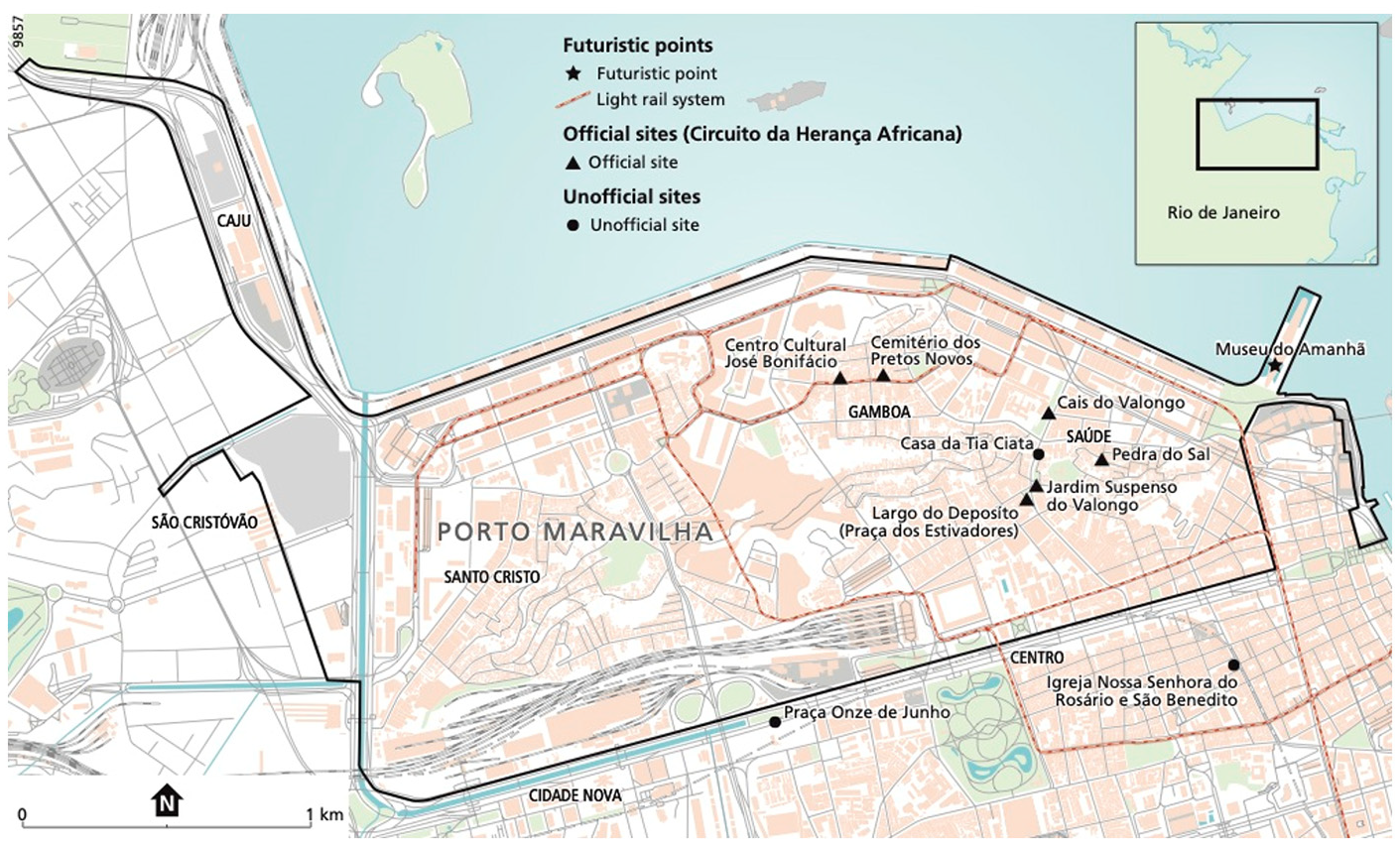
Porto Maravilha contrasts: future projects and forgotten monuments
The ‘discovery’ of Valongo Wharf was not a surprise, since a commemorative plaque remained in 2011 when the archaeological studies for Porto Maravilha began. Valongo Wharf was built in 1811 under the orders of Prince Regent Dom João VI, replacing Praça da República as the place for the public market of humans. Valongo Wharf functioned as a site where activities related to the slave trade took place (Lima et al., 2016). It operated until 1843, when it was buried as Emperor Dom Pedro II ordered its redevelopment to honour the arrival of his fiancée, Princess Teresa de Bourbon from Europe, and the site was renamed ‘Empress’ Wharf’. The renovations of French architect Grandjean de Montigny, a member of the French artistic mission arriving in Brazil in 1816, aspired to modernise the Empire following Parisian aesthetics. The classic decorative statues once adorning the wharf are now displayed in the Hanging Garden of Valongo, renovated in 2012 for the Rio Olympics (De Araujo Andrade, 2018; Jordão, 2015). In 1911, the city-wide colossal renovations under Mayor Pereira Passos (1902–1906) once again buried the site. Both wharfs remained beneath a square, a street and a parking lot, until the Porto Maravilha OUC began.
Although Valongo Wharf operated for several decades, urban revitalisation projects such as those of Empress’ Wharf and later of Pereira Passos literally buried the history of enslaved Africans brought to Brazil. Ironically, the Porto Maravilha revitalisation project uncovered the history of slavery, raising questions about cultural and historical representation and reparations. Archaeologist Tania Andrade Lima, responsible for archaeological monitoring of Porto Maravilha, notes that ‘the royalty was sufficiently remembered, but not the enslaved Blacks. These were deliberately erased with the overlap of the Empress’ Wharf’ (cited in Movimento Negra Unificado, 2012). Given the ‘discovery’ of the two wharfs in 2011 during the revitalisation process, the Movimento Negra Unificado (2012)– the Black Unified Movement – argues that the government and civil society ignored the history of slavery and racism, rather than proactively recovering, publicising and denouncing the violent legacy of the slave trade. In UNESCO (2017), the Valongo Wharf Archaeological Site was declared a cultural patrimony of humanity. The site’s conservation is supervised by the National Historic and Artistic Heritage Institute (IPHAN) and supported by CDURP, the company overseeing Porto Maravilha.
Conversely, the Cemitério dos Pretos Novos was uncovered in 1996 during renovations of the house of the Guimarães family, at Rua Pedro Ernesto #36. Like the wharfs, the Cemitério dos Pretos Novos was in the area known until the mid-19th century as Little Africa. The cemetery operated between 1769 and 1830 as a mass grave, where the remains of enslaved Africans who had not survived the transatlantic journey or the journey to the slave market were deposited. The remains of tens of thousands of enslaved Africans were stored anonymously for over two centuries. The Guimarães contacted the Palmares Cultural Foundation, a public federal entity to preserve Afro-Brazilian culture, and the Municipal Council for the Defence of the Rights of Afro-Brazilians (Conselho Municipal de Defesa dos Direitos do Negro, COMDEDINE), about the cemetery’s existence. The Guimarães thus transformed their home into a research institute for the memory of the Pretos Novos, the IPN, officially created in 2005. Overnight, Mercedes Guimarães became an advocate for the preservation of the Cemitério dos Pretos Novos. In an interview, she explains that the municipal government promptly embraced the ‘discovery’ of Valongo Wharf in 2011 but had resisted supporting the Cemitério dos Pretos Novos in the 1990s. As Mercedes Guimarães noted, In these 20 years of fighting [for the preservation of the Cemitério dos Pretos Novos] I witnessed racism. In the first 10 years when IPN was born, we met Antonio Carlos who was already from COMDEDINE, he made us see that nobody cares about it. Firstly, because it is [about] death, there is a cultural issue in Brazil that we do not worship death. Therefore, we at IPN dealt with two problems, the problem that this is a Blacks’ Cemetery, if it were Jewish or other ethnicity, it would become a grand monument, and there is the issue of fear of the cemetery. How can we deconstruct the issue of fear? Bringing events in here, making a happy graveyard, a living graveyard. (Personal interview, 2 August 2016)
Gradually, the archaeological site uncovered human remains and objects such as collars, kitchen utensils and food waste. Archaeologists and historians now understand the site more as a landfill than a cemetery, where human flesh and bones were crushed and burned. Only the remains of one body was recovered intact, named Bakhita, meaning blessed in the Nubian language. Bakhita honours the first female African saint canonised in 2000 as the patroness of the sequestered and enslaved. In a National Geographic report on the discovery of Bakhita, the Cemitério dos Pretos Novos is called ‘the Black holocaust’ (Vilela, 2018). Despite the discovery’s significance, the Guimarães family had to launch several fundraising campaigns to keep IPN open. Meanwhile, CEDURP invested three-quarters of its cultural budget in the Museum of Tomorrow and the Rio Art Museum, leaving only R$355 thousand for IPN. This contrast is emblematic, and it is a cruel contradiction to accept the title of UNESCO World Heritage Site for Valongo Wharf while neglecting the relevance of the Cemitério dos Pretos Novos (Rezende, 2017).
While the Cemitério dos Pretos Novos and Valongo Wharf are historically and archaeologically significant, the port district identified other locales for the memory of African heritage. Indeed, Little Africa contains more culturally relevant sites than those forming part of Porto Maravilha’s official Historic and Archeological Circuit of African Heritage (Ribeiro, 2014). It included neighbourhoods, plazas and religious gathering places providing support for freed slaves and Afro-Brazilians. Beginning in 1831, a set of laws freed some slaves in a legal reform process ending with the abolition of slavery in 1888, and freed slaves remained working in the area now known as Porto Maravilha. 5 Afro-Brazilians and freed Africans from Bahia State and other inland states migrated to Little Africa, searching for work and opportunities, moving to Gamboa, Santo Cristo and Saúde neighbourhoods, now Porto Maravilha (Netto, 2013; Velloso, 1990). Little Africa became an organised community where religious leaders provided support for newcomers, especially the tias baianas, Black women who migrated from Bahia State to Rio, organising the neighbourhood’s cultural and religious life (De Melo Gomes, 2003). The most famous tia in Little Africa was Tia Ciata, a religious and cultural leader who became a pillar of the community (Moura, 1983).
Little Africa was also a place for the Candomblé religion. According to a mapping of Rio’s Afro-religious places of worship known as terreiros, most emerged by the mid-19th century in the port area, especially in the Saúde neighbourhood (Conduru, 2010). The 1890 Brazilian Criminal Code prohibited the practice of spiritualism, magic and other sortileges (Alvarez et al., 2003). Brazil’s terreiros emerged in Bahia State, first documented in 1807. Rio’s religious leaders thus had direct connections to Bahia, establishing terreiros rooted in diverse African traditions (Conduru, 2010). Notably, UNESCO recognised some terreiros as intangible cultural heritage (Netto, 2013).
Although African heritage in the port district is under-recognised, the four neighbourhoods – Caju, Gamboa, Saúde and Santo Cristo – comprising the area and old centre of Rio have long been a place of Afro-Brazilian cultural production. With the 1983 publication of Roberto Moura’s book Tia Ciata e a Pequena Africa do Rio de Janeiro, Little Africa gained prominence in academic, activist and alternative tourism circles as a place of resistance to Eurocentric modernisation projects. According to Moura (1983), singer, samba composer and painter Heitor dos Prazeres coined the term ‘Little Africa’. In 1987, the sites of Pedra do Sal and Morro da Conceição were officially recognised as strongholds of samba and choro music, a cradle of the carnival and Afro-Brazilian religious celebrations (Leitão Pinheiro and Carneiro, 2016).
The heart of Little Africa was Praça Onze, a square and the centre of the Cidade Nova neighbourhood, which held early carnival festivities (Carvalho, 2013). Aunt Ciata lived in Little Africa along with other cultural and religious leaders. By the 1910s, Praça Onze also became the home and cultural centre of Eastern European Jewish immigrants to Rio. Although their numbers never reached more than 10% of Cidade Nova, the area had synagogues, Yiddish language newspapers and Jewish businesses (Carvalho, 2013; Silva, 2015[1974]). Little Africa and Praça Onze were the cradle of considerable cultural production by African and Afro-Brazilians, later appropriated by Euro-descendants as symbols of Brazilian culture in a process of whitening, rendering the African influence less visible.
The discriminatory impact of urban planning policies in the port district
Urban planning played a fundamental role in erasing African heritage from Rio, especially in the port district (Montoza, 2018; Ribeiro, 2014). Two major waves of urban revitalisation destroyed African life and culture in the port district: during slum tenement eradication and social cleansing led by Mayor Pereira Passos (1902–1906), and later during President Getúlio Vargas’s dictatorship (1937–1945) through the destruction of Praça Onze and creation of Presidente Vargas Avenue (De Melo Gomes, 2003; Velloso, 1990). Pereira Passos’ reforms became known as bota-abaixo (knock-it-down) reforms, as cortiços (slum tenements) and older buildings were demolished to open up avenues, resolve unsanitary conditions, prevent disease and beautify Rio’s central areas with newly constructed buildings. These urban revitalisation projects aimed to improve basic sanitation and to create large boulevards, monuments and beautification projects inspired by Haussmann’s renovation of Paris in the late 19th century (Guimarães, 2014). Yet, these reforms displaced Blacks, who moved to Morro da Providência, Brazil’s first favela, or to peripheral neighbourhoods. The construction of Avenida Central, today called Avenida Rio Branco, required the demolition of more than 641 cortiços (Da Matta Vicente, 2016). The 33-metre-wide avenue housed opulent buildings, requiring a pedestrian dress code and emulating the elegance of Parisian boulevards. The displacement of the poor to peripheral neighbourhoods resulted in considerable demographic changes in Rio. In 1890, 44% of Rio’s 518,292 inhabitants lived in downtown neighbourhoods, yet by the time Pereira Passos left office in 1906, only 30% of Rio’s 805,335 inhabitants lived downtown (Ferreira da Silva, 2019).
Pereira Passos’ urbanisation projects were made possible by funds from President Rodrigues Alves (1902–1906) for urban planning and public health. President Alves envisioned that the reforms in the port district would increase the distribution of products to all areas of Rio – then Brazil’s capital – by expanding roadways, which included sanitation. Locally, Pereira Passos achieved social cleansing, racial segregation and gentrification through various urban planning strategies, going beyond slum clearance in central neighbourhoods. Indeed, Decree 391 of 10 February 1903 established new requirements for construction approval, including construction, reconstruction, additions and repairs to buildings and façades, and which materials were allowed. Furthermore, building and floor-plan permits and professional builders became mandatory (Abreu, 2003). These regulations ensured that most future homes and businesses would be owned by elites, who were mostly Euro-Brazilians.
This section demonstrates the historical and persistent role that urban planning plays in the displacement and dispossession of Africans and Afro-Brazilians in the port district. As Brazil became a Republic, urban planning provided continuity to the White and Eurocentric development supremacy imposed by Portugal, and then by the Brazilian Empire. Notably, the buried history of slavery, displacement and exclusion contrasts with the OUC’s hypermodern real estate speculation. Given this contradiction, in the conclusion, drawing on the concept of legacy participation, we highlight the need for mandatory representation of African descendants in urban revitalisation projects.
Legacy participation: Representation in the planning of slave cemeteries
Taking the case of Rio’s Porto Maravilha, we use the notion of hypermodernity juxtaposing two narratives: first, based on a global city image and second, on the local reality of those occupying these spaces long before. Since the early 2000s, mega-events and the establishment of futuristic urban projects in Rio attempted both to hide and to undermine the spatialised history of the transatlantic slave trade. The objective has been to further manipulate the entrenched histories of Black Brazilians in Rio’s port for touristic consumption. Given this contradiction, in this section we call for the concept of legacy participation to secure the rights of Afro-Brazilian descendants in decision-making regarding their own territory, including jurisdiction over specific sites, such as slave cemeteries. In the Americas, most recognised slave cemeteries and post-emancipation African-descendant cemeteries are located in the USA. Counting active African cemeteries, they number 600 (Balanzátegui Moreno, 2018). Although Latin American countries such as Ecuador are recognised for their indigenous heritage, cemeteries of formerly enslaved Africans exist there also. In Brazil, Balanzátegui Moreno (2018) encountered more than 100 graveyards with political, historical and spiritual significance for Afro-Brazilians, and four representing formerly enslaved Africans. Only the Cemitério dos Pretos Novos, however, has been documented from an archaeological perspective. As the previous sections explained, the Cemitério dos Pretos Novos, active from 1769 to 1830, was created to exclusively bury enslaved Africans who died upon arrival in Rio before being sold on the slave market (Guedes et al., 2020). Of the 6119 people buried there, 95.5% were identified as enslaved Africans (Cook et al., 2015). The Cemitério dos Pretos Novos was a mass grave cemetery, bearing witness to the horrifying nature of the transatlantic slave trade.
In the USA, debates about the African diaspora in urban studies, law and planning often focus on reparations and compensation – achieved via litigation by individuals and groups who achieve legal standing to sue. This focus has shifted to memory, restorative justice and community development for communities impacted by segregation and discriminatory policies (Brooks, 2004; Wenger, 2017). In Latin America, such debates highlight the legal recognition of African territories, established by slaves and their descendants, called palanques in Colombia, and Quilombos and Mocambos in Brazil (Offen, 2003; Symanski, 2016). Across the Americas, Black movements and African Americans have challenged the biological view of representation (Cooper, 2012). In such views, requirements to prove a biological link to slavery to achieve standing to pursue litigation in the USA, or to file land claims for ethnic territorial recognition and collective land titling in Latin American countries, reinforce a colonial legacy of slavery. This assumes that African Americans and indigenous groups have been granted the same opportunities to keep family unity, records and oral histories as White settlers. Instead, people of colour in the Americas have had their families brutally separated and, thus, record-keeping requirements constitute a continuation of the colonial legacy (Ramos, 2017).
The memory and legacy of slavery gains a complimentary spatial dimension through the identification, recognition and preservation of cemeteries for enslaved Africans and Blacks in post-emancipation periods. As urban revitalisation projects – or single-family property renovations – expose the history of colonialism, oppression and segregation, Black cemeteries often become spaces of land conflict. Thus, what we term legacy participation advocates that Black movements, Afro-Brazilian grassroots’ organisations, policy institutes and African descendants should exert control over these sites. In the case of OODC applied within Porto Maravilha’s OUC, some of these funds for social improvements in African heritage sites should be allocated for self-management by organised Afro-Brazilian civil society.
Sometimes known in the Americas as African burial grounds, their existence and location are initially disputed, such as the case in São Paulo’s Liberdade neighbourhood, a former Black neighbourhood transformed by Japanese and North Korean immigration. In December 2018, areas of Liberdade underwent demolition to construct a commercial building, generating land conflicts. The demolition revealed an African burial site, likely from the late 18th century. In 2019, the Movimento Negro Unificado requested that the city use its eminent domain power to take the land and build a memorial for enslaved and freed Africans in São Paulo. Thus, the Cemitério dos Pretos Novos is neither the first nor the latest Brazilian space of ethnic erasure and contestation.
The Porto Maravilha case reveals the need for future research and advocacy to operationalise the concept of legacy participation, in the sense of ethnic community representation and jurisdictional territorial control in city planning matters related to the history of the African diaspora in the Americas. The concept of legacy participation is particularly important in the context of a PPP built upon financialisation and speculation of urban landed property, based on an ideology of hypermodernity in the rush to place Rio on the map of ‘grade A’ global cities. Thus, the history of slavery and persistent segregatory urban policies is solidified in the neglectful treatment of the slavery cemetery, revealing the inconvenient roots of urban racial capitalism and revanchism, where Africans and Afro-Brazilians have been displaced to generate ever-evolving projects of modernity and profit-seeking.
Footnotes
Acknowledgements
Thanks to Professor Mitch McEwen and the Michigan-Mellon Project on the Egalitarian Metropolis for the invitation to participate in the 2015 Porto Maravilha studio. The 2016 and 2017 field trips to African heritage sites were funded by the author’s discretionary funds. Special thanks to the Instituto dos Pretos Novos for the field visits and interviews.
Declaration of conflicting interests
The author(s) declared no potential conflicts of interest with respect to the research, authorship and/or publication of this article.
Funding
The author(s) received no financial support for the research, authorship and/or publication of this article.
