




Abstract
Whereas the so-called ‘citizenship premium’ in the labour market has been widely studied, we know little about how naturalisation affects immigrants’ lives beyond work and income. Focusing on the Netherlands, this paper analyses the relationship between citizenship acquisition and immigrant residential mobility, in particular the propensity of immigrants to move away from areas with high concentrations of migrants. We draw on register data from Statistics Netherlands (N = 234,912). We argue that possessing Dutch citizenship reduces spatial stratification by diminishing the risk of housing market discrimination, thereby facilitating mobility outside of migrant-concentrated areas. Our findings show that naturalised immigrants are 50% more likely to move out of concentrated neighbourhoods, all else constant. The effect of naturalisation is especially relevant for renting without housing benefits and for home ownership, and for mid-risk immigrants who earn around the median income and hold permanent jobs, whose applications face strong scrutiny from landlords, rental agencies and mortgage lenders.
Introduction
It is a well-known phenomenon that in European-destination countries, newcomers tend to live initially in urban areas with high concentrations of immigrants because of employment opportunities, the presence of pre-established ethnic networks and restricted financial resources (Zorlu and Mulder, 2008). Living in a neighbourhood with large numbers of other immigrants may have various implications for immigrants’ life outcomes. Although living with other immigrants can facilitate access to valuable information (Abascal, 2017) and can lead to better life satisfaction (Knies et al., 2016), it is also considered to reinforce socio-economic inequality, especially for those living in areas of economic deprivation. Previous studies have stressed that living in an immigrant-concentrated neighbourhood may have a detrimental effect on immigrants’ educational achievement and access to the labour market (Ihlanfeldt and Sjoquist, 1998; Overman, 2002). Moreover, ethnic concentration is often associated with lower social-cultural integration (Bouma-Doff, 2007; Gijsberts and Dagevos, 2007), though this claim remains debated in the literature (Bolt et al., 2010; Musterd, 2003).
Various studies shed light on why some immigrants stay in immigrant-concentrated neighbourhoods while others move, over time, to neighbourhoods dominated by native-born citizens. According to spatial assimilation theory, immigrants tend to move to wealthier neighbourhoods with fewer migrants as they integrate socially and economically in the host country (Lieberson, 1961; Logan and Alba, 1993). Other structural factors, however, such as housing market discrimination, impede the mobility of immigrants and prevent this process of spatial assimilation. This phenomenon is described in the literature as spatial stratification (Alba and Logan, 1991; Logan and Alba, 1993; Van Ham and Feijten, 2008).
This paper focuses on legal-status discrimination in the housing market as a crucial factor limiting spatial mobility. Studies focusing on European countries show that housing market discrimination is often based on ethnic and religious grounds (Ahmed and Hammarstedt, 2008; Carlsson and Eriksson, 2015; Heylen and Van Den Broeck, 2016). Even though some studies have included citizenship status in their models of residential mobility (South et al., 2005; Vogiazides, 2018), little attention has been paid in the literature to legal-status-based discrimination in the context of immigrants’ residential conditions. We intend to fill this gap by analysing the effect of naturalisation on immigrants’ mobility outside of migrant-concentrated neighbourhoods in the Netherlands. We argue that discrimination on the grounds of citizenship hinders the mobility of certain immigrant groups. Because possessing Dutch citizenship often acts as a positive signal for all actors in the housing sector, including landlords, real estate agents and mortgage lenders, naturalised immigrants will be less likely to suffer from discrimination in the Dutch housing market and will therefore be less constrained in their residential mobility.
The Netherlands has a significant proportion of persons with a migrant background 1 and there is evidence of an over-representation of ethnic minorities in the biggest cities (Karsten et al., 2006: 231; Salentin and Schmeets, 2017: 4; Van Ham and Feijten, 2008: 4). Using administrative data drawn from Dutch registers, we follow immigrants from their arrival in 2003, 2004 and 2005 until 2016 and analyse the relation between naturalisation and mobility using a statistical technique called survival analysis.
Although the aim of this paper is to find evidence of a citizenship premium in the housing market in the Netherlands, it is important to note that, because of data restrictions, we are not able to directly measure housing market discrimination. The following hypotheses therefore aim at testing the relation between citizenship and housing market discrimination by examining whether our data are consistent with particular corollaries of housing market discrimination. In that sense, this paper should be distinguished from previous studies that have aimed at measuring housing market discrimination with experimental designs (Ahmed and Hammarstedt, 2008; Heylen and Van Den Broeck, 2016).
We begin with a review of the literature that has contributed to explaining immigrants’ spatial mobility outside of neighbourhoods that contain many other immigrants. The next sections outline a theoretical framework for our analysis of the role played by naturalisation in residential mobility, followed by a discussion of the data and methods used in the analysis. Results of the analysis are presented in the empirical sections.
Theoretical framework and hypotheses
The topic of immigrant residential mobility has been extensively covered in the literature. Finding its roots in the Chicago School’s ecological tradition, which views residential mobility as a consequence of acculturation and social mobility, the spatial assimilation theory expects immigrants to move initially to migrant-concentrated neighbourhoods before relocating to predominantly native neighbourhoods as they integrate into the host country (Andersen, 2016; Logan and Alba, 1993; Massey, 1985). This is based on the assumptions that immigrants will first settle in migrant-concentrated neighbourhoods and that changes in integration will affect their residential preferences. Previous studies have confirmed that spatial assimilation explains housing inequalities and ethnic concentration to a substantial degree (Andersen, 2016; Logan and Alba, 1993). Focusing on the Netherlands, Zorlu and Mulder (2008) found that on arrival immigrants tend to settle into migrant-concentrated neighbourhoods and move towards less concentrated neighbourhoods if they are in a better socio-economic position. Bolt and Van Kempen (2010) reached a similar conclusion regarding immigrants’ relocation.
Yet, disparities in residence patterns between ethnic groups often remain even after accounting for factors related to spatial assimilation (Vogiazides, 2018). This has led scholars to question some of the assumptions of the assimilation theory and consider two alternative explanations. First, all immigrants may not share the desire to leave migrant-concentrated neighbourhoods and may hold a preference for ethnic enclaves (Bolt and Van Kempen, 2010; Vogiazides, 2018). Second, even when spatial assimilation takes place, it can be disrupted by cultural prejudice and discrimination in the housing market, a phenomenon that is defined as spatial stratification (Alba and Logan, 1991).
Housing market discrimination can take place at different stages of a person’s search for housing and involves different types of actor, including mortgage lenders, real estate agents, landlords and local authorities (Bengtsson et al., 2012; Bolt and Van Kempen, 2010; Bosch et al., 2010; Dill and Jirjahn, 2014; Ross and Tootell, 2004). Scholars traditionally distinguish between two types of housing market discrimination: taste-based discrimination and statistical discrimination (Van Der Bracht et al., 2015). Taste-based discrimination usually involves preferences for certain ways of doing things and prejudices against certain minority groups. Statistical discrimination, on the other hand, occurs when economic actors have imperfect information about an individual’s characteristics and compensate for this lack of information with stereotypes or group averages.
No study has, to our knowledge, analysed the relevance of citizenship acquisition to immigrants’ residential mobility and to housing market discrimination in the Netherlands. While it is hard to see how citizenship acquisition could be relevant with regard to taste-based discrimination, there are reasons to believe that naturalisation may help to reduce several types of statistical discrimination encountered in the Dutch housing market. Starting with the rental market, we can expect citizenship acquisition to positively affect the risk-calculation of landlords and real estate agents. Because rent in neighbourhoods with low numbers of migrants is often relatively expensive, lessors and real estate agents may prevent immigrants from entering such neighbourhoods if they expect them to have problems paying the rent. Naturalisation may, however, send a positive signal to landlords and estate agents and be considered a marker of economic integration into the host country. Moreover, naturalisation is often associated with permanent settlement and an intention to stay in the host country, which may suggest greater long-term commitment for landlords and real estate agents. Finally, landlords may perceive naturalised immigrants as more traceable if they leave the Netherlands with a rent debt, which may also be taken into consideration in the risk calculations of landlords and real estate agents.
Naturalisation may also positively affect the chances of immigrants to be granted a mortgage and can therefore facilitate immigrants’ mobility through homeownership. As outlined in previous studies, discriminatory practices can be observed among mortgage lenders who believe that persons with a migrant background present a future risk of non-payment, a process that is sometimes defined as ‘redlining by ethnicity’ (Aalbers, 2007). But possessing citizenship of the host country may signal to lenders an intention to invest resources in that country and greater integration into the labour market. Naturalisation may, therefore, weigh favourably on the risk calculations of lenders (Peters, 2020).
Naturalisation, then, is important to explanations of spatial mobility. Because we expect citizenship acquisition to act as a positive signal for real estate actors, we expect naturalised citizens to be more likely to move outside of migrant neighbourhoods. This leads us to the first hypothesis of this paper:
H1: Citizenship acquisition has a positive effect on the probability of moving out of migrant-concentrated neighbourhoods.
Other factors complicate the issue, however. Real estate agents, landlords and lenders apply strict financial standards that may hinder the mobility of the most vulnerable immigrant groups. It is therefore important to make a distinction between immigrants who are in a precarious economic situation and immigrants who are financially stable. Because financial stability is a very important criterion for housing market actors when it comes to risk calculation, it is probable that housing applicants who have a very low income, and therefore fall within the category of high-risk applicants, will see their loan or rent application turned down, regardless of their nationality. Similarly, naturalisation may be viewed by landlords and lenders as less important for immigrants who have a high income as these immigrants represent a very low risk. On the other hand, we might expect mid-risk applicants to see their applications fall under stronger scrutiny, hence increasing the risk of arbitrary assessment and statistical discrimination (Aalbers, 2007). Possessing Dutch citizenship may therefore matter more for them than for others. This leads us to our second hypothesis:
H2: The positive effect of naturalisation on the probability of moving out of migrant-concentrated neighbourhoods is stronger for immigrants whose household income is situated around the median value.
Household income is not the only criterion taken into account in risk assessments. Mortgage lenders, landlords and real estate agents often also assess an applicant’s job contract, as this offers additional information about the source and security of their income. Being employed on a permanent contract suggests financial stability over the long term, while a fixed contract provides less insight into a person’s future. Previous research shows that having a permanent job contract increases the odds of securing a mortgage (Aalbers, 2007: 8). A similar mechanism may also apply to actors in the rental market. Following this line of reasoning, we argue that applicants with a permanent contract are less likely to be in the high-risk category and are therefore more likely to see their housing applications approved. This leads to our third hypothesis:
H3: The positive effect of naturalisation on the probability of moving out of migrant-concentrated neighbourhoods is stronger for immigrants who have a permanent job contract.
As mentioned, we have reasons to believe that citizenship acquisition can help in reducing housing market discrimination. Yet, a common view is also to consider naturalisation to be a marker of cultural integration. If this is the case, we would expect, in line with spatial assimilation theory, naturalised immigrants to leave concentrated neighbourhoods not only because they face a lower degree of housing market discrimination but also because they share a desire to break away from migrant-concentrated neighbourhoods. While we cannot entirely rule out this possibility, we use different strategies to control for immigrants’ cultural integration and self-selection into naturalisation. This is further discussed in the method section.
The Dutch context
Discrimination in the Dutch housing market
The Netherlands has a highly segmented and peculiar housing market. The rules and procedures for the allocation of dwellings vary greatly between the different housing sectors. While landlords and real estate agencies have some freedom in the choice of potential tenants, dwellings in the social housing sector are allocated based on clear and transparent local and national criteria including income, length of residency, family situation and urgency. On the other hand, mortgages are mostly allocated based on economic indicators although other requirements, such as the possession of permanent residence status, also apply in the case of a mortgage backed by the Dutch National Mortgage Guarantee (NHG). Banks may also use discretionary criteria for mid-risk borrowers, such as ‘judgment, routines, common knowledge, rules of thumb’ (Aalbers, 2007: 8).
Although research focusing on discrimination in the Dutch housing market remains relatively scarce in comparison with other European countries, there is growing evidence that taste-based and statistical discrimination do take place in the Netherlands. Previous studies suggest that immigrants seeking to secure a mortgage may sometimes be confronted with statistical discrimination (Aalbers, 2007). As regards discrimination in the rental market, a report from the Netherlands Institute for Social Research (SCP) from 2009 found marginal evidence of discrimination in the private rental sector and no evidence in the case of social housing (Sociaal en Cultureel Planbureau, 2009). In contrast, reviews of legal cases show that discrimination in the rental market on the basis of skin colour (College voor de Rechten van de Mens, 2018) or on the basis of religious faith (College voor de Rechten van de Mens, 2016b) occasionally occurs. A recent study furthermore suggests that discrimination in the private rental market based on ethnicity may in reality be substantial (De Groene Amsterdammer, 2018).
We have little knowledge about how much housing market discrimination can be attributed to nationality in the Netherlands. Although discrimination on grounds of nationality in the field of housing is strictly prohibited in the Netherlands by the General Equal Treatment Act (Algemene Wet Gelijke Behandeling), landlords, real estate agents and mortgage lenders often request information about their clients’ nationality during the registration process. While it is not always clear what they do with this information, recent legal cases show that nationality may sometimes be used as a source of direct discrimination. This applies both to actors in the private rental sector and mortgage lenders. 2 There is, however, no evidence of discrimination on the basis of nationality in the social housing sector. This may be because social housing is allocated on the basis of transparent and objective criteria (Sociaal en Cultureel Planbureau, 2009).
Citizenship policy in the Netherlands
Immigrants who settle in the Netherlands must fulfil various criteria to become eligible for naturalisation. Requirements for eligibility generally include the applicant being at least 18 years old, holding a permanent residence permit in the Netherlands, residing in the Netherlands for at least five consecutive years prior to the application and being willing to renounce his or her foreign citizenship. Since the revised Dutch Nationality Act of 2003, immigrants are additionally required to pass a formal naturalisation test that assesses their knowledge of Dutch society and their command of the Dutch language. Naturalisation is then viewed as the crown of the completed integration process, rather than a facilitator of integration. This has led to an increase in the cost of the naturalisation procedure and a decline in the number of naturalisations (Van Oers et al., 2013).
Data and methods
Data
We analyse the relation between naturalisation and immigrants’ residential mobility using Dutch register data from Statistics Netherlands. Our focus is on foreign-born immigrants (first generation) who moved to the Netherlands and registered in a Dutch municipality in 2003, 2004 or 2005. We decided to focus on this time period because all immigrants from the three cohorts were eligible for citizenship under the same conditions. We follow immigrants from their arrival in the Netherlands until they move out of a migrant-concentrated neighbourhood or until the end of the observation period. Individuals are tracked annually until 2016 over a maximum period of 13 years.
First-generation immigrants are defined in this paper as immigrants who are born abroad and have two parents born abroad. We exclude immigrants born in Suriname before 1975 and those born in the Dutch Antilles, since these immigrants are Dutch citizens by birth. We also do not include EU citizens, who may be less subject to discrimination in the housing market than other immigrant groups. Because we are interested in individuals who move outside of migrant-concentrated neighbourhoods on their own initiative, we reduce the possibility of including immigrants living with their parents by looking only at individuals aged 25 years or older. Given how we measure the concentration of immigrant neighbourhoods (percentage of individuals with an immigrant background living in a specific area), we also exclude immigrants living in a neighbourhood with fewer than 100 individuals in order not to categorise neighbourhoods with few immigrants as concentrated. To limit cases of informed right-censoring, we additionally exclude immigrants who left migrant-concentrated neighbourhoods by leaving the Netherlands entirely. Finally, since we are interested in immigrants’ first move outside of immigrant-concentrated neighbourhoods, we only take into consideration immigrants who moved to a concentrated neighbourhood upon arrival. In total, we have data on 29,400 individuals, across 234,912 observations, including 64,240 observations censored after a person moved out of a migrant-concentrated neighbourhood (our ‘event’ of interest).
The unit of measurement of the neighbourhoods is the buurt. The buurt is the second smallest spatial unit in the Dutch population register data. It is composed on average of 1300 inhabitants and is sufficiently small for us to be able to zoom in to specific economic and social processes taking place in an individual’s close environment. We measure migrant concentration by looking at the proportion of persons of migrant background living in a specific neighbourhood. This means that our measure of migrant concentration covers not just first-generation migrants but also individuals of migrant descent (so called ‘second generation’). We chose to include individuals of migrant descent in our measurement of ethnic concentration because they significantly differ from the Dutch population in terms of socio-economic outcomes (De Mooij et al., 2018). The threshold we use to determine concentrated neighbourhoods is set at the average proportion of individuals with an immigrant background living in the Netherlands over time in our data (20%). Thus, we define a ‘migrant-concentrated neighbourhood’ as one in which at least 20% of the inhabitants have a migrant background. 3 Our database covers all concentrated neighbourhoods located in the Netherlands. 4
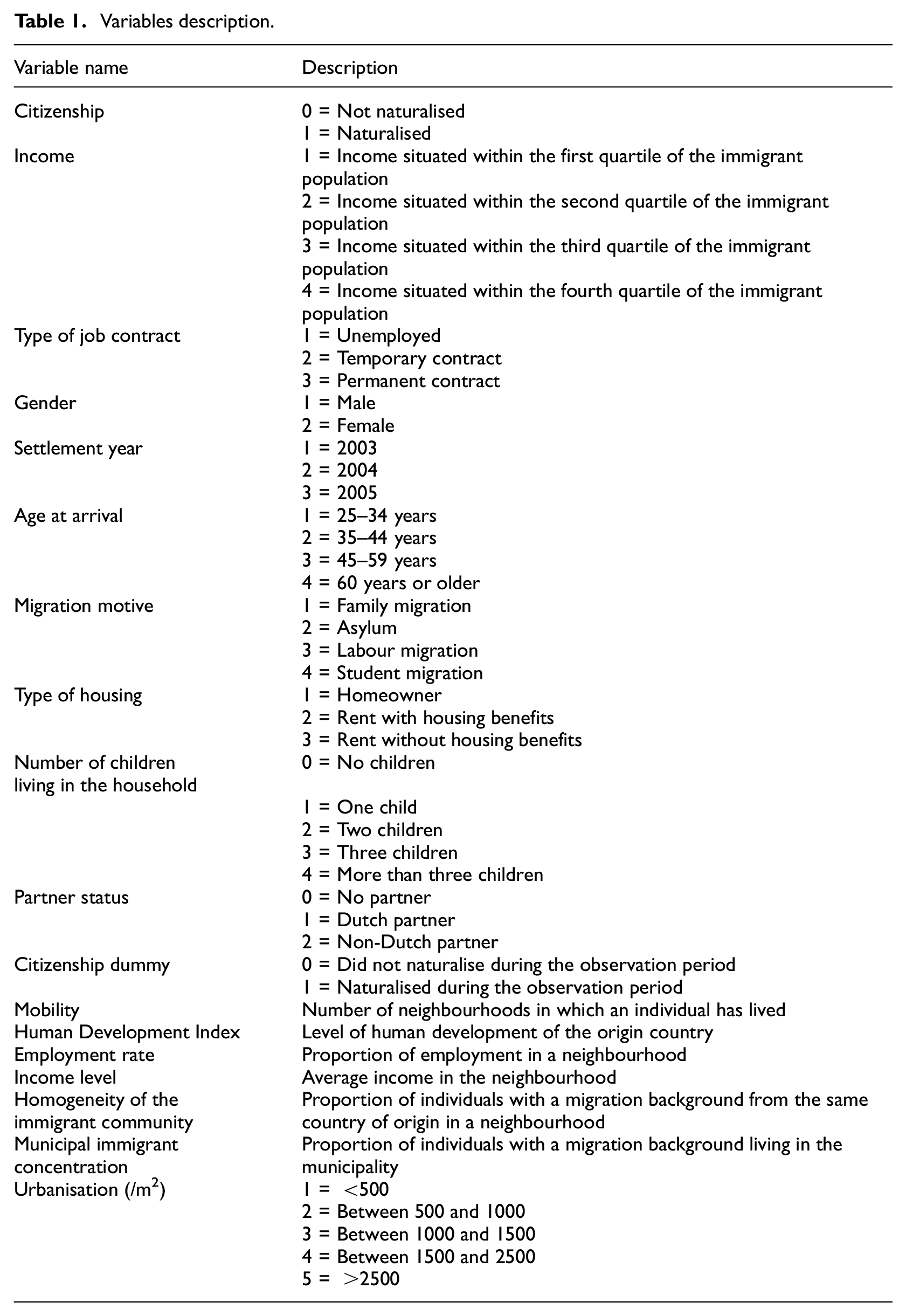
We control for various characteristics at the individual, household, contextual and neighbourhood level. Individual-level variables include gender, type of job contract, marital status, age at migration, migration motive and the individual’s type of housing. At the household level, we control for the number of children living in the household and we include a measure of standardised household income. Our measure of household income is cut across quartiles. 5 The quartiles categories are based on the immigrant population in our database. The first quartile corresponds to low-income individuals while the second and third quartiles are referred to as medium-low and medium-high income. The fourth quartile constitutes the high-income category. Contextual-level variables refer to characteristics of the country of origin. We thus control for the level of development of the origin country as measured by the Human Development Index. Regarding neighbourhood characteristics, we control for the level of urbanisation and the proportion of individuals with an immigrant background living in the municipality. Based on register data alone, we are not able to directly measure immigrants’ housing preferences. However, we also control for three neighbourhood characteristics that we think can be related to an immigrant’s desire to stay in or leave a certain neighbourhood: the level of employment, the average income level and the degree of ethnic homogeneity of the migrant community. 6 Further information on the different variables used in the analysis can be found in Table 1.
Variables description.
Method
Modelling strategy
We examine the relation between immigrants’ naturalisation and mobility outside of concentrated neighbourhoods using survival analysis. Survival analysis is commonly used to estimate the timing and occurrence of a specific event. In contrast to other forms of traditional regression-based methods, it has the advantage of controlling for right censoring, which is particularly important in this case as we observe individuals for a limited period of time (Box-Steffensmeier and Jones, 1997). It also accommodates for the longitudinal nature of our data.
This paper employs a Cox proportional hazard model, which is a specific type of survival analysis. This model does not assume a parametric form for the distribution of time and allows an easier inclusion of time-varying covariates. We argue that the probability of being in a certain neighbourhood at time t depends on an individual’s situation at a previous time (t−1). Therefore, all time-varying covariates are expressed at t−1 with a lagged variable. For an individual (i), with a vector of covariates X, the Cox proportional hazard model expresses a hazard rate that takes the form of:

We control for any violation of the proportionality assumption using time interactions but also with a stratification method that controls by stratification for each predictor that does not satisfy the proportionality assumption (Borucka, 2014). 7 Predictors that violate the assumption are not included in the model. Instead, the model is estimated across different strata that are defined as the different categories of the variables violating the assumption. If Z equals the number of stratified covariates, using stratification leads to the following changes in the Cox proportional hazard equation:

where
To analyse different types of mobility, we run competing risk models that allow us to distinguish between mobility through homeownership (1) and mobility through renting (2). We follow the cause-specific approach in which individuals experiencing the competing event are treated as censored (Noordzij et al., 2013).
Controlling for the endogenous effects of naturalisation
Because naturalisation is not a random process, immigrants who choose to embark on the road towards citizenship have specific cognitive, cultural or material characteristics that other immigrants do not necessarily have. In the context of this research, it can be argued that some of these characteristics such as better resilience, motivation or ability to learn a foreign language are positively related to the decision to move out of migrant-concentrated neighbourhoods. We control for self-selection into naturalisation due to observed and unobserved characteristics by including in our models a time-invariant citizenship acquisition dummy variable that indicates whether an individual has acquired Dutch citizenship at any time during the observation period. 8 Our models will therefore include both a time-variant and a time-invariant variable of citizenship.
Moreover, if naturalisation is an indicator of better cultural integration we might assume, according to the spatial assimilation theory, that immigrants who decide to acquire Dutch citizenship share a common desire to break away from migrant enclaves. We account for cultural integration by controlling for whether someone has a Dutch partner.
Results
Main analysis
Descriptive statistics show that 39.2% of the individuals in our data set moved out of a migrant-concentrated neighbourhood during our observation period. The move was achieved either by purchasing a home (7.9%) or by renting (31.3%). Immigrants who naturalised during our examination period show a higher rate of mobility outside of concentrated neighbourhoods (65.7%). Looking specifically at types of mobility, naturalised immigrants show lower survival rates for both mobility via homeownership (16.7%) and mobility via renting (49.0%). In other words, they move away from migrant-concentrated areas sooner than non-naturalised immigrants. These findings are reflected in the Kaplan and Meier curves (Figure 1).
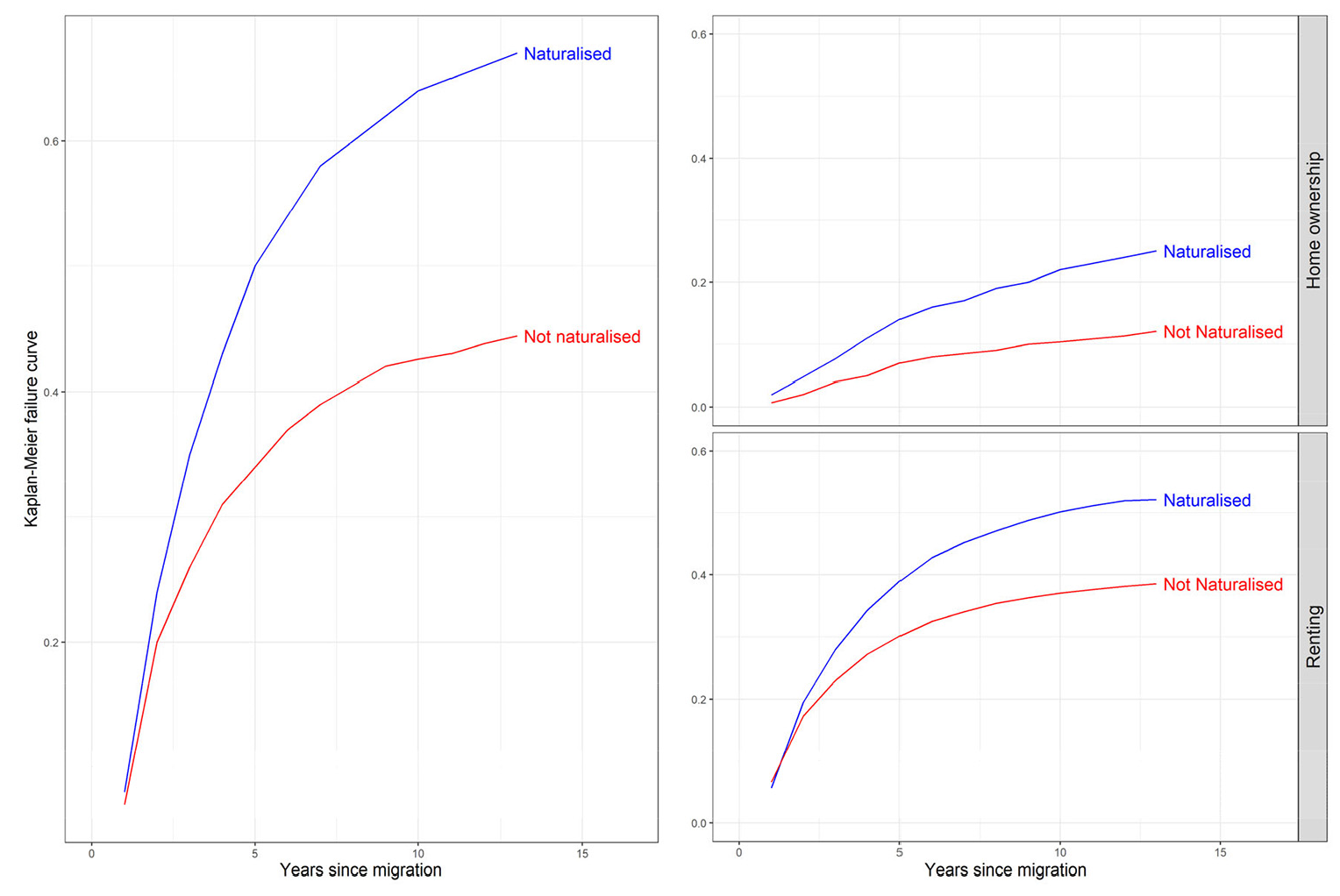
Proportion of individuals who move outside concentrated neighbourhoods.
This is confirmed with the outcome of the first regression (model 1), which suggests that naturalisation is positively associated with mobility outside of migrant-concentrated neighbourhoods. Overall, being a Dutch citizen increases the odds of mobility by 50%, ceteris paribus. Looking at inter-group differences, it is interesting to note that possessing Dutch citizenship is particularly relevant for Turkish and Moroccan immigrants (models 2 and 3), the two largest immigrant groups in our database. 9 While our analysis does not allow us to draw any inferences on why this is the case, one explanation could be that Turkish and Moroccan immigrants are more likely to be confronted with discrimination (Ministerie van Binnenlandse Zaken en Koninkrijksrelaties, 2019). Excluding members of the Turkish and Moroccan communities leads to a reduction in the effect naturalisation has on mobility out of migrant-concentrated neighbourhoods (Hazard ratio: 1.29) (model 4). However, the effect remains positive and statistically significant, thus suggesting that naturalisation is also relevant for other immigrant groups.
Models 5 and 6 take this analysis one step further by focusing on how this mobility is actually achieved. For this, we distinguish between two types of mobility: mobility via homeownership and mobility via renting. The outcome of these two models indicates that naturalisation is relevant for mobility in the rental market (1.51) but also for mobility achieved by purchasing a home (1.44). Additionally, we perform two separate competing risk models in which we distinguish immigrants who receive housing benefits to help pay the rent from those who do not. Although we are not able to draw a clear line between renting in the private or public sectors, we assume here that immigrants who receive housing benefits will be more likely to rent in the social housing sector. As noted earlier, we expect discrimination to occur more prominently in the private sector than in the social housing sector. Model 7 confirms this assumption and shows that naturalisation does not have a significant effect on mobility for those renting with housing benefits, while model 8 shows that naturalisation is particularly relevant for immigrants who rent without housing benefits. Overall, this analysis confirms our assumption that naturalised immigrants are more likely to move out of concentrated neighbourhoods (hypothesis 1), with the exception of immigrants who benefit from housing benefits after they achieve mobility through renting (Figure 2).
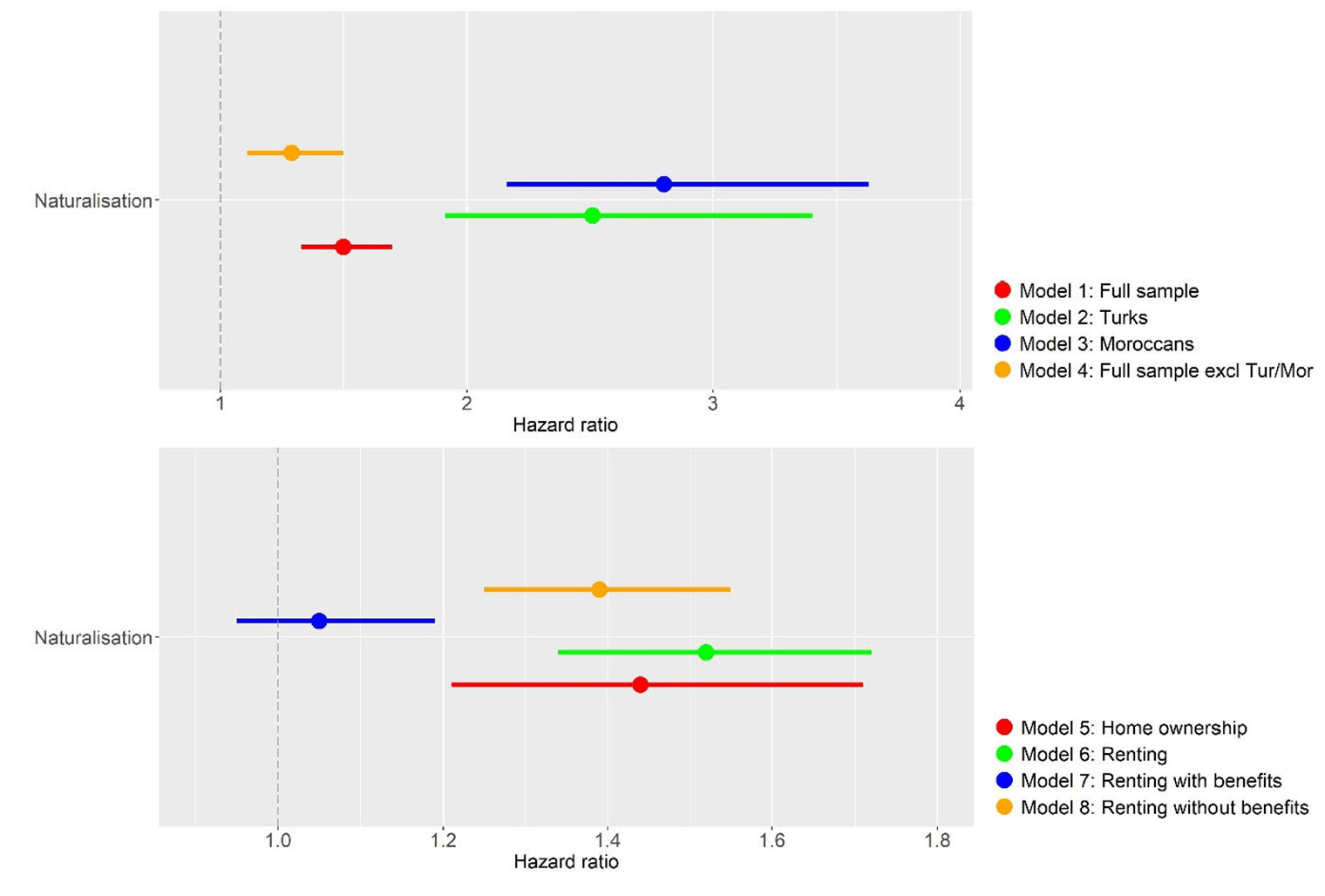
Effect of naturalisation on immigrants’ mobility outside concentrated neighbourhoods (Models 1 to 8). Dots denote hazard ratios from Cox-regression and horizontal lines correspond to 95% confidence intervals. All models include all controls.
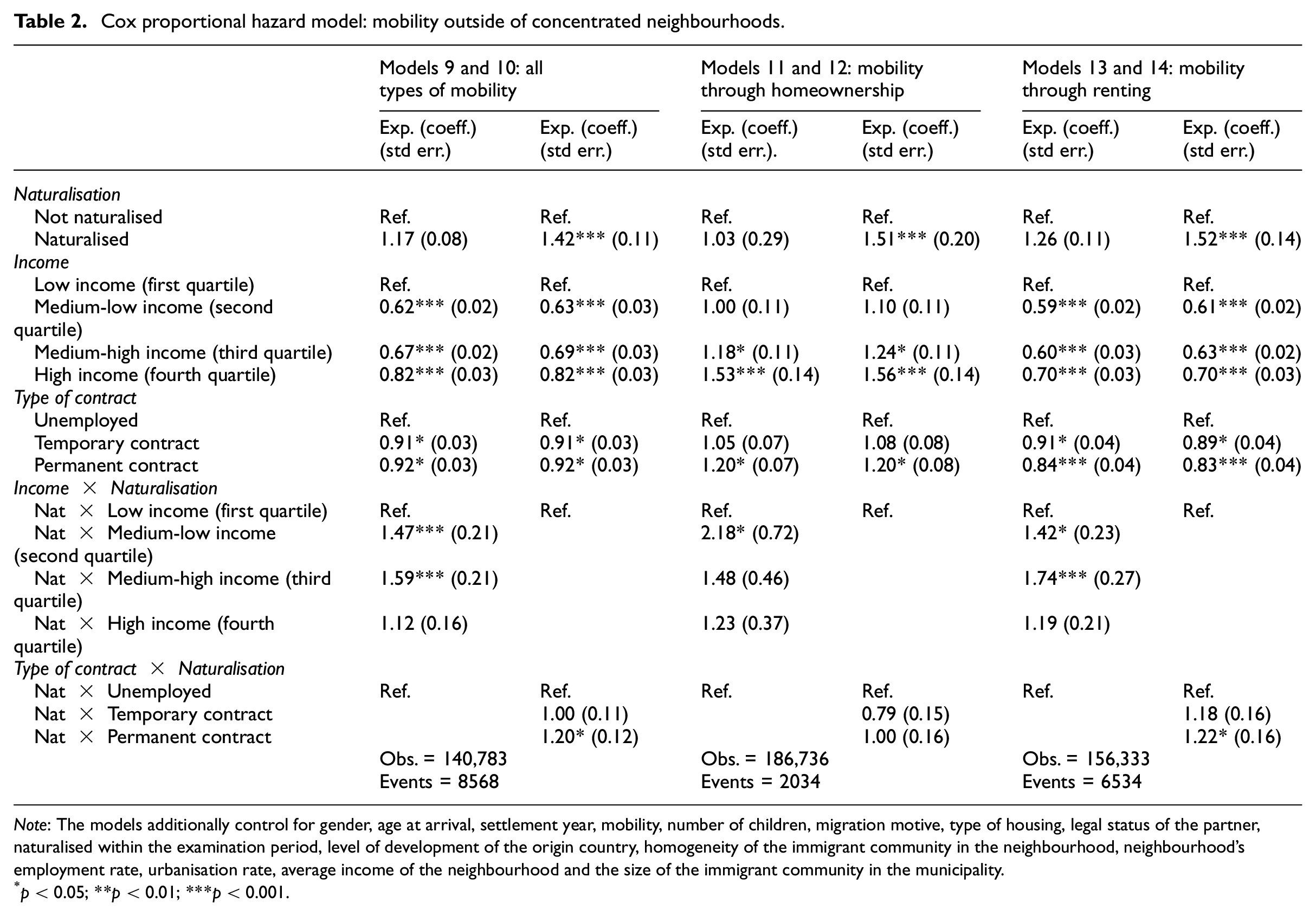
To further analyse the effect of naturalisation on residential mobility, we test whether the importance of naturalisation holds for all income groups and all types of job contract (Table 2). We start our analysis with two Cox proportional hazard models (models 9 and 10), pooling both types of mobility. For individuals with a low income (first quartile), model 9 suggests that naturalisation does not have a significant effect on mobility. However, the effect of naturalisation increases for individuals who are situated in the low-medium and high-medium income categories in comparison with individuals who are in the first quartile (interaction term of, respectively, 1.47 and 1.59). This is in line with our second hypothesis. Regarding type of job contract, model 10 shows that the effect of naturalisation is positive and statistically significant for unemployed individuals (HR: 1.42). Yet, it becomes stronger for individuals holding a permanent contract (interaction term of 1.20). This lends support to our third hypothesis.
Cox proportional hazard model: mobility outside of concentrated neighbourhoods.
Note: The models additionally control for gender, age at arrival, settlement year, mobility, number of children, migration motive, type of housing, legal status of the partner, naturalised within the examination period, level of development of the origin country, homogeneity of the immigrant community in the neighbourhood, neighbourhood’s employment rate, urbanisation rate, average income of the neighbourhood and the size of the immigrant community in the municipality.
p < 0.05; **p < 0.01; ***p < 0.001.
Looking at specific forms of mobility gives a more nuanced picture. As shown in model 11, naturalisation does not seem to matter for low-income individuals who have made the transition out of migrant-concentrated areas through homeownership (HR: 1.03). In line with our hypothesis, the value of the interaction term indicates that the importance of naturalisation increases for individuals situated in the second category of income (interaction term of 2.18). However, contrary to our expectations, the effect of naturalisation on mobility through homeownership is not conditioned by the type of job contract held by a migrant (model 12). Put together, these two findings may suggest that income is viewed by mortgage lenders as a better indicator of low financial risk than the type of job contract one holds. 10 Regarding mobility through renting, model 13 shows that naturalisation does not have a significant effect on mobility for individuals who are within the lowest income quartile. However, it becomes more relevant for individuals situated within the second- and third-income quartiles (interaction coefficients of, respectively, 1.42 and 1.74). Regarding the type of job contract, the effect of naturalisation rises significantly for individuals who have a permanent contract (model 14). Overall, these findings corroborate our second hypothesis. Our third hypothesis is, however, only validated for individuals who have moved within the renting sector.
Conclusion
It has been widely observed that immigrants who wish to change neighbourhoods are constrained in their mobility by housing market discrimination (Alba and Logan, 1991). Most studies focusing on this issue have paid particular attention to taste-based discrimination, often disregarding statistical discrimination based on nationality. This paper has addressed the latter by investigating the relation between citizenship acquisition and immigrants’ mobility outside of migrant-concentrated neighbourhoods. Drawing on literature that highlights the signalling effect that naturalisation has for employers and mortgage lenders in the job and housing markets (Peters, 2020; Peters et al., 2018), we have argued that naturalisation can act as a positive signal for landlords, real estate agents and mortgage lenders and help to reduce statistical discrimination in the housing market. As a result, it can facilitate immigrants’ mobility outside of concentrated neighbourhoods. Because we expected statistical discrimination to occur more often for mid-risk applicants for mortgages and rental housing, people whose applications often fall under intensive scrutiny, we hypothesised that the effect of naturalisation would be stronger for individuals who have an income situated around the median value. Moreover, we argued that housing market actors would be more likely to rule out applicants who do not hold a secure job. From this perspective, we expected the impact of naturalisation to be stronger for immigrants who have a permanent contract.
Overall, we find that naturalised immigrants are 50% more likely to move out of a concentrated neighbourhood, all covariates held constant. This effect is stronger for Turkish and Moroccan immigrants, two groups that commonly suffer from discriminatory practices (Ministerie van Binnenlandse Zaken en Koninkrijksrelaties, 2019). The outcome of the competing risk models moreover implies that naturalisation is viewed positively by landlords, real estate agents and mortgage lenders. Conversely, our findings suggest that possessing Dutch citizenship may be less relevant for immigrants moving into social housing. This seems to be in line with previous studies that do not report cases of discrimination in the social housing sector (Sociaal en Cultureel Planbureau, 2009). Further studies offering a better estimation of the distinction between public and private housing will, however, be needed to confirm these latter findings.
As we hypothesised, naturalisation matters more for immigrants with an income situated around the median value. However, possessing a permanent job contract is only a relevant condition for individuals moving in the renting sector. This implies that how the effect of naturalisation is conditioned by an individual’s economic situation depends on the kind of housing market actors the person has to deal with. It also suggests that income may be considered by mortgage lenders a better indicator of economic stability than the type of job contract.
Our results corroborate previous studies that have found evidence of the existence of a citizenship premium in the Dutch housing and labour markets (Peters, 2020; Peters et al., 2018). The paper also contributes to the literature on immigrant mobility in the Netherlands (Bolt and Van Kempen, 2010; Zorlu and Mulder, 2008).
Overall, our findings support the idea that naturalisation should not only be viewed as the crown of the completed integration process but should also be considered a facilitator of integration. At a time when the Netherlands is considering increasing the language requirement for naturalisation, which may significantly delay the naturalisation procedure for already vulnerable immigrants, these findings raise questions regarding the appropriateness of such restrictions.
This paper is the first to analyse the relation between naturalisation and immigrants’ propensity to move out of migrant-concentrated neighbourhoods. We have outlined an original theoretical framework, drawn from prior literature on citizenship and residential mobility. Further research will be needed to refine the argument we have developed in this paper. It would be interesting, for instance, to see if the relation between naturalisation and mobility holds in the long run for naturalised immigrants who leave concentrated neighbourhoods but decide at a later point to return to live among members of their own ethnic community. Moreover, it is important to point out that, because of data restrictions, we do not control for several factors that could possibly affect the moving decisions of immigrants, such as market buoyancy, public services provision and crime rates. We also do not include information on the range of possible destinations as is traditionally done in literature focusing on market equilibrium (Kuminoff et al., 2013). Finally, the empirical strategy of this paper aims to analyse the extent to which hypothesised relationships are in line with the data, but is not geared towards causal inference. Hence, we invite further research to establish the causal effect of citizenship on residential mobility among immigrants.
Supplemental Material
sj-pdf-1-usj-10.1177_00420980211006030 – Supplemental material for Citizenship acquisition and spatial stratification: Analysing immigrant residential mobility in the Netherlands
Supplemental material, sj-pdf-1-usj-10.1177_00420980211006030 for Citizenship acquisition and spatial stratification: Analysing immigrant residential mobility in the Netherlands by Christophe Leclerc, Maarten Vink and Hans Schmeets in Urban Studies
Footnotes
Declaration of conflicting interests
The author(s) declared no potential conflicts of interest with respect to the research, authorship and/or publication of this article.
Funding
Replication material
Register data for the analyses in this paper were made available by Statistics Netherlands. The data use agreement does not allow us to disclose individual-level data. Information about access to the microdata of Statistics Netherlands is available here: https://www.cbs.nl/en-gb/our-services/customised-services-microdata/microdata-conducting-your-own-research. Replication code is available here:  .
.
Supplemental material
Supplemental material for this article is available online.
Notes
References
Supplementary Material
Please find the following supplemental material available below.
For Open Access articles published under a Creative Commons License, all supplemental material carries the same license as the article it is associated with.
For non-Open Access articles published, all supplemental material carries a non-exclusive license, and permission requests for re-use of supplemental material or any part of supplemental material shall be sent directly to the copyright owner as specified in the copyright notice associated with the article.
