




Abstract
We combine theory and evidence on incubator and accelerator programmes and their effects on urban economic development. These structured co-working programmes have grown rapidly. However, a rich descriptive literature reveals little about their impact on participants or surrounding urban areas. We situate programmes in a conceptual framework of co-location tools, theorise objectives and benefits and report findings from systematic, OECD-wide reviews of the evaluation literature. These evaluations provide evidence that accelerators and incubators raise participant employment, with accelerators also aiding access to finance. Ecosystem features such as university involvement and urban economic conditions also influence programme outcomes. However, evaluation evidence is less clear on detailed intervention design. We consider wider lessons and lay out an agenda for future research.
Introduction
A large literature documents the positive effects of geographic concentration on innovation and entrepreneurship, at neighbourhood, urban and regional scales. Innovation influences economic development: new ideas advance the technological frontier and increase productivity (Romer, 1986); entrepreneurs are ‘carriers’ of these ideas (Freeman, 1991; Schumpeter, 1962). Both innovation and entrepreneurship require learning from others, involve experimentation and carry a high risk of failure (Kerr et al., 2014). Geographical concentration is one way to facilitate creativity and ideas exchange, reducing entrepreneurial risk. Co-location tools are thus a potentially important part of urban economic development policy.
Most work on geographic concentration focuses on clusters. Clustering is ‘associated with pervasive market failures’ (Duranton, 2011: 4), so government intervention can, in principle, improve on market outcomes. In practice, the case for and effectiveness of cluster policies have been contested (Duranton, 2011; Martin and Sunley, 2003). In contrast, we focus on smaller-scale co-location programmes: incubators and accelerators that co-locate startups or individual founders, typically at a single site. Incubators typically act as ‘clubs’– co-working space with some business support added on, and firms renting space on flexible contracts. Accelerators are more akin to ‘bootcamps’– combining co-location with intensive training, networking and mentoring offered to competitively selected firms, over shorter time periods. With roots in the technology industry and in earlier co-location practices, such programmes are a growing presence in many cities (Hausberg and Korreck, 2020; Schmidt and Brinks, 2017). In the UK, for example, accelerator participation has risen by 78% per year since 2014 (Beauhurst, 2018). While incubators are evenly distributed across UK cities and towns, especially those with universities, accelerators are more urbanised, with over half of provision in London, and the rest largely in conurbations such as Manchester, Birmingham and Bristol (Bone et al., 2017).
Strong claims are made for both incubators and accelerators. Proponents argue that they help young firms develop new ideas, strengthen business models, attract external investment and increase sales (Phan et al., 2005). Birdsall et al. (2013) argue that firms graduating from the top US accelerators have 10–15% higher survival rates after five years and have earlier, higher rates of acquisition than comparable companies. Programmes 1 may also benefit surrounding clusters (Bliemel et al., 2019) and the wider urban economy (Markley and McNamara, 1995), for example by bringing external finance to local non-accelerated businesses (Hochberg and Fehder, 2015). Many programmes also receive public funding: one recent review identified at least 13 national innovation policies providing direct incubator or accelerator support (Audretsch et al., 2020). 2 In the UK, over half of incubators and accelerators are at least partly publicly funded, with the average receiving over £187,000 per year in UK or EU government support (Bone et al., 2019).
There is now an extensive descriptive and case study literature on incubators, accelerators and co-working spaces (e.g. Bound and Miller, 2011; Dee et al., 2011; Hackett and Dilts, 2004; Mian et al., 2016; Ng et al., 2019; Phan et al., 2005; Schmidt and Brinks, 2017). However, actual impacts on participants, let alone those on surrounding urban economies, are rarely discussed (Bone et al., 2019). Given the rapid growth in incubators and accelerators, the increasing role of public sector support and the broader links between innovation and entrepreneurship policy, now is a good time to review theory and evidence.
This raises conceptual and practical research questions. First, what are the causal effects of programmes, especially when entry is competitive? If the best participants might have ‘done well’ anyhow, the real effect could be minimal. Second, what roles do specific policy design and higher-level local ecosystem 3 features play? For example, what is the importance of design features such as participant mix or length of stay, versus the role of local universities (Valero and Van Reenen, 2018)? Third, who benefits? Co-location tools may be useful as a response to rising rents. They may also help female and minority ethnic entrepreneurs (for example) navigate structural economic barriers (Lyons and Zhang, 2017) – providing such groups can access the programmes (Stam, 2015).
This article makes three contributions to answer these three questions. First, we situate accelerators and incubators within a larger family of co-location programmes. We develop a parsimonious typology for delineating these programmes based on tenant density, the extent of programme curation and the actors involved. Drawing on a range of literatures, we formalise incubator and accelerator design as sitting on a spectrum from unstructured (e.g. simple co-location) to structured interventions (e.g. intensive learning), and describe how these might benefit participating firms.
Second, we summarise robust evaluation evidence on programme impacts, derived from systematic reviews of studies from OECD countries up to 2018. 4 Within a very large literature, these focus on 14 studies that are the small subset aiming to identify causal effects. We use our conceptual framework alongside other evidence (such as exploratory or descriptive analyses) to help frame the findings from these studies. We also draw on interviews with policymakers and programme operators. We assess overall effectiveness, design features and distributional aspects, and draw out policy lessons and wider reflections for future research.
This is the first article we are aware of to conduct such a focused theoretical and empirical exercise for incubators and accelerators. The closest comparator is Hausberg and Korreck (2020), who do not apply evidence thresholds to included studies and do not include the majority of the studies in our review. 5 Our approach has parallels with developments in the science parks literature, where a large body of inconclusive descriptive work (reviewed by Siegel et al., 2003) has been succeeded by a wave of evaluations aiming to identify causal effects (Albahari et al., 2017; Arauzo-Carod et al., 2018; Lamperti et al., 2017; Vásquez-Urriago et al., 2016).
We draw five main lessons. First, both accelerators and incubators have positive impacts on participant outcomes, in particular in relation to employment (and, for accelerators, in relation to access to finance). Second, programmes may help ‘non-typical’ firms, such as female- or BAME-headed businesses, where founders may have trouble accessing mainstream economic institutions. Third, programme effectiveness varies by ecosystem features. Accelerators are most effective when located in dense entrepreneurial ecosystems; incubators may be more effective with university involvement. Fourth, evidence of programme effectiveness could increase the price of this type of urban real estate, especially in locations where programmes are most effective, and if demand for permanent office space in cities falls post-lockdown.
Fifth, outcomes for non-profit programmes suggest a potential role for urban public policymakers. However, the impact of detailed design choices is still poorly understood; for example, there is no clear evaluation evidence on the relative importance of funding, mentoring and networking, or the optimal length of tenancy. Providers and policymakers should further test for optimal designs.
We conclude by setting out suggestions for a broader research agenda: testing design features; cross-country and area comparisons; evaluating more structured (accelerator) against less structured (incubator) approaches; and exploring linkages between programme presence and cluster and urban economic performance.
Conceptual framework
In this section, we draw on a range of literatures, as well as semi-structured interviews carried out with policymakers and programme operators (Numbered I1–I8), to develop a conceptual framework. First, we locate accelerators and incubators within a larger family of co-location programmes, using a simple typology to distinguish key features and objectives. We then highlight two key drivers of recent programme growth. Finally, we use these building blocks to formalise what programmes offer to participating firms.
A typology of co-location programmes
Policymakers have directly or indirectly provided subsidised workspace for small firms for decades. In the UK, direct provision dates to the 1960s, with a shift to indirect provision through planning obligations after the 1990s (Ferm, 2014). We should thus view accelerators and incubators as part of a larger ‘family’ of co-location-based urban economic development tools – including science parks, industrial estates and service offices. We link these tools via a simple typology: the density of tenants, the level of programme curation and the number of actors involved (Figure 1).
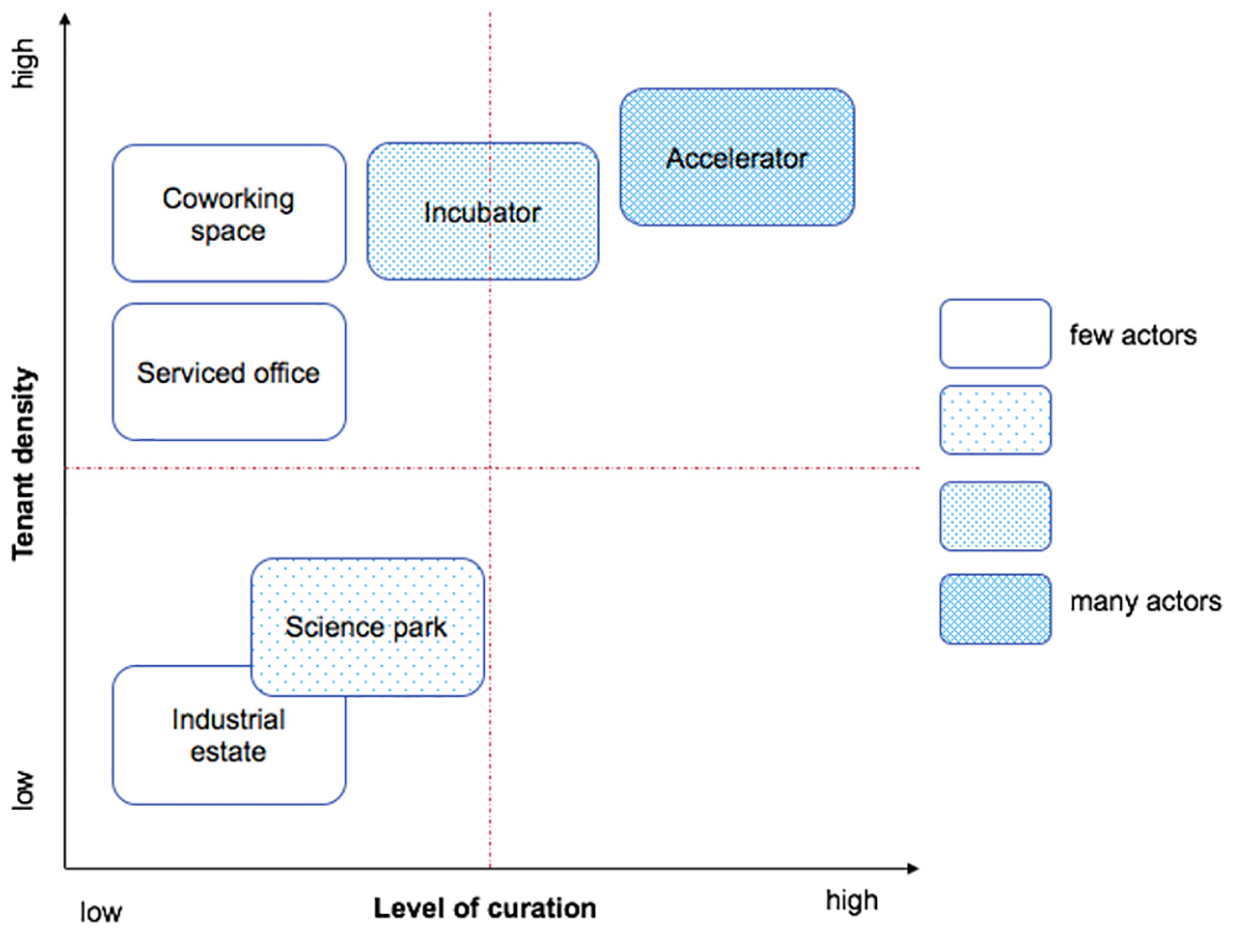
A typology of co-location programmes.
Of the larger, less dense spaces, industrial estates provide space for urban manufacturing, logistics, distribution and workshops (Wainwright, 2017). Here the emphasis is on input-sharing and flexible commercial space, with minimal additional business support. Science parks allow a range of input-sharing, from university labs and researchers to meeting rooms and cafeterias (Ng et al., 2019; Phan et al., 2005). Many parks also offer business advice and may help manage companies, especially when universities are involved (Albahari et al., 2017).
Serviced offices are aimed at established businesses: fully fitted-out office buildings offering modular space where the emphasis is on input-sharing. Co-working spaces have similarities with incubators – in terms of physical set-up, input-sharing and business models aimed at early-stage firms and based on low-cost flexible rents. However, accelerators and incubators are distinct from other smaller, denser spaces in the extent to which participants are selected and their interactions are structured or ‘curated’ by providers, and in the number of other actors involved in business support activity.
We summarise the distinguishing features of incubators and accelerators in Table 1, using co-working spaces as a benchmark. Incubators typically offer relatively ‘light-touch’ support for young firms, with the emphasis on cheap shared space offered on rolling (typically monthly) contracts. Rents may be cross-subsidised by public grants or other lines of business. Entry selection is usually based on encouraging a mix of activities; exit is usually ‘organic’, as firms grow out of the space or go out of business (Interviewees 1, 3, 4). Incubators may run networking events and provide ad hoc training (e.g. in accounting). External mentorship is also provided but is often minimal and tactical (i.e. advice as needed), as opposed to the more intense scheduled provision offered by accelerators.
Accelerators, incubators and co-working spaces.
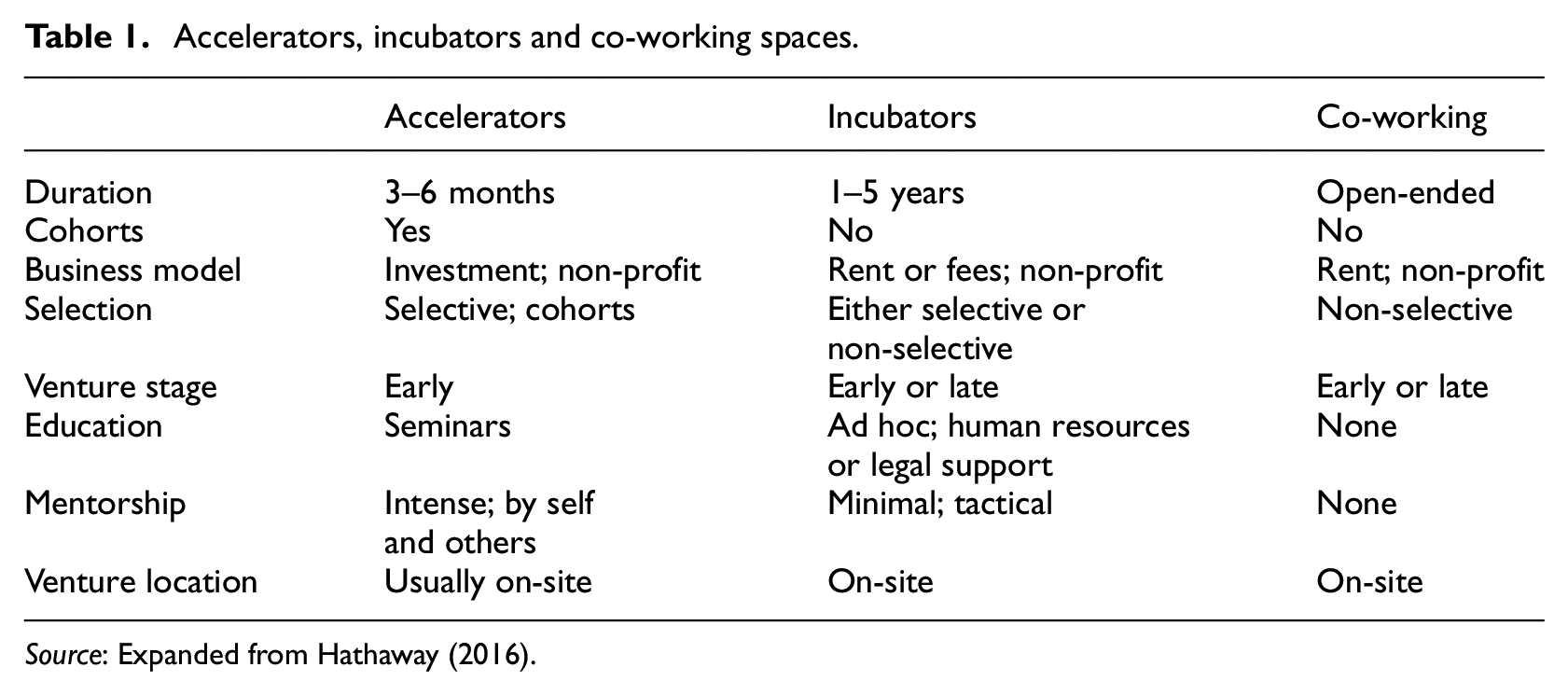
Source: Expanded from Hathaway (2016).
Accelerators use competitive entry and intensive support for early-stage firms, typically over 3–6 months. While increasingly funded by governments, universities or philanthropy, the best known are operated by venture capitalists or big corporates who take equity stakes in participating companies (Beauhurst, 2018; Bone et al., 2019). Participants are usually provided with an on-site workplace, business skills training and intensive mentoring and networking activity, culminating in a demo day where companies pitch to investors, programme alumni and other industry figures. Entry is typically highly competitive. For instance, top US accelerator TechStars has two application seasons per year, accepting less than 1% of the several thousand startups applying. Depending on the programme, each ‘cohort’ of participants may cover a mix of industries or be highly specialised.
Drivers of provider growth
Two connected forces help explain the growth of accelerator and incubator provision, especially in urban areas. The first is the increasing number of entrepreneurs and their demands for information, advice and support. In the past two decades, company formation and running costs have fallen substantially (Ewens et al., 2018). Technology entrepreneurship, in particular, has grown very strongly (Brynjolfsson and McAfee, 2014). Entrepreneurial lifestyles have also become more common, reflecting shifts in preferences and desired professional identities (Schmidt and Brinks, 2017). At the same time, weaker economic conditions in many European countries since 2007 have contributed to rising self-employment (Hatfield, 2015; Merkel, 2019); in the UK, over 15% of the workforce is now self-employed, up from 12% in 2001 (Yuen et al., 2018). For some groups, such as some migrant and minority ethnic communities, self-employment may be the only feasible response to labour market discrimination (Kloosterman and Rath, 2001).
The second driver is competing demands for space, especially residential versus commercial uses in large post-industrial cities such as London, New York, Stockholm or Berlin (Hamnett and Whitelegg, 2007). Unsurprisingly, co-working has grown most rapidly in cities with big local tech scenes and expensive housing (Zukin, 2020). Business models that raise the effective density of a given building – such as co-working or incubator spaces – help mitigate these conflicts, facilitating access to central city neighbourhoods. Many variants can be offered in a single building, in combination with cafes, restaurants and retail, increasing landlord yields. These real estate forces reflect deeper urban structure changes. Long-term shifts from manufacturing to services have increased employment in activities for which co-working is relevant (Moretti, 2012). 6 A shift to smaller, more networked firms increases the benefits of sharing physical inputs. Space-sharing may also be beneficial if multi-site firms employ small headcounts in each location.
So far, this account implies that accelerators are primarily responding to the growth in entrepreneurship and self-employment, while co-working and incubator spaces are essentially real estate innovations. In practice, many programme providers have diversified income streams by combining incubator and accelerator elements (I4). Accelerator programmes that own or lease spaces can increase revenues by providing desks or workspace in between their core programmes; incubators can – increasingly – pick up public grants to run accelerators in parts of their spaces (I1, I3, I4, I8). For incubators, helping tenants’ survival and growth can also help ensure income flow, move tenants into more expensive space (from hot-desking to offices, for example) and attract new entrants (I1, I3, I4).
What advantages do accelerators and incubators offer to firms?
We now turn to the key features of incubators and accelerators and how these might affect outcomes for participating firms. We set out how design sits on a spectrum of less structured to more structured, from simple input-sharing to intensive learning, which providers use in different combinations. We draw on a range of theoretical perspectives, alongside existing reviews of co-working spaces (Bound and Miller, 2011; Schmidt and Brinks, 2017), business incubators (Dee et al., 2011; Hackett and Dilts, 2004; Mian et al., 2016; Phan et al., 2005) and science parks (Ng et al., 2019; Phan et al., 2005).
Unstructured co-location
Accelerators, incubators and co-working spaces all co-locate participants in the same building or room. We can theorise such co-location as creating ‘cities in miniature’, where participants benefit from localised agglomeration economies. Following Duranton and Puga (2004), co-location may generate two benefits in particular: ‘sharing effects’ cut costs by pooling inputs (such as workspace, broadband and IT support); and ‘learning effects’, or knowledge spillovers, arise from chance interactions within the space. If such interactions help firms identify partners or collaborators, they generate ‘matching effects’. Programmes might also generate diseconomies of agglomeration, such as poaching of ideas if secrecy is hard to maintain.
Different programme types use co-location in different ways. Co-working spaces rely on unstructured co-location, without pre-selecting participants. In contrast, as we discuss below, incubators select participants and structure their interactions; accelerators further combine this with intensive learning.
A ‘cities in miniature’ approach alone is effective only if close physical proximity provides benefits over and above everyday urban interactions. For example, knowledge spillovers exhibit substantial distance decay, especially for complex activities requiring face-to-face interaction (Jaffe et al., 1993; Kerr and Kominers, 2015), for example in professional services (Arzaghi and Henderson, 2008) and tech and creative industries (Hutton, 2008; Martins, 2015). Co-location within a building or room may therefore be better for ideas generation and knowledge exchange than simply locating in a city. However, programme effectiveness may also partly depend on the wider environment/ecosystem: large, dense urban locations may offer complementary benefits (say, networks of expertise, partners, collaborators, funders), but also imply greater competition.
Curating and structuring interactions
Incubators and accelerators typically combine co-location with (a) selective entry, and (b) structured interactions between participants and others in the shared space. We can formalise this as providers attempting to optimise various ‘proximities’ between firms. Many economic geographers (Boschma, 2005; Boschma and Frenken, 2009; Torre and Rallet, 2005) see physical co-location as one of several proximities shaping outcomes, particularly in contexts involving researcher collaboration and knowledge-intensive work.
Just as norms and untraded interdependencies shape the nature of interactions in cities (Storper, 1997), so interactions within a co-located programme may be shaped by social proximity (e.g. through friendship), organisational proximity (e.g. working in the same firm), cognitive proximity (e.g. the same subject background) or institutional proximity (e.g. common norms). Boschma argues that proximities can be complements or substitutes – for example, ‘too much proximity’ can be detrimental if it leads to groupthink. In contrast, Menzel (2015) and Ibert and Müller (2015) suggest that co-location bridges multiple ‘relational distances’, where physical closeness strengthens linkages over time.
This view implies that curating participants and overseeing at least some interactions is necessary for programme effectiveness, over and above unstructured co-location. While the ‘best’ mix of participants and interactions will be partly programme-specific – providers often select on nebulous qualities such as ‘attitude’ and ‘fit’ (I3, I4, I6) – we can pick out cross-cutting issues. In theory, specialised programmes could leverage Marshallian knowledge spillovers within a single industry space; generalist programmes could exploit Jacobs-style cross-industry spillovers. However, single-industry or highly selective programmes may limit learning if they draw from a cognitively or institutionally narrow set of participants. Conversely, ‘too much diversity’ along these dimensions may limit what participants can learn from each other, and create frictions in interactions (Page, 2007). To mitigate such frictions, providers may seek to develop a strong collective identity, to encourage specialised subgroups and to bring in external speakers and wider professional networks (I1–5, I8).
Intensive learning
Accelerators combine co-location, selective entry and structured interaction with intensive training. If entrepreneurship is a Schumpeterian process of ‘experimentation’ (Howell, 2017; Kerr et al., 2014) or ‘noisy learning’ (Aghion et al., 1991; Lerner and Malmendier, 2013), then entrepreneurs typically operate under imperfect information, as well as bounded rationality (Cohen et al., 2019b). Improving firms’ information and decision-making may increase their chances of success: in particular, providing expert knowledge and contacts which would otherwise be costly to obtain, or whose importance might not be understood ex ante. Accelerators thus aim to improve the entrepreneurial process through reducing trial and error and speeding up discovery (Hallen et al., 2020). As many accelerators are highly competitive, participation itself can also act as a quality signal, de-risking funder-side decisions: we can expect these signalling effects to be more prominent the higher the programme’s profile.
In principle, accelerator programmes could operate like conventional business support interventions, without shared space: a few do run virtually (I6, I7). However, the vast majority offer workspace because they seek to leverage the affordances of co-location: for example, Cohen et al. (2019a) suggest that nearly 80% of US accelerators do so. Sharing space and peer interaction (a) ease the delivery of formal training, reducing co-ordination costs, and (b) are a complement to it, through sharing/matching/learning effects for participants (I2, I5). Selective entry and structured interactions further refine these processes. This complex design raises important questions about the relative effect of each ‘treatment’– co-location, versus mentoring and networking; expert advice; and encouraging individual learning and reflection. A further implication of this approach is that programmes may help participants to realise that a given idea is not viable. If ‘fixing bad ideas’ involves disbanding or reconfiguring firms, programmes have an ambiguous effect on firm survival, even if surviving firms then perform better than they would have done otherwise.
Synthesis
Overall, we see co-working, incubation and acceleration programmes as operating on a continuum from unstructured to structured interventions. Co-working spaces rely exclusively on an unstructured ‘cities in miniature’ approach to generate benefits for participants. Incubators combine co-location with tools to curate participants and structure interactions between them and others; we theorise these in terms of proximities and distances. Accelerators combine the above approaches with intensive learning, which we summarise as ‘de-risking’ entrepreneurship.
These differences naturally feed into programme presentation, marketing and tone. From participants’ point of view, programmes may operate as spaces to develop ‘an entrepreneurial self’, as well as to develop their venture (Gill and Larson, 2014). Different business models emphasise different community aspects (Schmidt and Brinks, 2017): accelerators typically emphasise individual achievement over collective success (Bound and Miller, 2011). By contrast, many co-working spaces and incubators are positioned in terms of shared values or working conditions – providers see themselves as ‘mothers’, ‘hosts’ or ‘social gardeners’ creating contexts where any participant can succeed (Merkel, 2015; Peluffo, 2013).
Evidence review: Methodology
We now turn to programme outcomes, which we analyse using systematic reviews. Systematic reviews are a method for structured literature reviews, using iterated search parameters, multiple searches and transparent rules for selecting and ranking evidence (Gough et al., 2013). In this analysis, we use the five-stage approach developed by the What Works Centre for Local Economic Growth (2016). Supplemental Appendix A details the review methodology, which we summarise below. 7
The first stage entails consulting policymakers, academic experts and existing reviews to agree topic and scope. The second stage develops comprehensive search terms and locates evaluations through a combination of database search and snowballing. The third stage entails selecting evaluations that are (i) quantitative policy impact evaluations of incubators and accelerators, (ii) from OECD countries, and (iii) in the English language (with some exceptions). The fourth stage scores these impact evaluations using the Maryland Scientific Methods Scale (SMS), a five-point scale based on methodological robustness (specifically, internal validity). We include evaluations that score ‘2’ or higher (see Supplemental Appendix A). This means that we keep all evaluations that use a method that makes some sort of counterfactual comparison and make some attempt to control for differences between treated and untreated units.
This approach is tightly focused. Our initial searches turned up hundreds of studies. However, after filtering for methodological relevance and robustness in the ‘sift’ and ‘score’ stages we end up with 14 impact evaluations. 8 Supplemental Appendix B provides a list of the evaluations, with ID numbers and full references. Seven evaluations examine accelerators, and four examine incubators. An additional three evaluations do not distinguish between accelerators and incubators and are included in both reviews. The size of this evaluation evidence base compares well against other reviews, even when these do not use quality restrictions. For example, Hausberg and Korreck (2020) include 12 studies looking at programme outcomes from an initial 347 returns, of which we would include only five. This gives us confidence that our review is picking up a substantive body of additional robust evidence.
The final stage reports evaluation findings. To reflect the balance of the evidence, we organise findings by outcome, use vote counts (i.e. counting the number of impact evaluations that find a positive impact on some outcome X), then interpret results, using evidence quality rankings to inform our understanding. In the tradition of ‘realist synthesis’ (Pawson, 2006), we also use material from relevant qualitative and descriptive studies to help interpret our findings. Many of the non-evaluation studies used are drawn from studies retrieved in the search stage. In order to further bolster the evidence, we also draw on our semi-structured interviews with incubator and accelerator providers, as well as industry and academic experts.
For the task at hand – uncovering evidence for the effectiveness of co-location tools – the advantage of this approach is that it combines a wide remit with a narrow focus. The comprehensive searches mean that we consider almost everything for inclusion, but the careful sifting and scoring means that our findings reflect only the strongest evaluations: those where estimates can reasonably be attributed to the policies considered. Drawing on other bodies of evidence, as well as practitioner views, then enriches interpretation. This is arguably the most useful way of synthesising evidence for policymakers, if they care most about knowing what works and why.
Evidence review: Findings
We now return to our three research questions. In what follows, we give each study an ID number. Full references, country details and SMS scores for studies are given in Supplemental Appendix B.
Overall impacts
Both accelerators and incubators aim to help firms grow. We find that both have positive impacts on employment. There is more evidence for accelerators than incubators: three evaluations featured find that accelerators have a positive effect (evaluations 179, 105, 103). Two further evaluations also report positive effects, but they pool both accelerators and incubators (202, 235).
Accelerators also aim to improve participants’ access to external finance. Five evaluations test accelerators’ effects on firms’ external funding (e.g. from angel investors or venture capital firms). Five find positive effects (179, 101, 103, 104, 106), one no effect (105). We found no evaluations looking at incubators and external finance; given their objectives and business models (see second section), this is not surprising.
A third marker of success is business survival. Five evaluations consider the impact of accelerators on participants’ survival: findings are positive in one case (103), mixed in one (180), zero in one (105) and negative in the other two (104, 106). The negative outcomes can be explained in terms of accelerator design. As highlighted in the third section, they help participants quickly gauge the quality of their ideas, and encourage those with weak propositions to quit early – arguably a positive outcome for the entrepreneur involved. Both interviews (I2, I5, I6, I7) and evaluations (study 104) support this interpretation.
For incubators, only one study (203) looks at survival effects. Focusing on five German programmes, it finds a negative effect for three and no effect for two. Since incubators rely on continued fees or rents, deliberate programme design is unlikely to explain this result. Qualitative evidence points to, inter alia, lower survival rate associations with small firm size (Mas-Verdú et al., 2015), lack of founders’ human capital (Pena, 2004) or lack of effective applicant screening (Aerts et al., 2007). In our framework, this implies ineffective curation by programme providers.
Mechanisms: Programme features
Our review presents two ‘structural’ challenges when looking at programme design (rather than overall effects). First, most impact evaluations do not consider design features in detail or at all. Second, when comparisons are made, they no longer involve a carefully selected control group, but rather compare different participants across different types of programme. Thus, it is more difficult to assign estimates as effects of programme design elements, rather than as a reflection of the type of participants in each case. With those caveats in mind, we start by looking at the basic features of programmes, such as ‘treatments’, participant mix and length of intervention. We then turn to higher-level ecosystem features.
What mix of treatments is most effective? The only direct evidence is for accelerators, and it is inconclusive. One study (106) combines a quantitative impact evaluation with participant interviews: these stress the importance of intensive learning – structured learning, mentoring and advice – but also of structured and unstructured interactions with others in their cohort. That is, all elements of an accelerator programme complement each other. Participant interviews in Australia reported by Seet et al. (2018) suggest that mentors and outside experts are especially helpful, as do US startups interviewed by Christiansen (2014), who flag mentoring and networking to be among the most valuable features of programme participation. However, Cohen et al. (2019a), also surveying US accelerators, suggest that external mentorship and (in some cases) co-working space are associated with poorer financial outcomes. Overall, it is not clear whether more or less structured elements of accelerators are most helpful.
For incubators, there is no direct evidence, but other user surveys highlight curated/structured elements, such as mentoring, networking and peer feedback (Chan and Lau, 2005; Merkel, 2015). This implies that incubators’ basic model may be effective if well implemented.
What industry mix is optimal? For accelerators, our evidence suggests that it is not a factor at all; rather, human capital (study 103) and founders’ social networks (179) are more important than the industry that the startup enters. For incubators, three evaluations (201, 202, 203) find that firms in high-tech industries (e.g. biotechnology, university startups) benefit most from support. This implies that cognitive and institutional proximity matter, with pre-selected participants able to learn a lot from each other. These are also sectors where the ‘liability of smallness’ is larger – that is, there is a viable product which has large up-front costs – and may thus benefit the most from incubation. A further study (204) considers sector mix directly for incubators and accelerators together, again finding that more specialised programmes are conducive to firm survival.
What is the right programme length? Accelerators are time-limited, and here the evidence is not clear: only one evaluation study considers this question (104). Looking at two prominent US accelerators, it finds that time spent in-programme is negatively associated with obtaining external funding; in our framework, longer stays may act as a negative signal to investors. Conversely, Cohen et al. (2019a) find that smaller, longer programmes – which in our framework allow for greater structured and peer learning – are linked to a greater likelihood of raising external finance and achieving high valuations.
For incubators, where stay is open-ended, the question is more salient and more widely considered. Again, findings are mixed, and may be partly explained by differences in provider quality. One evaluation (201) finds that length of time spent in an incubator is associated with lower survival post programme but has no impact on revenue and employment growth. Another finds positive effects on revenues, no effect on survival and negative effects on the likelihood of graduating and getting funded (206). A third finds negative effects on graduating but a positive effect on survival – that is, the longer firms stay in an incubator, the more likely they are to stay in business (205). A fourth reports a negative effect on survival and no effect on sales or employment (201).
Does the type of provider matter? No studies directly compare public and private sector provision, but we do have suggestive evidence. For accelerators, one study (105) finds that public sector, non-profit accelerator programmes can successfully increase firms’ employment and funding. Several studies find that for-profit accelerators are also successful at attracting further funding (101, 103, 104, 106, 179). Study 103 finds that for US private sector-run programmes, quality matters –‘top’ investor-run accelerators had positive effects while others did not, consistent with the signalling role for accelerators we discussed earlier. This is also consistent with Cohen et al. (2019a), who find that participants of investor-sponsored accelerators raise more external funding and achieve higher valuations than the mean startup in their data, and in contrast to participants in government-sponsored programmes. For incubators, both private (for-profit) and public (non-profit) provision appear to be effective. We also find that non-profit provision can promote firm survival (203), sometimes to a larger degree than for-profit incubators, particularly for startups founded by women (201), a point we return to below. Overall, for both programme types, the sustainability of each model is likely to depend on their ability to keep providing returns to investors and/or securing grants.
Mechanisms: Local ecosystems
Perhaps surprisingly, there is more evaluation evidence here than for features of the programmes themselves. First, a number of studies look at the role of local universities. This evidence is richer for incubators than for accelerators, where universities are less likely to be partners (Bone et al., 2019). The evidence suggests that university involvement in incubators tends to positively influence firm survival, but that universities’ effects on other programme outcomes are very variable. Both studies (201, 205) to look at this outcome find that university affiliation improves overall firm survival rates. However, study 201 finds reduced survival rates for firms headed by non-minority group members and study 205 finds a negative impact on graduation from the incubator. Three studies look at employment and revenue (201, 206, 235). Two of these find that university involvement has no effect on employment or revenue (201, 206). However, study 206 finds that using university research increases the likelihood of obtaining venture capital, and the amount of funding. One study finds a positive effect on both revenue and employment. In our framework, this is broadly consistent with spillovers from universities’ intellectual property and resources to participants, and benefits from organisational and institutional proximity between the programme and the surrounding university environment.
Second, the evaluation evidence also suggests that surrounding location makes a difference for programme success. For accelerators, one evaluation (179) finds that accelerated firms located in areas with denser entrepreneurial networks are more likely to increase employment and gain funding. For incubators, one evaluation (201) finds that having denser entrepreneurial networks has no overall impact on revenue or employment but decreases the likelihood of survival. However, for firms headed by minorities, denser networks increase survival (see below). Another study (204) finds that programme design interacts with the wider context – in particular, competitive environments might make networking and training programmes more effective, and specialisation (i.e. housing one type of firm) less effective. Overall, these results imply that locations within cities with dense entrepreneurial systems can magnify success for accelerators, for incubators of certain types and for firms headed by minorities, but may hasten firms’ demise in other cases. In our framework, it is less clear whether these linkages derive from co-location itself (e.g. greater knowledge spillovers or competition in large cities), whether providers structure these localised resources for participants or if there is some combination of the two.
Who benefits?
We have little evaluation evidence on who benefits from programmes, either at the individual or the area level. For accelerators, one study (180) finds that accelerators have positive impacts for the survival of BAME and female-led firms. For incubators, as noted above, study 201 finds that dense entrepreneurial networks as well as non-profit status are associated with higher sale growth for female- and minority-headed firms. These studies do not explain their results. Based on our framework, we can safely say that for founders more likely to be excluded from mainstream economic institutions, some combination of curated entry, structured interactions and intensive learning is driving these outcomes. We can think of this as a (temporary) reduction in physical distance combined with intensive support.
One of the accelerator studies (101) looks at funding outcomes at the city level rather than the firm level. Since this study, too, finds positive effects, it lends support to the idea that the firm-level studies are not simply capturing displacement effects, that is, a redistribution of funding to participant firms away from other local firms. While there are no area-level studies for other outcomes (e.g. employment), the result of this study is somewhat reassuring on displacement effects.
Finally, we found no evaluations directly comparing accelerators and incubators. Given the relatively small number of studies overall, and the overlapping but distinct outcomes for each programme type, we are thus unable to directly judge which programme type performs most effectively.
Discussion
A large body of theory and evidence links physical proximity to innovation and entrepreneurship. Incubators and accelerators use close proximity, among other tools, to encourage creativity and ideas exchange in early-stage firms. They are potentially important tools for urban economic development. We develop new tools for understanding programme features, aims and impacts, and use these to interpret findings from available impact evaluation evidence across OECD countries up to 2018. We synthesise this body of evidence, generating new insights and adding substantive material to previous systematic reviews, notably Hausberg and Korreck (2020).
Incubators and accelerators belong to a larger family of co-location programmes, which can be delineated according to tenant density, extent of programme curation and number of actors involved. Long-term shifts in entrepreneurship and in urban real estate markets help explain their rise, and there is extensive business model hybridisation on the ground. We formalise programmes as running combinations of treatments on participating firms, from the unstructured ‘cities in miniature’ approach of co-working spaces to the intensive, highly structured co-located learning of accelerators.
How effective are these approaches? Our systematic reviews generate five conclusions. First, incubators and accelerators work on the aggregate for participating firms– we find positive impacts on employment for both; and for accelerators, on receiving external finance. Impacts on firm survival are more mixed; for accelerators, forcing bad ideas out is a success measure, but for incubators this result is more problematic. In theory, participant benefits might come at costs to other firms in a city: we find one study that links programmes to higher external finance for all firms in a given urban area, providing some reassurance on displacement.
Second, curated and structured co-location (plus, for accelerators, intensive learning programmes) may be particularly fruitful for members of groups often excluded from mainstream economic activity (e.g. women or members of some ethnic minorities). That is, narrowing physical distance may also be an effective way to narrow other distances. In turn, this foments knowledge exchange in a manner that is efficient, rather than limited to pre-existing social structures.
Third, and relatedly, we have suggestive evidence on some aspects of policy design, especially at the ecosystem level and across user groups. Accelerators work better in dense urban milieux; university involvement can help incubator success; and female- or BAME-headed businesses may benefit even when the average firm does not.
Fourth, our results suggest some lessons for the urban real estate industry. Such programmes may raise landlord profitability by using urban space more intensively. If evidence of programme effectiveness translates into provider profitability, this should increase the price of this type of urban real estate. More broadly, as outlined in the second section, the growth of accelerators and incubators partly reflects structural changes in urban economies. Such programmes may become even more popular in a ‘post-lockdown’ world where demand for permanent office space is falling.
Finally, there is a potential role for public policy. Although accelerators and incubators are often private sector-run programmes, we find no penalty inherent in non-profit programmes. Moreover, private sector programmes will likely prioritise projects that are already ‘well connected’, leaving spaces for the public sector to fill. This implies that the national policy attention given to such programmes, as well as the public funding behind many of them, can potentially improve economic welfare for urban firms and citizens.
Importantly, these results have parallels in related literatures on science parks and researcher co-location. Such studies also highlight the importance of knowledge spillovers from close co-location; links to the wider ecosystem; and cognitive proximity. For science parks, a handful of robust evaluations find positive effects for on-park firms’ employment and sales (e.g. Arauzo-Carod et al., 2018; Colombo and Delmastro, 2002; Liberati et al., 2016). Science park evaluations also find clear effects of park location on innovative activity, typically measured via patenting (Helmers, 2019; Lamperti et al., 2017; Squicciarini, 2008), with effects dying away rapidly with distance (Helmers, 2019). Participant surveys suggest that the most innovative firms on parks are closely connected both to other on-park firms and to local universities, especially if the park is on campus (Chan and Lau, 2005; Soetanto and Jack, 2013). A recent study on researcher co-location also finds evidence of within-building effects on research quality (Catalini, 2018). Other researcher-level studies provide strong suggestive evidence that spillovers are largest for those working in related fields (Boudreau et al., 2012; Chai and Freeman, 2019; Helmers and Overman, 2017).
Nevertheless, there are still multiple knowledge gaps in the evaluation evidence base, and we conclude by identifying three broad sites for future research. First, for firms, we need evidence on which type of support is most effective (e.g. funding, mentoring, networking, etc.), the optimal length of tenancy, programme size and several other features of programme design. Relatedly, we need to better understand how far communications technologies complement or substitute for intensive face-to-face interaction. The forced experiment of lockdown may encourage providers to move some activities online, allowing evaluators to compare online vs in-person delivery in future. We recommend that researchers work with practitioners to fill these and other gaps. Given the need for robust evaluation evidence, an experimentally orientated workflow that combines exploratory observation and more structured designs, using randomisation where possible, is most likely to yield reliable results (Bravo-Biosca, 2019).
Second, there is also a clear need for cross-country and cross-city comparisons: comparing the same programme design in different contexts would allow for better understanding of the role of different institutions, regulations and norms across space. Similarly, we need more studies that directly compare accelerator versus incubator models for the same kinds of firms (e.g. same industry, stage, founder).
Finally, we know little about how programmes affect the broader area. For instance, programme-level evaluation evidence suggests that accelerators are complementary to wider agglomeration forces, specifically the cross-industry matching and learning processes typically found in larger cities (Jacobs, 1969). In aggregate, accelerator provision might then help strengthen a cluster by improving the productivity advantages of cluster location. However, it is unclear what the effect size would be, or what would comprise critical mass – how many spaces are needed, and how many firms should be ‘treated’? Which sectors would most benefit from expansion in provision, or would effects be visible cross-industry? A further question is why, so far, we do not appear to see such linkages for incubator programmes.
Clusters involve positive and negative feedback loops (Nathan and Overman, 2013). Productivity effects grow with cluster size, as the set of knowledge spillovers gets larger and richer; but growing clusters become progressively more crowded and expensive, often displacing smaller or newer firms. Co-working-based interventions can – in theory – simultaneously steepen the productivity curve (by enabling innovation and entrepreneurship) and flatten the cost curve (by more densely co-locating firms in physical space). What might be the effect size of such provision, at what scale, and how might such interventions shape cluster lifecycle trajectories (Boschma and Fornahl, 2011; Martin and Sunley, 2011)? We look forward to future research tackling these issues.
Supplemental Material
sj-pdf-1-usj-10.1177_00420980211004209 – Supplemental material for Incubators, accelerators and urban economic development
Supplemental material, sj-pdf-1-usj-10.1177_00420980211004209 for Incubators, accelerators and urban economic development by Margarida Madaleno, Max Nathan, Henry Overman and Sevrin Waights in Urban Studies
Footnotes
Acknowledgements
Many thanks to our editor at Urban Studies, Chris Leishman, to three anonymous referees and to our interviewees. Thanks also to Suzi Hall, Kat Hanna, Monder Ram and to conference/seminar participants at GCEG 2018, RSA 2017, Birmingham University, Centre for London/Brookings Institution and Liverpool University for comments.
Declaration of conflicting interests
The author(s) declared no potential conflicts of interest with respect to the research, authorship, and/or Nathan and Overman also gratefully acknowledge financial support from the Leverhulme Trust (grant number RPG-2015-375). This paperpublication of this article.
Funding
The author(s) disclosed receipt of the following financial support for the research, authorship, and/or publication of this article: This article is partly based on research conducted for the What Works Centre for Local Economic Growth, ESRC Grant ES/L003945/1, 1/9/2013-28/2/2020. Nathan and Overman also gratefully acknowledge financial support from the Leverhulme Trust (grant number RPG-2015-375). This paper represents the views of the authors, not the Centre or its funders.

Supplemental material
Supplemental material for this article is available online.
Notes
References
Supplementary Material
Please find the following supplemental material available below.
For Open Access articles published under a Creative Commons License, all supplemental material carries the same license as the article it is associated with.
For non-Open Access articles published, all supplemental material carries a non-exclusive license, and permission requests for re-use of supplemental material or any part of supplemental material shall be sent directly to the copyright owner as specified in the copyright notice associated with the article.
