




Abstract
This article examines a case of urban displacement currently underway in central Rio de Janeiro, Brazil. In some respects, this case represents a classic example of what researchers call ‘downward raiding’: a type of urban displacement whereby low-income housing is exploited by higher-income groups. Yet, in other respects, it also raises important questions about the ways urban displacement happens in public housing, as well as how downward raiding operates on the ground in cities. By exploring these questions, this article aims to accomplish two goals: first, to investigate an overlooked and often hidden form of urban displacement that, in this case, coincides with a large-scale, public–private housing initiative; and, second, to critically interrogate the concept of downward raiding in order to better understand and define the process. It is argued that by placing greater emphasis on how, empirically speaking, urban displacement happens, researchers may gain new insight into diverse forms of urban displacement in cities around the world.
Downward raiding in central Rio de Janeiro
Standing in a parking lot inside a large, state-subsidised housing estate in central Rio de Janeiro, Chico is talking about cars and he is clearly unhappy. It is a hot summer night, and others around us are unwinding and enjoying themselves. People are gathered in small groups, talking and laughing, watching others pass by. Some are drinking beers or listening to music. Kids are everywhere, doing what kids do: running, playing, yelling and being yelled at. But Chico is leaning in, visibly frustrated.
People come here and they see these nice cars in the parking lot and they think, ‘Oh, there’s money here! These people aren’t so poor. Why are they complaining [about paying the bills]? They can afford [the high costs]’. But it’s not true! I don’t have a car. [Pointing to others] He doesn’t have a car. He doesn’t have a car. Salvador doesn’t have a car. You see what I mean? […] People think that everyone here can pay the residents’ fee, that they have money, so the fee goes up. But for us it’s a lot of money!
Two issues are at stake in what Chico has just said. On the one hand, he is upset about the residents’ fee he and others pay each month, and he knows there is nothing he can do about it. This is a state-subsidised housing estate, intended for low-income families, and yet the administration office recently increased the residents’ fee by 150%. Chico could complain to government officials, but he knows it would do no good. Even if, in theory, the state responded, they would dismiss the complaint as soon as they arrived and saw all the nice cars in the parking lot. After all, Chico points out, anyone who can afford a new car in Rio should be able to pay the residents’ fee. So, on the one hand, he is frustrated that these cars betray the large number of low-income families who live here, and how this enables the exploitation of low-income residents such as himself.
On the other hand, Chico also recognises these cars do, in fact, belong to local residents, and this represents another part of the problem: since this housing estate opened in 2014, middle-income residents have, very quietly, replaced large numbers of low-income ones. This has happened informally and very much under the table, but today the results are obvious. Looking around at the cars in the parking lot, the evidence is undeniable: a resource that was built with public money for low-income residents is being overtaken by middle-income ones and, as this process continues, fewer and fewer housing options exist for poor people in the city centre.
What we are witnessing is a rather unique case of urban displacement. First, this housing estate is located in the city centre, instead of on the urban outskirts like most public housing in Brazil (or elsewhere in the Global South – e.g. Fernández Arrigoitia, 2017). Second, this is a federally funded public housing estate, with most units intended specifically for low-income residents, meaning that middle-income newcomers are effectively poachers. And, third, this turnover is happening clandestinely, meaning that the process is secretive but also rather obvious to anyone paying close attention (on account of the size of the housing estate, its central location, etc.). It remains hidden enough to avoid drawing attention, but it must also be visible and accessible to those looking to get involved. After all, if it were too secretive, the process would stall for lack of buyers and sellers; and if it were too obvious, it would lead to public scandal, since what is happening is against the law. It is a large-scale, carefully guarded, out-in-the-open secret.
In the urban studies literature, this type of urban displacement is often called ‘downward raiding’ (Lemanski, 2014; Payne, 2001; Payne et al., 2009; Shirgaokar and Rumbach, 2018). In the most general sense, it is a process whereby low-income housing is exploited by higher-income groups. According to Thirkell (1996: 71), downward raiding tends to occur in expanding cities when middle-income groups cannot afford rising costs of land and housing, and so begin to ‘buy out poorer families living in informal or squatter settlements’. The name downward raiding comes from the way middle-income buyers effectively ‘raid’ housing stock intended for lower-income families.
Identified in a few instances in Latin America (Gilbert, 1997; Ward et al., 1993), downward raiding is more commonly linked with cities in Asia (e.g. Baruah, 2007; Choi, 2016; Shirgaokar and Rumbach, 2018) and Africa (e.g. Lemanski, 2014; Payne, 2001; Payne et al., 2009). While the process is often associated with urban slums and informal housing (Thirkell, 1996), downward raiding has also been used to describe the purchase of state-subsidised housing by middle-income groups (Croese and Pitcher, 2019), as well as in cases when formal land titling and infrastructure upgrades by the state make poor areas attractive to middle-income buyers (Del Mistro and Hensher, 2009).
While similar in many respects to gentrification, downward raiding is distinguished by a few key features. According to Lemanski (2014: 2946), these include: (1) where downward raiding occurs (in Southern cities, ‘and typically on the urban edge in areas explicitly intended for low-income occupation’); (2) how it happens (it usually involves informal housing and transactions); and (3) what roles the state plays (e.g. ‘gentrification is increasingly part of state-led regeneration […] whereas downward raiding is largely led by opportunistic individuals’). 1 Now, to be fair, definitions for gentrification lack consensus (Díaz-Parra, 2020; Maloutas, 2011), with ongoing debate over the applicability of gentrification theory to Southern cities (Garmany and Richmond, 2020; Ghertner, 2015). Still, the term is not generally used to describe what we are witnessing in central Rio (e.g. the clandestine takeover of public housing by middle-income ‘raiders’). Gentrification tends to be more open, with recognisable aesthetics that hail middle-class consumers, investors and so on (e.g. Gaffney, 2016). Such visibility is important to how the process operates and is reproduced. Downward raiding, on the other hand, is more closeted. Though it can involve a diverse set of accomplices – from low-income sellers, to middle-income buyers, to state actors themselves – it is not, like gentrification, meant to be openly visible. Too many transgressions (legal, economic, moral, ethical, etc.) are at stake.
So, why draw attention to this issue? More to the point, what is significant about this case of urban displacement in central Rio, and why invoke downward raiding to make sense of it? First, as this case study highlights, urban displacement can take many forms, including ones that operate secretly and appear to show little pushback from those being displaced. For urban researchers seeking to understand these processes, the hard question is not so much why this happens, but how it happens. For example, it is not difficult to understand why downward raiding operates secretly in central Rio (viz. it is illegal); the better question is how it operates secretly in central Rio. By considering this question, our aim is to provide researchers better traction for broader analyses of urban displacement, including tools for identifying similar cases around the world.
Second, while the concept of downward raiding has existed for decades, there are no detailed case studies of the process itself. Writes Lemanski (2014: 2946), ‘downward raiding is rarely the primary focus of research and certainly not considered an urban theme itself, having received virtually no theoretical critique or development’. In other words, though it may be a useful lens for seeing, describing and making sense of specific forms of urban displacement, the process itself is under-studied. It remains poorly understood and vaguely described (cf. Lees, 2018; Tomlinson, 2001; Ward, 1981). This case study helps to address this blind spot in the urban studies literature, revealing how downward raiding remains overlooked both in practice (e.g. on the ground in central Rio) as well as in academic work on urban displacement.
Our goals in this article are twofold: first, to explore an overlooked and often hidden form of urban displacement that, in this case, coincides with a large-scale, public–private housing initiative; and, second, to critically interrogate the concept of downward raiding in order to better understand and define the process. Drawing on findings from our case study of a public housing estate in central Rio de Janeiro, we provide a detailed account of downward raiding, including analysis and discussion of how it remains a secretive process. By focusing on attributes that help to distinguish downward raiding – for example, where it takes place, how it happens and what roles the state plays – we work to provide a more precise definition of the term, and an argument for why ethnographic research is crucial for studying it. Our suggestion is that by placing greater emphasis on how, empirically speaking, urban displacement happens, researchers may gain new insight into diverse forms of urban displacement in cities around the world.
We begin, in the next section, with an overview of our case study from Rio de Janeiro. Following that, we move on to our findings and analysis, weaving ethnographic data with critical analysis of downward raiding. In the conclusions that follow, we reflect on the implications of our findings, offering a revised definition for downward raiding, and a discussion of what this study offers broader debates over urban displacement.
Public housing in central Rio de Janeiro
Beginning in 2016, and extending through to 2020, we conducted ethnographic fieldwork with a team of social scientists and activists in central Rio de Janeiro. The purpose of our research was to investigate different forms of social housing in the city centre, and the research team included eight people working at four different field sites. One of these sites – which in this article we call Elizete Cardoso 2 – was a public housing estate built under the federal programme Minha Casa Minha Vida (MCMV). Elizete Cardoso was completed and opened to residents in 2014 and contains 500 two-bedroom apartments, all alike, divided among 25 identical buildings (see Figure 1). The location sits less than 2 km from Rio’s city centre, making Elizete Cardoso particularly attractive to those who work in Centro or in the Zona Sul region, where employment and wealth are concentrated.
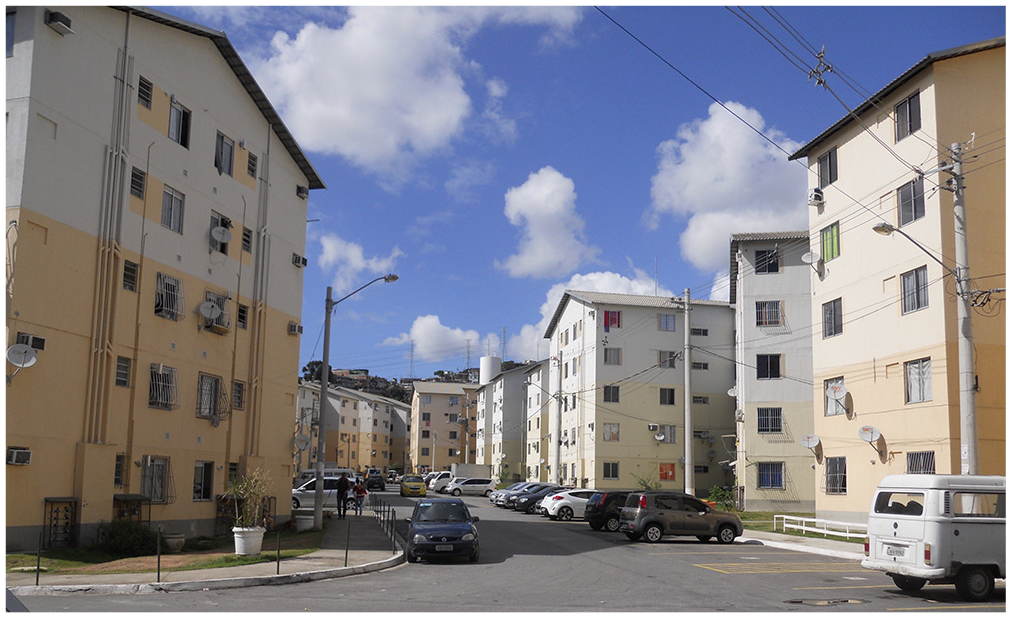
Photo from inside Elizete Cardoso in 2016.
Before outlining specific details of our research design, some background on public housing in central Rio is in order. Though costs of living in downtown Rio are not so prohibitive as they are in the city’s Zona Sul region, over the last several years lower-income families have found it increasingly difficult to afford dignified, formal housing in the city centre (Mello, 2015). To address this, in 2014, two centrally located, federally funded housing estates – one being Elizete Cardoso– were opened to the public, providing a total of 1000 housing units to primarily low-income families. Construction was financed by the Brazilian Federal Bank (Caixa) and nearly half of the residents who arrived in 2014 were awarded housing through MCMV’s lottery system, which randomly selects qualifying applicants from a centralised registry. Most of the other residents were awarded housing through resettlement schemes for families living in precarious, informal areas throughout the city. To be fair, not all residents who received housing were low-income – MCMV also includes pathways for middle-income households and, as we detail later, some apartments were awarded underhandedly as political favours – but a majority of those who arrived in 2014 were low income, meaning their household income was less than US$500 per month. Many of them came from nearby favelas.
Compared with other MCMV communities, Elizete Cardoso is distinguished by several features. First is its central location, which is rare for public housing in Brazil and particularly in Rio. Though MCMV is credited with resettling more than 4 million households since it launched in 2009 (Mazza et al., 2019), the programme is notorious for moving families to the urban periphery (Fernández Arrigoitia, 2017). Similarly, MCMV housing is often criticised for shoddy construction (Marques and Rodrigues, 2016), as well as the frequent presence of drug trafficking gangs and vigilante militias (Acolin et al., 2019). None of these issues were obviously visible in Elizete Cardoso when fieldwork began in 2016, making it, for all outward appearances, a good site to investigate a successful case of public housing in Rio’s city centre. 3 This, after all, was what we were looking for in a case site: not an archetypal MCMV community, but a compelling example of social housing near to the city centre we could compare with our other case studies. Our goal was not to investigate MCMV per se, or to make comparisons with other MCMV communities (nor is that our goal in this article). Instead, we were interested in what enabled some lower-income residents to stay put in the city centre – in the face of mounting displacement pressures – and what factors caused others to leave. Federally funded public housing (e.g. MCMV) is just one part of a larger social housing ecosystem in central Rio, and the broader objective in this research was to understand what helps low-income residents stay put in the city centre. 4
With respect to ethical considerations, this project posed several challenges, as well as possibilities for innovation. Our research team was a diverse mixture of academics and housing activists, 5 most of whom live and work in Rio. As researchers, this helped open doors for us (the authors of this article) and also helped us to build more equitable relationships with research participants. For example, to help share our research with participants, we created a YouTube channel 6 where we could archive professionally made videos documenting the project. The content of these videos reflects collaborative engagements between the research team and participants. Going further, we organised and taught English classes over several months and participated with communal work projects and youth tutorial groups. Our goal was to make our skills and resources available to research participants, and to let their concerns and ideas help drive the project. We were particularly mindful of this in the case of Elizete Cardoso, knowing that our presence, in some instances, could have worked to normalise downward raiding. After all, we might have been confused for downward raiders by some residents and visitors – particularly in the early phase of data collection when fewer people knew us – and this, inadvertently, could have worked to stimulate the process. Our ethnographic approach enabled us intimate perspective but our constant presence may have been ambiguously interpreted by some residents.
In our effort to gain ethnographic insight, we spent a combined total of nine months living in the estate. During this time, we rented accommodation from local residents, in some cases staying with friends and in others with hosts we met online via the accommodation platform Airbnb. The goal was to fully immerse ourselves in the community for extended periods of time. Our primary mode of data collection was ethnography, and together we recorded several hundred pages of fieldnotes focusing on the challenges faced by residents, what they liked and disliked about Elizete Cardoso and the different ways they went about building community. This included countless conversations and daily interactions, participation in different activities, attendance at dozens of social functions, helping with domestic labour and home improvement projects, and so on. We also undertook extensive formal interviews with more than 100 residents (equivalent to roughly 15% of all households in Elizete Cardoso), where we recorded personal life histories, details of household income and expenditure, employment activities, kinship and personal relationships, stories of personal and collective struggle, emotional connections to home and community and the ups and downs of living in a public housing estate in central Rio.
A case study from Elizete Cardoso
‘[If] we know gentrification when we see it’, as Gaffney (2016: 1134) writes in his analysis of pre-Olympic Rio de Janeiro, then downward raiding is less obvious. For instance, near to Elizete Cardoso, ‘[the] typologies of architecture, configurations of public space, and changing residential design [that] may be complemented by new cafés and consumer storefronts’ (Gaffney, 2016: 1134) have changed little since the housing estate opened in 2014. Indeed, when we began fieldwork in 2016, we never intended to study downward raiding, unaware the process was so ubiquitous. Were it not for our ethnographic approach, we might have underestimated its significance. As we explain below, it was only through living in the housing estate that we came to see how prevalent downward raiding had become. That this process remains camouflaged is noteworthy, we argue, and helps to explain how it operates, including why it receives little attention from researchers investigating urban displacement.
In the three subsections that follow, we provide an on-the-ground account of downward raiding in Elizete Cardoso, focusing on three issues in particular: where it occurs, how it happens and what roles the state plays. Our reasons for this are to provide structure to our case study and to critically engage with the concept of downward raiding. As Lemanski (2014) points out, these three features not only distinguish downward raiding from gentrification, they also characterise how downward raiding is understood by urban researchers. By focusing on these features, our goals are to consider the experiences of local residents and to shed light on the ways urban displacement can remain hidden in plain sight.
Where does downward raiding take place?
For Carla, the best part about living in Elizete Cardoso was simple: ‘Here you’re close to everything’, she said. ‘There’re lots of buses, metro, Uber, taxi … [snapping her fingers] … you get wherever you want in 30 minutes’. Like virtually every resident we spoke with, Carla emphasised central location and easy transport when asked what she liked best about Elizete Cardoso. Before moving to the estate in 2014, she lived not far away, in the favela of Andaraí, and living centrally had always been important to her. ‘It’s easier to work’, she explained. ‘If you live up there [waving her hand, towards the north], damn! You spend hours on transport. [Cost of living] is cheaper up there, but man, you suffer’.
Time and again, residents stressed similar feelings when asked what they liked most about Elizete Cardoso. Whether because of daily commutes, access to employment, proximity to Rio’s beaches and nightlife, etc., central location was consistently emphasised as an attractive feature. The downside, however, as Carla alluded to, were higher costs that come from living near to the city centre. She expanded on this: It’s good here, in the centre [of the city], but it’s expensive. That’s why so many new people live here now. Everyone wants to live around here, but not everyone can do it, it’s expensive. And look around here, man, there are people with money! You understand? [Laughing] This isn’t a favela, no way!
In addition to central location, Carla highlights another feature crucial for explaining Elizete Cardoso’s appeal to ‘people with money’ (i.e. downward raiders): the fact that ‘this isn’t a favela’. While people from favelas, such as Carla, may live here, the estate represents a different type of housing altogether: namely, formal housing, clearly distinguishable from favelas.
The distinction may seem subtle, but to working- and middle-class cariocas (residents of Rio de Janeiro) it represents a key difference (Abreu, 1994; Cavalcanti, 2014; McCann, 2014). For example, were middle-income homebuyers willing to live in favelas, there would be no shortage of options for them in central Rio. Yet, for a host of interconnected reasons – mainly because of violence and social stigma – favelas are not realistic options for them (Garmany and Pereira, 2019). Most would never consider the idea. But Elizete Cardoso is different: it may be intended for low-income families; it may house low-income residents (many of whom used to live in favelas); and it may even sit alongside several large favela communities; but it is not, according to local distinctions, a favela. It represents formalised housing and, more generally, an association with the formal city (known colloquially in Rio as o asfalto– the asphalt). This helps to explain why downward raiding is happening in Elizete Cardoso and has not, for example, been observed in any of the adjacent favelas.
These two observations, regarding urban centrality and urban formality, raise important questions about where downward raiding is assumed to take place (Choi, 2016; Lemanski, 2014; Thirkell, 1996). For example, while downward raiding is often thought to manifest in informal, slum communities at the urban periphery, findings from this case study show just the opposite. Key drivers of downward raiding in this instance were, on the one hand, urban centrality, and on the other, formal housing clearly distinguishable from slums and urban informality. This is not to say downward raiding does not also happen at the urban periphery but to suggest that, geographically speaking, the process could be more widespread than originally thought. Afterall, it should come as no surprise that low-cost, state-subsidised formal housing in the city centre would draw interest from middle-income buyers unable to afford housing in traditionally middle-class areas. (This, along with buy-to-let investment – more on this later.)
Going further, the stipulation that downward raiding happens ‘in areas explicitly intended for low-income occupation’ (Lemanski, 2014: 2946) is important not only for distinguishing the process but also for understanding how it works. For example, if gentrification calls attention through ‘typologies of architecture, configurations of public space, and changing residential design’ (Gaffney, 2016: 1134), downward raiding is just the opposite. It operates behind the scenes, eschewing visibility precisely because it involves the transgression of established rules (viz. middle-income residents are appropriating space formally designated for low-income occupation). As the case of Elizete Cardoso shows, this secrecy is important for understanding how downward raiding operates, as well as reasons for why, arguably, it receives little attention from urban researchers. It is to these issues we turn our attention in the next subsection of the article.
How does downward raiding happen?
Like many of Elizete Cardoso’s initial residents, Priscila experienced decades of precarious housing before she was awarded an apartment within the estate. This included living in different favelas throughout Rio, as well as occupying an abandoned building for several months. When she moved to Elizete Cardoso in 2014, it was, for her, a dream come true, though one she struggled to afford.
When I moved to this apartment, everyone thought I had won the lottery or something. But things here are expensive! You have the residents’ fee, you have water, you have electricity, you have gas. In [where I lived before], we didn’t have this. In the favela you don’t have all these bills. We bought gas, but it’s much cheaper […] And everything in this area is expensive, too. Going to the market is more expensive, you go to the bakery, you pay more. You understand? It’s nice here, but it’s expensive. I was shocked, I said, ‘oh my god, how will I live here?’.
To make ends meet, Priscila began renting out her apartment to guests using internet platforms such as Airbnb and Facebook. Given Elizete Cardoso’s central location, she could sometimes find budget-minded tourists, particularly in the summer months near to Carnaval. During these times she would stay with a friend nearby, or sometimes with her son’s family. Other times she would rent out only one of the bedrooms, and then share the apartment with her guests. By 2017, however, she was struggling to keep up with the bills – particularly water, which the administration office had begun cutting off when residents missed payments – and a year after that, in 2018, she began talking privately about leaving Elizete Cardoso. In several conversations she mentioned her desire to sell the apartment, pay off her bills, and move back to a nearby favela where she lived before. ‘I don’t want all this stress’, she often said. ‘If I can find someone to buy this place, I’ll leave right away. [The favela] has its problems, but where doesn’t? At least I can live without this stress, my god! I don’t understand how we’re supposed to live here’.
Finding a buyer was not so straightforward, though. First, according to MCMV regulations established by the Federal Bank, residents must wait at least ten years to receive legal title to their apartments. In other words, anyone such as Priscila wanting to sell their apartment must do so informally through the grey market. Often called contratos de gaveta (‘drawer contracts’), these informal real estate transactions can take many forms: trading property, indefinite leases, rent in-kind, cash payments, etc. Such tactics were famously described by Valladares (1978) as ‘passing’ a house in Rio, since formal transactions cannot take place, and also because compensation can take many forms (i.e. ‘passing’ is a euphemism for selling or renting). Given the tenuous nature of such contracts, they require a certain level of trust between buyer and seller. For Priscila, this made finding a willing buyer more complicated.
Second, precisely because she was working through the real estate grey market, it meant that advertising her apartment was more difficult. While everyone in Elizete Cardoso knew that covert sales and rentals took place, people rarely spoke about it openly, and those looking to rent or sell their apartment avoided drawing attention to themselves. For example, despite all the residential turnover – which, realistically, involved dozens of arrivals and departures each year – there were never any ‘for sale/rent’ signs posted within the estate. Some residents contracted real estate companies who would quietly advertise their apartments online, but for those such as Priscila, who already faced financial hardship, more inexpensive methods were preferred. Some used their social networks through Facebook and WhatsApp, but mostly they relied on word-of-mouth communication.
Such was the case in 2018 when Priscila made it clear she was looking for a buyer. In the privacy of her own apartment, she said, ‘if you or your colleagues are interested, or maybe someone else you know, you can give them my number, ok?’. Requests such as this from residents were common and, during the course of this research, several made similar offers. The assumption was that people like us could help connect them with buyers, or that we might want to buy the property ourselves. The process was slow-going and many residents would spend months or years looking for a buyer. The social networks of these sellers were often limited to other low-income people such as themselves, making it even more challenging to find an interested party that could make a suitable offer. Finally, in 2019, Priscila found a buyer: a lawyer who lived in Copacabana was looking for a buy-to-let investment. She sold the apartment, paid off her debts and moved to Vigário Geral, a favela far to the north where she had once lived before.
Though stories such as Priscila’s were common, what distinguished her case, to a certain extent, was when it happened. According to virtually everyone interviewed who had lived in Elizete Cardoso since it first opened, residential turnover had been most intense during the first year (e.g. 2014–2015). Estimates ranged widely but, on average, residents speculated that at least half of Elizete Cardoso’s original inhabitants left by the end of the first year. ‘It’s sad’, said Vitória, one of the first residents who also worked on the custodial staff, ‘[because] those people couldn’t adapt to life here. They couldn’t pay the bills here every month, they didn’t have enough, you understand? So, they left, they returned to where they were living before’. This process – what Abreu (1994: 41) called the ‘dance of the favelas’– is one that has a long history in Rio (along with other cities in the Global South – e.g. Fernández Arrigoitia, 2017). In short, efforts to address informal housing through relocation and new home building typically reproduce urban informality, particularly when underlying drivers such as inequality and poverty go unaddressed. Low-income families may receive new homes but this typically comes with new expenses – along with severed social networks, longer commutes and reduced employment opportunities – that make costs of living unaffordable. Not surprisingly, many of these families sell their new homes and go back to where they lived before.
Returning to Elizete Cardoso, while there was consensus over who moved away, when they left and why they did so, it was much less clear who the apartments had been ‘passed’ to. Again, this reflected, at least partially, the diversity of transactions that took place. For example, in some cases apartments were occupied by friends or family members of the original leaseholder. In these cases, monthly rents typically reflected the heavily subsided mortgage fees established under the MCMV programme (roughly R$100–R$200 per month, equal to US$25–US$50). In other cases, the original leaseholder might rent out the apartment to someone else, though at market rates much higher than the monthly mortgage payment (roughly R$1000–R$1200 per month, equal to US$250–US$300). In these cases, the new occupants might be anyone, whether low- or middle-income, who could pay for formal housing near to the city centre.
Then again, there were also numerous cases, such as Priscila’s, where the apartment had been sold outright, or in some cases traded for another home or asset. In these instances, the new leaseholder might occupy the apartment themselves, or use it as a buy-to-let investment, renting it out at market rates. This meant that by 2019, when Priscila sold her apartment, so many other apartments had already been ‘passed’ in different ways it was difficult to know who the current leaseholders were. Coupled with this were high turnover rates among renters, reflecting the growing presence of market-rate and short-term rentals. As one woman named Jacqueline explained – herself a long-time renter in Elizete Cardoso–‘people come and go so fast you don’t even know who’s living in the building. Sometimes they’re only here a few months, you don’t even know their name […] I don’t know what they’re thinking, but probably once they find out how expensive it is, they leave’. In short, by 2019, it had become difficult to know who lived in each apartment, let alone who owned it.
It was not just residential turnover or informal transactions, however, that made it difficult to identify current leaseholders: equally significant was the clandestine nature of the process itself. For example, while low-income leaseholders such as Priscila had to be discreet when trying to ‘pass’ their apartments, even more under-the-radar were middle-income apartment buyers. Not only were these people buying their apartments informally; they were taking advantage of a publicly funded asset built specifically for low-income families. The sale of the apartment, and their presence more generally, was both legally and morally dubious. Some of the political and legal implications of this are considered in the next section – which examines the state’s role in downward raiding – but it bears noting that we never once saw downward raiders face legal or administrative trouble on account of their transgressions.
Still, these people kept a low profile within the estate and it was difficult to make contact with them. On rare occasions when we spoke to these residents, it was clear they understood the transgressive nature of their presence, and they usually avoided follow-up contact with us. Only one of them agreed to be interviewed, during which he said, very bluntly, ‘of course no one [like me] wants to talk to you! They know they’re not supposed to be here!’. Though this population has been growing since Elizete Cardoso opened in 2014, they continue to remain inconspicuous, refraining from public engagement within the estate and shying away from communal spaces where people gather, gossip and hang out.
This raises an important question for how downward raiding is typically understood. For example, while this case study confirms that informal transactions are crucial to how the process works, it also highlights something that deserves more attention: namely, that downward raiding is a transgressive process and one that operates clandestinely. More to the point, it is not just because of informal transactions that downward raiding happens covertly: it is also because the process itself is ethically questionable – and technically illegal – as raiders appropriate resources intended for low-income families. In other words, because of where downward raiding happens (e.g. ‘in areas explicitly intended for low-income occupation’– Lemanski, 2014: 2946), how it happens requires a certain level of secrecy. Any investigation of downward raiding needs to account for this and, in particular, the transgressive nature of the process.
Going further, what this finding also helps to emphasise is the importance of ethnography for identifying, understanding and theorising diverse processes of urban displacement. While other research methods are surely useful, ethnography is especially well attuned to contexts (and circumstances) where processes such as downward raiding are prone to manifest. Again, this may help to explain why so few studies of downward raiding exist, as urban researchers are unlikely to see the process without in-depth ethnographic engagement. Related to this are the subtle ways ethnography sheds light on how people feel about downward raiding, including who they hold responsible for it. These questions animate the next subsection of the article, where we focus on the state’s role in downward raiding.
What role does the state play?
As Lemanski (2014: 2946) points out, studies of downward raiding typically emphasise how the process ‘is largely led by opportunistic individuals’. In other words, while the state is recognised as a decisive actor in gentrification, it is the decisions of middle-income homebuyers themselves that tend to spur downward raiding. Though state initiatives may help induce the process – for example, the construction of state-subsidised housing, urban infrastructure upgrades, formal land titling (Croese and Pitcher, 2019; Del Mistro and Hensher, 2009; Payne 2001) – the state is not thought to actively drive downward raiding, as it does gentrification.
Given this, one might expect animosity towards middle-income raiders in Elizete Cardoso, particularly from low-income residents unhappy with increased costs of living. But feelings were mixed within the estate, with plenty of low-income residents either indifferent to or, in many cases, happy with the prospects of downward raiding. Reasons for this could largely be attributed to two factors: first, some residents were glad their old neighbours had moved away, saying ‘more civilised people’ had moved in. They were often conflicted by this, recognising that numerous apartments were now in the hands of non-deserving beneficiaries, but they also stressed how life had improved within the estate. Listen again to Vitória: ‘those people [who moved away] are really poor, and they’re back now living where they were before […] But that first year was really difficult, and since then it got much better here’.
Second, for low-income residents who held provisional titles to their apartments, middle-income buyers represented a financial opportunity. Many of these residents planned to sell their apartment one day and move somewhere else. For them, downward raiding offered the potential to continue an upward trajectory that had seen them move from precarious, informal housing, to Elizete Cardoso, to (conceivably) somewhere even better in the future. For these residents, middle-income buyers were a potential resource to be cultivated (see also Burdick, 2020).
But for those not looking to sell and unhappy with the broader effects of downward raiding, blame for the process was rarely placed on middle-income buyers. Instead, it was usually directed towards actors and institutions that enabled downward raiding. For example, residents complained about the estate’s administration office, or about government officials turning a blind eye to non-eligible, higher-income people appropriating public assets. Many even believed that state and administrative officials encouraged downward raiding to make more money on residential fees and mortgage payments, as well as for reasons of prejudice and stigma against low-income residents. Priscila was convinced of this before she left in 2019: ‘They don’t want us here’, she had said. ‘They want people who pay the residents’ fee every month and keep their mouths shut. They can’t say it, but they want us out of here’.
In saying ‘they’, Priscila was referring to one group in particular: the estate’s management office. Appointed by Federal Bank officials when Elizete Cardoso first opened, this was a private real estate firm effectively deputised with administration duties, albeit according to basic ground rules established under MCMV. Such arrangements are standard for MCMV housing, which, unlike some other social programmes in Brazil (e.g. the Bolsa Família conditional cash transfer programme – see Garmany, 2016), are administered by the private sector. For Priscila, however, ‘they’ represented an unscrupulous actor, more interested in profits than housing low-income families. This was the same office Chico complained about, saying they increased residential fees by 150% and then justified it by saying residents could afford the costs. That night in the parking lot he expanded on this: [The government] put these people in charge, but they don’t monitor them. So, what happens when they raise the resident’s fee? Everywhere else [i.e. in other MCMV communities] it’s R$80 per month [roughly US$20], but here it’s R$200 [roughly US$50]. Explain that to me! And what can we do? Complain to the Federal Bank? They won’t do anything! They don’t care.
In addition to the administration office, Chico’s comments draw attention to the second group most often blamed for downward raiding: government officials. Frustration reflected several things, including a general feeling that the state was indifferent to the fate of low-income residents. More specifically, people were angry the state could show capacity in some instances – such as building millions of housing units under the MCMV programme – but then lack basic initiative to maintain such programmes. For these residents, downward raiding represented more than just state ineptitude: it was the result of state actors actively turning a blind eye to transgressive practices. Vitória did not mince words as she discussed this: ‘Of course this whatever you call it [i.e. downward raiding] is happening! Who’s going to stop it? Maybe it’s not right, but the government won’t stop it. They’re the dirtiest! (Eles são os mais safados!)’.
In addition to complaints that the state ignored the effects of downward raiding were also stories of how state actors worked to facilitate it. For instance, it was well known in Elizete Cardoso that many apartments had been awarded as political favours by public officials, bypassing the MCMV lottery system and resettlement schemes meant to ensure transparency. The effects of this were obvious: dozens of apartments were occupied by municipal employees who tended to work nearby at City Hall. Like other middle-income residents, they kept a low profile but their presence was hardly a secret within the estate. Carlos, who worked at the front entrance and was acquainted with most families, lamented Many people here don’t need [their apartment]. They received it from a politician, you understand, they don’t need it. It’s really sad: you have so many people that don’t have a house, they need one, and here you have people that don’t need one, but a politician gave them [an apartment]. That’s Brazil.
In saying ‘that’s Brazil’, Carlos emphasised something expressed often by residents: that such transgressions were not unique or remarkable but rather commonplace and built into the state. They were perversely functional, serving the interests of long-established patron–client networks. More specifically, they represented cases where the state not only allowed for downward raiding to happen but had actively contributed to the process.
What these findings help to illustrate are some behind-the-scenes ways that public–private housing initiatives can coincide with urban displacement. While the state may not outwardly encourage downward raiding as it does gentrification, neither does it play an insignificant part. In the case of Elizete Cardoso, the state remains an important actor, influencing how downward raiding plays out both directly and indirectly. Given the process itself is secretive and transgressive, it is not surprising the state’s role is hidden. The ramifications of this raise several questions for urban researchers, calling for a closer look at how urban displacement happens. We consider these issues in the conclusion, working to refine the ways downward raiding is understood, and considering what these findings indicate for broader debates over urban displacement.
Conclusion
In the same parking lot where this article started, but on a different night in 2020, Jacqueline sat discussing costs of living in Elizete Cardoso. A mother of four, she and her husband rent an apartment in the estate for R$1000 per month (roughly US$250). The cost is hard on them – they spend nearly half their monthly income on rent – but they do it because of how much they prefer Elizete Cardoso to where they lived before (a vacant warehouse and, before that, the favela of Jacarezinho). As she reflected on the ways apartments around her were being bought, sold and rented out, she smiled, ruefully. ‘It’s funny’, she said. ‘It’s like this: here, it’s as if it was an open secret, but of course for people on the outside it’s not obvious’. We talked about this, including what the effects have been for low-income renters such as herself. Mostly we discussed her rental fee of R$1000 per month, an (almost) unthinkable amount for Minha Casa Minha Vida. She smiled again, shaking her head. ‘It’s true’, she said. ‘Even for me it’s difficult to believe sometimes’.
Throughout this article we have worked to investigate a closeted case of urban displacement. Drawing on ethnographic research, our goal has been to explore how urban displacement can happen in hidden ways and, more specifically, to provide an in-depth account of downward raiding. Our findings indicate that ethnographic research can be crucial for identifying and understanding such forms of urban displacement, as well as for scrutinising the ways researchers analyse and compare different processes. For example, while our results represent only one case study, they show how downward raiding can occur in formal housing in central urban areas (and not just in informal communities on the urban periphery) and that the state’s role can be complicated, revealing both direct and indirect involvement. Moreover, informality is important to how downward raiding operates – as noted by several researchers (e.g. Lemanski, 2014; Payne, 2001; Thirkell, 1996) – but equally significant may be the transgressive nature of the process itself.
In light of these findings, we suggest downward raiding could be better defined along the following lines: when housing (or land) intended specifically for low-income residents is appropriated through irregular and transgressive means by middle-income groups. This definition draws attention to key attributes showing how downward raiding happens, yet also leaves open the possibility that it may exist more broadly (e.g. not just in peripheral slums of Southern cities). For example, recently published research from Angola (Croese and Pitcher, 2019) reveals that downward raiding is happening in state-subsidised (formal) housing for low-income residents and that, similar to Elizete Cardoso, the state plays a decisive role. Similarly, in South Africa (Del Mistro and Hensher, 2009), it has recently been observed that formal land titling can induce downward raiding, particularly when accompanied by urban infrastructure upgrades. What these studies highlight are the ways state-led housing initiatives can enable downward raiding, particularly in rapidly growing cities with increased costs of living for low- and middle-income residents. Whether this indicates that downward raiding might also exist in Northern cities is something to be considered in future research.
Going further, while one of our goals in this article has been to provide a detailed account of downward raiding, more work is needed to theorise the process. For example – and similar to research on gentrification (e.g. Lees et al., 2016; Ley, 1994; Smith, 1996) – what are the structural drivers of downward raiding; under what conditions is it more or less likely; and how is it connected to other processes that shape the urban landscape? These are questions that lie beyond the scope of this article but are important for a fuller discussion of the links between downward raiding and urban inequality. Our findings suggest that downward raiding may be linked with (and potentially help to trigger) broader processes of gentrification – for example, increasing ground rents near to city centres where urban renovation or infrastructural improvements are underway – but more study is needed to confirm such a hypothesis. By considering these issues, researchers should gain new insight into diverse forms of urban displacement, including critical traction for theorising processes of urban displacement in Southern and Northern cities.
Footnotes
Acknowledgements
This work is dedicated to Professor John Burdick, second author on this article, who sadly passed away on 4 July 2020. John is remembered by his colleagues for his commitments to social justice, activism and anthropological research, as well as for being a wonderful colleague and friend. This article benefited from the comments of anonymous reviewers and the editor at Urban Studies, as well as other members of the research team (listed in note 5). A special thank you also to everyone in Rio who participated in the research.
Declaration of conflicting interests
The author(s) declared no potential conflicts of interest with respect to the research, authorship and/or publication of this article.
Funding
The author(s) disclosed receipt of the following financial support for the research, authorship, and/or publication of this article: This research was made possible thanks to support from the National Science Foundation (1632145) and the Economic and Social Research Council (ES/P007635/1).
