




Abstract
Prevalent notions of ‘education cities’ and ‘education hubs’ are vaguely defined, operate at blurry scales and tend to reproduce promotional language. The article contributes to theorising the geographies and spaces of globalising higher education by developing the concept of transnational education zones. Through an urban political economy lens, we review the relations between universities and cities, consider universities’ role in the political economy and understand universities as transnational urban actors. We exhaustively map the phenomenon of transnational education zones and empirically analyse cases from four cities (Doha, Dubai, Iskandar and Flic en Flac) with respect to their embeddedness in state-led projects for the ‘knowledge economy’, their vision for transnational subject formation and their character as urban zones of exception. The conclusion develops a research agenda for further critical geographic inquiries into the (re)making of cities through the development of transnational spaces of higher education that explores the relations between globalising higher education and material and discursive transformations at the urban scale.
Education City, our flagship initiative, is a pretty unique place. During just one short walk – or tram ride – around campus, you could be visiting an Ivy League university, cross the street to browse one of the region’s largest libraries, and then attend an open-mic at the neighbouring university behind it. That’s just how life is when you’re part of the close-knit community at Education City. It’s a place with branch campuses of some of the world’s leading educational institutes, a home-grown research university, start-up incubators, technology parks, heritage sites, cultural institutions and so much more. (Qatar Foundation, 2019)
Introduction
Education City in Qatar, Uniciti in Mauritius, EduCity in Malaysia. Variations of the notion of ‘education city’ take shape in three quite different cities around the world. These new forms of education cities all have in common that they are, to a large extent, composed of physical presences of foreign universities. The development of universities’ offshore campuses (also called international branch campuses) in these examples follows a clear spatial strategy and constitutes a relatively recent urban form. Traditional notions of university cities, invoking historically grown and picturesque places like Cambridge in the United Kingdom (UK) or Heidelberg in Germany, are, however, far away from the imaginaries constructed by governments and private sector actors in Qatar, Malaysia and Mauritius. The ‘education cities’, also termed ‘education hubs’ (Knight, 2011, 2018), are nodes in transnational networks of universities (as they are sites of physical presences of international universities) and simultaneously territorially embedded in urban and economic development strategies of their countries. Thus, ‘education cities’ constitute ideal sites for observing interlinked contemporary processes of globalisation of higher education and urban development but have remained so far largely out of scholarly view.
The socio-spatial relations of the university are complex. To date, (economic) geographic research has prioritised the local or regional scale, above all to assess universities’ economic contribution to regional development (e.g. Benneworth, 2019; Lawton-Smith, 2006). Given the on-going globalisation of higher education, geographers have asserted the need to look beyond the locally embedded university, as ‘universities are more likely to be actors involved over multiple scales; they are global players who are highly influential beyond their immediate locale while exhibiting a significant capacity to affect the social, spatial and symbolic structures of the metropolis’ (Addie et al., 2015: 30). Investigating the multi-scalar relations of the university and the university–city relations (see Goddard and Vallance, 2013; Heffernan et al., 2018) becomes even more intriguing when considering the expansion of universities beyond their country of origin.
Transnationalisation of higher education, meaning the provision of degree programmes outside of the universities’ home country, is one element in the increasingly marketised and globalised higher education industry (Luke, 2005). In particular, universities from neoliberalised higher education systems, above all the United States, the UK and Australia, operate offshore campuses (Cross-Border Education Research Team [C-BERT], 2017). In particular settings, offshore campuses form clusters. Far from spontaneous agglomerations, these ‘education hubs’ or ‘education cities’ are integrated into urban megaprojects and into government projects for constructing a knowledge-based economy. As such, it makes sense to look beyond the realm of international higher education studies and to interrogate them through an urban political economy lens that takes into view the complex spatialities of those clusters, their relation to political-economic state projects and urban development. In the following, the second section ties together different literatures and develops the concept of transnational education zones (TEZs).
In the third section, we empirically map and comparatively analyse the phenomenon of TEZs. For this, we collected and triangulated data on offshore campuses globally (e.g. location, opening date, programmes offered) from university websites, ‘education city’ authorities and marketing organisations, policy documents and media reports. We analyse how offshore campuses and TEZs present themselves online and offline with regard to (intended) urban and political economic transformations, transnationality, education and its subjects, and the characteristics of the zone. In developing our arguments, we also draw on field visits of five TEZs between 2016 and 2019.
We develop the notion of TEZs as an analytical concept from an urban political economic lens and call for further critical geographical analysis of transnational higher education that explores the relations between globalising higher education and material and discursive transformations at the urban scale.
Towards an urban political economy of ‘education cities’
In the following, we develop an understanding of the spatial relations of the university as a transnational actor that is simultaneously deeply embedded at the local and national scale. To this end, we start with a review of urban studies literature that has engaged with university–city relations and critical political economic literatures on the role of the university in constructing the knowledge-based economy. We then develop an urban political economic conceptualisation of transnational education zones to think beyond prevalent but problematic notions of ‘education hubs’ and ‘education cities’.
Universities as transnational urban actors
Universities fulfil important social, economic and civic functions and are heterogeneous entities with complex socio-spatial relations, within and across borders. Universities have had international students and scholars from their early foundations onwards, 1 thus the idea of universities as transnational institutions is not fundamentally new. In contrast to the traditionally mobile people comprising the institution (students and faculty), it is now the university itself that has become a mobile and travelling actor, constituting a ‘new species’ (Kosmützky, 2018: 2). The ‘outward’ relations of the university and academic mobilities have historically been, and continue to be, constitutive for the geographies of knowledge production and the formation of universities’ locales as knowledge hubs or ‘centres of calculation’ (Jöns, 2015). In a recent study of branch campuses in South Africa, Gunter and Raghuram (2018: 192) have analysed the mobilities of students, academic staff and institutions together, arguing that mobilities should not be understood as an exception but as ‘constitutive to knowledge production’. The offshore campuses and constitutive mobilities are place-specific, situated within complex histories and education, migration and economic policies, usually determined at the national level. Moreover, they are situated within cities or are actively mobilised as institutions to contribute to the development of new cities.
The geographies of the university are complex and involve multiple, and interrelated, scales (Heffernan et al., 2018). Universities are variously analysed as urban actors (Addie, 2017; Goddard and Vallance, 2013), as regional economic development engines through university–industry cooperation and spin-offs (Benneworth, 2019; Lawton-Smith, 2006), as agents enrolled to advance national competitiveness and the knowledge-based economy (Moisio, 2018) and as entrepreneurial ‘world-class’ international institutions that compete on a global scale (Luke, 2005; Marginson, 2004; Robertson, 2010). When aiming to understand the construction of ‘transnational education zones’, interlinked spatial scales are relevant to make sense of the phenomenon. Above all, universities’ role as transnational urban actors enrolled in national or regional state projects requires attention, and to date it has not received sufficient theorisation.
Higher education institutions operating within neoliberalised higher education systems have increasingly become entrepreneurial actors that engage in international competition (Luke, 2005; Robertson, 2010; Slaughter and Leslie, 1997). Global university rankings propel the international competition for ‘excellence’ and ‘world-class’ status of institutions that translates into economic revenue in the competition for (international) fee-paying students (Jöns and Hoyler, 2013). Entrepreneurial universities may employ a diverse range of income-generating strategies; for instance, the commercialisation of research output through patenting and spin-offs (Slaughter and Leslie, 1997). The importance of universities’ real-estate property and facilities is elevated for entrepreneurial universities, both to support the recruitment of fee-paying students and as own revenue-generating streams, for instance of sports facilities and university accommodation (Jessop, 2017: 860; Oh, 2017). Entrepreneurial higher education institutions have expanded beyond recruiting international students to their home campus and have opened international branch campuses to offer their degrees in situ (see Leung and Waters, 2017; Waters and Leung, 2013).
The General Agreement on Trade in Services (GATS) regulates the delivery of transnational education in different forms. The setting up of commercial presences in another country (offshore campuses) is differentiated from cross-border trade (distance education), consumption abroad (international students) and the presence of natural persons (individuals teaching in foreign countries). Offshore campuses are thus physical presences of higher education institutions in another country, which offer foreign academic degree programmes. They may operate independently or in collaboration with business and/or academic partners and can be large or small in size. Their infrastructures range from replica campuses replete with architecture made to resemble the original campus, to using shared campus infrastructure provided by a third party, to renting individual office spaces. Focusing on universities as urban actors across political borders offers precisely a link between the globalisation of higher education and urban development that currently remains little explored.
Higher education institutions thus become urban actors in cities beyond their country of origin; they become transnational urban actors. The literature on universities as urban actors is extensive. Much work has focused on the ‘civic’ (urban) mission of universities (Addie, 2017; Goddard and Vallance, 2013; Goodall, 1970). Goddard and Vallance (2013) suggest that the city is a significant scale to analyse universities; first, because universities tend to be located in cities, and second, because ‘the city as an object of study encourages exploration of a more broadly-conceived territorial development […]. The relationship between the university and the city is a multi-faceted one of distinct but interrelating physical, social, economic and cultural dimensions’ (Goddard and Vallance, 2013: 1). Their empirical analysis focuses on the, largely synergetic, more-than-economic relations between ‘civic universities’ and English cities. Offshore campuses are, by definition, less firmly integrated within their urban surroundings and are unlikely to become active citizens as much in their new environments as they are in their regions and localities of origin, although their places of origin may influence their internationalisation strategies (see Cochrane, 2018).
More conflicting relations between universities and urban neighbourhoods have been investigated under the notion of ‘studentification’ (Smith, 2008), which also highlights the negative indirect effects of universities on their localities. The focus on the city in most cases means a focus on the local relations of the university in contrast to its embeddedness in international networks. Fewer studies focus on the relationship between the globalisation of higher education and cities, although ‘major urban areas are the spaces where these increasingly global dimensions of higher education touch down’ (Collins and Ho, 2014: 128). Geographic literature on the experiences of students enrolled in transnational education programmes in Hong Kong has shown how these projects are embedded within uneven global (post-colonial) power geometries (see Leung and Waters, 2017; Waters and Leung, 2013). Studies that take into account the transnational relations of the university and the city focus primarily on international students, as central subjects who act as ‘transnational urban consumers’ (Malet Calvo, 2017) or ‘urban agents’ transforming the city (Collins, 2010), for instance through their aspirations and location preferences for higher education, consumption habits and housing demands.
Political economy perspectives on universities and urban development
In parallel, a literature that critically explores the role of universities in urban transformations, including (neo-liberal) real-estate projects, has emerged. Recent studies have explored campus developments and real-estate projects in the home cities of universities in Europe and the United States (Belina et al., 2013; Bose, 2015; Melhuish, 2019; Van Heur, 2010). The focus in these studies lies on (re-)development projects of universities in close physical proximity to existing campuses. Bose (2015), for instance, explores the case of the University of Ohio to analyse a neoliberal institution acting in a neoliberal city in the United States. Less is known about the effects of universities acting as transnational urban actors when constructing offshore campuses. Sidhu and Christie (2015) present the fascinating single-case study of Monash University Malaysia, an Australian joint venture with Malaysian conglomerate Sunway Group, to reveal how the creation of transnational spaces of higher education is deeply linked to broader processes of neoliberalisation as well as local and national power configurations of the post-colonial, ethno-nationalist Malaysian state.
Political economic analyses of the ‘geopolitics of higher education’ also take the built environment as a secondary circuit of capital into view (Moisio, 2018). They show how the state, acting in collaboration with higher education institutions, is a key actor in producing sites of surplus value production in knowledge-based capitalism: States (and local governments) have taken great pains to finance and guarantee large-scale and long-term projects with respect to establishing the conceivably crucial built environments of the knowledge-based economy. This discloses the fact that states remain vital institutional anchors of political power in the purportedly ‘global’ knowledge-based economy, which is typically construed around urban agglomerations. (Moisio, 2018: 23)
The economic imaginary of the knowledge-based economy presents a performative vision of the future that valorises ‘knowledge’ as the key driver of economic growth and has major implications for the reorganisation and reorientation of society and education institutions (Jessop, 2016). The construction of projects which enrol various universities as transnational urban actors into agglomerated ‘education cities’ is clearly embedded within large-scale regional and national development strategies, often discursively linked to the construction of a knowledge-based economy. This is exemplified by the United Arab Emirates’ (UAE) national project, launched in 2010, aimed at turning the country into a ‘competitive knowledge economy’ through inward investment attraction of international universities and the development of an ‘education hub’ (Government of United Arab Emirates, 2014). Erfurth (2019: 188) conceptualises these education hubs as ‘governmental political-economic projects’ targeting reforms of the higher education sector to transform selected territories into economically competitive and socially progressive areas. Koch (2018) identifies state-driven university campus projects in the Arab Gulf region, including Education City in Qatar and NYU-Abu Dhabi, as ‘exemplars’ or ‘laboratories of sustainability’, through which regimes build legitimacy internally (towards their population) and externally (towards the rest of the world) as ‘modern’ states. The building of ‘world-class international universities’ in the Arab Gulf region is not simply driven by neoliberalisation processes but can also be analysed as part of classical rentier-state projects (traditionally involving the construction sector), which are disguised by narratives of nationalism (Koch, 2014).
Given that ‘the political and social aspects of the Gulf’s recently transformed higher education landscape are inseparable from their spatial dimensions’ (Koch, 2018: 528), the relations between campus constructions and ‘education hub’ projects and urban (re)development offer a productive angle for further analysis. Exploring the expansion of campuses outside of the universities’ city of origin (and outside of the United States) means engaging in a different political-economic context and involving different sorts of alliances and (state) actors. Real-estate activities of universities in East Asia, for instance, have been much more embedded within (post-)colonial relations and developmentalist state projects, while simultaneously being enrolled in capitalist accumulation strategies (Oh, 2017). A critical gap in the literature remains in exploring the reciprocal relations of entrepreneurial universities’ physical expansion offshore and state-led development projects for transnational higher education in different spatial contexts.
Conceptualising transnational education zones
To date, urban scholars have not been prominent voices in the debate on ‘education hubs’, which have largely been examined in the field of international higher education (Knight, 2014). Education scholars employ different definitions of the notion ‘education hub’ indiscriminately for projects on the national, regional or urban scale. Knight (2011: 227) defines them as ‘a planned effort to build a critical mass of local and international actors strategically engaged in cross-border education, training, knowledge production and innovation initiatives’, and empirically identifies entire countries, though the selection process remains unspecified. 2 In contrast, C-BERT (2017) defines an ‘education hub’ as a ‘designated region intended to attract foreign investment, retain local students, build a regional reputation by providing access to high-quality education and training for both international and domestic students, and create a knowledge-based economy’. The selection of ‘education hubs’ tends to uncritically repeat the self-ascribed and aspirational notion used by governments and project developers for their higher education-cum-smart city ambitions, instead of following clearly identified criteria.
For our endeavour, the definition of ‘education hubs’ in the higher education literature suffers from three interlinked shortcomings: it lacks concrete indicators for systematic case selection and data-based analysis; consciously or not, it connotes different spatial scales (from countries to cities) and thus phenomena, and the term may involuntarily serve to amplify boosterist city-marketing. To shed light on the production of space through transnational higher education as well as on the (re)making and branding of cities as potential hubs for foreign investments, we alternatively advance the term ‘transnational education zone’ to denote a territorially defined area at the urban scale with at least two offshore campuses that provides shared campus infrastructure, advertises itself as an education hub, and has higher education as its primary function. We highlight the transnational element to contrast these zones from other, local or national clusters of higher education institutions. The definition ties into Parnreiter’s (2012: 99) conceptualisation of ‘transnational urban spaces’, as nodal points with distinct physical and social environments that are produced and used by actors involved in global–local networks. In the following, we empirically and conceptually discuss the phenomenon of transnational education zones from an urban political economic lens.
TEZs as urban state-led projects for the ‘knowledge economy’
We focus our empirical analysis of TEZs on those instances where concrete spatial projects at the urban scale are formed. This is in contrast to most research from the field of international higher education, which has mapped the geographies of international branch campuses on the national scale and identified countries as sites of investments (C-BERT, 2017; Kosmützky, 2018). Some higher education scholars have noted different agglomeration patterns of offshore campuses at the sub-national scale. Lane and Kinser (2011: 83–84) use the term ‘acropolis’ for spatial concentrations that follow a dedicated ‘education hub’ policy, and ‘archipelago’ for scattered campuses across the national territory. An example of the latter is Singapore, where the state has been a crucial driver in attracting investments by foreign universities so as to become an education or ‘knowledge hub’ (Olds, 2007; Sidhu et al., 2011), but no distinct spatial policy has guided where in the city-state universities can locate and specific incentives have not been based on the geographic location within designated areas. In contrast, we think of TEZs as a distinct urban form that is not the result of spontaneous agglomerations of education institutions but which rather results from state-led projects that construct material urban conditions in the pursuit of the knowledge-based economy. TEZs tend to be carefully curated and managed spaces in which the state, acting through or in collaboration with (semi-)private actors, including planning authorities, zone operators and infrastructure providers, is responsible for inviting and selecting the ‘right mix’ of university tenants.
Worldwide, we identify eight TEZs (Figure 1). Four attach the label ‘city’ to their names. Located in seven cities in six countries, TEZs host between four and 12 offshore campuses each. TEZs were developed from 2001 onwards but most projects are still undergoing construction. TEZs are an expanding phenomenon: several more TEZs are planned or are under consideration in Indonesia, Malaysia and Egypt.
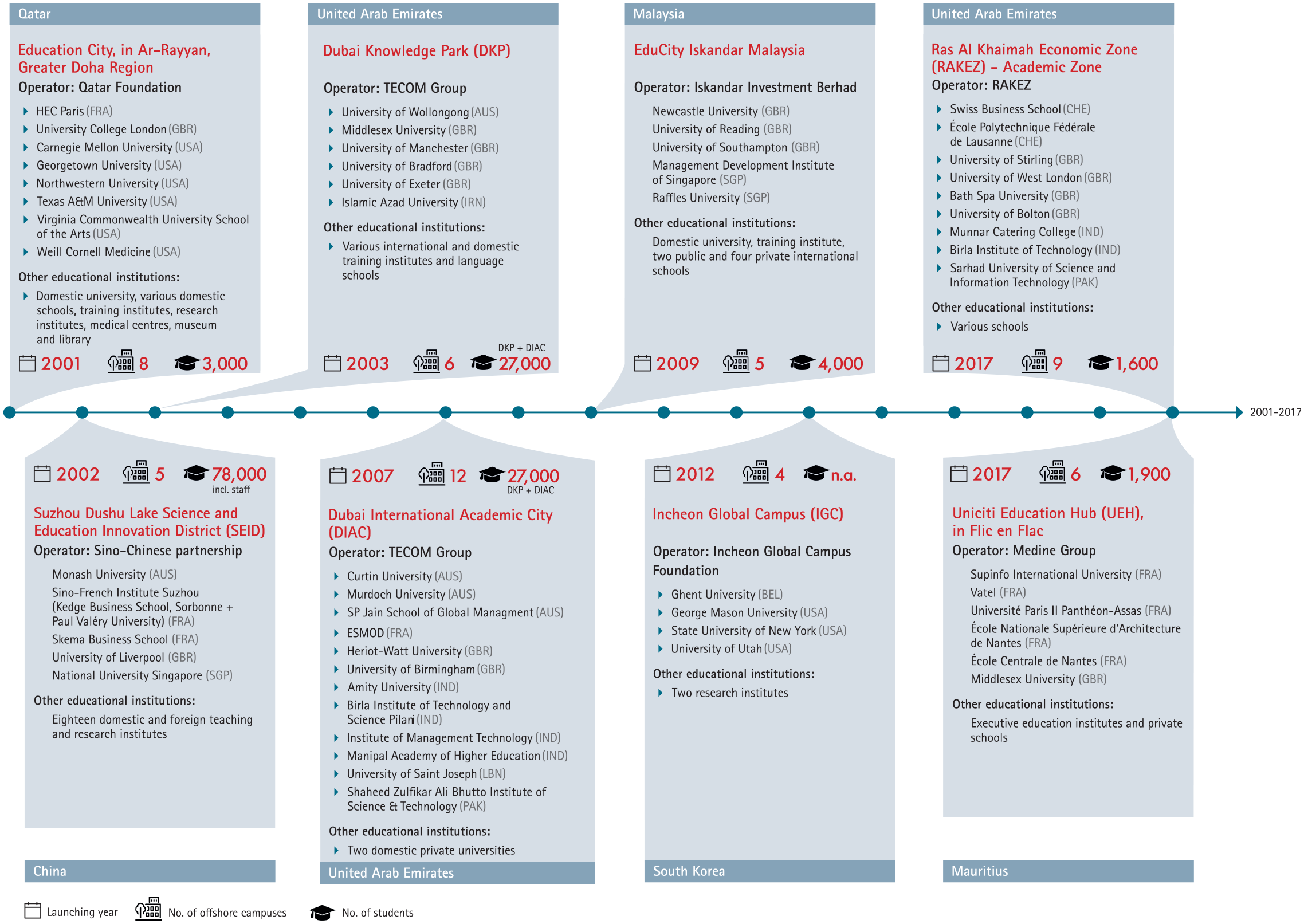
TEZs in the world.
Five empirical examples have been chosen to illustrate how those zones are embedded in state-led projects, with the goal of promoting a so-called knowledge-based economy, namely, Education City (Qatar), Dubai International Academic City and Dubai Knowledge Park (both UAE), EduCity Iskandar (Malaysia) and Uniciti Education Hub (Mauritius).
The oldest TEZ, Education City, is part of Doha’s larger urban agglomeration and covers a vast area of roughly 14 km2 (Figure 2). Education City was conceived and is operated by the Qatar Foundation, a formally private foundation founded by the late Emir Sheikh Hamad Bin Khalifa Al Thani and his wife Sheikha Moza bint Nasser and whose leadership mainly recruits itself from members of Qatar’s ruling family (Qatar Foundation, 2019). Education City is the foundation’s flagship project and has been created by internationally renowned architects, including Rem Koolhaas, and international architectural firms (Qatar Foundation, 2019). Education City hosts eight offshore campuses of rather prestigious, mainly US-based universities, as well as a private domestic university, research facilities, schools, convention centres, a museum, an equestrian centre and a sports stadium which is set to host games of the 2022 FIFA World Cup.
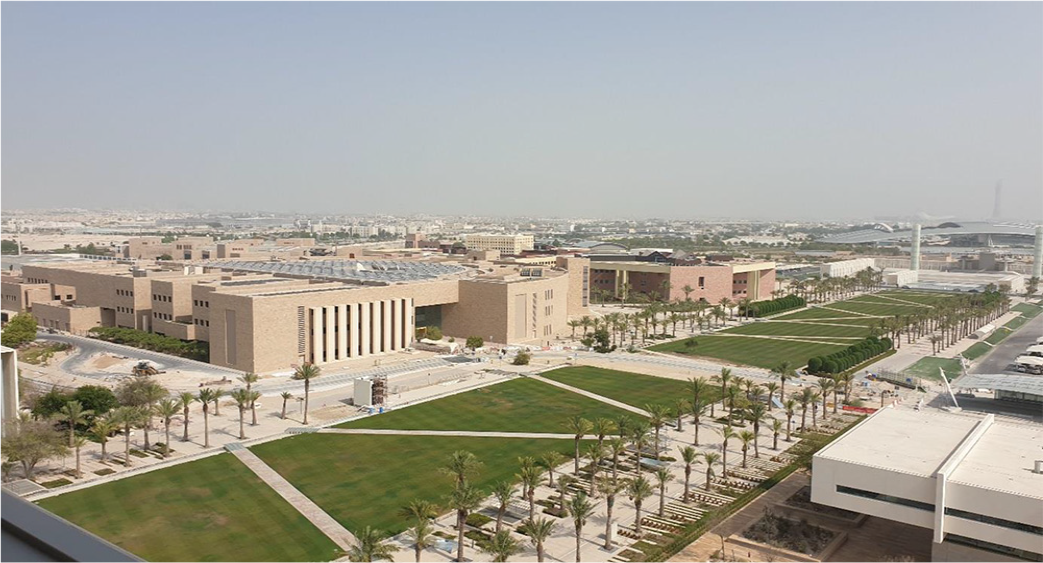
Education City, Qatar.
Three of the eight zones are located in the UAE, two of which are in the Emirate of Dubai: Dubai International Academic City (DIAC) and Dubai Knowledge Park (DKP), previously known as Dubai Academic Village. Both are run by the TECOM Group, which is part of Dubai Holding, the sovereign investment vehicle in which the Ruler of the Emirate of Dubai is majority shareholder. The TECOM Group operates various purpose-built zones in Dubai, which tie into the UAE’s largest cities’ ambitions to develop ‘global talent hubs’ to diversify their economies away from oil (Ewers, 2017). DKP was launched in 2003 as a free zone (a customs-free area akin to a special economic zone) and DIAC followed in 2007, originally intended to replace DKP. Today, DIAC is the larger of the two zones, covering roughly 1.7 km2 on the South-Eastern fringes of Dubai and hosting the majority of the offshore campuses of the city. According to the managing organisation, both zones together hosted over 27,000 students with 150 nationalities in the academic year 2018/2019 (TECOM Group, n.d.).
EduCity Iskandar is a 1.2 km2 TEZ in the Malaysian state of Johor. It is located on the outskirts of the state’s capital Johor Bahru and in proximity to neighbouring city-state Singapore. EduCity hosts three branches of British universities as well as three other branches of non-Malaysian institutions in a greenfield investment site (Figure 3), promoted on its website as a ‘fully-integrated education hub’. Combining various universities in a dedicated ‘hub’ is a different spatial strategy from earlier inward investments of offshore campuses in Malaysia, which occupy individual and decentralised locations in the larger Kuala Lumpur region and Eastern Malaysia. Since EduCity is managed by EduCity Iskandar Sdn Bhd, an entity whose stakeholders are private investors, as well as the federal government’s investment fund Khazanah Nasional Berhad, the education sector is – among other sectors such as tourism or health – part of a greater regional development project: Iskandar Malaysia. In this project, EduCity as a TEZ is intended to function not only as a catalyst for investment and economic development but also as a supplier of talents to Iskandar Malaysia’s specialised economic sectors (Iskandar Investment Berhad, 2019).
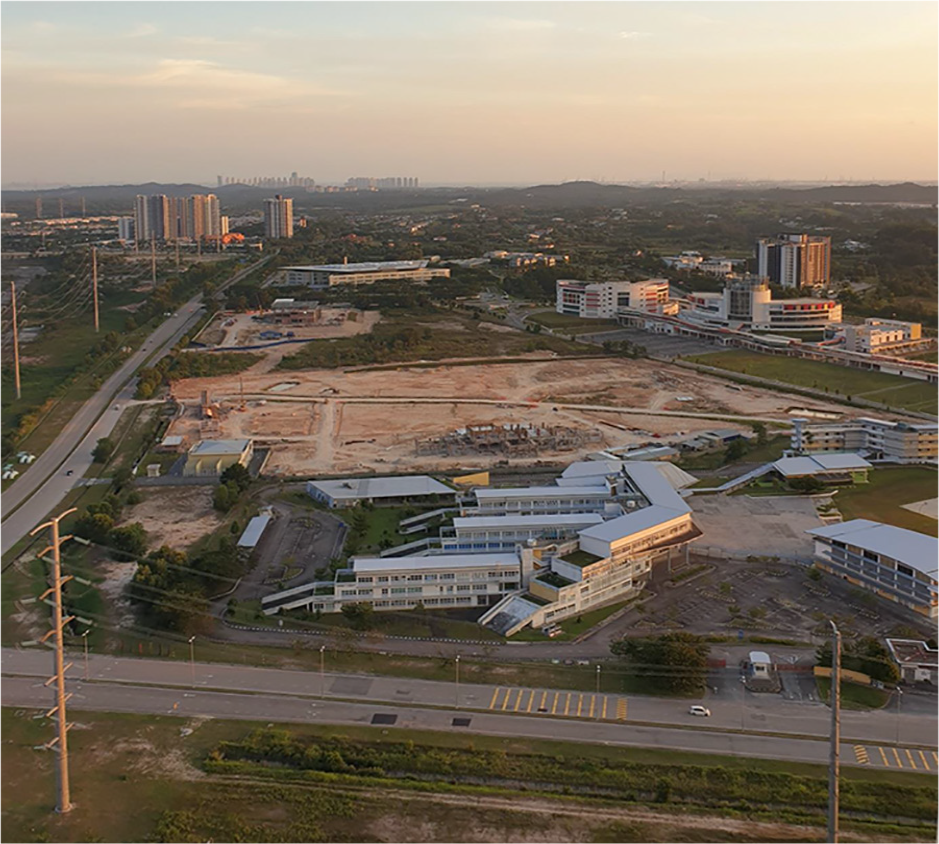
EduCity Iskandar, Malaysia.
Uniciti Education Hub (UEH) is integrated into the larger Uniciti Smart City project, which occupies 3.5 km2 in the village of Flic-en-Flac on the west coast of Mauritius. It is part of a strategy aimed at positioning Mauritius as a knowledge ‘hub’ geared towards Africa. According to the Medine Group’s website, UEH has 1,900 students and plans to recruit 5,000 students by 2025 (Medine Group, 2019). UEH is managed by the Medine Limited Group, which was founded in 1911 as the Medine Sugar Estates Company under British colonial rule. The company was renamed and restructured along the clusters Property, Agriculture and Leisure in 2009, adding Education as a fourth cluster in 2014. Initial developments of the UEH started in 2011, and it was officially launched as part of the ‘smart city’ project in 2017. The developers of Uniciti in Mauritius explicitly link higher education investments to the ‘knowledge economy’ and urban development: ‘Uniciti is poised to be an integrated and connected city that will promote sustainable development through a knowledge economy. The Medine Group is indeed committed towards providing a smart city whose main driver would be Education’ (Uniciti Education Hub, 2018). While the notion of ‘smart city’ usually centers around ideas of entire cities that are technologically networked and sustainably designed, here, the developers discursively link it to the individual education zone and the production of a ‘smart’ urban population.
Universities guided by market behaviour and profit-making rationales often aim to teach business and management courses at their offshore campuses, which are relatively cost-efficient to teach since they require little infrastructure and are relatively easy to transplant. Technical subjects, like engineering, rank second. Only a few universities offer programmes in the humanities and social sciences at offshore campuses (Miller-Idriss and Hanauer, 2011). The courses offered in TEZs, as state-led projects, however, do not simply follow market calculations of individual universities, but are carefully selected programmes to teach knowledge that is functionally linked to particular sectors and considered to be ‘useful’ or ‘productive’ within the economic strategies of the respective country. The Qatar Foundation has focused on attracting high-ranking universities to its Education City. Iskandar Malaysia Berhad, operating EduCity Iskandar, has developed exclusivity clauses for degree programmes of universities in the zone so as to prevent competition and guarantee market shares (Wan and Weerasena, 2018: 17). Thus, we see a number of highly specialised and/or expensive degrees being offered, for instance aeronautics and astronautics by the University of Southampton, medicine by Newcastle University (both Iskandar) and journalism by Northwestern University in Qatar.
Education in TEZs is sometimes combined with businesses to provide synergies, research and development transfer and to link graduates with future employers as skilled labour to spur economic development. However, in most cases, the promises of economic development through university–industry linkages of offshore campuses seem difficult to realise, given that most offshore campuses focus on teaching rather than research activities. Despite the project of developing ‘knowledge-based economies’, the construction of education zones may actually serve to spatially de-couple the education and research activities of universities, leading to limited opportunities for innovation and knowledge spill-overs.
TEZs as sites of transnational subject formation
Universities in the knowledge-based economy are critical sites for human capital development and subject formation (Moisio, 2018). Who are the (actual and intended) subjects populating TEZs in terms of ethnicity, citizenship, class and gender? No clear answers can be given based on the available data. Student profiles of international branch campuses and TEZs differ depending on domestic contexts. Comparing student profiles at offshore campuses in Malaysia and the UAE, Stephenson and Rajendram (2019) reveal important differences: while at Malaysian offshore campuses students stem largely from high-income ethnic Chinese, Indian and Malay communities, in the UAE they are drawn largely from middle-income South Asian and Arab expatriates. Access to (transnational) higher education in both contexts depends on country-specific power structures interlinking economic abilities and categories of nationality, citizenship and ethnicity. Since TEZs can also be set up with the aim of providing an alternative to migration, student enrolment can also be shaped by uneven mobilities based upon gender. Education City in Qatar, for instance, has an overwhelmingly female student population (Khodr, 2011: 520).
Advertisements suggest that socio-economically privileged individuals are a key target group; for instance, UEH in Mauritius aims to recruit ‘high net-worth students’ (Medine Smart City, 2019). The attributes of a ‘cosmopolitan lifestyle’ and references to globally connected ‘world-class universities’ displayed in marketing representations of universities and zones construct students as future members of a transnational capitalist class (Sklair, 2001). This class possesses tacit embodied knowledge and skills that are central in navigating and directing globalisation processes. Thus, higher education infrastructure is complemented with other functions in the zones. In UEH Mauritius and EduCity Iskandar Malaysia, a strong focus is placed on what could be termed the ‘education experience’, with advertised amenities largely relating to free-time activities, such as retail shopping, golf courses and other sport complexes, and proximity to beaches or amusement parks like LEGOLAND (EduCity) and Casela World of Adventures (UEH). The notion of the education experience is coupled with entertainment functions, highlighting lifestyles and consumption over infrastructures more generally associated with universities, such as laboratories and libraries, which are less frequently mentioned in promotion materials.
Whereas transnational higher education is the main function of TEZs, they often also host other education institutions, including domestic universities (e.g. Hamdan Bin Khalifa University in Education City Qatar) and (inter)national primary and secondary schools. Beyond constituting feeder institutions to the tertiary education sector, these institutions are considerable actors in their own right. For instance, in EduCity Iskandar, two international schools, Raffles International School and Marlborough College, together account for almost a third of the total student population in the TEZ, thus showing that transnational subject formation starts below tertiary education.
Unpacking the notion of ‘transnational’ education, we can also ask to what extent these spaces are characterised by transnational migration flows of staff and students. As shown above, most TEZs list the number of nationalities students come from: in Dubai’s zones this is more than 150 countries and in Qatar there are more than 70 nationalities. However, it remains an open question whether these are ‘international students’, defined as having left their country of origin and moved to another country for the purpose of study (Organisation for Economic Co-operation and Development [OECD], 2012: 371), and thus constituting new educational immigrants, or whether they are family members of workers in the Emirates, who do not have access to national universities and thus enrol in offshore branch campuses in TEZs – paradoxically precisely to avoid outward migration for tertiary education (see Stephenson and Rajendram, 2019). The distinction between ‘local’ and ‘international’ students may thus hinge not on transnational mobility but on citizenship criteria, necessitating further problematisation of the singular category of ‘the international student’ (Madge et al., 2015: 683).
TEZs as urban zones of exception
Our conceptualisation of these peculiar transnational higher education spaces as zones consciously establishes a link to the expansive literature on special economic zones (SEZs). Free trade zones and SEZs have a long history but have generally been developed as an instrument to enable spatially selective exceptions to national legislation, for instance granting exemptions or reductions to tariffs and taxes, deregulated labour legislation or more favourable visa policy to attract foreign direct investments and spur export-led development (Narula and Zhan, 2019). Whereas they are traditionally often devised for labour-intensive manufacturing industries, such as textiles and manufacturing, some states deploy them in urban areas for digital services exports (see Easterling, 2014; Kleibert, 2018). As a concept, SEZs have shown considerable flexibility and have increasingly become urban phenomena, with zones of exception as neighbourhoods within cities, or the development of entire cities as SEZs (Bach, 2011; Easterling, 2014; Kleibert, 2018). Contemporary urban zones fulfil multiple functions, sometimes branded as ‘live, work, play’ enclaves (Kleibert and Kippers, 2016), which with the more recent addition of ‘learn’ also include international university campuses.
The notion of the zone offers a conceptual linkage to SEZs as ‘spaces of exception’ (Ong, 2006). What kinds of exceptions are granted in TEZs? The rules and regulations differ but are especially important to selectively enable attractive modes of operation for foreign higher education institutions. In the case of the UAE’s zones, foreign universities operating an offshore campus are exempted from regulatory oversight by the Federal Ministry of Education. Dubai has established its own quality assurance body for foreign universities that accredits degrees (the Knowledge and Human Development Authority) and has therefore relatively tight control over the quality of higher education. This also has some disadvantages, as these degrees are not accepted by government employers in the other six Emirates. Ras al-Khaimah is also working towards a more autonomous system of regulation and tries to emulate Dubai. So far, it does not have an accrediting body and accreditation comes from the universities’ home countries. In such instances, we can observe that new (sub-state) transnational actors, such as the British Quality Assurance Agency, become responsible for the accreditation and quality assurance of higher education degrees on foreign territory. This leads to a rescaling of regulatory powers and ‘graduated sovereignty’ (Ong, 2006).
In some authoritarian contexts, regulations in offshore campuses seem to be less restrictive of academic freedom, including uncensored internet access not readily available outside of the zones (Wildavsky, 2010: 58). In her analysis of western academics in the Gulf, Koch convincingly conceptualises offshore campuses as planned exceptional spaces: Perhaps most curiously of all, [planners] are increasingly advancing their higher education agendas through a series of ‘exceptional’ projects, set outside the rules of their education ministries, spatially isolated on massive compounds outside city centres, or otherwise treated as islands where these scholars and their judges might at least have the impression of minimizing their potential contamination from the prevailing illiberal order outside the university walls. (Koch, 2016: 451)
In their urban form, most TEZs are constructed and marketed as integrated enclaves that provide all amenities, residential facilities and leisure activities. Education City in Qatar, for instance, was ‘created as an urban enclave of educational promise’ with the intention to spur local and regional economic and social transformations (Khodr, 2011: 524). The enclave nature of TEZs should, however, not be understood as a striving to be hermetically sealed from their surroundings; they can also function as ‘exemplars’, as spaces of experimentation that are supposed to have a transformative effect on their ‘outsides’, even if mainly realised in symbolic terms (Koch, 2018).
One such effect on TEZs’‘outsides’ is their relation to and embeddedness within overarching urban mega-projects and large-scale SEZs. In South Korea, the Incheon Global Campus forms part of the new development of ‘Smart City’ Songdo, erected adjacent to Seoul. Similarly, across the strait from Singapore, EduCity is embedded within the large-scale Iskandar Malaysia SEZ development project in the Johor region that comprises, among others, industrial areas, tourism resorts and a Chinese investment-focused city built on reclaimed islands (see Moser, 2018; Rizzo, 2019). Despite their relatively small size, TEZs are envisioned as ‘catalysts’ in the construction of new cities, above all those that make a claim to ‘smart’ cityness. The physical integration into these projects, some still under construction, presents challenges for the TEZs’ accessibility. Several of the TEZs are located in relatively remote locations, for instance on the outskirts of existing cities, and, at least to date, remain poorly connected by public transport requiring the use of private vehicles, taxis or ride shares.
Moreover, in the case of EduCity Iskandar, its accessibility problems and enclave character feature in relation not only to the zones’ outsides but also to within it, contrasting ideas of collaboration and the joint use of shared spaces often presented as a key function of ‘education cities’: Institutions that have their own compounds have fenced them off. One must first pass through a security barrier when entering the EduCity campus, and then through another layer of security as one enters the compound of each institution. Vehicles have to be registered at each point. […] The general feeling is similar to that of a military camp or high-security prison. (Wan and Weerasena, 2018: 18–19)
The extent to which these zones constitute enclave spaces – similar to gated communities – separated and securitised spaces for elites, requires further comparative empirical scrutiny.
Conclusions and research agenda
Our key contribution has been to reconceptualise ‘education cities’ and ‘education hubs’ through an urban political economic lens, revealing how TEZs are complex state-led projects, in which universities become enrolled as transnational urban actors and contribute to urban and political-economic transformations. TEZs emerge from the above discussion as ideal vantage points for an investigation of contemporary globalisation of higher education and urban development across different geographic contexts. The comparative analysis of TEZs has shown surprising similarities across a range of different urban and economic development projects.
First, TEZs differ from organically grown clusters as they are strategic national projects, usually with substantial funding and engagement from state authorities, while simultaneously rescaling regulation to the level of individual zones, selectively creating regulatory exceptions and involving new public and/or private actors as zone authorities, infrastructure providers and facility managers, usually with some connection to traditional ruling elites. Second, they are usually imbricated in broader economic and social transformation efforts, most visibly in the reference to establishing ‘knowledge-based economies’, including subject formation. Third, TEZs make frequent reference to ‘cities’ and are actively mobilised to construct or transform urban spaces. Fourth, at the discursive level, TEZs are marketing a vision of the future that is focused on transnational, (supposedly) privileged lifestyles and globality through the creation of particular imaginaries and infrastructures.
Clearly, TEZs arise out of very specific political and socio-economic contexts. This calls for further in-depth analysis of their different rationales, shapes and outcomes, offering an interesting opportunity for future qualitative comparative research that takes into consideration their embeddedness into specific geographic contexts and their respective regulatory frameworks. Moreover, the interrelations between different TEZs, in terms of policy transfers and mobilities through inter-referencing as well as transnational actors facilitating their development (e.g. consultants, financial or legal intermediaries, real-estate firms) would be interesting to uncover. What constellations of local and global urban actors drive the production of transnational urban spaces (see Parnreiter, 2012)? In-depth research could reveal the extent to which TEZs are locally embedded and connected or become indeed bordered enclave structures that remain insular and aim to dissociate themselves from their surroundings. More research is required to understand to what extent these become ‘successful’ projects in the sense that they materialise in the ways they are planned and envisioned.
From an urban studies perspective, it is interesting to reflect upon whether TEZs can be read as part of a ‘territorial moment’ in urban governance (Schindler, 2015), which implies a shift from the remaking of populations to the remaking of territories. While the logic of territorial transformation through the remaking of cities is clearly visible in the preceding analysis, education plays an important role in subject formation in the knowledge-based economy. More research is required into who the actual and intended subjects of TEZs are in terms of ethnicity, citizenship and gender. In sum, we argue that TEZs can offer a privileged vantage point and research site from which to conduct further critical geographical investigations that understand urban spaces ‘as much more than just the geographical backdrop to the globalisation of higher education’ (Collins, 2014: 242) and to reveal the material and discursive strategies that underlie the remaking of cities and transnational spaces of higher education for the ‘knowledge economy’.
Footnotes
Declaration of conflicting interests
The author(s) declared no potential conflicts of interest with respect to the research, authorship, and/or publication of this article.
Funding
The author(s) disclosed receipt of the following financial support for the research, authorship, and/or publication of this article: This research was funded by the Leibniz Association as Leibniz Junior Research Group ‘Constructing Transnational Spaces of Higher Education’ in the 2018 Competition.
