




Abstract
Ongoing splintering and siloification in urban studies require alternative approaches to bring the major theoretical and epistemological perspectives into constructive dialogue. Reflecting growing calls for engaged pluralism, we analyse the extent to which different perspectives can come together as complementary alternatives in understanding cities and present a framework for overcoming the key theoretical and methodological challenges caused by fragmentation. Using Istanbul as our illustrative case, we do this in three steps. Theoretically, we stress-test the potentials and limits of four dominant perspectives in urban theory making – global cities, state rescaling, developmental and postcolonial – revealing how each can only ever generate a partial, one-dimensional, explanation. Methodologically, we proceed to make the case for doing comparative urbanism differently by developing a conjunctural approach. Finally, and conceptually, we identify ‘conjunctural cities’ as a distinctive type of city and as a new approach to analysing cities. Our contention is that approaching all cities conjuncturally provides a significant step towards putting engaged pluralism into action, as well as indicating new terrain on which the future of urban theory/urban studies can be constructively debated.
[Istanbul] is a city like no other and yet it is a city that has things in common with many other cities, even if it does not always recognize it. (Sudjic, 2009: 4) In today’s global age, the world’s key axis is shifting from the North–South, which dominated an earlier colonial history, to that of the East–West. Within this shift, Istanbul’s strategic location is ascendant. (Sassen, 2019: 193)
Moving beyond siloification in urban studies
The first two decades of this century have been characterised by the emergence of a global urban studies. Despite the development of a critical body of work that has contributed to the globalisation of urban thinking, this has been accompanied by a diversification in approaches to understanding cities and the urban condition. In this paper, we focus on four of the most influential and long-standing theoretical perspectives underpinning global urban studies, namely global cities, state-rescaling, developmental and postcolonial. 1 Each of these approaches has originated from very different intellectual starting points and subsequently developed its own conceptual vocabulary, methodological tools and empirical preoccupations. Despite each approach representing a diverse set of ideas, sometimes overlapping with other approaches, the result has been a siloification around different schools of thought, often constructed and collapsed (by others) into a simplified core idea and perspective. There is a growing recognition that the constant attacking and defending of what constitutes a legitimate approach to current urban theory making has led to an intellectual environment in which it is difficult to engage in meaningful exchange (Brenner, 2018; Hoyler and Harrison, 2017; van Meeteren et al., 2016).
Ever since Robinson’s (2002) intervention arguing that adopting one approach, in this case global cities, brings certain cities to the fore and relegates others to the background in global urban research, there has been an ongoing debate as to the capacity of each perspective to understand certain, some or all cities. Reacting against any form of formal categorisation of cities, the response is a call for a comparative urbanism capable of, on the one hand, recognising the diverse urban experiences of all cities, while on the other hand simultaneously removing the barriers to researching ‘across different contexts’ (Robinson, 2011: 5). The problem, as noted by Peck (2015) and others, is that in (over)emphasising the particularity of each city, advocates of the comparative turn in urban studies distance themselves to such an extent it actually serves to prevent continuing conversations and meaningful comparisons between cities and perspectives. Alongside this, while the different perspectives on studying the global urban now mean that more cities are being included in contemporary global urban research (Kanai et al., 2018), there nevertheless remain certain cities that are problematic to align with one or more of these frames.
These cities that do not easily fit, and therefore fall between the gaps of international urban theory making, are increasingly the subject of researchers’ attention. 2 A first grouping of cities, such as Doha, Panama, Manila and Beirut, have capitalised on their in-betweenness to develop niche economies (Kleibert, 2017; Krijnen et al., 2017; Sigler, 2013). What we might usefully identify as interstitial cities leads us to consider a second grouping, including Moscow, Budapest and Istanbul. These former imperial interstitial cities sit at the interface of what Müller (2020) has termed ‘Global East’–‘suspended somewhere in the shadows between the Global North and the Global South, not quite belonging to either’ (Müller, 2020: 734). This is true in particular for Istanbul, which ‘[l]ike its geographical location, […] resembles both West and East [and] has been characterised generally by the less-developed attributes of the Global South but also has certain modern, developed aspects of the Global North’ (Yetiskul and Demirel, 2018: 3338).
Using Istanbul as an illustrative case, this paper proposes an alternative approach to doing comparative urban research that brings different theoretical perspectives into conversation. Recent convention has it that there are two principal approaches to comparative urbanism: ‘The first is a multi-city comparison, while the second deals with multiple sites within a single city’ (Ren and Luger, 2015: 153). We argue that collapsing comparative urbanism into debates about site selection is counterproductive to the type of meaningful exchange required to understanding the multiple ways of seeing cities (section ‘Doing comparative urbanism differently’). Our approach is grounded in a belief that to engage in meaningful comparative urban research we must explore the extent to which different perspectives (can) come together as complementary alternatives in explaining processes of urban change. We do this in two ways. We begin by stress-testing the capacity and limits of global cities, state-rescaling, developmental and postcolonial perspectives in making sense of cities, and in our case, Istanbul (section ‘Explaining Istanbul: Stress-testing urban theories in an interstitial city’). Arguing that Istanbul can only be partially understood through adopting a single epistemological perspective, we proceed in section ‘Conjunctural cities as both city type and approach’ to examine whether interstitial cities require a new theoretical starting point, or are best served by bringing together existing perspectives as complementary alternatives? From this we argue that there is a strong case to extend a conjunctural approach to urban theory making by proposing ‘conjunctural cities’ as both a distinctive type of city and as an approach to analysing cities. Attaching particular importance to the latter proposition, we demonstrate how a conjunctural approach is capable of establishing the potentials and limits of individual perspectives, ascertaining which different perspectives may usefully come together to go beyond these limits, and thereby establishing an urgently required open analytical framework. We conclude that conjunctural cities as an approach to analysing cities is a necessary step in moving beyond siloification in urban studies and toward putting engaged pluralism into practice.
Doing comparative urbanism differently
Such has been the splintering and siloification of urban studies that the emphasis on difference finding bears the risk of impeding the comparison of cities (Peck, 2015). There is something paradoxical about this because ‘putting comparison to work’ is what others argue is happening (Robinson, 2014), reporting a desire among urban scholars to seek out potential common ground rather than claim incommensurability, through the internationalisation of urban theory making (Lawhon and Truelove, 2020; Sheppard et al., 2013), the rise of comparative methodologies and urbanism (Cochrane, 2020; Nijman, 2007; Robinson, 2016; Schmid et al., 2018; Ward, 2010), and calls for constructive dialogue across different intellectual traditions via engaged pluralism (van Meeteren et al., 2016). In short, it suggests there remains a considerable amount of work to do on all three fronts.
It is beyond our scope here to provide an in-depth account of approaches to doing comparative urbanism (see Robinson, 2016 and Ward, 2010 for this) so for our present purpose we focus on two aspects of this debate we seek to move beyond in this paper. The first is a concern with a starting proposition that sees comparative urbanism operationalised as inter-city or intra-city comparison (Ren and Luger, 2015). Useful in tracing shared instances, features and repeated outcomes from place-to-place, and then analysing this by tracing connections (or not) between them, our concern is that we do not see anything in this that directly contributes to facilitating constructive dialogue across different intellectual traditions and perspectives in urban studies.
The second concern derives directly from what Robinson (2016: 187, our emphasis) rightly observes as researchers’‘eagerness to develop new practices of global urban theorizing and generate new concepts for thinking twenty-first century cities’. Her article is particularly instructive because, on the one level, it sets out to reframe comparative urbanism to deliver a more effective global urban studies. Yet, at the same time, in Robinson’s article alone, ‘new’ features 31 times: variously referencing new geographies, understandings, taxonomies, centres, repertoires, thinking, approaches, practices, concepts, ideas, subjects, analytical and methodological agendas, cultures and generation of scholarship. In fairness to Robinson this is explicitly set in the context of being ‘committed to’ working with, and revision of, existing theories, concepts and understandings. In saying this it does nevertheless highlight the wider issue: as urban theory making becomes more diverse and the number of new (and often competing) alternative perspectives increases, our theoretical understanding of cities is becoming ever more complex. This is not to say conceptual innovation is a bad thing, far from it; rather this should not come at the expense of renewing and reworking tried and tested approaches (Hoyler and Harrison, 2017).
Our contention is that to engage in meaningful comparative urban research we must explore ways in which different perspectives can come together as complementary alternatives to better understand cities. This requires reframing how we approach doing comparative urbanism by taking emphasis away from comparing shared instances and the quest for newness and directing it towards bringing different theoretical perspectives into conversation. We do this in three ways. First, we focus on a single city – Istanbul. Istanbul was selected as a test case because it does not easily align to one of the four dominant theoretical perspectives we considered (global cities, state-rescaling, developmental and postcolonial). More specifically, the geographies commonly associated with each perspective meant that Istanbul’s position at the intersection of the global East–West and North–South axes (Sassen, 2019) made it a logical choice to be an illustrative case. One of the world’s largest cities throughout history and only overtaken by London as Europe’s largest city in the 18th century, despite being replaced as capital city by Ankara in 1923, Istanbul continues to be a dynamic and strategically important city. Population growth of 3.3% at the beginning of this century saw Istanbul rank as the fastest-growing OECD metro-region (OECD, 2008) and it regularly features in the top ten tourist destination cities for international visitors (Euromonitor, 2019).
Second, and following Peck (2015), we begin the task of bringing different theoretical perspectives together by testing their ‘explanatory veracity’. This is not to put individual theoretical perspectives into some form of competition to determine which is more or less useful, but to illustrate that each perspective can only offer a limited and partial explanation of a city (such as Istanbul) or, for that matter, ever come close to grasping cities in all their complexity. Following from this, third, we contrast two approaches for better understanding cities in general, and Istanbul in particular. One follows on from the current trend in urban studies to develop a new, alternative perspective. The other brings the four different theoretical perspectives together. In undertaking this manoeuvre we reveal how the former is appealing in many ways but ultimately results in further siloification, whereas the latter affords us with a more inclusive – we would argue progressive – approach for doing comparative urbanism that is capable of putting engaged pluralism into practice.
To achieve this, our research on Istanbul draws on data from interviews and desk-based research conducted between 2015 and 2018. A total of 32 semi-structured interviews were conducted in two periods of fieldwork (in 2016 and 2017) with 45 local and central government officials, policy advisers, planners, business and trade representatives, as well as non-governmental organisations such as environmental groups and social movements. The interviews covered Istanbul’s position as a major metropolis (past, present and future in global, national and regional contexts) and tensions surrounding its development (local–national, political–economic–social–environmental). Interviews were conducted in Turkish, generating 35 hours of audio data, before being fully transcribed, translated into English (235,000 words total) and thematically coded. Quotations are used to inform and support the key findings presented, with the names of interviewees anonymised.
Explaining Istanbul: Stress-testing urban theories in an interstitial city
Perspective I: Global cities
Global cities research is premised on understanding how the world economy is spatially organised and, more specifically, how it has come to be associated with the concentration of high-value economic activity in specific locations. Intellectually, global cities research has contributed to our understanding of the urban world by accounting for how cities are positioned within global circuits of capital accumulation. Its major contribution is to provide tools, methods and framing capable of uncovering the geo-economic role and function of a city/cities in globalisation (Sassen, 1991; Taylor and Derudder, 2016). Of the four approaches, only a global cities perspective has the capacity to show how a city is connected into the global service economy, to assess this relative to other cities and explain the implications therein.
Turning to Istanbul, a global city perspective reveals the city’s rise in strategic importance in the global economy and that it is first among several interstitial cities in this regard. One important indicator of this is found in the Globalization and World Cities (GaWC)’s city classification, measuring a city’s integration into the world city network through indirect relational measures of economic flows. Based on the location of advanced producer services in cities across the world, the GaWC classification reveals Istanbul as transitioning from beta+ to alpha between 2000 and 2018 (GaWC, 2018). 3 Critically, the story is similar for other interstitial cities, with Moscow making the same transition, while Vienna, Budapest and Lisbon all moved from beta+ to alpha−. By focusing on different facets of the global economy (business and professional services, financialisation, high-skilled labour, international management, real estate, infrastructure-transport-logistics, planning and governance) a global city perspective is key to unlocking the processes by which cities such as Istanbul are fulfilling particular strategic roles, examining the strategies through which they seek greater global integration and assessing the implications (Keyder and Öncü, 1994; Sassen, 2019; Yıldırım and Mullineux, 2015). Yet, with this comes limitations.
Some limitations are generic and have been well-rehearsed elsewhere (e.g. Acuto and Steele, 2013) but others are specific to understanding interstitial cities such as Istanbul and it is these we focus on here. The first is how global cities research has become appropriated by a cadre of so-called ‘urban experts’, corporatising urban studies as they go by engineering off-the-shelf blueprints essentialising the need to embrace corporate globalisation (Hoyler and Harrison, 2017; Leon, 2017; Taylor, 2016). As a quickly globalising city, Istanbul is at the forefront of this, as the following quote from management consultants A.T. Kearney shows: Over the past five years, Melbourne, Istanbul, Berlin and Miami showed the greatest improvement in their Index rankings, chiefly because of increases in information exchange, human capital and business activity. (A.T. Kearney, 2017: 3)
Important though it is, note how the emphasis is only on aspects of corporate globalisation. This is relevant because, second, services are significant, but they are only part of the story in cities such as Istanbul (Figure 1): What is claimed in the discourse of globalisation is a totally deindustrialised, service and finance intensive city, yet this is not what is happening in Istanbul. Istanbul is not deindustrialising. On the contrary, it continues to industrialise. I mean, there is a total economic growth in Istanbul [in GDP]: both in industry and in services. (Interview, Chamber of City Planners)
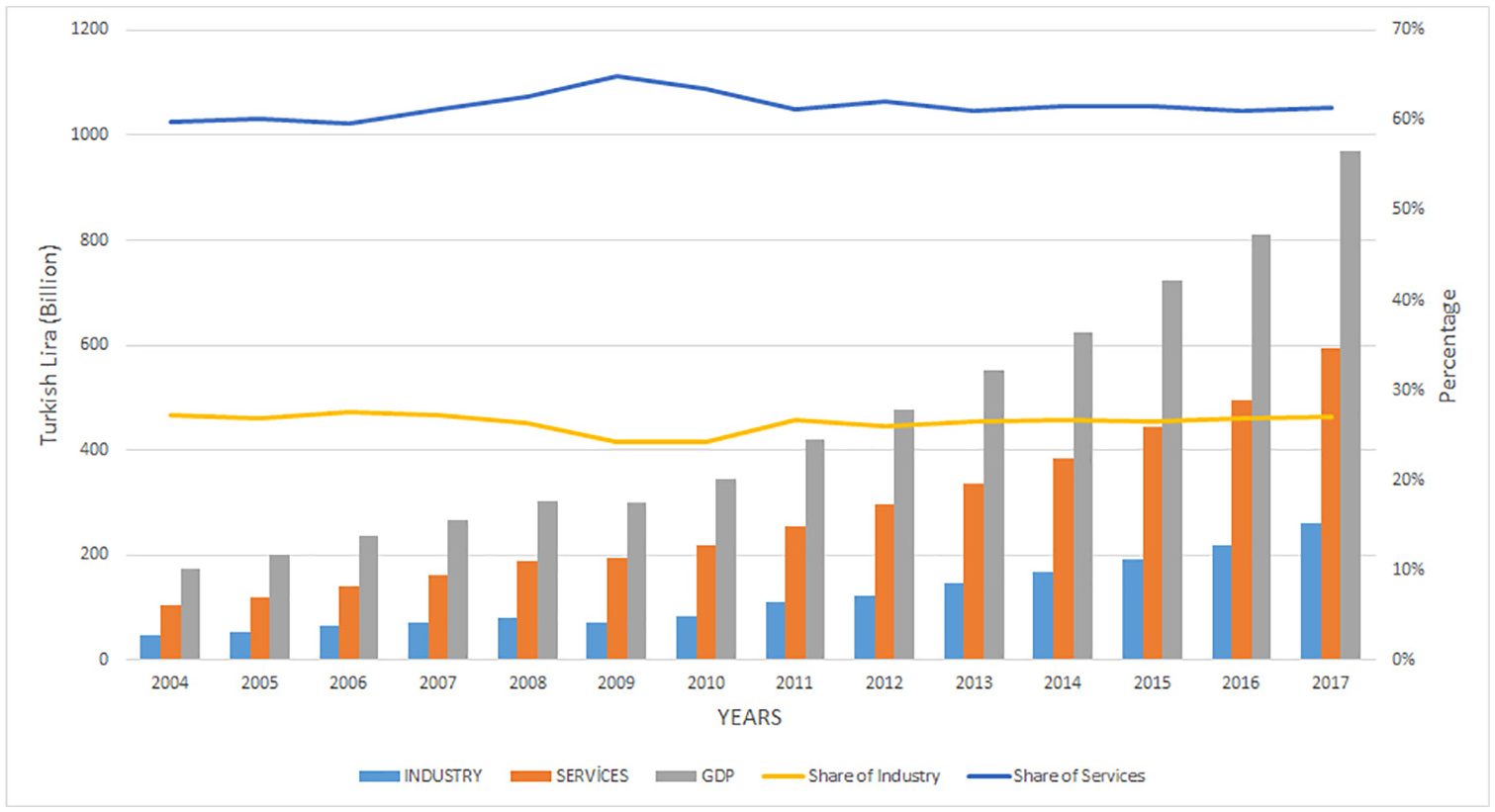
Economic profile of Istanbul, 2004–2017.
And third, while the focus on the economic has traditionally underplayed some political aspects of urban development, the focus on the formal economy has overshadowed informal aspects of the economy in global cities research. Both – the political and the informal – are essential to understanding the development of Istanbul: Istanbul seems to disrupt a few established notions of the global city paradigm. The first is the role of an authoritarian government, [and] the second is the history of illegal settlements, which unsettles the perceived profusion of informality as a characteristic of globality in Asian, African and South American cities. (Akcan, 2015: 364)
It cannot go unnoticed how point one exhibits the hallmarks of state rescaling and developmentalism, while point two is indicative of postcolonial critiques of the global city perspective. It is to these we now turn.
Perspective II: State rescaling
The state rescaling perspective is a complementary critique of the geoeconomic logic underpinning approaches such as the global cities perspective. Highlighting how an overly narrow economic focus sometimes neglects the important role of politics, a state rescaling perspective serves to reveal how urban change is not only encouraged by state actors: they have an essential role in orchestrating neoliberal reforms, urban entrepreneurialism and financialisation. Serving as an important counterbalance to claims that political actors are being side-lined by corporate globalisation, it quickly came to pass that it is no longer intellectually sustainable to separate the economics of urban change from the politics. This balance between complementarity and critique is most clearly articulated in Brenner’s (2004) distinction between the ‘rescaling of capital’ and ‘rescaling of statehood’ as the twin determinants of contemporary urban change.
A key facet of the state rescaling perspective is the focus it places on the always-in-motion political-economic struggles that reflect different actors’ attempts to upscale, downscale and institutionalise functions, powers and authority. The primary but not exclusive focus here is on the legitimacy of the nation-state vis-à-vis other actors (often at different spatial scales) to regulate and govern. A state rescaling perspective is essential to understanding the development of Istanbul because when the Justice and Development Party (AKP) were elected to national government in 2003, they immediately embarked on a comprehensive process of decentralisation for economic (responding to the economic crisis facing Turkey) and political reasons (fulfilling EU stipulations for considering Turkey’s membership). Moreover, the politics of scale is very evident in how AKP, and its leader President Recep Tayyip Erdoğan, reflect on the enabling and disabling role of politics in projecting Istanbul as a global city within a decentralised system of governance: I served as mayor in Istanbul for 4.5 years and I had a goal, an ambition in those days to turn Istanbul into a financial capital. Of course, because it was different politics ruling in the central government we couldn’t do it then. But now, we are in power in the central government, and also in Istanbul local government. We considered the pros and cons and decided to take prompt action to make Istanbul the financial centre. (Erdoğan, 2009: n.p.)
AKPs experimentation with decentralisation proved to be short-lived, however, because after 2010 the party switched to increasingly authoritarian and centrist rule, and the room for compromises to be negotiated largely disappeared: Whatever is being done in Istanbul, the local government just serves for the projects whose decisions are made by Ankara. So, we are not talking about a relationship like the relationship between Westminster and Greater London Council … All decisions relevant to Istanbul such as road decisions, bridge decisions, tunnel decisions, metro decisions, major commercial decisions, even the opening of any meteorological station, are given by Ankara. (Interview, Policy Advisor 1)
This is significant because, as the interviewee alludes to, a state rescaling perspective is imbued with the historical political-economic transition from Fordist-Keynesianism towards consolidating post-Fordist, post-Keynesian, post-national regimes which has taken place across, principally, North America and Western Europe. All of which raises important questions about cities in countries that do not fit this model. Writing on Turkey, Kuyucu (2018: 1152) explains how ‘neoliberal economic transformations in developing countries do not necessarily lead to political decentralization, which sets them apart from advanced capitalist context’. Reflected in the above quotations, he goes on to argue that the ‘dynamics of transformation have been notably different, mostly due to the lingering (and even increasing) power of central states’ (2018: 1154). This does not undermine the relevance of a state rescaling perspective per se, but the ‘aggressive interventionist style of the government and its institutions’ (Sanli and Townshend, 2018: 1247) in Turkey arguably bears more resemblance to developmental city-states where the interests of ‘city’ and ‘state’ are aligned (Olds and Yeung, 2004).
Perspective III: Developmental
Alongside the state rescaling critique, a second political economic perspective emerged from East Asia. Arguing against any notion of a single hegemonic type of global city, a developmental perspective uses the example of East Asian cities to argue for fundamental regional differences in the formation of global cities (Hill and Kim, 2000; Olds and Yeung, 2004). In much the same way that the state rescaling perspective revealed global city formation to take on nationally and regionally specific forms, East Asian developmentalism magnifies further the importance of national regulatory controls in producing divergence: New York and Tokyo are two different world city types, we argue; the former is market-centred and bourgeois, the latter is state-centred and political-bureaucratic. (Hill and Kim, 2000: 2168)
Three of the main differences identified by Hill and Kim (2000) in relation to developmental urbanism are also apparent in interstitial cities such as Istanbul: the continued importance of manufacturing; the key role of national governments in shaping urban development; and the embeddedness of even the most globalised cities within their national political economy (see sections ‘Perspective I: Global cities’ and ‘Perspective II: State rescaling’). But whereas a developmental perspective emphasises binaries with respect to global city formation (e.g. market-rational versus plan-rational, weak state controls versus strong state controls), Istanbul illustrates how many cities defy either categorisation and instead exhibit strong elements of both (see also Wu, 2015, on China): While many of the post-2002 laws are broadly consistent with what might be termed ‘neoliberal’ reforms (such as increased financialization and marketization, and a focus on competition and entrepreneurship), it’s crucial to recognize that the state, and the central government in particular, has not been sidelined by these processes. (Angell et al., 2014: 650) It is difficult to claim that we have a national development policy. You know, in reality, we have never prepared a national plan. Of course, we make development plans, but we cannot follow them. (Interview, Chamber of City Planners)
These quotations illustrate that, for all the characteristics of developmentalism that emerged under Erdoğan’s AKP government, the capacity of the state to proceed on this basis only allowed so much to be achieved. Furthermore, whereas developmentalism may appear to offer considerable explanatory capacity, the events surrounding the 2019 mayoral elections – with opposition politician İmamoğlu elected to office – highlight the fragility of such an approach. Overnight the political alignment between city and state was broken, the consequences of which did not escape Erdoğan when he said two years earlier ‘If we lose Istanbul, we lose Turkey’ (Ingleby, 2019).
And finally, less pronounced socio-spatial polarisation evident in the examples of Tokyo and Seoul (Hall and Kim, 2000) contrasts with significant inequality in Istanbul (Tansel, 2019).
Perspective IV: Postcolonial
Researchers writing from a postcolonial perspective emphasise particularity rather than universality, drawing attention to difference and diversity within and between cities. Pushing back against what they see as universal claims that derive from a narrow urban theory constructed in Europe and North America, postcolonial scholars call for a more cosmopolitan urban studies (what Roy and Ong, 2011, conceptualise as ‘worlding’), recognising the distinctiveness of all cities and asserting their equal standing as places from which urban theory can be produced (Robinson, 2006).
Istanbul is one of the four largest urban areas on the continent of Europe, alongside Moscow, London and Paris. Yet, while London and Paris have long been fundamental staging posts in developing urban theory, Istanbul and Moscow have been largely ignored by virtue of being politically, geographically and economically ‘off the map’ of North Atlantic Fordist-Keynesianism (1930s–1970s) and then neoliberal orthodoxy. In this way, the postcolonial premise to decentre urban theory should be paving the way for cities such as Istanbul to be more prominent in contemporary urban discourse. Despite seeing a growing number of papers in urban studies focusing on Istanbul, the postcolonial vision of theorising from elsewhere has been somewhat usurped by researchers seeking to understand Istanbul’s development through the lens of Northern theory, and neoliberalism in particular (Karaman, 2013; Le Galès, 2016). Where the postcolonial perspective has more potential to gain traction is the recognition that as well as broadening out where we theorise from, we also need to broaden our focus of what we study in cities beyond choosing either a global city or developmental lens (Robinson, 2002). Drawing particular attention to the dynamic potential of other sectors of the economy, especially the informal economy, and other spaces in the city (e.g. slums; Roy, 2011), a postcolonial perspective does appear particularly well-suited to a city such as Istanbul because: There is no city in Europe whose population increased from a million to fifteen million in 50 years. There is no city in Europe which has such a big informality phenomenon. There is no [major] city in Europe whose GDP per capita is as low as Istanbul. (Interview, Policy Advisor 2)
One of the challenges of adopting a postcolonial perspective to understanding Istanbul is its history as a major imperial city and capital of the Ottoman Empire. This means Istanbul’s colonial legacy is atypically postcolonial in the sense that it has more in common with ‘post-imperial’ European cities than with cities elsewhere that experienced colonial rule (King, 1990). In more modern times, however, Turkey is operating in complex relations with the four major geopolitical powers of EU, USA, China and Russia reinforcing Istanbul’s place as an interstitial city.
Stretching good ideas too far?
Understanding Istanbul through any one of these theoretical perspectives is, we argue, a case of stretching a good idea too far. At best the result is a partial, one-dimensional, explanation. At worst the result can be entirely misleading. As we illustrate, all the perspectives offer explanatory capacity but equally they all contain blind spots and inherent weaknesses that obfuscate certain aspects of the city. One starting point for furthering this discussion is to conduct additional stress-testing of each perspective, systematically comparing each approach in order to present an argument pertaining to which is most/least useful in explaining Istanbul. However, this will only get us to the unwanted position of identifying which perspective is more/less partially right, while also serving to unhelpfully reinforce division by putting ideas, perspectives and researchers into direct competition (van Meeteren et al., 2016). To understand and explain cities such as Istanbul it is our contention that we need to be far more ambitious, and at the same time, inclusive.
Let us be clear, an approach that offers a partial reading is not a problem per se. To the contrary, each approach provides a specific lens, allowing precision in understanding specific aspects of cities to be achieved. Partiality is only a problem when it is conflated with whole-city analyses by those advancing the approach and/or its critics. To make more sense of the city at large we need an approach capable of bringing together multiple perspectives in a coherent way. It is to this challenge that we now turn.
Conjunctural cities as both city type and approach
Directly responding to critiques about the reach of Northern theory and the explanatory relevance of European-North American examples in critical urban studies, Jamie Peck (2017a, 2017b) utilises the idea of ‘conjunctural urbanism’ as shorthand for overcoming what he sees as the ‘deconstructive manoeuvres’ (Peck, 2015: 160) preventing constructive dialogue across different theoretical perspectives. Tackling the fundamental question of how we theorise in urban studies, Peck’s focus is drawn to emphasising the ‘dialogic connections between case studies, midlevel concepts and revisable theory claims’ (Peck, 2017a: 4). In making his case for a ‘conjunctural’ approach to urban analysis, Peck (2017a: 4) explicitly frames this as being ‘complementary to, but at the same time distinct from’ other current approaches. 4
It is in the same spirit that we suggest a ‘conjunctural’ approach to urban analysis can be developed in two further ways. The first conjunctural approach emerges from our argument that there is a distinct grouping of not insignificant cities (notably Istanbul, but also including, in a European context, Moscow, St Petersburg, Budapest, Warsaw, Vienna) which are largely unaccounted for by any of the dominant theoretical perspectives in urban studies. This being so, one way to account for these cities is to understand them as a distinct grouping of ‘conjunctural cities’– places between established geographies and perspectives in global urban studies – which offers a complementary alternative to existing theoretical perspectives. Such an approach does not seek to challenge extant approaches but to add another analytical string to the theoretical bow. The second conjunctural approach involves understanding a city by bringing together and blending the different perspectives through the analytical lens of cities such as Istanbul. This latter approach has the advantage of moving beyond any attempt to understand or explain cities through a singular lens (be it neoliberalism, developmentalism, postcolonial, state-rescaling, assemblage, or ‘as a global city’) but through a conjunctural reading of the city.
Conjunctural cities 1: Explaining Istanbul as a conjunctural city
Having established that a genuine understanding of Istanbul through an existing theoretical perspective was not desirable or possible, our research led us to ask whether Istanbul could be considered an exemplar of a different city type – what we term here the ‘conjunctural city’. We arrived at this term because the first observation most observers make in relation to Istanbul is its geographical and strategic location between Eastern and Western, Northern and Southern urbanisms (Sassen, 2019; Yetiskul and Demirel, 2018). But we also deployed ‘conjunctural city’ because existing approaches and spatial vocabulary did not adequately address the case of Istanbul (Schmid et al., 2018). 5
In a recent article, Müller calls for researchers to theorise the Global East as part of an endeavour to think between North and South, but in so doing has to ask: ‘What about South Korea, Turkey or the ominous Middle East?’ (2020: 749). This implies Istanbul is somehow located inside/outside depending on how the Global East is constructed and mobilised. Notwithstanding the value of this approach, our contention is that to understand a city such as Istanbul we need to separate out city type from city location. This is because Istanbul ‘represents the characteristics of both the Global South and North’ (Yetişkul and Demirel, 2018: 3366). In this way, Istanbul cannot be separate from Global South and North. Likewise, as one interviewee remarked, the same is true for East and West: the East is the east of Istanbul, and the West is the west of Istanbul. (Interview, TOKI board member)
6
From this perspective, the specificity of Istanbul’s geographic and strategic location is very much to the fore. But this would be to fall into the particularity trap that Sudjic (2009) notes when highlighting that Istanbul is a city which has things in common with many other cities even though local and national actors do not always recognise this. This tension, and the resulting contradictions, were very evident throughout our research: Istanbul is not a city that should take others as a role model, but a city that should be taken as a role model. I don’t think there should be a question as to which city should be a role model for Istanbul. (Interview, TOKI executive)
What this interviewee alerts us to is not, as first might be imagined, a perception that Istanbul is unique. Albeit this is undoubtedly part of the story, the broader narrative interviewees sought to develop centred on a combination of three factors: (1) Istanbul’s geoeconomic importance as one of the fastest-growing urban economies in the world; (2) Istanbul’s geopolitical importance for relations with and between the European Union, USA, China and Russia; and (3) Istanbul’s geohistorical importance as an imperial capital from 330 until 1922. It is this latter point of difference which came to the fore time and again. As this interviewee put it: ‘owing to power coming from its past, Istanbul is a city that can be an example’ (interview, Istanbul Metropolitan Municipality planning executive). The key point here is that this is not unique to Istanbul. Other post-imperial cities such as Budapest, Warsaw and Prague are places where a process of recentralisation is seeing them ‘regain some of their prewar importance’ (Sassen, 2019: 73). We can add Vienna to this list – as an emerging international business centre for Eastern Europe – and the post-Soviet cities of Moscow and St Petersburg. What we arrive at very quickly, then, is a distinctive group of cities, not easily accounted for by existing categorisations or perspectives in urban studies, but which have a similar set of economic, political and historical characteristics.
Our argument here is that this is much more than just geography. Granted, the aforementioned cities are all located in an interstitial zone situated between Western Europe and Asia but broaden our horizons beyond city location and we can note other cities which have similar defining characteristics – Lisbon, for example. Focusing on city type also directs attention towards other cities which, despite not having an imperial legacy, are places clearly situated between established geographies and perspectives in global urban studies and might therefore be usefully understood as conjunctural cities. Included here we might consider inter alia Abu Dhabi, Astana, Baku, Beirut, Cairo, Casablanca, Chengdu, Doha, Guangzhou, Kuwait City, Riyadh, Shenzhen and Tel Aviv 7 as strategically important cities which do not easily avail themselves to being understood through one of the four established perspectives in urban studies discussed in this paper.
Against the backdrop of an increasingly internationalised urban studies, extending conjunctural thinking in the way we propose offers a complementary alternative to existing theoretical perspectives. We would go further and say it is a necessary step towards understanding those cities, such as Istanbul, for which existing approaches and spatial vocabulary do not provide sufficient explanatory capacity. And yet, for all the importance of developing ‘conjunctural cities’ in a way that is distinct from, but still complementary to, existing approaches, it must be recognised that the addition of a fifth perspective would have important consequences. What we are thinking of most here is the trend in contemporary urban studies for infinitely minting spatial vocabulary to differentiate between so-called ‘new’ city types, urban forms and processes, theories and approaches (Paasi et al., 2018; Schmid et al., 2018; Taylor and Lang, 2004). The hidden danger therefore in developing conjunctural cities as a distinctive city type is if it will make global urban studies a more fragmented, complex and messy field to navigate. Indeed, if we are not careful, there is the potential that ‘conjunctural cities’ inadvertently makes global urban studies more parochial, affording opportunity for more ‘straw man’ arguments to develop (van Meeteren et al., 2016). It is for this reason we propose a second extension to conjunctural thinking which seeks to overcome further siloification in urban studies.
Conjunctural cities 2: Explaining Istanbul through conjunctural cities
Our second extension of conjunctural thinking involves moving beyond objectifying some cities as ‘conjunctural cities’ to consider all cities conjuncturally. The point of difference is that whereas the former represents a single outcome – a city is categorised as either being conjunctural or not – the latter is a means by which to achieve other ends. By bringing together and blending different perspectives in urban studies we see conjunctural cities as an approach that can help achieve the goal of putting engaged pluralism into practice. In other words, conjunctural cities becomes an analytical lens through which to observe, understand and explain cities. 8
More than this, conjunctural cities as an analytical lens is arguably already present – albeit implicitly we would argue – in the work of scholars such as Patrick Le Galès (2016: 166), who, when writing about Istanbul identified the problem with one-dimensional understandings of the city: A series of papers have now argued that the transformation of Istanbul is all about neoliberalism … Neoliberalism explains Istanbul’s development. Is that really so, however?
Our argument is that we could just as easily replace ‘explained with neoliberalism’ with ‘explained with global city theory’, ‘explained by state-rescaling’, ‘explained with developmentalism’, ‘explained with postcolonial urban theory’ and so on, still reaching the same conclusion. What is most interesting in this regard, and appropriate to now quote at length, is how Le Galès (2016: 166–167) proceeds to suggest a solution to this type of one-dimensional thinking: It is not too difficult to provide ample evidence of the massive development of Istanbul over the last three decades, for example, through the huge new housing schemes organized by the state agency TOKI to get rid of informal settlements, the Gecekondus. Yet, the development of Istanbul reflects the political economic project of a group of conservative Muslim elites of the AKP party under the leadership of the increasingly authoritative leader Erdogan […] One part of the story is about Istanbul’s status in the competition between large globalizing metropolises – not really a new issue that is grounded in neoliberalism. In that case, the mobilization of neoliberalism as an explanatory framework hides interest groups […] The contemporary Turkish case might […] more fruitfully be analysed as a particular religious version of the developmental state once identified and then revised by Peter Evans (2010), with a particular historical state inherited from the Ottomans and the Kemalist regime (Aymes et al., 2014), leaning towards authoritarism. By contrast, the general explanation in terms of neoliberalism is both empirically very weak and reveals a naive analysis of the role of ideas on policy changes or about the state. The same analysis would apply to contemporary analyses of many Asian (Park et al., 2012) or, even more so, African metropolises (Bekker and Fourchard, 2013; Fourchard, 2011).
Contained within this single quotation we observe conjunctural thinking in action. First, we see all four perspectives brought together into one conversation: global cities, when identifying Istanbul’s ‘status’ in the competition between large globalising metropolises; state-rescaling, when highlighting Istanbul’s development being an elite-driven political-economic project; developmentalism, when referring to the notion of a particular religious version of the developmental state; and the postcolonial, when attention is directed to Istanbul’s informal settlements. Second, Le Galès restates the problem of one-dimensional thinking when referring to global urban competition as being only ‘one part of the story’. And third, he comes out of this quotation suggesting there is wider applicability. Is this not engaged pluralism in practice?
Our contention is yes but to genuinely use conjunctural cities to practise engaged pluralism requires moving from the implicit (and possibly accidental) to the explicit (reflecting conscious research strategy). In other words, we need to build what Yeung (2003: 455) termed ‘theoretical triangulation’ into the way we analyse cities. Theoretical triangulation is the awareness of the multiple insights offered by different perspectives – complementary, overlapping, competing and contradictory – on a(ny) given issue. Critically, this does not prevent commitment to a particular epistemological lens but it does require constructively engaging in conjunctural thinking. Here we find it useful to distinguish between scoping cities conjuncturally and synthesising cities conjuncturally. Scoping is formative, requiring researchers in the initial design phase to establish the potentials and limits of individual perspectives, and to ascertain which different perspectives may usefully come together to go beyond these limits in making sense of a (particular aspect of a) city. Synthesising is summative, requiring researchers throughout the execution and write up phases to maintain an open analytical framework that enables triangulation in practice and to evaluate the approach adopted. This distinction is important because although scoping can be decided a priori and theoretically, synthesis must be determined ex post and empirically. Put simply, if we are to genuinely practice engaged pluralism, scoping is a useful starting point, but synthesis is where the stress-testing of urban theories must increasingly take place.
Conclusion: Towards new urban geographies
Istanbul is a very valuable ore, but very badly processed. (Interview, National Business Association executive)
Research on interstitial cities such as Istanbul raises important questions about urban theory. This is because they do not easily fit, or align with, one of the dominant theoretical perspectives in global urban studies. Seeing a city through the epistemological lens of either global cities research, state rescaling, developmentalism or postcolonial urban theory, can only ever generate a partial, one-dimensional understanding. Nevertheless, urban studies remains to a large extent characterised by siloification, as researchers struggle to engage in constructive dialogue beyond the distinctive ‘invisible colleges’ (Acuto, 2011) in which they are situated, because of their different intellectual vantage points (Peck, 2015; van Meeteren et al., 2016). Our contention is that to overcome this theoretical and methodological impasse, we must explore the extent to which different epistemological perspectives can come together as complementary alternatives to better understand cities. This requires a renewed focus on how we approach doing urban research (Harrison and Hoyler, 2018; Leitner et al., 2019).
Our paper makes four contributions to advancing theoretical and methodological approaches to the study of cities. Theoretically, we have emphasised the critical importance of stress-testing existing approaches to reveal their strengths and weaknesses in explaining the object of urban enquiry and/or the chosen urban context. Methodologically, we advance current approaches to doing comparative urbanism beyond a focus on site selection and an emphasis on ‘the new’ by developing an analytical framework capable of bringing different theoretical perspectives into conversation. Empirically our research on Istanbul allows us to make two conceptual advances. Extending Peck’s (2017a, 2017b) initial call for a conjunctural approach to urban analysis, the first conceptual advance has been to identify a group of cities, which, as places situated between established geographies and perspectives in global urban studies, can best be understood as conjunctural cities. Our second extension of conjunctural thinking moves beyond objectifying some cities as ‘conjunctural cities’ to consider all cities conjuncturally.
Connecting back to broader debates in urban studies, we see these two extensions of conjunctural thinking as indicating the terrain on which the future of urban theory making should be debated. For all that the identification and categorisation of some cities as conjunctural cities might have its place in generating and sustaining debate in urban studies, and offering a complementary alternative to existing perspectives, it does not overcome the fundamental challenge of creating dialogue through a genuine enactment of engaged pluralism. One observation we should make here is that this approach of placing different perspectives alongside each other is becoming more common in urban studies. We have done it in this paper to make the initial case for ‘conjunctural cities’ as an alternative perspective, Storper and Scott (2016) do likewise with postcolonial urban theory, assemblage theory and planetary urbanism to make their case for the urban-land nexus, while in a recent contribution Yap and McFarlane (2020) examine urban extreme poverty through the epistemological lenses of political economy, political ecology, feminist urbanism and postcolonial urbanism. While the end point might be different, the structure and framing for the argument is identical: a section on each perspective highlighting strengths/weaknesses, what they reveal/obscure. Our argument is that for all that this does to go beyond adopting a single approach in urban research, this still actively reinforces siloification precisely because each theoretical perspective and epistemological approach is analysed as a single lens. It highlights different ways of seeing a city or issue, but it does not actively bring them together. To our mind, the failure to put engaged pluralism into action – by which we mean not actively bringing different perspectives together in a systematic way – remains the biggest single challenge in how we generate urban theory today. For our part, we argue that conjunctural cities as an approach offers one way to do this, potentially overcoming some of the inherent dualisms in global urban theory but also pointing towards a future urban studies where the skill of urban research becomes one of synthesis once more.
Footnotes
Declaration of conflicting interests
The author(s) declared no potential conflicts of interest with respect to the research, authorship and/or publication of this article.
Funding
The author(s) disclosed receipt of the following financial support for the research, authorship, and/or publication of this article: Özgür Sayın received research funding through a PhD scholarship from the Ministry of National Education, Republic of Turkey.
