




Abstract
The appeal of revolutionising urban governance through information technologies has prompted cities across the globe to pursue smart city initiatives. The mainstream scholarship on these initiatives has mostly focused on technology and corporate-led urban development, and it also often privileges the experience of cities in the global North. Nevertheless, this mainstream understanding of the smart city may obscure emerging new power dynamics and locally contextualised processes associated with smart urban development, especially in cities at the global periphery. Inspired by post-colonial theories, this article makes the case for ‘provincialising’ smart urbanism by dislodging technology from the centre of analysis, accentuating perspectives of cities outside the locations where the smart city knowledge is traditionally produced and attending to power relationships. In our case study of Taipei, this provincialising approach helps unveil various logics, intentionalities, assemblages and power dynamics through which the smart city is employed as a political strategy to facilitate urban regime transition. We argue that the current non-affiliated Ko administration exploits the veneer of technological superiority and political neutrality of its smart city agenda to set a new growth agenda, form new development coalitions, establish new institutions and incorporate rising populist momentum into policy-making. Focusing on the politics of being smart, our findings illustrate how smart city experiments reshape power dynamics and regime formation through reorganising actors and interest groups, reconfiguring government institutions, reallocating resource distribution and, in the end, bolstering governing legitimacy.
Introduction
The smart city, as a policy idea and a planning practice, has emerged at the forefront of global urban policy discussions. The incorporation of information and communication technologies (ICTs) into urban governance began as piecemeal and experimental initiatives in the 1990s, but has since grown into an extended urbanism idea adopted by major cities and even elevated to supranational agendas such as the Digital Agenda for Europe. Concurrently, a growing body of scholarship on smart cities has focused on the application of smart technologies (e.g. Alawadhi et al., 2012; Khatoun and Zeadally, 2016) as well as the discourse and rationale of smart cities (e.g. Söderström et al., 2014; Wiig, 2016).
With a growing population, rising fortunes and an unwavering faith in technological solutions, many Asian cities have also embraced this trend of technology-oriented urbanism. Over the last two decades, major cities in Asia have adopted technical strategies to improve their governance. These initiatives are often branded under labels like ‘cyber city’, ‘intelligent city’, ‘networked city’, ‘ubiquitous city’ and, the most encompassing term, ‘smart city’ (Douglass, 2000; Komninos, 2009; Shwayri, 2013). But the current literature provides limited understanding of this rise of smart cities in Asia. Research on smart urbanism still prioritises the experience of cities in the global North, where the neoliberal economic logic of global competitiveness and the interests of dominant transnational ICT corporations are in the foreground. The underlying narrative presents smart urbanism as an exemplar of fast-circulating neoliberal policy, one in which global capitalism facilitates rational and efficient governance that also facilitates austerity measures in the post-crisis era (Rossi, 2016; Wiig, 2015; Wiig and Wyly, 2016). So far, critical studies on smart cities in Asia remain limited, with a few exceptions (Datta, 2015; Kong and Woods, 2018; Shwayri, 2013).
Nevertheless, post-colonial urban scholars assert that this neoliberal logic explains little of the variegated urban development processes in the global South (Parnell and Robinson, 2012; Roy, 2009; Roy and Ong, 2011). The mainstream literature on smart cities, predominantly informed by the experience of cities in the global North, focuses on smart technologies, best practice models and post-political technocratic governance. Its underlying high modernism assumption has the tendency to overlook other emerging dynamics and processes vital to smart urbanism, such as the experimental nature of smart city governance, the constant negotiation between local political priorities and global economic interests, non-technological agendas and the contestations from the periphery (in terms of both geography and positionality). These emerging dynamics and processes are often hidden by the normalised mainstream understanding of smart cities.
A better understanding of these dynamics and processes requires ‘provincialising’ (Sheppard et al., 2013). Provincialising considers the production of smart urbanism from cities outside of the core. In doing so, it examines variegated, contextualised and situated social processes of smart urbanism implementation, challenges universalist claims of one smart utopia, and deconstructs as well as reconstructs our imaginaries of the smart urban future. This approach can help reveal particular forms of the smart city in diverse conditions and explore plural rationalities and causalities behind the making of contemporary smart urbanism. As a methodological and analytical approach, provincialising can also complement critical smart city research to explore the diverse situatedness of the smart city agenda, revealing the varying politics, ideologies and ethics of smart city discourses and practices (Kitchin et al., 2019).
What kinds of emerging dynamics and processes would be exposed when we took a provincialising stance to examine smart urbanism, displace the mainstream account focusing on technologies and corporate-led agendas and focus on contextualised power dynamics? This article investigates the contextualised power dynamics in the adoption of smart city initiatives in Taipei, Taiwan. Once a leader in East Asia’s ‘economic miracle’, Taipei over the last two decades has experienced stagnant economic growth. Against this backdrop, Taipei introduced smart-related initiatives in 1999 and has undergone several phases of smart city development. This article examines the evolution of these initiatives in the context of Taipei’s urban regime and Taiwan’s political economy. We draw from archival analysis of Taipei’s smart city initiatives; formal, informal and follow-up interviews with 27 key actors in government, industries and civic groups in 2018 and 2019; and participatory observation on-site and at related public forums, conferences and workshops for 16 months. The extensive data helps us reveal how the current non-affiliated Ko administration has capitalised on the smart city agenda to set new developmental goals, to bypass traditional interest groups tied to the authoritarian and developmental state and to incorporate rising populist momentum into policy-making. For research on smart cities in general, this case study demonstrates how looking beyond technological and neoliberal logics helps reveal contextualised power formation and struggles in the making. More importantly, it also shows that even though cities across the globe may adopt similar strategies for smart development, the rationalities and causalities behind these strategies could be drastically different.
In the following, we first discuss how the idea of provincialising can provide a different perspective for approaching smart urbanism. Taking a provincialising stance, we then situate Taipei’s current smart city development in Taiwan’s changing political economy and an urban governance structure rooted in its developmental state legacy. We specifically focus on how the current Ko administration reshapes the local power dynamics through strategic deployment of its smart city agenda. In dislodging the mainstream ‘corporate storytelling’ (Söderström et al., 2014) of smart urbanism, the provincialising stance, we argue, helps us reveal the politics of being smart and the political potential of the smart city agenda in mobilising different interest groups and reshaping urban regime formation. Such findings also help reveal the variegated rationalities and causalities underlying contemporary smart urbanism, and provide insights into similar smart developments in cities in the global South and East under the developmental state legacy.
Smart urbanism: From mainstream to provincialising
The smart city – the general idea of incorporating ICTs and their applications in urban design, planning and management – is the latest urbanism model in the quest for a better urban future. This model presents a futuristic vision with data-driven and real-time governance that can more efficiently integrate various urban systems. Through technological and administrative reforms, the models promise advances for an extensive range of urban issues, covering the economy, governance, the environment, mobility and everyday living (Giffinger et al., 2007; Townsend, 2013).
The prevailing policy narrative behind the smart city tells a story of urban entrepreneurialism. The most dominant smart city policies have been driven by transnational ICT corporations, such as IBM, Cisco, Siemens, Google, Hitachi, Toshiba and General Electric. These corporations sell proprietary platforms and technologies to state and local governments with the promise that advanced information technology in urban governance will help cities achieve environmental sustainability, economic prosperity, transportation and communication improvement, governmental efficiency, social welfare delivery and overall security (Khatoun and Zeadally, 2016; McNeill, 2015; Pellicer et al., 2013). Under their framing, smart cities are an essential infrastructure investment that yields dividends in economic competitiveness and connects cities to the global economy.
This narrative has convinced state and local governments to pursue smart city initiatives in order to become the ‘nodes’ that anchor global flows of capital and information. As revealed in case studies of Philadelphia in the US (Wiig, 2016), Songdo in South Korea (Shwayri, 2013) and Dholera in India (Datta, 2015), governments see collaboration with transnational ICT corporations on smart city initiatives as opportunities to build prominent public–private partnerships that signal their business-friendly environment for global industries. Moreover, prevalent austerity measures imposed in the wake of the Great Recession have cultivated an environment receptive to the supposed waste reduction and improved government efficiency associated with smart cities. Together, the idea of rising economic fortunes and reduced administrative costs offers cities an opportunity to tackle the legitimacy crisis brought about by the recession (Rossi, 2016: 5).
Recent critical urban studies, however, argue that this entrepreneurial account of smart cities must be challenged to reveal the diverse reality of smart urbanism. First, the corporate-led understanding of smart cities, with its top-down, techno-fetishist and technocratic reductionist perspective (Söderström et al., 2014), obscures not only other versions of smart cities – such as bottom-up smart experiments without preset performance goals – but also the interaction, articulation and co-production between different versions of smart cities. The rise of citizen-centric, collective programming of cities and of the use of digital platforms as new tools for social mobilisation is redefining the concept of ‘smartness’. The existence of different versions of smart cities, as well as the various permutations of their interrelations, is particularly important when more and more cities start to frame smart city initiatives as localised experiments or ‘urban living laboratories’ (Castán Broto, 2018). As we will see in the case of Taipei, cities can and do seek multiple pathways towards smart transitions. The critical literature on experimental cities or urban living laboratories has argued that more attention should be given to the emerging alternatives and new modes of governance – which are often highly political – rising from experimental sites (Evans, 2011; Evans et al., 2016; Karvonen and Van Heur, 2014; Marvin et al., 2018). This experimental urbanism perspective resonates with the call of Shelton and his colleagues (Shelton et al., 2015) to study the ‘actually existing smart city’ by exploring the reconfiguration of relationships between various actors and institutions, the new imaginaries of urban space and the methods of governance under smart agendas. Similarly, Luque-Ayala and Marvin (2015) appeal for a more critical understanding of smart urbanism by investigating both the material and discourse of the smart urbanism coalition, which consists of various urban actors and ICT companies. This critical understanding also demands attention to the differentiated politics of ‘smartness’ and consideration of international comparative research across ‘contrasting geographies’ (Luque-Ayala and Marvin, 2015: 2109–2111), most likely involving cities in the global South and East.
The call to study the ‘actually existing smart city’ and ‘contrasting geographies’ expands into the provincialising perspective proposed by post-colonial urban scholars. As Leitner and Sheppard (2016: 231) maintain, provincialising means seriously engaging with the monist core, disrupting norms and challenging the seeming naturalness of knowledge claims. It requires theoretically and empirically scrutinising the claims from the standpoint of peripheral perspectives. Inspired by this perspective, we call for questioning the meaning of ‘smartness’ in smart city initiatives, dislodging technology from the centre of the focus and extending research to cities outside the core (in most cases, the global North) in order to reveal power dynamics and contextualised processes behind variegated smart urbanism. Studying such grounded dynamics and contextualised processes is important for better understanding the convergence and divergence of smart initiatives across cities in both the core and the periphery. For one thing, similar smart city initiatives unfolding in contemporary urban landscapes can be driven by drastically different underlying rationales and causalities. Taking a provincialising stance can therefore enable us to explore urbanism in plural (Parnell and Robinson, 2012; Robinson, 2006; Robinson and Parnell, 2011; Sheppard et al., 2013), including particular forms of the smart city in diverse conditions, and the plural logics and causalities in the making of such forms. Such a stance also complements critical smart city research by seeking a relational understanding of smart city development that emphasises ‘situatedness, positionality, contingencies, assumptions and shortcomings’ (Kitchin, 2019: 223). In addition, the provincialising perspective also pays special attention to the ‘worlding’ process embedded in the positionalities and power dynamics of different cities (Roy, 2009; Roy and Ong, 2011; Sheppard et al., 2013). Through the ‘worlding’ process, cities establish new forms of urban networks that position their local visions and practices in a world of flows, and thus they contest the dominant forms of neoliberal globalisation (Roy and Ong, 2011: 12). With the emphasis on locally embedded ‘worlding’ processes, the provincialising perspective can help explore the circulation of smart city initiatives across cities in both the global North and the global South.
Taking a provincialising stance does not mean we completely set aside the wider economic and geographical processes in smart urban development that has been dominated by neoliberalism. Rather, we maintain that the neoliberal, universal notions of urban modernity must encounter ‘pre-existing concepts, categories, institutions and practices through which they get translated and configured differently’ (Chakrabarty, 2007: xii). The provincialising approach guides us to look for the articulation of the North/South or the core/periphery divide and to account for the diversity and complexity in the formulations of smart cities. Our focus is therefore on how specific geographical and historical experiences feed into the thinking of smart urbanisation. From this perspective, experience of cities outside of the core is of great relevance to the North. Our research on the smart city development of Taipei serves as a counterpoint that offers empirical and theoretical insight to the current smart city literature.
Methodologically speaking, the provincialising perspective frames cities outside of the core as its epistemological location and relies on an ethnographic understanding of urban conditions. Such work requires situated research in context, thick description before explanation and rejecting the tendency to make prescribed policy recommendations (Lawhon et al., 2014). It also provides us with an opportunity to seek an ‘epistemological reorientation’ (Lawhon et al., 2014: 507; see also Lawhon and Truelove, 2020; Parnell and Robinson, 2012; Roy, 2009; Simone, 2011) by looking into a variety of logics, intentionalities, assemblages and power dynamics in the making of smart urbanism, and reconsidering: what is the smart city, how does it work and whom is it for?
Following this methodology, we will rely on thick description to provide an in-depth understanding of Taipei’s smart city development. Although Taipei has been pursuing smart initiatives since the 1990s, it has never achieved an exemplar status and has constantly been positioned as a latecomer in smart city development. With this peripheral positionality, Taipei’s smart city development is also embedded in Taiwan’s unique authoritarian and developmental state history, as well as the political tension between the local and central governments. In the following sections, we will read Taipei’s smart city development through the provincialising stance by excavating a variety of logics, intentionalities, assemblages and power dynamics associated with a series of smart city initiatives from the late 1990s to today. Although the smart city development in Taipei has been framed as anything from neoliberal to alternative, experimental to citizen-oriented, we argue that the development reflects the transition of the urban governance regime under Taiwan’s still ongoing democratisation processes, embodies its struggles in the changing global economy and underscores the historical legacy of the island’s authoritarian and developmental state. The case study helps us contextualise not only the politics of being smart, but also the political capacity of the smart city agenda in mobilising interest groups and reshaping urban regime formation. And most importantly, this case study helps us explore the plural causalities underlying contemporary smart urbanism that is significantly different from the mainstream neoliberal logics.
From the Silicon Island to smart Taipei
The development of the smart city initiatives of Taipei needs to be understood in the context of political economic restructuring in Taiwan. Facing the loss of its comparative advantage in labour-intensive manufacturing, Taiwan in the 1990s sought new economic niches in knowledge and capital-intensive ICT industries by developing science parks and similar facilities across the island. Notably, the Taiwanese central government established in 1994 the National Information Infrastructure Construction Committee to push for building an island-wide cyber network that connects all households to the internet, and also to promote internet-based applications in education, government access and financial services (Tseng, 2007). These initiatives were designed to create a protected domestic market for Taiwan’s nascent ICT industries. Starting in the early 2000s, these infrastructure projects morphed into a national policy campaign of building Taiwan into an entrepreneurial ‘Silicon Island of East Asia’ (akin to the Silicon Valley). These attempts to promote ICT industries reflected a common industrial development strategy of a strong development-oriented nation state. The central government directly invested in ICT infrastructure projects, and also mobilised state-owned enterprises, semi-governmental agencies and local governments to build and manage internet-based applications.
Taipei’s first step in its smart urbanism agenda was a response to this development campaign. Starting in 1999 under the Nationalist Party (also known as Kuomintang or KMT) mayor Yin-Jeou Ma, Taipei launched the ‘CyberCity’ project by positioning Taipei, the capital of Taiwan, as the site to spearhead the central government’s policy of developing ICT industries. During Ma’s two terms from 1999 to 2006, CyberCity closely followed the National Information Infrastructure Construction Committee’s goal of building ICT infrastructure and promoting internet-based applications. Taipei invested one billion New Taiwan Dollars (approximately 33.33 million US Dollars) and partnered with semi-government and private ICT corporations to build its city-wide broadband and Wi-Fi network. To promote greater usage of the network, the Ma administration launched a series of digital education and governmental initiatives, such as providing online life-long education and digital literacy training, setting up websites and databases for all government agencies, creating a digitally verifiable personal identity infrastructure for online banking and promoting a contactless smartcard payment system (EasyCard) for Taipei’s metropolitan public transportation services (Alamsyah et al., 2016; Tan and Tan, 2009).
The reactive smart urbanism agenda continued after Ma left the mayor’s office to become the president of Taiwan in 2008. Ma’s mayoral successor from the same party, Lung-Bin Hau, carried on with the smart urbanism initiative, which had been renamed ‘Intelligent City’. This phase of the initiative aimed to create ubiquitous access to the internet and to e-government services by expanding the ICT infrastructure and integrating governmental websites and databases. Cloud computing, big data and Internet of Things (IoT) were added as part of the ICT infrastructure construction in the early 2010s (Chuang et al., 2011; Huang, 2012). The Hau administration regarded ICT infrastructure and industries as crucial for the revitalising of Taipei’s stagnant economy. It proclaimed that the Intelligent City initiative would help transform Taipei into an urban science park that would complement Taiwan’s national industrial development strategy and raise the city’s economic competitiveness (Taipei City Government, 2013). Conceptually speaking, Taipei’s smart urban initiatives during these early phases had some elements of urban entrepreneurialism, but the initiatives were primarily perceived as part of the industrial development strategy of the entire island. As a result, Taipei-focused place branding efforts were limited.
Taipei’s smart urbanism agendas under the Ma and Hau administrations reflected the strong influence of central government over urban planning. This type of local–central power dynamic is commonly seen as a legacy of Taiwan’s authoritarian developmental state (Hsu, 2011). Taiwan’s developmental state relied heavily on the patron–client relationship between the central government, local administrations and related interest groups (Evans, 1995; Wade, 1990). Typically, the central government directs investment into local development and involves certain interest groups in exchange for their political support. Such patron–client relationships are most present in infrastructure construction projects and known as doken kokka (‘the construction state’) in the research of developmental states, referring to how the state maintains governing legitimacy through perpetual construction (McCormack, 2002; Wan, 2008).
Such accounts illustrate the distinct trajectory of Taipei’s smart urbanism development prior to the early 2010s. Many smart urbanism agendas in the global North and West are dominated by the internet applications and software platforms of transnational corporations. In contrast, Taipei’s smart urbanism agendas under Ma and Hau were chiefly state-led large-scale infrastructure construction, implemented by the National Information Infrastructure Construction Committee, Taipei City officials, domestic semi-governmental or government-sponsored ICT companies (Chunghwa Telecom, FarEasTone Telecommunications, Taiwan Mobile) and the Taipei Computer Association, an entity representing the upstream suppliers to, and producer services firms of, Taiwan’s major ICT companies (Taipei City Government, 2012). While IBM-Taiwan and Cisco were consulted on the initiative, their involvement was very limited.
Taipei’s smart urbanism agenda, however, underwent a drastic shift starting in 2015 under the newly elected mayor Wen-Je Ko. Ko was the first non-affiliated, and the second non-KMT, Taipei mayor since the end of Taiwan’s martial law in 1987. Ko placed smart technology and the smart city agenda at the forefront of his election campaign and of his eventual administration’s governance strategy. The Ko administration made significant changes to Taipei’s agenda to secure populist political support. Rather than passively following the central government’s industrial development goals, Ko presented smart city initiatives as a new platform to make urban governance more transparent and to boost residents’ participation in urban decision making. The Ko administration narrates smart city initiatives as a pathway towards a democratic ‘Open Government’ for ‘ordinary citizens’ (Taipei City Government, 2017a). Such framing employs a populist narrative: emphasising the role of ‘the people’ (Mudde and Kaltwasser, 2017) as opposed to the governing elites and the developmental goals descending from the developmental state.
Using this populist framing, the Ko administration shifted Taipei’s smart urbanism focus from state-led infrastructure construction to city-led experiments. The administration redefined Taipei as a citizen-centred ‘living laboratory’. This vision is enacted in the ‘5+N’ scheme that aims to create innovative solutions (the ‘N’) across five major domains of everyday urban living: transportation, public housing, health care, education and daily monetary transactions (Taipei City Government, 2018). Under this scheme, the Ko administration incentivises ICT and related industries to use Taipei City as the experimental site to test various ‘Proof of Concepts’ (‘POC’, Figure 1). If successful, the city promises to help commodify and scale up smart solutions and adopt them in its city-wide policies. In adopting this living laboratory approach, Taipei has repositioned its smart city development as led by the local government instead of the central state.
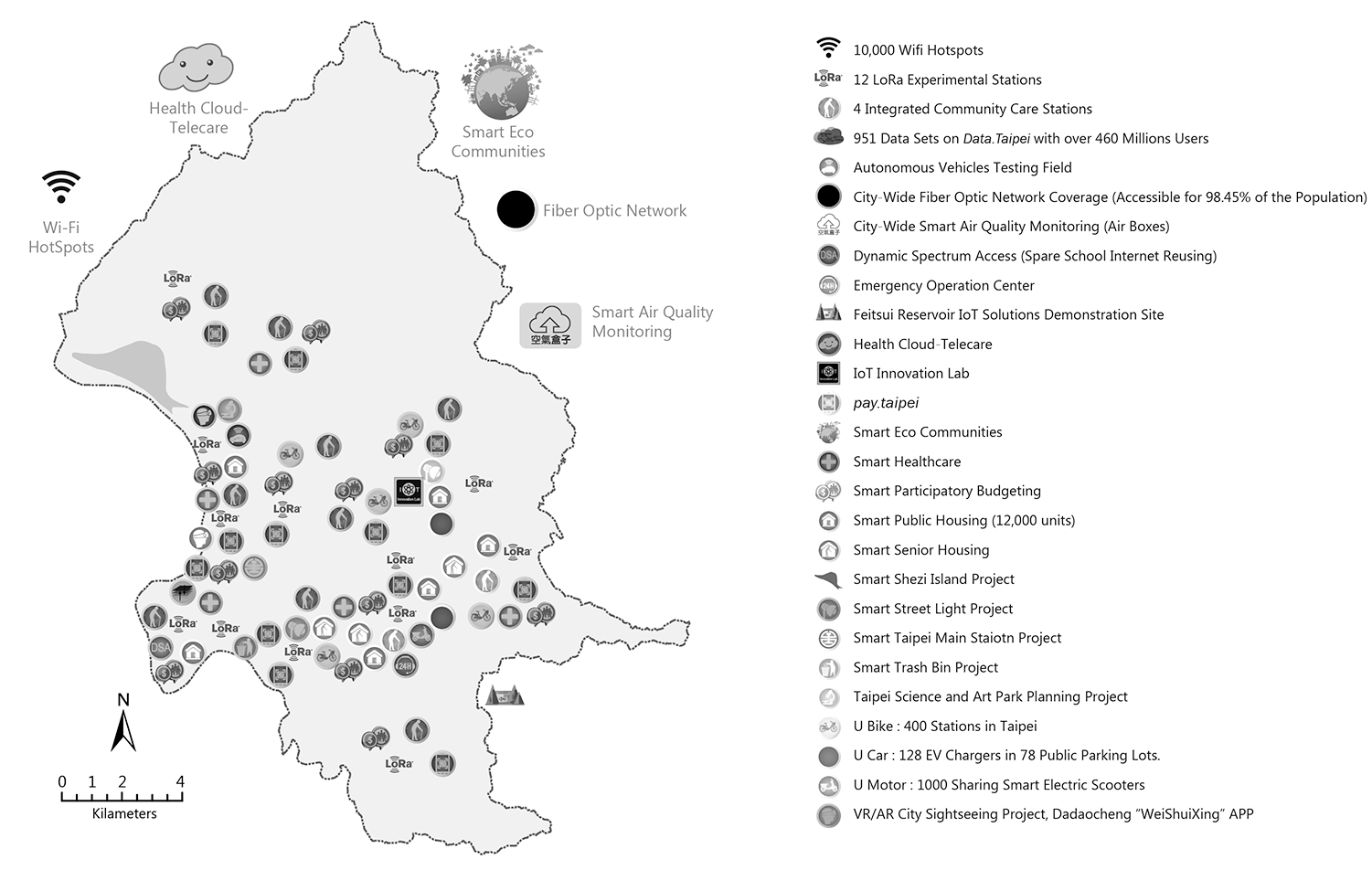
Major smart initiatives and Proof of Concepts experiments across the city.
The smart city as a political strategy for urban regime transition
Taipei’s smart urbanism agenda has reflected shifts in the power relationship between Taipei and the central government during the tenure of three mayors. In this section, we discuss how Taipei’s smart urbanism agenda under the current Ko administration has served as a strategic policy tool to facilitate the transition of the urban governance regime away from the legacy of Taiwan’s developmental state. We argue that the seemingly neoliberal smart city agenda was intentionally deployed by the new administration to pursue a locally-led development path with a new group of stakeholders, to reform urban governing institutions and to secure populist political support. Through this process, the Ko administration restructured Taipei’s urban regime and made the city a more autonomous local government. The analysis we provide below challenges the neoliberal account of the smart city, and reveals a variety of logics, intentionalities, assemblages and power dynamics underlying Taipei’s smart initiatives. This use of the provincialising approach helps us consider how smart urbanism can be articulated and politicised in specific geographical and historical experiences.
Pursuing a new development path: Smart growth
In rejecting the subordinate role of Taipei in the central–local relationship, the Ko administration used its smart urbanism agenda to re-orient Taipei’s trajectory from a capital faithfully serving the state’s developmental needs to a city actively pursuing its own economic sustainability. Key to this objective is indigenous ‘smart growth’, an idea that the Ko administration has promoted through cultivating local ICT industries. 1 In practice, the administration embraces the living laboratory approach and invites small local ICT firms and start-ups to participate in Taipei’s smart city experiments. In 2015, the Ko administration established the Taiwan Smart City Solutions Alliance (TSCSA). This new alliance aims to cultivate local start-ups as well as to recruit talented individuals and small firms from across the world to collaborate on developing smart urban solutions using Taipei as their testbed site (Smart Taipei, n.d.c). To ensure that firms can set up in Taipei, the Ko administration also established the Invest Taipei Office in 2017 to provide one-stop customised services that help start-ups and small innovative firms navigate local regulations and financing options. Together, the living laboratory approach and collaboration with the TSCSA opened up the city to a diverse group of actors. 2 In involving these new actors, the Ko administration formed a new economic development coalition that diminishes the role of state-sponsored ICT industries and state agencies, and bypasses the major actors under Ma and Hau (including the Institute for Information Industry, Chunghwa Telecom, FarEasTone Telecommunications and Taiwan Mobile). The TSCSA, together with the indigenous smart growth agenda, helped the Ko administration to strengthen Taipei’s capacity to drive its own smart development agenda.
It is worth discussing why large transnational corporations, such as IBM-Taiwan and Cisco, are also absent from this new coalition and its smart development initiatives. 3 Part of the reason is incidental: the majority of the state-sponsored ICT agencies in Taiwan are connected to large transnational corporations, and Ko’s deliberate distancing from state-sponsored ICT agencies resulted in the administration also avoiding large transnational corporations. On the other hand, officials believed that many large transnational corporations do not appear to have a strong interest in Taipei’s smart city development. While some have attempted to enter Taiwan’s smart city market since the 2000s, their goal seems to be merely to use Taiwan as an entry point into cities in China. 4 In addition, some key actors have suggested that the cost of enlisting the service of large transnational corporations appeared prohibitive given Taipei’s limited budget. 5
In addition to forming TSCSA as the new economic development coalition, the Ko administration also asserted Taipei’s autonomy by positioning it as a leader of smart urbanism for other cities in Taiwan and beyond. In March 2018, Taipei announced plans to establish the Global Organization of Smart Cities (GO Smart) in 2019. GO Smart intends to provide a free platform for governments, institutions and citizens to participate in making cities smarter and to facilitate cooperation between governments and industries. 6 Taipei has actively sought and secured support from all other major cities in Taiwan (New Taipei, Taichung, Tainan, Kaohsiung, Taoyuan), leading domestic ICT corporations and semi-governmental institutions (Advantech, Liteon, Acer, Tatung, FarEasTone, Asus, Pegatron, Asia Pacific Telecom, Chunghwa Telecom, Transcend, the Institute for Information Industry and the Industrial Technology Research Institute) as well as 18 cities, mostly non-primary cities, in Argentina, South Korea, New Zealand, the UK, the US, Canada, Greece, France and the Czech Republic. As the lead city of the organisation, Taipei seeks to collaborate with other cities and industries to enable an ‘inter-city Proof of Concept’, which means scaling up the POC experiments (mostly for the ‘perceptible’ initiatives, see discussions below) currently underway in Taipei and making the projects national or even international (Smart City Summit and Expo, 2018). Taipei’s former Deputy Mayor Charles Lin claimed that GO Smart ‘reflects the ambition of the Taipei city government to incorporate resources from Taiwan’s technology industries and start-ups and become a key player in global competition for urban development strategies’ (Teng, 2018).
The significance of GO Smart is multifold. While it is part of a smart growth agenda driven by urban entrepreneurialism, the involved parties differ from the standard neoliberal account of smart city development. Taipei chose to partner with domestic, state-sponsored industries, and mostly non-primary international cities, over leading transnational ICT corporations. Under GO Smart, the central–local power relationship has also shifted further. The central government and state-sponsored industries no longer drive Taipei’s urban development. Instead, Taipei is leading the central government, state-sponsored industries, as well as other Taiwanese cities, in the search for new development strategies and economic opportunities. In addition, Taipei uses the GO Smart platform to push its smart city development agenda, which was developed to strengthen its political autonomy from the central government and to connect a new network of cities – a process of ‘worlding’ that intersects with the neoliberal globalisation of smart city.
Reforming governing institutions: The Taipei Smart City Project Management Office
While the pursuit of smart growth helped Taipei form new development coalitions and establish a local-led development path, the Ko administration also uses the smart city agenda to reform the governing institutions of the city. Our findings indicate that the reform assisted the Ko administration in consolidating power into the mayor’s office and creating new linkages between the mayor’s office and major departments. The institutional reform, we argue, made Taipei a more independent local government.
The Ko administration maintained that Taipei’s smart experiments require the locally-led, cross-sectoral and inter-departmental governing capacity that its formal urban governance structure does not provide (Smart Taipei, n.d.d). In order to effectively launch the smart urbanism agenda and open the city to ICT industries, start-ups and other interested firms, the administration established a new governing agency in 2016: the Taipei Smart City Project Management Office (PMO). The PMO is positioned as an innovation matchmaking platform that can integrate industry and government resources to develop smart solutions that meet public demand: The main appeal of the PMO is to promote public participation and public-private partnership in order to create new technologies, innovative applications, and data/information to solve citizens’ problems … the Taipei city government hopes to construct an eco-system so that the government, the industry, and citizens can share the prosperity from its development. (Taipei City Government, 2017b)
The PMO directly reports to the mayor’s office and is advised by the Commissioner of the Department of Information Technology, a department receiving increased resources under the Ko administration (Figure 2).
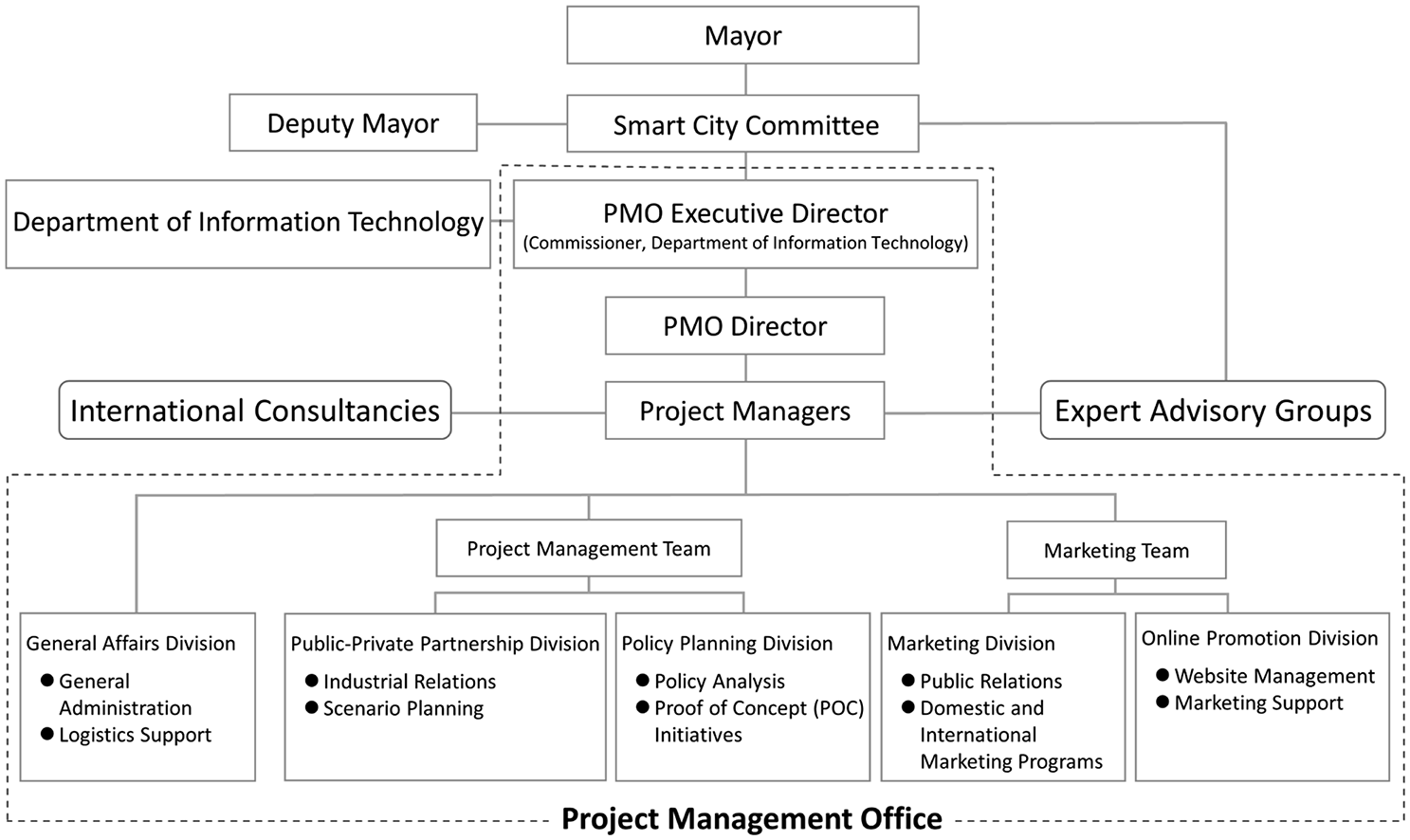
The structure of the PMO.
In addition, the mayor’s office has also set up a Taipei Smart City Committee (TSCC), to which it has recruited PMO members from the Ko administration’s smart development coalition, two national agencies (the Institute for Information Industry and the Commerce Development Research Institute) and the consulting and legal services provider International Data Corporation Taiwan. 7 The recruitment channel of the committee is different from that of other departments in the city government, where the members are typically bureaucrats assigned through the national public servant examination system. In addition, the TSCC also provides recommendations on policy directions, helps select potential projects, conducts feasibility assessments and brings in resources from industries. Since its inception, the PMO claims to have facilitated more than 130 POC projects (see Figure 1), engaged more than 500 different stakeholders and transformed the bureaucratic culture across Taipei City departments to become more innovative (Lee, 2018; Smart Taipei, n.d.b).
While the establishment of the PMO and the TSCC has institutionalised the involvement of the new smart development coalition in city governance, it has also significantly increased the influence of the mayor’s office over city departments. Because the smart urbanism agenda is framed as related to all aspects of everyday urban living, the PMO, along with the mayor’s office, can legitimately intervene in the operations of all departments. In interviews with members of the PMO office, officials all indicated that they spend most of their time establishing connections with other departments to insert smart urbanism ideas into the departments’ normal work. PMO officials noticed that over time they have become the primary link between the mayor’s office, the Taipei Smart City Committee, city departments and the private sector. PMO officials are then often put in charge of mobilising city departments to implement Ko’s development agendas. 8
By inserting smart features into the normal work of city departments, the PMO also helps the new smart development coalition extract financial value from government businesses (especially construction) that were previously dominated by interest groups tied to the construction-based developmental state regime. An example is the Smart Public Housing project, which equips traditional high-rise public housing with smart grids, AI security systems, the 5G network and smart home features (Smart Taipei, n.d.a). Public housing construction had been fully under the purview of the Department of Urban Planning. Through a series of negotiations, however, the PMO successfully introduced smart features into the Department’s public housing projects. In addition, it secured some additional 3–5% of the total construction budget for the participating ICT industries (Feng, 2018). ‘Although the percentage seems low’, a PMO official explained, ‘the actual cash amount is sufficient for these ICT industries to secure profits and maintain the collaborative relationship with the Ko administration’. 9 With the estimated budget now reaching 87.9 billion New Taiwan Dollars (approximately 2.93 billion US Dollars) (Lin, 2018), the 3% would likely mean at least 2.637 billion New Taiwan Dollars (approximately 87.9 million US Dollars) of investment in smart infrastructure, communication protocols and IoT applications. For the local ICT industries, this amount is substantial and has been perceived as the Ko administration’s firm commitment to Taipei’s smart growth. 10 Interestingly, traditional construction-based interest groups also welcomed these added smart features, as the features transform normal public housing construction into special projects, giving it higher priority in the Ko administration’s development agenda. In this regard, inserting smart urbanism into conventional construction projects allowed the Ko administration to build additional ties with the construction-based coalition.
In promoting smart urbanism, the PMO facilitated extensive project-based interventions that transformed routine work into special, high-priority projects with ICT components and affected a wide range of city departments. 11 The shift towards special project-based interventions brought about a more assertive, dynamic and entrepreneurial governing style commonly seen in the neoliberalisation era, but our findings suggest that the active engagement of the PMO also promotes critical changes in priorities and institutional configurations that are accompanied by new power geometries outside traditional arenas of government (see also Swyngedouw et al., 2002). With routine city services increasingly converted into special projects, project implementation now faces additional administrative requirements such as regulatory changes, special proposal reviews, additional budget approval and several rounds of competitive bids. 12 Needing political support from the mayor’s office to meet these requirements, city departments have become accommodating of the de facto gatekeeper, the PMO. As the director of the PMO noted, ‘the PMO is very efficient and effective in making the top-down projects [initiated by the mayor’s office] happen’. 13 Indeed, the PMO has been critical in transforming Taipei’s mode of governance. The city government was once content with providing routine services and passively responding to guidelines set by the central government. Now, it focuses on self-initiated special project-based governance, with power consolidated at the mayor’s office. In the end, the PMO has helped shape a new development coalition and has mobilised city bureaucrats to implement the Ko administration’s development agenda, making the Taipei city government more autonomous than before.
Securing political support: Populist framing
As the first non-affiliated Taipei mayor after the end of Taiwan’s martial law in 1987, Ko faces the distinct political challenge of securing an electoral base without partisan support. 14 To this end, the Ko administration has promoted populist narratives that frame its smart urbanism agenda as creating an ‘Open Government’ for ‘ordinary citizens’. It has chosen initiatives likely to leave a direct impression on citizens. Moreover, we observed how the administration targets specific groups of voters and develops strategic collaborations with social groups and neighbourhood organisations accordingly.
Similar to other East Asian developmental states, over the last few decades of the 20th century Taiwan thrived on an export-oriented economy founded on expanded education combined with depressed wages (Wade, 1990; Wan, 2008). This mode of development produced a large share of well-educated but relatively undercompensated working-age adults. During this same period, housing prices in Taipei experienced multifold increases, just like many other major cities across the world that witnessed the influx of global capital driving their local real estate markets (Smith, 2002). The combination of low wages and high housing prices made it impossible for most people between 20 and 39 years old to purchase a residential unit in Taipei on their own (Li and Hung, 2018; Taipei City Government Department of Land Administration, 2017). Disillusioned with the traditional political parties that had overseen, if not caused, the housing affordability crisis, this highly educated but relatively undercompensated young cohort became Ko’s most avid supporters in the 2014 mayoral race, and has continued to back his administration after the election (Chen and Yang, 2016).
Our research finds that the Ko administration has used its smart city agenda to court this cohort. For one thing, the smart growth agenda promises better economic opportunities for this demographic group. In addition, the technological modernisation rationale underlying the agenda signals a clear break from the previous urban regime and the developmental state, two of the supposed perpetrators of the housing crisis. Adopting a populist narrative, the Ko administration also often presents its smart city projects as its tools to combat traditional governing elites and interest groups privileged by the developmental state regime. The Smart Public Housing project, for instance, is presented as an affordable housing policy for housing justice to help the highly educated but relatively undercompensated cohort portrayed as victims in a system dominated by conspiring politicians and real estate developers (Chen, 2018; Ko, 2016; Taipei City Government, 2015). A few new participatory initiatives, such as i-Voting, Open Government and smart participatory budgeting, are also framed as inviting ordinary people into the decision making process, which was previously shielded from the public and dominated by partisan politics and interest groups (Wan, 2018).
Furthermore, the Ko administration has invited groups organised by young professionals to collaborate on implementing its initiatives. One prominent partner is the g0v.tw online community, which presents itself as a community that ‘pushes information transparency, focusing on developing information platforms and tools for the citizens to participate in society’ (g0v, n.d.). This community has extensively participated in Taipei’s smart city projects: it is currently heading the open data and data visualisation initiatives under the i-Voting, Open Government and smart participatory budgeting projects. The Ko administration on multiple occasions has touted its collaboration with g0v.tw on news outlets and social media, showcasing its commitment to participatory democracy. Members of g0v.tw also actively support the administration and its smart city policies. During the 16 months of our research, members from g0v.tw often defended Ko’s administration on Taiwan’s largest online forums and on the social media platforms we were keeping track of. Their defence often cast the Ko administration as the only local administration with the courage to involve civic communities and upend the corrupt alliance between political and business interests. The populist framing of the smart city agenda and the collaboration with the young cohort have clearly helped the Ko administration accumulate political legitimacy.
In addition to using populist framing on policies to gain support from the young cohort, the Ko administration, as it planned to seek re-election, also focused on promoting what it referred to as ‘perceptible’ smart urban projects, that is, projects with the type of impact that would be recognised even by residents with limited digital proficiency. To this end, the PMO consulted social groups and online communities, organised public hearings, workshops and online i-Voting surveys with residents and interviewed lee changs (‘里長’, the elected leaders of the smallest administrative divisions) about their needs. The final list of projects included smart air quality monitoring, smart efficient street lights that achieve energy efficiency through detecting moving objects and adjusting brightness; a smart parking system that can display vacant spots in real time and issues tickets for parking violations; a smart animal control system that tracks all urban animals, especially strays; smart rubbish bins that automatically sort and recycle waste; and a Safe Campus system that combines facial recognition with artificial intelligence to enhance security. Proposals like the smart animal control and Safe Campus projects were rejected by local communities due to concerns about animal and human rights or surveillance. Other proposals, however, seem to have helped promote the idea that the Ko administration genuinely cares about people’s everyday lives. As one of the community leaders said: we residents do not often understand what a high-tech smart city is … but we feel great about those initiatives that add convenience to our daily routines … parking, rubbish, lighting. These are issues that we care about, and we appreciate that the administration cares too.
15
As Ko was elected to a second term in 2018, such appreciation might have well helped him secure many votes.
New challenges and emerging contestations
So far, our research has revealed how the Ko administration strategically mobilised the smart city agenda to assume control over Taipei’s development trajectory and secure political support. Still, this new urban regime faces challenges stemming from the legacy of Taiwan’s developmental state as well as new resistance to the shift in power relations and its underlying technological modernisation justification. In this regard, we discovered that Taipei City’s smart city agenda is not only a strategic political tool but also a contested political arena in which new power struggles emerge.
The Ko administration has proclaimed victory in attracting small firms and start-ups for its smart city experiments, and also in diversifying the stakeholders in Taipei’s economic development. Nevertheless, the PMO has encountered implementation issues with these new stakeholders. Throughout our interviews, officials at the PMO and other departments indicated difficulty in determining which firms could carry out their proposals and complete the experiments. ‘These firms are small and new, sometimes just several months old,’ as one official explains, ‘we cannot tell who actually has the capacity to carry out the projects’. 16 Over time, there has been a growing tendency for the PMO and city departments to favour more established firms in the proposals. Interest groups tied to the traditional developmental state regime have also rebranded themselves and joined the competition for the smart development projects. One such example is the Taiwan Intelligent Building Association (TIBA), which was formed by major construction groups and real estate companies under the developmental state regime. The TIBA assists its members in bidding for Taipei’s smart construction projects by working closely with the TSCSA. In addition, the TIBA’s financial backing can often skew the competition results. According to the founder of a new firm providing innovative smart home solutions, it has now become more difficult for independent small firms to win proposal competitions because ‘our small scale makes our services more expensive, and far less competitive than those who have a whole corporation or a group of associated businesses to financially back them up’. 17
The PMO and some city departments have noticed this issue and struggle with how to reward innovative and appropriate proposals. Their decision making is constrained by the lowest-bid rules set by the Government Procurement Act, which was specifically designed to stamp out corruption fostered under the developmental state regime. As an official complained, ‘Sometimes there is little we can do. Under some conditions, the law requires us to give our contract to the lowest bid.’ 18 The PMO and some city departments have actively petitioned the city council to adopt best-value methods in the bidding process for some projects in recent years. Still, on some occasions when the PMO and some city departments would like to work on innovative projects with new actors, they simply cannot overcome the historical legacy.
At the grassroots level, some citizens have expressed concerns over the administration’s focus on smart technologies. Specifically, the lee changs and other community leaders question the technological modernisation assumption underlying the smart urbanism agenda. As one said: We appreciate that the administration cares about our lighting and parking issues, but we also noticed that more money has gone to the smart living labs, internet infrastructure, hardware and software … we might end up with less money to provide for non-smart needs.
Several community leaders also worry that not all residents have the technological literacy or the ability to access the smart services. As the Ko administration launches i-Voting and the smart participatory budget systems to advance inclusive governance, one lee chang responded, ‘I don’t know how and what to propose there … my people’s needs are not considered smart at all.’ Although Taipei’s smart city development has been framed as a populist development agenda, its focus is clearly on younger people who feel disenfranchised under the developmental state regime. On most objective metrics, however, this young cohort may not be the most disadvantaged. Here, the overarching concern has been that the Taipei smart city agenda may divert resources from other much-needed social investment, and further marginalise the already disadvantaged. Acting on local community leaders’ concerns, the city council has at times boycotted the PMO’s budgets and other proposed policies, countering Ko’s smart city agenda.
These new contestations indicate the need for continued research on the implementation of Taipei smart city and associated unequal implications. The Ko administration came to power only in 2015. Hence the implementation results remain mostly unclear at the time of writing, as many of its smart city initiatives are still in the planning stage or have only just started. It is, however, apparent that the Ko administration has formed a new development coalition, established new institutions and promoted policies under populist narratives. We next need to question how these changes unequally impact the city and its residents. Who are the active citizens configured by the smart city initiatives? Who benefits from the current smart city agenda, and who is excluded? Is this smart agenda implemented at the expense of other social and political agendas, and if so, how? Which issues have been made visible, and which have not – and why? These questions will certainly guide the continuing research on Taipei smart city development.
Conclusion
Inspired by the provincialising urbanism approach, in this article we set aside the common elements in the mainstream research on smart urbanisms: technology, competitiveness, efficiency and effectiveness. We instead focus on the power dynamics and the contextual processes of smart city development in Taipei and explore various logics, intentionalities and assemblages. Through the case study of Taipei, we explore the ‘contrasting geographies’ of a city outside the dominant core of smart city development and academic research. Taipei’s smart city policies under the current Ko administration, we argue, are deployed as both a material and a discursive strategy to resolve the struggles between its local-led development agenda and the still-powerful legacy of Taiwan’s authoritarian developmental state. By anchoring its policies on smart city development, the administration successfully mobilised a new development coalition, reformed the city government’s institutions and secured political support. The smart city agenda has facilitated Taipei’s transition into a more autonomous urban regime, while also opening up a new arena of contestation. Our findings reveal that smart city experiments have the political capacity to reshape power dynamics and regime formation through reorganising actors and interest groups, reconfiguring government institutions, redistributing resources and promoting governing legitimacy. The provincialising approach allows us to see how the technological, neoliberal logics and the experimental, citizen-centric initiatives are articulated into Taipei’s specific geographical and historical context. These situated articulations expand the understanding of smart city development outside the global North.
Our findings also suggest a need to further explore a variety of logics, intentionalities, assemblages and power dynamics of the smart city in the following ways. First, our research reveals a striking potential for seemingly technical and mundane smart urban policies to facilitate urban regime transitions. Urban regime theory (Stoker and Mossberger, 1994; Stone, 1993) has thoroughly explored how changes in urban governance can reshape power relations and the institutions between the government, the market and citizens. To the extent that smart urbanism research has considered power, it has largely focused on the politics of data and knowledge (e.g. Kitchin, 2013; Leszczynski, 2016) and the ‘actually existing smart city’ in cities primarily in the global North. Our findings from Taipei’s smart city suggest that promoting smart urbanism may bring about more general and extensive institutional change in the political relations of cities, and enable urban governance and regime transition. A useful comparison can be found in recent research on low-carbon and sustainable urbanism, which demonstrates that such projects can be strategically deployed to facilitate transitions of national and urban regimes in a fashion known as ‘eco-state restructuring’ (Chang et al., 2016; While et al., 2010). As our findings have revealed, the potential of a similar ‘smart city restructuring’ deserves consideration from students of smart urbanism and urban politics alike.
Second, our findings point to another important area of future research: the relationship between smart urbanism and citizenship. This case study on Taipei already reveals the many uses of smart city initiatives, from promoting participatory democracy, improving transparency, empowering ordinary citizens and privileging particular social groups, to strengthening the legitimacy of the government. As ‘citizen-centric’ smart city development 19 becomes the newest trend across the globe, we see simultaneously the rise of grassroots smart city initiatives that aim to improve democracy, and the adoption of smart technologies that enhance surveillance and the power of authoritarian regimes. One widely reported example of the latter case is China’s social credit system experiments in its major cities; the system uses AI facial recognition technology and databases of personal information to monitor the daily lives of ordinary people. According to our interviews, this AI facial recognition technology was also developed in Taipei’s POC experiments and proposed for several initiatives. In this sense, smart urbanisms can be a double-edged sword for democracy. With the rise of populist governments and authoritative regimes across the world, it is imperative to keenly observe the role that smart urbanism plays in the relationship between governments and the governed. We believe that this is a topic that requires more critical research.
Footnotes
Acknowledgements
The authors would like to thank the guest editors and the three manuscript reviewers for their constructive comments throughout the reviewing process. We sincerely appreciate all the interview participants in Taipei for sharing their perspectives with us. Chang would also like to thank Por-Fu Aspen Chen for his suggestions and feedback on the article. Any mistakes or omissions are of course our own.
Declaration of conflicting interests
The author(s) declared no potential conflicts of interest with respect to the research, authorship, and/or publication of this article.
Funding
The author(s) disclosed receipt of the following financial support for the research, authorship, and/or publication of this article: Chang would like to thank the Regional Studies Association Early Career Grant for funding support.

Notes
References

 ).
).  ).
).  ).
). 
 )
)  ).
).  ). Press release,
  ). Available at: https://land.gov.taipei/News_Content.aspx?n=0ABE9F8A3E5B75C2&sms=72544237BBE4C5F6&s=0ADBE689FEC847D8 (
 ).
).