




Abstract
Urban planning systems, processes and regulations are often blamed – by many mainstream economists – for constraining the supply of housing by interfering with the efficient allocation of land by the market and unnecessarily delaying development. In England, this orthodox view has influenced the government’s deregulatory planning reforms, including – since 2013 – the removal of the requirement for developers to apply for planning permission for the conversion of an office building to a residential one (making it ‘permitted development’). Drawing on original empirical research in five local authority areas in England, this article examines the impacts of this deregulation of planning control on the ground. We find that, although more housing units have been delivered than were expected, a focus on housing numbers is eclipsing problems of housing quality, the type of housing being made available and whether it is in sustainable locations. There are also costs of deregulating planning, including direct financial costs and the lost opportunity to secure affordable housing and public infrastructure through planning gain. We conclude by examining the contradictions in the UK government’s approach to addressing the housing crisis and propose there are dangers of deregulating the urban that have consequences for England and other countries pursuing neoliberal reforms.
Introduction
The ‘housing problem’ in most advanced economies is complex and multi-dimensional, ranging from problems of affordability of market housing, lack of social rented housing to poor housing quality and insecure tenures. The problem of affordability has, however, become a primary focus of policy reform internationally. Despite differences in planning systems, legislation, taxation and levels of home ownership, the ratio of house prices to incomes (a measure of housing (un)affordability) has increased steadily, on average, across all advanced economies in the OECD over the last 20 years (Ryan-Collins, 2018).
In response, there is now a well-established construction of the housing crisis as being all about supply problems, which legitimates a view of the market being ‘held back by over-zealous bureaucracy’, which in turn supports calls to reduce planning control (Gallent et al., 2018: 131). Despite significant differences in governance structures, urban geography and approaches to spatial planning and development control, governments in the UK, Australia and New Zealand all commissioned a series of housing reviews from the early 2000s onwards, which increasingly problematised the planning system, underpinned by neoliberal policy ideas that have been particularly mobile (Gurran et al., 2014). This links to a well-developed international trend for planning to be scapegoated for preventing efficient market delivery (Gunder, 2016) and acting as a barrier to growth (Olesen and Carter, 2017), leading to government reforms to deregulate planning systems, for example in Australia (Gleeson and Low, 2000; Gurran and Ruming, 2016) and across Western Europe (Waterhout et al., 2013), as part of a broader neoliberal ‘turn’ away from planning’s public interest roots (Olesen, 2014).
The precise form that planning deregulation has taken varies internationally. The deregulation of planning in England has focused on extending the range of development that is ‘permitted’, that is, that can take place without the need for planning permission. Most controversial has been the introduction of permitted development (PD) – in May 2013 – for the conversion of an office building into residential use, which had been treated as a ‘material’ change of use requiring planning permission since the Town and Country Planning Act of 1947. Following a three-year trial period, and despite vocal opposition and applications for exemptions from 165 (of 353) local planning authorities in England,
1
this form of PD was made permanent in 2016. The Minister for Housing and Planning explained: We’re determined that … everything is done to get the homes we need built … Today’s measures will mean we can tap into the potential of underused buildings to offer new homes for first-time buyers and families long into the future, breathing new life into neighbourhoods. (HM Government, 2015: online)
Under new legislation, developers are required to notify the planning authority that they intend to make use of the right but are not required to submit detailed plans. The authority is not able to refuse on the basis of the principle of change of use, the location of the development, its design or its wider implications for people, environment and place – as they would with a full planning application. They are also not able to secure affordable housing or other contributions to infrastructure, normally sought from new development through planning gain.
Industry-led research (EGi, 2014) on the policy’s impact in the first year in London noted a surge in applications through PD, representing ten times the average number of regular planning applications for the same change of use received in any given year in some parts of outer London. Yet low levels of implementation (or ‘construction starts’) led to speculation that developers were using PD as leverage to facilitate a later planning application for new build and avoid affordable housing contributions. With time, implementation rates picked up and as schemes were being delivered it was found they were more affordable (per residential unit) than comparable new build apartments but smaller and more expensive per square metre (EGi, 2015). Research undertaken for the British Council for Offices (2017) found office stock conversion rates were five times higher than the average before 2013. Since May 2013, we calculate there have been over 65,000 housing units created across England through this form of PD. 2 The numbers delivered have helped to legitimate this policy approach but, at the same time, it has been the subject of significant controversy, from the loss of office floorspace (BCO, 2017) and affordable housing (EGi, 2015; London Councils, 2015), to the lost opportunity to redevelop at higher densities (EGi, 2015).
Ideologically, this form of deregulation is seen as exemplifying an anti-planning agenda (TCPA, 2018). In academic debates, it has been viewed through the lens of a neoliberal turn in planning away from its public-interest roots towards market-based values, focusing on the respective roles of planning (and local planners) vis-à-vis the market in allocating land uses and facilitating the adaptive re-use of office buildings (Muldoon-Smith and Greenhalgh, 2016; Remøy and Street, 2018). Holman et al. (2018) argue that this wave of deregulation represents a new assault on the value of planning but that the persistent demonstration of local planners’ values in working in the public interest suggests the need for an understanding of how neoliberalisation as a hegemonic ideology plays out in local practice.
The benefits of re-use of redundant or vacant office buildings has helped to legitimate the government’s approach, but what has been underexplored to date is the extent to which permitted development has been driven by a persistent narrative – influenced by a neoclassical economic perspective – that greater housing supply is the solution to the housing crisis and that planning regulation is the problem. In the first two sections of this article, we explore this influence. The empirical body of the article then reveals the impacts in practice of a neoclassically inspired approach to planning deregulation that privileges quantity over quality. Our in-depth case study research investigates permitted development for office-to-residential conversions in five urban planning authorities across England, extending previous research on the topic which has mostly focused on London. Three research questions guide the presentation of our findings: (1) how successful has the policy been in stimulating housing supply, and what type of housing is being delivered? (2) What are the qualitative outcomes of this form of deregulation – in terms of housing quality, space standards and residential amenity? (3) What are the direct (financial) and indirect (opportunity) costs of deregulation? Our purpose is not to assess the desirability of office-to-residential conversion per se, for example in terms of its contribution to sustainable urban densification (Dempsey et al., 2012), but rather to use England’s PD experiment to draw attention to the consequences of an approach to planning deregulation that is legitimated and driven by a narrow quantitative logic.
Mainstream economic perspectives on the relationship between planning and housing, and their critiques
As Hincks et al. (2013: 1) suggest, debates about planning for housing have ‘come to be dominated by “economists”… whose analyses are based on largely quantitative forms of economic thinking’. Although urban economics has long interested itself with residential location preferences and the workings of residential land markets, this strand of research was not brought to bear on the world of housing policy until the publication of Duncan McLennan’s (1982) book, Housing Economics, which at the time was considered ‘fresh and illuminating’ (Whitehead, 1984: 206). Thirty years later, it is professional economists setting the research questions, conducting the research and transmitting messages to policy makers, with planners and other social scientists largely excluded from the process (Hincks et al., 2013: 2).
The mainstream neoclassical perspective on the causes of housing unaffordability is (broadly) that whereas demand for housing is rising – due to demographic change, rising incomes and spatial changes in the pattern of economic activity – the supply of housing is not keeping up, causing price inflation. The neoclassical school understands the economy as a self-equilibrating system, where the rising price of consumption goods stimulates supply, causing a market correction. The American economist, Edward Glaeser, applies neoclassical logic straightforwardly to the housing market, ‘Prices reflect the interaction of demand and supply. High prices, for housing or anything else, can only persist when demand is high and supply is limited’ (2012: 180). Glaeser argues there is is sufficient land to meet demand but supply is affected by more restrictive planning regulations in some US cities, leading to issues of housing affordability in places such as New York (Glaeser and Gyourko, 2003; Glaeser et al., 2005). There is a lively debate on the extent to which convincing empirical evidence exists to support Glaeser’s observations, with Rodríguez-Pose and Storper (2019: 223) claiming there is ‘no clear and uncontroversial evidence’ in the US context that planning deregulation will increase affordability for lower-income households in prosperous regions.
In the UK, mainstream economists have been influential in the debate on the relationship between planning and housing affordability. Hilber and Vermeulen (2016: 390), ‘point to the English planning system as an important causal factor behind the [housing affordability] crisis’. The argument has particularly focused on the development restrictions caused by the ‘Green Belt’ around metropolitan centres, which restricts supply (Cheshire and Sheppard, 2002). More broadly, planning’s role in allocating land for housing without regard to price is considered problematic (Cheshire, 2018). It has also been argued that the costs of restrictive planning regulations include poor housing quality, as developers focus on land acquisition at inflated prices, causing them to compromise on design (Morton, 2012a). Nevertheless, the government’s Productivity Plan (HM Treasury, 2015: 44) limits the debate to a discussion of housing supply and quantity based on a range of neoclassically inspired research suggesting, ‘The under-supply of housing, especially in high-growth areas of the country has pushed up house prices. The UK has been incapable of building enough houses to keep up with growing demand’.
Theoretically, the mainstream neoclassical interpretation treats housing as similar to other consumption goods, offering a limited conceptualisation of housing as a commodity and a predominantly economic asset; a perspective which circumvents our understanding of how the housing market processes at play today encourage rising inequality, unaffordability and social injustice (Gallent, 2019). Furthermore, Edwards (2015: 16) warns, the debate is somewhat flawed if we focus only on how to make markets work more efficiently: Even ‘perfect’ markets in our society can be disastrous where income and wealth disparities are so great and where regional differences are so strong: there is a substantial part of the population whom ‘the market’ will never be able to house: their salaries or pensions are too low or too insecure.
Beyond housing, a broader narrative has developed that planning regulation is ‘anti-competitive’ and has financial, environmental and social costs, borne by the whole community (Cheshire et al., 2012). This view of planning as a barrier to the proper functioning of the economy has been influenced by think-tanks, which have been instrumental in ‘constructing market utopias and deconstructing planning utopias’ (Haughton and Allmendinger, 2016: 1678), leading to a ‘frenzied atmosphere of anti-planning rhetoric’ (Haughton and Allmendinger, 2016: 1688).
Some of the most direct critics of the claim that planning is to blame for the inadequacy of land supply point out that far more land is allocated for development in plans than is actually built out (Bowie, 2010; Edwards, 2015), and that there are hundreds of thousands of housing units with planning permission across the UK that remain unimplemented (Letwin, 2018). This raises questions about developers ‘land banking’; however, even if the planning system were more responsive, there is no guarantee house builders would build more quickly (Adams et al., 2009), because of viability, costs, strategies and other interconnected issues such as local market conditions (McAllister et al., 2016). Other factors that cause housing supply to be inelastic, aside from planning regulations, include a lack of competition in the housebuilding sector (Ball, 2003; Shelter and KPMG, 2014).
The narrow focus on housing supply and the delivery of housing units in government policy, has resulted in inadequate attention being paid to the drivers of housing demand, and solutions that address the other side of the supply–demand equation. Although increasing demand for housing has been driven partly by rising incomes (Cheshire, 2018), Ryan-Collins (2018) argues that the more powerful driver of demand has been the availability of mortgage credit, an outcome of a financial and banking system that has come to rely more on lending money for the purpose of purchasing housing and real estate than lending to businesses for investment. This has facilitated a fundamental change in the function of housing away from residential use primarily for occupation and towards a vehicle for investment and wealth accumulation, which has led to a restructuring of the economy, with housing – rather than production – playing a stronger economic role, such that ‘the housing market has become untouchable’ (Gallent, 2018: 209). As a result, intervention has focused on policy changes that could realistically be implemented (see Shelter and KPMG, 2014), rather than anything requiring a major reconsideration of the function of housing and its role in the economy. This could be part of, as Gurran and Phibbs (2015: 718) argue, a strategy for politicians to ‘look busy’ without ‘interrupting the status quo’, in contexts where the homeowner and residential real estate lobbies are strong (Colenutt, 2020). The extension of permitted development to include office-to-residential change of use should, we argue, be seen in this context: a policy approach that focuses on easy, quick wins, which helps to meet housing targets but leaves the mainstream economic perspective unchallenged and does not disrupt the status quo or the structure of real estate or banking industries.
Permitted development as an extension to supply-side solutions in UK housing policy
Despite the contestability of the orthodox economic view of planning deregulation as the key to stimulating housing supply and reducing affordability, it has come to dominate the UK government’s approach, and the extension of PD can be seen as a culmination of a decade-long series of attempts to stimulate private-led housing supply through planning reform.
There is a long history of government concern with housing supply, with a consensus from the end of the second world War until the incoming Thatcher government in the late 1970s that the shortfall of housing should be met primarily through direct state provision (Bramley, 2007, 2013). Under Blair’s Labour government (1997–2007), with issues of housing affordability becoming increasingly pressing, the focus shifted away from state provision with an emphasis on facilitating market-led delivery through speeding-up plan-making and planning permissions (Clifford, 2013). Key to this shift was a government review of housing led by the economist, Kate Barker, which recommended annual targets for private-led housing delivery to bring down the growth in real house prices, and identified planning as both part of the problem and a potential solution (HM Treasury, 2004).
A later review of planning by Barker paved the way for the extension of PD as one way to stimulate housing supply, emphasising, ‘There may be numerous instances where a change of use has no impact. Requiring planning approval in these circumstances loads extra burdens onto the system for no public interest benefit’ (HM Treasury, 2006: 115). Although the Labour government at the time did not pursue the wider deregulatory programme of reform she alluded to, this provided a basis for the next government – the Conservative-led Coalition government elected in 2010 – to do so.
Tasked with managing the fall out of the financial crash of 2007/2008 and recession, the Coalition government pursued a number of reforms that were sceptical about the value of planning regulation (Lord and Tewdwr-Jones, 2014). The influential right-wing think-tank, Policy Exchange, argued that relaxing planning regulations around the conversion of commercial buildings to residential use could significantly boost housing supply with associated economic benefits (Morton, 2011, 2012b; Morton and Ehrman, 2011). This was directly linked to ideas of supply-side reform: ‘No one is going to mind if an office becomes a home … We need to systematically change the planning system … Our current planning system, designed as part of a Socialist utopia in the 1940s, has to be modernised for a twenty-first century economy’ (Morton, 2012a: online). The lead author of these reports went on to work as the Prime Minister’s planning and housing adviser, and Policy Exchange’s founder, Nick Boles, became planning minister. After leaving office, Boles reflected on how the Treasury was frustrated at the reluctance of other civil servants to ‘liberalise planning’ and there was a perception he had been appointed to ‘put a bomb under it [planning]’ (Institute for Government, 2016: online). The introduction of office-to-residential PD was thus promoted as part of a wider agenda to deregulate planning so that housing supply and demand could be brought in line, in order to make market housing more affordable. At the same time, we suggest that the government’s enthusiasm for this policy can be seen as a desperate attempt to boost housing supply through quick-win, short-term solutions, at a time when enthusiasm for top-down housing targets informed by economic modelling had waned (Bramley, 2013).
The case of permitting office-to-residential conversions in England: A live experiment in planning deregulation
Explanation of the case study and methods
Our research extends existing work on this topic by taking a detailed in-depth case-study approach to investigate the impacts in practice of office-to-residential PD across five English urban authorities: the London Boroughs of Camden and Croydon, Reading in the South East, Leicester in the Midlands, and Leeds in the North. Analysis of government data on the numbers of office-to-residential prior notifications received between 2013 and 2017 (DCLG, 2017) led to a shortlist of 30 local planning authorities (of 336 total in England) with the highest rates of notification. Only two of these authorities (Leicester and Leeds) were outside London and the South East of England, and so were selected. Of the remainder, two London boroughs and one other major centre in the South East of England were selected to represent the frequency and type of authorities in the list. The final selection sought to represent the range of geographical, property market and built environment characteristics in the shortlisted authorities, within the limits of the number of case studies we had capacity to study.
A mixed-method approach was adopted (see Clifford et al., 2018, 2019 for further detail). First, local planners in the five urban authorities were asked to provide a list of every prior notification for office-to-residential conversions received (2013–2017) and any office-to-residential conversions which had gone through full planning permission for 2009–2017 (the longer period as numbers through planning permission declined rapidly after the deregulation in 2013). We then undertook detailed site observations for every scheme on the prior notification lists (414 buildings), as well as a selection of office-to-residential conversions that had gone through full planning permission (104 buildings). 3 A selection of 45 schemes – representing typical prior approval and planning permission schemes in each urban area – were then chosen for desktop analysis, including a review of plans and documents relating to that scheme and online research of the marketing of the building, data on business rates, council tax and sales history. Thirty semi-structured interviews were conducted with stakeholders including planners, councillors, civic societies, developers, property agents and residents. In the following three sections, we examine our findings. We start by revealing how this form of planning deregulation has delivered significant numbers of housing units, yet does not meet the government’s objective to primarily deliver homes for first-time buyers and families. We then examine the negative outcomes of deregulation in terms of the quality and size of homes delivered, and lack of amenities. Finally, we examine the direct (financial) and indirect costs of deregulation.
A focus on housing numbers rather than ‘homes’
The government’s initial impact study (DCLG, 2013) speculated that the extended PD rights would have a modest impact on housing numbers, with an estimated 140 applications a year across England. Upon announcing in 2015 that these rights would be made permanent, the government stated thousands more homes would be developed (HM Government, 2015), suggesting an optimism based on the outcomes of the trial period. The change in policy has resulted in a far greater number of prior notifications than originally anticipated, which explains the government’s enthusiasm. Over the three years between 2014 and 2017, there were 10,166 prior notifications received across all English local authorities, of which 4873 (48%) were granted (DCLG, 2017). Even if we take the lowest annual figure of 2864 prior notifications in 2016–2017, this is still more than 20 times the annual figure originally estimated. Some caution needs to be reserved when interpreting the government’s data. Our research found there were often several prior approvals relating to the same building, which means that figures on approvals do not equate to numbers of schemes/buildings. Seen in context, the number of net additional dwellings made through office-to-residential change of use represented 6.8% of the total net additional dwellings across England in 2015–2016 (MHCLG, 2020).
Early studies (BCO, 2015; EGi, 2014) speculated on the ‘implementation gap’– a difference between consents and implementations. However, lack of data on actual implementations to date led to uncertainty over the impacts of the policy. Across our five case study authorities, we visited all the schemes with prior approval to observe progress and implementation. Table 1 shows the impact on the ground of extending PD rights to office-to-residential change of use. Implementation rates (of approved schemes) range between 68% and 75%, suggesting earlier speculations that developers were securing prior approval as leverage were overplayed. In fact, a planning consultant acting for one of the main office-to-residential developers in Leeds suggested PD schemes were in fact quicker and less complex (than schemes with planning permission) to deliver because ‘they haven’t put any onerous, pre-commencement conditions on the prior approval … you can crack on pretty quickly usually’.
Office-to-residential conversions through prior approval in five case study LPAs in England 2013–2017.
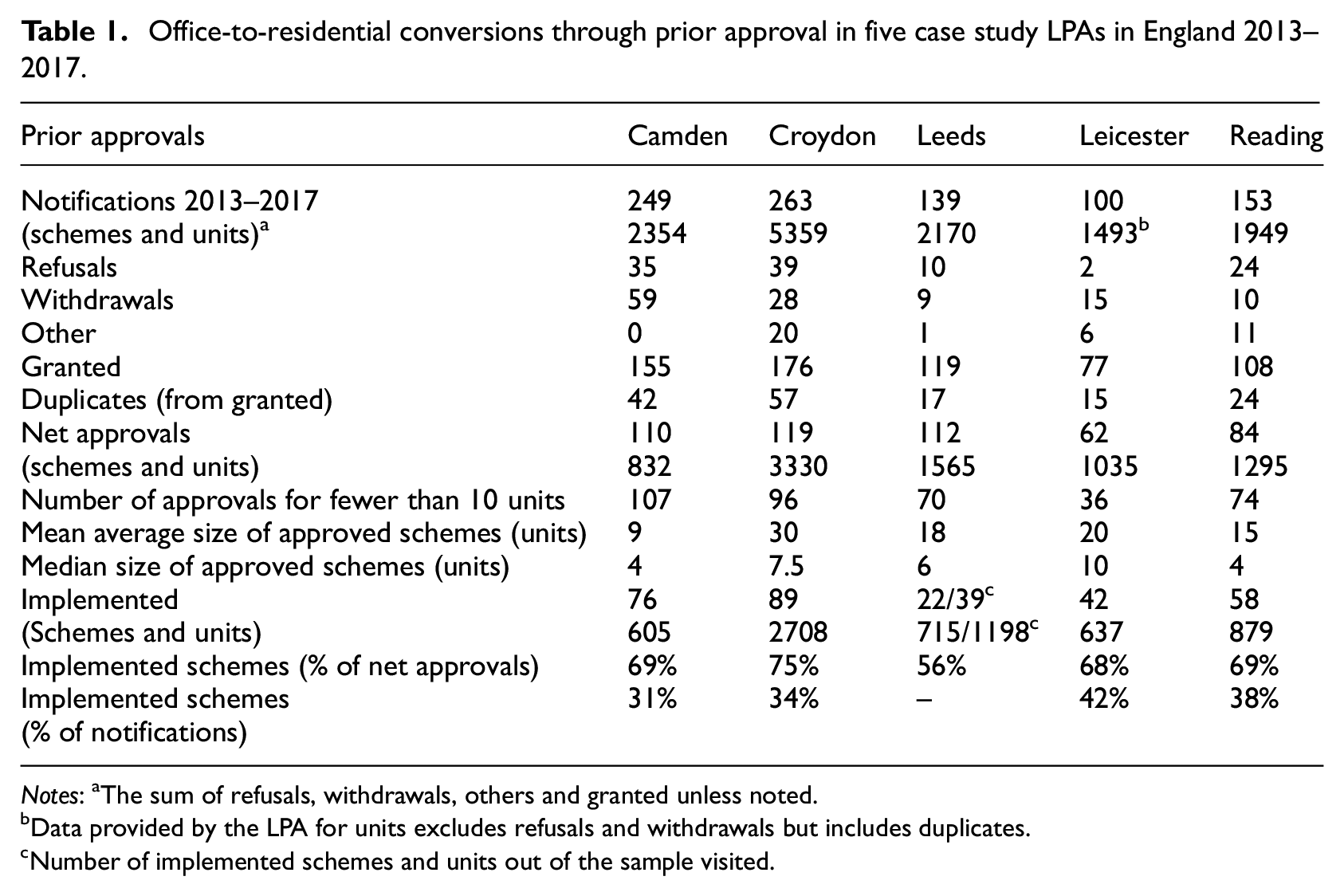
Notes: aThe sum of refusals, withdrawals, others and granted unless noted.
Data provided by the LPA for units excludes refusals and withdrawals but includes duplicates.
Number of implemented schemes and units out of the sample visited.
Table 1 also reveals that the majority of schemes granted prior approval are small, with a median scheme size of between 4 and 10 units. There is geographical variation to this. In Camden, 97% of all prior approvals were for schemes less than 10 units; in Reading the figure was also high at 88%. In Croydon, despite a few high-profile, very large schemes (such as Delta Point, which has 404 units), 81% of schemes had fewer than 10 units. In Leicester, large conversions were more prevalent, with only 58% of approvals being for these smaller schemes. In Leeds, the data are somewhat skewed since the authority has not been collecting data on schemes under a threshold of 5 units. These smaller schemes are less likely to attract widespread attention, nonetheless their cumulative impacts could be significant.
Although our analysis has shown that central government statistics on housing units delivered through PD need to be interpreted with caution, 4 the policy does seem to have ‘stirred the market’ so that more developers have engaged in office-to-residential conversion than before deregulation. Arguably this might have been achieved by other means not depriving local authorities of planning control (Clifford et al., 2018, 2019). However, we need to look beyond the numbers to what type of housing is being delivered and for whom.
In Leeds City Centre, two companies dominated the market. The first provided serviced apartments available to rent on a nightly basis, catering to the visitor economy. The second provided small apartments marketed at students and young professionals. The higher quality conversions that have taken place to date are in the city centre, either in areas that are close to or accessible to the university campus(es), or where residential land values are higher. As commented by a Leeds planner: What I’m finding is that people are using their permitted development rights in those kind of locations where they’re attractive to students, so I’m seeing a cluster of development around the northern end of the city, which have easy access to Leeds University and Leeds Metropolitan University, but elsewhere, no.
In Leicester, planners were concerned about schemes targeting students: it’s not named student provision, but it is aimed at students; the units are very small, the units are not well designed, so actually we’ve got an emerging part of the stock that is worrying in terms of the nature of provision.
This was of concern, they suggested, since the abundance of low quality private rental stock coming onto the market through PD could undermine the growth of the Private Rental Sector, which has the potential to provide higher quality, longer-lease, rental accommodation in Leicester city centre. In Croydon, the conversion of Concord House (454 London Road) to 93 studios and 33 one-bed apartments was being used as temporary accommodation for residents on the Council’s housing waiting list (Croydon Council, 2017). All 93 of the studio flats were smaller than the national space standards of 37 m2 for a one-bed, one-person unit.
Our findings suggest that the policy is facilitating new niche products to come to the market – such as city centre apartments for students and young professionals, and apart-hotels – and providing a way for new developers to enter the market. However, this is not necessarily helping the government to deliver homes for first-time buyers and families, as was its stated intention.
Outcomes of deregulation: Housing quality, space standards and amenities
Our site-based research provided an opportunity to investigate housing quality, revealing that PD conversions are less likely to meet national space standards or have amenity space. Across our case studies, 77% of units delivered through PD were studios or one-bedroom apartments, compared with 37% of conversions going through full planning permission. Studio flats of 15–17 m2 were not uncommon, smaller than half the size recommended in national space standards (37 m2) and one-third of the size recommended by housing policy in Germany (48 m2) (Roberts-Hughes, 2011). Just 30% of the PD units met the suggested national space standards, compared with 94% of the units delivered through full planning permission. Such tiny units can have damaging impacts on those occupying them, who often have little choice given the housing crisis (Carmona et al., 2010). Only 14% of the PD units had access to private or communal amenity space (such as a balcony or garden), compared with 77% of the units with planning permission.
In the example of 75 London Road, Leicester, a planning application to convert an office building to residential was initially submitted before the introduction of PD and refused by the planning authority on the basis that the housing units were too small and would breach local plan policies. An identical scheme was later implemented via PD, where the regulation of design is not a matter for consideration. Planners in Leeds said their politicians are pressing for the Council to adopt the voluntary national space standards but pointed out how potentially meaningless that could be since: Even once we do that, that only applies to applications which need planning permission, it does not apply to permitted development rights. Is the government really wanting this twin track approach where all the crap, for want of a better word, is provided by permitted development rights and then the other stuff we can manage … no, I don’t think that’s right.
Although there were examples of high-quality conversions, these tended to be in buildings and areas, such as Camden (in London), where investment could be easily recouped by marketing to the luxury end of the market. Typically, conversions in former industrial or warehouse buildings from the late 19th and early 20th centuries were of higher quality. The lowest quality examples were seen in conversions of late 20th-century commercial units on the ground floor of terraces in local shopping parades or purpose-built office buildings. Figure 1 illustrates an example of a conversion of a ground-floor commercial unit in Croydon.

The appearance of 410 Brighton Road, Croydon, on our site visit. Now an occupied ‘home’.
In some PD schemes, natural light and ventilation were compromised, as developers sought to maximise the number of units per building, leading in some cases to rooms without windows or apartments with only a single window. For example, in Reading, there were examples of fully let late-20th-century office buildings near the railway station being converted for housing. Figure 2 illustrates a conversion that resulted in 72 residential units, where the lack of private amenity space and natural ventilation was evident. The floorplate of the building has led to awkwardly shaped units, in some cases bedrooms had no external windows and were separated from the living room by a glass pane; where there were external windows, these were the original office windows, with a tinted glaze. Poor natural light and ventilation has been shown to impact the wellbeing of occupiers of housing (WHO, 2018).

King’s Reach, Reading. This is now in residential use.
Planners also raised the issue of the inability to control location and the resultant impacts on residents’ quality of life. For example, in Leeds, we found two conversions through PD rights on active industrial estates, where the Council has had no leverage to promote sustainable patterns of land use or to mitigate the impacts of noise, pollution and poor environmental quality for the benefit of residents living there. Residents of these conversions would not have access to nearby green space or children’s’ play space.
One argument, rooted in the orthodox view and regularly put forward by the property industry, is that the market generally delivers what there is demand for. For example: ‘on a capital value basis at least [Permitted Development Rights] schemes are affordable. The sizes are small but some would argue that owning a small flat is better than not owning one at all’ (EGi, 2015: 26). The findings here suggest, however, that allowing the market to dictate the outcomes is leading to a range of negative outcomes.
In sum, quality of life and place is suffering under deregulation. Not only are office-to-residential conversions through PD skewed towards smaller (studios and one-bedroom) units compared with conversions through planning permission, they are less likely to meet national space standards or have amenity space, are more likely to suffer from lack of natural ventilation and have poor quality or unsafe internal finishing. This can lead to overcrowding, particularly when the very housing crisis this deregulation is a response to can force people – including families with children – into sub-optimal housing. There is also no control over the sustainability of development in terms of its location close to public transport, jobs or other social or green infrastructure and no means to mitigate the impacts of noise, pollution or environmental quality through urban design, impacting negatively on residents’ quality of life.
The costs of deregulation
The UK planning system enables the public sector to recoup some of the value of new development (realised through the granting of planning permission) through both a standard tariff on all development to fund strategic infrastructure (the Community Infrastructure Levy) and a negotiated sum, normally termed planning gain or Section 106 agreements, used to pay for affordable housing and other social or community infrastructure. In bypassing the normal system of planning permission, conversions through PD rights are not contributing to either of these funds. 5
Between 2013 and 2017, we calculated that our five Local Authorities may have lost out on 1667 affordable housing units from approved office-to-residential PD schemes. There is some geographical variation to this, with the opportunity cost in London and Reading being greater than in Leeds and Leicester (where developments going through full planning permission are anyway securing little affordable housing because of viability). As one Camden Councillor explained: We fight very hard to try and deliver new homes through our own programmes and to get as much affordable housing as we can from developers and, as you know, that’s increasingly difficult because of lots of different government policy changes. So to allow this [permitted development] and then to prevent us from getting affordable housing out of it is adding insult to injury.
In Croydon, where there have been some very large conversions comprising hundreds of residential units, this represents a significant lost opportunity. For example, if one conversion to 348 apartments had gone through a full planning permission rather than PD, the Council’s planning officers indicated they would have sought 174 units of affordable housing. After negotiation and viability processes, the final number secured may have been less but comparison with planning permission schemes suggests at least 100 units would have been achieved.
In addition to the affordable housing units, which would previously have been delivered on-site as part of any development, across our five councils there has also been a potential loss of £10.8 million in negotiated planning gain. A rough calculation of the lowest likely burden on public infrastructure as a result of this cumulative development revealed that there would be a minimum of £27.5 m cost to the public purse of providing the additional infrastructure to support these additional homes (including for example education, health costs, provision of open space). This is in the context of the very apparent profitability of office-to-residential conversions for developers, with several examples of prior approval leading to large uplifts in sale prices apparent in the case studies (90% in one example, over less than a one-year period). In Camden, the conversion of Parker Tower to residential under a full planning application (in an area of the borough exempt from PD) led to 13 affordable housing units being provided on-site (out of 53 new dwellings created), and nearly £4 million of Section 106 contributions towards further off-site affordable housing, social infrastructure, transport infrastructure and public open space. None of this would have been secured under a PD conversion.
Research undertaken the year after the introduction of PD in London (EGi, 2014) showed that there was a significant increase in the number of conversions from office-to-residential use that year, and that conversions through PD were in addition to, rather than replacing, conversions through planning permission. This has served to undermine claims that there is a ‘real’ loss of affordable housing or planning gain as a result of this PD. However, looking beyond snapshot data focused on London, there is more evidence of a diversion of investment towards PD. From the government’s own data (MHCLG, 2020: Table 120), we find that there was a significant jump in housing units being delivered through ‘change of use’, just as PD rights were introduced – from 12,520 units in 2013–2014 to 20,650 in 2014–2015 and 30,600 in 2015–2016. In that latter year, 13,879 of those units were delivered through PD and 16,721 through planning permission. Yet longer-trend data are required to understand the extent to which the PD units are genuinely ‘in addition to’ those that would be normally be delivered through planning permission. The global financial crash led to a decline in all planning applications from 2007/2008 onwards for a few years, then a rebound back to pre-crash levels (Clifford, 2018: 60), so it would be reasonable to expect a similar rebound for units delivered through planning permission for change of use. However, they do not, and we would argue that this is because there has been some diversion of investment away from conversions through planning permission (using the PD route instead). This is further supported by evidence from Leeds and Leicester, which saw a decline in numbers of new flats delivered through planning permission in the period 2013–2017, despite the economy performing better during this time. In addition, through our case study research in Leicester, there was an example of a developer who had delivered office-to-residential conversions through planning permission for many years, who then switched to delivering through PD instead, with poorer quality outcomes. This makes sense, because it is more profitable to deliver a scheme through PD as affordable housing, CIL and Section 106 contributions are avoided.
This means there will have been a real loss of both affordable housing and planning gain delivered during this period, which would have helped to offset the impact of all these new homes on existing social and green infrastructure. Furthermore, our five councils had received £4.1 m less income because of the lower fees associated with prior approval applications compared with full planning applications. The government’s impact assessment before the introduction of the policy (DCLG, 2013: 2) claimed the policy change would have ‘no monetised costs’ and would be ‘unlikely to have any potential costs in terms of additional infrastructure requirements’, but this is clearly not the case.
Discussion and conclusion
England’s experiment with deregulating the planning system is based on an almost hegemonic discourse, rooted in orthodox economics, that sees planning regulation as an inhibitor to the efficient allocation of land for housing, and the main barrier to delivering adequate housing supply, which in turn is required to make market housing more affordable. This framing of the housing crisis as a failure to allow the market the freedom to deliver enough housing has arguably led to a relentless focus on planning as a barrier to delivering housing numbers, rather than a focus on the creation of real ‘homes’, and ignores the multi-faceted nature of the crisis, including concerns about space, environmental standards, quality, security of tenure and availability of supporting social and community infrastructure.
Policy solutions have focused almost exclusively on alleviating supply-side constraints – primarily through ‘quick win’ planning deregulation initiatives that do little to disrupt the status quo or undermine powerful interests – rather than on addressing the complex and structurally embedded demand-side issues, such as mortgage lending, finance and the increasingly central role of housing (as an asset class) in the economy.
PD for office-to-residential conversions in England has resulted in the delivery of a quantity of housing units over and above the government’s original predictions. The Minister responsible for it, reflecting on his time in office, called this deregulation ‘a big success’ which had been delivered despite the ‘bog of resistance, lethargy and obstruction’ from central government civil servants and from planners (Institute for Government, 2016: online). Our research found, however, that the type, quality and location of housing delivered through PD is not satisfactorily meeting the government’s objective to deliver ‘much needed homes’, nor are the outcomes contributing to the achievement of sustainable development, possibly the fundamental objective of the National Planning Policy Framework. Without planning permission, conversions do not usually deliver private or communal amenity space or improve the environmental standards of buildings through better windows and insulation, there are no mechanisms to secure affordable housing or control the location of development and there are fewer checks and balances to ensure buildings are converted to required fire or health and safety regulations. The ‘freer market’ is delivering housing that is often both significantly below the national space standards and of poor quality, fuelling concerns that the policy is creating the ‘slums of the future’ (Wainwright, 2015). In financial terms, office-to-residential PD has been a fiscal giveaway from the state to private real estate interests, undermining the ability of the public sector to deliver adequate wider infrastructure to support the housing growth achieved and further exacerbating the very real budgetary challenges it faces in a context of continued austerity.
The orthodox economic discourse is also profoundly sceptical about the value of state regulation. The resultant deregulatory approach necessitates bypassing the very land-use planning system that has been the primary mechanism for securing affordable housing (Whitehead, 2007) and other infrastructure in the UK since the 1990s. Over a much longer time, the planning system has also played an important role in maintaining space, safety and quality standards for housing development, in ensuring sustainable locations for new housing and patterns of land use, and in delivering homes of different tenures and sizes, to meet housing need. The planning system certainly does not always lead to perfect outcomes: even those generally sympathetic to it have criticised the constraints of the Green Belt (Hall, 1973; Mace, 2018) or some of its place-making outcomes (Carmona, 2019). However, as our evidence comparing office-to-residential conversions consented through planning permission with those allowed under deregulated PD demonstrates, the planning system has acted to prevent extremes of poor-quality housing and to secure public benefit. On the one hand, the UK government is introducing policies and initiatives to support the planning system in addressing housing quality (Jenrick, 2020), yet on the other it is undermining the planning system’s fundamental role in promoting and securing design quality and sustainable outcomes. Following the controversies surrounding office-to-residential PD, the government has expanded its remit to other types of development, including other changes of building use, and upward extensions of buildings (see MHCLG, 2018). Therefore, although Inch et al. (2020) have speculated that we may be entering a period of ‘late neoliberal governmentality’, where the extent to which market discipline and economic methods can be relied on to realise public interest objectives begins to be questioned, the government’s relentless pursual and expansion of PD in the face of evidence of its negative impacts, suggests this may be optimistic.
PD does not represent a true test of the potential of a free market in housing development because other elements of the planning system remain tightly regulated. Therefore, we cannot test the proposition by neoclassical economists that, if regulation were removed, developers would compete over quality, leading to better housing outcomes (Morton, 2012b). However, aspiring to a truly unrestricted market with a self-regulating equilibrium of supply and demand, is a form of utopian market fundamentalism (Block and Somers, 2014). Beyond the theoretical problems with this proposition – that markets will always operate as contingent state–market–society hybrids – practically, there will always be constraints on housing supply: we could abolish the Green Belt and planning permission but would still have environmental regulations, building regulations, heritage considerations and so on (many of which flow from international obligations or health and safety considerations), as well as constraints of physical geography. Because of the persistence of regulation and constraints in other forms, there are inherent contradictions in the government’s approach. However, what PD does represent is an attempt to introduce free-market principles to a segment of housing delivery. It does seem reasonable to judge PD as a case study of market-driven deregulation, particularly given that the government’s own impact assessment argued that market discipline would prevent low-quality development emerging (DCLG, 2013), and given that think-tanks taking a neoclassical economic view directly advocated for it.
As a case study, it tells a cautionary tale of the pursuit of the deregulation of planning in order to stimulate a more efficient market-led allocation of resources. In practice, there are many negative housing outcomes. Concerned primarily with the balance of supply and demand, the orthodox perspective fails to engage adequately with some of the negative consequences for society of the market-led allocation of resources. Given the similarities in rhetoric around the housing crisis in other countries as part of the neoliberal age, this article provides important lessons for places elsewhere that, despite their different planning and regulatory frameworks, are looking with interest to England’s experiments with the deregulation of planning. Our examination points to an urgent need, if we are to counter the power of the orthodox narrative and address the problem of asymmetric information in policy formulation and transfer (Gurran and Phibbs, 2015), for a research agenda around monetising the benefits – not just the costs – of planning and regulation.
Footnotes
Acknowledgements
The authors would like to thank Peter Rees for his strategic advice during the project and colleagues at Sheffield University (led by John Henneberry and Peter Bibby) for fruitful discussions as they conducted a parallel RICS-funded study. We are grateful to our editor and five anonymous referees, to John Tomaney for his constructive comments on an earlier version of this article and participants at the AESOP conference in Gothenburg (July 2018), where we presented a draft of this paper for discussion.
Funding
The authors disclosed receipt of the following financial support for the research, authorship, and/or publication of this article: This research was funded by the RICS Research Trust.
