




Abstract
This critical commentary introduces the Summer Institute in Urban Studies (SIUS) in the context of the wider inter-disciplinary discussions over the future of urban studies. It outlines the context out of which the institute first took place in Manchester in 2014 and how it has evolved across four subsequent iterations, the most recent of which was held in Singapore in July 2018. We document and discuss the profile of those who have participated in the four institutes and reflect upon some of the challenges that have emerged through discussions on the current state of the field of urban studies and its various possible futures. In conclusion, this critical commentary reflects on what we have learnt from the four institutes to date as we plan for #SIUS2020.
Introduction
This critical commentary introduces the Summer Institute in Urban Studies (SIUS) in the context of the wider inter-disciplinary discussions over the future of urban studies. It outlines the context out of which the institute first took place in Manchester in 2014 and how it has evolved across three subsequent iterations, the most recent of which was held in Singapore in July 2018. We document and discuss the profile of those who have participated in the four institutes and reflect upon some of the challenges that have emerged through discussions on the current state of the field of urban studies and its various possible futures. We recognise the limits of our shared voice. This commentary does not claim to be more than it is – written by two male senior academics educated and trained in Anglophone institutions in the Global North. Nevertheless, our intention is to reflect critically on how and the extent to which the institute has provided new spaces for early career urban scholars. At the very least, such reflection on what we have learnt from the four institutes to date allows recalibration of future iterations as we plan for #SIUS2020. More widely, our hope is that our reflections resonate with others who aspire to grow spaces for discussing the future of urban studies amongst those who will be central to its making.
The origins and rationale for the Summer Institute in Urban Studies
Three concerns came together to generate the initial proposal for the Summer Institute in Urban Studies (SIUS). First, a group of staff at Manchester across architecture, development studies, geography and planning were interested in how some in the field of urban studies were seeking out ways of generating an altogether more ‘global’ future for the field. This appeared to mean different things to different members of the Manchester group but, commonly, the notion of the ‘global’ was used to reveal the uneven geographies running through and structuring the academic system. That included reflecting upon where in the world academic journals are edited and academic papers are written and reviewed (Rodriguez-Pose, 2006; Short et al., 2001), as well as upon which cities in the world are written about, deemed comparable and ‘count’ as the basis for wider conceptual claims (Robinson, 2006; McFarlane and Robinson, 2013; Peck, 2015). As Roy (2009: 820) asked when reflecting upon what was going on across the urban Global South, ‘[c]an the experiences of these cities reconfigure the theoretical heartland of urban and metropolitan analysis?’
Second, a number of us at Manchester shared a sense that the field of ‘urban studies’ was experiencing heightened intellectual restlessness, particularly in geography and planning. This was in the summer of 2013. For example, there had been differences of opinion expressed around the introduction into the urban theoretical lexicon of the notion of assemblage (McFarlane, 2011; Brenner et al., 2011). Yet, for the most part the different modes of urban theorisation still co-existed, an intellectual rapprochement of sorts still in place. This began slowly to unravel – to put it mildly – with two parallel and intertwined developments over the five years of the summer institutes to date. First was an intervention by Scott and Storper (2015: 1), in which urbanisation was argued to rest on ‘the dynamics of agglomeration/polarization, and the unfolding of an associated nexus of locations, land uses and human interactions’. This was met with a series of critical responses on the disciplining work done by their mode of theorisation (Leitner and Sheppard, 2016; Mould, 2016; Peake, 2016; Robinson, 2016; Robinson and Roy, 2016; Roy, 2016; Simone, 2016; Walker, 2016). Second, was the emergence of planetary urbanisation in urban studies, and the various debates this generated about competing and contrasting epistemologies and ontologies of the urban (Brenner and Schmid, 2014, 2015; Peake et al., 2018). A subsequent intervention by Storper and Scott (2016: 1114) in which they took aim not only at planetary urbanisation but also at ‘postcolonial urban theory’ and ‘assemblage theoretic approaches’ – ‘three currently influential versions of urban analysis’ as they put it – sped up the unravelling of the prior intellectual truce.
Third and finally, there were a number of us at Manchester trying to find ways to represent ourselves in a manner that reflected what we did and with whom rather than how we were organised institutionally. UK universities – like many around the world – tend to organise academics/faculty, post-doctoral researchers and graduate studies into disciplinary departments. So, think geography or planning or sociology, for example. Yet, for more and more scholars working in and across cities of the Global North and Global South, the concerns that we address transcend traditional disciplinary boundaries. At Manchester a small group of us had used the popular interest in notions of the ‘urban age’ and the ‘urban century’ to leverage some funding from our university to establish cities@manchester. 1 This was a loose network that brought together those working on cities across the campus. It was an experiment in a new way (at Manchester at least) of organising research that ran counter to the dominant disciplinary narratives accompanying the UK’s Research Excellence Framework (REF). As part of this initiative we were looking to set something in motion that might make a small contribution to the future of urban studies.
While being very clear that we were not setting out to attend to all of the challenges facing urban studies through one single initiative, it was agreed that the institute would be organised for one year and then the result would be assessed. 2 How would we ensure that the advert reached potential applicants around the world? Would we have any applicants? Would those who were accepted attend, participate and find it rewarding? Would we be able to convince already established academics to attend and to participate? Could we envisage a schedule that acknowledged the differences amongst participants? These and other less prosaic but nevertheless important administrative and logistical concerns characterised the initial thinking at Manchester.
Assuming all went well at the first institute, on the basis of formal and informal feedback from all involved, it was envisaged that it would run annually for three years to get it ‘established’, so to speak. It would then move to a biennial basis, to ensure there was a sizeable pool of applicants and that the work involved for organisers was manageable. Each year external speakers would be invited to the institute, joining those at the host institution. This would serve to embed internationalisation and multi-disciplinarity in the DNA of the institute. Those of us at Manchester would seek to partner with urban groupings at other universities who would host future institutes, involving the wider academic community in both owning and financing it.
Beginning with a financial commitment from the University of Manchester and the journal Town Planning Review, a call for applications was circulated towards the end of 2013. It had taken more than a year of internal negotiations amongst colleagues from across cities@manchester to decide that an institute was how we wanted to use a sizeable amount of our non-pay budget. Those involved at Manchester used their personal and professional networks to promote the institute. The initial call spelt out the focus on both academic and professional development and the target audience of close-to-completion graduate students, post-doctoral researchers and early career faculty/lecturers, with the size designed to maintain a close and intimate feel to the institute.
The internal organisation of the institute would draw upon two inter-related reference points. One was the experiences and reflections of those at Manchester who had participated in other similar events. We were aware of a number of existing summer institutes and summer schools 3 across the social sciences, many of which came out of single disciplines. For example, the University of Manchester had hosted both the Summer Institute in Economic Geography (in July 2008) (Peck and Olds, 2007; Peck and Barnes, 2014) and Antipode’s Institute for the Geographies of Justice (283 Collective, 2008). The second reference point was what junior academic colleagues and graduate students at Manchester explained to us they would want from an institute. Above all, they wanted to build upon the support they were receiving from within their own disciplines. Drawing upon these two sets of insights, the strategy was to leave as much room as possible for ‘the doing’ of the institute to emerge organically during its duration, to organise it through a range of different types of formats (panels, plenaries, workshops, etc.) and to include a fieldtrip activity to embed some of the general discussion in the surrounding urban context. Our hope was that in setting a minimal – but important – framework for the institute we would be supporting participants in the early stages of their academic careers.
Making the Summer Institute in Urban Studies (SIUS)
In designing a programme for the first institute, our primary aim was to support those at the beginning of their academic careers. That is, those who had already decided they wanted a career working at a university. While we needed to organise it with a particular general ‘subject’ in mind, in practice we acknowledged that the subject positions of potential participants would be structured by class, gender, race and the differences in resources between universities within and across the Global North and Global South, as well as by disciplinary affiliation. Put directly, ‘the urban’ is more important in some disciplines than others, so some participants would be participating from a position of centrality (e.g. geography) while others would be participating from one of marginality (e.g. political science). This necessitated making some assumptions regarding the background of potential participants and what they might want from the institute and then building-in revisiting these assumptions, where possible, during the institute and then more systematically after it ended. We chose to focus on some important themes in contemporary urban studies that no doubt said as much about us as a group as it did about the state of the field. The emphasis was not on replicating the forms of support that we assumed already existed for many potential participants (even if experience has suggested that organisers of these sorts of events should assume very little). In particular, there was no time built in for participants to present their own research, as we assumed there would be other means through which they would gain that experience (such as in departments or at the annual conferences of learned societies). We expected that each participant would bring their own aspirations, expectations, needs, wants and worries to the institute. The programme was designed to create the formal and informal spaces (such as coffee or lunch breaks or in the evening) where participants could learn from ‘senior scholars’ and from each other, and that these interactions would form the basis of relationships that would last beyond the week. 4
The foundational aims and agenda of SIUS, revisited and tweaked across its four iterations up to 2018, have given rise to the following four key session types:
Contemporary debates in urban studies – at each institute three to four themes have been identified and have formed the basis for plenaries as a means of exploring the nature of the field to which participants are beginning to contribute and shape.
Doing urban research – these panels have tended to discuss ways in which different areas of urban studies acknowledge and validate different types of ‘data’ and different ways in which those data are generated and represented.
Being an academic – these sessions have involved discussing insights and sharing experiences on the work that goes into becoming and being an academic, from editing books/journals to reviewing academic papers and grant applications, from presenting at academic conferences to writing letters of reference for others, and from identifying potential referees to when (and when not) to collaborate with others.
Personal and professional development – the most personal debates and discussions at institutes have often centred on CV writing, departmental politics, interviewing for academic posts, managing workloads inside and outside of paid academic work, racism and mental health. In particular, through these exchanges were highlighted the ableist, classed, gendered and racialised nature of some elements of the academic system.
Each institute has also engaged with representatives of the host city, through a mixture of non-academic stakeholder panels and off-campus walking tours, with these experiences then included in subsequent discussions over the course of the institute.
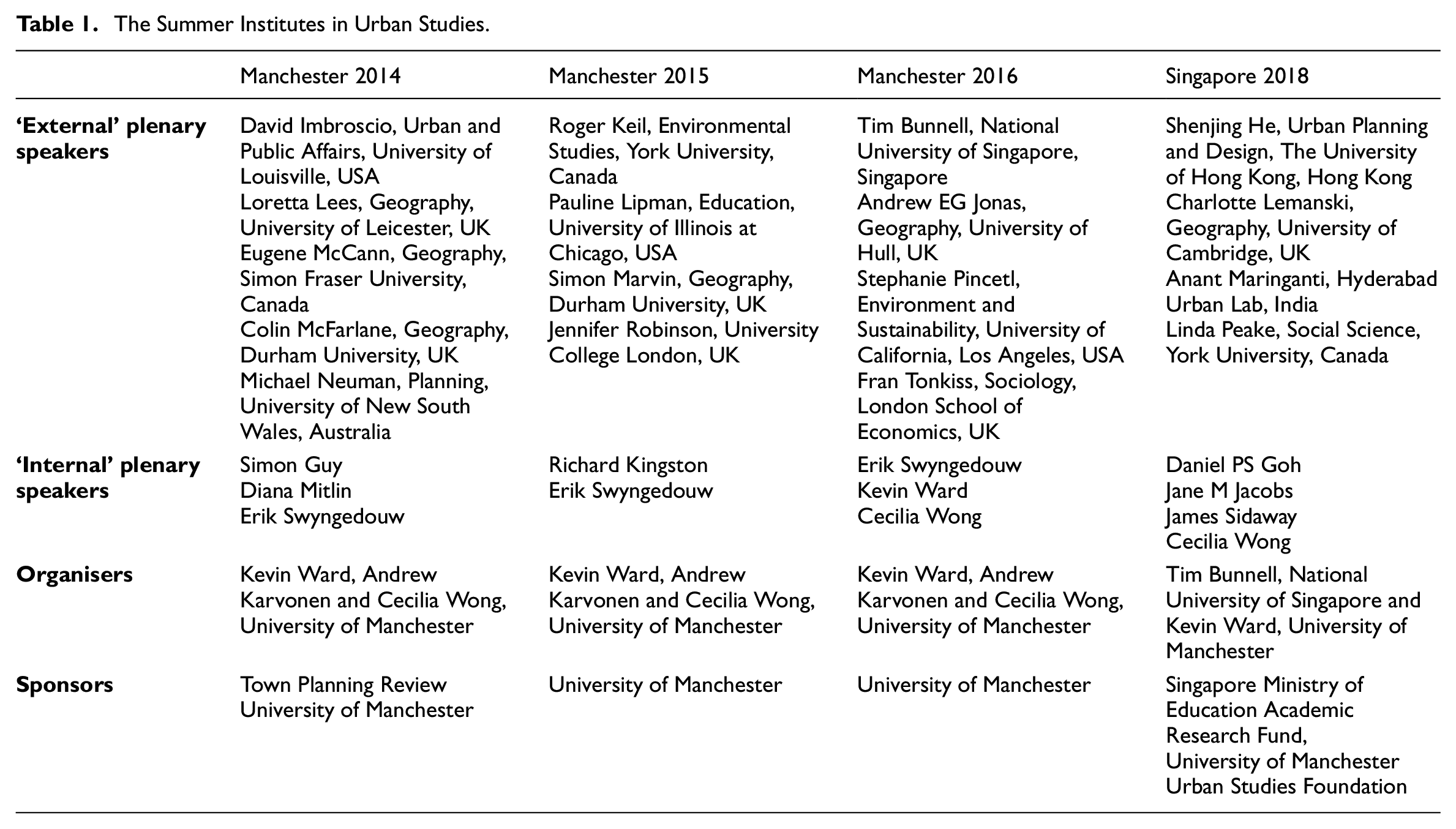
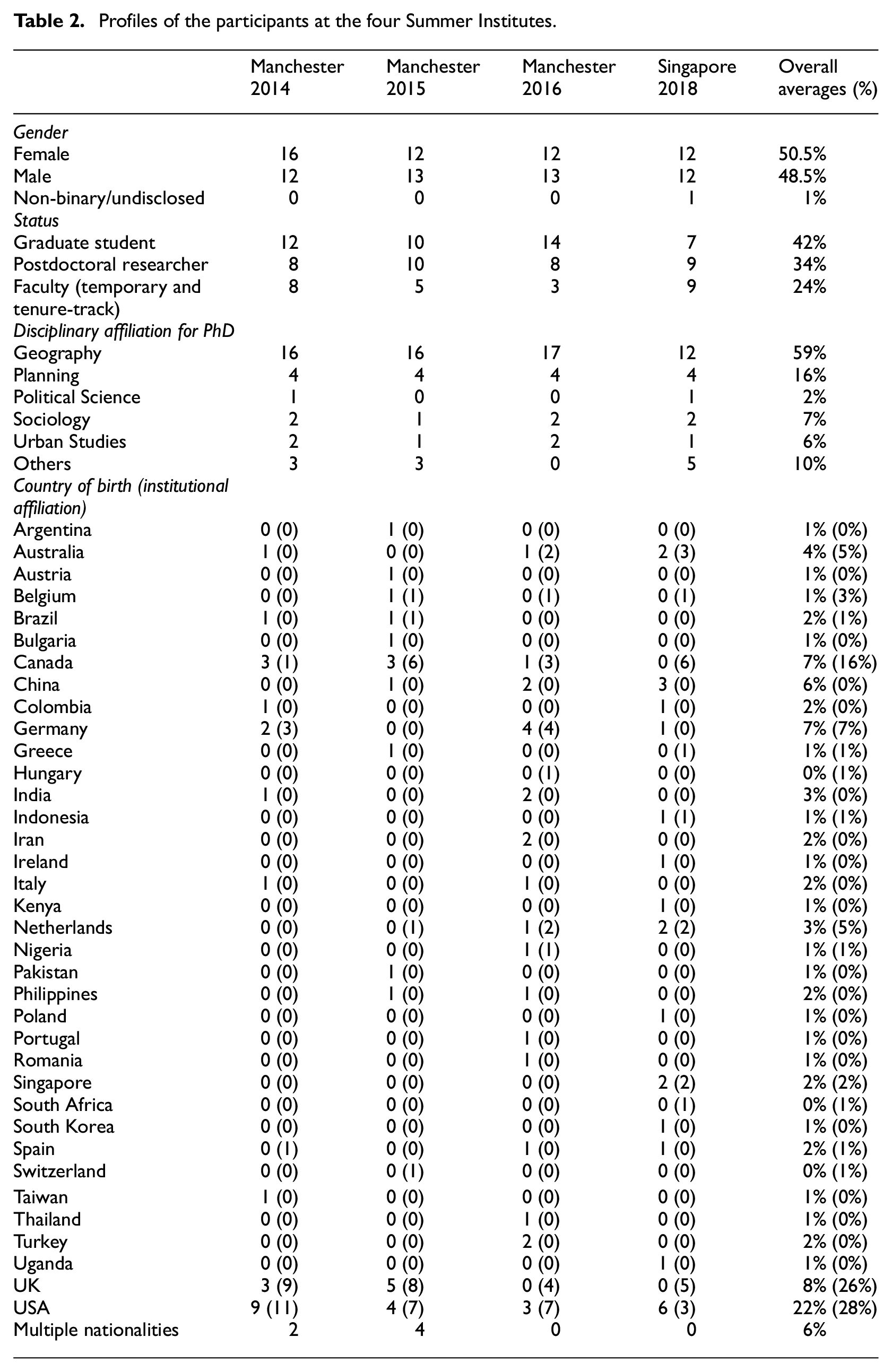
The profile (Table 2) of the participants at the four institutes has been fairly diverse and heterogeneous by some measures, although perhaps not as much as we would have liked when it comes to their country of birth and certainly not when it comes to their place of study (see Table 1). The gender balance has been almost 50:50, 5 while in terms of professional status the majority of participants have been graduate students (42%), with the split between postdoctoral researchers (34%) and faculty/lecturers (23%) more even. Citizens from 36 countries have participated in the four institutes, although there is a long tail, with the majority of the participants being citizens of just six countries: Australia (4%), Canada (7%), China (6%), Germany (7%), the UK (8%) and the USA (22%). The uneven geography of participation is even more marked when we turn to institutional affiliation. Here the tail is even longer, with universities in just three countries accounting for 70% of all participants – Canada (16%), the UK (26%) and the USA (28%). Of course, not everyone from these universities is situated in the same way, as racial and social markers of difference structure experiences and opportunities for progression.
The Summer Institutes in Urban Studies.
Profiles of the participants at the four Summer Institutes.
In terms of the external speakers, the primary consideration has been to identify those who are not only well known for their academic scholarship but who also had the social skills and willingness to extend scholarly interaction between formal sessions and discussion. At the first three summer institutes in Manchester all were white, 5 out of 13 were women and only 1 was based beyond Australia, Canada, the UK or the USA. While these speakers discussed a wide range of urban experiences, nevertheless, the involvement of more external speakers from urban and institutional contexts beyond the Global North would have brought a different set of experiences to the conversation. As discussed in our coverage of SIUS 2018 below, this is an issue that was addressed in the fourth institute in Singapore, where three of the four external speakers were women and two were Asian scholars based institutionally in Asia.
The disparities in resourcing between universities in the Global North and Global South structured who came to know about the institute (even in the age of the internet and social media) and their ability to attend, even allowing for the existence of partial scholarships that were allocated according to the eligibility criteria used by the International Sociological Association (ISA) (https://www.isa-sociology.org/en/membership/table-of-economies-by-category). These ‘structures’ included the extent to which potential participants were able to imagine themselves attending the institute through to the financial and logistical issues of acquiring a visa to travel. Efforts were made from the outset to write the advert in an inclusive and open manner, and this has been something to which we have returned after each institute. Of the 173 applicants for the first institute only 30 (or just over 17%) came from nationals of countries that could be considered part of the Global South (and the equivalent figure for the last year in Manchester, 2016, was 33 out of 116 applicants or just over 28%). Of those 30 ‘Global South’ applicants in 2014, only four were selected to attend the institute, all of whom had done their graduate studies in universities in the Global North. Each of those participants received an award to cover their travel and registration, and this mode of support continued across subsequent institutes. Applicants were asked to complete a short form when applying. This consisted of some general academic career data, a research statement and a short statement explaining their decision to apply. A panel of involved academics then ranked and shortlisted applicants before comparing and talking through their lists in an attempt to generate as best we could a disciplinary, geographically and socially inclusive list of those we wanted to invite. After each institute we revisited this selection process, making minor changes. In the run up to #SIUS2018 the organisers discussed how to deal with applicants who were not advantaged through their location in the more resourced areas of the Global North and those whose CVs were reflective of this. We committed to do what we could to value diverse forms of urban scholarship and activity, alongside more mainstream indicators of research performance such as academic presentations and papers. 6
#SIUS2018: Urban Studies from/in elsewhere
Hosted by the Global Urban Studies research cluster at the National University of Singapore (NUS), the Yale-NUS College of Liberal Arts and Sciences and the ETH-Future Cities Lab, the fourth Summer Institute in Urban Studies ran from 16 to19 July 2018. The choice of Singapore was pragmatic. Geographically it took the institute out of western Europe but to a location that in many ways sits within the Global North in terms of academic networks and resourcing. #SIUS2018 was co-funded by a grant from the Singapore Ministry of Education Academic Research Fund, the University of Manchester and the Urban Studies Foundation (see Table 1 for details of the funding of all four institutes that have been held to date). While much of the format was inherited from Manchester, drawing upon accumulated experience and feedback from the three prior institutes, local organisers 7 of #SIUS2018 sought to make the most of opportunities associated with holding the event in a location in Asia.
To what extent does location really matter in the organisation and effectiveness of an institute in urban studies? On the one hand, in all likelihood, most of the formal topics for plenary and panel presentation would have fomented similar lines of discussion among the institute participants anywhere in the world. On the other hand, place matters, not just for the mere fact of bringing people together but also in terms of how – and in relation to what external stimuli – early and later career scholars are brought together, especially for out-of-session conversation. Scaling down from regional- or even city-level comparisons, there are pros and cons associated with holding the institute in a university environment such as NUS’s Kent Ridge campus as opposed to in the heart of a city (as in the case of the three institutes held in Manchester).
More widely, the very fact of hosting a ‘summer institute’ in a tropical Asian city-state that does not have a ‘summer’ season invited critical reflection on previously taken-for-granted aspects of the institute. #SIUS2018 also began by locating Singapore not so much in relation to other cities that feature prominently in the existing mental maps of Anglophone urbanists (the likes of Chicago, Los Angeles or even Manchester) but as an opening to other urban worlds. Just about visible from the 6th-floor seminar room in which much of #SIUS2018 was held, for example, is Batam, an Indonesian island which is home to what in 2015 was declared the fastest growing city in the world by population (Massy-Beresford, 2015). Similarly, as part of a predominantly Muslim Malay World region (alam Melayu) in South-east Asia, Singapore has long had profound religious-cum-commercial connections to the city of Mecca (see Tagliacozzo, 2013) – ranging from everyday prayer rituals to once-in-a-lifetime journeys – which have rarely been acknowledged in academic urban geographies. ‘Urban Studies from Elsewhere’ was the organising theme of the opening pair of plenary presentations, and was a strand that ran through all four days of the institute (see Table 1 for a full list of plenary speakers, and visit https://soundcloud.com/faculty-of-humanities-uom/sets/2018-summer-institute-in-urban-studies-plenary-talks to listen to their presentations).
Debates around the different epistemologies and ontologies in contemporary urban studies were part of the institutes in Manchester and hosting the fourth institute at NUS was not in itself a radically de-centring or post-colonialising move. NUS has more in common with the University of Manchester than with institutions in Singapore’s trans-border hinterland in South-east Asia. Relatedly, while Batam may have been visible from the seminar room vantage point for #SIUS2018, by many indicators of development, it is a world apart from Singapore (Sparke et al., 2004). Not only is Singapore an established ‘alpha’ node on world/global city rosters (Beaverstock et al., 1999) but its urban development expertise is exported across and beyond Asia (Chua, 2011; Pow, 2018), and the city-state also features prominently in developmental discourses of Asian-centred global urban futures (Bunnell and Goh, 2018). To what extent does growing academic as well as popular imagination and examination of Asian urbanisms as ‘the future’ mean that leading international urbanists are institutionally located in Asia? The fact that in the first three institutes only one of the external speakers was based at an Asian university may suggest that academic urban studies has not yet undergone a substantive de-centring from established (EuroAmerican) heartlands of knowledge production (Foster et al., 2007; Kong and Qian, 2017), although the pragmatic consideration of the expense of bringing Asia-based scholars to Manchester was also significant. 8 Even within ‘developed Asia’ (McKinnon, 2011) Singapore universities are unusual in their degree of connectedness to and visibility within Anglophone academic circuits, including in urban studies. NUS is quite familiar elsewhere for Manchester- and other EuroAmerica-based urbanists. Yet, the fact that two of the external speakers in #SIUS2018 were Asian scholars based in Asia could be a sign of a more de-centred scholarly futures in academic urban studies, as well as reflection of a conscious effort at geographical diversification of the line-up compared with prior institutes in Manchester.
One possible explanation as to why #SIUS2018 did relatively little to redress the highly uneven geography of participants’ institutional location is precisely that NUS is part of similar international academic networks to those of the University of Manchester. Dissemination of the advertisement for the institute in Singapore was initially handled from Manchester, building upon experience from prior institutes, while the Singapore-based organising team used their local and regional connections to try to grow the number of applicants – with some success as 63 of 152 applications were from Asian nationals. 9 However, of these only 35 were from Asian nationals currently studying or working in Asia. For the selected participants over two-thirds had done (or were in the process of completing) their graduate studies in universities in just four countries: Australia (12%), Canada (24%), the UK (20%) and the USA (12%); only one participant was based at a university in the Global South; and only three were based anywhere in Asia. These figures reproduced patterns in the institutional affiliation of participants in prior institutes – very much skewed to Anglophone countries in the Global North – and are surely more than a matter of advertising reach.
Another factor has to do with the institute’s conception of urban studies. Irrespective of where in the world the institute is held, the version of academic urban studies upon which it is founded is far removed from the priorities, practices and incentive systems of many university-based urbanists. On the NUS campus in Singapore there are architects, for example, who identify at least partly as doing ‘urban studies’ but whose applied or design-focused orientations are clearly different from the academic social science urban studies world. More significantly, in Singapore’s neighbouring countries in South-east Asia, even urban scholars in the social sciences have often been more focused on government policy and planning practice (or, in a smaller number of cases, on resisting government policy and plans) than on squarely academic urban studies debates or outputs. In some cases, the desire to be involved in government or private-sector projects is to compensate for, or to supplement, low rates of academic pay – such that even being able to do the kind of more theoretically oriented urban studies assumed in the institute is itself an expression of privilege (Bunnell, 2018). This may be changing as universities in South-east Asia are becoming increasingly concerned with international university rankings (which are based at least partly on academic publication output and associated metrics) but the inherited skills, experiences and interests of urban scholars in universities outside the Global North nonetheless differ from those valued in the shortlisting process for the institute. While we sought to acknowledge and address this, there is still more to be done for it raises wider concerns about which and whose interests, priorities and values are served by the institute, and about the extent to which it could or should be more oriented to other ways of being an academic urban studies person. 10
Although the participant composition of #SIUS2018 may have continued to reflect ingrained global academic institutional hierarchies and uneven geographies, it did seek to provide a space for deliberation of the challenges facing early career scholars even in the relatively privileged Global North. As in prior institutes, some of the parts of the programme that were most appreciated by participants were panel sessions devoted to discussion of academic career development and pathways. One concerned the potential and politics of ‘collaboration’ of various kinds – with colleagues at different career stages, across disciplinary divides, and with scholars in academic institutions in the Global South and beyond the academy into ‘real’ urban worlds and lives. Mindful of growing expectations in many national scholarly contexts for academic urbanists to demonstrate ‘impact’, another session took the form of a workshop on the craft of writing for more-than-academic audiences. Perhaps most widely appreciated of all (from participants’ feedback) was the ‘job talk’ session. Panellists interpreted ‘job talk’ in ways ranging from specifically what it means to give an effective research seminar when applying for an academic/faculty position, to reflection on the current state of the academic labour market in urban studies. Discussions around so-called ‘rules of the game’ were revealing. Some participants emphasised that ‘the game’ was not the same for everyone, and that class, gender, race and sexuality mattered, together with geographical location, echoing points from previous institutes. Unsurprisingly this discussion did not lead to any easy solutions. However, through sharing insights and understandings there was a sense that all involved were better placed to reflect upon their accumulated privileges as well as impediments, and to do what they could in the future to produce a more inclusive urban studies community.
The job talk session also gave rise to important discussion about how inherited rules of the game, and the politics of efforts to overcome inequitable relations to them, might be reconfigured by the shifting global geographies of academic job opportunity in urban studies and cognate fields. In climates of growing uncertainty in higher education in the UK and the USA – on top of a longstanding situation where the supply of PhDs exceeds academic institutional demand for them – mention was made of expanding horizons of opportunity in other parts of the world. It was noted that urban studies is a ‘hot topic’ in China, for example, as evidenced by the opening of new programmes across several disciplines, although tenure track positions are increasingly rare and already highly competitive. Relatedly, returning attention to Singapore, it is worth noting that two of the organising partners for #SIUS2018 – the ETH-Future Cities Lab and the Urban Studies programme of Yale-NUS College – were founded within the past decade. The latter hosted an interactive workshop on the pedagogy of urban studies, including a brainstorming exercise about what skills and content should form part of an Urban Studies programme in and for the 21st century 11 – a time when, by conventional measures, the majority of the world’s urban population lives in Asia. Even more recent relevant additions to the academic landscape of Singapore are a minor programme in Environmental and Urban Studies at Nanyang Technological University and the Urban Science, Policy and Planning programme at the Singapore University of Technology and Design (SUTD). Who is being hired into such positions, doing what kinds of urban studies? And will the process of filling emerging urban studies positions – in Asia and elsewhere – unsettle or reinforce existing hierarchies of privilege or replace them with new ones? 12 These are among the important questions to be grappled with by participants in future iterations of the institute, wherever in the world those are held.
Towards #SIUS2020
The fifth Summer Institute in Urban Studies will take place in Toronto in June 2020. In its planning we continue to wrestle with some fundamental challenges related to the objectives of the institute, which in turn speak to wider asymmetries in the geographies of urban academic knowledge participation and production. Here we set out those challenges that we feel are most pressing.
First, the current moment in urban studies continues to be at once both profoundly exciting and generative, while at the same time fraught with friction and tension, which at times appears to have gone beyond academic differences. The field is witnessing a range of theoretical interventions, as its future and who gets to make a claim over it continues to be keenly contested. While a clear indicator of vibrancy, some participants at the institute were also aware of the need for academic debate to stop short of being harmful to those involved. These concerns were also voiced with an awareness of the continued casualisation of a number of national academic labour markets, particularly those of Australia, Canada, the UK and the USA. As is becoming increasingly clear, mental health and wellbeing is a significant issue, particularly amongst those who are nearer to the beginning of their academic careers (Peake and Mullings, 2016). This is an issue that is likely to figure more prominently in #SIUS2020.
Second, and building upon the first point, is the worsening state of the academic labour market in some countries around the world, particularly in Europe and North America, with many at the beginning of their academic careers in one type of precarious employment or another. And yet, at the same time, there are new opportunities emerging elsewhere (including but not only in some parts of Asia). In response to these labour market conditions, those at successive institutes have discussed and shared anecdotes and experiences in order that each of them is better prepared for what is required to secure stable employment. In particular, we have reflected upon the different rules that govern different areas of the academic job market and how some involved are more privileged than others in ‘playing the game’. Building upon these reflections and exploring what might be done to address these issues will form part of the #SIUS2020 programme, with a continued emphasis on cooperation rather than competition amongst participants.
Third, and while the applicants and participants at successive institutes have come from an ever more diverse set of geographical locations, there remains work to do in terms of how this diversity is reflected over the week. It is a challenge to all involved – organisers, academics and participants – to create respectful and safe spaces that support the active involvement of all participants, regardless of class, gender, race and sexuality. Reflecting upon how to create the conditions to allow all participants to speak during sessions, to draw upon their own experiences to shape the nature of the conversation, is something to which all involved need to be attuned.
Fourth, and finally, is the intellectually thorny issue of where ‘urban studies’ stops and starts, and in what ways this matters for those who want to use the term to identify what they do. This issue has appeared and reappeared at each institute. For some participants this really mattered. For others it was of negligible importance. Successive institutes have seen the debating and discussing of different understandings of what goes into the making-up of ‘urban studies’. The intention has never been to move towards a shared understanding, in which differences are glossed over or marginalised. Rather, the objective has been to establish a space where differences are acknowledged, named and valued, leading all involved to return to their particular vantage points more aware and informed. Nevertheless, where the boundary is drawn and who draws it does matter in terms of how those early in their careers narrate what they do when it comes to applying for academic positions or working towards tenure. Despite the inter-disciplinary turn across much of the social sciences, many universities still look to hire into disciplinary departments. So, an orientation to reach out beyond, say, geography or planning has, under certain conditions, to be offset against the realities of how universities are organised and hires presented. Nevertheless, at the institutes there has been a commitment to working across disciplines, not least because the challenges facing cities around the world seem to demand it of university researchers, even when the organisation of many national academic labour markets remains stubbornly structured along traditional disciplinary lines.
Footnotes
Acknowledgements
Thank you to the following SIUS ‘alumni’ for their helpful and insightful comments on an earlier version of this paper: Naomi Adiv, Josh Akers, Ricardo Cardoso, Desiree Fields, Prince Guma, Wangui Kimari, Elsa Koleth and Sophie Yarker. We also acknowledge the critical but supportive comments of reviewers and the editor at Urban Studies, Vanessa Watson.
Funding
The authors gratefully acknowledge funding from the Singapore Ministry of Education AcRF Tier 1 Research grant FY2017-FRC2-014.
