




Abstract
Social and social-spatial inequality are on the rise in the Global North. This has resulted in increasing segmentation between population groups with different social and ethnic backgrounds, and in differentiated access to cultural and material assets. With these changes, the relation between segregation in the educational sphere and segregation in the residential sphere has become crucial for understanding social reproduction and intergenerational social mobility. However, knowledge about this relation is still limited. We argue that the institutional and spatial contexts are key dimensions to consider if we want to expand this knowledge. The institutional context regards the extent of public funding, the degree to which parental choice and/or geographical proximity drive school selection, the role and status of private schools and the religious and pedagogical pluralism of the educational system. The spatial context refers to the geographies of education: the ethnic and social composition of school populations and their reputations; the underlying levels and trends of residential segregation; and the spatial distribution of schools in urban space. In this introduction to the special issue we will address these interrelated dimensions, with reference to theoretical and empirical contributions from the existing body of literature; and with reference to the contributions in this special issue. School segregation emerges from the studies included in this special issue as a relevant issue, differently framed according to the institutional and spatial contexts. A comparative typology will be proposed to illustrate how school segregation is peculiarly shaped in different national and local contexts.
Introduction
While educational systems may facilitate social mobility, the structure and institutional arrangements of the educational system are also key drivers of social inequality. The way in which the educational system offers different opportunities for children and how these differences are compounded over the length of individual educational trajectories are perhaps the most important factors in producing social inequalities such as in terms of health, wealth and well-being. In the last two decades, inequality across most countries of the Global North has been on the rise and has increased the distance and cultural segmentation between population groups with different social and ethnic backgrounds and differentiated access to cultural and material assets. As social and spatial (residential) divisions have been exacerbated in many cities due to the changes of the last decades (Cucca and Ranci, 2017; Musterd et al., 2017; Tammaru et al., 2016), the intertwinement of segmentation within the education system and segregation in the residential sphere has become ever more crucial for understanding the socio-spatial mechanisms behind social reproduction and intergenerational social mobility. This, therefore, will be the focus of the contributions in this special issue.
School segregation regards the uneven distribution across schools of pupils on the basis of inequalities in terms of socioeconomic, ethnic or other characteristics (Ball, 2003). Our main hypothesis is, however, that school segregation not only reflects existing social – and also spatial – inequalities, but also plays a crucial part in maintaining and exacerbating them. The way in which processes of residential segregation and school segregation are interconnected and reinforce each other is key for understanding how this occurs. The ways in which the educational system is (co-)responsible for the reproduction of social inequality are highly contingent on the specific institutional and spatial arrangements that are in place at various scales: national, regional, urban and local. In order to understand how educational inequalities are produced in space, it is paramount to understand how various aspects of the institutional and the spatial context are interrelated and work together in what we will refer to as a specific educational landscape.
These educational landscapes are formed where national, regional and local regulations and policies are combined with historically developed geographies of education: spatial distributions of schools with different profiles and reputations that on the one hand reflect, and on the other shape residential patterns across race/ethnicity and social class.
Educational landscapes differ in many respects, but two key dimensions seem to be of greatest importance. First, landscapes differ in terms of the institutional dimensions of the educational system. This includes the extent of public funding; the degree to which parental choice and/or geographical proximity are central to outcomes of school selection processes; the role and status of private schools; and the pluralism and differentiation of the educational system according to quality and religious and pedagogical programmes.
Second, the educational landscapes differ in terms of the geographies of education. This regards primarily the ethnic and social composition of school populations, the underlying levels and trends of residential segregation and the spatial distribution of schools in urban space.
In this introduction to the special issue, we will address these dimensions and their interrelations, with reference to theoretical and empirical contributions from the existing body of literature; and with reference to the contributions in this special issue. We will discuss crucial findings that connect to the institutionally and spatially constructed educational landscapes across cities and other contexts. These educational landscapes, which include inequalities in residential space, can then be related to social inequality with regard to schools. But the association between residential segregation and school segregation is most central. The studies in this special issue offer the opportunity to compare these relations between cities and contexts, which may provide new insights into the role played by various educational landscapes. We will also present some of the crucial outcomes of the studies, individually, and in comparison. These can be seen as ‘teasers’, inviting the readership to continue with the other articles of this issue. This presentation will also provide building blocks for potential future research.
Educational systems: Institutional contexts
The way in which education is funded clearly affects the opportunities of children with different resources. Fully state-funded systems in general may offer a more level playing field for parents and children than systems in which private funding and often highly differentiated school fees play a larger role (Coulson, 2009; Dronkers and Robert, 2008). State-funded systems are, however, not the same as public systems. In Denmark, the Netherlands and Spain, for instance, private schools are (largely) publicly funded, which takes away most of the economic constraints for access to private education but not the different legal positions of these schools. In other countries (such as Greece or Italy), private schools are not, or are only partially, funded by the State, and they represent therefore a separate, though expensive and selective, sector of the whole education system. Furthermore, organisation of funding impacts not only the affordability and thus accessibility (of parts) of the educational system, but also the degree to which schools may design their own admission policies and hence control their intake differently from the public system.
The degree to which the system allows parents to choose forms another element. This aspect has become crucial in the last decades as quasi-markets have been introduced in the regulation of the access to school in many countries. Nevertheless, while free choice mechanisms are differently framed across countries, residential location continues to play an important role and still structures the set of schools from which a selection can be made.
In most countries where school allocation is ruled by residential location, some elements of parental choice are part of the institutional design for school allocation policies. In cities where most public schools are assigned to one particular district or catchment area, in France or the US for instance, choice is associated with opting-out of the public system into private schools, charter schools, faith-based schools and so forth. In countries like Finland, districts have one public school and the absence of alternatives makes this a nearly completely geographically contingent system. Correspondingly, residential mobility may play a significant role as part of educational strategies in these contexts. In several other contexts in which catchment areas or other geography induced mechanisms have been implemented, a similarly strong relation between school choice and residential behaviour may exist (Hamnett and Butler, 2013; Noreisch, 2007; Van Zanten and Kosunen, 2013).
In contexts where more free choice is allowed, such as Italy or Spain, school choice is sensitive to the social and ethnic characteristics of the neighbourhood. Here many parents, especially middle-class parents, aim at cultural and economic reproduction, and tend to firmly invest in getting their children into a preferred school. They will try to anticipate the impacts of new school allocation policies and avoid unwanted allocation. This may result in avoiding some schools, or in efforts to collectively change the composition of a school, but also in moving away from perceived ‘risky’ environments to residential areas in which the preferred schools are located (Boterman, 2013). This is even more extreme in the context of the Netherlands, where free parental choice for schools has been a longstanding legal principle. Schools do not have formal catchment areas, and even municipal boundaries do not present significant barriers. However, even there, spatial proximity still influences the choices parents make, and the spatial distribution of schools (of different pedagogical programmes and quality) affects the mechanisms of allocation. So even in choice-based systems the geography of education still matters.
This ties into another aspect impacting the educational landscape: the plurality and differentiation of the educational system, mainly related to the size and role of the private school sector, and/or the variation of school profiles based on faith or pedagogical programmes. Some countries, such as Finland or Greece, have a public school system with relatively little variety (Bernelius and Vaattovaara, 2016). Other countries like Germany, Scotland and the Netherlands have a majority of primary schools belonging to a particular religious denomination – in these countries, Catholic and Protestant (Denessen et al., 2005; Flint, 2007). In England too, Catholic schools and Church of England schools are part of the set of schools that parents can choose from (Butler and Hamnett, 2012). In other countries – such as France, Italy and Spain – most of the private schools are managed by religious (mainly Catholic) institutions, which have gained a special status granting them autonomy as well as parity with public schools. Furthermore, various educational landscapes, for example in American and Dutch cities, are dotted with schools based on pedagogical profiles, such as magnet schools and Waldorf/Steiner schools (Renzulli and Evans, 2005; Saporito, 2003). The range of options available to parents evidently increases the potential for school segregation because latent differences in terms of preferences between parents become more easily expressed in the context of ample choice.
Finally, educational systems also differ in the way in which children are selected and tracked according to ability (Van de Werfhorst and Mijs, 2010). Systems that offer more general forms of education for children until a later age, such as Scandinavian models, are supposed to be associated with lower inequalities in eventual attainment compared with early tracking systems such as those in Germany, Austria and the Netherlands (Van de Werfhorst and Mijs, 2010). Early selection also raises the stakes for social reproduction early on, which makes the dynamics of school choice and allocation also very pertinent for primary education. In more general systems, secondary schools seem to be the primary sites for issues of social reproduction. There are, however, exceptions such as the cases of Italy and Spain, where general educational systems and late tracking are associated with higher inequality even in primary schools. The different designs and organisations of the educational system may thus have important repercussions for the level (primary or secondary) at which inequalities are reproduced and segregation manifests itself most clearly.
Educational systems: Geographies of education
Educational landscapes are also shaped by the specific social geographies of cities and urban regions. Segregation levels and patterns in schools, along lines of social class and ethnicity/race, are highly interrelated with the composition and distribution of groups across neighbourhoods within these urban regions (Boterman, 2018; Burgess et al., 2005; Frankenberg, 2013; Owens et al., 2016). This corroborates recent findings that segregation tends to be reproduced in multiple domains of life simultaneously (Boterman and Musterd, 2016; Van Ham and Tammaru, 2016; Van Ham et al., 2018). The association between residential and school segregation offers even more support to the idea of the multi-domain reproduction of segregation, even if not all urban regions show similar levels and trends of social inequality. Inequality, however, does not automatically translate into residential segregation. The filtering of social inequality into spatial inequality depends on the actual physical structure of each city and on the organisation of the wider welfare state regime. One of the key factors that mediate social inequalities at different spatial levels is the structure and regulation of the housing market in terms of tenure, quality and affordability. The domain of housing is closely aligned with other domains through which redistribution of various resources occurs, such as health care, social security and education. In their study on urban segregation, Musterd and Ostendorf (1998) conclude that segregation levels tend to be clearly higher in liberal welfare states compared with social democratic welfare states, even if cities are exposed in a similar way to global networks and economic restructuring leading to more powerful urban positions. On top of all of these macro processes, there is also the impact of individual household preferences. These preferences appear to differ at different stages in the life course of the households, but also according to gender, social class, ethnicity and other characteristics (Mulder, 2013). These impacts on residential decisions, and thus residential segregation, all play a role, but turn out to be heterogeneous across states and cities. The effects on school segregation are expected to follow that heterogeneity.
Notwithstanding the strong connection between residential social-spatial patterns and school segregation, the exact relationship between the two is, as argued, heavily influenced by other aspects of the educational landscape, as we saw in the previous section. Most pertinently, whether and how parents can opt out of the school(s) available in their residential neighbourhood affects the degree to which the residential neighbourhood of children determines school segregation. Which role space plays in the production of school segregation and educational inequalities depends on the entire educational landscape of a specific context. This special issue presents a range of studies of various educational landscapes and aims to fill a gap in the literature concerning the connection between patterns and mechanisms behind school segregation and the spatial contexts, both in terms of how specific urban contexts and institutional settings influence patterns and trajectories of school segregation and of how they are impacted by their outcomes. The focus is on segregation in primary and secondary schools, as geographical proximity is most relevant in the process of student allocation at these schools. We include empirical city-case studies of different educational landscapes, utilising a range of different methodologies. The various urban contexts of this special issue provide evidence from educational landscapes that are positioned differently on the key dimensions that we identified above.
Introducing the articles
The 13 contributions to this special issue include studies from France, Germany, Italy, the Netherlands, the UK, Greece, Finland, Denmark, the US and Spain. This variety of experiences allows for a discussion of the impact of a wide range of institutional, economic, social and spatial contexts, that is, of different educational landscapes. We also see it as an advantage that the authors of the articles are from different disciplinary backgrounds.
This special issue is organised into two sections. The first section includes studies that explain how the distribution of different populations across urban space affects different school-related issues (such as student distribution and school achievement). The Dutch experience, discussed by Boterman (2019, in this special issue), shows how relatively moderate levels of residential segregation and high levels of egalitarianism coincide with high levels of school segregation. However, a closer look at residential segregation reveals that levels of family segregation are actually not that moderate, which, in fact, provides an important explanation for the higher levels of school segregation found in Dutch cities. As Bernelius and Vilkama (2019, in this special issue) describe for Helsinki, an almost complete overlap of school districts and residential areas, in the absence of opt-out opportunities, results in an educational landscape where residential mobility is the single most important strategy for getting into a particular school. In Paris too, as Oberti and Savina (2019, in this special issue) show, a rather rigid school catchment area policy connects place of residence with school location. Nevertheless, school composition does not directly reflect the composition of the neighbourhood, and school achievements do greatly reflect this complexity of contextual effects. With the case of Athens, Maloutas et al. (2019, in this special issue) address the connection between residential segregation and the length of educational trajectories (as an indicator of school performance), and put this in a social class perspective. Here too, segregation at the micro level is limited, and mainly ‘vertical’ (between the floors of a building), but school trajectories of students lead to very unequal outcomes. In the study by Vergou (2019, in this special issue), policies addressing the issue of urban refugees in three Greek communities are analysed by considering how the social-spatial configuration of refugee accommodation in such local communities not only is a catalyst for social exclusion and territorial stigmatisation, but also results in de facto school segregation. Finally, in a US-based study, Owens and Candipan (2019, in this special issue) investigate the relation between the level of socio-economic segregation of neighbourhoods and student achievement, and conclude that high-income neighbourhoods are served by schools with greater peer, financial and instructional resources and greater student achievement than in those of low-income neighbourhoods.
The second section addresses the complexity of the institutional dimensions of the educational landscape, showing the effects of policy frameworks on school segregation, with particular attention paid to the role of school choice. Here we start with the contribution of Wilson and Bridge (2019, in this special issue), who offer a systematic analysis of the ways in which educational systems work differently in terms of school allocation. Based on a meta study with evidence from a wide range of contexts, they conclude that school choice is consistently associated with higher levels of segregation. They argue, however, that the mechanisms that produce this result are highly specific to the local context. Cordini et al. (2019, in this special issue) show that in Milan, though the city is characterised by a relatively mixed social-spatial structure, levels of school segregation are much higher than expected. This is the result of a regulatory regime of completely free school choice, and the strong preference of parents to avoid schools located in the poorest areas or in areas with a high share of migrants of non-Western origin. Nielsen and Andersen (2019, in this special issue) demonstrate for Copenhagen that school segregation emerges even in an egalitarian educational landscape. The selectivity of the process, and the strong differentiation between the public (Folkeskole) and the private sectors, mean that the poorest households lag behind and end up keeping their children in schools with more problems and bad reputations. The integration role of publicly funded schools is thus undermined. The case of Barcelona presented by Bonal et al. (2019, in this special issue) shows how the specificities of the admissions policy, which combines catchment area restrictions with a high level of school choice, result in complex mechanisms of contextually bounded school segregation within local education markets. This regulatory setting may therefore alter the expected effects of residential segregation on school segregation among city neighbourhoods. A different and interesting example of how school choice exacerbates segregation is offered by the contribution of Ramos Lobato and Groos (2019, in this special issue). They discuss the effects of abolishment, in Mülheim an der Ruhr in North-Rhine Westphalia (one of the regional states, or Länder, in Germany), of school allocation through primary school catchment areas, which are the rule across Germany. They find that this change of policy has resulted in increasing school segregation because choice now seems to be seen as something parents have to exert, instead of that they are allowed to. A related study has been carried out by Serbulo (2019, in this special issue), in Portland, Oregon, USA. In the 1970s and 1980s, special magnet school programmes and open enrolment policies had stimulated racially and economically integrated schools. However, after the mid-1990s, neoliberal education policies based on freedom of school choice were introduced, resulting in school segregation levels that came to exceed residential segregation levels. Finally, Candipan (2019, in this special issue) focuses on the effects of a changing neighbourhood composition on the composition of local schools in a large number of urban school districts in the US. She also measures effects in situations where greater school choice is available. One of the interesting findings is that neighbourhoods that experience socio-economic ascent are associated with local public schools enrolling fewer white students. This association is stronger when the number of nearby non-neighbourhood schools increases.
Comparing school segregation in different cities: Some preliminary results
This special issue brings together contributions focused on different cities and countries across Europe and the US. Though such contributions have been developed relatively independently from each other, taken together their synthesis provides many elements that are useful for an analysis of the different ‘geographies of education’ (Butler and Hamnett, 2007).
We will explore the following two main questions:
How and to what extent are patterns and trends of school segregation explained by the social-economic and ethnic composition and spatial distribution of school-aged populations in urban contexts?
How and to what extent are patterns and trends of school segregation explained by the institutional settings and recent dynamics of urban education systems?
First, we will consider the present characteristics of school segregation across cities and countries. We will then focus on two main drivers of school segregation: residential segregation and the public regulation of school access. We will consider how recent trends in urban segregation have differently shaped school segregation in our cities, and how these two forms of segregation are compositionally linked together. As school segregation is also significantly shaped by the institutional context, we will consider too how ‘the rules of the game’ and the overall educational landscape differently shape the access of students to the education system, either increasing or hampering the level of school segregation.
In the conclusion we tentatively discuss the main effects of school segregation on patterns and trends of residential segregation and inequalities in school attainment, on social inclusion and on chances for upward social mobility for the most disadvantaged groups. We refer back to some of the findings of the studies in the special issue that also explicitly dealt with the repercussions of segregation for educational outcomes.
School and residential segregation
In the face of a general trend of an increase in both social inequality and urban segregation in Western countries (Musterd et al., 2017), the articles collected in this special issue empirically investigate the hypothesis that schools are more segregated than neighbourhoods. A number of studies of this issue provide measures of residential and school segregation, mostly based on segregation and dissimilarity indexes. This index is suitable for comparative analysis as it is insensitive to the size of the groups studied. It calculates the relative spatial imbalance of one group compared with the other in a system, in this case a city, across neighbourhoods or schools. The resulting measures, however, are affected by the number and size of the units in the city. Considering these limitations, Table 1 reports the main results obtained for some of the local contexts considered in this issue. Though measures are not directly comparable across cities and countries, they provide indications of the relation between school segregation and residential segregation across Europe.
Segregation/dissimilarity indexes measured in different cities.
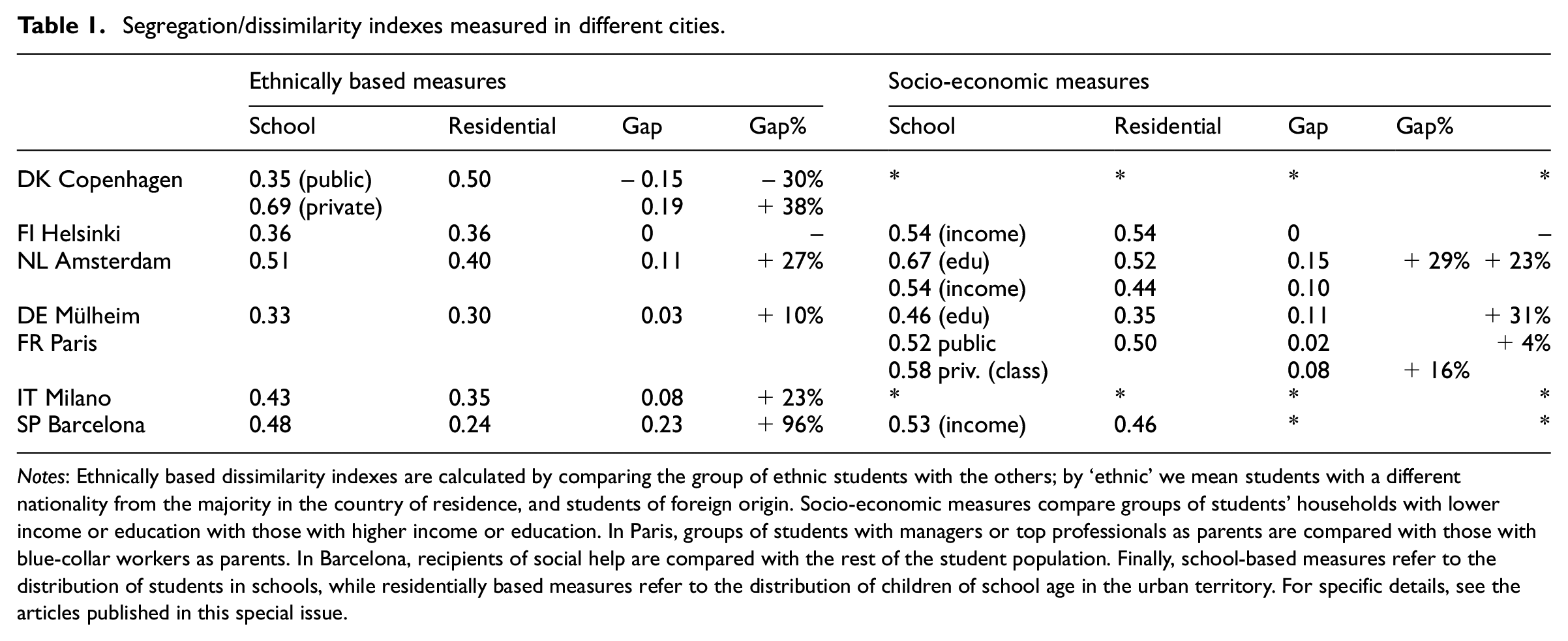
Notes: Ethnically based dissimilarity indexes are calculated by comparing the group of ethnic students with the others; by ‘ethnic’ we mean students with a different nationality from the majority in the country of residence, and students of foreign origin. Socio-economic measures compare groups of students’ households with lower income or education with those with higher income or education. In Paris, groups of students with managers or top professionals as parents are compared with those with blue-collar workers as parents. In Barcelona, recipients of social help are compared with the rest of the student population. Finally, school-based measures refer to the distribution of students in schools, while residentially based measures refer to the distribution of children of school age in the urban territory. For specific details, see the articles published in this special issue.
When measured on the ‘ethnic’ dimension, school segregation appears to be generally higher than residential segregation – except in Helsinki where mechanisms for sorting students are strictly based on residence (like in Athens), and in Copenhagen public schools where we see a reduction in ethnic segregation (while private schools are more segregated). The gap is especially high in Barcelona, where the level of citizenship-based school segregation is twice the level of residentially based. When measured on the socio-economic dimension, the difference between school segregation and residential segregation is only fractional, except for Amsterdam, where socio-economic segregation is higher in schools than in the residential sphere. We should be aware, however, of the effect of the definitions used, which not only vary between cities, but also make quite coarse category comparisons.
In the United States, where sorting of students in public primary schools is based on neighbourhood residence, Candipan (2019, in this special issue) measures a ‘neighbourhood–school gap’, defined as ‘the difference in the share of white elementary school-age children in neighbourhoods and schools in a single year’. Her analysis shows that the gap has increased in economically ascending areas, where also the share of white residents has increased over recent years.
Furthermore, Table 1 shows that in some European cities school segregation based on socio-economic disparities is more significant than segregation based on ethnic or migration background (see the cases of Mülheim, Helsinki and Amsterdam). The cases of Paris and Copenhagen show that private schools are generally more segregated than public ones.
The analyses show that not only is school segregation a widespread phenomenon across cities and welfare regimes, but also it involves both ethnic and socio-economic aspects. Although socio-economic disparities seem to be more relevant than ethnic differentiation in the European context, the difference between school segregation and residential segregation is mainly to be found in the sphere of the ethnic dimension. In general, therefore, primary school systems across Europe not only reproduce, but also reinforce territorial segmentation, especially in terms of ethnicity.
Complex links between neighbourhood and school
Within these general trends, the way residential and school segregation interact depends on specific features of the urban context. The types of urban settings taken into account in this special issue are quite diverse. Structural factors, institutional and contextual factors (Tammaru et al., 2016) and specific urban configurations (Vaughan and Arbaci, 2011) very differently shape the forms of urban segregation in different cities and across different domains (residential, work, leisure, schools, etc). Even if not all the articles provide complete information on the urban features, and being aware of the risks and limitations inherent in such generalisations, we can, heuristically, roughly group the types of urban settings into three families: Northern and Western European cities (Copenhagen, Amsterdam, Helsinki, Paris, Mülheim), Southern European/Mediterranean cities (Athens, Volos, Milan, Barcelona) and US cities.
Southern European cities are characterised by relatively high levels of social polarisation (OECD.Stat, 2018), coupled with relatively low levels of urban or neighbourhood segregation, even if on this last point evidence from the literature is still contested and somewhat inconclusive about the real dimension of marginalisation behind relatively mixed urban spaces (Arbaci, 2008; Pfirsch and Semi, 2016). These societies are more unequal than the Northern European ones, but they tend to be less segregated in space, which means that a number of factors linked to urban structure, history, the grain of the urban fabric, the type of property structure and housing markets etc. make for a more mixed urban environment. In Milan, the level of residential segregation is relatively low and it concerns the micro-scale within neighbourhoods, while the school choice mechanism leads to higher segregation in education (see Cordini et al., 2019, in this special issue); in Athens and Volos we do not have exact measures, but qualitatively the articles underline that the levels of socio-economic and ethnic residential segregation are not very high, and, in the case of Athens, they are also linked to forms of vertical segregation within the same buildings (see Maloutas et al., 2019, in this special issue; Vergou, 2019, in this special issue). In Barcelona, the combination of catchment areas, school choice mechanisms and segmentation of the school supply into public and private makes the system relatively segregated, even in the face of low levels of residential segregation. In such cities, the structure, organisation and distribution (existence, design and dimension of school districts) of the school supply (the educational landscape) within the urban context appear crucial for understanding and ultimately tackling school segregation, which is likely to reflect conflicts and tensions emerging in mixed contexts due to high levels of social inequality. Ethnic differentiation is added as this is aligned to the dominant social cleavage between the rich upper class and the middle and lower classes.
Continental and Northern European urban contexts are relatively moderately polarised in term of social inequality (using the Gini index on disposable income at the regional level (OECD.Stat, 2018)), but they tend to be more segregated residentially than their Southern European counterparts. Compared with highly segregated urban contexts such as most UK or US cities, the levels of residential segregation in the urban contexts of Northern and Continental Europe are generally considered modest. Yet, contrary to studies on the socio-economic or ethnic segregation of the whole population (Musterd and Ostendorf, 2009; Tammaru et al., 2016), the articles in this issue show that children in primary schools are more strongly segregated. In Copenhagen, for instance, the geography of different forms of tenure affects the residential segregation of children, particularly along ethnic lines. This in turn affects school segregation, even if the municipality has been modifying the school districts to tackle increasing segregation (see Nielsen and Andersen, 2019, in this special issue). The Helsinki study (Bernelius and Vilkama, 2019, in this special issue) emphasises the role of housing strategies and the distribution of population groups across catchment areas. The analysis shows distinct features of the different catchment areas in terms of the socio-economic characterisation of families, but also in terms of prevailing housing types. In the more residentially segregated context of Paris, the level of school segregation is still generally higher than that of socio-residential segregation, in particular for upper middle-class and for working-class pupils, whose presence in the urban region is already spatially concentrated (see Oberti and Savina, 2019, in this special issue). In the German case, Mülheim, where levels of segregation are quite modest, the recent introduction of school choice in North Rhine-Westphalia has been conducive to growing school segregation. Here, exercising choice seems to have a distinct geography: particularly in socially mixed areas, parents with a high socio-economic status make use of their newly granted right to choose (see Ramos Lobato and Groos, 2019, in this special issue).
Finally, the articles on US cities show that at a general level, in cities characterised by levels of social polarisation and residential segregation higher than those in European cities, schools serving high-income neighbourhoods have greater social, economic and educational resources than schools serving lower-income neighbourhoods, and the longstanding features of the connection between neighbourhoods and populations are being impacted by the effects of gentrification in inner-city areas, which are reflected in increased school segregation, even when neighbourhoods tend to de-segregate.
The institutional context: Free choice and educational heterogeneity
Access to primary schools is differently framed according to the specific characteristics of national and local educational landscapes. International literature on school choice has not yet developed a comprehensive comparative framework able to capture national and local differences. The articles in this special issue provide useful information for such a comparative analysis of public regulation concerning access to primary schools. We understand regulation as institutional filtering mechanisms through which urban and social dynamics of segregation are channelled into the school system, giving way to specific sorting effects.
The institutional aspects of the educational landscape are primarily related to two factors: i) the public regulation of school allocation: as previously discussed, national school systems mainly differ in the extent of free choice allowed to families and children; ii) the plurality of the school system, that is, the variety of schools offered to families, which is related to the public–private mix, the role of faith-based schools and the differentiation in terms of quality and tuition fees.
Public regulation of the school allocation is defined at different institutional levels, involving national, regional and local rules. Figure 1 summarises the distribution of competences across different institutional levels for middle schools in selected OECD countries. As this figure shows, national and local contexts differ strongly in terms of where decisions are taken. In Finland, municipalities make all decisions, whereas in the Netherlands, schools are highly autonomous. Usually, nationwide regulation defines the general rules to be followed in sorting students for different educational levels, and provides general criteria for selection procedures. State funding of schools and the selection structure of the educational system (comprehensive vs. differentiated) are also generally defined at the national level. Moreover, national rules define the status of private schools and their funding and official recognition. On the other side, local institutions are involved in specific selection and/or prioritisation procedures, which take into account demand size, place availability and the spatial/social configuration of specific areas. The overall regulation of school access, especially at the local level, is therefore defined according to the actual range of school opportunities available in each local context. The overall impact of such complex systems of student sorting is that general rules might produce different segregation effects because of the different opportunities and school options offered in specific areas. For example, Candipan (2019, in this special issue) shows that segregation in American public schools is partly affected by the number of school options (including private as well as magnet or charter schools): the broader the set of choices, the less likely that white students will attend their neighbourhood’s schools, and therefore the higher the segregation level of the local schools.
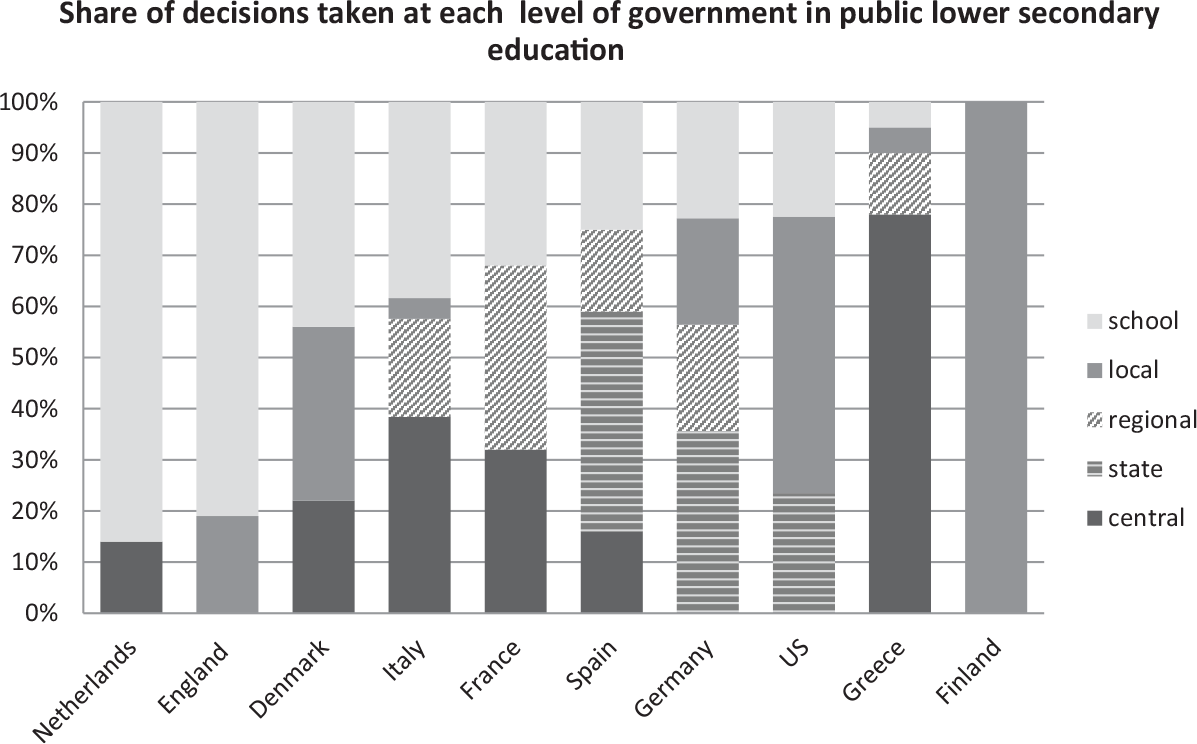
Share of decisions taken at each level of government in public lower secondary education.
In the last two decades, the public regulation of school allocation has been shaped by the introduction of quasi-market rules, instituting parental freedom of choice and open competition among schools. The setting of market rules has been different not only across countries but also across cities. The same general rules have been differently implemented by local and school authorities, contributing to a very mixed scenario. Even though we identify three main general models, their level of implementation is so differentiated that we can only define a continuum between open choice systems and geographically constrained sorting systems.
Open choice: a completely 1 ‘open choice’ setting is actually found only in the Netherlands; based on a combination of a historical legacy of religious pluralism and more recent neoliberal educational reforms, this model paves the way for high levels of school segregation due not only to residential segregation but also to the selectivity of school choices.
Restricted choice: in most of the countries analysed here, a ‘restricted choice’ setting has been dominant, in which school choice is constrained by placement and priority criteria privileging residential proximity rather than choice or school attainment. In Mediterranean countries (Italy and Spain), quasi-markets have been implemented since the 1980s and lately reinforced by strong school competition dynamics (schools compete in attractiveness to get more financial resources): the overall impact is a rather high level of school segregation. In other Continental and Nordic countries (such as Germany, Denmark and Finland), constrained school choice, along different criteria, has been only recently introduced, with a still limited impact in terms of school segregation.
Enforced catchment area systems: in countries still characterised by an ‘enforced catchment area’ system (such as France and the US), free choice is conditional on specific requirements. The most affluent social groups are much more able to capture the available choice options. As a consequence, school segregation is very high not only in segregated residential areas, but also in socially mixed areas where (public or private) optional schools are available and widely requested by middle-class families escaping local schooling. Only in Greece, among the countries here considered, is school choice not allowed within the public school system, leaving little room for exit strategies towards the small, elite private sector.
The plurality of the educational system is another determinant of school segregation. Here, one of the key issues is the size and role of the private sector. Further aspects of plurality include the cultural, pedagogical or religious heterogeneity of (public and private) schools and the differentiation in terms of affordability of schools for low- and middle-income households. The articles included in this special issue show that private schools have very different positions across countries. Dronkers J, Felouzis G and Van Zanten (2010) identified a typology of public–private relationships based on the levels of public funding and public control. In our analysis, mainly focused on school access, we distinguish two main regimes of public–private relationships: a) an integrated regime where private schools have obtained public status granting them financial support from the State and large autonomy in school access at the same time (France, Spain, the Netherlands, Finland, Denmark and Germany); b) a split system where private schools are managed by independent bodies with no (or very little) state support or control (the US, the UK, Greece and partially Italy).
In both models, private schools are typically exempted from catchment area restrictions in the public system, with Finland and the Netherlands being – opposite – exceptions. This fact allows them to capture most of the parents willing to avoid local schools, especially in educational systems (such as in France and the US) where choice is not permitted. In general, integrated regimes have supported a big increase in private schooling, as public funding allows reduced fees, or in the context of the Netherlands the near absence of fees. The level of popularity of private schools, measured through the share of students attending private primary schools, represents therefore a good way to consider the degree of school variety available to children accessing primary school.
Combining these two aspects, we constructed Figure 2, which considers the specific urban contexts analysed in this issue. In general, a higher degree of free choice is associated with a higher share of students enrolled in private schools. Cities allowing open school choice also have a strong private school sector, as in the cases of Barcelona and the Dutch cities, followed by Milan and Copenhagen, where school choice is also widespread, though formally constrained by place availability. In these latter two cities, private schools, partially funded by the State, greatly contribute to extending school choice and consequently also to increasing segregation. In general, open school choice systems have high levels of school segregation (see Table 1), due to the selection of different socio-economic status (mainly middle and upper class) and ethnic groups for specific private schools and public schools. This is the case in cities like Amsterdam, but also in, for example, Barcelona, Copenhagen and Milan, where a restricted choice system, along with parents’ preferences to move their children out of their neighbourhood schools, makes access to the best schools even more difficult.
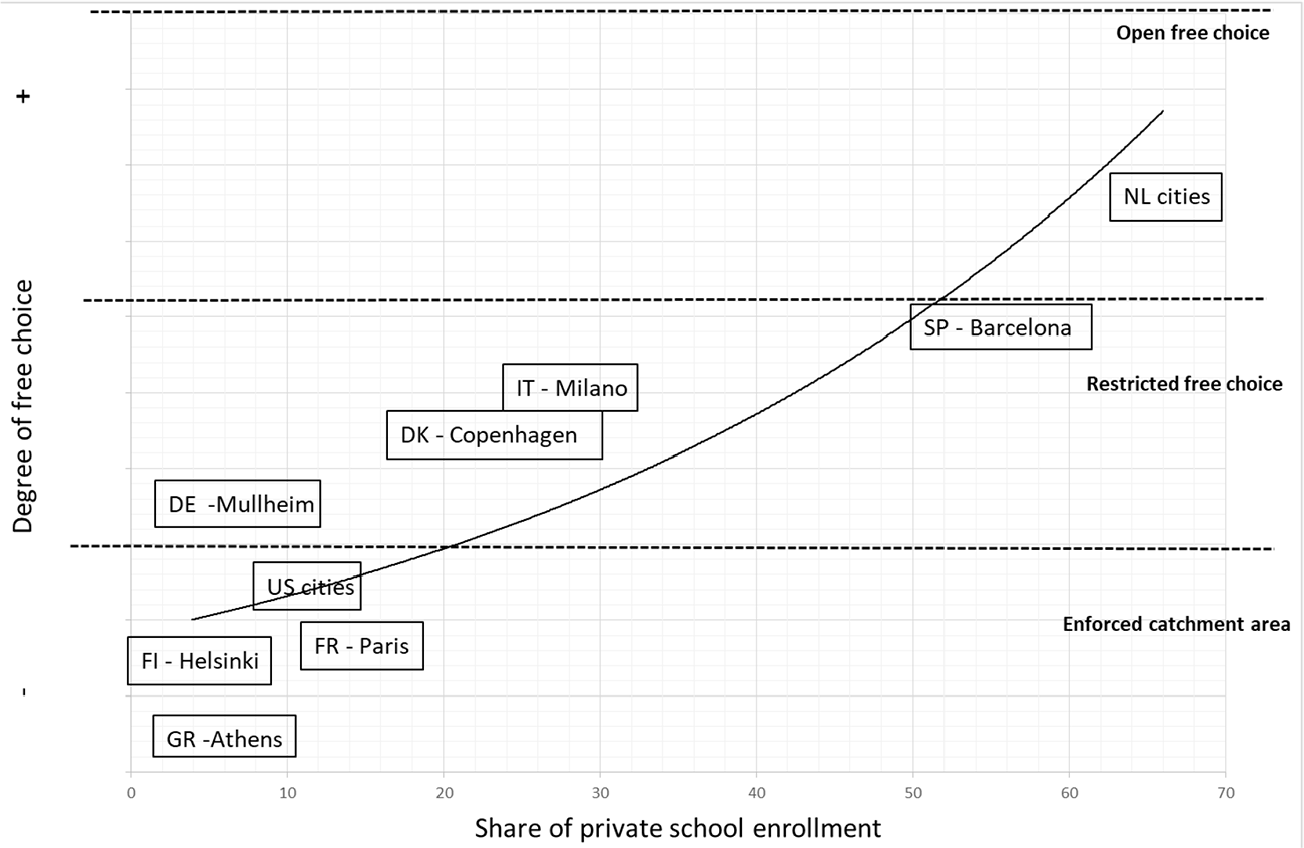
Degree of school choice and weight of private schools in different urban school systems.
In cities where free choice is only allowed under restrictive conditions, private or ‘special’ schools represent the only opt-out strategy from local schools. In France, and in Paris in particular, private schools (also heavily funded by the State) play an important, though limited, role by attracting 14% of total students. In Finland, the very few private schools are fully integrated within the public school system and do not play a relevant role in student sorting. In all the other countries here considered, a split system is dominant and this fact reduces the chance of a large expansion of private schools. In these contexts, characterised by limited school choice and private schools largely only serving the upper strata of society, school segregation tends to mirror residential segregation. This is the case for US cities, for example. Nevertheless, even in these contexts the recent extension of school choice due to the expansion of special schools, such as charter and magnet schools, has contributed to increasing levels of school segregation, even in urban areas characterised by an increasing social or ethnic mix.
In short, similar trends towards the marketisation and privatisation of the school systems have been at work in the last two decades in Europe and the US. Free school choice mechanisms have been introduced, and private schools have gained ground as alternative options to locally-based public schools. These facts, together with increased spatial inequalities, have largely contributed to increasing segregation in schools. Nevertheless, the mechanisms at work have been quite different across countries. The ‘rules of the game’ are indeed different, and the introduction of quasi-market logics has thus followed different path-dependent trajectories. The role of private schools has also been different according to the local/national settings of public–private relationships.
Two main trajectories towards school segregation have been at work:
In countries and cities characterised by open (or lightly restricted) school choice and a relevant role played by state-funded private schools, school segregation has been the result of the pluralisation, marketisation and selective de-territorialisation of the whole integrated (public and private) school system. In these contexts, school segregation is significantly higher than residential segregation (as shown in Table 1) – a result showing how urban educational policies promoting plurality and free choice are strong drivers of socio-spatial segregation even in urban contexts characterised by social mix or low residential segregation.
In countries and cities where school choice is highly restricted (or not allowed) and private schools play a minor role, geographical inequalities still play a crucial part in determining school segregation. School segregation is therefore mainly a mirror of the socio-spatial structure of the cities. In these systems, however, school choice and private schools play a highly selective role in detaching a relatively small, highly privileged part of the student population from the public locally-based system. Though to a lesser extent, school-based segregation mechanisms still play an important role even in these contexts.
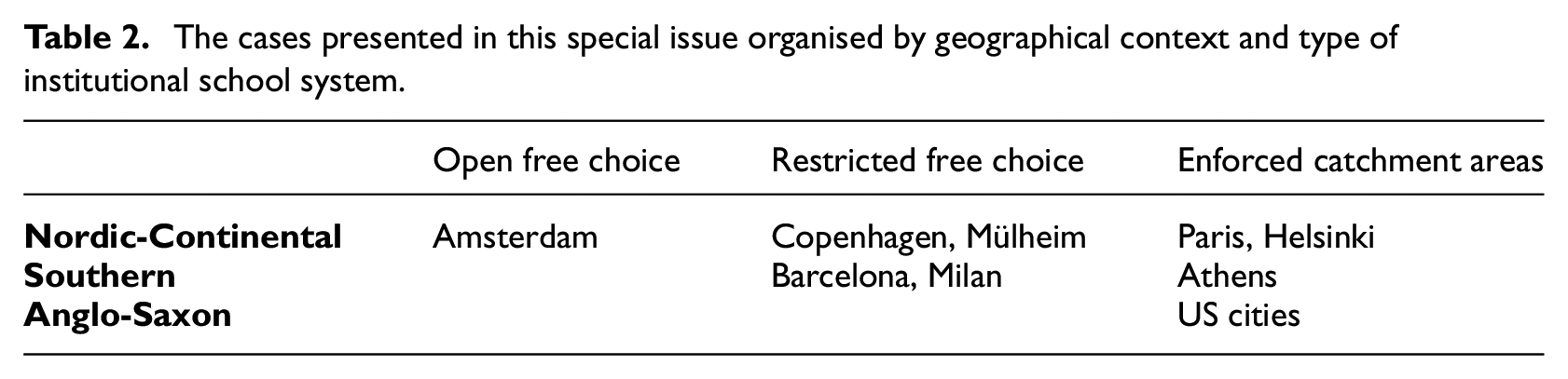
In order to connect the comparative reconstruction of the nexus between school and residential segregation with the analysis of the cases presented in this issue, we summarise the position of our cases along two axes, one that relates to the geographical contexts they belong to, and one that differentiates between three models with regard to the effects on family choice induced by the institutional systems. Table 2 shows how, among the cases in this issue, the presence of (quite) rigid catchment areas is diffused across different types of countries, the restriced free choice characterises a smaller number of cases and the open free choice concerns only Dutch cities.
The cases presented in this special issue organised by geographical context and type of institutional school system.
Conclusion
Urban studies in school segregation have been growing in the last decade as a result of important socio-economic and spatial dynamics reshaping the urban context in which school allocation and school choice take place. In this introduction to the special issue, we have proposed understanding the complex interplay of residential and school segregation in urban localities through the idea of an educational landscape.
Educational landscapes are highly differentiated, as they bring together the historically grown geography of education of a city with the multi-layered institutional context in which it is embedded. Despite the variety of landscapes, there are a number of important organising principles that affect the level and patterns of school segregation, and also their significance for wider educational inequalities. In this contribution, we have proposed a simplified conceptual scheme that may be useful for understanding the complex interplay between residential and school segregation in urban localities. First, based on the empirical results of the collection of articles presented in this special issue, we found that in all the European countries considered, school segregation was higher than residential segregation. While in some countries the differences are small, children with different socio-economic and/or ethnic backgrounds are consistently more separated in schools than in neighbourhoods. Considering the broad range of urban contexts included in this special issue, this attests to the importance of considering segregation from a multi-domain perspective and exploring how these domains are interlinked. As to why segregation in schools is higher, much is related to how the institutional education context interacts with the geography of that locale.
Through the second dimension of our framework, we presented school segregation as a dynamic process developing at the crossroads of spatial and institutional locally shaped processes. In all studied urban contexts, we see a general dynamic towards pluralisation of the educational landscape and de-regulation, in support of freedom of parental choice. We identified two main models through which the relationship between residential and school segregation is structured. In cities where the ‘rules of the game’ strongly support high levels of pluralisation and marketisation of the educational landscape, levels of school segregation are significantly higher than the residential distribution of the population. In cities where school allocation is strongly controlled through a rigid school catchment area system, school segregation tends to reflect most of the residential segregation resulting from the composition of neighbourhoods, from which only the upper social classes opt out, by sending their children to selective and often expensive private schools or, as evidenced in the US, to charter schools. Some of our studies suggest that rigid school catchment systems, however, make school choice a greater part of decisions around residential mobility, leading to stronger residential segregation. Yet in many countries, in the last decade, the rigidity of such systems has been softened by the introduction of more parental choice and greater variation of schools, paving the way for a relaxation of the strong alignment between school and residential systems. This may, as Wilson and Bridge (2019, in this special issue) also revealed with their review article, lead to exacerbation of levels of school segregation, because choice seems to catalyse segregation irrespective of the other dimensions of the educational landscape.
Finally, the articles of this special issue also discussed some of the implications of high and rising levels of school segregation. Segregation is not only a reflection of existing social inequalities in (urban) society, it is also complicit in maintaining social differences. While not having studied peer effects of the school context, the contributions of this special issue also found evidence for the fact that school context and neighbourhood context work simultaneously to produce unequal outcomes for children (Maloutas et al., 2019, in this special issue; Oberti and Savina, 2019, in this special issue). This may be due to the fact that schools in specific areas may be under-resourced, leading to lower performance outcomes than when solely based on a disadvantaged school population (Owens and Candipan, 2019, in this special issue), but it may also be due to the institutional setting provided to private schools and the very geography of where high quality schools are located. The geography and institutional setting of private education in Paris is a good example of this, but also the founding of new charter schools in gentrified areas in US cities is part of a continuously reshaped educational landscape that is providing better opportunities for the better-off, leading to unequal outcomes across class and often also across ethnicity/race.
Footnotes
Declaration of conflicting interests
The author(s) declared no potential conflicts of interest with respect to the research, authorship, and/or publication of this article.
Funding
The author(s) received no financial support for the research, authorship, and/or publication of this article.
