




Abstract
China’s recent environmental turn in urban development has been marked by a rush of urban green projects. Many city governments have lately focused on green infrastructure of a specific kind – the greenway. This article provides a preliminary assessment of the contributions of greenways to a new, environmentally benign form of urbanisation advocated by the central government. Through a case study of the city of Maanshan, it reveals that Chinese greenways are not just a sustainability fix for the economy’s sake, as many urban green projects in China tend to be conceived. Although the greenways are far from being effective in stimulating tourism, they can promote urban liveability beyond the symbolic and lend material support to active travel. These findings endorse an analytical approach that gives equal emphasis to both the physical and political nature of emerging green infrastructure initiatives to more fully appreciate the logics and functions in their ongoing popularity.
Introduction
The city is the strategic scale for the Chinese state to reconcile its steadfast commitment to rapid economic growth with emerging environmental imperatives. Since the 1990s, the central government has ushered in a series of campaigns, policies and regulations to bring environmental concerns to bear upon its cities, whose governments are known for their entrepreneurial nature in the post-reform era (Xu and Chung, 2014). In particular, China’s latest national urbanisation blueprint, the National New-Type Urbanisation Plan (2014–2020) (NNUP), appeals for the full-fledged reorientation of urban development along eco-friendly lines (Central Committee of the Communist Party of China and State Council, 2014). These political pressures for green urbanism have prompted many city governments to make an ‘environmental turn’, instrumentalising environmental care as a core element of their development strategy (Hoffman, 2009).
A remarkable manifestation of this environmental turn has been a boom in urban green projects, the latest example of which being urban green infrastructure of a specific kind – the greenway. Since its debut in the Pearl River Delta (PRD) region in 2010, the idea of greenway development has caught on across China. Government-led greenway planning has been initiated in 31 provincial-level jurisdictions. In 2016, the Ministry of Housing and Urban–Rural Development promulgated the Greenway Planning and Design Guidelines, a sign of central-level recognition of the nationwide popularity of greenways. However, despite its scale and visibility, China’s greenway development has been subject to little research attention. Specifically, why greenways as a planning strategy have enjoyed such a strong currency in recent years among local governments remains a question of debate.
To address this question, this article provides a preliminary assessment of the contributions of greenways to the Chinese state’s aspiration for a ‘new’, environmentally benign form of urbanisation as the NNUP articulates. Our assessment draws on two strands of scholarship on urban green infrastructure, which respectively emphasise the ecological and economic significance of nature to cities. We argue against privileging either of these analytical views to avoid overlooking the potentially wide-ranging purposes of urban green infrastructure initiatives. Whereas existing urban responses to national environmental interventions are found to be distorted by economic ambitions, our case study in the city of Maanshan suggests that greenways fall short of advancing local tourism, but that they do encourage a more liveable environment, both symbolically and materially, while lending support to active travel.
Findings subsequently reported in this article on Maanshan are based on our research on the planning, development and use of greenways in the city. Our research was undertaken in three parts, collecting and triangulating views across the expert–layperson spectrum and from both primary and secondary sources. First, 10 interviews were conducted between 2016 and 2018 with current and former government officers involved in the planning or management of Maanshan’s greenways, as well as with a university professor consulted for the city’s greenway work. Based on their direct engagement with Maanshan’s greenway development processes, our interviewees offer significant insights into how and why greenways were brought to the city, and what impacts greenways have made. Second, as detailed in subsequent sections, field surveys were undertaken in Maanshan in July 2016 to explore how greenways are felt about and used by local urban dwellers. Third, we consulted plans and other directives issued by the governments of Maanshan and Anhui province on greenways, and media reports and scholarship on Maanshan’s economic and environmental progress.
Analysing green infrastructurein the urban context: Moving beyond dualism
In recent years, heightened attention to sustainable development has brought about a renewed emphasis in the public domain on environmental protection and conservation. An expanding squad of scholars, planners and policymakers have rearticulated green spaces in various guises and scales – parks, green roofs, farmland, streams and forests, to name just a few – as constituents of a complex network of ‘green infrastructure’ (Benedict and McMahon, 2006; Sandström, 2002; Wong, 2010). Though not always consistent in their ontological and functional emphasis on the ecological world (Lennon, 2015), attempts to deploy the notion of green infrastructure are united in their aim to place green spaces on a par with roads, utilities and other conventionally conceived infrastructure as physical fundamentals of the continuance and growth of human communities. They epitomise an understanding of green spaces as ‘something that we must have instead of […] something nice to have’ (Walmsley, 2006: 257, emphasis in original), hence as ‘a set of assets that must be actively managed and maintained rather than left entirely to “natural” processes’ (Thomas and Littlewood, 2010: 210).
Drawing on a range of scientific evidence and social survey findings, the literature on environmental studies has asserted the diverse array of critical ecological services that green spaces provide to humanity. From a public health perspective, green spaces can promote people’s physical and mental wellbeing (Tzoulas et al., 2007; Wolch et al., 2014). They offer pleasant settings for social interaction and leisure. Their vegetation removes air pollutants and attenuates noise for the surrounding settlements. In the face of climate change, green spaces are critical sites to activate natural mechanisms which mitigate, moderate and counteract the effects. Apart from serving as carbon sinks, they can abate the impacts of extreme climatic episodes (Gill et al., 2007; Mathey et al., 2011). Examples include reducing flooding through intercepting storm runoff and easing discomfort caused by rising temperature through evaporative cooling. According to these ecological assessments, green spaces deserve to be conserved and expanded as a form of infrastructure.
Green infrastructure planning has primarily been advocated in relation to cities (Horwood, 2011; Sandström, 2002), whose high concentration of population creates significant demand for ecological services, but whose entrepreneurial governance model tends to undermine their provision. The latter is rooted in the conventional wisdom that green spaces are costly social amenities which do not deserve high budget priorities (Crompton, 2007). However, as a chorus of critical urban scholars have contended, urban entrepreneurialism is evolving in response to the soaring political-economic salience of the environment, due to escalating pressures for environmental protection from across the state, society and businesses (Hodson and Marvin, 2007; Keil and Whitehead, 2012; While et al., 2004). Many urban growth regimes appear to acknowledge that the environment ‘is becoming a necessary rather than contingent condition’ to sustain economic success (While et al., 2004: 554). In what While et al. (2004) characterised as the institution of an ‘urban sustainability fix’, these regimes have begun selectively incorporating environmental considerations into their agenda to look after the economic growth of their cities, notwithstanding emerging physical or political limits posed by the environment. This insight points to the need to examine urban economic and environmental governance not as separate domains, but in relational terms (Hodson and Marvin, 2007). While environmental issues are increasingly being considered as part of urban economic development, urban growth regimes are increasingly interested in intervening in urban environmental policymaking so that it can be aligned with their interests.
Based upon this theoretical premise, a new strand of inquiry on green infrastructure has emerged in urban studies with a commitment to decipher the economic ambitions underwriting the widespread spearheading of urban green infrastructure initiatives, such as the creation of urban parks (Birge-Liberman, 2017), the restoration of urban streams (Cho, 2010) and the establishment of urban farms (Walker, 2016). It is often revealed that these initiatives serve the purpose of espousing a cleaner, greener image for cities to, inter alia, attract investments from new economy sectors (Gibbs and Krueger, 2007), and add a green premium to real estate development (Xiao et al., 2016). They reflect the development of a symbolic economy associated with the consumption of the aesthetics of urban natures for urban restructuring (Birge-Liberman, 2017: 133). Pushing this line of argument further, some studies have questioned whether urban green infrastructure rooted in economic objectives can contribute to as much urban socio-environmental betterment as its green appearance might suggest to urban dwellers. Two examples of concerns are how spatially concentrated investment in urban green spaces may serve as a strategy to promote gentrification in particular urban sites (Birge-Liberman, 2017), and how urban ecosystems restored in the name of promoting sustainability may only result in another metabolic rift (Cho, 2010). In these cases, urban green spaces perform as infrastructure of a different kind, whose primary function is to sustain capital accumulation in the city.
As the above review shows, both environmental studies and critical urban studies have yielded considerable insights around the significance of green infrastructure to the city. Whereas the former appraises green spaces as physical spaces which hold the promise of a myriad ecological services, the latter interrogates them as political spaces where entrepreneurial ambitions find new expression in ostensibly environmentally more sustainable forms. However, thus far, there are few attempts to cross the analytical boundaries between these two strands of scholarship. Insofar as both the physical and political emphases on urban green spaces have a degree of truth, privileging one of them ‘risks essentialising [these spaces’] multiple functions, rationalities and meanings’ (McClintock, 2014: 157). To avoid running into an analytically disabling dualism, inquiries of urban green infrastructure initiatives would benefit from keeping an analytically open mind to recognise potential overlaps – hopefully synergistic ones – between these two categories of spaces.
China’s new urbanisation blueprint and environmental turn
Although pictures of smoggy skylines tend to suggest otherwise, China’s central government is increasingly concerned about reducing the environmental costs of the country’s ‘economic miracle’, as pollution becomes an economic barrier and a source of social unrest. The national leader’s willingness to avert an environmental collapse has become apparent, from the endorsement of sustainable development as a national strategy in the 1990s, to the prevailing doctrine of building an ‘ecological civilisation’ which pitches that ‘lucid waters and lush mountains are as valuable as gold and silver’ (Xinhua, 2017). These normative promises have been translated into various regulatory initiatives to insert environmental rationalities into the country’s devolved city governments, from rewarding environmentally outstanding cities with model city titles, to imposing environmental prerequisites upon local planning discretion (Xu and Chung, 2014).
In this regard, the NNUP has reinforced the central state’s commitment to fostering greener patterns of urban development. Promulgated by the National Development and Reform Commission in 2014, the plan aims to raise the proportion of China’s de facto urban population from 52.6% in 2012 to 60% by 2020 to stimulate domestic demand and enhance social wellbeing (Chapter 1), whilst urbanisation becomes more eco-friendly to achieve a higher level of urban sustainability. It enshrines ‘fully integrating the idea of ecological civilisation into urbanisation processes’ as one of China’s key principles of urbanisation (Chapter 4). In its proposal for a ‘new-type city building’, the plan articulates the ideal of the ‘green city’, which necessitates cities that ‘establish green forms of production, living and consumption’ (Chapter 18). Six key points of green city building are proposed, which are: increasing the production and use of sustainable energy; expanding the implementation of green building standards; popularising green transport modes; optimising the circular use of resources; reinforcing efforts in pollution control and nature conservation; and promoting green lifestyles with regards to everyday living and recreation (Central Committee of the Communist Party of China and State Council, 2014).
These carrots and sticks over the years have encouraged an incipient ‘environmental turn’ in Chinese cities, whose leaders have become active in articulating their growth agenda incorporating environmentalism through urban projects with stated green purposes (Hoffman, 2009). However, many of these projects have been criticised as being greenwashing vehicles. It has been noted that eco-cities in China are often built from scratch as a sustainability fix to ‘imagineer’ urban competitiveness (Pow and Neo, 2013). The prohibitive cost of buying a home in these eco-cities has led them to be identified as ecological enclaves for the rich (Caprotti et al., 2015). Another example is the growing number of new parks in Chinese cities designed with a focus on projecting a visual, observable green image to global investors, ‘with [local] people being treated as spectators not as users of the spaces’ (Yu and Padua, 2007: 63; see also Miao, 2011). These findings tend to suggest that if China’s urban entrepreneurialism is ‘greening’, it is driven by an imperative to mobilise the environment as a force for economic transformation, rather than to bring environmental benefits to the public.
Greenways, the focus of this article, represent the latest addition to the repertoire of green projects in urban China. A well-known form of green infrastructure in the transatlantic context, greenways have only attracted critical attention in China’s planning community since circa 2000. They refer to ‘a natural, green way based on protected linear corridors which will improve environmental quality and provide for outdoor recreation’ (Little, 1990: 3). In the Chinese context, the idea is implemented as networks of linear green spaces with footpaths and/or cycleways surrounded by trees, streams and other ecological elements, often traversing urban and rural areas. The highly positive public responses to the pilot development of greenways in the PRD since 2010 has encouraged them to be replicated across the nation. This leads us to ask: Are greenways just another vehicle for local governments to valorise through eco-aesthetics, or indeed a benign intervention for the environment and people where they are developed?
It would be unfair to claim that no studies have ever sought to analyse China’s recent interest in greenways, but these studies leave two research gaps for this article to address. First, existing studies tend to focus on the techno-physical optimisation of greenway planning and design (Liu K, et al., 2016; Liu X, et al., 2018), to the neglect of reasons behind the rise of greenways as an important part of recent Chinese urban transformation. An exception is Chung et al. (2018), who reveal that greenways in the PRD are embedded within the region’s political-economic dynamics. First, based upon residual urban land and rural ecological amenities, greenways were developed to meet urbanites’ green space demands without consuming the limited land quota cherished by city governments for urban development. Second, under the provincial leaders tight work schedule, some rural greenways were rerouted to circumvent delays in completion due to difficulties in land acquisition, at the cost of covering fewer areas of high environmental value. These findings demonstrate that political-economic factors do affect how and why greenways are developed, and therefore should not be excluded from a contextually situated analysis of what greenways can deliver.
Second, echoing the broader trend of urban studies in China, there is a tendency for existing greenway studies to focus on the country’s most developed cities (e.g. Guangzhou and Shenzhen), which are either commerce-centric or functionally diversified (cf. Liu, 2006). In contrast, these studies have yet to cover the economic latecomers, many of which are ‘resource-based cities’ (ziyuan xing chengshi, or RCs) whose economy pivots around the extraction and processing of local resources. According to the Chinese State Council’s (2013) National Plan for Sustainable Development of Resource-Based Cities (2013–2020) (NPSDRC), 114 (40.6%) of the 286 prefecture-level cities in China are RCs. These cities ‘are faced with multiple economic, social and environmental problems, including resource depletion, unbalanced industrial structure, weak extended and substitute industry, unsatisfactory social welfare, unemployment and poverty, and pollution together with land degradation and subsidence’ (He et al., 2017: 76). As the NPSDRC’s promulgation highlights the central government’s concerns about the future of these RCs, recent studies have attended to how attempts to resuscitate the economy of these cities do not come at further costs to their people and environment (He et al., 2017; Yu et al., 2016).
To address both research gaps, this article pursues a case study in order to understand the motivations and implications of greenway making in Maanshan, an RC known for being the national hub of iron and steel manufacturing. This permits an assessment of greenways’ contributions to urban transformation, with an equal emphasis on both economic and environmental aspects in the specific context of China’s RCs.
Maanshan and its greenways: Where provincial obligations meet local aspirations
Identified in the NPSDRC as an RC which has undergone regeneration, Maanshan is a prefecture-level city in the eastern province of Anhui (Figure 1). Its government oversees a territory of 4049 km2, covering three urban districts and three predominantly rural counties. Its urban development is concentrated in Huashan and Yushan districts, with a combined area of 353 km2, including 95 km2 of built-up area forming the central city (zhongxin chengqu). With rich iron ore resources, the city was born in the 1950s under the then national directive to develop the iron and steel industries. As with many other RCs, Maanshan is depleting its strategic endowments, which puts its economy, dominated by the iron and steel sector, at great risk.
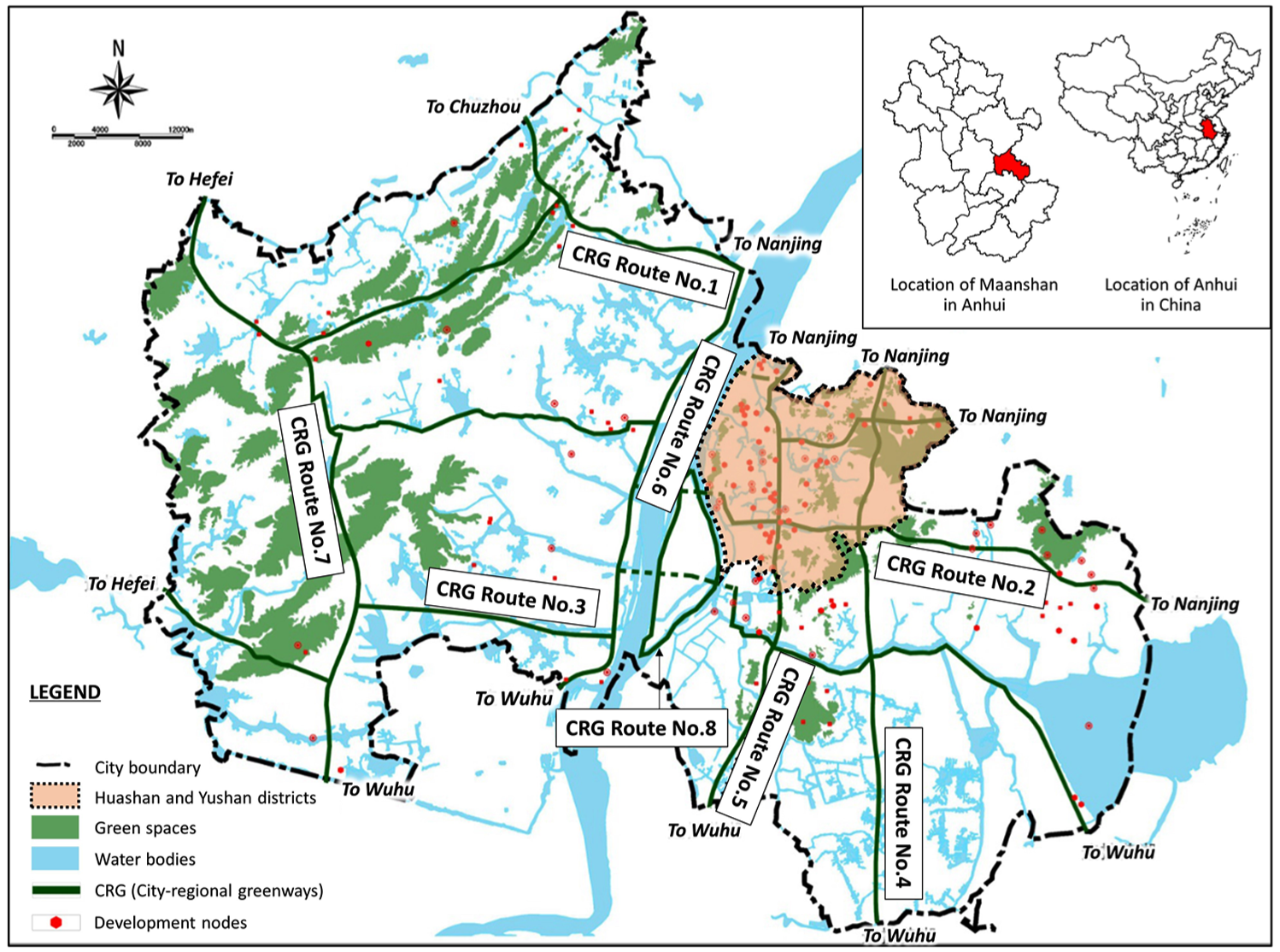
Location of Maanshan and its main greenways.
The Maanshan government has responded in recent years by promoting a more diversified economic structure. In Maanshan’s 2002 master plan, the city’s longstanding positioning as an iron and steel production hub was replaced by its development into ‘a base of processing and manufacturing industries’ and ‘a riverine garden city for tourism’ for the middle and lower reaches of the Yangtze River (Yin et al., 2010: 331). The recent national policy on reducing steel production capacity has made this tourism shift all the more important (interview, Maanshan Landscaping Administration (MLA) officer, October 2017).
The success of Maanshan’s economic transformation hinges very much on its environmental transformation, which involves mitigating pollution and the associated negative image brought by the scattering of heavy industries in the city. This is for two reasons. First, a clean environment is a prerequisite for many new secondary industries, which the city government seeks to promote, including biomedical production and advanced materials manufacturing. Second, the tertiarisation of the city, through the development of tourism, real estate and other service sectors, requires an attractive landscape and high liveability, which demand new ways to mobilise and enhance Maanshan’s environmental advantages. Thanks to the city government’s commitment since the 1990s, Maanshan has been, despite its industrial legacy, very successful in building up its environmental competitiveness. The city is one of the first in the country to be designated a National Garden City (in 1996) for remarkable improvement in urban greenery, and official efforts in pollution control have earned the city the title of National Model City for Environmental Protection (in 2006).
Greenway development was added to the toolbox of Maanshan’s environmental city-building strategy in 2012. Rather than a municipal initiative, it was a provincially-imposed requirement. Attracted by the widespread praise of Guangdong’s greenway project, the Anhui government saw greenways as a means to make Anhui an ‘ecologically strong province’ (shengtai qiang sheng), thereby chiming with the central government’s growing ecological rhetoric (interview, university professor, June 2018). It proposed to develop a province-wide greenway system and cascaded the pertinent responsibilities to the city governments through a system of territorialised targets, including an annual addition in greenway length, and a monthly progress assessment (interview, MLA officer, June 2018).
To meet its political mission, the Maanshan government has assumed a proactive role in developing greenways in its jurisdiction. The Maanshan Urban and Rural Planning Bureau (MURPB) oversaw the planning of greenways. It commissioned the Anhui Urban & Rural Planning and Design Institute (AURPDI) to prepare the Maanshan Greenway Master Plan (MGMP). Released in 2013, the plan sets out eight ‘city-regional greenways’ (shiyu lüdao) threading across urban and rural parts of Maanshan for 549 km. These are supplemented by multiple ‘city greenways’ (chengshi lüdao) serving the needs of particular neighbourhoods. On the other hand, MLA takes charge of greenway implementation, including having a direct role in managing and maintaining greenways. As of 2017, over 250 km of greenways have been established in multiple sections. For the convenience of discussion, we shall refer to these different sections of greenways by their locations, as either rural greenways in the countryside or urban greenways in the city centre.
Though stemming from provincial mandates, Maanshan’s greenway development is also informed by the aspirations of its government, which has considerable discretion on where and how greenways are developed. As the next section examines, the Maanshan government has sought to instrumentalise greenways to meet three of its own goals of urban reinvention: stimulating tourism, boosting liveability and supporting active travel. The result, we argue, is a greenway system which not only seeks to extract value from the environment, but which also materially contributes to better environmental qualities that benefit its urban masses.
Maanshan’s greenways in use: Greening not just for the economy’s sake
Greenway as a weak stimulus to tourism
Positioning Maanshan as a tourism city, the Maanshan government has made tourism promotion a key objective of greenway development, particularly through its eight city-regional greenways. According to the MGMP (AURPDI, 2013: 10–11), these greenways serve to connect and improve accessibility to over 180 natural and cultural sights scattered across nine spatial concentrations of tourism resources, mostly located in Maanshan’s rural hinterland. Therefore, geographically speaking, greenway tourism is a form of rural tourism facilitated by rural greenways. For greater appeal, each route is branded with respect to its predominant features: three of them underscore the heritage sites they reach, four are distinguished by natural features and one is named as ‘health promoting’ (yangsheng) for its hot spring destination.
Echoing the expanding scope of the geographical scholarship on tourism (Boniface et al., 2016), ‘tourism’ in Maanshan officials’ minds assumes a broader meaning to cover spatially and temporally shorter visits which used to be identified as recreational pursuits. Besides luring in visitors, officials’ aspirations were also that greenways could boost what they called ‘suburban tourism’ (jinjiao lüyou), in which Maanshan’s urban residents would use greenways to explore the beauty of their rural hinterland (interview, MLO officer, June 2018). In the MGMP’s words, to become ‘Maanshan’s tourism brand’, greenways should not only ‘attract the outsiders’ (duiwai xiying), but also ‘stimulate [demand among] the insiders’ (duinei ladong) (AURPDI, 2013: 10). Four city-regional greenways (routes 1, 2, 4 and 5) serve the latter purpose as they extend from the central city into the rural areas.
Despite this thoughtful plan, Maanshan greenways only function as a limited stimulus to tourism. For local tourism, although rural sections of the city-regional greenways are increasingly popular among Maanshan’s urban dwellers, the public visibility of rural features along them has experienced little improvement. This is because the popularity of these rural greenways does not stem entirely from their own merit but also from their proximity to established attractions in rural areas. Contrary to the official vision, few of Maanshan’s urban dwellers follow rural greenways as tourism routes to explore the countryside. Instead, it is more common for them to visit sections of greenways that are contiguous to major rural attractions, where their interest primarily lies (interview, university professor, June 2018). They would drive or take public transport from the central city to visit one of these attractions and take the chance to spend some time in its nearby greenway as a complementary feature. In this sense, the development of greenways in the countryside has at best added to the strength of rural attractions already well-known to Maanshan’s urban residents. The same pattern can be said for inbound tourism, for which greenways have yet to constitute distinct attractions on their own and therefore have ‘no significant effect’ on the sector (interview, former MURPB officer, October 2018).
This notwithstanding, a Maanshan Culture and Tourism Commission official (interview, October 2018) argued that greenways should be valued as infrastructure lending support to cycling tourism, in which cycling forms a crucial part of the holiday experience. Without denying this potential, we are cautious about the difficulties for this sector to make a significant contribution to Maanshan’s tourism economy in the near future. Apart from the niche nature of long-distance cycling, the truncation of rural greenways constitutes another barrier, and this is for two main reasons. The first one is about land. In China, while urban land is owned by the state, rural land is owned by village collectives, with land use rights fragmented among villagers. Similar to the PRD experience (Chung et al., 2018), it takes time for the government to negotiate the land for the greenways in the countryside (interview, university professor, June 2018). The second reason is about funding. Between 2013 and 2016, the Maanshan government spent CNY 31.12 million on developing 136 km of greenways in its central city (interview, MLA officer, June 2018). On this basis, the average cost of the city’s greenways can be estimated at around CNY 228,000/km – an amount that is financially rather modest. However, since greenways came as an unanticipated provincial requirement, the Maanshan government had a limited budget to implement its extensive plan in one go (interview, MLA officer, July 2016). This was aggravated by the arrangement that, except for an annual provincial subsidy of CNY 200,000, the Maanshan government has had to bear all the costs for greenway development.
Greenways as an effective vehicle for liveability
Maanshan’s greenway planning also embodies the city government’s desire to project a green city image. As the MGMP elaborates, greenways are planned according to the principle of ‘connecting mountains and waters; blending nature and city’ (AURPDI, 2013: 9). Besides boosting tourism, the joining up of various natural features through greenways serves to ‘highlight Maanshan’s unique charm’ (AURPDI, 2013: 9) in environmental terms.
With 531 valid responses (out of 652), our exploratory street-intercept survey in various parts of Maanshan’s central city in July 2016, which gauged local urbanites’ perceptions and use patterns of greenways, suggests that the greenways live up to the government’s expectations. Among the respondents, the presence of greenways in Maanshan was widely recognised, a prerequisite for this new green infrastructure to realise its city imaging role. Asked at the beginning of the survey about how familiar they were with the city’s greenways, 72.6% of the respondents indicated that they had either used or noticed them. The remainder were able to recall their encounters with greenways upon receiving a brief introduction of greenway development in their city. This widespread recognition can be confirmed as a positive one because an overwhelming share of respondents were satisfied with the greenery and the surrounding environments of greenways (Table 1).
Attitudes towards greenways.
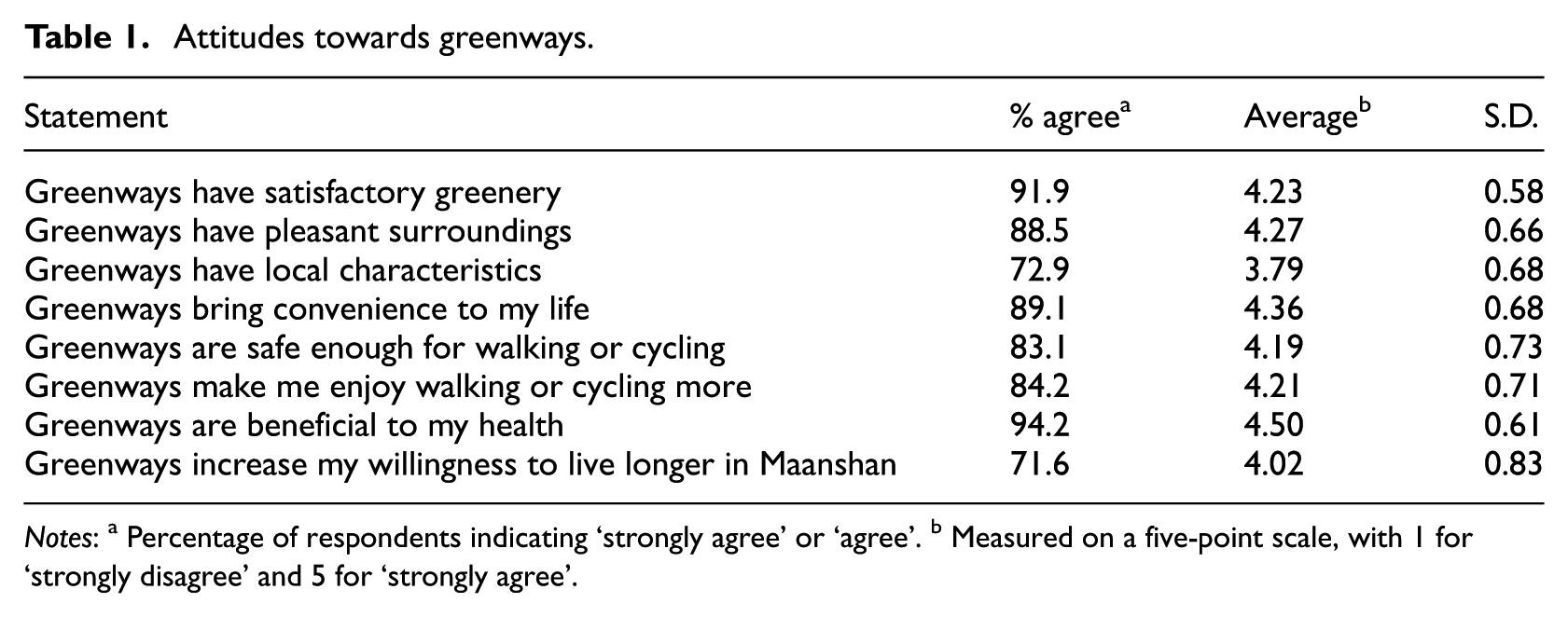
Notes: a Percentage of respondents indicating ‘strongly agree’ or ‘agree’. b Measured on a five-point scale, with 1 for ‘strongly disagree’ and 5 for ‘strongly agree’.
Given indications of greenways performing well for city imaging, it is tempting to conclude that greenways in Maanshan are just window-dressing landscapes. This is, however, not true. In terms of objectives, the Maanshan government explained that greenways should be not only a poster child for environmental improvement, but a vehicle to deliver ‘a high-quality life’ through facilitating people ‘to be integrated with nature, to get close to nature’ (AURPDI, 2013: 9). Apart from being landscape corridors, greenways on their own merits are linear open spaces supporting a variety of ‘distinctive, attractive activities’ to ‘effectively raise the liveability’ of all people (AURPDI, 2013: 29). In terms of effects, Maanshan’s urbanites do actively use greenways (Table 2) – 28.8% of our survey respondents used greenways once a day or more frequently, and a comparable share used them between once and six times a week. Only about one in seven of them used greenways less than once per month or never used them. This high level of patronage, it should be noted, is geographically uneven. A third of our respondents never visited any section of rural greenways, while almost two-fifths of them visited one. These numbers corroborate the aforementioned finding on the circumscribed role of rural greenways in encouraging rural tourism. In contrast, over two-fifths of the respondents visited four or more sections of urban greenways.
Use of greenways.
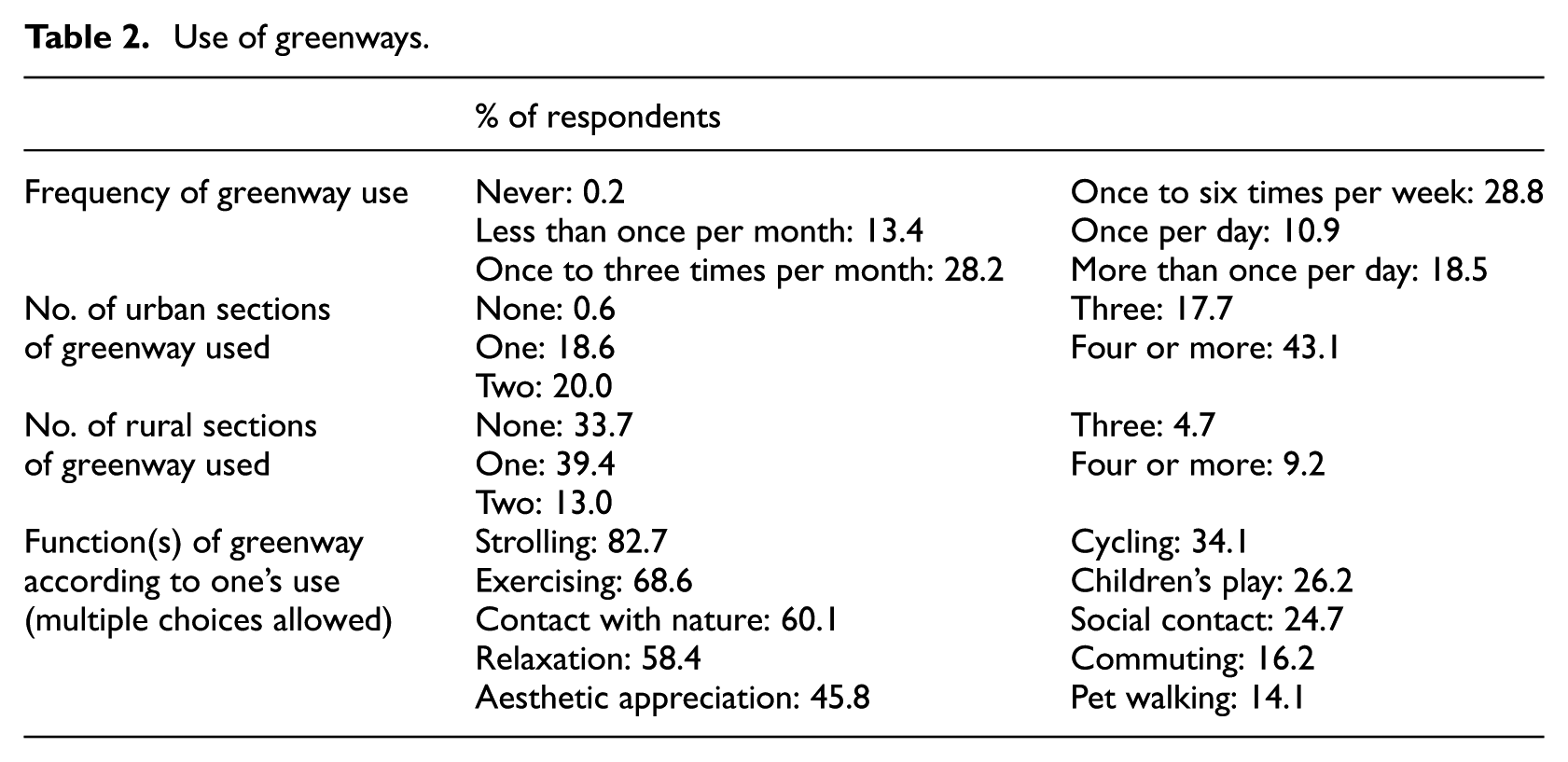
Two factors explain the popularity of urban greenways. First, compared with rural ones, urban greenways are obviously closer to where urban dwellers live and more accessible to them for frequent patronage. Second, compared with other forms of urban green amenities, urban greenways contribute to Maanshan’s urban liveability differently. As a National Garden City, Maanshan is not short of green spaces. According to its last city master plan prior to the greenway initiative (Maanshan City Government, 2009: 54), its per capita urban green space for central city residents (11.54 m2 in 2008) was well above the national planning standard (9 m2). Nonetheless, as an MLA officer (interview, October 2017) pointed out, the development of greenways has further significance as they are aligned to join up Maanshan’s existing urban green spaces to ‘achieve a more complete green space system’. They will make it therefore easier for urbanites to move between green spaces. More importantly, existing urban green spaces and greenways meet different recreational needs. The former, such as parks and gardens, are primarily designed for passive leisure (such as taking a rest), whereas the latter encourage active leisure as ‘ways’ leading people from one point to another. As our survey reflects (Table 2), strolling (82.7%) and exercising (68.7%) were the most frequently identified purposes for greenway visits. These practical benefits of urban greenways explain why as many as 71.6% of our survey respondents agreed that greenways increased their willingness to live in Maanshan.
Greenways as a strong stimulus for active travel
Another form of more-than-economic contribution of Maanshan’s greenways is through the promotion of active travel, that is, forms of moving around which rely significantly on people’s physical activity, such as walking and cycling. Coinciding with growing domestic attention to sustainable transport, Chinese greenways are commonly developed in urban areas with an emphasis on their function as transport routes. Many greenway projects involve the renovation of pavements and expansion of cycling infrastructure. This is within the context that greenways are sometimes synonymously known among Chinese as ‘slow-moving systems’ (manxin xitong), vis-a-vis the presumably faster motorised transport systems.
Maanshan’s greenway system is exemplary of the trend to use greenways as part of the wider transport infrastructure. Its urban greenways are designed as ‘a walking and cycling system on a human scale’ (AURPDI, 2013: 15) which enjoys good connections with public transport hubs for intermodal transfer (AURPDI, 2013: 27). Moreover, the Maanshan government invested in the construction of a greenway-based cycle hire system, now run by a private company, to promote cycling. This focus on active travel was partly imposed by the provincial planning authority, whose greenway design guidelines meticulously prescribed the width and slope of footpaths and cycleways to be created as part of the local greenway system. Nevertheless, the translation of these standards into reality was only made possible by municipal leaders, who were interested in using greenways to help meet Maanshan’s transport needs. Perplexed by the city’s limited and congested longitudinal and latitudinal thoroughfares, the leaders hoped that ‘the rich greenway network can improve urban walkability, promote and encourage people to [adopt] green travel, and further relieve congestion and pollution in the city’ (interview, MURPB officer, August 2016).
The greenways have thus far not let Maanshan’s leaders down as a stimulus for active travel. The vast majority (84.2%) of our survey respondents affirmed that the greenways have stimulated their interests in walking or cycling (Table 1). Informants attributed such encouragement to two factors. First, with better pavements and clearer directional signage, greenways provide a safe and encouraging environment to walk or cycle (interview, university professor, June 2018). Second, the intermingling of greenway development as an urban greening initiative and the expansion of cycling infrastructure has helped to ensure the environmental appeal of cycling experiences, making cycling more attractive to non-cyclists (interview, MLA officer, October 2017).
Both commuting and non-commuting trips involving active travel are supported by Maanshan’s urban greenways, as revealed by differences in weekday and weekend patterns of greenway use in two urban greenways, Circum-Yushan Lake Greenway (CYLG) and Jiashan Circum-Hill Greenway (JCHG) (Figure 2). These are among the earliest developed greenways in Maanshan, and their use patterns can demonstrate how greenways have become an established part of the city. Data was collected through manual enumeration on two working days and two weekend days in July 2016 at one of their main entrance points.
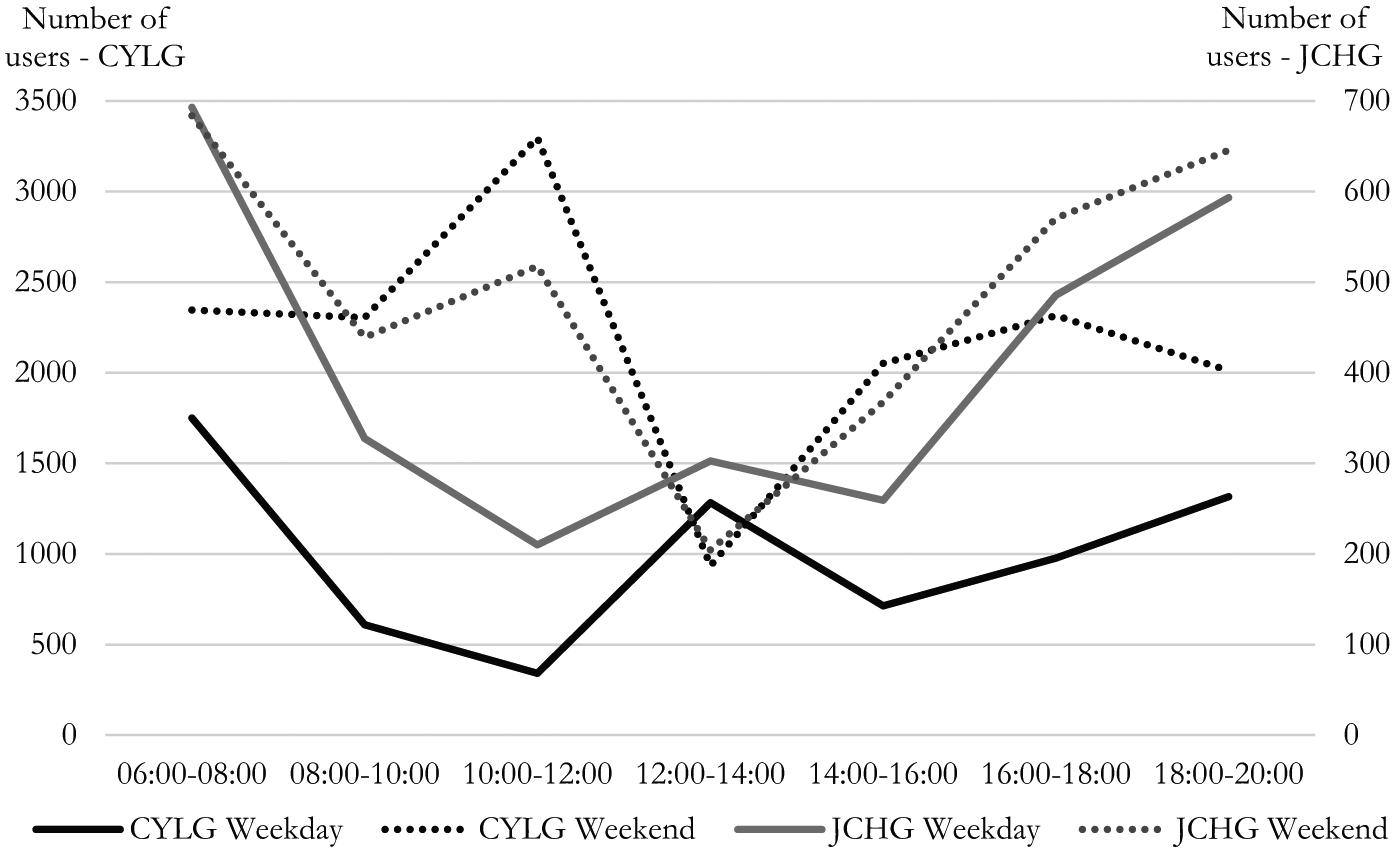
Observed level of use of CYLG and JCHG.
On weekdays, the diurnal variation in use level on both greenways exhibits a W-shaped pattern, with two primary peaks at early morning (06:00–08:00) and early evening (18:00–20:00), and a secondary peak during the early afternoon (12:00–14:00). As we observed during the enumeration process, the two primary peaks were due to the use by both commuters and exercisers, but the secondary peak was overwhelmingly attributable to commuters. This is made possible by two factors in Maanshan. First, it is common for work units in China to offer long lunchtime breaks lasting for two hours or more to allow employees to return home for lunch and a nap. Second, like other less developed Chinese cities, Maanshan has a compact urban core, so its residents can commute back home during their lunchtime either by walking or cycling. Note that since commuters tend not to stop by to participate in the survey, commuting was only reported by a small share of respondents (16.2%) as an activity supported by greenways (Table 2).
As for the weekends, we observed that users were predominantly recreationalists. Despite the loss of commuters, user headcounts exceeded weekday levels for most of the time, compensated by those who only have time during weekends for outdoor leisure. The average numbers of users on a weekend day for CYLG and JCHG are 15,261 and 3429; 2.1 and 1.2 times those of their respective weekday levels. The surge in the level of use was especially obvious along CYLG, given its connection to a number of major open spaces, including a zoo and an amusement park, which helped pull in more users. Interestingly, the early afternoon period, during which the secondary weekday peak was registered, exhibited a notable exception to the weekend boom. The level of use during that period not only dropped below the weekday level on both greenways, but in fact reached the lowest level of the weekend. An explanation for this is that, since our survey was done in summer, recreational users would stay indoors during the early afternoon to avoid the most direct sunlight of the day.
Conclusion: Where does greenway lead us to?
Existing scholarship on urban green infrastructure is characterised by two analytically distinctive bodies of work. One of them, often based on scientific investigations, celebrates the ecological services of urban green infrastructure to advocate for its expansion. Another of them, steered by critical urban scholars, is wary of the instrumentalisation of urban green infrastructure by economic interests as a sustainability fix. This article contends that the two views should not be seen as mutually exclusive when we attempt to assess the contributions of an urban green infrastructure initiative – it may perform simultaneously as a strategy for green city marketing and an intervention for real progress in the quality of living and the environment. We argue that this is precisely the case for greenways– a form of green infrastructure which has blossomed across Chinese cities in recent years– with our investigation of the planning and actual usage of greenways in the city of Maanshan.
On one hand, greenway development is situated within the economic restructuring of China’s troubled RCs, one of which is Maanshan. The Maanshan government has assimilated greenways, whose development was mandated by the provincial government, into its toolkit of economic diversification. It values the function of greenways in re-imaging Maanshan from a steel city plagued by pollution to a green and clean city attractive to investments related to new secondary industries and the tertiary sector. It also envisions greenways as an instrument to pair Maanshan’s economy and the environment through stimulating the development of local tourism. As our survey indicates, greenways succeed in giving Maanshan a green facelift. The majority of respondents rated favourably the greenways as a source of greenery and expressed a stronger willingness to live longer in Maanshan due to the creation of greenways. However, the intention for greenways to boost tourism, which resonates with the NNUP’s appeal for a green lifestyle and consumption, has not materialised for the moment. Disconnection among established greenways and inadequate publicity have prevented greenways from drawing urban dwellers into rural areas, where attractive natural and cultural features are in abundance. Since Maanshan’s greenway system was still being expanded during our research, the jury is still out on how likely it will be to unleash the tourism potential of Maanshan’s countryside, with respect to both the city’s residents and visitors from outside the city.
On the other hand, greenways deserve to be identified as green infrastructure with respect to their contributions to Maanshan as a more liveable and sustainable city. The fact that greenways serve as a means to mobilise the symbolic power of the environment for Maanshan’s economy has not prevented them from also effectively promoting material socio-natural improvements. First, greenways raise Maanshan’s urban liveability in terms of satisfying local people’s demand for more outdoor recreational amenities. They have been used for various purposes, from strolling and exercising, to getting in touch with nature. Almost 60% of the respondents visit the city’s greenways once a week or more frequently, which is vivid evidence that greenways are not mere embellishments. Second, greenways help usher Maanshan’s people into a less polluting way of getting around their city, another objective which the NNUP sets out for its green city vision. Over four-fifths of respondents agreed that greenways offer a safe and enjoyable setting for active travel, including walking and cycling. Since Maanshan is a medium-sized city where people live and work in close proximity, greenways offer a favourable means for non-motorised commuting, which is confirmed by the peak use level of the two city centre greenways at rush hours and lunchtime.
The perceptions and actions of greenway users in Maanshan lead us to conclude that greenways cannot be reduced to an apparatus for urban economic reinvention per se but should be duly acknowledged as a strategy to strengthen urban liveability and environmental sustainability. For RCs searching for their way into the era of ecological civilisation, greenways demonstrate the potential to be a win-win eco-spatial intervention that concomitantly adds to a city’s environmental appeal and green amenities – but, of course, only if they are planned with both goals in mind. We are not suggesting that greenways are opening up a bold new horizon for China’s urbanisation, or that the development of Chinese cities is being orientated to a strong sustainability approach. After all, greenway developments are only one of the many urban green projects of varying degrees of commitment to sustainability which Chinese city governments have pursued. However, by clarifying the potential environmental contributions of greenways across the symbolic–material spectrum, we propose that the ongoing environmental turn in urban China is perhaps not as pessimistic as the literature has tended to portray it. An analytical approach that gives equal emphasis to both the physical and political nature of urban green spaces, such as our study on Maanshan’s greenways has adopted, is required to more fully appreciate the logics, functions and outcomes of the amenity of green infrastructure initiatives we are witnessing today.
Footnotes
Declaration of conflicting interests
The author(s) declared no potential conflicts of interest with respect to the research, authorship, and/or publication of this article.
Funding
The author(s) disclosed receipt of the following financial support for the research, authorship, and/or publication of this article: The research was supported by two grants from the British Academy (SG163119) and the UK Economic and Social Research Council (ESRC) (ES/P003435/1). We are also grateful for the support of the journal’s editorial team and the constructive comments from three anonymous referees.