




Abstract
Modern infrastructure systems serve to separate urban flows of water, sewage, waste and energy. However, ideas concerning the combination of these flows to achieve resource efficiency have shaped Hanoi’s urban planning since the colonial era. Today, dominant visions of the generation of energy from waste have led to a redefinition of what is ‘waste’ that largely ignores ‘alternative modes of nexusing’, established industries of recycling operating across the city. These industries are intertwined with and overlap provincial waste management and perpetually exist beyond state-led planning and urban–rural boundaries. The case of Hanoi reveals the exclusionary and disruptive potential of predominant visions of the urban nexus, as socio-managerial conceptions obscure and potentially displace alternative modes of nexusing. We argue that opening the view to alternative modes of nexusing as part of heterogeneous infrastructures not only challenges conventional analyses of the urban nexus that exclude marginalised practices and people, but also has important policy implications for waste management and recycling in Hanoi.
Introduction
As technological infrastructures mediate material and energy flows through cities, they shape urban space and life (Coutard and Guy, 2007). In line with modern ideas of functional separation, different infrastructures exist to separate the various urban flows, constituting apparently independent infrastructure ‘domains’. However, in recent years, scientific studies and policies have increasingly emphasised the idea that flows of water, waste, power, money and people are inextricably linked (cf. Hansman et al., 2006; Schnoor, 2011). International organisations project a dramatic increase in the global demand for water, energy and food in upcoming decades. These projections have motivated researchers and policymakers alike to investigate new types of resource efficiency beyond the boundaries of energy, waste, sanitation and water sectors (Beisheim, 2013). ‘Nexus thinking’, the attempt to create ‘resource-efficient cities’, or to produce ‘urban symbioses’ through a re-configuration of urban material and energy flows, has become an important theme in academic circles and among policymakers (Stein et al., 2014). Procedures for the generation of gas from waste are one focus of engineering research on urban nexuses. Technological studies on waste-to-energy nexuses compare, for example, different technological options or focus on the optimisation of material and energy flows within cities (cf. Bieker et al., 2010; Hartmann and Ahring, 2005).
Urban nexuses have also become an increasing concern in social scientific studies (cf. Artioli et al. 2017; Bulkeley et al., 2014). Studies in this field examine the positioning of the urban nexus as a solution for broader socio-environmental challenges. Some authors are critical about studies of ways to reshape current infrastructural arrangements toward urban nexuses, as these tend to provide an overly simplistic perspective on socio-technical systems and change (cf. e.g. Williams et al., 2014). Purely technocratic or managerial approaches to the reconfiguration of urban resource flows may obscure the various, highly place-specific ways in which such flows are embedded in broader socio-spatial relations, practices, and cultures.
With regard to urban resource flows in the South and nexus projects intended to redirect these flows, the heterogeneity of infrastructures mediating these flows is an important feature. Authors note that a diverse and place-specific variety of technologies and practices regularly shape urban service provision and access beyond planning (Jaglin, 2014; Lawhon et al., 2017). While these technologies and practices have a significant influence on the possibilities and potential impacts of nexus projects, current nexus projects and their reception in the literature largely ignore them. Our case of Hanoi reveals that this ignorance is a central shortcoming. As we elaborate below, this is because ignoring the sociotechnical heterogeneity of infrastructures means disregarding the potentially adverse and disrupting impacts, as well as the potential failure of urban nexus projects.
Since its foundation more than 2000 years ago Hanoi has seen changing political regimes – almost a millennium of Chinese rule, the French colonial project, financial and ideological support by the Soviet Union and the current cooperation with international and bilateral agencies (Quang and Kammeier, 2002). These regimes have shaped urban planning and infrastructure provision in particular ways. While planning since the colonial period has pursued modernisation through the installation of uniform large technological systems, the ways in which people access, create and negotiate services in fact incorporate centralised systems, but also reach far beyond them (Schramm and Wright-Contreras, 2017). French engineers were the first in Hanoi to pursue the construction of a ‘sanitary city’ (cf. Melosi, 2000), with large underground sewage networks separating the city’s liquid wastes from public urban spaces and satisfying the colonial elite’s desire for hygiene as well as socio-spatial segregation from the colonial subject. The idea of generating gas from sewage sludge at the end of the 1930s was integral to the colonial project of sanitising Hanoi. Currently, technological research as well as national policy changes suggest a revival of this urban nexus project in Vietnam and Hanoi. Current state policies present a very specific notion of ‘waste’. As we explain below, this notion includes materials that are collected, reused and recycled within established recycling industries operating beyond state control. The current centralised attempt to create waste-to-energy nexuses in Hanoi therefore potentially brings about competition with these industries, rendering it a highly political project in which questions about what is valuable and what is waste, who defines this, and who has access to the materials labelled either way, are at stake.
We argue that the case of Hanoi reveals how precarious predominant visions of the urban nexus are, as techno-managerial conceptions promoted by international policies and inscribed into technologies ignore and potentially displace ‘alternative modes of nexusing’, established practices of recycling and reusing various materials. This article is based on 20 qualitative, semi-structured interviews with entrepreneurs engaging in alternative modes of nexusing, representatives of Hanoi’s environmental company, researchers and staff of international cooperation agencies. We interviewed these actors as experts in their specific fields (cf. Bogner and Menz, 2009). We also carried out in-depth observations as well as qualitative analyses of historic plans, news articles and broadcasting, current technological research, legal documents and scientific studies of Hanoi’s waste sector between 2009 and 2017. We follow Harding’s (1995) concept of ‘strong objectivity’, which contends that any study that aims to understand power structures by analysing those at the margins needs to unveil the positionality of the researcher, as there is no neutral view ‘from nowhere’. Our identity as two woman researchers, one from Europe and one from Vietnam, certainly has affected the outcome of this study, for example as we translated back and forth during interviews. Some nuances always get lost in translation, but we hope to have countered this fact by in-depth conversations about our data. In our analysis of documents, observations and interviews we consider not only the intentions of Hanoi’s centralised nexus projects as present in plans, policies, scientific research and explained in interviews. Rather, we include the manifold practices and views of those excluded from, and yet affected by, this centralised project, those engaging in alternative modes of nexusing, in order to understand its actual effects to date (cf. Glasze and Mattissek, 2009). This approach enables us to show how Hanoi’s centralised nexus projects have since the colonial era rested on a specific narrative, one that promotes the notion of waste being available as a resource for the generation of energy. Importantly, it furthermore enables us to reveal how this is a narrative that continues to be ‘in the making’, inherently contested and contradicted by the perpetuation of alternative modes of nexusing.
Toward alternative modes of nexusing
Ideas relating to the urban nexus concern the integrated analysis, planning or implementation of services beyond sectoral boundaries (Beisheim, 2013). There is no fixed idea of what the urban nexus is, but different disciplines and fields have contributed their perspectives on cross-sectoral analyses of material and energy flows and possibilities for their re-combination. Concerns over the interlinkages between, for example, water and energy supply in cities and their more efficient management have emerged mostly within engineering debates (cf. e.g. Hartmann and Ahring, 2005). However, they have become increasingly subject to scholarly debates within the social sciences and humanities (Artioli et al., 2017). Scholars in these fields recognise that climate change and rapid urbanisation demand approaches to urban resource management beyond conventional sectoral boundaries (Bulkeley et al., 2014). They also critically assess the rather techno-managerial conceptions of the urban nexus as ignoring deeper analyses of political interests, power relations and urbanisation dynamics that shape nexus projects (Williams et al., 2014). An insightful study on the urban governance of the nexus operationalises it as a ‘policy agenda’ that rests upon a certain socially constructed narrative, a ‘causal story’ that links environmental and social issues with the current condition of urban infrastructure provision and the necessity of integrated infrastructure governance (Artioli et al., 2017: 219).
In this article we draw on this operationalisation, focusing on two closely related and overlapping nexuses: the ‘waste-to-energy nexus’ and the ‘organic waste (including human manure)-to-energy nexus’. Although these specific nexuses have, up to now, predominantly featured in engineering debates, they are being discussed more and more in the context of the social sciences (cf. Martin et al., 2015). Waste-to-energy nexuses roughly concern the ways in which the processing of wastes can be used for the generation of energy (Fruergaard et al., 2009). Related technologies, such as waste incineration, are not new and have become an integrated part of urban waste management across the globe (Eriksson et al., 2007).
Another central debate in engineering science concerns a reconfiguration of urban sewage systems toward the separation of human manure from the wastewater stream and its treatment together with solid organic wastes. This shifting of human manure from the realm of ‘wastewater’ to ‘solid waste’ could potentially solve environmental issues related to the transportation of human faeces in water (Martin et al., 2015). It also allows for the generation of gas from the co-fermentation of these organic materials (Bieker et al., 2010). While this particular ‘organic waste (including human manure)-to-energy’ nexus may be rational, it requires fundamental changes to urban infrastructure systems and everyday practices. This is the case because the dominant paradigm for urban sanitation is to provide a large underground sewage system connected to single households via flush toilets (Melosi, 2000). This paradigm has affected urban infrastructure planning and re-constructions, as well as embedded perceptions of hygiene, comfort and modernity across the globe (Gandy, 2004). In many cities of the South, such large underground sewage systems have been part of centralised planning since the colonial era. Still, they rarely cover more than small fractions of urban spaces, while manifold practices in relation to hygiene and the handling of human manure persist (van Vliet et al., 2010). This underlines how difficult it is to change path-dependent sociotechnical systems.
Nevertheless, a large part of the literature on the (organic) waste-to-energy nexus tends to adopt an uncritical perspective on technological change (cf. Stein et al., 2014; Williams et al., 2014). However, infrastructural transformations are contingent on manifold interrelated social, economic, environmental and institutional dynamics and they are shaped by uneven power relations (Hommels, 2005). Dynamics of urban infrastructural change depend on the ‘situated effects of various combinations of actors, techniques and rationalities’ (Coutard and Rutherford, 2016: 2). Therefore, a recognition of place-specific infrastructures adds insights to the potential to implement urban nexus projects that aim to radically change urban infrastructures and their possible implications for urban environmental management and access to services. Focusing on cities of the South, a growing body of literature seeks to understand these place-specific infrastructures (Jaglin, 2014; Lawhon et al., 2017).
A modern ideal of uniform, standardised and centrally regulated infrastructure provision through centralised, city-wide networks has informed urban planning and policymaking across the globe (Coutard and Rutherford, 2016; Graham and Marvin, 2001). Scholars note that the idea of networks providing ‘universal connections’ is a paradox in itself, as networks always simultaneously include and exclude (Graham, 2000). This contradiction inherent in the modern infrastructure ideal is not reduced to, but becomes particularly apparent in, cities of the South (cf. Coutard, 2008; Gandy, 2004). Here, colonial infrastructure planning and policies have adapted the ideal in such a way that it has reinforced sociospatial fragmentation through the exclusive connection of European quarters to centralised networks (Monstadt and Schramm, 2017). Until today, access to services has remained greatly diverse across cities and urban regions. Instead of centralised sociotechnical networks, a range of very dynamic and place-specific technologies and practices have shaped heterogeneous infrastructures within highly uneven power relations (Jaglin, 2014; Lawhon et al., 2017). Scholars show how the multiple technological and economic connections between ‘alternative’ and ‘conventional’ services form a ‘continuum’ instead of being separated from each other (cf. Jaglin, 2014). They also reveal the often complicated entanglements of entrepreneurial service providers with the state. These providers may act outside the law while at the same time being highly involved with state actors and recognised service provision (cf. Ranganathan, 2014). Concerning waste and recycling infrastructures, large technological artefacts such as landfills or incineration plants, as well as simple technologies such as pushcarts and brooms are part of heterogeneous infrastructures. A range of actors do recycling work, from municipal or privatised companies, or small entrepreneurs, to individuals and community groups (cf. Fredericks, 2014; Mitchell, 2009). Within these dynamics of waste management and recycling, the notion of what is waste, that is, material rejected or made redundant, and what is a resource, is by no means fixed, but subject to constant change and highly place-specific negotiations (Gidwani and Reddy, 2011).
We mobilise the literature on heterogeneous infrastructures in cities of the South in order to show how policies and projects aiming to generate energy from waste in Hanoi are based on a mistaken notion of infrastructure being centrally provided, operated and regulated. Drawing on Artioli et al. (2017), we consider the waste-to-energy nexus as a political project, one that promotes change not only of policy, but also of the management of urban services based on certain narratives. Crucially, these narratives gain import as they become inscribed into technological artefacts, such as incineration plants for the generation of energy from waste. Waste-to-energy nexus projects aim to increase resource efficiency through the recycling of materials they position as waste. However, there are, in fact, already numerous ways in which people engage in waste recycling that official planning and provision ignore despite their manifold entanglements with centralised waste management and technologies. In order to draw attention to these variegated practices and their manifold relations with centralised nexus projects, we refer to them as alternative modes of nexusing. We argue that shifting the focus toward various alternative modes of nexusing not only challenges conventional analyses of the urban nexus, but also has implications for policies and planning.
In the next section we discuss changes in planning for waste-to-energy schemes in Hanoi and Vietnam since the colonial period, as well as persistent alternative modes of nexusing. In the third section we analyse the provincial waste and sanitation sectors as well as the thriving recycling industry beyond formal planning, which are at odds with ambitious plans to bring about the centrally regulated generation of energy from solid waste and sewage sludge. We conclude that including alternative modes of nexusing into analyses of urban nexuses instead of focusing solely on centralised nexus projects reveals not only the potentially disruptive effects of such centralised nexus projects. Furthermore, this inclusion has policy implications, as it opens the view to possible contributions by established recycling industries to sustainable urban management and service provision and, at the same time, reveals the highly precarious nature of this work.
Planning for waste-to-energy schemes: Changes over time and persistent alternative modes of nexusing
Planning for biogas from organic wastes and attempts to implement such schemes reflect the history of Hanoi and Vietnam, which has been influenced by external occupations, torn by wars and shaped by changes in the political economy. Raffin employs a postcolonial perspective to explain the complicated impacts of various visions of modernity on Vietnam as a place that is not only postcolonial, but also postsocialist (Raffin, 2008). She explains how ‘hybrid’ modernities have emerged in Vietnam through the ‘assimilation’ and ‘reconceptualisation’ of technologies and practices from the colonial and the socialist projects of modernisation (Raffin, 2008: 334). With regard to urban studies, different authors note how centralised plans and policies have influenced urban space and culture in numerous ways. These plans and policies have, in turn, been inspired by international planning visions since French colonialisation (Chi et al., 2010; Leaf, 1999). Top-down planning has affected place-specific practices of city making, but it has never replaced them. Rather, authors show how the appropriation of modernist planning ideals have contributed to the wide diversity of Hanoi’s urban spaces, where external models and ideas are constantly mixed and adapted within place-specific practices of urbanisation (cf. Parenteau and Thong, 2010; Pédelahore, 1993; Wright, 1991). As almost no literature is available on the role of infrastructure in the diverse projects of modernisation and their place-specific adaptations in Hanoi or Vietnam, these studies provide a useful starting point for an understanding of these dynamics of old and current ideas of waste-to-energy nexuses.
The reuse of sewage sludge: Plans and practice from the late colonial era onwards
Sewage-to-gas schemes already existed in the late French colonial era. Fayet, then Chef des Travaux Municipaux, introduced the city to the idea of generating gas from wastewater sludge as part of his urban sanitation plan ‘les Égouts de Hanoi’ as early as 1939 (Fayet, 1939). In this plan, which was published at the end of the French colonial period, Fayet envisioned the centralised generation of gas through anaerobic sludge digestion and the use of treated sludge as a fertiliser in agriculture (Fayet, 1939: 56–63). Fayet proposed installing a modern, large technological system regulated by the municipality. This system was supposed to replace common practices in the management of human manure in Hanoi (Schramm, 2016). The Fayet plan reflects the desire of the colonial state to control Hanoi’s urban water and waste cycles. The projected sewage-to-gas scheme is one specific articulation of the waste-to-energy nexus that illustrates the aim of colonial planners to formalise not only the costs but also the benefits of the management of these cycles, to make these benefits accessible to state administration, and to extend centralised control over citizens and their behaviour and practices. However, it has not materialised as planned. Soon after the publication of Fayet’s plan, which has deeply influenced the centralised wastewater planning of Hanoi, the idea of generating gas from sewage sludge was dismissed (Bigorgne, 1941; Conseil Municipal, 1939: 11). The exact reasons for this remain unclear, but it is probably rooted in financial considerations.
However, the chief engineer’s assessment that Fayet’s plan would not be implemented any time soon proved to be realistic (Bigorgne, 1941). The end of French colonial rule in 1954 meant that his ideas were off the agenda. In fact, until the end of the American War in 1975, planned urbanisation integrating the development of urban space and large infrastructure systems largely came to a halt in Hanoi, where people evicted from the city to then forested peri-urban settlements and resources were bound up in war and reconstruction activities (Logan, 2000). After the war the Soviet Union supported urban planning in what was then Northern Vietnam and its capital Hanoi. Plans produced at the time were grandiose but implemented in a piecemeal fashion (Chi et al., 2010; Leaf, 1999). People living in and around Hanoi continued to rely on decentralised service provision, including alternative modes of nexusing, such as adapting traditional practices of disposal and reusing organic wastes and, at times, untreated manure in aqua- and agricultures (Parenteau and Thong, 2010). This has been the case even though urban planners have portrayed these practices as disdainful and unworthy of the modern capital city since the colonial era (Schramm, 2016).
The 1986 ‘doi moi’ (renewal) reforms mark the re-insertion of Vietnam into global flows of knowledge, finance and technology. This most recent change to the political economy of Vietnam contributed to rapid urbanisation, economic growth and social stratification (Quang and Kammeier, 2002). It had a deep impact on the lives and culture of Hanoi’s residents (Han and Vu, 2008). The creation of new financing mechanisms, as well as international aid in the wake of ‘doi moi’, have contributed to a rush to construct large-scale infrastructures (Labbé and Musil, 2014; Schramm, 2016). Along with the increased investments in centralised infrastructures, waste-to-energy schemes have re-emerged in research, planning and policy.
Current plans and schemes: The production of ‘biogas’ from solid waste and human manure
In line with new economic possibilities in the wake of ‘doi moi’, the idea to generate gas from waste in Hanoi has again become the subject of debates in research and policy circles. Scientific research mostly discusses the possibilities of generating gas from human manure and organic waste through anaerobic digestion, while current policies tend to focus on the production of gas from incineration, which involves all the waste arriving at the landfill, that is, organic as well as anorganic fractions of waste, but not human manure (Nguyen and Ha-Duong, 2009; Nguyen et al., 2014). Consequently, two interrelated and overlapping waste-to-energy nexuses are prominent in research on the one hand and in policy debates on the other. Scholars justify the search for technological innovations with the need to increase resource efficiency through the generation of ‘green’ energy. This approach has been underlined by relabelling gas from anaerobic digestion as ‘biogas’ (cf. Nguyen et al., 2014: 367).
According to a recent study, the anaerobic digestion of organic wastes could ‘contribute between 2.4 and 4.1% of the electricity demand of Vietnam […]’ (Nguyen et al., 2014: 365). According to a further study, sludge from septic tanks could support the generation of biogas through its co-fermentation with the organic fraction of Hanoi’s household waste (Böhm et al., 2011). The implementation of such technologies would contribute to the goal of the seventh national power development plan, which aims to increase power from renewable energy resources for electrical energy production from 3.5% in 2010 to 6% in 2030 (SRV and the PM, 2011).
Technological research has emphasised the possible gains of different (organic) waste-to-energy schemes in general and for Hanoi in particular. Furthermore, particularly in the past decade, the globally travelling idea of generating renewable energy from urban waste has become formalised in laws, plans and strategies in Vietnam. The Vietnamese power development plan states:
The state will develop policies on investment and tax incentives to develop forms of energy with minimum impact to the environment, contributing to environmental improvement: new and renewable energy; using agricultural waste, forestry waste and urban waste to generate electricity […]. (SRV and the PM, 2011)
A recent decision by the Prime Minister of Vietnam specifies incentives for investment in plants for the generation of electricity from waste, their construction and their connection to Vietnam’s power grid (SRV and the PM, 2014). Other laws and regulations deal with the support of companies providing environmental services, with tariff setting for power purchased from renewable sources, and with the standardisation of respective processes (SRV and MoIT, 2014; SRV and the PM, 2010).
Apart from international pressure and environmental concerns, policymakers, utility companies and local governments in Vietnam are motivated by economic aspects when it comes to considering investment in particular waste-to-energy schemes. As we elaborate below with regards to Hanoi, the government often has direct influence on utility companies. It exerts pressure to recover costs, for example by pursuing potentially profitable schemes such as the recycling of waste, the recovery of gases and their supply to the power grid (Albrecht et al., 2010). Respective projects in urban Vietnam are under negotiation, or are in the design phase, and a number of pilots are taking place. The upgrading and feeding of gases into the national power grid has not yet been realised (Nguyen, 2014).
In short, the re-framing of the generation of gas as a sustainable, resource-efficient solution to current environmental problems that also promises economic gains, reflects international policy discourse. This re-framing is also in line with the insertion of Vietnam into a global market economy and the related aim to operate urban utilities on a cost recovery basis. Seeing waste as a resource in explicitly economic terms goes hand in hand with the sectoral dis/integration of the current attempt to generate biogas from wastes. While the energy and solid waste sectors are central to this endeavour, the hitherto completely non-economic sanitation sector is excluded from related plans. In contrast to colonial planning, sewage sludge is hardly part of waste-to-energy schemes in urban Vietnam (cf. SRV and HPC, 2009). Investment schemes and policies mostly focus on the recuperation of gases from landfills and incineration plants. This is apparently because these processes do not require the separation of waste or greater institutional changes, apart from the technologies and processes related to the feeding of energy into the grid. These studies and policies position this particular waste-to-energy nexus, that is, the incineration of various materials for the production of energy, as an environmental project, a completely non-political, non-controversial endeavour benefiting not only the environment, but also the economy and thus the society as a whole. This argumentation is enabled by a definition of the materials for incineration as waste, as things out-of-use, which can easily be put into use by efficient and state-regulated waste and energy sectors. However, as we elaborate below, none of these assumptions actually apply.
Waste and sanitation today: Heterogeneous infrastructures
Current policies promote the generation of energy from waste. However, an international consultant explains that particularly the feeding-in of energy into the power grid is a massive challenge and that the large energy companies in Vietnam have been ‘tinkering’ with this issue for the past decade without any measurable outcome. According to this interlocutor, respective schemes are ‘institutionally, legally and organisationally’ infeasible in urban Vietnam (Interview, International consultant, 2010).
This rather pessimistic assessment of the potentials of waste-to-energy nexuses in urban Vietnam motivates this investigation into Hanoi’s urban solid and liquid waste management including alternative modes of nexusing, that is, technologies and practices of waste recycling beyond formal planning. The analysis below shows that no state-regulated organisational and institutional structures are in place that could facilitate the rather complex procedures related to waste-to-energy nexuses. Furthermore, as opposed to the assumption in current policies that waste is readily available, a large share of garbage is actually not ‘wasted’ in the province of Hanoi. As we discuss below, these factors together make current waste-to-energy nexus schemes not only potentially infeasible, but also a highly political project.
The rocky road toward increased state influence: Hanoi’s waste and sanitation companies
Concerning Hanoi’s formal utilities there is a difference between the waste and sanitation sectors in terms of neoliberal restructuring since ‘doi moi’, as well as capacities and size. Hanoi has the administrative status of a province. Utility companies of Hanoi are directly linked to the provincial people’s committee, the people’s committee of Hanoi. The people’s committee officially sets tariffs. Consequently, utilities are directly dependent on local and central state agencies, while also being subject to policies aimed at opening up to external stakeholders’ capital (Albrecht et al., 2010).
The sanitation company, the Hanoi Sewerage and Drainage Company (HSDC), has hardly undergone any changes since the socialist era and remains fully state-owned. In contrast to recent legislation, there is not yet any wastewater tariff in place in Hanoi. As the underground sewerage network covers only 10% of the city, the most prevalent means of sanitation in Hanoi are decentralised septic tanks (SRV and HPC, 2009). The HSDC is majorly subsidised by the provincial and central governments. It struggles to carry out even its basic task, to drain the sewage sludge accumulating in the city’s channels and rivers. The HSDC claims that it manages septic tank sludge in Hanoi. However, a recent report states that mostly sludge from Hanoi’s drainage system and not sludge from septic tanks is dumped at the company’s landfill (Nguyen Leroy and Cong, 2015).
Hanoi’s waste management company, the Urban Environmental Company (URENCO), is one of the few utility companies in Vietnam that was already corporatised in 2006 (USRPCE, 2008: 17). It has made the greatest progress of urban environmental companies in Vietnam toward autonomy from the central government (Albrecht et al., 2010). Today, the company is a limited liability company, 100% owned by the province of Hanoi. It has opened up the capital of two of its eight subsidiaries to external stakeholders. Tariffs are exceptionally low in Hanoi and the company is subsidised by the government (HPC, 2016; USRPCE, 2008). Thus, despite current institutional changes, it continues to be dependent on the government. Its main activities are the collection and landfilling of solid waste. According to the 2005 Environmental Law, it is also responsible for the collection of septic tank sludge. However, owing to restricted capacities, Hanoi’s URENCO only empties public toilets and not household septic tanks.
A subsidiary of Hanoi’s URENCO runs a co-composting plant for organic waste and sewage sludge in Cau Dien, west of Hanoi’s centre. Originally this plant was designed to recycle organic waste and septic tank sludge to produce stabilised fertiliser and therefore increase resource efficiency. Its success has so far been limited. According to the director of a privatised subsidiary of URENCO this scheme has been hampered by two factors: the lack of organic material arriving at the plant and the lack of interest of farmers on the outskirts of Hanoi in purchasing fertiliser produced by the plant. This reluctance of farmers puzzles the director, as it is less costly than commercial fertiliser. He blames the low amount of septic tank sludge arriving at the plant on service providers who aim to avoid transportation costs (Interview, Director solid waste company, 2009).
This plant is one of the first attempts to expand state control beyond the transportation of waste to the city’s landfill to include the recycling of urban waste. However, what is produced at the plant is no longer sold as fertiliser. This illustrates the difficulties in achieving central control of waste management. In fact, the liberalisation of the waste sector and the orientation toward profit have had ambivalent effects in terms of centralised recycling and waste-to-energy nexuses. This is because, on the one hand, the government puts pressure on provinces and provincial companies to engage in potentially profitable enterprises and, on the other hand, profit-seeking privatised enterprises have fewer incentives to carry out even basic services. As a consequence, entrepreneurs beyond state regulation continue to play an important part in waste management and they remain virtually the sole providers of liquid waste services and solid waste recycling in Hanoi.
Alternative modes of nexusing with and beyond the state
Waste pickers, septic tank emptying entrepreneurs and junk buyers collect and recycle a large portion of household waste in Hanoi within highly specialised industries. These industries recycle not only materials such as plastic, metal, paper and glass, but also organic waste, sewage and human manure. These are sought-after products of markets which operate beyond state-led planning processes, albeit being often deeply entangled with state actors and institutions.
Various studies shed light on the practices of collecting, trading and recycling solid waste across Hanoi (DiGregorio et al., 1998; Mitchell, 2008, 2009; Ngo, 2001). These studies emphasise the positive contribution of the mostly small-scale, owner-operated enterprises to the re-direction of wastes away from landfilling by provincial companies, and thus to the reduction of disposed waste. They also reveal the close and long-lasting interrelations between these enterprises and provincial waste management. Along with the urban transition in the wake of ‘doi moi’, rapid population growth has contributed to an intensification of waste picking and junk buying, as agricultural production has become insufficient to provide for growing peri-urban populations (Mitchell, 2008). DiGregorio explains that people from villages close to official landfills have begun to integrate waste picking and junk buying into their productive activities. What is more, URENCO workers themselves are engaging in waste recycling activities beyond their stipulated tasks, even though this is formally prohibited (DiGregorio et al., 1998: 36f). Provincial waste and sanitation management and small-scale recycling enterprises in Hanoi have co-evolved at least since the colonial era (see also Mitchell, 2008).
Hanoi’s waste industry is highly differentiated, with villages specialising in the recycling of materials such as metal, paper, glass and plastic. Entrepreneurs collect these materials directly from households, collection points in the city and the provincial landfill (see Figure 1). A waste collector in central Hanoi explains that she collects recyclable plastic before URENCO takes the waste to the provincial landfill. She sells plastic to sidewalk dealers who take these materials to a recycling village on the outskirts of Hanoi (Interview, Waste collector, 2010). While entrepreneurs collect a large portion of recyclables in Hanoi already, waste pickers separate less valuable materials, such as torn plastic bags, directly at the landfill (DiGregorio et al., 1998). Villagers on the outskirts of Hanoi specialise in the processing of materials such as plastic, and trade processed materials with factories producing goods in other parts of Vietnam or China (Pearse, 2010). In our interviews, scrap traders emphasised the fact that this work is highly precarious because of exposure to toxic substances (Interview, Scrap trader, 2017, 1 and 2). One scrap trader stated that she does not think that the government will interfere because they are also involved in the processing and trading of scrap materials (Interview, Scrap trader, 2017, 2). This hints at the close interrelations between state actors and alternative modes of nexusing and how these may work against the latter’s formal recognition as the government would otherwise have to deal with the health implications of these industries.
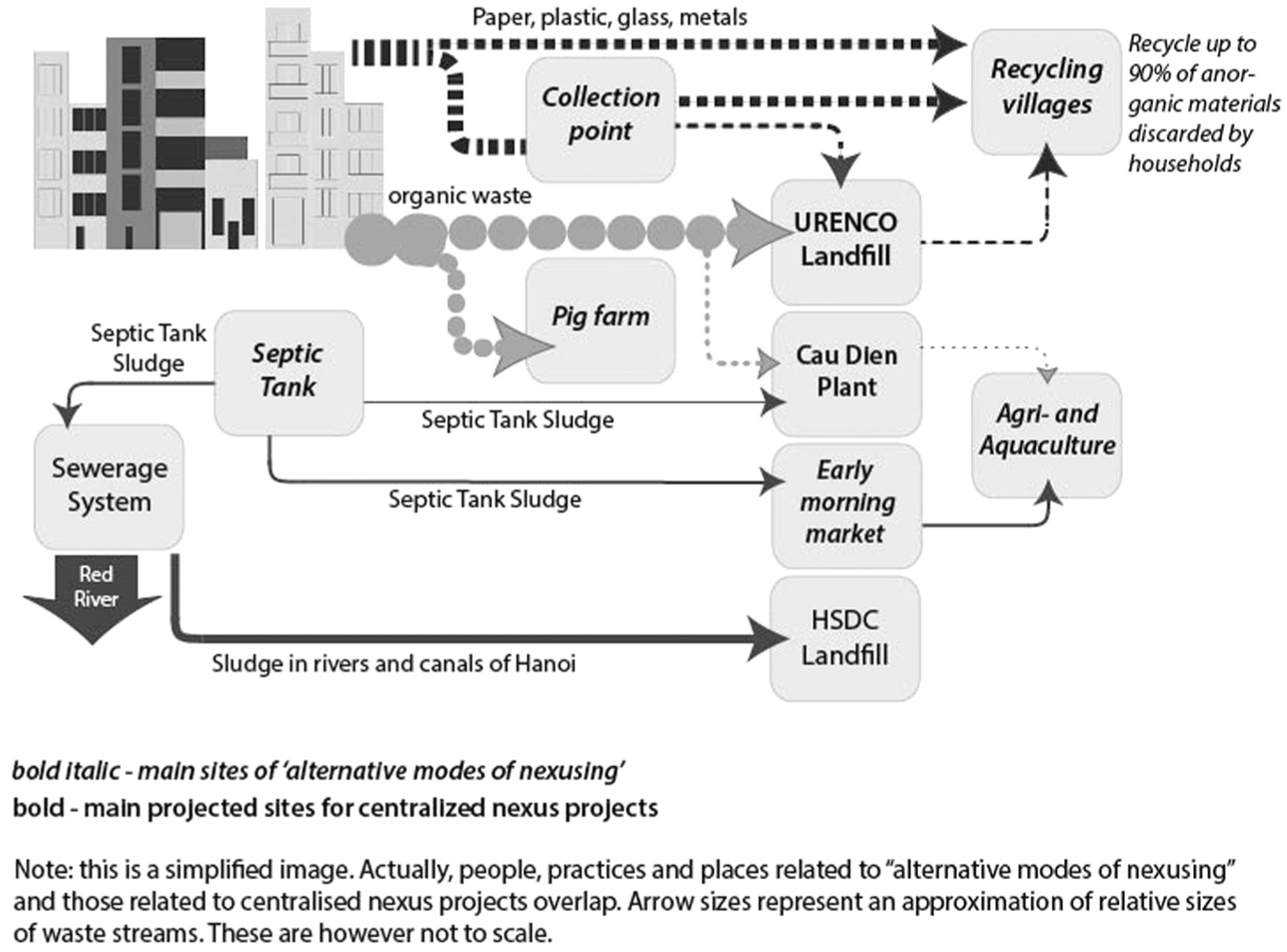
Hanoi’s sociotechnical flows of waste and sites for different modes of nexusing (authors).
Because of these activities concerning the recycling of non-organic household wastes, the waste finally dumped at the landfill of Hanoi has an estimated organic share of 90% (Böhm et al., 2011). While some organic waste does get delivered to the provincial landfill and is available for centralised processing, the entirety of Hanoi’s organic waste is not readily available for the generation of biogas. Part of it is used by pig farmers collecting organic wastes from restaurants (see Figure 1). Although this industry has existed for a long time, the increased availability of individual motorised transport since ‘doi moi’ has contributed to a proliferation of such businesses because the entrepreneurs of larger pig farms at Hanoi’s urban edges use motorbikes to transport organic wastes from inner-city restaurants to the city’s outskirts (Urban Harvest, 2005).
Urban–rural interlinkages beyond formal planning also exist in relation to sewage sludge and septic tank sludge management. As explained above, the city’s formal waste and sewage companies hardly collect any sludge from septic tanks and this task is mainly in the hands of registered limited liability or, to a lesser extent, unauthorised companies. While the treatment of sludge is part of these companies’ functions, they often lack the means to invest in technological devices (Interview, Dean of Faculty of Environmental Engineering, NUCE, 2017). A septic tank emptying entrepreneur stated that he had never had any contact with the local authorities and that he was not aware of any formal laws or rules concerning his business. He did not reveal where he dumped the sludge (Interview, Septic tank entrepreneur, 2009). However, according to a newspaper article, the dumping of sludge from septic tanks into the city’s rivers, lakes, and the underground sewage networks, is common practice (VIETBAO, 2008). A recent news broadcast indicated that not only private entrepreneurs, but also utility staff, engage in the illegal dumping of sludge (An Ninh Thế Giới, 2016). This underlines that the formalisation of the sector through licensing private enterprises does not prevent actors, including those within the provincial companies, from acting outside the law and thereby undermining centralised nexus projects.
Apart from dumping sludge into the city’s sewerage, entrepreneurs in the sector are also said to sell it at markets on the outskirts of Hanoi where farmers buy it for use as fertiliser in agri- and aquacultures (see Figure 1). These markets operate in secrecy as this practice is strictly prohibited in Hanoi because it allows faecal bacteria to travel from the city’s toilets to agri- and aquacultures on the outskirts of the city and from there back to urban residents, causing major health risks (XALUAN, 2009). The continuation of these practices explains the limited success of schemes such as the co-composting plant, as farmers have little incentive to buy processed fertiliser from the plant as they access a less costly product. Apart from costs, other issues play a role in the farmers’ preference for these markets. Some vegetables such as aubergines are said to grow particularly well when treated with fresh, that is, untreated manure, making processed fertiliser a less attractive option. The difficulties in formalising these transactions and practices may be rooted in their radical opposition to the image of modern urbanisation which Hanoi’s city officials are striving to achieve.
In sum, changes of the political economy of Vietnam, rapid urbanisation and economic growth have not contributed to an expansion of centralised provision of waste and sanitation services, but to an adaptation and further growth of alternative modes of nexusing (cf. Mitchell, 2009). Despite that, officials continue to pretend that urban discards are out-of-use, very literally ‘wasted’, and readily available to provincial enterprises to turn them into a valuable resource. This pretence is central to the pursuit of modernity as it is the basis for the rationalisation of the expansion of state control over recycling industries. However, this discursive re-definition of various materials as waste, which rests upon, and is stabilised by, technological artefacts, contrasts with our interlocutors’ idea of what the materials they handle are. When asked whether she would define her materials as waste or as a resource, a restaurant owner who sells leftovers to pig farmers answered ‘I have not thought about whether it is waste or a resource, I just do not want to waste anything’ (Interview, Restaurant owner, 2017), declining to categorise the material either way and insisting on the procedural character of waste. This resonates with a conception of waste not as a fixed category, but as a mobile one which is constantly re-defined by the boundary work of different actors (cf. Gidwani and Reddy, 2011).
Conclusion
Scientific debates and related research on Hanoi suggest that waste-to-energy schemes are an innovative way of fostering resource efficiency and sustainable urban development. Vietnam’s urban and central governments are currently showing an interest in such schemes as profitable provincial enterprises. In this article we have shown that these ideas are by no means new to Hanoi but have been part of Hanoi’s urban infrastructure planning since the French colonial era. During that era and today these policies and plans have disregarded Hanoi’s elaborate recycling industries which are intertwined with and overlap provincial waste and sanitation management and perpetually exist beyond state-led planning.
We have mobilised the literature on heterogeneous infrastructures in order to provide a better understanding of how various place-specific alternative modes of nexusing relate to centralised waste and sewage systems that are the target of nexus projects in Hanoi. This focus has implications for nexus projects in the city and beyond, as it shows that the very definition of ‘waste’ is at stake as policymakers and urban planners strive to create a centralised system of waste incineration in the name of sustainability. This new attempt to redefine specific materials as waste and consequently who gets to process, transform or recycle these materials, is a political project, as it is exclusive and has the potential to disturb, marginalise or even destroy existing industries of waste recycling in Hanoi. However, the difficulties the waste, sewage and electricity sectors experience when trying to implement the necessary institutional and technological changes have hampered this project to date. This enduring failure either to replace or to recognise alternative modes of nexusing has policy implications. It calls for a recognition of the perpetuating existence of practices beyond state planning, a recognition which involves considering the potential contribution of these practices to sustainability transitions in Hanoi. Importantly, recognising alternative modes of nexusing means also dealing with the highly precarious nature of some of the recycling work, which exposes waste workers to toxic substances.
We conclude that the consideration of alternative modes of nexusing expands existing literature on the urban nexus by calling attention to the already existing ‘nexus work’ of various actors and its manifold interrelations with centralised nexus projects. This is particularly relevant for postcolonial cities where urbanisation since the colonial era has been shaped not only by centralised policies often inspired by other places, but also importantly by very place-specific practices of city-making. Nexus projects and the literature on the urban nexus would benefit from taking these manifold dynamics more thoroughly into account as they shape urbanisation and therefore urban nexus projects far beyond policies and plans.
Footnotes
Acknowledgements
We would like to thank Olivier Coutard and Jochen Monstadt for hosting the workshop from which this paper and the Special Issue have emerged. We would also like to thank the participants in the workshop, as well as Yusif Idies, Abigail Friendly and the three anonymous referees for their helpful comments and ideas.
Declaration of conflicting interests
The author(s) declared no potential conflicts of interest with respect to the research, authorship, and/or publication of this article.
Funding
The author(s) received no financial support for the research, authorship, and/or publication of this article.
