




Abstract
This paper reports on a project exploring the friendships of children and adults in ‘super-diverse’ (Vertovec, 2007) localities in London, England, examining whether and how friendships are made and maintained across ethnic and social class differences. The aim is to identify what friendships reveal about the nature and extent of ethnic and social divisions in contemporary multicultural society. Drawing on interviews with children and their parents, this paper analyses affective parental responses to their children’s friendships, identifying instances where parents seek to manage these friendships. We identify the importance of the ‘ease of similarity’ for many parents concerning their children’s friendships, and the relative lack of concrete practices amongst parents to support their children’s friendships across difference. However, we also note parental support for living in super-diverse localities and children attending schools therein.
Introduction
This paper reflects on parental responses to the friendships made by eight and nine year olds in two different primary schools in ‘super-diverse’ localities in London, England. We use the children’s interviews to establish the shape and scope of their friendship networks, and draw directly on interviews with 34 of their parents to analyse the adults’ affective responses to their children’s friendships (the children’s own understandings of their friendship are further addressed elsewhere, Iqbal et al, 2016). The paper is part of an on-going research project which focuses on friendships made by adults and children across social class and ethnic difference, how differences and similarities in social and ethnic background shape and affect those relationships and how differences are routinely negotiated and managed.
We are seeking to contribute to two broad literatures: the first is the body of research in sociology and geography that focuses on parents’ actions and priorities with regard to their children’s schooling. Much of this research has been conducted in urban areas, documenting parents’ search for a school space with which they feel comfortable. Several researchers have identified parental concerns about their children potentially sharing school space with raced and classed others (e.g. Ball, 2003; Boterman, 2013; Butler and Hamnett, 2011; Byrne, 2006; Byrne and De Tona, 2014; Reay et al., 2011; Vowden, 2012). Drawing largely on interviews with middle class parents, this body of work broadly argues that whilst middle class parents living in urban areas perceive diversity and social mix in school populations as positive in the abstract, the limits of what is understood as an ‘acceptable’ degree of mix are variously defined, but often exclude working class populations. Even the middle class parents in research by Reay and colleagues, who make the apparently ‘counter-intuitive’ choice to send their children to local comprehensives, despite their average or low performance in terms of GCSE 1 results, expressed anxiety around ‘a potentially contaminating other’ (Reay et al., 2011: 106), namely, sections of the white and black working classes understood to be feckless, non-aspirational and thereby to pose a risk to the achievement and wellbeing of their own children. Reay and her colleagues deploy an analysis influenced by the psycho-social, and highlight the ambivalences for these middle class parents as they seek to manage both their egalitarian principles and their anxiety about too close a contact with ‘others’. However, it is important to note that Reay et al. also recognise a ‘significant minority’ (2011: 120) as having an openness to and ‘a yearning after and for difference’ (p. 121). We will return to these points later in the paper.
The second body of research is on encounter and diversity. Vertovec (2007) argues that the multiplicity of origins of those who arrive in London and other major cities, their varying immigration status, gender, age, religion, patterns of spatial distribution and so on, contribute to super-diverse urban populations. This then provides the backdrop for our research in London primary schools. Within these fluid and dynamic circumstances of super-diversity, the ways in which people negotiate interactions with others has led to a focus on the potential of encounter. Studies of populations who live in diverse urban areas have emphasised the need to recognise the everyday or ordinary-ness of multiculture where ‘differences are negotiated on the smallest of scales’ (Wilson, 2013: 635) and often in un-panicked and routine ways (Neal et al., 2013; Noble, 2009). Vertovec cites Ash Amin (2002) as calling for ‘an anthropology of “local micropolitics of everyday interaction” akin to what Leonie Sandercock (2003: 89) sees as “daily habits of perhaps quite banal intercultural interaction”’ (Vertovec, 2007: 1045). Recognising often mundane instances of conviviality and competency acts to reposition urban landscapes from the dystopic, conflictual and segregated to more complex places where difference is routine, and regularly, often amicably, negotiated in prosaic interactions and settings (Anderson, 2004; Hemming, 2011; Matejskova and Leitner, 2011; Thrift, 2005).
However, there have been concerns about the ‘convivial turn’ (Neal et al., 2013), and the extent to which encounters may be meaningful and have the potential to reshape social relations across difference is contested. Lees, reviewing gentrification initiatives, notes that the literature documents the tendency of middle class incomers to ‘self-segregate’, as ‘notions of diversity are more in the minds of gentrifiers rather than in their actions’ (Lees, 2008: 2458). Everyday encounters may be simply shaped by socially accepted forms of public civility, and ‘urban etiquette does not equate with an ethics of care and mutual respect for difference’ (Valentine, 2008: 329, 2013). Nor do ad hoc encounters, even of a positive nature, necessarily develop any lasting challenge to embedded prejudices and stereotypes (also Clayton, 2009; Hemming, 2011; Vertovec, 2015). As Valentine and Sadgrove (2012: 2060) note, it is not a fleeting encounter, nor spatial proximity alone ‘that overcomes social difference, but rather closeness – it is the act of knowing – or the production of intimacy which aligns different bodies in time and space’.
Thus other research has focused on what Rzepnikowska (2013) refers to as spaces of ‘habitual contact’ (p. 3), her examples being educational courses and mother and toddler groups. However, Cook, Dwyer and Waite (2011), in their research on relationships between established communities and Eastern European migrants, argue that only a minority of participants had experienced everyday neighbourhood and workplace encounters – ‘on the factory floor, in shops, on the street, and in the school playground’ (p. 737) – as generating meaningful engagement. For the majority, such encounters were more likely to result in ‘strategic withdrawal from the “other” community’ (p. 737).
In order to produce opportunities for the development of more sustained and productive relationships, Amin (2002) identifies the need for ‘micro-publics’ (p. 970), ‘spaces of interdependence’ (Valentine, 2013: 7). Whilst Amin refers to community spaces, voluntarily attended and fostering a shared interest, the institutional space of the primary school can be a potential candidate, allowing for sustained and regular encounters between parents and children over a number of years, and offering a shared sense of identity (as a parent/child attending X School). A shared sense of purpose offered by institutional settings such as schools can be more productive in generating mixing than routine neighbourhood interaction (Nast and Blokland, 2014). In theory, then, diverse multicultural primary schools can offer a site of sociality, allowing relationships to develop between children and their parents across difference.
Indeed, several researchers have emphasised the school as a site of negotiation of difference (Wilson, 2013; Neal and Vincent, 2013). However, encounters in school are not immune from existing inequalities of power and resources, and the patterns of sociality these create. Hunter et al. (2012) note the caution of the mothers in their sample in supporting their children’s friendships across racial difference, and in particular, in developing relationships with the other child’s family. It is important to note that this study is set in the American South with its specific and difficult history of race relations, and now experiencing increased and diverse migration. Nast and Blokland (2014), researching the generation of social capital in a Berlin primary school, identified instances of (cautious) bridging amongst parents across class boundaries. More positively, in the pilot to this main study, we found amongst a small sample, mothers who acted as ‘transversal enablers’ (Wise, 2009), ready to facilitate intercultural relationships between their children and diverse others, and to build relationships themselves with parents from different backgrounds (Vincent et al., 2015a).
The literature on children and adolescent relationships presents the same nuanced picture. Harris (2014) argues that the young people in her study sharing working class backgrounds, and living in super-diverse areas within an Australian city, are ‘deeply engaged in intercultural mixing’ (p. 140), a process she understands as including some negative as well as positive interactions:
What has been highlighted here are their ordinary capacities for convivial living that develop through the routinised sharing of and negotiations over spaces, relationships and taste cultures. These do not map easily onto ideas of harmony, unity, shared values and appreciation of fixed ethnic difference. These young people report an everyday and normalised local management of diversity, whether it is through prosaic encounters, friendships, neighbourhood disputes or virtual community building …. Convivial living with difference is a process not an outcome. (Harris, 2014: 141–142)
Conducting research within a London secondary school, Hollingworth and Mansaray (2012) argue that whilst diverse urban schools do lead to a degree of mixing amongst the students, school processes and policies (e.g. setting (tracking), different transitions at 16) influence the development of friendships marked by sameness. Children’s ages are potentially a key factor in shaping attitudes to others and awareness of difference. Bruegel (2006), studying friendship in primary schools, is optimistic, concluding that these can and do cross ethnic divides when children are in multi-ethnic schools, as it is sharing daily routines that leads to such relationships, rather than more artificial initiatives such as twinning schools. Her report concludes by noting that some parents in the study became more positive about those of different backgrounds as a result of their children’s friendships, and she agrees with Putnam that ‘more communal schools’ (Putnam, 2000) can foster ‘civic re-engagement’. Bruegel’s later work with Weller (Weller and Bruegel, 2009; Weller, 2010) emphasises the active role children play in the generation of neighbourhood social capital, directly through their own local relationships, and indirectly, as parents come to form new networks around their children (see also Byrne, 2006).
From these literatures, we take forward the potential for adult and children’s friendships formed within the space of the urban school, but also an awareness of the difficulties of and constraints on developing friendships across difference. We now turn to our data.
Methods and data sources
At the time of writing, we were collecting semi-structured individual and paired interviews with children (8/9 years old), their parents and their teachers in three London primary schools with mixed class and multi-ethnic populations. As this is an on-going project, this initial paper focuses on two classes of children at two of the three schools, and offers an analysis of discussions with 58 children and 34 adults. The schools were chosen using school inspection reports, local knowledge and government data that indicates the percentage of pupils from different ethnic backgrounds and the percentage who are awarded the Pupil Premium (an extra funding allowance based on the take up of Free School Meals, a proxy indicator of relative poverty).
We regularly visited each class so as to become more familiar to the children (please see Table 1 for data on the children’s ethnicities). Then, speaking to them in pairs, we asked them to draw pictures ‘mapping’ their friendship networks. By putting these individual pictures and conversations together, we created maps of the social relations across the entire class in each school. The children were very enthusiastic about speaking with us, although we are aware that not all children would be willing to ‘own’ peer conflict in a discussion with adults (George and Clay, 2013). Thirty-four of their parents were also interviewed, using interpreters where necessary, about their understanding and management of, and desires for, their child’s friendships. We also spoke to six of the teaching staff across the two schools, although this data is not greatly drawn on here.
Summary of children’s ethnicity.
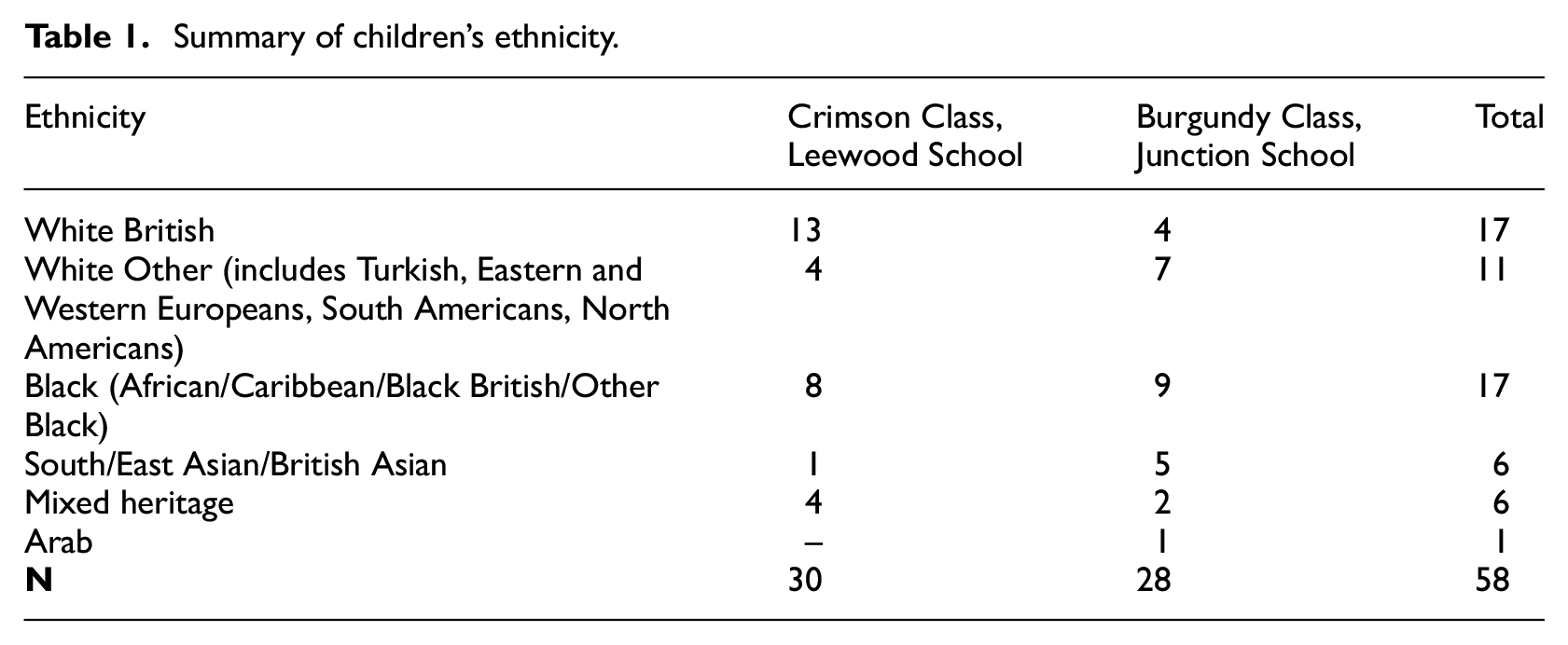
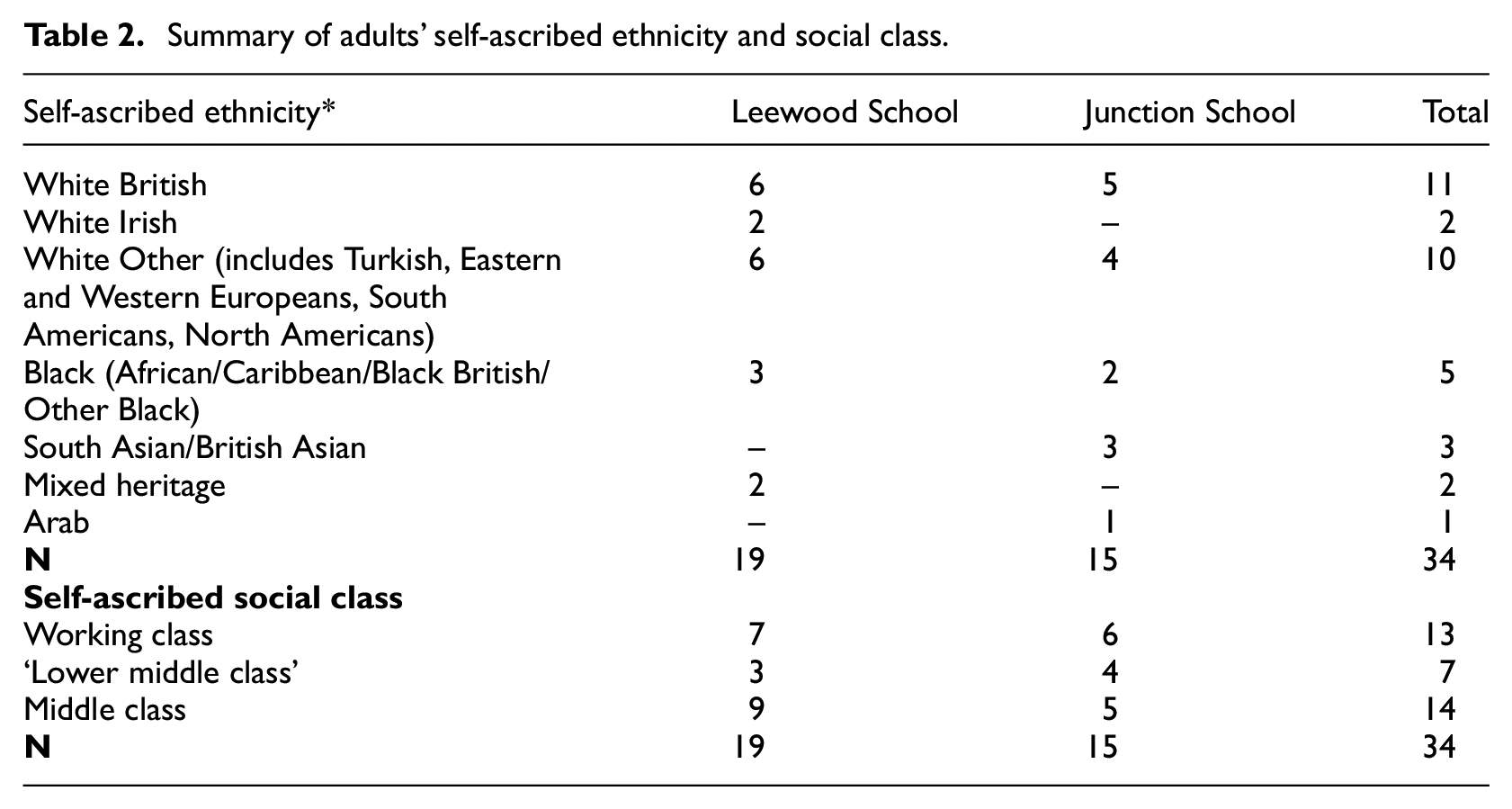
Table 2 uses the adults’ self-ascribed class and ethnic categories, so individual respondents’ understandings of ‘lower middle class’ for example may vary. We also categorised the parents using their occupations as listed in government NS-SEC (National Statistics Socio Economic Classifications), and note that those parents who self-identified as ‘middle class’ had professional/managerial jobs, higher education qualifications and were mainly owner occupiers (the latter characteristic is less prevalent owing to London’s expensive property market). Our sample of middle class parents has much in common with Reay and colleagues’ (2011) fraction of the metropolitan middle classes, which they identify as urban-based ‘middle class egalitarians’, those making a principled choice to send their children to local diverse state schools, rather than activate their capitals in order to access more homogeneous schools. For further discussion in relation to this project, please see, Vincent et al., 2015a. 2 Data management and analysis is through a combination of handcoding and qualitative data analysis software (NVivo). Whilst our initial theoretical categories drew from existing literature on class, multiculture and diversity, social capital, social mix and friendships, our code book was derived from team discussions focusing on an initial sample of transcripts. The codes are being refined and challenged through further engagement with and scrutiny of data (Le Compte and Preissle, 1993).
Summary of adults’ self-ascribed ethnicity and social class.
The localities and the schools
Leewood School
Understanding the schools as a part of their locality was an important aspect of our project and we spent time walking around the local areas (the role of space in constituting social relationships is discussed in more detail in Neal et al., 2016). Two of our key areas for observation were the degree of ethnic mix and the degree of gentrification 3 in each locality, and we give a flavour of that here.
The two schools are six miles away from each other, separated by the dense residential and small scale commercial geography of this part of London. Leewood School 4 serves Glen Park, a relatively affluent area, within a super-diverse and gentrifying London borough. It is a highly bounded locality focusing around a small central shopping area, and an adjacent area of parkland. Glen Park has been gentrified over 20–25 years, and the current shops and services (independent bookshop, clothes shops, butchers, restaurants, several artisanal cafes, gentrified pubs, a delicatessen and a ‘traditional’ green grocer) reveal the middle class dominance of the area (the ‘village’ as it was known was described as ‘ponce-y’ – pretentious – by one white working class father who had grown up in the locality). Whilst Glen Park’s shops and services are increasingly directed at the affluent section of the local population, considerable social housing remains. The park itself is popular and well used by all the local children to whom we spoke. The role of park spaces in localities for fostering senses of belonging and attachment among diverse populations has been recognised by other research (Neal et al., 2015).
Leewood itself has a long-established reputation as attracting a middle class population. However, it also serves several areas of social housing, and has a multi-ethnic population. The school is oversubscribed, known locally for its creativity, and also as a school inclusive of children with special educational needs. The latest report (2013) from national school inspectors, Ofsted, rated the school as ‘good’.
Junction School
The area around Junction School is busier than Glen Park, and with less green space. The school stands on a side road, just off a major traffic and commercial artery that leads to a busy shopping centre. The surrounding area is visibly more multi-ethnic than Glen Park; this is reflected in the shops, the places of worship and passers-by. The shopping centre also caters for a significantly poorer and more diverse population than the one living in the environs of Glen Park. However, the residential roads around the school are full of large Victorian terrace houses that are increasingly popular with middle class professional families, priced out of more established middle class enclaves nearby. There are far fewer signs of gentrification here than in Glen Park, but the recent appearance of an artisanal café, a general ‘up-scaling’ of some local restaurants and the rising house prices are testament to the beginnings of this process.
Junction School is a Victorian building on an attractive site. Under the current headteacher, the school has improved in terms of attainment, and in 2013 it received an Ofsted rating of ‘good’. The headteacher has also developed an emphasis upon creativity and performance. The school has a diverse multi-racial population, and one (white) father told us he had heard it referred to as the ‘headscarf school’. It had a higher rate of pupils eligible for Pupil Premium funding (extra funding for disadvantaged children) than Leewood (19.7% and 32.8% respectively). Unlike at Leewood, where families had to live very close-by to access the school, Junction took children from a much wider area, and local families could generally have obtained places at other local schools. The middle class respondents in particular stressed that they had chosen to send their children to Junction, displaying their commitment to their local school and their support for its diverse population (see Ethan below).
Friendship configurations in and out of the classroom
It was noticeable that children from both classes generally understood cultural difference to be ‘commonplace’ (Wessendorf, 2013), an ordinary part of their lives: ‘The school don’t really have a lot of the same culture […] because literally we are like all mixed’ [i.e. from a range of cultural backgrounds] (Callum, Crimson Class, Leewood School).
Speaking about their children’s schools, the parent respondents adhered to a positive narrative of social diversity; that is the benefits that accrue in terms of knowledge and personal development from knowing others who are different to oneself.
I like the idea that it is all mixed because now she talks about Muslims, you know, she talks about Catholics, she like – we are Christian […] And they will have their little conversations about Jesus and Allah, …. and then there will be ones that don’t go to church …‘How come they don’t go to church?’ and I am like, ‘Maybe you should ask’. But I think it is quite good. (Ava, Black mother, working class, Leewood School)
The more affluent middle class parents at both schools, who had the greatest degree of housing choice, all spoke positively about living in a diverse urban area, and had chosen to send their children to their local school. Ethan, for example, explaining his strong commitment to a diverse school, notes:
I had such a homogenous schooling [in a private school] and I think that gave me a terribly blinkered view of society which I’m hoping that I’ve shrugged off some of it, but I don’t think you shrug off all of it, because school is an important part of your forming of your ideas. (Ethan, white British father, middle class, Junction School)
However, narratives emphasising the benefits of diversity and difference often overlapped with what Hunter et al. (2012) have called ‘narratives of social invisibility’ – that differences are not important, that in the end we have recourse to our shared humanity, that what matters is not people’s class or ethnicity but their characteristics as people. Elif strongly expressed this view:
Even at Glen Park [which] is very posh, very trendy, very expensive area, but we’re all coming from the different backgrounds … For example, I’m a council resident [public housing] but most of my friends they are owner of one of the Victorian houses, you know, and some of them rent in the area and some of us, you know, some of them is solicitors, they have high-class jobs. But the thing is, I think, end of the day, we are all human, our needs is same. (Elif, Turkish mother, working class, Leewood School)
As Hunter et al. (2012) note, this argument is frequently applied to children and speaks to the location of pre-teen children as ‘innocent’, the assumption is that they do not see difference, or they do not accord it any social significance. Yet, despite narratives of social diversity (cultural and social diversity presented as positive) and narratives of social invisibility (that such differences do not, in the end, matter much in the face of our common humanity), a closer look at the social relations in the two classrooms reveals the reflection of entrenched social divisions in the children’s friendships. Using the children’s social maps, and interviews, we analysed the children’s friendships in another paper (Iqbal et al., 2016), so for our purposes here we will just note some aspects of the scope and shape of the children’s in-class networks, and then turn to their parents’ understandings of their child’s social networks.
Our main purpose in the interviews with the children was to identify the social networks within the class. Although the children did mention friends from other year groups, from outside school and also family members, we have focused on their relationships with their classmates. We wanted the children to define ‘friendship’, and they easily differentiated between degrees of closeness when talking about particular individuals. They also discussed what behaviour makes a good friend (e.g. kindness, reliability, trustworthiness) and what behaviour does not (switching allegiances, bossiness, lack of reciprocity, Vincent et al., 2015a).
Crimson Class in Leewood School contained 30 8/9 year olds, most of whom had been together for five years. Although the interviews with the children revealed some moments of tension and distress, friendships were generally presented positively. Some children, however, were clearly less embedded than others, and this was particularly noticeable in relation to two girls, the only practising Muslims in the class, and two boys both of whom have complex learning needs and some physical disabilities. The class teacher of Burgundy Class at Junction School characterised the 28 children as rather young for their age, and insecure. Friendships appeared more fraught than in Crimson, and the rate of pupil mobility higher. The teacher saw the class as not having clear friendship groups, but rather temporary alliances that ‘dissipate quite regularly’, with the exception of a small group of white middle class children who were held together by their shared experience of outside activities, and their parents’ friendships. Our data suggested that the most isolated children were three recently arrived boys, two from abroad who were learning English, and one who had a statement of special educational need and (at the time of the fieldwork, this later changed) was largely taught separately in a corner of the classroom.
From our analysis of the children’s data and interviews with parents and teachers, we identified gender, social class, ethnicity, religion and disability as key dimensions influencing the friendship configurations in Crimson and Burgundy Classes. Both classes had friendship groups largely split along gender lines, but both contained friendship groups that were mixed in terms of ethnicity. However, these friendships tended to be amongst children with a similar social class background. We discuss the clearest exception – a multi-ethnic, mixed-class quartet of boys at Junction below. The other grouping we draw attention to is a tight-knit group of girls at Leewood School described by their teacher as the ‘white middle class girls’ group, which encompasses all of that particular demographic in the class, except for one girl.
We wish to draw attention to the apparent tendency towards homophily in terms of social class and, to a lesser extent, ethnicity. We are here particularly concerned with the parents’ understandings of their children’s friendships. In our pilot project (Neal and Vincent, 2013) with middle class mothers, we found an emphasis on the ease and comfort of similarity offered as an explanation for why mixing may be limited. This attitude was voiced explicitly in the main study by parents from a range of ethnicities. This resulted in many of the children’s friendships, especially out of school, being dominated by those in similar social groupings. This was not, we argue, necessarily a conscious indicator of a desire for withdrawal or avoidance of ‘others’, but rather an unarticulated, often unperceived, caution about mixing which gave rise to a degree of inactivity. Supporting friendships across difference and diversity can involve considerable parental labour. Despite this, there was a small minority of parents who made marked attempts to facilitate social relationships across difference.
The ease of social similarity?
Coleman’s (1997) theory of social capital emphasises the importance of social connections between families, specifically networks of parents and children where adults and children all know each other. He refers to this as ‘intergenerational closure’ and understands it to be a positive force for maintaining expectations of children’s behaviour, as networks of parents in local communities who know each other establish a ‘dense social structure of norms, extensive trust and obligations’ (Edwards et al., 2003: 4). In schools where intergenerational closure is not readily apparent, Coleman (2000) argues that this allows opportunities for differentiated youth cultures to emerge which may be antagonistic to conventional norms. Carbonaro (1998) contests this, noting that parents ‘knowing’ one another does not mean that common norms and expectations can be assumed, nor that parents’ relationships will lead to enforcement of particular values and norms. We are finding that the instances of intergenerational closure apparent in our data describe networks of socially similar individuals, where norms and values are more likely to be broadly similar anyway. Here we focus on the example of the mostly white British professional middle class parents at our two schools, commenting on some shared parenting practices, and their social networks. Such networks can be perceived as exclusive by others. At Junction School, one identifiable web of middle class affiliations was broader than the children’s friendships in Burgundy Class, and included children of different genders and ages. Their parents all lived in one particular network of roads (known locally as The Gate), and had made friends through toddler activities in the locality, the school and outside activities. That members of this grouping were perceived to be both cohesive, and very present in the life of the school (through the governing body and the Parent Teacher Association, PTA
5
) was asserted by one mother – who saw herself as outside this group – referring to it as the ‘Gate Gang’:
That is quite a tight knit community […] They know each other […] I honestly don’t know [how]. Perhaps they have an inbuilt radar. There is tennis at [recreation ground] and all their kids go to tennis lessons, and I think they just do the same sort of things, and go to the same sort of – you know their kids from being little will go to the same sort of clubs and what have you, … and possibly childminders, I don’t know […] The core [of the school PTA] is that clique. (Lorna, white British mother, intermediate class, Junction School
6
)
The reference to the ‘inbuilt radar’ is lightly made, but is a striking indicator of the perceived exclusivity of this group of parents, as they focus on other ‘people like us’. Lorna is describing the embodiment of social structures and divisions. This is what Ball et al. (2002: 52) refers to as ‘social class in the head’. We reach this conclusion about the role of social class in shaping friendship formations amongst adults after careful consideration of the parental interviews and who they identified as friends in the context of the playground. This is not to say that adult friendship groups were entirely homogenous, but rather that there was a marked tendency in both schools for parents to mix with others similar to themselves in terms of class and ethnicity (see Vincent et al., 2015b for further discussion of middle class social networks).
At both schools, the middle class children’s social relationships are reinforced by spending time together out of school, often at activities. Emma is in the embedded group of white girls – Emma, Shauna, Phoebe, Joyce and Megan – in Crimson Class. Her mother describes her after-school time as spent with the same girls.
[Emma] does dancing on a Monday, Wednesday she has piano followed by her tutor, Thursday gymnastics [at school]. So she has got Tuesdays and Thursdays free […] Shauna does the dance [too], Phoebe and Megan do the gymnastics. She is going to [day summer camp] with Joyce and Phoebe in the summer. (Catherine, white British mother, middle class, Leewood School)
Claire, the mother of a boy in Crimson Class, comments on the role of activities in reinforcing her son’s friendships with particular children in the class who she identifies as socially similar. The quote below is taken from a longer extract in which she discusses with some concern her son’s diminishing friendship with two working class boys, and the strengthening of his friendship with another middle class boy, which she understood as a result of their increasing time spent together outside school in activities: ‘So that [shared activities] is where the friendship just bonded, it seems to be that is where the kids spend more time with each other outside school, the older they get, it becomes more important’ (Claire, white British middle class mother, Leewood School). The considerable involvement in paid-for activities indicates a shared approach to parenting amongst the middle class parents of Crimson Class that reveals an adherence to ‘concerted cultivation’ 7 (Lareau, 2003), characteristic of a professional middle class family habitus.
We asked parents for their views on their children’s friendships, which led the middle class parents at the two schools to reflect on the relative homogeneity of their children’s networks, something which one father described as ‘regrettable but understandable’. Olivia, also with a daughter in the embedded girls’ group in Crimson Class, comments:
I wonder if [children] are going for similar kids who have got, like I said, similar radio on in the background, similar books, similar newspapers, similar kinds of outlook and faith, if they have got a faith. So they are going for the familiar. And it is boosted by parents who encourage it … I like the parents therefore you can be friends with and we can have coffee … It flows more easily … the easy path. Whereas if [daughter] was friends with Queenie, beautiful girl, black skin, yeah it would be different. I think we are all a bit racist inside, may be not racist, just culturalist. (Olivia, white British, middle class mother, Leewood School)
Olivia perhaps implies criticism of parents like her who take the ‘easy path’, but she finishes by stating that ‘like attracts like’, this is just the way things are, a view expressed by other white parents, although some with more obvious concern about this apparently inevitable state of affairs. Here too, we see the impact of commonalities in family habitus and in the possession of shared capitals. Family habitus is a (contested) extension of Bourdieu’s concept of habitus and can be used to bring into focus a ‘broad spectrum of family resources, practices, values, cultural discourses and “identifications” (‘who we are’)’ (Archer et al., 2012: 886. For a more extended discussion, see Archer et al., 2012; Atkinson, 2011; Burke et al., 2013; Vincent et al., 2012). Catherine and Olivia share a sense of ‘appropriate’ and possible children’s activities, and reference shared cultural signifiers indicating the possibility and desirability of play-dates, parties and sleepovers. It is worth noting that Olivia departs from the colour-blind approach of most of the white parent respondents (see also Hunter et al., 2012) by mentioning race specifically as a marker of difference, the unknown ‘other’, one not likely to share similar dispositions. This is boundary work, defining ‘us’ and ‘others’ on the basis of classed practices and ethnicities, and likely to bring about social closure.
Negotiating difference
At Junction School, there is a core of boys from varying class backgrounds who were close friends and who also met out of school: Musa (British Bangladeshi), Sam (white British), Oliver (white British) and Haydon (Black Caribbean). Their parents maintain cordial relationships with each other which facilitate the necessary arrangements for the children to go home with another family: ‘We haven’t become close, but we meet at school and say hello. If they go round to visit, I go to their houses to pick up Musa’ (Nadeem, Musa’s father, intermediate class). ‘Obviously we talk and we pass the time of day and we organise them to come to each other’s houses and things like that. But nothing as a close relationship. No’ (Lorna, Sam’s mother, intermediate class). Oliver’s mother, Elizabeth, describes her relationship with Haydon’s mum, Chantelle, as generally operating smoothly, although marked by an acute awareness of difference. Here class and ethnicity, reflected in age, family structure and presentation of self, intersect to position these two mothers at a social distance from each other; friendship is presented as an impossibility:
Oliver’s friend’s parents are not our friends […] So Haydon’s mum, I am probably old enough to be her mother, in fact probably older than her mother […] It has been quite easy to establish – even though she and I will never be friends because we are so different – to establish going to each other’s houses and to talk about difficulties where necessary, and that is brilliant, but very unusual in my experience […] I have a very different life from Haydon’s mum. I really like her, but I have very little in common. I’m 46. I think she is about 25 now, she is a single mum of three kids. It is just totally different. I went to pick Oliver up from her a few weeks ago, and she had had hair extensions, and I went ‘Oh they look nice, really lovely’, quite spontaneous, and she went ‘I didn’t know you knew about hair extensions’. Well, I don’t, I just know that that is what they are called! (Elizabeth, white British mother, middle class, Junction School)
As Nast and Blokland (2014) note, people may bridge class gaps for certain purposes – such as facilitating children’s friendships – for particular periods of time. Despite the acute sense of awkwardness which pervades Elizabeth’s words, it is clear that the two women try and bridge the perceived social space in order to facilitate their sons’ friendship (see also Vincent et al., 2015b).
Similar examples of working with and around difference could be found in relation to religion. Populist discourses of ‘self-segregation’ by Muslims and other religious and ethnic minorities are well established in England (Crozier and Davies, 2008; Phillips, 2006). We found that religious differences were a factor that affected the configuration of children’s friendships, but that self-segregation was a far from adequate explanation. Majority attitudes are not always inclusive. Bercu, mother of Zayla in Crimson Class, described being made to feel uncomfortable for wanting her daughter to eat halal food:
We went to a birthday party with my daughter and I didn’t know what was in the food and I had to refuse and I had to make Zayla refuse as well. But with Fatimah [friend from Crimson Class] because it’s all halal food, then I can send my daughter there with a good heart …. After that incident because they [other parents] look at you a little bit differently when you don’t eat the food, then nowadays she just goes to birthday parties of Turkish families. (Bercu, Turkish mother, working class, Leewood School)
Rabia, a Pakistani mother at Junction School, was one of a number of parents who, whilst very keen that their children had friends at school and interacted with their peers, did not want their children visiting unfamiliar houses. In her case, she specifically links this to her role in their religious upbringing as Muslim. Rabia’s sense of dissonance, discomfort, comes from anxiety that she may be ‘operating in a space with which [her] personal moral disposition is not compatible’ (Valentine and Sadgrove, 2012: 2060):
Basically like to be honest, I don’t like them going to their houses, because of some reason. It is just that I recognise that they have got different traditions, and you know we have to follow a few things when they go there [to others’ houses], obviously they will get to know many things […] I can just limit them and make them understand what is good, what is not for us. […] It is not that I am going to try and stop them all through [their childhood], as soon as they go to secondary, they are not in my hand. I am just trying to make them understand what is good, what is not. (Rabia, Pakistani origin, Junction School)
We want to make three points here. First, that parental anxiety around their children attending the homes of an unknown ‘other’ was by no means confined to parents of a particular ethnic or religious background, and that not all the Muslim parents to whom we spoke took this view (e.g. Musa’s dad, Nadeem, cited above). Second, Rabia is not trying to prevent friendships, but rather to preserve her sense of security around her children. To try and compensate for any missed social opportunities, she hosts a party at home for her children’s friends, indicating her willingness to invite diverse children into her home. Furthermore, she recognises that her stance on this will change as her children age. Therefore, we argue that she is not presenting an example of withdrawal and segregation, but one of management and negotiation, of her own feelings as well as the wider context. Third, and very pertinent for our purposes, a reluctance to mix is often assigned to minority groups, whereas patterns of separation, around social class for instance (as discussed above), in the white population are often ignored. We note here that it is Rabia, a first generation migrant, who is making an effort to facilitate her children mixing with their friends across difference.
Conclusion
In our research, social mix did not translate straightforwardly into social mixing, despite the diversity of the school populations and of the locations (also Blokland and van Eijk, 2010). It would be possible to read our data as an example of the phenomenon described by Amin (2002: 976) as living difference through ‘co-presence’, rather than through the development of sustained relationships. We suggest that Reay et al’s (2011: 121) ‘yearning after and for difference’, cited above, is more visible in the rather abstract support for multicultural living and social mix, than in examples of concrete practices to support mixed friendships. We find that the social is heavily classed, as friendship across class difference was less common than friendship across ethnic difference. Those parents with homogenous friendship networks themselves did not generally reflect on how the nature of their own friendship practices influenced their children’s experiences. Rather the common understanding was of children as not ‘seeing’ difference, and so they were assumed to have the capacity to form relationships independently of social divisions.
It seems to us that one explanatory factor for this tendency towards homophily may be parental anxiety. Educational research, influenced by psychoanalysis (Bibby, 2001; Lucey and Reay, 2002; Walkerdine et al., 2001) points to the way in which behaviour is shaped by conscious and unconscious defensive reactions to managing anxiety. We are not adopting a fully-fledged psycho-social framework here, but we do suggest that the reactions we see to negotiating diversity are ways of managing anxiety, ways of responding to what Fortier (2007) describes as tension and ambivalence around the idea of ‘multicultural intimacy’. This is not to suggest a consciously anxious, alert, stressed population, but rather that many adults, whilst consciously and for the most part competently managing diverse encounters, experienced some level of anxiety about close contact with others not like themselves. The parent respondents were all content to have their children in schools with diverse populations, and most of the middle class respondents had the resources to engineer a place at a different school had they so chosen. However, within the context of this broad acceptance of, and often stated enthusiasm for, diversity, perhaps a response to what Ahmed (2013) calls the ‘imperative to love difference’, different parents displayed different ways of negotiating difference. As Fortier (2007) notes, there are obligations to encourage interaction across difference – ethical imperatives towards polite, friendly behaviour towards neighbours and/or fellow parents sharing the same playground space or school, broader national conceptions of a harmonious and tolerant nation – but also individual fears and anxieties around proximity with difference. Thus some parents in our study managed those who came into the house, or limited the houses their children went to. For others, the private space of the home was more open, but a process of managing difference still took place, through the consignment of others not like themselves to the periphery of the social encounter, centring instead the dense networks of other ‘people like me’, through, for example, organising the children’s out of school time. As a result, children’s friendships were not bound by sameness, but they were initiated and practised on a terrain inscribed by largely unspoken, but still powerful social divisions (May, 2011: Smart, 2007).
However, as Harris (2014: 142) notes (cited above), ‘convivial living is a process, not an outcome’. We have identified here some instances of engagement and interaction, some fleeting but others more prolonged, between the children and between their parents (see also Iqbal et al., 2016; Neal et al., 2016; Vincent et al., 2015a). Thus we wish to end by highlighting the support amongst our respondents for living in diverse localities (see also Boterman, 2013) and attending diverse schools, and to the, albeit fragile, examples of efforts to forge relationships across difference.
Footnotes
Funding
This paper was funded by the Economic and Social Research Council ES/K002384/1.