




Abstract
There are substantial variations in labour market outcomes between neighbourhoods. One potential partial explanation is that residents of some neighbourhoods face discrimination from employers. Although studies of deprived areas have recorded resident perceptions of discrimination by employers and negative employer perceptions of certain areas, until now there has been no direct evidence on whether employers treat job applicants differently by area of residence. This paper reports a unique experiment to test for a neighbourhood reputation effect involving 2001 applications to 667 real jobs by fictional candidates nominally resident in neighbourhoods with poor and bland reputations. The experiment found no statistically significant difference in employer treatment of applicants from these areas, indicating that people living in neighbourhoods with poor reputations did not face ‘postcode discrimination’ in the labour market, at the initial selection stage.
Introduction
This article explores neighbourhood effects as an explanation for variations in employment rates between neighbourhoods within labour markets. It focuses on exploring one pathway as an explanation: ‘stigma’, or poor neighbourhood reputation. It exploits a field experiment methodology, supported by contextual qualitative and quantitative evidence, through case studies of three local labour markets (LLMs) and nine neighbourhoods in England and Wales. It focuses on one outcome: employment. The hypothesis it aims to test is that Residents of neighbourhoods with poor reputations fare worse when applying for relatively low-skilled jobs than residents of neighbourhoods in the same labour market with better reputations, all other things being equal.
If verification is found for this hypothesis, it is evidence of a neighbourhood effect operating through the ‘stigma’ pathway (although it is possible that neighbourhood effects might also be operating through other pathways). It would suggest that neighbourhood effects contribute to some extent to variation in employment rates between neighbourhoods.
The article begins by examining variations in employment rates at neighbourhood level and discussing explanations for such variations. The methodology used for the particular field experiment which is the focus of the article is then discussed. Next the results of the experiment are presented. The article ends with a discussion of what the results mean for the role of the ‘stigma’ neighbourhood effects pathway.
Variations in Employment Rates between Neighbourhoods within Labour Markets
There is longstanding academic and policy interest in the existence and persistence of geographical variations in employment, economic inactivity and unemployment rates. These concerns encompass a range of geographies—from regional, to LLM and neighbourhood scales (Green and Owen, 2006). This paper focuses on variations between neighbourhoods within LLMs. In the UK, the National Equality Panel (2010) highlighted that in the most deprived tenth of neighbourhoods only 55 per cent of adults were employed compared with more than 80 per cent in the least deprived half of neighbourhoods nation-wide.
Concerns about uneven employment rates between neighbourhoods and the (relatively) low absolute employment rates in some areas have been part of the motivation for successive generations of urban policy in the UK and elsewhere. Closing gaps in neighbourhood worklessness was a key objective of the National Strategy for Neighbourhood Renewal (in England) from 1998 to 2008 (Amion Consulting, 2010), the Working Neighbourhoods Fund (in England) (Dewson et al., 2007) and the City Strategy Pathfinders (in Great Britain) (Green and Adam, 2011). Areas with high unemployment and low employment tend to overlap with areas with poor reputations.
Explaining Variations in Employment Rates between Neighbourhoods within Labour Markets
There are three broad categories of explanation for variation within labour markets: first, skills mismatch, largely as a result of residential sorting; secondly, spatial mismatch; and thirdly, neighbourhood effects. These explanations are not exclusive and could operate together for additive or interacting effects.
First, residential sorting and changes in skills requirements can result in spatial concentrations of individuals who are at greater risk of non-employment due to poor skills, lack of qualifications, ill health and lack of recent work experience (Houston, 2005; Green and Owen, 2006). Hence, spatial variations in employment and non-employment rates are a function of spatial differences in individual characteristics and a mismatch between the skills or attributes required or preferred by employers and those held by people in certain neighbourhoods. Skills mismatches could be reduced by improving individuals’ relative skills (and other characteristics).
Secondly, the spatial mismatch hypothesis explains variations in non-employment through geographical disparities between the location of jobs and potential employees (see Kain, 1968; Holzer, 1991; Houston, 2005). Spatial mismatch can develop through residential sorting, the impact of housing policy and uneven geographical impacts of economic restructuring. For instance in a case study of an inner London borough, Watt (2003) described how many local authority tenants were in effect marooned over a 30-year period as the immediate area lost almost all its manual employment. Over time, those in employment travelled longer distances to work.
Thirdly, when applied in relation to employment outcomes, the neighbourhood effects hypothesis suggests that spatial variations in non-employment are not reducible to compositional effects (i.e. characteristics of residents) but rather that there is an additional area related effect on employment (or other outcomes) that results from spatial concentrations of individuals who are at greater risk of non-employment or who have other disadvantages (Syrett, 2008), or from other characteristics of the area (for example, Lupton, 2003a; van Ham et al., 2012). Potential pathways for neighbourhood effects may be either endogenous (i.e. internal to the neighbourhood) or due to the relationship between the neighbourhood and outside people or institutions. In a comprehensive typology of mechanisms, Galster (2012) prefers the categories of social interactive, environmental, geographical and institutional, with 14 sub-categories. Under ‘institutional’ mechanisms, he lists local institutional resources, the behaviour of local market actors and private services, and stigmatisation. Thus, the behaviour of employers and neighbourhood stigma are just two of numerous potential mechanisms.
Explaining Variations in Employment Rates between Neighbourhoods within LLMs through Neighbourhood Effects
Much research into neighbourhood effects has used multivariate analysis of quantitative data on the characteristics of, and outcomes for, residents of different neighbourhoods (Kleinhans, 2004; Joseph et al., 2007; Galster, 2007). Qualitative research (for example, with employers and intermediaries), although sometimes overlooked, is particularly important in generating hypotheses and in developing and testing ideas about pathways (Lupton, 2003a). Another approach with potential is the use of randomised control trials or experimental methods.
Each of these methods is independently valid. However, combinations of methods offer the potential to confirm and accumulate evidence. While econometric analysis is broadly seen as the ‘gold standard’ within neighbourhood effects research, in the field of employer preferences, this kind of data analysis is seen as secondary to experimental studies (Riach and Rich, 2004). Research into neighbourhood effects so far has tended to explore neighbourhood effects without focusing on specific mechanisms (Galster, 2012).
This paper explores neighbourhood effects as an explanation for variations in employment rates between neighbourhoods within labour markets. It focuses on exploring one pathway as an explanation: ‘stigma’, or poor neighbourhood reputation. It exploits a field experiment methodology, supported by contextual qualitative and quantitative evidence, through case studies of three LLMs and nine neighbourhoods in England and Wales. It focuses on one outcome: employment.
The hypothesis it aims to test is that Residents of neighbourhoods with poor reputations fare worse when applying for relatively low-skilled jobs than residents of neighbourhoods in the same labour market with better reputations, all other things being equal.
If verification is found for this hypothesis, it is evidence of a neighbourhood effect operating through the ‘stigma’ pathway (although it is possible that neighbourhood effects might also be operating through other pathways). It would suggest that neighbourhood effects contribute to some extent to variation in employment rates between neighbourhoods.
Evidence for the Role of Neighbourhood Reputation in Explaining Variations in Employment Rates through Neighbourhood Effects
Evidence that some neighbourhoods have worse reputations than others is ubiquitous in urban studies (for example, Wilson, 1987; Tilly et al., 2001; Waquant, 1993; Hastings and Dean, 2003; de Souza Briggs et al., 2010). Neighbourhoods with poor reputations often are the same neighbourhoods that have low rates of employment and high rates of non-employment and unemployment. This brief review focuses on evidence from the UK.
Relatively poor reputations may be held by outsiders including the general public, key public- and private-sector decision-makers and service providers, or potential residents. These reputations may affect the behaviour of all these groups towards the neighbourhoods—for example in decisions to provide services or to employ residents. Existing residents are likely to be aware of these poor external reputations and this in itself may affect their attitudes and behaviours, including, for example, decisions to apply for jobs and their behaviour in the job application process. Poor reputation may also affect the provision of private and public services (for example, Christie and Rolfe, 1992).
Over 30 years ago, McGregor (1977) used multivariate analysis, now established as the core approach to investigating neighbourhood effects, to explore the role of stigma in explaining variations in employment rates between neighbourhoods within labour markets through neighbourhood effects. He examined unemployment rates and unemployment duration for men in Scotland, including Ferguslie Park, a neighbourhood with a poor reputation, controlling for age, skill, industry, marital status, length of time in previous job, preference for light, medium or heavy work, preferences for local or more distant work, and preferences for day or any hours, and concluded that although the Ferguslie Park sample would experience relatively high unemployment duration no matter where they lived, the fact of their residence in Ferguslie Park significantly adds to the disadvantages associated with their individual characteristics (McGregor, 1977, p. 311).
To date, no other studies appear to have used such techniques to explore the stigma pathway for neighbourhood effects on employment.
Studies using other methods have added important information. Although employer statements may not fully reflect practice and do not preclude unconscious preferences, several studies provide insights into potential neighbourhood preferences from an employer perspective (Pager and Quillian, 2005). Writing about four US metropolitan areas, Tilly et al. noted that each manager forms his or her own mental map of … [their] environment. Employer’s maps, in turn, have important effects on the labor market (Tilly et al., 2001, p. 304).
A majority of employers in this study thought there were systematic differences between urban and suburban workers (across neighbourhoods) within a labour market, although in the US context it should be noted that spatial differences are also heavily racialised. Negative attitudes about particular groups of workers could feed into spatial mismatch, if they affect employers’ location decisions and the pattern of employment opportunities.
In the UK, some studies have found at least some self-reported preference for individuals not from areas with poor reputations (for example, Hastings and Dean, 2003; Aleksandraviciene et al., 2005). Interviews with employers, with recent experience of recruitment in less skilled occupations in various cities in Great Britain, about their selection and recruitment procedures suggested that employers preferred workers from areas without poor reputations, but the effect was only at the margin and in specific conditions (Nunn et al., 2010). Employers generally talked of individuals’ personal characteristics as the main factor in recruitment decisions. Address could be an issue, but this mainly related to travel-to-work considerations, particularly where jobs involved anti-social hours. A few indications of a lack of willingness to employ applicants from certain areas, or an intention to subject them to special attention, emerged. In their study of Nottingham, Green et al. (1991, p. 273) found evidence of a preference amongst some employers for local workers, regardless of neighbourhood reputation: “[they] preferred their employees to be locally based, since this was thought to make them more reliable”. Zenou (2002) and Lupton (2003b) uncovered similar preferences. This suggests a potential ‘spatial match’ effect or positive neighbourhood effect for people in neighbourhoods close to employment.
Qualitative research can contribute to understanding of how pathways for neighbourhood effects may work and the circumstances in which they may not operate. Nunn et al. (2010) suggested that neighbourhood effects via area reputation required ‘local knowledge’ amongst employers, discretion and ability to deviate outside automated or rigid processes amongst those involved in recruitment. Like the exercise of other forms of employer preference or discrimination, this may have been influenced by the state of the labour market, with economic circumstances offering more choice for employers resulting in more screening.
Another source of information is interviews with job applicants and those working with them. This is a weaker source, as these informants have only indirect insight into employer preferences and no oversight of aggregate patterns. However, numerous studies have recorded the belief that ‘postcode discrimination’ is taking place in the UK (for example, Lawless and Smith, 1998; SEU, 1998; Taylor, 1998; Fieldhouse, 1999; Roberts, 1999; Dean and Hastings, 2000; Speak, 2000; Mellor, 2002; Hastings and Dean, 2003; Taylor, 2003; Aleksandraviciene et al., 2005; Sanderson, 2006; Green and White, 2007; Fletcher, 2007; Dewson et al., 2007; Bates et al., 2007; Fletcher et al., 2008) and beyond (for example, in France (Waquant, 1993; Recchia, 2008), in Australia (Atkinson and Jacobs, 2008) and in the US (Tilly et al., 2001)). More specifically, some social housing tenants interviewed in four different areas about employment in 2008 thought that there was postcode discrimination against them (Fletcher et al., 2008). In a study of working-class women in Scotland and northern England, Taylor (2003, par. 7.4) reported: “Several … explained their long-term unemployment by having specific, devalued postcodes”. Bates et al. (2007) found at least one such allegation in a study of employment in rural areas. A study of high unemployment areas in Coventry reported Although they could not easily always provide evidence for it, many project workers felt that ‘postcode discrimination’ against people from areas of high unemployment who are stereotyped as unreliable workers undoubtedly operated (Aleksandraviciene et al., 2005, pp. 64–65).
In the evaluation of the 12 Working Neighbourhood Pilots covering areas of high unemployment and inactivity, interviewees said Employers tar everyone with the same brush. It’s just not fair. The area definitely goes against you [and] if you put [this area] as your address on your application that puts employers off (Dewson et al., 2007, p. 32).
In a rare example of direct evidence, albeit second-hand and for a single case, Speak (2000) reported that a resident from Benwell in Newcastle upon Tyne had been interviewed for a job but was not given it and was told: “It’s not you, we think you’d do the job fine … but if you live in [Benwell] you either know a villain or you are a villain”.
In summary, existing evidence from the UK on the role of stigma in explaining variations in employment rates between neighbourhoods within labour markets through neighbourhood effects was described recently as “thin” (Dewson et al., 2007). Houston summed up the situation for the UK as follows: “direct evidence of ‘postcode discrimination’ is difficult to find” (2005, p. 229). The pattern appears similar at least for France, the US and Australia.
Exploring the Role of Neighbourhood Reputation in Variations in Employment Rates through Neighbourhood Effects Using an Experimental Method
Given the difficulties establishing direct evidence of neighbourhood effects linked to a particular pathway through multivariate analysis, or through interviews alone, the study used an experimental method, supported by contextual quantitative and qualitative research. This permits testing the hypothesis set out earlier, through establishing
variations in employment rates between neighbourhoods;
variations in reputation between neighbourhoods;
employers’ awareness of neighbourhood reputations, attitudes to different neighbourhoods, assessment of neighbourhood reputation as a factor in decision-making; and
variations in success in applying for employment amongst residents of neighbourhoods with different reputations, all other factors being equal (same jobs; equivalent applicant characteristics).
There is very limited experimental evidence on neighbourhood effects. There are ethical, legal, political and cost problems in creating experimental policy design in urban and social policies (Stafford et al., 2001). In a few cases policy design has enabled randomised control trial methods in housing and urban policy, most notably the Moving to Opportunity (MTO) programme for the relocation of public housing residents in the US (de Souza et al., 2010). This is amongst the most quoted studies in reviews of evidence on neighbourhood effects. There has been some use of randomised assignment to different treatment groups in welfare-to-work interventions (Eardly and Thompson, 1997; Kornfeld et al., 1999; Rangarajan and Novak, 1999; Walker, 2000; Stratford et al., 2005; Purdon et al., 2006; Burns et al., 2007).
The Field Experiment Method
The experimental method we used was the ‘correspondence test’, involving sending out multiple applications to real jobs, differing as far as possible only in terms of the variable being tested; here, the reputation of the applicant’s neighbourhood. This has been used before in studies of employer preferences or discrimination in employment by ethnicity, age, gender and disability status (Jowell and Prescott-Clarke, 1970; Riach and Rich, 2004; Pager, 2007; McGinnity et al., 2009; Wood et al., 2009). It has some inevitable limitations: it cannot be used to research that part of the labour market where jobs are not formally advertised, or the parts of the recruitment process that involve face-to-face interactions. There is evidence that recruitment through informal networks tends to mean recruitment of people similar to existing staff (Marsden, 1994). It focuses on employer behaviour. Applicant behaviour—for example in response to belief about employer prejudice—may also play a role in explaining employment variations between areas.
Labour Market and Neighbourhood Case Studies
Three LLMs 1 across the UK were selected (see Table 1). The criteria for selecting them were that
—each should have at least some neighbourhoods with markedly poor local reputations;
—each should be large enough to generate sufficient vacancies but small enough that local neighbourhoods within them might be known to employers;
—they should include ‘weak’, ‘medium’ and ‘strong’ LLMs in terms of unemployment rates, in case competition for vacancies affected the neighbourhood effects; and
—each should have low minority ethnic populations, to rule out any effects from employer preference for different ethnic groups (Fieldhouse, 1999; Tilly et al., 2001).
Case study LLMs
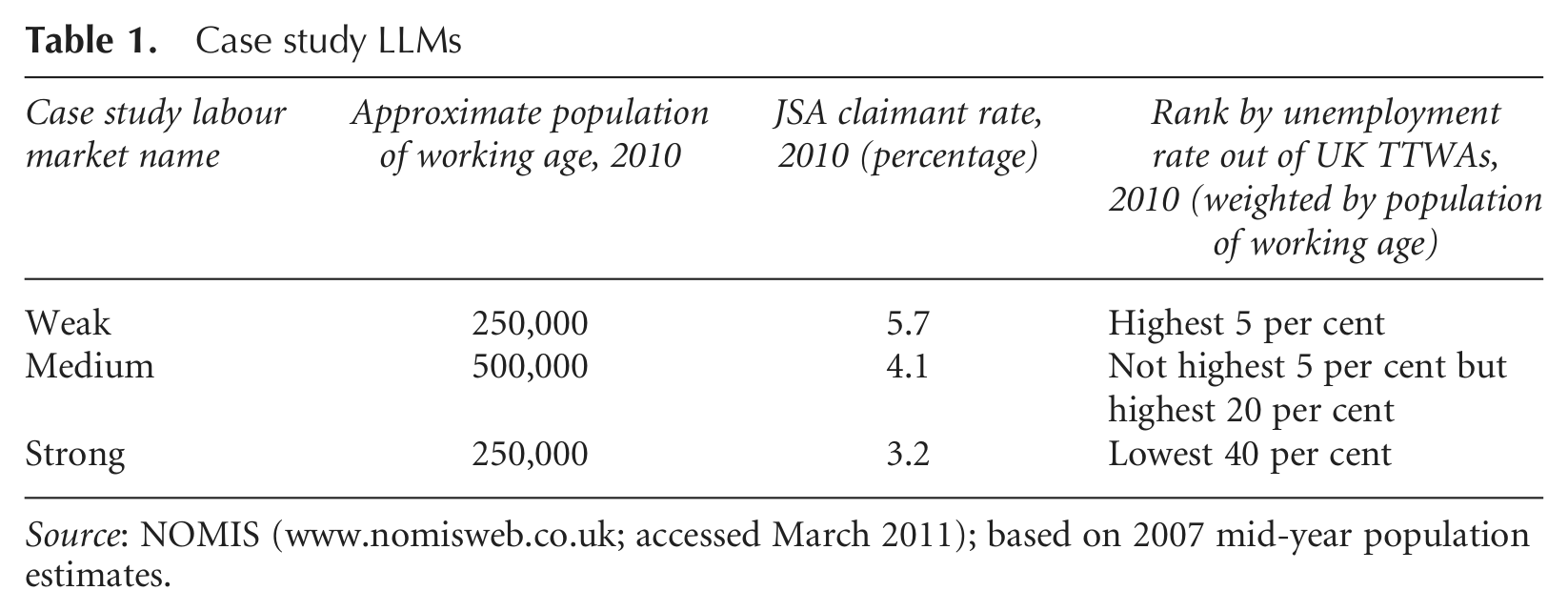
Source: NOMIS (www.nomisweb.co.uk; accessed March 2011); based on 2007 mid-year population estimates.
Three neighbourhoods were selected in each LLM using the following criteria, based on desk research on local identity and reputations; analyses of secondary sources on deprivation levels, ethnic mix and accessibility indicators; and field visits—including street interviews (discussed in more detail later) which were used to confirm the poor reputation and bland reputation of shortlisted areas
—two particularly deprived neighbourhoods with well-established ‘poor’ reputations (five out of the six neighbourhoods were in the top 5 per cent of Indices of Multiple Deprivation [IMD] scores and one was in the top 15 per cent) and one not particularly deprived neighbourhood (all three neighbourhoods were in the middle 40–60 per cent of neighbourhoods on IMD scores) with a ‘bland’ reputation, to serve as a comparator;
—each had relatively strong local identities, linked to identifiers including neighbourhood name, main street name or postcode;
—each had relatively small minority ethnic populations (the White British population share was around 97 per cent in the neighbourhoods in the ‘weak’ LLM, 93 per cent in the ‘medium’ and 90 per cent in the ‘strong’ LLM);
—all were at a similar distance and public transport travel time from the city centre, to limit (although not exclude) any effect of employer preference for more accessible employees (Green et al., 1991; Zenou, 2002; Lupton, 2003b; Nunn et al., 2010).
Field Visits and Street Interviews
The field visits included interviews with 81 members of the public, providing what appears to be the first, although small scale, evidence of the perceptions of the general public on potential neighbourhood reputation effects. In each LLM, members of the public identified the worst reputation two or three neighbourhoods with remarkable consistency. This was used to confirm the selection of the ‘poor reputation’ and ‘bland reputation’ neighbourhoods from desk research. In each of the three LLM areas, just over half of those interviewed (53 per cent) thought that the ‘poor reputation’ case study neighbourhoods were undesirable places to live. The same proportion thought it was ‘very’ or ‘fairly likely’ that local employers would look less favourably on people from these or similar areas. Only a minority (23 per cent) thought that it was ‘very’ or ‘fairly unlikely’ that employers would look unfavourably on applicants from these neighbourhoods.
Interviews with employers
To provide insights into employers’ awareness of neighbourhood reputations, attitudes to different neighbourhoods, assessment of neighbourhood reputation as a factor in decision-making, and to confirm our understanding of employers’ recruitment methods and the realism of the applications used in the experimental method (discussed later), we interviewed 14 employers and 11 labour market intermediaries (i.e. employment agencies and job seekers’ advisors). Employers interviewed were based in the three case study LLMs and had recently recruited people to one or more of the job types examined in the experiment (see later). They encompassed different establishment sizes and industries, predominantly from the private sector but also from the public and voluntary sectors.
All employers and labour market intermediaries interviewed were aware of certain neighbourhoods with poor reputations. Again, there was consistency between interviewees and their views overlapped closely with the assessment of the general public and desk research. Three of the 11 labour market intermediaries thought that neighbourhood reputation effects on employment might exist. One intermediary in the medium LLM reported some cases of applicant perceptions of neighbourhood reputation effects There have been instances where people have said: ‘Because of where I live, I won’t get a job. They won’t trust me’.
Another, from the weak LLM, said that he believed in neighbourhood reputation effects strong enough to promote action We used to take address off applications … we remove address to remove a stigma.
In the strong LLM, another said Employers would say ‘no’ to the idea that they discriminate on area—but privately the answer is ‘yes’.
This respondent subsequently significantly amended the point, “it’s not necessarily about prejudice, but the majority of people have barriers to entry”. While this evidence is strong enough to support the hypothesis that neighbourhood reputation effects might form a partial and subsidiary explanation for variations in employment rates, and encourages further exploration, it is not in itself strong enough to support a hypothesis that they are a major explanation.
Almost all employers stated unambiguously that they looked equally on applications from all areas. However, one private-sector employer from the strong LLM explicitly showed awareness of the potential for discrimination, but claimed that he would not apply it in practice, at least up to interview stage I am not going to be that prejudiced on areas … So you get ‘em in, and see what they’re like … (emphasis added).
One of the employers interviewed in the medium LLM admitted to ‘thinking twice’ about applicants from some neighbourhoods There are areas where you sort of think, hmm, you know, not too sure about that … where you have a large number of unemployed people, where you have council accommodation.
Some of the employers stated preferences on other grounds such as distance to work, clothing and accent.
The Experiment
The jobs search and application strategy of fictional job applicants
In the experimental phase of the study, we searched for and applied to real jobs in the three LLMs that fitted the following criteria
—jobs advertised on www.direct.gov.uk, 2 gumtree.com and aggregator sites;
—advertised August 2010-June 2011;
—the job location appeared to be within the TTWA boundary;
—selected job types (office admin, cleaner, security guard, sales assistant, accounts clerk, kitchen hand and chef jobs). These job types did not require degrees, vocational qualifications or substantial experience, but were prevalent enough to give a good overview of the low- and medium-skilled labour market and included jobs principally held by men, by women and either gender.
From this subset, we selected jobs that met the requirements of the experimental method
—for which main recruitment and selection decision-maker appeared to be based in the LLM, and was likely to be aware of local neighbourhood reputations;
—could be applied to without face-to-face or phone contact (i.e. via email, upload to website or post); and
—for which the closing date was at least 2–3 days hence, to allow time to make three applications that did not arrive simultaneously.
The jobs applied to
Between August 2010 and June 2011, 2001 applications were made to 667 jobs (i.e. three applications in each case). There were 197 applications to office admin jobs, 139 to retail jobs, 97 to chef jobs, 75 to cleaner jobs, 74 to kitchen hand jobs, 73 to accounts clerk jobs and 12 to security guard jobs, reflecting the incidence of vacancies and variations in the extent to which jobs fitted experimental constraints. Of the jobs applied for, 246 were in the strong LLM, 261 in the medium LLM and 159 in the weak LLM; 76 per cent of jobs applied for did not offer a traditional full-time ‘9am–5pm’ work schedule. This largely reflects the type of jobs available via www.direct.gov.uk in the three LLMs. Fifty-four per cent of the jobs for which wage data were available paid at the minimum wage level.
The characteristics of the fictional job applicants
‘Personas’ were created for each of the job types applied to, with fictional names, addresses, dates of birth, educational and work histories and real phone numbers and email addresses, which were used as the basis of CVs and covering letters. These were then slightly tailored to individual jobs. It is possible that employers might be more likely to express neighbourhood reputation discrimination against less attractive candidates. This has been found in the case of ethnic discrimination (Dovidio and Gartner, 2000). However, the personas were intended to represent people who would be relatively attractive candidates for jobs that required limited education and skills. The aim was to limit the number of cases in which none of the three applicants was successful, which would hinder investigation of discrimination, while ensuring applications were realistic. To obviate any employer preference for other characteristics, all three applicants for any one job had the same gender. All had names chosen to avoid signalling minority ethnicity (see Wood et al., 2009, for further discussion). All were in their early 20s.
One of the three applicants for each job appeared to be living in each of the three local neighbourhoods selected. The applicant address, including a fictional numbered home in a real major street in the area likely to be well known, the area name and the postcode were prominently stated at the top of each CV. Applicants differed in their exact qualifications and work experience, and CV typeface and layout used, in order to maintain as much similarity between candidates as possible without raising the suspicions of employers. Addresses in each of the three neighbourhoods were allocated randomly to the three prepared CVs and covering letters as the final stage of the process in application to every job. CVs’ contents were placed on one of three CV templates with different fonts and layouts, which were made similarly attractive. Age, qualifications and work experience were rotated between CV templates at intervals throughout the experiment. This random allocation ensured that any differences in employers’ responses to candidates living in different neighbourhoods could not be attributed to their age, the style of their CV, exact qualifications or minor differences in work experience.
Most other applicant characteristics were largely determined by job type and were intended to create candidates for the various jobs who were promising but not exceptionally overqualified. In 286 (43 per cent) of the jobs, all three applicants were male; in the remainder, all were female. Jobs were allocated by gender in accordance with the gender profile of employment revealed by secondary data sources. The slight predominance of female applicants in the experiment overall reflects the availability of job types advertised and the availability of jobs which we could apply to using our methods.
Applicants were allocated academic and vocational qualifications of the types commonly held by young people in the LLMs and relevant to the post they were applying for. All of the applicants had continual work records since they had completed education and some were given Saturday job experience before this.
Wherever a job required a car and a clean driving licence, they were given to all three applicants, and likewise to candidates for any jobs with unsocial hours in order to distinguish between any discrimination by employers based on ‘travelability’ rather than discrimination against people from areas with poor reputations. Hence the candidates had a higher rate of private transport mobility than might be typical for applicants for these types of jobs.
Making applications
The majority of applications took the form of a CV or a CV and covering letter. Covering letters were used in many cases, even if they were not explicitly demanded by employers, in order to maximise positive response. Over 85 per cent of applications were made via the Internet. We used local assistants to put the remainder of applications in the post, to achieve local postmarks. In most of these cases, we avoided sending all the applications on the same day in order to reduce employer suspicion. In most cases, applications were made very rapidly after advertisements were first posted on the Internet. More than half were sent within three days of the advert first appearing.
Recording the results for the fictional candidates
After sending off three matched applications to any one job, we monitored specially established email and voicemail accounts to receive employer responses. We were not able to monitor any employer responses that might have been made by post to applicants’ home addresses, but employer and intermediary interviews suggested that communication by post was exceptional. As the addresses used were false ones, any employer writing to one of our candidates would have had mail returned and could then have tried another means to get in touch, but we did not learn of any such experiences.
Some 620 applications (31 per cent) resulted in responses from potential employers. When we received a positive response, we responded as fast as possible via email to withdraw the applicant from consideration, stating that the candidates had already accepted another offer or that their circumstances had changed. Where more than one application for the same job received a positive response from employers, the style and content of our responses to employers were varied. One month after the application, we stopped monitoring for responses.
The experiment was concerned with positive responses at the first selection stage. Thus the experimental results cannot be applied directly to subsequent stages, such as interviews, or to the selection process as a whole.
Results of the Field Experiment
‘First-stage’ Positive Response Rates
A total of 17 per cent of the 2001 applications received one of a range of first-stage positive responses. This share of positive responses is higher than that achieved in another recent experimental study (Wood et al., 2009). This may reflect differences in the mix of jobs applied for, the LLMs studied or the quality of experimental applications.
Three applicants were offered a post right away. Most first-stage positive responses did not lead directly or with any certainty to job offers. Thirteen per cent of applicants were invited to meet employers and 2 per cent were asked for further information—for example, what days and hours they might be able to work. Thus fewer than one in five of the experimental candidates got through the first round of selection for jobs that required relatively limited skills and experience, and which generally paid close to the minimum wage. Young people with fewer labour market advantages would be likely to experience lower first-stage positive response rates when applying for the same sorts of jobs. Thirteen per cent of applications received one of a range of responses we classified as negative, including an acknowledgement of application but no further correspondence, or notice they had been unsuccessful; 69 per cent of applications received no response of any kind.
Previous studies using an experimental method to test for discrimination in employment have discussed several possible methods of conceptualising discrimination and analysing results (for example, Riach and Rich, 2004). The key issue is how to deal with jobs in which none of the candidates received a positive response, and those in which all of the candidates did. The first case suggests none met some minimum standard, or that no appointment was actually made, and offers no sign of preference between the experimental candidates. Wood et al. (2009) who conducted the most recent experiment of this type in the UK, and Bovenkerk (1992), who has prepared a manual for the conduct of these tests and analyses, argue that non-response to all candidates should not be treated as positive evidence of non-discrimination by employers. In the second case, all met some minimum standard and, while all appear to have been preferred over any other real candidates applying, there is no sign of preference between them.
In 475 (71 per cent) of the 667 jobs applied for, none of the three candidates received a first-stage positive response. In the remaining 192 (29 per cent) of jobs, employers gave a positive response to one or more of our candidates for the same post. These are the cases used to explore employer preferences and discrimination, following Bovenkerk (1992) and Wood et al. (2009).
‘First-stage’ Positive Response Rates Where Employer Showed A Preference for One or More Candidates
In accordance with the experimental methodology deployed, in each of the 192 sets of applications with at least one first-stage positive response, one of the applications was for a candidate from a bland reputation neighbourhood. Of these, 140 (62.5 per cent) applications received a first-stage positive response (Table 2). The other two applications in each of the 192 sets were from candidates from poor reputation neighbourhoods, totalling 384 applications. Of these, 230 (59.9 per cent) applications received a positive response. The 2.6 percentage point difference between the success percentages for the two neighbourhood types provides a measure of aggregate net ‘postcode discrimination’. However, the net preference was small and it was not statistically significant at the 1 per cent, 5 per cent or 10 per cent level.
Employers’ preference for applicants from different neighbourhood types
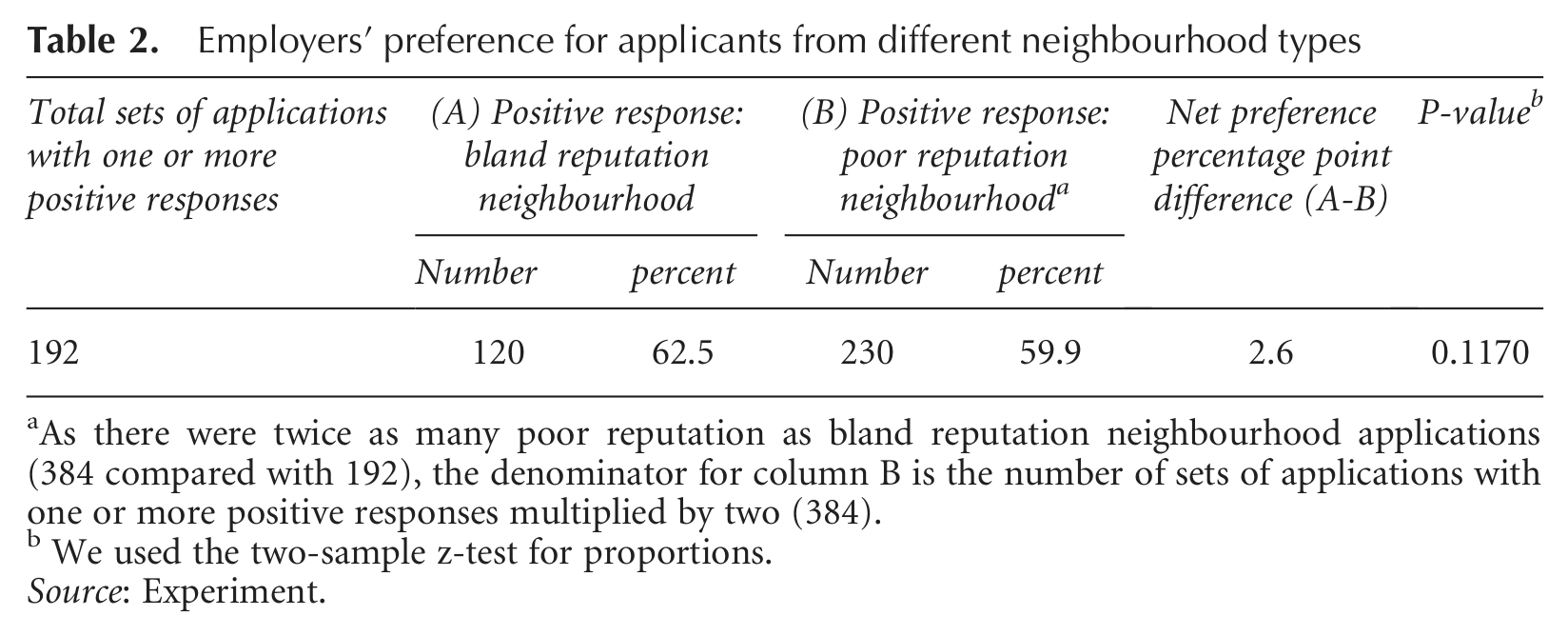
As there were twice as many poor reputation as bland reputation neighbourhood applications (384 compared with 192), the denominator for column B is the number of sets of applications with one or more positive responses multiplied by two (384).
We used the two-sample z-test for proportions.
Source: Experiment.
In each of the three LLMs, there was a difference between the positive response rates for the neighbourhood types, with applications from the bland reputation neighbourhood having a slightly higher positive response rate. The level of net preference found was highest in the medium LLM, at 4.5 percentage points, but in no area was it statistically significant.
We examined subsets of the results for evidence of ‘postcode discrimination’ in any particular job or employer type. In some cases, there was evidence of a small amount of net preference, but in no case was the difference in positive responses between those from neighbourhoods with different reputations statistically significant.
In summary, we do not find statistically significant evidence that employers prefer those living in neighbourhoods with bland reputations to those living in neighbourhoods with poor reputations, in the case of attractive candidates looking for work in selected jobs requiring limited education and skills, in three contrasting LLMs. There was some net preference for candidates from neighbourhoods with bland reputations but it was small in size and not statistically significant.
Discussion
The ‘Stigma’ Neighbourhood Effects Pathway and Variation in Employment between Neighbourhoods
Based on this evidence, the hypothesis that residents of neighbourhoods with poor reputations fare worse when applying for relatively low-skilled jobs than residents of neighbourhoods in the same labour market with better reputations was not proven.
It remains possible that, in a larger correspondence test study, the net preferences found would achieve statistical significance. It also remains possible that poor neighbourhood reputation might create neighbourhood effects on employment in parts of these LLMs or parts of the recruitment and selection process that were outside the scope of this experiment, in particular for unpromising candidates and for jobs applied to face-to-face.
As it stands, this is a different result from that found through multivariate analysis by McGregor (1977). One interpretation is that the earlier study’s method was not able to take account of all hidden variables. Another, perhaps more important one, however, is that the market for male manual labour in Glasgow in the 1970s differed from the market for low-skilled service employment for both genders across England and Wales in 2010–11.
The size of the net preferences is small in relation to the differences in employment rates between neighbourhoods. It is not so small in relation to the typical size of neighbourhood effects, one explanation for differences in employment rates, as revealed in empirical studies (for example, Lupton, 2003a; Syrett, 2008; van Ham et al., 2012).
Reviewing the Sources for the Ideas about the ‘Stigma’ Neighbourhood Effects Pathway
The idea that poor neighbourhood reputation might provide a pathway through which neighbourhood effects might operate appears to have developed through qualitative research which indicates variations in reputation coinciding with variation in employment, and the presence of beliefs about neighbourhood effects amongst at least some residents and LLM intermediaries. One of the irreplaceable functions of open-ended qualitative work is to explore new areas of social enquiry and to generate hypotheses. However, not all such hypotheses are the same and the strength of evidence behind them, and the indications of the prevalence and salience of the processes they identity may vary.
Most existing qualitative studies which have produced evidence of potential or perceived neighbourhood reputation effects on employment have not been focused on neighbourhood reputation effects (Lawless and Smith, 1998; SEU, 1998; Taylor, 1998; Fieldhouse, 1999; Roberts, 1999; Dean and Hastings, 2000; Speak, 2000; Mellor, 2002; Taylor, 2003; Aleksandraviciene et al., 2005; Dewson et al., 2007; Sanderson, 2006; Green and White, 2007; Fletcher, 2007; Fletcher et al., 2008). Many have not asked explicitly or directly about neighbourhood reputation effects, but have recorded references that emerged in open-ended enquiries or as interesting by-products of research into other issues. Thus they have tended to record mentions of potential neighbourhood reputation effects without taking into account their prevalence or salience as potential explanations for individual employment status or neighbourhood employment rates, or the extent to which direct experience is reported.
In a study of young unemployed people in Newham in London, Roberts (1999) found that almost a third of young people from the most deprived parts of the borough thought that employers were put off by the area in which they lived. The converse finding was that a majority of residents did not think that poor neighbourhood reputation might create neighbourhood effects on employment. The evaluation of Working Neighbourhood Pilots found that just over one in ten residents thought that ‘employers don’t want to employ local people’ (Dewson et al., 2007). The converse is that almost nine in ten did not agree with this idea. In both cases, the context of the research might have encouraged respondents to point to barriers to employment other than their own characteristics and behaviour. Like Roberts (1999) and Dewson et al. (2007), we found that only a minority of interviewees supported the neighbourhood reputation effects hypothesis. Members of the public were most likely to think that neighbourhood reputation effects on employment might exist, but they were also the group least likely to have direct experience or evidence of neighbourhood reputation effects.
It is possible that neighbourhood effects may be specific not only to national or neighbourhood contexts, but also to particular time-periods. Over the past five years, employers even for low-skilled, low-paid and manual work, have switched from paper and mail to electronic applications. This practice was reflected amongst employers interviewed for this project, with the partial exception of those employing kitchen hands. This has meant that circumventing any poor reputation neighbourhood effect by using a false postal address is both virtually costless and practically redundant.
Conclusions
In summary, this paper has found evidence to contradict the hypothesis Residents of neighbourhoods with poor reputations fare worse when applying for relatively low-skilled jobs than residents of neighbourhoods in the same labour market with better reputations, all other things being equal.
The result suggests that relatively well-qualified candidates from areas with poor reputations should not fear postcode discrimination, at least up until the interview stage of the recruitment process. It remains possible that poor neighbourhood reputation might create neighbourhood effects on employment in parts of these LLMs or parts of the recruitment and selection process that were outside the scope of this experiment. However, centralised and electronic recruitment may be reducing the scope for these effects in large parts of the labour market.
On the basis of this evidence, there is no argument for policy interventions, including policies to reduce sorting or to address this neighbourhood effect pathway more directly, on the grounds of neighbourhood effects on employment. Nonetheless, there may be other arguments for these policies on area reputations; for example, that residents of areas with poor reputations suffer discrimination in the provision of services, or face unequal treatment or recognition.
The paper demonstrates the value of investigating the sources of ideas about neighbourhood effects pathways, and the factors necessary for pathways to operate, as well as for testing pathways themselves. It demonstrates the value of experimental methods in exploration of neighbourhood effects. It also demonstrates how mixed methods approaches may add to the value of individual elements of research. As existing evidence on neighbourhood effects suggests that the size of the effects is relatively small compared with differences in employment rates between neighbourhoods, the results of this work do not rule out a possible contribution of area reputation to neighbourhood effects on employment rates.
Footnotes
Acknowledgements
The authors would like to thank all those who gave time to be interviewed, and two anonymous referees of this paper.
Funding
The authors would like to thank the Joseph Rowntree Foundation for funding the research on which this article is based.