




Abstract
Street youth have been part of South Africa’s cities since the 1980s, maintaining a visible and mobile presence. Contemporary adaptations to urban governance strategies in Cape Town have resulted in management practices that are creating challenges for street youth’s lives. This paper explores these challenges which have emerged through strategies to clean up the city and are aimed at reducing youth’s visible presence on the streets. Through an examination of street youth’s lives, this paper conceptualises four ways in which their mobilities have changed, dramatically affecting their everyday practices. The paper develops theoretical understandings of street youth’s lives by identifying ‘new’ street geographies. This moves away from current conceptualisations of street children/youth as having a visible presence on the streets and rather expresses street life as hidden and marginalised, pushed into less wealthy parts of the urban landscape. This has significant implications for addressing street children/youth’s needs in policy contexts.
Introduction
Geographers have long been investigating young people’s relationship with urban space. Initially, researchers drew attention to children and youth’s invisibility in the city, noting that they were either ignored or viewed as out of place and therefore disruptive (Connolly and Ennew, 1996; Sibley, 1995). Attention quickly turned to demonstrating young people’s capacities for understanding their environments (Matthews, 1992) and to challenging the lack of attention they received in planning and designing city spaces (Chawla, 2002). Coupled with the renewed interested in young people’s lives in the 1990s through developments in the sociology of childhood, which positioned young people as social actors, children and youth were seen to be creating their own urban spaces (Valentine, 2004). In the following decades, children’s and youth’s urban lives have been well researched, albeit with a focus on case study research perhaps to the neglect of wider socioeconomic processes (Ansell, 2009). This has included work exploring the lives of street youth (Abebe, 2008; Beazley, 2000; Young, 2003). Yet, despite the significance of this work in drawing attention to the daily struggle for survival on the streets, mobility has been uncritically examined as a central process for street youth. Through unpacking the complexities of street youth mobility, which highlight the diverse positive and negative ways in which mobility is utilised as a necessary coping strategy and to contain and remove youth from the streets, this paper takes a broader approach to contextualising their everyday practices within the wider socioeconomic and political context.
The paper addresses three specific objectives: first, to theorise street youth’s place in the urban landscape in relation to the wider context, achieved through a focus on urban governance strategies in Cape Town; secondly, to explore the nuanced ways in which street youth’s complex urban mobilities are creating ‘new’ street geographies in response to these urban management practices; and, thirdly, to identify policy implications for addressing the needs of marginalised street youth.
I begin by conceptualising the relationship between street youth and mobility alongside contextualising urban governance in Cape Town. I then turn to the empirical data to demonstrate the ways in which street youth are engaging in daily mobilities and how this is shaped by recent urban management practices. Through this process, I develop a novel conceptualisation of the changing nature of street geographies and its significance for wider international policy on street youth’s lives.
Youth and Mobility in the City
Holt and Costello (2011) postulate that the contributions children/youth can make to our understanding of daily life through exploring their mobility practices has, in some ways, been overlooked. Although calls for bringing children/youth into migration research, which deals with broader trends and analysis of demographic shifts and patterns, are being responded to (McKendrick, 2001; van Blerk and Ansell, 2006); the micro mobilities of children/youth’s lives, those daily movements around local areas and between home, school and street, require more attention (Holt and Costello, 2011).
For youth in the city, the ways in which they engage with urban space is inherently mobile. They use the city creatively on a temporal (often at night) or a spatial (less overtly public locations) basis: carving out special niches where social gathering and identity formation can take place (Matthews et al., 1998; Ward, 1978; Hopkins, 2010). Yet youth are often excluded in the city (Sibley, 1995) as moral panics associated with youth in public space mean that they can be subject to prejudice based on their age and fear of their potential involvement in crime, rather than any actual criminal activity (Langevang and Gough, 2009; Pain and Francis, 2004; Pickering et al., 2012; Watt and Stenson, 1998). As Katz (2006) highlights, youth are seen as a risk to the city, particularly those from poor communities. Therefore, when youth congregate in places not specifically designed for them, or not sufficiently marginal that they are ‘invisible’ to the public, they are seen as threatening and kept under close surveillance. Youth mobility in the city has therefore emerged as a central process in the creation of their urban identities, giving them freedom to express themselves, to meet others, to have fun and to subvert the disruptive notion that their presence in public space portrays.
The complexity of this mobility needs to be further unpacked. The freedom that mobility enables must be juxtaposed with the negative forms of mobility to which youth can be subject. Creswell (2006) is particularly critical of theorists such as Deleuze and Guattari, de Certeau and Tschumi, who generally only explore mobility positively. He argues that the act of mobility has a hidden politics and is socially differentiated, where there is unevenness to mobility that does not always equal freedom. Gill et al. (2011) illustrate this through their work on forced migration where mobility can be imposed upon populations that would prefer to be sedentary. Not only is this mobility undesirable, it can then also create a state of immobility in refugee camps, while migrants wait to hear their fate.
When we apply this to urban youth in the global South, where research has recently began to emerge exploring mobilities (Langevang and Gough, 2009; Porter et al., 2010; van Blerk, 2005), the complexity of this juxtaposition is apparent. Despite the centrality of positive mobility to much of daily life, where youth move around to access education, employment and livelihoods (Rigg, 2007), for freedom (Porter et al., 2010) to help/care for others (Ansell and van Blerk, 2004), or to develop social networks (Langevang and Gough, 2009), youth are still subject to forced mobilities, moved on in the street, subject to curfews or excluded from certain areas. Benwell (2009) draws attention to this ambiguity in Cape Town where the legacy of apartheid, coupled with other factors such as age, fear/safety, remoteness and the physical environment, all produce a liminality where young people experience freedom through mobility in their local neighbourhoods but others are subject to restrictions through fear of the ‘other’. Similarly in Accra (Langevang, 2008) and Kampala (Young, 2003), despite youth accessing freedom in the city through mobility, this can be viewed by adults as dangerous resulting in mobility employed as a subversive tactic, moving around in order to escape the gaze of police or security. This demonstrates not only the importance of understanding the nuances of mobility practices, but also that such practices are relational, shaped by changing power relations where power shifts between different actors in different places and at different times.
Conceptualising Mobility and the City in Street Youth’s Lives
The connections between mobility and the city are especially applicable for street youth. Although the literature indicates connections to special places: Beazley (2000) in Indonesia and Young (2003) in Uganda both identify the marginal spaces and times in which street children/youth use the city, identifying unique locations such as rubbish sites, rooftops, drains, toilets and transport hubs as places for eating, sleeping and washing. It is the creative way street children/youth engage in mobility that enables them really to make use of the city. From first introduction to street life, mobility plays a key role: both as a strategy for accessing the street and as necessary for surviving the daily struggles (Beazley, 2000). Mobility enables youth to break out of problematic home lives and gang-related networks in their communities (van Blerk, 2012) and to survive on the streets—albeit within contexts that result in mobility sometimes being forced and not always a positive experience, as they are moved on and pushed into marginal locations (Young, 2003).
Mobility is so central to street life that it is intricately bound up with street identities. However, the internationally recognised terminology of ‘street children/youth’, discourages association with their mobility. The term locates youth in the ‘street’, which is static, excluding their capacity to move between different social and spatial environments, and it associates negative characteristics of street environments, such as homelessness, vagrancy and crime, with childhood (Conticini, 2004). In contrast, the locally recognised pseudonym for street children/youth in Cape Town—‘stroller’, meaning to drift—illuminates the connections between their mobility and urban life (see Hansson, 2003; Parker-Lewis, 2004). As Hansson points out, strolling refers to the general way of life of Cape Town’s street youth. It is a rich complexity of social processes … [where] tolerance on the part of the host communities rarely lasts for lengthy periods because the environments in which strolling takes place are dynamic (Hansson, 2003, p. 4).
Although she begins to illustrate the itinerant, non-static nature of strolling, which is distinguished from other forms of street life through three particular activities: “aanklop (begging from pedestrians and motorists …); parking [as attendants]… and glue sniffing”, I contend that mobility has much greater importance for street life. The wider literature on street children/youth demonstrates that they move around the city to engage in street activities, which are visible and often interactive with members of the public. Across continents, research details the ways in which they use mobility to access livelihoods, often travelling to different areas of the city to earn an income because of particular opportunities, so that they can steal, beg or work, and may even use public transport as a means for earning while travelling (Abebe, 2008; Beazley, 2000; Jones and Thomas de Benítez, 2009; van Blerk, 2007, 2005). Mobility is also important for social activities, to access help and support (Hansson, 2003), and to evade law enforcers or gangs (Young, 2003). As this paper will show, it is through mobility that the dynamic process of street life takes place.
In conceptualising street life, the new mobilities paradigm (Sheller and Urry, 2006) offers an important theoretical framing for situating the micro mobilities of street youth’s daily life within wider social, political and economic contexts. This paradigm importantly highlights a shift within the social sciences of movement away from an a-mobile focus on society to an understanding of daily life as transcending spatial boundaries connected through relational networks. Mobility is therefore socially produced and full of meaning and power. This power is sometimes held by those engaged in mobility, but sometimes by outsiders shaping the nature of that mobility (Gill et al., 2011). Therefore, although mobility is enabling for some and often seen as a privileged state, it is not always. Yet, Sheller and Urry (2006, p. 211; drawing on Skeggs, 2004, and Morley, 2000) move on from this idealised position of privileging a ‘mobile subjectivity’ towards an understanding of mobility as both reflecting and reinforcing power relations. They and other mobility theorists (Cresswell, 2006; Adey, 2010) are critical of those who link power and mobility only positively as power enabling mobility, or mobility as the freedom to evade power. They contend that “mobility is a resource to which not everyone has an equal relationship” (Sheller and Urry, 2006, p. 211). Within this paradigm, street youth cannot be viewed as statically located in the street, but dynamically connected to the city through their movement.
Power relations, therefore, are central to understanding the ways in which street youth engage with the city and how competing agendas shape their mobility practices. More often, street youth are seen as being powerful through their mobility-shaping identities and accessing resources. Even where mobility is engaged with subversively, street youth as mobile subjects are seen to be negotiating control (van Blerk, 2005). Little attention has been paid to street youth’s mobility as shaped by power held by others, where the effects of mobility are not always beneficial. Yet, both Langevang and Gough (2009) and Porter et al. (2010) note for other youth that not only are they engaging in diverse mobility strategies as part of their daily survival and identity formation in urban areas, but these mobilities are framed within wider socioeconomic and political contexts. It is the impacts of these wider contexts that have often been neglected and constitute a key criticism of much work in geography investigating the lives of children/youth (Horton and Kraftl, 2006). Through investigating the lives of Cape Town street youth, this paper will respond to this criticism by following Ansell’s (2009) call to investigate youth’s lives more broadly, examining the daily minutiae of street life, not in isolation, but rather through exploring how temporal and spatial aspects of daily urban life may be affected by governance processes beyond the control of street youth themselves.
The contextualisation of street youth mobilities within the agenda to position Cape Town on the global stage, as a global city, facilitates a more nuanced understanding of how and why power relations are shaping street life and changing mobility practices.
The Changing Context of Cape Town’s Global Position: Urban Governance Strategies in the City
Cape Town’s political, economic and social histories, coupled with the unique physical attributes of the city, have resulted in a special prominence on the global stage—for instance, as a tourist destination—despite the existence of huge inequalities among its communities. Since the early 1990s, Cape Town has embarked on processes of spatial governance that have pushed the city to become increasingly integrated into the global economy following normalisation of relations in the post-apartheid era (Lemanski, 2007, 2006, 2004; Miraftab, 2007; Robinson, 2002; Samara, 2005; Wilkinson 2000). However, Cape Town’s journey is historically grounded as apartheid policies have left a legacy of social and spatial inequalities. For example, the 1950 Group Area Act intensified and formalised residential segregation along a systematic ‘race’ classification. This included the dislocation of some well-established inner-city communities and the forced removal, by the end of the 1960s, of an estimated 150 000 people to new public housing built on the Cape Flats. 1 By the 1970s and 1980s, the failure to provide enough public housing to meet the demand resulted in new squatter settlements springing up on the city outskirts. Poor conditions in the townships made the Cape Flats difficult to govern other than through social exclusion policies (Lemanski, 2004).
Against this backdrop, the reintegration of South Africa on the global stage in the 1990s resulted in two conflicting agendas: on the one hand, the desire for Cape Town to reach global city status in terms of attracting international investment, economic growth and tourism in order to demonstrate (Western) goals of urban achievement (Robinson, 2002); and, on the other, the need to implement pro-poor strategies to address the legacy of social and spatial inequalities. In fact, the former has often been associated with the increasing polarisation and inequality (Samara, 2005, 2010).
In July 1999, Cape Town implemented a strategy for establishing City Improvement Districts (CIDs): a policy that mirrored the urban revitalisation strategy popularised by Guilliani’s approach to cleaning up New York (Samara, 2003, 2010). CIDs are special zones within the city that are managed through public–private partnerships with property owners and receive additional privately funded public services. The Central City Improvement District (CCID) was established in November 2000. Its management team—the Cape Town Partnership—comprises government departments, business and property owners, the tourist board and the chamber of commerce. Its two central aims are: to achieve world-class standards in the city centre; and, to establish the city as globally competitive.
In the following 6–7 years the CCID used its additional funding to ‘clean up’ crime, through private security companies and CCTV; and dirt, through private refuse collection and street cleaners (Lemanski, 2007; Samara, 2003). The transformation of the city centre has been significant with increased investment, new developments and tourism bringing businesses and visitors in, supported by the lure of Cape Town as a 2010 World Cup site (Cornelissen, 2011), and contrasting with the 1990s when businesses and residents were moving out of the city to safer locations. In addition, CIDs have powers to enforce the city’s municipal by-laws regulating the uses and users of public space. This includes the exclusion of informal traders to formalised market spaces, the regulation of parking attendants and the removal of vagrants, in particular street youth, who are no longer seen to have a place in the city (Miraftab, 2007). Further, the successful World Cup bid brought with it additional by-laws for regulating public space in the host cities (Cornelissen, 2011).
The impact of the initial phase of implementation (2000–03) on street youth was a series of harsh tactics resulting in their systematic and forced removal from the city as they were regularly picked up in random city round-ups and reportedly beaten (Samara, 2005). Youth were pushed out of the city centre and into the commercial centres of the southern suburbs, positioned as security threats and obstacles to renewal (see Figure 1). Safety and security were seen as the primary tasks, achievable only through a crackdown on crime and applying a zero tolerance approach. Samara (2003) suggests that this used both the discourse and practice of a ‘war on crime’, basically overshadowing the social development remit the African National Congress had when it came to power. Although the CCID now operates with a social development policy, the municipal by-laws continue to be enforced. It was against this backdrop that this research took place.
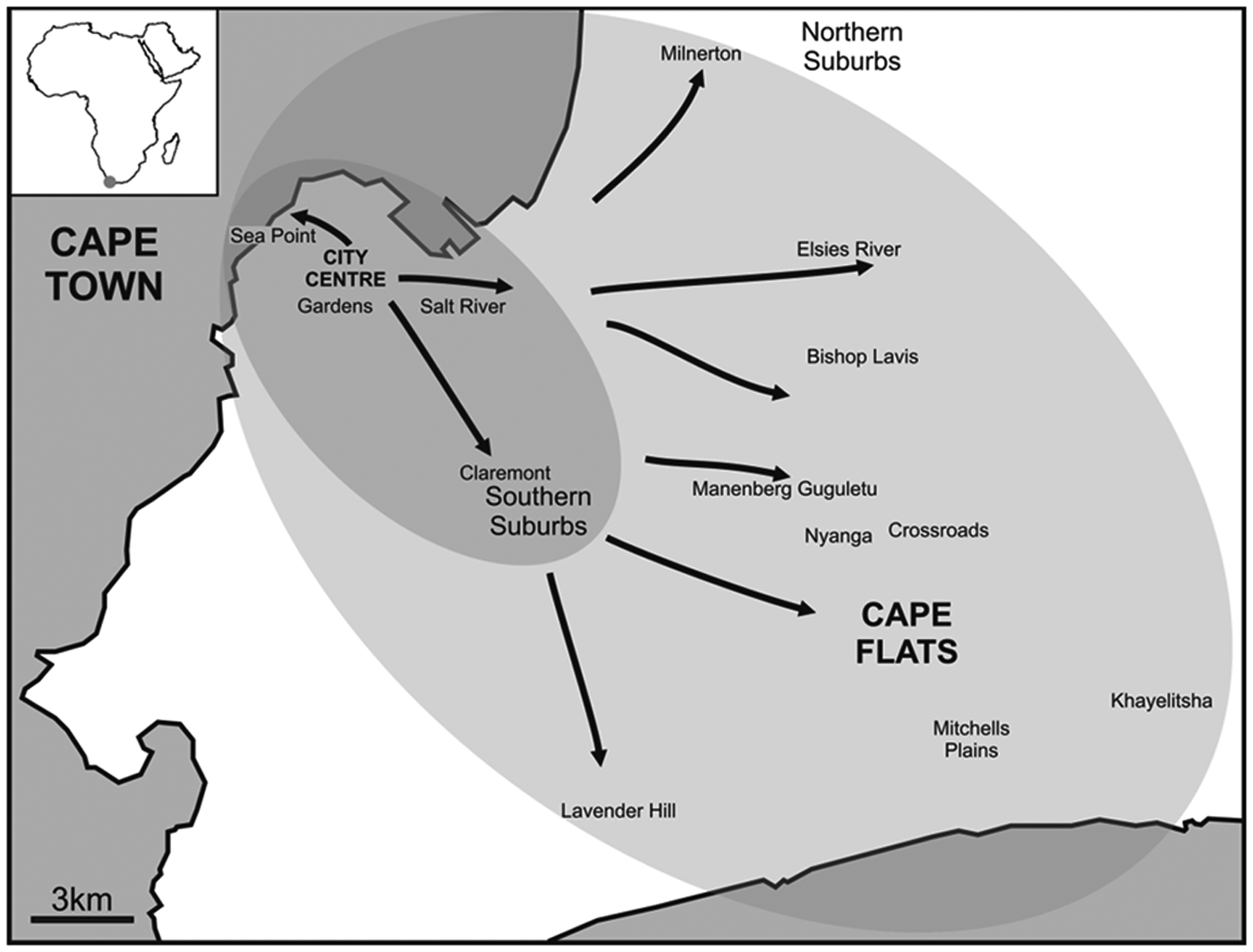
Street mobilities in Greater Cape Town.
The Research
Through ethnographic and participatory research with street youth, following Bemak’s (1996) ‘street researcher’ approach, I engaged in a lengthy period of ethnography that took place over several months from August 2006. This involved being on the streets at various times of the day and evening, and being mobile on the streets, moving around to where youth were and meeting and spending time with them in places where they were comfortable. Sometimes the nature of hanging-out is in itself mobile, moving around while engaging in conversation with youth as they go about their business. Sometimes I met with a larger group, spending long periods on the streets, playing football and eating food. At other times, interactions were shorter and might involve a brief visit to a smaller group or an individual, while in the city on other research tasks or when accompanied by one of my children. 2 Initially, I was accompanied by one of two former street youth, still well respected on the streets, who acted as cultural advisors and translators and who were recommended to me by several organisations including the Homestead. 3 This was essential for developing a trust-based relationship, in order that through time I could be accepted on the streets.
During this phase, it became apparent that it was more difficult to find street youth in the city centre than I had expected. The number of youth visible on the streets appeared to have dropped significantly since the 1990s and specifically in the years immediately preceding fieldwork. This became a preoccupation in discussions both with Homestead staff and cultural advisors, and immediately raised questions regarding the possibility that youth were no longer making use of the streets in response to community and home life concerns. However, through these discussions and the research itself, it became apparent that the implementation of particular urban governance strategies, implemented by the CCID in recent years, had significantly affected the street population. Widening the search to outlying areas, it became possible to piece together a picture that demonstrates that youth are still affected by the same problems but that they are expressing these differently through the way they use the city.
Through this process, I engaged with 50 street youth, aged 10 to 28, living in the city centre and several outlying suburbs of Greater Cape Town. Most youth on the streets were boys, with a smaller proportion of girls. 4 Most had been on the streets for several years, had come as children due to problems at home and were very well connected to the streets and street life. 5 Following street researcher introductions, other research activities mainly comprised biographical interviews, focus groups and participatory activities including mapping, photography and poster production. This was also supplemented with family interviews 6 and interviews with policy-makers/practitioners.
In this paper, I mainly draw on the ethnographic work, biographical interviews, policy interviews and participatory activities to piece together the complex ways in which urban governance influences mobile street lives.
Mobile Street Lives
The biographical narratives demonstrated that street lives were indeed based on mobile relational networks that shaped their mobility practices as they engaged with other street youth and others located throughout the city. These relations formed part of their expert ability to access opportunities on the streets (Hansson, 2003; Langevang and Gough, 2009). Their mobility was at different times subversive, visible and based on power relations with others. The following two extracts reveal much about the complexity of this mobility and how it is intrinsic to much of street life. They highlight how street youth moved around the city individually and in groups looking to ‘skurrel’ (access money through begging or stealing); have fun; escape gangsters or the police; and to find somewhere to sleep. Their mobility, both on a daily and long-term basis, enabled them to remain in the city centre. Danyl
7
(now 29) states I stayed everywhere on the streets … I went from one place to another breaking into cars, sniffing glue and begging money. I started on the Grand Parade but my first group was Waterkant Street. All the clubs were there and I was a cute kid so I made lots of money. The group noticed me and made me join them. I moved around as well, when I fought with someone or just got bored, when you learn street life you can move around. I went to Dog Road, Sea Point and Green Point and places like that. It was always like that, you got a group in every area … but they were different, some did drugs, others glue, some did break ins, others begged at the robots [traffic lights] (Danyl, now 29; emphasis added).
In Danyl’s narrative, we can pick out the importance of mobility as he notes moving around from one place to another for different activities. We can also distinguish different forms of mobility in Danyl’s connections to the street and how he uses his mobility to his own advantage: there are a variety of reasons for these different forms of mobility. He mentions moving around individually—for example, if he was engaged in conflict with his group—and between different groups, to develop his street connections, meeting with others and joining them. He also moves with his group to access survival tactics such as begging and glue sniffing. This generates detailed knowledge of the city, with many sites highlighted as special places as well as the diversity of places with potential for earning opportunities. As Beazley (2000) notes, this detailed knowledge of the city developed through mobility creates place-based identities, a visible presence and a sense of belonging within the cityscape.
Grant (now 18, on the streets since the age of 6) states We used to walk up to Adderley Street. There was a Roxy cinema there and we would eat sweets and chips. Then at night we would come down to the station to sleep. The station was the biggest group and they [leaders] would sodomise us little kids so we would work for them. When it was busy they put us on different robots (traffic lights) to beg for money. There were about 20 of us (Grant, now 18; emphasis added).
Grant also demonstrates engaging in mobility and in particular with his group. The extract shows that mobility can be temporal with street children/youth moving around to access opportunities at different times, but also multipurpose. Here, Grant illustrates the different reasons for his mobility: to seek entertainment, access earning opportunities and find places to sleep. His narration highlights the complexity of street mobility as the boundaries between reasons can become blurred—for example, as the group moves to the station at night both to beg and to sleep.
The extracts together demonstrate the diverse ways in which street youth use the city and the richness of their connections to the urban environment. They conjure up a picture of relatively large groups moving around the city, in and between a variety of city-centre locations as part of their survival on the streets. They suggest that, through complex processes of mobility, street children/youth develop extensive knowledge of the resources available to them in different places at different times and learn how to maximise their potential for survival. The narratives reveal the central importance of mobility, and particularly visible mobility, for survival on the streets. Their mobility is also full of power (Sheller and Urry, 2006), which is fluid, changing hands between and within different street groups as they navigate the city to maximise their advantage as well as to evade power relations that may negatively impact on their mobility practices.
Yet, against the backdrop of urban governance processes that Cape Town has implemented in its bid to achieve world city status, I turn now to explore how cleaning up the city has affected these well-developed geographies of street youth and resulted in significant changes to their mobility practices.
Creating ‘New Street Geographies’: Narratives from the Street
According to numerous newspaper reports, and confirmed in interviews with street workers and the CCID social development adviser (SDA); the homeless, including street youth, and vagrants were highlighted as a threat to urban renewal and so the clean-up of the city centre explicitly involved their removal and dispersal. Further, narratives and maps undertaken with street youth demonstrated that CCID security were still implementing strategies to reduce the visible presence of youth on the streets. One of the particular motivations for a progressive tightening-up of ‘undesirable’ elements and the removal of street people was the successful 2010 World Cup bid and the ensuing international attention on South Africa. The SDA noted at the time that this was a key issue for the city, stressing that there was an assumption that 2010 will attract new people into the streets to look for work and there will be pressure from the city to round up children and vagrants (SDA, January 2007).
He also discussed that, although strategies would be put in place to remove street people, deeper social problems cannot possibly be tackled at that level: “This will happen but it will just be the same window dressing”. Given that the SDA did not stay long with the CCID, with a new social development adviser taking over in 2008, and given the relatively small proportion of the overall CCID budget earmarked for social development—3 per cent of the CCID budget is spent on social development, while 51 per cent is spent on security (Cape Town Partnership, 2010)—it is not surprising that underlying problems cannot be tackled easily. Understanding how these security practices affect street youth’s lives elucidates the unequal ways in which power is controlled on the streets through mobility (Sheller and Urry, 2006), offering insight into the implications of urban governance for marginalised youth.
Various tactics were used by security to clean up the city centre, which had a number of consequences. Youth regularly mentioned a significant security presence on the streets and lamented that this had recently increased in 2006. They talked of being watched, rounded up and taken to shelters (often younger street youth), police stations (usually older street youth) and marginal locations. The use of mobile fingerprint technology was a source of aggravation among older youth who could be stopped and tested at any time. For some, this resulted in court cases and imprisonment; for others, merely a night in the cells while checks were carried out. Many of the young men mentioned that they were locked up for ‘old cases’; often ones for which they had already been tried. Constantly being moved on during the day and being woken up at night during spot checks were tactics that moved youth into more hidden and obscure locations, thereby leaving the city free of vagrancy. The socioeconomic/political context in which street youth were living in Cape Town in 2006/07 highlights the way in which mobility processes are complex and fluid. Mobility was increasingly utilised as a reaction to being forced out of the city as well as for creatively accessing resources.
Wilma and George both articulate how disturbances from security have changed the way they use the city and how this is connected to their mobility. Both stories explore how recent security measures implemented by the CCID, particularly in light of the successful World Cup bid, have increasingly resulted in forced mobility in an attempt to further marginalise youth in the city centre. Wilma, for instance, was dropped far out of town as a tactic to move her out of the city centre, while George demonstrates the fluidity of his mobility practices under changing contexts in producing more forced mobility
I used to sleep in front of the shops in Plein Street but the greys [security] pick us up and tell us that we are not allowed to sleep in front of the property and they take our blankets and put us in the van … and drop me in Strandfontein. Its really far and I didn’t know the way back.
When I was younger it wasn’t as heavy as now. You could hang out whenever you want. Now things have changed. If you are standing somewhere the security say they have a complaint against you. You move and they find you and move you again. They are not treating us like humans. It’s better to just sit at the castle during the day.
Melvin also stresses the heightened presence of security and how this is causing incarceration, displacing youth into non-street locations. His expression of anger at such processes suggests that little negotiation takes place. Rather than the street enabling mobility, in this case security, are enforcing fixity on street youth by rendering them immobile through locking them in the cells.
The security are coming every day. They are trying to make a case about us so that we will get locked up. They treat us like dogs. They don’t see some of these things that one of their children also lives on the street.
These stories are not exceptional and most narratives and maps suggested that changes had occurred, and were continuing to occur, in the ways youth had access to, and made use of, the streets for survival. The creative processes street youth employed for accessing entertainment, resources and safe spaces are increasingly interspersed with forced mobility and immobility as youth are moved on or rounded up by security. Analysis identified four changes that were taking place, although not necessarily in isolation from each other. I have termed these processes of removal: displacement, dispersal, localisation and marginalisation.
Processes of Removal
A significant result of the security measures in the city centre was the displacement of street youth (see Figure 1). Previously, they moved creatively around the city to experience new environments, to access new opportunities, to access NGO/shelter support and to avoid conflict. Many of these areas were popular wealthy districts with mini CBDs such as Claremont, Seapoint and Gardens. In the first phase of CID renewal, youth made greater use of these neighbourhoods; however, as more CIDs have been set up during the second phase of renewal, generally in the wealthy suburban commercial centres (Samara, 2005), street youth are being displaced to other locations. What is important here is that rather than having a presence in Cape Town’s business and commercial centres, youth are finding themselves increasingly pushed into less wealthy, and therefore less prominent, areas on the outskirts of Greater Cape Town, and back into the Cape Flats (see Figure 1). The powerful control of the CCID is being reflected through their displaced mobility (Sheller and Urry, 2006). The outreach co-ordinator for the Homestead supports this, noting that youth are not in the city centre but hanging around newly built shopping malls for example in Mitchell’s Plain and Kryfontein (Cape Flats) as places to skurrel; or buying drugs and getting involved in gangsterism (Outreach co-ordinator, February 2007).
Displacement is also occurring more locally within the central city, as the mobile practices of street youth show a subtle loss of control and power in being on the streets. Here, youth are progressively moving further out into less prominent locations: they are moving from commercial centres into more industrial, formerly non-White inner-city areas. The City Square youth are a prime example of this. Most of this group have been connected to the streets for several years, having come as children, and are now well into their teenage years. They are confident on the streets and experts at surviving in the city. It is not easy for this group to return home, or to be pushed into the townships; their narratives revealed that they have established connections, support networks and livelihood strategies in the city. However, over the course of my fieldwork, the City Square youth were progressively moved out of the city centre (see Figure 2). They began on the square in the heart of Cape Town’s commercial centre before moving out towards the castle and then progressively nearer Woodstock under the flyover in an attempt to escape the wrath of security forces. Tammi, one of the group, notes how they are woken up at night and moved on, having to find a new place to sleep each time
They wake us up at 2 am and throw water on us and steal our blankets, so every night we have to find somewhere new to sleep.
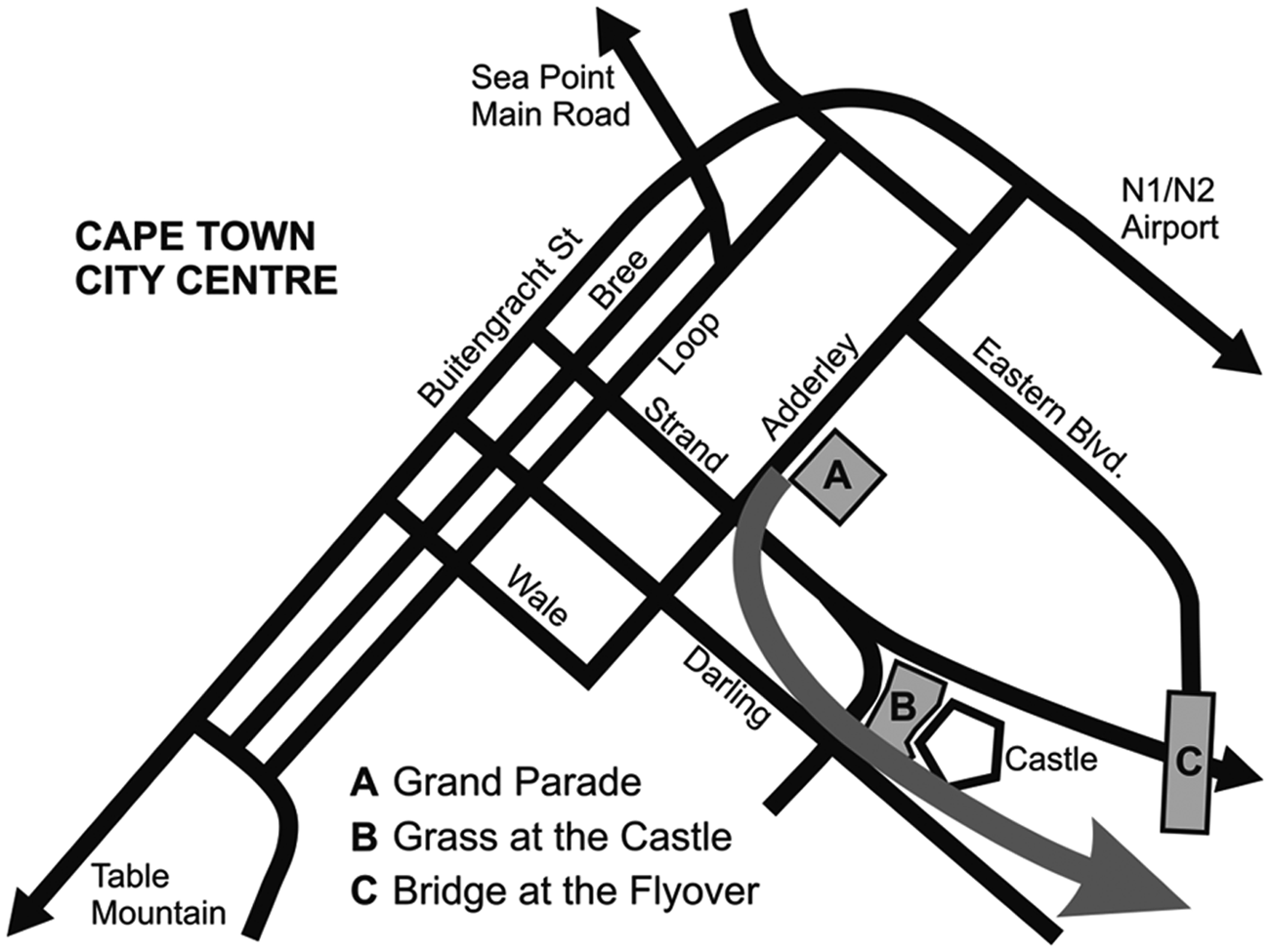
Displacement of the City Square youth out of the city centre.
The second process, dispersal, refers to the breakdown of large groups on the street, which has the effect of reducing their visibility and minimising their influence on the streets. As noted earlier, prior to the establishment of the CCID, street youth operated in fairly substantial numbers, often 20 or more. Hansson (2003) terms these ‘bands’, highlighting a hierarchical structure for the protection and maintenance of the group as a whole. None of the youth referred to themselves in this way or talked about being part of such an organised structure. More often small groups of two, three or four youth strolled together. Larger groups had generally disbanded and were talked about nostalgically. The dispersal of groups in this way has significant implications. Although it may enable small groups creatively to access the city’s resources, and retain some level of freedom and power through their micro mobilities, it is much easier for security to manage small groups; they can be more easily moved on or removed from the streets. They are also much harder to find and their small number can make them vulnerable on the streets. Thabo’s narrative highlights these safety implications, noting how small groups have to select places to sleep carefully. This is particularly important as it was often cited by younger street youth (under the age of 18) as a way to avoid security taking them to shelters
We have a small group now I skurrel all day with three friends and then we sleep behind the Engen garage at 12pm. It’s only safe to sleep late at night.
The third process affecting street youth is localisation, where mobility is limited to a small area. This is characterised by a significant reduction in the once wide-ranging mobility the streets offered. Many of the youth highlighted spending a lot of time in particular locations where they felt safe. Sometimes this was a drop-in centre, a piece of waste ground, a park or a rubbish site. For Marawan (11) in Somerset West, the beach offered a safe place for him and his friends to survive yet remain hidden. In his map, shown in Figure 3, he drew the Jetty
This is the jetti. I stay here at night with three other boys. We just stay around the beach asking people for money and the fisherman if we can clean fish.
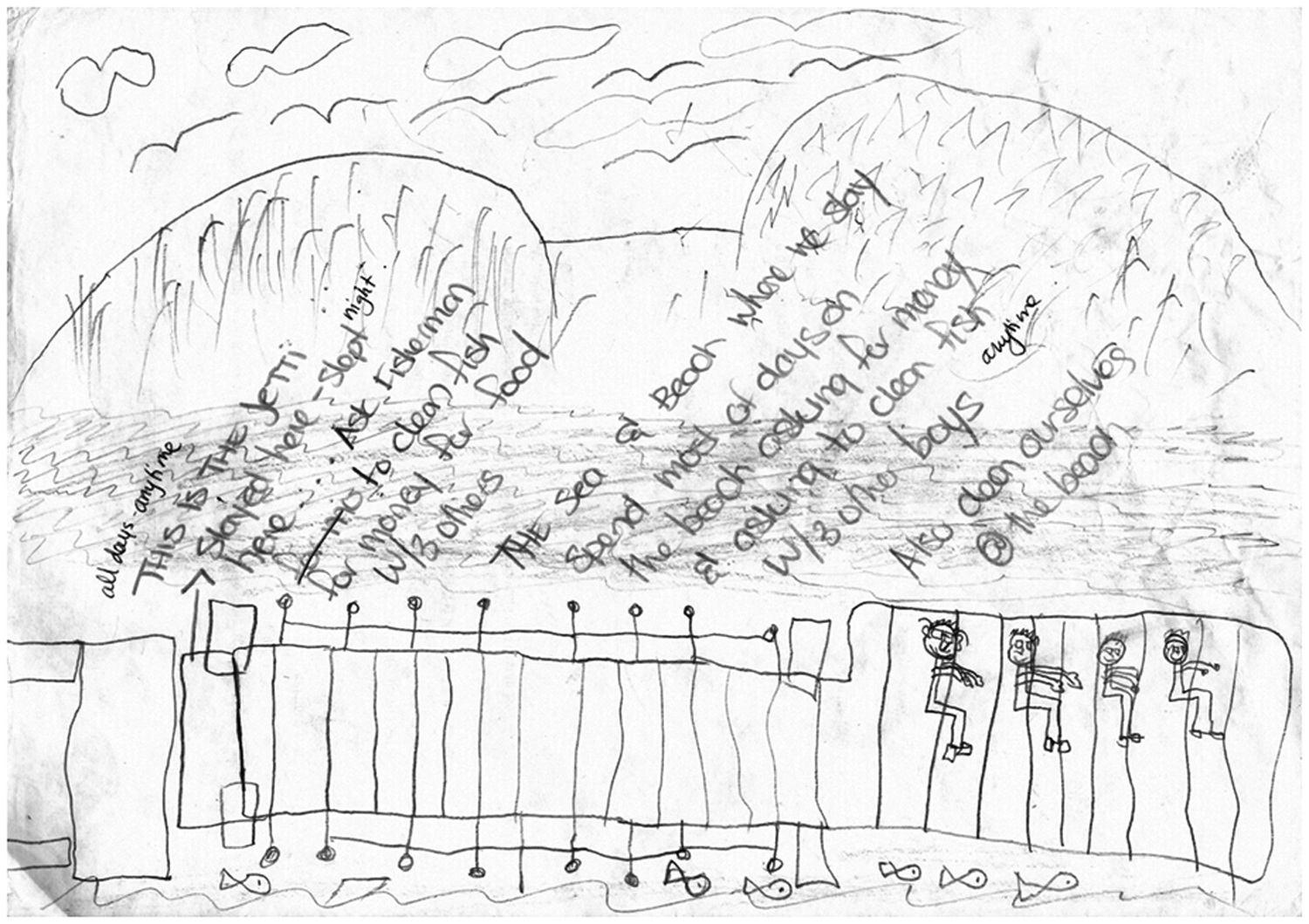
Marawan’s (11) map of localisation in Somerset West.
Paul (15)’s map, shown in Figure 4, provides another example. Having moved out of the city centre to an outlying area where he and his brothers felt more comfortable, they also employed localised micro mobilities to avoid the risk of being noticed and returned to the shelter. Paul’s map illustrates the few places that they use for skurrelling, relaxing and sleeping. Localisation has also been seen in the increase in the number of children using shelters and going to the streets intermittently, an option not usually available to those over 18. The reduction in wide-ranging mobility through localisation demonstrates a lack of freedom for street youth in engaging with the city. They are constrained by the context within which they operate, resulting in their mobility being frustrated (Porter et al., 2010). This has implications for the variety and type of resources/opportunities they are able to access.
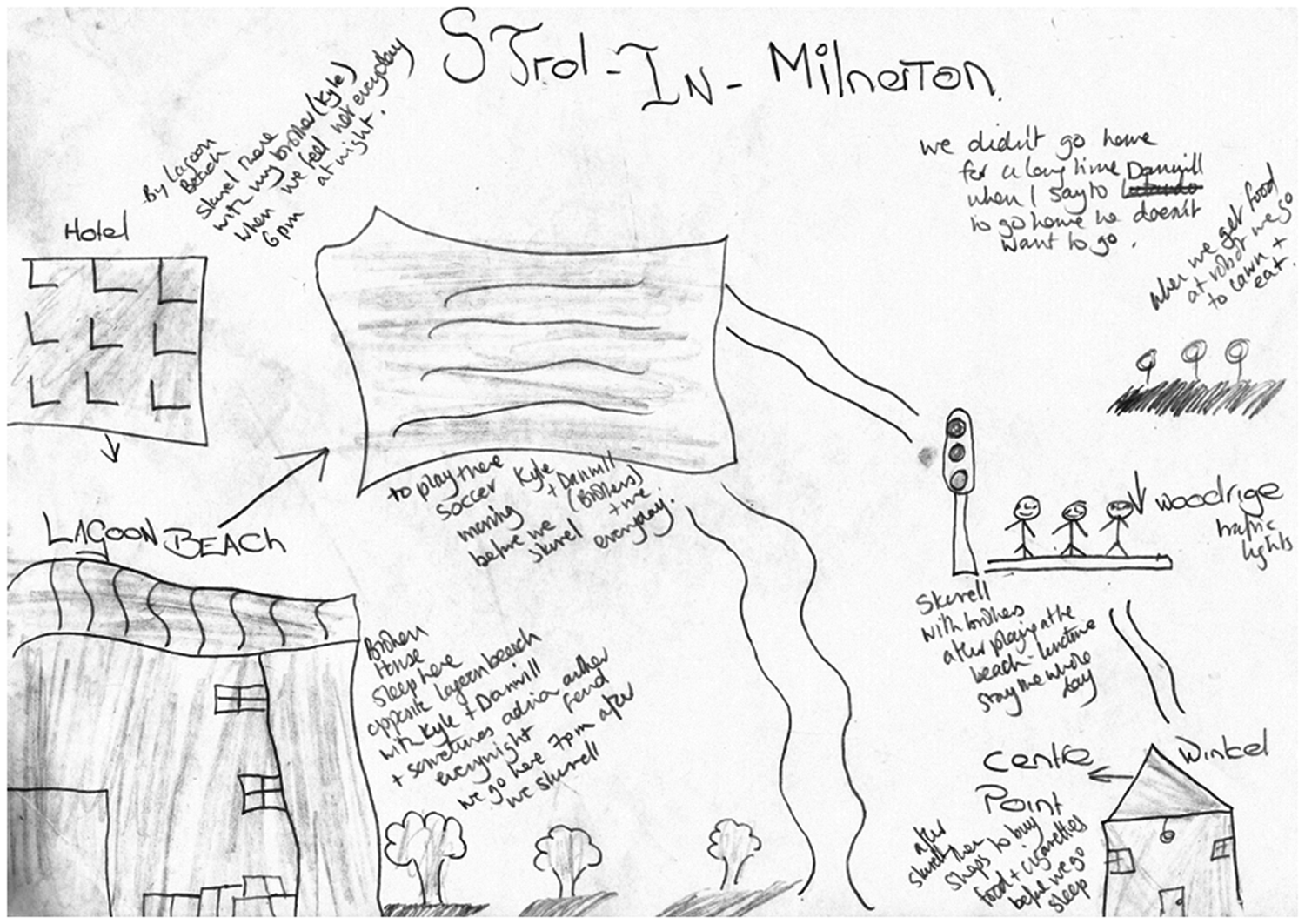
Paul’s (15) map of localisation in Milnerton.
Finally, spatial marginalisation was reflected through street youth mobilities. Tammi (17) in her map, like many others, highlighted that she now spends much of her time in a few central locations but that she travels to outlying areas to access many of the things that she used to do easily in the city. Particularly for the older youth who may have been in prison several times already, it is much easier and safer to undertake activities deemed illegal, such as crime, prostitution and drug taking, in hidden and marginal areas. Marginalisation, created by moving to hidden or obscure places, was also used by youth to escape the potential threat of arrest. Alfonso (16), for example, stays well away from the city and its security during the day by going into the mountains and only returning at night. He says: “I sit in the trees at the mountain everyday to be away from the securities”. The use of marginal places in street survival is not new (Young, 2003), but what is interesting here is how mobility is the process through which security are controlling the city, forcing this marginalisation and changing the locus of control on the streets. Here, youth mobility is reflecting the power of the CCID.
Although I have discussed these mobile processes in relative isolation, they are often employed simultaneously. Tactics of dispersal are often combined with displacement as small groups of youth move to outlying locations to avoid being targeted by security. Samoosa (13) and his friend Bulele (14) use combined processes of displacement and dispersal in an effort to find a safe sleeping space. They leave the city in the evening and move out to Milnerton. Samoosa (13) states: “I sleep under this tree in Milnerton every night just two of us me and Bulele”. Sometimes these tactics result in youth accessing marginal locations and engaging in more localised geographies: staying in one or two locations they attribute as relatively safe.
These processes of urban renewal have markedly changed the way the city is used. The regeneration process has brought businesses, tourists and shoppers back into the city. For street youth, however, the result has been increasing invisibility. Through a combination of displacement, dispersal, localisation and marginalisation as a result of the implementation of tough security measures, street youth now have a much reduced presence on the streets. Their geographies are very much about survival, as they have always been, but the way this is displayed in time and space has changed. This will have significant implications for their lives.
Implications for Street Youth’s Lives
The implications of these new street geographies where street youth are now hidden in the urban landscape and accessing much more disparate locations in small numbers are three-fold. First, their invisibility in the city makes them much more open to abuse. This can be particularly problematic for girls or younger youth, although by no means exclusively as young men sleeping alone on the streets are also vulnerable (see Grant’s narrative for an example of such abuse). However, safety in numbers is more difficult to achieve as this creates a presence in the urban landscape. Secondly, removing street youth from view, can create a false impression that the ‘problem of street youth’ has been ‘solved’ but, as the narratives in this paper demonstrate, they are merely located out of sight. The underlying problems in home and community life that most youth attributed to their being on the streets, such as drugs, crime, gangsterism and extreme poverty, are still there. The clean-up campaigns and security measures have sought to make inner-city spaces safe for the wealthy, but had the opposite effect for street youth. Pushed into more marginal and impoverished areas, many harbouring the exact social degradation they sought to escape, has generally placed youth in greater danger. Finally, the reduced visibility of street youth and their dispersal across Greater Cape Town not only makes it harder for security to find youth, but also makes it more difficult for them to access services. Interviews with outreach workers supported the fact that it was becoming increasingly difficult to find street youth.
New street geographies require new street services that are also dispersed into marginal locations engaging in prevention but also working with youth on the streets in these outlying suburbs. Such outreach strategies must also engage with the diversity of mobility strategies youth employ and develop more novel ways of reaching youth that are locating in hard-to-reach places. Some alternatives could include using mobile drop-in centres or information units that travel to outlying locations to provide services and support to youth on the streets. Although this will not replace the intensity of work undertaken in drop-in centres, it could work as a first point of contact. Advertising through posters and radio may also help to raise the profile of such schemes. However, the implementation of national policies that tackle the deep-rooted social problems and extreme poverty that exist in many communities will be a key strategy for reaching those most marginalised on the streets.
Conclusion
In conclusion, I turn to consider how the creation of new street geographies for Cape Town youth, offers some important insights for the way we conceptualise street youth lives and for our understanding of youth mobility more generally.
By taking Ansell’s (2009) call to explore young people’s lives more broadly, and situating the everyday lives of street youth within wider contexts of urban governance and the desire for global city status (Robinson, 2002), the paper reveals the continued marginalisation of street youth. Despite the much-needed focus of previous work with street youth drawing attention to their capacities and capabilities and illustrating resourcefulness on the streets (Conticini, 2004; Beazley, 2000; Thomas de Benítez, 2011), the research presented here demonstrates that their lives are also very much shaped by structures beyond their control and influence.
In addition, through employing mobility as a conceptual lens to achieve this bringing together of the everyday with more strategic processes, the research presents a nuanced understanding of urban youth mobilities as both reflective of, and reinforcing, power (Sheller and Urry, 2006). This means we cannot really understand the connectedness of young people to our cities or fully understand their frustrated mobility (Porter et al., 2010) without investigating the context in which mobility takes place. By locating street youth’s everyday experiences within these wider contextual processes, this paper demonstrates that youth, notwithstanding their competency as social agents, are not always able to access opportunities, networks and resources. This is because they are connected relationally, and therefore powerfully, through mobility to others who are also operating within the same wider contexts and often with divergent goals.
At a time when street youth are still high on the international agenda—for example, with the United Nations Human Rights Council resolution on street children in March 2011—there is a danger that their invisibility could result in a false perception that much has been achieved and street youth’s lives are improved. This is particularly pertinent at a time when many cities in the global South are receiving significant international attention by hosting major events, not least sports mega events such as the Comonwealth Games in Dehli in 2011 and the forthcoming World Cup taking place in several Brazilian cities in 2014. The realities of global attention for street youth in these cities, as demonstrated here, are increasing invisibility and marginality, rather than opportunity, through the processes of displacement, dispersal, localisation and marginalisation. Conceptualising street youth’s lives as locally lived but globally influenced, presents a challenge for nations to address the local strategies employed in the pursuit of global competitiveness and to illustrate the relevance of young people’s lives to those concerned with national and international agendas.
Footnotes
Acknowledgements
The author would like to thank the Editors and anonymous referees for their very helpful comments on an earlier draft of this paper. The author also gratefully acknowledges the support provided by The Homestead Project for Street Children; The Centre for Social Science Research at the University of Cape Town; and the assistance of Freda and Damien Snyders, Amber Abrams and the youth who participated in the research.
Notes
Funding Statement
This research was funded by an ESRC small grant (RES-000-22-1286-A); however, the views contained in the paper, including any shortcomings, are entirely the author’s.