




Abstract
The fate of Chinese urban villages (chengzhongcun) has recently attracted both research and policy attention. Two important unaddressed questions are: what are the sources of informality in otherwise orderly Chinese cities; and, will village redevelopment policy eliminate informality in the Chinese city? Reflecting on the long-established study of informal settlements and recent research on informality, it is argued that the informality in China has been created by the dual urban–rural land market and land management system and by an underprovision of migrant housing. The redevelopment of chengzhongcun is an attempt to eliminate this informality and to create more governable spaces through formal land development; but since it fails to tackle the root demand for unregulated living and working space, village redevelopment only leads to the replication of informality in more remote rural villages, in other urban neighbourhoods and, to some extent, in the redeveloped neighbourhoods.
1. Introduction
China has experienced rapid urbanisation in the past three decades, its urbanisation level increasing from about 19 per cent in 1979 to 46.6 per cent in 2008 (CNSB, 2009). Rural to urban migration is mainly concentrated in the eastern coastal area (Fan, 2008), especially in the peri-urban areas of large metropolises (Wu, 2002; Wang et al., 2010). To what extent can the development of Chinese cities be understood with reference to the global South (Roy and AlSayyad, 2004), especially the notion of the ‘planet of slums’ attributed to a world of globalising capitalism (Davis, 2006)?
Despite extensive studies of China’s rural to urban migration, only recently have there been substantial published accounts of the habitat of migrants (Tian, 2008; Wang et al., 2010; Liu et al., 2010). Earlier studies of migrants largely focused on their social structure and their exclusion from the labour market (Solinger, 1999; Zhang, 2001) rather than their living spaces. From studies of migrant housing, we know that rural migrants tend to live in peri-urban locations due to a shortage of private rental space inside Chinese cities (Wang et al 2010; Wu, 2002). In some cities such as Shanghai, the distribution of rural migrants is more dispersed, including to old municipal and work-unit housing areas, while in others such as Guangzhou and Shenzhen they are concentrated in chengzhongcun, the so-called villages in the city (Tian, 2008).
The purpose of this paper is to use the perspective of recent informality research to trace the source of informality in the context of Chinese cities and critically examine recent policies of village demolition in China. This study aims to compare urban informality in different Chinese cities as well as with other countries and hence challenge the official discourse of informal and disorderly villages which it is deemed necessary to demolish. The research is centred upon the understanding that informality is created by the political economic institution that defines the development process and management of informal settlements. In the following section, the literature of informal settlements and informality is reviewed. Section 3 then proposes a framework for analysing informality in human settlements. Section 4 explains the persistence of informality after land acquisition. Section 5 examines in detail three cases of village redevelopment. The paper concludes by critically considering implications for informality research in China and elsewhere.
2. Property Rights, ‘Informality’ and ‘Informal Settlements’
There has been extensive research on informal settlements in the field of development studies over many years (Gilbert and Ward, 1985; Gilbert, 2007; Gilbert and Gugler, 1992; UN-Habitat, 2003; Varley, 2002; van Gelder, 2009). There is particularly good coverage of Latin American (Gilbert and Ward, 1985), South Asian (Nijman, 2010), Hong Kong (Smart, 2006) and African cities (Huchzermeyer, 2003). At the heart of the notion of the ‘informality’ of settlements is the issue of property rights over land inhabited by the poor and low incomed. The literature exposes tremendous diversity within the category of informal housing (also see Payne, 2004 for a comparative discussion). While ‘squatter settlements’ usually mean that housing development and occupation have occurred without the formal consent of the landowner, other rights over the squatted land or building might be legal. In their study of three Latin American cities, Gilbert and Ward emphasise the diversity across Valencia, Bogota and Mexico City, for example. They found that
the poor acquire land principally through illegal processes but the form of this illegality varies considerably between settlements and between cities (Gilbert and Ward, 1985, p. 127).
In Valencia, it has been invasions of public and private land that have created informal settlements; while in Bogota, informal neighbourhoods have been widely built on ‘pirate sub-divisions’ of legally acquired land owned by rural élites and let or sold to migrants outside the formal development process. In Mexico City, illegal sub-division has been the major form of informal neighbourhood expansion; but for short periods there have been land invasions. The first distinction to make, therefore, in understanding the idea of settlement informality, is between the legality of land development and legality of ownership. This proves to be crucial, as we shall show, in understanding China’s version of the informal settlement, since the extent of self-built multistorey ‘illegal’ development in the chengzhongcun of southern China suggests a high degree of contractual security (Zhao and Webster, 2011). We suggest that it is the relative strength of sanctions in different legal domains that determines the nature of a country’s informal settlements. Weak development control laws and strong formal or customary laws of contract may be consistent with an efficient ‘informal’ land market.
The legal domains governing the emergence of informal settlements go beyond the laws governing primary land development and exchange of newly built property, however. Property rights over land are divisible and tend to fragment as land values increase (Webster and Lai, 2003). An agricultural field under single ownership may be sold and sub-divided into multiple house plots and any one of these plots sub-divided again into a 10-floor building—as is typical in the chengzhongcun of Guangdong province, for example (Zhao and Webster, 2011). What ultimately defines an ‘informal’ settlement when property rights are viewed, in this way, as separable rights over a property’s multiple attributes? The answer is that the definition should be purpose-specific. If the issue at stake is sub-standard and undersupplied infrastructure, then we should be interested in settlements built without land development and building control permits. If the issue is space and public health of tenants, then the interest will be in rental markets operating outside public health and rental laws. If the problem is lack of capital, the focus might be on legal title.
One of the problems with the studies of informal housing in the past has been the lack of nuance in this respect and the application of overgeneralised diagnosis and prescription and confused debate. Kiddle (2010) notes two seminal authors (Turner and de Soto) who have shaped this debate, both of whom make certain assumptions about the efficiency of existing property rights allocations in informal settlements. Based on fieldwork in Peru, Turner (1976) argued that squatter settlements provided ‘self-help housing’ to the poor who cannot afford formal housing. Depending upon informal labour markets, the poor cannot afford to travel long distances and have to live near their informal jobs to reduce transport costs and time. Turner’s emphasis on the positive function of squatter housing led to a widespread reversal of earlier policies of demolition and slum resettlement, which were widely replaced in the 1970s and 1980s with in situ squatter upgrading (Pugh, 2000).
Hernando de Soto (2000) argued that the poor in the developing world possess valuable assets that cannot be transacted because of the lack of legal property rights. He insisted that an absence of legally protected private property hinders capital formation among the poor because it reduces an incentive to save and invest and lowers access to borrowing. The policy implication of his research is advocacy of the legalisation of land titles through land titling programmes—an approach supported by the World Bank (van Gelder, 2009; Mooya and Cloete, 2007).
De Soto’s analysis and message have been criticised on various grounds. In developing countries, land sales are common without formal title (Gilbert, 2002); and there are social practices that recognise de facto property rights, sometimes rendering ‘informal’ agreements stronger than those made under formal laws (Varley, 2002; Musembi, 2007). Gonzalez (2009) criticises de Soto’s tenure regularisation as a panacea, noting that it has been used by liberal governments as a way of avoiding problems that cannot be solved by tenure policy. Varley (2002) warns that incorporating informal housing into the formal market can disrupt community life and lead to forced relocation through gentrification.
Many of the problems addressed in such debates are resolved by understanding the divisible nature of property rights. As we have said, property rights over a resource may be divided between multiple owners, the fragmentation being limited only by the technical and legal possibility of creating exclusive ownership and the existence of specialists with the appropriate knowledge to assume ownership of a specialised right. De Soto’s leverage point, at a technical level, is incontrovertible: if the tenure system is adjusted so that the freehold or leasehold right to a poor family’s abode can be temporarily separated from the right of abode and transferred to a bank or other owner of capital, then that family is likely to have greater access to capital. This is not necessarily a panacea for all ills in informal settlements but it may, under certain conditions, contribute to creating wealth among the poor. In other conditions, it may lead to gentrification with or without windfall gains to the poor who vacate an attractive location to make way for the more wealthy. Windfall gains are significant in China, through its own version of tenure regularisation which, as we explain, involves the acquisition of formal property rights through compensation apartments after the informal property is demolished. However, the gains fall only to the informal landlords, not to the displaced migrant renters—which creates a serious problem of shrinkage in the supply of low-cost homes.
Payne (2004) makes the point that legally separable rights to collateralised property are neither sufficient nor necessary for home investment in poor neighbourhoods: perceived tenure security is also an important factor. Van Gelder (2009) finds that tenure legality and perceived tenure security are closely related and that both can enhance housing improvement, but through different mechanisms. One consequence of recognising the separate effects of legal and perceived tenure security in the spontaneous upgrading of poor neighbourhoods is to widen the idea of informality. Informality is not a binary categorisation (formal/informal): there are levels and degrees of informality. This is closely linked to the law and property rights theorists’ Alchian and Demsetz’ (1973) seminal idea that a property right, in essence, is not a binary assignment (right/no right); in practice, rights are held in degrees and the level of right depends not only (or not at all in some cases) on legal writ, but most importantly on the power to enforce. If this is true, then because property rights are infinitely divisible and always therefore incompletely assigned (there is always some other attribute of land that can be partitioned and transferred to another owner), all land everywhere and all structures on it are to some degree subject to informal use. Even in a city as well established and organised as Milan, Italy, neo-classical building façades become the informal canvas for graffiti artists. The purchaser of an apartment located in the catchment area of a good state school in a Chinese city may well pay a price premium of tens of thousands of yuan compared with a similar apartment outside the catchment. This is payment for an informal right to educational public goods: informal in the sense that the right is protected neither by planning or educational law nor by the private contract law by which rights to the apartment were acquired. The valuable ‘educational-access’ attribute of the property could be taken away without compensation but the informality of the right does not stop the housing market functioning as a surrogate education market. This is as true in European, American and African cities as Chinese cities, demonstrating the generic and ubiquitous nature of informality in cities of all kinds.
3. Sources of Informality in China’s Urban Villages
We suggest that there are four important sources of property rights ambiguity and therefore informality in China’s urban villages.
3.1 Dualistic and Fragmented Landownership
Rural land is collectively owned, while urban land is state owned. The land use rights of urban land can be leased to developers through the competitive land market. Urban villages are created by the disjuncture of the dual land use system. The municipality, as the owner of state land, monopolises the supply of leased land in the primary land market. During rapid urban expansion, former rural villages have been encircled by expanding urban built-up areas, becoming literally ‘villages in the city’. According to the 1988 Land Administration Law, updated in 1998, compensation for land acquisition consists of compensation for land, relocation cost and property compensation. Land compensation is calculated as six to ten times the average annual output of the farmland in the previous three years and relocation compensation is based on the size of the affected household (Tian, 2008; Zhao and Webster, 2011). To save costs in land acquisition, the original site of a village may not be acquired by state development projects and thus remains in collective ownership, while the village agricultural land is transferred into state ownership. This process of land acquisition forms the juxtaposed dual landownerships in peri-urban areas. Rights over village property are ambiguous from two points of view. First, village land tends to be allocated by a mixture of administrative fiat (by the village committee) and quasi market mechanisms (through supplementing administrative allocation rules with price for premium sites, for example, and then through subsequent trading—for example, one villager amassing land by buying up other villagers’ plots). Secondly, under Chinese land law, the land may not legally be freely transacted in the land market. Village land is inalienable outside the village, but this has not prevented a buoyant black market in so-called small property rights homes. These are sold under the protection of contracts, but they are not strictly legal.
3.2 Lax Land Management and Development Control
The formal management and development control required by urban plans only covers state-owned land. Rural farming households have been able to build and extend their houses with minimal formal development control. In rural areas, land for housing is initially allocated to farming households according to family size. On these land plots, farmers can build relatively freely within space limits. Since 1989, however, many places have stopped allocating land for housing because of the shortage of land. This inevitably led to a densification of the historical village housing plots. Villagers' com-mittees in densely populated peri-urban areas have therefore allowed farmers to extend their houses upwards and where possible outwards when their children get married and need more space. The bigger driver for village densification, however, has been building upwards to maximise rental floor space. Peri-urban villagers surrounded by farmland converted by the state into urban uses, find themselves in possession of prime land for migrant worker rental and respond rationally by maximising the yield of their inalienable assets. Self-built high density is thus the norm rather than exception in rural areas. Village housing redevelopment is not illegal if the overall housing space is within the specified limit (the normal limit is set as the standard farmers’ housing of ‘two floors and a half [loft space]’ with a space of 240–280 square metres, depending on province). However, left outside the regime of formal development control, rental housing is constructed by individual landlords at much higher densities than this, working as small developer-owners without formal residen-tial land use plans. Each household tries to maximise the use of its assigned housing plot, building up to the boundary and leaving medieval-style narrow gaps between buildings. Urban villages are thus characterised by high building coverage and it is this plus the unregulated quality of construction and lack of public goods that make such a stark physical contrast between urban villages and the other neighbourhoods in Chinese cities.
3.3 Informal Service Provision and Management
The infrastructure of these villages is very underdeveloped. Villagers’ committees may provide skeletal basic services such as roads, pavements and water supply but, in most cases, urban villages are outside the formal provision of municipal-government-supplied services. There is an irony in this but also a consistent logic. The irony is that municipal governments generate their working revenue from the land taken from farmers but they do not generally reinvest any of it (beyond the set compensation component) in upgrading village infrastructure. The logic of this is that the municipal state has no jurisdiction in urban villages: it neither owns the land nor has a responsibility for territorial governance. Village landlords do not pay tax to the municipal government and, if they wish to avail themselves of organised urban services, they hire the services of property management companies. In this sense, urban villages are rather like an informal and low-income version of the privately governed commodity housing estates built on the farmers’ former fields. The Chinese urban governance and financing model is much more in line with the idea of a residential club economy rather than the tradition municipal public-sector economy (Webster and Lai, 2003). The result is an underprovision of public goods as urban economic theory would predict and a proliferation of informal arrangements with degrees of security of provision.
3.4 Marginal and Ambiguous Status of Village Governance
This fourth dimension of informality is closely related to the third. The emergence of informal rental housing in urban villages is a result of the constrained housing supply facing millions of rural migrants who are subject to severe discrimination and disadvantages in obtaining other kinds of housing (Song et al., 2008). This kind of rental housing is developed under a marginalised development process (Wu, 2004; Liu et al, 2010) because municipal governments adopt a highly urban-biased development approach and, as we have noted, neglect investment in ‘leftover’ villages. The governance of these villages has an inferior status because it is the preserve of villagers’ committees. In reality, it is the shareholding companies formed to control villagers’ collective assets rather than the village administrative government that takes on the responsibility for providing basic social services. On the one hand, the ability of village government to adapt through incorporation is a strength and has undoubtedly contributed to the dynamic nature of the urban village economy. On the other hand, it has created even more ambiguities in responsibilities and a greater discontinuity than might otherwise have been the case with formal urban governance.
4. The Persistence of Informality after Redevelopment
The informal urbanisation described, starts in peri-urban villages before the acquisition of farmland. In villages at distances up to 50 km or more from large cities, evidence can be found of village-initiated urban development on parts of village land (Webster et al, 2005). An acceleration of the processes is triggered by farmland acquisition. The informal urban order we have described does not disappear through the process of village land acquisition, however, and there are two important specific ways in which informality persists in the life of an urban village.
First, compensation practices contribute to the persistence of informality, particularly in southern China. To reduce the monetary cost of compensation, local governments have typically returned a proportion of agricultural land as in-kind compensation, known as ‘economic development land’ (jingji fazhan yongdi), to villagers (Tian, 2008), transferred back to them as a collective asset to be developed into non-agricultural income-earning uses. Property rights over land in this part of a village redevelopment plan are in collective ownership. These lands are subject to little formal development control. This further expands the stock of land outside the state’s formal development regime, which strengthens rather than reduces informality.
A second way in which informality persists is in the internal dynamic established by a buoyant rental economy. Over time, the growth of the rental economy in urban villages has meant that there are hundreds of neighbourhoods in any one large city, co-owned by a new rentier class of villager who has long ago abandoned the hard and dirty work of farming in favour of the informal urban economy. Informality has repaid these families handsomely and villagers have a deeply entrenched interest in finding ways to maintain and expand their privileged informality. One way is to resist any formal development control by the municipal government over the use of their land and in some cases to resist urban redevelopment. The resistance is even greater from villagers who have developed rental factories and commercial buildings since their income loss is typically greater than owners of residential rental property (Tian, 2008; Zhao and Webster, 2011; Liu et al., 2010). The size of the migrant rental economy in urban villages can be said to have helped to sustain the informality of these parts of the Chinese city—the informal economy providing crucial income to landless farmers who would otherwise suffer from poverty and deprivation (He et al., 2009) and creating opportunities for non-agricultural activities such as low-level urban services, workshops and village enterprises. Wang et al. (2010) observed that, because of the practice of returning land to farmers, urban villages have acquired an important function in manufacturing. Small enterprises and workshops located in these villages, usually on collective land, provide employment to local villagers as well as to migrant workers. Viewed as micro urban economies, not just migrant dormitories, it is clear that urban villages in China play the familiar role of the informal settlement in other developing countries: providing affordable housing to rural migrants, an entry-point for people from the same origin and a low-rent enclave within which to try and build a productive urban life (Ma and Xiang, 1998; Zhang, 2001; Zhang et al., 2003; Song et al., 2008; Wang et al., 2010).
5. Three Chinese Urban Villages
In this section, we examine three urban villages respectively located in Beijing, Shanghai and Guangzhou. The dimensions of informality are explored, taking a comprehensive narrative.
5.1 Research Method
The original research presented in this paper was conducted from May to September 2010 as part of a larger study of peri-urban informal settlements in Chinese cities. We conducted face-to-face semi-structured interviews in three cities (Beijing, Shanghai and Guangzhou). In each city, we selected four to five villages within which to conduct case studies and undertake a survey (reported in other papers); we conducted 15 interviews in each city lasting from 30 minutes to 2 hours and collected other information from key informants. In addition, in Shanghai, the investigation was facilitated by focus group meetings in local district planning offices, in conjunction with separate research organised by the municipal planning bureau. For the current paper, we choose to focus on three villages; two that have received wide media attention (Tangjialing in Beijing and Gaojiabang in Shanghai) and the other, an archetypical project for city-wide policy formulation (Liede in Guangzhou). We collected internal documents for village planning and government policy through our collaborators, all of whom had expert knowledge in their respective villages through independent academic or government-commissioned research.
5.2 Tangjialing in Beijing: Enclave of the ‘Ant Tribe’
Tangjialing is located in the town of Xibeiwang outside the fifth ring road of north-west Beijing. The Zhongguancun Science Park extended to this area in 2000 and the arrival of workers in the IT sector stimulated a huge demand for housing. The low-income IT workers became known locally as the Chinese ‘ant tribe’ (yizu) because they could not afford formal housing and lived like ‘ants’. As well as constructing their own rental properties, villagers leased land to private developers (who ‘informally’ developed residential compounds in Beijing) to build large standard rental apartments, creating a residential compound managed commercially by private companies. These apartments became known as ‘student apartments’ and, later, as ‘white-collar apartments’. This illustrates both the persistence of informality and its trajectory towards greater formality as the value of informal collective assets rises in the face of demand. The quality of these apartments is much better than individual self-built blocks, but the rental activities are nevertheless still informal in the sense that they are not recognised as a formal business that should pay urban taxes. Instead, apartments built on collective land contribute rental income to the villagers’ management committees through a ‘lease contract of land’. The contract is upheld by contract law and formal in that sense, but in theory it is illegal in the sense that it contravenes the state’s property right over the conversion of agricultural land to urban uses.
The rent in Tangjialing ranges from 300 yuan per month for a low-quality room of around 10 square metres to 700 yuan per month for a relatively better-quality 20 square metre studio with kitchen and toilet. Surprisingly, most rental housing has an Internet connection. Because the rental housing market is competitive, landlords are quite innovative in improving housing conditions. For example, in some buildings, the corridors of the second floor upwards use transparent panels to allow light to pass through to lower floors. Seeing this kind of practical innovation, one planning professional commented, “this is really marvellous; we could not do this because we simply do not know what the tenants need” (personal communication, July 2010). Another example of market-driven innovation is the provision of a small shuttle bus by a large landlord to connect residents with the bus station at the entrance of Tangjialing. Shuttle buses are convenient for tenants and have become a selling point for residential compounds such as the Dongjia Compound. Others plan to follow, one landlord telling us of his plan to buy a small van (an unregulated transport service) to do the same, which was only suspended when he heard of the plan for demolition of nearby compounds (personal communication, July 2010). Most tenants in Tangjialing seem satisfied, as one young couple suggested to us, when they were preparing the check-out procedure with the landlord and leaving because of the forthcoming demolition Could you please ask the government not to demolish this place? We are quite happy to live here, and now we have to find another place and don’t know whether we might have the same kind of customised buildings to live (personal communication, July 2010).
The management of services, as shown in this example, is generally informal, depending upon demand and perceived profit opportunities. Informality thus makes for dynamism and responsiveness to the needs of the local market. In March 2010, the project to redevelop Tangjialing officially started (Figure 1). Instead of using the words ‘demolition and relocation’ (chai qian), the phrase now adopted in Beijing for redevelopment is ‘vacating’ (teng tui), implying that for landlords and local villagers this means temporarily vacating the old homes and then returning to the same place after the project is completed.
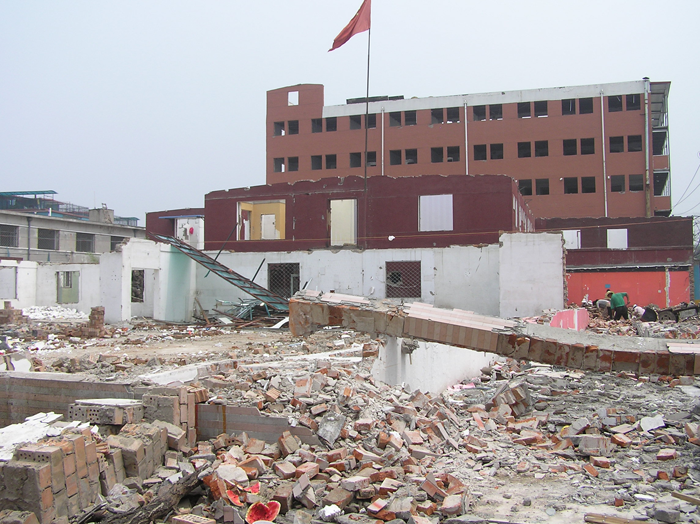
The demolition of Tangjialing.
The case shows that, although informality persists with the inbuilt dynamics we have suggested, its trajectory, at least here, is towards full integration with the formal economy. This happens when property rights are shared between the municipal state (district or municipal level), developers and onward purchasers of land leased by the state and the residual and formalised institutions of village collective organisation—namely, the stock companies that own ‘compensation land’ ceded back to villagers by the state together with other assets won by the villagers during the redevelopment negotiation process. At this point, there is little informality left. There may be some ambiguity in the rights allocated by the village companies and there will almost certainly be ambiguities in the relationships between the residual village administrative committees and the incorporated equivalents. Yet since the village committees will disappear and be replaced by residents’ committees under street office governance, this is the end of the trajectory. This is a very different trajectory from those of informal settlements in other countries. The end game is redistribution of property rights via a mixture of market, government and collective institutions and the formalisation of each of these in different ways.
5.3 Gaojiabang in Shanghai: A Hidden Enclave of Informal Housing
Gaojiabang is hidden away behind a prosperous street in the district of Xuhui, a well-developed central district in Shanghai. The entrance to this village is very modest, unexpectedly leading to a high-density, congested residential area of low-quality housing with bustling narrow streets full of small shops and stores. The registered population is 1373 individuals, but the migrant population adds about 3000. About 20 per cent of the 1373 local residents still live there (interview, ‘street officer’, June 2010), the others having moved out to the suburbs for better housing. The area of Gaojiabang is about 60 mu (4 hectares).
The modern history of Gaojiabang is associated with the rise and fall of Shanghai’s colour TV industry. Before the 1980s, the place was at the edge of the built-up area of the city. The village’s agricultural land was acquired and later used by the TV factory, but the factory became bankrupt in 2009; the place was then under the management of Caohejin ETDZ (nicknamed, ‘Cao developer’), which has never managed to acquire the village site because of the Shanghai government’s strict control over the land conversion process. In Shanghai, the municipality strictly legislates against negotiations between developers and villages. This has the effect, among other things, of weakening the villagers’ bargaining position and reducing their cut of the urban land value created by redevelopment. Following the normal dynamic of urban villages, the area experienced spontaneous densification over the years as landlords responded to a market demand for smaller and hence cheaper units. The area is central, well developed and very accessible for service-sector workers, so as long as it remains un-redeveloped this piece of residual space has a powerful niche position for low-quality, crowded but cheap accommodation, which is very popular with tenants (personal communication, landlord, August 2010).
The case suggests that the on-going informality in this village results from a typically complex structure of ownership that includes a more attenuated version of village collective right than in Beijing and other cities. A fragmentation of administration structure at the time of development may have exacerbated the uncoordinated nature of self-build activities and left allocation of property rights over buildings and shared land unclear and undocumented. The initial land transaction when the TV factory and worker village was built had shades of informality but appears to have been endorsed by the state and was not, in that sense, illegal. This is quite distinct from the first case. There, informality was associated with illegality and although informality persisted with positive effects, it came to an end because property rights were not sufficiently ambiguous and/or fragmented to prevent comprehensive redevelopment. In Gaojiabang, fragmented and ambiguous ownership plus the lack of villager rights to negotiate a favourable collective deal with potential developers have prevented comprehensive redevelopment. The irony in this is that the strong state control over the right to urban land value increase (capping this for villagers at statutory compensation levels on the assumption that villagers do not have any right to development value) has the effect of protecting the informal settlement from redevelopment through stalemate. We show in the third case study how the Guangzhou government has overcome this.
5.4 Liede in Guangzhou: A Vertical Village through Massive Redevelopment
Liede is located in the new city centre of Guangzhou in Guangdong province. The central location means that this village is exceptional in terms of accessibility and importance to the image of the city, which is a strategic priority of the municipal government. It is inside the new central business district of Guangzhou known as ‘Pearl River New Town’. The village is a long-established one, with a total population of 7800 people (about 3000 households) in 2010 and a migrant population of 8000 in 2008. The village occupies an area of 33.7 hectares. The total existing building floor space is 653 000 square metres, of which 595 000 square metres (over 90 per cent) have formally approved property certificates (internal documents for the draft plan of the area, obtained in 2009).
The cost of redeveloping a single village usually amounts to several billion yuan (interview, manager of a major development corporation in Guangzhou, September 2010), a figure that has risen consistently over time. Faced with rising costs, the municipal government made virtually no progress in the redevelopment of villages in the 1990s. The bargaining power of local villagers is strong in southern China because of the clan network organisation that overlays administrative (villagers' committee), political (local communist party) and corporate (village stock companies) organisations. To gain more compensation as well as rental income, villagers extended and in some cases comprehensively replanned and reconstructed the residential buildings constructed on their housing plots. Some village buildings are as high as 15 floors, creating the most dense chengzhongcun in China. In an effort to break negotiation deadlocks facing its redevelopment programme in the city, the municipal government conceded an upper limit for compensated space at 280 square metres under the conditions of redevelopment (interview, district planner, August 2010). In Liede, however, such was the power of the villagers in this prominent location that this compensation limit restriction was relaxed (interview, municipal land administration bureau, August 2010). The gradual concession of a larger fraction of urban development land value to villagers giving up their land makes it more likely that villagers subsequently facing redevelopment will use all means at their disposal (popular protest, political connections, patronage and legal challenge) to hold out for a better compensation deal and the process is thus self-reinforcing.
In the new phase of redevelopment starting in 2008, there has been no uniform city-wide policy. Instead, individual villages negotiate with the municipal government under the ‘one village, one policy’ (yi cun y ice). What is unique in Liede’s redevelopment package is that villagers were fully compensated according to a 1:1 compensation ratio—i.e. compensated space is equivalent to full-property rights space demolished. Even for non-certified floor space, however, villagers were given 10 per cent of the floor space in compensation. This greatly smoothed the redevelopment process and meant that some villagers acquired as many as seven compensation units (interview, district planner, September 2010). To do this, the municipality had to relax its own legal density controls—which may be viewed as another kind of informality persistence. Because of the excessively high-density redeveloped collective assets, the newly redeveloped village is nicknamed the ‘vertical village’ (personal communication, university researcher, August 2010).
The three cases show that sources of informality and the approach to redevelopment vary across different cities. Informality means many things and we have technically defined it as arising from ambiguities in rights over urban resources. The differences we have described are reminiscent of the diversity of informal settlements in Latin America (Gilbert and Ward, 1985). Making the comparison between three cities in the same country enables us to be quite specific about the sources and trajectories of informality which, as we suggest in our earlier discussion, reflect the relative strength of sanctions wielded by the institutions governing the contested assets found in urban villages.
6. Conclusion
This paper is based on an analysis of urban villages in Beijing, Shanghai and Guangzhou. The villages have all been the location of widespread self-built, high-density and low-quality housing for rural migrants. We have identified the sources of informality and explained why governments continue to strive to formalise rental housing owned by former farmers. The informality in these settlements, by which we mean property rights ambiguities, was sewn into the institutions of urban–rural dualism prior to market reform and has flourished and diversified since the introduction of market mechanisms. The ownership and responsibility ambiguities resulting from a dual land market, administrative land allocation within collectives, parallel political and corporate organisations representing near-overlapping sets of villagers, weak development control institutions and from years of unregulated entrepreneurialism, mean that informality has multiplied along several interlocking dimensions under market-led growth.
Because of the persistence of urban–rural dualism, full alienable land title to rural land is denied to villagers and farmers cannot sell their land to developers. On the other hand, the management of rural land is more lax, partially because of the lack of land management capacity in rural areas and partially because of the practice of allowing farmers to retain some land as in-kind ‘compensation’ to save the cost of land requisition. Farmers are allowed to change agricultural to non-agricultural uses on this land by self-development. Informal development is exacerbated by complex landownership created during piecemeal land requisition and constrained by the extension of urban governance to rural areas. Through the demolition of urban villages, the state hopes to create more ‘governable spaces’. This is achieved through a formal land development process through which village land is acquired by the local state to lease to larger developers in the formal land market. However, informality is not immediately eradicated. On the contrary, redevelopment diminishes informal-sector housing because the formally developed commodity housing is generally simply too expensive for migrant workers and their families. The informality thus allows the poor to live on lower wages and therefore bring down the cost of production—a phenomenon well identified in the literature of development studies. 1 This thus creates a demand for alternative informal housing elsewhere. When urban villages are demolished, some migrants are pushed further away to other villages in the peri-urban area. Others, who can afford to rent the villagers’ newly redeveloped properties on the site of the former village may stay in situ in neighbourhoods that look less like slums but nevertheless may be informal in the sense of being governed by multiparties with respective rights not fully delineated (village committee, stock company, individual villagers and local government). As a result, informality is to a degree, sustained and transformed.
These cases also show that the detailed processes of creating informality and of formalisation through redevelopment are different from place to place. This is contingent upon different configurations of the relation between the state, capital, land and villagers. In Shanghai, the governance capacity is stronger than in the other two cities and hence the regime of formal development tends to dominate in the process of village redevelopment. However, such a formal development approach is not able to ‘conquer’ a place where there is complicated landownership and/or unfavourable development conditions such as smaller parcels or irregular plot shapes. Informality in places such as Gaojiabang thus remains. In Guangzhou, self-built and informal land markets are more established because traditionally the role of villagers’ committees and other rural organisations is stronger. Recognising the power of villagers, the municipality has taken a pragmatic approach to compensate villagers more generously, leading to the emergence of large redeveloped projects in these villages. In Beijing, the state, developer and villages jointly participate in the process of redevelopment. While the compensation to villagers is often better than in Shanghai, the redevelopment process requires formalisation similar to that of Guangzhou. The diversity of these cases shows that there is no standard practice of village redevelopment, as implied by the title of Guangzhou’s ‘one village, one policy’. The difference between the villages shows that there is tremendous diversity in the sources and practices of informality and the formation, destruction and evolution of informal settlements in China—as is the case in the rest of the world (Gilbert and Ward, 1985; Payne, 2004; Roy and AlSayyad, 2004). The fact that there is such diversity in practices between these three Chinese cities indicates the informal practices—flexible and ambiguous application of the law with respect to local circumstances. China is a good laboratory for studying the nuanced variations of informality in cities facing different circumstances because it has great local diversity but a common set of strong overarching institutions governing land development. In fact it is, ironically, the strength of these institutions (principal amongst which is the dual urban–rural landownership system), that has given rise to much of the legal ambiguity that we have defined in this paper as ‘informality’. The reason for this is that the dual landownership system at all points impedes normal land market practices and inhibits and distorts those markets. The prize from this state of affairs is shared by all stakeholders: the rural–urban migrant workers who find cheap housing in the urban villages; the enriched rentier class and small-developer village landlords; and the state, which benefits first, from the economic contribution to the city provided by the cheap labour housed in these informal spaces and, secondly, by land value uplift earned through redevelopment. The dominance of the beautification and modernisation narrative in discussions about urban village redevelopment is rarely balanced with a discussion of the opportunity cost to the local economy of removing the main source of low-cost homes. Pragmatically, policy-makers probably simply assume and accept that their attempt to eradicate informal spaces will push the informality further out to the urban fringes, to newly engulfed urban villages, which can be dealt with later. There is a typically Chinese logic to this, which may well work. If city-wide programmes to redevelop urban villages are too successful, however, it is likely that the first prize will fall to villagers and their developer partners (i.e. the owners of land and capital). Migrants will lose out by not having access to jobs and the urban economy will eventually lose out through a smaller and poorer-quality low-skilled labour force. Of course, some cities might try to eradicate informal settlements for strategic economic reasons. Shenzhen, for example, demolished low-cost homes in 2005 precisely to drive rural migrant workers away to help shift the economy towards higher value-added manufacturing and services (personal communication, Shenzhen’s deputy director of housing bureau, 2005). The informality in Chinese cities is thus purposely permitted as an economic development approach (through the variance and flexible execution of formal regulation and law) and also constrained for the sake of governance (see Roy, 2009, for ‘informality as exception’).
Footnotes
Acknowledgements
This research is being undertaken in collaboration with Chinese partners. The authors would like to especially thank Professor Yuemin Ning, Dr Mingfeng Wang, Xiujin Bi and Xiaoling Lin in Shanghai, Dr Zhigang Li, Dr Shenjing He in Guangzhou, and Dr Jian Feng, Dr Yun Qian in Beijing for helping with the fieldwork.
Notes
Funding Statement
This research is supported by the UK Economic and Social Research Council (ESRC)/Department for International Development (DFID) project (RES-167-25-0448) and the Ministry of Education of PRC project at Modern City Research Centre at East China Normal University (11JJD840015).