




Abstract
While the value of inclusive children's libraries is widely recognized, practical guidance on how to determine books that contribute to culturally responsive, high-quality collections—particularly in urban classrooms—remains limited. In response, we return to the familiar and cross-cultural seek-and-find model of the I Spy game to introduce a new framework for evaluating children's books that reflect urban classroom diversity. Our approach challenges the constraints of traditional checklist methods by encouraging more nuanced, critically grounded, and contextually aware evaluation practices—those that better reflect the dynamic identities and realities of urban school communities.
Keywords
For parents and educators seeking to provide texts that can serve as both mirrors in which children can see themselves and windows through which they can see the world (Bishop, 1990), a diverse library is a necessity. A diverse classroom library provides an opportunity not only for students to see themselves represented in text, but also for a homogenous group of students to have access to diversities that are otherwise unfamiliar. It is certain, however, that not all children's books that mirror classroom diversity 1 are of equal quality (Agosto, 2017; Patterson & Moore, 2019; Pérez Huber et al., 2020). We see this not as a decontextualized problem but rather as a symptom of systemic issues that result in the U.S. book publishing world being overwhelmingly homogeneous (White, straight cis-non-disabled women) at all levels, including industry executives, editors, sales and marketers, book reviewers, and agents (Lee & Low Books, 2024).
Given this background upon which children's books that mirror classroom diversity are produced, educational practitioners and parents alike need reliable means for conducting effective evaluations of their chosen reading materials. In this article, we offer a tool to support individuals curating libraries for children in whom they are invested to achieve this goal. In contrast to some other available tools, however, we provide a method that goes beyond what can often be an underwhelmingly helpful checklist system.
Thinking critically about the content of children's books is no new endeavor. As far back as 1998, the Council on Books for Interracial Children (CBIC) took up this work as an acknowledgement of its vitality in terms of student access and opportunity. The Council was first formed in 1965 as an outgrowth of the concerns about racist portrayals of Black individuals in children's books by Mississippi Freedom Schools teachers, and its stated objective was to “encourage the writing, production, and effective distribution of books to fill the needs of nonwhite and urban poor children” (Dodson et al., 1966, p. xxx). As a matter of advancing this goal, the Council published quarterly newsletters that provided reviews of children's and young adult literature featuring children's books that mirror classroom diversity topics. The checklist offered a means by which readers could conduct their own reviews of the texts, originally titled “Ten Quick Ways to Analyze Children's Books for Racism and Sexism” and updated in 2013 to more broadly guide the selection of “Anti-Bias Children's Books” by Derman-Sparks.
We stand on the shoulders of those like the CBIC who forged the path toward a serious, complex consideration of what constitutes quality picturebooks centering diverse subjects. We are particularly interested in considering what this process might look like when the featured diversity includes multiracial families due to the increasing number and percentage of these students in public schools (5%) (Irwin et al., 2024) and urban settings. Though multiracial individuals comprise the youngest and fastest growing racial subgroup in the country (Jones et al., 2021), this student group receives far too little attention in education overall and in children's literature and urban education conversations specifically.
Within the urban education context, the absence of focus is heightened by the fact that the population of multiracial individuals in the 50 largest U.S. cities grew by four times the rate of white persons in the same cities between 2010 and 2020, while Black populations in these cities slightly declined (Frey, 2021). Though the body of children's literature focused on multiracial populations (now approximately 3%) has seen rapid growth in recent years, this growth has not matched the 276% increase of multiracial U.S. residents from 2010 to 2020 (Hernandez, 2022). As such, the shortage of attention paid to multiracial young readers in urban education academic literature has increased our urgency to focus on this group of students.
We reviewed the body of research focused on criteria for evaluation of children's books that mirror urban classroom diversity (i.e., Bishop, 2007, 2011; Keifer & Tyson, 2018; Tyson, 2002, 1999) and offering examples of the undertaking of such evaluations (i.e., Adam, 2021; Aronson et al., 2018; Crawley, 2020; Enriquez et al., 2020; Epstein, 2012; Mccabe et al., 2011; Monoyiu & Symeonidou, 2016; Pompper & Merskin, 2020; N. Rodriguez, 2018; S. Rodriguez, 2018). As we attempted to utilize available evaluation frameworks (e.g., Agosto, 2017; Booksource, 2020; Derman-Sparks, 2016), we found no one best recipe or checklist able to get the job done sufficiently.
Evaluation checklists—though we acknowledge and appreciate their helpfulness from the vantage point of an “everyday reader of children's books” who is not likely to be trained in literary or cultural theory and critique—oversimplify the process, inviting book evaluators to scan the list and book while searching for reasons to check off given boxes. If one finds at least some of the stated characteristics, the book is likely “to make the cut,” even if it features other components that would be problematic at best and reifying biases and stereotypes at worst. Such a process can lead to classroom usage that actually serves to reinscribe injustices that an equity-focused classroom intends to move beyond (Hollingworth, 2008). As such, an effective evaluation system that can be effectively used by the everyday reader of children's books must push beyond the limitations of an evaluatory checklist.
Thus, we offer the “I Spy” approach to evaluating children's books that mirror urban classroom diversity which takes on an extended, deep, critically driven view of the task. The approach we offer can be used with children's books that mirror classroom diversity and that cover a range of topics, including race, language, class, LGBTQIA+, immigration status, and other (continually evolving) characteristics of urban learning spaces. For purposes of its illustration and to highlight one specific group for whom we advocate inclusion in children's books that mirror urban classroom diversity, we focus herein on books that include representations of multiracial families. In what follows, we provide theoretical framing tied specifically to the multiracial families topic before presenting our I Spy approach to reviewing children's books with a critical eye. We then illustrate the application of the method with two books featuring multiracial families while showcasing the affordances of the I Spy method.
Grounding Theoretical Perspective for Children's Books That Mirror Urban Classroom Diversity Featuring Multiracial Families: MultiCrit
Harris' (2016) MultiCrit framework centers the specific needs of multiracial individuals as a part of the process of analyzing social phenomena. We take up this lens to focus on one specific group of students whose needs we are prioritizing; however, the I Spy method we offer is applicable beyond this group of learners. As with any lens (literal or figurative), MultiCrit is a tool that we use to provide focus for what is being considered at the given moment (in this article, specifically children's books that mirror urban classroom diversity while featuring multiracial families). No one single lens can facilitate the focus required to look deeply into every picturebook given the span of content areas covered within the genre, so we urge readers to utilize the lenses that are most appropriate for whatever are the evaluation goals at hand. Here, we provide an overview of what taking up an I Spy method might look like when reviewing children's books featuring multiracial families and to do so we first briefly describe the MultiCrit lens.
MultiCrit (Harris, 2016) was built upon the foundations provided by critical race theory (CRT; Bell, 1980; Delgado & Stefancic, 2017; Ladson-Billings & Tate, 1995; Lynn & Dixson, 2013), which offers a number of organizing tenets to facilitate interrogation of how racial inequities shape everyday life, including via the U.S. education system or the tools (such as children's books) used therein. MultiCrit, Harris's expansion of CRT, allows its user to consider the system of racial inequity that forms the foundation of U.S. society while paying special attention to the inclusion of multiracial individuals. She reenvisioned several of the originally offered CRT tenets in a manner that explicitly includes multiracial individuals, their perspectives and needs while also offering four new tenets specific to MultiCrit.
Because of its explicit consideration of multiracial individuals, this framework provides a helpful lens for focusing in on the population we highlight in the evaluation examples we provide in this article. Within the confines of this project, we rely most heavily on the following tenets: (a) a challenge to ahistoricism (i.e., insistence that a nuanced understanding of how multiracial individuals fit into the racialized sociohistorical context must be established); (b) consideration of racism, monoracism, and colorism as endemic parts of society; and (c) challenge to dominant ideology (i.e., prioritizes foregrounding of multiracial individuals’ narrative voice as counterexamples to hegemonic narratives).
Methodology for Framework Development
Before describing the data and methods with which we interacted as we developed the I Spy notion, we first take a moment to present ourselves as the individuals who undertook the project. The first author identifies as a Queer BIPOC, educator, scholar, and activist whose work with diversity in literature for children and young adults has focused on the ways contemporary realistic fiction increases engagement and literary understandings while simultaneously moving students toward social political agency. This author has written a textbook for the teaching of children's literature, reviews forthcoming and published books for classroom and curriculum development, and is also a nationally and internationally sought after children's literature consultant, especially in urban schools.
The second author identifies as a Black cis-woman, mother, educational scholar, and social justice advocate whose interest in children's literature ranges from wanting to ensure that her own and other children have wide access to high-quality book options to an appreciation of picturebooks as avenues for starting challenging, necessary conversations. She often employs tools of critical discourse studies to analyze data, an approach that contributed to the development of the I Spy method.
We began the project that has evolved into the study at hand with an interest in thinking about how we might update the classic CBIC checklist for evaluating children's books that mirror classroom diversity, children's literature in general, to adequately address details specific to books featuring multiracial families specifically. Ultimately, we compiled a list of 152 picturebooks published between (the year when the first picturebook featuring a multiracial family, Black is Brown is Tan [Adoff & Arnold McCully, 1973], was published in the U.S.) and 2016 (the year prior to initial data collection) and collected individual copies of as many of the books as we could locate, a total of 109 unique books.
We planned first to review the books using the CBIC checklist and then to derive an adapted checklist that would better encompass any unaddressed concerns identified during the first round of the review process. We envisioned applying the hypothetical second, aspirationally more appropriate, list to the same selection of books featuring multiracial families to evidence the more effective ability of the second checklist to evaluate individual texts. We quickly found, however, that significant adjustments to our plan were necessary. The initial checklist did not adequately capture the myriad thoughts and observations we had while reading each book. We analyzed every book using the checklist's guidance, but the data this process produced were largely meaningless.
Although none of the books we reviewed would likely have been determined to be propagators of racist or sexist ideals, as the original checklist sought to ensure, many left us feeling as if we would not want to include them in our personal or professional libraries. We needed an evaluatory system that would account for this and became convinced that any checklist—even one modified to specifically consider the content of children's books that mirror urban classroom diversity via its feature of multiracial families—would not be a sufficient tool.
A reorientation to our goals and application of what we learned from our first attempt led us to the creation of the I Spy Approach to evaluating children's literature. This approach, described in detail below, accounts for those observations—both cerebral and emotive—that are missed by a checklist. We developed this approach by combining the goals of the checklist approach and our own expertise established as folks immersed in children's literature and facilitators of learning about methods for developing young children's literacy.
To exemplify just how the I Spy method transcends the possibilities of a closed, checklist-based approach, we selected two titles from those we reviewed based upon researcher notes taken during our initial review. Our review of Mixed Me! authored by actor and father of multiracial children Taye Diggs and illustrated by Shane W. Evans (2015), did not result in “red flags” about its content. However, one reviewer wrote in the “additional comments” section of the checklist review form, “Why am I not feeling this?” This incongruence made this book a strategic choice for further examination and for illustrating the utility of the I Spy method of which we had conceived. We chose a second book, Marisol McDonald Does Not Match/Marisol McDonald no Combina written by Monica Brown et al. (2011), illustrated by Sara Palacios and translated into Spanish by Adrana Dominquez (2011) because it was similar to Mixed Me both in storyline and lack of concern-raising when evaluated with the checklist. Unlike the first book, however, additional comments from reviewers did not indicate hesitance around its potential use.
A deeper examination of both Mixed Me and Marisol McDonald guided by the MultiCrit framework provides an opportunity to showcase different potential outcomes of an I Spy method application. Mixed Me, when evaluated using a checklist approach, seems to meet the minimum requirements associated with a book worthy of inclusion in a classroom library. An I Spy approach, however, problematizes its merits as a picturebook that mirrors the diversity of an urban classroom and features a multiracial family. With Marisol McDonald, we provide an example of ways an I Spy approach can provide a more robust evaluation that is generative, specific to the identified focus and not confined by the limiting features of a checklist approach. Instead of asking whether or not a certain feature is present, the I Spy method encourages the evaluating reader to ask, “What's here? What else is here? What's not here? and What should be here?” What follows is our description of the I Spy approach itself, along with an application of the method to these two selections.
Defining the I Spy Method
We offer the I Spy method for evaluating children's literature that mirrors urban classroom diversity as a set of five considerations that connect the game from which we draw inspiration to our theoretically driven process of critique. This evaluative approach can be utilized with children's picturebooks intended for use in urban learning spaces from any genre, featuring any range of specific content. Given its commitments to centering justice and equity, we highly encourage its use with books being considered because of the diversity they will add to a school, classroom, or home library. The purpose of the I Spy approach is not to conduct a review that yields an “objective,” binary “good book,” or “bad book” assessment, but rather one that is robust, generative and effectively does the work of leaving the evaluator with a sufficient amount of information to decide whether or not a book is one they wish to include in a personal or professional library, hold up as an exemplar, expose young children to, or not.
Here, we focus specifically on books featuring families from multiracial backgrounds as doing so illustrates how the I Spy method can be taken up with this specific subgenre of children's books. Our hope is that witnessing the undertaking of the I Spy evaluatory process with this specific subgroup that contributes to the diversity of urban classrooms will facilitate its usage with other subgroups that add to the beauty of the pluralism of urban student populations. The five components of our approach include the following: (a) search with intention; (b) apply contextual knowledge; (c) embrace imagery; (d) notice language; and (e) seek joy.
When playing the well-loved collaborative children's game, I Spy, the guesser hears the clue describing the object of focus and then uses the guiding prompt to look around the room with intentionality. A guesser or a clue giver alike can gain advantage by applying contextual knowledge, either about the space in which the game is being played or the preferences or knowledge-base of their opponent when guessing the object of focus or selecting an object to spy. One of the highlights of the game is the invitation to embrace the imagery with which we are surrounded, an opportunity to pay close attention to visuals that sometimes go otherwise unnoticed. During the process of guessing, players have the chance to play with language, using an array of vocabulary words to describe the items they are noticing. Finally, what compelled us to draw inspiration from the I Spy game at the onset and what has propelled the popularity of the game across generations, there is a palpable joyfulness inspired by the entire engagement.
Each of these components is intricately connected to and builds upon the others; the order is not important, but each makes unique contributions to the process of spying out a book's quality. Although we offer sample questions the spyer might ask during the process, they are examples of how components of this approach can engender critical, inquiry-driven thoughtfulness and should not be translated into any sort of discrete items on a checklist. The spirit of the I Spy evaluation approach is that it is a generative, open-ended offering of new possibilities instead of an overly simplified, closed process. Below, we introduce each consideration with a brief description of how it serves as a crucial component for children's literature evaluation. We also make clear the theoretical foundations upon which we have built our approach.
Search with Intention
Using their knowledge about the experiences and representations of the stories’ characters, the evaluating reader sets a purpose for searching. Part of a commitment to seeking out texts that can add diversity to and encourage genuine inclusion in picturebook libraries is a requirement to become familiar with topics that are outside of one's immediate realm of knowledge or familiarity (i.e., windows). Building this requisite topical understanding may include activating existing prior knowledge or doing some focused research. Those research efforts may include intentionally seeking out individuals who have intimate knowledge about the topic or interacting with popular or academic media about the topic.
As neither of us authors were raised in a multiracial family, we needed to build our understandings about such families to enact our I Spy method with the two books we evaluated in this article. Some of the research we conducted in preparation was to familiarize ourselves with the MultiCrit framework (Harris, 2016), which guided us to attend to instances of monoracism, colorism, and a historicization specifically. The evaluating reader is not randomly scanning the pages; rather, they are intentionally looking, in this instance, for the degree to which the concept of multiracial is centered. Does the book focus on the individual monoraces that contribute to the characters’ multiple races? These types of storylines favor an understanding of race that oversimplifies the concept (Harris, 2016). Is the focus on the multiracial individuals themselves or the ways that race can mean something other than a singular, discrete notion? Such an approach considers race beyond the limiting black/white binary that often dominates racial discussions in the U.S.
By intently questioning whether differential microracialization is at work, the evaluating reader might also ask, are the characters’ qualities being rated based upon their proximity to whiteness? Are they presented as somehow better than individuals who are monoracially Black or belong to other minoritized races? An affirmative answer to either of these questions is a likely indication that differential microracialization is in play, as it is an attempt to position multiracial individuals in a way that separates them from other people of color and ultimately benefits white people. By engaging with the text intentionally, instances within which a favorable, justice-oriented presentation is being made can be spotlighted, just as those that fall short can become apparent.
Apply Contextual Knowledge
When I Spying for the purpose of book evaluation, it is also important to have some active contextual understanding about the topic of focus. The various components of the I Spy approach are intertwined and this knowledge will contribute to the evaluator's intentionality as described in the previous section. Just like a single graphic or cognitive organizer can be used to help organize information for any number of content areas, the I Spy method of evaluation can be used across a range of book topics.
If another set of underrepresented characters (e.g., characters with disabilities, or who have nonbinary gender identities, or who have grown up in a country other than the United States) is the reading evaluator's focus, theoretical frameworks and contextual familiarization with that group in particular should be sought as a part of the evaluation process. Recognition that this gap in familiarity exists, however, is a necessary first step in the process of eventually filling that gap in awareness.
Embrace Imagery
Illustrations complete a picture book. Pictures communicate ideas, concepts, feelings and sensations that words sometimes cannot. Even when a picture book is void of words altogether, pictures tell a complete story. Again, when reading children's books that mirror classroom diversity, children's literature that features multiracial families, a MultiCrit framework helps provide focus to the evaluation of the picturebook's images. An emphasis on colorism encourages the reading evaluator to pay attention to the shades of skin tone, facial features, and hair textures used to depict multiracial individuals. For instance, are multiracial individuals exclusively drawn with fair skin and European features (e.g., thinner nose and lips, lighter eyes, and straighter hair), a potential indication of the anti-Black racism woven into U.S. society conflates assessments of beauty with facial features associated with whiteness?
Notice Language
As with illustrations, text is an important component of children's literature. The language of the text operates on at least two planes, both of which must be considered during the evaluation process. First, the actual words on the page: What story is being told and what are the contents of the story? In the case of the books we are focusing on herein, is it clear that the primary focus of the story is to be educational for individuals who are not multiracial or from multiracial families (a subtle indication that a monoracial view of the world is the norm)? Is the story told about the multiracial family themselves or is it told around them? Is the story set in a historical context or a contemporary one? If historical, are there inaccuracies present? If contemporary, does the reading evaluator judge it as “authentically” representative? In order to effectively answer these questions, background knowledge must be activated as previously discussed.
The next layer of language evaluation considers the subtext: What are the messages being sent even if not explicitly stated? Which of the characters are being positioned as active agents? Which messages are passive? Is race depicted as a celebrated marker of identity among others? Is race presented as something that must be overcome in order to live a fulfilling life? Looping back to embracing imagery, how do images reinforce the story's message? A consideration of MultiCrit tenets again becomes important as the reading evaluator spies the text with intentionality, looking specifically for instances where dominant ideologies about multiracial persons are challenged and their stories are presented as fully developed characters who contribute to the story in their own right.
Seek Joy
The most highly acclaimed children's stories may be considered so for any of a variety of reasons—beautiful poetry or prose, stunning images, compelling retelling of a historical event or time—but they typically share at least one common characteristic, one we believe rests at the core of top-quality children's literature: it inspires joy (see Brown et al., 2025). When spying through a book, we invite the reading evaluator to seek joy. As we understand it, joy, unlike happiness, often exists more in the ephemeral realm than one that is concrete or easily articulated (Edwards & Reynolds, 2024). As such, the evaluator must first actively tune into the set of senses that register joy.
As Vlach, Lentz and Muhammad (2023) remind, joy is also an essential component to any “rigorous and serious pursuit in literacy education” (p. 121). Muhammad (2022) also contended that joy is a necessary ingredient for a classroom space's ability to be culturally sustaining as well as culturally and historically responsive. When children have the opportunity for joy to be activated (Vlach, Lentz & Muhammad, 2023)—joy which can be inspired by literature that reflects classroom diversity—“high levels of engagement, smiles, and interest in learning” are a likely and achieveable result (p. 121).
Each of the other components of the spying approach to evaluation we have presented might contribute here. Is there something about the story itself that creates joy in the reader? Do the images do so? Is there a special or personal connection the reader has to the book that triggers nostalgic joy or the joy of seeing oneself reflected on the page? Considering each of these en totale, what is the overall vibe of the book and what emotions does it elicit? While we offer joy as a guidepost, the reading evaluator should also attend to other present emotions… confusion? Unease? Excitement? Pride? Any present emotional response should be considered as a part of the spying process.
Illustrating the I Spy Method: Examples of Evaluating Children's Books That Mirror Urban Classroom Diversity and Feature Multiracial Families
Summaries of Reviewed Books
Mixed Me!
The main character is Mike, an elementary school-aged child with a dad whose skin is “deep brown” and a mom whose skin tone is a “rich cream and honey.” The story takes the reader through a day in Mike's world from the moment he flies down the stairs and onto the school bus until his return home from an eventful day of art class, lunch, and recess as shown through the illustrations. The illustrations show an exaggerated depiction of all characters drawn with bright colors and with multimedia patterns embedded in the images throughout. Most notable of the exaggerations is Mike's reddish colored hair that takes up the majority of space on some pages.
The book's text is not storyline driven, rather it features Mike's commentary on his self-identification and on the perceptions others have about him. He introduces himself, explaining that others (depicted as similarly aged peers in the book) call him “Mixed Up Mike,” and that they sometimes stare when he is with his parents, tell him, “Your mom and dad do not match,” or insist that he choose who to “cruise with.” He rejects these notions and insistences by posing questions in response, “Why pick only one color or face? Why pick one race?” The book ends with Mike's declaration that he is “just right” and that he is “not mixed up” rather “just happens to be mixed.”
Marisol McDonald Does Not Match/Marison McDonald no Combina
This book features both English and Spanish text. Marisol McDonald is an elementary school-aged child who is also a Peruvian-Scottish-American soccer-playing artist. The illustrations are cartoonishly realistic and depict a red-haired young girl who dresses with a style that features an array of patterns and colors. In the story, told from her perspective, Marisol introduces herself saying, “My name is Marisol McDonald, and I do not match. At least that's what everyone tells me.” She explains that her cousin, her brother, her teacher and her classmates all have opinions about her lack of matching, and she replies to each with clarifying assertions of her own that she likes her hair, her clothes, her signature (which is a mix of cursive and print), and her peanut butter and jelly burrito.
One day, Marisol decides that she will match and does so by wearing clothes all the same color, eating a regular peanut butter and jelly sandwich and creating “boring” artwork. However, when her teacher inquires as to why she's trying to match, the clearly unhappy Marisol “cannot think of a single good reason.” At the end of the day, Marisol's teacher writes her an encouraging note that begins, “I want you to know that I like you just the way you are.” With this validating massage in hand, Marisol skips home and goes back to her “mismatched and simply marvelous” ways. The story ends with Marisol picking out a puppy from the pound with differently shaped ears and differently colored eyes who she names Kitty.
Reviewing Mixed Me with a Checklist Approach
As depicted in Table 1, according to the CBIC (1998) checklist's criteria, there are only two areas—portrayal of lifestyles and the book's heroes—that yield any cause for concern, the latter only raising “somewhat” of a concern. Such limited concern does not seem to encourage a removal of this book from the library shelf. Given the checklist format, we are not inclined to consider further those areas that have been deemed unimportant. The portrayal of lifestyles drew concern because monoraciality, identification with a single racial category, is represented as the norm (Harris, 2016).
Traditional Checklista Evaluation Picture Book Reviews.
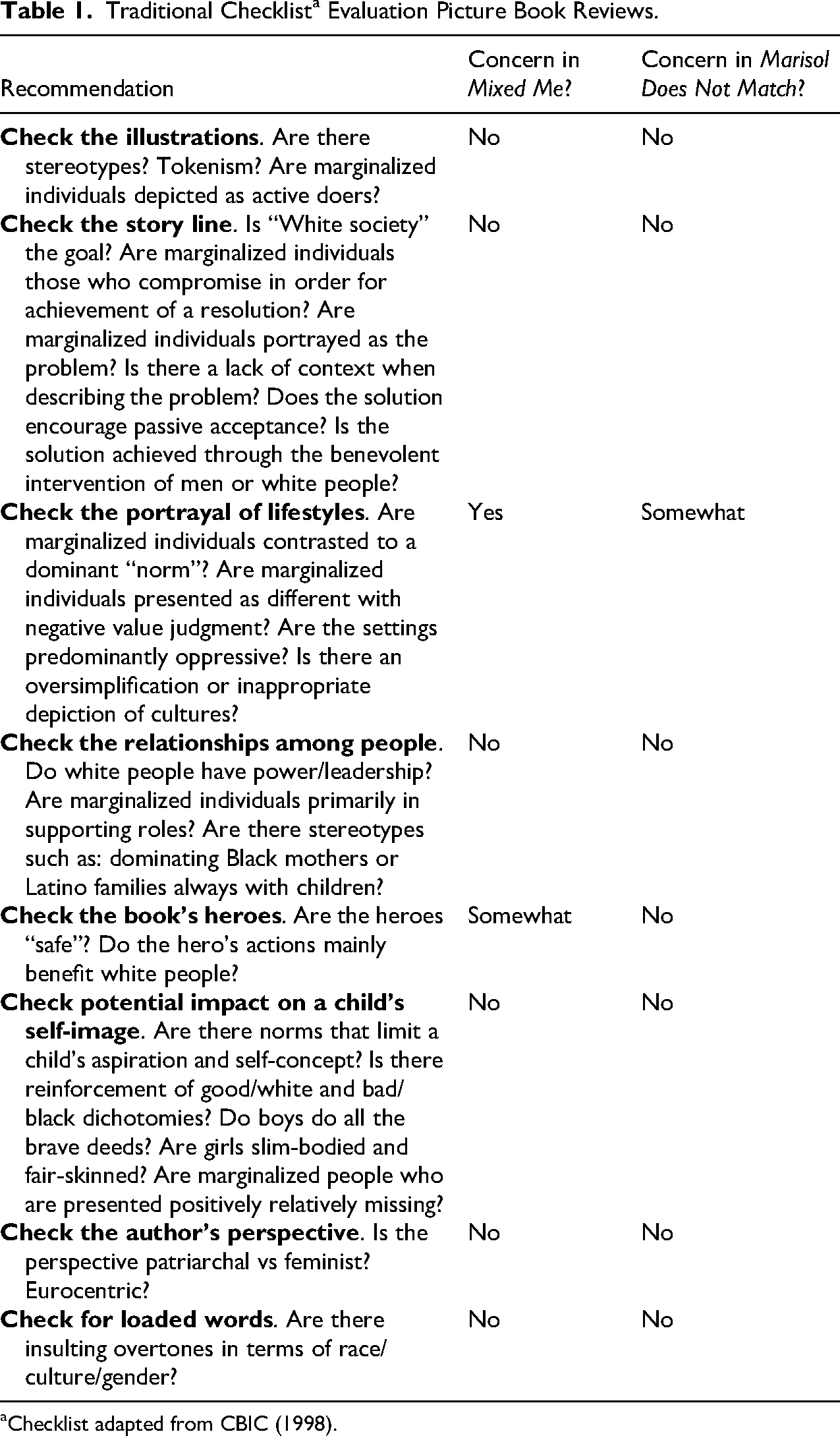
Checklist adapted from CBIC (1998).
Throughout the story, the reasoning cited for Mike's peers telling him he is “mixed up” or “does not match” is that his parents are not of the same race. Mike is the book's hero; in fact, he wears a superhero cape in many of the illustrations. As a hero, Mike is “safe” (e.g., not a threat to oppressive cultural norms) in that he does not explicitly push back against the negative message his peers give, including that he “pick one race.” Instead of taking on the burden of directly addressing the commentary, he dismisses their uninvited perspectives explaining, “If you do not get it, then you do not get it.” We rated this area as somewhat of a concern because, although Mike does not pose a threat to his antagonizers in the form of direct combat in response to their statements, we believed his response—an insistence on his own positive self-esteem—to be age-appropriate and authentic to the child voice of the story's narrator. Aside from these “think abouts,” the checklist approach does not inspire significant further consideration of this book.
Reviewing Mixed Me with an I Spy Approach
Given its open-ended nature, the I Spy approach to examining children's literature that mirrors urban classroom diversity makes space for following pathways of intrigue instead of focusing on a singular destination in the form of a checkmark or lack thereof. Doing so with Mixed Me (as well as with Marisol McDonald) gives the reviewer an opportunity to explore the tensions that surfaced during reading. Because the I Spy strategy encourages question asking, this analytical approach allows for sufficient examination of the book as a whole instead of a cursory review of its individual features. What follows are some of our reflections made while using the I Spy approach with this book, just one of the many sets of reflections that could be had.
Search with Intention
As does the “apply contextual knowledge” feature of the I Spy approach, this component invites the evaluator to first consider what they already know about multiracial families and their portrayal in children's literature as a means by which to focus the evaluator's attention. Doing so alerts the evaluator to keep an eye out for some of the overgeneralizations stereotypically attributed to multiracial families, as seen in literature reviewed earlier in this article. Though the checklist evaluation encouraged us to acknowledge the imposition of a monoracial understanding of race (Harris, 2016), it did not necessitate a deep consideration of this portrayal.
Spying this feature of the book with intention, we see that monoraciality both is and is not at the center of the book. The author seems to go out of his way not to name the parents’ races as Black and White or any other particular race for that matter. It was interest to us, then, that Mike declares that he is “mixed” (a term taken by some to be offensively reminiscent of a time when multiracial individuals were associated with livestock such as sterile mules [Patterson, 2017]) though an explicit racial identification of the components contributing to that mixture go unnamed. Instead, they are referred to only by the tones of their skin; Mike describes his dad as “a deep brown,” his mom as “rich cream honey” and himself as “a blend of dark and light.” This avoidance of any explicit identification of race on the one hand takes a focus off of a monoracialized understanding of race (Harris, 2016) while also providing an understanding of racial difference that would be age appropriate for Mike.
On the other, we wondered if the lack of explicit mention of racial categories unduly obfuscates the topic altogether. As another matter of intentional searching, Mike's hair is a huge (in some illustrations, quite literally) part of the book, and there is stereotypically a significant amount of societal preoccupation with multiracial individuals’ hair. As an I Spy approach to evaluating this book makes space for, we made note of and sat with the feelings of curiosity, and at times unease, inspired by Mike's hair as we perused the pages intentionally even if we did not settle on a single interpretation of those emotions.
Apply Contextual Knowledge
We reviewed Mixed Me with our understanding of ongoing conversations happening within and around the multiracial community at the forefront of our minds. One thing we were particularly attuned to was the portrayal of home and school given that tensions have been observed when comparing the level of comfort and acceptance felt in home spaces as opposed to school spaces (Patterson & Moore, 2019). With this background knowledge activated, we noted that any of the questioning Mike endured about his multiraciality took place in the school setting. In one scene, he holds up a picture of his family during art class, proud and celebratory of the same drawing that is causing his classmates confusion.
In this scene, Mike's eyes are closed as if he is imagining his family. On the following page, Mike seems to have been mentally transported to the safety of his home in an image where he is being hugged by both of his parents, still with crayon in hand. This juxtaposition of images, one in which his classmates look on with questioning expressions and another in which he is at the center of his parents’ embrace, sends a subtle message that school is the place where Mike's “mixedness” is up for interrogation while home is the place where he can feel supported and not scrutinized. It is important to note, however, that Mike does not appear to be dejected or unhappy in school spaces; rather, it is a place where he insists on the autonomy of his racial self-identification in spite of unsolicited input and inquiry from peers.
Embrace Imagery
Instead of simply checking that illustrations do or do not contain stereotypes or tokenism, the I Spy method invites the evaluator to look to the book's images in order to hear the stories they are telling alongside the story being told in the text. This book is full of “Easter eggs” or subtly hidden images that serve as a special little treat for those who notice them. The concept of “mixedness” is carried throughout the book via its subtle illustrations. For instance, the dog eats food named “Various Vittles,” the family uses “Multi Use” soap, and the “all natural” juice boxes sport labels such as “Blended Joy!,” “Merged Medley!,” and “Fused Focus!” Mixed things are everywhere thus making it the norm.
As noticed during the process of searching with intention, Mike's hair takes up a lot of figurative and literal space in the book. Given that hair is a trope often stereotypically aligned with multiracial experiences, the illustrations of Mike's hair stood out to us. The illustrations are particularly, and seemingly intentionally, exaggerated to connote an unruly, out-of-control presentation. There seems to be an emphasis on the inability of Mike's hair to be contained that is presented in such a way that it left us unsettled as viewers. While we are in full support of interrogating and pushing back against any singular notion associated with what is allowed to count as “good,” admirable or attractive hair, we found the exaggeration to be off-putting at the same time. For us, it seemed the illustrator went out of their way to focus on the “wildness” of Mike's hair in a way that exoticized him (Harris, 2016) without contributing to the overall message of the story.
Notice Language
The questioning of one's identity can be traumatizing. At the same time, inquisitive questions about one's background or identity are not always interpreted as offensive if they seem to be coming from a place of innocence or genuine wanting to learn. In our intentional examination of his peers’ questions, we interpreted the inquiries as curious questions not intended to make Mike feel small or less-than his peers. The language could have taken on a negative feel or could have led the reviewer to understand them as invasive, but the language chosen by the author led our interpretation as “things kids are likely to say” without ostracization as a goal. We noticed this in juxtaposition with chosen illustrations; even with the faces of the inquiring children appearing to be more scornful than playful or curious, Mike remains unphased.
Toward its end, Mike returns to the book's opening line, “They call me Mixed-up Mike.” This time, however, Mike has a follow-up response to this observation. He says, “They call me Mixed-up Mike, but that name should be fixed. I’m not mixed up; I just happen to be mixed.” At first read, we understood this to be a worthy concluding message, putting a final punctuation on the steady insistence of Mike's positive self-esteem in regards to his identity. We grappled, however, with why this closing still did not bring us feelings of joy.
As an I Spy approach encourages us to do, we revisited and contemplated the lines and, during this process, we identified the cause: the word “should.” Though we have been hearing a series of affirmations that he, indeed, is not mixed up in spite of what others say, in this conclusion, Mike is not demanding that the misnomer be fixed or declaring that he has proven it false. For us, this statement that it “should” be fixed undid much of the positive messaging offered by the rest of the book by leaving us with the lesson, “Even if you feel good about yourself and can explain why that is the case, others still have the power to name you as they see fit.”
Seek Joy
While this element of the I Spy approach is particularly subjective, we argue that all literary review has elements of subjectivity woven throughout the process. By explicitly interrogating the degree to which joy is inspired, the I Spy approach brings this emotive, ephemeral component of picturebook evaluation to the forefront with transparency and without apology. Rhymes in picturebooks often add an inviting, whimsical element to text that gleefully pulls the reader along. For us, the rhymes here were often forced in unfulfilling ways. As we reviewed, we were emotionally preoccupied with the reactive, defensive stance that Mike was in throughout the book.
The level of positive self-esteem he displayed, especially as a young child, was indeed inspiring, but tied with the fact that he did not have any obvious support in the situations catalyzing that display of self-esteem, we were left with unresolved feelings. We questioned the unspoken message: “If I am a multiracial child, can I only rely on myself, my parents and my dog for support of my identity?” For us, Mike certainly had positive esteem, but we would have been more inclined to find joy in him having self-pride. The defensive condition of his esteem made it difficult for us to find joy in its display.
Reviewing Marisol McDonald Does Not Match/Marisol McDonald No Combina with a Checklist Approach
Similar to the checklist review of Mixed Me, Marisol McDonald's story does not raise significant concern (see Table 1). The portrayal of lifestyles yielded “somewhat” of a concern in our estimation. Most of the comments made about Marisol not matching are related to her style and her preferences, not her race. Still, her cousin's comment that her skin and hair do not match indicates reliance upon monoracial notions of race as the norm. Several instances of her being told she did not match or being encouraged to match in a particular way were highlighted, an indication of oppressive settings and of insistence that she assimilate to a dominant, matching culture.
With each example, however, Marisol retorted with an assertion that she liked her mismatched style and personal choices. As a checklist approach does not inspire investigation beyond a quick yes or no determination as to concerning components, the review of the Marisol McDonald picturebook ends here; its level of quality is deemed at least that which is minimally expected for children's books that mirror urban classroom diversity, but it does not afford us significant opportunity to celebrate the text's rich contributions as an I Spy approach does.
Reviewing Marisol McDonald Does Not Match/Marisol McDonald No Combina with an I Spy Approach
Search with Intention
A contribution this book brings to the classroom is that its teacher character, Ms. Apple, provides a model for enacting a justice-oriented, asset-based pedagogy. She does not do so through expository statements about her teaching philosophy, but through her actions. Ms. Apple is offered as an imperfect presentation of a teacher, adding layers of relatability as well as attainability for the reader considering her as a model. At one point in the story, Ms. Apple says what she later describes as the “wrong thing” when she questions Marisol's mismatching choices. Though her comment may have had benign intent, upon realization that the impact was deleterious for her student, Ms. Apple made effort to remedy the situation by talking to Marisol and acknowledging her misstep. Even as a person of color herself, the author does not allow Ms. Apple to be absolved from responsibility for making a child feel less than welcome in the classroom.
The I Spy method we offer is much less concerned with the specifics of the intentionality that is set, but rather that one is put in place. We can imagine a range of intentions (i.e., What is this book telling us about self-definition? About being willing to try new things? About being willing to acknowledge when a decision should be reevaluated? About what it's like to live in a house when your parents have two different cultural backgrounds?) being set for this book, another indication of its strength as a member of the classroom library.
Apply Contextual Knowledge
Though this book centers a multiracial family, the text does not overtly describe the family's racial background until the end of the book when Ms. Apple celebrates Marisol's Peruvian-Scottish American heritage. In order to appreciate this, background knowledge about the representation of multiracial families in children's literature must be activated. As we saw in Mixed Me, historically, many texts seem to be written about multiracial families, but with an explanatory or defensive tone indicating that they are indeed written for the benefit of monoracial readers (Chaudhri, 2017). Keeping this contextual background in mind, the appeal of this book is raised for us as evaluating readers as we intentionally seek texts that normalize difference instead of hyperfocusing on it and thus inspiring feelings of otherization rather than inclusivity.
Embrace Imagery
Our attention to illustrations is tied to the joy seeking component of the I Spy approach. In embracing the book's imagery, we ask, “What is the form and function of what I’m seeing?” For us, many of the images invoked joy. We enjoyed the subtlety of nods to Marisol's cultural background in the traditional Peruvian pattern on her headband or the llama magnet on the family refrigerator. Another function of the illustrations was to insist on the normalcy of Marisol's style and mismatched approach to life. We enjoyed Marisol's maintenance of her own agency as communicated through the images; though others are drawn with confused or disapproving faces when they suggest to Marisol that she does not match, her face is consistently illustrated with calm and happiness, similar to the depictions of Mike and his peers in Mixed Me.
Unlike in Mike's story, however, we do eventually see images of an upset Marisol. The images only appear, however, when she has imposed upon herself the limits of matching. We also took note of the mixed media included in the illustrations in the form of newsprint incorporated into the drawings throughout the book. Though we were less clear about the function of the newsprint incorporation, with an I Spy approach to book evaluation, that's ok! What is important is that the images are considered deeply and in conjunction with the other components of the method.
Notice Language
An immediate notice of the words in this book is that they are presented in two languages, Spanish and English. Though bilingual children's books are not uncommon, the presentation of this particular story in two languages has particular implications. Marisol explains that she loves “speaking Spanish, English, and sometimes both.” Her love for her multiple heritage languages is able to be fittingly extended to the story through inclusion of both. The bilingual text also mirrors what is likely to happen in a bilingual, bicultural home, adding another layer of authenticity to the story.
In the book's postscript notes, the editor added additional context to the book's bilingualism, noting that it was difficult to find a Spanish translation of the book's title that made sense and matched the spirit of the story. The note explains that there are many verbs in Spanish that mean “to match,” but that they did not sound quite right when applied to Marisol because it is not typically people but things that are described as “matching.” The editor explained that, with consideration of this quandary, the writing team chose to use the Spanish verb combinar. The editor then coyly added a bit of contextual justification by predicting that Marisol would agree with the translation, even if slightly mis-matched. The thoughtfulness described in this short paragraph is illustrated through other examples seen throughout the book.
In one instance of noticing language that brought us joy, Marisol explains that her classmates do not seem to like her drawings. She does not, however, use this negatively connotated language to convey that explanation. Instead, she says, “I think my drawings surprise my friends.” The author's language choice here (along with the fact that the illustration accompanying this text features Marisol's drawing and not the faces of her assessing friends), successfully uncouples Marisol's peers’ opinion about her drawing and any necessarily negative interpretations. Surprise can be a troubling response for some, an exciting one for others. Either way, readers are given space to make their own interpretations.
Toward the end of the story, after Marisol has spent one miserable day matching, her teacher, noticing she does not seem to be herself, asks why she has decided to try to match. The author could have couched Marisol's response in the negative comments and reactions of others who expressed displeasure with her nonmatching style and sensibility. Instead, she centered Marisol and her feelings about the situation as she responded, “I cannot think of a single good reason.”
Seek Joy
One element in particular that brought us joy was the book's resolution. The many strands that were developed throughout the text were tied up in a way that brought it all together without seeming to be forced, overly idyllic or inattentive to themes and ideas introduced earlier in the text. One of the many individuals who highlighted Marisol's lack of matching was her teacher who pointed out that the way she wrote her name, “Marisol” in cursive and “McDonald” in print, did not match. When this interaction occurred, we both lamented the teacher's lack of support for Marisol and also identified with her having made a misstep, as is a natural part of the teacher role, even for those most committed to being inclusive and supportive of all students.
We found joy, then, when this interaction was resolved both for Marisol and for her teacher when Ms. Apple followed up her verbal inquiry into why Marisol had chosen to try to match even though that was not her preference with a written note affirming Marisol's nonmatching style. In the note, Ms. Apple described the many reasons she liked Marisol just the way she is and concluded by insisting that she was “simply marvelous.” As we read, we imagined the conversation Ms. Apple likely had with herself in realizing that she had negatively contributed to the development of Marisol's self-image and the tension and heartbreak that such a realization would have caused a teacher seeking to sustain her students' cultures.
We identified with her attempt to reconcile the imposition caused by her positionality and the intentional attempt she made to find joy in Marisol's. We understood the unspoken message to be one championing the power of evolution and continual growth both for children and for adults. The joy we found was amplified, then, when Marisol claimed for herself the adjective introduced in Ms. Apple's note when she declared at the book's end—after having recommitted to her mismatching ways—that she was, indeed, marvelous.
Conclusion
Throughout this manuscript, we subscribe to the foundational understanding that parents, caregivers, and educators should be intentional in providing texts that can serve as both mirrors in which children can see themselves and windows through which they can see the world (Bishop, 1990) and that a library reflective of the diversity in the world is essential. We have clearly outlined the issues and challenges reflected in the U.S. book publishing world as homogeneous at all levels of the industry including executives, editors, sales and marketers, book reviewers and agents (Lee & Low, 2024).
It is against this backdrop, and after a thorough review of the literature, that we determined there is no one checklist or list of criteria that will provide the evaluation framework needed to critically examine children's books that mirror the diversity of urban classrooms and feature representations of multiracial protagonists and characters. However, our inability to locate such a tool does not dismiss the fact that a manageable, dependable protocol for evaluating children's literature is essential in urban settings which students of color (multiracial students in particular) highly populate, and where their demographics are expected to increase steadily.
Using an I Spy method to evaluate diverse picturebooks—tested here with those featuring multiracial families—we created a framework that provides a deeper, more intentional way to assess children's literature beyond simple checklist methods. Our approach does not result in discrete answers, rather provides a set of starting points to guide one's critical evaluation of children's literature aiming to meet the goal of being a worthy addition to a library seeking to provide culturally relevant and conscious windows and mirrors to its readers. This approach is particularly meaningful in urban classrooms, where students bring a wide variety of racial, cultural, and linguistic identities to the learning space, and where the importance of inclusion, affirmation, and relevance is especially high.
Urban schools often serve the most racially and ethnically diverse student populations in the country, yet classroom libraries in these settings too often fail to represent the full range of student experiences or to do so well. When we say “well,” we point to picturebooks that offer the following for their readers: a non-deficit-based descriptions of times, places and characters; accurately and adequately contextualized details; engaging and unproblematic illustrations; language that is equity and inclusion-driven in terms of both explicit and implicit messaging; and an overall joyful experience. The I Spy approach encourages its users to go beyond surface-level displays of diversity and instead engage in a deliberate process of “searching with intention.” Much like the I Spy game itself, this method prompts educators to observe closely—spotting what is visible, what is missing, and what messages are conveyed beneath the surface. And because this method is an initiation of meaningful, personalized inquiry rather than a routinized checking of boxes, we hope the educators, parents, librarians and seekers of strong examples of diverse children's literature who use it have fun while doing so.
By implementing this framework in urban classrooms, educators acquire strategies to select books that acknowledge and celebrate the diverse identities of their students, including those from multiracial families—a quickly expanding and often overlooked group. This is especially important in schools where literature can either contribute to students feeling invisible or act as a mirror and bridge for fostering connection, identity growth, and academic involvement. Ultimately, the I Spy method helps teachers, librarians, and curriculum leaders create libraries that are not only visually diverse but also culturally rich and contextually meaningful. It emphasizes literature as a vital resource for promoting equity, fostering belonging, and supporting culturally sustaining pedagogy in urban education.
Footnotes
Acknowledgements
We offer many thanks and humble gratitude to the research teammates who supported data collection for this project: Dr. Kaela Fuentes-Packnick and Mia Thomas.
Declaration of Conflicting Interests
The authors declared no potential conflicts of interest with respect to the research, authorship, and/or publication of this article.
Funding
The authors received no financial support for the research, authorship, and/or publication of this article.
