




Abstract
Covering six decades of scholarship and research in Urban Education (1965–2025), the systematic content analysis entailed a critical examination of the representation and thematic focus of published articles addressing Black male student experiences in urban educational contexts. A comprehensive search using key terms yielded 363 articles, which underwent rigorous screening methods to render a sample of 59 articles published between 1995 and 2024. The findings of the content analysis illustrated the increasing scholarly discourse on Black men and boys in urban education, characterized by increased attention in recent decades and contrasted with periods of limited scholarly coverage in this journal.
For the past 60 years, Urban Education has served as a leading scholarly outlet for research addressing critical concerns in urban education related to curriculum and instruction, counseling and social services, educational policy, leadership, psychology and human development, special education, and teacher education. As a peer-reviewed journal, it has regularly produced empirical studies, conceptual analyses, and policy critiques on the aforementioned topics. Within its broader mission, Urban Education has contributed to both shaping and advancing the discourse on Black students, including Black males, by publishing scholarship that informs practice, advances policy, and defines the goals of equity-driven educational transformation in urban, formal and informal, learning contexts.
Despite its aim and scope, the experiences of young Black men and boys in education, particularly in preK-12 settings, have often been framed through a deficit paradigm or lens (Burt et al., 2023; Ford et al., 2023; Hines et al., 2023, 2025). Rather than being viewed as holders of promise, Black young men and boys are often framed or cast as a vulnerable population to be managed, leading to patterns of marginalization that have material consequences (Burt et al., 2023; Hines et al., 2021). It is well-documented in theoretical and scientific literature how young Black men and boys are subjected to disproportionate discipline, exclusionary practices, and negative stereotyping (e.g., being perceived as threatening or defiant), often without regard for context or developmentally appropriate expectations (Hines et al., 2021, 2022; Moore et al., 2021).
One manifestation of this pattern is the process of adultification, wherein young Black men and boys are perceived and treated as older and more culpable than other demographic peers (Hines et al., 2021). Time and time again, the negative perceptions contribute to harsher disciplinary actions, such as suspensions or expulsions, for behaviors that are often addressed more leniently when exhibited by other student groups (Gilmore & Bettis, 2021). Over time, the negative perceptions shape how education practitioners, thought leaders, and policymakers respond to young Black men and boys but also how scholarship represents them.
While there is a growing body of literature that centers the strengths, resilience, and cultural knowledge of young Black men and boys (Fletcher & Hines, 2022; Hines, 2024; Moore et al., 2021), questions remain about the consistency and breadth of such representations in the education literature. Specifically, in a journal like Urban Education, which frames itself as an outlet for equity-focused and culturally responsive research, it is worth examining how often and in what ways young Black men and boys have been featured or underscored in different articles since its inception.
As a multidisciplinary team, the authors conducted a 60-year content analysis of Urban Education, focusing on how the journal has examined or engaged the topic of young Black men and boys. By analyzing trends over time, identifying core domains of focus, and examining the extent to which articles reflect single and multidomain representations, the content analysis provides a descriptive but critically informed conception of past and present scholarship on young Black men and boys as well as how this corpus of literature evolved and/or remained stagnant in the journal over time.
Theoretical Framework
In this section, we situate our study within the broader discourse on urban education, racial inequity, and the experience of Black males. Drawing on Critical Race Theory (CRT; Dixson & Anderson, 2018; Ladson-Billings & Tate, 1995), Culturally Relevant Pedagogy (Ladson-Billings, 1995), Culturally Sustaining Pedagogy (Paris & Alim, 2014), and related scholarship, we illustrate why it is essential to examine how Urban Education has represented scholarship on young Black men and boys over time. These frameworks help highlight the racialized, gendered, and structural forces that shape educational access, opportunity, and belonging for young Black men and boys, underscoring the need for a systematic review of how the field has both conceptualized and depicted their educational experiences.
The urban context is particularly significant because its educational settings often present concentrated challenges related to resource allocation, demographic composition, and policy impacts that create unique conditions for Black male students (Moore & Lewis, 2012). In such schools, Black males are typically more likely than students in other groups to be cited for behavior problems, to experience exclusionary discipline, and to exhibit achievement patterns shaped by systemic risk factors—low test scores in reading and math, disproportionate referral to special education, and lower graduation rates (Boykin & Noguera, 2011). Many of these problems are embedded in urban poverty and related issues, including residential racial segregation, housing and food insecurity, and high levels of residential mobility and criminal justice system involvement (Nation et al., 2020).
CRT offers a powerful lens for understanding how these inequities persist. Further, CRT emphasizes that racism is a pervasive and entrenched feature of U.S. institutions, including educational systems (Ladson-Billings & Tate, 1995), and that racial inequity is the logical outcome of policies and practices rooted in competition, stratification, and deficit framings (Dixson & Anderson, 2018; Ladson-Billings, 1995). Urban school districts regularly find themselves at the center of education reform efforts because of large gaps in academic performance among students based on income, race, and ethnicity (Blagg & Luetmer, 2020). Extant research has documented differential access to emotional, physical, and mental health resources (Panchal et al., 2022); high teacher stress and turnover (Camacho et al., 2021; Conroy et al., 2024); larger class sizes (Boozer & Rouse, 2001); and racially disparate discipline policies (Tefera et al., 2022) as evidence of urban education failing Black male students.
The aforementioned educational inequities have deep psychological and relational consequences. To this end, institutional betrayal erodes Black male students’ sense of belonging, engagement, and self-efficacy within the school community, often restricting their educational opportunities and denying them full access to critical forms of support while also limiting their possibilities and humanity (Brooms, 2022). Young Black men and boys, particularly in preK-12 settings, are more often perceived by teachers as more aggressive, lacking discipline, or less academically capable than their peers (Welsh et al., 2025). By middle school, Black boys become aware of their teachers’ negative perceptions of them and consequentially start to internalize them (Welsh et al., 2024).
A culturally centric, strengths-based approach can help foster student academic success (Ladson-Billings, 1995) and strong racial or ethnic identity development (Paris & Alim, 2014). Ideally, urban schools that excel at affirming Black male students’ racial or cultural identities and lived experiences create inclusive environments through positive relationships, increase the presence of Black male teachers, counseling and mental health professionals, and demonstrate respectful and equitable practices (e.g., access to disability support services, career development opportunities and financial resources). Such work requires that educators recognize the effect of social oppression on the communities in which their students live and form specialized skill sets that translate this understanding into strategies for student engagement, teaching and counseling (Manyam et al., 2020).
Methodology
Current literature underscores the urgency of examining how young Black men and boys are represented in academic scholarship, particularly within Urban Education, a journal situated at the intersection of urban schooling, equity, and structural inequality. Despite extensive research documenting challenges faced by Black male students, much less is known about how the field of urban education has conceptualized their experiences over time and which topics, domains, and issues have been emphasized or overlooked. Understanding these patterns is critical for identifying gaps, tracing historical shifts in attention, and assessing whether scholarly discourse aligns with the lived realities and needs of young Black men and boys.
To address this gap, we conducted an inductive summative content analysis (Rapport, 2010) of article titles and abstracts published in Urban Education between 1965 and 2025. Titles and abstracts were selected to map the scope and trajectory of scholarship and to identify the substantive domains emphasized in its coverage of young Black men and boys. Specifically, the study was guided by the following research questions:
What are the peer-reviewed publication trends in Urban Education articles focusing on young Black men and boys between 1965 and 2025? How frequently are young Black men and boys the explicit focus of educational scholarship in Urban Education between 1965 and 2025? What substantive domains (e.g., psychosocial, academic, and policy) are most addressed in articles on young Black men and boys between 1965 and 2025? To what extent do the articles focus on young Black men and boys within a single substantive domain versus multiple domains between 1965 and 2025?
Research Team
The research team comprised eight individuals with strong preK-12 and higher education backgrounds, including vast experiences conducting educational studies on young Black men and boys. The team met weekly, through video conference, for nine weeks to develop and execute the research plans. As the first step, the first author conducted a text analysis of all the article titles published in Urban Education, over the past 60 years. The initial process helped with better understanding the scope of topics, language, and other time-dependent changes in articles’ phrasing as they relate to young Black men and boys. The second author queried the publishers’ journals website and, as a result, produced an initial list of all the Urban Education articles mentioning young Black men and boys. The multidisciplinary research team used the inclusion/exclusion criteria on this list to identify the articles in the sample.
In the context of this study, we used the term multidisciplinary to describe the research team's diverse professional and scholarly backgrounds across preK-12 education, higher education, counseling, educational leadership, urban education policy, and Black male studies. The range of disciplinary perspectives was essential to interpreting how Black male students have been represented in Urban Education over six decades, ensuring that the coding, categorization, and interpretation of domains were informed by multiple areas of expertise rather than a single disciplinary lens. Such disciplinary diversity also aligned with the recommendations for content analyses focused on marginalized populations, where cross-disciplinary interpretation can reduce bias and enhance analytic depth.
Positionality Statement
The first author identifies as a heterosexual, able-bodied, middle-class male of mixed White and Hispanic heritage and a first-generation PhD, whose research centers on examining and challenging systemic structures that shape educational experiences and outcomes for marginalized groups. The second author identifies as a Black woman, first-generation PhD whose research centers on student success, perfectionism, Black students in higher education, college and career readiness, and STEM engagement. The third author identifies as a Black male whose research focuses on examining and challenging systemic structures that influence Black student academic achievement, social-emotional wellbeing, and college and career readiness in all educational settings.
The fourth author identifies as a heterosexual, able-bodied, middle-class Black male whose research centers on creating liberative and culturally affirming mathematics structures and experiences for Black and Brown children to thrive. The fifth author identifies as a heterosexual, able-bodied, middle-class, Black woman whose research centers on recognizing and addressing systemic structures that perpetuate inequities faced by Black male students. The sixth author, a former mayor, is a Black male graduate student in school counseling whose work is committed to justice, Black liberation, healing racial trauma, and mentorship for Black boys and men. The seventh author is a Black man who is a professor with an extensive research agenda on the academic outcomes of Black men and boys. The last author is a Black man who is the former inaugural executive director of a research center for African American males and an eminent professor who studies Black men and boys throughout their lifespan.
Summative Content Analysis
Content analysis is a systematic research method used to interpret patterns in textual data by organizing, categorizing, and quantifying the presence of key concepts, themes, or features (Krippendorff, 2018). Summative content analysis (SCA) allows researchers to examine what is emphasized, omitted, or trends over time within a body of scholarship. This approach seems quantitative in the early stages, but its goal is to explore the usage of the words/indicators in an inductive manner (Zhang & Wildemuth, 2009). SCA is a collaborative analytic technique enabling a wide range of researchers, academics, and scientists to come together through group analysis sessions to explore the details of textual data (Rapport, 2010). In this study, the SCA provided a structure for identifying how Urban Education has represented Black male students over a 60-year span.
The merit of summative content analyses as it relates to generalizing the psychosocial experiences and issues affecting exclusively Black children and adults is demonstrated by Evans (2013), Manyam, Davis and Mitchell (2020), Young and Young (2020), and Shannon et al. (2024). First, their work documents patterns of culturally responsive care, locates where Black males are humanized in the scholarship, and surfaces the topics that are gaining more traction (Shannon et al., 2024). Second, the SCAs exemplify the urgency to enumerate and catalog the severely low number of articles available and reveal the topics that are critically missing. To illustrate, the four aforementioned SCAs alarmingly show that more than 40 journal searches returned 230 articles: 31 published between 2006 and 2016 (Young & Young, 2020); 66 between 1981 and 2011 (Evans, 2013); 31 between 1980 and 2018 (Manyam et al., 2020); and 102 between 1972 and 2022 (Shannon et al., 2024). The resultant data obtained from SCAs can be of incredible value to families, mentors, policymakers, researchers, and educators to generate paths ahead to improve urban education experiences for young Black males.
Because the research team was interested in the scholarship trends of young Black men and boys and the topics presented (domains), SCA was the appropriate method to examine Urban Education's article titles and abstracts on young Black men and boys published between 1960 and 2025. Our study focused specifically on identifying the frequency and distribution of themes (domains) across the dataset, complemented by inductive coding to allow categories to emerge from the data (Rapport, 2010; Thomas, 2006). The mixed approach, combining deductive metrics with inductive theme generation, was appropriate given our interest in (a) overall scholarship trends related to Black male students and (b) the substantive domains represented in the titles and abstracts of Urban Education articles published between 1965 and 2025.
Article Selection Criteria
Our review adopted an intracategorical intersectional (Bauer & Scheim, 2019) focus on Black male students as a distinct group whose racialized and gendered experiences have historically been marginalized in educational research. To maintain alignment with this focus, we included only articles in which Black males were explicitly centered in the title or abstract. Articles that grouped Black males with other populations (e.g., “Black and Latino males”), without disaggregated analysis, were excluded because they did not allow for clear identification of Black males as a distinct intersectional population. The presented approach ensured conceptual coherence with examining how Urban Education has specifically represented the educational experiences of young Black men and boys.
Specifically, the multidisciplinary research team defined the initial search terms to “Black male,” “Black males,” “African American male,” and “African American males.” The initial query resulted in 363 articles out of the entire set 2,559 articles in Urban Education between 1965 and 2025; however, after a second round of screening titles and abstracts (excluding book reviews, editorials, duplicates, articles focused on nonstudent populations like teachers or administrators, and ineligible titles mentioning Black and Latino males, Black girls, etc.), the inclusion criteria returned a final sample of 59 articles, published between 1995 and 2024. Figure 1 illustrates the multistep screening procedure used to identify eligible articles for this content analysis (see Appendix 1 for a complete list of the articles included in this study).
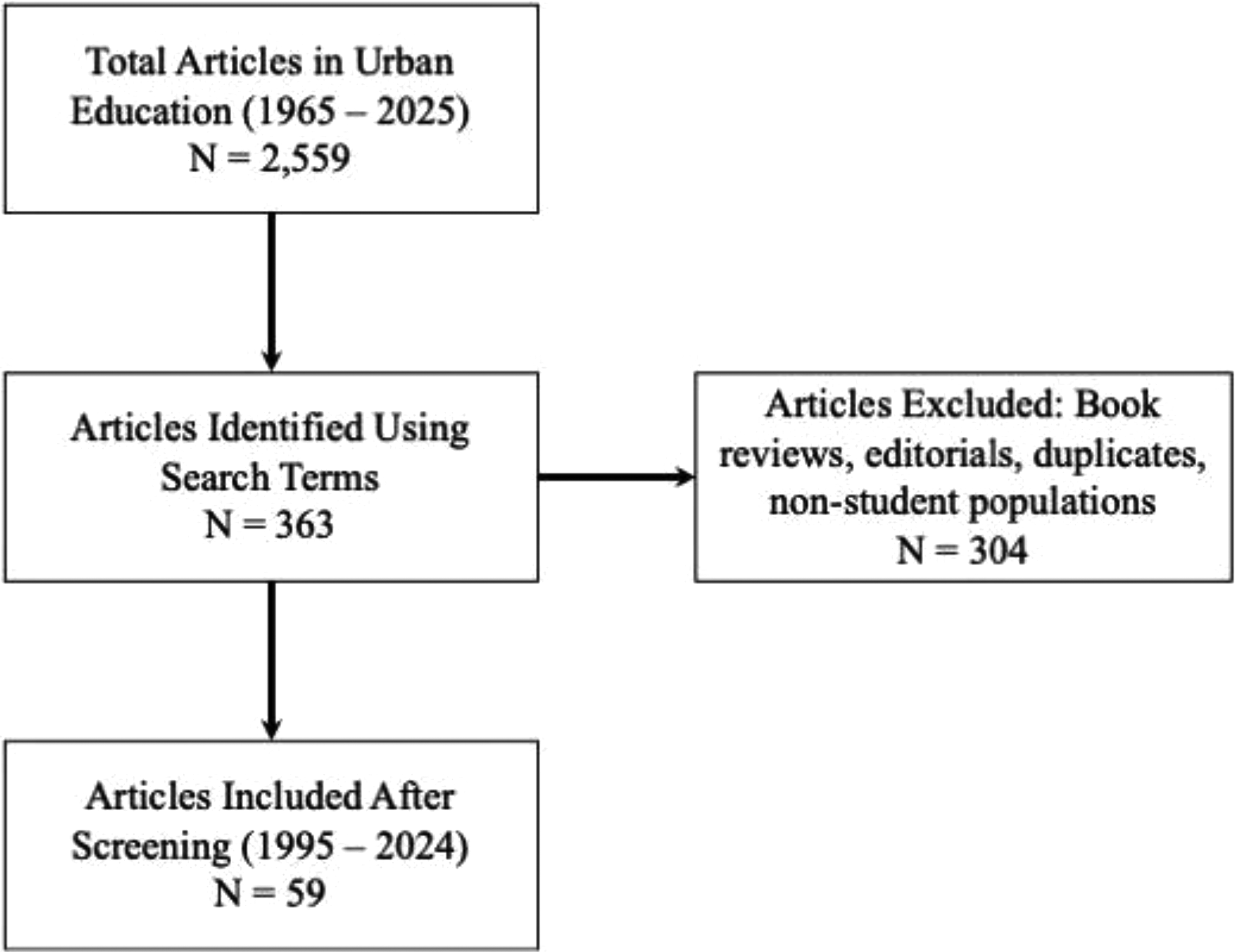
Article Selection Process for Content Analysis of Black Males in Urban Education (1965–2025).
Inductive Coding Procedures
The multidisciplinary research team used an inductive content analysis approach (Thomas, 2006), a qualitative method in which patterns, categories, and themes emerge from data through repeated review rather than being imposed beforehand. Using this approach, we examined the trends in article titles and abstracts mentioning young Black men and boys published in Urban Education from 1965 to 2025. After determining the final sample of 59 articles, the research team identified the substantive areas most represented in the literature. Through iterative review, five overarching domains emerged:
Policy domain: Articles examining education policies or structural reforms shaping the experiences of Black and African American males in urban contexts. Leadership domain: Articles focused on instructors, administrators, service providers, and/or institutions influencing the schooling experiences of Black and African American males. Pedagogy domain: Articles addressing instructional approaches teaching practices, or classroom-level strategies involving Black and African American males. Psychosocial domain: Articles centering identity development, mental health, psychological processes, or socio-emotional wellbeing of Black and African-American males. Academic domain: Articles emphasizing academic achievement, performance, or learning outcomes of Black and African American males.
Each member of the research team independently reviewed the 59 articles (i.e., titles and abstracts) and assigned at least one relevant domain (i.e., article domain coding). For the purposes of this analysis, articles were classified as either single-domain, meaning the article's focus aligned with only one of the five domains, or multidomain, meaning the article substantively engaged two or more domains. Articles were permitted to receive multiple domain assignments to capture the multidimensional nature of educational experiences among young Black men and boys. Thus, the articles were allowed to receive multiple domain assignments to reflect the multidimensional nature of Black males’ experiences and challenges in urban education. Following the initial round of independent coding, three of the team members convened to review the team's codebooks to assess intercoder consistency and identify preliminary trends. In this round, the Psychosocial and Academic domains were the most frequently assigned (collectively appearing in over 80% of articles), and only one article had been assigned to a single domain.
Because such a high rate of multidomain assignments could indicate coder drift, increased familiarity with the sample, or over-inclusiveness, the team conducted a second round of collaborative coding. In this phase, team members jointly coded without reference to prior individual codebooks, and the process confirmed the prominence of the Psychosocial (47 articles) and Academic (47 articles) domains, followed by Policy (21 articles), Leadership (9 articles), and Pedagogy (8 articles). Importantly, the number of articles assigned to a single domain increased from 1 (in independent coding) to 10 in the joint coding round, suggesting that the earlier pattern of heavy multidomain coding was not solely an artifact of coder drift. Further, the additional step provided greater confidence that the prevalence of multidomain assignment was not solely due to coder drift, but rather an accurate reflection of the complex and overlapping themes present in the literature.
Deductive Coding Procedures
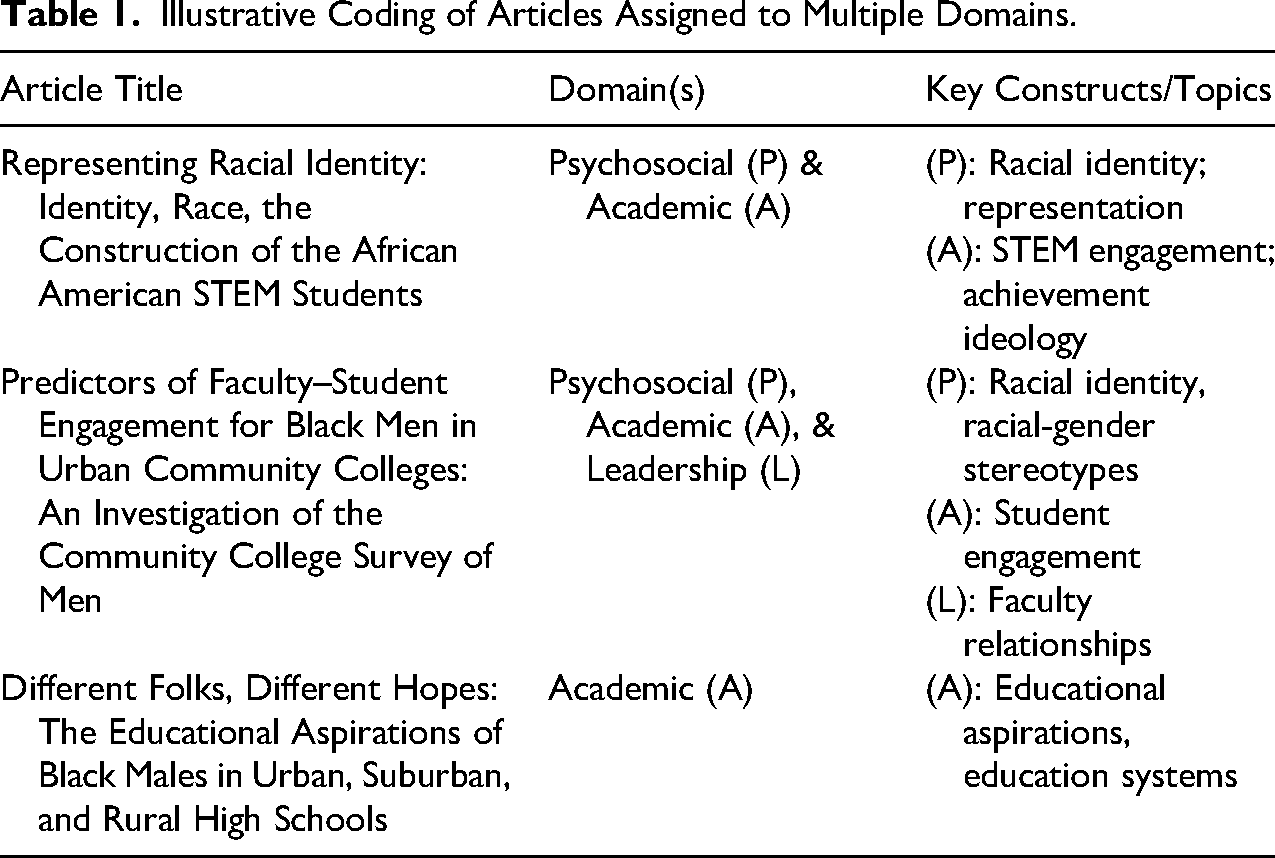
Upon confirming the article domain codes, the multidisciplinary research team segmented the articles by their domain code to extract the key relevant constructs and topics (that aligned with the domain). Table 1 illustrates how key constructs and topics were recorded for articles assigned to the multiple domains. Thus, the key constructs and topics were analyzed to highlight both the unique and shared topics among articles (themes). It is worth noting that the goal was to ascertain which substantive domains (i.e., psychosocial, academic, and policy) were most common for articles on young Black men and boys, and how many articles on them were single-domain or multidomain in scope? The deductive approach resulted in 15 themes across the five domains.
Illustrative Coding of Articles Assigned to Multiple Domains.
In the results section, a rich description of the domains and themes are presented (see Table 2 for a summary of the domains and themes). Because our analysis was restricted to titles and abstracts, our illustrative examples draw directly from that content rather than from full manuscripts. Titles and abstracts contained sufficient information to determine the primary topical domains, but they do not lend themselves to the use of extended quotations (see Appendix 1 for the full list of titles and domains).
Domain and Themes in Urban Education.
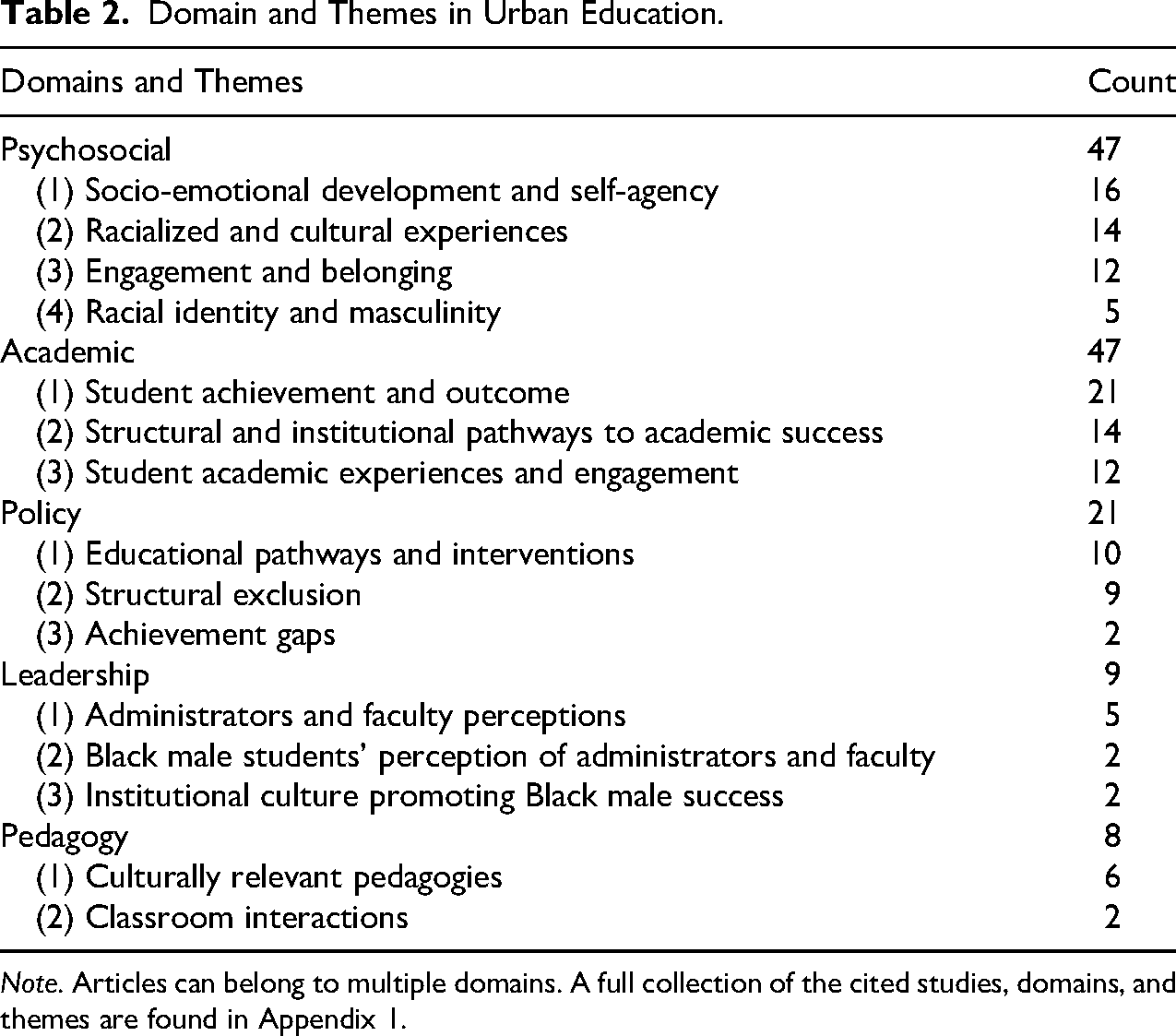
Note. Articles can belong to multiple domains. A full collection of the cited studies, domains, and themes are found in Appendix 1.
Results
Across the 59 articles analyzed, five primary domains were identified: psychosocial, academic, policy, leadership, and pedagogy. The most frequently coded domains were psychosocial and academic, each assigned to 47 articles, followed by policy (21 articles), leadership (9 articles), and pedagogy (8 articles). Within each domain, inductive analysis revealed multiple themes reflecting the complexity of young Black men and boys in urban education (Table 2). Figure 2 provides the temporal distribution of the Black male, student-focused articles, over the period of 1995 to 2024.
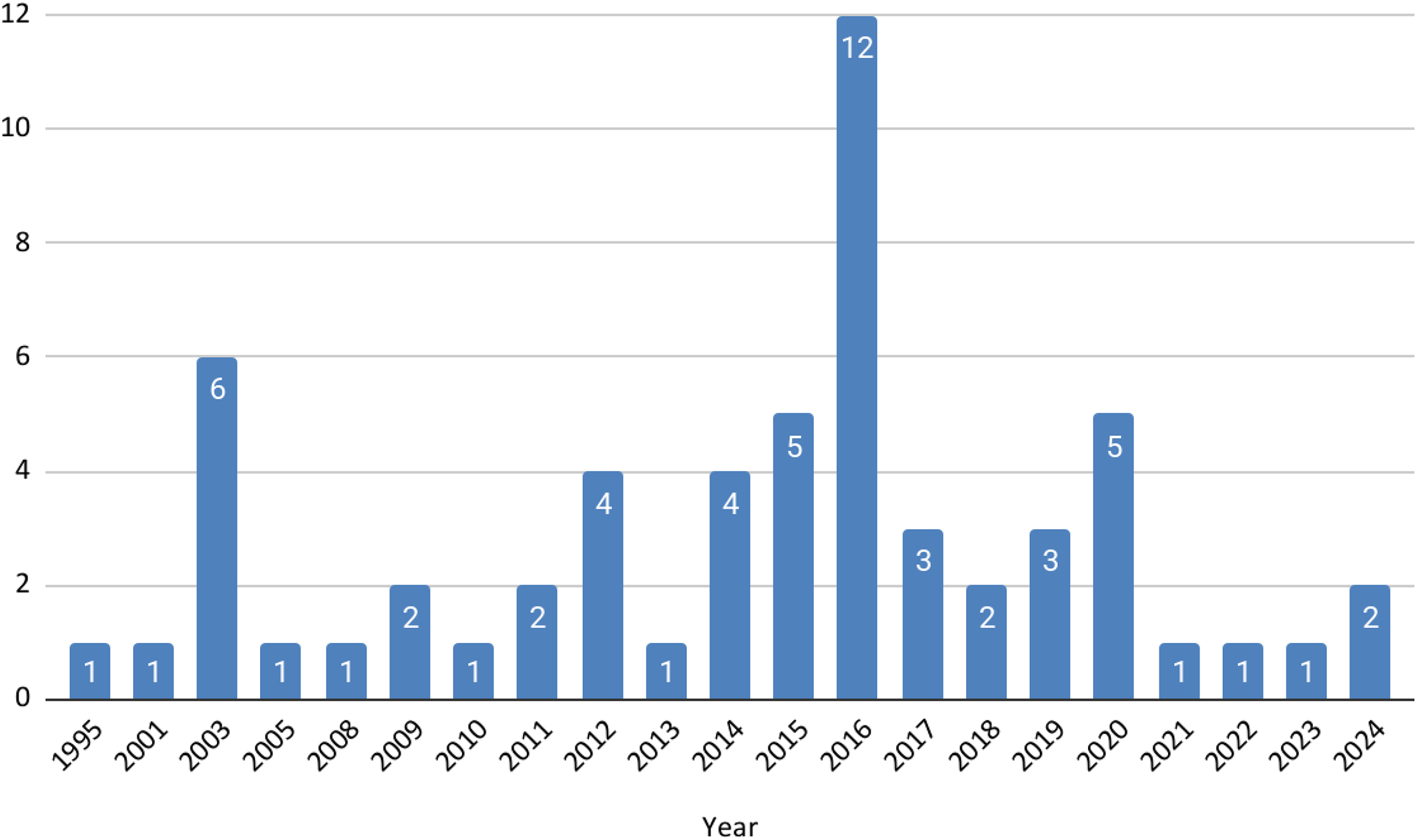
Temporal Distribution of Black Male Student-Focused Articles in Urban Education (1995–2024).
Notably, although our review spanned 1965–2025, no articles published prior to 1995 met our inclusion criteria. Earlier Urban Education articles frequently referenced “urban youth,” “minority students,” and “Black students” but did not specify gender or identify Black boys or Black male students as the primary population. In some cases, terminology or framing did not allow us to determine whether Black males were a distinct analytic focus. Because our criteria required an explicit reference to young Black men or boys in the title or abstract, these earlier articles were not eligible. This pattern likely reflects broader shifts in how scholars described race and gender in earlier decades, rather than an indication of missing articles in our review.
In the psychosocial domain, the most common themes included socio-emotional development and self-agency (16 articles), racialized and cultural experiences (14 articles), engagement and belonging (12 articles), and racial identity and masculinity (5 articles). Within the academic domain, themes emphasized both structural and experiential dimensions of education. They also included student achievement and outcomes (21 articles), structural and institutional pathways to academic success (14 articles), and student academic experiences and engagement (12 articles).
The policy domain focused on broader systemic issues, with themes such as educational pathways and interventions (10 articles), structural exclusion (9 articles), and achievement gaps (2 articles). In the leadership domain, themes included administrators’ and faculty perceptions of Black males (5 articles), Black male students’ perceptions of school leadership (2 articles), and institutional cultures that promote Black male success (2 articles). Finally, the pedagogy domain, while smaller in count, highlighted critical issues in the use of culturally relevant pedagogies and classroom interactions that shape educational experiences for Black males in urban settings. The complete list of articles analyzed, and their themes are found in Appendix 1.
The thematic structure illustrates the multidimensional and intersectional nature of how young Black men and boys are represented in Urban Education, over the past three decades. In the following section, a more detailed examination of each domain and its associated themes are presented. Through illustrative examples drawn from the articles, it is unpacked how the themes reflect the educational, social, and institutional realities faced by young Black men and boys in urban settings. Equally as important, the analysis highlights not only recurring patterns across the literature but also the nuanced ways in which these themes intersect.
To address the earlier presented research questions, an SCA of 59 articles, focused on young Black men and boys published in Urban Education between 1995 and 2025, was conducted. As stated previously, the articles were inductively coded into five overarching domains: academic, psychosocial, policy, leadership, and pedagogy. Within each domain, deductive coding revealed a set of recurring themes that reflect the multidimensional nature of how young Black men and boys are represented in the scholarship within Urban Education. The following sections summarize the key patterns identified in each domain, with illustrative examples to highlight the depth and variation in topical focus across the dataset.
Psychosocial
The first domain is Psychosocial, which includes articles (n = 47) that focus on the identity development, psychological wellbeing, and mental health of Black and African American males in urban education. The Psychosocial domain was synthesized into four themes: (a) racialized and cultural experiences, (b) socio-emotional development and self-agency, (c) racial identity and masculinity, and (d) engagement and belonging. Collectively, these themes explore how young Black men and boys navigate identity, emotional development, and educational system and how culturally responsive practices can promote resilience, connection, and academic achievement.
The first theme, social-emotional development and self-agency (n = 16), focuses on the roles of masculinity, culturally affirming relationships, emotional expression, programming, and opportunity perceptions in fostering social-emotional growth and agency. Collectively, these articles challenge narrow, deficit-based interpretations of young Black men and boys’ behavior and instead position social emotional expression and cultural identity as integral to personal agency and psychological wellbeing. Further, another subset of the articles (n = 14) discussed the racialized and cultural experiences of Black males in education.
Titles and abstracts related to this theme revealed that young Black men and boys frequently encounter barriers, such as stereotype threat, cultural mistrust, racism, ableism, and cultural dissonance in their pursuit of academic success, and lend strategies and interventions, such as conceptual tools and critical frameworks, to better understand and respond to the unique challenges young Black men and boys face in education and beyond. Collectively, the articles highlight how they navigate complex racial and cultural systems in education, emphasizing the urgent need for affirming, equity-driven environments that validate their identities and experiences.
Those articles examining the role of school culture, relationships, and systemic factors in Black males’ engagement and sense of belonging were assigned to the engagement and belonging theme (n = 12). Supportive and inclusive school environments that promote equitable access to advanced coursework, affirm student identities, and encourage active family engagement have a positive impact on young Black men and boys’ academic engagement and aspirations. Conversely, systemic barriers, such as biased disciplinary practices and perceptions among educators, can lead to academic disconnection. Collectively, these articles underscored the need for systemic reforms, culturally responsive pedagogy, and targeted interventions like after-school programming; mentorship; and equitable discipline to dismantle structural barriers, foster inclusive school climates, and empower Black males to achieve academic success and increase their perceptions of their social-emotional wellbeing in urban educational settings.
Fewer articles (n = 5) highlighted the complex and intersectional nature of racial identity and masculinity, such as young Black men and boys’ self-perceptions, psychological processing, and response to oppressive societal narratives related to race and gender. The aforementioned theme captured how they navigated their identities in academic and social settings among racialized and gendered societal expectations; and circumnavigated and resisted succumbing to racialized social expectations to gain or maintain acceptance within white-dominant societal structures.
Overall, the articles illustrated how, in resisting stereotypes and societal expectations, young Black men and boys were actively developing an understanding of their intersectional identities and redefining what it means to be successful in formal and/or informal learning spaces. Hence, it is worth noting that educational institutions can play a significant role in fostering the healthy development of racial/ethnic identities and helping young Black men and boys embrace their masculinity.
Academic
The Academic domain included articles (n = 47) that focused on Black and African American male achievement in urban contexts. Three themes emerged from these cluster of articles: student achievement and outcomes (n = 21); structural and institutional pathways to academic success (n = 14); and student academic experiences and engagement (n = 12). Titles assigned to the Academic domain suggest that the achievement for Black and African American males in urban contexts is dependent on three elements: continuous probing and research on the effectiveness of current academic programming for young Black men and boys in preK-12 and in postsecondary contexts; increasing, developing, and implementing policies within educational institutions through both equity and critical lenses that work to continually ensure the success of Black males while continually dismantling oppositional agentic elements (both systemic and systematic) to their success; and a continual academic nurturing of their schooling environments (especially STEM places of educational practice) to develop strong academic identities toward scholarship.
Within the student achievement and outcomes’ theme (n = 21), the article titles focused on academic achievement and success; educational trajectories and pathways; and college decisions of Black males matriculating from secondary institutions. The articles, published during the years 1995–2022, focused on the academic success and educational trajectories of young Black men and boys. It is quite likely that it is indicative of an intentional commitment to enlighten both the academy and secondary and postsecondary stakeholders on the impacts of the current state and effectiveness of academic programming for young Black men and boys at the time.
Structural and institutional pathways significantly influence the academic success of Black males in urban education, shaped by systemic supports, equitable practices, and specialized environments. These studies (n = 14) highlighted after-school programs, academic and educational supports, and single-sex programs. The authors alluded that these pathways provided critical frameworks for fostering academic achievement and countering systemic barriers faced by young Black men and boys in urban schools. By addressing structural inequities, the presented interventions were often used to motivate them to thrive academically and socially.
The student academic experiences and engagement theme (n = 12) encapsulated the schooling experiences of young Black men and boys, from factors influencing their academic experience (i.e., zero tolerance policies, attending alternative schooling environments by choice, etc.), engagement in science, technology, engineering, and mathematics (STEM; i.e., risk factors of talented Black boys in mathematics, STEM identity, etc.) and athletics, expectations of their academic behavior (i.e., the behaviors that are learned and expected to be demonstrated by students in academic and scholarly environments), and parental involvement (i.e., counterstories from fathers and mothers’ in support of their sons navigating schooling). Such studies implied that young Black men and boys’ schooling decisions and experiences were influenced by institutional expectations and parental and personal encounters with school culture.
Policy
The Policy domain (n = 21) is interpreted as articles that examined urban education policies and procedures impacting Black and African American males. There were three themes identified from the cluster domain: structural exclusion (n = 9), educational pathways and interventions (n = 10), and achievement gaps (n = 2). These articles, collectively, revealed how existing policies often marginalize Black male students and perpetuate educational inequity. One subset (n = 10) outlines educational pathways and interventions, advocating for solutions like out-of-school time programs and single-sex settings to counteract systemic failures. Another subset of articles (n = 9) investigates structural exclusion, detailing how disciplinary actions, academic tracking, and special education placement are shaped by racist and ableist procedures. The last subset (n = 2) focuses on the achievement gap, identifying it as a critical issue rooted in early school disengagement.
Generally speaking, titles assigned to the Policy domain suggest that systemic issues, rather than individual deficits, are the primary source of inequity. Lasting change, therefore, requires equity-driven reform that dismantles these structural barriers and creates educational systems that are truly responsive to and supportive of young Black men and boys.
Leadership
The Leadership domain (n = 9) is interpreted as articles that focused on urban education instructors, administrators, service providers, and/or institutions impacting Black and African American males, which rendered three major themes: administrators and faculty perceptions (n = 5), Black male students’ perception of administrators and faculty (n = 2), and institutional culture promoting Black male success (n = 2). The articles, published between 2015 and 2020, highlighted the attitudes and beliefs that mark the experiences and engagement of Black males in urban education. Another subset of articles (n = 5) refers to teacher and administrator attitudes that inform young Black men and boys’ participation in AP courses, classroom environments, and student disciplinary decisions.
A brief subset of articles (n = 2) highlights schools that promote Black male success. The last subset (n = 2) describes young Black men and boys’ academic advising experiences and their desire to engage with faculty. Titles assigned to the Leadership domain suggest institutional agents must be intentional and reflexive of their attitudes and beliefs to support young Black men and boys in formal and informal (urban) learning contexts. Institutions that yield success for them often have the strategy, staff, and resources that enable their achievement. Institutional agents alike ought to incorporate culturally relevant strategies and resources into practice, while being intentional about their thoughts, beliefs, and attitudes to develop positive relationships with young Black men and boys.
Pedagogy
Pedagogy (n = 8) was the fifth and smallest domain represented in our sample. To this end, the pedagogy domain is interpreted as the articles that focus on the instructional experiences of Black males. With this in mind, two themes emerged from this domain: culturally relevant pedagogies (n = 6) and classroom interactions (n = 2). The articles, published between 2011 and 2023, refer to “reimagining” teaching and learning in urban education, calling out longstanding disparities facing young Black men and boys in special education and traditional learning contexts, and the instructional ideologies and practices that enable inequities.
A subset of articles (n = 6) emphasized the integration of critical literacy instructional practices (informed by BlackPlayCrit Theory, CRT, and Disability Critical Theory) in reading, writing, and science to improve the literacy rates among Black males. The smaller subset of articles (n = 2) highlighted the significance and impact of observed racial and discursive power dynamics in teacher–classroom interactions with young Black men and boys during instruction. Titles assigned to the Pedagogy domain suggested that the incorporation of power and identity discourse in the classroom may contribute to improved learning experiences and outcomes for Black males.
Discussion
The purpose of this study was to perform a summative content analysis of articles published in Urban Education (1965–2025) that explicitly focused on young Black men and boys. Rather than assessing the quality of research findings, the analysis examined the breadth and depth of topics addressed over time, drawing interpretive insight from a team of scholars and practitioners deeply familiar with the experiences of young Black men and boys in educational settings. The study aims and research approach were informed both by existing critical perspectives on urban education, racial inequity and Black males, and Black/African American-centered SCAs to examine how young Black men and boys have been represented in academic discourse in Urban Education and the extent to which these representations acknowledge complexity, resilience, and structural inequity.
The findings revealed five overarching domains: psychosocial, academic, policy, leadership, and pedagogy, encompassing 15 themes. The predominance of psychosocial and academic themes indicates that research in Urban Education has consistently focused on both internal (e.g., identity development, self-agency, and/or emotional wellbeing) and external factors (e.g., school climate, instructional practices, or institutional policies) shaping the development and success of Black males. Themes such as social-emotional development, racialized experiences, structural exclusion, institutional responsiveness, and culturally relevant instruction underscore the interconnectedness of identity, environment, and opportunity.
Together, these themes reflect a gradual shift away from deficit-oriented narratives toward more holistic and contextually grounded representations. The presence of multidomain articles further demonstrates how young Black men and boys’ educational trajectories are shaped by dynamic and overlapping forces. Understanding how students, families, educators, and institutions navigate and resist systemic barriers is essential to advancing equity-driven practices and research. The challenges are not isolated incidents but are embedded in educational systems that often reproduce racial hierarchies. Thus, continued work must attend to the structural conditions and institutional logics that shape what is possible for young Black men and boys in urban, formal and informal, learning contexts.
Moreover, the content of the articles reviewed revealed a growing attention to the complexity of young Black men and boys’ lived experiences, often framed at the intersection of psychosocial and academic challenges. For example, several articles emphasized how racial identity development, masculinity norms, and experiences of adultification intersect with school climate and student engagement. Others highlighted the tensions they often face in navigating environments that simultaneously demand academic excellence while offering limited culturally affirming support.
At the same time, our analysis revealed a relative scarcity of articles situated within the leadership and pedagogy domains, suggesting underexplored areas where systemic and instructional practices could be more deeply interrogated. Importantly, the co-occurrence of multiple domain codes in most articles reflects an emerging recognition in the literature that no single thematic lens is sufficient to understand the educational realities of young Black men and boys, reinforcing the need for intersectional, multisystemic frameworks that attend to how racialized policies, institutional practices, and social narratives collectively shape educational outcomes.
Connections to the Broader Literature on Black Male Students
The patterns identified across the five domains in this review are closely aligned with longstanding findings in research on Black boys and young Black men. The prominence of psychosocial themes, including socio-emotional development, racialized experiences, belonging, and racial identity, reflects extensive scholarship that documents how racial stereotypes, adultification, and cultural mismatch shape Black boys’ experiences in schools. Prior research shows that Black boys often navigate complex processes related to identity negotiation, stereotype threat, and racialized stress, which can influence their engagement and wellbeing (Brooms, 2016; Cintron & Ong, 2025; Ferguson, 2020; Howard, 2014; Noguera, 2009). The presence of 47 psychosocial-focused articles in Urban Education aligns with these broader patterns.
The strong representation of academic themes, particularly those related to achievement, institutional pathways, and academic engagement, is also consistent with established research on Black male students. Scholars have emphasized how school structures, instructional practices, mentoring relationships, and supportive environments contribute to academic outcomes for Black boys (Cintron et al., 2020; Harper, 2015; Hines et al., 2021; Wood & Harris, 2017). The emphasis on structural pathways within this domain corresponds with research that highlights the value of targeted programs, culturally affirming support systems, and intentional educational interventions for Black male students (Golden et al., 2023; Hines et al., 2023; Hines, 2023).
The policy and leadership domains in our findings are similarly reflected in the literature. Research consistently shows that exclusionary discipline practices, inequitable tracking, and harmful institutional policies contribute to racial disparities in school outcomes for Black boys (Dixson & Anderson, 2018). Studies also demonstrate that school leaders influence the climate, expectations, and relationships that shape Black boys’ experiences (Brooms, 2019; Harper, 2015). The themes in the leadership domain, including administrators’ perceptions and students’ views of institutional culture, mirror these findings.
Overall, this synthesis demonstrates that Urban Education reflects many of the well-established concerns in research on Black boys, particularly regarding psychosocial and academic factors. At the same time, it reveals enduring gaps related to institutional responsibility, policy, and leadership as contributors to student outcomes. By mapping these patterns over time, this study offers a comprehensive view of how scholarship on young Black men and boys has evolved within a key journal in the field and identifies important areas for future inquiry.
Implications for Practice and Policy
The implications below respond directly to the patterns emerging in our review, especially the prominence of psychosocial and academic domains, and address the specific, racialized, gendered, and structural challenges faced by young Black men and boys in urban educational spaces. First, educators must recognize that young Black men and boys experience racialized and gendered forms of surveillance, adultification, and criminalization that differ from those of other student groups. Practitioners must intentionally examine how these overlapping systems shape Black boys’ opportunities, safety, and belonging.
Second, culturally affirming and sustaining pedagogy must be designed to counter the racialized narratives and deficit framings disproportionately applied to Black boys. Instruction should foster critical consciousness, validate racial identity development, and explicitly challenge stereotypes about Black masculinity, academic aptitude, and “behavior.” Third, schools must prioritize holistic development by attending to the psychosocial realities uniquely documented in this literature, for example, the emotional labor of navigating stereotype threat, identity negotiation, and cultural dissonance. Programs should include targeted mentoring, racial identity–affirming spaces, and mental health supports attuned to Black boys lived experiences.
Fourth, educators require sustained professional learning focused on recognizing implicit bias, understanding how institutional practices disproportionately harm Black boys, and cultivating relational trust that disrupts exclusionary dynamics (e.g., zero-tolerance policies, pushout patterns, and special education over-referral). Fifth, systemic reforms must directly confront the structural barriers that limit Black boys’ academic pathways. This includes dismantling discriminatory discipline policies, reforming tracking and gatekeeping practices, especially in STEM, ensuring educational equity in access to advanced coursework or curriculum, and mandating disaggregated data to expose disparities affecting Black boys specifically. Finally, centering the voices of young Black men and boys is essential. Their insights should guide program design, policy development, and school climate reforms so they are not merely subjects of intervention but co-creators of educational transformation.
A related implication concerns the educator workforce itself. Although our review highlights the psychosocial and academic factors shaping Black boys’ experiences, research consistently shows that the presence of Black male educators, counselors, and leaders plays a critical role in creating affirming environments, strengthening relational trust, and improving academic and socio-emotional outcomes for Black boys. Generally speaking, the results suggest that the scholarship on Black male students in Urban Education has not kept up with the policy-driven interventions to shift outcomes, trajectories, and narratives about them.
For example, since 2010, there have been significant campaigns to recruit and retain Black male teachers, a notable example is former Education Secretary Arne Duncan's announcement of the national TEACH campaign at Morehouse College in 2011. Recent research stresses the need for Black male teachers, especially for mathematics and science (Garner, 2024; Hines, 2023). Positively, there have been aggressive efforts made to recruit Black males in other professional roles, such as school counselors (Moore, 2022), school psychologists, and administrative leadership roles (Fenwick & Akua, 2013).
Black male teachers occupy under 3% of teaching jobs and are more likely to exit the field due to microaggressions, stereotype threat, school and district conditions, and isolation. One factor to increasing Black male participation is affordable preservice and alternative certification programs that provide the academic, cultural and social support aspiring Black male teachers need to enter and stay in the field. Policymakers, institutions, nonprofits, professional associations, and other proponents of eliminating financial constraints are essential to increasing the availability of scholarships, stipends, and cost exemptions to cover licensing exams, program materials, and professional development centered on the experiences of young Black men and boys.
Limitations and Future Directions
The current study is subject to several limitations. First, our analysis focused exclusively on articles about Black male students in a single journal, Urban Education. While the journal is a central outlet for equity-focused educational research, it does not represent the full scope of scholarship on Black male students across the field. Second, our final sample of 59 articles, though carefully selected, limits the ability to assess trends in coverage over time or generalize beyond this dataset. Third, we did not evaluate the methodological quality, empirical findings, or conceptual rigor of the included articles; our content analysis was restricted to titles and abstracts, which provide limited insight into the depth or nuance of each study. Future research should extend this work by examining full manuscripts to capture more detailed conceptualizations, themes, and methodological details that are not always evident in abstracts.
A related limitation is that we focused solely on the representation of young Black men and boys, excluding articles about Black male teachers, administrators, and staff who also play critical roles in urban education. Because our aim was to center young Black men and boys as a distinct intersectional group, we included only articles in which Black males were explicitly identified as the primary population in the title or abstract. Consequently, we excluded multigroup studies (e.g., those referencing “Black and Latino males”) when they did not disaggregate findings for Black males. This decision ensured conceptual alignment with our research questions but may underrepresent comparative or multigroup research involving Black males.
Additionally, our ability to examine intersectional identities (e.g., LGBTQ+ status, disability, immigrant backgrounds) was limited by their scarce representation in the existing Urban Education literature on young Black men and boys. Although we included all articles that met our screening criteria, very few manuscripts substantively addressed these intersecting identities, reflecting a broader gap in the field. Finally, future work would benefit from engaging Black male students as co-analysts or advisors in content analyses. Their perspectives could enrich the interpretive process and provide insights into which representations resonate and what gaps remain.
Conclusion
The presented content analysis offers a critical window into six decades of scholarship on young Black men and boys in Urban Education, revealing patterns in representation, topic emphasis, and thematic complexity. While there has been meaningful growth in the range and depth of topics covered, especially in psychosocial and academic domains, there remain gaps in how the field accounts for intersectional identities, policy impact, and pedagogical transformation. By identifying the domains most frequently addressed and the themes that have emerged, this study provides a foundation for scholars, researchers, educators, practitioners, and policymakers to build more inclusive, rigorous, and equity-centered research agendas that will translate into practice to acknowledge and validate the experiences and potential of young Black men and boys in urban settings.
Footnotes
Funding
The authors received no financial support for the research, authorship, and/or publication of this article.
Declaration of Conflicting Interests
The authors declared no potential conflicts of interest with respect to the research, authorship, and/or publication of this article.

Author Biographies
Appendix 1. Included Articles With Assigned Domains and Themes.

| ID | Article Title | DOI | Domain (Themes) |
|---|---|---|---|
| 1 | A Phenomenological Variant Ecological Systems Theory Approach for Exploring Racial Stress, and Campus Engagement Among Black Male College Students | 10.1177/00420859241293101 | PS (3) |
| 2 | Black Sons to Mothers: Memory, Mothering, and Masculinity “in the Wake” | 10.1177/00420859241258144 | PS (4) |
| 3 | The Reading Journey of Zion—A Case Study of Race in the Context of Special Education | 10.1177/00420859231162916 | PS (2), PY (2), A (2), PD (2) |
| 4 | Black Male Brilliance as (Ill)Legible: Challenging and Changing Societal and Educational Narratives | 10.1177/00420859221097888 | PS (2), A (1) |
| 5 | Coming Back Home to Live and Not Die: A Human Geography of a Working-Class Black Gay Male Navigating the Local Higher Education Pipeline | 10.1177/0042085920987297 | PS (1), A (1) |
| 6 | From “Problems” to “Vulnerable Resources:” Reconceptualizing Black Boys With and Without Disability Labels in U.S. Urban Schools | 10.1177/0042085920972164 | PS (2), PY (2) |
| 7 | “Sometimes I Wish I Was a Girl, ’Cause They Do Shit Like Cry”: An Exploration Into Black Boys’ Thinking About Emotions | 10.1177/0042085920933327 | PS (1) |
| 8 | Where Are the African American Males? Enrollment Criteria and the Placement of African American Males in Advanced Placement Courses | 10.1177/0042085920959133 | PY (2), A (2), L (1) |
| 9 | Examining Teacher Dispositions for Evidence of (Transformative) Social and Emotional Competencies with Black Boys: The Case of Three Urban High School Teachers | 10.1177/0042085920933326 | PS (1), L (1), PD (2) |
| 10 | Remembering Tamir Rice and Other Black Boy Victims: Imagining Black PlayCrit Literacies Inside and Outside Urban Literacy Education | 10.1177/0042085920902250 | PS (2), A (2), PD (1) |
| 11 | Examining the Academic Advising Experiences of Black Males at an Urban University: An Exploratory Case Study | 10.1177/0042085919894048 | A (2), L (2) |
| 12 | Place, Race, and Sports: Examining the Beliefs and Aspirations of Motivated Black Male Students Who Play High School Sports | 10.1177/0042085919850261 | PS (1), A (2) |
| 13 | Urban Education and Academic Success: The Case of Higher Achieving Black Males | 10.1177/0042085919835284 | A (1), L (3) |
| 14 | Meet Me at the Corner: The Intersection of Literacy Instruction and Race for Urban Education | 10.1177/0042085918805807 | A (2), L (1), PD (1) |
| 15 | Race-Neutral Doesn’t Work: Black Males’ Achievement, Engagement, and School Climate Perceptions | 10.1177/0042085918804015 | PS (3), A (1) |
| 16 | “That’s Why I Say Stay in School”: Black Mothers’ Parental Involvement, Cultural Wealth, and Exclusion in Their Son’s Schooling | 10.1177/0042085917714516 | PS (3), PY (2), A (3) |
| 17 | Today’s Urban Black Male: The Importance of Finding the Right College to Realize Maximum Success | 10.1177/0042085915620652 | A (1) |
| 18 | That Smart Dude: A Qualitative Investigation of the African American Male Scholar-Baller Identity | 10.1177/0042085916668955 | PS (4), A (3) |
| 19 | Respecting a Cultural Continuum of Black Male Pedagogy: Exploring the Life History of a Black Male Middle School Teacher | 10.1177/0042085916677346 | PS (1), A (1), L (1), PD (1) |
| 20 | African American Male College Athletes’ Narratives on Education and Racism | 10.1177/0042085916669749 | PS (2) |
| 21 | Five Wise Men: African American Males Using Urban Critical Literacy to Negotiate and Navigate Home and School in an Urban Setting | 10.1177/0042085917690203 | PS (2), A (2) |
| 22 | “I Was Just Trying to Make It”: Examining Urban Black Males’ Sense of Belonging, Schooling Experiences, and Academic Success | 10.1177/0042085916648743 | PS (3), A (1) |
| 23 | Representing Racial Identity: Identity, Race, the Construction of the African American STEM Students | 10.1177/0042085916661385 | PS (4), A (3) |
| 24 | You Can’t Fix What You Don’t Look At: Acknowledging Race in Addressing Racial Discipline Disparities | 10.1177/0042085916660350 | PS (2), PY (2) |
| 25 | Constructing a Collaborative Critique-Learning Environment for Exploring Science Through Improvisational Performance | 10.1177/0042085916646626 | A (3), PD (1) |
| 26 | Understanding Disciplinary Disproportionality: Stereotypes Shape Pre-Service Teachers’ Beliefs About Black Boys’ Behavior | 10.1177/0042085915623337 | PS (2), PY (2), L (1) |
| 27 | The Psychology of Black Males Attending Urban Private Colleges and Universities | 10.1177/0042085915623348 | PS (1) |
| 28 | Factors That Influence the Persistence and Success of Black Men in Urban Public Universities | 10.1177/0042085915623347 | PS (3), PY (1), A (1) |
| 29 | Predictors of Faculty–Student Engagement for Black Men in Urban Community Colleges: An Investigation of the Community College Survey of Men | 10.1177/0042085915623343 | PS (3), A (3), L (2) |
| 30 | For Profit, For Success, For Black Men: A Review of Literature on Urban For-Profit Colleges and Universities | 10.1177/0042085915618724 | PY (1) |
| 31 | Advancing Black Male Success: Understanding the Contributions of Urban Black Colleges and Universities | 10.1177/0042085915618725 | PY (1), A (2), L (3) |
| 32 | The Status That Troubled Me: Re-Examining Work With Black Boys Through a Culturally Sustaining Pedagogical Framework | 10.1177/0042085915618717 | PS (2) |
| 33 | Using Systems Theory to Promote Academic Success for African American Males | 10.1177/0042085915613546 | PS (3), A (1) |
| 34 | From Alienation to Efficacy: An Examination of Racial Identity and Racial Academic Stereotypes Among Black Male Adolescents | 10.1177/0042085915602538 | PS (3), A (1) |
| 35 | The Misintegration of the Negro: A Historical Analysis of Black Male Habitus in Sport and Schooling | 10.1177/0042085915574526 | PS (4), PY (2), A (3) |
| 36 | A Motivational Intervention for African American Boys Labeled as Aggressive | 10.1177/0042085914549364 | PS (1), A (1) |
| 37 | After-School Programs: A Resource for Young Black Males and Other Urban Youth | 10.1177/0042085914549361 | PS (1), A (2) |
| 38 | Superstar or Scholar? African American Male Youths’ Perceptions of Opportunity in a Time of Change | 10.1177/0042085914528720 | PS (1) |
| 39 | Risk and Protective Factors in Mathematically Talented Black Male Students: Snapshots From Kindergarten Through Eighth Grade | 10.1177/0042085914525791 | PS (1), A (3) |
| 40 | Does the “Negro” Still Need Separate Schools? Single-Sex Educational Settings as Critical Race Counterspaces | 10.1177/0042085913496798 | PY (1), A (2) |
| 41 | The Forms of Capital and the Developed Achievement of Black Males | 10.1177/0042085912463707 | PS (3), PY (3), A (1) |
| 42 | “They Think Minority Means Lesser Than”: Black Middle-Class Sons and Fathers Resisting Microaggressions in the School | 10.1177/0042085912450575 | PS (2), A (3) |
| 43 | Black Male Perspectives on Their Educational Experiences in High School | 10.1177/0042085912454442 | PS (3), PY (2), A (3) |
| 44 | African American Males and Literacy Development in Contexts That are Characteristically Urban | 10.1177/0042085911429471 | A (2), PD (1) |
| 45 | Discursive Positioning in a Fifth-Grade Writing Lesson: The Making of a “Bad, Bad Boy” | 10.1177/0042085911399339 | PS (2), A (2), PD (1) |
| 46 | I Know Who I Am, Do You? Identity and Academic Achievement of Successful African American Male Adolescents in an Urban Pilot High School in the United States | 10.1177/0042085911400319 | PS (4), A (1) |
| 47 | Urban African American Males’ Perceptions of School Counseling Services | 10.1177/0042085910377430 | PS (1), A (2) |
| 48 | Different Folks, Different Hopes: The Educational Aspirations of Black Males in Urban, Suburban, and Rural High Schools | 10.1177/0042085908322705 | A (1) |
| 49 | Controlling the Black School-Age Male: Psychotropic Medications and the Circumvention of Public Law 94-142 and Section 504 | 10.1177/0042085907313440 | PS (1), PY (2), A (3) |
| 50 | Whatcha Doin’ After School? A Review of the Literature on the Influence of After-School Programs on Young Black Males | 10.1177/0042085907311808 | PS (1), PY (1), A (2) |
| 51 | Cultural Mistrust, Academic Outcome Expectations, and Outcome Values among African American Adolescent Men | 10.1177/0042085905278019 | PS (2), A (1) |
| 52 | Early Schooling and Academic Achievement of African American Males | 10.1177/0042085903256220 | PY (3), A (1) |
| 53 | What’s Happening to the Boys? Early High School Experiences and School Outcomes among African American Male Adolescents in Chicago | 10.1177/0042085903256221 | PS (3), A (1) |
| 54 | Black Males’ Structural Conditions, Achievement Patterns, Normative Needs, and “Opportunities” | 10.1177/0042085903256218 | PS (2), PY (1), A (1) |
| 55 | Developing the Talents of African American Male Students during the Nonschool Hours | 10.1177/0042085903038004004 | PS (1), PY (1), A (1) |
| 56 | High School Reform And Black Male Students: Limits and Possibilities of Policy and Practice | 10.1177/0042085902250485 | PS (1), PY (2), A (1) |
| 57 | The Trouble with Black Boys: The Role and Influence of Environmental and Cultural Factors on the Academic Performance of African American Males | 10.1177/0042085903038004005 | PS (2), A (3) |
| 58 | “Peas ‘N Rice” or “Rice ‘N Peas”—Which One are We Really Ordering? The Plight of African American Male Students Engaged in Educational Exchange Processes | 10.1177/0042085901363003 | PS (3), PY (1), A (3) |
| 59 | An Investigation of the Possible Effects of an Immersion as Compared to a Traditional Program for African American Males | 10.1177/0042085995030001007 | PS (1), PY (1), A (1) |