




Abstract
Antiblackness affects education policymaking and the educational experiences and opportunities of Black students. However, the research on antiblackness and education policymaking has been somewhat limited. To better understand the ways in which antiblackness permeates policymaking at the local level, we conducted a qualitative ethnographic case study using Black Critical Theory (BlackCrit) to examine the policy process surrounding a merger of two elementary schools in a large school district. We find that instances of antiblack racism emerged throughout the merger process, despite the local leaders’ portrayal of the merger as an equity-oriented policy intended to alleviate racial and class segregation.
Introduction
Recently, many federal, state, and local education actors have invested in policies that promote equitable outcomes, especially for racially minoritized students. For instance, in 2019 the state of Louisiana passed a series of policies aimed at addressing racial and class inequities in student participation in dual enrollment programs (Fischer et al., 2023). California, in another example, has invested nearly $4 billion in community schools. The suite of policies aims to improve learning environments and outcomes for minoritized student groups, including racially minoritized students (Fischer et al. 2023). However, research has established how policies with equity intents can become inequitable in design and implementation (e.g., Turner and Beneke, 2019; Welton et al., 2023). We maintain that racial inequities in student outcomes and achievement are “evidence of institutional and pedagogical dysfunctions,” and thus define equitable outcomes as those that are not patterned along racial lines (Bensimon, 2024, p.1).
Another small but profound body of research establishes that antiblackness and antiblack racism is deeply embedded within K-12 schooling and policymaking processes (Anderson, 1988; Coles, 2023; Coles & Powell, 2020; Dumas, 2016; Dumas & ross, 2016; Jenkins, 2021; ross, 2020a; ross, 2020b; Warren & Coles, 2020, Wun, 2014, Wun, 2016). We define antiblack racism as systemic and structural policies and practices that devalue Blackness and marginalize Black people and communities. For instance, some scholars, such as Dumas (2016) and Jenkins (2021), have argued that schools and the policies that govern them are deeply rooted within harmful, antiblack ideologies and have urged education policymakers to reevaluate the design and implementation of these policies—particularly those aimed at addressing the educational inequities currently being faced by Black students and families.
Yet, these two bodies of research are rarely bridged. Little work has explored how antiblackness emerges within local K-12 equity-oriented policy processes. Further, examining antiblackness at the local level is important because it illuminates how antiblackness is perpetuated and reinforced through commonplace policy processes and practices, shaping outcomes for Black students, families, and communities.
In response to this gap, we present a case of antiblackness in an urban education setting—that is, a large and densely populated metropolitan city, also known as an “urban-intensive” context (Milner, 2012). Through a BlackCrit lens (Dumas and ross, 2016), we document the debate, design, and implementation of a school merger policy within the Echeveria Unified School District,
1
the local district for a large city in the far-west region of the United States. Initially, the merger policy proposal suggested that two underenrolled elementary schools—one multiracial and the other predominantly Black—should merge on the latter's campus. District leadership suggested that the merger was an equitable solution to the district's persistent issues with underenrollment and would promote more racial and economic diversity. Additionally, the district argued that the merger was minimally disruptive because the schools were only a mile apart, and 90% of the students at the multicultural school commuted by car. In contrast, parents from the multiracial school vehemently argued against the merger. To understand the racialized nuances of this disagreement, we ask the following research questions:
To what extent did antiblack racism emerge in an equity-minded policy process? What factors shaped these patterns?
We answer these questions through a virtual ethnographic case study of school board meetings where the merger policy was discussed. Overall, we find that although the Echeveria Unified School District (EUSD) school board presented the merger as a way to advance racial equity and bring together two communities, the actual outcome of the merger was quite different, with the district creating a loophole that facilitated privileged parents avoiding the merger by enrolling their child(ren) elsewhere. Ultimately, our study illustrates how antiblack racism may become embedded into local policy processes, even those with equity intents.
Review of the Literature
Our study concerns a school consolidation or merger, a process in which two or more schools are combined under district policy. While mergers are often presented as distinct from closures, we conceptualize mergers as a type of school closure because they involve significant organizational and cultural restructuring. The body of literature on school mergers is relatively limited, but existing research tends to focus on rural settings where declining enrollment and geographic isolation have made consolidation a long-standing strategy (Bard et al., 2006). However, in recent years, “urban-intensive” (Milner, 2012) and suburban districts have increasingly turned to mergers as a response to post-COVID-19 financial strain, demographic shifts, and political pressure to demonstrate improved performance with fewer resources (Ewing & Green, 2022). Mergers in these urban contexts often mirror closures in terms of their disruptive impact on historically marginalized communities, particularly when involving the absorption of schools that primarily serve Black and low-income students into more resourced schools that cater to affluent, predominantly White students. As a result, we believe that it is important to situate school mergers within the broader discourse on school closures. Therefore, the remainder of this review focuses on the literature concerning school closures, with particular attention to the closure of urban schools.
Unpacking the Equity Rhetoric of School Closures
School closure policies have increasingly been framed as equity-driven reform efforts, despite their complex and often controversial implications. Many public-school districts use school closures to help reduce financial costs and bolster academic achievement within their respective districts (Cohen, 2016; Finnigan & Lavner, 2012; Lee & Lubienski, 2017). Relatedly, district officials have also tended to believe that school closures can provide more equitable educational opportunities to students within the district (Cohen, 2016; Tieken & Auldridge-Reveles, 2019). However, these framings warrant further scrutiny. While the equity rationale may guide initial decision-making, emerging evidence suggests that the benefits of closures are not evenly distributed and, in many cases, may exacerbate existing disparities (e.g., Engberg et al., 2012; Welsh, 2017).
Particularly, Black students and students from low-income backgrounds experience school closures more frequently than their peers (e.g., de la Torre et al., 2015; Greene-Bell & Pearman, 2024; Royal & Cothorne, 2021). In the last decade alone, city officials in Chicago, Detroit, Philadelphia, Oakland, and New York City have closed more than 30 schools, the majority of which served predominantly low-income Black communities (Tieken & Auldridge-Reveles, 2019). The high concentration of school closures in these racially segregated urban neighborhoods underscores the extent to which policy decisions—framed as reform—continue to exacerbate structural inequities, reinforcing cycles of disinvestment in Black educational spaces and raising critical equity concerns (Enoch-Stevens et al., 2022; Ewing, 2018; Greene-Bell & Pearman, 2024; Lipman, 2013; Morris et al., 2022; Tieken & Auldridge-Reveles, 2019). Given this, we believe it is also important to explore the effectiveness of these closures and their impact on students and school communities, particularly those residing in urban contexts.
The Mixed Outcomes of School Closures
Despite the ubiquity of school closures, the evidence on the impacts and benefits of school closures continues to remain mixed (Carlson & Lavertu, 2016; Gordon et al., 2018; Larsen, 2020; Sunderman et al., 2017). While school closures can contribute to improved resources and educational opportunities for historically and racially disadvantaged groups, educational outcomes for students affected by closures largely depend on the type of school that a student attends following a closure (Carlson & Lavertu, 2016; Kirshner & Gaertner, 2015; Steinberg & MacDonald, 2019). School closures have also been linked to decreased student performance and engagement, lower test scores, and higher rates of absenteeism (Billings et al., 2014; Ewing, 2018; Deeds & Pattillo, 2015; Kirshner et al., 2010; Lipman, 2011a; 2011b). These outcomes raise concerns about whether school closures genuinely serve the interests and needs of historically marginalized student populations. Existing literature on school closures also illustrates how they result in the disproportionate displacement of Black students and educators (de la Torre et al., 2015; Engberg et al., 2012, Ewing, 2018; Green et al., 2019; Lee & Lubienski, 2017), weakened relationships between Black students and school staff (Royal & Cothorne, 2021; Green et al., 2019; Gordon et al., 2018), and increased institutional mourning and Black suffering (Ewing, 2018; Tieken & Auldridge-Reveles, 2019), contributing to the further marginalization of Black and Brown communities. Although these outcomes are troubling in their own right, they also reflect deeper structural inequities in how and where closure decisions are made.
Targeting Blackness: School Closures, Systemic Displacement, and Racialized Harm
In recent years, scholars have also called attention to the role that race plays in school closure decisions, particularly the ways in which Black students and their communities have become more susceptible to the effects of these closures and the mechanisms driving these disparities (e.g., Morris et al., 2022; Pearman & Greene, 2022). Building on this work, recent studies have also critically examined how school closures in historically Black urban neighborhoods intersect with broader patterns of racial and economic displacement, revealing that such closures often serve as mechanisms of gentrification rather than genuine equity reform (Greene-Bell & Pearman, 2024; Pearman & Greene, 2022). However, despite this emerging and important scholarship, much of the work on closures continues to fall short in acknowledging and directly engaging with antiblackness within educational policy contexts. Addressing this gap is essential to more accurately understanding the consequences of school closures and to advancing policy approaches that genuinely challenge, rather than reinforce, racial injustice.
Reframing Equity: Antiblackness and the Limits of Policy Reform
Our study seeks to contribute to this critical gap in the literature by examining how a district explicitly framed a school closure/merger process as a racial and economic equity initiative—a framing that is increasingly prevalent in education policy, but that remains underexamined in terms of its on-the-ground impacts. By situating school mergers within the broader policy context of school closures, we are able to more critically interrogate how racial inequities are maintained, even within initiatives that are rhetorically positioned as equity-driven (Dumas, 2013; Diem et al., 2024; Diem & Welton, 2020; Ewing, 2018; Horsford, 2019; Tieken & Auldridge-Reveles, 2019). To make sense of these dynamics, we draw on Dumas and ross’ (2016) Black Critical Theory, which provides a necessary framework for understanding how antiblackness can persist within and be perpetuated through seemingly progressive local policy processes.
Theory
Building on the scholarship of Critical Race Theory (CRT) (e.g., Bell, 1995; Crenshaw, 1989; Harris, 1993) and the work of scholars who have advocated for a Black Critical Theory or BlackCrit (Lewis, 2000; Phillips, 1998; Roberts, 1998), Dumas and ross (2016) offer a BlackCrit framework. The framework offers theoretical tools to aid in the “examination of the specificity of the Black” experience (Dumas & ross, 2016, p. 428).
BlackCrit—unlike CRT, which is intended to expand on racial counternarratives more broadly (Solorzano & Yosso, 2002)—focuses on the systemic antiblackness present in racialized structures. As a result, BlackCrit insists on a deeper reckoning—one that centers the specificity of Black suffering and survival and foregrounds the ontological positioning of Black people as socially and structurally excluded (Dumas, 2014; 2016; Dumas & ross, 2016; ross, 2020a; ross & Givens, 2023; Warren et al., 2024). In doing so, it moves beyond CRT's broader focus on racial hierarchies, naming antiblackness not as a mere symptom of racism but as a distinct and foundational structure in its own right (e.g., Bell et al., 2024; Coles, 2023; Coles & Powell, 2020; Toliver, 2022; Warren et al., 2024).
This study draws on three framing principles of BlackCrit (Dumas & ross, 2016). First, antiblackness is endemic and pervasive and situates Black people as nonhuman. Second, Blackness exists in tension with the “neoliberal-multicultural imagination,” which is the notion that racism is no longer a barrier to equal opportunity within the market. Here, the relative success of other racialized groups serves to situate Black communities as problematic and unwilling to embrace the nation's prosperous and multicultural future. In other words, BlackCrit explores how concepts like multiculturalism and diversity mask and ignore antiblackness and exposes how societal structures shape Black experiences within the “free” market. Third, Black liberatory fantasy—or the freedom to dream of a world without racism—is fundamental for the eradication of antiblack racism. Black people's imaginings of freedom allow for the articulation of collective movements and policy reforms, which can thus lead to power shifts.
Dumas and ross (2016) argue that BlackCrit is useful for analyzing school policy and practice. For this study, we consider how antiblackness might shape a school merger policy process utilizing the three BlackCrit frames provided above. The BlackCrit framework allows for an examination of how a local policy framed as an “equity” policy can become antiblack in design and implementation, as well as come into tension with Black visions of educational equity. Our work makes an important contribution. K-12 education scholars have used BlackCrit to examine school policies at the macro level (Boutte et al., 2021; Coles & Powell, 2020); few studies have used the framework to understand school policy processes at the district level, which is a critical realm of policymaking. Further, BlackCrit is analytically useful as it provides tools to examine how antiblack racism affects the ways in which resources and power are distributed or stifled through policy processes (Coles & Powell, 2020; Dumas & ross, 2016; Wynter, 1989) and research has shown that local distribution and politics significantly shape the experiences of racially marginalized students (e.g., Condron & Roscigno, 2003). Such an examination is important in education policy research, where there is a well-established history of school policies and processes leading to particularly negative outcomes and experiences for Black students and communities (Horne et al., 2024).
Methods
The EUSD serves approximately 50,000 students, is located in a large city, and experiences many issues that other large urban districts face, such as underenrollment and a segregated and rapidly gentrifying community. In 2019, EUSD proposed the merger of Napenda Elementary with Washington Elementary as part of a comprehensive plan to close multiple schools within the district. Both schools were underenrolled at the time. Napenda was a predominantly Black school located in a historically low-income Black neighborhood. The school was considered low performing. Washington was a predominantly White but multiracial school located in a historically wealthy neighborhood of Echeveria. Washington was considered high performing. Research shows that Black working-class communities often face unique racialized and classed tensions with education decision-making (e.g., Dumas, 2013; Lipman & Haines, 2007), and the Washington-Napenda merger also reflected these racial and class-based strains. See Table 1 for school and district racial demographics.
Racial Composition of District and Case Schools.
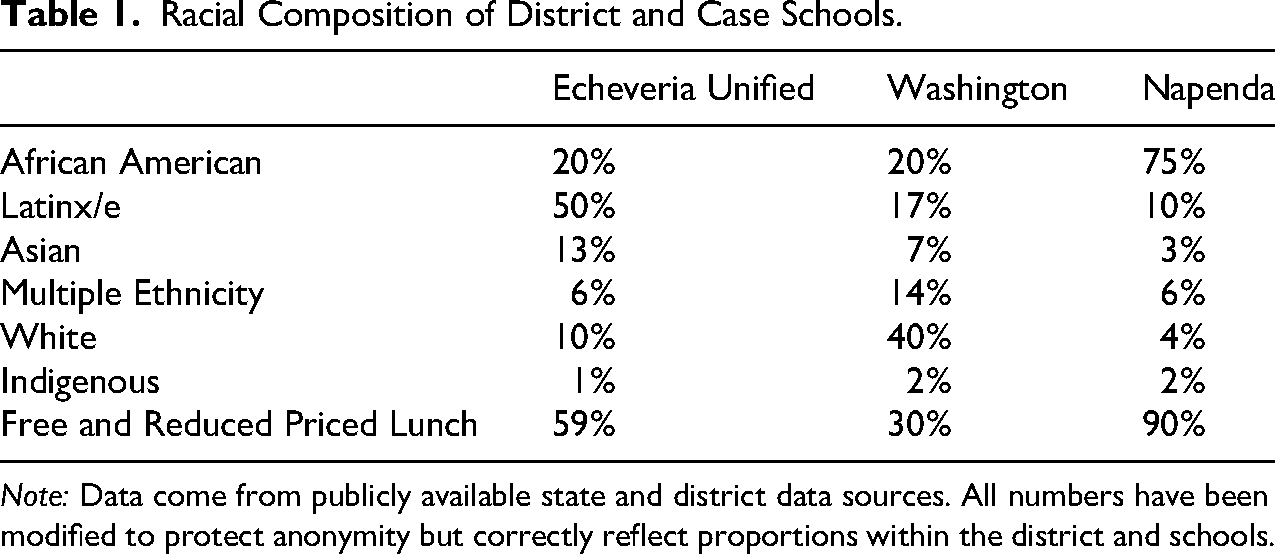
Note: Data come from publicly available state and district data sources. All numbers have been modified to protect anonymity but correctly reflect proportions within the district and schools.
The merger plan stated that all of Washington's students would move to Napenda. Ninety percent of Washington's student population enrolled in the school through the district's intradistrict open enrollment program. Napenda and Washington were less than a mile apart. So, the logic was that if parents could drive their students to Washington, they could drive them to Napenda.
The school district stated that the plan was necessary for fiscal solvency. The district estimated that the merger would save the district over $600,000 over 4 years. The district also noted its desire to avoid displacing a historically Black community. The merger plan was met with great opposition from the Washington community.
Data Collection
The data for our study consist of field notes from the observation of three EUSD school board meetings and 28 artifacts. We discuss how both types of data were collected below.
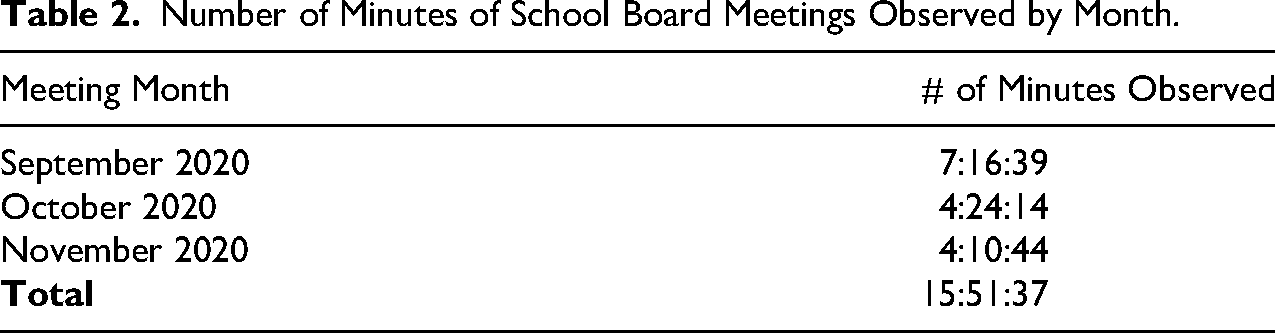
Observation Data. The study applies traditional ethnographic methods to a virtual space (Dicks, 2005; Dominguez et al., 2007; Hine, 2000; Murthy, 2013). As Table 2 details, this study's primary data consists of virtual observations of three EUSD school board meetings (Erickson, 2006). A researcher on the team downloaded the recordings of each meeting and saved them onto a virtual storage system. We also had the audio of each meeting transcribed. Additionally, we searched the website YouTube for alternative videos of the school board meetings. We found one pertinent video, which was recorded by a community member and uploaded to YouTube.
Number of Minutes of School Board Meetings Observed by Month.
Our observation process was guided by Erickson's (2006) approach to virtual observation. Initially, we identified several phenomena of interest (e.g., arguments for/against the merger, policy design/implementation, civil disobedience, and board addressing civil disobedience). Second, we viewed each meeting in its entirety and noted moments pertinent to our phenomena of interest. Third, we rewatched study-relevant scenes multiple times in order to capture the intricacies of the interactions; we also relied on transcriptions to capture dialogue accurately. As we observed, we took detailed field notes on a uniform observation template (Creswell, 2007; Emerson et al., 2011).
Throughout our observations, we employed a method known as “observed race,” where racial identity is typically defined by the interviewer's classification (Roth, 2016, p. 1315). This approach is particularly effective for observational studies that examine discrimination and socioeconomic disparities. Our team of three Black researchers categorized individuals as Black, White, Latinx, or Asian based on their appearance, interactions, and statements (Roth, 2016). For board members, school leaders, and community members with an online presence, we often found publicly accessible information indicating their race, such as campaign materials or civic organization affiliations. In some cases, we hesitated to label an individual's race and chose not to do so. We recognize that our study may reflect how participants appear phenotypically rather than how they identify racially (see the limitations section for a more detailed discussion of this approach).
Artifact Data. Document artifacts are an essential source of data and allow for a deeper understanding of the case (Bogdan & Biklen, 2006). We collected documents in two key ways. First, we used a variety of key phrases (i.e., Washington school EUSD, Napenda school EUSD, school closures in EUSD, and Washington–Napenda merger) to search the internet for news reporting about the policy process. Next, we identified EUSD policy documents concerning the merger policy (i.e., EUSD school closure plan, teachers’ union statements, school presentations, district PowerPoints, and meeting minutes). These processes resulted in district policy documents (n = 13), newspaper articles detailing district and community arguments (n = 9), and media sources providing context and information on the policy process (n = 6).
Data Analysis
Analysis for this study was theoretically driven and iterative. First, we designed a matrix using Google Sheets (Bush-Mecenas & Marsh, 2018). The columns of the matrix identified three distinct parts of the policy process (i.e., problem framing, policy design, and policy implementation; Fowler, 2012). We populated the cells of the matrix with data from our field notes that fit into each of these categories. Additionally, we tracked what type of actor (i.e., school board member, EUSD district official, teachers’ union member, Washington parent, Napenda parent) made certain arguments. At this point, antiblackness, which had always been one of the framings of the study, emerged as a primary logic within our data.
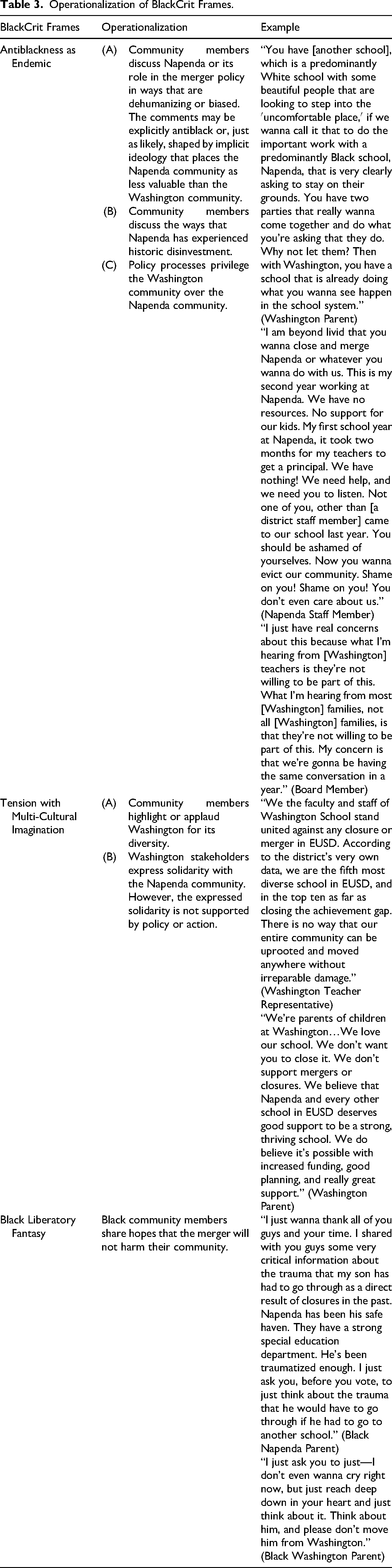
We turned to BlackCrit and operationalized how the three BlackCrit framings might appear in a school merger policy process (see Table 3). We then created a theoretically driven matrix to summarize how antiblackness emerged within the process, with supporting evidence from our observations. Next, we populated the matrix with data from our documents where appropriate. Artifact data was particularly helpful in providing evidence of what happened after the merger policy was passed, as it was no longer a topic at school board meetings.
Operationalization of BlackCrit Frames.
Limitations
Our study has limitations, beginning with our reliance on observation as the primary mode of data collection and the absence of interview data. Without interview data, we could not explore the motives of the actors in our study or understand how they interpreted the events that unfolded. As a result, our ability to capture the subjective dimensions of how Black communities experience, interpret, and respond to antiblackness was constrained. Nevertheless, our decision to rely primarily on observational data offered us distinct analytical advantages. As Jerolmack and Khan (2014) argue, observations are especially powerful for exposing the dissonance between stated intentions and enacted behaviors. This proved essential in our study, where we were able to trace the gap between the rhetoric of an “equity-minded” school merger and the actual implementation of the policy that followed.
Second, our observations were limited to publicly accessible school board meetings. While these spaces are significant for understanding how policy is debated and enacted, they do not capture the full range of contexts where antiblackness is produced and contested. Therefore, we intentionally focused our analysis on visible forms of antiblackness as they emerged during the school merger process. This decision afforded us the ability to identify and trace how racialized power manifests through formal discourse and public action.
Third, since we lacked interview data, we could not ask community members how they identify racially or in terms of gender. Instead, as three Black women, we relied on phenotype and gender presentation for our assessments. We recognize that this approach may not have aligned with the self-identifications of all the individuals involved in the meetings, risking the misclassification of certain actors. However, this approach is documented as particularly effective for observational studies that examine discrimination and socioeconomic disparities (Roth, 2016). Additionally, some community members did provide their racial and gender identities in their comments, helping to reduce the number of assessments that needed to be made.
Positionality
We acknowledge that we bring our own unique experiences and perspectives to this work (Jacobs-Huey, 2002). All members of the research team identify as Black and are former K-12 teachers. Each of us is a scholar of racial justice in K-12 schools. We acknowledge that antiblackness shapes our experiences, and we engaged in activities to ensure trustworthiness, such as continually revisiting our theoretical framework and considering the data through the theoretical lenses of this research. Further, as a mother, the lead author of this study understands the intellectual and emotional work of choosing where to send a child to school. The purpose of this study is not to vilify any parent or community member. Rather, we aim to exemplify how easily antiblack racism can enter K-12 education processes and demonstrate what the real-life ramifications of this seamless infiltration are for Black students and their communities (which extends beyond any one individual or perspective).
Findings
With this study, we seek to answer the following research questions: To what extent did antiblack racism emerge in an equity-minded policy process? and What factors shaped these patterns? Findings suggest that antiblackness emerged throughout the Washington–Napenda merger, shaped by policy design, community reactions, and policy implementation. The following sections detail three distinct periods in the Washington–Napenda merger process. Throughout, we provide specific examples of how antiblack racism emerged in this policy process.
Prologue: The Black Liberatory Fantasy of the Success Pass
To fully understand the Washington–Napenda policy process, it is crucial to consider a policy that came before it, the Success Pass. EUSD has long faced issues of low enrollment and sought to address those issues by closing schools. As is often the case (Ewing, 2018; Green et al., 2019), these school closures impacted Black and low-income areas the most.
Before the district recommended their school closures for the 2020–2021 years, a parent group led by Black parents advocated for a new school enrollment policy called the Success Pass. The Success Pass policy allowed students from a closed school in EUSD automatic rights to any open seat in the district. Therefore, students from closed schools had the ability to enroll in any of the top-performing schools in the district, provided that those schools had open seats. Students enrolling in a school using a Success Pass would have priority over siblings and other categories in the district's open enrollment system. The Success Pass was an attempt to stem the pain that school closures often impart on Black and low-income communities.
After a long advocacy process by the parent group, the EUSD board passed the Success Pass. The board stated that the policy would take effect in the 2020–2021 school years, meaning that students who experienced a school closure in the 2019–2020 school years would not benefit.
Proposed Policy Design
The Washington–Napenda merger proposal was part of a larger district plan to close multiple schools in the district. In the case of the Washington–Napenda merger, the goal was to close the Washington campus and move students to Napenda. The district may have viewed this as an equitable solution, as only 10% of Washington students lived in the Washington catchment. Further, Washington and Napenda were approximately 10 min away from each other. District officials suggested that they understood the complex realities and emotions that school closures created. Yet they believed they had no other choice due to fiscal solvency. Here, the Superintendent highlights the tensions when addressing the board at a September 2019 meeting: Uncertainty and change sometimes evokes fear and anger, particularly when we are discussing different communities coming together to create something new. Feelings are compounded when we also face issues of race, class, language and privilege. These issues have been front and center as folks have expressed their hopes and fears throughout this process. While we wrestle with issues of sustainability and quality, it is equally important that we make space for ongoing courageous conversations if we truly believe quality should be given to all, and not just a few.
The EUSD leaders and school board members suggested that the Washington–Napenda merger policy was a remedy to school closures, which had disproportionately impacted Black communities in Echeveria. For instance, the board vice president stated: From parents across the city—most of them parents of African-American children—I have heard that the time for all students to attend a quality school is now. We must move with haste and intention to correct historical underinvestment and distribution of resources. In all of these conversations, I see parents, guardians, and community members, who want the best for their child and other children in the city. What I do not see is a clear path forward that can meet the many competing demands of our diverse community. While I respect the passion and persistence of the Washington community, I find that the school's location in a neighborhood with few school-aged children makes it difficult to justify continuing to operate this school at that site.
Community Reactions
In this section, we detail how the Washington and Napenda communities discussed the possibility of the Washington–Napenda merger during school board meetings.
The Washington Community
We find that Washington community members detailed three levels of arguments: (a) “Solidarity” but not merger with Napenda, (b) Washington as multicultural, and (c) physical force.
Solidarity but No Merger with Napenda
Washington actors would often recognize that Napenda was underresourced. They would argue that the district could find a way to provide Napenda with resources while not closing Washington. For example, one Washington parent stated, “You can find ways to devote resources to Napenda to raise performance…Do not preside over the dismantling of one of your best schools in the city. That's what will happen if you vote ‘yes.’” The Washington father suggests that it is possible to help Napenda while not harming Washington. This parent further suggests that the merger would automatically “dismantle” Washington, although Napenda's adequate space and close proximity to Washington could continue to serve the whole Washington community.
In another example of “solidarity but not merger,” two Washington fathers, one Black and one White, suggested that EUSD should not merge the schools but adopt a reparations policy that would provide support to historically Black schools, such as Napenda, while not closing other schools. For instance, the White father stated: Since 2005, EUSD has closed 18 schools in predominantly Black and low-income neighborhoods and communities…62% of the African-American students never returned to the district, causing significant harm to Black communities formerly served by neighborhood schools. Our recommendation…is for EUSD to acknowledge and apologize for harm resulting from EUSD policies and adopt a reparations policy to assure increased investment in schools, families, children, and communities that have been allowed to deteriorate based on race and class…We request that you intervene using your administrative power to halt closures of any schools before EUSD formerly adopts a reparations policy and related implementation plans including enrollment strategies.
Washington as Multicultural
Another argument made by the Washington community was that Washington should not be closed because it was multicultural. For instance, one mother from Washington stated: I chose Washington because it wasn’t a White school. I chose it because it looks like Echeveria, and I love that. Now there's a threat where my kid is not gonna be able to go to that school that really, I feel, represents Echeveria. You need to keep Washington open.
Further, Black and Latinx/e Washington parents passionately argued that their children should not lose the opportunity to attend a well-performing school. For example, a Black mother argued: I am a parent at Washington. I am a Black woman who was born and raised in Echeveria, and my partner is a Black male, who was born and raised in Echeveria [The perception is] that Washington is, in some way, a White school, which is not true…I think what we do is we consistently talk about the African-American students at Napenda, and we forget that Washington is 60% minority students, most of those students are Black and Brown. We are depriving them of their education as well at a good school that's working well, that is diverse, to send them to another school, which I don’t think is fair.
Physical Force
Ultimately, when the board voted to approve the Washington–Napenda merger, it was a multicultural but predominantly White group of Washington parents that engaged in a protest that turned violent. Our field notes capture the interaction:
In the middle of a roll call for an agenda item, a South Asian woman with a tambourine and a White presenting man with a guitar stand up in front of the dais and start to sing and chant. It looks like they are wearing shirts that say “Echeveria Schools not for Sale.” The woman had a piece of paper and they appear to lead the crowd through some sort of song/chant. The woman bangs her tambourine against the speaker podium. The board attempts to continue the roll call, however, the banging of the tambourine against the dais is quite disruptive. A White female board member who is the vice president seems quite frustrated. She begins to pack up her things as does a Latina woman sitting beside her. 8–10 police officers come to the front and stand in front of the dais. One of the Latina board members stands to leave. The Asian woman with the tambourine becomes more agitated and starts to scream. There is an increase of chanting from the crowd and people in the front row in black and white shirts [similar to the one the music leaders are wearing] hold up green signs. The crowd has papers with lyrics and seems to be singing or chanting the same thing. What they are chanting is inaudible. People with signs begin to crowd the podium. Of the people visible 3 or 4 (out of 30–40 visible people) are Black, however, the vast majority appear to be non-Black. Some of the protesters are shaking musical instruments. At the 17:40 mark it is clear that they are singing “We will not be moved” which I understand to be a Civil Right Era protest song…A police officer asks the Asian woman to stop. She becomes louder…The South Asian woman moves to the right side of the dais. Before she had been in the center. Two new police officers speak to her. She becomes louder and shakes the tambourine in the face of one of the Black police officers. The board looks on in frustration or with blank faces. There are a number of non-Black children taking part of the protest. I do not see any Black children. At the 18:55 point, a police officer comes and speaks to the school board. The chanting continues. At 21:30 the board president says: “All right. We would like to continue this meeting. We would like to continue the meeting so that everyone can hear so we can hear the public comment of everyone. We're gonna give two more minutes. If this is still continuing in two minutes, we are gonna have to recess and go upstairs. When we go upstairs, we will be continuing the meeting upstairs. If we are not able to take public comment from down here, unfortunately, we won't be able to, so you can—about two more minutes, and at that point, we will be recessing and going upstairs, continuing the meeting upstairs.” During the speech, the Asian woman becomes louder and shakes her tambourine in front of the row of police officers. The crowd becomes louder. At 22:09 the board president says: “The board is now going to recess. The meeting is recessed and the board moves upstairs to a closed meeting.”
From news articles and videos of the event on YouTube, we know that at this point there was a “riot” in the public meeting room. Protestors attempted to break over the police barricade and storm the dais. Protesters shouted, “Echeveria is not for sale.” Video shows police officers with batons and pepper spray as protesters attempt to break barricades and shove past the police. There are several instances of White protesters shoving and tackling police officers. There is video footage of one White man shoving a Black police officer. It seems that man…was then pepper-sprayed. One of the protesters shouts “we will not be moved.” The man with the guitar is still playing and is shoving into police as he plays. The crowd continues to sing “we shall not be moved” and shake their shakers. The VAST majority of the crowd is White. Many of the police officers and security officers are Black. The police seem overwhelmed. The protesters then shout “we are fighting for our children” and add that variation into the “we shall not be moved” song. According to news reports, six people were arrested.
Echeveria is a liberal city, and many Washington parents used inclusive and progressive language while emphatically opposing the merger. Washington's multiracial supporters included white, Black, Latinx/e, and Asian parents. This multiracial coalition was at times used to obfuscate or even buttress antiblack racism.
The Napenda Community
The Washington community dominated the Washington–Napenda merger debate. However, a limited number of Napenda community members and Napenda supporters did make public comments. Napenda community members expressed Black liberatory ideas throughout the merger debate. A subset of Napenda community members shared that they were offended by the idea that Napenda needed Washington's help to improve. Instead, they argued that Napenda required resources. For instance, one community member stated: African-American people understand that they can be successful. We have overcome many, many hundreds of years of obstacles. We don’t need somebody to step in to lift us up…It's insulting for you to say, “In order for Napenda to be successful, somebody else has gotta come in and do it for [you]!” Napenda is telling you that if you give ‘em what they need, they can do it!
Still, others expressed ideas of the future that were a bit more limited. Many Napenda community members simply hoped the closure process would not harm their community. A subset of Napenda actors expressed that they would happily merge with Washington or another school—they just did not want to lose their community. For instance, one Black mother stated: “We don’t have a problem with a merger. We do not wanna give up our school. That school is 110 years old. That's the only school that Black people could go to in [Echeveria neighborhood] for a long time.” It seemed that for many Napenda community members, a merger was the best possible outcome they could imagine when compared to a more disruptive closure. We see that the dreams of many in the Napenda community were limited by what seemed realistically plausible.
Final Policy Design
Despite the pushback from Washington parents, the board did approve the merger of Washington and Napenda. The merged school was named Napenda-Unified. However, in a turn of events, the district tied the merger to the new Success Pass. In fact, EUSD chose to amend the Success Pass implementation date to the 2019–2020 school years instead of the 2020–2021 school years, allowing Washington families to take full advantage of the policy.
The administrative guidance also prevented Napenda families from using the policy. For instance, when debating the administrative guidance for the Success Pass policy, a board member advised that precise language was important to preclude Napenda families from using the policy: Just one technical, semantic question. Sometimes, we're talking about merging schools. Merging schools implies two schools. One is moving, and the other one is stationary. I think the language of merging should be eliminated and [switched]to moving because if you don't do that, then, in theory, Napenda families would also get a Success Pass to move somewhere else because they're with the merging school.
In public comments to the board, community members discussed the incongruity of the policy design. A community member stated: This Success Pass is not even what you promised the community it would be. This provides no opportunity for people living in neighborhoods that historically have had a lack of resources. It explicitly says, for this year, the only students who are going to benefit from the Success Pass are the Washington families and [another closed school] families. This [amended Success Pass] policy actually directly contradicts what you voted on when you voted you were gonna merge Washington into Napenda. Now, this policy explicitly says that every family at Washington is going to get a Success Pass… which means the promises you just made to Napenda are worthless?
Final Implementation
Ultimately, we see that the implementation of the policy harmed the Napenda community. As Table 4 shows, as of the 2020 school year, only ⅕ of the former Washington students attended Napenda-Unified. Three-fifths of the former Washington students utilized the Success Pass policy and attended other district schools. One-fifth of former Washington students either left the district or attended a charter school after the merger. In short, the implementation of the 2019–2020 Success Pass resulted in a co-optation of the original purpose of the policy, which was to alleviate the educational harm done to Black and Latinx/e families in disinvested communities. Instead, the inaugural Success Pass was used to appease families who were racially or economically privileged and ultimately undermined the equity intentions of the merger.
Washington Student Enrollment in the 2020–2021 School Year.
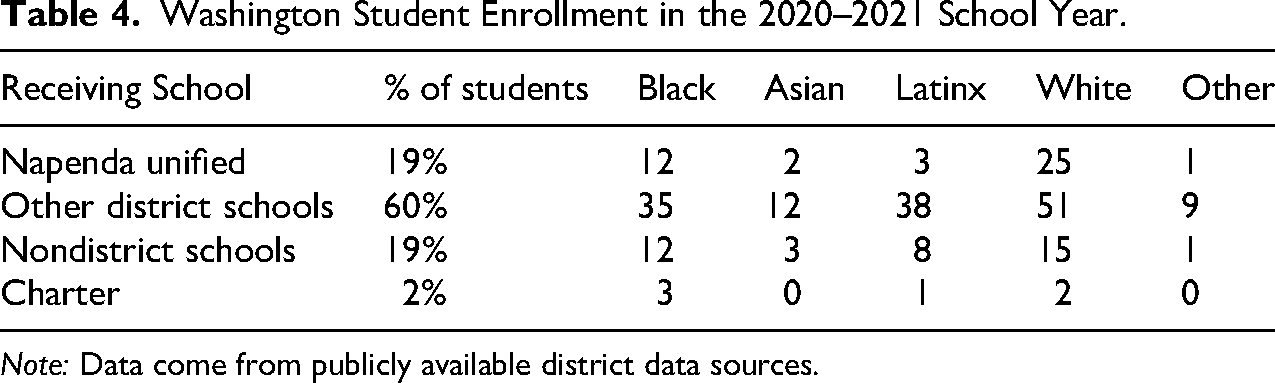
Note: Data come from publicly available district data sources.
Discussion and Implications
Work in BlackCrit reveals that Blackness is often portrayed as a “boogeyman” to be avoided at all costs (Dumas & ross, 2016), a dynamic evident in the Washington–Napenda school merger. The multicultural coalition of Washington parents was appalled at the idea of driving their students 10 min down the road to Napenda. Our work points to antiblackness as a key reason for their disdain, illustrating how antiblack racism can emerge in K-12 policy processes, even when that policy ostensibly has equity intentions. Our findings provide key insights and implications in three areas: (a) school district policy, (b) conceptions of multiculturalism, and (c) Black liberatory fantasy.
School District Policy
The EUSD is a district addressing many challenges, such as being located in a gentrifying urban city, experiencing issues of low enrollment, and facing steep budgetary declines. In these ways, EUSD is a mirror to many urban districts across the United States. District leaders face enormous pressures, but also hold a great deal of power in shaping policy in their districts and cities (Green et al., 2022). For instance, EUSD's open enrollment policy allows for White and more economically advantaged families to benefit the most from school choice policies because they have access to key resources like information about enrollment systems and transportation. Non-White and lower-income families often face barriers to participating in programs like intradistrict enrollment, making their local public school the only option (Jabbar, 2016). In many ways, Washington's parents were fighting to keep a school open that they only had access to because of their privilege. Indeed, many Napenda parents argued that Napenda was the only school that their family could enroll in both historically and currently. Even in multicultural environments, White families have a history of vehemently opposing shared resources with working-class Black families (Diamond & Lewis, 2022; Sattin-Bajaj & Roda, 2020), shaped by compounded racial and economic prejudices (e.g., Lipman & Haines, 2007).
Even still, one can empathize with EUSD's leadership's sincere concern that Washington families might have left the district altogether if they were not offered the Success Pass policy. Low enrollment is a key concern for districts as funding is often tied to student counts. However, rather than utilizing school closures and mergers, which are extremely controversial in local communities, to address enrollment concerns, districts could consider targeted, long-term efforts to garner public support for growing and expanding the tax base to adequately fund all of its schools (e.g., Backer, 2023).
Further, school district leaders must confront how systems, such as open enrollment, may have antiblack bias. Here, equity audits may be a useful practice. During equity audits, districts gather a variety of stakeholders to explore how outcome data is related to educational practices and to assess the extent to which practices could be improved to promote more equitable outcomes (Capper & Young, 2015; Green, 2017). We suggest that audit teams explicitly consider how key practices promote antiblack bias or outcomes. Further, Green and colleagues (2022) suggest that districts facing issues of demographic changes and budgetary pressures create racially just comprehensive plans to balance district demographics and resources. Such plans could aid districts in tracking inequities across campuses and implementing solutions to resolve them. However, it must be noted that neither equity audits nor comprehensive plans are “easy” solutions to implement. Such policy solutions will require district leaders who are dedicated to racially just and antiblack practices and who are willing to extend their political capital to such solutions.
Conceptions of Multiculturalism
Our study supports Dumas and ross’ (2016) assertions about the limits of multiculturalism to combat antiblack racism. In the case of our study, multiculturalism was used in two ways. First, Washington's multiculturalism was often used as proof of its necessity. Dominant logics claim that multicultural aims will adequately address any racial inequities that exist. However, this is simply not the case. Without explicit policies addressing antiblack and racist ideologies in education, these ideologies will continue to perpetuate “the careless removal, displacement, and dispossession of Black bodies” within our education system and society more broadly (Jenkins, 2021, p. 119). While it is important to prioritize policies that ensure equal access to quality education and resources for all students, it is crucial to acknowledge the racial realities that can hinder the effectiveness of these policies (Coles, 2023; Coles & Powell, 2020; Dumas, 2016; Dumas & ross, 2016; Jenkins, 2021). Without targeted, race-conscious measures to address the barriers faced by Black students specifically, multiculturalism will produce very little for Black communities.
Second, Washington's coalition of multiracial parents and educators helped to perpetuate White and antiblack interests. While Washington was multicultural, it did not represent the demographics of EUSD, and Washington actors often ignored its overrepresentation of White families. Yet, the board seemed unwilling to compel Washington families to attend Napenda-Unified, showing that, in the end, this multicultural space had access to “rights and enjoyment” that trumped that of Napenda. White families’ social and cultural capital often functions as our society's dominant or most valued logic (Carter, 2003; Gillborn, 2005; Leonardo, 2009). As such, White parents have often been able to leverage their position to align education policy with their interests (Dumas, 2011; Dumas, 2014; Lewis-Durham, 2020). This prioritization of White racial policy attitudes and interests, however, has only exacerbated the educational inequities of Black students and the disenfranchisement of their communities (Horsford, 2019; Jenkins, 2021). In the case of Washington, its multiculturalism extended White privilege to minoritized parents, but at the expense of a predominantly Black school community.
We agree with Stewart and Colleagues (2023), who call for thick solidarity among Black and other racially minoritized groups. This would mean multicultural coalitions that do not seek to hoard resources but to develop deep historical knowledge of shared and different histories. It would also mean a politics rooted in the recognition that marginalized people can be responsible for adding to the oppression of other marginalized people. We also suggest that future research deeply examine how the logics of multiculturalism shape local education policy and politics.
Black Liberatory Fantasy
Scholars have established that Black liberatory fantasies are key to moving beyond antiblackness in education (Grant et al., 2021; Love, 2019; Stovall, 2017, 2018; Warren, 2021; Warren and Coles, 2020). Our study supports work that shows that Black liberatory fantasies may be limited by political or social realities (Baldridge, 2014). The Napenda community did not seem to envision a future for their school that did not involve a merger. Yet, even within these limitations, their fantasy was important. The Napenda community articulated a world where a school closure process would not cause further harm to the Black community and could bring resources and opportunities to a historically Black school and community. Emerging work in this area establishes that such Black vision setting is vitally important and may have the possibility of shaping policy efforts in the future (e.g., Daramola, 2024).
Our work also points to the complexities of the Black experience and ultimately Black fantasy. As shown in our findings, Black middle-class parents may utilize policies and practices such as open enrollment to help their children obtain what they view as a better education. Put another way, Black parents sent their children to Washington as part of their dreams of their children having a “good education.” Historically and contemporarily, Black parents have sought “good” schools for their children in a racialized and antiblack environment (Posey-Maddox et al., 2021; Walker, 1996). School choice decisions have a multitude of tradeoffs for parents, such as choosing between a well-resourced school and a school that is supportive of Black culture and identity (Lewis-McCoy, 2014). Posey-Maddox and colleagues (2021) powerfully assert that in an educational system shaped by antiblackness, “no choice is right” (p.40). We do not vilify Black parents for wanting to send their children to a well-resourced school, while decrying the structures and policies that lead parents to equate a good school with having fewer Black students (Billingham & Hunt, 2016; Denice & Gross, 2016; Waitoller & Super, 2017).
We encourage Black communities to consider how they can build power and promote their own visions of the future (Horne et al., 2024; ross & Givens, 2023; Warren & Coles, 2020). We believe there are ways for Black communities to acknowledge historical and current antiblack education political realities while holding space for freedom dreaming and creating imaginative political strategies to move Black education forward (Daramola, 2024; ross & Givens, 2023). We also suggest that Black communities consider how these educational movements can be developed across lines of class and privilege. Further, we maintain that more research must be done to understand how Black communities establish and promote their own education fantasies through political action. One way of doing this could be combining ethnographic methods, like the ones used in this study, with counter-storytelling methodologies, which have the ability to provide a deeper and more nuanced understanding of how antiblackness operates over time and might be addressed.
Footnotes

Funding
The author(s) received no financial support for the research, authorship, and/or publication of this article.
Declaration of Conflicting Interests
The author(s) declared no potential conflicts of interest with respect to the research, authorship, and/or publication of this article.