




Abstract
In this article, we advocate for centering high school students in the work of school transformation for racial equity. We begin with an exploration of the need for and intent of Brown v Board of Education, then look at how high school students have engaged in resistance to educational inequity. We focus on the work that remains: The potential for collective resistance by engaging in a transformative student voice—developing a critical consciousness, researching issues, and posing solutions within authentic youth/adult partnerships that center student voice as a form of resistance to structural oppression.
Introduction
Our education system has, since its inception, been a site of contestation and struggle (Giroux, 1983), as policy makers, business leaders, educators, students, families, and communities hold differing perspectives as to the purpose of schooling. The grand narrative of US public education is one of opportunity—that via education, anyone can become anything with hard work, grit, and determination. The reality, though, is that our education system was designed explicitly to control, to track, to sort, and to possibly “rake a few geniuses from the rubbish” (RaceForward.org). Education for Black students in America is rooted in oppression–from the anti-literacy laws (Schweiger, 2013) that forbade the enslaved to read (or be taught to read) to the “separate but equal” doctrine (Plessy v Ferguson, 1896) that was upheld following emancipation until the Brown v the Board of Education (1954) decision, to the realities of unequal opportunities and outcomes that persist today.
Brown was intended to ensure that Black children had access to high-quality, well-resourced education, not segregated by race—the court's decision upheld the notion that segregated schools were inherently unequal and had a detrimental impact on Black students. What Brown did not do was provide specific guidance as to how or when desegregation should happen, nor did it take on institutionalized racism—it forced schools to allow Black students to attend, but did not require schools to hire Black teachers, nor to respect, love, or care for Black students (Feagin & Barnett, 2004). One might argue that the 70 years post Brown have been an exercise in watching the education system find new ways to segregate Black students, via approaches to curriculum and discipline systems (Love, 2023).
The American public-school curriculum narrates Black history through a white Anglo-Western narrative that continuously positions white men as the norm, centering a white epistemic view that teaches
Our discipline system ensures that Black students are disproportionately suspended and expelled, pushing them into the school-to-prison pipeline. Our schools’ culture and climate ensure ongoing marginality by rendering Blackness, both invisible and hyper-visible, via microaggressions (Sue et al., 2009; Williams, 2020) and other forms of psychic violence (Banks et al., 2022). The narrative about Black students often paints them as criminal, undeserving, underprepared, at-risk, disobedient, failure, and gang members (Harper, 2009). In efforts to establish more control of today's youth, school officials have implemented punitive measures, such as zero-tolerance policies instead of addressing social problems with curriculum—policies that do more harm than good for Black youth (Ginwright, 2007).
In the rest of the paper, we discuss the impact of these disparities on Black students, followed by an exploration of the ways, before, during, and post-Brown, that Black students have engaged in collective resistance to educational disparity. We end with recommendations for building the capacity of all youth to engage in collective resistance, via sociopolitical development and transformative student voice (TSV).
The Reality
While Black communities came together post-emancipation, to create educational opportunities for their students, Black students faced many disparities in education, including ongoing segregation, often into poorly resourced and funded schools housed in dilapidated buildings. Teachers were paid less and curriculum options were limited (Fenwick, 2022). Violence, aimed at the schools (between 1864 and 1876, over 630 southern Black schools were damaged or destroyed) or at students (as documented by media images of the Little Rock Nine) was a consistent reality (Harvard Library, 2024). These factors resulted in, by 1950, only 10% of Black adults having graduated high school, compared to 40% of white adults, creating a systemic impact on the educational and economic lives of the Black community that continues to this day as the educational disparities remain.
While Brown created a sense of hope that we might move beyond the atrocities of the past and achieve some form of equity based on educational attainment, school policies, and practices maintain harsh realities for Black students:
In the 2017–2018 academic year, Black students were disproportionately suspended from school, with 12% of students obtaining one or more out-of-school suspensions (Leung-Gagné et al., 2022). Black students comprise 15% of national enrollment but account for 22% of school-related arrests (NCES, 2024). Black boys in preschool represented a third of the documented suspensions even though they only represented 17% of the enrollment compared to other races (NCES, 2024). Academically, in 2019 about 88% of Black students in the United States had graduated with a high school diploma (Cheeseman Day, 2020). According to data from the National Center for Education Statistics (2024), Black secondary school students mean score on the SAT is 908, compared to 1082 for white students—and only 19% of Black test takers met the college and career readiness benchmarks for both reading and mathematics (JBHE, 2022).
These numbers make clear that in spite of increased access for some Black students, the promise of Brown has not been achieved and the educational system remains structured in ways that serve to perpetuate the ongoing marginalization of Black students. In spite of this long history, Black students have, and continue to, resist. In the following section, we provide a framework for thinking about forms of resistance, followed by examples of high school students’ resistance, historically and currently. We then propose a path forward, to meet the promise of Brown to engage high school students, with adults, to harness the power of student resistance for collective change and system transformation.
Resistance
We know through painful experience that freedom is never voluntarily given by the oppressor; it must be demanded by the oppressed (Dr. Martin Luther King Jr., 1963).
Paulo Freire (2005) laid this tension bare in his efforts to develop an approach to education that would liberate the oppressed from educational systems that reify and reinforce systemic inequalities, what he named as critical consciousness. His work identified challenges of individual and social harms, as a result of internalized and structural oppression, that are fundamentally dehumanizing and that create an ongoing cycle of oppression in which systems perpetuate themselves, and the oppressed participate in their own marginalization.
Internalized Oppression is experienced by the individual but impacts the group. When an individual believes and internalizes the stereotypes and negative conceptualizations of their group, they act in ways that further that harm. For example, young people in schools actively resist unfair treatment by refusing to comply with authority, by breaking the rules, by challenging authority, by checking out/dropping out. Alternatively, they go along with the systems, participating in their own/group marginalization, and internalizing the oppressive beliefs of the dominant group and becoming the “exception that proves the rule,” engaging in competition within their own groups, or becoming active participants in that system (Nadal et al., 2021).
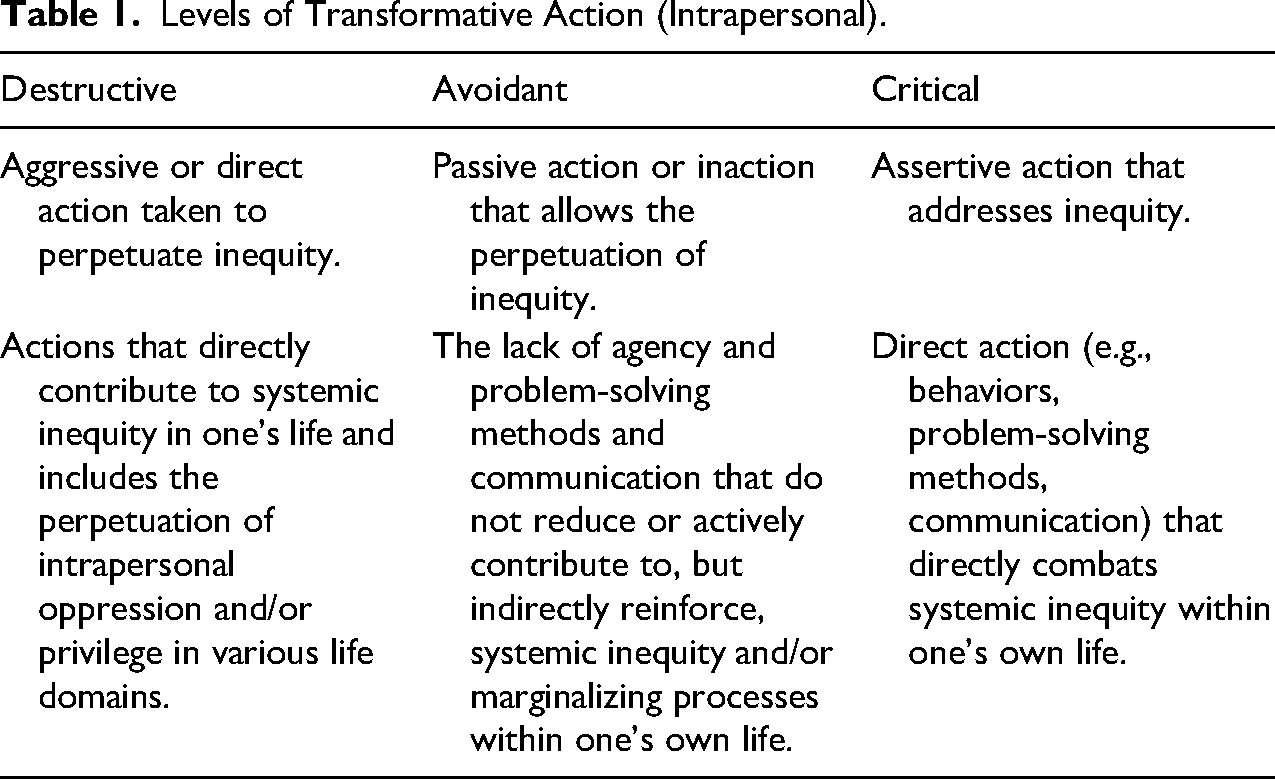
The resistance of individuals does not impact systemic oppression, whereas collective action can avoid the individual consequences of resistance, avoid complicity, and create a frame for new ways of thinking about and solving the problems at hand. Solorzano and Delgado Bernal (2001) posed a way to think about transformative resistance (Figure 1), rather than the internalized resistance that falls under reactionary, self-defeating, or conformist approaches. Likewise, Jemal (2017) explored a framework for critical consciousness and Transformative Action, as shown in Table 1. Her levels of destructive and avoidant align with internalized oppression, while the critical level directs energy at combating systemic oppression. We also note the importance of recognizing that resistance, in any form, should be acknowledged and taken up our focus on collective resistance is not meant to further blame young people for their own oppression (Hannegan-Martinez et al., 2024).
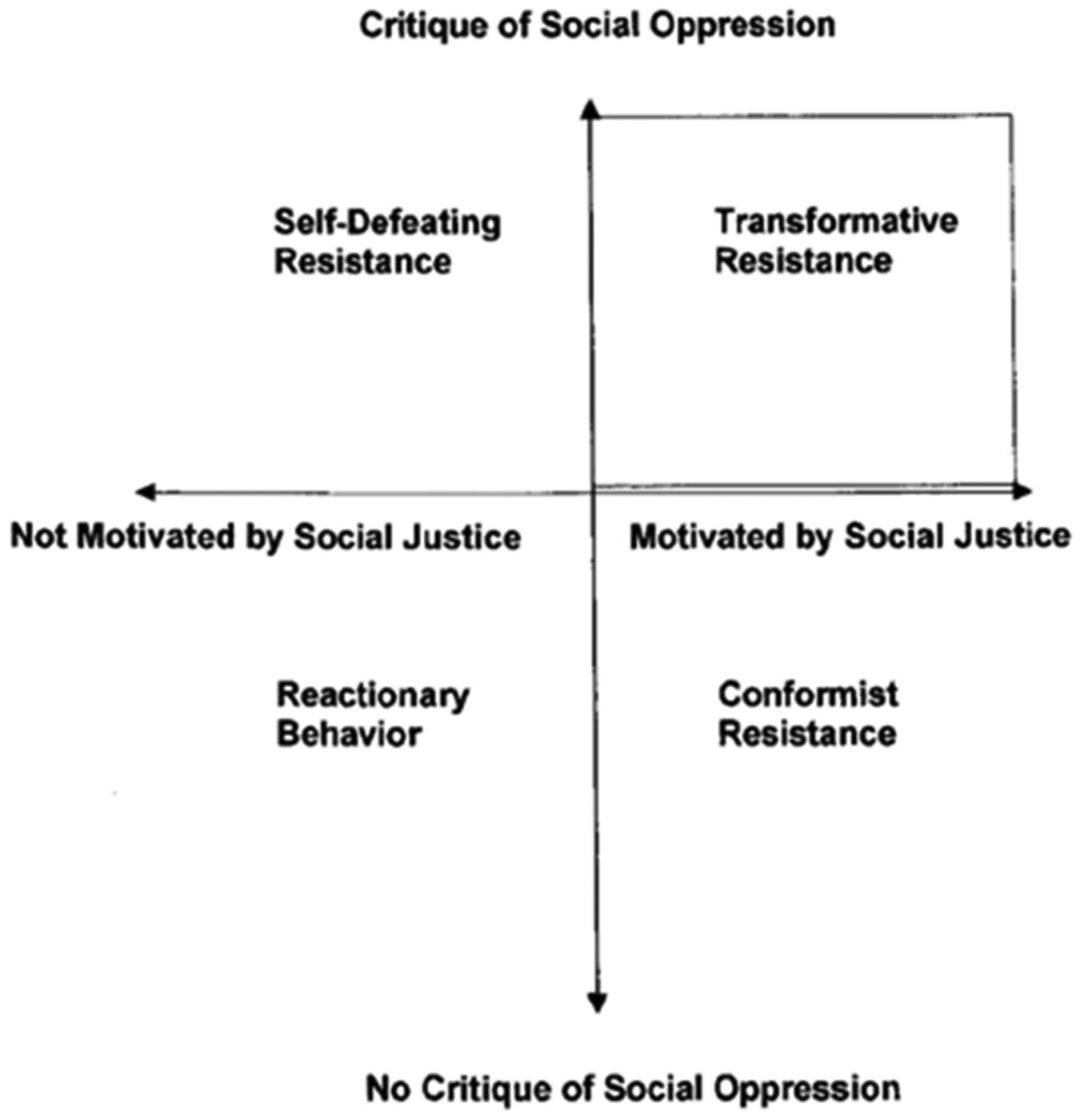
Forms of resistance.
Levels of Transformative Action (Intrapersonal).
In the remainder of this paper, we take up the idea of action to resist systemic oppression. First, we share some examples of the ways that K-12 students have been and are resisting educational oppression, and then we provide a path forward to harness the energy of young people toward the goal of liberation through collective action—after all, students are affected daily by educational decisions made by adults inside and outside of school, but their voices often go unheard in the raging debates about schooling and school reform (Zion, 2020).
Student Resistance—Then and Now
When we search through the history of how high school students were engaged with Brown and with other civil rights activities, we find stories like those of the Little Rock Nine, who were among students who were escorted into school by armed guards (Fitzgerald, 2007). We also find stories of bussing (Amaker, 1970) and how students were shifted across town to meet numeric quotas, or how students became the target of racialized hate and ongoing segregation. These stories share the experiences of those students, but are missing the exploration of how high school students’ voices and perspectives were included (if they were) in the conversations about desegregation.
We know that Black students have been present in resisting the inequities and oppression in American Education for almost a century (Blanchett & Zion, 2023). For instance, most of us are familiar with the role of Black college and university students, who were raising their voices in the fight for civil rights in the mid-1930s—about a decade before most would say was the start of the civil rights movement (Richards, 2008). The Southern Negro Youth Congress was an organization of young Black Americans who protested and campaigned for the dismantlement of unjust systems during the Jim Crow era. Young Black Americans have always utilized their voices as a means to advocate for themselves and others. The organizing of groups like The Caravan Puppeteers and many student-led walkouts and protests are evidence of this (Richards, 2008).
What we are less familiar with is the role of high school students in resistance to educational inequity. In 1951, Black students at Adkin High School decided that they were going to organize a protest after completing an assignment in school about their perception of an ideal school. Three years before the decision of Brown, five students unhappy with the conditions of their school decided that together they would address their concerns with the school board and demand better resources for their school (North Carolina Arts Council, 2013). These demands were dismissed by the school board and the group of students decided to organize a walkout independently, without adults. According to the North Carolina Arts Council (2013), John Dudley made a premeditated announcement to alert the students of Adkin High that the walkout was to begin. The council reported that all 720 students marched, holding signs from the school building to a recreation center. After almost two years, the students’ requests were fulfilled, and a new school was constructed with several desirable amenities (North Carolina Arts Council, 2013).
That same year, Barbara Rose Johns, a 15-year-old student from Virginia, would lead another monumental student-led strike. On Monday, April 23, 1951, Barbara, and her carefully arranged team of student leaders planned to put into place a student-organized strike that they had been planning for about a year (Kanefield, 2014). The students at Barbara's school, Moton High, were tired of the run-down conditions of their school. As Kanefield (2014) wrote in The Girl from the Tar Paper School Barbara Rose Johns and the Advent of the Civil Rights Movement, students were annoyed and impatient with the way the adults in their lives were handling the situation. Thus, after the school board had dragged its feet following through on promises made, the students decided it was time to strike.
Kanefield (2014) explained that the students chose to strike in the spring as a means of causing inconvenience. They knew this would affect graduation and final exams. Four days into the strike, the students of Moton High took to the streets and started collecting signatures from the adults in the Black community. Several meetings were held in conjunction with the NAACP to address the matters at hand. Thousands of people gathered to show support for Barbara and the rest of the students at Moton High School. Finally, after weeks of organizing, protesting, and resistance, the NAACP filed a lawsuit against the Prince Edward County school board on May 23, 1951. This case along with four other cases would become Brown v. Board of Education.
Two years after the decision to make segregation illegal was made, nine teenagers would make another brave mark of resistance. Historically known as the “Little Rock Nine,” a public declaration of the fight for equality was made at Central High School in Little Rock, Arkansas. Their first attempt was unsuccessful as they were rejected at the front doors of the school by the Arkansas National Guard (Bunch, 2017; Norwood, 2000;). A few weeks later, the students arrived again, this time under the protection of federal troops, and were permitted to enter the school.
According to Norwood (2000), the rejection of Black students integrating schools after the Brown decision was not uncommon. She further explained that the students of Little Rock Nine were, both, made aware of the potential risks, including verbal intimidation and violence, and prepped to handle these unfavorable interactions non-violently. The students endured the harassment of white students every day, but the nine students remained resilient and unmoved. They continued to face the backlash of their peers and on May 27, 1958, Ernest Green became the first Black student to graduate from Central High School (Bunch, 2017). This and other stories, some untold and undocumented, show just how powerful young people were in the fight for social justice—and their work continues today. Now, we fast forward to explore current actions led by youth in the ongoing search for educational access and justice for Black students.
Current Examples of High School Students Resistance
In direct contradiction to the mandate of Brown, a growing number of states have implemented policies that restrict the teaching of certain topics concerning race and history. Examples of these restrictions and bans illuminate the challenges facing Black students in today's schools. In Florida, Governor Ron DeSantis rejected the College Board's AP African American Studies course for high school students, citing the course addressed topics of reparations, Black Queer studies, and the Movement for Black Lives. Additionally, he banned any instruction that implied anyone is marginalized or oppressed due to race or skin color (Ellis, 2023).
Since 2021, 18 states have implemented restrictions on the topics of race and gender in their curriculums (Najarro, 2023), and Toni Morrison, the first Black woman to receive a Nobel prize in literature, has her books banned in several districts from Virginia to Utah (Wong, 2023). How are young people responding? Black students have strategically mobilized their efforts to address issues affecting their schooling experience, changing the narrative of Black youth—if urban decay and poverty can cultivate criminal behavior in Black youth, then urban decay and poverty can certainly cultivate Black youth activists (Ginwright, 2007).
A field trip to the National African American History Museum inspired students at one high school in Denver, Colorado, to take action. Their experience and exposure to new knowledge brought attention to the lack of inclusivity in their district-wide curriculum, as well as information not presented in their textbooks. Working together, students and teachers of Dr. Martin Luther King Jr. Early College (DMLK) advocated for changes that would prioritize the inclusion of Black history in their curriculum hoping to create a more comprehensive learning experience of Black history from Kindergarten through 12th Grade (Chavez, 2020). They specifically cited the teaching and learning of the economic influence slave labor had on America's economic growth and the role Claudette Colvin played in the civil rights movement as just two examples.
As students fought to transform their schooling experience, their work with the curriculum only amplified their voices and inspired them to begin another impactful journey. Determined to have their voices heard, several students banded together, led by Kimberly Grayson of DMLK, and started the podcast, Know Justice, Know Peace: DMLK's “The Take.” The 8-episode podcast addresses current events, education inequality, black history, etc., all from a student's perspective (Andrew, 2020). After garnering the interest of several national media outlets, including CNN, CBS, and The Today Show, it was evident that the students of DMLK were not alone in their advocacy and progressive movement toward transforming their schooling experiences.
Similarly, 1700 miles east, New Jersey teen Machayla Randall was entrenched in her fight to transform her school's curriculum. Machalya Randall of Cherry Hill East High School located in South Jersey, fought for Black history to be part of her school and district's curriculum. She is quoted as saying, “it's the same thing over and over again” in reference to the seemingly traditional Black History month curriculum (Andrew, 2020). Far too often, the teaching of Black history in our nation's public schools is relegated to February and events surrounding the Civil war (Fasano et al., 2021). Machayla, also a member of her school's African American Culture Club, organized, led, and titled her protest, The Learning Begins Now: Stop the Ignorance. She took the fight to her district's superintendent and school board in hopes to institutionalize the teaching of Black History and African American History within the curriculum (Andrew, 2020; Kanik, 2021).
Her voice was loud and clear, as she successfully made progressive changes to her school's curriculum. Approved by the board of education in 2021, the Cherry Hill School District became the first district in New Jersey to require students to take an African American History course to graduate (Kanik, 2021). For her efforts, Michayla would go on to win the 2021 Princeton Prize in Race Relations, a reward that encourages and recognizes high school students who exemplify and foster positive race relations within their communities. Michayla Randall and Kimberly Grayson led their charges to transform their school experiences by highlighting the need for curriculum changes in their districts. There is an equally pressing need to provide teachers with professional development and support to foster learning spaces that are inclusive and responsive, particularly in the context of race.
“Respect our Voices” was a student's call for change. In 2022, several middle school-age Black students of the Brockton School District in Brockton, Massachusetts, stood before a crowd of around 200 administrators and students asking for respect. This came after a Black student was overheard using the n-word in conversation with their classmate by their white teacher. The teacher proceeded to reprimand the young boy by asking him how he would feel if someone called him a nigger. Without an opportunity to explain himself, he spoke before his fellow students and administrators, calling for more social-emotional training of teachers, increasing the number of staff from their community, setting clear and explicit expectations for teachers, and more student involvement in the faculty hiring process. Students just wanted to be heard and they were. The superintendent committed to providing more social-emotional training for its teachers and aims to increase the number of faculty of color to 50% (Marble, 2022).
The Black Student Solidarity Network (BSSN), a Black and Brown student-led organization spanning across Missouri and Kansas, mobilized protest and demanded action by Shawnee Mission East High School (Kansas) after a hate crime occurred on their campus. A revision of the school's zero-tolerance policy was included in the list of demands presented by the BSSN. The rights of Black students should be protected when defending racial violence (Ryan, 2023). This particular case came on the heels of other incidents that occurred earlier in the year.
At Olathe South High School, just 14 miles away, students and parents of the community banded together in solidarity asking for an investigation into racially charged incidents, as well as a revision of disciplinary policies towards hate speech and racial discrimination. Additionally, they asked for diversity training of faculty and administrators (Ritter, 2023). At Olathe South High School, the board of education classified racial harassment and hate speech as a more serious offense within their student code of conduct—at Shawnee Mission Each High School, racial slurs or hate speech were not listed as an offense at the time of protests (Ryan, 2023).
Keneisha Buckley, a high school senior and youth leader with the Urban Youth Collaborative has been fighting for police-free schools for several years now. Her efforts are supported by other groups led by students of color, students with disabilities, immigrants, and LGBTQIA + student-led organizations (Sequiera, 2022). The Urban Youth Collaborative is a student-led coalition in New York City whose mission is to band youth organizing groups to end the school-to-prison pipeline and support New York City schools to create learning spaces that are inclusive and supportive for all students. They believe removing police from schools can assist in this charge.
In addition to ending the school-to-prison pipeline, the Urban Youth Collaborative has highlighted the disproportionate suspension rates of minoritized students in NYC and responded by introducing the Solutions Not Suspension Act (A.5917/S.7198). This act would establish a framework for prioritizing restorative practices over suspensions. This act was first introduced during the 2019–2020 Legislation Session. Furthermore, they introduced the Counseling Not Criminalization Act to prioritize counseling over the criminalization of youth (Urban Youth Collaborative, n.d.).
In New York, the Urban Youth Collaborative is calling for police-free schools. In Kansas, the BSSN is asking for a review of zero-tolerance policies. Students and teachers in Denver and New Jersey want a more accurate and substantial account of Black history in their curriculum. And students in Massachusetts are urging their district officials be more intentional and purposeful in hiring more Black and Brown faculty. In Baltimore, Maryland, the youth assembled to challenge their district's budget crisis that cut their Baltimore Algebra Project (BAP), a peer-to-peer math tutoring program (Warren et al., 2008).
Our nation's youth are actively participating in reform movements to improve their school experience. How do we build on that energy to take collective action that transforms our system, ends oppression, liberates Black students, and meets the promise of Brown? These are all cases in which students, with some support from educators, organized resistance—but we call for education systems writ large to commit to TSV for all students to continue the effort to meet the promise of Brown.
The Work That Remains: TSV
Many scholars call for the development of a critical consciousness for adults who work in educational settings (Gay & Kirkland, 2003; Ladson-Billings, 1995; Paris, 2012). Other scholars focus on supporting young people to develop a critical consciousness (Allen-Handy & Thomas-EL, 2018; Cammarota, 2016; Diemer et al., 2006; Watts et al., 1999). We want young people to resist rather than participate in their own oppression—and we know that individual resistance doesn’t shift systems. The shifts have come, historically and currently, when we come together.
If we want to shift systems, we have to be systemic and collective in our resistance, perhaps by engaging with the Transformational Resistance of young people (Hannegan-Martinez et al., 2024) and building the Transformative Potential (Jemal & Bussey, 2018) of both young people and adults by committing to TSV (Zion et al., in press, 2025), an approach to building authentic youth/adult partnerships that shift systems towards equity and justice. TSV requires that both adults and young people engage in developing a critical consciousness, an awareness of how they are situated in the world, and how social systems work to privilege or marginalize them. They have to build skills to take action to identify the issues that impact them, to find the root causes, to collect data, to propose solutions, and to work together to change systems (Kirshner et al., 2015; Watts et al., 1999). Collective action, informed by critical consciousness, could be a deciding factor in achieving the progress that was hoped for with Brown.
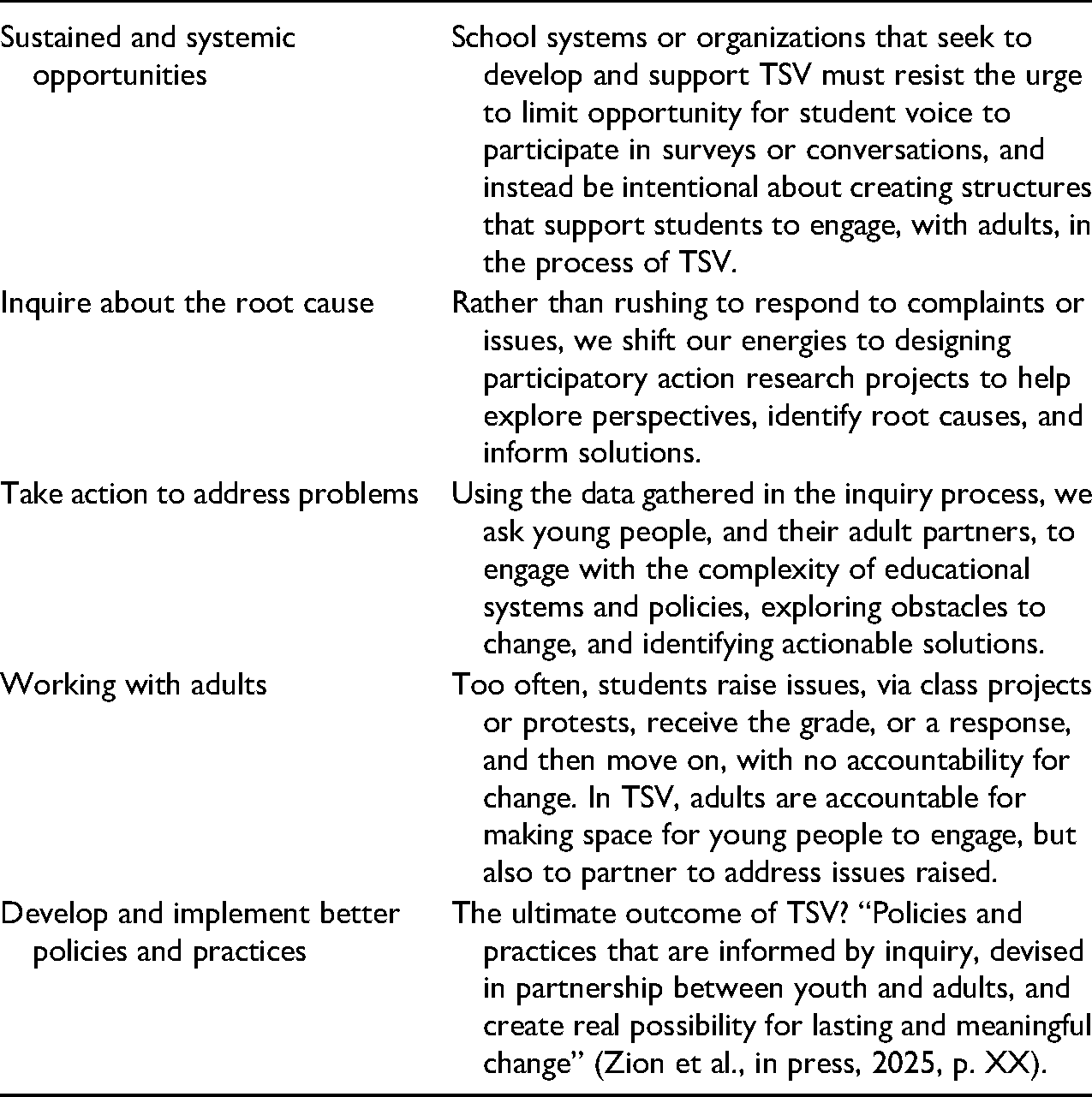
Too much of the work for school reform/improvement is focused on implementing programs designed by adults to fix individual students’ perceived gaps in learning or behavior, rather than seeing those gaps as evidence of systemic failures, or as “seeds of resistance” (Hannegan-Martinez et al., 2024). TSV creates “sustained and systemic opportunities for students to inquire about the root causes of problems in their schools and take action to address them by working with adults to develop and implement better policies and practices” (Zion et al., 2015, p. XXX). It is at its root a collective process, in which we center youth–adult partnerships and center the voices and experiences of young people in identifying issues, researching the root causes, proposing and implementing solutions. Five key elements make up the process of TSV: (1) sustained and systemic opportunities for students to (2) inquire about the root causes of problems in their schools and (3) take action to address them by (4) working with adults to (5) develop and implement better policies and practices.
To do this work, we call for a culture change—a shift in the mental models (mindsets) that inform how we think about school transformation. The first shift is towards a partnership mindset—this disrupts the hierarchical relationships between adults and students and challenges paternalistic views of the agency of young people. It requires that adults are willing to share power, and to acknowledge the expertise that students bring. It requires youth to abandon the easy route of allowing adults to tell them how to think and what to do.
Educators must also be willing to re-examine their own thinking about the purpose and structure of schooling and their role in perpetuating or dismantling it. They must be willing to engage in critical reflection about their identities and positions of privilege and marginality. Mutual respect, support, trust, and vulnerability are key elements that create the possibility of powerful youth–adult partnerships. It is only when we come together, youth and adults, and harness our collective power of resistance that we will be able to reach the promise of Brown.
Footnotes
Declaration of Conflicting Interests
The authors declared no potential conflicts of interest with respect to the research, authorship, and/or publication of this article.
Funding
The authors received no financial support for the research, authorship, and/or publication of this article.
