




Abstract
Partners United for Research Pathways Oriented to Social Justice in Education is a partnership between a university research training program and a Children's Defense Fund Freedom Schools® site in north Florida. It addresses the lack of demographic diversity among doctoral students in education. Emphasis is on researcher positionality and building relationships with stakeholders in a service-learning practicum. Research fellows design projects around literacy and social action, negotiate with stakeholders, and provide service. We use autoethnographic methods to articulate how Fellows, CDF Freedom School staff, and faculty collaborate. We offer suggestions for conducting research that can lead to meaningful, systemic change.
The major aim of this paper is to articulate how a central organizing concept of the Children's Defense Fund (CDF) Freedom Schools’ learning context—The Freedom School Way—can guide successful collaborations between Freedom Schools stakeholders and research partners. CDF Freedom Schools programs are a free, 6-week summer camp provided by the CDF to children across the country to prevent summer learning loss and provide culturally sustaining (Ladson-Billings, 2021) reading and social action experiences to scholars (i.e., children enrolled in the camp) and their teachers as they engage in the curriculum together. Teachers in the camps, known as servant leader interns (SLIs), teach by modeling both a love for learning and a belief in their agency to make a difference in the world.
As we describe below, our stakeholders and research team-members comprise a myriad of roles. We showcase their voices here, including the executive director of a CDF Freedom Schools site (Sheila), former servant leader interns (Madelyn and Mike), former research fellows (Camille and Madelyn), graduate student researchers and mentors (Erik, Mike, Cheyeon, Camille, and Madelyn), faculty researchers and mentors (Alysia, Jeannine, Peggy and Tamara), and scholars (whose voices we obtained from evaluation interviews). Through these various, often overlapping roles, we are drawn to The Freedom School Way as a transformational, culturally sustaining methodology for teaching and learning.
Although members of the research team may have initially come to the CDF Freedom Schools program as outsiders, each team member had the opportunity, and privilege, to join in the intergenerational leadership model by learning with CDF Freedom Schools scholars and SLIs. The Freedom School Way is complex because it simultaneously evokes history, an approach to scholarship, and ways of being and relating to others, to name just a few aspects. We introduce the concept here by grounding it in the relationships that bring it to life, observable at any given moment in a CDF Freedom Schools classroom across the United States. Later in the paper, we draw from our specific experiences to illustrate what the concept has meant to us as a group as well as individually.
In the CDF Freedom Schools program, caring classroom communities are built upon mutual respect, cooperation, and self-discipline (Roehrig et al., 2017). For example, The Freedom School Way is observable in the practices of scholars working with SLIs to create classroom cooperation contracts, which reflect the unique voices in each classroom to decide on the rules for respectful scholar and SLI behavior. Understood collectively, these cooperation contracts represent a guide for all who set foot in the CDF Freedom Schools classroom for interacting respectfully, and at an abstract level each represents an entry-point for understanding of The Freedom School Way. The theoretical framework of community cultural wealth (Yosso, 2005) also informs how beginning researchers and community stakeholders collaborate within this transformative educational context. We take the position that we cannot do our work ethically or validly without entering the context as servants, participants, and partners in the research.
First, we describe the ideas of community cultural wealth, which frames our work. Then, we describe our research-community partnership that involves a multi-university research training program and the Florida Agricultural & Mechanical University (FAMU) Developmental Research School (DRS)'s CDF Freedom Schools program. Then, we provide an overview of the CDF Freedom Schools program and our local FAMU DRS CDF Freedom Schools site. Finally, through multiple voices, we demonstrate how aspects of our partnership integrate and exemplify The Freedom School Way. In telling the overall story of our partnership, we have tried to represent as many stakeholder voices as possible. In the conclusion, we provide suggestions for others who want to build and sustain research partnerships that support systemic change.
Throughout our paper, we were guided by autoethnographic research methods, “call[ing] on memory and hindsight to reflect on past experiences; talk[ing] with others about the past; examin[ing] texts such as photographs, personal journals, and recordings” (Adams et al., 2017, p. 2), and using narrative voices to help readers understand cultural experiences. In doing so, we provide counter stories that speak against dominant narratives of ways of doing research and being in school. The narratives are based on interviews we conducted with one another and with children in the CDF Freedom Schools program in Florida. We also used reflections on our experiences, as well as previous written products that were created by our team over the last several years.
Community Cultural Wealth
In our work, we follow the premises of community cultural wealth (Yosso, 2005). Community cultural wealth is an asset-based framework that grew from Critical Race Theory (Jayakumar et al., 2013). The premise of community cultural wealth acknowledges that marginalized students have accrued benefits from their lived experiences. This pushes against the dominant narrative in research that is deficit-based. Deficit-based research focuses on identifying negative outcomes of marginalized students with a goal to fix both the students and the outcomes, rather than address systemic issues. We chose this approach because it complements the individual and collective accountability required in order to sustain successful, mutually beneficial community partnerships. We believe it is important to name and take a stance against deficit educational practices as well as educational research.
Community cultural wealth (Yosso, 2005) proposes at least six types of capital that students may bring into educational spaces:
Aspirational capital is their ability to hold “hopes and dreams for the future, even in the face of real and perceived barriers” (p. 77). Linguistic capital involves “intellectual and social skills attained through communication experiences in more than one language” (p. 77) that allow them to use an array of communication skills honed through interacting with multiple societal systems. Linguistic capital also supports their navigational capital, which allows marginalized students to “maneuver through structures of inequality permeated by racism” (p. 80). Familial capital broadly encompasses those who share “cultural knowledges … that carry a sense of community history, memory, and cultural intuition” (p. 79). Social capital reflects “networks of people and community resources” (p. 80), who provide emotional and psychological support. Finally, resistant capital refers to “knowledges and skills fostered through oppositional behavior” (p. 81) that can challenge existing conditions.
As we show below, we believe that all forms of capital are evident in the Freedom Schools context and the partnership with PURPOSE. We give special emphasis to familial, social, and resistant capitals as they are particularly salient in the curricula of PURPOSE and the Freedom Schools.
PURPOSE: Research Training for Social Justice
PURPOSE, a partnership between Florida State University (FSU, a Predominantly White Institution) and Florida A&M University (FAMU, a Historically Black University), is funded by the Institute of Education Sciences (IES). The goal of PURPOSE is to increase participation in education sciences by underrepresented students (i.e., fellows) who have a passion for social justice issues. PURPOSE also attempts to rethink the ways fellows learn to do research by emphasizing researcher positionality and building relationships with stakeholders in a service-learning research practicum. We recruit fellows from both institutions (FSU, FAMU) through a yearlong research fellowship.
The opportunity to participate in an inter-institutional fellowship is possible in part due to the unique context of Tallahassee, FL, where both universities are located. The fellowship provides academic experiences, one-on-one faculty mentoring (including inter-institutional mentorship), and graduate socialization. The graduate socialization component is enriched by the fact that fellows belong in cohorts that combine socialization experiences acknowledging the different university contexts. Most of our fellows identify as Black or Latinx, over half the faculty mentors identify as Black, and members of the faculty leadership team (who also serve as mentors) identify as Black (Tamara), and White (Alysia, Jeannine, and Peggy) women. Peer mentors include our lead coordinator, Erik (White male doctoral student), other male and female graduate students (different ethnicities), and former fellows (Black or Latinx). Peer mentors include those who identify as Black (Camille, Madelyn), Latinx (Mike), and Asian (Cheyeon). The fellows and mentors of the PURPOSE team represent the diversity we envision for the future of education research.
PURPOSE is designed to be a community research endeavor that provides fellows with research-training within authentic educational settings (e.g., the CDF Freedom Schools program). Fellows develop their research-related knowledge and skills as a community, sharing their ideas and experiences. Aligned with the ideals of community cultural wealth, PURPOSE strives to both (a) enhance fellows’ confidence to conduct research by acknowledging their own capital, and (b) use their capital within research processes that will impact the targeted educational settings. The overarching goal of our PURPOSE training program is to provide a pathway into doctoral programs for students who have been traditionally underrepresented in education sciences. While the ultimate goal is to have fellows become faculty researchers, they must first develop researcher identities that allow them to see how obtaining a PhD is possible and supports their long-term goals. Thus, we tap into fellows’ aspirational capital to support their development of skills and beliefs that will empower them to be successful in graduate programs and beyond.
During the yearlong training program, each fellow works with the support of their faculty mentor to design and implement a research project. To provide fellows with a model for culturally relevant teaching/learning, as well as a context for culturally relevant research, PURPOSE partners with the local CDF Freedom Schools program, hosted by FAMU's Developmental Research School. The CDF Freedom Schools site provides a context for fellows to engage in a service-learning research practicum that is both culturally relevant and is focused on social justice.
Eyler and Giles (1999) defined service-learning as a form of experiential learning through which students engage in a cycle of action and reflection. Although service-learning has been studied within teacher education (e.g., Celio et al., 2011; Yorio & Ye, 2012), few studies have examined service-learning in an extended research-training context. Balancing service and research in the CDF Freedom Schools program may support the development of fellows’ researcher identities as well as the integration of The Freedom School Way into research studies.
Culturally Relevant Research Training
In addition to framing our work on the premises of community cultural wealth, we also rely on the related ideas of culturally sustaining pedagogy (Paris & Alim, 2014). Culturally sustaining pedagogy is instruction that fosters (sustains) cultural and linguistic competence (Paris & Alim, 2014). Our culturally relevant research training is an application of culturally sustaining pedagogy (Ladson-Billings, 2014; Paris, 2012). Gloria Ladson-Billings (1995, 2014, 2021) developed the framework of culturally relevant pedagogy through studying the characteristics of highly effective teachers of African American students. She proposed three tenets of culturally relevant pedagogy: (1) students must experience academic success; (2) students must develop and maintain cultural competence, and (3) students must develop a critical consciousness that allows them to participate in disrupting the inequitable status quo (Ladson-Billings, 1995). We apply these tenets to our PURPOSE training.
Importantly, fellows enter PURPOSE with common goals of advocating for social justice and acquiring research experience to support their applications to graduate programs. Entering a graduate program, specifically a doctoral program, is a major life event. Therefore, having fellows explore basic questions about how their passion for social justice and their scholarly identities intersect provides them with valuable understandings that we anticipate will impact their future careers. As evidence of the reciprocal nature of our partnership, fellows who experience The Freedom School Way are armed with additional resistant capital for challenging oppression in educational systems beyond the higher education contexts typically emphasized in social justice education (e.g., Hackman, 2005). In other words, The Freedom School Way can allow fellows to collaborate in the continuous legacy of challenging historic and current oppressive conditions in education, for instance, by sharing alongside scholars and SLIs in the interpretation of counter-narratives (e.g., challenging persistent White hegemony by centering other identities or epistemologies) included in the CDF Freedom Schools Integrated Reading Curriculum.
Fellows develop and maintain cultural competence by using reflexivity in the research process. As we describe next, although fellows may enter the training program with high levels of some forms of capital (e.g., aspirational or resistant capital), we believe that without a training environment that intentionally supports developing research efficacy alongside sustaining fellows’ multiple forms of capital, they may not draw upon these assets throughout their research processes. On one hand, fellows may require varying degrees of practice before developing efficacy for research reflexivity. On the other hand, developing reflexivity may be perceived as contrary to dominant narratives about the right ways to do research (methodologies that emphasize neutrality or objectivity).
The network of faculty and peer mentors is an important structural component of the program that provides a supportive environment (Lunsford et al., 2017). Throughout their research process, mentors work from shared research-values that prioritize fellows’ integration of their own cultures. In our view, culturally relevant research training provides an added dimension, or lens, through which fellows may interpret their experiences. As fellows proceed through their training—including their service-learning at the FAMU DRS Freedom Schools—they experience success with developing their research competence in ways that align with their cultural competence.
As such, fellows integrate their own cultural identities with their developing researcher identities. Aligned with the tenets of culturally relevant pedagogy, one overarching goal of PURPOSE is that fellows will develop a critical consciousness that will allow them to disrupt the inequitable status quo throughout their graduate research and professional careers. Having fellows explore and define their positionality helps them to reflect on all aspects of the research process, and their role in that process, using their lens of critical consciousness.
Positionality
Through their experiences and communal reflections, fellows examine their own subjective identities (e.g., race, gender, socio-economic status) that inform their positionality. Positionality refers to researchers’ intentional stance regarding the sociopolitical context of any research situation (Rowe, 2014), which is informed by researchers’ unique subjectivity and identities. Understanding one's own positionality is a dynamic, reflexive process. As fellows learn about research design, they reflect on the role of identity in research. For example, what is the status quo in research regarding researcher identity, or more precisely, identities? What are the processes that researchers are expected to follow in expressing (or not) their identities?
Researchers working in qualitative traditions are far more likely to incorporate these stances into their practice, simply because it is built into the methodology and analysis (e.g., trustworthiness) as well as the ethical philosophy (Symonette, 2009). However, we believe these reflections are also important for quantitative research, particularly if scholars are using critical lenses in their research. Further, we believe this practice might be experienced by individuals as the practice of resistance in higher education contexts to challenge legacies of oppression, and to avoid reproducing histories of harm to marginalized students, staff, and faculty.
Research methodologies that challenge beginning researchers to understand their own sociocultural positionality within the research context have been a powerful learning tool for students, especially when situated in the rich methodological history of qualitative research paradigms that position researchers as instruments themselves (Symonette, 2009). This allows students to move away from a narrow understanding of objectivity and subjectivity as “good” and “bad” respectively when engaged in research. Rather, fellows have the epistemological agency to decide how their subjectivity is relevant throughout the research process. In the CDF Freedom Schools context, fellows’ salient identities such as race and gender might inform how they develop relationships with scholars and SLIs.
A goal of PURPOSE is for fellows to value and understand that their positionality is integral to their research. Because of our focus on personal understanding and transparency in research designs, the PURPOSE program promotes developing one's positionality. Fellows are encouraged to consider how their positionality and research practices are integrated, no matter which research design they employ to address a given research problem. The aim is for them to be aware of, and to continually reflect on, how their positionality supports both stakeholder relationships and their research.
PURPOSE emphasizes that research itself is not owned by the researcher. Instead, PURPOSE presents research as a partnership with those involved in the research; therefore, researchers have a responsibility to protect the voices of the participants that made their research possible. Our goal is for fellows to emerge from PURPOSE with an appreciation of culturally relevant research that allows them to interpret, communicate, and be a steward of research stories. Further, through developing these relationships fellows and stakeholders have the opportunity to share power in the research process. Stakeholders from the CDF Freedom Schools community, who may be active research participants for the first time, may learn to value research that foregrounds active partnership as well as de-centers research power throughout the research process.
Service and Research in Freedom Schools
We see our partnership as a supportive system made up of multiple organizations within our local community that share opportunities for service, research, and learning in the context of the CDF Freedom Schools program (see Figure 1). These opportunities are reinforced through our mutual goal of social justice. Not only do the organizations provide overlapping opportunities for our fellows, but many individuals across the partnership also have roles in one or more of the organizations. For example, Alysia, the PURPOSE Director, is a faculty member at FSU and also serves as a co-director of research for FAMU DRS Freedom Schools. The mentors for PURPOSE include faculty members from both FSU and FAMU. Peer mentors also include doctoral students from both universities as well as former PURPOSE fellows.
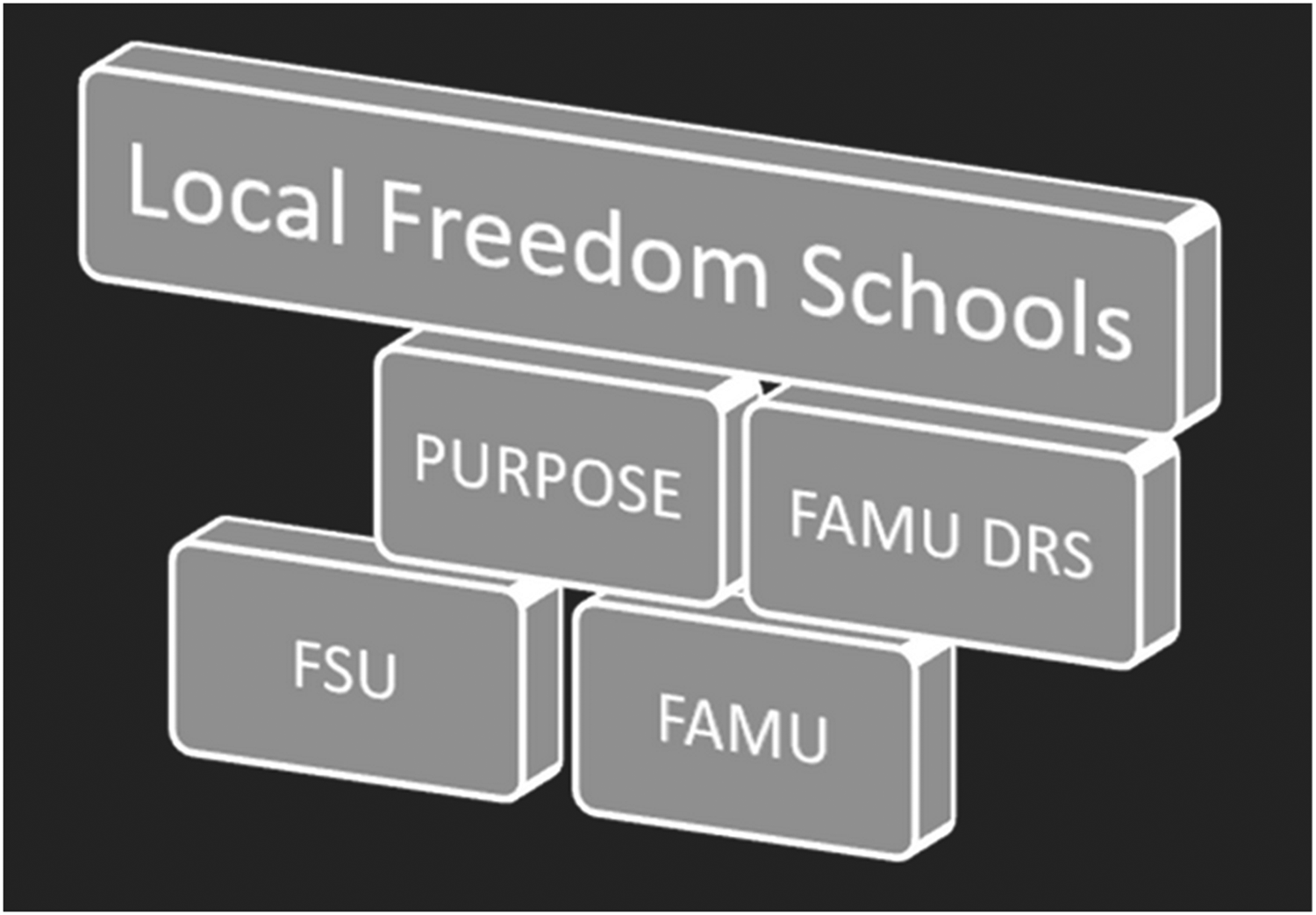
Connected partner organizations representing stakeholders in our community.
The overlapping roles and identities of those involved in our partnership are central to our success. PURPOSE fellows participate in the intergenerational leadership model of the CDF Freedom Schools program by providing scholars and SLIs with complex, and more importantly, open and accessible examples of what it means to be a professional scholar or scientist. Additionally, scholars interact with fellows and mentors, who model conducting research as social activism. Just as research fellows have direct access to authentic, and moreover transformational, educational contexts, scholars and SLIs have interpersonal access to authentic professional scholarship.
Some of the SLIs have been motivated by the research and researchers with whom they interact during the FAMU DRS Freedom Schools, so they become PURPOSE fellows themselves (the following year). We anticipate that PURPOSE fellows will go on to play multiple roles themselves, including being community activists and faculty members, who will serve the communities they work in and lift up the next generations of researchers. Thus, the partnership ultimately becomes a model for everyone's understanding and appreciation of intergenerational collaborations.
The CDF Freedom Schools Program
The CDF Freedom Schools program is rooted in the American Civil Rights movement, specifically the Freedom Summer of 1964, also known as the Mississippi Summer Project. The goal of the Freedom Summer was to register as many voters in Mississippi as possible, as well as provide educational experiences to counter the educational disenfranchisement of Black children (Ares et al., 2021; Chilcoat & Ligon, 2001). In 1995, under the leadership and vision of CDF founder and President Emerita Marian Wright Edelman, the first CDF Freedom Schools summer camps opened their doors. The CDF Freedom Schools summer camps have been provided every summer nationwide for six weeks, driven by two primary goals derived from the original civil rights movement: literacy and social action. The CDF Freedom Schools program emphasizes academic identity—children who attend the camps are called scholars from day one—and empowerment, with the culturally relevant curriculum themes centering around scholars’ ability to make a difference in themselves, their families, their communities, their country, and their world (Mesa et al., 2021; Smith, 2010).
The annually revised CDF Freedom Schools reading curriculum has been designed to promote reading as a cherished, intrinsically motivated act as well as a tool of empowerment (Ha et al., 2021). CDF Freedom Schools programs employ an intergenerational leadership model to help Scholars achieve these outcomes. The SLIs are typically college aged students who may have minimal instructional training beyond the annual CDF training provided. Still, SLIs frequently model a love of reading and, with the support of the curriculum, work to demonstrate how reading has empowered them in their own academic and civic journey (Roehrig et al., 2017). Intergenerational servant-leadership models distribute accountability for success among newer and more experienced members of an organization while integrating a foundational responsibility for service (Russell & Stone, 2002).
Research fellows share with SLIs the common goal of service through participation in the intergenerational research model. Like SLIs, fellows bring their unique capital into the local Freedom Schools context, which delivers the national program model that was designed to create pathways for the integration of the various forms of capital in the community cultural wealth model. Aspirational, navigational, and familial capital, for instance, are nurtured through the social action themes of making a difference. Resistant and language capital are represented in the integrated reading curriculum. Social capital develops as fellows collaborate with SLIs and scholars in enacting the CDF Freedom Schools program model, and all hopefully leave with new and lasting relationships.
Our Local Freedom Schools Context
The focus of PURPOSE activities involves scaffolding fellows’ skills to design and conduct valid research projects for social justice. Our local context for research is centered on FAMU's Developmental Research School, which serves local, neighborhood children. Many of these children identify as Black and come from low-income households. The context allows fellows to immerse themselves into a real-world, culturally relevant teaching/learning experience. The context provides both a service-learning opportunity and a context to fulfill their research requirement.
An important early step in PURPOSE training is to help fellows understand the nature and purpose of the CDF Freedom Schools—including their history and mission of social action, and how they engage young scholars in a culturally relevant literacy curriculum. Most importantly, they learn The Freedom School Way. This incorporates ideas of community cultural wealth (i.e., multiple forms of capital, including possibly new forms) and culturally relevant pedagogy. As the voices below demonstrate, The Freedom School Way also focuses on ideas of serving, building trust, and demonstrating mutual respect.
Although we focus on research, we emphasize that we do not want fellows to conduct research when they first come into the CDF Freedom Schools site. We want them to provide service, to get to know the children, and to become familiar with the SLIs—we want them to build relationships of trust through service. As Sheila describes below, being a servant leader is an important part of the framework of the CDF Freedom Schools program, and it is also part of the framework of how we see research—that is, being in service to the community.
At the beginning of each PURPOSE cohort in spring, the program leadership invites the local CDF Freedom Schools executive director to meet fellows and share information about the local CDF Freedom Schools context. During this professional development seminar, fellows learn about the history of the CDF Freedom Schools and the concept of The Freedom School Way. The executive director also talks about the kinds of research in which FAMU DRS Freedom Schools is interested, with the intent to help guide fellows’ research plans so that they are supportive of the context. As partners, we work together to make sure that fellows’ research projects are appropriate to the age level of scholars, appropriate to the context, and they do not distract or take away from the children's experiences during the camp.
There are several ways that research fellows can serve the stakeholders at the CDF Freedom Schools site. Fellows can serve both the SLIs and the scholars. At the most basic level, this happens by entering the site respectfully and working to develop relationships with all stakeholders. At a more sophisticated level, some fellows elect to build service into their research designs. In other words, fellows may choose to conduct participatory action research, which can empower stakeholders to share in the conceptualization of the research project.
Participatory action research transforms the status quo of researchers’ power and control by distributing that power to participants and including them in critical decision-making (Shamrovi & Cummings, 2017). For example, after embedding themselves into the site context and building relationships with SLIs and scholars, research fellows could rely on stakeholders’ insider knowledge and experiences to pose research questions that fellows and stakeholders find meaningful.
Participatory action research represents the apex of combining service and research, as the research is collaboratively shaped by expressed needs and the assets (e.g., local expertise or community cultural wealth) of the stakeholders. For example, fellows might propose and teach an afternoon activity that serves scholars by engaging them in activities that complement the CDF Freedom Schools curriculum. These afternoon activities could be related to the research topic of the fellow or an activity of personal importance such as the visual arts, computer programming, or STEM education. As such, it might be considered a less daunting task for a research fellow who might have less research experience.
Given the PURPOSE program's emphasis on designing and implementing contextually relevant research projects, fellows are encouraged to develop projects that minimally interrupt the CDF Freedom Schools program delivery, as experienced by scholars and SLIs, or that serve the stakeholders by including them as agents in the inquiry about their community. To accomplish this, fellows are encouraged to focus on understanding the CDF Freedom Schools context themselves, while building relationships with stakeholders. Just as research fellows have direct access to authentic, and moreover transformational, educational contexts, scholars and SLIs have interpersonal access to the authentic professional scholarship. The bidirectionality of this access across stakeholders is maintained through open communication and relationship-building. Through The Freedom School Way, they work together towards the same transformational goals.
In the following sections, we share our lived experiences following The Freedom School Way, highlighting those who have held multiple roles in PURPOSE (Camille) or roles in both the CDF Freedom Schools program and PURPOSE (Madelyn and Mike).
The Freedom School Way: Lived Experiences
Madelyn (SLI, PURPOSE Fellow, Peer Mentor)
When you enter Freedom Schools, you must leave much of what you think you know about education and be ready for a new academic experience. In describing Freedom Schools, a scholar explained, “It is not really like a school environment. It is not really like school, so it is different … ‘cause like, at school they call you students; here, they call you scholars.” The language of “scholars” provides an example of both aspirational and linguistic capital; by calling themselves scholars, the children learn the value of respecting through their experiences of being respected in the camp.
Another scholar offered insight into navigational and familial capital developed in the Freedom Schools: [A teacher in Freedom Schools] loves us, and he gets on us a lot ‘cause he knows how far we can get …. He is just trying to keep us on the right path. He talked more about Black history and all that …. [I like] the books … some kids don’t have the chance to read this kind of books [in school].
The bridge that is created for scholars at Freedom Schools is fundamentally important to the development of the scholars going forward. For instance, the types of culturally relevant activities and community interactions are priceless. In particular, SLIs who are FAMU students may have a multitude of strong relationships within the local HBCU community, and they can bring this network into the classroom. Through those relationships, SLIs may introduce scholars to life changing experiences.
As an SLI and as a PURPOSE fellow doing research on an afternoon activity I taught at Freedom Schools, my scholars had access to my scholarly network, including each of my student organizations. At that time, the girls that I taught told me how “surprised they were to be meeting so many cool people.” Aside from my colleagues in the FAMU English Guild, I also introduced scholars to members of the National Council of Negro Women (NCNW), Zeta Phi Beta Sorority, Inc., the FAMU Transfer Student Association, and band members of The Marching 100. In the words of Mrs. Marian Wright Edelman, founder and President Emerita of the Children's Defense Fund, “It's hard for children to be what they can’t see” (Children’s Defense Fund, 2021).
As someone who has had multiple roles, I believe The Freedom School Way is not just the academic experience that the scholars get, but also the experience you will get as a participant. With Freedom Schools, we bear witness to how history has shaped so many factors in our lives. Then, we can put into practice not only what we have learned from Freedom Schools, but our own authentic experiences within Freedom Schools. And, when you walk away from Freedom Schools, you never look at education the same way. I truly gave the scholars everything I could at that time. I believe that a quality education never really leaves you. Instead, it fortifies your ability to elevate in the future. That was my goal as an SLI.
Mike (SLI, Peer Mentor, Research Coordinator)
As someone who had multiple roles in the partnership between Freedom Schools and PURPOSE, my own understanding of The Freedom School Way developed and expanded as I participated under these different roles. Today, I believe that The Freedom School Way is focused on working together to make a difference in the world. In this section, I outline how my understanding of The Freedom School Way developed, how it is actualized within the Freedom Schools program and PURPOSE, and how it is supportive of the stakeholders in both programs.
I first participated in Freedom Schools as an SLI. Prior to attending the national training provided by the Children's Defense Fund, I thought of The Freedom School Way as a method of providing reading instruction to children in a manner that acknowledges and appreciates the children's cultural background (i.e., culturally relevant pedagogy). During the national training provided to SLIs, I came to understand and appreciate the history of the Freedom Schools program, which dates to the Mississippi Freedom Summer of 1964. Further, I came to understand the emphasis that is placed on civic engagement and social justice. SLIs not only provide children with culturally relevant reading instruction during the summer, but they also discuss and acknowledge social injustices of the past, and present, with a focus on what we (SLIs, scholars) can do to make a difference.
As a PURPOSE peer mentor and research coordinator, my understanding of The Freedom School Way further developed to include working together. In this new role, I helped train fellows to conduct ethical and culturally relevant research in the context of Freedom Schools. I provided fellows with details about the context of Freedom Schools from the perspective of an SLI, including how to respectfully enter a site, build relationships with Freedom Schools stakeholders, and gain access to conduct research. I used my own experiences and relationships at Freedom Schools to support the fellows in their endeavors.
From the development of the fellows’ research ideas to the interpretation of results, successful research in the context of the partnership required collaboration. Ultimately, what resulted were PURPOSE fellows working together with scholars and SLIs at Freedom Schools to make a difference. The collaborative relationship between Freedom Schools and PURPOSE is highlighted by the fact that several SLIs have chosen to be PURPOSE fellows after learning about the training program while they participated in Freedom Schools.
Next, we shift to elaborating on intergenerational mentorship that is a core tenet of the CDF Freedom Schools.
Positive Relationships that Support Intergenerational Mentorship
Another important and essential aspect of The Freedom School Way is forming positive relationships that support intergenerational mentorship. In both the CDF Freedom Schools program and PURPOSE, a model of intergenerational mentorship is evident. For example, in the CDF Freedom Schools program, more experienced SLIs welcome new SLIs and gradually support their learning and development during both the national training and the summer program. More novice SLIs bring with them innovative ideas and unique experiences and skills, which are often implemented into the summer program (e.g., a musically skilled SLI may incorporate music into the curriculum/schedule of the program). We believe that the strong relationships formed among SLIs result in supportive social interactions (e.g., sharing effective instructional techniques), innovative developments to the program (e.g., adding new enriching experiences to the CDF Freedom Schools program), and motivating experiences (e.g., sharing examples of scholar achievement/growth).
Similarly, the cohort structure within PURPOSE supports positive relationships among current fellows, as well as intergenerational mentorship. PURPOSE fellows begin their training as novice researchers and they receive training and mentoring from more experienced researchers to develop their own skills. As part of the training, past fellows are often brought in to speak about their PURPOSE experiences and provide advice to current fellows. Several PURPOSE fellows have had official roles, such as Peer Mentors, who provide advice and support in current fellows’ planning and implementation of research projects. Some Peer Mentors have even collaborated in the research projects that the current fellows proposed and led.
A positive relationship between PURPOSE and CDF Freedom Schools staff is an integral component of the partnership. For example, PURPOSE fellows/mentors and staff at CDF Freedom Schools have open lines of communication. This includes the CDF Freedom Schools’ executive director approving all research projects that are proposed. PURPOSE also emphasizes that fellows should understand the history and goals of the CDF Freedom Schools program, and that their proposed research should support the scholars who are participating in the program, as well as the program as a whole.
The positive relationship between PURPOSE and the CDF Freedom Schools program, which is maintained through shared goals and open communication, results in a collaboration that mutually supports the developing researchers in PURPOSE and the CDF Freedom Schools program. The use of intergenerational mentorship in both PURPOSE and the CDF Freedom Schools program supports the longevity and continuous improvement of both programs. Together, PURPOSE and the CDF Freedom Schools program support the next generation of researchers, and civically engaged scholars, who are bound to make a difference in their community, country, and world.
Mentoring Fellows to Respectfully Enter CDF Freedom Schools Spaces
In our experience, some researchers and the practitioners with whom they work may think it is simply important to know “why” they conduct research. The “why” of research is necessary, but not sufficient, so we emphasize that researchers must equally know their “how.” As Madelyn (informed by her roles as an SLI, fellow, and peer mentor) explained, “your ‘how’ will define you during your first encounter with the Freedom Schools Community.” We emphasize in the training program that research can be a tool for social action. In other words, the “why” can mean being deeply motivated to engage in research to contribute one's individual voice and talents towards solutions to intractable social problems.
At the same time, we take the stance that research is embedded in social contexts that require constant critical examination; thus, the research process is never value neutral. On the contrary, the way of expressing the “how”—or the way—that we engage in research, is to understand that research practice is value-laden. Researchers hold values and beliefs about the ethical practice of research that they carry with them as they engage in research. For example, we believe that research is enhanced by service to, and collaboration with stakeholders.
Respectfully entering the site is paramount to building trust and respect as a researcher and supports the collaboration between PURPOSE and CDF Freedom Schools staff. This begins by asking “what can I do?”, “how can I help?”, and asking for permission, so that researchers do not get in SLIs’ and scholars’ way, interrupting activities that are going on in the class. By putting the needs of research participants, and their classroom communities, at the forefront of the research, the bond of trust and respect becomes mutually binding. One example of putting the needs of the CDF Freedom Schools at the forefront of research is that all research activities are designed to minimally interfere with the day-to-day activities and procedures of the CDF Freedom Schools program. It is impossible to not interfere; rather, PURPOSE fellows are expected to lean into the complexities of doing research within a context where they become active participants, while embracing the role of learner with respect to the context.
Additionally, researchers are required to ask CDF Freedom Schools participants (e.g., SLIs, scholars) for verbal assent prior to all research activities (e.g., “Is now a good time to observe your classroom?”) even when written consent has already been given. Access to CDF Freedom Schools stakeholders is never taken for granted by the research team. Once SLIs and CDF Freedom Schools scholars identify that their boundaries and emotional wellness are in good hands, respectful research activities can begin to take place. Cheyeon, another peer mentor and beginning researcher, concurs. She explained, What I think is important when I enter the Freedom Schools site is to remind myself that we are a team with a common goal. Site coordinators, SLIs, researchers, mentors, and PURPOSE fellows all have a common goal of supporting scholars’ successful summer camp experiences, although each plays a different role in the camp. Therefore, our role can be very flexible in the camp; building a rapport among all participants is the important first step to enter the Freedom Schools site. We need to be prepared to provide help to the team through continuous communication.
Paying it Forward
The Freedom School Way is a path of empowerment grounded in intergenerational respect and service, and in literacy-infused social action. PURPOSE leadership, peer mentors, fellows, and SLIs are humbled that we have been able to sustain a partnership across the years in which we work to meet our needs reciprocally. The Freedom School Way supports this collaboration precisely because it is a path of growth for all stakeholders who participate in the program. In other words, no one can excel in the program on their own, without following The Freedom School Way.
For example, SLIs co-create powerful learning spaces where reading and community activism collide, while they grow through relationships with scholars, colleagues, and PURPOSE fellows. Researchers, who take the stance of helpers and learners, are well-positioned to be successful in their research while sharing their academic growth with stakeholders. Over the year-long fellowship, and subsequent peer mentoring opportunities, we have seen fellows’ efficacy and research identity develop through their service and research experiences, conducted in partnership with stakeholders. Camille's narrative exemplifies this development. Camille's individual lived experience provides an example of how this played out.
Camille (PURPOSE Fellow, Peer Mentor)
Entering into the PURPOSE fellowship, I (a former PURPOSE fellow and now peer mentor) knew a lot about education, but little about research and its intersection with social justice. The fellowship offered a unique lens into pathways that can effectively change society and my own communities through research and policy implementation. As a former teacher, who then entered Freedom Schools as a fellow-researcher, I understood the teacher's role (an example of my social capital). I sympathized and empathized with teachers as a researcher, and I empathized and sympathized with the researchers, as a teacher.
Additionally, a lot of the scholars just knew me from going to school, through my own children and former students. I was able to view them, not as a teacher or researcher, but as like, “Hey, I know your mom and your grandma, you stay down the street from me”—a community feel (an example of my familial capital). I was in a situation where I could connect all those dots: I realized that I can be a researcher in my own neighborhood, working with participants who I know, on a topic that is meaningful to me, and I can ask them what's meaningful to them. I was in an environment where I could see how research can be played out in the social justice lens in my personal life. We were taught different tools, and frames, and theories that aren’t traditionally taught in mainstream research or mainstream academia (an example of my resistant capital). An Audre Lorde quote that pops into my head is: “The master's tools will never dismantle the master's house” (Lorde, 1984, p. 187).
My time in PURPOSE allowed me, and other fellows, to begin to view ourselves as researchers and increased our self-efficacy in our own skill sets. Through the fellowship, we were able to gain an authentic research experience where we learned from mentors and peers, scholars and SLIs. PURPOSE introduced me to the value of qualitative research and how important our identities and biases are when approaching solutions to social justice issues within schools. In addition to gaining insight into its importance, we also engaged in rigorous procedures and methods while collecting qualitative data.
Although the introduction to qualitative data was beneficial, the most valuable part of my PURPOSE experience was being exposed to Black women who are in, or recently graduated from, doctoral programs. As a Black woman, this experience allowed me to view myself as a researcher and inspired me to pursue my doctoral degree (an example of my aspirational and navigational capital). I also appreciated that PURPOSE placed diverse researchers into the Freedom Schools; and, as a former teacher, I understand the positive impact this could have on the scholars.
In PURPOSE, we work with schools I consider myself from, in the neighborhood I grew up in, a neighborhood where FAMU is located. My own kids went to school there. I taught in that neighborhood; so, I consider myself a part of the population. I felt, through my presence there, I was able to relate with the scholars. The fact that I was familiar with the neighborhood made the research more impactful to me. I also felt like I could reach the participants, maybe in a way that an outsider could not. By placing us in the schools, the scholars were able to interact with mentors and researchers that came from similar backgrounds as them, which could contribute to them forming their own identity as a scholar and/or future researcher. The PURPOSE fellowship laid a strong foundation that has resulted in me pursuing a doctoral degree in educational psychology and instilled a love and passion for social justice research that will impact all who come after me.
Conclusion
The partnership between the CDF Freedom Schools program and PURPOSE has transformational potential to empower all participating stakeholders—scholars, SLIs, and the executive director, and PURPOSE fellows, peer and faculty mentors, respectively. This is only possible through open communication, intergenerational mentoring, and most importantly, a shared sense of history and community. Scholar and researcher identities are formed, meaningful connections are made, and the next generations of social justice researchers are inspired. In other words, we must continually assess our work by synthesizing rigorous research methodologies (e.g., frameworks for analyzing researcher positionality/role to support trustworthiness; Lincoln & Guba, 1985; Symonette, 2009) with the power of The Freedom School Way. As the program continues to evolve and improve in its support of scholars and researchers from various cultures and backgrounds, continual reflection and improvement will be necessary to enhance its effectiveness.
As we move forward, The Freedom School Way reminds us that we should not solely reflect on the profound history of the Freedom Schools to guide our contemporary practice. The framework for tracing history provided by The Freedom School Way focuses our attention on the specific history of our partnership and contextualizes that history within the greater local history of our surrounding community and the partner universities. The PURPOSE program provides powerful opportunities for stakeholders to experience multiple institutional contexts.
Crossing borders between those institutional contexts becomes more meaningful when we understand our local institutional histories, including the successes and challenges faced in our histories of building bridges within the community. We offer the following suggestions as ways to support further reflection:
PURPOSE team members should continue to foster positive relationships between the local CDF Freedom Schools stakeholders and surrounding community organizations and programs. Structures and strategies should be in place to assist SLIs, fellows, research mentors, and faculty in navigating the tension and stress that may arise as individuals’ roles shift between student, teacher (SLI), researcher, and mentor. PURPOSE team members should strive to continue to find ways to support the mental health of SLIs, scholars, and fellows. It will be mutually supportive of both the scholars and the researchers to gain a holistic understanding of the scholars’ and SLIs’ lived community experiences. This may require partnering with community organizations and other entities that students are involved with on a daily basis.
The FAMU DRS Freedom Schools and PURPOSE provide a unique training ground for student researchers to engage in nontraditional learning and research by viewing research through a social justice lens while also remaining grounded in the Freedom School Way. The cyclical nature of the fellowship and the long-term relationship between PURPOSE and FAMU DRS Freedom Schools provides opportunities for all participants’ understanding of the intersection of social justice and research to deepen.
For other universities and organizations that are looking to create similar educational research partnerships that are guided by social justice and community cultural wealth, we offer the following recommendations:
Develop and sustain open lines of communication between all partner organizations. Include members of the communities that partners are serving at all levels of the intergenerational partnership. Ensure that all collaborating parties enjoy benefits from partnering.
Moreover, to ensure the above, faculty and student researchers and mentors should engage in continual reflexive analysis of their own positionality and attitudes towards research and marginalized groups. Development of community cultural wealth (Yosso, 2005) is grounded in trust and understanding, both of which cannot be accomplished without a thorough understanding of our own positionality and how that impacts our interactions with others. By following The Freedom School Way, we believe that community research partnerships, such as ours, can provide a solid foundation for social justice research that can make a difference in our communities and our world.
This approach transforms university-based research by de-centering the academy as the frontier of knowledge production through research, while properly acknowledging the contributions of stakeholder partners as essential to advancing theoretical and empirical work. The critical consciousness (Paris, 2012) that sustains individual identities from historically marginalized subject positions could also be distributed more equitably between educational stakeholders within university contexts and beyond into the communities that make research possible.
The Freedom School Way is an enduring model because it is rooted in history and the power of individual and collective action to resist seemingly indomitable forces of oppression. This includes looking within our contexts, naming, and putting an end to the reproduction of oppression (e.g., deficit-based research) within our educational contexts. Redistributing this power may reinforce the bridges that can exist between universities and their surrounding communities–paving the way for many future crossings–because efficacious partnerships require not only cultivating but carefully disseminating the resistant consciousness to make a difference.
Footnotes
Acknowledgements
We would like to humbly thank our local Freedom Schools partners, especially Dr. Sheila Labissiere, former executive director of the FAMU DRS Freedom Schools, who contributed deeply to the conceptual contours of this paper.
Declaration of Conflicting Interests
The author(s) declared no potential conflicts of interest with respect to the research, authorship, and/or publication of this article.
Funding
The research reported here was supported by the Institute of Education Sciences, U.S. Department of Education, through Grants R305B170017 and R305B210014 to Florida State University. The opinions expressed are those of the authors and do not represent views of the Institute or the U.S. Department of Education.