



Abstract
Our work rests upon empirical and conceptual frameworks of systemically trauma-informed practice (SysTIP) to bring criticality to current conceptualizations of trauma-informed education. This paper presents (1) a description of a case-based exercise with elaborated design considerations that serve to illuminate mundane racial injustices occurring in schools as they intersect with trauma and (2) an analysis of teacher candidates’ learning, using artifacts of their classwork on the case-based exercise and their interactions with their instructors. This paper fortifies educators’ abilities to move beyond color-evasive (Annamma et al., 2017) views of trauma-informed practice and provide models of how individuals can act in anti-racist, systemically trauma-informed ways.
Introduction
It's taken 500 years to begin to decipher Catherine of Aragon's defiance, to hear her voice of resistance. In a recent New York Times feature, an innovative woman scholar, Vanessa Braganza, notes that this powerful defiance of a former queen was hiding—for five centuries, in plain sight.
Trauma—the sort that is felt and born individually—is often produced by systems—whether by systems of patriarchy that demanded Henry VIII have a male heir and empowered him to persecute the wives who did not birth healthy male children; or by modern-day systems of schooling that codify “legitimate” disciplinary rules that are spoken about as if they are neutral. But, we know that in fact they are not. Scholarship has named the school-to-prison pipeline as a force that harms many of the children inside of schools and their communities (Annamma et al., 2017; Meiners, 2011), especially communities of color, of LGBTQIA + identities and disabled identities. These children, often pejoratively labeled as “defiant” (Morris, 2016), are punished for their trauma and truth-telling. Systems of US public schooling have often caused and perpetuated trauma, while obscuring and erasing the productive and warranted defiance of children of color and their communities.
Five hundred years ago, Catherine of Aragon encoded a tangle of the letters in her name and Henry's into a set of jewelry designs. It took centuries for someone with Braganza's astute ability of perception to decipher the defiant message—Catherine's refusal to be erased by her husband's forced annulment of their lawful marriage. “It's a gateway into her thinking,” Braganza (as quoted in Schuessler, 2022) said of the pendant. “It's just sitting there, daring you to see it.” We take inspiration from Catherine's defiance, which connects to the defiance of children and the omnipresence of cues in schooling environments that help us to decipher truth—truths about the trauma produced systemically in schools and society and felt individually by children.
The sort of teaching that is needed to dismantle these harms—racially just systemic teaching—is rare in mostly White spaces. Within the intellectual space of the ivory tower, teacher candidates appear to grasp the severity of the school-to-prison pipeline, reading the sobering statistics that evidence the pathway. But once they enter their classrooms, new teachers are confronted with a stark reality. One where an entire system stands before them, concretized in the practices of the school, the posters on the wall, the discourse of teachers and principals, the truths ignored in their curriculum, and even the movement of children's bodies in rigid lines down the hallways. Here, then, the profound challenge of severing the pipeline becomes real. We believe that there is a key to the teaching needed to do this. A system or code, like Catherine's jewelry designs, hiding in plain sight in the environment, in the society we live in, that when dared to be seen, allows teachers to distill the systemic factors that are often obscured and disrupt it.
In this article, we ask the following: How can we teach about the systemic nature of trauma in trauma-inducing educational spaces? How can teacher candidates decipher the truths about the systemic ills that are at the root of their students’ trauma—trauma that when unexamined leads teachers to put students in harm's way?
Literature Review
Systemic Inequity
We draw on Critical Race Theory (Crenshaw et al., 1995) to name the centrality of race and racism and its intersectionality with other forms of oppression (Solorzano et al., 2000), including ableism, anti-Semitism, classism, homophobia, Islamophobia, linguicism, transphobia, and more. Oppression is intersectional—all systems of harm buttress others, and are thus inextricable. In our work, we acknowledge this inherent inter-connectedness, but focus our analyses on racism given our CRT stance. Racism is a powerful tool to categorize people, justify exclusion, and legitimize inequalities (Raby, 2004); it permeates institutions, cultures, and ideologies. For example, a history of oppression within the healthcare system has severely limited Black Americans’ access to adequate care. The child welfare system has a history of over-surveilling and oppressing Black families by disproportionately forcing separation, resulting in trauma and a lower likelihood of family reunification (Dettlaff et al., 2020). Research has linked other systems such as housing to systemic inequity, citing racial bias in mortgage lending, Black neighborhood isolation, and disproportionate rates of segregation (Beyer et al., 2019). Other forms of oppression operate within and across systems; however, racism is foundational in the history of the United States and thus guides our gaze.
In US education, there exist racial disparities for students of color. Related to systemic anti-Blackness, research has found that Black students are often overrepresented in special education (Annamma et al., 2014; Harry & Klinger, 2014), underrepresented in gifted education (Ford & King, 2014), and forced to take on more student loan debt (Addo et al., 2016). Looking across the literature on racial disparities in schools, Milner (2012) asserted that we must conceptualize these differences as opportunity gaps, bringing awareness to the underlying systemic issues that shape these disparities. With respect to school discipline, there are stark contrasts between Black and White students. For example, by elementary school, one study by Fadus and colleagues (2021) found that Black and multiracial Black children had up to 3.5 greater odds of receiving detention or suspension compared to White children. Basile et al. (2019) found that Black elementary boys were hyper-criminalized by school staff.
Specific to urban education, Howard and Milner (2021) named that “urban” is often used as a euphemism for a school's largely Black, Brown, and poor student populations. It is no surprise to those intimately familiar with the connection between racism, structural oppression, and capitalism (McLaren & Torres, 2005), that urban schools face a number of systematic challenges. Research has established that urban school systems report lower levels of academic “achievement,” changing demographics, and severe budget cuts (e.g., Turner & Spain, 2020). Darling-Hammond (2004, 2010) has found that teachers working in urban schools are more likely to be inexperienced, underqualified, and have fewer advanced degrees. Beneath the surface of these statistics is an ever-present deficit framing, often used to pathologize students of color (Ullucci & Howard, 2015), “maintain order” (Acevedo & Solorzano, 2021), and render structural conditions invisible (Gorski, 2016). These stark realities have significant implications for students who attend what Darling-Hammond (2010) calls “apartheid schools” that serve more than 90% students of color (p. 38).
Psychological Trauma
We conceptualize trauma as an experience or set of experiences that overwhelm an individual's capacity to adapt or cope. Different from stress, trauma can lead to emotional, cognitive, behavioral, and physical responses (SAMHSA, 2014). These effects can manifest in individuals, communities, and systems and can be felt across generations (Yehuda & Lehrner, 2018). However, as Hankerson et al. (2022) argued, we must consider the role of structural racism and cumulative trauma as fundamental drivers of the intergenerational transmission of trauma and subsequent impacts. When an individual is denied access to resources (e.g., housing, food, healthcare, child care, high-quality education), the reverberating effects can be traumatic. Racial trauma, too, is constructed by a system fueled by White supremacy. This form of trauma often stems from overt and covert racial discrimination, harassment, hate crimes, and other racially-motivated negative experiences (Saleem et al., 2020).
Trauma-Informed Practice and Teacher Education
In response to the realities of trauma, educators have looked to implement trauma-informed approaches. At its core, trauma-informed practice (TIP) is the deliberate effort to be informed about trauma and its impact, and to use that knowledge to transform schooling experiences (Venet, 2021). TIP can include everything from policy shifts and pedagogical strategies to direct student interventions. However, there is no singular definition of TIP (Thomas et al., 2019; Venet, 2021), nor has there been, historically, an explicit focus on systemic racism and its role in trauma experiences. This color-evasiveness (Annamma et al., 2017) has led to the weaponization of TIP, with practitioners taking up individualized approaches without responding to the systemic nature of racism and inequality. In a recent study, (Goldin et al., 2021a), we found an alarming number of “trauma-informed” teachers taking up White saviorism by (a) assuming school is a/the safe space, (b) blaming children and their communities for trauma and systematically constructed injustices, (c) deficit framing children and their communities, (d) performatively virtue signaling, and (e) using trauma to deny access to ambitious academic content. New iterations of TIP such as equity-centered trauma-informed education (Venet, 2021), healing-centered engagement (Ginwright, 2018), Holistic Trauma Framework (Alvarez & Farinde-Wu, 2022), Culturally Responsive Trauma-Informed Practice (Blitz et al., 2020), and our work, grapple substantively with the centrality of race and racism and the intersections of oppression within trauma-informed educational spaces.
In a review of state-level teacher competency policies, Reddig and VanLone (2022) found that states are increasingly adding competencies related to trauma-informed education. As the concept continues to gain traction, there is a need to better understand the role that university teacher preparation programs play in equipping the next generation of teachers. However, Brown et al. (2022) noted that few studies, to date, have empirically investigated the work of preparing teacher candidates to teach in more trauma-informed ways. The authors found that trauma training embedded within coursework led to positive shifts in teacher candidates’ attitudes, knowledge, and skills needed to support students impacted by trauma. Still, much of the current work related to TIP, particularly within teacher education spaces, fails to take up questions related to structural inequality and oppression. And, as we have written (Goldin et al., 2021a, 2021b), there is grave potential for harm when trauma-informed initiatives are implemented without educator training that centers race and racism.
Systemically Trauma-Informed Practice
Trauma is nested within an unequal society. It can stem from systemic factors such as racism (Carter & Pieterse, 2020; Saleem et al., 2020), microaggressions (Nadal, 2018), homophobia (McCormack, 2020), and institutional betrayal (Lind et al., 2020). As part of an inequitable system, schools, too, can cause trauma (see Duane, in press, for a scoping review). Given this reality, we have previously called for systemically trauma-informed practice (SysTIP), to directly address the intersection of trauma, racism, and systemic inequality in education (Goldin et al., 2021a, 2021b; Khasnabis & Goldin, 2020; Khasnabis et al., in press).
We invite scholars and practitioners to devise individual and systemic approaches to working with children and adults who experience trauma. SysTIP builds on Bronfenbrenner's (1979) Ecological Systems Theory, which examines the connectedness of individuals within communities and broader society. Other scholars too have developed models that show nested educational settings (Bajaj et al., 2016; Matsko et al., 2022). SysTIP expands Bronfenbrenner's framework by integrating the core tenets of Critical Race Theory and focusing specifically on the educational context (see Figure 1). These nested contexts can be examined independently and interdependently; the spheres are permeable, each affected by one another, and all affected by race and racism.
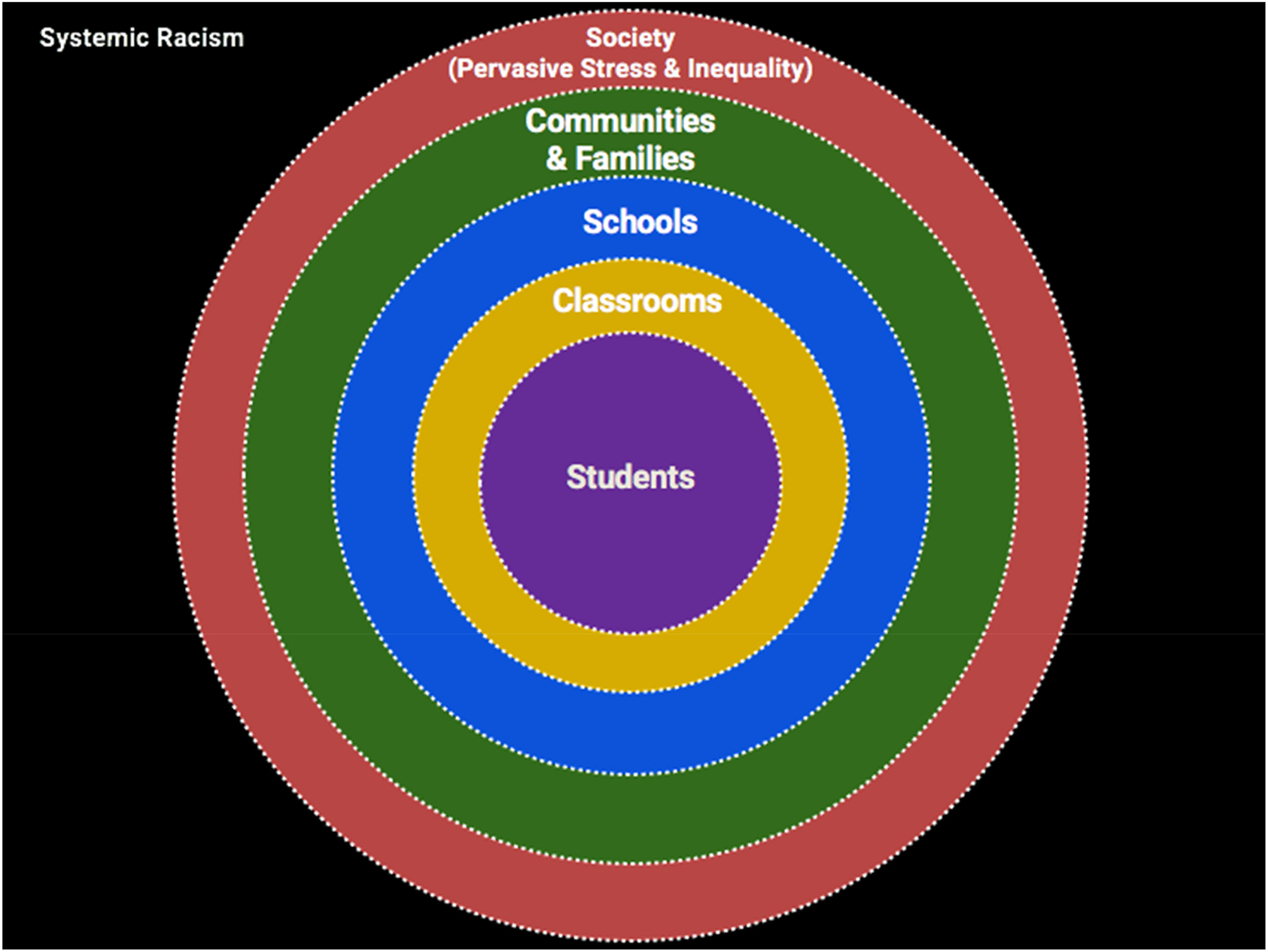
Systemically trauma-informed practice model.
Teacher Education Context
The teacher education context of this study, consistent with the majority of teacher education programs in the United States, is a predominantly White institution (National Center for Education Statistics, 2018). Yet the commitment to diversity, inclusion, equity, and justice of the institution is clearly articulated and pursued in the development of the program's curriculum. There are many challenges inherent to this work. How can we navigate this work successfully—supporting teacher candidates to see trauma as harmful, yet systemically produced, when they may themselves be contributing to that harm? What cues do they need to decipher? Responding to these questions requires strategic decision-making about where to hold that work and to spread it across inert and human resources.
We engaged in a multi-year process of learning and teaching about trauma, TIP, and ultimately SysTIP, as we engaged with teachers and teacher candidates in multiple professional development and university coursework sites. Through these experiences, we came to understand the challenges that teachers and teacher candidates were facing in their contexts in addressing student trauma as well as gauging the causes of that trauma altogether. Importantly, we also came to understand just how challenging it was, and is, for educators to grapple substantively with their role in (re)producing trauma in their classrooms.
The challenges educators face in learning about trauma became the undergirding principles for our subsequent theorization and case design work which we elaborate in this paper. The use of cases in teacher education has long been shown to support learning (Harrington et al., 1996; Merseth, 1991, Shulman, 1986). We build upon this scholarship by integrating the use of counterstory as we have done in prior work (Goldin et al., 2021a, 2021b). We first designed a case called the “Khang Case” (Khasnabis et al., in press) as a way to scaffold educators’ learning about how trauma is situated, how it is produced by systemic racism and injustice, and how they might widen what they “see” beyond children as individuals, to also include the systems impacting children, thus preparing them for SysTIP.
The case provided a narrative about a Hmong fourth grader, Khang, who was chronically late to school and whose family experienced intergenerational school-based trauma. The case explores the ways that a family like Khang's is typically seen by schools in uni-dimensional ways that obscure a wide range of assets including familial and aspirational capital (Yosso, 2005). We taught the Khang case across our universities, as well as in professional development sessions and in community spaces, while practicing reflexivity (McCaw, 2021) to further refine and ground our work in teachers’ realities. This led to the development of a new case study exercise that we elaborate in this paper, the “Julian Case.” Though “Julian” is a pseudonym, the case was inspired by an actual child and real experiences, which were observed by the fourth author, Katie. Like Khang, Julian and his family experienced school-based trauma, but to a more severe degree, where teachers regularly positioned him as a “troublemaker” (Shalaby, 2017) who needed to be surveilled, removed, and disciplined.
Principled Design
Here, we elaborate on the four principles of SysTIP that ultimately became key design elements of the Julian case and our teaching approach. We then describe the Julian case itself.
Principle 1: Naming Individuals as Existing Inside Systems
Across our respective universities and communities, we know that teachers and teacher candidates value social justice and want to advance equity in education. Further, we observe that many teacher candidates are able to identify systemic challenges that directly impact their work as educators (i.e., lower teaching salaries and larger class sizes in economically disadvantaged communities). And yet, teachers and teacher candidates struggle to maintain a focus on the connection between systems and childhood trauma, often having difficulty situating these systemic inequities at the root of psychological trauma. They do see these hardships—for example, parents who work multiple jobs and families who lack healthcare; but they do not see these hardships as systemically rooted. For example, educators often acknowledge the trauma associated with a student living in foster care, but fail to make the necessary connection between individuals within the foster care system, a history of racism in welfare laws, and the gross misuse of government funds to punish families of color for being poor (Roberts, 2022).
These fissures often result in saviorist tendencies - the notion, for example, that teachers must be “mothers,” “nurses,” “counselors” and “teachers”—all at once; and that children must be rescued from the shortcomings of their families and communities (Goldin et al., 2021a, 2021b; Matias, 2016). Focusing on the systemic in teacher education design work pushes back on this tendency. For example, in the cases that we design and courses we teach, we name, examine, and study the systems that operate within our unequal society, demonstrating not that families “lack” jobs or healthcare; but rather that they have been disenfranchised and are being denied opportunities due to systemic inequality.
Principle 2: Using Asset Frames
Our work with educators has revealed a persistent inclination to emphasize deficits in children and families. This aligns with recent scholarship critiquing the biomedical model of seeing trauma as symptoms and deficiencies (Petrone & Stanton, 2021; Venet, 2021; Winninghoff, 2020). For example, even when it is clear that children's traumatic experiences warrant the provision of considerable resources, teachers have referred to children as “taking advantage of” school-based resources, such as spaces designed for children to decompress. Similarly, even in the midst of discussions about families and their devotion to children while they navigate profound hardship, we have heard the argument, “We just need to teach them how to parent.” These deficit-laden statements pathologize children and families, flattening their experiences and even holding them responsible for the systemic ills that plague them. They also demonstrate teachers’ problematic cravings to “fix” children and families, with a set of discrete steps—like teaching people how to parent, or using a prescribed set of statements to calm a child. Thus, in our teaching and case design, we are committed to centering the importance of asset frames, and seeding them in the cases we design.
Principle 3: Speaking to and About Race and Racism
Many who work in schools claim a commitment to racial equality in society; however, when referring to the dynamics of their own schools and classrooms, they often do not name race. Even when the vast demographic differences between children and their teachers are undeniable—e.g., schools with majority Black student bodies and majority White staff—educators remain color-evasive (Annamma et al., 2017). At times, coded referents and racial microaggressions do rise to the surface. These patterns have led us to explicitly draw attention to race and racism in our teacher education design work—by naming the race of individuals portrayed in the cases, pointing to the racial oppression experienced (or not) by those individuals, and asking pointedly, “is race named or implied?” and “are there coded words in use here?” (Goldin et al., 2021a, 2021b). This instructional work requires that educators grapple with what they may have been avoiding, and practice developing the muscle memory of racial literacy (Sealey-Ruiz, 2021). We seize the opportunity to illuminate intersectional identities (Crenshaw, 2013)—to see the overlap of identities in relationship to race and racism, recognizing that individuals and communities do not actually face the same level of risk when they speak about these topics.
Principle 4: Navigating Whiteness
The tendency toward avoidance of race is specifically an attribute of Whiteness (Castagno, 2008), a force that we believe requires particular focus in our work with educators. Because the groups we work with are overwhelmingly White, are often supported by White leadership, and are buttressed by White cultural norms, Whiteness is omnipresent yet typically unacknowledged. These norms contribute not only to the erasure of race and racism, but also to other tendencies that serve to protect oppressors and harm the oppressed. For example, during discussions on norms of engagement, suggestions are often made that request kindness, respect, or politeness, instead of critique, frustration, or anger. A Black educator once shared that the common norm of “assuming best intentions” contradicted the way that they had to navigate the world, as they never had the luxury of assuming safety in an overwhelmingly White environment. Thus, in a White normative space, requests that may on the surface appear reasonable can actually serve to further oppress minoritized groups by silencing pain or fear. These tendencies have led us to explicitly name Whiteness and interrupt it by infusing norms that push against the grain.
Together, these four foundational principles of SysTIP guided our teaching and design work of the Julian Case Exercise.
The Julian Case Exercise
The Julian Case Exercise is a three-part narrative documenting a week in the life of a Black third-grade student, Julian, told through the perspective of his White teacher, Mrs. Smith. Mrs. Smith is an experienced teacher in a school where 56% of its students are economically disadvantaged, 68% are White, and 20% 1 are Black. Teacher candidates are positioned as teachers in this school, where Mrs. Smith is their colleague. The school employs Positive Behavioral Interventions and Supports (PBIS) as the primary behavior management program, where children's behavior is tracked and rewarded accordingly. In the first part of the narrative, Julian faces many challenges. Mrs. Smith's notes document Julian's “defiance” and “frustration” with his peers and teachers. For example, Mrs. Smith reports that Julian once threw his shoes and ran down the hall, expressing that he wanted to “get out of this place.” Mrs. Smith describes Julian in degrading ways, utilizing old tropes such as “aggressive” and stating that he uses “abusive language.” The case narrative provides this overview information and then prompts the teacher candidate to reflect on several questions before more information about Julian's week is provided.
Part Two of the exercise, titled “A Turn of Events,” documents a shift in Julian's experience when Mrs. Smith is absent. The substitute teacher, Miss Collins, leaves notes and photos for Mrs. Smith showing her productive math work with Julian. She references her efforts to engage Julian in representing mathematical ideas artistically before moving into the math content of the lesson. Julian's successes, both artistic and mathematical, are evidenced in the photos that Miss Collins leaves for Mrs. Smith. Teacher candidates are prompted to reflect upon this new information.
Part Three of the exercise is titled “Reflexive Reimagining,” and documents Mrs. Smith's efforts to transform her own understandings of Julian. Mrs. Smith, upon returning to school, is shocked to see what a productive day Julian had in her absence. She is compelled to seek more background information about Julian from the school social worker, where she learns about considerable trauma that he has recently experienced, witnessing his father's killing through gun violence, and his family's subsequent homelessness. Mrs. Smith commits herself to learning more about these serious issues, and over the weekend spends time researching these topics. She also examines her racial privilege as she reckons with her failure to see the bias she was operating on, and how these biases impacted her work with Julian.
These questions lead Mrs. Smith to reach out to her colleague, the teacher candidate completing the exercise, to request their help in making sense of the experience, Julian's strengths and challenges, and Mrs. Smith's challenges in meeting his needs. Mrs. Smith also shares links to articles she uncovered in her research that speak to her growing awareness of the intersection of race and racism with several of the social issues that Julian and his family have experienced, including homelessness and gun violence. The teacher candidate's task is to respond to Mrs. Smith's email in writing.
Methods
In this study, which received university IRB approval, SysTIP course content was taught to undergraduate elementary teacher candidates at a large university during the first semester of a four-semester teacher certification program. The course under study focused on supporting teacher candidates to create a school and classroom culture that is affirming of student identities, anti-racist, and focused on building relationships with students as an essential feature of creating a classroom culture that is equitable and just. The fourth author, Katie, was the instructor of record for the course. Katie invited the second author, Debi, into her class as a guest lecturer. Debi, in partnership with Katie, taught the SysTIP content across two class meetings, both of which were recorded. During both classes, teacher candidates were split into five groups to work together on class activities.
We investigated the following research questions: How can teacher candidates shift towards SysTIP? What is the work of teaching about the systemic nature of trauma? The data we analyzed were artifacts of teaching and learning. The data sources about the teaching are the transcribed lecture recording, lecture slides, and the Julian Case. The data sources about teacher candidate learning were student work completed during the course, including questions teacher candidates asked as captured during the lecture recording, poster papers where teacher candidates wrote their responses to questions posed in the case exercise and responses the teacher candidates wrote to Mrs. Smith's email message.
In coding and analysis, we engaged in the process of reflexive thematic analysis (Braun & Clarke, 2021). With this process, we took up the work of critically reflecting on our roles as researchers and practitioners, the research practice, and the process as a whole. We recognize that, as Braun and Clarke (2021) name, our personal knowledge and values, coupled with our methods and design, shaped our analytic process. Simona is a White Jewish woman, the child of an immigrant, and the mother of three children. Debi is an Indian American woman, child of Indian immigrants, single mother of two biracial daughters, and former elementary school teacher. Addison is a White woman and former elementary teacher. Katie is a White woman, former elementary teacher, and mother of two grown children.
We come to this work as teacher educators with experience working across K-12 and higher educational contexts in mostly urban-intensive spaces (Milner, 2012). We have spent extended time in thought and conversation together mostly over zoom, posing questions, sitting in reflective silence, reading and listening, with the goal of growing in our work as teacher educators, members of the education community, women, and friends. We have engaged in this research as collaborators who care for one another and seek to extend our own perspectives as influenced by one another's experiences. This is especially meaningful given our varied intersectional identities, including the differences in our institutional roles, professional experiences, and racial and ethnic identities, which often help us to shift perspectives and check for our biases and assumptions.
Our coding and analysis first involved the development of a deductive codebook. These codes, derived from previous empirical work (see Goldin et al., 2021a, 2021b), ultimately became our SysTIP principles. We systematically worked through the dataset multiple times to ensure rigor, separately at first, then came together to discuss agreements and disagreements. Through this process, we refined our codebook based on the data and convened to reach a consensus. From there, we engaged in thematic mapping (Braun & Clarke, 2021, p. 97) to generate themes and continually refine ideas.
Throughout the process we engaged in what San Pedro and Kinloch (2017) refer to as the “dialogical spiral,” in that we used “words and ideas as catalysts for our own construction of thoughts” (p. 29). This was a critical aspect of not only our analysis, but our case design, and broader work together, where this meaningful dialogue, expressed through listening, reading, and connecting (p. 32), spurs ideas from each of us to each other (p. 30).
Findings
We organize the findings by our foundational design principles, which are both the key features of SysTIP and deductive codes used in our analysis. Per principle, we report first how teaching around the systemic nature of trauma occurred in this context. We then report on the teacher candidates’ learning.
Principle 1: Naming Individuals as Existing Inside Systems
Across the teaching data we see the consistent naming of individuals, and placing these individuals inside of systems in ways that illuminate their nestedness. Particular pivots are regularly featured: between the concepts of individual and systemic trauma, and between Debi's own individual experience as a professor and woman of color teaching in a Predominantly White Institution (PWI). The very definition of trauma is constructed in ways that reflect this principle. In the lecture and on the slides, Debi names that “trauma is situated.” Even more, if teachers do not situate trauma within society, acknowledging how trauma is produced from societal inequalities, “we're really missing a big piece of the puzzle.” This introduction precedes a set of slides and graphic shown in Figure 1, in which the nestedness of trauma is depicted.
Building from this, Debi names a particular “occupational hazard”: A tendency to view students in a singular way, stripped from the nested society in which they live. This is a counter-cultural concept. Teacher candidates are regularly taught to focus on the individual students in their classrooms: What they know—and do not know—what they need, and how the teacher can meet those needs. The idea that focusing on the child can actually lead to harming that child is a nuanced, and difficult, point. And yet, we need teacher candidates to learn that they must “see” the children inside of their classrooms, but that if all they “see” is individuals, and not the communities, families, historical, and sociological inheritances, they will likely be mis-seeing them. Debi names the sets of systems, layering one on top of another, finally adding the student. The narrow focus, itself, is illustrated (Figure 2), when all other concentric circles fall away, leaving only the student in the teacher's view:
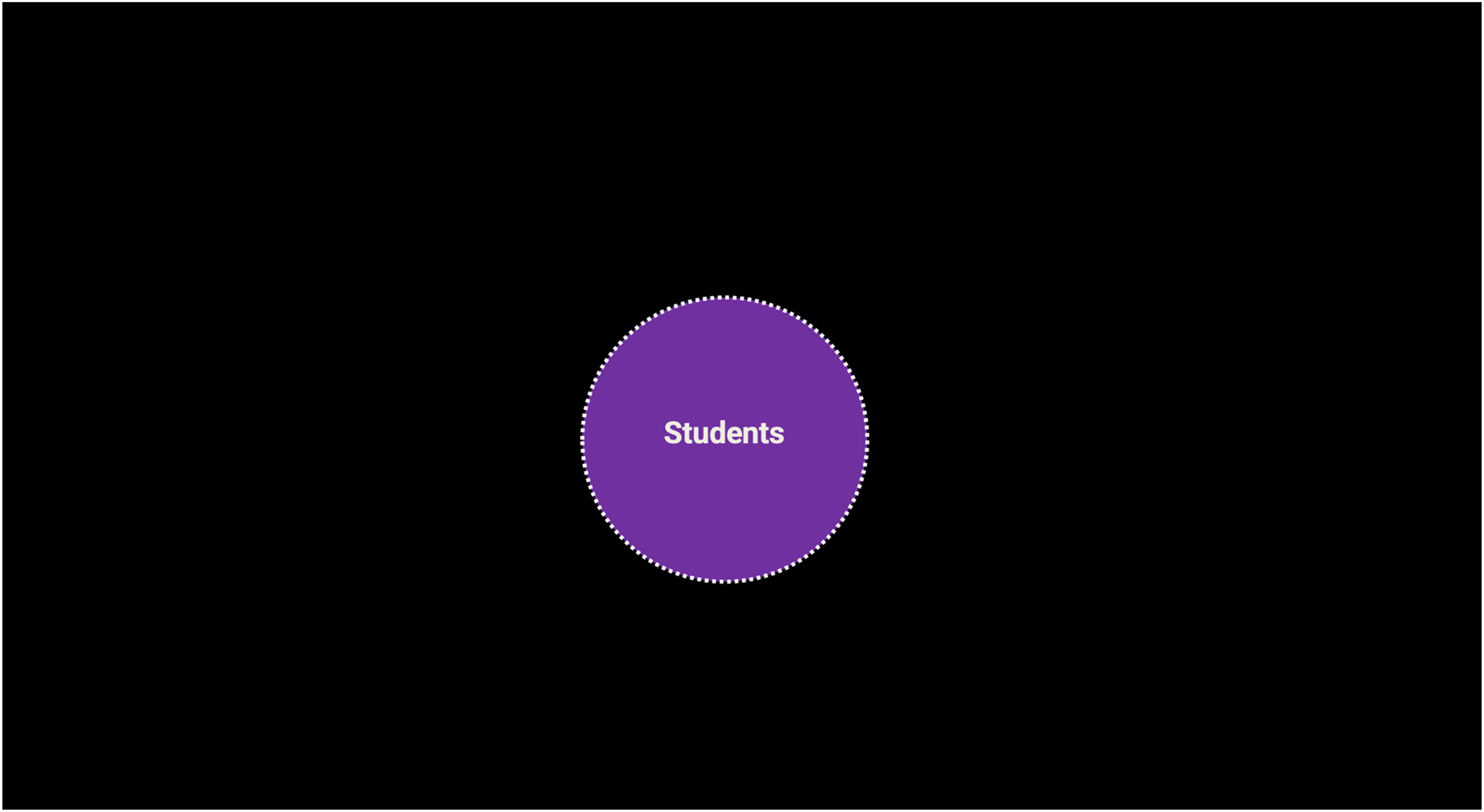
A (harmful) singular focus on students.
After modeling this view, which is the critical conceptual apparatus of SysTIP, Debi presents the Khang Case, and how it is possible that all that a teacher would see, of Khang's morning, is that Khang arrives to school with her siblings late every day, and comes to class when reading has already started. Missing, obscured by the singular focus on the individual, would be the contemporaneous and historical disinvestment in Khang's community and redlining, and how these contribute to the disrepair of her neighborhood and the financial barriers her family faces. This narrow focus blurs the contextual and situated experiences of the child, Khang, and also the experiences of Khang's family, including her grandmother, who, we learn, avoids school because of her own “ghosts in the classroom” (Lightfoot, 2004).
We shift now to reporting what it is that the teacher candidates do together in their groups, in response to these offerings as they analyze the Julian case and respond to Mrs. Smith. Across the groups’ work, we see a range of responses, from homogenized views of teaching that preserve a singular view of students, to examples where teacher candidates explicitly place Julian and what is shared in the case in more systemic view. Group 5's email response to Mrs. Smith was reproductive of a singular focus on Julian and children: Implement a social-emotional curriculum from the school counselors. Advocate for this change in your staff meetings, administration meetings, and more to make sure that relationships are maintained between adults and students throughout the building.
In a system that is anything but neutral, we know that injustice is not disrupted with neutrality. If there is any change to Mrs. Smith's practice, here, it is administrative and gendered: a new set of procedures, with a dose of “nurturing.” Further, the recommendation to advocate for SEL curriculum itself implied that the problem – the deficit – lies in Julian: He is in need of development in the social-emotional sphere, and a curriculum can help to fill that deficit. The challenges rest with Julian's SEL deficits, not systems or structural inequality. It is hard to see how any of these recommendations would get inside and remake the practice of a teacher who had typecast a student in her class.
The other groups make further progress. For example, Group 3 explicitly named the “multiple, overlapping levels, including racism, school-to-prison pipeline, and gun violence” that Julian is facing. Group 2 went even further, offering their expertise and time in collaborating with Mrs. Smith “for more support staff for our students and culturally responsive training for the staff. We would also like to discuss different strategies to interrupt the effects of societal racism and biases on the classroom.” But, across the responses where systems of inequality come further into view, only one group, Group 4, addresses the ways that Mrs. Smith's actions can—and must—intercede upon the school-to-prison pipeline. Naming the school-level systems that reinforce and reproduce inequality and referring to Venet's (2021) frame “creative noncompliance,” this group named both Mrs. Smith's culpability and her power to disrupt: Creative noncompliance is a helpful way to keep Julian safe and supported, viewing him with compassion and understanding. The way he is in the classroom is a function of what's going on in his life. In order to keep Julian safe for the future, we need to keep him out of the punitive system. This will help the students but may also help you as a teacher enduring the PBIS system.
Principle 2: Using Asset Frames
How can teacher educators help teacher candidates to see and name histories of racism that are embedded in legal, institutional, and social institutions while also seeing, naming, and leveraging children's and their families’ assets? Using CRT as a prism through which she views communities of color, Yosso's (2005; Yosso & Burciaga, 2016) Community Cultural Wealth Model (CCWM) can bring children into focus in asset-based ways. The teaching—including the teaching resources, featured efforts to help teacher candidates see what is hiding in plain sight—in the Khang case, in the Julian case, and, then, in the work they endeavor to do as educators.
Framed in this way, Debi offered the teacher candidates a definition of asset frames and CCWM as a grounding theory and then contextualized this theory, modeling how to lift it up and use it in the practical work of classrooms. She began by showing how this theory can be used to understand her own experience as a woman of color inside of a PWI. Speaking explicitly, Debi shared, “If I drill down to one person, I am a woman of color. For a long time, I was the one and only. I believe I faced constant scrutiny from my students, from my colleagues, from community members.” Continuing, Debi named the ways in which she navigated the PWI, resisted the systems of oppression inside of that PWI, leaned into her bond with her daughters and parents when she felt alone as a woman of color at her institution, sang in her family's home language, Bengali, at a community event, and kept alive her own hope of disruption and repair, despite the knowledge that she was, and would long continue to be, “the one and only.” Weaving personal and professional examples together with Yosso's theoretical work, Debi named, repeatedly, how, “If we see people for their strength rather than the ways the world has pathologized them it changes everything that comes next.” Thus, the teaching and the resources for this teaching—the cases, the slides, and readings—were designed to open up the ways that asset perspectives can enrich the work of racially just teaching.
We shift now to ask, what is it that the teacher candidates learned about asset and deficit framing, and how did they use those learnings to enrich their understanding of the systemic ills at the root of trauma? While all of the teacher candidates recommended that Mrs. Smith meet with and develop relationships with Julian and his family, some struggled to overcome deficit-laden hierarchies of knowledge. In the shadows of the recommendations, we can see their hollowness, especially in comparison with the asset-framing that some groups bring. For example, Group 3 wrote to Mrs. Smith: The best place to start is with relationship building with Julian and his family. This could look like multiple things, including: Connecting their family with resources and support, having flexibility with meeting Julian's mother, communicating with other adults in the school to make sure you’re all on the same page when it comes to teaching Julian, and most importantly, taking the time to build real trust with Julian so you can work through his difficulties together. All of this tends to be encompassed in culturally responsive teaching and responsive classroom.
We see how the teacher candidates might be more asset-laden, more generous, to use a key term in the definition of asset-based frames, when looking at how other groups framed Mrs. Smith's work and how she might learn with and from Julian's family. Groups 2 and 4 named the ways that Mrs. Smith, herself, might have contributed to the difficulties at hand, how she can repair the relationship, and how this repair could inform her pedagogy. For example, Group 4 named Mrs. Smith's culpability in the case: Looking at the sources from all of these articles, one place to start would be one-on-one with Julian in the classroom and getting to know each other. Invite a conversation with him since you might’ve gotten off on the wrong foot. Start a chat with things that he likes and his aspirational capital. Then later get to know him and how he is feeling.
Principal 3: Speaking to and About Race and Racism
Throughout the lesson, Debi identified racism as a foundational force operating in society through the text and images presented on the slides and her elaborations. The concentric circle model began with a large red circle depicting a society in which multiple forms of inequality persist: housing and food shortages, unequal access to employment opportunities, high-quality early childhood education, highly qualified teachers, healthcare, and mental health services. The slide then showed that racism is enacted across all of these inequalities. Debi explained, “That is an unequal society. That's the world we live in. And across all of that is racism. Racism is always moderating how we experience the world because it is directly delimiting resources, material and otherwise, from people.” Then, Debi went on to demonstrate the hazard of thinking with a singular focus on children when an unequal and racist system is inherent to our experiences and how the CCWM can be a resource for developing an asset-focused gaze that also maintains a focus on racism.
The omnipresence of racism was further emphasized through a fraught moment that Debi experienced as racialized. Katie, as co-instructor, circulated the classroom and observed that several students were using their computers for purposes other than coursework. She consulted with Debi and shared her concern that some students were not focused. Debi and Katie decided that they would together address this with the students with Debi modeling her thinking as a woman of color. Katie first acknowledged this matter to the teacher candidates: Something that I really loved about Debi's sharing, and that she does so beautifully, she shares her innermost thoughts, she shares her vulnerability, she's sharing her experience. It's deeply personal. And for me, I know as a learner, that helps me. It raises my awareness … So I’m going to invite all of you to be in this moment with us. Fully.
Debi built from what Katie shared by explicitly naming her experience as racialized: “I really do appreciate that because that really speaks right to what I was saying. I’ll share with you that one of the ways I have experienced racism in my work as a professor was student resistance.” Debi shared about a time when she felt harmed by her students and needed to take a break from teaching. She then connected past experiences of harm to the present moment: I don’t know what people were doing on their computers, but I think it's important for me to share that with you, for me as a woman of color, I know my body is seen. When I walk into a space, my skin color, right away people are making assumptions of that. I know that. I always feel pretty under scrutiny when I teach. It's pretty heavy for me. I can tell you this, a routine for me is when I teach, I try to keep the rest of my day totally like nothing, because my body can’t take the stress. As a woman of color, speaking about racism, it's dangerous. It's dangerous.
Our analyses of the teacher candidates’ email responses to Mrs. Smith demonstrate an uptake of speaking to race, albeit summarily in most cases. Group 3 briefly referred to racism and the school to prison pipeline as “injustices Julian is facing.” The other groups referred to racism and the potential for racial bias, with Group 1 writing, “As a white teacher, it is important for you to be aware about how Black students unjustly get in trouble more because of misinterpretations of different cultural aspects.” These referents were generally spare, lacked nuance, and were not actionable. In some ways, the medium of a short email response may have limited the opportunity to develop a more nuanced racial commentary.
More concerning were the ways in which racialized topics were presented as race-neutral or color-evasive (Annamma et al., 2017), a feature most present in Group 5's response to Mrs. Smith: “In your classroom, raise awareness about the dangers that encompass them. It does not need to be directed at a certain situation, or feeling the need to call a student out, but more so during a safety lesson, spend time focusing on guns themselves.” Group 5's message was meant to compel Mrs. Smith to teach children about gun safety, but did not recognize the role of racism in gun violence, despite the fact that the case exercise explicitly referred to Mrs. Smith's realization that “Julian's experience and his family's, had been shaped by a long history of racial oppression.” In the case exercise, Mrs. Smith also shared an article that referred directly to the disproportionate impact of gun violence on Black communities. Thus, Group 5 was silent on race as it relates to gun violence, even in the face of multiple cues that the teacher candidates were being instructed to take up race.
Principle 4: Navigating Whiteness
The development of the Julian Case spanned several years, during which the authors navigated Whiteness in different ways. Katie and Debi, close colleagues and suitemates, often conversed informally—sharing their experiences as teacher educators and opening up their different racialized experiences and perspectives as a White woman and woman of color. Before there ever was a case study, Julian's story was inspired by a real child and school whom Katie visited. The school was composed of mostly Black children, while most of its staff were White. Over the course of a few years, Katie shared with Debi her reflections on the child and the ways the school had harmed him. This sharing occurred during a window of time when Katie was learning to interrogate her own Whiteness and engage as a co-conspirator (Love, 2019) with people of color. At times, Katie shared the story with her teacher candidates also, and as she did so came to understand that her narration of the story was founded in her perception as a White woman.
With Debi as a thought partner, Katie realized that Whiteness impacted the details she saw as salient and the ways that she narrated the story, a narration that appeared painful for her teacher candidates of color to hear. To maintain the anonymity of the “real Julian,” we do not share those details here. Rather, we seek to highlight that navigating Whiteness has meant reckoning with the very ways we perceive salience and assign significance. In Katie's early narration of “Julian's” story, there was an aspect of “shock and awe”—a dramatic detail that stayed with Katie and influenced her sensemaking and narration to culminate in a disturbing and emotional climax. Over time, Katie developed awareness that the shock she felt was imbued with Whiteness. She expressed to Debi her observation that White people begin to “realize (very slowly) that racism is operating in our institutions and in ourselves, and is woven into the fabric of our culture.” She continued, “The headline becomes something like Outraged White People Suddenly Discover that Racism is Everywhere and Demand Action RIGHT NOW! This headline still centers Whiteness, as it is about White people's realizations more than the people being harmed.”
Katie and Debi's dialogue and sensemaking about Julian and the narration of his story underscores the need for case design in teacher education to be reflexive. We also recognize that a feature of Whiteness is a propensity to seek quick solutions to deep problems that people of color have been working on for generations. A shocking climax, even when it acknowledges the reality of racism, can work against the goal of careful interrogation of the concretized institution of racism—one where harm occurs in many ways simultaneously, some features more visible than others, and those features more visible to some viewers than others—yet all features critical to see in order for racism to be dismantled.
Thus, we wrote the Julian Case with an understanding of Whiteness and its impact on learners in mind. Designing the case in this way meant collaboration across the author team and ample time for reflection and self-interrogation. We sought to stretch out the full story of a child and illuminate complexity, including the many ways that a young Black boy was being harmed systemically—by a teacher, by a behavioral management curriculum, by disciplinary norms, by the lack of social services; all moderated by race and racism. We also interrogated which tropes to press upon. We purposely included some tropes in the case narrative, so that we could engage teacher candidates in problematizing them; and we pulled back on others. Some tropes, we believe, are dangerous in that they can overtake the case and make it difficult for the learner who is still developing racial literacy to focus on the complicity of the school.
Debi and Katie navigated Whiteness during the teaching of the lesson, with Debi and Katie both referring to Katie's White identity, and their cross-racial collaboration as a resource; and with Katie naming the efforts she had made to deepen her own racial awareness. In addition, a key way that they taught the teacher candidates to attend to Whiteness was in the directions they gave as they framed the task of writing the email response to Mrs. Smith. They asked the teacher candidates to center their focus on Julian and not on comforting Mrs. Smith, explaining that their cohort was a multi-racial space, with people of color present across the group—and that it could be harmful to people of color to have to offer comfort to Mrs. Smith, a White woman who had harmed a child of color. Debi further elaborated “the right to comfort” (Okun & Jones, 2000) as a feature of Whiteness.
Despite these efforts, the groups’ written responses did little to explicitly address White dominant ways of being, other than naming the potential for Mrs. Smith to have racial bias as a White teacher. Most concerning was the response from Group 5, who demonstrated a duality with regard to this navigation. On the one hand, they referred to Mrs. Smith's likely bias: “Because you are working with a Black student as a white educator, you must work to treat him equitably as to avoid unintentionally causing harm that could impact his future like we see with many students who end up in the School to Prison Pipeline.” And yet, at the same time, they offered recommendations that embodied White saviorism: “We also think that it is important to take a field trip, if you are able to, to a food drive, a clothing donation center, or to a local homelessness shelter to expose students to helping others in their community.” This duality illuminates the ubiquity of Whiteness, which, like the omnipresence of racism, can be intractable—hardly being dented, even when teacher candidates are being pressed to acknowledge and interrogate Whiteness.
Discussion
We have sought here to illuminate what is often unseen, and to investigate how we can help teachers and teacher candidates press against the many caricatures of children and their communities that permeate schooling and teacher education. We seek to light a path forward—to share cues that support educators in seeing the whole, including the brilliance and assets that children bring to their work in schools and that are often hiding in plain sight. We interpret our findings below.
Teaching against singular views. By repeatedly acknowledging individuals as existing in systems, we have illuminated the damage caused by deficit-laden views. These narratives permeate our field, cutting across schooling institutions and levels from K-12 through institutions of higher education. And, these statements echoed in our classroom, as one group continued to refer to Julian, in ways characterized by a reproductive and singular focus. Teacher candidates need to experience the friction of a singular view, and see the systems that they, and we, all swim in. This means, as we have seen in the data above, that teachers need to interrogate individual-based solutions, such as “maintaining relationships” or focusing on SEL as a means to “fix” children. Doing so is complicated work and necessitates seeing children with nuance and generosity. But it is critical, as it cuts against the occupational hazard of seeing the individual student in our classroom, floating as if unaffected by systems of privilege and oppression.
Resisting the hollow hallmarks of Culturally Responsive Teaching. Teaching is one of the “professions of human improvement” (Cohen, 2011). It has, at its core, the work of learning, stretching, growing. And yet, we are fed syrupy-sweet narratives of pulling oneself up by our bootstraps. In a field permeated by tropes, such as the idea of a meritocracy, it can be much simpler to submit to optimism cloaked in naivete. In this data, we saw this in the hollowness with which one group took up what they called culturally responsive teaching. In reality, Culturally Relevant Pedagogy (Ladson-Billings, 2014) and Culturally Responsive Teaching (Gay, 2010) are anything but hollow. Still, despite extensive coursework elevating the thinking of these incredible scholars, in our analysis we see that there remain gaps in learning—with some teacher candidates writing about relationship building with Julian and his family that reveal deficit stances, even while using the terminology of culturally responsive approaches.
This challenge aligns with a broader pattern we see in our work. Teacher candidates often perceive that even if they are building relationships on their own unexamined terms, connections are forged. But in actuality, the process of co-constructing a trusting relationship with children and their families is a key focus that teacher candidates work on in the course. We see that this has not taken root. Teacher candidates must learn not only to see the many assets of the children they teach, but also their roles as co-creators of mutual relationships.
Silence as violence. By insisting that educators speak about race and racism, we push against norms that operate in predominantly White spaces. Schooled in Whiteness, few teacher candidates come to us with racial literacy (Goldin et al., 2021a, 2021b; Khasnabis et al., 2019). Though they've come of age in a time that some insist is ‘post-racial,’ speaking about race and racism is hazardous work in our contexts. We echo the chants of racial justice protestors who model the lesson that silence on racism is violence. Looking across teacher candidates’ work, we see that learning to develop the muscle of speaking about race and racism in spaces with little racial diversity is difficult. But cultivating teacher candidates’ abilities to do so is critical.
Working in concert. Navigating Whiteness in predominantly White spaces, where White cultural norms are the dominant currency, is a thorny problem. Just as speaking about race and racism is countercultural, so too is naming Whiteness. Thus, doing so requires collective power—an effort to work in concert across identities, spaces, and roles. Just as we hope to help teacher candidates understand and intervene upon the systemic nature of racism and trauma, so we, too, have had to seed countercultural teaching in collaborative ways that acknowledge and push back on systemic inequality. The teaching of this work is too laborious to be born alone. Working in concert allows us to bring each other's wisdom into our own respective courses. This can occur through the collaborative design of instructional materials as well as co-teaching structures. This has meant dialogue and sense-making across racial and hierarchical identities. And this has meant interceding by speaking directly to racialized moments of pain.
The teacher candidates’ group work did not embody this sort of brave partnership—instead, candidates worked with each other, sometimes naming bias, but ultimately not working in concert to ferret that bias out nor interrogate it. Building those coalitions entails speaking about racism to each other, challenging each other, and being able to move through that challenge to resolution. Doing that would unsettle White saviorism, itself ubiquitous in a number of the groups’ statements. We could not do this work without each other. Nor can our students do this work, when they have keys to their own classroom, without co-conspirators.
Limitations
In our study, there were several limitations. First, while the curriculum of the teacher certification program was designed to center social justice across four semesters, content on SysTIP was taken up only during two sessions of one course. Thus, the data do not capture the full potential of what can be learned through these instructional approaches over time. Additionally, the present study took up questions related to teachers and the work of teaching. However, we acknowledge that SysTIP can be most successful when enacted within and across all parts of the school system; school psychologists, social workers, administrators, and support staff, too, can benefit from understanding and grappling with the complex realities of trauma through a systemic lens. Future studies can—and should—apply this frame to investigate the importance of SysTIP in each of these contexts and roles.
Conclusion
It took 500 years for Catherine of Aragon's message of defiance to be deciphered. We do not have more time to discover and leverage truth in our schools. Nor to make good on the promises we’ve made to our nation's children. SysTIP seeks to bring into clear view the truths about trauma that are hidden in plain sight. Many educators are deeply worried about trauma, are teaching about trauma, and are working to implement TIP. It is incumbent upon us to prepare the next generation of teachers so that they can push against popularized forms of TIP, diving deeper beneath the surface, constantly questioning the systemic roots of trauma. The truth is there, always waiting to be discovered.
Footnotes
Declaration of Conflicting Interests
The author(s) declared no potential conflicts of interest with respect to the research, authorship, and/or publication of this article.
Funding
The author(s) received no financial support for the research, authorship, and/or publication of this article.
