




Abstract
Current conceptualizations of trauma-informed practice in urban education spaces fail to center the strengths of Black youth, nor do they interrogate the role of schools in causing trauma. In partnership with an elementary-aged participatory Student Advisory Board, this article explores the both/and of strengths and school-based trauma for these Black youth. Through narrative analysis coupled with student art and poetry, findings highlight the normative nature of Black brilliance (Gholson et al., 2012). Situating strengths and school-based trauma together promotes a more comprehensive view of trauma, especially as it relates to liberatory trauma-informed educational practice in urban contexts.
Keywords
“Paradoxical thinking requires that we embrace a view of the world in which opposites are joined, so that we can see the world clearly and see it whole…. When we think things together, we reclaim the life force in the world, in our students, in ourselves” (Palmer, 2007, p. 66).
Paradoxical thinking. Not either/or, but both/and. It is not easy to hold tensions, resist dichotomies, and hold two truths at once. But it is possible.
When it comes to childhood trauma, few, if any, would refute the harm it causes to individuals and communities. Decades of research and centuries of lived experience have established the damage of trauma's impacts. But as the awareness of trauma and its connection to schools continues to expand, so too must our conceptualizations of the topic, especially as it relates to Black youth.
In an interview, educational researcher and activist Bettina Love once said, “if all you know about Black folx is our pain and our trauma, you can’t do social justice work – because our history does not start with this pain” (Love, as quoted in Johnson, 2021, np). Coles and Stanley (2021) wrote that although endemic racism will cause suffering, we must refuse that singular view– to lean into and be informed by what lies beyond Black suffering to build more just educational futures.
Although trauma-informed practice (TIP), which I explore further in the literature review, has the potential to be transformational, there remain critical gaps in existing TIP scholarship and approaches. First, much of the popularized work related to understanding trauma in urban schools (i.e., trauma-informed educational practice), focuses on trauma that occurs outside of schools, rather than addressing or ameliorating the myriad ways schools cause harm. For example, TIP has largely focused on individual-level solutions such as breathing strategies and social and emotional learning (Duane et al., 2021), without attending to the policies, practices, systems, and structures at school that cause trauma (Venet, 2021; Gorski, 2020). Second, TIP has been, historically, color-evasive by failing to name the role of race (Alvarez, 2020), racism, and systemic inequities in (re)producing trauma. This inattention to the structural and systemic view has led to the weaponization of TIP (Khasnabis & Goldin, 2020) and White saviorism (Goldin et al., 2021).
Third, there is nascent scholarship that fully integrates the voices and strengths (e.g., forms of resistance and positive coping, brilliance, assets) of children, their families, and the broader community. Even less scholarship has highlighted Black children's narratives at the intersection of trauma and schooling, despite the fact that they are so frequently harmed by schools (Saleem et al., 2021) and not centered in research narratives (Duane & Mims, 2022). Popularized forms of TIP are also not inherently liberatory; to date, researchers and practitioners have not made wide-spread efforts to connect TIP to grassroots groups and scholars who organize for school abolition. The present study is derived from these overlapping and interconnected ideas.
Thus, to investigate the intersection of these ideas, in this paper I ask: what are the school-based traumatic experiences for these Black elementary youth? And what does it mean to grapple with these realities in a way that includes the complexity, cultural wealth, and strengths of individuals and communities? First, I present a review of relevant literature. From there, I explore the methods and findings of this critical qualitative and participatory study. I end with a discussion of findings and exploration for the work that lies ahead.
Literature Review
To grapple with the complexity and “both/and” of these ideas—gaps in trauma-informed practice and scholarship, centering Black youth voice, amplifying strengths, and school abolition—let me first put existing scholarship in conversation with one another. First, I explore the concept of Black family brilliance and its connection to the work of school abolition in an effort to start with strengths. From there, I synthesize existing definitions of trauma, situate trauma within systemic inequality, and define my conceptualization of school-based trauma. Finally, I present the two overarching frameworks that informed the present study.
Axiomatic Brilliance and Abolition
Martin (2011) asserted that scholars and practitioners must treat the brilliance of Black children as an axiomatic starting point from which all research, policy, and practice stem. In doing so, we 1 can avoid the trap of substantiating that Black children are, in fact, brilliant. Gholson et al. (2012) expanded on Martin's idea, to pose this critical question: “Given that Black children are brilliant, how does this affect my research agenda?” (p. 4). Many scholars and educators, especially those of color, have taken up an axiom of brilliance in their work with Black youth. For example, Mims et al. (2022) conducted a systematic review of 155 articles related to Black child brilliance to develop the BlackCreate Framework. Love (2019) connected Black joy and brilliance to the broader abolitionist movement, arguing the need for wholeness, humanity, creativity, and abundant love in the quest for justice (p. 120).
In the path towards justice, school abolition readily acknowledges that schools are not a “just, efficient, or moral solution to problems’’ (Meiners & Winn, 2010). Abolition seeks to “dismantle, change, and build” (Stovall, 2018), to transform the entire landscape of how we live, yielding entities that divide to work towards collective access to life sources (Mei-Singh, 2021). Abolition does not mean reform (Meiners, 2011; Dunn et al., 2021); instead, school abolitionists envision a world in which schools collectively seek to understand and embody the belief that “no one is disposable” (Barrie, 2020; Gilmore & Loyd, 2012; Reda, 2018) and liberation for all. School abolitionists call for a critical examination of the structures in schools that visibly punish and oppress (Stovall, 2018) as the first step in building towards liberation and freedom (Love, 2019). This systemic account of “schooling” (Stovall, 2018) interrogates educators’ complicity in the current state of schools with continued reflection on cycles of violence (Whynacht et al., 2018). This violence continues to be enacted by White supremacy and causes trauma in schools.
A Working Definition of School-Based Trauma
I draw on existing definitions of trauma, identified by the Substance Abuse and Mental Health Services Administration as a “set of circumstances that is experienced by an individual as physically or emotionally harmful or life-threatening and that has lasting adverse effects on the individual's functioning and mental, physical, social, emotional, or spiritual well-being” (SAMSHA, 2014, p. 7). Yet I name, here, that much of the earliest work in trauma studies conceptualized trauma solely through the lens of child abuse, neglect, and “household dysfunction” (see Winninghoff, 2020), and largely ignoring the role of oppression and systemic inequity in investigations of trauma. The field of TIP, in turn, took up a similar view by centering individualistic approaches and solutions to systemic problems (Golden, 2020). Venet (2021) wrote that trauma-informed educational practices seek to “respond to the impacts of trauma on the entire school community and prevent future trauma from occurring” (p. 10). However, like the broader field of trauma studies, TIP has most widely assumed a reductive view of trauma (Golden, 2020; Petrone & Stanton, 2021).
Trauma's effects can reverberate through individuals, communities, and societies via behavioral, emotional, cognitive, and physical shifts (Substance and Mental Health Services Administration, 2014). And we must also consider the effects of trauma as consequences of larger systemic injustices. What may present as trauma-related responses in individuals (e.g., headaches, nightmares, withdrawal) can be linked to broader sociocultural factors (Petrone & Stanton, 2021). That is, systemic factors (e.g., housing instability, food insecurity, climate change, lack of access to healthcare and childcare, etc.) cause and contribute to the production of trauma, resulting in trauma responses for an individual or community forced to cope.
These systemic factors are highly visible in urban schools. Schools that qualify as urban (see Milner & Lomotey, 2021 for their conceptualization of urban education) often report higher discipline referrals, overcrowded classrooms, and underqualified teachers (Milner, 2012) compared to suburban counterparts. These realities stem from decades of policies that ensure urban areas remain underfunded (National League of Cities, 2022), segregated (Locke et al., 2021), and over-policed (Densley, 2021). Given this state-sanctioned violence, it is not surprising, then, that Black youth in urban schools experience schools as “a site of suffering”—of trauma (Dumas, 2014, p. 2). For example, Black male students reported high rates of trauma exposure during their elementary school years (McGee & Pearman, 2014), anti-Black aggression at school can lead to “deeply ingrained psychological trauma,” and spirit murdering of Black girls (Hines & Wilmot, 2018, p. 67). Urban school policing tactics (e.g., strip searches) are related to heightened emotional distress) as well as increased post-traumatic stress symptoms (Jackson et al., 2019; White & Hyman, 1994).
Still, much of the extant scholarship around trauma and Black youth investigates the trauma stemming from families and communities, despite the reality that schools, too, can be a place of trauma. The Violence Exposure Scale for Children—Revised (Fox & Leavitt, 1995), for example, names schools as one possible community location where trauma can occur for children. This measure is often used in trauma studies to highlight traumas endured at the community level (see Bernstein et al., 2003 for more examples of community trauma measures). However, the school is a worthy site of study in and of itself; it has the unique potential to help or hinder a child's learning and development. For this reason, I echo the call of scholar-activists who urge the field of education to interrogate the role of schools in causing trauma, especially for Black youth.
Looking across more than thirty years of scholarship in the fields of trauma and education, in forthcoming work (Duane, in press), I define school-based trauma (SBT) as the response to an event or set of events—witnessed or experienced in person or virtually—at school. SBT can occur during school hours, before or after school, on school grounds, or during school-sanctioned activities, including field trips and weekend events. Rooted in de-humanization, SBT can disrupt healthy functioning, upend an individual and community's capacity to cope, exacerbate educational inequities, and lead to long-term negative impacts psychologically, physically, behaviorally, and academically. Thus, in the present study, I situate this definition of SBT within the following broader frames to investigate the ways Black elementary children and their families draw on existing strengths to traverse trauma-inducing school experiences.
Systemic and Asset-Based Frames
Two theoretical frames underpin the present study. First, Systemically Trauma-Informed Practice (SysTIP) integrates the key tenets of Critical Race Theory—seeing racism as ordinary, not an aberration (Crenshaw et al., 1995)—and trauma-informed educational practice. The authors combine an awareness of structural inequality with the individual and systems-level solutions needed for children impacted by trauma in school settings (Khasnabis et al., in press). SysTIP posits that educators must also take up asset views, drawing frequently from Yosso’s (2005) Community Cultural Wealth model. This “kaleidoscope model” of CCW is defined as “an array of knowledge, skills, abilities, and contacts possessed and used by communities of color to survive and resist racism and other forms of oppression” (Yosso & García, 2007, p. 154). Yosso, too, draws on Critical Race Theory, seeing race and racism as endemic to and permanent in the United States (Yosso et al., 2009). Still yet, missing from current trauma-informed and systemically trauma-informed approaches is child perspectives and narratives of school-based trauma.
I advance these ideas by investigating school-based trauma from Black youth perspectives to expand the scope of trauma-informed educational practices as a necessary part of liberatory education. With a wider lens, we can see systems (Khasnabis et al., in press), amplify the strengths of Black children and their families, and name schools as sites of trauma (Duane, 2022), to contribute to the ongoing pursuit to build institutions that are just, loving, equitable, and center Black, Brown, and Indigenous lives (Dunn et al., 2021).
Methods
In the present study, I use critical qualitative inquiry and narrative analysis through participatory research, semi-structured interviews, and narrative analysis to center Black youth and parent perspectives through an investigation of the following research questions:
What experiences cause school-based trauma for Black elementary youth? How and in what ways do children draw on familial strengths to cope with school-based trauma?
Setting, Participants, and Procedures
The study received University Institutional Review Board approval. All data were collected virtually during the summer and fall of 2021 as part of broader University-community research-practice partnership investigating positive Black family processes during COVID-19 in a large midwestern urban city. A Google form was distributed to all families who had children between the ages of seven and twelve years old requesting participation in a recorded semi-structured interview. In total, I conducted 11 parent interviews and 11 child interviews. All participants self-identified as Black or African American and spoke English (see Table 1 for descriptives).
Child Participant Demographics.
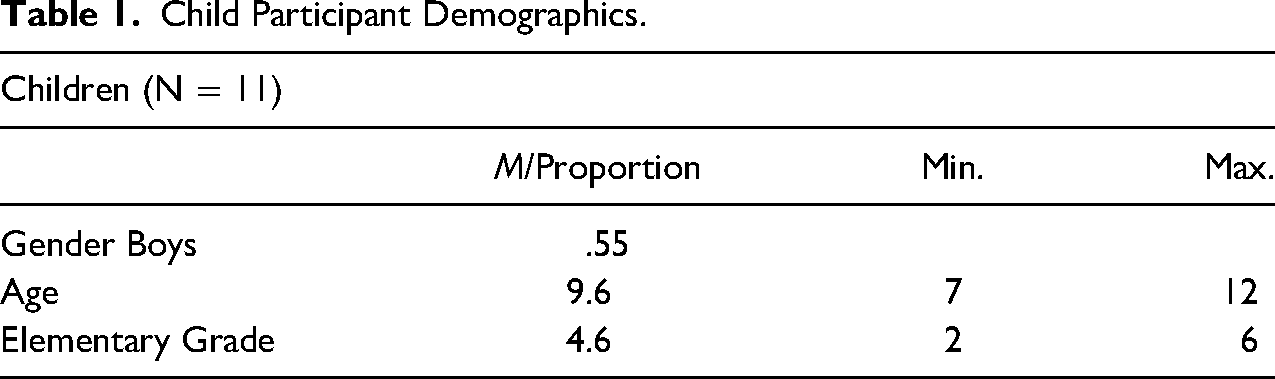
In parent interviews, I asked about familial strengths, children's experiences of school-based trauma, and SBT-related coping. Child participants were recruited after their parents’ interviews utilizing a welcome packet that included a graphic illustration of study goals, paper and coloring supplies, a stop-light visual to indicate they wished to end the interview, a certificate of completion, and a small sensory fidget to use during our conversation (see Duane, 2022 for more). With children, I employed the participatory Mosaic approach (Clark, 2005), collecting information across multiple means of conversation. First, I invited them to tell me what school is like and to provide a story of their best day of school. Next I ask them to describe their worst day of school. Through narrative elaboration (Saywitz & Snyder, 1996), I connected children's responses to the trauma responses (e.g., behavioral, cognitive, emotional, and physical) (Duane, 2022). All interviews were coded and cleaned by an undergraduate and graduate research team.
Student Advisory Board
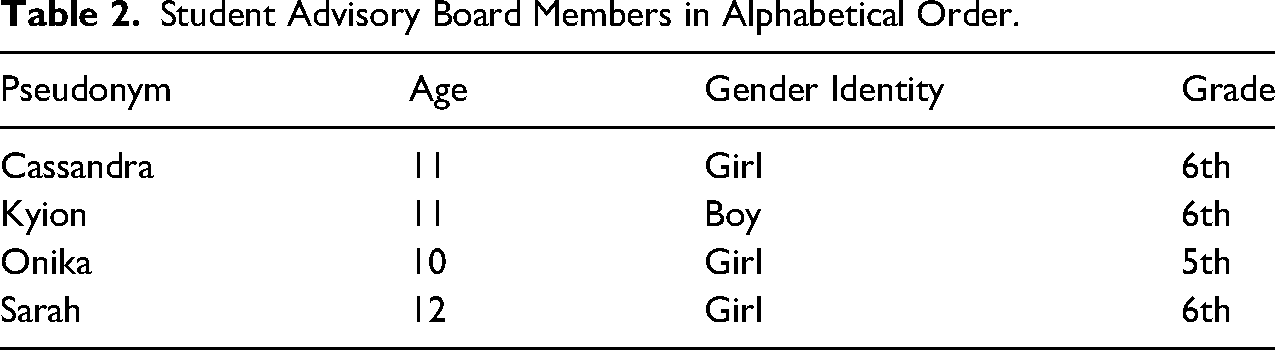
A Student Advisory Board (SAB) was created to center participatory research methods, and consisted of four children (see Table 2) to help inform and guide the project. In each phase of the research process, I met with the SAB to direct the entirety of the process—this went beyond member checking to a more all-encompassing participatory approach. During board meetings students engaged in qualitative coding, analysis, and narrative writing. Together, students co-wrote poems and created artwork based on our narrative research findings, of which, will be presented alongside the results below. Board participation came with additional digital gift card incentives. I incorporated the content of our collaboration to inform analysis and dissemination with their permission.
Student Advisory Board Members in Alphabetical Order.
Coding and Narrative Analysis
I conducted narrative thematic analysis (Riessman, 2008) of both sets of interviews iteratively in two phases: descriptive and interpretive (Murray, 2009). First, I engaged in a descriptive stage that involves inductive/open coding, thematic mapping, and generating initial patterns of stories being told (Smith, 2016). Instead of focusing on mini-units or fragments, the initial phase of analysis focused on the overarching stories told. In the second interpretative phase of analysis, I worked independently first, and then with the Student Advisory Board, to connect themes across the narratives to theoretical frameworks (Murray, 2009). The SAB was instrumental during this phase, often talking about patterns and themes across narratives in ways I had not considered. After both phases, the SAB selected individual narratives from each theme to represent visually.
Role of the Researcher
Positionality is layered and complex and impacts all aspects of the research process (Secules et al., 2021). I come to this work through the trauma-informed education community, as a White, cisgender, able-bodied, middle class, heterosexual woman, with teaching experience at the elementary level in two large urban intensive school districts. Additionally, my own experience as a student shapes my research lens. As I continue to process and cope with the long-term consequences of my own school-based trauma, I make connections to the students in classrooms around the country who are also navigating trauma-inducing spaces. Though I must also simultaneously consider the structurally embedded advantages that I receive as a product of my Whiteness.
I entered the field in pursuit of building strong relationships with children. A byproduct of this goal has been the transformative community I've simultaneously built with families, colleagues, mentors, and community members who have helped me unlearn harmful practices, dismantle internalized White supremacy characteristics, and interrupt the saviorism that is so deeply rooted in my Whiteness. I unpack this here to highlight how my experience informs this work and to situate myself within my study. This research is not purely an intellectual pursuit, but also a matter of the heart.
Importantly, I wrestled with what pronouns to use when presenting findings—should it be “I” or “we”? How can I honor the analysis that happened alongside trusted mentors, peers, community members, and most importantly the SAB? Through many conversations and after much thought, I have arrived at the use of “I,” as the sole writer of the manuscript, though I am careful to name explicitly that this work is not merely my own.
Findings
I break down the findings from this study into three sections, following the work of the SAB who encouraged us to look at the “good and bad together.” I intentionally start with “the good,” exploring findings related to collective strength. From there, I present analysis around school-based trauma and children's means of coping. A complete narrative example follows the findings to illustrate findings within the context of a child's lived experience.
Familial Strength
To capture the complexity and nuances of these experiences, let us first look to the generational strength that exists within Black families. This first finding of familial strength draws on the historical legacies of brilliance embedded within the Black community (Hill, 2003). These strengths can be considered protective factors that support child development (Benzies & Mychasiuk, 2009) and serve as formative resources coping with stress and trauma. In naming the strengths of these Black families, I am careful not to focus on exceptionalities or the “magic” of Black families. The findings presented as family-level strengths include presence, a culture of advocacy, support seeking, and spirituality.
Presence
Families embraced presence as a core tenet of their family dynamic. This pattern pushes against much of the previous research where Black families are seen as detached and unavailable (Roberts, 1998). Families in this study demonstrated strong presence, whether it was physical presence to stand by their children, or emotional availability to provide support, acceptance, responsiveness, sensitivity, and warmth.
With respect to physical presence, parents talked about physically showing up to spaces frequently. Aniyah, for example, ate lunch next to her daughter for weeks and started volunteering at the school. Dominique joined the school board to have a physical presence Cassandra began volunteering on campus, and Journee said that in frequently going to school: “I was able to feel, like literally firsthand, see that which was to me really great cause I’m that hands-on mom.”
Parents also described cultivating emotional availability (Easterbrooks & Biringen, 2009) and responsiveness in their families by being present to their child's feelings, demonstrating sensitivity towards situations, offering affection and comfort, communicating, and being involved. For example, Whitney emphasized the role of communication in her home, “we have our little talks. I feel like communication is a big thing” (Whitney), while Whitney described having “very uplifting conversations with my children.” Cassandra, too, talked about emotional availability and gave “little pep talks” to teach her family how to work through feelings and hard moments. She brought affirmations into the home and started having her children repeat “I am kind, I am smart, I am awesome,” she even purchased backpacks with custom embroidered affirmations on them for her children to see and remember the strengths they were learning at home. For Dominique, this presence came through finding comfort in joy and humor, and laughing a lot with her family. When Whitney felt her son's hurt, she first spent time validating the hurt and soothing, then moved to a space of imparting wisdom.
Advocacy
Across families, it was clear that parents were instilling a culture and life of advocacy in their children and family systems; families prioritized advocacy in myriad ways.
From arguing for more equal treatment at school to standing firmly behind their children, parents, especially, advocated with and for their children. At school specifically, parents would ask for meetings, go to administrators about issues, solicit additional information, ask teachers questions, and observe. Aniyah shared about the importance of her daughter knowing her mom was her biggest cheerleader. I try my best to talk to her and make her aware that she's not alone. You know, she's not alone in the situations. I'm there to fight for her, advocate for her, going to be there. I'll come up there every day and eat too. (Aniyah, mother)
Aja advocated for her children frequently and fervently. She requested multiple meetings, showed up to school events, and even sought out additional support to advance her advocacy. Journee's physical presence allowed her to push for action from school administrators.
Dominique utilized her role on the school board to advocate for changes that would benefit her children. When Whitney met with the teachers, she also used that time to advocate for a counselor and additional services and supports. Kaylen was adamant that advocacy is big in her family, especially with respect to her supporting and standing up for her children: If I don't advocate for her, she's not old enough to advocate for herself. If I don't advocate for her, who's going to?
Strong Support Networks
Every family reported the presence of highly supportive communities that included immediate and extended family as well as chosen family such as neighbors, friends, and religious leaders. Families also named how close they were, both to each other, and to their broader networks of support. For example, Dominique talked about calling her sister on the phone every day, and having an active presence on Facebook as an online community of support. Journee explained how close was with her parents, and how when her mom passed away, the bond between her and her dad got even stronger. In fact, Journee brought her dad to school with her on a particularly bad day for her son, and her dad helped her cope and stepped in to advocate for his grandson. Kaylen talked about the generational aspects of strong support, explaining how her own parents had modeled a strong community, which she then carried into her own family.
Parents also talked about the strong support networks they cultivated within school spaces as well. For some, this meant continuing to build relationships with school staff such as their child's current or former teachers, counselors, and social workers. Dominique talked about having “really good relationship[s] with the teachers,” and Tamara discussed the ease with which she could “really just call [the teacher]” because they “had a really great relationship.” Aja described how she “had an ally” at school who supported her before, during, and after her son's SBT. Cassandra discussed how she connected with the school staff so much that they all “became friends outside of work.” Having these people in their support network empowered families to draw on their navigational and familial capital (Yosso, 2005). Indeed the presence of these strong networks only bolsters the argument that Black families have and will continue to cultivate strong relational networks of support.
Spirituality
Finally, the last family strength was that of a strong spiritual presence. Similar to extant literature on Black family spirituality (Dancy & Wynn-Dancy, 1995), families drew on their relationships to a higher power. Many families named the role of spirituality in their home life, often referencing God, talking about church activities and services. As a minister herself, Aniyah saw spirituality as a central role in her family ecosystem. Whitney talked about the importance of spirituality in her home, especially in the wake of traumatic loss, and how her son had taken to prayer: I taught him to talk to his father, even though he's not here. I say as soon as you say his name I promise you he'll be sitting right beside you. As soon as you say his name, he’ll be standing right beside you. He is there, you need to use your words, he will listen, you may not hear what he says, but I promise you he's going to help you through it. Just call on him. … I taught my children Christianity… I will say [my son] prays a lot.
After her daughter's SBT, Aniyah's family elected to move Willow to a small, private, Christian school, while Nia talked about moments in life where she “prayed the whole time,” like her son's first day of kindergarten. This pattern of spirituality was present in conversations, and like all findings presented here, contributes to the scholarship around Black family strengths.
School-Based Trauma
Despite the fact that children had innumerable familial strengths to draw on, every single child, and their parent, reported at least one instance of school-based trauma. In the analysis, I identified three broad themes around the experiences that cause trauma for these Black children at school: 1) bias-based bullying, 2) unintentional physical injuries, and 3) teacher abuse. Within each of these themes, I identified a sub-theme of institutional betrayal, which mostly appeared in relation to teacher abuse and bullying. Notably, all parent-child dyads reported the same event(s) when asked about school-based trauma. I connect these specific experiences to trauma, which varies from the concept of stress (Dulmus & Hilarski, 2003), given that all participants explicitly named the experiences as traumatic. This level of specificity, coupled with the presence of children's trauma responses in the wake of these experiences (e.g., behavioral, emotional, and physiological shifts) further solidified the following themes as school-based trauma.
Bias-Based Bullying
The first form of SBT, bias-based bullying (Mulvey et al., 2018), was the most common, with more than half of the participants identifying some form of bullying during their time in elementary school, starting as early as pre-school. Mulvey et al. (2018) define “bias-based bullying,” as is bullying on the basis of one or more social identities (e.g., gender, race, disability status). Participants in the study discussed bullying related to weight, disability status (e.g., having an Individualized Education Program), and gender. For example, Drake was bullied and repeatedly called “fat” by an older boy in his class. Onika was accused of looking and acting “like a boy” and teased for her hair. Tamara talked about how in kindergarten her daughter was teased for her intelligence– children would call her stupid. As all participants identified as Black, there was also the added layer of racism, though no one in the sample reported specific racism-related bullying encounters to date. In narrative form below, I present Willow's experience of bias-based bullying from the perspective of Willow (8-year-old child) and her mother (Aniyah).
Unintentional Injuries
Public health scholars have called physical accidents, or unintentional injuries, a prevalent issue for education given that one-fifth of injuries sustained by children occur in schools (Zagel et al., 2019). Furthermore, researchers estimate that one in fourteen children suffer an unintentional injury from school recreational activities that requires medical attention and/or leads to temporary disability (Miller & Spicer, 1998). Participants talked about unintentional injuries that were traumatic, both for the impact on their body, and on the long-term consequences. Jamal, for example, was running while playing a game and “forgot to duck” and hit the play structure, which caused his head, hand, and shirt to be “covered in blood,” while Niles talked about play fighting at recess. I will explore this finding through a narrative vignette of Sarah (age 11) and her mom, Zoe.
Teacher Abuse
While most of the literature on childhood trauma tends to situate abuse as experienced in the home, participants in the study described various forms of physical and verbal teacher abuse. For example, Willow discussed how her teacher repeatedly swatted her with a pencil to sit up straight during writing time. Jasmine talked about her teacher throwing a whiteboard eraser across the room to scare the children into working on a math task. According to Jasmine's mom, Imani, Jasmine's kindergarten teacher “yanked her up” and “snatched her” by the backpack, to move her away from the door as she was crying about her mom leaving after dropping her off. The vignette below details Christian's experience of teacher abuse from the perspective of Christian (9-year-old child) and his mother (Aja).
Institutional Betrayal
Participants also talked about the school's lack of response to intervene and support from the school, and this was in and of itself traumatic. Institutional betrayal is characterized by the failure of an institution (e.g., school staff, teachers, administrators) to protect individuals and take their concerns seriously (Lind et al., 2020). Recent studies have documented instances of institutional betrayal across diverse contexts; findings suggest that this form of betrayal may exacerbate, and even cause trauma (Lind et al., 2020). The same is true of this study, though the institutional betrayal was always coupled with another form of SBT. For example, Kaylen discussed the lack of response from the school, noting that both the teachers and school administrators were uninterested in addressing the bias-based bullying her grandchildren were experiencing. When she confronted the principal to inquire about what the school would do, he said “well you know, kids will be kids.”
When a school staff member tried to talk to the school administration about the issues Christian was having with abuse from the gym teacher, Aja watched as administration “kind of silenced her … and I’m like dang I hope she doesn’t get in trouble but it was just, it was a nightmare.” When she advocated for her son to be taken out of gym class until they could find a solution she was told “no” repeatedly. The school-based trauma, coupled with the institutional betrayal from the school, will be illustrated through the vignette of Kyion (age 11) and his mom, Journee.
Coping with School-Based Trauma
As previously discussed, the Black families in this study embody a variety of strengths. And, in the analysis it was clear that these strengths were also critical in the wake of SBT. Children drew on their familial strengths and assets to negotiate and navigate trauma at school. While most of the extant psychological literature around coping focuses on “maladaptive” (i.e., “bad”) coping strategies, all participants in the present study detailed adaptive coping strategies, which I elaborate here. Research has demonstrated that adaptive coping can buffer the impact of trauma (Schnider et al., 2007). Children employed a myriad of coping skills to navigate SBT, including communicating, ignoring, and resistance.
Communication
Children primarily coped via communication—they described frequently talking to others (e.g., friends, family) to help them work through SBT. This form of coping both supports the child's ability to work through the trauma, and also provides parents with a greater opportunity to comfort, and support problem-solving (Gentzler et al., 2005). Jasmine described how she “talked to [her] friends” about the teacher abuse, while Drake said, “I was getting upset so that's why I call my moms for she could come pick us up.”. Niles shared how he spoke with his mentor, a school social worker, to “talk about what [I was] gonna do next time not to get in trouble.”
Additionally, children clearly drew on their familial strengths, having learned how to advocate through modeling. By verbally discussing and naming the problems they were experiencing, children could advocate for what they felt they needed and in turn, cope with the trauma. For example, Drake went to the principal's office to talk about the bullying. He communicated directly what the issues were and his ideas for fixing the problem, “I told the principal about [him] to actually, like, get him suspended or something for bullying kids in class.” Jamal communicated with his mom to advocate for no longer going to summer school, where he was experiencing bullying. Willow and Kyion used their words to communicate with those who were bullying them, “I would say “stop it” and stuff like that” (Willow).
Ignoring/Distraction
Consistent with the coping literature, child participants also coped through ignoring. Ignoring has been found to be an adaptive coping strategy for individuals who experience racial-ethnic discrimination (McDermott et al., 2019). Interestingly, those who experienced unintentional injuries and teacher abuse did not talk about ignoring, but this was a salient theme among the children who reported instances of bias-based bullying. Some children used methods of internal distraction like Willow who would “get in [her] happy place” to “just push through it.” Others ignored by acting as if it had not occurred, such as Niles who “went back to school like nothing happened,” as reported by his mom. Jamal ignored the bullying to “kind of [move] along with [the] day,” as Jenna described. These findings are consistent with extant bullying literature where research indicates “ignoring” as a frequently endorsed coping strategy (Craig et al., 2007).
Resistance
Yosso (2005) defines resistance capital as knowledge and skills fostered through oppositional behavior that challenges inequality (p. 80). Children also coped with SBT by resisting. When the principal confronted him about his resistant behavior, Christian stood his ground. Aja shared that Christian clearly articulated why he was getting in trouble and why he would rather be sent home, not trying to “hide the truth,” but challenge the school's refusal to allow him to opt-out of gym. When Willow was sent to the counselor with the child who was repeatedly bullying her, she resisted engaging in a group meeting by hiding underneath an umbrella chair. After Niles was suspended for an incident between him and another student, he talked about how his brain kept about “going back to school and having more fights” to resist further bullying. Kyion, too, coped through resistance by holding his bully accountable for harm done by challenging the boy's assumptions. Drawing a historical legacy and family strength, child participants coped by resisting further maltreatment.
Narratives of Strength, School-Based Trauma, and Coping
The following narrative vignettes further illustrate the breadth of Black familial strength, school-based trauma and its impacts, and means of coping in the wake. Compiling a more complete narrative allows us to grapple with the complexity of SBT– to see the “good and bad” together, while also pushing against deficit narratives that see Black children only as their trauma. Coupled with the narratives are pieces of art or poetry created by board members to further illustrate the experience.
Familial Strengths
Willow is an eight-year-old third grader who loves recess, the color purple, and has a massive collection of fidgets. She has attended her current school, a private Christian elementary school, for one year. Prior to that, she was enrolled in public school in the city. Her mom Aniyah describes Willow as a “4.0 student” who was doing third grade math in first grade. Aniyah is also very involved in Willow's schooling, describes the close-knit family grounded in faith, and draws on the generational knowledge of having an educator parent herself.
School-Based Trauma
Both Willow and her mom discussed at the length the bias-based bullying Willow experienced at her previous school. What began as threats on the playground towards Willow soon became constant, repetitive bullying from a boy in her second-grade class (see Figure 1 for poem about Willow's experience). On the first day it happened, the class was walking to the park for recess and had to walk single file. The boy was behind Willow and began telling her about boxing, and “he said that his sister took a boxing class and that he beat her up and that if…if he punched me then it will hurt 10 times worse. And then he started threatening me” (Willow). Willow considered telling the teacher but, as she describes, if she were to get out of line the class would lose five minutes of recess and “nobody wants to get their recess taken away” (Willow). As the days went on, this same boy continued to target Willow, but the threats turned into bias-based bullying.
Aniyiah, Willow's mother, believed he singled her out because she is a girl. Willow also noticed this bullying on the basis of gender, talking about instances at circle time where the boy “always went over to the girls and did stuff” (Willow). Aniyah recounted how Willow repeatedly came home and told her and her husband that the boy pulled her hair, called her ugly, pushed and kicked her, and that “if she [told] on him then [he’d] start calling her names” (Aniyah). Willow added that the boy would say “her hair looks crazy” while talking about Willow to other children in class and said things like “you always wear stuff like that” (Willow). Willow experienced emotional shifts, attempting to avoid school, as well as physiological shifts that included a diminished appetite.
Means of Coping
Drawing from their familial strength, Aniyah and Willow coped in several ways in the wake of this bias-based bullying. When Willow stopped eating, Aniyah began going to school a couple of times a week to eat with her daughter. She described her approach. I started even going up there during lunchtime a couple days out of the week. Where it's like okay, well let's eat together, you know, because I'm like, I want her to be at her best. Especially because this was kind of out of my control (Aniyah)
Willow coped through attempts to ignore the bullying, and using distraction techniques like “getting in her happy place” and “pretending [she's] being hugged by mom.” When COVID-19 closed schools, the bullying subsided, and then Aniyah made the decision to pull Willow and put her in a smaller private school. She has not had issues with bullying since.
Familial Strengths
Christian is a nine-year old boy who loves basketball, science, and robots. As a fourth grader now, he previously attended a large public charter school in the city for the first four years of school but was pulled out and homeschooled after the abuse occurred. His mom, Aja, describes Christian as having “his own personality” and “he wants to ask you questions and he wants to do stuff; he's hands on.” Christian also has an Individualized Education Program (IEP) for his hearing impairment and Aja ensures he receives the necessary support.
School-Based Trauma
Aja described how Christian has struggled in school, particularly with the militant approach of the charter school, and the White male gym teacher. Aja frequently got calls from the school about “problems” with Christian in gym. Aja repeatedly advocated for other options for Christian, drawing on her strong relationships with his teachers to appeal to the administration, who she says “kind of silenced” the classroom teachers. One day, she received a phone call where the administration told her “Christian is putting himself in danger.” Aja immediately went to the school. Aja talked to both Christian and the gym teacher: [Christian] was like “ma he put his hands on me, try to pick me up” I said, “why did you run from the gym?” He said “because he kept yelling at me.”
When the teacher followed Christian out of the gym and “tried to grab Christian and pick him” (Aja), this led Christian to go “ballistic,” kicking and screaming, which led the gym teacher to grab harder (Image 1 depicting Christian's experience). Aja took Christian home that day, but in the days that followed, both Christian and Aja talked about Christian exhibiting a variety of trauma responses from the experience.
Means of Coping
Christian drew on his strengths and peer support to resist the trauma-inducing gym class. Aja describes how Christian started acting out even more aggressively during PE to “get kicked out of class” faster: Him and his friends purposely got in trouble to be sent home … and they came together… they did not want to go school. I said “Christian you have to be in school” and he said “it's okay ma, I’ll just do my work at home.”
This experience continued to affect Christian, which led Aja to call a “power meeting” with members of her support network. Christian discussed how he coped by talking with his mom often, about the experience and the lasting impacts, and problem solving with his peers. He also began using words to name the problems, and advocate for himself, as Aja taught him “if you don't feel comfortable it's okay to say “hey can I call my mom?” However, the issue was never fully resolved, and the cascading effects on the family became too much. Christian embodied resistance in a way that drew on his, and his family's strengths, like many young children of color in schools (Shalaby, 2017). Aja made the decision to pull Christian out of the school and homeschool him during the school closures of COVID-19.
Familial Strengths
Sarah is a twelve-year-old girl now in seventh grade at a local public school in the suburbs of the city. She loves Anime and doing art, and takes piano lessons. She has lived with her step-aunt, Zoe, whom she refers to as mom, since she was two months old. A few years ago Zoe and her husband obtained full guardianship of Sarah. Sarah also lives with Zoe's daughter and, according to Zoe, is a great big sister and role model. As a family, they love to bake and do projects together.
School-Based Trauma
When Sarah was in fourth grade, her class went out to the playground in the winter. At recess one day, Sarah said, “I don't know what I was exactly thinking at the time, but I decided to go down on the slide on my stomach, which led me to, slice like, the side of my eyebrow” (Sarah). When she stood up, she was a bit disoriented, covered in blood, and, as she says, “everybody just was kind of like staring at me, and I was a little bit confused, but I was also in a lot of pain” (Sarah). A few of Sarah's friends tried to help her up but they also “got a good amount of blood on their hands” (Sarah). Her mom shoveled out of the garage in a snowstorm to get to school and when she arrived Sarah was in the office covered in blood and “crying a lot.” Zoe took her to the Children's Hospital where they “taped and glued” her head.
Sarah said the injury itself “was traumatizing,” as were the reverberating impacts. When Sarah returned to school the next day, the teacher announced that the class was no longer allowed to play on the playground during recess. Sarah said, “They wouldn't let us play on the playscapes anymore because of that. I kid you not.” Although the teachers did not attribute the change to Sarah, they announced to all students that it was due to an “injury,” which Sarah put in air quotes. Sarah also discussed how the “entire fourth grade class did see” what happened before she left for the hospital. So, despite this being an accident, which Sarah acknowledges, she also felt disappointed and at fault for students no longer having access to the playground (Figure 2 poem about Sarah's experience). She also worried about people being upset with her and blaming her. To this day, Sarah and Zoe believe the rule is still in place which Sarah continues to attribute to her fall.
Means of Coping
Waiting in the hospital waiting room, Sarah leaned on her strong relationship with her mom to cope– something that clearly existed long before the incident: I was talking with my mom to help me feel better…since she was there it did help call me down a little bit because I wasn't by myself, I had somebody there with me.
Zoe talked about the role her husband played in supporting the family as well. It was clear that the family relies on familial support and communication to work through traumatic experiences, a strength that they continue to draw on as Sarah enters middle school.
Familial Strengths
Kyion is a sixth-grade boy at a large public school. He has one older sister and splits time between his mom and dad's houses. His mom, Journee, works for the local non-profit and co-founded a local grief group. Kyion loves video games, math, and science, and wants to be a chef when he grows up. The family draws on their strong support network– extended family members who had careers in education, their love of art and music, and have a “family color” they wear together on major holidays.
School-Based Trauma
Both Journee and Kyion described the same incident when asked about Kyion's school-based trauma: extreme bullying from another student in his class, coupled with the school's inability to respond and provide adequate support. According to Kyion, the bullying from this one specific student started a few years ago. On a particularly bad day, Kyion describes how he was trying to participate in class, raising his hand to answer a science question, when the boy got up out of his seat and “got in his face.” When Kyion alerted the teacher about what was happening mid-lesson, he says he “got yelled at…and got told to be quiet. But [redacted] would just be yelling out and being disrespectful to [the teacher], yet she don’t do nothing” (Kyion) (Image 2 depicting Kyion's experience). After some back and forth, Kyion's mom shared “then we get the phone call saying Kyion was being disrespectful and disruptive” so she and her dad went to the school.
After pulling Kyion from class that day, she and her dad went to advocate for changes with the school administration. Journee drew on her familial presence, leveraging her time in the office to advocate for changes. She spoke with the teacher to “hear what they got to say,” and try to make an intervention plan. However, according to both Journee and Kyion, the school did nothing. Journee asked for help, but the school couldn’t “even say what the plan was.” She continued to be present on campus in the days afterwards, and chose to bypass the teacher and talk with the school administrators directly, though they did little to support, according to Journee.
Means of Coping
Kyion utilized a variety of coping strategies as the bullying persisted. He started with attempts to ignore, where he described imagining the future.
I thought about playing video games to be honest (laughs). That's honestly what I did. Also, imagining myself in a…what's the thing? That chef's put around themselves?
An apron?
An apron, yeah. I imagined myself in those, cooking with a wife. Don’t know who but cooking with a wife!
Why did you imagine yourself grown up?
I don't know, I wanted to think of something else [than the bullying].
Finally, he moved into coping through resistance, using words to name the problems, holding the child he called his bully accountable for harm done. Journee reached a breaking point after months of on-going bullying that impacted Kyion's learning and emotional wellbeing. After continued advocating, the school administration moved Kyion to a new class “for a couple of weeks,” but later moved him back. It has continued into the COVID-19 virtual school setting and now almost three years later, the same student continues to threaten and provoke Kyion at school. To date, the school has done little in the way of intervening.
Discussion
In the present study, I investigated the role of familial and individual strengths, experiences of school-based trauma, and means of coping for eleven Black elementary youth. Findings highlight the need for scholarship that continues to center youth narratives, particularly Black youth, and research that situates strengths of children and families from start to finish, to work toward liberatory trauma-informed education.
Centering Youth Narratives of SBT
“Y’all really need to interact with kids more”—Student Advisory Board Member
I wrote that quote down during a Student Advisory Board meeting. It summarized the need for future scholarship to listen to and amplify those at the center of the lived experiences. When we center the voices of Black children and their parents, we cultivate opportunities for Black youth to reframe their own narratives through their lens, or as Lorde (1982) wrote, to “define themselves for themselves.” Centering Black youth voice also provides space for children to articulate the specific meaning-making methods they employ (Foster, 2022), which can both foster positive youth development and build leadership skills (Powers & Allaman, 2012), and also shape future policy and practice.
Highlighting Black youth voices in research pushes against a history of scholarship that not only omitted but also frequently ignored Black children's perspectives. Cultivating spaces and opportunities for Black children and their parents to share their testimonies about SBT can also be seen as “a step in the restoration of one's own humanity” and “in the rebuilding of mutuality and of trust” (Laub, 2009, p. 141); both of which are necessary for healing and trauma transformation and contribute to a more human-centered approach to trauma scholarship. And, as Welz (2016) notes, “before any content of a testimony can be told, one needs to participate in a relationship with someone who will listen” (p. 122), which confirms to need for strong relationships rooted in community-based research approaches, a keen eye on our shared humanity, and a firm commitment to upending interpersonal and institutional school factors that produce trauma.
Seeing Schools as Sites of Trauma
Every single child reported at least one instance of SBT, which supports the need for continued investigation of the conceptualization of school-based trauma as a set of unique traumatic experiences. As explored in the literature review, extant trauma scholarship collapses school-based trauma within community violence or community trauma. But condensing school-based trauma within community trauma absolves the education system of interrogating its role in causing harm. This collapsing also situates the problem within urban communities, which contribute to existing deficit views of those who inhabit them. However, as presented in the findings, Black families are not deficient. They are not the ones causing trauma, schools are.
For Black youth specifically, school-based trauma can also be thought of as connected to race-based trauma or racial trauma. Bryant-Davis (2007) made the case for seeing specific racist incidents (e.g., racial harassment and racial discrimination) as an additional traumatic stressor. Saleem et al. (2021) advanced a framework for educators to realize, respond to, and resist racial school trauma, which situates school incidents within the race-based traumatic stress framework. The work of identifying specific race-based trauma is incredibly important for the future of our field. And, I advance an argument that—in addition to the existence of specific race-based traumatic experiences (e.g., microaggressions, racial discrimination)—all school-based trauma is racial trauma for Black youth given the omnipresence of racism. For example, although Sarah did not name her unintentional injury as racial trauma, we can see the racialized aspects in the school's response to closing down the playground and ostracizing Sarah in response to an accident. Future work is needed to flesh out a model for both understanding the impact of racial school-based trauma and interrogating the way systemic racism and structural inequality generate school conditions where all types of trauma occur.
Taking Up Liberatory Trauma-Informed Practice
While it is important to understand school-based trauma, it is not enough to singularly explore the topic. Instead, we can and must adopt a research and practice lens rooted in a more expanded view of trauma to work towards liberation. To do this, we can see the whole child as intimately interconnected, taking into account the historical, cultural, and sociopolitical factors, and amplifying strengths. In the present study, parents and children highlighted the various forms of cultural wealth, especially resistant capital (Yosso, 2005) they embodied to navigate SBT. Resistance is also a critical component of abolition; Love writes that education abolitionists must “resist oppression all while building a new future” (Love, 2019, p. 68). That families modeled support and advocacy, which children then took up to cope with SBT expands the literature that so frequently only documents narratives focused solely on pain (Tuck, 2009).
By explicitly exploring assets, too, participants generated a more comprehensive view of the child at the center, who is nested within networks of strength, thus advancing a more liberatory view of trauma and more specifically, school-based trauma. This new strengths-based lens also contributes to what Tuck (2009) refers to as a “desire-based framework,” thus cultivating space for liberation and healing. As such, future research should take up questions around school-based trauma, it's a connection to trauma-informed practice, by following the participants’ lead, in a way that: 1) amplifies strengths and assets, 2) names schools as possible settings where trauma can, and does, occur, and 3) centers abolition in trauma-informed practice.
Findings from this study also contribute to existing scholarship around coping and mental health. However, it is important that scholarship look, once again, at the expanded view of trauma, not to seek out coping in a way that searches for “magic.” Rather, we can assume a stance that honors the cultural, historical, ancestral, and social ways of thriving both in face of adversity and independent of stress and trauma. In doing so, we must take caution so as to avoid the “toxic positivity” of harmful resilience narratives that reify bootstrap mentalities around trauma and healing. Instead, we can start from a place of acknowledging that, especially for Black families, coping is intrinsically part of surviving and thriving, and also part of a holistic framework. With this perspective, we can name coping as strengths and assets that are part of individuals and communities, not as exceptionalities, but as “the way it's always been done” (Stokes, 2022, personal communication).
Conclusion
In this study, I worked alongside eleven Black elementary children and their parents to explore family strengths, school-based trauma and its cascading effects. In doing so, we pushed against what Eve Tuck (2009) calls “damage-centered research” which connects to the pervasive deficit frames embedded within trauma studies (Goldin et al., 2021; Thompson, 2021) that see children, particularly Black children, as lacking. Instead, from research design to dissemination, I partnered with students to tell the “good and bad” of school-based trauma together—the both/and of its existence, consequences and the strengths and beauty of those who impacted. As Lorde once wrote, “there is no thing as a single-issue struggle because we do not live single-issue lives” (1984, p. 130). Abolitionists see the issues of the world as intimately connected; so too must we.
At one of our final SAB meetings, students decided to create a poem to illustrate the complex both/and of holding the tension between pain and suffering and seeing strengths. I conclude with their poem (Figure 2) as an exemplar from the students themselves: a lesson on how to hold the “good and the bad” (Figure 3) together, seeing experiences through a wider lens, and working towards the goal of critically examining institutions that harm to uplift humanity and center their voices in the work towards freedom.
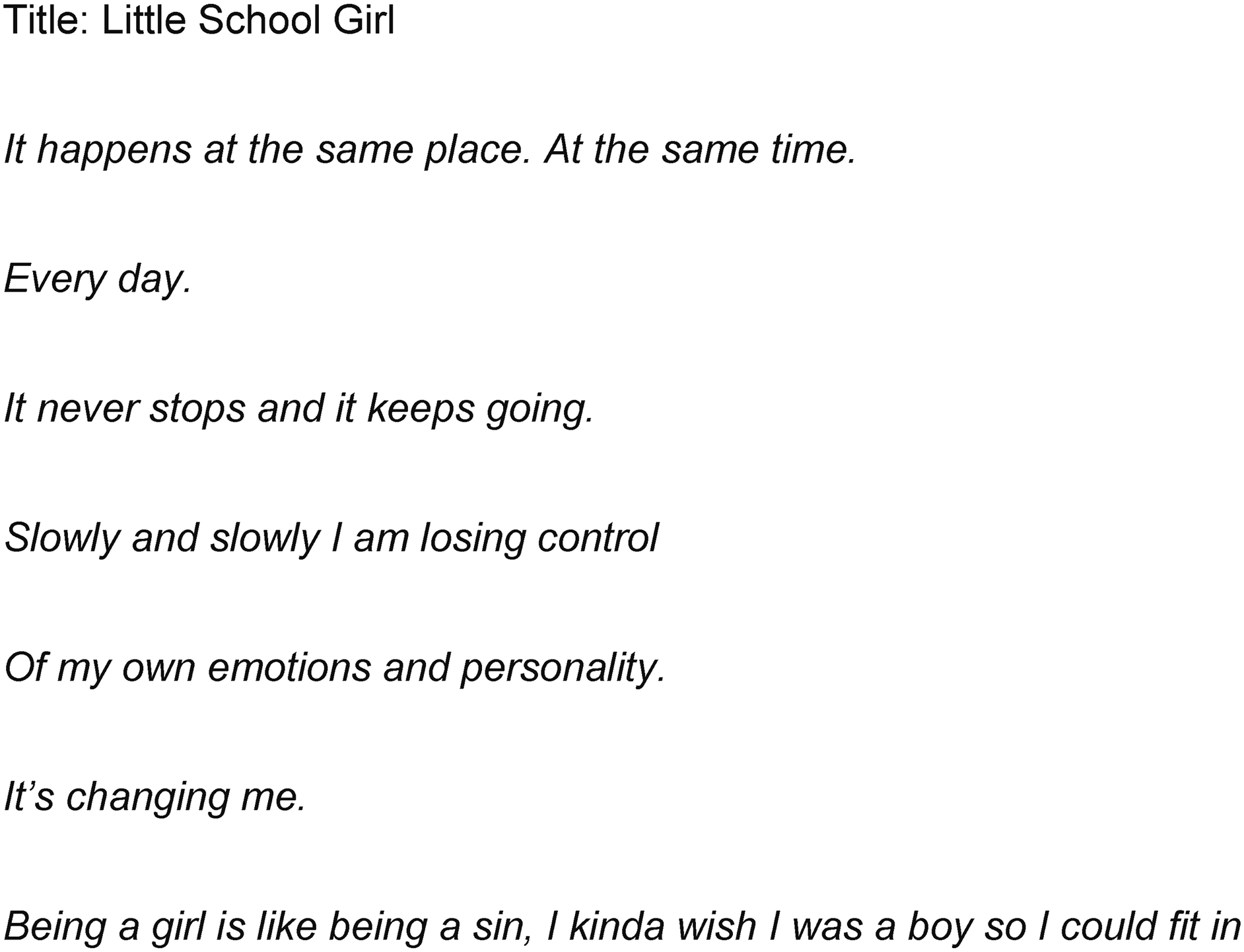
Student advisory board poem about Willow's experience.
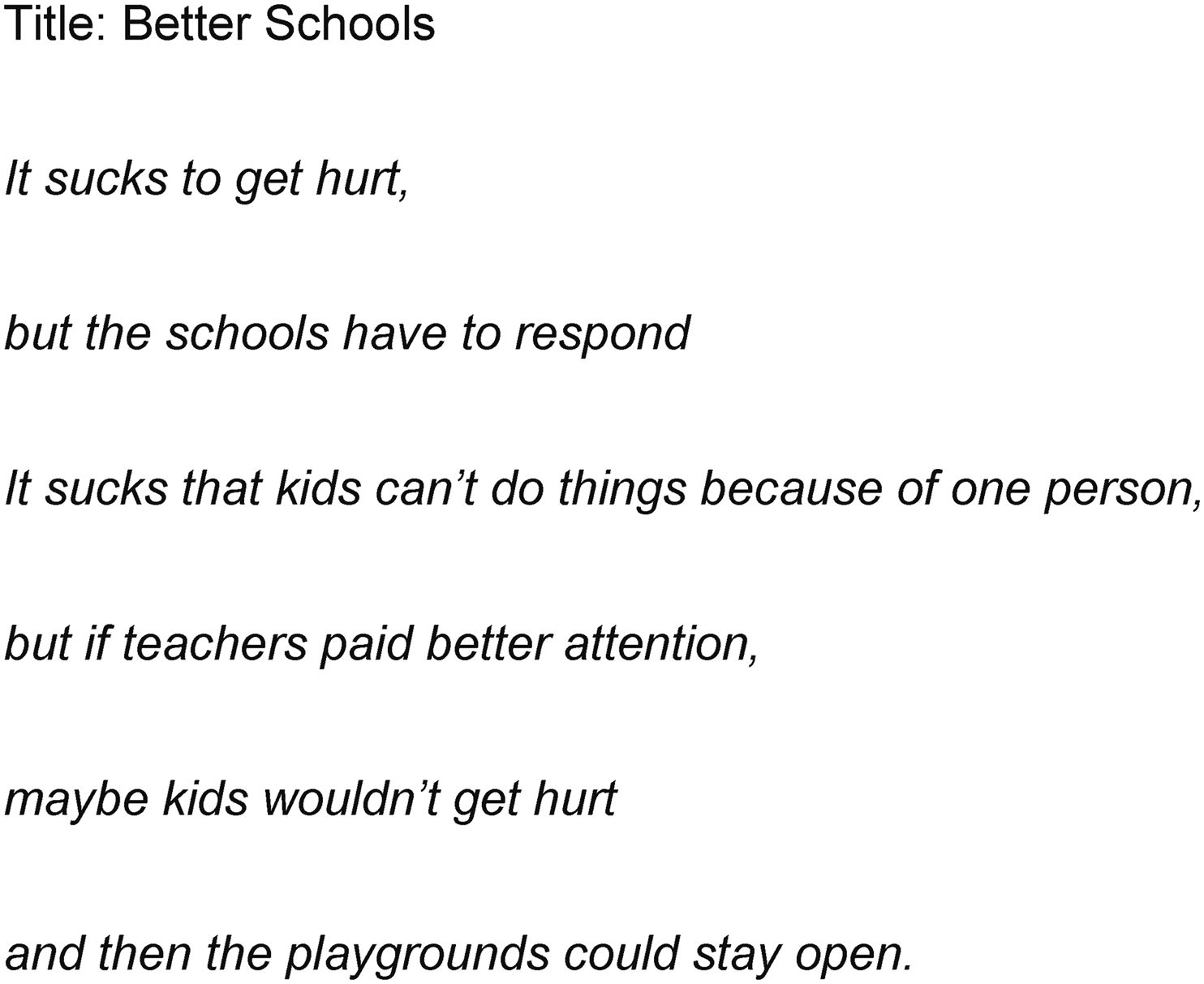
Student advisory board poem about Sarah's experience.
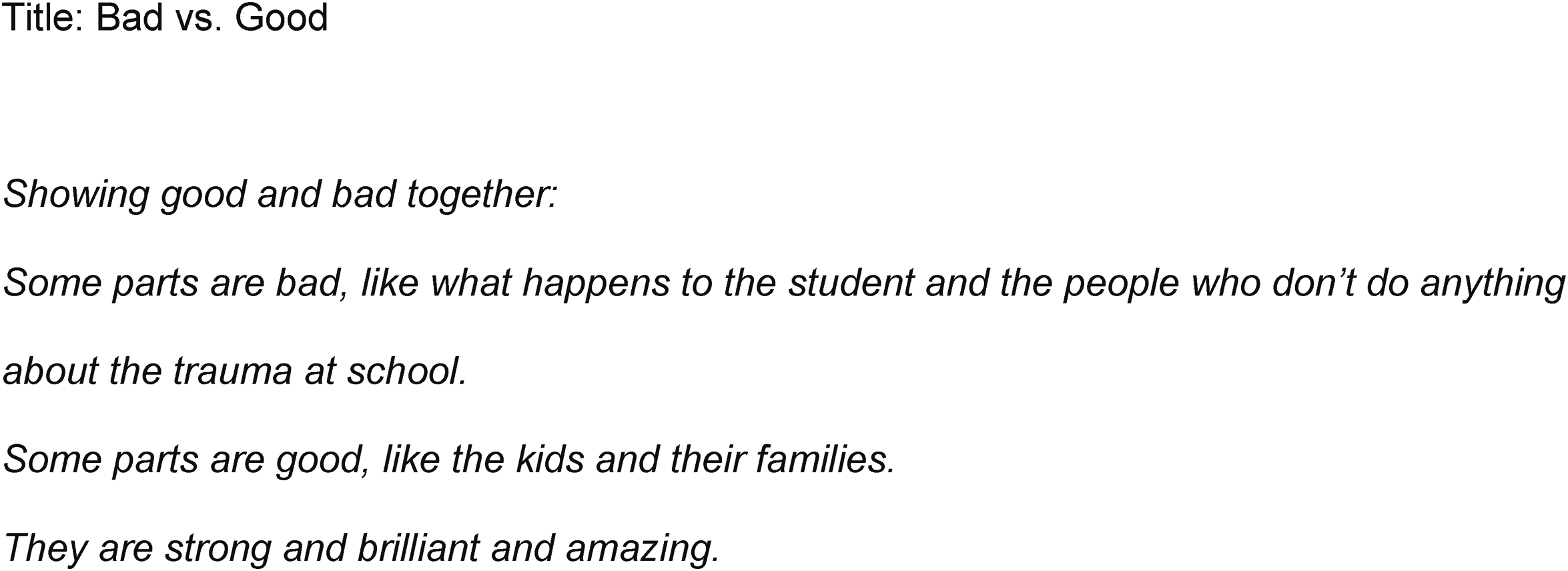
Student advisory board poem about the full study.
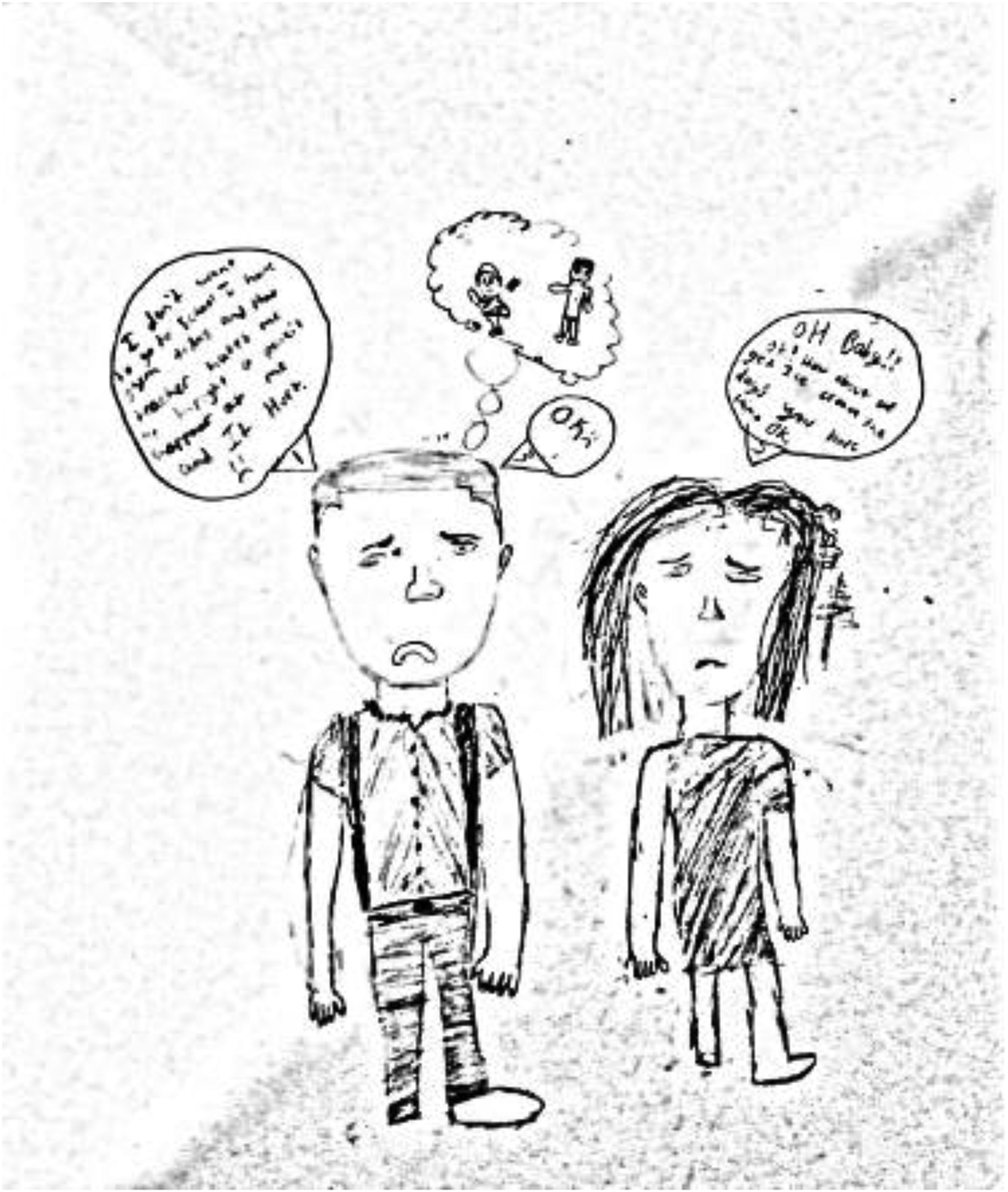
Student advisory board art depicting Christian's experience.
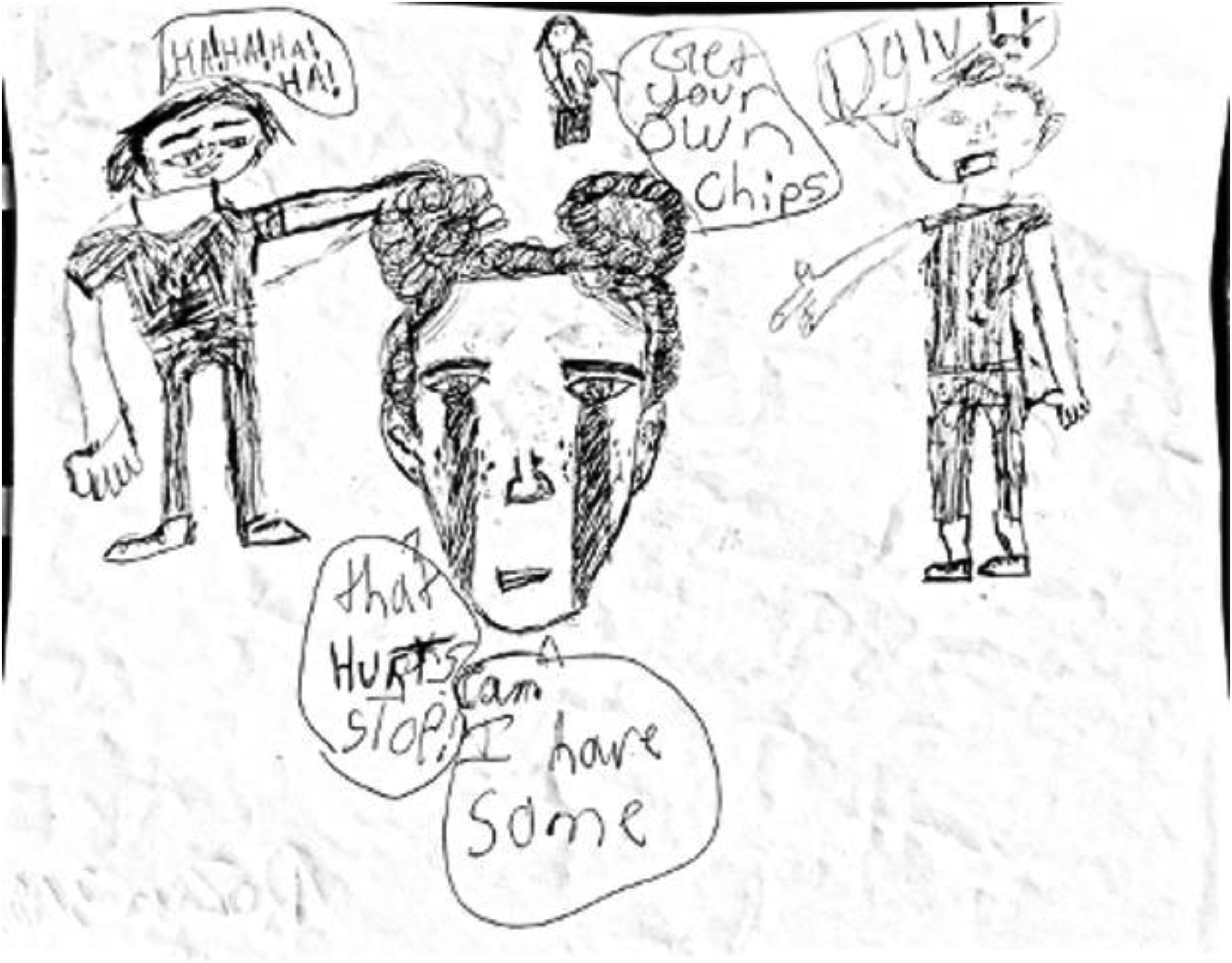
Student advisory board art depicting Kyion's experience.
Footnotes
Acknowledgments
My sincere and deepest gratitude to the children and parents who shared their stories, trusted me with putting their words on paper, and co-created this experience.
Declaration of Conflicting Interests
The author(s) declared no potential conflicts of interest with respect to the research, authorship, and/or publication of this article.
Funding
The author(s) received no financial support for the research, authorship, and/or publication of this article.